EP1003145A2 - Système de visualisation pour produire une image virtuelle continue - Google Patents
Système de visualisation pour produire une image virtuelle continue Download PDFInfo
- Publication number
- EP1003145A2 EP1003145A2 EP99203830A EP99203830A EP1003145A2 EP 1003145 A2 EP1003145 A2 EP 1003145A2 EP 99203830 A EP99203830 A EP 99203830A EP 99203830 A EP99203830 A EP 99203830A EP 1003145 A2 EP1003145 A2 EP 1003145A2
- Authority
- EP
- European Patent Office
- Prior art keywords
- display
- video
- image
- operator
- lenses
- Prior art date
- Legal status (The legal status is an assumption and is not a legal conclusion. Google has not performed a legal analysis and makes no representation as to the accuracy of the status listed.)
- Granted
Links
Images



Classifications
-
- G—PHYSICS
- G09—EDUCATION; CRYPTOGRAPHY; DISPLAY; ADVERTISING; SEALS
- G09B—EDUCATIONAL OR DEMONSTRATION APPLIANCES; APPLIANCES FOR TEACHING, OR COMMUNICATING WITH, THE BLIND, DEAF OR MUTE; MODELS; PLANETARIA; GLOBES; MAPS; DIAGRAMS
- G09B9/00—Simulators for teaching or training purposes
- G09B9/02—Simulators for teaching or training purposes for teaching control of vehicles or other craft
- G09B9/08—Simulators for teaching or training purposes for teaching control of vehicles or other craft for teaching control of aircraft, e.g. Link trainer
- G09B9/30—Simulation of view from aircraft
- G09B9/32—Simulation of view from aircraft by projected image
-
- G—PHYSICS
- G06—COMPUTING OR CALCULATING; COUNTING
- G06F—ELECTRIC DIGITAL DATA PROCESSING
- G06F3/00—Input arrangements for transferring data to be processed into a form capable of being handled by the computer; Output arrangements for transferring data from processing unit to output unit, e.g. interface arrangements
- G06F3/14—Digital output to display device ; Cooperation and interconnection of the display device with other functional units
- G06F3/1423—Digital output to display device ; Cooperation and interconnection of the display device with other functional units controlling a plurality of local displays, e.g. CRT and flat panel display
- G06F3/1446—Digital output to display device ; Cooperation and interconnection of the display device with other functional units controlling a plurality of local displays, e.g. CRT and flat panel display display composed of modules, e.g. video walls
-
- G—PHYSICS
- G09—EDUCATION; CRYPTOGRAPHY; DISPLAY; ADVERTISING; SEALS
- G09B—EDUCATIONAL OR DEMONSTRATION APPLIANCES; APPLIANCES FOR TEACHING, OR COMMUNICATING WITH, THE BLIND, DEAF OR MUTE; MODELS; PLANETARIA; GLOBES; MAPS; DIAGRAMS
- G09B9/00—Simulators for teaching or training purposes
- G09B9/02—Simulators for teaching or training purposes for teaching control of vehicles or other craft
- G09B9/08—Simulators for teaching or training purposes for teaching control of vehicles or other craft for teaching control of aircraft, e.g. Link trainer
- G09B9/30—Simulation of view from aircraft
- G09B9/34—Simulation of view from aircraft by cathode-ray screen display
Definitions
- the present invention relates generally to visual display systems and methods and, more particularly, to a system for displaying continuous virtual images.
- Visual display systems are commonly used to simulate training environments where training through actual operations would be dangerous, expensive or otherwise impractical.
- One common application for visual display systems is flight simulation and training systems.
- a typical flight simulation and training system requires visual "out the window” images simulating the terrain, landscape, cultural features, buildings, vehicles, and other aircraft in the simulated vicinity of the trainee.
- One form of conventional flight simulator includes the projection of images onto the inside of a large spherically-shaped dome or partial dome structure. The images are displayed inside the domes using multiple video projectors and associated optical devices mounted inside the domes. These projectors and optics must be carefully positioned inside the domes in order to properly display the simulated images.
- a flight simulator typically includes one or more video display screens onto which video images are projected by one or more projectors, such as cathode ray tubes.
- the video images may be projected onto the display screens from either the front or the rear of the screens.
- An example of such a conventional flight simulator is the Virtual Image Display Simulator (VIDS), manufactured by The Boeing Company, the assignee of the current invention.
- the VIDS provides four rear-projected video screens positioned a few feet from the trainee used to display simulated images in front of the trainee and up to three additional rear-projected display screens used to display simulated images behind the trainee.
- Conventional flight simulators also usually include a control panel and a control stick and throttle for providing input to the visual display system in response to the displayed video images.
- the control panel and surrounding pilot environment are often realistic simulations of the controls and displays present in the actual aircraft.
- the operator can simulate the flight of an aircraft and can respond to the environment as depicted by the visual display.
- flight simulators One primary objective of flight simulators is to enhance and optimize the simulated images to present the operator with a high fidelity and realistic training environment. Problems experienced by conventional flight simulators include diminished brightness and contrast, and a low resolution of the projected images. These problems arise in large part because of the capability of conventional video projectors, and the use of a relatively small number of video screens (necessitating that each video projector project a relatively large image). Additionally, conventional flight simulators generally provide a simulated image that is focused relatively close to the trainee's eyes, and not at a far distance. An improved flight simulator would produce a virtual image that is focused at or near infinity so that the virtual image appears sufficiently real to the simulation pilot.
- Such an improved flight simulator would be of great assistance to one particular simulation scenario, namely air-to-ground training, which requires eye-limited resolution, i.e., display resolution that meets or exceeds the resolution of the human eye.
- eye-limited resolution i.e., display resolution that meets or exceeds the resolution of the human eye.
- Another drawback to conventional flight simulators is the size of the projectors, display screens, and associated electronics and optics.
- An improved flight simulator would have a reduced overall size, allowing the entire simulator to be located in a small room, thus reducing the cost of installing and operating the flight simulator.
- the system would have enhanced brightness, contrast and resolution over existing visual systems and produce a virtual image focused at or near infinity.
- a preferred visual system would be of relatively compact size and designed using upgradeable, commercially-available components.
- the present invention provides a compact visual display system producing a composite display image that is perceived by a simulation pilot or other operator as a far-focused, continuous virtual image of high resolution, brightness and contrast.
- the visual display system is used as part of a flight simulator operated by a simulation pilot positioned in a predetermined viewing volume and having an associated field of view concentrically surrounding a line of sight extending outwardly from the pilot's viewing volume.
- the visual display system provides out-the-window visual imagery and incorporates a plurality of adjacent video image generation and display modules that include an image generator that generates a video image.
- the video image generated by each of the image generators is representative of a portion of the composite display image that is displayed to the operator.
- the video image generation and display modules also preferably include a video display, for example, a flat panel video display that is operatively connected to, and responsive to the video image generated by, an image generator.
- Each of the video displays preferably displays a portion of the composite display image.
- the preferred visual display system also includes a plurality of lenses, such as, for example, positive aspheric Fresnel type optical lenses.
- Each of the lenses is associated with one of the image generation and display modules and is preferably positioned between the operator and one of the video displays.
- the lens restricts the operator's field of view such that the operator views only a portion of the display area of the video display.
- the image generation and display modules are arranged into an array in front of, or partially surrounding, the operator and the lenses are joined together along their edges to form an enclosure partially surrounding the operator so that the operator views the composite display image displayed on the plurality of video displays through the plurality of optical lenses.
- each optical lens is designed such that its focal length allows the operator to view the composite display image focused at or near infinity in order to present the operator with a realistic visual simulation.
- each optical lens is positioned such that the operator views only the image displayed on the display area of each video display that does not overlap any of the image viewed by the operator on adjacent video displays.
- the operator may move or rotate his head and the system will continue to provide an image that appears as a continuous virtual image displayed across the plurality of video displays.
- the visual display system incorporates optical lenses having planar surfaces with five or six sides, i.e., pentagonal or hexagonal shapes.
- These preferred shapes allow the lenses to be arranged so that they tessellate a sphere partially or completely surrounding the operator.
- the lenses are preferably positioned and oriented parallel to their associated video displays and perpendicular to a line extending from the operator's viewing position to the center of their associated video displays.
- the use of the preferred shapes allows the lenses to be arranged such that all sides of the optical lenses completely intersect with the sides of the lenses of adjacent modules providing the operator with a continuous virtual image.
- the visual system may also include a database accessed by the image generators to generate the video image.
- the display system further preferably includes a display system controller for providing each image generation and display module with an index into the database so that the image generators can access data from the database associated with the portion of the composite display image displayed on the video displays.
- the present invention includes a method of presenting far-focused virtual images.
- the preferred method includes the step of generating a plurality of video images, wherein each video image is representative of a portion of the composite display image.
- a plurality of video displays are arranged into an array, each video display providing one of the plurality of video images.
- a plurality of lenses such as, for example, positive aspheric optical lenses, are arranged and positioned between the operator and the video displays to restrict the operator's field of view such that the operator views only a portion of the total display area of the video displays.
- the optical lenses are arranged such that their edges are joined together to form an enclosure partially or completely surrounding the operator so that the operator views the composite display image displayed on the plurality of video displays through the plurality of optical lenses, which is then perceived by the operator as a continuous virtual image.
- the visual display system can be used as part of a flight simulation system that is employed to train military, commercial or other personnel to fly aircraft.
- the principles of the visual display system described herein, however, can also be employed to simulate other environments and to train personnel for other operations without departing from the spirit and scope of the present invention.
- the visual display system can be employed in other industries, such as, for example, the entertainment industry when as a video display-based arcade-type game or a theme park ride, and the advertising industry when used as a video wall.
- the visual display system 10 is preferably used in conjunction with a flight simulation system used to train aircrew to fly and operate an aircraft.
- the flight simulation system typically includes a simulation pilot 12 seated at a predetermined viewing location facing, or surrounded by, an array of image generation and display modules 14 .
- the pilot 12 may move his head during the simulation system within a three-dimensional space known as a viewing volume.
- the image generation and display modules 14 include appropriate electronics and computer equipment to generate a video image and display the image to the pilot 12 .
- the array of image generation and display modules 14 generate and display an appropriate "out-the-window" scenario simulating the outdoor environment that might be typically seen by the pilot flying an actual aircraft.
- each image generation and display module 14 generates and displays a portion of the overall out-the-window image so that the array of modules will display the overall images as a composite display image to the pilot 12 .
- the image generation and display modules 14 are preferably arranged side-by-side in an array fashion completely or partially surrounding the pilot 12 to provide a continuous image (forming up to a 360 degree solid angle) as viewed from the pilot's 12 predetermined viewing volume.
- the image generation and display modules 14 are preferably mounted in a supporting structure 15 designed to hold each of the modules 14 .
- the pilot 12 may also be provided with a conventional or simulated cockpit comprised of an array of cockpit components such as a throttle and flight stick (having associated controls and switches), a number of head-down cockpit displays displaying various navigation, situational and tactical information, and either a real or simulated head-up display.
- the pilot 12 is preferably positioned in a predefined viewing volume facing the array of image generation and display modules 14 .
- the pilot 12 has an associated field of view concentrically surrounding a line of sight extending outwardly from the pilot's viewing volume in a direction toward the array of modules 14 .
- FIG. 2 illustrates the major components of the presently preferred image generation and display module 14 .
- Each module 14 preferably includes an image generator 16 coupled to a video display 18 .
- the video display 18 may be, for example, a low cost flat panel display, such as a conventional liquid crystal display (LCD) having a back fluorescent light source as commonly employed in lap-top notebook or other portable computers.
- LCD liquid crystal display
- conventional LCDs include a small border 19 (typically as much as one inch) surrounding an active display area 24 . While it is physically possible to tile an array of video displays 18 together, it is generally impossible using commercially-available low cost video displays having a border 19 to display a continuous image, as the image will be interrupted by the borders 19 .
- the present invention solves this problem by incorporating an optical lens that restricts the pilot's view so that the pilot only views the image, or a fraction thereof, displayed in the active display area 24 .
- the image generator 16 receives data from a database 20 , processes the data based on the simulated position of the pilot's aircraft, and generates a video image representative of a portion of the composite display image presented to the pilot 12 .
- Each image generator 16 generates a portion of the composite display image associated with the position of the video display 18 associated with the image generator 16 within the array.
- each image generation and display module 14 has an associated address indicating its relative position within the array of modules 14 incorporated into the video display system 10 . The module 14 uses this address to retrieve the appropriate data from the database 20 from which to generate the appropriate image for display at the module's location.
- the image generator 16 may be a conventional single board computer, a desktop personal computer, a motherboard populated with appropriate computing devices, or any other similar commercially available computing apparatus capable of generating video images.
- the image generation and display module 14 will include other components that are not shown, such as a power supply, interface cards, video accelerator cards, hard disks, and other conventional components.
- the database 20 which is preferably replicated in each of the image generation and display modules 14 , includes a predefined three-dimensional structural database that is used by each of the image generators 16 to create the portion of the two-dimensional composite display image that will be displayed on the image generator's associated video display 18 .
- the contents of the database are downloaded during initiation of the simulation session across a communication link into a memory unit contained within the module 14 .
- only one copy of the database 20 may be provided and maintained in a central computer system (not shown) that is accessible by each of the image generators 16 .
- the database 20 (or portions thereof) may be updated during the simulation session from a central computer system. As will be appreciated by those skilled in the art, this embodiment requires a fast communication link so that the database may be retrieved by the image generators 16 from the stored database 20 .
- the visual display system 10 includes a simulation controller 22 that provides overall control of the flight simulation.
- the simulation controller 22 allocates a particular portion of the overall composite display image to each of the image generation and display modules 14 and provides a viewing location defining an address into the database 20 storing the data and information necessary for a particular image generation and display module 14 to generate and display a portion of the overall composite display image.
- the simulation controller 22 may communicate with each image generation and display modules 14 via a wide band communication link 23 , such as, for example, an Ethernet type communication bus.
- Each video display 18 is associated with a lens, preferably a positive aspheric optical lens 32 and, most preferably, a Fresnel type lens having a planar surface.
- a Fresnel lens is a thin replica of a plano lens cut into rings to obtain a flat profile.
- Each optical lens 32 is preferably mounted to a structural module 15 that also holds one of the image generation and display modules 14 .
- the optical lens 32 is mounted parallel to the surface of the video display 18 with its optical axis pointed toward the simulation pilot 12 .
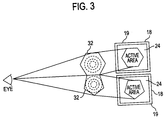
- Figure 3 illustrates how the lens 32 preferably restricts the field of view of the pilot 12 and refracts the view point of the pilot 12 so that the pilot 12 only views a portion of the active display area 24 of the video display 18 .
- the optical lens 32 restricts the pilot's view so that he only sees a portion of the entire image displayed on a particular video display 18 .
- some of the image generated and displayed on the video display 18 is displayed outside of the portion of the active display area 24 viewed by the pilot 12 through the optical lens 32 to accommodate continuous imagery as the pilot 12 moves or rotates his head.
- the image displayed on a particular video display 18 overlaps the image displayed on adjacent video displays 18 to further accommodate situations in which the pilot 12 moves or rotates his head.
- the pilot 12 continuously views a composite virtual image.
- Figure 3 only illustrates two video displays 18 and associated lenses 32 .
- the focal length of the lens 32 is preferably optimized for the particular size of the simulator, the size of the video displays 18 and to accommodate the operator's anticipated head movement and is selected based on two conjugate distances: the distance from the pilot's viewing position to the lens 32 and the distance from the lens 32 to the video display 18 . These two conjugate distances are then adjusted for apparent virtual image location based on desired view distance and dome tessellation and determine the field of view available to the pilot 12 .
- the focal length of the lens 32 is designed such that the portion of the image viewed through the lens 32 is perceived to be at a predetermined distance.
- the lens 32 has a profiled surface structure in the form of grooves extending with a circular symmetry relative to the optical axis of the lens 32 , i.e., perpendicular to the surface of the lens 32 .
- the preferred Fresnel type lens used in the present invention may be formed on a suitable transparent material such as acrylic or glass, in accordance with well-known pressing and cutting operations.
- Each lens 32 may be manufactured as one large lens and then machined into the proper size and shape.
- the image displayed on the video display 18 is viewed by the pilot 12 through the optical lens 32 .
- the video displays 18 are arranged and positioned at a distance from the predetermined viewing position of the pilot 12 such that the image displayed on them is at focus or slightly inside of focus.
- the image seen by the pilot 12 through the lens 32 requires the eyes to slightly converge (or be parallel), allowing the pilot 12 to perceive a far-focused or collimated virtual image.
- the image is perceived to be at distance from the pilot 12 that is greater than the distance between the pilot 12 and the video display 18 .
- Each video display 18 is arranged with its associated lens 32 such that the surfaces of the video display 18 and optical lens 32 are parallel with the center of each lens 32 perpendicular to the line of sight of the pilot 12 .
- the distance from the pilot 12 to each of the lenses 32 is uniform for all of the lenses 32 incorporated into the visual display system 10 .
- the distance from the pilot 12 to each of the lenses 32 may not be uniform.
- the array of modules 14 form an enclosure, or partial enclosure, surrounding the pilot 12 so that the simulation pilot 12 views the continuous virtual image from inside the enclosure.
- each optical lens 32 is shaped into a five- or six-sided lens to allow them to be joined together to form a spherical-like structure.
- Figure 4 shows a front view of an array of six lenses 32 mounted edge to edge. Each of the lenses 32 is preferably ranged such that its surface is substantially perpendicular to the pilot's line of sight. The array of lenses illustrated in Figure 4 may thus be used to form a partial enclosure placed in front of the pilot 12 . As will be appreciated, this ray of optical lenses may be expanded to form a larger partial enclosure encircling the pilot 12 or, using an appropriate number of lenses, may form a complete enclosure completely surrounding the pilot 12 .
- the lenses 32 are preferably machined and aligned edge to edge with their adjacent lenses.
- a connecting element 34 such as a fastener or adhesive, may preferably be used to hold the lenses in place.
- the image generation and display modules 14 are located behind each of the optical lenses 32 .
- the video display system 10 may include as many image generation and display modules 14 (and associated optical lenses 32 ) as required to obtain the desired viewing angle.
- the representative array of six lenses illustrated in Figure 4 has about a 50 degree solid viewing angle. This array is formed using one pentagon-shaped center lens 32a and five hexagon shaped surrounding lenses 32b . As the desired viewing angle increases, more image generation and display modules 14 will be incorporated into the video display system 10 .
- the tessellation of a partial or complete sphere with flat surfaces has many solutions.
- One preferred solution uses a combination of three differently shaped hexagonal shaped lenses and one perfect pentagonal shaped lens. Of course, many other solutions are available and are within the scope of the present invention.
- the visual display system 10 includes a number of image generation and display modules 14 coupled together to provide the continuous virtual image to the pilot 12 .
- the number of modules 14 required for a particular application is dependent on a number of factors, including the total angle of view desired to be provided to the operator and the size of the video displays 18 .
- the modules 14 are designed as stand-alone, replaceable modules that allow for rapid maintenance or replacement.
Landscapes
- Engineering & Computer Science (AREA)
- Theoretical Computer Science (AREA)
- Physics & Mathematics (AREA)
- General Physics & Mathematics (AREA)
- Aviation & Aerospace Engineering (AREA)
- Business, Economics & Management (AREA)
- Educational Administration (AREA)
- Educational Technology (AREA)
- Multimedia (AREA)
- Human Computer Interaction (AREA)
- General Engineering & Computer Science (AREA)
- Devices For Indicating Variable Information By Combining Individual Elements (AREA)
Applications Claiming Priority (2)
| Application Number | Priority Date | Filing Date | Title |
|---|---|---|---|
| US197025 | 1994-02-16 | ||
| US09/197,025 US6152739A (en) | 1998-11-20 | 1998-11-20 | Visual display system for producing a continuous virtual image |
Publications (3)
| Publication Number | Publication Date |
|---|---|
| EP1003145A2 true EP1003145A2 (fr) | 2000-05-24 |
| EP1003145A3 EP1003145A3 (fr) | 2009-06-03 |
| EP1003145B1 EP1003145B1 (fr) | 2018-08-22 |
Family
ID=22727704
Family Applications (1)
| Application Number | Title | Priority Date | Filing Date |
|---|---|---|---|
| EP99203830.7A Expired - Lifetime EP1003145B1 (fr) | 1998-11-20 | 1999-11-16 | Système de visualisation pour produire une image virtuelle continue |
Country Status (4)
| Country | Link |
|---|---|
| US (1) | US6152739A (fr) |
| EP (1) | EP1003145B1 (fr) |
| CA (1) | CA2287650C (fr) |
| IL (1) | IL132362A (fr) |
Cited By (2)
| Publication number | Priority date | Publication date | Assignee | Title |
|---|---|---|---|---|
| WO2002054148A3 (fr) * | 2000-12-29 | 2003-07-10 | Honeywell Int Inc | Ecran de projection par transparence sans coupure |
| WO2003088186A1 (fr) * | 2002-04-11 | 2003-10-23 | The Boeing Company | Systeme d'affichage visuel et procede pour l'affichage d'images a foyer eloigne dans un simulateur utilisant un collimateur holographique |
Families Citing this family (35)
| Publication number | Priority date | Publication date | Assignee | Title |
|---|---|---|---|---|
| US6424322B1 (en) * | 1998-10-05 | 2002-07-23 | Jesse D. Northcutt | Multi-module stereoscopic 3D video viewing/listening station |
| FR2817992B1 (fr) * | 2000-12-12 | 2003-04-18 | Philippe Charles Gab Guillemot | Dispositif d'ecran video numerique |
| GB2370818B (en) * | 2001-01-03 | 2004-01-14 | Seos Displays Ltd | A simulator |
| US20020091003A1 (en) * | 2001-01-11 | 2002-07-11 | Beken Robert A. | Multi-player electronic entertainment system |
| WO2002103655A1 (fr) * | 2001-06-15 | 2002-12-27 | Skaggs Jay D | Systeme et procede de formation aux instructions de vol |
| US20030016227A1 (en) * | 2001-07-19 | 2003-01-23 | Matthies Dennis L. | Adaptable large area display |
| US20030164808A1 (en) * | 2002-03-04 | 2003-09-04 | Amery John G. | Display system for producing a virtual image |
| US6678098B2 (en) * | 2002-06-18 | 2004-01-13 | The Boeing Company | Multiple lens support |
| GB0314760D0 (en) * | 2003-06-25 | 2003-07-30 | Westland Helicopters | Display system |
| US7426292B2 (en) * | 2003-08-07 | 2008-09-16 | Mitsubishi Electric Research Laboratories, Inc. | Method for determining optimal viewpoints for 3D face modeling and face recognition |
| US7118228B2 (en) * | 2003-11-04 | 2006-10-10 | Hewlett-Packard Development Company, L.P. | Image display system |
| US20050228620A1 (en) * | 2004-04-08 | 2005-10-13 | Corys Training & Engineering Support Systems | Method and apparatus for simulating a train and track |
| US20060114171A1 (en) * | 2004-11-12 | 2006-06-01 | National Research Council Of Canada | Windowed immersive environment for virtual reality simulators |
| US8241038B2 (en) * | 2005-07-08 | 2012-08-14 | Lockheed Martin Corporation | Simulator utilizing a non-spherical projection surface |
| WO2008022463A1 (fr) * | 2006-08-25 | 2008-02-28 | Imaginum Inc. | Circuit intégré à composants numériquement commutés destinés à commander une sortie à laquelle une charge est reliée |
| TW200842692A (en) * | 2007-04-17 | 2008-11-01 | Benq Corp | An electrical device and a display method |
| US20090180166A1 (en) * | 2008-01-16 | 2009-07-16 | Samsung Electronics Co., Ltd. | Imaging using diffraction optics elements |
| US20090180180A1 (en) * | 2008-01-16 | 2009-07-16 | Samsung Electronics Co., Ltd. | Sub-pixel optical array |
| US8194193B2 (en) * | 2008-02-08 | 2012-06-05 | The Boeing Company | Method and apparatus for a wide field of view display |
| US7663793B1 (en) * | 2008-07-31 | 2010-02-16 | Institut National D'optique | Wide angle immersive display system |
| TWI455012B (zh) * | 2008-08-19 | 2014-10-01 | Wistron Corp | 顯示器分割畫面顯示方法及應用該方法之電子裝置 |
| US8547295B2 (en) * | 2008-10-16 | 2013-10-01 | Video Display Corporation | Motion simulator and display system typically using light-emitting diodes |
| US8733028B2 (en) * | 2010-01-08 | 2014-05-27 | Mechdyne Corporation | Display transformation assembly for a visualization system |
| USD697862S1 (en) * | 2013-04-15 | 2014-01-21 | Rockwell Collins, Inc. | Curved flight display |
| US10162591B2 (en) | 2013-05-13 | 2018-12-25 | Steve Welck | Modular multi-panel digital display system |
| US9110358B1 (en) | 2013-06-04 | 2015-08-18 | The Boeing Company | Method for creating and a system for using a constant vertical resolution toroidal display |
| US9470967B1 (en) | 2013-06-04 | 2016-10-18 | The Boeing Company | Motion-based system using a constant vertical resolution toroidal display |
| JPWO2015011758A1 (ja) * | 2013-07-22 | 2017-03-02 | 株式会社東芝 | 表示システム |
| US10937332B2 (en) * | 2015-10-20 | 2021-03-02 | The Boeing Company | Systems and methods for providing a virtual heads up display in a vehicle simulator |
| US20180121152A1 (en) * | 2016-11-01 | 2018-05-03 | International Business Machines Corporation | Method and system for generating multiple virtual image displays |
| TWI614735B (zh) * | 2016-12-14 | 2018-02-11 | 財團法人工業技術研究院 | 全景視覺系統 |
| US10264245B2 (en) | 2017-03-07 | 2019-04-16 | Walter Joseph FUNK | Methods and system for generating three-dimensional spatial images |
| US11256465B2 (en) * | 2019-05-24 | 2022-02-22 | The Boeing Company | Wide field of view visual display system in an aircraft flight simulator using flat display panels |
| US10951877B2 (en) | 2019-07-15 | 2021-03-16 | Msg Entertainment Group, Llc | Providing a contiguous virtual space for a plurality of display devices |
| CN110955021B (zh) * | 2020-02-28 | 2022-02-22 | 福建福光股份有限公司 | 具有大相对孔径的紧凑型中长焦光学系统及其工作方法 |
Family Cites Families (28)
| Publication number | Priority date | Publication date | Assignee | Title |
|---|---|---|---|---|
| US3909525A (en) * | 1973-12-10 | 1975-09-30 | Rockwell International Corp | Display system optics |
| GB2003103B (en) * | 1977-08-27 | 1982-01-06 | British Aircraft Corp Ltd | Simulators |
| US4246605A (en) * | 1979-10-12 | 1981-01-20 | Farrand Optical Co., Inc. | Optical simulation apparatus |
| US4295159A (en) * | 1980-06-05 | 1981-10-13 | General Electric Company | Light projection system |
| US4463380A (en) * | 1981-09-25 | 1984-07-31 | Vought Corporation | Image processing system |
| US4473355A (en) * | 1983-06-30 | 1984-09-25 | Messerschmitt-Boelkow-Blohm Gesellschaft Mit Beschraenkter Haftung | Visual simulator and display screen for said simulator |
| US4634384A (en) * | 1984-02-02 | 1987-01-06 | General Electric Company | Head and/or eye tracked optically blended display system |
| NL8501424A (nl) * | 1985-05-17 | 1986-12-16 | Philips Nv | Optisch beeldvergrotend element, informatie-weergeefeenheid bevattende een dergelijk element en informatie-weergeefpaneel bevattende een aantal van dergelijke eenheden. |
| US4775859A (en) * | 1985-10-18 | 1988-10-04 | Hilliard-Lyons Patent Management, Inc. | Programmable interlace with skip and contrast enhancement in long persistence display systems |
| JPH0787561B2 (ja) * | 1988-03-08 | 1995-09-20 | パイオニア株式会社 | プロジェクションテレビユニット及びマルチプロジェクションテレビの連結部材 |
| JPH0830848B2 (ja) * | 1988-04-15 | 1996-03-27 | 株式会社日立製作所 | マルチスクリーンプロジェクタ |
| US5341229A (en) * | 1988-07-14 | 1994-08-23 | Larry Rowan | Holographic display system |
| JP2898673B2 (ja) * | 1989-05-10 | 1999-06-02 | 株式会社日立製作所 | マルチスクリーンプロジェクタ及びプロジェクタ装置 |
| US5130794A (en) * | 1990-03-29 | 1992-07-14 | Ritchey Kurtis J | Panoramic display system |
| US5320534A (en) * | 1990-11-05 | 1994-06-14 | The United States Of America As Represented By The Secretary Of The Air Force | Helmet mounted area of interest (HMAoI) for the display for advanced research and training (DART) |
| US5137450A (en) * | 1990-11-05 | 1992-08-11 | The United States Of America As Represented By The Secretry Of The Air Force | Display for advanced research and training (DART) for use in a flight simulator and the like |
| JPH04298178A (ja) * | 1991-03-26 | 1992-10-21 | Victor Co Of Japan Ltd | 画像処理装置 |
| US5179440A (en) * | 1991-05-13 | 1993-01-12 | Hughes Aircraft Company | Rear projection facetted dome |
| US5242306A (en) * | 1992-02-11 | 1993-09-07 | Evans & Sutherland Computer Corp. | Video graphic system and process for wide field color display |
| US5982352A (en) * | 1992-09-18 | 1999-11-09 | Pryor; Timothy R. | Method for providing human input to a computer |
| US5320538A (en) * | 1992-09-23 | 1994-06-14 | Hughes Training, Inc. | Interactive aircraft training system and method |
| US5585967A (en) * | 1993-09-07 | 1996-12-17 | The Walt Disney Company | Three dimensional virtual image system |
| US5746599A (en) * | 1994-10-31 | 1998-05-05 | Mcdonnell Douglas Corporation | Modular video display system |
| US5487665A (en) * | 1994-10-31 | 1996-01-30 | Mcdonnell Douglas Corporation | Video display system and method for generating and individually positioning high resolution inset images |
| JPH08271979A (ja) * | 1995-01-30 | 1996-10-18 | Hitachi Ltd | 背面投写型マルチスクリーンディスプレイ装置およびそれを用いたディスプレイシステム |
| US5655909A (en) * | 1995-03-06 | 1997-08-12 | Kitchen; William J. | Skydiving trainer windtunnel |
| US5619373A (en) * | 1995-06-07 | 1997-04-08 | Hasbro, Inc. | Optical system for a head mounted display |
| US5626410A (en) * | 1995-09-20 | 1997-05-06 | Palomar Technologies Corporation | Rear projection screen with uniform brightness for tiling the images from an array of projectors |
-
1998
- 1998-11-20 US US09/197,025 patent/US6152739A/en not_active Expired - Lifetime
-
1999
- 1999-10-13 IL IL13236299A patent/IL132362A/en not_active IP Right Cessation
- 1999-10-27 CA CA002287650A patent/CA2287650C/fr not_active Expired - Lifetime
- 1999-11-16 EP EP99203830.7A patent/EP1003145B1/fr not_active Expired - Lifetime
Cited By (4)
| Publication number | Priority date | Publication date | Assignee | Title |
|---|---|---|---|---|
| WO2002054148A3 (fr) * | 2000-12-29 | 2003-07-10 | Honeywell Int Inc | Ecran de projection par transparence sans coupure |
| US6833951B2 (en) | 2000-12-29 | 2004-12-21 | Honeywell International Inc. | Seamless rear projection screen |
| WO2003088186A1 (fr) * | 2002-04-11 | 2003-10-23 | The Boeing Company | Systeme d'affichage visuel et procede pour l'affichage d'images a foyer eloigne dans un simulateur utilisant un collimateur holographique |
| US6814578B2 (en) | 2002-04-11 | 2004-11-09 | The Boeing Company | Visual display system and method for displaying images utilizing a holographic collimator |
Also Published As
| Publication number | Publication date |
|---|---|
| EP1003145B1 (fr) | 2018-08-22 |
| IL132362A0 (en) | 2001-03-19 |
| IL132362A (en) | 2002-12-01 |
| EP1003145A3 (fr) | 2009-06-03 |
| US6152739A (en) | 2000-11-28 |
| CA2287650A1 (fr) | 2000-05-20 |
| CA2287650C (fr) | 2008-01-08 |
Similar Documents
| Publication | Publication Date | Title |
|---|---|---|
| US6152739A (en) | Visual display system for producing a continuous virtual image | |
| US6814578B2 (en) | Visual display system and method for displaying images utilizing a holographic collimator | |
| US7056119B2 (en) | Periscopic optical training system for operators of vehicles | |
| EP1886179B1 (fr) | Dispositif de visualisation tete haute combine | |
| US9188850B2 (en) | Display system for high-definition projectors | |
| US8241038B2 (en) | Simulator utilizing a non-spherical projection surface | |
| US20060114171A1 (en) | Windowed immersive environment for virtual reality simulators | |
| US9470967B1 (en) | Motion-based system using a constant vertical resolution toroidal display | |
| RU2367026C1 (ru) | Тренажер для обучения летчиков пилотированию ударного вертолета и применению авиационных средств поражения | |
| US7871270B2 (en) | Deployable training device visual system | |
| US20030164808A1 (en) | Display system for producing a virtual image | |
| EP4099306A1 (fr) | Panneau de protection ajusté pour résoudre le conflit de vergence-accommodation dans un simulateur en dôme | |
| CN121175731A (zh) | 具有扩展的垂直视场的准直显示系统 | |
| Amery et al. | Flight simulation visual requirements and a new display system | |
| RU2152079C1 (ru) | Компактная система раздельной визуализации зон периферического зрения и зоны ясного зрения пользователя в тренажере | |
| Simons et al. | Visualization solutions for AVCATT-A reconfigurable cockpits | |
| US11551572B2 (en) | Adjusted-projection panel for addressing vergence-accommodation conflict in a dome-type simulator | |
| Simons et al. | HMD-based training for the US Army's AVCATT-A collective aviation training simulator | |
| Kelly et al. | Helmet-mounted area of interest | |
| Melzer et al. | Displaying the battlespace environment: evolution of a head-mounted display | |
| Isabelle et al. | Defense applications of the CAVE (CAVE automatic virtual environment) | |
| Mowafy et al. | Visualizing spatial relationships: Training fighter pilots in a virtual environment debrief interface | |
| Bolas et al. | Display research at the University of Southern California | |
| RU2230370C2 (ru) | Имитатор визуальной обстановки авиационного тренажера | |
| Shenker | Visual-simulation optical systems |
Legal Events
| Date | Code | Title | Description |
|---|---|---|---|
| PUAI | Public reference made under article 153(3) epc to a published international application that has entered the european phase |
Free format text: ORIGINAL CODE: 0009012 |
|
| AK | Designated contracting states |
Kind code of ref document: A2 Designated state(s): AT BE CH CY DE DK ES FI FR GB GR IE IT LI LU MC NL PT SE |
|
| AX | Request for extension of the european patent |
Free format text: AL;LT;LV;MK;RO;SI |
|
| PUAL | Search report despatched |
Free format text: ORIGINAL CODE: 0009013 |
|
| AK | Designated contracting states |
Kind code of ref document: A3 Designated state(s): AT BE CH CY DE DK ES FI FR GB GR IE IT LI LU MC NL PT SE |
|
| AX | Request for extension of the european patent |
Extension state: AL LT LV MK RO SI |
|
| 17P | Request for examination filed |
Effective date: 20091124 |
|
| AKX | Designation fees paid |
Designated state(s): AT BE CH CY DE DK ES FI FR GB GR IE IT LI LU MC NL PT SE |
|
| 17Q | First examination report despatched |
Effective date: 20100218 |
|
| REG | Reference to a national code |
Ref country code: DE Ref legal event code: R079 Ref document number: 69945890 Country of ref document: DE Free format text: PREVIOUS MAIN CLASS: G09B0009300000 Ipc: G09B0009340000 |
|
| GRAP | Despatch of communication of intention to grant a patent |
Free format text: ORIGINAL CODE: EPIDOSNIGR1 |
|
| RIC1 | Information provided on ipc code assigned before grant |
Ipc: G09B 9/34 20060101AFI20180117BHEP Ipc: G06F 3/14 20060101ALI20180117BHEP Ipc: G09B 9/32 20060101ALI20180117BHEP |
|
| INTG | Intention to grant announced |
Effective date: 20180215 |
|
| GRAJ | Information related to disapproval of communication of intention to grant by the applicant or resumption of examination proceedings by the epo deleted |
Free format text: ORIGINAL CODE: EPIDOSDIGR1 |
|
| GRAR | Information related to intention to grant a patent recorded |
Free format text: ORIGINAL CODE: EPIDOSNIGR71 |
|
| GRAS | Grant fee paid |
Free format text: ORIGINAL CODE: EPIDOSNIGR3 |
|
| GRAA | (expected) grant |
Free format text: ORIGINAL CODE: 0009210 |
|
| INTC | Intention to grant announced (deleted) | ||
| AK | Designated contracting states |
Kind code of ref document: B1 Designated state(s): AT BE CH CY DE DK ES FI FR GB GR IE IT LI LU MC NL PT SE |
|
| INTG | Intention to grant announced |
Effective date: 20180713 |
|
| REG | Reference to a national code |
Ref country code: GB Ref legal event code: FG4D |
|
| REG | Reference to a national code |
Ref country code: CH Ref legal event code: EP |
|
| REG | Reference to a national code |
Ref country code: DE Ref legal event code: R096 Ref document number: 69945890 Country of ref document: DE |
|
| REG | Reference to a national code |
Ref country code: AT Ref legal event code: REF Ref document number: 1033373 Country of ref document: AT Kind code of ref document: T Effective date: 20180915 |
|
| REG | Reference to a national code |
Ref country code: IE Ref legal event code: FG4D |
|
| REG | Reference to a national code |
Ref country code: NL Ref legal event code: MP Effective date: 20180822 |
|
| PG25 | Lapsed in a contracting state [announced via postgrant information from national office to epo] |
Ref country code: SE Free format text: LAPSE BECAUSE OF FAILURE TO SUBMIT A TRANSLATION OF THE DESCRIPTION OR TO PAY THE FEE WITHIN THE PRESCRIBED TIME-LIMIT Effective date: 20180822 Ref country code: GR Free format text: LAPSE BECAUSE OF FAILURE TO SUBMIT A TRANSLATION OF THE DESCRIPTION OR TO PAY THE FEE WITHIN THE PRESCRIBED TIME-LIMIT Effective date: 20181123 Ref country code: NL Free format text: LAPSE BECAUSE OF FAILURE TO SUBMIT A TRANSLATION OF THE DESCRIPTION OR TO PAY THE FEE WITHIN THE PRESCRIBED TIME-LIMIT Effective date: 20180822 Ref country code: FI Free format text: LAPSE BECAUSE OF FAILURE TO SUBMIT A TRANSLATION OF THE DESCRIPTION OR TO PAY THE FEE WITHIN THE PRESCRIBED TIME-LIMIT Effective date: 20180822 |
|
| PGFP | Annual fee paid to national office [announced via postgrant information from national office to epo] |
Ref country code: DE Payment date: 20181128 Year of fee payment: 20 |
|
| REG | Reference to a national code |
Ref country code: CH Ref legal event code: PK Free format text: BERICHTIGUNGEN |
|
| RIC2 | Information provided on ipc code assigned after grant |
Ipc: G09B 9/32 20060101ALI20180117BHEP Ipc: G06F 3/14 20060101ALI20180117BHEP Ipc: G09B 9/34 20060101AFI20180117BHEP |
|
| REG | Reference to a national code |
Ref country code: AT Ref legal event code: MK05 Ref document number: 1033373 Country of ref document: AT Kind code of ref document: T Effective date: 20180822 |
|
| PG25 | Lapsed in a contracting state [announced via postgrant information from national office to epo] |
Ref country code: ES Free format text: LAPSE BECAUSE OF FAILURE TO SUBMIT A TRANSLATION OF THE DESCRIPTION OR TO PAY THE FEE WITHIN THE PRESCRIBED TIME-LIMIT Effective date: 20180822 |
|
| PGFP | Annual fee paid to national office [announced via postgrant information from national office to epo] |
Ref country code: FR Payment date: 20181127 Year of fee payment: 20 Ref country code: GB Payment date: 20181127 Year of fee payment: 20 |
|
| PG25 | Lapsed in a contracting state [announced via postgrant information from national office to epo] |
Ref country code: AT Free format text: LAPSE BECAUSE OF FAILURE TO SUBMIT A TRANSLATION OF THE DESCRIPTION OR TO PAY THE FEE WITHIN THE PRESCRIBED TIME-LIMIT Effective date: 20180822 Ref country code: IT Free format text: LAPSE BECAUSE OF FAILURE TO SUBMIT A TRANSLATION OF THE DESCRIPTION OR TO PAY THE FEE WITHIN THE PRESCRIBED TIME-LIMIT Effective date: 20180822 |
|
| REG | Reference to a national code |
Ref country code: DE Ref legal event code: R097 Ref document number: 69945890 Country of ref document: DE |
|
| PG25 | Lapsed in a contracting state [announced via postgrant information from national office to epo] |
Ref country code: DK Free format text: LAPSE BECAUSE OF FAILURE TO SUBMIT A TRANSLATION OF THE DESCRIPTION OR TO PAY THE FEE WITHIN THE PRESCRIBED TIME-LIMIT Effective date: 20180822 |
|
| PLBE | No opposition filed within time limit |
Free format text: ORIGINAL CODE: 0009261 |
|
| REG | Reference to a national code |
Ref country code: CH Ref legal event code: PL |
|
| STAA | Information on the status of an ep patent application or granted ep patent |
Free format text: STATUS: NO OPPOSITION FILED WITHIN TIME LIMIT |
|
| 26N | No opposition filed |
Effective date: 20190523 |
|
| PG25 | Lapsed in a contracting state [announced via postgrant information from national office to epo] |
Ref country code: LU Free format text: LAPSE BECAUSE OF NON-PAYMENT OF DUE FEES Effective date: 20181116 Ref country code: MC Free format text: LAPSE BECAUSE OF FAILURE TO SUBMIT A TRANSLATION OF THE DESCRIPTION OR TO PAY THE FEE WITHIN THE PRESCRIBED TIME-LIMIT Effective date: 20180822 |
|
| REG | Reference to a national code |
Ref country code: BE Ref legal event code: MM Effective date: 20181130 |
|
| REG | Reference to a national code |
Ref country code: IE Ref legal event code: MM4A |
|
| PG25 | Lapsed in a contracting state [announced via postgrant information from national office to epo] |
Ref country code: LI Free format text: LAPSE BECAUSE OF NON-PAYMENT OF DUE FEES Effective date: 20181130 Ref country code: CH Free format text: LAPSE BECAUSE OF NON-PAYMENT OF DUE FEES Effective date: 20181130 |
|
| PG25 | Lapsed in a contracting state [announced via postgrant information from national office to epo] |
Ref country code: IE Free format text: LAPSE BECAUSE OF NON-PAYMENT OF DUE FEES Effective date: 20181116 |
|
| REG | Reference to a national code |
Ref country code: DE Ref legal event code: R071 Ref document number: 69945890 Country of ref document: DE |
|
| PG25 | Lapsed in a contracting state [announced via postgrant information from national office to epo] |
Ref country code: BE Free format text: LAPSE BECAUSE OF NON-PAYMENT OF DUE FEES Effective date: 20181130 |
|
| REG | Reference to a national code |
Ref country code: GB Ref legal event code: PE20 Expiry date: 20191115 |
|
| PG25 | Lapsed in a contracting state [announced via postgrant information from national office to epo] |
Ref country code: GB Free format text: LAPSE BECAUSE OF EXPIRATION OF PROTECTION Effective date: 20191115 |
|
| PG25 | Lapsed in a contracting state [announced via postgrant information from national office to epo] |
Ref country code: PT Free format text: LAPSE BECAUSE OF FAILURE TO SUBMIT A TRANSLATION OF THE DESCRIPTION OR TO PAY THE FEE WITHIN THE PRESCRIBED TIME-LIMIT Effective date: 20180822 |
|
| PG25 | Lapsed in a contracting state [announced via postgrant information from national office to epo] |
Ref country code: CY Free format text: LAPSE BECAUSE OF FAILURE TO SUBMIT A TRANSLATION OF THE DESCRIPTION OR TO PAY THE FEE WITHIN THE PRESCRIBED TIME-LIMIT Effective date: 20180822 |