EP1003154A2 - Identification d'un système acoustique au moyen de masquage acoustique - Google Patents
Identification d'un système acoustique au moyen de masquage acoustique Download PDFInfo
- Publication number
- EP1003154A2 EP1003154A2 EP99302391A EP99302391A EP1003154A2 EP 1003154 A2 EP1003154 A2 EP 1003154A2 EP 99302391 A EP99302391 A EP 99302391A EP 99302391 A EP99302391 A EP 99302391A EP 1003154 A2 EP1003154 A2 EP 1003154A2
- Authority
- EP
- European Patent Office
- Prior art keywords
- signal
- acoustic
- masking threshold
- test signal
- spectral
- Prior art date
- Legal status (The legal status is an assumption and is not a legal conclusion. Google has not performed a legal analysis and makes no representation as to the accuracy of the status listed.)
- Granted
Links
Images



Classifications
-
- G—PHYSICS
- G10—MUSICAL INSTRUMENTS; ACOUSTICS
- G10K—SOUND-PRODUCING DEVICES; METHODS OR DEVICES FOR PROTECTING AGAINST, OR FOR DAMPING, NOISE OR OTHER ACOUSTIC WAVES IN GENERAL; ACOUSTICS NOT OTHERWISE PROVIDED FOR
- G10K11/00—Methods or devices for transmitting, conducting or directing sound in general; Methods or devices for protecting against, or for damping, noise or other acoustic waves in general
- G10K11/16—Methods or devices for protecting against, or for damping, noise or other acoustic waves in general
- G10K11/175—Methods or devices for protecting against, or for damping, noise or other acoustic waves in general using interference effects; Masking sound
- G10K11/178—Methods or devices for protecting against, or for damping, noise or other acoustic waves in general using interference effects; Masking sound by electro-acoustically regenerating the original acoustic waves in anti-phase
- G10K11/1781—Methods or devices for protecting against, or for damping, noise or other acoustic waves in general using interference effects; Masking sound by electro-acoustically regenerating the original acoustic waves in anti-phase characterised by the analysis of input or output signals, e.g. frequency range, modes, transfer functions
- G10K11/17813—Methods or devices for protecting against, or for damping, noise or other acoustic waves in general using interference effects; Masking sound by electro-acoustically regenerating the original acoustic waves in anti-phase characterised by the analysis of input or output signals, e.g. frequency range, modes, transfer functions characterised by the analysis of the acoustic paths, e.g. estimating, calibrating or testing of transfer functions or cross-terms
- G10K11/17817—Methods or devices for protecting against, or for damping, noise or other acoustic waves in general using interference effects; Masking sound by electro-acoustically regenerating the original acoustic waves in anti-phase characterised by the analysis of input or output signals, e.g. frequency range, modes, transfer functions characterised by the analysis of the acoustic paths, e.g. estimating, calibrating or testing of transfer functions or cross-terms between the output signals and the error signals, i.e. secondary path
-
- G—PHYSICS
- G10—MUSICAL INSTRUMENTS; ACOUSTICS
- G10K—SOUND-PRODUCING DEVICES; METHODS OR DEVICES FOR PROTECTING AGAINST, OR FOR DAMPING, NOISE OR OTHER ACOUSTIC WAVES IN GENERAL; ACOUSTICS NOT OTHERWISE PROVIDED FOR
- G10K11/00—Methods or devices for transmitting, conducting or directing sound in general; Methods or devices for protecting against, or for damping, noise or other acoustic waves in general
- G10K11/16—Methods or devices for protecting against, or for damping, noise or other acoustic waves in general
- G10K11/175—Methods or devices for protecting against, or for damping, noise or other acoustic waves in general using interference effects; Masking sound
- G10K11/178—Methods or devices for protecting against, or for damping, noise or other acoustic waves in general using interference effects; Masking sound by electro-acoustically regenerating the original acoustic waves in anti-phase
- G10K11/1787—General system configurations
- G10K11/17879—General system configurations using both a reference signal and an error signal
- G10K11/17881—General system configurations using both a reference signal and an error signal the reference signal being an acoustic signal, e.g. recorded with a microphone
-
- G—PHYSICS
- G10—MUSICAL INSTRUMENTS; ACOUSTICS
- G10K—SOUND-PRODUCING DEVICES; METHODS OR DEVICES FOR PROTECTING AGAINST, OR FOR DAMPING, NOISE OR OTHER ACOUSTIC WAVES IN GENERAL; ACOUSTICS NOT OTHERWISE PROVIDED FOR
- G10K2210/00—Details of active noise control [ANC] covered by G10K11/178 but not provided for in any of its subgroups
- G10K2210/30—Means
- G10K2210/301—Computational
- G10K2210/3018—Correlators, e.g. convolvers or coherence calculators
-
- G—PHYSICS
- G10—MUSICAL INSTRUMENTS; ACOUSTICS
- G10K—SOUND-PRODUCING DEVICES; METHODS OR DEVICES FOR PROTECTING AGAINST, OR FOR DAMPING, NOISE OR OTHER ACOUSTIC WAVES IN GENERAL; ACOUSTICS NOT OTHERWISE PROVIDED FOR
- G10K2210/00—Details of active noise control [ANC] covered by G10K11/178 but not provided for in any of its subgroups
- G10K2210/30—Means
- G10K2210/301—Computational
- G10K2210/3023—Estimation of noise, e.g. on error signals
- G10K2210/30232—Transfer functions, e.g. impulse response
-
- G—PHYSICS
- G10—MUSICAL INSTRUMENTS; ACOUSTICS
- G10K—SOUND-PRODUCING DEVICES; METHODS OR DEVICES FOR PROTECTING AGAINST, OR FOR DAMPING, NOISE OR OTHER ACOUSTIC WAVES IN GENERAL; ACOUSTICS NOT OTHERWISE PROVIDED FOR
- G10K2210/00—Details of active noise control [ANC] covered by G10K11/178 but not provided for in any of its subgroups
- G10K2210/30—Means
- G10K2210/301—Computational
- G10K2210/3035—Models, e.g. of the acoustic system
- G10K2210/30351—Identification of the environment for applying appropriate model characteristics
-
- G—PHYSICS
- G10—MUSICAL INSTRUMENTS; ACOUSTICS
- G10K—SOUND-PRODUCING DEVICES; METHODS OR DEVICES FOR PROTECTING AGAINST, OR FOR DAMPING, NOISE OR OTHER ACOUSTIC WAVES IN GENERAL; ACOUSTICS NOT OTHERWISE PROVIDED FOR
- G10K2210/00—Details of active noise control [ANC] covered by G10K11/178 but not provided for in any of its subgroups
- G10K2210/30—Means
- G10K2210/301—Computational
- G10K2210/3049—Random noise used, e.g. in model identification
-
- G—PHYSICS
- G10—MUSICAL INSTRUMENTS; ACOUSTICS
- G10K—SOUND-PRODUCING DEVICES; METHODS OR DEVICES FOR PROTECTING AGAINST, OR FOR DAMPING, NOISE OR OTHER ACOUSTIC WAVES IN GENERAL; ACOUSTICS NOT OTHERWISE PROVIDED FOR
- G10K2210/00—Details of active noise control [ANC] covered by G10K11/178 but not provided for in any of its subgroups
- G10K2210/30—Means
- G10K2210/301—Computational
- G10K2210/3053—Speeding up computation or convergence, or decreasing the computational load
Definitions
- This invention relates to the active control of noise in an acoustic system and, in particular, to the identification of a mathematical model of the acoustic system.
- the active noise control system is characterized by the system impulse response, which is the time response, at a particular controller input, due to impulse at a particular controller output. This response depends upon the input and output processes of the system, such as actuator response, sensor response, smoothing and anti-aliasing filter responses, among other responses.
- system impulse response is the time response, at a particular controller input, due to impulse at a particular controller output. This response depends upon the input and output processes of the system, such as actuator response, sensor response, smoothing and anti-aliasing filter responses, among other responses.
- a matrix of impulse responses is required, one for each input/output pair.
- the impulse between the j th output and the i th input at the n th sample will be denoted by a ij ( n ).
- the system can be characterized by a matrix of transfer functions, which correspond to the Fourier transforms of the impulse responses. These are defined for the k th frequency by where N is an integer, the k th frequency is (k/NT) and T is the sampling period in seconds.
- the objective of system response identification is to find a mathematical model for the acoustic response of the system.
- the most common technique for system response identification is to send a random test signal from the controller output, and measure a response signal at the controller input. The response signal is correlated with the random test signal so as to reduce the effects of noise from other sources.
- the correlation can be estimated as a time average of products of the signals.
- the time-averaged power of the noise component will decrease in proportion to the averaging time.
- the measured response y(n) will have two components. A first component r(n), which is the response to the test signal, and a second component d(n) which is due to ambient noise.
- the expected value of this correlation can be written as The first term on the right hand side, is the expected value of the time-averaged product of the test signal with the response to the test signal.
- the second term on the right hand side is the expected value of the time-averaged product of the test signal with the noise.
- the first term on the right hand side is the true value for the impulse response coefficient, the second term is an error term.
- the error term can be reduced either by increasing the number of samples N over which the measurement is made, or by increasing the amplitude ⁇ ss of the test signal relative to the amplitude ⁇ dd of the noise.
- This technique for system response identification may utilize a variety of models, including transfer function models and impulse response models.
- the present invention is a system and method for identifying a mathematical model of an acoustic system in the presence of noise.
- the system comprises a sensor, which produces a sensed signal in response to the noise at one location within the acoustic system, an acoustic actuator for producing controlled sounds within the acoustic system, and a signal processing module.
- the frequency spectral content of the noise is measured from the sensed signal, and a psycho-acoustical model is used to calculate a spectral masking threshold, below which added noise is substantially inaudible.
- the spectral masking threshold together with a prior estimate of the transfer function between the input to the acoustic actuator and the sensed signal, is used to calculate a desired test signal spectrum.
- a signal generator is used to generate a spectrally shaped, random test signal with the desired spectrum. This test signal is supplied to the acoustic actuator, thereby producing a controlled sound within the acoustic system.
- the spectrally shaped test signal is also used as an input to an acoustic system model of the acoustic system, which includes the acoustic actuator and sensor and any associated signal conditioning devices.
- the parameters of the acoustic system model are adjusted using a correlation algorithm according to the difference between the output from the acoustic system model and the sensed signal, which is responsive to the combination of the noise and the controlled sound.
- the correlation algorithm is implemented by an adaptation module.
- the frequency spectrum of the response to the spectrally shaped test signal is at or below the masking threshold and is therefore substantially inaudible.
- One object of the present invention is to provide a system and method for the identification of a mathematical model of an acoustic system using a substantially inaudible test signal.
- Another object is to provide a system and method for the identification of a mathematical model of an acoustic system, which provides improved accuracy.
- a further object of the present invention is to provide a system and method for the identification of a mathematical model of an acoustic system, which provides improved convergence speed.
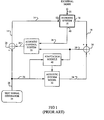
- an acoustic system 10 is subject to external noise sources 11.
- An acoustic actuator 12, preferably a loud speaker driven by an actuator drive signal 14, is used to generate a controlled sound that interferes destructively with an unwanted noise.
- the controlled sound may be an anti-noise signal having the same amplitude, yet 180 degrees out of phase with the unwanted noise signal.
- the residual noise is measured by a sensor 16, (usually a microphone), to produce a sensed signal 18.
- An error signal 20, derived from the sensed signal 18, is used to adjust the characteristics of the acoustic control system 22.
- this system response model is obtained by using a test signal generator 24 to generate a test signal 26 that is combined at signal combiner 28 with a control system output signal 30 to form the actuator drive signal 14.
- the test signal 26 is also supplied to an acoustic system model 32 to produce an estimated response signal 34.
- the estimated response signal 34 is subtracted from the residual signal or sensed signal 18 at combiner 36 to form the error signal 20.
- the acoustic control system 22 is responsive to the error signal 20 and, optionally, to one or more reference signals 38 from reference sensors 40.
- the effect of the control system output signal 30, which is represented in the actuator drive signal 14 is to drive the acoustic actuator 12 so as to modify the noise in acoustic system 10.
- the error signal 20 is correlated with the test signal 26 in adaptation module 42 and is used to adjust or adapt the parameters of the acoustic system model 32.
- the correlation algorithm serves to reduce the effects of noise from sources other than the test signal 26.
- the correlation algorithm performed by adaptation module 42 as applied to the present invention is described in greater detail below.
- the response to the test signal should be inaudible, since the goal of an active sound control system is usually to reduce an unwanted noise.
- the current invention utilizes the concept of "acoustic masking", which will now be described.
- acoustic masking The ability of one sound to reduce the audibility of another sound is called acoustic masking.
- the amount of masking is the amount by which the threshold of audibility must be increased in the presence of the masking noise. This concept is described in "Fundamentals of Acoustics", L.E. Kinsler et al., third edition, Wiley, 1982. Generally, the amount of masking of a signal by a tone decreases according to the difference in frequencies.
- K has been assigned values in the range of 3-6 dB.
- the psycho-acoustic model utilized with the present invention is implemented by masking spectrum generator 62 and is described in greater detail below.
- a variety of empirical models may be used without departing from the scope of the present invention.
- the present invention uses the unwanted noise from external sources 11 to mask the test signal (such as test signal 26) and thereby make it substantially inaudible. For example, if the external noise has a strong tonal component at one frequency, the level of the test signal at nearby frequencies can be set relative to this level. Even if the response to the test signal at these nearby frequencies is much higher than the external noise level at these frequencies, the test signal will still be inaudible because of the acoustic masking property. This is a considerable improvement over prior schemes in which the test signal level was chosen with regard only to external noise at the same frequency. In the present invention, the test signal at the nearby frequencies is louder, enabling the system response model to be estimated more accurately and significantly faster.
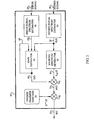
- a block diagram of the present invention is shown in Figure 2.
- the basic operation of the common functional blocks is similar to the system described in Figure 1, except that the test signal 26 is replaced a spectrally shaped test signal 46.
- the shaped signal generator 44 produces the spectrally shaped test signal 46.
- This spectral shaping of test signal 46 is continually updated to ensure that the sound due to the spectrally shaped test signal is masked by the external noise 11.
- the sensed signal 18, from the sensor or microphone 16 is passed to a masking threshold generator 50.
- the masking threshold generator 50 is used to estimate spectral shaping parameters 52 utilized by the shaped signal generator 44 for generating the spectrally shaped test signal 46.
- the masking threshold generator 50 utilizes a perceptual model of hearing. In one embodiment the masking threshold generator 50 is also responsive to an estimated response signal 34 generated by the acoustic system model 32.
- the spectrally shaped test signal 46 is combined by signal combiner 28 with the control signal 30 produced by the acoustic control system 22 to form the actuator drive signal 14.
- the shaped test signal 46 is also supplied to an acoustic system model 32 to produce the estimated response signal 34.
- the estimated response signal 34 is subtracted from the sensed signal 18 at signal combiner 36 to form the error signal 20.
- the acoustic control system 22 is responsive to the error signal 20 and, optionally, signals 38 from reference sensors 40.
- the effect of the actuator drive signal 14 is to drive the acoustic actuator 12 so as to modify the noise in the acoustic system 10.
- the error signal 20 is correlated with the spectrally shaped test signal 46 in adaptation module 42 and is used by the adaptation module 42 to adjust or adapt the parameters of the acoustic system model 32.
- the correlation function serves to reduce the effects of noise from sources other than the spectrally shaped test signal 46.
- LMS Least Mean Square
- Widrow B. Widrow and S.D. Stearns, "Adaptive Signal Processing", Chapter 6, Prentice Hall, 1985
- J.J. Shynk Frequency Domain and Multirate Adaptive Filtering
- the frequency spectrum 56 of sensed signal 18 is estimated by the sensed signal spectrum estimator 54. This may be a broadband frequency spectrum or a harmonic frequency spectrum.
- the frequency spectrum 56 is used by masking spectrum generator 62 to calculate an initial spectral masking threshold 64.
- the initial spectral masking threshold 64 is optionally multiplied by spectral gains 68 (produced by gain estimator 66) at multiplier 70 to produce a modified or scaled spectral masking threshold 72.
- This scaled spectral masking threshold 72 is further scaled by an inverse transfer function 74 at multiplier 76 to produce the spectral shaping parameters 52 as an output of the masking threshold generator 50.
- the inverse transfer function 74 is set a set of stored values (for each frequency) and represents the gain or attenuation that must be applied to the spectrally shaped test signal 46 to compensate for the response of the acoustic system 10.
- the values are not required to a high accuracy, unlike the transfer function used by the controller of the acoustic control system 22.
- the initial spectral masking threshold 64 represents the spectrum of a test signal that would produce the desired response at the sensor 16, that is a response that will be acoustically masked by the ambient sound. However, the accuracy of this initial spectral masking threshold 64 depends on estimates of the inverse transfer function 74 and the ambient noise level; neither of which is known with certainty.
- the frequency spectrum 56 of sensed signal 18 contains energy produced by the spectrally shaped test signal 46 and by the external noise sources 11. It may therefore be necessary to modify the initial spectral masking threshold 64 at some frequencies to account for this. In the embodiment shown in Figure 3, this modification is achieved by scaling the initial spectral masking threshold 64 by spectral gains 68 generated by gain estimator 66.
- the purpose of the spectral gain 68 is to compensate for errors in the estimate of the inverse transfer function 74 or the ambient noise level. It has been described above how the transfer function accuracy depends upon the ratio of the test signal level (as measured at the sensor) to the ambient noise level. Hence, if the transfer function accuracy is poor it is likely because (a) the test signal level is too low or (b) the acoustic system response has changed. In either case it desirable to increase the level of the test signal in order to improve accuracy. This improvement in accuracy is achieved by multiplying the spectrum by a gain factor, such as spectral gains 68 which are generated by the gain estimator 66. The gain factor is increased if the transfer function accuracy is thought to be too low, and decreased if it is higher than necessary (so as to minimize the level of the test signal).
- the spectral gains 68 are calculated by gain estimator 66 according to the power spectrum 60 of the error signal 20, which is calculated by the error signal spectrum estimator 58, and according to the frequency spectrum 56 from sensed signal spectrum estimator 54. This may be a recursive calculation, which also depends on previous gains 68 from gain estimator 66.
- Figure 4 shows a time-domain, shaped test signal generator 44.
- the spectral shaping parameters 52 are supplied to inverse transform block 80 to produce the coefficients 82 for a time-domain shaping filter 84.
- a test signal generator 86 produces a pseudo-random signal 88 with substantially equal energy in each frequency band. This signal is passed through the shaping filter 84 to produce the spectrally shaped test signal 46.
- Figure 5 shows a frequency domain, shaped test signal generator 44'.
- a test spectrum generator 90 generates a complex frequency spectrum 92 with uniform amplitude and random phase. This complex frequency spectrum 92 is multiplied by spectral shaping parameters 52 at multiplier 94 to produce the spectrum of the shaped test signal 96. An inverse transform is applied at block 98 to produce the spectrally shaped test signal 46. Further detailed description of the various elements associated with the system of the present invention is provided below.
- the function provided by the masking threshold generator 50 of the present invention can be modeled as follows.
- the sensed signal 18 in Figure 3, at time sample n is denoted by r ( n ).
- the Fourier transform of r(n) is calculated by the sensed signal spectrum estimator 54.
- the transform may be calculated as: where N is the transform block size and T is the sampling period.
- the Fourier transform at frequency f is denoted by R ( f ).exp( i ⁇ ( f )), where R ( f ) is the amplitude of the spectrum and ⁇ ( f ) is the phase of frequency spectrum 56.
- the initial spectral masking threshold 64 at frequency f is given by where The parameters K , ⁇ and ⁇ may be adjusted to control the amount of masking modeled.
- the initial spectral masking threshold 64 is calculated by the masking spectrum generator 62 using this psycho-acoustical model above.
- the spectral gain adjustment performed by the masking threshold generator 50 is described as follows.
- a large value of the amplitude of ⁇ ( f ) indicates that H ( f ) (the transfer function) is large compared to h(f) (the error in the transfer function).
- the spectral gain 68 is adjusted by the gain estimator block 66 so that the amplitude of the ratio ⁇ ( f ) is maintained above some minimum level for frequencies between the discrete frequencies.
- the masking threshold generator 50 Compensation for the system transfer function is accomplished by the masking threshold generator 50 as follows.
- the sound due to the spectrally shaped test signal 46 will be modified by the transfer function of the acoustic system 10 (including the actuator response function, the sensor response function and acoustic propagation).
- the initial spectral masking threshold 64 must be modified accordingly to compensate for this transfer function.
- the detailed transfer function is not known, since this is what the invention seeks to identify, but the general form of the transfer function is usually known from previous measurements, or from knowledge of the acoustic system 10.
- the phase of the transfer function is generally more important than the amplitude, since the adaptation rate may always be reduced to compensate for amplitude errors.
- the prior estimate or measurement of the transfer function, at frequency f is denoted as H(f).
- a minimum level may be set for S ( f ) in order to prevent underflow errors or errors due to non-linearities in the acoustic system. This minimum level may be set relative to the largest value of S ( f ).
- the external disturbance of the system is characterized by a frequency spectrum that contains sound power in discrete, narrow frequency bands.
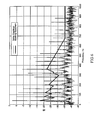
- An example of a noise spectrum resulting from such a disturbance is shown in Figure 6.
- Figure 6 shows the amplitude of the external noise 11 in decibels (dB) as a function of frequency measured in Hertz.
- the fundamental frequency of the external noise 11 is 40 Hz.
- the spectral masking threshold or spectral shaping parameters 52 shown as the heavier line in Figure 6, has sound power across a broad frequency range.
- the spectral masking threshold 52 is about 20dB below the frequency spectrum of the external noise. Between the discrete frequencies, the spectral masking threshold 52 is considerably higher than the frequency spectrum of the external noise 11. However, a spectrally shaped test signal 46 shaped by the spectral masking threshold 52 will still be substantially inaudible.
- the prior art system response identification systems use a test signal 26 that is set at each frequency according to the noise at that same frequency. The resulting signal is produced at a much lower amplitude level than that used in the present invention.
- the spectrally shaped test signal 46 used in the present invention is louder, it is masked by the nearby discrete tone and is therefore substantially inaudible. Accordingly, at frequencies between the discrete frequencies, the shaped test signal 46 of the present invention is loud compared to the external noise 11, enabling a very rapid identification of the acoustic system model 32.
- the acoustic system model 32 is identified using an adaptive algorithm implemented within the adaptation module 42 in which the change to the model at each iteration of the algorithm is proportional to the misadjustment and to a convergence step size.
- the time taken to identify the acoustic system model 32 is related to the step size as shown in Figure 7.
- Figure 7 shows the number of iterations (i.e. the time) for a model to converge to within 10% of its final estimate as a function of the convergence step size.
- the current invention provides a technique by which much higher signal-to-noise ratios may be used (between the discrete frequencies), and therefore increases the accuracy of the resulting acoustic system model 32 and/or reduces the time required to estimate the acoustic system model 32.
- the transfer function of the acoustic system model 32 may be estimated via interpolation from nearby frequencies.
- the frequencies to be interpolated are determined by measuring the frequencies of the noise or the repetition rate of the machine (using a tachometer for example).
- a joint estimation of the external noise d(n) 11 and the acoustic system model 32 can be made as described in co-pending U.S. Patent Application Serial No. 09/108,253, filed on July 1, 1998.
- the adaptation of the acoustic system model 32 is preferably performed in the frequency domain, so that the noise at the discrete frequencies does not degrade the adaptation process.
Landscapes
- Physics & Mathematics (AREA)
- Engineering & Computer Science (AREA)
- Acoustics & Sound (AREA)
- Multimedia (AREA)
- Soundproofing, Sound Blocking, And Sound Damping (AREA)
- Measurement Of Mechanical Vibrations Or Ultrasonic Waves (AREA)
Applications Claiming Priority (2)
| Application Number | Priority Date | Filing Date | Title |
|---|---|---|---|
| US195294 | 1998-11-18 | ||
| US09/195,294 US6594365B1 (en) | 1998-11-18 | 1998-11-18 | Acoustic system identification using acoustic masking |
Publications (3)
| Publication Number | Publication Date |
|---|---|
| EP1003154A2 true EP1003154A2 (fr) | 2000-05-24 |
| EP1003154A3 EP1003154A3 (fr) | 2002-08-07 |
| EP1003154B1 EP1003154B1 (fr) | 2006-05-31 |
Family
ID=22720842
Family Applications (1)
| Application Number | Title | Priority Date | Filing Date |
|---|---|---|---|
| EP99302391A Expired - Lifetime EP1003154B1 (fr) | 1998-11-18 | 1999-03-29 | Identification d'un système acoustique au moyen de masquage acoustique |
Country Status (3)
| Country | Link |
|---|---|
| US (1) | US6594365B1 (fr) |
| EP (1) | EP1003154B1 (fr) |
| DE (1) | DE69931580T2 (fr) |
Cited By (12)
| Publication number | Priority date | Publication date | Assignee | Title |
|---|---|---|---|---|
| WO2007077420A3 (fr) * | 2005-12-30 | 2007-09-07 | Peter Craven | Amplification de reaction pour commande d'installation |
| EP1947642A1 (fr) | 2007-01-16 | 2008-07-23 | Harman/Becker Automotive Systems GmbH | Procédé et système pour utiliser la mémoire morte (MEM) programmable une seule fois (OTP) afin de configurer les caractéristiques d'utilisation de puce |
| WO2010004098A1 (fr) * | 2008-07-11 | 2010-01-14 | Commissariat A L'energie Atomique | Estimation de la réponse impulsionnelle d'un système à partir d'observations binaires |
| US7728658B2 (en) | 2007-07-25 | 2010-06-01 | D2Audio Corporation | Low-noise, low-distortion digital PWM amplifier |
| US7812666B2 (en) | 2005-12-30 | 2010-10-12 | D2Audio Corporation | Low delay corrector |
| WO2010074899A3 (fr) * | 2008-12-23 | 2011-04-07 | Bose Corporation | Réglage du gain par masquage |
| EP1162599A3 (fr) * | 2000-06-05 | 2012-06-27 | Siemens VDO Automotive Inc. | Recalibration d'un système actif de suppression du bruit |
| US8229125B2 (en) | 2009-02-06 | 2012-07-24 | Bose Corporation | Adjusting dynamic range of an audio system |
| US8442251B2 (en) | 2009-04-02 | 2013-05-14 | Oticon A/S | Adaptive feedback cancellation based on inserted and/or intrinsic characteristics and matched retrieval |
| US8964997B2 (en) | 2005-05-18 | 2015-02-24 | Bose Corporation | Adapted audio masking |
| CN107210032A (zh) * | 2015-01-20 | 2017-09-26 | 弗劳恩霍夫应用研究促进协会 | 在掩蔽语音区域中掩蔽再现语音的语音再现设备 |
| WO2024107428A1 (fr) * | 2022-11-14 | 2024-05-23 | Bose Corporation | Test de chemin acoustique |
Families Citing this family (22)
| Publication number | Priority date | Publication date | Assignee | Title |
|---|---|---|---|---|
| ATE289152T1 (de) | 1999-09-10 | 2005-02-15 | Starkey Lab Inc | Audiosignalverarbeitung |
| GB0023207D0 (en) * | 2000-09-21 | 2000-11-01 | Royal College Of Art | Apparatus for acoustically improving an environment |
| US8477958B2 (en) | 2001-02-26 | 2013-07-02 | 777388 Ontario Limited | Networked sound masking system |
| DE60116559D1 (de) * | 2001-10-01 | 2006-04-06 | Koninkl Kpn Nv | Verbessertes Verfahren zur Ermittlung der Qualität eines Sprachsignals |
| US7450725B2 (en) * | 2001-12-17 | 2008-11-11 | Mahle International Gmbh | Digital filter modeling for active noise cancellation |
| AU2003210111A1 (en) * | 2002-01-07 | 2003-07-24 | Ronald L. Meyer | Microphone support system |
| CA2690511C (fr) * | 2003-03-13 | 2016-02-09 | 777388 Ontario Limited | Systeme de masquage sonore avec generateur de masque sonore centralise |
| CA2471674A1 (fr) * | 2004-06-21 | 2005-12-21 | Soft Db Inc. | Systeme et methode de masquage sonore a reglage automatique |
| EP1770685A1 (fr) * | 2005-10-03 | 2007-04-04 | Maysound ApS | Système de réduction de la perception audible du bruit de fond pour un être-humain. |
| US7933420B2 (en) * | 2006-12-28 | 2011-04-26 | Caterpillar Inc. | Methods and systems for determining the effectiveness of active noise cancellation |
| US8068616B2 (en) * | 2006-12-28 | 2011-11-29 | Caterpillar Inc. | Methods and systems for controlling noise cancellation |
| US8340318B2 (en) * | 2006-12-28 | 2012-12-25 | Caterpillar Inc. | Methods and systems for measuring performance of a noise cancellation system |
| US8767975B2 (en) * | 2007-06-21 | 2014-07-01 | Bose Corporation | Sound discrimination method and apparatus |
| US8243924B2 (en) * | 2007-06-29 | 2012-08-14 | Google Inc. | Progressive download or streaming of digital media securely through a localized container and communication protocol proxy |
| US8620003B2 (en) * | 2008-01-07 | 2013-12-31 | Robert Katz | Embedded audio system in distributed acoustic sources |
| US8611554B2 (en) * | 2008-04-22 | 2013-12-17 | Bose Corporation | Hearing assistance apparatus |
| US8666086B2 (en) | 2008-06-06 | 2014-03-04 | 777388 Ontario Limited | System and method for monitoring/controlling a sound masking system from an electronic floorplan |
| JP5709760B2 (ja) * | 2008-12-18 | 2015-04-30 | コーニンクレッカ フィリップス エヌ ヴェ | オーディオノイズキャンセリング |
| US20110317522A1 (en) * | 2010-06-28 | 2011-12-29 | Microsoft Corporation | Sound source localization based on reflections and room estimation |
| US9078077B2 (en) | 2010-10-21 | 2015-07-07 | Bose Corporation | Estimation of synthetic audio prototypes with frequency-based input signal decomposition |
| WO2016199119A1 (fr) * | 2015-06-06 | 2016-12-15 | Oppenheimer Yehuda | Système et procédé pour la réduction active de bruit acoustique audio prédéfini à l'aide de signaux de synchronisation |
| EP3480809B1 (fr) * | 2017-11-02 | 2021-10-13 | ams AG | Procédé pour déterminer une fonction de réponse d'un dispositif audio activé à annulation de bruit |
Family Cites Families (13)
| Publication number | Priority date | Publication date | Assignee | Title |
|---|---|---|---|---|
| US4438526A (en) * | 1982-04-26 | 1984-03-20 | Conwed Corporation | Automatic volume and frequency controlled sound masking system |
| GB2122052B (en) | 1982-06-09 | 1986-01-29 | Plessey Co Plc | Reducing noise or vibration |
| US4677676A (en) | 1986-02-11 | 1987-06-30 | Nelson Industries, Inc. | Active attenuation system with on-line modeling of speaker, error path and feedback pack |
| US4947435A (en) | 1988-03-25 | 1990-08-07 | Active Noise & Vibration Tech | Method of transfer function generation and active noise cancellation in a vibrating system |
| US5091953A (en) * | 1990-02-13 | 1992-02-25 | University Of Maryland At College Park | Repetitive phenomena cancellation arrangement with multiple sensors and actuators |
| DE69327885T2 (de) | 1992-05-26 | 2000-10-05 | Fujitsu Ten Ltd., Kobe | Lärm-Kontroll-Gerät |
| US5524057A (en) | 1992-06-19 | 1996-06-04 | Alpine Electronics Inc. | Noise-canceling apparatus |
| US5469087A (en) * | 1992-06-25 | 1995-11-21 | Noise Cancellation Technologies, Inc. | Control system using harmonic filters |
| KR960009936B1 (ko) * | 1992-10-07 | 1996-07-25 | 대우전자 주식회사 | 오디오 신호의 왜곡 측정장치 및 방법 |
| US5553153A (en) | 1993-02-10 | 1996-09-03 | Noise Cancellation Technologies, Inc. | Method and system for on-line system identification |
| US5475761A (en) | 1994-01-31 | 1995-12-12 | Noise Cancellation Technologies, Inc. | Adaptive feedforward and feedback control system |
| US5796849A (en) | 1994-11-08 | 1998-08-18 | Bolt, Beranek And Newman Inc. | Active noise and vibration control system accounting for time varying plant, using residual signal to create probe signal |
| US5625745A (en) * | 1995-01-31 | 1997-04-29 | Lucent Technologies Inc. | Noise imaging protection for multi-channel audio signals |
-
1998
- 1998-11-18 US US09/195,294 patent/US6594365B1/en not_active Expired - Lifetime
-
1999
- 1999-03-29 EP EP99302391A patent/EP1003154B1/fr not_active Expired - Lifetime
- 1999-03-29 DE DE69931580T patent/DE69931580T2/de not_active Expired - Fee Related
Cited By (16)
| Publication number | Priority date | Publication date | Assignee | Title |
|---|---|---|---|---|
| EP1162599A3 (fr) * | 2000-06-05 | 2012-06-27 | Siemens VDO Automotive Inc. | Recalibration d'un système actif de suppression du bruit |
| US8964997B2 (en) | 2005-05-18 | 2015-02-24 | Bose Corporation | Adapted audio masking |
| US7756592B2 (en) | 2005-12-30 | 2010-07-13 | Peter Craven | Enhanced feedback for plant control |
| US7812666B2 (en) | 2005-12-30 | 2010-10-12 | D2Audio Corporation | Low delay corrector |
| WO2007077420A3 (fr) * | 2005-12-30 | 2007-09-07 | Peter Craven | Amplification de reaction pour commande d'installation |
| CN101354885B (zh) * | 2007-01-16 | 2012-10-10 | 哈曼贝克自动系统股份有限公司 | 主动噪声控制系统 |
| EP1947642A1 (fr) | 2007-01-16 | 2008-07-23 | Harman/Becker Automotive Systems GmbH | Procédé et système pour utiliser la mémoire morte (MEM) programmable une seule fois (OTP) afin de configurer les caractéristiques d'utilisation de puce |
| US7728658B2 (en) | 2007-07-25 | 2010-06-01 | D2Audio Corporation | Low-noise, low-distortion digital PWM amplifier |
| US8705597B2 (en) | 2008-07-11 | 2014-04-22 | Commissariat A L'energie Atomique Et Aux Energies Alternatives | Estimation of the impulse response of a system on the basis of binary observations |
| WO2010004098A1 (fr) * | 2008-07-11 | 2010-01-14 | Commissariat A L'energie Atomique | Estimation de la réponse impulsionnelle d'un système à partir d'observations binaires |
| US8218783B2 (en) | 2008-12-23 | 2012-07-10 | Bose Corporation | Masking based gain control |
| WO2010074899A3 (fr) * | 2008-12-23 | 2011-04-07 | Bose Corporation | Réglage du gain par masquage |
| US8229125B2 (en) | 2009-02-06 | 2012-07-24 | Bose Corporation | Adjusting dynamic range of an audio system |
| US8442251B2 (en) | 2009-04-02 | 2013-05-14 | Oticon A/S | Adaptive feedback cancellation based on inserted and/or intrinsic characteristics and matched retrieval |
| CN107210032A (zh) * | 2015-01-20 | 2017-09-26 | 弗劳恩霍夫应用研究促进协会 | 在掩蔽语音区域中掩蔽再现语音的语音再现设备 |
| WO2024107428A1 (fr) * | 2022-11-14 | 2024-05-23 | Bose Corporation | Test de chemin acoustique |
Also Published As
| Publication number | Publication date |
|---|---|
| DE69931580T2 (de) | 2007-05-03 |
| DE69931580D1 (de) | 2006-07-06 |
| EP1003154B1 (fr) | 2006-05-31 |
| EP1003154A3 (fr) | 2002-08-07 |
| US6594365B1 (en) | 2003-07-15 |
Similar Documents
| Publication | Publication Date | Title |
|---|---|---|
| EP1003154B1 (fr) | Identification d'un système acoustique au moyen de masquage acoustique | |
| EP4115413B1 (fr) | Optimisation de la voix dans des environnements bruyants | |
| CN104303227B (zh) | 通过结合有源噪音消除及感知噪音补偿改善声音重现的感知质量的装置和方法 | |
| US7885417B2 (en) | Active noise tuning system | |
| CN101354885B (zh) | 主动噪声控制系统 | |
| KR970001736B1 (ko) | 소음소거장치 및 그 소음소거방법 | |
| US8422697B2 (en) | Background noise estimation | |
| EP3025516B1 (fr) | Contrôle automatique du timbre et de l'égalisation | |
| US11189297B1 (en) | Tunable residual echo suppressor | |
| EP1538868A2 (fr) | Dispositif d'amplification audio | |
| AU2003236382A1 (en) | Feedback suppression in sound signal processing using frequency transposition | |
| EP2490218A1 (fr) | Procédé pour supprimer l'interférence | |
| EP4161104A1 (fr) | Procédé d'amélioration de la qualité sonore de reproductions sonores ou d'enregistrement sonores dans une pièce | |
| JP3489137B2 (ja) | 能動型騒音制御装置 | |
| JP3316259B2 (ja) | 能動型消音装置 | |
| EP3025517B1 (fr) | Contrôle de timbre automatique | |
| CN117714956B (zh) | 确定听力仪器的声学特性 | |
| US20260107095A1 (en) | Sub-band acoustic feedback cancellation with forward-path decorrelation | |
| Kletschkowski et al. | Broadband active noise control around human’s head—determination and achievement of physical limit | |
| Liebich et al. | Excitation Signals for Online Secondary Path Estimation in Active Noise Control |
Legal Events
| Date | Code | Title | Description |
|---|---|---|---|
| PUAI | Public reference made under article 153(3) epc to a published international application that has entered the european phase |
Free format text: ORIGINAL CODE: 0009012 |
|
| AK | Designated contracting states |
Kind code of ref document: A2 Designated state(s): AT BE CH CY DE DK ES FI FR GB GR IE IT LI LU MC NL PT SE |
|
| AX | Request for extension of the european patent |
Free format text: AL;LT;LV;MK;RO;SI |
|
| PUAL | Search report despatched |
Free format text: ORIGINAL CODE: 0009013 |
|
| AK | Designated contracting states |
Kind code of ref document: A3 Designated state(s): AT BE CH CY DE DK ES FI FR GB GR IE IT LI LU MC NL PT SE |
|
| AX | Request for extension of the european patent |
Free format text: AL;LT;LV;MK;RO;SI |
|
| 17P | Request for examination filed |
Effective date: 20030206 |
|
| AKX | Designation fees paid |
Designated state(s): DE FR GB |
|
| 17Q | First examination report despatched |
Effective date: 20040322 |
|
| GRAP | Despatch of communication of intention to grant a patent |
Free format text: ORIGINAL CODE: EPIDOSNIGR1 |
|
| GRAS | Grant fee paid |
Free format text: ORIGINAL CODE: EPIDOSNIGR3 |
|
| GRAA | (expected) grant |
Free format text: ORIGINAL CODE: 0009210 |
|
| AK | Designated contracting states |
Kind code of ref document: B1 Designated state(s): DE FR GB |
|
| REG | Reference to a national code |
Ref country code: GB Ref legal event code: FG4D |
|
| REF | Corresponds to: |
Ref document number: 69931580 Country of ref document: DE Date of ref document: 20060706 Kind code of ref document: P |
|
| ET | Fr: translation filed | ||
| PGFP | Annual fee paid to national office [announced via postgrant information from national office to epo] |
Ref country code: DE Payment date: 20070316 Year of fee payment: 9 |
|
| PGFP | Annual fee paid to national office [announced via postgrant information from national office to epo] |
Ref country code: GB Payment date: 20070322 Year of fee payment: 9 |
|
| PLBE | No opposition filed within time limit |
Free format text: ORIGINAL CODE: 0009261 |
|
| STAA | Information on the status of an ep patent application or granted ep patent |
Free format text: STATUS: NO OPPOSITION FILED WITHIN TIME LIMIT |
|
| 26N | No opposition filed |
Effective date: 20070301 |
|
| PGFP | Annual fee paid to national office [announced via postgrant information from national office to epo] |
Ref country code: FR Payment date: 20070319 Year of fee payment: 9 |
|
| GBPC | Gb: european patent ceased through non-payment of renewal fee |
Effective date: 20080329 |
|
| REG | Reference to a national code |
Ref country code: FR Ref legal event code: ST Effective date: 20081125 |
|
| PG25 | Lapsed in a contracting state [announced via postgrant information from national office to epo] |
Ref country code: DE Free format text: LAPSE BECAUSE OF NON-PAYMENT OF DUE FEES Effective date: 20081001 |
|
| PG25 | Lapsed in a contracting state [announced via postgrant information from national office to epo] |
Ref country code: FR Free format text: LAPSE BECAUSE OF NON-PAYMENT OF DUE FEES Effective date: 20080331 |
|
| PG25 | Lapsed in a contracting state [announced via postgrant information from national office to epo] |
Ref country code: GB Free format text: LAPSE BECAUSE OF NON-PAYMENT OF DUE FEES Effective date: 20080329 |