EP1003177B1 - Structure interne d'un réacteur nucléaire comportant des moyens pour stabiliser le courant du réfrigérant - Google Patents
Structure interne d'un réacteur nucléaire comportant des moyens pour stabiliser le courant du réfrigérant Download PDFInfo
- Publication number
- EP1003177B1 EP1003177B1 EP99308502A EP99308502A EP1003177B1 EP 1003177 B1 EP1003177 B1 EP 1003177B1 EP 99308502 A EP99308502 A EP 99308502A EP 99308502 A EP99308502 A EP 99308502A EP 1003177 B1 EP1003177 B1 EP 1003177B1
- Authority
- EP
- European Patent Office
- Prior art keywords
- outlet
- coolant
- flow
- nuclear reactor
- outlet nozzle
- Prior art date
- Legal status (The legal status is an assumption and is not a legal conclusion. Google has not performed a legal analysis and makes no representation as to the accuracy of the status listed.)
- Expired - Lifetime
Links
Images




Classifications
-
- G—PHYSICS
- G21—NUCLEAR PHYSICS; NUCLEAR ENGINEERING
- G21C—NUCLEAR REACTORS
- G21C15/00—Cooling arrangements within the pressure vessel containing the core; Selection of specific coolants
- G21C15/02—Arrangements or disposition of passages in which heat is transferred to the coolant; Coolant flow control devices
- G21C15/14—Arrangements or disposition of passages in which heat is transferred to the coolant; Coolant flow control devices from headers; from joints in ducts
-
- G—PHYSICS
- G21—NUCLEAR PHYSICS; NUCLEAR ENGINEERING
- G21C—NUCLEAR REACTORS
- G21C19/00—Arrangements for treating, for handling, or for facilitating the handling of, fuel or other materials which are used within the reactor, e.g. within its pressure vessel
- G21C19/02—Details of handling arrangements
- G21C19/04—Means for controlling flow of coolant over objects being handled; Means for controlling flow of coolant through channel being serviced, e.g. for preventing "blow-out"
-
- Y—GENERAL TAGGING OF NEW TECHNOLOGICAL DEVELOPMENTS; GENERAL TAGGING OF CROSS-SECTIONAL TECHNOLOGIES SPANNING OVER SEVERAL SECTIONS OF THE IPC; TECHNICAL SUBJECTS COVERED BY FORMER USPC CROSS-REFERENCE ART COLLECTIONS [XRACs] AND DIGESTS
- Y02—TECHNOLOGIES OR APPLICATIONS FOR MITIGATION OR ADAPTATION AGAINST CLIMATE CHANGE
- Y02E—REDUCTION OF GREENHOUSE GAS [GHG] EMISSIONS, RELATED TO ENERGY GENERATION, TRANSMISSION OR DISTRIBUTION
- Y02E30/00—Energy generation of nuclear origin
- Y02E30/30—Nuclear fission reactors
Definitions
- the present invention generally relates to the shape and disposition of an internal structural member constituting part of an internal structure and disposed within a pressurized water reactor in which heat exchange takes place between heating members and a coolant. More particularly, the invention is concerned with the shape and disposition of coolant flow stabilizing members disposed within an upper plenum in the vicinity of outlet nozzles for stabilizing the coolant flow in regions located close to the outlet nozzles.
- a pressurized water reactor for a power plant In a pressurized water reactor for a power plant, light water serving as a coolant is fed to a reactor core to be heated to a high temperature by heat generated through nuclear fission. The heated light water is taken out and supplied to a steam generator for generating steam which is then fed to a steam system provided separately from a core cooling system to be utilized for rotationally driving a steam turbine and a rotor of an electric generator operatively coupled to the turbine to thereby generate electric energy.
- Figure 8 of the accompanying drawings shows an internal structure of a pressurized water reactor typical of nuclear reactors.
- a nuclear reactor vessel 10 accommodated within a nuclear reactor vessel 10 are reactor core internals, nuclear fuel assemblies, control rods, control rod cluster guide tubes, support members and others.
- the nuclear reactor vessel 10 is integrally provided with inlet nozzles 11 and outlet nozzles 12 for the reactor coolant which is light water, and a core barrel 30 is suspended vertically within the nuclear reactor vessel 10.
- the number of the inlet nozzles 11 and the outlet nozzles 12, respectively coincide with the number of coolant circulation loops which in turn depends on the output power rating of the reactor. Ordinarily, the number of the inlet nozzles 11 and outlet nozzles 12 ranges from two to four each.
- a plurality of coolant circulation loops in consideration of the capacities of pumps and the steam generator employed in the cooling system as well as restrictions imposed with respect to the disposition thereof within a containment vessel.
- the number of coolant circulation loops installed is determined depending on the output capacity. Since a reactor power plant with a large output capacity is provided with four coolant circulation loops, the number of the inlet nozzles 11 and the outlet nozzles 12 is also four, respectively.
- the inlet nozzles 11 and the outlet nozzles 12 are installed in the nuclear reactor vessel at predetermined intervals in the circumferential direction thereof.
- a lower core support plate 32 and a lower core plate 31 are horizontally disposed within the core barrel 30 at a lower portion thereof, respectively.
- a bottom or lower plenum 41 is defined beneath the lower core support plate 32.
- a large number of loaded fuel assemblies 33 which are disposed adjacent to one another to thereby constitute a reactor core.
- an upper core plate 21 Disposed above the fuel assemblies 33 is an upper core plate 21 which is supported by an upper core support plate 20 by way of upper core support columns 23.
- the fuel assemblies 33 are pressed downwards by means of the upper core plate 21 so that the fuel assemblies 33 are prevented from being displaced upwards under the influence of buoyancy exerted by the flowing coolant.
- a plurality of control rod cluster guide tubes 22 are supported at lower ends thereof on the upper surface of the upper core plate 21 by means of supporting pins or the like (not shown). The control rod cluster guide tubes 22 extend upwardly through and beyond the upper core support plate 20.
- control rod clusters By withdrawing the control rod clusters (not shown either) from the reactor core through the medium of the control rod cluster guide tubes 22 or inserting the control rod clusters into the fuel assemblies 33 of the reactor core through the control rod cluster guide tubes 22, the thermal output of the reactor core can be adjusted.
- the upper core plate 21 and the upper core support plate 20 are interconnected by means of the upper core support columns 23 in order to ensure structurally high strength or robustness. Further, the control rod cluster guide tubes 22 extending through the upper core support plate 20 are fixedly secured to the upper core support plate 20. Thus, the control rod cluster guide tubes 22 are protected against displacement or dislocation in a lateral or transverse direction. Defined between the upper core plate 21 and the upper core support plate 20 interconnected as mentioned above is an upper plenum 40.
- light water of low temperature fed to the nuclear reactor vessel 10 by way of the inlet nozzles 11 flows as indicated by the arrows in Fig. 8. More specifically, light water fed to the nuclear reactor vessel 10 through the inlet nozzle 11 flows at first downwardly through an annular space defined between the outer surface of the core barrel 30 and the inner wall of the nuclear reactor vessel 10. The light water is forced to turn upwards within the lower plenum 41. Thereafter, the light water flows into the reactor core after passing through the lower core support plate 32 and the lower core plate 31. Within the reactor core, light water flows upwardly substantially in parallel.
- the nuclear reactor vessel 10 of the four-loop reactor plant mentioned previously is implemented in a structure such that two outlet nozzles 12 are disposed adjacent to each other because of the restrictions imposed in view of the requirement for realizing the structure of the primary coolant loop and the reactor containment vessel in a reduced size, as can be seen in Figs. 9 and 10 of the accompanying drawings. Consequently, some of the light water flowing along the inner wall of the core barrel 30 tends to flow transversely beneath the outlets of the outlet nozzles 12, and will also collide with the coolant streams in a region between the adjacent outlet nozzles 12. After the collision, light water is forced to change its flow directions so as to flow upwardly.
- a stratified flow distribution within the upper plenum 40 is formed such that the coolant of relatively high temperature flows at a relatively high level while the coolant of relatively low temperature flows at a relatively low level.
- a plurality of stratified coolant flows of different temperatures are produced within the upper plenum 40, as viewed in the vertical direction.
- the coolant flowing on or in proximity to the upper surface of the upper core plate 21 along the inner wall of the core barrel 30 is at a relatively low temperature.
- the unstable coolant flow of a relatively low temperature brings about fluctuations or variations in the temperature of the coolant flowing through the outlet pipe 42 connected to the outlet nozzle 12. Consequently, this can easily become an obstacle when mean temperature of the nuclear reactor is measured by measuring the temperature of the coolant flowing through the outlet pipe 42 connected to the outlet nozzle 12.
- reactor rods are protected from coolant flow using columnar protectors linked by a series of guide plates.
- US 5 906 573 describes another example of a prior art nuclear reactor, although in this instance a boiling water reactor, which is structured to extract steam and water directly from the core.
- a nuclear reactor vessel with an internal structural member that is configured and disposed so as to be capable of stabilising the coolant flow in a region located near or close to an outlet nozzle, and thereby to eliminate or mitigate difficulties that may otherwise be involved in the temperature measurement of the coolant flowing through the outlet pipe.
- the present invention is directed to a nuclear reactor vessel comprising: a suspended core barrel including a fuel region through which a current of coolant flows; and an upper plenum defined above the fuel region and which is hydraulically communicated with a plurality of outlet nozzles mounted on a side wall of the reactor vessel, wherein the coolant current flows in separated streams that collide at the outlet nozzles.
- the invention is characterised in that the upper plenum also includes a flow stabilising member, the flow stabilising member comprising an unperforated member located on an upper core plate in the vicinity of the core barrel and in a region outside of said fuel region and extending to a height lower than that of one of the plurality of outlet nozzles, whereby the member is further positioned to help maintain separation of the coolant streams and thereby to hinder collision of the streams at the outlet nozzles.
- the flow stabilising member comprising an unperforated member located on an upper core plate in the vicinity of the core barrel and in a region outside of said fuel region and extending to a height lower than that of one of the plurality of outlet nozzles, whereby the member is further positioned to help maintain separation of the coolant streams and thereby to hinder collision of the streams at the outlet nozzles.
- the currents or streams of the heated coolant flowing in the vicinity of the core barrel at a level lower than the outlet nozzle within the upper plenum are smoothly guided upwards by the short flow stabilising member without undergoing collision.
- unstable coolant flowing in the vicinity of the outlet nozzle can be avoided.
- temperature fluctuation of the heated coolant flowing through the outlet pipe connected to the outlet nozzle can be suppressed, whereby the average or mean temperature measurement mentioned previously can be carried out with enhanced stability and reliability.
- the short flow stabilising member is lower than the outlet nozzle, the hydrodynamic load acting on the flow stabilising member can be reduced. Thus, the soundness of the reactor internal structure can be ensured.
- the short flow stabilising member may be disposed in the vicinity of an outlet of the outlet nozzle such that a top end of the short flow stabilising member is positioned beneath the outlet of the outlet nozzle.
- the short flow stabilizing member may be disposed at a position directly underneath a center portion of the outlet of the outlet nozzle.
- the teachings of the present invention can equally be applied to a nuclear reactor for a four-loop plant as well.
- the short flow stabilizing members may be disposed at positions substantially midway between two adjacent outlet nozzles. With the arrangement in which the short flow stabilizing members are disposed between the adjacent outlet nozzles in the reactor for a four-loop plant, the streams of the heated coolant flowing within the upper plenum in the vicinity of the core barrel at a lower level can be prevented from colliding, and thus the coolant can flow into the outlet nozzles of every loop with enhanced stability.
- the length of the flow stabilizing member should preferably be selected such that when mounted, the top end thereof is positioned at a height level within a range of from a position midway between the upper surface of the upper core plate and the lowermost portion of the outlet of the outlet nozzle to a position level lower than the lowermost portion of the outlet.
- FIG. 1 is a sectional view showing generally and schematically a structure of a pressurized water reactor equipped with flow stabilizing members according to a first embodiment of the present invention.
- some components are omitted from illustration.
- the pressurized water reactor according to the instant embodiment of the invention differs from conventional ones in that a short member 1 serving as a flow stabilizing member is mounted within the upper plenum 40 in an outer region extending outside of the fuel region along the inner wall of the core barrel 30 at a position lower than the outlet nozzle 12.
- the phrase "outer region extending outside of the fuel region” means a region on the upper surface of the upper core plate 21 extending outside of the fuel assembly region 33 (indicated by a double-dotted line in Fig. 2) within the upper plenum 40 the outer periphery thereof corresponding to that of the core. Further, the phrase “at a position lower than the outlet nozzle 12" means that the top end of the flow stabilizing member 1 in the mounted state within upper plenum 40 is lower than a lowermost portion of the bore of the outlet nozzle 12.
- Fig. 2 is a schematic top plan view showing half of an essential portion of the nuclear reactor
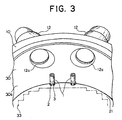
- Fig. 3 is a perspective view showing a region where the short members are mounted in the vicinity of the outlet nozzles.
- the short members 1 serving as the flow stabilizing members, respectively are disposed in the outer region extending outside of the fuel region in the proximity of the inner wall of the core barrel 30.
- the short member 1 is mounted on the upper core plate 21 within the upper plenum 40 in a region extending or located outside of the fuel assembly region 33 (indicated by a double-dotted broken line) at a position close to the inner wall 30a of the core barrel 30. It should, however, be noted that in practical applications, the short member 1 is mounted at a certain distance from the inner wall 30a of the core barrel 30 in consideration of the thermal expansion of the short member 1. Furthermore, the short member 1 is mounted so that the top end thereof is positioned lower than the lowermost portion of a coolant outlet 12a of the outlet nozzle 12. This arrangement is effective for stabilizing the flow of the coolant within the upper plenum 40 in the regions located below the outlets 12a of outlet nozzles 12 as well as for reducing the hydrodynamic load acting on the short members 1.
- the length of the flow stabilizing member 1 is selected so that the top end thereof is positioned lower than the lowermost portion of the outlet 12a of the outlet nozzle 12 when the flow stabilizing member 1 is mounted on the upper core plate 21. More specifically, the flow stabilizing member 1 should preferably be dimensioned so that the length thereof falls within a range of from a position midway between the upper surface of the upper core plate 21 and the lowermost portion of the outlet 12a of the outlet nozzle 12 to a position lower than the lowermost portion of the outlet 12a.
- the flow stabilizing member 1 should be so dimensioned that the length thereof falls within the range defined above.
- installation of the flow stabilizing member 1 can be realized by securing a bracket 2 which is fixed to the flow stabilizing member 1 onto the upper core plate 21 by means of bolts 3.
- the short length and ease of mounting of the flow stabilizing members on the upper core plate 21 can facilitate installation of the flow stabilizing members in existing equipment as well.
- Fig. 4 is a schematic top plan view of half of a nuclear reactor illustrating disposition of the internal structural members within the upper plenum 40 together with the flow of the coolant in the vicinity of the outlet nozzles 12, and Fig. 5 is a schematic side view showing behavior of the coolant flowing in the vicinity of adjacent outlet nozzles 12.
- the coolant flows radially outward along the upper surface of the upper core plate 21 from a center region of the core to reach the inner wall 30a of the core barrel 30, whereupon the coolant flows toward the outlet nozzles 12 along the inner wall 30a of the core barrel 30 in the region outside of the outer periphery of the core.
- a portion of the coolant or light water flowing along the inner wall 30a of the core barrel 30 flows below the outlet nozzle 12. Accordingly, when the short members 1 serving as the flow stabilizing members are not disposed, as in conventional reactors, streams of the coolant flowing in opposite directions collide with each other in a region between the adjacent outlet nozzles 12.
- the coolant flow entering the outlet nozzle 12 is stabilized, as a result of which temperature fluctuation of the coolant flowing through the outlet pipe 42 connected to the outlet nozzle 12 can be effectively suppressed.
- measurement of variation or fluctuation of the temperature within the outlet pipe 42 connected to the outlet nozzle 12 in a demonstration test simulating flow behavior of the outlet nozzle 12 and upper plenum 40 show that temperature fluctuation in the outlet pipe 42 of the reactor equipped with the flow stabilizing members 1 can be suppressed or reduced by approximately half when compared with the structure in which no flow stabilizing members 1 are employed.
- the flow stabilizing member 1 is implemented in a hollow cylindrical shape in view of the fact that the hollow cylindrical flow stabilizing member 1 can be manufactured with light weight and relatively low cost.
- the present invention is not restricted to a flow stabilizing member with such a shape.
- flow stabilizing members 1 with different structures such as a solid cylindrical or columnar structure, a plate-like structure, a prism structure or the like can be employed as well.
- a third embodiment of the present invention is directed to application of the flow stabilizing member to a nuclear reactor for a two- or three-loop plant.
- the disposition of the flow stabilizing member(s) according to the instant embodiment of the invention can be equally adopted in the four-loop reactor plant described above.
- Fig. 6 is a schematic top plan view showing an essential portion of the nuclear reactor for a three-loop plant, wherein some components are omitted from illustration
- Fig. 7 is a perspective view showing a region of the upper plenum in the vicinity of the outlet nozzles 12.
- the shape and the length of the flow stabilizing member 1 are essentially the same as those of the flow stabilizing member described hereinbefore. Accordingly, repeated description thereof will be unnecessary.
- the third embodiment of the invention differs from the preceding embodiments in that the outlet nozzles 12 are not disposed adjacent to each other.
- the flow stabilizing member 1 according to the third embodiment of the invention is disposed directly underneath a central portion of the outlet 12a of the outlet nozzle 12 in close proximity to the inner wall 30a of the core barrel 30.
- disposition of the flow stabilizing member in close proximity to the inner wall 30a of the core barrel 30 is very effective for reducing the hydrodynamic load applied to the flow stabilizing member 1 and also stabilizes flow of the coolant F in a space within the upper plenum 40 below the outlet nozzle 12.
- the flow stabilizing member 1 employed in the instant embodiment of the invention is installed underneath a center portion of the outlet of the outlet nozzle 12, it goes without saying that the flow stabilizing member 1 can be mounted at practically any position as long as the mounting position of the flow stabilizing member is covered by a region extending below and across the outlet nozzle 12. What is important is to avoid collision of the coolant streams in the vicinity of the region beneath the outlet nozzle 12, because then the flow of the coolant flowing into the outlet nozzle 12 can be stabilized.
- the flow stabilizing member 1 can be mounted at a position more or less deviated from a position underneath the center of the bore of the outlet nozzle 12 as long as the deviated position lies within the region extending beneath and across the outlet nozzle 12.
- the present invention can be applied to existing nuclear reactors without any appreciable difficulty.
Landscapes
- Physics & Mathematics (AREA)
- Engineering & Computer Science (AREA)
- Plasma & Fusion (AREA)
- General Engineering & Computer Science (AREA)
- High Energy & Nuclear Physics (AREA)
- Heat-Exchange Devices With Radiators And Conduit Assemblies (AREA)
- Monitoring And Testing Of Nuclear Reactors (AREA)
- Structure Of Emergency Protection For Nuclear Reactors (AREA)
- Heat Treatment Of Strip Materials And Filament Materials (AREA)
Claims (6)
- Cuve de réacteur nucléaire (10) comprenant :dans laquelle le courant de fluide caloporteur circule en des jets séparés qui se heurtent aux buses de sortie (12) ;une enveloppe de coeur suspendue (30) comprenant une zone de combustible (33) à travers laquelle circule un courant de réfrigèrent ; etune chambre supérieure de mise en pression (40) définie au-dessus de la zone de combustible (33) et qui est mise en communication hydraulique avec une pluralité de buses de sortie (12) montées sur une paroi latérale de la cuve du réacteur (10),
caractérisée en ce que la chambre supérieure de mise en pression (40) comprend également un élément de stabilisation de flux (1), l'élément de stabilisation de flux (1) comprenant un élément non perforé situé sur une plaque de coeur supérieure (21) au voisinage de l'enveloppe de coeur (30) et dans une zone à l'extérieur de ladite zone de combustible (33) et s'étendant à une hauteur inférieure à celle d'une buse parmi la pluralité de buses de sortie (12), moyennant quoi l'élément (1) est en outre positionné afin d'aider à maintenir la séparation des jets de réfrigèrent et, de ce fait, empêcher le heurt des jets aux buses de sortie (12). - Cuve de réacteur nucléaire selon la revendication 1, dans laquelle ledit élément de stabilisation de flux (1) est disposé en dessous d'une sortie (12a) de ladite buse de sortie (12).
- Cuve de réacteur nucléaire selon la revendication 2, dans laquelle ledit élément de stabilisation de flux (1) est disposé directement en dessous d'une partie centrale de ladite sortie (12a) de ladite buse de sortie (12).
- Cuve de réacteur nucléaire selon la revendication 2, dans laquelle ledit élément de stabilisation de flux (1) est disposé à des positions à mi-chemin entre deux buses de sortie (12) adjacentes.
- Cuve de réacteur nucléaire selon la revendication 3, dans laquelle ledit élément de stabilisation de flux (1) est dimensionné de façon à ce qu'une extrémité supérieure de celui-ci soit positionnée à un niveau de hauteur allant d'une position à mi-chemin entre une surface supérieure de ladite plaque de coeur supérieure (21) et une partie la plus basse de ladite sortie (12a) de ladite buse de sortie (12), jusqu'à une position inférieure à ladite partie la plus basse de ladite sortie (12a).
- Cuve de réacteur nucléaire selon la revendication 4 dans laquelle ledit petit élément de stabilisation de flux (1) est dimensionné de façon à ce qu'une extrémité supérieure de celui-ci soit positionnée à un niveau de hauteur allant d'une position à mi-chemin entre une surface supérieure de ladite plaque de coeur supérieure (21) et une partie la plus basse de ladite sortie (12a) de ladite buse de sortie (12), jusqu'à une position inférieure à ladite partie la plus basse de ladite sortie (12a).
Applications Claiming Priority (2)
| Application Number | Priority Date | Filing Date | Title |
|---|---|---|---|
| JP32075198A JP3316459B2 (ja) | 1998-11-11 | 1998-11-11 | 原子炉容器の炉内構造物 |
| JP32075198 | 1998-11-11 |
Publications (2)
| Publication Number | Publication Date |
|---|---|
| EP1003177A1 EP1003177A1 (fr) | 2000-05-24 |
| EP1003177B1 true EP1003177B1 (fr) | 2004-12-01 |
Family
ID=18124883
Family Applications (1)
| Application Number | Title | Priority Date | Filing Date |
|---|---|---|---|
| EP99308502A Expired - Lifetime EP1003177B1 (fr) | 1998-11-11 | 1999-10-27 | Structure interne d'un réacteur nucléaire comportant des moyens pour stabiliser le courant du réfrigérant |
Country Status (10)
| Country | Link |
|---|---|
| US (1) | US6445758B1 (fr) |
| EP (1) | EP1003177B1 (fr) |
| JP (1) | JP3316459B2 (fr) |
| KR (1) | KR100346126B1 (fr) |
| CN (1) | CN1163910C (fr) |
| DE (1) | DE69922321T2 (fr) |
| HU (1) | HU224776B1 (fr) |
| ID (1) | ID25739A (fr) |
| TR (1) | TR199902756A2 (fr) |
| TW (1) | TW421805B (fr) |
Families Citing this family (11)
| Publication number | Priority date | Publication date | Assignee | Title |
|---|---|---|---|---|
| CN1089597C (zh) * | 1998-04-01 | 2002-08-28 | 王新岭 | 一种治疗银屑病的中药制剂及其制备方法 |
| US20040096026A1 (en) * | 2002-11-18 | 2004-05-20 | Hwang Choe | Apparatus and methods for optimizing reactor core coolant flow distributions |
| US20100293947A1 (en) * | 2007-04-18 | 2010-11-25 | Jiubin Chen | Nuclear Reactor |
| JP2012013436A (ja) * | 2010-06-29 | 2012-01-19 | Mitsubishi Heavy Ind Ltd | 圧損調節部材設置用工具 |
| EP2654043A4 (fr) | 2010-12-13 | 2016-05-11 | Toshiba Kk | Réacteur à eau sous pression |
| CN103377735B (zh) * | 2012-04-27 | 2016-08-03 | 上海核工程研究设计院 | 一种反应堆下部堆内构件 |
| JP6560861B2 (ja) * | 2014-12-15 | 2019-08-14 | 株式会社日立製作所 | 燃料集合体 |
| CN104882183B (zh) * | 2015-04-09 | 2017-10-24 | 中国核动力研究设计院 | 压水堆堆芯流量分区方法 |
| FR3068821B1 (fr) | 2017-07-06 | 2020-08-28 | Electricite De France | Plot de centrage d'un coeur de centrale nucleaire pour cuves de reacteurs |
| CN110217948B (zh) * | 2019-07-10 | 2022-07-08 | 大连民族大学 | 一种导流筒环流反应器 |
| CN111681786B (zh) * | 2020-06-23 | 2022-12-30 | 中国科学院上海应用物理研究所 | 一种反应堆容器的下腔室结构及反应堆容器 |
Citations (1)
| Publication number | Priority date | Publication date | Assignee | Title |
|---|---|---|---|---|
| EP1005047A2 (fr) * | 1998-10-15 | 2000-05-31 | Mitsubishi Heavy Industries, Ltd. | Appareil pour augmenter le taux de melange des courants du caloporteur chauffé dans un réacteur nucléaire |
Family Cites Families (15)
| Publication number | Priority date | Publication date | Assignee | Title |
|---|---|---|---|---|
| US3623948A (en) * | 1968-04-25 | 1971-11-30 | Babcock & Wilcox Co | Pressurized-water nuclear reactor |
| US3660231A (en) * | 1968-11-26 | 1972-05-02 | Gen Electric | Steam cooled nuclear reactor |
| US3864209A (en) * | 1970-04-21 | 1975-02-04 | Westinghouse Electric Corp | Inlet flow oscillation damper for a nuclear reactor |
| FR2214938B1 (fr) | 1973-01-23 | 1976-05-14 | Commissariat Energie Atomique | |
| US4187147A (en) * | 1976-02-20 | 1980-02-05 | Westinghouse Electric Corp. | Recirculation system for nuclear reactors |
| JPS5837594A (ja) * | 1981-08-31 | 1983-03-04 | 株式会社東芝 | 沸騰水形原子炉の給水スパ−ジヤ |
| US4793966A (en) * | 1983-04-29 | 1988-12-27 | Westinghouse Electric Corp. | Nuclear reactor |
| US4788033A (en) * | 1983-04-29 | 1988-11-29 | Westinghouse Electric Corp. | Calandria |
| US4681728A (en) | 1985-03-22 | 1987-07-21 | Westinghouse Electric Corp. | Nuclear reactor |
| FR2596563B1 (fr) * | 1986-04-01 | 1990-12-21 | Framatome Sa | Reacteur nucleaire a guidage d'ecoulement dans les equipements internes superieurs |
| US4947485A (en) | 1989-07-24 | 1990-08-07 | General Electric Company | Method for obtaining load-following capability in natural circulation, free-surface separation boiling water reactors |
| US5106573A (en) | 1991-03-11 | 1992-04-21 | General Electric Company | BWR Natural steam separator |
| US5553107A (en) * | 1995-01-30 | 1996-09-03 | Westinghouse Electric Corporation | Pressurized water reactor vessel with slotted support columns |
| JPH0972985A (ja) | 1995-09-04 | 1997-03-18 | Mitsubishi Heavy Ind Ltd | 竪型熱交換器の被加熱流体混合促進構造 |
| JPH09197087A (ja) | 1996-01-12 | 1997-07-31 | Mitsubishi Heavy Ind Ltd | 加圧水型原子炉 |
-
1998
- 1998-11-11 JP JP32075198A patent/JP3316459B2/ja not_active Expired - Lifetime
-
1999
- 1999-05-21 KR KR1019990018480A patent/KR100346126B1/ko not_active Expired - Lifetime
- 1999-05-31 TW TW088108996A patent/TW421805B/zh not_active IP Right Cessation
- 1999-10-13 US US09/416,933 patent/US6445758B1/en not_active Expired - Lifetime
- 1999-10-13 HU HU9903572A patent/HU224776B1/hu not_active IP Right Cessation
- 1999-10-18 ID IDP990964D patent/ID25739A/id unknown
- 1999-10-27 EP EP99308502A patent/EP1003177B1/fr not_active Expired - Lifetime
- 1999-10-27 DE DE69922321T patent/DE69922321T2/de not_active Expired - Lifetime
- 1999-11-09 TR TR1999/02756A patent/TR199902756A2/xx unknown
- 1999-11-11 CN CNB991234618A patent/CN1163910C/zh not_active Expired - Lifetime
Patent Citations (1)
| Publication number | Priority date | Publication date | Assignee | Title |
|---|---|---|---|---|
| EP1005047A2 (fr) * | 1998-10-15 | 2000-05-31 | Mitsubishi Heavy Industries, Ltd. | Appareil pour augmenter le taux de melange des courants du caloporteur chauffé dans un réacteur nucléaire |
Also Published As
| Publication number | Publication date |
|---|---|
| HUP9903572A2 (hu) | 2001-06-28 |
| CN1253362A (zh) | 2000-05-17 |
| HU9903572D0 (en) | 1999-12-28 |
| TR199902756A3 (tr) | 2000-06-21 |
| DE69922321D1 (de) | 2005-01-05 |
| ID25739A (id) | 2000-11-02 |
| JP2000147179A (ja) | 2000-05-26 |
| US6445758B1 (en) | 2002-09-03 |
| EP1003177A1 (fr) | 2000-05-24 |
| CN1163910C (zh) | 2004-08-25 |
| KR100346126B1 (ko) | 2002-07-22 |
| HU224776B1 (en) | 2006-02-28 |
| TW421805B (en) | 2001-02-11 |
| KR20000034853A (ko) | 2000-06-26 |
| TR199902756A2 (xx) | 2000-06-21 |
| DE69922321T2 (de) | 2005-05-04 |
| JP3316459B2 (ja) | 2002-08-19 |
| HUP9903572A3 (en) | 2003-02-28 |
Similar Documents
| Publication | Publication Date | Title |
|---|---|---|
| EP2111622B1 (fr) | Appareil de jupe de flux de réacteur d'eau sous pression | |
| US8064564B2 (en) | Neutron shielding panels for reactor pressure vessels | |
| EP1003177B1 (fr) | Structure interne d'un réacteur nucléaire comportant des moyens pour stabiliser le courant du réfrigérant | |
| KR101129735B1 (ko) | 원자로 | |
| SE503854C2 (sv) | Kärnbränsleaggregat med stor kylmdelsförande tub | |
| EP3127122B1 (fr) | Ensemble combustible nucléaire à faible chute de pression | |
| JPS5829879B2 (ja) | 原子炉 | |
| US4716012A (en) | Reactor internals loose parts strainer | |
| EP0212257A1 (fr) | Agencement du coeur d'un réacteur nucléaire avec un réflecteur neutronique | |
| US5572560A (en) | BWR fuel assembly having fuel rods with variable fuel rod pitches | |
| US5857006A (en) | Chimney for enhancing flow of coolant water in natural circulation boiling water reactor | |
| JPH05215877A (ja) | 沸騰水型原子炉の炉心 | |
| EP0994488A1 (fr) | Equipement de support supérieur de coeur pour réacteur nucléaire muni d'un dispositif tranquilliseur d'écoulement de fluide | |
| JPH05157867A (ja) | 燃料集合体 | |
| US6173028B1 (en) | Apparatus for promoting intermixing of heated coolant streams in nuclear reactor | |
| JP4392412B2 (ja) | 流路形成装置、および自然循環型沸騰水型原子炉 | |
| JP2004219133A (ja) | 沸騰水型原子炉の炉心 | |
| WO2025046645A1 (fr) | Séparateur gaz-eau et réacteur nucléaire à eau bouillante | |
| JPH0972985A (ja) | 竪型熱交換器の被加熱流体混合促進構造 | |
| JPS61213791A (ja) | 原子炉 | |
| JPH0333688A (ja) | 沸騰水型原子炉 | |
| JPS6311893A (ja) | 原子炉の炉内上部構造 |
Legal Events
| Date | Code | Title | Description |
|---|---|---|---|
| PUAI | Public reference made under article 153(3) epc to a published international application that has entered the european phase |
Free format text: ORIGINAL CODE: 0009012 |
|
| AK | Designated contracting states |
Kind code of ref document: A1 Designated state(s): DE FR GB |
|
| AX | Request for extension of the european patent |
Free format text: AL;LT;LV;MK;RO;SI |
|
| 17P | Request for examination filed |
Effective date: 20001121 |
|
| AKX | Designation fees paid |
Free format text: DE FR GB |
|
| 17Q | First examination report despatched |
Effective date: 20030212 |
|
| GRAP | Despatch of communication of intention to grant a patent |
Free format text: ORIGINAL CODE: EPIDOSNIGR1 |
|
| GRAS | Grant fee paid |
Free format text: ORIGINAL CODE: EPIDOSNIGR3 |
|
| GRAA | (expected) grant |
Free format text: ORIGINAL CODE: 0009210 |
|
| AK | Designated contracting states |
Kind code of ref document: B1 Designated state(s): DE FR GB |
|
| REG | Reference to a national code |
Ref country code: GB Ref legal event code: FG4D |
|
| RIN1 | Information on inventor provided before grant (corrected) |
Inventor name: ICHIKAWA, TOSHIO,MITSUBISHI HEAVY IND. LTD. Inventor name: KURIHARA, MIKIO,MITSUBISHI HEAVY IND. LTD. Inventor name: KUBO, NOBORU,C/O KOBE SHIPYARD&MACH. WORKS Inventor name: TSUTSUI, TAKEHIKO,C/O KOBE SHIPYARD&MACH.WORKS Inventor name: KURIMURA, CHIKARA,C/O KOBE SHIPYARD&MACH.WORKS Inventor name: NAKAJIMA, MAKOTO,C/O KOBE SHIPYARD&MACH.WORKS Inventor name: IZUMI, HAJIME,C/O TAKASAGO RES.&DEV. CENTER |
|
| REF | Corresponds to: |
Ref document number: 69922321 Country of ref document: DE Date of ref document: 20050105 Kind code of ref document: P |
|
| PLBE | No opposition filed within time limit |
Free format text: ORIGINAL CODE: 0009261 |
|
| STAA | Information on the status of an ep patent application or granted ep patent |
Free format text: STATUS: NO OPPOSITION FILED WITHIN TIME LIMIT |
|
| ET | Fr: translation filed | ||
| 26N | No opposition filed |
Effective date: 20050902 |
|
| REG | Reference to a national code |
Ref country code: FR Ref legal event code: PLFP Year of fee payment: 18 |
|
| REG | Reference to a national code |
Ref country code: FR Ref legal event code: PLFP Year of fee payment: 19 |
|
| REG | Reference to a national code |
Ref country code: FR Ref legal event code: PLFP Year of fee payment: 20 |
|
| PGFP | Annual fee paid to national office [announced via postgrant information from national office to epo] |
Ref country code: FR Payment date: 20180913 Year of fee payment: 20 |
|
| PGFP | Annual fee paid to national office [announced via postgrant information from national office to epo] |
Ref country code: DE Payment date: 20181016 Year of fee payment: 20 |
|
| PGFP | Annual fee paid to national office [announced via postgrant information from national office to epo] |
Ref country code: GB Payment date: 20181024 Year of fee payment: 20 |
|
| REG | Reference to a national code |
Ref country code: DE Ref legal event code: R071 Ref document number: 69922321 Country of ref document: DE |
|
| REG | Reference to a national code |
Ref country code: GB Ref legal event code: PE20 Expiry date: 20191026 |
|
| PG25 | Lapsed in a contracting state [announced via postgrant information from national office to epo] |
Ref country code: GB Free format text: LAPSE BECAUSE OF EXPIRATION OF PROTECTION Effective date: 20191026 |