EP1003351A2 - Résistance chauffante pour éléments chauffants céramiques,éléments chauffants et méthode de fabrication des éléments chauffants céramiques - Google Patents
Résistance chauffante pour éléments chauffants céramiques,éléments chauffants et méthode de fabrication des éléments chauffants céramiques Download PDFInfo
- Publication number
- EP1003351A2 EP1003351A2 EP99309134A EP99309134A EP1003351A2 EP 1003351 A2 EP1003351 A2 EP 1003351A2 EP 99309134 A EP99309134 A EP 99309134A EP 99309134 A EP99309134 A EP 99309134A EP 1003351 A2 EP1003351 A2 EP 1003351A2
- Authority
- EP
- European Patent Office
- Prior art keywords
- heating resistor
- ceramic
- ceramic heater
- heating
- adjusting
- Prior art date
- Legal status (The legal status is an assumption and is not a legal conclusion. Google has not performed a legal analysis and makes no representation as to the accuracy of the status listed.)
- Granted
Links
- 239000000919 ceramic Substances 0.000 title claims abstract description 125
- 238000010438 heat treatment Methods 0.000 title claims abstract description 104
- 238000004519 manufacturing process Methods 0.000 title claims description 17
- 239000002994 raw material Substances 0.000 claims description 45
- 229910052751 metal Inorganic materials 0.000 claims description 30
- 229910052720 vanadium Inorganic materials 0.000 claims description 19
- 229910052804 chromium Inorganic materials 0.000 claims description 18
- 229910052719 titanium Inorganic materials 0.000 claims description 18
- 229910052750 molybdenum Inorganic materials 0.000 claims description 17
- 229910052758 niobium Inorganic materials 0.000 claims description 17
- 229910052726 zirconium Inorganic materials 0.000 claims description 17
- 239000013078 crystal Substances 0.000 claims description 16
- 229910052735 hafnium Inorganic materials 0.000 claims description 16
- 229910052715 tantalum Inorganic materials 0.000 claims description 16
- 150000004767 nitrides Chemical class 0.000 claims description 15
- 229910021332 silicide Inorganic materials 0.000 claims description 14
- FVBUAEGBCNSCDD-UHFFFAOYSA-N silicide(4-) Chemical compound [Si-4] FVBUAEGBCNSCDD-UHFFFAOYSA-N 0.000 claims description 13
- 229910052721 tungsten Inorganic materials 0.000 claims description 13
- 150000001875 compounds Chemical class 0.000 claims description 11
- 239000012254 powdered material Substances 0.000 claims description 8
- 238000000034 method Methods 0.000 claims description 6
- 238000002156 mixing Methods 0.000 claims description 6
- 239000000203 mixture Substances 0.000 claims description 5
- 238000000465 moulding Methods 0.000 claims description 4
- 239000006104 solid solution Substances 0.000 claims description 3
- 239000007787 solid Substances 0.000 abstract description 15
- 239000000463 material Substances 0.000 abstract description 11
- 229910052581 Si3N4 Inorganic materials 0.000 description 23
- 239000000843 powder Substances 0.000 description 20
- HQVNEWCFYHHQES-UHFFFAOYSA-N silicon nitride Chemical compound N12[Si]34N5[Si]62N3[Si]51N64 HQVNEWCFYHHQES-UHFFFAOYSA-N 0.000 description 18
- 238000005452 bending Methods 0.000 description 14
- 238000005245 sintering Methods 0.000 description 13
- ATJFFYVFTNAWJD-UHFFFAOYSA-N Tin Chemical compound [Sn] ATJFFYVFTNAWJD-UHFFFAOYSA-N 0.000 description 8
- QDOXWKRWXJOMAK-UHFFFAOYSA-N dichromium trioxide Chemical compound O=[Cr]O[Cr]=O QDOXWKRWXJOMAK-UHFFFAOYSA-N 0.000 description 8
- 229910020968 MoSi2 Inorganic materials 0.000 description 5
- 230000003247 decreasing effect Effects 0.000 description 5
- 239000011230 binding agent Substances 0.000 description 4
- 239000011812 mixed powder Substances 0.000 description 4
- 239000000126 substance Substances 0.000 description 4
- 229910003470 tongbaite Inorganic materials 0.000 description 4
- 230000000694 effects Effects 0.000 description 3
- 238000001746 injection moulding Methods 0.000 description 3
- 238000009413 insulation Methods 0.000 description 3
- 238000002844 melting Methods 0.000 description 3
- 230000008018 melting Effects 0.000 description 3
- 150000001247 metal acetylides Chemical class 0.000 description 3
- QYEXBYZXHDUPRC-UHFFFAOYSA-N B#[Ti]#B Chemical compound B#[Ti]#B QYEXBYZXHDUPRC-UHFFFAOYSA-N 0.000 description 2
- 229910019912 CrN Inorganic materials 0.000 description 2
- 229910052691 Erbium Inorganic materials 0.000 description 2
- 229910015173 MoB2 Inorganic materials 0.000 description 2
- 229910033181 TiB2 Inorganic materials 0.000 description 2
- 229910052769 Ytterbium Inorganic materials 0.000 description 2
- 230000000052 comparative effect Effects 0.000 description 2
- 238000001035 drying Methods 0.000 description 2
- 238000011156 evaluation Methods 0.000 description 2
- 230000001747 exhibiting effect Effects 0.000 description 2
- 230000001788 irregular Effects 0.000 description 2
- 238000004898 kneading Methods 0.000 description 2
- ZKATWMILCYLAPD-UHFFFAOYSA-N niobium pentoxide Chemical compound O=[Nb](=O)O[Nb](=O)=O ZKATWMILCYLAPD-UHFFFAOYSA-N 0.000 description 2
- 230000000630 rising effect Effects 0.000 description 2
- 230000035939 shock Effects 0.000 description 2
- 239000007921 spray Substances 0.000 description 2
- 229910052727 yttrium Inorganic materials 0.000 description 2
- OKTJSMMVPCPJKN-UHFFFAOYSA-N Carbon Chemical compound [C] OKTJSMMVPCPJKN-UHFFFAOYSA-N 0.000 description 1
- 229910052692 Dysprosium Inorganic materials 0.000 description 1
- 229910015503 Mo5Si3 Inorganic materials 0.000 description 1
- 239000000654 additive Substances 0.000 description 1
- 230000000996 additive effect Effects 0.000 description 1
- PNEYBMLMFCGWSK-UHFFFAOYSA-N aluminium oxide Inorganic materials [O-2].[O-2].[O-2].[Al+3].[Al+3] PNEYBMLMFCGWSK-UHFFFAOYSA-N 0.000 description 1
- 229910052799 carbon Inorganic materials 0.000 description 1
- 239000002131 composite material Substances 0.000 description 1
- PMHQVHHXPFUNSP-UHFFFAOYSA-M copper(1+);methylsulfanylmethane;bromide Chemical compound Br[Cu].CSC PMHQVHHXPFUNSP-UHFFFAOYSA-M 0.000 description 1
- VQCBHWLJZDBHOS-UHFFFAOYSA-N erbium(III) oxide Inorganic materials O=[Er]O[Er]=O VQCBHWLJZDBHOS-UHFFFAOYSA-N 0.000 description 1
- 238000005469 granulation Methods 0.000 description 1
- 230000003179 granulation Effects 0.000 description 1
- 238000007731 hot pressing Methods 0.000 description 1
- 239000002184 metal Substances 0.000 description 1
- 150000002739 metals Chemical class 0.000 description 1
- 239000008188 pellet Substances 0.000 description 1
- 238000013001 point bending Methods 0.000 description 1
- 229910001404 rare earth metal oxide Inorganic materials 0.000 description 1
- 229920006395 saturated elastomer Polymers 0.000 description 1
- FIXNOXLJNSSSLJ-UHFFFAOYSA-N ytterbium(III) oxide Inorganic materials O=[Yb]O[Yb]=O FIXNOXLJNSSSLJ-UHFFFAOYSA-N 0.000 description 1
Images
Classifications
-
- H—ELECTRICITY
- H05—ELECTRIC TECHNIQUES NOT OTHERWISE PROVIDED FOR
- H05B—ELECTRIC HEATING; ELECTRIC LIGHT SOURCES NOT OTHERWISE PROVIDED FOR; CIRCUIT ARRANGEMENTS FOR ELECTRIC LIGHT SOURCES, IN GENERAL
- H05B3/00—Ohmic-resistance heating
- H05B3/10—Heating elements characterised by the composition or nature of the materials or by the arrangement of the conductor
- H05B3/12—Heating elements characterised by the composition or nature of the materials or by the arrangement of the conductor characterised by the composition or nature of the conductive material
- H05B3/14—Heating elements characterised by the composition or nature of the materials or by the arrangement of the conductor characterised by the composition or nature of the conductive material the material being non-metallic
- H05B3/141—Conductive ceramics, e.g. metal oxides, metal carbides, barium titanate, ferrites, zirconia, vitrous compounds
-
- H—ELECTRICITY
- H05—ELECTRIC TECHNIQUES NOT OTHERWISE PROVIDED FOR
- H05B—ELECTRIC HEATING; ELECTRIC LIGHT SOURCES NOT OTHERWISE PROVIDED FOR; CIRCUIT ARRANGEMENTS FOR ELECTRIC LIGHT SOURCES, IN GENERAL
- H05B3/00—Ohmic-resistance heating
- H05B3/10—Heating elements characterised by the composition or nature of the materials or by the arrangement of the conductor
- H05B3/12—Heating elements characterised by the composition or nature of the materials or by the arrangement of the conductor characterised by the composition or nature of the conductive material
- H05B3/14—Heating elements characterised by the composition or nature of the materials or by the arrangement of the conductor characterised by the composition or nature of the conductive material the material being non-metallic
- H05B3/148—Silicon, e.g. silicon carbide, magnesium silicide, heating transistors or diodes
-
- H—ELECTRICITY
- H05—ELECTRIC TECHNIQUES NOT OTHERWISE PROVIDED FOR
- H05B—ELECTRIC HEATING; ELECTRIC LIGHT SOURCES NOT OTHERWISE PROVIDED FOR; CIRCUIT ARRANGEMENTS FOR ELECTRIC LIGHT SOURCES, IN GENERAL
- H05B2203/00—Aspects relating to Ohmic resistive heating covered by group H05B3/00
- H05B2203/018—Heaters using heating elements comprising mosi2
-
- H—ELECTRICITY
- H05—ELECTRIC TECHNIQUES NOT OTHERWISE PROVIDED FOR
- H05B—ELECTRIC HEATING; ELECTRIC LIGHT SOURCES NOT OTHERWISE PROVIDED FOR; CIRCUIT ARRANGEMENTS FOR ELECTRIC LIGHT SOURCES, IN GENERAL
- H05B2203/00—Aspects relating to Ohmic resistive heating covered by group H05B3/00
- H05B2203/027—Heaters specially adapted for glow plug igniters
-
- Y—GENERAL TAGGING OF NEW TECHNOLOGICAL DEVELOPMENTS; GENERAL TAGGING OF CROSS-SECTIONAL TECHNOLOGIES SPANNING OVER SEVERAL SECTIONS OF THE IPC; TECHNICAL SUBJECTS COVERED BY FORMER USPC CROSS-REFERENCE ART COLLECTIONS [XRACs] AND DIGESTS
- Y10—TECHNICAL SUBJECTS COVERED BY FORMER USPC
- Y10T—TECHNICAL SUBJECTS COVERED BY FORMER US CLASSIFICATION
- Y10T29/00—Metal working
- Y10T29/49—Method of mechanical manufacture
- Y10T29/49002—Electrical device making
- Y10T29/49082—Resistor making
- Y10T29/49083—Heater type
Definitions
- the present invention relates to an heating resistor for ceramic heaters, ceramic heaters and a method of manufacturing ceramic heaters, and particularly to a heating resistor for ceramic heaters to used for heating glow plugs of a diesel engine or others, ceramic heaters employing the same, and a method of manufacturing the ceramic heaters.
- a heating resistor for ceramic heaters contains an electric conductive element composed of at least one kind of silicide, carbide, and nitride of one kind or more selected from W, Ta, Nb, Ti, Mo, Zr, Hf, V and Cr and an adjusting element made at least part thereof solid in the electric conductive element for changing resistance temperature coefficient of the heating resistor for the ceramic heater.
- a ceramic heater of the first embodiment has a ceramic base and the heating resistor for the ceramic heater of the first embodiment to be disposed in the ceramic base.
- the ceramic heater of the first embodiment can have a compound member including a heating part composed of the heating resistor for the ceramic heater and a control resistor formed in at least one side of the heating part.
- the electric conductive element it is possible to select one kind or two kinds or more of silicide, carbide and nitride of one kind or more selected from metallic elements shown inW, Ta, Nb, Ti, Mo, Zr, Hf, V and Cr.
- the ceramic sensor of the present invention is produced by baking at high temperature, the better the higher their melting points. For example, there may be WC, TiN, or MoSi 2 .
- the adjusting element is sufficient with such a metallic element in which if it is made solid in the electric conductive element, the resistance temperature coefficient of the heating resistor for the ceramic heater (called briefly as “heating resistor” hereafter) may be changed, not defining any special limitation.
- this adjusting element is a metallic element can be one kind or two kinds or more selected from W, Ta, Nb, Ti, Mo, Zr, Hf, V and Cr.
- V or Cr is desirous, and the metallic elements composing the conductive element are excepted.
- the ceramic element contained in the heating resistor for the ceramic heater or the ceramic element composing the ceramic base are variously selected in view of purposes, and ordinarily the ceramics of silicon nitride quality are used.
- elements containing mainly silicon nitride are broadly included, and the main element is not limited to silicon nitride.
- control resistor has properties different from the heating part composed of the heating resistor (rising temperature property or electric conductive property), for example, differing kinds or containing rates in the electric conductive element and/or the adjusting element.
- such control resistors may be enumerated, in which a conductive element composing the heating part and another conductive element composing the control resistor are the same kind, and the control resistor has different containing rate in the adjusting element.
- the method of manufacturing the ceramic heater according to the first embodiment includes the steps of mixing raw materials for electric conductive element composed of at least one kind of silicide, carbide, and nitride of one kind or more selected from W, Ta, Nb, Ti, Mo, Zr, Hf, V and Cr and raw materials for an adjusting element to be made solid as the adjusting element after baking, molding the mixture, burying this molded body in ceramic powdered materials, and baking it.
- the ceramic powdered materials buried therein with the molded body are molded as one body to be a ceramic molded body, and this molded body is baked.
- the raw materials for the electric conductive element to be used to this method are one kind or two kinds or more of silicide, carbide and nitride of one kind or more selected from W, Ta, Nb, Ti, Mo, Zr, Hf, V and Cr.
- WC powders, TiN powders or MoSi 2 powders are preferable.
- the raw material for the adjusting element to be used in the inventive method is sufficient with raw materials adjusting the resistance temperature coefficient in the heating resistor for the ceramic after sintering.
- raw materials are one kind or more of carbide, oxide, nitride and silicide of metallic elements of one or more of metallic elements different from metallic elements contained in the electric conductive element among W, V, Ti, Mo and Cr.
- the materials containing metallic elements composing the heating resistor are excepted. Boride (W 2 B 5 , TiB 2 , MoB, Mo 2 B, MoB 2 , or CrB) may be selected.
- kinds of the ceramic powdered materials buried therein with desired molded bodies may be selected in view of purposes, and ordinarily ceramic powdered materials of silicon nitride quality are employed.
- Substances of silicon nitride being main are broadly contained in this silicon nitride quality, not limiting to silicon nitride.
- Shapes of these raw materials are not specially limited and may be merely powdered, granulated or pulverized, and grain diameters are not specially limited.
- the adjusting element In the heating resistor for ceramic heaters, parts or all of the adjusting element are made solid in crystal grains of the conductive element e.g. in the form of a solid solution.
- the amount of the adjusting element contained in the ceramic heaters and accordingly the amount of the adjusting element made solid are increased. Following this increasing, the resistance temperature coefficients are small (see Table 2).
- the resistance temperature coefficient of the heating resistor can be optionally determined.
- the adjusting element is not only made solid in the crystal grains of the conductive element, but also partially segregated as various compounds in grain boundary phases. It is assumed that the adjusting element segregated in the grain boundary gives influences to changes of the resistance temperature coefficient of the heating element, but large influences to an extent of being made solid will not be generated.
- the adjusting element can bring about large effects at a small amount of addition, it is assumed that the addition of the adjusting element gives little bad influences to properties other than the resistance temperature coefficient of the heating resistor (for example, strength, durability, thermal shock resistance and adherence).
- the predetermined raw materials for the conductive element, the insulation raw material (Si 3 N 4 powder), the sintering assistant and the raw materials for the adjusting element of a predetermined amount were added (the volume ratio of the raw materials for the conductive element and the raw materials for insulation was 20:80, and concerning the adjusting element, see Table 1). They were wet-mixed for 72 hours. Then, the mixed powders were produced by drying. The powders and molding assistant binder were thrown into a kneading machine and mixed for 4 hours.
- the sintering assistant powders (about 6%) was mixed into Si 3 N 4 powders, wet-mixed for 40 hours, and granulated by a spray dryer. Then, the unsintered heater main body was buried in the granulated product charged into a predetermined mold and pressed all over them to turn out unsintered ceramic heaters. Then, the unsintered ceramic heater was temporarily baked at 600°C for about 2 hours to remove the binder and hot-press-baked at 1800°C, 300kgf/cm 2 and for 60 minutes to turn out ceramic heaters.
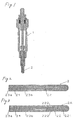
- a ceramic heater 2 which is manufactured by the manufacturing method of this embodiment is shown in Fig.2.
- a glow plug 1 employing the ceramic heater 2 is shown in Fig.1.
- the glow plug 1 is furnished with the ceramic heater 2 at a front end being a heating position, and the ceramic heater comprises the base 21, heating resistor 22 and electric supplies 23a, 23b.
- the base 21 is the ceramics of main Si 3 N 4 for protecting the heating resistor 22 and the electric supplies 23a, 23b to be buried.
- the heating resistor 22 is a U-shaped bar disposed in the base 21, and further contains the adjusting element for adjusting the conductive element other than the conductive element as the main ceramics.
- Each one ends of the electric supplies 23a, 23b are, as shown in Fig.2, disposed at the surface of the base 21, and the other ends are connected to each ends of the heating resistor 22, so that the power supplied outside of the ceramic heater 2 can be supplied to the heating resistor 22 in the base 11.
- the resistance temperature coefficients were studied and results are shown in Table 1.
- the mixing percent of the raw materials for the adjusting elements was the mixing amount when both raw materials for the conductive elements and the adjusting elements were 100 weight parts in total, referring to as "wt%" hereafter.
- the containing rate of the adjusting elements contained in the sintered body, i.e., the heating resistor is substantially the same as the percents in Table 1.
- the average grain diameters of the raw materials for the conductive elements and the adjusting elements are as follows.
- WC 1 ⁇ m
- TiN 1 ⁇ m
- VC 1 ⁇ m
- V 2 O 5 2 ⁇ m
- VN 3 ⁇ m
- Cr 3 C 2 2 ⁇ m
- Cr 2 O 3 1 ⁇ m
- CrN 3 ⁇ m
- the resistance temperature coefficients of the ceramic heater were ratios of the resistant values at 25°C and the resistant values at 1000°C.
- the resistant values were measured as follows. Namely, conditions were prepared in that the electric conduction was kept for 3 minutes or more under a state where the voltage was adjusted such that a highest temperature portion of the ceramic heater would be 1000°C, and the resistant value at 1000°C was calculated from the voltage and the current value when being stable.
- the resistant value at 25°C was obtained by an ohmmeter.
- the resistance temperature coefficients can be varied over wide ranges from the coefficient of 3.45 without containing the adjusting element to the coefficient of 3.16 with containing VC lwt% (that is, the adjusting element V is lwt%). Since the addition amount at this time is low as lwt% at maximum, large influences are not given to the properties of the heating resistor. It is seen that as the containing amount (addition amount) is increased, the resistance temperature coefficient is decreased in reverse proportion.
- the elements can be varied within the inventive ranges in response to purposes or uses. That is, as the electric conductive element and the adjusting element materials, not only the metallic elements shown in Table 1 but also other metallic elements may be used. Further, as the raw materials for the adjusting element, a metallic simple substance can be used other than the ceramic compounds of carbides.
- a double frame ceramic heater 2A as shown in Fig.3 in which the heating resistor 22 is divided into a heating part 221 and a control resistor 222, and if resistance temperature property of the heating part 221 is made large and the control resistor 222 is made low resistance, it is possible to produce such a ceramic heater of low consumption power where heating is lowered in the vicinity of requiring no heating and the heating is generated concentrically at the front end requiring the heating. It is possible to produce a further ceramic heater that the heating part 221 and the control resistor 222 are exchanged to enlarge a heating range (heating volume).
- the electric conductive element may be used in common, and if changing respectively the content ratios of the adjusting elements, different resistance temperature coefficient may be available in the heating part 221 and the control resistor 222.
- such a double frame ceramic heater 2A may be enumerated, in which WC is used to the conductive elements of the heating part 221 and the control resister 222, and the adjusting element is not contained in the heating part 221 and VC of 0.5wt% is contained in the control resistor 222.
- difference of 0.14 occurs in the resistance temperature coefficient, and when it is at high temperature, since the heating part 221 has higher resistance than that of the control resistor 222, the heating part 221 mainly issues heating.
- the electric conductive element is used in common between the heating part 221 and the control resistor 222 and the only containing ratio of the adjusting elements is changed, deviations of the respective baking conditions may be decreased.
- the same kind of the raw materials for the electric conductivity and for the adjusting material is used to form as one body, so that the adherence can be heightened and breakage at grain boundary can be avoided.
- the ceramic heater of the desired heating properties may be produced, not largely changing other properties of the heating resistor but changing the resistance temperature coefficient.
- the double frame ceramic heater deviations of the baking conditions may be made little, and it is possible to increase the adherence and prevent breakage at grain boundary. Further, the useful ceramic heater can be made easily and securely.
- a heating resistor for ceramic heaters according to a second embodiment composed of the sintered body contains an electric conductive element composed of at least one kind of carbide, nitride and silicide of one kind or more selected from W, Ta, Nb, Ti, Mo, Zr, Hf, V and Cr and an adjusting element made partially solid in the electric conductive element for changing resistance temperature coefficient of the heating resistor, wherein when an total of the electric conductive element and the adjusting element is 100wt%, the adjusting element is 0.1 to 5.0wt%, and the average diameter of crystal grains of the electric conductive element composing the heating resistor is 11 ⁇ m or less.
- the average diameter of crystal grains of the electric conductive element is 0.5 ⁇ m or more.
- a ceramic heater according to the second embodiment has a ceramic base and the heating resistor for the ceramic heater of the second embodiment.
- the electric conductive element it is possible to select one kind or two kinds or more of silicide, carbide and nitride of one kind or more selected from metallic elements shown in W, Ta, Nb, Ti, Mo, Zr, Hf, V and Cr.
- An average grain diameter of crystal grains of the electric conductive element in the sintered body is 11 ⁇ m or less (especially preferably 10 ⁇ m or less, and more preferably 9.5 ⁇ m). Because, if exceeding llpm, it is difficult to get enough anti-bending strength, and electric conduction durability is deteriorated. By changing the grain diameter, the resistance temperature coefficient may be appropriately changed.
- the adjusting element is sufficient with such metallic elements in which if at least its part is made solid in the electric conductive element, the resistance temperature coefficient of the heating resistor may be changed, not defining any special limitation.
- a metallic element may be taken up which is at least one kind of W, Ta, Nb, Ti, Mo, Zr, Hf, V and Cr, and is different from the metallic elements contained in the conductive element.
- V, Cr, Nb and Ta are desirous.
- the containing rate of the adjusting element is 0.1 to 5.0wt% (in this case, called merely as "%", preferably 0.2 to 5% and more preferably 0.2 to 4.5%). If the adjusting element is contained less than 0.1%, the sintering property of materials of the resistor is severely irregular when baking, easily causing insufficient sintering or reversely growth of oversized grains so that properties of strength and electric conductance durability are decreased, and if the adjusting element is contained more than 5.0%, the lowering of heat resistance or the increasing thermal expansion of the heating resistor are brought about so that the electric conductive durability is undesirably lowered.
- the ceramic element contained in the heating resistor or the ceramic element for composing the base may be selected in view of purposes, for example, the silicon nitride quality, alumina or aluminum nitride may be selected. In them, the silicon nitride quality is preferable. In this silicon nitride quality, elements containing mainly silicon nitride are broadly included, and the main element is not limited to silicon nitride. In general, since sintering assistants (oxides of Y, Yb or Er) are mixed several wt% (around 2 to 10wt%) in the heating resistor and baked, elements resulted from these assistants (compounds) are contained in the heating resistor.
- sintering assistants oxides of Y, Yb or Er
- the anti-bending strength is 1250MPa or more (preferably 1300MPa or more) and/or the cycle number (called as “durability” hereinafter) that no breaking of wire is caused by an electric supply per minute at 1400°C is 10,000 cycles or more.
- the resistance temperature coefficient of the heating resistor may be changed until 2.8 to 3.9.
- the anti-bending strength is 1250MPa or more and the durability is 10,000 cycles or more.
- the method of manufacturing the ceramic heater according to this embodiment includes the steps of preparing mixed powders of raw materials for an electric conductive element and raw materials for an adjusting element to be made at least parts solid as the adjusting element for changing resistance temperature coefficient after baking, producing a molded body shaped in an heating resistor from the mixed powders, burying thereafter the molded body in raw materials for the base composed of the ceramic powders to be one body, and baking it, wherein the raw materials for the electric conductive element are at least one kind of carbide, nitride and silicide of one kind or more selected from W, Ta, Nb, Ti, Mo, Zr, Hf, V and Cr, and when the total of the electric conductive element and the adjusting element is 100wt%, the adjusting element is 0.1 to 5.0wt%, and average diameter of crystal grains of the electric conductive element composing the heating resistor obtained by baking is 11 ⁇ m or less.
- the raw material for the electric conductive element contains as shown above one kind or two kinds or more of silicide, carbide and nitride of W and other elements, and may contains these composite compounds.
- the compounds of W, Ti, Mo, Zr and Hf are preferable, and in particular, WC powders, TiN powders or MoSi 2 powders are preferable.
- the nearer is the coefficient of expansion to other ceramic elements (silicon nitride quality), and the better the higher their melting points.
- the grain diameter of the raw materials for the electric conductive element is enough with 11 ⁇ m or less in crystal grain diameter of the electric conductive element in the sintered body after baking, for example, the grain diameter may be 1.8 ⁇ m or less (especially, 0.5 ⁇ m or more), preferably 0.5 to 1.5 ⁇ m, more preferably 0.5 to 1.2 ⁇ m.
- the crystal grain diameter of the conductive element can be 11 ⁇ m or less, and by making the grain diameter 1.5 ⁇ m or less (especially, 0.5 ⁇ m or more), the crystal grain diameter thereof can be 10 ⁇ m or less (especially 0.5 ⁇ m or more), and by making the grain diameter 1.2 ⁇ m or less (especially 0.5 ⁇ m or more), the crystal grain diameter can be 5 ⁇ m or less (especially 4 ⁇ m or less).
- the raw material for the adjusting element is to adjust the resistance temperature coefficient in the heating resistor for the ceramic after sintering, and is sufficient with such substances which do not largely decrease the strength and the durability by mixing 0.5% or more.
- the raw material is at least one kind of W, Ta, Nb, Ti, Mo, Zr, Hf, V and Cr, and may be at least one kind of carbide, oxide, nitride and silicide of metallic elements different from the metallic element contained in the electric conductive element.
- carbide, oxide, nitride and/ or silicide of V, Cr, Nb, Ta, Zr and Ti are preferable, and particularly carbide, oxide and/or nitride of V, Cr and Nb are preferable.
- the mixing rate of the raw material for the adjusting element is, as shown in the explanation of the adjusting element, 0.5 to 5.0% (preferably 0.2 to 5.0%, more preferably 0.2 to 4.5%). If the adjusting element is contained less than 0.1%, the sintering property of materials of the resistor is severely irregular when baking, easily causing insufficient sintering or reversely growth of oversized grains so that properties of strength and electric conductive durability are decreased, and if the adjusting element is contained more than 5.0%, the lowering of heat resistance or the increasing thermal expansion of the heating resistor are brought about so that the electric conductance durability is undesirably lowered.
- kinds of the ceramic powdered materials buried therein with desired molded bodies or the raw materials for the base may be selected in view of purposes, and ordinarily ceramic powdered materials of silicon nitride elements are employed.
- the silicon nitride quality is meant as mentioned, and the sintering assistant is appropriately used as said.
- Shapes of these raw materials are not specially limited and may be merely powdered, granulated or pulverized, and grain diameters are not specially limited.
- the adjusting element In the heating resistor for ceramic heaters, parts or all of the adjusting element are made solid in crystal grains of the conductive element. When the raw materials for the adjusting element are much mixed and baked, the amount of the adjusting element contained in the ceramic heaters and accordingly the amount of the adjusting element made solid are increased. Following this increasing, the resistance temperature coefficients are small (see Table 2). Thus, if the adjusting element is contained in the conductive element at an optional rate, the resistance temperature coefficient of the heating resistor can be optionally determined.
- the adjusting element is not only made solid in the crystal grains of the conductive element, but also partially segregated as various compounds in grain boundary phases. It is assumed that the adjusting element segregated in the grain boundary gives influences to changes of the resistance temperature coefficient of the heating element, but large influences to an extent of being made solid will not be generated.
- the anti-bending strength and the durability can be made excellent, and the resistance temperature coefficient can be also adjusted.
- the addition of the adjusting element gives little bad influences to properties other than the resistance temperature coefficient of the heating resistor (for example, strength, durability, thermal shock resistance and adherence).
- a mixture is WC powders as the raw materials for the conductive element, the raw materials for the adjusting element of a predetermined amount (VC, Cr 3 O 2 and Nb 2 O 5 powders, see Table 2), the ceramic powders for insulation (Si 3 N 4 powders) 34wt% - called after merely as "%") and the sintering assistant (Yb 2 O 3 or Er 2 O 3 ) 6%.
- the total amount of WC powders and the raw material for the adjusting element of the predetermined amount is 60%. They were wet-mixed for 72 hours. Subsequently, the mixed powders were produced by drying, thrown together with a binder into a kneading machine and mixed for 4 hours.
- the sintering assistant powders (about 6%) (RE 2 O 3 (RE: Er, Yb, Dy, Y, etc.)) was mixed into Si 3 N 4 powders, wet-mixed for 40 hours, granulated by a spray dryer method, buried thereinto with the unsintered heater body during this granulation, and pressed all over them to turn out unsintered ceramic heaters. Then, the unsintered ceramic heater was temporarily baked at 600°C for about 2 hours to remove the binder and produce a temporarily baked body. The temporarily baked body was set in a hot pressing carbon mold, and hot-press-baked at 1800°C, 300kgf/cm 2 and for 60 minutes to turn out ceramic heaters.
- the grain diameter of the conductive element was adjusted by changing the grain diameter of the raw materials for the conductive element (WC powders in the present example).
- the average grain diameters of each used WC powders are 0.6 ⁇ m in the cases of (1) Nos.1 to 8, 17, 19, 20, 23; 1.0 ⁇ m in the cases of (2) Nos.9 to 16, 18, 21, 22 and 24; 1.5 ⁇ m in the cases of (3) Nos. 25 and 26; and 2.0 ⁇ m in the cases of Nos. 27 and 28.
- the ceramic heater as shown in Figs. 1 and 2 were manufactured in the manner as described above.
- the structure of the ceramic heater is similar to that of the first embodiment. Accordingly, the description thereof is omitted here.
- the anti-bending strength was obtained by a three point bending test (span; 20mm and cross head speed; 0.5mm/sec).
- the resistance temperature coefficients are ratios of the resistant values of the respective heating resistors at temperatures of 1000°C and 25°C.
- the tests of the conductive durability were carried out by impressing voltage that a saturation temperature (saturated for about 20 seconds) in a portion having highest temperature by electric conduction is 1400°C, determining 1 cycle by stopping impression and leaving for one minute, and measuring the cycle number until breaking wires.
- the crystal grain diameters of the conductive element were obtained by photographs of an electron microscope.
- the anti-bending strength was large as 1290 to 1340MPa, and in the durability, no breaking of wire occurred at 10000 cycles, exhibiting very excellent durability.
- the conductive element was WC, the resistance temperature coefficient could be appropriately adjusted within the range of 3.7 to 2.9 following the contents of the adjusting elements (0.2 to 4.3%).
- the elements can be varied within the inventive ranges in response to purposes or uses. That is, as the electric conductive element (raw materials for the electric conductive element) and the adjusting element (raw materials for the adjusting element), not only the metallic elements shown in Table 2 (compounds of the metallic elements) but also other metallic elements (compounds of the metallic elements) may be used. Further, as the raw materials for the adjusting element, a metallic simple substance can be used other than the ceramic compounds of carbides.
- the molding method of the heating resistor may depend upon arbitrary methods as a thick film printing, not limiting to the injection molding.
- a double frame ceramic heater 2A as shown in Fig. 3 can be manufactured.
- the heating resistor or the ceramic heater of the desired heating properties may be produced by changing the resistance temperature coefficient.
- the anti-bending strength and the durability can be made considerably excellent.
- the useful ceramic heater can be made easily and securely.
Landscapes
- Chemical & Material Sciences (AREA)
- Engineering & Computer Science (AREA)
- Ceramic Engineering (AREA)
- Resistance Heating (AREA)
- Ceramic Products (AREA)
Applications Claiming Priority (4)
| Application Number | Priority Date | Filing Date | Title |
|---|---|---|---|
| JP32731798 | 1998-11-17 | ||
| JP32731798A JP3963412B2 (ja) | 1998-11-17 | 1998-11-17 | セラミックヒータ用発熱抵抗体及びセラミックヒータ並びにセラミックヒータの製造方法 |
| JP10327318A JP2000156276A (ja) | 1998-11-17 | 1998-11-17 | セラミックヒータ用発熱抵抗体及びセラミックヒータ並びにセラミックヒータの製造方法 |
| JP32731898 | 1998-11-17 |
Publications (3)
| Publication Number | Publication Date |
|---|---|
| EP1003351A2 true EP1003351A2 (fr) | 2000-05-24 |
| EP1003351A3 EP1003351A3 (fr) | 2001-10-10 |
| EP1003351B1 EP1003351B1 (fr) | 2004-06-16 |
Family
ID=26572454
Family Applications (1)
| Application Number | Title | Priority Date | Filing Date |
|---|---|---|---|
| EP99309134A Expired - Lifetime EP1003351B1 (fr) | 1998-11-17 | 1999-11-17 | Résistance chauffante pour éléments chauffants céramiques,éléments chauffants et méthode de fabrication des éléments chauffants céramiques |
Country Status (3)
| Country | Link |
|---|---|
| US (1) | US6274855B1 (fr) |
| EP (1) | EP1003351B1 (fr) |
| DE (1) | DE69918034T2 (fr) |
Cited By (5)
| Publication number | Priority date | Publication date | Assignee | Title |
|---|---|---|---|---|
| CN103002604A (zh) * | 2012-11-30 | 2013-03-27 | 东风富士汤姆森调温器有限公司 | 一种电子调温器用加热元件及其制备方法 |
| US20150048077A1 (en) * | 2012-02-29 | 2015-02-19 | Kyocera Corporation | Heater and glow plug with the same |
| CN105165113A (zh) * | 2013-04-27 | 2015-12-16 | 京瓷株式会社 | 陶瓷加热器 |
| EP3404405A1 (fr) * | 2017-05-18 | 2018-11-21 | Heraeus Sensor Technology GmbH | Capteur de détermination de paramètres de gaz |
| CN110446606A (zh) * | 2017-05-30 | 2019-11-12 | 贺利氏先进传感器技术有限公司 | 具有共烧结多层结构的加热器 |
Families Citing this family (15)
| Publication number | Priority date | Publication date | Assignee | Title |
|---|---|---|---|---|
| US6576224B1 (en) * | 1999-07-06 | 2003-06-10 | Sinuspharma, Inc. | Aerosolized anti-infectives, anti-inflammatories, and decongestants for the treatment of sinusitis |
| JP3984074B2 (ja) * | 2002-02-27 | 2007-09-26 | 日本特殊陶業株式会社 | セラミックヒータの製造方法 |
| DE10314218A1 (de) * | 2003-03-28 | 2004-10-14 | Vacuumschmelze Gmbh & Co. Kg | Elektrisches Heizelement |
| US9668302B2 (en) * | 2011-03-31 | 2017-05-30 | Kyocera Corporation | Ceramic heater |
| US12291982B2 (en) | 2020-11-30 | 2025-05-06 | Rondo Energy, Inc. | Thermal energy storage systems for use in material processing |
| US12018596B2 (en) | 2020-11-30 | 2024-06-25 | Rondo Energy, Inc. | Thermal energy storage system coupled with thermal power cycle systems |
| US11913362B2 (en) | 2020-11-30 | 2024-02-27 | Rondo Energy, Inc. | Thermal energy storage system coupled with steam cracking system |
| US11913361B2 (en) | 2020-11-30 | 2024-02-27 | Rondo Energy, Inc. | Energy storage system and alumina calcination applications |
| US12359591B1 (en) | 2020-11-30 | 2025-07-15 | Rondo Energy, Inc. | Thermal energy storage systems for repowering existing power plants for improving efficiency and safety |
| MA71196B1 (fr) | 2020-11-30 | 2025-04-30 | Rondo Energy, Inc. | Système et applications de stockage d'énergie |
| IE20250101U1 (en) | 2023-04-14 | 2025-10-22 | Rondo Energy Inc | Thermal energy storage blocks and associated support structures |
| WO2025226989A2 (fr) | 2024-04-24 | 2025-10-30 | Rondo Energy, Inc. | Système de stockage d'énergie thermique pour génération d'énergie de cycle simple et combinée |
| WO2025245498A1 (fr) | 2024-05-24 | 2025-11-27 | Rondo Energy, Inc. | Système de stockage d'énergie thermique à commande de dispositif de chauffage à haut rendement |
| US12566034B1 (en) | 2024-07-02 | 2026-03-03 | Rondo Energy, Inc. | Thermal energy storage system coupled to a heat exchanger with thermal protection |
| US12607170B2 (en) | 2024-07-12 | 2026-04-21 | Rondo Energy, Inc. | Thermal energy storage system for use with a low temperature heat source and a thermal power cycle system |
Family Cites Families (15)
| Publication number | Priority date | Publication date | Assignee | Title |
|---|---|---|---|---|
| US3275572A (en) * | 1961-10-11 | 1966-09-27 | Ruben Samuel | Refractory composition and electrical resistance made therefrom |
| JPS5991685A (ja) * | 1982-11-17 | 1984-05-26 | 株式会社デンソー | セラミツクヒ−タ |
| JPS6028193A (ja) | 1983-07-25 | 1985-02-13 | 株式会社日本自動車部品総合研究所 | セラミックヒ−タ |
| JPS60216484A (ja) * | 1984-04-09 | 1985-10-29 | 株式会社日本自動車部品総合研究所 | セラミツクヒ−タ |
| JPH0719643B2 (ja) * | 1984-10-26 | 1995-03-06 | 日本電装株式会社 | セラミツクスヒ−タおよびその製造方法 |
| JPS61109289A (ja) * | 1984-11-01 | 1986-05-27 | 日本碍子株式会社 | セラミツクヒ−タおよびその製造方法 |
| DE3701929A1 (de) * | 1986-01-22 | 1987-08-13 | Jidosha Kiki Co | Gluehkerze fuer eine dieselmaschine |
| US5086210A (en) | 1988-03-29 | 1992-02-04 | Nippondenso Co., Ltd. | Mo5 Si3 C ceramic material and glow plug heating element made of the same |
| JP2545970B2 (ja) | 1988-03-29 | 1996-10-23 | 日本電装株式会社 | 導電性セラミックヒータおよびこの導電性セラミックヒータの製造方法さらにはこの導電性セラミックヒータを有する自己制御型グロープラグ |
| JP3044630B2 (ja) * | 1991-02-06 | 2000-05-22 | ボッシュ ブレーキ システム株式会社 | セラミックヒータ型グロープラグ |
| JP4445595B2 (ja) * | 1995-09-12 | 2010-04-07 | 日本特殊陶業株式会社 | セラミックヒータ、セラミックグロープラグおよびその製造方法 |
| BR9700466A (pt) * | 1996-03-29 | 1998-11-03 | Ngk Spark Plug Co | Aquecedor cerâmico |
| JPH10208853A (ja) * | 1996-11-19 | 1998-08-07 | Ngk Spark Plug Co Ltd | セラミックヒータ、およびその製造方法 |
| JPH10300085A (ja) * | 1997-04-22 | 1998-11-13 | Ngk Spark Plug Co Ltd | セラミックヒータおよびセラミックグロープラグ |
| JP3411498B2 (ja) * | 1997-04-23 | 2003-06-03 | 日本特殊陶業株式会社 | セラミックヒータ、その製造方法、及びセラミックグロープラグ |
-
1999
- 1999-11-16 US US09/441,207 patent/US6274855B1/en not_active Expired - Lifetime
- 1999-11-17 EP EP99309134A patent/EP1003351B1/fr not_active Expired - Lifetime
- 1999-11-17 DE DE69918034T patent/DE69918034T2/de not_active Expired - Lifetime
Cited By (13)
| Publication number | Priority date | Publication date | Assignee | Title |
|---|---|---|---|---|
| US9689570B2 (en) | 2012-02-29 | 2017-06-27 | Kyocera Corporation | Heater and glow plug with the same |
| US20150048077A1 (en) * | 2012-02-29 | 2015-02-19 | Kyocera Corporation | Heater and glow plug with the same |
| EP2822356A4 (fr) * | 2012-02-29 | 2015-12-02 | Kyocera Corp | Élément chauffant et bougie incandescente équipée de l'élément chauffant |
| CN103002604B (zh) * | 2012-11-30 | 2015-11-25 | 东风富士汤姆森调温器有限公司 | 一种电子调温器用加热元件及其制备方法 |
| CN103002604A (zh) * | 2012-11-30 | 2013-03-27 | 东风富士汤姆森调温器有限公司 | 一种电子调温器用加热元件及其制备方法 |
| CN105165113A (zh) * | 2013-04-27 | 2015-12-16 | 京瓷株式会社 | 陶瓷加热器 |
| CN105165113B (zh) * | 2013-04-27 | 2017-06-23 | 京瓷株式会社 | 陶瓷加热器 |
| EP3404405A1 (fr) * | 2017-05-18 | 2018-11-21 | Heraeus Sensor Technology GmbH | Capteur de détermination de paramètres de gaz |
| WO2018210571A1 (fr) * | 2017-05-18 | 2018-11-22 | Heraeus Sensor Technology Gmbh | Capteur pour déterminer des paramètres de gaz |
| CN110612277A (zh) * | 2017-05-18 | 2019-12-24 | 贺利氏先进传感器技术有限公司 | 用于测定气体参数的传感器 |
| CN110446606A (zh) * | 2017-05-30 | 2019-11-12 | 贺利氏先进传感器技术有限公司 | 具有共烧结多层结构的加热器 |
| CN110446606B (zh) * | 2017-05-30 | 2022-02-08 | 贺利氏先进传感器技术有限公司 | 具有共烧结多层结构的加热器 |
| US11673375B2 (en) | 2017-05-30 | 2023-06-13 | Heraeus Nexensos Gmbh | Heater having a co-sintered multi-layer structure |
Also Published As
| Publication number | Publication date |
|---|---|
| DE69918034D1 (de) | 2004-07-22 |
| US6274855B1 (en) | 2001-08-14 |
| EP1003351B1 (fr) | 2004-06-16 |
| DE69918034T2 (de) | 2005-06-30 |
| EP1003351A3 (fr) | 2001-10-10 |
Similar Documents
| Publication | Publication Date | Title |
|---|---|---|
| EP1003351B1 (fr) | Résistance chauffante pour éléments chauffants céramiques,éléments chauffants et méthode de fabrication des éléments chauffants céramiques | |
| US5998049A (en) | Silicon nitride ceramic heater | |
| US4804823A (en) | Ceramic heater | |
| US4449039A (en) | Ceramic heater | |
| EP0798948B1 (fr) | Elément chauffant céramique | |
| EP0798949B1 (fr) | Elément chauffant céramique | |
| EP2107854A1 (fr) | Réchauffeur en céramique et bougie de préchauffage | |
| KR100705991B1 (ko) | 소결된 핀형 가열기 | |
| EP1501335B1 (fr) | Element de chauffage en ceramique et bougie de prechauffage comprenant ledit element | |
| US5086210A (en) | Mo5 Si3 C ceramic material and glow plug heating element made of the same | |
| EP1054577B1 (fr) | Résistance chauffante,résistance chauffante destinée à être utilisée dans un élément chauffant en céramique,et élément chauffant en céramique l'employant | |
| JP3889536B2 (ja) | セラミックヒータ及びその製造方法、並びに該セラミックヒータを備えるグロープラグ | |
| EP1282341A2 (fr) | Elément chauffant et sa méthode de fabrication | |
| US6328913B1 (en) | Composite monolithic elements and methods for making such elements | |
| JP3963412B2 (ja) | セラミックヒータ用発熱抵抗体及びセラミックヒータ並びにセラミックヒータの製造方法 | |
| US6423944B2 (en) | Ceramic heater and glow plug with reference zone and condensed zone of ceramics and conductive particles dispersed therein | |
| US20020028360A1 (en) | Composite monolithic elements and methods for making such elements | |
| EP0866473B1 (fr) | Matériau composite PCT | |
| JPH11214124A (ja) | セラミックヒータ | |
| JPS6033265A (ja) | ヒータ用セラミックス導体 | |
| JP4699816B2 (ja) | セラミックヒータの製造方法及びグロープラグ | |
| JP3981482B2 (ja) | 窒化珪素質焼結体の製造方法及びセラミックヒータの製造方法 | |
| JPH01317170A (ja) | 導電性セラミックヒータおよびこの導電性セラミックヒータの製造方法さらにはこの導電性セラミックヒータを有する自己制御型グロープラグ | |
| JP3115254B2 (ja) | セラミックヒータ | |
| JP2000156276A (ja) | セラミックヒータ用発熱抵抗体及びセラミックヒータ並びにセラミックヒータの製造方法 |
Legal Events
| Date | Code | Title | Description |
|---|---|---|---|
| PUAI | Public reference made under article 153(3) epc to a published international application that has entered the european phase |
Free format text: ORIGINAL CODE: 0009012 |
|
| AK | Designated contracting states |
Kind code of ref document: A2 Designated state(s): AT BE CH CY DE DK ES FI FR GB GR IE IT LI LU MC NL PT SE Kind code of ref document: A2 Designated state(s): DE FR GB IT |
|
| AX | Request for extension of the european patent |
Free format text: AL;LT;LV;MK;RO;SI |
|
| PUAL | Search report despatched |
Free format text: ORIGINAL CODE: 0009013 |
|
| AK | Designated contracting states |
Kind code of ref document: A3 Designated state(s): AT BE CH CY DE DK ES FI FR GB GR IE IT LI LU MC NL PT SE |
|
| AX | Request for extension of the european patent |
Free format text: AL;LT;LV;MK;RO;SI |
|
| 17P | Request for examination filed |
Effective date: 20020314 |
|
| AKX | Designation fees paid |
Free format text: DE FR GB IT |
|
| 17Q | First examination report despatched |
Effective date: 20030204 |
|
| GRAP | Despatch of communication of intention to grant a patent |
Free format text: ORIGINAL CODE: EPIDOSNIGR1 |
|
| GRAS | Grant fee paid |
Free format text: ORIGINAL CODE: EPIDOSNIGR3 |
|
| GRAA | (expected) grant |
Free format text: ORIGINAL CODE: 0009210 |
|
| AK | Designated contracting states |
Kind code of ref document: B1 Designated state(s): DE FR GB IT |
|
| REG | Reference to a national code |
Ref country code: GB Ref legal event code: FG4D |
|
| REF | Corresponds to: |
Ref document number: 69918034 Country of ref document: DE Date of ref document: 20040722 Kind code of ref document: P |
|
| PG25 | Lapsed in a contracting state [announced via postgrant information from national office to epo] |
Ref country code: GB Free format text: LAPSE BECAUSE OF NON-PAYMENT OF DUE FEES Effective date: 20041117 |
|
| ET | Fr: translation filed | ||
| PLBE | No opposition filed within time limit |
Free format text: ORIGINAL CODE: 0009261 |
|
| STAA | Information on the status of an ep patent application or granted ep patent |
Free format text: STATUS: NO OPPOSITION FILED WITHIN TIME LIMIT |
|
| 26N | No opposition filed |
Effective date: 20050317 |
|
| GBPC | Gb: european patent ceased through non-payment of renewal fee |
Effective date: 20041117 |
|
| PGFP | Annual fee paid to national office [announced via postgrant information from national office to epo] |
Ref country code: IT Payment date: 20081126 Year of fee payment: 10 |
|
| PG25 | Lapsed in a contracting state [announced via postgrant information from national office to epo] |
Ref country code: IT Free format text: LAPSE BECAUSE OF NON-PAYMENT OF DUE FEES Effective date: 20091117 |
|
| REG | Reference to a national code |
Ref country code: FR Ref legal event code: PLFP Year of fee payment: 17 |
|
| PGFP | Annual fee paid to national office [announced via postgrant information from national office to epo] |
Ref country code: DE Payment date: 20151110 Year of fee payment: 17 |
|
| PGFP | Annual fee paid to national office [announced via postgrant information from national office to epo] |
Ref country code: FR Payment date: 20151008 Year of fee payment: 17 |
|
| REG | Reference to a national code |
Ref country code: DE Ref legal event code: R119 Ref document number: 69918034 Country of ref document: DE |
|
| REG | Reference to a national code |
Ref country code: FR Ref legal event code: ST Effective date: 20170731 |
|
| PG25 | Lapsed in a contracting state [announced via postgrant information from national office to epo] |
Ref country code: FR Free format text: LAPSE BECAUSE OF NON-PAYMENT OF DUE FEES Effective date: 20161130 |
|
| PG25 | Lapsed in a contracting state [announced via postgrant information from national office to epo] |
Ref country code: DE Free format text: LAPSE BECAUSE OF NON-PAYMENT OF DUE FEES Effective date: 20170601 |