EP1003817B1 - Flammwidrige polycarbonat abs-formmassen - Google Patents
Flammwidrige polycarbonat abs-formmassen Download PDFInfo
- Publication number
- EP1003817B1 EP1003817B1 EP98945108A EP98945108A EP1003817B1 EP 1003817 B1 EP1003817 B1 EP 1003817B1 EP 98945108 A EP98945108 A EP 98945108A EP 98945108 A EP98945108 A EP 98945108A EP 1003817 B1 EP1003817 B1 EP 1003817B1
- Authority
- EP
- European Patent Office
- Prior art keywords
- weight
- component
- compositions according
- parts
- moulding compositions
- Prior art date
- Legal status (The legal status is an assumption and is not a legal conclusion. Google has not performed a legal analysis and makes no representation as to the accuracy of the status listed.)
- Expired - Lifetime
Links
Classifications
-
- C—CHEMISTRY; METALLURGY
- C08—ORGANIC MACROMOLECULAR COMPOUNDS; THEIR PREPARATION OR CHEMICAL WORKING-UP; COMPOSITIONS BASED THEREON
- C08L—COMPOSITIONS OF MACROMOLECULAR COMPOUNDS
- C08L69/00—Compositions of polycarbonates; Compositions of derivatives of polycarbonates
-
- C—CHEMISTRY; METALLURGY
- C08—ORGANIC MACROMOLECULAR COMPOUNDS; THEIR PREPARATION OR CHEMICAL WORKING-UP; COMPOSITIONS BASED THEREON
- C08J—WORKING-UP; GENERAL PROCESSES OF COMPOUNDING; AFTER-TREATMENT NOT COVERED BY SUBCLASSES C08B, C08C, C08F, C08G or C08H
- C08J5/00—Manufacture of articles or shaped materials containing macromolecular substances
-
- C—CHEMISTRY; METALLURGY
- C08—ORGANIC MACROMOLECULAR COMPOUNDS; THEIR PREPARATION OR CHEMICAL WORKING-UP; COMPOSITIONS BASED THEREON
- C08K—Use of inorganic or non-macromolecular organic substances as compounding ingredients
- C08K3/00—Use of inorganic substances as compounding ingredients
- C08K3/01—Use of inorganic substances as compounding ingredients characterized by their specific function
-
- C—CHEMISTRY; METALLURGY
- C08—ORGANIC MACROMOLECULAR COMPOUNDS; THEIR PREPARATION OR CHEMICAL WORKING-UP; COMPOSITIONS BASED THEREON
- C08K—Use of inorganic or non-macromolecular organic substances as compounding ingredients
- C08K5/00—Use of organic ingredients
- C08K5/49—Phosphorus-containing compounds
- C08K5/51—Phosphorus bound to oxygen
- C08K5/52—Phosphorus bound to oxygen only
- C08K5/521—Esters of phosphoric acids, e.g. of H3PO4
- C08K5/523—Esters of phosphoric acids, e.g. of H3PO4 with hydroxyaryl compounds
-
- C—CHEMISTRY; METALLURGY
- C08—ORGANIC MACROMOLECULAR COMPOUNDS; THEIR PREPARATION OR CHEMICAL WORKING-UP; COMPOSITIONS BASED THEREON
- C08L—COMPOSITIONS OF MACROMOLECULAR COMPOUNDS
- C08L23/00—Compositions of homopolymers or copolymers of unsaturated aliphatic hydrocarbons having only one carbon-to-carbon double bond; Compositions of derivatives of such polymers
- C08L23/02—Compositions of homopolymers or copolymers of unsaturated aliphatic hydrocarbons having only one carbon-to-carbon double bond; Compositions of derivatives of such polymers not modified by chemical after-treatment
- C08L23/04—Homopolymers or copolymers of ethene
- C08L23/08—Copolymers of ethene
-
- C—CHEMISTRY; METALLURGY
- C08—ORGANIC MACROMOLECULAR COMPOUNDS; THEIR PREPARATION OR CHEMICAL WORKING-UP; COMPOSITIONS BASED THEREON
- C08L—COMPOSITIONS OF MACROMOLECULAR COMPOUNDS
- C08L51/00—Compositions of graft polymers in which the grafted component is obtained by reactions only involving carbon-to-carbon unsaturated bonds; Compositions of derivatives of such polymers
-
- C—CHEMISTRY; METALLURGY
- C08—ORGANIC MACROMOLECULAR COMPOUNDS; THEIR PREPARATION OR CHEMICAL WORKING-UP; COMPOSITIONS BASED THEREON
- C08L—COMPOSITIONS OF MACROMOLECULAR COMPOUNDS
- C08L55/00—Compositions of homopolymers or copolymers, obtained by polymerisation reactions only involving carbon-to-carbon unsaturated bonds, not provided for in groups C08L23/00 - C08L53/00
- C08L55/02—ABS [Acrylonitrile-Butadiene-Styrene] polymers
-
- C—CHEMISTRY; METALLURGY
- C08—ORGANIC MACROMOLECULAR COMPOUNDS; THEIR PREPARATION OR CHEMICAL WORKING-UP; COMPOSITIONS BASED THEREON
- C08K—Use of inorganic or non-macromolecular organic substances as compounding ingredients
- C08K2201/00—Specific properties of additives
- C08K2201/002—Physical properties
- C08K2201/003—Additives being defined by their diameter
-
- C—CHEMISTRY; METALLURGY
- C08—ORGANIC MACROMOLECULAR COMPOUNDS; THEIR PREPARATION OR CHEMICAL WORKING-UP; COMPOSITIONS BASED THEREON
- C08L—COMPOSITIONS OF MACROMOLECULAR COMPOUNDS
- C08L2201/00—Properties
- C08L2201/02—Flame or fire retardant/resistant
-
- C—CHEMISTRY; METALLURGY
- C08—ORGANIC MACROMOLECULAR COMPOUNDS; THEIR PREPARATION OR CHEMICAL WORKING-UP; COMPOSITIONS BASED THEREON
- C08L—COMPOSITIONS OF MACROMOLECULAR COMPOUNDS
- C08L2666/00—Composition of polymers characterized by a further compound in the blend, being organic macromolecular compounds, natural resins, waxes or and bituminous materials, non-macromolecular organic substances, inorganic substances or characterized by their function in the composition
- C08L2666/02—Organic macromolecular compounds, natural resins, waxes or and bituminous materials
-
- C—CHEMISTRY; METALLURGY
- C08—ORGANIC MACROMOLECULAR COMPOUNDS; THEIR PREPARATION OR CHEMICAL WORKING-UP; COMPOSITIONS BASED THEREON
- C08L—COMPOSITIONS OF MACROMOLECULAR COMPOUNDS
- C08L27/00—Compositions of homopolymers or copolymers of compounds having one or more unsaturated aliphatic radicals, each having only one carbon-to-carbon double bond, and at least one being terminated by a halogen; Compositions of derivatives of such polymers
- C08L27/02—Compositions of homopolymers or copolymers of compounds having one or more unsaturated aliphatic radicals, each having only one carbon-to-carbon double bond, and at least one being terminated by a halogen; Compositions of derivatives of such polymers not modified by chemical after-treatment
- C08L27/12—Compositions of homopolymers or copolymers of compounds having one or more unsaturated aliphatic radicals, each having only one carbon-to-carbon double bond, and at least one being terminated by a halogen; Compositions of derivatives of such polymers not modified by chemical after-treatment containing fluorine atoms
- C08L27/18—Homopolymers or copolymers or tetrafluoroethene
-
- C—CHEMISTRY; METALLURGY
- C08—ORGANIC MACROMOLECULAR COMPOUNDS; THEIR PREPARATION OR CHEMICAL WORKING-UP; COMPOSITIONS BASED THEREON
- C08L—COMPOSITIONS OF MACROMOLECULAR COMPOUNDS
- C08L51/00—Compositions of graft polymers in which the grafted component is obtained by reactions only involving carbon-to-carbon unsaturated bonds; Compositions of derivatives of such polymers
- C08L51/04—Compositions of graft polymers in which the grafted component is obtained by reactions only involving carbon-to-carbon unsaturated bonds; Compositions of derivatives of such polymers grafted on to rubbers
-
- Y—GENERAL TAGGING OF NEW TECHNOLOGICAL DEVELOPMENTS; GENERAL TAGGING OF CROSS-SECTIONAL TECHNOLOGIES SPANNING OVER SEVERAL SECTIONS OF THE IPC; TECHNICAL SUBJECTS COVERED BY FORMER USPC CROSS-REFERENCE ART COLLECTIONS [XRACs] AND DIGESTS
- Y10—TECHNICAL SUBJECTS COVERED BY FORMER USPC
- Y10T—TECHNICAL SUBJECTS COVERED BY FORMER US CLASSIFICATION
- Y10T156/00—Adhesive bonding and miscellaneous chemical manufacture
- Y10T156/10—Methods of surface bonding and/or assembly therefor
- Y10T156/1002—Methods of surface bonding and/or assembly therefor with permanent bending or reshaping or surface deformation of self sustaining lamina
- Y10T156/1028—Methods of surface bonding and/or assembly therefor with permanent bending or reshaping or surface deformation of self sustaining lamina by bending, drawing or stretch forming sheet to assume shape of configured lamina while in contact therewith
-
- Y—GENERAL TAGGING OF NEW TECHNOLOGICAL DEVELOPMENTS; GENERAL TAGGING OF CROSS-SECTIONAL TECHNOLOGIES SPANNING OVER SEVERAL SECTIONS OF THE IPC; TECHNICAL SUBJECTS COVERED BY FORMER USPC CROSS-REFERENCE ART COLLECTIONS [XRACs] AND DIGESTS
- Y10—TECHNICAL SUBJECTS COVERED BY FORMER USPC
- Y10T—TECHNICAL SUBJECTS COVERED BY FORMER US CLASSIFICATION
- Y10T156/00—Adhesive bonding and miscellaneous chemical manufacture
- Y10T156/10—Methods of surface bonding and/or assembly therefor
- Y10T156/1089—Methods of surface bonding and/or assembly therefor of discrete laminae to single face of additional lamina
- Y10T156/1092—All laminae planar and face to face
-
- Y—GENERAL TAGGING OF NEW TECHNOLOGICAL DEVELOPMENTS; GENERAL TAGGING OF CROSS-SECTIONAL TECHNOLOGIES SPANNING OVER SEVERAL SECTIONS OF THE IPC; TECHNICAL SUBJECTS COVERED BY FORMER USPC CROSS-REFERENCE ART COLLECTIONS [XRACs] AND DIGESTS
- Y10—TECHNICAL SUBJECTS COVERED BY FORMER USPC
- Y10T—TECHNICAL SUBJECTS COVERED BY FORMER US CLASSIFICATION
- Y10T428/00—Stock material or miscellaneous articles
- Y10T428/24—Structurally defined web or sheet [e.g., overall dimension, etc.]
- Y10T428/24777—Edge feature
Definitions
- the present invention relates to flame-retardant phosphoric compounds Polycarbonate-ABS molding compounds that have excellent mechanical properties, in particular an excellent stress cracking resistance and Have flame retardancy.
- EP-A 0 174 493 discloses flame-retardant, halogen-containing polymer mixtures aromatic polycarbonate, styrene-containing graft copolymer, monophosphates and a special polytetrafluoroethylene formulation. In the fire behavior and mechanical values level, these mixtures are sufficient, but at high processing temperatures can affect the moldings the surface quality occur. In addition, moldings show deficits in the Tension crack resistance.
- EP-A 0 363 608 discloses polymer blends of aromatic polycarbonate, styrene-containing copolymer or graft copolymer and oligomeric phosphates as Flame retardant additives described. For the production of thin-walled housing parts is the Stress crack resistance of these mixtures is often insufficient.
- EP-A 771 851 describes molding compositions comprising the aromatic polycarbonate, graft copolymer based on diene rubber, SAN copolymer a phosphate and tetrafluoroethylene polymers contain, wherein the polycarbonate different molecular weights Has. As part of the molding compositions, however, are no feinstteiligen described inorganic compounds.
- Object of the present invention was to flame-retardant polycarbonate ABS molding compositions which is excellent in stress cracking resistance as well have good processing properties, and in particular for the production thin-walled housing parts are suitable.
- the molding compositions of the invention are suitable because of their excellent Flame retardancy, stress cracking resistance and very good processing properties in particular for the production of thin-walled molded parts (data technology housing parts), where high processing temperatures and pressures lead to a significant Lead to stress on the material used.
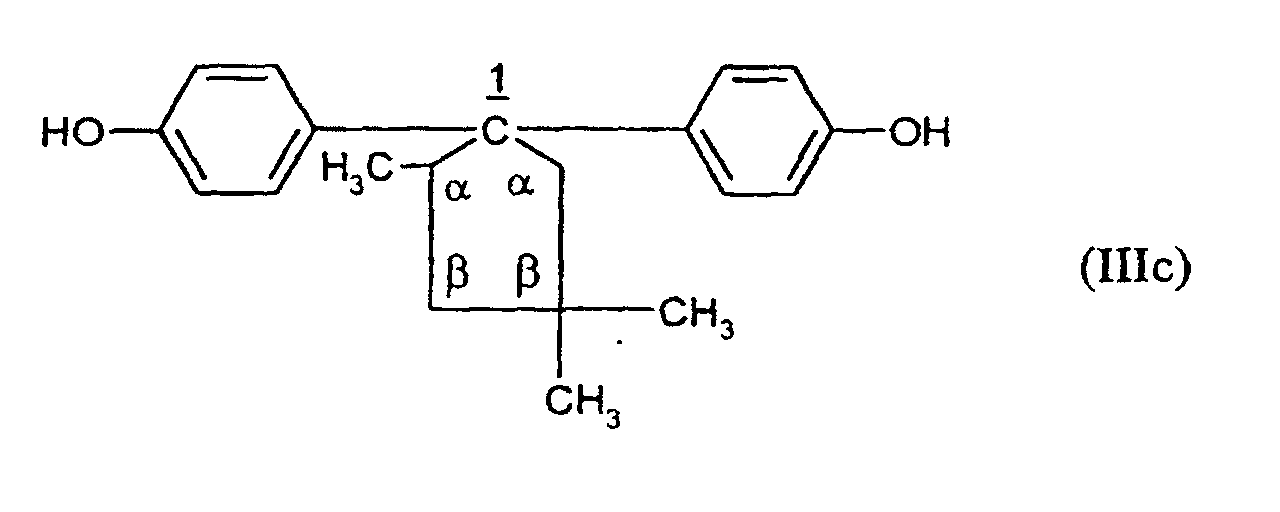
- Suitable diphenols of formula (II) are e.g. Hydroquinone, resorcinol, 4,4'-dihydroxydiphenyl, 2,2-bis (4-hydroxyphenyl) propane, 2,4-bis (4-hydroxyphenyl) -2-methylbutane, 1,1-bis (4-hydroxyphenyl) cyclohexane, 2,2-bis (3-chloro-4-hydroxyphenyl) -propane, 2,2-bis (3,5-dibromo-4-hydroxyphenyl) propane.
- Preferred diphenols of the formula (II) are 2,2-bis (4-hydroxyphenyl) propane, 2,2-bis (3,5-dichloro-4-hydroxyphenyl) -propane and 1,1-bis (4-hydroxyphenyl) cyclohexane.
- trifunctional compounds are 2,4-dihydroxybenzoic acid, Trimesic acid, cyanuric chloride and 3,3-bis (3-methyl-4-hydroxyphenyl) -2-oxo-2,3-dihydroindole.
- Preferred polycarbonates are in addition to the bisphenol A homopolycarbonate the Copolycarbonates of bisphenol A with up to 15 mol%, based on the moles of sums on diphenols, on 2,2-bis- (3,5-dibromo-4-hydroxyphenyl) -propane.
- the aromatic polycarbonates of component A can be partially replaced by aromatic Polyestercarbonates are exchanged.
- the aromatic polycarbonates of component A may also include polysiloxane blocks contain. Their preparation is described for example in DE-OS 33 34 872 and in the U.S. Patent 3,821,325.
- Aromatic polycarbonates and / or aromatic polyester carbonates according to component A are known from the literature or produced by literature methods (for Preparation of aromatic polycarbonates, see, for example, Schnell, Chemistry and Physics of Polycarbonates ", Interscience Publishers, 1964 and DE-AS 1 495 626, DE-OS 2 232 877, DE-OS 2 703 376, DE-OS 2 714 544, DE-OS 3 000 610, DE-OS 3 832 396; for the preparation of aromatic polyester carbonates e.g. DE-OS 3,077,934).
- aromatic polycarbonates and / or aromatic polyester carbonates occurs e.g. by reaction of diphenols with carbonyl halides, preferably phosgene and / or with aromatic dicarboxylic acid dihalides, preferably benzenedicarboxylic acid halides, according to the interfacial process, optionally using the chain terminators and optionally using trifunctional or more than trifunctional branching agents.
- carbonyl halides preferably phosgene and / or with aromatic dicarboxylic acid dihalides, preferably benzenedicarboxylic acid halides
- the polycarbonates A.1 and A.2 have the same structures, i. she are built from the same monomers.
- Another polycarbonate is preferably used up to an amount of 30% by weight. (based on the amount of A.1 and A.2) added.
- the mixture of polycarbonates A.1 and A.2 is characterized in that the relative solution viscosity of A.1 is 1.18 to 1.24, that the relative solution viscosity of A.2 is 1.24 to 1.34, and the difference between the relative solution viscosities of A.1 and A.2 is greater than or equal to 0.06, in particular greater than or equal to 0.09, ie relative solution viscosity (A.2) minus relative solution viscosity (A.1) ⁇ 0.06 , in particular ⁇ 0.09.
- the relative solution viscosity is measured in CH 2 Cl 2 as a solvent at 25 ° C at a concentration of 0.5 g / 100 ml.
- One or both polycarbonate components A.1 or A.2 in a mixture can be recycled polycarbonate.
- recycled polycarbonate are those Understood products that already have a processing and life cycle behind them have and by special processing methods of adhering impurities have been released so that they are suitable for further applications.
- the thermoplastic polymer B comprises (co) polymers of one or at least two ethylenically unsaturated monomers (vinyl monomers) such as Styrene, ⁇ -methylstyrene, nucleus-substituted styrenes (e.g., halo and / or alkyl-nucleus substituted), Acrylonitrile, methacrylonitrile, methyl methacrylate, maleic anhydride, N-substituted Maleimides and (meth) acrylic acid esters having 1 to 18 carbon atoms in the Alcohol component.
- ethylenically unsaturated monomers such as Styrene, ⁇ -methylstyrene, nucleus-substituted styrenes (e.g., halo and / or alkyl-nucleus substituted)
- Acrylonitrile methacrylonitrile
- methyl methacrylate methyl methacrylate
- the (co) polymers according to component B are resinous, thermoplastic and rubber-free.
- the molding composition may also contain various (co) polymers B.
- Preferred vinyl (co) polymers B are those of at least one monomer from the series styrene, ⁇ -methylstyrene, kemsubstitusammlungm styrene and / or methyl methacrylate (B.1) with at least one monomer selected from acrylonitrile, methacrylonitrile, Methyl methacrylate, maleic anhydride and / or N-aryl substituted maleimide (B.2).
- the content of monomers B.1 in the (co) polymer is preferably 50 to 99, particularly preferably 60 to 95 wt .-%, of monomers B.2 preferably 1 to 50, more preferably 40 to 5 wt .-%.
- Particularly preferred (co) polymers B are those of styrene with acrylonitrile and optionally with methyl methacrylate, from ⁇ -methylstyrene with acrylonitrile and optionally with methyl methacrylate, or from styrene and ⁇ -methylstyrene with acrylonitrile and optionally with methyl methacrylate.
- the (co) polymers according to component B are known and can be prepared by free-radical polymerization, in particular by emulsion, suspension, solution or bulk polymerization.
- the (co) polymers according to component B preferably have molecular weights M w (weight average, determined by light scattering or sedimentation) between 15,000 and 200,000.
- Particularly preferred (co) polymers B according to the invention are also random built copolymers of styrene and maleic anhydride, preferably by a continuous mass or solution polymerization with incomplete conversions can be prepared from the corresponding monomers.
- suitable statistically built styrene-maleic anhydride copolymers can within further Limits are varied.
- the preferred content of maleic anhydride is 5 to 25% by weight.
- the polymers may also contain ring-substituted styrenes, such as p-methylstyrene, 2,4-dimethylstyrene and other substituted styrenes, such as ⁇ -methylstyrene, contain.
- ring-substituted styrenes such as p-methylstyrene, 2,4-dimethylstyrene and other substituted styrenes, such as ⁇ -methylstyrene, contain.
- the molecular weights (number average M n ) the random styrene-maleic anhydride copolymers according to component B which are suitable according to the invention can vary over a wide range.
- the range is from 60,000 to 200,000.
- Preferred for these products is an intrinsic viscosity of 0.3 to 0.9 (measured in dimethylformamide at 25 ° C., see Hoffmann, Krömer, Kuhn, Polymeranalytik I, Stuttgart 1977, page 316 ff).
- Component C represents graft polymers. These include Graft copolymers having rubbery properties which are substantially at least 2 of the following monomers are available: chloroprene, butadiene-1,3, Isoprene, styrene, acrylonitrile, ethylene, propylene, vinyl acetate and (meth) acrylic acid esters with 1 to 18 carbon atoms in the alcohol component; ie polymers, as they are e.g. in Methods of Organic Chemistry "(Houben-Weyl), Vol. 14/1, Georg Thieme-Verlag, Stuttgart 1961, pp. 393-406 and in C.B. Bucknall, "Thoughened Plastics ", Appl., Science Publishers, London 1977.
- Preferred Polymers C are partially crosslinked and have gel contents of more than 20% by weight, preferably more than 40% by weight, in particular more than 60% by weight.
- Preferred graft polymers C are e.g. with styrene and / or acrylonitrile and / or (Meth) -acrylic acid alkyl esters grafted bases C.2 such as polybutadiene, butadiene / styrene copolymers and acrylate rubbers; i.e.
- (Meth) -Acrylklareester ⁇ are esters of acrylic acid or methacrylic acid with monovalent Alcohols with 1 to 18 carbon atoms. Particularly preferred are methyl methacrylate, ethyl ester and propyl ester, n-butyl acrylate, t-butyl acrylate and t-butyl methacrylate.
- the graft base ⁇ in addition to butadiene residues up to 50 wt .-%, based on ⁇ , Residues of other ethylenically unsaturated monomers, such as styrene, acrylonitrile, esters of Acrylic or methacrylic acid having 1 to 4 carbon atoms in the alcohol component (such as Methyl acrylate, ethyl acrylate, methyl methacrylate, ethyl methacrylate), vinyl ester and / or vinyl ethers.
- the preferred graft base ⁇ consists of pure Polybutadiene.
- the graft degree G denotes the weight ratio of grafted graft monomers to the graft and is dimensionless.
- the average particle size d 50 is the diameter, above and below which each 50 wt .-% of the particles are. It can be determined by ultracentrifuge measurement (W. Scholtan, H. Lange, Kolloid, Z. and Z. Polymere 250 (1972), 782-796).
- the acrylate rubbers ⁇ of the polymers C are preferably polymers of alkyl acrylates, optionally with up to 40% by weight, based on ⁇ , of other polymerizable, ethylenically unsaturated monomers.
- Preferred polymerizable acrylic acid esters include C 1 -C 8 alkyl esters, for example, methyl, ethyl, butyl, n-octyl and 2-ethylhexyl esters; Haloalkyl, preferably halo-C 1 -C 8 alkyl esters, such as chloroethyl acrylate, and mixtures of these monomers.
- crosslinking monomers having more than one polymerizable double bond be copolymerized.
- Preferred examples of crosslinking monomers are Esters of unsaturated monocarboxylic acids having 3 to 8 carbon atoms and unsaturated monovalent Alcohols with 3 to 12 carbon atoms or saturated polyols with 2 to 4 OH groups and 2 to 20 C atoms, such as e.g. Ethylene glycol dimethacrylate, allyl methacrylate; polyunsaturated heterocyclic compounds, such as e.g. Trivinylund triallyl; polyfunctional vinyl compounds such as di- and trivinylbenzenes; but also triallyl phosphate and diallyl phthalate.
- Preferred crosslinking monomers are allyl methacrylate, ethylene glycol dimethyl acrylate, Diallyl phthalate and heterocyclic compounds containing at least 3 ethylenic having unsaturated groups.
- crosslinking monomers are the cyclic monomers triallyl cyanurate, Triallylisocyanurate, trivinylcyanurate, triacryloylhexahydro-s-triazine, Triallylbenzenes.
- the amount of the crosslinking monomers is preferably 0.02 to 5, in particular 0.05 to 2 wt .-%, based on the graft base ⁇ .
- cyclic crosslinking monomers having at least 3 ethylenically unsaturated It is advantageous for groups to reduce the amount to less than 1% by weight of the graft base restrict.
- Preferred "other" polymerizable, ethylenically unsaturated monomers which may optionally be used in addition to the acrylic acid esters for the preparation of the graft base are, for example, acrylonitrile, styrene, ⁇ -methylstyrene, acrylamides, vinyl-C 1 -C 6 -alkyl ethers, methyl methacrylate, butadiene.
- Preferred acrylate rubbers as graft base ⁇ are emulsion polymers which have a gel content of at least 60% by weight.
- grafted silicone rubbers Sites as described in DE-OS 3,704,657, DE-OS 3,704,655, DE-OS 3 631 540 and DE-OS 3 631 539.
- the gel content of Pfropfground C.2 is determined at 25 ° C in dimethylformamide (M. Hoffmann, H. Krömer, R. Kuhn, Polymer Analytics I and II, Georg Thieme-Verlag, Stuttgart 1977).
- the graft polymers C can be prepared by known processes such as mass, suspension, Emulsion or mass suspension method can be produced.
- Graft polymers C are also understood to mean those products obtained by polymerization of Graft monomers are obtained in the presence of the graft.
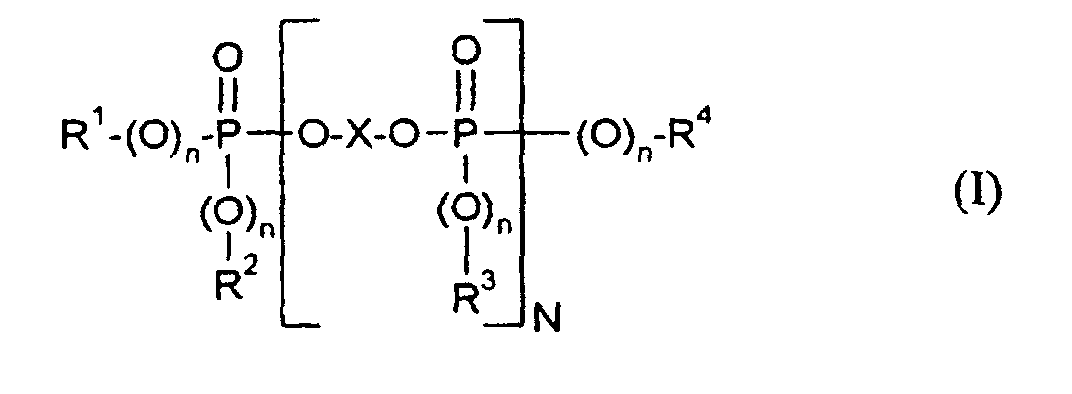
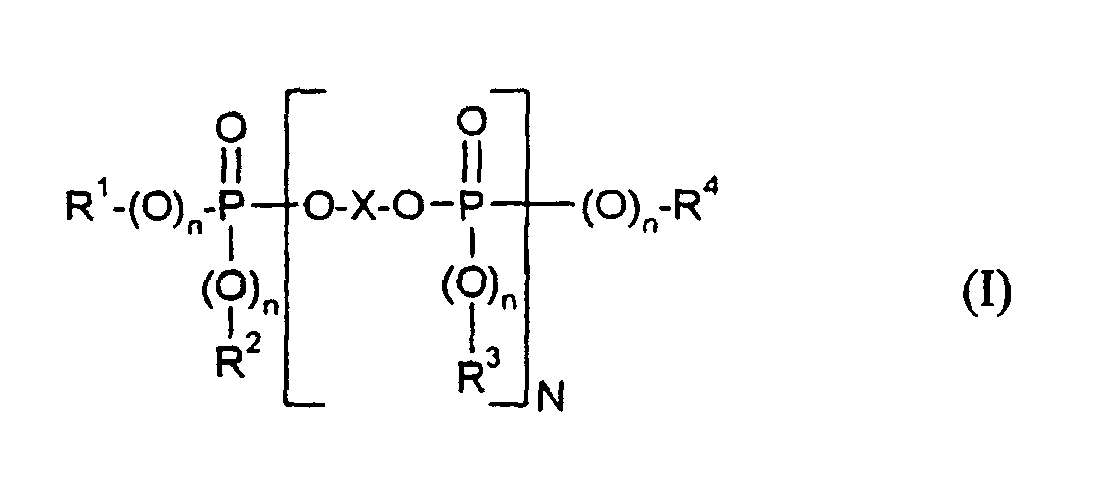
- the molding compositions according to the invention contain as flame retardants at least one organic phosphorus compound or a mixture of organic phosphorus compounds of the formula (I).
- R 1 , R 2 , R 3 and R 4 have the meanings given above.
- R 1 , R 2 , R 3 and R 4 are C 1 -C 4 alkyl, phenyl, naphthyl or phenyl-C 1 -C 4 alkyl.
- the aromatic groups R 1 , R 2 , R 3 and R 4 may in turn be substituted by halogen and / or alkyl groups (preferably C 1 -C 4 -alkyl).
- Particularly preferred aryl radicals are cresyl, phenyl, xylenyl, propylphenyl or butylphenyl and the corresponding brominated and chlorinated derivatives thereof.
- X in the formula (I) represents a mono- or polynuclear aromatic radical of 6 up to 30 carbon atoms. This is preferably derived from diphenols of the formula (II) from such as Bisphenol A, resorcinol or hydroquinone or their chlorinated or brominated derivatives.
- n in the formula (I) may independently be 0 or 1, preferably n equal to 1.
- N can take values from 0 to 30.
- N may have average values of 0 to 30, preferably an average value of 0.3 to 20, especially preferably 0.5 to 10, in particular 0.5 to 6.
- Phosphorus compounds of the formula (I) are preferably tributyl phosphate, tris (2-chloroethyl) phosphate, Tris (2,3-dibromopropyl) phosphate, triphenyl phosphate, tricresyl phosphate, Diphenyl cresyl phosphate, diphenyl octyl phosphate, diphenyl 2-ethyl cresyl phosphate, Tri (isopropylphenyl) phosphate, halogen substituted aryl phosphates, Methylphosphonic acid dimethyl ester, methylphosphonic acid diphenylester, diethyl phenylphosphonate, Triphenylphosphine oxide and / or m-phenylene bis (diphenyl) phosphate.
- the Mixture generally consists of 10 to 90 wt .-% of dimers and / or oligomeric and from 90 to 10 wt .-% of monophosphorus compounds, preferably Mono-phosphate compounds of the formula (I).
- the mono-phosphorus compounds in the range of 12 to 50, especially 14 to 40, whole more preferably from 15 to 40% by weight with the complementary amount mixed oligomeric phosphorus compounds.
- the phosphorus compounds of component D are known (see, e.g., EP-A 363 608, EP-A 640 655) or can be prepared according to known methods in analog (See, for example, Ullmanns Encyklopadie der ischen Chemie, Vol. 301 ff. 1979; Houben-Weyl, Methods of Organic Chemistry, Vol. 12/1, p. 43; Beilstein Vol. 6, p. 177).
- the fluorinated polyolefins E are of high molecular weight and have glass transition temperatures of above -30 ° C., generally greater than 100 ° C., fluorine contents, preferably from 65 to 76, in particular from 70 to 76% by weight, average particle diameter d 50 of 0, 05 to 1,000, preferably 0.08 to 20 microns.
- the fluorinated polyolefins E have a density of 1.2 to 2.3 g / cm 3 .
- Preferred fluorinated polyolefins E are polytetrafluoroethylene, polyvinylidene fluoride, Tetrafluoroethylene / hexafluoropropylene and ethylene / tetrafluoroethylene copolymers.
- the fluorinated polyolefins are known (see “Vinyl and Related Polymers” of Schildknecht, John Wiley & Sons, Inc., New York, 1962, pages 484-494; "Fluorine polymers” by Wall, Wiley-Interscience, John Wiley & Sons, Inc., New York, Volume 13, 1970, pages 623 to 654; "Modern Plastics Encyclopedia", 1970 to 1971, Vol. 47, No. 10A, October 1970, Mc Graw-Hill, Inc., New York, pages 134 and 774; "Modern Plastics Encyclopedia", 1975 to 1976, October 1975, Vol. 52, No. 10A, Mc Graw-Hill, Inc., New York, pages 27, 28 and 472 and U.S. Patent 3,671,487, 3,723,373 and 3,838,092).
- They can be prepared by known methods, for example by polymerization of tetrafluoroethylene in an aqueous medium with a free-radical-forming catalyst, for example sodium, potassium or ammonium peroxydisulfate at pressures of 7 to 71 kg / cm 2 and at temperatures of 0 to 200 ° C, preferably at temperatures of 20 to 100 ° C. (See, for example, U.S. Patent 2,393,967 for further details).
- a free-radical-forming catalyst for example sodium, potassium or ammonium peroxydisulfate
- the density of these materials can be between 1.2 and 2.3 g / cm 3 and the average particle size between 0.05 and 1000 ⁇ m.
- preferred fluorinated polyolefins E are tetrafluoroethylene polymers and have average particle diameter of 0.05 microns to 20, preferably from 0.08 .mu.m to 10, and a density of 1.2 to 1.9 g / cm 3, and are preferably in the form of a coagulated mixture of emulsions of tetrafluoroethylene polymers E with emulsions of the graft polymers C.
- Suitable tetrafluoroethylene polymer emulsions are commercially available products and are offered for example by the company DuPont as Teflon® 30 N.
- Suitable fluorinated polyolefins E which can be used in powder form are tetrafluoroethylene polymers having average particle diameters of 100 to 1000 ⁇ m and densities of 2.0 g / cm 3 to 2.3 g / cm 3 .
- a coagulated mixture of C and E is first an aqueous Emulsion (latex) of a graft polymer C with average latex particle diameters from 0.05 to 2 .mu.m, in particular 0.1 to 0.6 .mu.m, with a finely divided Emulsion of a tetrafluoroethylene polymer E in water with average particle diameters from 0.05 to 20 microns, especially from 0.08 to 10 microns, mixed; suitable Tetrafluoroethylene polymer emulsions usually have solids contents from 30 to 70 wt .-%, in particular from 50 to 60 wt .-%.
- the aqueous emulsion of the graft polymer C has solids contents of 25 to 60 wt .-%, preferably from 30 to 45 wt .-%, in particular from 30 to 35% by weight.
- component C closes the proportion of Graft polymer in the coagulated mixture of graft polymer and fluorinated Polyolefins are not included.
- the emulsion mixture is the weight ratio of graft polymer C to Tetrafluoroethylene polymer E at 95: 5 to 60:40.
- the emulsion mixture is dissolved in coagulated known manner, for example by spray drying, freeze drying or coagulation by addition of inorganic or organic salts, acids, Bases or organic, water-miscible solvents, such as alcohols, Ketones, preferably at temperatures of 20 to 150 ° C, in particular from 50 to 100 ° C. If necessary, it may be dried at 50 to 200 ° C, preferably 70 to 100 ° C become.
- Very finely divided inorganic compounds according to component F consist of Compounds of one or more metals of the 1st to 5th main group or 1, to 8. Subgroup of the periodic table according to Mendeleev, preferably 2 to 5. Main group or 4th to 8th subgroup, more preferably 3rd to 5th main group or 4th to 8th subgroup with at least one element selected from the group consisting of oxygen, sulfur, boron, phosphorus, carbon, nitrogen, hydrogen or silicon.
- Preferred compounds are, for example, oxides, hydroxides, hydrous Oxides, sulfates, sulfites, sulfides, carbonates, carbides, nitrates, nitrites, nitrides, borates, Silicates, phosphates, hydrides, phosphites or phosphonates.
- Preferred very finely divided inorganic compounds are, for example, TiN, TiO 2 , SnO 2 , WC, ZnO, Al 2 O 3 , AlO (OH), ZrO 2 , Sb 2 O 3 , SiO 2 , iron oxides, Na 2 SO 4 , BaSO 4 , vanadium oxides , Zinc borate, silicates such as Al silicates, Mg silicates, one, two, three-dimensional silicates. Mixtures and doped compounds are also useful. Furthermore, these nanoscale particles can be surface-modified with organic molecules to achieve better compatibility with the matrix. In this way, hydrophobic or hydrophilic organic surfaces can be produced.
- the average particle diameters are less than or equal to 200 nm, preferably less than or equal to 150 nm, in particular from 1 to 100 nm.
- Particle size and particle diameter always means the average particle diameter d 50 , determined by ultracentrifuge measurements according to W. Scholtan et al. Colloid-Z. and Z. Polymere 250 (1972), pp. 782 to 796.
- the inorganic compounds can be used as powders, pastes, sols, dispersions or Suspensions are present. By precipitation can from dispersions, sols or Suspensions powder can be obtained.
- the powders can be prepared by conventional methods in the thermoplastic materials be incorporated, for example, by direct kneading or extruding the Ingredients of the molding material and the finely divided inorganic powders.
- preferred Methods make the preparation of a masterbatch, e.g. in flame retardant additives, other additives, monomers, solvents or in thermoplastics A, the co-precipitation of dispersions of components B or C with dispersion, suspensions, Pastes or sols of the finely divided inorganic materials.
- the molding compositions according to the invention may comprise at least one of the customary additives, such as lubricants and mold release agents, nucleating agents, antistatic agents, stabilizers and Dyes and pigments included.
- customary additives such as lubricants and mold release agents, nucleating agents, antistatic agents, stabilizers and Dyes and pigments included.
- the molding compositions of the invention may optionally of compounds of Formula (I) contain various flame retardants in an amount up to 20 parts by weight. Preference is given to synergistic flame retardants. exemplary are used as other flame retardants organic halogen compounds such Decabromobisphenyl ether, tetrabromobisphenol, inorganic halogen compounds such as ammonium bromide, nitrogen compounds such as melamine, melamine-formaldehyde resins or siloxane compounds.
- organic halogen compounds such Decabromobisphenyl ether, tetrabromobisphenol, inorganic halogen compounds such as ammonium bromide, nitrogen compounds such as melamine, melamine-formaldehyde resins or siloxane compounds.
- the molding compositions according to the invention may optionally differ from the inorganic compounds F inorganic Substances such as inorganic hydroxide compounds such as Mg, Al hydroxide, inorganic compounds such as alumina, Antimony oxides, barium metaborate, hydroxoantimonate, zirconium oxide, zirconium hydroxide, Molybdenum oxide, ammonium molybdate, zinc borate, ammonium borate and Tin oxide.
- F inorganic Substances such as inorganic hydroxide compounds such as Mg, Al hydroxide, inorganic compounds such as alumina, Antimony oxides, barium metaborate, hydroxoantimonate, zirconium oxide, zirconium hydroxide, Molybdenum oxide, ammonium molybdate, zinc borate, ammonium borate and Tin oxide.
- the molding compositions according to the invention comprising the components A to F and optionally other known additives such as stabilizers, dyes, pigments, Lubricants and mold release agents, nucleating agents and antistatics are produced, by mixing the respective components in a known manner and at Temperatures of 200 ° C to 300 ° C in conventional units such as internal mixers, Extruders and twin-screw extruders melt-compounded and melt-extruded, wherein the component E is preferably coagulated in the form of the above-mentioned Mixture is used.
- additives such as stabilizers, dyes, pigments, Lubricants and mold release agents, nucleating agents and antistatics
- the mixing of the individual constituents can both in a known manner successively as well as simultaneously, both at about 20 ° C (room temperature) as well as at higher temperature.
- the molding compositions of the present invention can be used to produce molded articles of any kind used.
- moldings can be injection molded getting produced.
- manufacturable moldings are: housing parts each kind, e.g. for household appliances such as juice presses, coffee machines, blenders, office machines, such as computers, printers, monitors or copiers or cover plates for the construction sector and parts for the motor vehicle sector. You will also be in the field used in electrical engineering because they have very good electrical properties.
- molding compositions for the production of thin-walled moldings for example, data technology housing parts
- the molding compositions for the production of thin-walled moldings for example, data technology housing parts
- Another form of processing is the production of moldings by deep drawing from previously produced plates or foils.
- Another object of the present invention is therefore also the use the molding compositions of the invention for the production of moldings of any kind, preferably the abovementioned and the shaped bodies of the invention Molding compounds.
- Styrene / acrylonitrile copolymer with a styrene / acrylonitrile ratio of 72:28 and an intrinsic viscosity of 0.55 dl / g (measured in dimethylformamide at 20 ° C).
- Graft polymer of 45 parts by weight of a copolymer of styrene and acrylonitrile in the ratio of 72:28 to 55 parts by weight of particulate crosslinked polybutadiene rubber (average particle diameter d 50 0.4 .mu.m), prepared by emulsion polymerization.
- Tetrafluoroethylene polymer as a coagulated mixture of a SAN graft polymer emulsion according to component C in water and a tetrafluoroethylene polymer emulsion in water.
- the weight ratio of graft polymer C to tetrafluoroethylene polymer E in the mixture is 90% by weight to 10% by weight.
- the tetrafluoroethylene polymer emulsion has a solids content of 60 wt .-%, the average particle diameter is between 0.05 and 0.5 ⁇ m.
- the SAN graft polymer emulsion has a solids content of 34 wt .-% and a medium Latex particle diameter of 0.4 ⁇ m.
- the emulsion of the tetrafluoroethylene polymer (Teflon 30 N from DuPont) is mixed with the emulsion of the SAN graft polymer C and stabilized with 1.8% by weight, based on polymer solids, of phenolic antioxidants.
- the mixture is coagulated with an aqueous solution of MgSO 4 (Epsom salt) and acetic acid at pH 4 to 5, filtered and washed until virtually no electrolyte, then freed by centrifugation of the bulk of water and then at 100 ° C. dried to a powder. This powder can then be compounded with the other components in the described aggregates.
- the most finely divided inorganic compound is Pural 200, an aluminum oxide hydroxide (Fa. Condea, Hamburg, Germany) used.
- the middle Particle size of the product is about 50 nm.
- the mixing of components A to F is carried out on a 3 1 internal kneader.
- the moldings are produced on an injection molding machine type Arburg 270E at 260 ° C.
- the notched impact strength is determined by method ISO 180 1A on rods of dimension 80 ⁇ 10 ⁇ 4 mm 3 at room temperature.
- the stress cracking behavior is investigated on bars measuring 80 ⁇ 10 ⁇ 4 mm 3 , melt temperature 260 ° C.
- the test medium used is a mixture of 60% by volume of toluene and 40% by volume of isopropanol.
- the specimens are pre-stretched by means of a circular arc template and stored simultaneously for 5 min at room temperature in the test medium.
- the pre-strain ⁇ x is 0.2 to 2.4%.
- the stress cracking behavior is judged by the cracking or breakage depending on the pre-strain.
- the table shows that the molding compositions according to the invention a very good combination of properties of the mechanical properties, in particular an unexpected improvement in stress cracking resistance and a good flame retardance compared to the molding compositions containing no feinstteiligen inorganic powder (component F).
- composition and properties of polycarbonate-ABS molding compounds example 1 comparison 2 comparison 3 according to the invention components [Parts by weight] A 79 - - A1 - 49 49 A2 - 30 30 B 5 5 5 C 5 5 5 D 5.5 5.5 5.5 e 3 3 3 F - - 1.0 mold release agents 0.5 0.5 0.5 ⁇ rel 1252 1252 1252 Properties: Vicat / B 120 [° C] 114 115 115 Impact impact resistance: [kJ / m 2 ] 44 46 46 ESC screening 5 min / 1.0% BR 5:00 ESC screening 5 minutes / 0.8% BR 5:00 KR + OR ESC screening 5 min / 0.6% BR 3:14 KR + OR ESC screening 5 min / 0.4% KR MVR 240 ° C / 5 kg ml / 10 min 16.0 16.4 16.6 fire UL 94V (1.6mm) V-2 nb V-0
Landscapes
- Chemical & Material Sciences (AREA)
- Health & Medical Sciences (AREA)
- Chemical Kinetics & Catalysis (AREA)
- Medicinal Chemistry (AREA)
- Polymers & Plastics (AREA)
- Organic Chemistry (AREA)
- Engineering & Computer Science (AREA)
- Manufacturing & Machinery (AREA)
- Materials Engineering (AREA)
- Compositions Of Macromolecular Compounds (AREA)
- Graft Or Block Polymers (AREA)
- Casting Or Compression Moulding Of Plastics Or The Like (AREA)
Abstract
Description

- R1, R2, R3 und R4,
- unabhängig voneinander gegebenenfalls halogeniertes C1-C8-Alkyl, jeweils gegebenenfalls durch Halogen und/oder C1-C4-Alkyl substituiertes C5-C6-Cycloalkyl, C6-C20-Aryl oder C7-C12-Aralkyl,
- n
- unabhängig voneinander 0 oder 1,
- N
- 0 bis 30 und
- X
- einen ein- oder mehrkernigen aromatischen Rest mit 6 bis 30 C-Atomen bedeuten,

- A
- eine Einfachbindung C1-C5-Alkylen, C2-C5-Alkyliden, C5-C6-Cycloalkyliden, -S-, -SO2-, -O-, -CO-, C6-C12-Arylen,
- B
- Chlor, Brom,
- x
- 0, 1 oder 2 und
- p
- 1 oder 0 sind

- R11 und R12
- unabhängig voneinander, jeweils Wasserstoff, Halogen, bevorzugt Chlor oder Brom, C1-C8-Alkyl, bevorzugt C1-C4-Alkyl, C5-C6-Cycloalkyl, C6-C10-Aryl, bevorzugt Phenyl, und C7-C12-Aralkyl, bevorzugt Phenyl-C1-C4-Alkyl, insbesondere Benzyl,
- m
- eine ganze Zahl von 4 bis 7, bevorzugt 4 oder 5,
- R13 und R14
- für jedes Z individuell wählbar, unabhängig voneinander Wasserstoff
oder C1-C6-Alkyl, vorzugsweise Wasserstoff, Methyl oder Ethyl,
und - Z
- Kohlenstoff bedeutet, mit der Maßgabe, daß an mindestens einem Atom Z R13 und R14 gleichzeitig Alkyl bedeuten.


- α
- 10 bis 70, vorzugsweise 15 bis 50, insbesondere 20 bis 40 Gew.-%, bezogen auf Pfropfpolymisat C, mindestens eines (Meth)-Acrylsäureesters oder 10 bis 70, vorzugsweise 15 bis 50, insbesondere 20 bis 40 Gew.-% eines Gemisches aus 10 bis 50, vorzugsweise 20 bis 35 Gew.-%, bezogen auf Gemisch, Acrylnitril oder (Meth)-Acrylsäureester und 50 bis 90, vorzugsweise 65 bis 80 Gew.-%, bezogen auf Gemisch, Styrol, als Pfropfaugflage C.1 auf.
- β
- 30 bis 90, vorzugsweise 50 bis 85, insbesondere 60 bis 80 Gew.-%, bezogen auf Pfropfpolymisat C, eines Butadienpolymerisats mit mindestens 50 Gew.-%, bezogen auf β, Butadienresten als Pfropfgrundlage C.2,
- τ.
- 20 bis 90 Gew.-%, bezogen auf Komponente C, Acrylatkautschuk mit einer Glasübergangstemperatur <-20°C als Pfropfgrundlage C.2 und
- δ.
- 10 bis 80 Gew.-%, bezogen auf Komponente C, mindestens eines polymerisierbaren, ethylenisch ungesättigten Monomeren als Pfropfmonomere C.1.

| Zusammensetzung und Eigenschaften der Polycarbonat-ABS-Formmassen | |||
| Beispiel | 1 Vergleich | 2 Vergleich | 3 erfindungsgemäß |
| Komponenten | |||
| [Gew.-Teile] A | 79 | - | - |
| A1 | - | 49 | 49 |
| A2 | - | 30 | 30 |
| B | 5 | 5 | 5 |
| C | 5 | 5 | 5 |
| D | 5,5 | 5,5 | 5,5 |
| E | 3 | 3 | 3 |
| F | - | - | 1,0 |
| Entformungsmittel | 0,5 | 0,5 | 0,5 |
| ηrel | 1.252 | 1.252 | 1.252 |
| Eigenschaften: Vicat/B120 [°C] | 114 | 115 | 115 |
| Kerbschlagzähigkei t: [kJ/m2] | 44 | 46 | 46 |
| ESC-screening 5 min/ 1,0 % | BR 5:00 | ||
| ESC-screening 5 min/ 0,8 % | BR 5:00 | KR+OR | |
| ESC-screening 5 min/ 0,6 % | BR 3:14 | KR+OR | |
| ESC-screening 5 min/ 0,4 % | KR | ||
| MVR 240°C/5 kg ml/10 min | 16,0 | 16,4 | 16,6 |
| Brand | |||
| UL 94 V (1,6 mm) | V-2 | nb | V-0 |
Claims (15)
- Flammwidrige, thermoplastische Formmassen enthaltendA. 5 bis 95 Gew.-Teile eines Gemisches zweier aromatischer Polycarbonate A.1 und A.2 mit unterschiedlicher Lösungsviskosität, wobeiwobei ein oder mehrere weitere Polycarbonate dem Gemisch aus A.1 und A.2 zugesetzt werden können,1. die relative Lösungsviskosität von A.1 1,18 bis 1,24 beträgt,2. die relative Lösungsviskosität von A.2 1,24 bis 1,34 beträgt und3. die Differenz der relativen Lösungsviskositäten von A.1 und A.2 größer oder gleich 0,06 ist,B. 0 bis 50 Gew.-Teile Vinyl(co)polymerisat aus einem oder wenigstens zwei ethylenisch ungesättigten Monomeren,C. 0,5 bis 60 Gew.-Teile Pfropfpolymerisat erhältlich durch Pfropfpolymerisation von wenigstens zwei Monomeren ausgewählt aus Chloropren, Butadien-1,3, Isopren, Styrol, Acrylnitril, Ethylen, Propylen, Vinylacetat und (Meth)-Acrylsäureester mit 1 bis 18 C-Atomen in der Alkoholkomponente,D. 0,5 bis 20 Gew.-Teile Phosphorverbindung der Formel (I)worin
- R1, R2, R3 und R4
- unabhängig voneinander, gegebenenfalls halogeniertes C1-C8-Alkyl, jeweils gegebenenfalls durch Halogen und/oder C1-C4-Alkyl substituiertes C5-C6-Cycloalkyl, C6-C20-Aryl oder C7-C12-Aralkyl,
- n
- unabhängig voneinander 0 oder 1,
- N
- 0 bis 30 und
- X
- einen ein- oder mehrkernigen aromatischen Rest mit 6 bis 30 C-Atomen bedeuten,
E. 0,05 bis 5 Gew.-Teile fluoriertes PolyolefinF. 0,01 bis 50 Gew.-Teile pro 100 Gew.-Teile aus A) bis E) feinstteilige anorganische Verbindung mit einem mittleren Teilchendurchmesser von kleiner gleich 200 nm, - Formmassen gemäß Anspruch 1, dadurch gekennzeichnet, daß in Formel (I) N einen Wert von 0,3 bis 20 besitzt.
- Formmassen gemäß Anspruch 1 und 2, wobei Komponente B ein (Co)Polymer von einem oder wenigstens zwei ethylenisch ungesättigten Monomeren ausgewählt aus Styrol, α-Methylstyrol, kernsubstituierte Styrole, Acrylnitril, Methacrylnitril, Methylmethacrylat, Maleinsäureanhydrid, N-substituierte Maleinimide und (Meth)-Acrylsäureester mit 1 bis 18 C-Atomen in der Alkoholkomponente.
- Formmassen gemäß Ansprüche 1 bis 3, wobei in Formel (I) R1, R2, R3 und R4 jeweils unabhängig voneinander, C1-C4-Alkyl, ein jeweils gegebenenfalls mit Halogen- und/oder Alkylgruppen substituiertes Phenyl, Naphtyl oder Phenyl-C1-C4-alkyl, bedeutet und X sich von Diphenolen, ausgewählt aus Bisphenol A, Resorcin oder Hydrochinon, gegebenenfalls chloriert oder bromiert, ableitet.
- Formmassen nach einem der Ansprüche 1 bis 4, wobei die Phosphorverbindung der Formel (I) ausgewählt ist aus Tributylphosphat, Tris-(2-chlorethyl)-phosphat, Tris-(2,3-dibrompropyl)-phosphat, Triphenylphosphat, Trikresylphosphat, Diphenylkresylyphosphat, Diphenyloctylphosphat, Diphenyl-2-ethylkresylphosphat, Tri-(isopropylphenyl)-phosphat, halogensubstituierte Arylphosphate, Methylphosphonsäuredimethylester, Methylphosphonsäurediphenylester, Phenylphosphonsäurediethylester, Triphenylphosphinoxid, Trikresylphosphinoxid und/oder m-Phenylen-bis(diphenyl)phosphat.
- Formmassen nach Anspruch 1, wobei als fluorierte Polyolefine E, Polytetrafluorethylen, Polyvinylidenfluorid, Tetrafluorethylen/Hexafluorpropylenund/oder Ethylen/Tetrafluorethylen-Copolymerisate eingesetzt werden.
- Formmassen nach Anspruch 1 enthaltend als Komponente F Verbindungen der 1. bis 5. Hauptgruppe oder 1 bis 8. Nebengruppe des Periodensystems mit mindestens einem Element ausgewählt aus der Gruppe bestehend aus Sauerstoff, Schwefel, Bor, Kohlenstoff, Phosphor, Stickstoff, Wasserstoff oder Silicium.
- Formmassen gemäß der vorhergehenden Ansprüche, worin Komponente F ausgewählt ist aus TiN, TiO2, SnO2, WC, ZnO, Al2O3, AlO(OH), ZrO2, Sb2O3, SiO2, Zinkborat, Na2SO4, BaSO4, Vanadiumoxide und/oder Silikate.
- Formmassen gemäß der vorhergehenden Ansprüche, worin der mittlere Teilchendurchmesser der Komponente F kleiner gleich 150 nm beträgt.
- Formmassen nach Ansprüchen 1 bis 9, dadurch gekennzeichnet, daß sie 0,01 bis 20 Gew.-%, bezogen auf die Gesamtformmasse wenigstens eines weiteren von Komponente D verschiedenen Flammschutzmittels enthalten.
- Formmassen nach einem der Ansprüche 1 bis 10, enthaltend 10 bis 90 Gew.Teile der Komponente A), gegebenenfalls 2 bis 30 Gew.-Teile der Komponente B), 1 bis 40 Gew.-Teile der Komponente C) und 1 bis 18 Gew.-Teile der Komponente D) 0,1 bis 1 Gew.-Teile E) und 0,1 bis 10 Gew.-Teile F).
- Formmassen nach einem der Ansprüche 1 bis 11, enthaltend als Pfropfgrundlage für die Komponente C einen Dienkautschuk, Acrylatkautschuk, Silikonkautschuk oder Ethylen-Propylen-Dien-Kautschuk.
- Formmassen nach einem der Ansprüche 1 bis 12, welche mindestens einen Zusatz aus der Gruppe der Stabilisatoren, Pigmente, Entformungsmittel, Fließhilfsmittel und/oder Antistatika enthalten.
- Verwendung der Formmassen nach einem der Ansprüche 1 bis 13 zur Herstellung von Formkörpern.
- Formkörper, hergestellt aus Formmassen nach einem der Ansprüche. 1 bis 13.
Priority Applications (1)
| Application Number | Priority Date | Filing Date | Title |
|---|---|---|---|
| DK98945108T DK1003817T3 (da) | 1997-08-11 | 1998-07-29 | Flammehæmmende polycarbonat-ABS-stöbemasser |
Applications Claiming Priority (3)
| Application Number | Priority Date | Filing Date | Title |
|---|---|---|---|
| DE19734666 | 1997-08-11 | ||
| DE19734666A DE19734666A1 (de) | 1997-08-11 | 1997-08-11 | Flammwidrige Polycarbonat-ABS-Formmassen |
| PCT/EP1998/004731 WO1999007791A1 (de) | 1997-08-11 | 1998-07-29 | Flammwidrige polycarbonat abs-formmassen |
Publications (2)
| Publication Number | Publication Date |
|---|---|
| EP1003817A1 EP1003817A1 (de) | 2000-05-31 |
| EP1003817B1 true EP1003817B1 (de) | 2005-02-09 |
Family
ID=7838576
Family Applications (1)
| Application Number | Title | Priority Date | Filing Date |
|---|---|---|---|
| EP98945108A Expired - Lifetime EP1003817B1 (de) | 1997-08-11 | 1998-07-29 | Flammwidrige polycarbonat abs-formmassen |
Country Status (12)
| Country | Link |
|---|---|
| US (2) | US6254968B1 (de) |
| EP (1) | EP1003817B1 (de) |
| JP (1) | JP4221146B2 (de) |
| KR (1) | KR100560040B1 (de) |
| CN (1) | CN1122082C (de) |
| AU (1) | AU9255798A (de) |
| BR (1) | BR9811893A (de) |
| CA (1) | CA2300215C (de) |
| DE (2) | DE19734666A1 (de) |
| ES (1) | ES2238766T3 (de) |
| TW (1) | TW473500B (de) |
| WO (1) | WO1999007791A1 (de) |
Families Citing this family (16)
| Publication number | Priority date | Publication date | Assignee | Title |
|---|---|---|---|---|
| DE19828536A1 (de) * | 1998-06-26 | 1999-12-30 | Bayer Ag | Flammwidrige Polycarbonat/ABS-Formmassen |
| DE19853105A1 (de) | 1998-11-18 | 2000-05-25 | Bayer Ag | Flammwidrige Polycarbonat-ABS-Formmassen |
| DE19904392A1 (de) * | 1999-02-04 | 2000-08-10 | Bayer Ag | Polycarbonat-Formmassen mit verbesserten antistatischen Eigenschaften |
| DE19907831A1 (de) * | 1999-02-24 | 2000-08-31 | Bayer Ag | Flammwidrige thermoplastische Formmasse |
| US6758533B1 (en) * | 1999-06-11 | 2004-07-06 | Dr. Ing. H.C.F. Porsche Ag | Wheel for a motor vehicle and a method of making the wheel |
| DE19941824A1 (de) * | 1999-09-02 | 2001-03-08 | Bayer Ag | Flammwidrige Polycarbonat-Blends |
| KR100611441B1 (ko) * | 1999-12-30 | 2006-08-09 | 제일모직주식회사 | 폴리카보네이트/스티렌계 수지 조성물 |
| KR100611448B1 (ko) * | 1999-12-30 | 2006-08-09 | 제일모직주식회사 | 폴리카보네이트/스티렌계 수지 조성물 |
| AU2012206982B2 (en) * | 2003-01-16 | 2013-12-05 | Viva Healthcare Packaging Limited | Methods, compositions and blends for forming articles having improved environmental stress crack resistance |
| WO2004062896A1 (en) | 2003-01-16 | 2004-07-29 | Ian Orde Michael Jacobs | Methods, compositions and blends for forming articles having improved environmental stress crack resistance |
| US20070149661A1 (en) * | 2005-12-23 | 2007-06-28 | Sanjay Gurbasappa Charati | Polycarbonate composition, method of manufacture thereof and articles comprising the same |
| KR100722146B1 (ko) | 2005-12-30 | 2007-05-28 | 제일모직주식회사 | 압출가공성 및 내열습성이 우수한 난연성 폴리카보네이트계열가소성 수지 조성물 |
| ES2429793T3 (es) * | 2007-05-04 | 2013-11-15 | Sachtleben Chemie Gmbh | Material sintético que contiene sulfato de bario |
| CN102936402A (zh) * | 2011-08-15 | 2013-02-20 | 上海金发科技发展有限公司 | 一种低烟耐热无卤阻燃聚碳酸脂/丙烯腈-丁二烯-苯乙烯树脂组合物及其制备方法 |
| US11655359B2 (en) * | 2017-02-10 | 2023-05-23 | Ineos Styrolution Group Gmbh | Acrylonitrile-butadiene-styrene copolymer composition with high surface energy |
| EP4069780B1 (de) * | 2019-12-04 | 2025-11-05 | Covestro Deutschland AG | Flammhemmende schlagzähmodifizierte polycarbonatzusammensetzung |
Family Cites Families (18)
| Publication number | Priority date | Publication date | Assignee | Title |
|---|---|---|---|---|
| US3166606A (en) * | 1960-12-28 | 1965-01-19 | Union Carbide Corp | Polycarbonate resins having improved flow properties |
| DE2729763A1 (de) * | 1977-07-01 | 1979-01-18 | Bayer Ag | Thermoplastisch verarbeitbare polycarbonatmischungen |
| DE3562922D1 (en) * | 1984-08-17 | 1988-06-30 | Bayer Ag | Thermoplastic moulding masses with flame-retarding properties |
| US5204394A (en) * | 1988-09-22 | 1993-04-20 | General Electric Company | Polymer mixture having aromatic polycarbonate, styrene I containing copolymer and/or graft polymer and a flame-retardant, articles formed therefrom |
| JPH0619007B2 (ja) * | 1989-03-27 | 1994-03-16 | 帝人化成株式会社 | 難燃性ポリカーボネート樹脂組成物 |
| JPH0763980B2 (ja) | 1991-03-13 | 1995-07-12 | 河西工業株式会社 | 積層成形体の成形方法および成形型装置 |
| US5616396A (en) | 1991-11-25 | 1997-04-01 | Kasai Kogyo Co., Ltd. | Automotive door trim with attachment joined during molding |
| JP2701683B2 (ja) | 1992-10-30 | 1998-01-21 | 豊田合成株式会社 | 樹脂成形体の製造方法 |
| FR2720320B1 (fr) | 1994-05-26 | 1996-09-20 | Cera | Procédé d'inclusion d'un décor, notamment textile, dans une pièce en matière plastique. |
| JP3820268B2 (ja) | 1994-06-17 | 2006-09-13 | トヨタ紡織株式会社 | 車両のドアトリム或いは車両用内装材の製造方法 |
| DE19505155A1 (de) | 1995-02-16 | 1996-08-22 | Magna Zippex Autotechnik Gmbh | Verfahren zum Herstellen eines Auskleidungsteiles aus Kunststoff und ein insbesonders nach diesem Verfahren hergestelltes Auskleidungsteil |
| JP3497917B2 (ja) * | 1995-04-17 | 2004-02-16 | 株式会社イノアックコーポレーション | 複合型樹脂成形品の製造方法及び樹脂成形用金型装置 |
| DE19538892A1 (de) * | 1995-10-19 | 1997-04-24 | Bayer Ag | Flammgeschützte, spannungsrißbeständige Polycarbonat/ABS-Blends |
| SG69988A1 (en) | 1995-11-01 | 2000-01-25 | Gen Electric | Flame retardant polycarbonate/graft blends exhibiting heat aging stability |
| DE19545289A1 (de) * | 1995-12-05 | 1997-06-12 | Bayer Ag | Thermoplastische Massen mit verbessertem Röntgenkontrast |
| FR2744947B1 (fr) | 1996-02-19 | 1998-04-03 | Allibert Ind | Procede d'habillage, par une feuille, d'une piece injectee, moule pour la mise en oeuvre du procede et piece obtenue |
| DE19622499A1 (de) | 1996-06-05 | 1997-12-11 | Otto Deuschle Modell Und Forme | Kunststoff-Formteil mit mehreren Feldern sowie Verfahren und Vorrichtung zu dessen Herstellung |
| HU221689B1 (hu) | 1996-06-27 | 2002-12-28 | Georg Kaufmann | Eljárás és berendezés műanyag idom mozgatható elemeinek előállítására |
-
1997
- 1997-08-11 DE DE19734666A patent/DE19734666A1/de not_active Withdrawn
-
1998
- 1998-07-20 US US09/485,518 patent/US6254968B1/en not_active Expired - Fee Related
- 1998-07-27 TW TW087112205A patent/TW473500B/zh not_active IP Right Cessation
- 1998-07-29 CN CN98808057A patent/CN1122082C/zh not_active Expired - Lifetime
- 1998-07-29 BR BR9811893-5A patent/BR9811893A/pt not_active IP Right Cessation
- 1998-07-29 DE DE59812563T patent/DE59812563D1/de not_active Expired - Lifetime
- 1998-07-29 EP EP98945108A patent/EP1003817B1/de not_active Expired - Lifetime
- 1998-07-29 WO PCT/EP1998/004731 patent/WO1999007791A1/de not_active Ceased
- 1998-07-29 JP JP2000506282A patent/JP4221146B2/ja not_active Expired - Fee Related
- 1998-07-29 CA CA2300215A patent/CA2300215C/en not_active Expired - Fee Related
- 1998-07-29 ES ES98945108T patent/ES2238766T3/es not_active Expired - Lifetime
- 1998-07-29 US US09/485,100 patent/US6444735B1/en not_active Expired - Lifetime
- 1998-07-29 AU AU92557/98A patent/AU9255798A/en not_active Abandoned
- 1998-07-29 KR KR1020007001364A patent/KR100560040B1/ko not_active Expired - Fee Related
Also Published As
| Publication number | Publication date |
|---|---|
| US6254968B1 (en) | 2001-07-03 |
| CN1266454A (zh) | 2000-09-13 |
| HK1030961A1 (en) | 2001-05-25 |
| ES2238766T3 (es) | 2005-09-01 |
| JP4221146B2 (ja) | 2009-02-12 |
| TW473500B (en) | 2002-01-21 |
| EP1003817A1 (de) | 2000-05-31 |
| BR9811893A (pt) | 2000-08-22 |
| CA2300215C (en) | 2011-04-26 |
| WO1999007791A1 (de) | 1999-02-18 |
| US6444735B1 (en) | 2002-09-03 |
| KR100560040B1 (ko) | 2006-03-13 |
| DE19734666A1 (de) | 1999-02-18 |
| AU9255798A (en) | 1999-03-01 |
| DE59812563D1 (de) | 2005-03-17 |
| KR20010022764A (ko) | 2001-03-26 |
| CN1122082C (zh) | 2003-09-24 |
| CA2300215A1 (en) | 1999-02-18 |
| JP2001512774A (ja) | 2001-08-28 |
Similar Documents
| Publication | Publication Date | Title |
|---|---|---|
| EP1003810B1 (de) | Flammwidrige, spannungsrissbeständige polycarbonat abs-formmassen | |
| EP1047728B1 (de) | Flammwidrige polycarbonat-abs-formmassen | |
| EP1003807B1 (de) | Flammwidrige, verstärkte polycarbonat-abs-formmassen | |
| EP1268648B1 (de) | Flammwidrige polycarbonat-formmassen | |
| EP1003808B1 (de) | Flammwidrige wärmeformbeständige polycarbonat-abs-formmassen | |
| EP1003809B1 (de) | Flammwidrige polycarbonat-abs-formmassen | |
| EP1095100B1 (de) | Flammwidrige polycarbonat/abs-formmassen | |
| EP1355987B1 (de) | Flammwidrige; mineralverstärkte polycarbonatzusammensetzungen mit hoher bindenahtfestigkeit | |
| EP1294801B1 (de) | Flammwidrige und anti-elektrostatische polycarbonat-formmassen | |
| EP0640655A2 (de) | Flammwidrige, spannungsrissbeständige Polycarbonat-ABS-Formmassen | |
| EP1137710B1 (de) | Polycarbonat-formmassen mit verbesserten mechanischen eigenschaften | |
| EP1141107B1 (de) | Polycarbonat-formmassen mit verbesserten mechanischen eigenschaften | |
| WO1999007791A1 (de) | Flammwidrige polycarbonat abs-formmassen | |
| EP1047724B1 (de) | Polycarbonat-abs-formmassen | |
| EP1530612B1 (de) | Flammwidrige mit pfropfpolymerisat modifizierte polycarbonat-formmassen | |
| EP3433319A1 (de) | Polycarbonat-zusammensetzungen mit verbesserter hydrolysebeständigkeit | |
| WO2003027165A1 (de) | Schlagzähmodifizierte polycarbonat-zusammensetzung | |
| WO2001066634A1 (de) | Flammwidrige polycarbonat-formmassen für extrusionsanwendungen | |
| EP1133529B1 (de) | Thermoplastische harze mit niedrigem grobkorn-anteil | |
| DE10224616A1 (de) | Schlagzähmodidizierte Polycarbonat-Zusammensetzung |
Legal Events
| Date | Code | Title | Description |
|---|---|---|---|
| PUAI | Public reference made under article 153(3) epc to a published international application that has entered the european phase |
Free format text: ORIGINAL CODE: 0009012 |
|
| 17P | Request for examination filed |
Effective date: 20000313 |
|
| AK | Designated contracting states |
Kind code of ref document: A1 Designated state(s): BE CH DE DK ES FR GB IT LI NL |
|
| 17Q | First examination report despatched |
Effective date: 20030930 |
|
| GRAP | Despatch of communication of intention to grant a patent |
Free format text: ORIGINAL CODE: EPIDOSNIGR1 |
|
| RAP1 | Party data changed (applicant data changed or rights of an application transferred) |
Owner name: BAYER MATERIALSCIENCE AG |
|
| GRAS | Grant fee paid |
Free format text: ORIGINAL CODE: EPIDOSNIGR3 |
|
| GRAA | (expected) grant |
Free format text: ORIGINAL CODE: 0009210 |
|
| AK | Designated contracting states |
Kind code of ref document: B1 Designated state(s): BE CH DE DK ES FR GB IT LI NL |
|
| REG | Reference to a national code |
Ref country code: GB Ref legal event code: FG4D Free format text: NOT ENGLISH |
|
| REG | Reference to a national code |
Ref country code: CH Ref legal event code: EP |
|
| REF | Corresponds to: |
Ref document number: 59812563 Country of ref document: DE Date of ref document: 20050317 Kind code of ref document: P |
|
| REG | Reference to a national code |
Ref country code: DK Ref legal event code: T3 |
|
| GBT | Gb: translation of ep patent filed (gb section 77(6)(a)/1977) |
Effective date: 20050404 |
|
| PGFP | Annual fee paid to national office [announced via postgrant information from national office to epo] |
Ref country code: DK Payment date: 20050704 Year of fee payment: 8 |
|
| PGFP | Annual fee paid to national office [announced via postgrant information from national office to epo] |
Ref country code: CH Payment date: 20050711 Year of fee payment: 8 |
|
| REG | Reference to a national code |
Ref country code: ES Ref legal event code: FG2A Ref document number: 2238766 Country of ref document: ES Kind code of ref document: T3 |
|
| PLBE | No opposition filed within time limit |
Free format text: ORIGINAL CODE: 0009261 |
|
| STAA | Information on the status of an ep patent application or granted ep patent |
Free format text: STATUS: NO OPPOSITION FILED WITHIN TIME LIMIT |
|
| ET | Fr: translation filed | ||
| 26N | No opposition filed |
Effective date: 20051110 |
|
| PG25 | Lapsed in a contracting state [announced via postgrant information from national office to epo] |
Ref country code: LI Free format text: LAPSE BECAUSE OF NON-PAYMENT OF DUE FEES Effective date: 20060731 Ref country code: DK Free format text: LAPSE BECAUSE OF NON-PAYMENT OF DUE FEES Effective date: 20060731 Ref country code: CH Free format text: LAPSE BECAUSE OF NON-PAYMENT OF DUE FEES Effective date: 20060731 |
|
| REG | Reference to a national code |
Ref country code: DK Ref legal event code: EBP |
|
| REG | Reference to a national code |
Ref country code: CH Ref legal event code: PL |
|
| REG | Reference to a national code |
Ref country code: DE Ref legal event code: R081 Ref document number: 59812563 Country of ref document: DE Owner name: COVESTRO DEUTSCHLAND AG, DE Free format text: FORMER OWNER: BAYER MATERIALSCIENCE AKTIENGESELLSCHAFT, 51373 LEVERKUSEN, DE Effective date: 20140317 Ref country code: DE Ref legal event code: R081 Ref document number: 59812563 Country of ref document: DE Owner name: BAYER INTELLECTUAL PROPERTY GMBH, DE Free format text: FORMER OWNER: BAYER MATERIALSCIENCE AKTIENGESELLSCHAFT, 51373 LEVERKUSEN, DE Effective date: 20140317 |
|
| PGFP | Annual fee paid to national office [announced via postgrant information from national office to epo] |
Ref country code: GB Payment date: 20140723 Year of fee payment: 17 |
|
| PGFP | Annual fee paid to national office [announced via postgrant information from national office to epo] |
Ref country code: BE Payment date: 20140714 Year of fee payment: 17 |
|
| REG | Reference to a national code |
Ref country code: FR Ref legal event code: PLFP Year of fee payment: 18 |
|
| PGFP | Annual fee paid to national office [announced via postgrant information from national office to epo] |
Ref country code: ES Payment date: 20150629 Year of fee payment: 18 |
|
| PGFP | Annual fee paid to national office [announced via postgrant information from national office to epo] |
Ref country code: NL Payment date: 20150625 Year of fee payment: 18 |
|
| PGFP | Annual fee paid to national office [announced via postgrant information from national office to epo] |
Ref country code: FR Payment date: 20150629 Year of fee payment: 18 |
|
| PGFP | Annual fee paid to national office [announced via postgrant information from national office to epo] |
Ref country code: IT Payment date: 20150727 Year of fee payment: 18 |
|
| REG | Reference to a national code |
Ref country code: DE Ref legal event code: R081 Ref document number: 59812563 Country of ref document: DE Owner name: COVESTRO DEUTSCHLAND AG, DE Free format text: FORMER OWNER: BAYER INTELLECTUAL PROPERTY GMBH, 40789 MONHEIM, DE |
|
| GBPC | Gb: european patent ceased through non-payment of renewal fee |
Effective date: 20150729 |
|
| PG25 | Lapsed in a contracting state [announced via postgrant information from national office to epo] |
Ref country code: GB Free format text: LAPSE BECAUSE OF NON-PAYMENT OF DUE FEES Effective date: 20150729 |
|
| REG | Reference to a national code |
Ref country code: NL Ref legal event code: MM Effective date: 20160801 |
|
| PG25 | Lapsed in a contracting state [announced via postgrant information from national office to epo] |
Ref country code: NL Free format text: LAPSE BECAUSE OF NON-PAYMENT OF DUE FEES Effective date: 20160801 Ref country code: FR Free format text: LAPSE BECAUSE OF NON-PAYMENT OF DUE FEES Effective date: 20160801 |
|
| REG | Reference to a national code |
Ref country code: FR Ref legal event code: ST Effective date: 20170331 |
|
| PG25 | Lapsed in a contracting state [announced via postgrant information from national office to epo] |
Ref country code: BE Free format text: LAPSE BECAUSE OF NON-PAYMENT OF DUE FEES Effective date: 20150731 |
|
| PG25 | Lapsed in a contracting state [announced via postgrant information from national office to epo] |
Ref country code: IT Free format text: LAPSE BECAUSE OF NON-PAYMENT OF DUE FEES Effective date: 20160729 |
|
| PGFP | Annual fee paid to national office [announced via postgrant information from national office to epo] |
Ref country code: DE Payment date: 20170725 Year of fee payment: 20 |
|
| REG | Reference to a national code |
Ref country code: ES Ref legal event code: FD2A Effective date: 20180507 |
|
| PG25 | Lapsed in a contracting state [announced via postgrant information from national office to epo] |
Ref country code: ES Free format text: LAPSE BECAUSE OF NON-PAYMENT OF DUE FEES Effective date: 20160730 |
|
| REG | Reference to a national code |
Ref country code: DE Ref legal event code: R071 Ref document number: 59812563 Country of ref document: DE |