EP1003977B1 - Douille de fermeture pour un dispositif de serrage utilise pour assembler de facon liberable deux pieces profilees - Google Patents
Douille de fermeture pour un dispositif de serrage utilise pour assembler de facon liberable deux pieces profilees Download PDFInfo
- Publication number
- EP1003977B1 EP1003977B1 EP98936064A EP98936064A EP1003977B1 EP 1003977 B1 EP1003977 B1 EP 1003977B1 EP 98936064 A EP98936064 A EP 98936064A EP 98936064 A EP98936064 A EP 98936064A EP 1003977 B1 EP1003977 B1 EP 1003977B1
- Authority
- EP
- European Patent Office
- Prior art keywords
- clamping device
- sleeve
- closure
- closure sleeve
- wall plate
- Prior art date
- Legal status (The legal status is an assumption and is not a legal conclusion. Google has not performed a legal analysis and makes no representation as to the accuracy of the status listed.)
- Expired - Lifetime
Links
Images


Classifications
-
- F—MECHANICAL ENGINEERING; LIGHTING; HEATING; WEAPONS; BLASTING
- F16—ENGINEERING ELEMENTS AND UNITS; GENERAL MEASURES FOR PRODUCING AND MAINTAINING EFFECTIVE FUNCTIONING OF MACHINES OR INSTALLATIONS; THERMAL INSULATION IN GENERAL
- F16B—DEVICES FOR FASTENING OR SECURING CONSTRUCTIONAL ELEMENTS OR MACHINE PARTS TOGETHER, e.g. NAILS, BOLTS, CIRCLIPS, CLAMPS, CLIPS OR WEDGES; JOINTS OR JOINTING
- F16B7/00—Connections of rods or tubes, e.g. of non-circular section, mutually, including resilient connections
- F16B7/04—Clamping or clipping connections
- F16B7/044—Clamping or clipping connections for rods or tubes being in angled relationship
- F16B7/0446—Clamping or clipping connections for rods or tubes being in angled relationship for tubes using the innerside thereof
- F16B7/0453—Clamping or clipping connections for rods or tubes being in angled relationship for tubes using the innerside thereof the tubes being drawn towards each other
- F16B7/046—Clamping or clipping connections for rods or tubes being in angled relationship for tubes using the innerside thereof the tubes being drawn towards each other by rotating an eccenter-mechanism
-
- F—MECHANICAL ENGINEERING; LIGHTING; HEATING; WEAPONS; BLASTING
- F16—ENGINEERING ELEMENTS AND UNITS; GENERAL MEASURES FOR PRODUCING AND MAINTAINING EFFECTIVE FUNCTIONING OF MACHINES OR INSTALLATIONS; THERMAL INSULATION IN GENERAL
- F16B—DEVICES FOR FASTENING OR SECURING CONSTRUCTIONAL ELEMENTS OR MACHINE PARTS TOGETHER, e.g. NAILS, BOLTS, CIRCLIPS, CLAMPS, CLIPS OR WEDGES; JOINTS OR JOINTING
- F16B5/00—Joining sheets or plates, e.g. panels, to one another or to strips or bars parallel to them
- F16B5/06—Joining sheets or plates, e.g. panels, to one another or to strips or bars parallel to them by means of clamps or clips
- F16B5/0685—Joining sheets or plates to strips or bars
-
- Y—GENERAL TAGGING OF NEW TECHNOLOGICAL DEVELOPMENTS; GENERAL TAGGING OF CROSS-SECTIONAL TECHNOLOGIES SPANNING OVER SEVERAL SECTIONS OF THE IPC; TECHNICAL SUBJECTS COVERED BY FORMER USPC CROSS-REFERENCE ART COLLECTIONS [XRACs] AND DIGESTS
- Y10—TECHNICAL SUBJECTS COVERED BY FORMER USPC
- Y10T—TECHNICAL SUBJECTS COVERED BY FORMER US CLASSIFICATION
- Y10T403/00—Joints and connections
- Y10T403/59—Manually releaseable latch type
-
- Y—GENERAL TAGGING OF NEW TECHNOLOGICAL DEVELOPMENTS; GENERAL TAGGING OF CROSS-SECTIONAL TECHNOLOGIES SPANNING OVER SEVERAL SECTIONS OF THE IPC; TECHNICAL SUBJECTS COVERED BY FORMER USPC CROSS-REFERENCE ART COLLECTIONS [XRACs] AND DIGESTS
- Y10—TECHNICAL SUBJECTS COVERED BY FORMER USPC
- Y10T—TECHNICAL SUBJECTS COVERED BY FORMER US CLASSIFICATION
- Y10T403/00—Joints and connections
- Y10T403/59—Manually releaseable latch type
- Y10T403/591—Manually releaseable latch type having operating mechanism
-
- Y—GENERAL TAGGING OF NEW TECHNOLOGICAL DEVELOPMENTS; GENERAL TAGGING OF CROSS-SECTIONAL TECHNOLOGIES SPANNING OVER SEVERAL SECTIONS OF THE IPC; TECHNICAL SUBJECTS COVERED BY FORMER USPC CROSS-REFERENCE ART COLLECTIONS [XRACs] AND DIGESTS
- Y10—TECHNICAL SUBJECTS COVERED BY FORMER USPC
- Y10T—TECHNICAL SUBJECTS COVERED BY FORMER US CLASSIFICATION
- Y10T403/00—Joints and connections
- Y10T403/59—Manually releaseable latch type
- Y10T403/598—Transversely sliding pin
Definitions
- the present invention relates to a device for detachable Connecting two profile pieces with a clamping device that in an opening provided in a profile piece can be inserted with a closure sleeve, which is used for the positive reception of the body the clamping device has a recess, and with an operating button with which the clamping device in the closure sleeve can be locked.
- Such a device is known from DE 28 04 222, in which a connection fitting for furniture parts is described with which a clamping pin embedded in a profile piece through a locking sleeve is locked, with a rotation of the closure sleeve an engagement spiral of the same in annular grooves of the Clamping pin engages.
- the devices mentioned are for a multiple opening and closing Dismantling, as is necessary in exhibition stand construction, is not suitable.
- a clamping device of the type mentioned above is for stand construction known for example from WO 97/25536 by the applicant.
- Such Clamping devices are provided for two profile pieces with each other connect to. On the one hand, this is usually the case around a profiled rod to which a wall profile is attached becomes.
- an internal milling is provided in which the clamping device can be inserted up to the protruding hook elements can.
- On one side of the wall surface is for one out of the Known clamping device WO 97/25536 provided a round bore, through which the locking head extends, after opposing the action of a spring force in the clamp countersunk through the cut to the hole into which it snaps into place.
- Said control button also absorbs tensile forces acting on the Act on the wall plate and separate it from the profile strip to attempt.
- the invention is based on the above-mentioned prior art therefore the task is based on devices of the aforementioned Art so that they can be used for frequent Construction and dismantling are suitable and at the same time with non-metallic Materials such as Wood, can be used.
- control button in the Clamping device is provided that the closure sleeve a Has control button receptacle hole, and that the control button in the transverse direction to the longitudinal axis of the clamping device against a spring force can be inserted into the body of the clamping device.
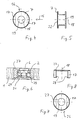
- FIG. 1 shows a top view of a wall panel 1 introduced clamping device 2, of which only the clamping hook 3 protrude beyond the front wall panel edge 24.
- the reference symbol 14 is a profiled rod in which the clamp hooks 3 are releasably hooked.
- the clamping device 2 is in a milling marked with the reference number 5 embedded in the wall plate 1.
- the structure of the clamping device 2 can be found in WO 97/25536.
- An essential one Characteristic of the clamping device 2 is the head 6, which against the Effect of a spring force in the body of the clamping device 2 sunk and then inserted through the milling 5 into the wall plate 1 becomes. This head 6 then protrudes into a transverse bore in the Wall plate 1 into it, advantageously with the wall plate 1 is flush.
- Reference number 7 denotes the sleeve, its function is explained in connection with the other drawings.
- Fig. 2 shows a cross section along the line II-II of Fig. 1, wherein the same features with the same reference numerals Marked are. It can be clearly seen that the Clamping device 2 is pushed into the cutout 5 and that the head 6 of the clamping device 2 is flush with the surface 8 closes the wall plate 1, with a cylindrical around the axis 9 Bore 10 is provided in the before insertion of the Clamping device 2, the sleeve 7 is to be used.
- FIG. 3 is a cross section along the line III-III 1 shown.
- 4 shows the sleeve 7 in one Top view. 5, which is the same sleeve 7 in the side view from the direction 15 shows.
- the cylindrical sleeve 7 via a penetrating here has rectangular bore 16 on both sides in each case in plan view a circular section 17 of material left to stand for.
- Through the bore 16 is the body of the clamping device 2 can be pushed forward.
- Concentric to the axis of symmetry 18 of the cylinder of the sleeve 7, a receiving bore 19 is provided, whose diameter is adjusted so that the head 6 of the Clamping device 2 essentially fits into it.
- FIGS. 1 to 3 From the representation of the sleeve 7, its mode of operation is related with FIGS. 1 to 3 immediately clear.
- the force absorption in one of the directions of the double arrow 20 in FIG. 1 or 3 is through the large side surfaces of the clamping device 2 guaranteed.
- This force usually corresponds the weight of the wall panels 1, which via the clamping device 2 to be attached to profiled rods 14.
- the inventive sleeve to a clamping device also for trays / shelves and base plates or others are used for supporting areal elements, and here especially in exhibition stand construction.
- the area is greatly increased, about which forces can be absorbed, which in one of the Directions of the double arrow 12 act, i.e. essentially Tensile forces that remove the wall plate 1 from the profiled rod could into which the clamping hook 3 of the clamping device 2nd intervention.
- the stressed area of the sleeve 7 corresponds to train in the projection in Fig. 4 of the area in the Level of arrow 15 is arranged. This has thus the design chosen in the exemplary embodiment more than doubled.
- this area which is indicated in FIG. 14 by the reference symbol 11 is marked, also occur and in particular the surface areas identified by reference numeral 31 of the circular segment sections 17 in the jacket.
- the base 22 of the sleeve 7 is an abutment, which a Tilting of the head 6 in the sleeve 7 or of the sleeve 7 with respect the wall plate 1 safely prevented.
- the wall plate 1 a Retains bottom portion 21 so that the sleeve 27 only from the Top, i.e. only recognizable from one side in the wall plate is.
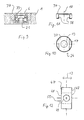
- FIGS. 7 and 8 in the representation of the sleeve 27 can be seen, it now has its recess 26 no longer via a base plate 22, but via two elongated ones Undercuts 28 in the corresponding in the clamping device Engage 2 grooves 29 provided.
- FIG. 9 shows a third embodiment of the invention, in which the height of the sleeve 37 provided here is reduced once again so that the undercuts 38 approximate half the height of the clamping device 2 in a corresponding provided groove 39 of this engage.
- the hole is too here formed into a U-shaped recess 26.
- 10 and 11 to see that the enlargement of the The effective area can also be guaranteed with a very low overall height of the sleeve is.
- the sleeve 7 not cylindrical, but angular, especially rectangular. Besides one Rectangle can also use other polygons for the outer shape of the sleeve to get voted. 12 gives a corresponding sketch reflected in the top view.
- This sleeve 47 can correspond to the first mentioned exemplary embodiments have different heights, through the plate 1 completely or undercuts exhibit. It is important in any case that a front Edge surface 48, which is perpendicular to the direction of arrow 12 lying surface larger than the diameter of the bore 49 through which the head 6 of the clamping device 2 protrudes. With the reference numeral 50 is in the sleeve 47 for the clamping device 2 designated bore designated.
- the Sleeve 47 of course requires the provision of one accordingly opening drilled at right angles in the wall plate 1.
- the lateral areas 48 which consist of a profile piece 1 Record the tractive force and use the control button 6 in the Introduce the clamping device 2 and then into the profiled rod 14.
- the head 6 is also like a honeycomb structure or an octagon possible.
- the hole 49 for the head 6 to the requirements of this one other head 6 having an outer shape can be adapted, whereby to fix the clamping device 2 and the clamping hook 3rd in a profiled rod 1, of course, the circular shape of the head 6 is preferred because it is thus easy to turn.
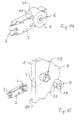
- FIG. 13 shows a perspective view of one with a Sleeve 7 according to the invention equipped clamping device 2, which is inserted in a wall plate 1, in front of a profiled Rod 14. The front rests after assembly 24 of the plate 1 on the profiled rod 14.
- FIGS. 1 and 13 shows a perspective view of the clamping device 2 with closure sleeve 7 according to FIGS. 1 and 13 in assembled Status.
- areas 11 and 31 can be recognized that protrude laterally beyond the clamping device 2 and thus after installation in the material of the wall plate 1 rest and are suitable for force absorption.
- clamping device 15 shows an exploded view of clamping device 2, Closure sleeve 7 and wall plate 1 according to FIG. 1 before assembly.
- the through bore 10 and the milling 5 can be seen in which the closure sleeve 7 in this order and the clamping device 2 are used.
- any clamping device can be a cuboid shape like the clamping device 2 Has.
- the clamping device can also be, for example have cylindrical body.
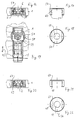
- FIG. 16 shows a cross section corresponding to FIG. 3 Wall plate 1, clamping device 2 and a sleeve 57 according to one fifth embodiment of the invention.
- the Clamping device 2 laterally each over the outer edge of the Housing of the clamping device 2 overlooking sections 58, the better in the partially cut top view of the clamping device 2 can be seen in FIG. 19.
- These sections 58 are part of the longitudinally movable slide 59.
- FIG. 17 shows a side view of the sleeve 57
- FIG. 18 shows a plan view of this sleeve 57. that laterally at the appropriate height and complementary to the sections 58 longitudinal grooves 60 are provided, which function as Undercuts 28 and 38 meet.
- the height is preferred the sleeve 57 thus as high as the height of the clamping device 2 with head 6.
- FIG Surface directed in the pull-in or pull-out direction 12 with the reference symbol 51 provided.
- FIG. 20 shows a cross section corresponding to FIG. 3 through wall plate 1, clamping device 2 and sleeve 67 according to one sixth embodiment of the invention
- FIG. 21 being a Side view
- Fig. 22 is a plan view of the sleeve 67 to Figure 20 illustrates.
- the clamping device 2 has rounded Side edges and in particular rounded lower side edges 69 on. These act together with undercuts 68 of the sleeve 67, which have the same complementary radius of curvature.
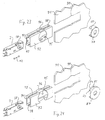
- FIG. 23 shows an exploded view of a clamping device 2 with a lock housing 92, a thin wall plate 91 and a closure sleeve 77 according to a seventh embodiment.
- the sleeve 77 is like the sleeve 57 with a groove 60 provided with protruding elements 58 of the clamping device 2 interact.
- a lock housing 92 is provided, which has a continuous cavity 93 with grooves 94 for which has elements 58.
- opening 95 is provided for receiving the sleeve 77.
- the complementary Form in the wall plate 91 is excluded. You can the mass of the closure housing 92 in another embodiment also be chosen so that the circular segment Recess 99 in the wall plate 91 is dispensed with.
- FIG. 24 finally shows an exploded view of one Clamping device 2 with a further closure housing 92, one thin wall plate 91 and a closure sleeve 87 according to one eighth embodiment.
- This embodiment is very similar to that from Fig. 23. The differences lie in that the sleeve 87 has two sections 84 and 85 with different Circle diameters. The back or the bottom Section 84 is smaller and forms part of the surface the groove 98. The upper larger section 85 takes a place in Lock housing 92, which in the lock housing 92 after 23 has been filled in by the latter itself. So that's one space-saving design of the clamping device 2 with the sleeve 87 possible for the thin wall plate 91.
- the sleeves intended for use with the closure housing 92 77 and 87 can of course also correspond to other embodiments and in particular according to the sleeves 7, 27, 37, 47, 57 and 67. Then in particular on the Groove 94 can be dispensed with if the clamping device 2 has none has protruding sections 58.
- the sleeves 7, 27, 37, 47, 57, 67, 77 and 87 and the sealing sleeve 92 preferably consist of a light metal, e.g. Aluminum. But you can also use any other material be made, especially from plastic. In summary these sleeves have the advantage that with such a closure sleeve 7, 27, 37, 47, 57, 67, 77 and 87 Clamping devices 2 considerably better in the longitudinal direction 12 of the Resist clamping device 2 acting tensile forces. With that Clamping devices 2 of the type mentioned now also with other materials the profile pieces 1, e.g. Wood, can be used. Through commitment a closure sleeve 92 can now also very thin profile elements 1, such as thin wooden panels 91, are used come.
- a closure sleeve 92 can now also very thin profile elements 1, such as thin wooden panels 91, are used come.
Landscapes
- Engineering & Computer Science (AREA)
- General Engineering & Computer Science (AREA)
- Mechanical Engineering (AREA)
- Clamps And Clips (AREA)
- Connection Of Plates (AREA)
- Seal Device For Vehicle (AREA)
- Forms Removed On Construction Sites Or Auxiliary Members Thereof (AREA)
- Joining Of Building Structures In Genera (AREA)
- Mutual Connection Of Rods And Tubes (AREA)
Claims (9)
- Dispositif pour assembler de façon libérable deux pièces profilées (1, 91 et 14) avec un dispositif de serrage (2) qui peut être inséré dans une ouverture (5) prévue dans une pièce profilée (1, 91), avec une douille de fermeture (7, 27, 37, 47, 57, 67, 77, 87) qui comprend une cavité (16, 50) pour recevoir le corps du dispositif de serrage (2) à engagement positif, et avec un bouton de commande avec lequel le dispositif de serrage (2) peut être sécurisé dans la douille de fermeture (7, 27, 37, 47, 57, 67, 77, 87), caractérisé en ce que le bouton de commande (6) est prévu dans le dispositif de serrage (2), en ce que la douille de fermeture (7, 27, 37, 47, 57, 67, 77, 87) comprend un alésage (19) qui reçoit le bouton de commande (6), et en ce que le bouton de commande (6) peut être, à l'encontre d'un effet de ressort, poussé dans le corps du dispositif de serrage (2) dans la direction transversale par rapport à l'axe longitudinal du dispositif de serrage (2).
- Dispositif selon la revendication 1, caractérisé en ce que la douille de fermeture (7, 27, 37, 57, 67) a une forme extérieure cylindrique.
- Dispositif selon la revendication 1, caractérisé en ce que la douille de fermeture (47) a une forme extérieure polygonale.
- Dispositif selon l'une des revendications 1 à 3, caractérisé en ce que la cavité (16, 50) est un alésage résultant en ce que la douille de fermeture (7) a un fond (22) localisé diamétralement opposé à l'alésage (19).
- Dispositif selon l'une des revendications 1 à 3, caractérisé en ce que la cavité (26) est configurée de telle manière que, de la douille de fermeture (27, 37, 67), une partie en forme de U subsiste dans une vue de coupe transversale, et en ce que la douille de fermeture (27, 37, 67) a des contre-dépouilles (28, 38, 68) qui engagent des rainures complémentaires (29, 39, 69) du dispositif de serrage (2).
- Dispositif selon l'une des revendications 1 à 3, caractérisé en ce que la douille de fermeture (57, 77, 87) a des rainures (60) qui s'étendent latéralement dans la direction d'introduction (12) et engagent des sections complémentaires (58) du dispositif de serrage (2).
- Boítier de fermeture pour un dispositif suivant l'une des revendications précédentes, caractérisé en ce que le boítier de fermeture (92) comprend une cavité (93) pour recevoir le dispositif de serrage (2), une ouverture (95) qui est alignée transversalement par rapport à la direction longitudinale dudit dispositif de serrage et est prévue pour recevoir la douille de fermeture (77, 87), et des rainures (98) qui s'étendent dans la direction longitudinale sur les côtés étroits du boítier de fermeture et qui sont prévues pour recevoir les pièces profilées (91).
- Boítier de fermeture selon la revendication 7, caractérisé en ce que sur ses cotés étroites, il comprend des sections cylindriques (96) protubérantes qui engagent les cavités complémentaires (99) de la pièce profilée (91).
- Boítier de fermeture selon la revendication 7, caractérisé en ce que sur ses côtés étroits, la cavité (93) comprend des rainures (94) mutuellement opposées pour recevoir des sections (58) qui s'étendent latéralement au delà du dispositif de serrage (2).
Applications Claiming Priority (3)
| Application Number | Priority Date | Filing Date | Title |
|---|---|---|---|
| CH190097 | 1997-08-12 | ||
| CH190097 | 1997-08-12 | ||
| PCT/CH1998/000337 WO1999009326A1 (fr) | 1997-08-12 | 1998-08-11 | Douille de fermeture pour un dispositif de serrage utilise pour assembler de facon liberable deux pieces profilees |
Publications (2)
| Publication Number | Publication Date |
|---|---|
| EP1003977A1 EP1003977A1 (fr) | 2000-05-31 |
| EP1003977B1 true EP1003977B1 (fr) | 2003-06-25 |
Family
ID=4221225
Family Applications (1)
| Application Number | Title | Priority Date | Filing Date |
|---|---|---|---|
| EP98936064A Expired - Lifetime EP1003977B1 (fr) | 1997-08-12 | 1998-08-11 | Douille de fermeture pour un dispositif de serrage utilise pour assembler de facon liberable deux pieces profilees |
Country Status (9)
| Country | Link |
|---|---|
| US (1) | US6334732B1 (fr) |
| EP (1) | EP1003977B1 (fr) |
| CN (1) | CN1117219C (fr) |
| AT (1) | ATE243814T1 (fr) |
| AU (1) | AU736455B2 (fr) |
| DE (1) | DE59808834D1 (fr) |
| HU (1) | HU222223B1 (fr) |
| RU (1) | RU2232307C2 (fr) |
| WO (1) | WO1999009326A1 (fr) |
Families Citing this family (12)
| Publication number | Priority date | Publication date | Assignee | Title |
|---|---|---|---|---|
| DE20103064U1 (de) * | 2001-02-21 | 2001-06-28 | Hestex Systems B.V., Apeldoorn | Klemmverbindersystem |
| JP5132875B2 (ja) * | 2005-10-07 | 2013-01-30 | ヘステックス システムズ ベー.フェー. | クランプジョイントシステム |
| EP2006550A1 (fr) * | 2007-06-23 | 2008-12-24 | Hestex Systems B.V. | Dispositif de connexion |
| EP2088332A1 (fr) * | 2008-02-08 | 2009-08-12 | Hestex Systems B.V. | Dispositif de connexion |
| US8956071B2 (en) * | 2009-02-12 | 2015-02-17 | Moss Holding Company | Quick release joint system for assembling frames |
| DE202009010237U1 (de) * | 2009-07-28 | 2009-12-10 | Häfele GmbH & Co KG | Tablarträger und Tablaranordnung |
| AU2011304534B2 (en) * | 2010-09-23 | 2015-04-30 | Syma Intercontinental Ag | Slide plate for a cam-type closure |
| US8408835B1 (en) * | 2012-01-05 | 2013-04-02 | Zhijun Zhang | Clamp for section tubes with rigid hooked lever |
| PL2685111T3 (pl) | 2012-07-09 | 2020-03-31 | Syma Intercontinental Ag | Mocowanie zaciskowe do rozłącznego łączenia dwóch profili |
| US9151060B2 (en) * | 2013-10-22 | 2015-10-06 | Stramos Oy | Construction block |
| US11619250B2 (en) * | 2021-04-23 | 2023-04-04 | Ming Yang Aluminum Co., Ltd. | Connecting apparatus |
| DE102023114450A1 (de) * | 2023-06-01 | 2024-12-05 | Michael Mahle | Verbindungsanordnung und Holzkonstruktion |
Family Cites Families (17)
| Publication number | Priority date | Publication date | Assignee | Title |
|---|---|---|---|---|
| DE1429491B2 (de) * | 1964-09-29 | 1970-06-25 | Baresel-Bofinger, Rudolf, 7129 Hsfeld | Vorrichtung zum leicht lösbaren Verbinden plattenförmiger Möbelteile mittels Exzenterschlösschen |
| LU57387A1 (fr) * | 1968-11-25 | 1969-03-03 | ||
| DE2610200C3 (de) * | 1976-03-11 | 1980-01-31 | Richard Heinze Gmbh & Co Kg, 4900 Herford | Beschlag zum lösbaren Verbinden zweier Bauteile, insbesondere von plattenförmigen Bauteilen für Möbel |
| DE2625182C3 (de) * | 1976-03-11 | 1980-06-19 | Richard Heinze Gmbh & Co Kg, 4900 Herford | Beschlag zum losbaren Verbinden von zwei Bauteilen, insbesondere plattenförmigen Bauteilen fur Möbel |
| DE2723850C2 (de) * | 1977-05-26 | 1986-08-28 | Richard Heinze GmbH & Co KG, 4905 Spenge | Möbelscharnier |
| DE2804222A1 (de) * | 1978-02-01 | 1979-08-02 | Lautenschlaeger Kg Karl | Verbindungsbeschlag fuer moebelteile |
| US4787769A (en) * | 1984-03-19 | 1988-11-29 | Exibelco Gmbh | Connecting element |
| CN88200402U (zh) * | 1988-01-22 | 1988-12-07 | 牛玉荣 | 金属构架联接件 |
| DE3871150D1 (de) * | 1988-11-28 | 1992-06-17 | Exibelco Gmbh | Verbindungselement. |
| EP0412339B1 (fr) * | 1989-08-11 | 1992-12-02 | Gerd und Bernd Vieler KG. | Dispositif pour la connexion de barres profilées d'une étagère |
| RU2089759C1 (ru) * | 1991-03-25 | 1997-09-10 | Сима Интерконтиненталь, АГ | Зажимное устройство для разъемного соединения двух профильных деталей |
| DE4218842A1 (de) * | 1992-06-09 | 1993-12-16 | Offenbroich A | Klemmvorrichtung |
| DE4225926A1 (de) * | 1992-08-05 | 1994-02-10 | Mero Raumstruktur Gmbh & Co | Befestigungsvorrichtung |
| ATE150848T1 (de) * | 1992-11-21 | 1997-04-15 | Hestex Systems Bv | Verbindungselement |
| GB2301412B (en) * | 1995-05-31 | 1999-03-10 | Titus Int Plc | A housing for joint forming devices |
| CA2239502C (fr) | 1996-01-09 | 2006-05-09 | Syma Intercontinental Ag | Dispositif de serrage pour assemblage separable de deux pieces profilees |
| IT1298152B1 (it) * | 1998-01-19 | 1999-12-20 | Giovannetti F | Dispositivo di fissaggio per unire tra di loro pannelli per arredamento |
-
1998
- 1998-08-11 EP EP98936064A patent/EP1003977B1/fr not_active Expired - Lifetime
- 1998-08-11 DE DE59808834T patent/DE59808834D1/de not_active Expired - Lifetime
- 1998-08-11 US US09/462,874 patent/US6334732B1/en not_active Expired - Lifetime
- 1998-08-11 WO PCT/CH1998/000337 patent/WO1999009326A1/fr not_active Ceased
- 1998-08-11 HU HU0002799A patent/HU222223B1/hu not_active IP Right Cessation
- 1998-08-11 CN CN98807905A patent/CN1117219C/zh not_active Expired - Fee Related
- 1998-08-11 AU AU85275/98A patent/AU736455B2/en not_active Ceased
- 1998-08-11 AT AT98936064T patent/ATE243814T1/de active
- 1998-08-11 RU RU2000106037/11A patent/RU2232307C2/ru not_active IP Right Cessation
Also Published As
| Publication number | Publication date |
|---|---|
| ATE243814T1 (de) | 2003-07-15 |
| WO1999009326A1 (fr) | 1999-02-25 |
| DE59808834D1 (de) | 2003-07-31 |
| AU736455B2 (en) | 2001-07-26 |
| EP1003977A1 (fr) | 2000-05-31 |
| US6334732B1 (en) | 2002-01-01 |
| HUP0002799A3 (en) | 2001-12-28 |
| CN1265725A (zh) | 2000-09-06 |
| HU222223B1 (hu) | 2003-05-28 |
| HK1025143A1 (en) | 2000-11-03 |
| HUP0002799A2 (hu) | 2000-12-28 |
| CN1117219C (zh) | 2003-08-06 |
| AU8527598A (en) | 1999-03-08 |
| RU2232307C2 (ru) | 2004-07-10 |
Similar Documents
| Publication | Publication Date | Title |
|---|---|---|
| DE4125976C2 (fr) | ||
| WO1995022702A1 (fr) | Element de liaison filete des deux cotes | |
| EP1003977B1 (fr) | Douille de fermeture pour un dispositif de serrage utilise pour assembler de facon liberable deux pieces profilees | |
| DE4306877C2 (de) | Profilstabsystem für Rahmenkonstruktionen, Fahrzeugaufbauten, Regalsysteme, Werkstatt- und Laboreinrichtungen od. dgl. | |
| EP0099972B1 (fr) | Elément d'assemblage pour plaques | |
| DE3603453C2 (fr) | ||
| DE202006021264U1 (de) | Tür- und Fensterrahmen mit einem hinterschnittenen Eingriffsbereich für eine Getriebeeinheit | |
| DE10348264B3 (de) | Feststeller für eingenutete Rückwände an Kastenmöbeln | |
| DE202008000430U1 (de) | Netzpfosten mit Netzhaken | |
| DE2724201A1 (de) | Moebelbausystem oder -bausatz | |
| EP1070859B1 (fr) | Dispositif de fixation avec au moins deux barres profilées rainurées | |
| DE102021101212B4 (de) | Verbindungsvorrichtung zum lösbaren Verbinden plattenförmiger Wandelemente und Stellwand damit | |
| DE102009057594B4 (de) | Befestigungssystem zum Verbinden eines Fachbodens mit einer Trägerstruktur, Fachboden, Regalsystem sowie Befestigungseinrichtung | |
| DE4316808C2 (de) | Spannstück für Rohrelemente | |
| DE69002342T2 (de) | Befestigungsvorrichtung durch Zusammenschrauben auf einem Profil, insbesondere auf einem Elektrizitätsschrank. | |
| DE9210946U1 (de) | Verbindungsteil | |
| DE2354066C3 (de) | Klemmvorrichtung zum Befestigen von Beschlagteilen an hinterschnittene Längsnuten aufweisenden Metall- oder Kunststoff- Hohlprofilen für Fenster- und Türrahmen o.dgl. | |
| DE9004757U1 (de) | Stangenführung für die Stangen eines Stangenverschlußes | |
| DE19701442C1 (de) | Schraubverbindung | |
| DE69208462T2 (de) | Vorrichtung zum befestigen eines dehnbares teiles an eine profilstrecke | |
| AT396699B (de) | Knotenkörper zum verbinden mehrerer balken | |
| DE19605541A1 (de) | Rückwandriegel für Möbel wie Schränke oder dergleichen | |
| DE202021101966U1 (de) | Fachboden für Möbel | |
| DE19854598A1 (de) | Tischplatten-Verbindungsvorrichtung | |
| DE29900115U1 (de) | Ringeleinsatz für die Eckstücke von Containern |
Legal Events
| Date | Code | Title | Description |
|---|---|---|---|
| PUAI | Public reference made under article 153(3) epc to a published international application that has entered the european phase |
Free format text: ORIGINAL CODE: 0009012 |
|
| 17P | Request for examination filed |
Effective date: 19991227 |
|
| AK | Designated contracting states |
Kind code of ref document: A1 Designated state(s): AT CH DE GB IT LI SE |
|
| GRAH | Despatch of communication of intention to grant a patent |
Free format text: ORIGINAL CODE: EPIDOS IGRA |
|
| GRAH | Despatch of communication of intention to grant a patent |
Free format text: ORIGINAL CODE: EPIDOS IGRA |
|
| GRAA | (expected) grant |
Free format text: ORIGINAL CODE: 0009210 |
|
| AK | Designated contracting states |
Designated state(s): AT CH DE GB IT LI SE |
|
| REG | Reference to a national code |
Ref country code: GB Ref legal event code: FG4D Free format text: NOT ENGLISH |
|
| REG | Reference to a national code |
Ref country code: CH Ref legal event code: NV Representative=s name: ISLER & PEDRAZZINI AG Ref country code: CH Ref legal event code: EP |
|
| REF | Corresponds to: |
Ref document number: 59808834 Country of ref document: DE Date of ref document: 20030731 Kind code of ref document: P |
|
| GBT | Gb: translation of ep patent filed (gb section 77(6)(a)/1977) |
Effective date: 20030801 |
|
| REG | Reference to a national code |
Ref country code: SE Ref legal event code: TRGR |
|
| PLBE | No opposition filed within time limit |
Free format text: ORIGINAL CODE: 0009261 |
|
| STAA | Information on the status of an ep patent application or granted ep patent |
Free format text: STATUS: NO OPPOSITION FILED WITHIN TIME LIMIT |
|
| 26N | No opposition filed |
Effective date: 20040326 |
|
| REG | Reference to a national code |
Ref country code: CH Ref legal event code: PCAR Free format text: ISLER & PEDRAZZINI AG;POSTFACH 1772;8027 ZUERICH (CH) |
|
| PGFP | Annual fee paid to national office [announced via postgrant information from national office to epo] |
Ref country code: CH Payment date: 20110818 Year of fee payment: 14 |
|
| PGFP | Annual fee paid to national office [announced via postgrant information from national office to epo] |
Ref country code: SE Payment date: 20120821 Year of fee payment: 15 Ref country code: GB Payment date: 20120821 Year of fee payment: 15 |
|
| PGFP | Annual fee paid to national office [announced via postgrant information from national office to epo] |
Ref country code: IT Payment date: 20120823 Year of fee payment: 15 Ref country code: DE Payment date: 20120822 Year of fee payment: 15 |
|
| PGFP | Annual fee paid to national office [announced via postgrant information from national office to epo] |
Ref country code: AT Payment date: 20120813 Year of fee payment: 15 |
|
| REG | Reference to a national code |
Ref country code: CH Ref legal event code: PL |
|
| REG | Reference to a national code |
Ref country code: SE Ref legal event code: EUG |
|
| REG | Reference to a national code |
Ref country code: AT Ref legal event code: MM01 Ref document number: 243814 Country of ref document: AT Kind code of ref document: T Effective date: 20130811 |
|
| GBPC | Gb: european patent ceased through non-payment of renewal fee |
Effective date: 20130811 |
|
| PG25 | Lapsed in a contracting state [announced via postgrant information from national office to epo] |
Ref country code: CH Free format text: LAPSE BECAUSE OF NON-PAYMENT OF DUE FEES Effective date: 20130831 Ref country code: LI Free format text: LAPSE BECAUSE OF NON-PAYMENT OF DUE FEES Effective date: 20130831 Ref country code: SE Free format text: LAPSE BECAUSE OF NON-PAYMENT OF DUE FEES Effective date: 20130812 Ref country code: DE Free format text: LAPSE BECAUSE OF NON-PAYMENT OF DUE FEES Effective date: 20140301 |
|
| REG | Reference to a national code |
Ref country code: DE Ref legal event code: R119 Ref document number: 59808834 Country of ref document: DE Effective date: 20140301 |
|
| PG25 | Lapsed in a contracting state [announced via postgrant information from national office to epo] |
Ref country code: IT Free format text: LAPSE BECAUSE OF NON-PAYMENT OF DUE FEES Effective date: 20130811 Ref country code: AT Free format text: LAPSE BECAUSE OF NON-PAYMENT OF DUE FEES Effective date: 20130811 |
|
| PG25 | Lapsed in a contracting state [announced via postgrant information from national office to epo] |
Ref country code: GB Free format text: LAPSE BECAUSE OF NON-PAYMENT OF DUE FEES Effective date: 20130811 |