EP1004111B1 - Systemes d'affichage - Google Patents
Systemes d'affichage Download PDFInfo
- Publication number
- EP1004111B1 EP1004111B1 EP98909659A EP98909659A EP1004111B1 EP 1004111 B1 EP1004111 B1 EP 1004111B1 EP 98909659 A EP98909659 A EP 98909659A EP 98909659 A EP98909659 A EP 98909659A EP 1004111 B1 EP1004111 B1 EP 1004111B1
- Authority
- EP
- European Patent Office
- Prior art keywords
- grid
- image
- strips
- masking
- window
- Prior art date
- Legal status (The legal status is an assumption and is not a legal conclusion. Google has not performed a legal analysis and makes no representation as to the accuracy of the status listed.)
- Expired - Lifetime
Links
- 230000000873 masking effect Effects 0.000 claims abstract description 173
- 230000006835 compression Effects 0.000 claims abstract description 42
- 238000007906 compression Methods 0.000 claims abstract description 42
- 230000000694 effects Effects 0.000 claims description 12
- 230000003287 optical effect Effects 0.000 claims 1
- 230000007246 mechanism Effects 0.000 abstract description 34
- 230000003068 static effect Effects 0.000 description 29
- 239000000463 material Substances 0.000 description 13
- 239000004033 plastic Substances 0.000 description 4
- 229920003023 plastic Polymers 0.000 description 4
- 238000005192 partition Methods 0.000 description 3
- 230000002411 adverse Effects 0.000 description 2
- 230000008859 change Effects 0.000 description 2
- 230000003247 decreasing effect Effects 0.000 description 2
- 230000007717 exclusion Effects 0.000 description 2
- 238000005286 illumination Methods 0.000 description 2
- 230000014759 maintenance of location Effects 0.000 description 2
- 238000000034 method Methods 0.000 description 2
- 230000009467 reduction Effects 0.000 description 2
- 239000007787 solid Substances 0.000 description 2
- 230000000007 visual effect Effects 0.000 description 2
- XAGFODPZIPBFFR-UHFFFAOYSA-N aluminium Chemical compound [Al] XAGFODPZIPBFFR-UHFFFAOYSA-N 0.000 description 1
- 229910052782 aluminium Inorganic materials 0.000 description 1
- 230000000903 blocking effect Effects 0.000 description 1
- 230000001427 coherent effect Effects 0.000 description 1
- 239000002131 composite material Substances 0.000 description 1
- 230000008602 contraction Effects 0.000 description 1
- 238000005520 cutting process Methods 0.000 description 1
- 230000007423 decrease Effects 0.000 description 1
- 238000009792 diffusion process Methods 0.000 description 1
- 238000005562 fading Methods 0.000 description 1
- 238000009434 installation Methods 0.000 description 1
- 238000010030 laminating Methods 0.000 description 1
- 238000003475 lamination Methods 0.000 description 1
- 238000004519 manufacturing process Methods 0.000 description 1
- 230000037361 pathway Effects 0.000 description 1
- 230000002093 peripheral effect Effects 0.000 description 1
- 239000004417 polycarbonate Substances 0.000 description 1
- 229920000515 polycarbonate Polymers 0.000 description 1
- -1 polyethylene terephthalate Polymers 0.000 description 1
- 229920000139 polyethylene terephthalate Polymers 0.000 description 1
- 239000005020 polyethylene terephthalate Substances 0.000 description 1
- 230000002829 reductive effect Effects 0.000 description 1
- 230000006903 response to temperature Effects 0.000 description 1
- 238000000926 separation method Methods 0.000 description 1
- 125000006850 spacer group Chemical group 0.000 description 1
Images




Classifications
-
- G—PHYSICS
- G09—EDUCATION; CRYPTOGRAPHY; DISPLAY; ADVERTISING; SEALS
- G09F—DISPLAYING; ADVERTISING; SIGNS; LABELS OR NAME-PLATES; SEALS
- G09F11/00—Indicating arrangements for variable information in which the complete information is permanently attached to a movable support which brings it to the display position
Definitions
- This invention relates to poster display systems and to methods of displaying poster images.
- a poster display system for presenting a plurality of different images by mounting a masking sheet over a poster image sheet and moving the masking sheet small distances relative to the poster image sheet.
- the poster image sheet is formed with a multiplicity of image strips with adjacent strips defining portions of different images.
- the masking sheet has alternate opaque and transparent strips so as to reveal selected ones only of the poster image strips. In one position of the masking sheet relative to the image sheet, strips of a first image remain exposed while other image strips are concealed behind opaque strips of the masking sheet. In another position of the masking sheet relative to the image sheet strips of the first image are concealed behind opaque strips whilst the image strips relating to another image that were previously concealed behind the masking strips become exposed.
- the display system may be used to display a plurality of unrelated static images, or a plurality of closely related images which, when displayed in the correct sequence, provide an animation, as for example proposed in US 3,918,185.
- US4118879 describes animated display devices which project an animated display towards a viewer, the display being formed using a rigid platen having a convex surface with sections of transparent and opaque character, a flexible sheet of film in contact with the convex surface having translucent images thereon, resilient means tensioning the film over and in full surface contact with the convex platten surface, and a drive mechanism for shifting the film and platten relative to each other.
- US3918185 describes display devices in which a rear illuminated strip image transparency sheet and a grid sheet having alternate opaque and transparent strips are continuously moved mechanically relative to one another or change their angular disposition relative to a viewer by movement of the viewer or the device to produce an animated display.
- the strip images are of greater width than the transparent strips of the grid sheet to produce a visual effect wherein each illuminated view of the display dwells for a brief time.
- a poster display system for displaying a plurality of different images, the system comprising
- the image grid preferably carries three or more sets of image strips. It is then possible to have three or more images displayed sequentially by the system. The more sets of image strips that are provided, the greater the width required for the masking strips relative to the image strips. As a result, accurate mounting of the masking strips relative to the image strips, which can be facilitated by the present invention, becomes more advantageous.
- the width of each window strip may be less than one fifth of the width of adjacent masking strips and a good image can still be displayed. It is advantageous that the masking strips between adjacent window strips have widths of less than about 2mm so that the images appear continuous to the eye.
- each window strip is preferably less than the width of each image strip with the respective window strip is aligned.
- Such extra width of image strip provides a small tolerance for the relative positions of the window strips and image strips, and it also allows for oblique viewing of the display.
- the image grid may form one face of a rigid body of substantial thickness, it is preferably formed on a flexible sheet which advantageously has a thickness of less than 1mm and more particularly of less than 0.5mm.
- the image strips are preferably printed on the image grid.
- the masking grid should at least be translucent and preferably transparent. It is also preferred that the masking strips be printed on the masking grid. Forming the image strips and the masking strips by printing is very simple and modern printers can print such strips with sufficient accuracy.
- the masking grid and the image grid are preferably made from the same material so that they will expand and contract in a similar way in response to temperature changes and the like. These two grids preferably have a low coefficient of expansion.
- the image grid and the masking grid with their respective printed faces immediately adjacent to each other as this can enable the accuracy of positioning the image strips and the masking strips to be improved and problems caused by oblique viewing can be reduced.
- the lamination film is preferably not more than 13 ⁇ m thick.
- systems in accordance with the present invention can include additional means for increasing such contact. Electrically charging one of the grids is a particularly suitable method of achieving this. Employing the inherent static properties of the image and masking grids to attract one grid to the other is another such means.
- Systems in accordance with the present invention preferably include adjustment means for setting up the relative positions of the image grid and the masking grid in a first display position.
- Such adjustment means preferably allow an operator to carry out fine adjustment of the relative positions of these grids after the installation of a new image grid, and it is preferred to use a screw-threaded adjuster element to effect such adjustment.
- the adjustment means preferably includes means for altering the positions of a drive member for moving the moveable grid, and the drive means by which it is driven, relative to a member to which the static member is fixed.
- the drive member may be a rotatable cam which is preferably detachable without dismantling the display unit, it being particularly convenient to be able to change the cam and the grids without dismantling the whole system.
- the position of the axis of rotation of the cam is preferably adjustable using adjustment means.
- the material from which the image grid and/or the masking grid are made can also be significant.
- they are of a plastics material and more preferably polyethylene terephthalate or a polycarbonate.
- An especially preferred material is sold under the trade mark Melinex, the grade Melinex 506 being used in the specific embodiments of display systems in accordance with the present invention which are described herein.
- Systems in accordance with the present invention preferably include means for lighting the image grid from behind both the image grid and the masking grid and this can be provided by providing a pathway for natural light and/or at least one artificial light source.
- the masking grid would have to be in front of the image grid, but we have found that these grids can be mounted either way around, it being preferred to use back lighting when the image grid is nearest to the viewer.
- the mounting arrangement can, therefore, enable the two grids to be mounted with either in front.
- the drive means can be attached to either the masking grid or to the image grid.
- the grid not so attached remains static.
- Such a curve can be achieved by fixing a clear base panel, made of the same or similar material, and of the same or similar thickness as that of the image grid and the masking grid, along two opposite edges within a display housing to an angled section using clamping bars of an appropriate material.
- the clear base panel can then be fixed so that it forms a natural curve when the display housing is laid horizontally on its back.
- the lowest part of the curve formed by the clear base panel can, for example, be between 5 and 50mm lower than its fixed edges.
- adjustable compression bars of an appropriate material can then be positioned between the two clamping bars.
- a secondary clear panel can then be positioned between the two compression bars.
- the curved width of the secondary clear panel is preferably a few millimetres less than the curved distance between the two compression bars when these two bars are fully adjusted away from each other. However, the curved width of the secondary clear panel is wider than the curved distance between the two compression bars when they are fully adjusted towards each other.
- the compression bars can therefore be adjusted to meet the corresponding and parallel edges of the secondary clear panel and then further squeezed together providing a compressive force upon the secondary clear panel forcing it into the curve of the clear base panel. In this manner, the curved clear base panel and the curved secondary clear panel become sufficiently rigid to retain a coherent curve when the display housing is raised into an upright and vertical position.
- the masking grid which has a width which is less than the curved distance between the compression bars and thereby allowing lateral registration of the masking grid in relation to the image grid, is placed over the secondary clear panel and fixed to this panel by adhesion or by the use of bolts along its top or bottom edge through the secondary clear panel to the clear base panel.
- the image grid which also has a width which is less than the curved distance between the compression bars but is greater than the width of the masking grid, is placed over the curved masking grid and it is attached to a mechanism for moving it up and down relative to the masking grid. Lateral registration of the image grid relative to the masking grid can then be achieved using off-set cams positioned either side of the image grid towards the edge of the image grid furthest away from the mechanism. These cams can then be rotated and fixed in position touching opposite side edges of the image grid once the latter has been laterally registered with the masking grid. Vertical registration of the image grid relative to the masking grid using the mechanism has been previously described.
- the image grid and the masking grid can be interchanged so that the masking grid is in front of the image grid.
- the image grid is preferably fixed to the secondary clear panel or through this panel to the base panel, and the masking grid is then positioned between the off-set cams and fixed to the drive mechanism.
- a front sheet of a clear material can be placed tightly between the compression bars and fixed through the static grid and the secondary clear panel to the clear base panel.
- the height of the moveable grid is then preferably sufficiently less than that of either the clear panels or the static grid to avoid the fixings of the clear panels and the static grid.
- either of the clear panels behind the grids or the rear grid itself can be made from a semi-opaque material.
- the compression bars can be used in place of the cams to achieve lateral registration of the grids though this generally requires very accurate cutting of whichever is the moveable grid.
- illumination for the display can be positioned on the concave or the convex side of the curved clear panels and grids with the display unit being viewed from the other side of the curved clear panels or grids.
- the drive mechanism can be fixed to the top panel of the display housing, or to the base panel of the display housing.
- a solid bar of clear material should in general be fixed tightly between the compression bars in front of the concave curve of the clear panels and grids so that this solid bar bends to match the curve of the clear panels and grids.
- Such a bar should be placed between both ends of the compression bars, and thus two such bars should be used.
- whichever grid is placed over the secondary clear panel can itself be attached to the protruding stud on the drive mechanism, thereby becoming the moveable grid.
- the grid placed over the moveable grid then becomes the static grid which is attached to the clear base panel through the secondary clear panel.
- Whichever grid is the moveable grid, it should in general be wider than the static grid to allow retention of registration if off-set cams are used to act on the moveable grid.
- either grid can be placed directly on to the clear base panel and the secondary clear panel can then be omitted, and indeed the clear front panel can also be omitted.
- the static grid can replace the clear base panel, and the secondary clear panel can be replaced by the moveable grid.
- the moveable grid would need to be cut very accurately as the compression bars become the means of keeping the moveable grid in linear registration with the static grid.
- the compression bars can be attached directly to the moveable grid. Compression can then be applied directly to the compression bars, for example using off-set cams or adjustable circular bearings attached to the angled section. These off-set cams or adjustable bearings can also be used to effect linear registration between the image grid and the masking grid.
- the image strips of the image grid and the transparent strips of the masking grid are of substantially the same width, the number of image strips that can be displayed, for example in an animation, can be increased compared to arrangements where the image strips are wider than the transparent strips because the number of image strips masked by each masking strip of the masking grid can thereby be increased.
- the more images that make up an animated sequence the smoother and longer an animated sequence can be.
- the animation effect will usually appear blurred.
- the opaque strips on a masking grid of A2 size can be at least 2.00mm with the image strips and the transparent strips of the masking grid each being as narrow as 0.10mm. It is then possible to provide an animated sequence of twenty images, each image varying slightly from its adjacent images, by obscuring nineteen consecutive sets of image strips using masking strips on the masking grid which are 1.90mm wide. The twentieth image strip is then visible from behind or in front of the transparent strips of the masking grid.
- an animated display can be achieved, for example a bird in flight or advertising graphics that appear at first to be moving away from the viewer and then towards them.
- the widths of the opaque strips on the masking grid can often be increased as the viewing distance increases.
- the width of the image strips on the masking grid do not necessarily have to be increased in the same proportion, and the number of image strips that make up an animation sequence can thereby be increased as a result of using wider masking strips.
- a drive mechanism which has a fixed rear plate 1 and a front plate 2 movably mounted on the rear plate 1.
- the front plate 2 has a horizontal, forwardly projecting, top flange 3 and it is secured on each side using slide bearings 4A and 4B in a manner (not shown in detail in the drawings) which facilitates precise vertical sliding of the plate 2 relative to the rear plate 1.
- the rear plate 1 has a horizontal, forwardly projecting top flange 5 which extends over the front plate 2 and a tension spring 6 (shown in Fig. 1) is connected between the plates 1 and 2, thereby biasing the front plate 2 upwardly.
- a bearing roller 7 is mounted on the rear of the front plate 2 and it is biased upwardly by the spring 6 into contact with a rotatable cam 8 in front of the rear plate 1.
- the cam 8 limits upward movement of the plate 2 and it thus defines the position of the front plate 2 relative to the rear plate 1.
- a stud 31 projects forward of the plate 2.
- the cam 8 is mounted on an output shaft 9 of a motor 10 which incorporates as a unit a motor and reduction gearing. Rather than mounting the motor 10 directly on the rear plate 1, it is mounted in a position that is finely adjustable relative to the rear plate 1 as will now be described.
- An adjustable arm 12 is pivotally mounted at one end by a pivot 13 to the rear plate 1 and it is finely adjustable at the other end by an adjusting mechanism 14 which, when operated, causes limited pivotal movement of the arm 12 about the pivot 13.
- the motor 10 has two mountings, the first being pivotal on the rear plate 1 coincident with the pivot 13, and the second being on a rod 15 which is behind the rear plate 1 and the arm 12.
- the adjusting mechanism 14 causes limited pivotal movement of the arm 12 about the pivot 13 and, when it does so, it imparts the same pivotal movement to the motor 10 thereby causing the shaft 9 on which the cam 8 is mounted to move about the pivot 13. Since the shaft 9 is at substantially the same vertical level as the pivot 13, the arcuate movement of the shaft 9 and the cam 8 is effectively vertical for small amounts of pivoting.
- An opening 17 in the rear plate 1 provides the necessary freedom of movement for the rod 15 to move relative to the plate 1.
- the adjusting mechanism 14 consists of a vertical shaft 18 connected at an upper end to the rear plate 1 and at a lower end to the arm 12 as will now be described more fully.
- the rear plate 1 In the region of the shaft 18, the rear plate 1 is partially cut away and portions 19A, 19B and 19C are bent out of the plane of the plate 1, portions 19A and 19C projecting rearwardly and portion 19B projects forwardly (see Fig. 3).
- the upper end of the shaft 18 (not shown in Fig. 2) passes in front of the portions 19A and 19C and to the rear of the portion 19B, it being screw-threadedly in those portions.
- the arm 12 In the region where the arm 12 is connected to the lower end of the shaft 18 it is similarly formed with bent portions 20A and 20C which project forwards and portion 20B which projects backwards.
- the lower end of the shaft 18 passes behind the portions 20A and 20C and in front of portion 20B, the shaft 18 being rotatably mounted in the portions without any axial movement.
- a knurled disc 22 fixed to the shaft 18 midway along its length enables a user to rotate the shaft 18, and compression springs 23 on each side of the knurled disc 22 between the disc 22 and the portions 19C and 20A respectively prevent the shaft 18 from rotating except when the disc 22 is positively moved by the user.
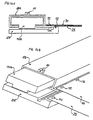
- clamping bars 69 and adjustable compression bars 71 within the display housing 43 are attached to the angled section 67 (see Fig. 5).
- a clear base panel 68 is located under the compression bars 71 and it is fixed to the angled section 67 by clamping bars 69.
- the arrangement of a front clear panel 74, an image grid 30, a masking grid 25 and a secondary clear panel 73 laid over the clear base panel 68 can also be seen.
- All of the clear panels 68, 73, 74 and the masking grid 25 are cut to the same length, this being indicated by lines 76 and 77, and they each have a slot 78 cut out of them to allow for movement of the single central stud 31 which projects forwards from the mechanism 79 and to which the image grid 30 is attached.
- the image grid 30 is shorter than the clear panels 68, 73, 74 and the masking grid 25 to ensure that as the image grid 30 is moved up and down it is not blocked by fixings 80 that pass through the clear base panel 68, the secondary clear panel 73, the masking grid 25, and the clear front panel 74 to hold the masking grid 25 in position between the secondary clear panel 73 and the moveable image grid 30.
- Lines 76 and 81 indicate the top and bottom of the image grid 30 when in its highest position, and the broken lines 82 and 83 indicate its lowest position.
- Lower side slots 84 cut from the front clear panel 74 allow off-set cams 85 fixed to the compression bars 71 to be swivelled to touch the sides of the image grid 30 and to keep the image grid 30 in lateral registration with the masking grid 25. Vertical registration between the two grids 25 and 30 is effected by the adjuster 22 forming part of the mechanism 79 which has previously been described.
- Fig. 1 is a side view corresponding to that of Fig. 4 along broken line 86-87 of Fig. 4, Fig. 1 showing the angled section 67 (see Fig. 5) and the relative positions of the clear base panel 68, the secondary clear panel 73, the masking grid 25, and the clear front panel 74, plus the image grid fixed to the stud 31, the image grid being sandwiched between the masking grid 25 and the clear front panel 74. Also shown is how a fixing 80 passes through the clear base panel 68, the secondary clear panel 73, the masking grid 25 and the clear front panel 74 to fix the masking grid 25 in position.
- the image grid 30 is cut shorter at a point 88 so that it is not blocked by the fixing 80 when the image grid 30 is moved up and down.
- a spacer 89 between the masking grid 25 and the front clear panel 74 allows free movement of the image grid 30.
- a "T" section bar 66 is attached to the interior of the display housing 43 to allow the angled section 67 to be set in position.
- the clear base panel 68 is attached to the angled section 67 by a clamping bar 69 and also to an opposing angled section (not shown) by bolts passing through apertures 70 (see Fig. 4).
- An adjustable compression bar 71 is positioned on the clear base panel 68 and it is held lightly in place by bolts which pass through apertures 72 (see Fig. 4) in the compression bars 71 and they screw into the angled section 67 through the clear base panel 68.
- the secondary clear panel 73 is placed on the clear base panel 68, and the adjustable compression bar 71 is pushed downwardly and inwardly as indicated by the arrow 71x so that the secondary clear panel 73 is compressed between the adjustable compression bar 71 and the opposing adjustable compression (not shown).
- the bolts passing through the apertures 72 are then tightened to secure the adjustable clamping bars 71 in position.
- Fig. 6 which is similar to Fig. 5, shows the static grid, in this case the masking grid 25, attached to an angled section 67 by the clamping bar 69 in a similar manner to that described with reference to Fig. 5.
- Circular adjustable bearings 130 which can be adjustably fixed towards or away from the clamping bar 69, as indicated by arrows 131, act upon the compression bar 71A which is attached directly to the movable grid, in this case the image grid, 30 to compress the moveable grid 30 into overall contact with the static grid 25. By adjusting the circular bearings 130, appropriate linear registration can also be achieved between the two grids. If required, a clear sheet 74 can be positioned between the compression bars 71A to protect the moveable grid 30.
- the off-set cams or the circular bearings 130 can be used to exert a compressive force directly to the moveable grid 30 to keep it in contact with the static grid 25.
- the compression bars are usually unnecessary.
- it can be more desirable to effect parallel registration between the two grids by attaching a single bracket to the moveable grid, this bracket being adjustably attached to another bracket or block attached to a slideable plate of the mechanism for moving the associated grid.
- the bracket attached to the slideable plate is then preferably attached at as great a distance as possible from the protruding stud to which the moveable grid is attached.
- the moveable grid can then be attached to the protruding stud on the slideable plate using circular bearings to allow the moveable grid to swivel at the point at which the moveable grid is attached to the protruding stud.
- the static grid can be sandwiched between a clamped clear or semi-opaque sheet and the moveable grid to which the compressive force is applied.
- the cam used in the embodiments of Figs. 1 to 6 is shown in Fig. 7, and, as can be seen, the periphery of the cam 8 is divided into a plurality of arcuate portions 8A to 8F, each defining an arc of a circle centered on the axis or rotation of the cam 8 and having a radius R A to R F . At the junction between adjacent arcs are inclined ramps 65.
- arcuate portions 8A to 8F At the junction between adjacent arcs are inclined ramps 65.
- the cam 8 is rotated by the motor 10 and, as it rotates, the bearing roller 7 rests against and remains in contact with the bottom of the peripheral surface of the cam 8 due to the bias of the spring 6.
- the vertical position of the roller 7 is then determined by the radius of whichever portion 8A to 8F of the cam periphery is in contact with the bottom of the cam 8, and the difference in radius between adjacent cam portions corresponds to the center-to-center spacing of adjacent image strips as shown, for example in Figs. 8A and 8B.
- An effect of one image fading into another can be achieved by reducing the incline or increasing the decline of the steps 65.
- the cam 8 shown in Fig. 7 will result in the images changing almost immediately and then remain for a given length of time. However, if the inclination of the steps 65 is considerably decreased and the declination of the steps 65 is considerably increased, for example so that the steps 65 are about one third of the lengths of the arcs 8A-8F, the images displayed will appear to fade into the next which will then appear for a shorter period of time.
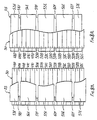
- Fig. 8A shows a cut away view of an image grid 30 positioned over a masking grid 25 in a system as described with reference to the preceding drawings. If these two grids are set up with this relative disposition with the roller on one of the portions 8A to 8F, rotation of the cam 8 of Fig. 7 through one eighth of a revolution will result in the roller 7 moving exactly the distance required to move the image grid 30 relative to the masking grid 25 by the exact width of one of the image strips, image strips 49B, 50B, 51B and 52B then becoming aligned with window strips 58F, 59F, 60F and 61F respectively.
- the image grid 30 will first be moved by three steps downardly from the first image visible through the masking grid as the cam 8 is rotated, and then three steps upwardly as it completes a revolution back to the first image. Each step brings the next of the four sets of image strips into alignment with the window strips 58F, 59F, 60F and 61F of the masking grid 25, and it then reverses the sequence, by which time the cam 8 has completed a single revolution.
- the cam 8 can be rotated continuously at a constant rotational speed and the individual strips of the image grid 30 will then be viewed for the time taken for the cam to effect approximately one eighth of a rotation of the cam 8.
- the cam 8 can be provided with a longer arcuate portion so that the roller 7 remains in contact with the cam 8 for a longer period of time with that portion than on others. In such cases it is generally preferred to have diagonally opposite long arcuate portions.
- a viewer of the display is usually unaware of the way in which the image grid 30 is moved relative to the masking grid 25, the viewer simply seeing a first image which, as the bearing roller 7 passes over one of the inclined ramps 65, changes smoothly into a second image, and so on.
- the masking strips 53E to 57E are not too thick as this could adversely affect the resolution of the display.
- masking strips with a width of up to about 1.5mm are generally satisfactory, but a noticeable reduction in resolution can be observed if the width of these strips is much wider than this.
- the masking strips 53E to 57E can be 1.4mm wide with the image strips being 0.2mm wide, the center-to center spacing of the masking strips being 1.6mm with that of the image strips being 0.4mm. 12.5% of the image is then displayed through the window strips.
- the cam 8 will have adjacent arcuate portions 8A to 8F which differ in radius by 0.4mm.
- the image strips are twice as wide as the window strips, only one half of each image strip therefore being displayed.
- the overlap of the image strips by the opposing edges of the windows in the masking grid is still only 0.1mm which can be regarded as the tolerance in positioning the respective strips relative to each other.
- the image grid and the masking grid therefore need to be printed, positioned and moved very accurately. It will also be appreciated that any separation of the masking grid from the image grid of even less than 0.1mm can have a markedly adverse effect on the performance of the system, and especially when the systems are viewed other than from directly in front.
- Fig. 8A shows only relatively few image strips and masking strips, it will be appreciated that in practice a multiplicity of strips will be used.
- the display area can be 0.7m wide or more and 1.0m high or more, and it is obviously important that the image grid and the masking grid be maintained in contact with each other throughout this area and that differences in expansion between these grids is kept to a minimum.
- Fig. 8B The arrangement of grids shown in Fig. 8B is substantially the same as that described with reference to Fig. 8A, but the masking grid 25 is in this case on top of the image grid 30.
- the image grid can be behind or in front of the masking grid.
- the grids described above use vertical movement of one grid relative to the other, it will be appreciated that the grids can be moved relative to each other horizontally or in a sideways direction. In a yet further alternative, the relative motion between the grids can be in a vertical direction, but with a drive mechanism below the grids rather than above them.
- Fig. 9 shows an alternative eight sided cam 104 having eight arcuate cam surfaces 105N to 112N which subtend equal angles to and are convex towards its center.
- the respective ends 114P to 121P of the arcs 105N to 112N are each 2.00mm further away from the center 113 than are the centers 122Q to 129Q of the surfaces 105N to 112N.
- the masking grid 25A or the image grid 30A (see Figs. 10A and 10B) controlled by the mechanism in the manner described in relation to Figs. 1 to 3 is moved 2.00mm down and then 2.00mm up as the periphery of the cam 104 moves in a clockwise sense over the bearing 7 of the mechanism 79 from position 126Q to 117P and then on to position 125Q.
- cam 104 rotates by one eighth of a revolution, the masking grid 25A or the image grid 30A are moved by rotation of the cam 104 and will at first fall 2.00mm and then rise by 2.00mm.
- each image strip 90C to 94E of the image grid 30A is 0.20mm wide, and since image strips B to J of each set 90 to 94 are obscured by opaque strips K95 to K99 of the masking grid, which themselves are each 1.80mm wide, only image strips A91 to A94 are visible through transparent strips L100 to L103 which are themselves 0.20mm wide.
- Fig. 10B where the image grid 30A and the masking grid 25A are identical to those in Fig. 10A but the image grid is on top of the masking grid 25A rather than on top of it.
- Each of the 0.20mm wide image strips 90C to 94E shown in Fig. 10A, or 90A to 94G shown in Fig 10B, will then briefly appear twice adjacent to the corresponding transparent strips 100L to 103L of the masking grid 25A, once as the masking grid 25A or the image grid 30A rises, and then once as it falls.
- Fig. 11 shows the clamping bar of Fig. 5 replaced by a slide housing 69B to which a static grid is attached, for example a masking grid 25.
- the bearings 130 of Fig. 6 are replaced by a self-lubricating plastic slider 130A to which the moveable grid 30 is attached, the slide housing 69B being fixed to the angled section 67.
- Studs 132 fixed to and projecting from the upper surface of the self-lubricating plastic slider 130A correspond with accurately punched holes along the side edges of the moveable grid 30 so that when the moveable grid 30 is held in position by the projecting studs 132, it is compressed into the static grid 25 when the static grid 25 and the moveable grid 30 are concave, the compressive effect being achieved by ensuring the distance between the punched holes along one side of the grid and those along the other side is greater than it would be if these punched holes were positioned to hold the grid so that it lay along the curve of the other fixed grid without being compressed into the fixed grid.
- the grids 25 and 30 are convex, the static grid 25 is compressed into the moveable grid 30, again by ensuring the distance between the fixings holding the static grid in position are appropriate to ensure the compressive force is effective.
- the static grid 25 is longer than the moveable grid 30, thereby allowing the static grid 25 to be attached to the slide housing 69B at points 133 without blocking movement of the moveable grid 30.
- a sheet of clear or semi-opaque material say 3mm thick, can be compressed between the two slide housings 69B to create a rigid curve matching that of the grids 30 and 25.
- the upper surface of the self-lubricating plastic slider 130A to which the projecting studs 132 are attached projects outwardly of the slide housing 69B, for example by 300 ⁇ m if the static grid 25 attached to the extended upper surface of the slide housing 69B is 250 ⁇ m thick.
- the self-lubricating slider 130A can be replaced by an arrangement of linear or roller bearings at each end of both slide housings 69B, the linear or roller bearing at one end of the slide housing being joined to the other at the other end of the slide housing by an aluminum bar to which projecting studs 132 are fixed corresponding to the holes punched along the side edges of the moveable grid 30.
- the moveable grid 30 can then be moved by spindles 134 controlled by linear stepper drive mechanisms 135A and 135B fixed to one end of each of the self-lubricating sliders 130A.
- the drive mechanisms 135A and 135B are controlled by a control board 136, and they can be arranged to drive the spindles 134 repeatedly up and down in appropriate increments, for example four increments of 0.40mm in the case of a quadruple image system, three increments of 0.50mm in the case of a triple image system, and a single up and down movement of 2.00mm in the case of an animated system incorporating ten images each made up of image strips 0.20mm wide.
- the self-lubricating slider 130A shown in Figure 11 is moved by the linear drive mechanisms 135A and 135B, and the slide housing 69B remains static.
- the slide housing 69B is moveable by the linear drive mechanisms 135A and 135B and the slider 130B remains static.
- the slide housings 69B are attached by brackets 137 to the spindles 134 which are driven by the linear drive mechanisms 135A and 135B, the self-lubricating slide 130B being fixed to the angled section 67.
- the window strips of the masking grid will then usually need to be centered along the center lines of the image strips of the image grid, and this can be effected using the linear drive mechanisms 135A and 135B to move the associated spindles 134 sufficiently to achieve registration. If the image strips of the image grid are not parallel with the window grids of the masking grid, the drive mechanism on one side of the moveable grid is then adjusted accordingly. Any vertical movement required to bring about registration of image and window grids which are parallel but not otherwise in registration can then be effected by moving both sides of the moveable grid by the same amount using the drive mechanisms 135A and 135B.
- Movement of the moveable grid relative to the static grid to display images can then be effected using equal steps produced by the linear drive mechanisms 135A and 135B under the control of the control board 136. Extra steps can be incorporated into the drive sequence to take account of back-lash in the drive mechanism that can occur when the driving force changes direction.
- Figs. 13A and 13B show an alternative slide housing 69B and self-lubricating slider 130A, the slide housing 69B being attached to the linear drive mechanism 135 using brackets 137 attached to the spindles 134, and the self-lubricating slider 130A being fixed to the angled section 67.
- Figs. 14A and 14B show a yet further alternative arrangement of slide housing 69B and self-lubricating slider 130A which is similar to that of Figs. 13A and 13B but has different profiles for the slide housing 69B and the self-lubricating slider 130A, in particular to provide a groove in the angled section 67A in which a portion of the studs 132 extending below the slide housing 69A can run freely.
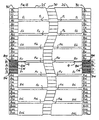
- Fig. 15 shows an arrangement of a masking grid 25 overlaying an image grid 30 which include means for obtaining registration between the window strips of the masking grid 25 and the individual image strips of the image grid 30, the masking grid 25 having been moved to the left to show the image strips below.
- the masking grid 25 shown in Fig. 15 has opaque strips Ei to Evii and window strips Fi to Fvii, and the image grid 30 has image strips Bi to Dviii.
- the window strip Fiv which is between adjacent masking strips Eiv and Ev, has a portion G near to the edge of the masking grid which is narrower than at its center and narrower than the window strips between the other masking strips.
- An edge portion of the image grid 30 beneath the masking grid 25 has four window strips AW, BW, CW and DW centered along the center lines of four adjacent image strips AV to AD, these being positioned so that the narrow portion of the window strip Fiv coincides with the windows AW, BW, CW and DW of the four adjacent image strips AV to DV when the respective sets of image strips A to D are in registration with the window strips Fi to Fvii of the masking grid 25.
- Registration of the window strips Fi to Fvii of the masking grid 25 with the respective images of the image grid 30 can then be effected using a photocell to detect light passing through the narrow windows in both grids, and this can also be used to control the relative upward and downward movement of these grids during normal operation of the system.
- registration of the image grid with the masking grid can be effected using arrangements of photocells, for example which respond to positional information determined from the opposite edges of the image and the masking grid such as have been described for the grids with reference to Fig. 15.
- Poster display systems in accordance with the present invention can be used in a wide variety of applications, for example:
Landscapes
- Physics & Mathematics (AREA)
- General Physics & Mathematics (AREA)
- Engineering & Computer Science (AREA)
- Theoretical Computer Science (AREA)
- Displays For Variable Information Using Movable Means (AREA)
- Control Of Indicators Other Than Cathode Ray Tubes (AREA)
- Fittings On The Vehicle Exterior For Carrying Loads, And Devices For Holding Or Mounting Articles (AREA)
- Circuits Of Receivers In General (AREA)
- Liquid Crystal (AREA)
Claims (17)
- Système de présentation d'affiche pour présenter plusieurs images différentes, comprenant :(a) une grille d'image qui porte une première série de bandes d'image formée de plusieurs premières bandes espacées les unes des autres et présentant différentes zones d'une première image, et une seconde série de bandes d'image formée de plusieurs secondes images espacées les unes des autres et présentant différentes zones d'une seconde image, les secondes bandes étant réparties sur la grille entre les premières bandes ;(b) une grille de masquage qui se trouve près de la grille d'image et qui porte une série de bandes de masquage formée de plusieurs bandes de masquage espacées les unes des autres, et une série de bandes formant fenêtres formée de plusieurs bandes formant fenêtres espacées les unes des autres, ces bandes formant fenêtres étant réparties sur la grille entre les bandes de masquage ;(c) un système de montage pour monter la grille d'image et la grille de masquage en vue de permettre un mouvement relatif entre les deux ;(d) des moyens d'entraínement pour produire un mouvement relatif entre la grille d'image et la grille de masquage entre une première position d'affichage dans laquelle les bandes formant fenêtres sont dans l'alignement des premières bandes d'image tandis que les secondes bandes d'image sont cachées par les bandes de masquage, et une seconde position d'affichage dans laquelle les bandes formant fenêtres sont dans l'alignement des secondes bandes d'image tandis que les premières bandes d'image sont cachées par les bandes de masquage ; et(e) des moyens de compression pour pousser les parties de bord opposées de la grille d'image et de la grille de masquage l'une vers l'autre, moyennant quoi la grille d'image et la grille de masquage se courbent et sont amenées l'une contre l'autre, sous pression.
- Système selon la revendication 1, dans lequel les moyens de compression appliquent une force supplémentaire aux zones de bord opposées de la grille de masquage ou aux zones de bord de la grille d'image, moyennant quoi la grille de masquage et la grille d'image se courbent et sont amenées l'une contre l'autre, avec une pression plus grande.
- Système selon l'une des revendications précédentes, dans lequel la grille d'image et la grille de masquage sont courbées par les moyens de compression de sorte qu'elles sont convexes, vues de l'avant du système.
- Système selon la revendication 1 ou 2, dans lequel la grille d'image et la grille de masquage sont courbées par les moyens de compression de sorte qu'elles sont concaves, vues de l'avant du système.
- Système selon l'une quelconque des revendications précédentes, dans lequel la grille d'image se trouve devant la grille de masquage, pour quelqu'un qui regarde le système.
- Système selon l'une quelconque des revendications 1 à 4, dans lequel la grille d'image se trouve derrière la grille de masquage, pour quelqu'un qui regarde le système.
- Système selon l'une quelconque des revendications précédentes, dans lequel les zones de bord opposées de la grille d'image ou de la grille de masquage sont fixées à des coulisseaux afin de faciliter le mouvement relatif entre la grille d'image et la grille de masquage.
- Système selon la revendication 7, dans lequel les coulisseaux comprennent des coulisseaux linéaires à l'intérieur d'un boítier de coulissement.
- Système selon la revendication 8, dans lequel la grille d'image ou la grille de masquage est fixée au coulisseau linéaire tandis que l'autre grille est fixée au boítier de coulissement.
- Système selon l'une quelconque des revendications précédentes, dans lequel les moyens d'entraínement comprennent au moins un moteur pas-à-pas.
- Système selon la revendication 10, dans lequel les moyens d'entraínement comprennent deux moteurs pas-à-pas qui sont disposés chacun de manière à déplacer les bords opposés de la grille d'image ou de la grille de masquage afin de produire ledit mouvement relatif.
- Système selon la revendication 11, dans lequel les moteurs pas-à-pas peuvent être entraínés séparément ou ensemble pour réaliser la concordance entre la grille d'image et la grille de masquage.
- Système selon la revendication 11 ou 12, dans lequel les moteurs pas-à-pas peuvent être entraínés ensemble pour réaliser les changements d'image.
- Système selon l'une quelconque des revendications précédentes, qui comporte plus de deux images sur la grille d'image.
- Système selon l'une quelconque des revendications précédentes, dans lequel la grille d'image comporte des bandes d'image pour plusieurs images, et le fonctionnement du système produit l'effet d'animation.
- Système selon l'une quelconque des revendications précédentes, dans lequel les bandes d'image de la grille d'image ont sensiblement la même largeur que les bandes formant fenêtres de la grille de masquage.
- Système selon l'une quelconque des revendications précédentes, comportant au moins un capteur optique destiné à commander les moyens d'entraínement afin de réaliser la concordance des bandes formant fenêtres de la grille de masquage et des bandes d'image des images respectives prévues sur la grille d'image.
Applications Claiming Priority (9)
| Application Number | Priority Date | Filing Date | Title |
|---|---|---|---|
| GB9705567 | 1997-03-18 | ||
| GBGB9705567.7A GB9705567D0 (en) | 1997-03-18 | 1997-03-18 | Poster display system |
| GB9714065 | 1997-07-04 | ||
| GBGB9714065.1A GB9714065D0 (en) | 1997-07-04 | 1997-07-04 | Poster display system |
| GBGB9716513.8A GB9716513D0 (en) | 1997-08-06 | 1997-08-06 | Poster display system |
| GB9716513 | 1997-08-06 | ||
| GBGB9717048.4A GB9717048D0 (en) | 1997-08-13 | 1997-08-13 | Poster display system |
| GB9717048 | 1997-08-13 | ||
| PCT/GB1998/000800 WO1998041967A1 (fr) | 1997-03-18 | 1998-03-18 | Systemes d'affichage |
Publications (2)
| Publication Number | Publication Date |
|---|---|
| EP1004111A1 EP1004111A1 (fr) | 2000-05-31 |
| EP1004111B1 true EP1004111B1 (fr) | 2003-01-08 |
Family
ID=27451616
Family Applications (1)
| Application Number | Title | Priority Date | Filing Date |
|---|---|---|---|
| EP98909659A Expired - Lifetime EP1004111B1 (fr) | 1997-03-18 | 1998-03-18 | Systemes d'affichage |
Country Status (12)
| Country | Link |
|---|---|
| US (1) | US6286239B1 (fr) |
| EP (1) | EP1004111B1 (fr) |
| JP (1) | JP2001515607A (fr) |
| CN (1) | CN1250537A (fr) |
| AT (1) | ATE230882T1 (fr) |
| AU (1) | AU744036B2 (fr) |
| CA (1) | CA2284239A1 (fr) |
| DE (1) | DE69810634T2 (fr) |
| ES (1) | ES2193520T3 (fr) |
| GB (1) | GB0012446D0 (fr) |
| IL (1) | IL131728A (fr) |
| WO (1) | WO1998041967A1 (fr) |
Families Citing this family (12)
| Publication number | Priority date | Publication date | Assignee | Title |
|---|---|---|---|---|
| HK1047180B (zh) * | 1999-11-12 | 2005-09-09 | Global Spectrum Australia Pty Limited | 帶有照明的多顯示系統 |
| AU726945B3 (en) * | 2000-02-03 | 2000-11-30 | Global Spectrum Australia Pty Limited | A multi-display apparatus |
| MY123389A (en) * | 1999-11-26 | 2006-05-31 | Global Spectrum Australia Pty Ltd | A multi-display apparatus |
| WO2001055998A1 (fr) * | 2000-01-28 | 2001-08-02 | Linqing He | Procédé et dispositif d'affichage d'une pluralité de matrices de points formant une image |
| GB2366437B (en) * | 2000-09-04 | 2004-06-30 | Vision Grid Ltd | Image displays |
| GB2366438B (en) * | 2000-09-04 | 2004-03-03 | Vision Grid Ltd | Display systems |
| GB0123942D0 (en) * | 2001-10-05 | 2001-11-28 | Hunt Robert J | A display device for creating animated movement |
| ES2277789B1 (es) * | 2006-01-13 | 2008-06-16 | Codice Exterior Gestion De Soportes, S.L. | Medios de accionamiento de la porcion movil de un expositor publicitario con actualizacion de imagenes. |
| US20090071048A1 (en) * | 2007-06-25 | 2009-03-19 | Yi Lan | Multiple static image display |
| GB0714254D0 (en) * | 2007-07-23 | 2007-08-29 | Marketing Works Internat Ltd | Multiple image display apparatus |
| WO2015017839A2 (fr) * | 2013-08-01 | 2015-02-05 | Durant Silas Jeffrey | Procédés et dispositifs d'affichage d'image |
| CN113495367A (zh) * | 2021-07-21 | 2021-10-12 | 上海北嘉数码影像科技有限公司 | 一种基于固定视角的光栅画装置 |
Family Cites Families (10)
| Publication number | Priority date | Publication date | Assignee | Title |
|---|---|---|---|---|
| US3683525A (en) * | 1970-07-14 | 1972-08-15 | Keiji Fukui | Automatic image shifting device |
| US3862504A (en) * | 1972-04-26 | 1975-01-28 | Harry M Ringelheim | Visual display apparatus |
| US3918185A (en) | 1972-09-05 | 1975-11-11 | Ernest Hasala | Animated display |
| US3883966A (en) * | 1973-09-26 | 1975-05-20 | Valmat Signs & Signals Ltd | Visual display apparatus |
| US4038767A (en) | 1975-12-09 | 1977-08-02 | David Chasin | Flexible flag advertising sign |
| US4118879A (en) | 1977-02-10 | 1978-10-10 | Thomas A. Schutz Co., Inc. | Animated display device having a curved platen and a movable film |
| US4246713A (en) * | 1979-06-08 | 1981-01-27 | Thomas A. Schutz Co., Inc. | Illuminated advertising display device with changing visual effects |
| US4489514A (en) | 1982-08-19 | 1984-12-25 | Honse James J | Motorized sign with sliding panels |
| US5459954A (en) * | 1993-08-31 | 1995-10-24 | Admotion Corporation | Advertising display method and apparatus |
| US5440214A (en) * | 1993-11-15 | 1995-08-08 | Admotion Corporation | Quiet drive control and interface apparatus |
-
1998
- 1998-03-18 AU AU64138/98A patent/AU744036B2/en not_active Ceased
- 1998-03-18 WO PCT/GB1998/000800 patent/WO1998041967A1/fr not_active Ceased
- 1998-03-18 US US09/380,613 patent/US6286239B1/en not_active Expired - Fee Related
- 1998-03-18 ES ES98909659T patent/ES2193520T3/es not_active Expired - Lifetime
- 1998-03-18 AT AT98909659T patent/ATE230882T1/de not_active IP Right Cessation
- 1998-03-18 DE DE69810634T patent/DE69810634T2/de not_active Expired - Fee Related
- 1998-03-18 JP JP54025698A patent/JP2001515607A/ja not_active Ceased
- 1998-03-18 EP EP98909659A patent/EP1004111B1/fr not_active Expired - Lifetime
- 1998-03-18 CN CN98803253A patent/CN1250537A/zh active Pending
- 1998-03-18 CA CA002284239A patent/CA2284239A1/fr not_active Abandoned
- 1998-03-18 IL IL13172898A patent/IL131728A/xx active IP Right Grant
-
2000
- 2000-05-23 GB GBGB0012446.1A patent/GB0012446D0/en not_active Ceased
Also Published As
| Publication number | Publication date |
|---|---|
| CA2284239A1 (fr) | 1998-09-24 |
| EP1004111A1 (fr) | 2000-05-31 |
| DE69810634D1 (de) | 2003-02-13 |
| JP2001515607A (ja) | 2001-09-18 |
| IL131728A0 (en) | 2001-03-19 |
| ES2193520T3 (es) | 2003-11-01 |
| AU6413898A (en) | 1998-10-12 |
| GB0012446D0 (en) | 2000-07-12 |
| DE69810634T2 (de) | 2003-10-16 |
| US6286239B1 (en) | 2001-09-11 |
| IL131728A (en) | 2003-07-06 |
| WO1998041967A1 (fr) | 1998-09-24 |
| AU744036B2 (en) | 2002-02-14 |
| CN1250537A (zh) | 2000-04-12 |
| ATE230882T1 (de) | 2003-01-15 |
Similar Documents
| Publication | Publication Date | Title |
|---|---|---|
| EP1004111B1 (fr) | Systemes d'affichage | |
| AU771704B2 (en) | Display unit | |
| EP1040465B1 (fr) | Dispositif d'affichage lumineux | |
| EP1299872B1 (fr) | Ensemble de visualisation eclaire, systeme de visualisation comprenant ledit dispositif, et methode de visualisation | |
| US7870686B2 (en) | Lighted subway signage | |
| AU2002307751B2 (en) | Lenticular display device | |
| EP1320771B1 (fr) | Dispositif pour maintenir une relation spatiale dans des afficheurs lenticulaires | |
| JPH07168535A (ja) | 広告表示の方法及び装置 | |
| GB2323463A (en) | Display systems | |
| WO1997026642A1 (fr) | Systeme de presentation d'affiches | |
| US20030223120A1 (en) | Lenticular display unit | |
| US7312926B2 (en) | Lenticular image display apparatus | |
| RU2222834C2 (ru) | Системы отображения | |
| US20090193698A1 (en) | Dynamic lenticular display unit | |
| HK1026500A (en) | Display systems | |
| WO2008065668A1 (fr) | Dispositif d'affichage lenticulaire | |
| JP3092645U (ja) | レンチキュラー表示装置 | |
| WO2005020197A1 (fr) | Dispositif d'affichage d'images multiples | |
| HK1033024B (en) | An illuminated display device |
Legal Events
| Date | Code | Title | Description |
|---|---|---|---|
| PUAI | Public reference made under article 153(3) epc to a published international application that has entered the european phase |
Free format text: ORIGINAL CODE: 0009012 |
|
| 17P | Request for examination filed |
Effective date: 19991018 |
|
| AK | Designated contracting states |
Kind code of ref document: A1 Designated state(s): AT BE CH DE DK ES FI FR GB GR IE IT LI LU NL PT SE |
|
| 17Q | First examination report despatched |
Effective date: 20000809 |
|
| GRAG | Despatch of communication of intention to grant |
Free format text: ORIGINAL CODE: EPIDOS AGRA |
|
| GRAG | Despatch of communication of intention to grant |
Free format text: ORIGINAL CODE: EPIDOS AGRA |
|
| GRAH | Despatch of communication of intention to grant a patent |
Free format text: ORIGINAL CODE: EPIDOS IGRA |
|
| GRAH | Despatch of communication of intention to grant a patent |
Free format text: ORIGINAL CODE: EPIDOS IGRA |
|
| GRAA | (expected) grant |
Free format text: ORIGINAL CODE: 0009210 |
|
| AK | Designated contracting states |
Kind code of ref document: B1 Designated state(s): AT BE CH DE DK ES FI FR GB GR IE IT LI LU NL PT SE |
|
| PG25 | Lapsed in a contracting state [announced via postgrant information from national office to epo] |
Ref country code: NL Free format text: LAPSE BECAUSE OF FAILURE TO SUBMIT A TRANSLATION OF THE DESCRIPTION OR TO PAY THE FEE WITHIN THE PRESCRIBED TIME-LIMIT Effective date: 20030108 Ref country code: GR Free format text: LAPSE BECAUSE OF FAILURE TO SUBMIT A TRANSLATION OF THE DESCRIPTION OR TO PAY THE FEE WITHIN THE PRESCRIBED TIME-LIMIT Effective date: 20030108 Ref country code: FI Free format text: LAPSE BECAUSE OF FAILURE TO SUBMIT A TRANSLATION OF THE DESCRIPTION OR TO PAY THE FEE WITHIN THE PRESCRIBED TIME-LIMIT Effective date: 20030108 Ref country code: BE Free format text: LAPSE BECAUSE OF FAILURE TO SUBMIT A TRANSLATION OF THE DESCRIPTION OR TO PAY THE FEE WITHIN THE PRESCRIBED TIME-LIMIT Effective date: 20030108 |
|
| REF | Corresponds to: |
Ref document number: 230882 Country of ref document: AT Date of ref document: 20030115 Kind code of ref document: T |
|
| REG | Reference to a national code |
Ref country code: GB Ref legal event code: FG4D |
|
| REG | Reference to a national code |
Ref country code: CH Ref legal event code: EP |
|
| REG | Reference to a national code |
Ref country code: IE Ref legal event code: FG4D |
|
| REF | Corresponds to: |
Ref document number: 69810634 Country of ref document: DE Date of ref document: 20030213 Kind code of ref document: P |
|
| PG25 | Lapsed in a contracting state [announced via postgrant information from national office to epo] |
Ref country code: LU Free format text: LAPSE BECAUSE OF NON-PAYMENT OF DUE FEES Effective date: 20030318 Ref country code: IE Free format text: LAPSE BECAUSE OF NON-PAYMENT OF DUE FEES Effective date: 20030318 |
|
| PG25 | Lapsed in a contracting state [announced via postgrant information from national office to epo] |
Ref country code: SE Free format text: LAPSE BECAUSE OF FAILURE TO SUBMIT A TRANSLATION OF THE DESCRIPTION OR TO PAY THE FEE WITHIN THE PRESCRIBED TIME-LIMIT Effective date: 20030408 Ref country code: PT Free format text: LAPSE BECAUSE OF FAILURE TO SUBMIT A TRANSLATION OF THE DESCRIPTION OR TO PAY THE FEE WITHIN THE PRESCRIBED TIME-LIMIT Effective date: 20030408 Ref country code: DK Free format text: LAPSE BECAUSE OF FAILURE TO SUBMIT A TRANSLATION OF THE DESCRIPTION OR TO PAY THE FEE WITHIN THE PRESCRIBED TIME-LIMIT Effective date: 20030408 |
|
| REG | Reference to a national code |
Ref country code: CH Ref legal event code: NV Representative=s name: KIRKER & CIE SA |
|
| ET | Fr: translation filed | ||
| REG | Reference to a national code |
Ref country code: ES Ref legal event code: FG2A Ref document number: 2193520 Country of ref document: ES Kind code of ref document: T3 |
|
| PLBE | No opposition filed within time limit |
Free format text: ORIGINAL CODE: 0009261 |
|
| STAA | Information on the status of an ep patent application or granted ep patent |
Free format text: STATUS: NO OPPOSITION FILED WITHIN TIME LIMIT |
|
| 26N | No opposition filed |
Effective date: 20031009 |
|
| REG | Reference to a national code |
Ref country code: IE Ref legal event code: MM4A |
|
| PGFP | Annual fee paid to national office [announced via postgrant information from national office to epo] |
Ref country code: GB Payment date: 20050418 Year of fee payment: 8 |
|
| PGFP | Annual fee paid to national office [announced via postgrant information from national office to epo] |
Ref country code: DE Payment date: 20050513 Year of fee payment: 8 |
|
| PGFP | Annual fee paid to national office [announced via postgrant information from national office to epo] |
Ref country code: AT Payment date: 20050907 Year of fee payment: 8 |
|
| PGFP | Annual fee paid to national office [announced via postgrant information from national office to epo] |
Ref country code: ES Payment date: 20050920 Year of fee payment: 8 |
|
| PGFP | Annual fee paid to national office [announced via postgrant information from national office to epo] |
Ref country code: FR Payment date: 20050926 Year of fee payment: 8 |
|
| PGFP | Annual fee paid to national office [announced via postgrant information from national office to epo] |
Ref country code: CH Payment date: 20050927 Year of fee payment: 8 |
|
| PG25 | Lapsed in a contracting state [announced via postgrant information from national office to epo] |
Ref country code: GB Free format text: LAPSE BECAUSE OF NON-PAYMENT OF DUE FEES Effective date: 20060318 Ref country code: AT Free format text: LAPSE BECAUSE OF NON-PAYMENT OF DUE FEES Effective date: 20060318 |
|
| PG25 | Lapsed in a contracting state [announced via postgrant information from national office to epo] |
Ref country code: ES Free format text: LAPSE BECAUSE OF NON-PAYMENT OF DUE FEES Effective date: 20060321 |
|
| PG25 | Lapsed in a contracting state [announced via postgrant information from national office to epo] |
Ref country code: LI Free format text: LAPSE BECAUSE OF NON-PAYMENT OF DUE FEES Effective date: 20060331 Ref country code: CH Free format text: LAPSE BECAUSE OF NON-PAYMENT OF DUE FEES Effective date: 20060331 |
|
| PGFP | Annual fee paid to national office [announced via postgrant information from national office to epo] |
Ref country code: IT Payment date: 20060331 Year of fee payment: 9 |
|
| PG25 | Lapsed in a contracting state [announced via postgrant information from national office to epo] |
Ref country code: DE Free format text: LAPSE BECAUSE OF NON-PAYMENT OF DUE FEES Effective date: 20061003 |
|
| REG | Reference to a national code |
Ref country code: CH Ref legal event code: PL |
|
| GBPC | Gb: european patent ceased through non-payment of renewal fee |
Effective date: 20060318 |
|
| REG | Reference to a national code |
Ref country code: FR Ref legal event code: ST Effective date: 20061130 |
|
| REG | Reference to a national code |
Ref country code: ES Ref legal event code: FD2A Effective date: 20060321 |
|
| PG25 | Lapsed in a contracting state [announced via postgrant information from national office to epo] |
Ref country code: FR Free format text: LAPSE BECAUSE OF NON-PAYMENT OF DUE FEES Effective date: 20060331 |
|
| PG25 | Lapsed in a contracting state [announced via postgrant information from national office to epo] |
Ref country code: IT Free format text: LAPSE BECAUSE OF NON-PAYMENT OF DUE FEES Effective date: 20070318 |