EP1004218B1 - Verfahren zur übertragung von daten über atm netzwerke unterschiedlichen typs - Google Patents
Verfahren zur übertragung von daten über atm netzwerke unterschiedlichen typs Download PDFInfo
- Publication number
- EP1004218B1 EP1004218B1 EP98935167A EP98935167A EP1004218B1 EP 1004218 B1 EP1004218 B1 EP 1004218B1 EP 98935167 A EP98935167 A EP 98935167A EP 98935167 A EP98935167 A EP 98935167A EP 1004218 B1 EP1004218 B1 EP 1004218B1
- Authority
- EP
- European Patent Office
- Prior art keywords
- atm
- network
- pointer
- atm cells
- protocol
- Prior art date
- Legal status (The legal status is an assumption and is not a legal conclusion. Google has not performed a legal analysis and makes no representation as to the accuracy of the status listed.)
- Expired - Lifetime
Links
- 238000000034 method Methods 0.000 title claims description 31
- 230000006978 adaptation Effects 0.000 claims description 14
- 230000011218 segmentation Effects 0.000 claims description 10
- 230000001360 synchronised effect Effects 0.000 claims description 2
- RPOCQUTXCSLYFJ-UHFFFAOYSA-N n-(4-ethylphenyl)-2-(2-methyl-3,5-dioxothiomorpholin-4-yl)acetamide Chemical compound C1=CC(CC)=CC=C1NC(=O)CN1C(=O)C(C)SCC1=O RPOCQUTXCSLYFJ-UHFFFAOYSA-N 0.000 claims 1
- 238000012546 transfer Methods 0.000 description 7
- 230000005540 biological transmission Effects 0.000 description 2
- 238000010586 diagram Methods 0.000 description 2
- 238000013507 mapping Methods 0.000 description 2
- 238000011084 recovery Methods 0.000 description 2
- 230000004075 alteration Effects 0.000 description 1
- 230000015572 biosynthetic process Effects 0.000 description 1
- 125000004122 cyclic group Chemical group 0.000 description 1
- 238000005516 engineering process Methods 0.000 description 1
- 238000012986 modification Methods 0.000 description 1
- 230000004048 modification Effects 0.000 description 1
- 230000003252 repetitive effect Effects 0.000 description 1
Images




Classifications
-
- H—ELECTRICITY
- H04—ELECTRIC COMMUNICATION TECHNIQUE
- H04Q—SELECTING
- H04Q11/00—Selecting arrangements for multiplex systems
- H04Q11/04—Selecting arrangements for multiplex systems for time-division multiplexing
- H04Q11/0428—Integrated services digital network, i.e. systems for transmission of different types of digitised signals, e.g. speech, data, telecentral, television signals
- H04Q11/0478—Provisions for broadband connections
-
- H—ELECTRICITY
- H04—ELECTRIC COMMUNICATION TECHNIQUE
- H04L—TRANSMISSION OF DIGITAL INFORMATION, e.g. TELEGRAPHIC COMMUNICATION
- H04L12/00—Data switching networks
- H04L12/54—Store-and-forward switching systems
- H04L12/56—Packet switching systems
- H04L12/5601—Transfer mode dependent, e.g. ATM
- H04L2012/5638—Services, e.g. multimedia, GOS, QOS
- H04L2012/5646—Cell characteristics, e.g. loss, delay, jitter, sequence integrity
- H04L2012/5652—Cell construction, e.g. including header, packetisation, depacketisation, assembly, reassembly
- H04L2012/5653—Cell construction, e.g. including header, packetisation, depacketisation, assembly, reassembly using the ATM adaptation layer [AAL]
- H04L2012/5656—Cell construction, e.g. including header, packetisation, depacketisation, assembly, reassembly using the ATM adaptation layer [AAL] using the AAL2
-
- H—ELECTRICITY
- H04—ELECTRIC COMMUNICATION TECHNIQUE
- H04L—TRANSMISSION OF DIGITAL INFORMATION, e.g. TELEGRAPHIC COMMUNICATION
- H04L12/00—Data switching networks
- H04L12/54—Store-and-forward switching systems
- H04L12/56—Packet switching systems
- H04L12/5601—Transfer mode dependent, e.g. ATM
- H04L2012/5638—Services, e.g. multimedia, GOS, QOS
- H04L2012/5663—Support of N-ISDN
Definitions
- This invention relates to a system and method for the transport of voice or data traffic over a telecommunications network.
- ATM asynchronous transfer mode
- information to be transmitted is loaded into packets or cells each of which is provided with a header containing information that is used for routing the cell to its correct destination.
- the header packet or cell may also contain other protocol control information relating to the cell payload and, in particular may include a cell sequence number so that cells received at a destination, possibly via different routes, may be unpacked in the correct order to recover the payload contents.
- the sequence number can also be used to indicate missing cells.
- ATM networks have evolved to handle different types of traffic, for example narrow band voice, wide band video and low bit-rate multi-user.
- Each particular network traffic type is adapted to its traffic content in an ATM network by the use of an ATM adaptation layer (AAL) a number of which have been defined.
- ATM adaptation layer type 1 (AAL-1) enables the transfer of n x 64 kbit/s structured data between source and destination whilst preserving the structure information
- ATM adaptation layer type 2 (AAL-2) provides the ability to encapsulate, multiplex and transport packets of user information inside an ATM cell stream, and so on.
- Arrangements for conveying narrow band traffic between ATM switches in a communications network are described in specification No. GB-A-2,299,240.
- Arrangements for interfacing a PBX and an ATM network are described in specification No. GB 2 294 840 A.
- the transport of PCM signals over an ATM network is described in specification No. US 5 390 175 A.
- a method of transporting structured data comprising blocks or frames from a first narrow band network to a second narrow band network over an asynchronous network arrangement incorporating a first ATM network having a first adaptation layer protocol, said first ATM network having embedded therein a second ATM network having a second adaptation layer protocol, the method being characterised by the steps of:
- the structured data can incorporate voice signals which have been digitised and which are in e.g. a TDM format.
- the ATM Adaptation Layer Type 1 (AAL1) enables the transfer of n x 64 kbit/s structured data between source and destination whilst preserving the structure information.
- AAL1 ATM Adaptation Layer Type 1
- Figure 1 shows the process used by AAL1 to provide the structured data transfer (SDT) capability.
- Frames of n x 64 kbit/s structured data arrive for transport every 125 microseconds.
- the example shows frames of less than 47 octets, so that consecutive octets from adjacent data structures are concatenated to form the payloads for consecutive AAL1 SAR-PDUs (segmentation and reassembly-protocol data units).
- SAR-PDUs segmentation and reassembly-protocol data units
- the AAL1 SAR-PDU always starts with a 1-octet header containing the four fields shown.
- a SAR-PDU pointer field of 1-octet is inserted immediately after the Header by the transmitter once in every cycle of eight cells, but only when the sequence count value in the SAR-PDU header is even.
- the figure shows AAL1 SAR-PDUs containing the pointer field, located in AAL1 cells with sequence number values equal to 2 in this example. The presence of the pointer field is indicated by the value '1' carried by the CSI field of the SAR-PDU header. At all other times, i.e.
- the CSI field is set to '0'. Note that the presence of the SAR-PDU pointer reduces the length of the SAR-PDU payload from 47 to 46 octets in those cells in which it appears.
- the pointer is used at the first opportunity in a cycle of eight cells to indicate the first start of the structured block of n x 64 kbit/s channels following the end of the pointer field. This enables the start of the block structure to be recovered reliably at the receiver.
- ATM Adaptation Layer Type 2 provides the ability to encapsulate and transport packets of user information inside an ATM cell stream. Packets from multiple users may be multiplexed onto a single ATM connection. These user packets consist, typically, of compressed voice information and vary in size from a few octets upwards, depending on the encoding algorithm in use. AAL2 permits packets of up to 45 octets to be carried by default with optional length of 64 octets. Longer packets must be segmented in a service specific convergence sublayer (SSCS) function prior to being handed down to the common part sublayer (CPS) of AAL2.
- SSCS service specific convergence sublayer
- PH refers to the packet header, PP to the packet payload and STF to the start field.
- FIG. 2 shows the sequence of operations involved in the AAL2 packet transfer process used to encapsulate user packets into an ATM cell stream.
- user information packets of variable length are encapsulated into SSCS-PDUs.
- the SSCS function is essentially null.
- This type of packet is referred to as Type 1 in Figure 2 and involves no addition of SSCS packet header (SSCS-PH) to the Type 1 packet.
- the UUI (user to user information) field in the CPS packet header identifies the Type 1 packets by means of one or more code point values.
- Other packet types e.g.
- Types 2, 3 and 4 are possible in which extra protocol control information and/or error protection is a requirement.
- Figure 2 identifies this latter type of packet as 'non-Type 1'.
- the resulting extra fields appear in the SSCS-PH and the corresponding packet types are again identified as such by specific code points of the CPS packet header UUI field.
- a CPS packet thus consists of a CPS packet Header (CPS-PH) and a CPS packet payload (CPS-PP).
- CPS-PH CPS packet Header
- CPS-PP CPS packet payload
- the latter field has a length of from 1 to 45 (default maximum) octets.
- the CPS-PH of 3 octets consists of the following 4 fields:
- One or more CPS packets are concatenated and a start field (STF) plus possibly a padding field are added as shown to form the CPS-PDUs, which are the fixed length 48 octet ATM cell payloads.
- STF start field
- padding field possibly a padding field
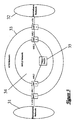
- FIG. 3 now shows an arrangement in which information being carried on an AAL1 cell stream is converted to an AAL2 cell stream.
- the arrangement provides for the transfer of structured data between narrow band networks 31, 32 via concatenated 'pure' ATM (33) and AAL2-based (34) ATM networks.
- the narrow band networks 31 and 32 will be time division multiplex (TDM) networks carrying voice and/ or data traffic. Switching of traffic within the AAL2-based network is performed by AAL2 switch 35.
- IWF 1 Interworking Function
- the n x 64 kbit/s structured data is adapted using the SDT (structured data transfer) mechanism of AAL1.
- the structured data is then transported across the ATM network to the interworking function IWF 2 located at the boundary between the ATM network 33 and the AAL2 network 34.
- the AAL1 structured data is converted by the interworking function IWF 2 to a suitable format for transport and switching by means of AAL2.
- the data is converted back for transport via AAL1 over the 'pure' ATM network 33 to the interworking function IWF 4.
- the structured data is converted back to its original TDM (time division multiplex) format for transport within the destination narrow band network.
- AAL1 structured data may be converted for transport via AAL2.
- Two preferred options involving segmentation of the AAL1 SAR-PDUs are discussed below.
- the stream of AAL1 SAR-PDUs is segmented in a simple manner and then encapsulated for transport by the AAL2 CPS.
- the 48 octet AAL1 SAR-PDUs (segmentation and reassembly-protocol data units) are segmented as required to enable their formation into the maximum (default) size 45 octet AAL2 CPS packets.
- This entails concatenating 45 octets from one or two consecutive AAL1 SAR-PDUs and adding an AAL2 CPS (common part sublayer) header field of 3 octets to form the CPS packets.
- the figure shows the AAL1 segments being loaded into consecutive AAL2 packets; however, it will be appreciated that packets from other applications can be interposed in the AAL2 packet stream. This in no way affects the AAL1 segmentation process, since the any AAL2 packet carrying the AAL1 segments only carries segments from the same source. These segments are identified as such belonging to a given source by means of the unique value of the CID field carried in their AAL2 packet headers.
- a requirement of the above segmentation process is that of identifying the start of a structured block of data within the AAL2 CPS packets.
- this identification is accomplished by the pointer field carried in every cycle of 8 cells as explained previously.
- the above segmentation process now causes the AAL1 SAR-PDU pointer to appear asynchronously to the start of the AAL2 packets carrying the AAL1 segments. Therefore, it is necessary to carry a further CPS pointer in the AAL2 CPS packet stream whose function is to locate the start of the AAL1 SAR-PDU pointer field.
- an extra unique UUI code point is used to signify routine traffic plus CPS pointer.
- the octet immediately following the CPS header carrying the new UUI codepoint is then used as the CPS pointer which locates the SAR-PDU pointer within the CPS packet. The data structure can thus be recovered at the receiver by reference to the SAR-PDU pointer.
- the stream of AAL1 SAR-PDUs is segmented such that the AAL1 SAR-PDU pointer is guaranteed to be synchronous with the start of the AAL2 CPS packets. This process is illustrated in Figure 5.
- the 48 octet AAL1 SAR-PDUs are segmented into 24 octet equal length segments.
- an AAL2 CPS packet header is appended to form 27 octet long CPS packets. This segmentation process guarantees that the SAR-PDU pointer always occupies the second octet position that follows an AAL2 CPS packet header (the first octet position being occupied by the AAL1 SAR-PDU header).
- the AAL1 SAR-PDU headers only appear in every second AAL2 CPS packet.
- the UUI fields in the CPS headers contain a sequence number of some modulus, e.g. 2 or 4 or 8 or 16.
- the SAR-PDU Pointer can always be located at the receiver. This is simply a matter of identifying the SAR-PDU Headers with a CSI field carrying the value '1'. The SAR-PDU pointer is then located in the octet immediately following the header field and enables the data structure to be recovered at the receiver.
- This segmentation process can be extended to segment lengths other than 24.
- the maximum AAL2 packet length is the default of 45 octets
- any segment length that is a whole number divisor of 48 can be used successfully, except 48 itself (48 octet segments can be used in cases where the default maximum AAL2 packet length is 64 octets).
- the result is that the AAL1 SAR-PDU header appears every 'N' AAL2 CPS packets, where 'N' is the integer divisor which provides the segment length.
- the SAR-PDU pointer can be recovered at the receiver.
- the SAR-PDU Header appears in the CPS packet with sequence number '0' (or some other known value of sequence number). This provides a ready index from which counting to determine the position of the SAR-PDU pointer every 'N' packets can be carried out.
- sequence number '0' or some other known value of sequence number
Landscapes
- Engineering & Computer Science (AREA)
- Computer Networks & Wireless Communication (AREA)
- Data Exchanges In Wide-Area Networks (AREA)
Claims (8)
- Verfahren zum Transport strukturierter Daten, die Blöcke oder Rahmen umfassen, von einem ersten Schmalband-Netz (31) zu einem zweiten Schmalband-Netz (32) über eine asynchrone Netzanordnung, die ein erstes ATM-Netz (33) mit einem ersten Anpassungsschicht-Protokoll beinhaltet, wobei in das erste ATM-Netz ein zweites ATM-Netz (34) mit einem zweiten Anpassungsschicht-Protokoll eingebettet ist, wobei das Verfahren durch die folgenden Schritte gekennzeichnet ist:an dem ersten ATM-Netz, Segmentieren der strukturierten Daten in erste ATM-Zellen, die auf das erste Protokoll strukturiert sind;Bereitstellen eines Zeigerfeldes, das den Anfang eines strukturierten Blockes oder Rahmens nachfolgend zu dem Zeigerfeld anzeigt, in einer Zelle eines Zyklus von acht der ersten ATM-Zellen,;an dem zweiten ATM-Netz, Segmentieren der ersten ATM-Zellen in zweite ATM-Zellen, die auf das zweite Protokoll strukturiert sind; undBereitstellen eines weiteren Zeigers in den zweiten ATM-Zellen,, wobei der weitere Zeiger die Position des Zeigerfeldes in den zweiten ATM-Zellen identifiziert.
- Verfahren nach Anspruch 1, bei dem die ersten ATM-Zellen für einen Transport in dem zweiten Anpassungsschicht-Protokoll derart segmentiert und eingekapselt sind, dass das Zeigerfeld auf den Anfang der zweiten ATM-Zellen synchronisiert ist.
- Verfahren nach Anspruch 1 oder 2, bei dem die ersten ATM-Zellen in Gemeinteil-Teilschicht-CPS-Pakete segmentiert werden, wobei jedes Paket mit einem Anfangsblock-Feld versehen wird.
- Verfahren nach Anspruch 3, bei dem das Anfangsblock-Feld drei Oktette umfasst.
- Verfahren nach Anspruch 3, bei dem die Segmentierung derart ist, dass der Anfangsblock der ersten ATM-Zellen in jedes zweite CPS-Paket eingefügt ist.
- Verfahren nach Anspruch 5, bei dem die strukturierten Daten achtundvierzig Oktett-Protokoll-Dateneinheiten umfassen, und bei dem jede Protokoll-Dateneinheit in zwei Segmente mit vierundzwanzig Oktetten segmentiert ist.
- Verfahren nach Anspruch 6, bei dem ein Zeigerfeld eine Oktett-Position belegt, die unmittelbar auf den Anfangsblock folgt.
- Verfahren nach Anspruch 7, bei dem das erste ATM-Netz ein ATM-Anpassungsschicht 1-, AAL1-, Typ-Netz umfasst und das zweite ATM-Netz ein ATM-Anpassungsschicht-2, AAL2-, Typ-Netz umfasst.
Applications Claiming Priority (5)
| Application Number | Priority Date | Filing Date | Title |
|---|---|---|---|
| US08/903,227 US6266343B1 (en) | 1997-07-22 | 1997-07-22 | Telecommunications system |
| US903227 | 1997-07-22 | ||
| GB9804107 | 1998-02-27 | ||
| GB9804107A GB2327557A (en) | 1997-07-22 | 1998-02-27 | Telecommunications system |
| PCT/GB1998/002160 WO1999005881A1 (en) | 1997-07-22 | 1998-07-20 | Telecommunications system |
Publications (2)
| Publication Number | Publication Date |
|---|---|
| EP1004218A1 EP1004218A1 (de) | 2000-05-31 |
| EP1004218B1 true EP1004218B1 (de) | 2004-03-17 |
Family
ID=26313187
Family Applications (1)
| Application Number | Title | Priority Date | Filing Date |
|---|---|---|---|
| EP98935167A Expired - Lifetime EP1004218B1 (de) | 1997-07-22 | 1998-07-20 | Verfahren zur übertragung von daten über atm netzwerke unterschiedlichen typs |
Country Status (4)
| Country | Link |
|---|---|
| EP (1) | EP1004218B1 (de) |
| CA (1) | CA2297253A1 (de) |
| DE (1) | DE69822475T2 (de) |
| WO (1) | WO1999005881A1 (de) |
Families Citing this family (15)
| Publication number | Priority date | Publication date | Assignee | Title |
|---|---|---|---|---|
| DE19832997C2 (de) * | 1998-07-22 | 2001-04-12 | Siemens Ag | Netzwerkanpassungseinrichtung und zugehöriges Verfahrens |
| GB2349294B (en) | 1999-04-19 | 2001-07-11 | Marconi Comm Ltd | Communications system |
| FR2821509B1 (fr) * | 2001-02-27 | 2003-05-30 | Thomson Csf | Procede et dispositif pour transferer des donnees dans un reseau de communication comportant une artere a faible debit |
| US8233462B2 (en) | 2003-10-15 | 2012-07-31 | Qualcomm Incorporated | High speed media access control and direct link protocol |
| US8462817B2 (en) * | 2003-10-15 | 2013-06-11 | Qualcomm Incorporated | Method, apparatus, and system for multiplexing protocol data units |
| US9226308B2 (en) | 2003-10-15 | 2015-12-29 | Qualcomm Incorporated | Method, apparatus, and system for medium access control |
| US8483105B2 (en) | 2003-10-15 | 2013-07-09 | Qualcomm Incorporated | High speed media access control |
| US8842657B2 (en) | 2003-10-15 | 2014-09-23 | Qualcomm Incorporated | High speed media access control with legacy system interoperability |
| US8903440B2 (en) | 2004-01-29 | 2014-12-02 | Qualcomm Incorporated | Distributed hierarchical scheduling in an ad hoc network |
| US7818018B2 (en) | 2004-01-29 | 2010-10-19 | Qualcomm Incorporated | Distributed hierarchical scheduling in an AD hoc network |
| US8315271B2 (en) | 2004-03-26 | 2012-11-20 | Qualcomm Incorporated | Method and apparatus for an ad-hoc wireless communications system |
| US7564814B2 (en) | 2004-05-07 | 2009-07-21 | Qualcomm, Incorporated | Transmission mode and rate selection for a wireless communication system |
| US8401018B2 (en) | 2004-06-02 | 2013-03-19 | Qualcomm Incorporated | Method and apparatus for scheduling in a wireless network |
| US7882412B2 (en) | 2004-10-05 | 2011-02-01 | Sanjiv Nanda | Enhanced block acknowledgement |
| US8600336B2 (en) | 2005-09-12 | 2013-12-03 | Qualcomm Incorporated | Scheduling with reverse direction grant in wireless communication systems |
Family Cites Families (3)
| Publication number | Priority date | Publication date | Assignee | Title |
|---|---|---|---|---|
| US5390175A (en) * | 1993-12-20 | 1995-02-14 | At&T Corp | Inter-cell switching unit for narrow band ATM networks |
| GB2294840B (en) * | 1994-11-07 | 1999-02-10 | Plessey Telecomm | Improvements in or relating to telecommunications systems |
| GB2299240A (en) * | 1995-03-24 | 1996-09-25 | Northern Telecom Ltd | Digital communications system |
-
1998
- 1998-07-20 WO PCT/GB1998/002160 patent/WO1999005881A1/en not_active Ceased
- 1998-07-20 EP EP98935167A patent/EP1004218B1/de not_active Expired - Lifetime
- 1998-07-20 DE DE69822475T patent/DE69822475T2/de not_active Expired - Fee Related
- 1998-07-20 CA CA002297253A patent/CA2297253A1/en not_active Abandoned
Also Published As
| Publication number | Publication date |
|---|---|
| CA2297253A1 (en) | 1999-02-04 |
| DE69822475D1 (de) | 2004-04-22 |
| EP1004218A1 (de) | 2000-05-31 |
| DE69822475T2 (de) | 2004-08-12 |
| WO1999005881A1 (en) | 1999-02-04 |
Similar Documents
| Publication | Publication Date | Title |
|---|---|---|
| US6266343B1 (en) | Telecommunications system | |
| US5936967A (en) | Multi-channel broadband adaptation processing | |
| US5481544A (en) | Multi-channel broadband adaptation processing | |
| KR100222222B1 (ko) | 종래의 디지탈 패킷 교환 망에서 멀티미디어 패킷을 효율적으로 전송하기 위한 데이타 처리 방법 | |
| US6108336A (en) | AAL-5 SSCS for AAL-1 and AAL-2 in ATM networks | |
| AU723092B2 (en) | Minicell sequence number count | |
| US6075798A (en) | Extended header for use in ATM adaptation layer type 2 packets | |
| US5703878A (en) | Method of transferring structured data of constant bit rate traffic in an ATM network | |
| US5953339A (en) | Logical link connection server | |
| US6574226B1 (en) | Data transmitting method | |
| EP1004218B1 (de) | Verfahren zur übertragung von daten über atm netzwerke unterschiedlichen typs | |
| EP1080600B1 (de) | Verfahren zur beseitigung von falschverkettung von teilpaketen in aal-2 und teilpaketen mit kanalidentifizierung | |
| EP1080601B1 (de) | Verfahren für eine leistungsfähige vermittlung von teilminizellen in der atm-anpassungsschicht 2 | |
| US6282196B1 (en) | Dynamic build-out approach for use in packet voice systems | |
| US5606552A (en) | Broadband adaptation processing | |
| US7463636B2 (en) | ATM communications system and method | |
| US6714543B1 (en) | ATM communications system and method | |
| EP0934673B1 (de) | Digitales kommunikationssystem | |
| US6597697B1 (en) | Extended AAL2 connection identifier | |
| JP2005516476A (ja) | 可変ビットレートリアルタイムサービス用のatmアダプテーションレイヤ2の実装方法 | |
| KR100354163B1 (ko) | 이동 통신 시스템에서 다중 가상 채널을 지원하는 aal2 프로토콜 구현 장치 및 방법 | |
| Zeug | Broadband Integrated Services Digital Network (B-ISDN) Standards | |
| US6694472B1 (en) | Error correction for frames carried over multiple networks | |
| KR0185857B1 (ko) | 에이에이엘 타입 1에서의 리드 솔로몬 순방향 오류정정 시스템에 있어서 고속 교직 및 역교직 처리장치 | |
| Killat | ATM Adaptation Layer (AAL) |
Legal Events
| Date | Code | Title | Description |
|---|---|---|---|
| PUAI | Public reference made under article 153(3) epc to a published international application that has entered the european phase |
Free format text: ORIGINAL CODE: 0009012 |
|
| 17P | Request for examination filed |
Effective date: 20000222 |
|
| AK | Designated contracting states |
Kind code of ref document: A1 Designated state(s): DE FR GB |
|
| RAP1 | Party data changed (applicant data changed or rights of an application transferred) |
Owner name: NORTEL NETWORKS LIMITED |
|
| GRAP | Despatch of communication of intention to grant a patent |
Free format text: ORIGINAL CODE: EPIDOSNIGR1 |
|
| RTI1 | Title (correction) |
Free format text: METHOD FOR TRANSMITTING DATA ACROSS ATM NETWORKS OF DIFFERENT TYPES |
|
| RAP1 | Party data changed (applicant data changed or rights of an application transferred) |
Owner name: NORTEL NETWORKS LIMITED |
|
| GRAS | Grant fee paid |
Free format text: ORIGINAL CODE: EPIDOSNIGR3 |
|
| GRAA | (expected) grant |
Free format text: ORIGINAL CODE: 0009210 |
|
| AK | Designated contracting states |
Kind code of ref document: B1 Designated state(s): DE FR GB |
|
| REG | Reference to a national code |
Ref country code: GB Ref legal event code: FG4D |
|
| REF | Corresponds to: |
Ref document number: 69822475 Country of ref document: DE Date of ref document: 20040422 Kind code of ref document: P |
|
| PGFP | Annual fee paid to national office [announced via postgrant information from national office to epo] |
Ref country code: GB Payment date: 20040615 Year of fee payment: 7 |
|
| PGFP | Annual fee paid to national office [announced via postgrant information from national office to epo] |
Ref country code: FR Payment date: 20040702 Year of fee payment: 7 |
|
| PGFP | Annual fee paid to national office [announced via postgrant information from national office to epo] |
Ref country code: DE Payment date: 20040730 Year of fee payment: 7 |
|
| ET | Fr: translation filed | ||
| PLBE | No opposition filed within time limit |
Free format text: ORIGINAL CODE: 0009261 |
|
| STAA | Information on the status of an ep patent application or granted ep patent |
Free format text: STATUS: NO OPPOSITION FILED WITHIN TIME LIMIT |
|
| 26N | No opposition filed |
Effective date: 20041220 |
|
| PG25 | Lapsed in a contracting state [announced via postgrant information from national office to epo] |
Ref country code: GB Free format text: LAPSE BECAUSE OF NON-PAYMENT OF DUE FEES Effective date: 20050720 |
|
| PG25 | Lapsed in a contracting state [announced via postgrant information from national office to epo] |
Ref country code: DE Free format text: LAPSE BECAUSE OF NON-PAYMENT OF DUE FEES Effective date: 20060201 |
|
| GBPC | Gb: european patent ceased through non-payment of renewal fee |
Effective date: 20050720 |
|
| PG25 | Lapsed in a contracting state [announced via postgrant information from national office to epo] |
Ref country code: FR Free format text: LAPSE BECAUSE OF NON-PAYMENT OF DUE FEES Effective date: 20060331 |
|
| REG | Reference to a national code |
Ref country code: FR Ref legal event code: ST Effective date: 20060331 |