EP1004432B1 - Heissschmelz-kalandrierte oder -extrudierte Nutzschicht für geprägte Substrate und Herstellungsverfahren - Google Patents
Heissschmelz-kalandrierte oder -extrudierte Nutzschicht für geprägte Substrate und Herstellungsverfahren Download PDFInfo
- Publication number
- EP1004432B1 EP1004432B1 EP99309274A EP99309274A EP1004432B1 EP 1004432 B1 EP1004432 B1 EP 1004432B1 EP 99309274 A EP99309274 A EP 99309274A EP 99309274 A EP99309274 A EP 99309274A EP 1004432 B1 EP1004432 B1 EP 1004432B1
- Authority
- EP
- European Patent Office
- Prior art keywords
- textured surface
- layer
- mils
- textured
- surface covering
- Prior art date
- Legal status (The legal status is an assumption and is not a legal conclusion. Google has not performed a legal analysis and makes no representation as to the accuracy of the status listed.)
- Expired - Lifetime
Links
- 239000000758 substrate Substances 0.000 title claims description 66
- 238000004519 manufacturing process Methods 0.000 title claims description 15
- 239000012943 hotmelt Substances 0.000 title description 16
- 238000000034 method Methods 0.000 title description 12
- 238000003490 calendering Methods 0.000 title description 9
- 239000000203 mixture Substances 0.000 claims description 39
- 239000000155 melt Substances 0.000 claims description 35
- 239000002952 polymeric resin Substances 0.000 claims description 27
- 229920003002 synthetic resin Polymers 0.000 claims description 27
- 229920005989 resin Polymers 0.000 claims description 5
- 239000011347 resin Substances 0.000 claims description 5
- 229920000915 polyvinyl chloride Polymers 0.000 claims description 4
- 239000004800 polyvinyl chloride Substances 0.000 claims description 4
- 238000001816 cooling Methods 0.000 claims description 3
- 238000010438 heat treatment Methods 0.000 claims description 2
- 239000013618 particulate matter Substances 0.000 claims 1
- 239000010410 layer Substances 0.000 description 64
- 238000004049 embossing Methods 0.000 description 5
- 229920001944 Plastisol Polymers 0.000 description 4
- 239000002131 composite material Substances 0.000 description 4
- 239000004999 plastisol Substances 0.000 description 4
- 230000001681 protective effect Effects 0.000 description 3
- 230000000007 visual effect Effects 0.000 description 3
- VVQNEPGJFQJSBK-UHFFFAOYSA-N Methyl methacrylate Chemical compound COC(=O)C(C)=C VVQNEPGJFQJSBK-UHFFFAOYSA-N 0.000 description 2
- 229920006243 acrylic copolymer Polymers 0.000 description 2
- -1 burlap Substances 0.000 description 2
- 239000000835 fiber Substances 0.000 description 2
- 239000006260 foam Substances 0.000 description 2
- 238000003475 lamination Methods 0.000 description 2
- 239000007788 liquid Substances 0.000 description 2
- 239000000463 material Substances 0.000 description 2
- 239000002344 surface layer Substances 0.000 description 2
- 125000000391 vinyl group Chemical group [H]C([*])=C([H])[H] 0.000 description 2
- 229920002554 vinyl polymer Polymers 0.000 description 2
- 239000002759 woven fabric Substances 0.000 description 2
- 241000272525 Anas platyrhynchos Species 0.000 description 1
- 239000004609 Impact Modifier Substances 0.000 description 1
- 239000006057 Non-nutritive feed additive Substances 0.000 description 1
- BZHJMEDXRYGGRV-UHFFFAOYSA-N Vinyl chloride Chemical compound ClC=C BZHJMEDXRYGGRV-UHFFFAOYSA-N 0.000 description 1
- NIXOWILDQLNWCW-UHFFFAOYSA-N acrylic acid group Chemical group C(C=C)(=O)O NIXOWILDQLNWCW-UHFFFAOYSA-N 0.000 description 1
- 239000000853 adhesive Substances 0.000 description 1
- 230000001070 adhesive effect Effects 0.000 description 1
- 239000003795 chemical substances by application Substances 0.000 description 1
- 238000000576 coating method Methods 0.000 description 1
- 238000000354 decomposition reaction Methods 0.000 description 1
- 230000006866 deterioration Effects 0.000 description 1
- 230000001627 detrimental effect Effects 0.000 description 1
- 235000014113 dietary fatty acids Nutrition 0.000 description 1
- 230000003467 diminishing effect Effects 0.000 description 1
- 230000000694 effects Effects 0.000 description 1
- 238000005516 engineering process Methods 0.000 description 1
- 239000004744 fabric Substances 0.000 description 1
- 239000000194 fatty acid Substances 0.000 description 1
- 229930195729 fatty acid Natural products 0.000 description 1
- 238000009472 formulation Methods 0.000 description 1
- 238000007646 gravure printing Methods 0.000 description 1
- 239000004615 ingredient Substances 0.000 description 1
- 239000000314 lubricant Substances 0.000 description 1
- 230000000704 physical effect Effects 0.000 description 1
- 239000004014 plasticizer Substances 0.000 description 1
- 238000007639 printing Methods 0.000 description 1
- 238000007650 screen-printing Methods 0.000 description 1
- 239000007921 spray Substances 0.000 description 1
- 239000003381 stabilizer Substances 0.000 description 1
- 229920001187 thermosetting polymer Polymers 0.000 description 1
- 238000009736 wetting Methods 0.000 description 1
Images

Classifications
-
- B—PERFORMING OPERATIONS; TRANSPORTING
- B32—LAYERED PRODUCTS
- B32B—LAYERED PRODUCTS, i.e. PRODUCTS BUILT-UP OF STRATA OF FLAT OR NON-FLAT, e.g. CELLULAR OR HONEYCOMB, FORM
- B32B5/00—Layered products characterised by the non- homogeneity or physical structure, i.e. comprising a fibrous, filamentary, particulate or foam layer; Layered products characterised by having a layer differing constitutionally or physically in different parts
- B32B5/02—Layered products characterised by the non- homogeneity or physical structure, i.e. comprising a fibrous, filamentary, particulate or foam layer; Layered products characterised by having a layer differing constitutionally or physically in different parts characterised by structural features of a fibrous or filamentary layer
- B32B5/022—Non-woven fabric
-
- B—PERFORMING OPERATIONS; TRANSPORTING
- B32—LAYERED PRODUCTS
- B32B—LAYERED PRODUCTS, i.e. PRODUCTS BUILT-UP OF STRATA OF FLAT OR NON-FLAT, e.g. CELLULAR OR HONEYCOMB, FORM
- B32B3/00—Layered products comprising a layer with external or internal discontinuities or unevennesses, or a layer of non-planar shape; Layered products comprising a layer having particular features of form
-
- B—PERFORMING OPERATIONS; TRANSPORTING
- B32—LAYERED PRODUCTS
- B32B—LAYERED PRODUCTS, i.e. PRODUCTS BUILT-UP OF STRATA OF FLAT OR NON-FLAT, e.g. CELLULAR OR HONEYCOMB, FORM
- B32B27/00—Layered products comprising a layer of synthetic resin
- B32B27/12—Layered products comprising a layer of synthetic resin next to a fibrous or filamentary layer
-
- B—PERFORMING OPERATIONS; TRANSPORTING
- B32—LAYERED PRODUCTS
- B32B—LAYERED PRODUCTS, i.e. PRODUCTS BUILT-UP OF STRATA OF FLAT OR NON-FLAT, e.g. CELLULAR OR HONEYCOMB, FORM
- B32B27/00—Layered products comprising a layer of synthetic resin
- B32B27/30—Layered products comprising a layer of synthetic resin comprising vinyl (co)polymers; comprising acrylic (co)polymers
- B32B27/304—Layered products comprising a layer of synthetic resin comprising vinyl (co)polymers; comprising acrylic (co)polymers comprising vinyl halide (co)polymers, e.g. PVC, PVDC, PVF, PVDF
-
- B—PERFORMING OPERATIONS; TRANSPORTING
- B32—LAYERED PRODUCTS
- B32B—LAYERED PRODUCTS, i.e. PRODUCTS BUILT-UP OF STRATA OF FLAT OR NON-FLAT, e.g. CELLULAR OR HONEYCOMB, FORM
- B32B3/00—Layered products comprising a layer with external or internal discontinuities or unevennesses, or a layer of non-planar shape; Layered products comprising a layer having particular features of form
- B32B3/26—Layered products comprising a layer with external or internal discontinuities or unevennesses, or a layer of non-planar shape; Layered products comprising a layer having particular features of form characterised by a particular shape of the outline of the cross-section of a continuous layer; characterised by a layer with cavities or internal voids ; characterised by an apertured layer
- B32B3/30—Layered products comprising a layer with external or internal discontinuities or unevennesses, or a layer of non-planar shape; Layered products comprising a layer having particular features of form characterised by a particular shape of the outline of the cross-section of a continuous layer; characterised by a layer with cavities or internal voids ; characterised by an apertured layer characterised by a layer formed with recesses or projections, e.g. hollows, grooves, protuberances, ribs
-
- B—PERFORMING OPERATIONS; TRANSPORTING
- B32—LAYERED PRODUCTS
- B32B—LAYERED PRODUCTS, i.e. PRODUCTS BUILT-UP OF STRATA OF FLAT OR NON-FLAT, e.g. CELLULAR OR HONEYCOMB, FORM
- B32B37/00—Methods or apparatus for laminating, e.g. by curing or by ultrasonic bonding
- B32B37/0007—Methods or apparatus for laminating, e.g. by curing or by ultrasonic bonding involving treatment or provisions in order to avoid deformation or air inclusion, e.g. to improve surface quality
-
- B—PERFORMING OPERATIONS; TRANSPORTING
- B32—LAYERED PRODUCTS
- B32B—LAYERED PRODUCTS, i.e. PRODUCTS BUILT-UP OF STRATA OF FLAT OR NON-FLAT, e.g. CELLULAR OR HONEYCOMB, FORM
- B32B38/00—Ancillary operations in connection with laminating processes
- B32B38/06—Embossing
-
- B—PERFORMING OPERATIONS; TRANSPORTING
- B32—LAYERED PRODUCTS
- B32B—LAYERED PRODUCTS, i.e. PRODUCTS BUILT-UP OF STRATA OF FLAT OR NON-FLAT, e.g. CELLULAR OR HONEYCOMB, FORM
- B32B5/00—Layered products characterised by the non- homogeneity or physical structure, i.e. comprising a fibrous, filamentary, particulate or foam layer; Layered products characterised by having a layer differing constitutionally or physically in different parts
- B32B5/02—Layered products characterised by the non- homogeneity or physical structure, i.e. comprising a fibrous, filamentary, particulate or foam layer; Layered products characterised by having a layer differing constitutionally or physically in different parts characterised by structural features of a fibrous or filamentary layer
- B32B5/024—Woven fabric
-
- D—TEXTILES; PAPER
- D06—TREATMENT OF TEXTILES OR THE LIKE; LAUNDERING; FLEXIBLE MATERIALS NOT OTHERWISE PROVIDED FOR
- D06N—WALL, FLOOR, OR LIKE COVERING MATERIALS, e.g. LINOLEUM, OILCLOTH, ARTIFICIAL LEATHER, ROOFING FELT, CONSISTING OF A FIBROUS WEB COATED WITH A LAYER OF MACROMOLECULAR MATERIAL; FLEXIBLE SHEET MATERIAL NOT OTHERWISE PROVIDED FOR
- D06N7/00—Flexible sheet materials not otherwise provided for, e.g. textile threads, filaments, yarns or tow, glued on macromolecular material
- D06N7/0005—Floor covering on textile basis comprising a fibrous substrate being coated with at least one layer of a polymer on the top surface
- D06N7/0007—Floor covering on textile basis comprising a fibrous substrate being coated with at least one layer of a polymer on the top surface characterised by their relief structure
-
- B—PERFORMING OPERATIONS; TRANSPORTING
- B29—WORKING OF PLASTICS; WORKING OF SUBSTANCES IN A PLASTIC STATE IN GENERAL
- B29C—SHAPING OR JOINING OF PLASTICS; SHAPING OF MATERIAL IN A PLASTIC STATE, NOT OTHERWISE PROVIDED FOR; AFTER-TREATMENT OF THE SHAPED PRODUCTS, e.g. REPAIRING
- B29C43/00—Compression moulding, i.e. applying external pressure to flow the moulding material; Apparatus therefor
- B29C43/22—Compression moulding, i.e. applying external pressure to flow the moulding material; Apparatus therefor of articles of indefinite length
- B29C43/24—Calendering
-
- B—PERFORMING OPERATIONS; TRANSPORTING
- B32—LAYERED PRODUCTS
- B32B—LAYERED PRODUCTS, i.e. PRODUCTS BUILT-UP OF STRATA OF FLAT OR NON-FLAT, e.g. CELLULAR OR HONEYCOMB, FORM
- B32B2327/00—Polyvinylhalogenides
- B32B2327/06—PVC, i.e. polyvinylchloride
-
- B—PERFORMING OPERATIONS; TRANSPORTING
- B32—LAYERED PRODUCTS
- B32B—LAYERED PRODUCTS, i.e. PRODUCTS BUILT-UP OF STRATA OF FLAT OR NON-FLAT, e.g. CELLULAR OR HONEYCOMB, FORM
- B32B2451/00—Decorative or ornamental articles
-
- B—PERFORMING OPERATIONS; TRANSPORTING
- B32—LAYERED PRODUCTS
- B32B—LAYERED PRODUCTS, i.e. PRODUCTS BUILT-UP OF STRATA OF FLAT OR NON-FLAT, e.g. CELLULAR OR HONEYCOMB, FORM
- B32B2471/00—Floor coverings
-
- B—PERFORMING OPERATIONS; TRANSPORTING
- B32—LAYERED PRODUCTS
- B32B—LAYERED PRODUCTS, i.e. PRODUCTS BUILT-UP OF STRATA OF FLAT OR NON-FLAT, e.g. CELLULAR OR HONEYCOMB, FORM
- B32B2607/00—Walls, panels
- B32B2607/02—Wall papers, wall coverings
-
- B—PERFORMING OPERATIONS; TRANSPORTING
- B32—LAYERED PRODUCTS
- B32B—LAYERED PRODUCTS, i.e. PRODUCTS BUILT-UP OF STRATA OF FLAT OR NON-FLAT, e.g. CELLULAR OR HONEYCOMB, FORM
- B32B37/00—Methods or apparatus for laminating, e.g. by curing or by ultrasonic bonding
- B32B37/14—Methods or apparatus for laminating, e.g. by curing or by ultrasonic bonding characterised by the properties of the layers
- B32B37/15—Methods or apparatus for laminating, e.g. by curing or by ultrasonic bonding characterised by the properties of the layers with at least one layer being manufactured and immediately laminated before reaching its stable state, e.g. in which a layer is extruded and laminated while in semi-molten state
- B32B37/153—Methods or apparatus for laminating, e.g. by curing or by ultrasonic bonding characterised by the properties of the layers with at least one layer being manufactured and immediately laminated before reaching its stable state, e.g. in which a layer is extruded and laminated while in semi-molten state at least one layer is extruded and immediately laminated while in semi-molten state
-
- Y—GENERAL TAGGING OF NEW TECHNOLOGICAL DEVELOPMENTS; GENERAL TAGGING OF CROSS-SECTIONAL TECHNOLOGIES SPANNING OVER SEVERAL SECTIONS OF THE IPC; TECHNICAL SUBJECTS COVERED BY FORMER USPC CROSS-REFERENCE ART COLLECTIONS [XRACs] AND DIGESTS
- Y10—TECHNICAL SUBJECTS COVERED BY FORMER USPC
- Y10T—TECHNICAL SUBJECTS COVERED BY FORMER US CLASSIFICATION
- Y10T428/00—Stock material or miscellaneous articles
- Y10T428/24—Structurally defined web or sheet [e.g., overall dimension, etc.]
- Y10T428/24479—Structurally defined web or sheet [e.g., overall dimension, etc.] including variation in thickness
- Y10T428/24521—Structurally defined web or sheet [e.g., overall dimension, etc.] including variation in thickness with component conforming to contour of nonplanar surface
-
- Y—GENERAL TAGGING OF NEW TECHNOLOGICAL DEVELOPMENTS; GENERAL TAGGING OF CROSS-SECTIONAL TECHNOLOGIES SPANNING OVER SEVERAL SECTIONS OF THE IPC; TECHNICAL SUBJECTS COVERED BY FORMER USPC CROSS-REFERENCE ART COLLECTIONS [XRACs] AND DIGESTS
- Y10—TECHNICAL SUBJECTS COVERED BY FORMER USPC
- Y10T—TECHNICAL SUBJECTS COVERED BY FORMER US CLASSIFICATION
- Y10T428/00—Stock material or miscellaneous articles
- Y10T428/24—Structurally defined web or sheet [e.g., overall dimension, etc.]
- Y10T428/24802—Discontinuous or differential coating, impregnation or bond [e.g., artwork, printing, retouched photograph, etc.]
- Y10T428/24851—Intermediate layer is discontinuous or differential
- Y10T428/24868—Translucent outer layer
-
- Y—GENERAL TAGGING OF NEW TECHNOLOGICAL DEVELOPMENTS; GENERAL TAGGING OF CROSS-SECTIONAL TECHNOLOGIES SPANNING OVER SEVERAL SECTIONS OF THE IPC; TECHNICAL SUBJECTS COVERED BY FORMER USPC CROSS-REFERENCE ART COLLECTIONS [XRACs] AND DIGESTS
- Y10—TECHNICAL SUBJECTS COVERED BY FORMER USPC
- Y10T—TECHNICAL SUBJECTS COVERED BY FORMER US CLASSIFICATION
- Y10T428/00—Stock material or miscellaneous articles
- Y10T428/24—Structurally defined web or sheet [e.g., overall dimension, etc.]
- Y10T428/24942—Structurally defined web or sheet [e.g., overall dimension, etc.] including components having same physical characteristic in differing degree
-
- Y—GENERAL TAGGING OF NEW TECHNOLOGICAL DEVELOPMENTS; GENERAL TAGGING OF CROSS-SECTIONAL TECHNOLOGIES SPANNING OVER SEVERAL SECTIONS OF THE IPC; TECHNICAL SUBJECTS COVERED BY FORMER USPC CROSS-REFERENCE ART COLLECTIONS [XRACs] AND DIGESTS
- Y10—TECHNICAL SUBJECTS COVERED BY FORMER USPC
- Y10T—TECHNICAL SUBJECTS COVERED BY FORMER US CLASSIFICATION
- Y10T428/00—Stock material or miscellaneous articles
- Y10T428/24—Structurally defined web or sheet [e.g., overall dimension, etc.]
- Y10T428/24942—Structurally defined web or sheet [e.g., overall dimension, etc.] including components having same physical characteristic in differing degree
- Y10T428/2495—Thickness [relative or absolute]
-
- Y—GENERAL TAGGING OF NEW TECHNOLOGICAL DEVELOPMENTS; GENERAL TAGGING OF CROSS-SECTIONAL TECHNOLOGIES SPANNING OVER SEVERAL SECTIONS OF THE IPC; TECHNICAL SUBJECTS COVERED BY FORMER USPC CROSS-REFERENCE ART COLLECTIONS [XRACs] AND DIGESTS
- Y10—TECHNICAL SUBJECTS COVERED BY FORMER USPC
- Y10T—TECHNICAL SUBJECTS COVERED BY FORMER US CLASSIFICATION
- Y10T428/00—Stock material or miscellaneous articles
- Y10T428/26—Web or sheet containing structurally defined element or component, the element or component having a specified physical dimension
- Y10T428/263—Coating layer not in excess of 5 mils thick or equivalent
Definitions
- the present invention relates to decorative products that are suitable as surface coverings for floors, walls, etc., and, more particularly it is directed to an embossed or textured product having a wear layer with a substantially uniform thickness and the method of manufacturing the wear layer.
- the wear layer is applied to an embossed or textured substrate and uniquely follows the contours of the substrate to provide a unique three dimensional aesthetic appearance with enhanced clarity.
- Decorative products useful as surface coverings for floors, walls, etc. are well known in the art and have achieved broad use in domestic and commercial environments.
- the application of a protective surface layer on an embossed substrate has presented many difficult problems.
- the embossing tends to diminish or distort upon application of the wear layer. Such distortion or diminishing reduces the aesthetic appearance and the three dimensional effect desired.
- air is entrapped between the wear layer and embossed or textured substrate when the wear layer is laminated to an embossed or textured substrate by conventional lamination processes.
- the wear layer has a relief pattern formed thereon and is laminated to a flat base layer.
- the wear layer which is substantially uniform in thickness, is embossed and then the base layer comprising a hot-melt composition is applied to the embossed wear layer.
- a base layer is resiliently deformed and another layer is applied thereto before the backing recovers its original shape.
- the other layer is not uniform in thickness and is the mirror image of the initially textured backing.
- Another preferred object of this invention is to provide a textured product which visually retains all of the textured features of the substrate while providing protection by means of the wear layer.
- Still another preferred object of this invention is to provide a wear layer on an embossed or textured substrate which is substantially uniform in thickness with substantially no variation in wear layer thickness throughout its length and breadth.
- Yet a further preferred object of this invention is to provide a textured product which clearly reflects the texture of the substrate including fine lenticular embossing.
- Still a further preferred object of this invention is to provide a direct hot melt calendering process or an indirect hot melt calender process in which a melt processable polymer resin or hot melt calendered film is formed and applied to woven fabrics, burlap, fibers, caning and scrims that have textured properties without evidence of detrimental air entrapment while retaining a visual image of the textured material.
- a further preferred object of this invention is to provide a hot melt calendering process and wear layer which can be applied to a textured substrate without shade change which normally occurs with plastisol wetting out a fabric or paper substrate.
- Still a further preferred object of this invention is to provide a unique textured material and method of producing the same which can be readily manufactured with commercially available calendering equipment.
- Another preferred object of this invention is the application of a hot melt wear layer to the textured or embossed substrate without loss of sharpness and distinctiveness and the softening of the embossed substrate which can cause a deterioration of the embossed pattern.
- Yet another preferred object of this invention is to permit pre-embossing (chemically and/or mechanically) of a substrate prior to applying a wear layer, which allows for a range of additional decorating techniques.
- a textured surface covering comprising: a) a pre-textured substrate and a layer overlying said pre-textured substrate; b) said layer comprising a melt processed polymer resin composition; c) said pre-textured substrate having a pre-textured surface; d) said layer having a first surface adjacent said pre-textured surface and a second surface spaced from said pre-textured surface; and e) said layer conforming to said pre-textured surface, whereby the first and second surfaces substantially follow the contours of the pre-textured surface wherein said layer is substantially uniform in thickness, wherein the thickness of said layer varies no more than 20%, wherein the difference in height of the pre-textured surface is at least 0.0508mm (2 mils) vertical distance over no more than 0.508mm (20 mils) horizontal distance, and wherein the viscosity of the melt processable composition during application to the pre-textured surface of the substrate is from 450 to 7000 Pa.s (4,500 to 70,000 poise).
- a method of manufacturing a textured surface covering having a wear layer bonded thereto comprising the steps of: a) heating a melt processable polymer resin composition to melt or soften the polymer resin composition; b) applying the method or softened melt processable polymer resin composition to a pre-textured surface of a substrate, the difference in height of the pre-textured surface being at least 0.508mm (20 mils) vertical distance over no more than 0.508mm (20 mils) horizontal distance and wherein the viscosity of the melt processable composition during application to the pre-textured surface of the substrate is from 50 to 7000 Pa.s (4,500 to 70,000 poise); and c) cooling the melt processable polymer resin composition after it is applied to the pre-textured surface to form a bonded wear layer on the pre-textured substrate, the thickness of said layer varying no more than 20%.
- this invention relates to the unique combination of visual and physical properties achieved by applying a hot melt calendered or extruded PVC or non-PVC wear layer to a textured substrate.
- Typical applications of this technology are floor and wall covering products.
- textured substrates such as, but not limited to, woven fabrics, burlap, duck, linens, decorative papers, fibers, scrims, caning and various types of embossed vinyl or embossed foams.
- embossed vinyl or foam can be created either chemically and/or mechanically.
- These textured substrates can also be decorated via gravure printing, screen printing, spray printing or other means to enhance the decorative image.
- the melt processable layer can be formed and applied via melt calender equipment in widths limited only by equipment and substrate availability.
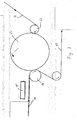
- a melt processable polymer resin composition 1 is delivered as a molten extrudate to a three roll calender 2 between first roll 3 and second roll 4.
- the melt processable polymer resin composition is further softened in the three roll calender by the heated rolls.
- the thickness of the molten layer 5 is determined by the gap between the second roll 4 and the third roll 6.
- An embossed or textured substrate 7 is preheated by a heater 8.
- the molten layer 5 is applied to the preheated substrate 7 between the third roll 6 and the conformable pressure roll 9 forming textured multilayered composite 10 in which the melt processable polymer resin composition forms a substantially uniformly thick wear layer.
- the conformable pressure roll deters air entrapment between the melt processable polymer resin composition and the textured substrate.
- the exposed surface of the wear layer closely follows the embossing or texture of the substrate.
- the hot melt composition or melt processable polymer resin is introduced as a film 11.
- the film 11 is subsequently melted or softened and applied to the substrate with a calender, including a two roll calender, or heated drum and conformable pressure roll, such as a rubber roll.
- the film 11 is introduced to a conformable rubber pressure roll 12 and on to a heated drum 13 in such a manner to eliminate entrapment of air between the film 11 and drum 13.
- the film is heated by the drum to melt the film or a softened condition approaching melt.
- the textured substrate 14 is preheated by heater 15.
- the film is then melt applied to the preheated substrate 14 between the heated drum 13 and a second rubber pressure roll 16 forming textured multilayered composite 17.
- the melt calendered layer can have a wide range of thickness depending on cost and performance capabilities desired. Typical thickness may range from a few mils [0.127mm] (.0005") to very thick layers [1.27mm or greater] (0.50" or greater). The thickness of the layer varies less than 25% with a preferred variation of less than 20%.
- the difference in height of the pre-textured surface of the present invention is at least about 0.0254mm (1 mil) vertical distance in not more than 0.508mm (20 mils) horizontal distance, preferably at least about 0.0508mm (2 mils) vertical distance in not more than 0.508mm (20 mils) horizontal distance, and the more preferably at least about 0.127 (5 mils) vertical distance in not more than 0.508mm (20 mils) horizontal distance.
- the average thickness of the overlying wear layer is between 0.0508mm (2 mils) to about 1.27mm (50 mils).
- the preferred thickness is between about 0.127mm (5 mils) to about 0.762mm (30 mils), and the most preferred is between about 0.254mm (10 mils) to about 0.508mm (20 mils).
- Melt calendering a melt processable layer directly to the textured substrate can be achieved without the air entrapment normally associated with lamination of a transparent layer on to an embossed or textured substrate by use of a conformable, preferably rubber, pressure roll.
- Adhesive coatings may need to be applied to some substrates in order to provide adequate adhesion of the composite layers.
- the viscosity of the hot melt calendered wear layer must be within a range of 450 to 7000 Pa.s (4,500 to 70,000 poise). Above 7000 Pa.s (70,000 poise) the applied hot melt wear layer will not adhere adequately to the substrate and the temperature necessary for the viscosity to be below 450 Pa.s (4,500 poise) will cause the hot melt film composition to degrade.
- the viscosity is measured on an Instron Capillary Rheometer with a ram speed of 12.7mm (0.5 inches) per minute and the 25.3mm (0.9960 inch) long, 12.78mm (0.5033 inch) diameter capillary or a shear rate of 73 per second.
- the specified viscosity range corresponds to a temperature range of 218°C (425°F) to 107°C (225°F).
- the preferred range is 1000 to 5000 Pa.s (10,000 to 50,000 poise) [190°C to 146°C] (375°F to 295°F).
- the most preferred range is 300 to 2400 Pa.s (13,000 to 24,000 poise) which corresponds to 163°C (325°F) to 182°C (360°F).
- the applied hot melt composition cools rapidly on the substrate avoiding distortion of the substrate resin though the melt temperature of the substrate may be similar to that of the hot melt composition which is applied.
- the pre-textured substrate may comprise a layer of a woven fibrous layer, or a non-woven fibrous layer, or an embossed layer, or a layer comprising deposited matter and combinations thereof, such as a foamable ink or non-foamable ink.
- the temperature of distortion or melt of the pre-textured resin substrate need not be greater than that of the melt processable composition applied thereto.
- the viscosity of the melt processable composition is critical. The viscosity and the temperature associated therewith and rapid cooling permit the wear layer to conform to the textured substrate without it flowing around and into the valleys of the embossed substrate to give a substantially uniform wear coat thickness over the substrate without distortion of the textured surface.
- a typical melt processable polymer resin having the following formulation was dryblended and compounded in an extruder, achieving a melt at 177°C (350°F) to 193°C (380°F).
- Ingredient Weight Percent General Purpose Vinyl Chloride Resin 66.5 Methylmethacrylate/Acrylic Copolymer Processing Aid 1.3
- Methylmethacrylate/Acrylic Copolymer Impact Modifier 3.3
- Fatty Acid Ester Lubricant 0.3 Plasticizer 26.0 Stabilizer 2.3
- This melt was introduced into a three roll calender with the first calender roll at about 168°C (335°F), the second calender roll at about 174°C (345°F) and the third calender roll at about 179°C (355°F).
- a molten layer nominally 0.381mm (15 mils) thick, was formed and applied directly to a textured substrate between the third calender roll and a rubber pressure roll.
- the textured substrate was preheated to about 135°C (275°F).
- a second textured multilayer composite was made using the same procedure but with a nominally 0.508mm (20 mil) thick molten layer.
- a commercially available, 0.508mm (20 mil) thick flexible polyvinyl chloride film was substituted for the melt processable polymer resin composition formed above.
- the film was heated around a drum, to a temperature of about 174°C (345°F).
- the melt processable polymer resin wear layer had a substantially uniform thickness with a variation of less than 25% which followed the contours of the pre-textured substrate.
- the wear layer was in intimate contact with the pre-textured substrate; there were no visible bubbles entrapped between the wear layer and the adjacent surface of the pre-textured substrate, even when the difference in height of the pre-textured surface was at least about 0.127mm (5 mils) vertical distance over no more than about 0.508 mm (20 mils) horizontal distance.
Landscapes
- Engineering & Computer Science (AREA)
- Textile Engineering (AREA)
- Quality & Reliability (AREA)
- Laminated Bodies (AREA)
- Shaping Of Tube Ends By Bending Or Straightening (AREA)
Claims (23)
- Ein texturierter Oberflächenbelag, umfassend:a) ein vortexturiertes Substrat und eine auf dem besagten Substrat aufliegende Schicht;b) wobei die besagte Schicht eine schmelzverarbeitete Polymerharzzusammensetzung umfasst;c) wobei das besagte vortexturierte Substrat eine vortexturierte Oberfläche aufweist;d) wobei besagte Schicht eine erste Oberfläche angrenzend an besagte vortexturierte Oberfläche und eine zweite Oberfläche in einem Abstand von besagter vortexturierter Oberfläche angeordnet aufweist; unde) wobei besagte Schicht sich an besagte vortexturierte Oberfläche anpasst, wodurch die ersten und zweiten Oberflächen im Wesentlichen den Konturen der vortexturierten Oberfläche folgen, wobei die besagte Schicht im Wesentlichen einheitlich in ihrer Dicke ist, wobei die Dicke der besagten Schicht nicht mehr als 20 % variiert, wobei der Unterschied in der Höhe der vortexturierten Oberfläche mindestens 0,0508 mm (2 mil) vertikale Distanz über nicht mehr als 0,508 mm (20 mil) horizontaler Distanz beträgt, und wobei die Viskosität der schmelzverarbeitbaren Zusammensetzung während des Auftragens auf die vortexturierte Oberfläche des Substrats von 450 bis 7000 Pa·s (4500 bis 70000 Poise) beträgt.
- Texturierter Oberflächenbelag nach Anspruch 1, wobei die Polymerharzzusammensetzung ein Allzweck-Polyvinychloridharz umfasst.
- Texturierter Oberflächenbelag nach Anspruch 1 oder Anspruch 2, wobei das vortexturierte Substrat aus der Gruppe ausgewählt wird, die aus einer Schicht aus einer gewebten Faserschicht, einer nicht-gewebten Faserschicht, einer geprägten Schicht, einer Sinkstoff umfassenden Schicht und Kombinationen davon besteht.
- Texturierter Oberflächenbelag nach Anspruch 3, wobei die geprägte Schicht chemisch geprägt, mechanisch geprägt oder chemisch und mechanisch geprägt ist.
- Texturierter Oberflächenbelag nach Anspruch 3, wobei der Sinkstoff aus der Gruppe ausgewählt ist, die aus aufschäumbarer Druckfarbe, einer nichtaufschäumbaren Druckfarbe, und partikulärem Stoff besteht.
- Texturierter Oberflächenbelag nach irgendeinem der Ansprüche 1 bis 5, wobei die Differenz der Höhe in der vortexturierten Oberfläche mindestens 0,127 mm (5 mil) vertikale Distanz über nicht mehr als 0,508 mm (20 mil) horizontaler Distanz beträgt.
- Texturierter Oberflächenbelag nach irgendeinem der Ansprüche 1 bis 6, wobei die durchschnittliche Dicke der aufliegenden Schicht zwischen 0,0508 mm (2 mil) und 1,27 mm (50 mil) beträgt.
- Texturierter Oberflächenbelag nach Anspruch 7, wobei die durchschnittliche Dicke der aufliegenden Schicht zwischen 0,127 mm (5 mil) und 0,762 mm (30 mil) beträgt,
- Texturierter Oberflächenbelag nach Anspruch 8, wobei die durchschnittliche Dicke der aufliegenden Schicht zwischen 0,254 mm (10 mil) und 0,508 mm (20 mil) beträgt.
- Texturierter Oberflächenbelag nach irgendeinem der Ansprüche 1 bis 9, wobei die Viskosität der schmelzverarbeitbaren Zusammensetzung von 1000 Pa·s bis 5000 Pa·s (10000 bis 50000 Poise) beträgt.
- Texturierter Oberflächenbelag nach Anspruch 10, wobei die Viskosität der schmelzverarbeitbaren Zusammensetzung von 13000 bis 24000 Poise beträgt.
- Ein Verfahren zur Herstellung eines texturierten Oberflächenbelages, der eine damit verbundene Nutzschicht aufweist, das die Schritte umfasst:a) Erwärmen einer schmelzverarbeitbaren Polymerharzzusammensetzung, um die Polymerharzzusammensetzung zu schmelzen oder zu erweichen,b) Aufbringen der geschmolzenen oder erweichten schmelzverarbeitbaren Polymerharzzusammensetzung auf eine vortexturierte Oberfläche eines Substrates, wobei die Differenz in der Höhe der vortexturierten Oberfläche mindestens 0,0508 mm (2 mil) vertikale Distanz über nicht mehr als 0,508 mm (20 mil) horizontaler Distanz beträgt und wobei die Viskosität der schmelzverarbeitbaren Zusammensetzung während der Aufbringung auf die vortexturierte Oberfläche des Substrats von 450 bis 7000 Pa s (4500 bis 70000 Poise) beträgt; undc) Kühlen der schmelzverarbeitbaren Polymerharzzusammensetzung, nachdem sie auf die vortexturierte Oberfläche aufgebracht wurde, um eine verbundene Nutzschicht auf der vortexturierten Oberfläche zu bilden, wobei die Dicke der besagten Schicht nicht mehr als 20 % variiert.
- Verfahren zur Herstellung eines texturierten Oberflächenbelages nach Anspruch 12, wobei die schmelzverarbeitbare Polymerharzzusammensetzung zwischen einer erwärmten Walze oder Trommel und einer nachgiebigen Druckwalze auf die vortexturierte Oberfläche aufgebracht wird.
- Verfahren zur Herstellung eines texturierten Oberflächenbelages nach Anspruch 12, wobei die schmelzverarbeitbare Polymerharzzusammensetzung auf der Walze eines Kalanders erwärmt wird.
- Verfahren zur Herstellung eines texturierten Oberflächenbelages nach Anspruch 14, wobei die schmelzverarbeitbare Polymerharzzusammensetzung in einem Kalander zu einer Schicht geformt wird, bevor sie auf die vortexturierte Oberfläche des Substrats aufgebracht wird.
- Verfahren zur Herstellung eines texturierten Oberflächenbelages nach Anspruch 12, wobei die schmelzverarbeitbare Polymerharzzusammensetzung in einem Extruder erwärmt wird.
- Verfahren zur Herstellung eines texturierten Oberflächenbelages nach Anspruch 12, wobei die Viskosität der schmelzverarbeitbaren Polymerharzzusammensetzung während der Aufbringung auf die vortexturierte Oberfläche von 1000 bis 5000 Pa·s (10000 bis 50000 Poise) beträgt,
- Verfahren zur Herstellung eines texturierten Oberflächenbelages nach Anspruch 17, wobei die Viskosität der schmelzverarbeitbaren Polymerharzzusammensetzung während der Aufbringung auf die vortexturierte Oberfläche von 1300 bis 2400 Pa·s (13000 bis 24000 Poise) beträgt.
- Verfahren zur Herstellung eines texturierten Oberflächenbelages nach irgendeinem der Ansprüche 12 bis 19, wobei die durchschnittliche Dicke der Nutzschicht zwischen 0,0508 mm (2 mil) und 1,27 mm (50 mil) beträgt.
- Verfahren zur Herstellung eines texturierten Oberflächenbelages nach Anspruch 19, wobei die durchschnittliche Dicke der besagten Nutzschicht zwischen 0,127 mm (5 mil) und 1,27 mm (50 mil) beträgt.
- Verfahren zur Herstellung eines texturierten Oberflächenbelages nach Anspruch 20, wobei die durchschnittliche Dicke der besagten Nutzschicht zwischen 0,254 mm (10 mil) und 0,508 mm (20 mil) beträgt.
- Verfahren zur Herstellung eines texturierten Oberflächenbelages nach irgendeinem der Ansprüche 12 bis 21, wobei die Differenz in der Höhe mindestens 0,127 mm (5 mil) vertikale Distanz über nicht mehr als 0,508 mm (20 mil) horizontaler Distanz beträgt.
- Verfahren zur Herstellung eines texturierten Oberflächenbelages nach irgendeinem der Ansprüche 12 bis 22, wobei die schmelzverarbeitbare Polymerharzzusammensetzung ein Allzweckharz ist.
Applications Claiming Priority (2)
| Application Number | Priority Date | Filing Date | Title |
|---|---|---|---|
| US200813 | 1998-11-27 | ||
| US09/200,813 US6649248B1 (en) | 1998-11-27 | 1998-11-27 | Hot melt calendered or extruded wear layer for embossed substrates and method of manufacture |
Publications (3)
| Publication Number | Publication Date |
|---|---|
| EP1004432A2 EP1004432A2 (de) | 2000-05-31 |
| EP1004432A3 EP1004432A3 (de) | 2002-01-23 |
| EP1004432B1 true EP1004432B1 (de) | 2006-06-07 |
Family
ID=22743318
Family Applications (1)
| Application Number | Title | Priority Date | Filing Date |
|---|---|---|---|
| EP99309274A Expired - Lifetime EP1004432B1 (de) | 1998-11-27 | 1999-11-22 | Heissschmelz-kalandrierte oder -extrudierte Nutzschicht für geprägte Substrate und Herstellungsverfahren |
Country Status (5)
| Country | Link |
|---|---|
| US (3) | US6649248B1 (de) |
| EP (1) | EP1004432B1 (de) |
| CA (1) | CA2286973A1 (de) |
| DE (1) | DE69931732T2 (de) |
| NO (1) | NO995799L (de) |
Families Citing this family (35)
| Publication number | Priority date | Publication date | Assignee | Title |
|---|---|---|---|---|
| US6649248B1 (en) * | 1998-11-27 | 2003-11-18 | Awi Licensing Company | Hot melt calendered or extruded wear layer for embossed substrates and method of manufacture |
| US6908663B1 (en) * | 2000-11-15 | 2005-06-21 | Awi Licensing Company | Pigmented radiation cured wear layer |
| SE518032C2 (sv) * | 2000-12-18 | 2002-08-20 | Tetra Laval Holdings & Finance | Sätt och anordning vid framställning av ett förpackningsmaterial |
| US6818282B2 (en) * | 2002-05-14 | 2004-11-16 | Awi Licensing Company | Resilient flooring structure with encapsulated fabric |
| US20050022682A1 (en) * | 2003-08-01 | 2005-02-03 | James Caron | System and method for embossing media |
| US7055427B2 (en) * | 2003-08-01 | 2006-06-06 | Spellbinders Paper Arts, Co. Llc | Media embellishing die |
| US20050079780A1 (en) * | 2003-10-14 | 2005-04-14 | Rowe Richard E. | Fiber wear layer for resilient flooring and other products |
| EP1537994A1 (de) * | 2003-12-04 | 2005-06-08 | Tarkett SAS | Kaschierverfahren und Anlage zur Herstellung von mehrschichtigen Produkten |
| US8402889B2 (en) * | 2004-02-03 | 2013-03-26 | Spellbinders Paper Arts Company, Llc | Apertured media embellishing template and system and method using same |
| USRE44893E1 (en) | 2004-03-26 | 2014-05-13 | Hanwha Azdel, Inc. | Fiber reinforced thermoplastic sheets with surface coverings |
| BE1017157A3 (nl) | 2006-06-02 | 2008-03-04 | Flooring Ind Ltd | Vloerbekleding, vloerelement en werkwijze voor het vervaardigen van vloerelementen. |
| MX2007009016A (es) * | 2007-07-26 | 2009-02-19 | Pyn S A De C V | Cubierta decorativa y protectora antideslizante de usos multiples, su composicion y proceso de produccion de la misma. |
| US20090321001A1 (en) * | 2008-06-26 | 2009-12-31 | Seaman Corporation | One-pass direct double lamination apparatus and process |
| US20110107926A1 (en) * | 2009-11-09 | 2011-05-12 | Pma Photometals Of Arizona, Inc. | Non-Apertured Media Embossing Template |
| ES2734439T3 (es) | 2009-12-22 | 2019-12-05 | Flooring Ind Ltd Sarl | Método para producir paneles de revestimiento |
| US8480841B2 (en) | 2010-04-13 | 2013-07-09 | Ceralog Innovation Belgium BVBA | Powder overlay |
| US8925275B2 (en) | 2010-05-10 | 2015-01-06 | Flooring Industries Limited, Sarl | Floor panel |
| BE1019501A5 (nl) | 2010-05-10 | 2012-08-07 | Flooring Ind Ltd Sarl | Vloerpaneel en werkwijze voor het vervaardigen van vloerpanelen. |
| BE1019331A5 (nl) | 2010-05-10 | 2012-06-05 | Flooring Ind Ltd Sarl | Vloerpaneel en werkwijzen voor het vervaardigen van vloerpanelen. |
| TW201239172A (en) * | 2011-03-31 | 2012-10-01 | Dongguan Meijer Plastic Products Co Ltd | Manufacturing method of anti-skidding floor tile |
| EP2602385A1 (de) * | 2011-12-07 | 2013-06-12 | VITRULAN Textile Glass GmbH | Flächiges Textilsubstrat enthaltend Glasfasern, Verfahren zu dessen Herstellung und dessen Verwendung |
| US9593443B2 (en) | 2012-11-28 | 2017-03-14 | Crayola Llc | Compositions and methods for embossing and debossing fabrics |
| US20150165748A1 (en) * | 2013-12-16 | 2015-06-18 | Armstrong World Industries, Inc. | Continuous floor product forming system and process |
| US9375753B2 (en) | 2013-12-23 | 2016-06-28 | Afi Licensing Llc | Methods for preparing multilayer composites using calendered films and products produced from same |
| US9677287B2 (en) | 2013-12-23 | 2017-06-13 | Afi Licensing Llc | Methods for encapsulating a substrate and products produced from same |
| AU2015290301B2 (en) | 2014-07-16 | 2019-07-18 | Valinge Innovation Ab | Method to produce a thermoplastic wear resistant foil |
| US10821714B2 (en) * | 2014-11-20 | 2020-11-03 | Ivc B.V. | Method for manufacturing a panel including a reinforcement sheet, and a floor panel |
| EP3245330A4 (de) | 2015-01-14 | 2018-08-22 | Välinge Innovation AB | Verfahren zur herstellung einer verschleissfesten schicht mit verschiedenen glanzebenen |
| US10570627B2 (en) * | 2015-06-19 | 2020-02-25 | Groove Surfaces, LLC | Durable decorative panels |
| US10974488B2 (en) | 2015-11-17 | 2021-04-13 | Wellmade Floor Covering Int'l Inc. | Engineered plank and its manufacturing method |
| KR102080403B1 (ko) * | 2017-09-14 | 2020-04-13 | (주)엘지하우시스 | 우수한 표면 외관을 갖는 인조가죽 및 그 제조방법 |
| US11421427B2 (en) | 2019-02-20 | 2022-08-23 | Wellmade Floor Covering International, Inc. | Plank with veneer material fused to rigid core |
| KR20220100014A (ko) * | 2019-11-13 | 2022-07-14 | 샤크렛 테크놀러지스, 아이엔씨. | 마멸로부터 표면 텍스처의 보호 |
| IT202100029126A1 (it) * | 2021-11-17 | 2023-05-17 | Cos T A S R L | Metodo di produzione di un prodotto laminare multistrato ed impianto per attuare tale metodo |
| IT202200024585A1 (it) * | 2022-11-29 | 2024-05-29 | Taghleef Ind S L | Film multistrato, relativo metodo di produzione ed articolo decorativo |
Family Cites Families (31)
| Publication number | Priority date | Publication date | Assignee | Title |
|---|---|---|---|---|
| US3376246A (en) * | 1965-02-23 | 1968-04-02 | Eastman Kodak Co | Polyvinyl chloride plastisols having greatly improved properties |
| CH480933A (de) | 1967-06-05 | 1969-11-15 | Breveteam Sa | Verbundmaterial |
| US3932245A (en) * | 1969-05-02 | 1976-01-13 | Gaf Corporation | Mechanical embossing of foamed sheet material |
| US3660200A (en) | 1969-07-09 | 1972-05-02 | Robert E Anderson | Process for bonding preheated thermoplastic film to a dissimilar substrate |
| GB1247616A (en) | 1969-07-31 | 1971-09-29 | Nairn Williamson Ltd | Coated substrates |
| US3996328A (en) * | 1970-04-01 | 1976-12-07 | Congoleum Corporation | Method for finishing resinous surface coverings |
| US4018957A (en) * | 1975-04-01 | 1977-04-19 | Gaf Corporation | Coated fabric sheet-type material having resilient backing and process for making same |
| US4273820A (en) * | 1976-08-05 | 1981-06-16 | Gaf Corporation | Embossed sheet type covering material |
| US4100318A (en) * | 1976-12-27 | 1978-07-11 | Dowdflor Corporation | Actinic radiation cured coating for cushioned sheet goods and method |
| US4210693A (en) * | 1977-12-20 | 1980-07-01 | Dowdflor Corporation | Register emboss and method |
| US4303695A (en) | 1977-12-20 | 1981-12-01 | Biscayne Decorative Products, Inc. | Crinkle emboss and method |
| US4306927A (en) | 1978-01-26 | 1981-12-22 | The Celotex Corporation | Process for producing a laminate of metal with thermoplastic material |
| US4248922A (en) | 1978-02-21 | 1981-02-03 | Congoleum Corporation | Resinous polymer sheet materials having selective, surface decorative effects and methods of making the same |
| US4214028A (en) * | 1978-02-21 | 1980-07-22 | Congoleum Corporation | Resinous polymer sheet materials having surface decorative effects and methods of making the same |
| US4312686A (en) * | 1980-02-11 | 1982-01-26 | American Biltrite Inc. | Printed and embossed floor covering and method and apparatus for its manufacture |
| US4405657A (en) * | 1981-02-24 | 1983-09-20 | Armstrong World Industries, Inc. | Non-skid plastic flooring product and method of manufacture |
| US4384904A (en) | 1981-08-24 | 1983-05-24 | Armstrong World Industries, Inc. | Process of forming an embossed surface covering having a wear layer attached uniformly thereto |
| US4614556A (en) | 1984-04-16 | 1986-09-30 | Armstrong World Industries, Inc. | Method for making decorative product |
| US4614680A (en) | 1984-04-16 | 1986-09-30 | Armstrong World Industries, Inc. | Decorative product |
| US4595621A (en) | 1984-10-29 | 1986-06-17 | Armstrong World Industries, Inc. | Simulated embossing on floor covering |
| US5112671A (en) * | 1989-04-13 | 1992-05-12 | Armstrong World Industries, Inc. | Tile product having multiple levels of height, multiple levels of gloss and mortar-line surround |
| US5230945A (en) * | 1990-11-19 | 1993-07-27 | Armstrong World Industries, Inc. | Laminate having textured wear surface of uniformly covered chips and recesses |
| US5800904A (en) * | 1991-12-27 | 1998-09-01 | Hallman; Robert A. | Embossable surface covering with inorganic wear layer |
| CA2074425C (en) | 1992-06-25 | 2003-01-07 | Daniel M. Wyner | Multi-layered sheet |
| US5405675A (en) | 1992-12-10 | 1995-04-11 | Minnesota Mining And Manufacturing Company | Embossed multilayer film |
| IT1271756B (it) | 1994-03-17 | 1997-06-09 | Interplastica S A | Procedimento ed apparato atti ad assicurare un ottimo ancoraggio fra un tessuto e il relativo rivestimento di materiale plastico, direttamente mediante calandratura |
| US5466320A (en) | 1994-05-09 | 1995-11-14 | Oscoda Plastics, Inc. | Making a cushiony decorative tile or cover product from extruded recycled membrane with discrete fibers randomly dispersed therein |
| US5679721A (en) | 1995-02-27 | 1997-10-21 | Domco Industries Ltd. | Curable coating composition for sheet goods |
| US5747133A (en) | 1996-12-19 | 1998-05-05 | E. I. Du Pont De Nemours And Company | Decorative composite floor coverings |
| US5990214A (en) * | 1997-07-31 | 1999-11-23 | Velsicol Chemical Corporation | Liquid glycol benzoate compositions |
| US6649248B1 (en) * | 1998-11-27 | 2003-11-18 | Awi Licensing Company | Hot melt calendered or extruded wear layer for embossed substrates and method of manufacture |
-
1998
- 1998-11-27 US US09/200,813 patent/US6649248B1/en not_active Expired - Lifetime
-
1999
- 1999-10-20 CA CA002286973A patent/CA2286973A1/en not_active Abandoned
- 1999-11-22 EP EP99309274A patent/EP1004432B1/de not_active Expired - Lifetime
- 1999-11-22 DE DE69931732T patent/DE69931732T2/de not_active Expired - Lifetime
- 1999-11-26 NO NO995799A patent/NO995799L/no unknown
-
2000
- 2000-01-04 US US09/477,261 patent/US6444075B1/en not_active Expired - Lifetime
-
2003
- 2003-09-10 US US10/659,206 patent/US7378143B2/en not_active Expired - Lifetime
Also Published As
| Publication number | Publication date |
|---|---|
| CA2286973A1 (en) | 2000-05-27 |
| NO995799D0 (no) | 1999-11-26 |
| US7378143B2 (en) | 2008-05-27 |
| EP1004432A3 (de) | 2002-01-23 |
| DE69931732D1 (de) | 2006-07-20 |
| DE69931732T2 (de) | 2006-10-12 |
| EP1004432A2 (de) | 2000-05-31 |
| US6444075B1 (en) | 2002-09-03 |
| US20040048044A1 (en) | 2004-03-11 |
| NO995799L (no) | 2000-05-29 |
| US6649248B1 (en) | 2003-11-18 |
Similar Documents
| Publication | Publication Date | Title |
|---|---|---|
| EP1004432B1 (de) | Heissschmelz-kalandrierte oder -extrudierte Nutzschicht für geprägte Substrate und Herstellungsverfahren | |
| US11554577B2 (en) | Method and installation for manufacturing a floor covering product and floor covering product obtained hereby | |
| EP0240559B1 (de) | Verfahren zur herstellung von plattenmaterial der inkrustationstyps | |
| US5536530A (en) | Laminate having textured wear surface and process of preparation | |
| US4454188A (en) | High reflectivity in flooring and other products | |
| US4483732A (en) | Process for preparing high reflectivity decorative surface coverings | |
| KR102344374B1 (ko) | 동조엠보 바닥재 제조방법 및 이 제조방법에 의해 제조된 바닥재 | |
| JPS6129249B2 (de) | ||
| KR200303367Y1 (ko) | 내구성 및 외관효과가 뛰어난 상업용 벽지 | |
| KR100569756B1 (ko) | 입체외관을 갖는 엠보싱 벽지 및 이의 제조방법 | |
| US6364989B1 (en) | Method for enhancing an extruded substrate with a decorative laminating film | |
| JP3111373B2 (ja) | 発泡内装材及びその製造方法 | |
| DE4131092A1 (de) | Abziehbare unterlage mit bereichen von vorbestimmtem glanz, verfahren zu ihrer herstellung und daraus hergestellter oberflaechenbelag | |
| JPH0725136B2 (ja) | シボ模様付きシート類の製造方法 | |
| JP2617979B2 (ja) | 多層化粧フィルムの製造方法 | |
| US12617195B2 (en) | Method and installation for manufacturing a floor covering product and floor covering product obtained hereby | |
| KR102930751B1 (ko) | 매트의 제조방법 | |
| DE102020122585B4 (de) | Dekorative folie, verfahren zum herstellen einer dekorativen folie und verfahren zum herstellen eines dekorierten formkörpers | |
| JP2781916B2 (ja) | 装飾材の製造方法 | |
| JP2747408B2 (ja) | 装飾用帯状床敷体及びその製造方法 | |
| JPH11268120A (ja) | エンボス模様を有するシートの製造方法 | |
| JPH07290569A (ja) | 熱可塑性樹脂エンボスシートの製造方法 | |
| JPH0448101B2 (de) | ||
| JPS5914596B2 (ja) | 装飾性弾性床敷体及びその製造方法 | |
| JPH03124886A (ja) | 表面にエンボス模様を有するスウェード調壁装材およびその製造方法 |
Legal Events
| Date | Code | Title | Description |
|---|---|---|---|
| PUAI | Public reference made under article 153(3) epc to a published international application that has entered the european phase |
Free format text: ORIGINAL CODE: 0009012 |
|
| AK | Designated contracting states |
Kind code of ref document: A2 Designated state(s): AT BE CH CY DE DK ES FI FR GB GR IE IT LI LU MC NL PT SE |
|
| AX | Request for extension of the european patent |
Free format text: AL;LT;LV;MK;RO;SI |
|
| PUAL | Search report despatched |
Free format text: ORIGINAL CODE: 0009013 |
|
| AK | Designated contracting states |
Kind code of ref document: A3 Designated state(s): AT BE CH CY DE DK ES FI FR GB GR IE IT LI LU MC NL PT SE |
|
| AX | Request for extension of the european patent |
Free format text: AL;LT;LV;MK;RO;SI |
|
| AKX | Designation fees paid | ||
| 17P | Request for examination filed |
Effective date: 20020708 |
|
| RBV | Designated contracting states (corrected) |
Designated state(s): DE DK FR GB SE |
|
| REG | Reference to a national code |
Ref country code: DE Ref legal event code: 8566 |
|
| 17Q | First examination report despatched |
Effective date: 20041229 |
|
| GRAP | Despatch of communication of intention to grant a patent |
Free format text: ORIGINAL CODE: EPIDOSNIGR1 |
|
| GRAS | Grant fee paid |
Free format text: ORIGINAL CODE: EPIDOSNIGR3 |
|
| GRAA | (expected) grant |
Free format text: ORIGINAL CODE: 0009210 |
|
| AK | Designated contracting states |
Kind code of ref document: B1 Designated state(s): DE DK FR GB SE |
|
| REG | Reference to a national code |
Ref country code: GB Ref legal event code: FG4D |
|
| RIC1 | Information provided on ipc code assigned before grant |
Ipc: B32B 37/00 20060101ALI20060419BHEP Ipc: D06N 7/00 20060101ALI20060419BHEP Ipc: B32B 3/28 20060101ALI20060419BHEP Ipc: B32B 3/30 20060101AFI20060419BHEP |
|
| REF | Corresponds to: |
Ref document number: 69931732 Country of ref document: DE Date of ref document: 20060720 Kind code of ref document: P |
|
| PG25 | Lapsed in a contracting state [announced via postgrant information from national office to epo] |
Ref country code: DK Free format text: LAPSE BECAUSE OF FAILURE TO SUBMIT A TRANSLATION OF THE DESCRIPTION OR TO PAY THE FEE WITHIN THE PRESCRIBED TIME-LIMIT Effective date: 20060907 |
|
| REG | Reference to a national code |
Ref country code: SE Ref legal event code: TRGR |
|
| PGFP | Annual fee paid to national office [announced via postgrant information from national office to epo] |
Ref country code: FR Payment date: 20061117 Year of fee payment: 8 |
|
| PGFP | Annual fee paid to national office [announced via postgrant information from national office to epo] |
Ref country code: SE Payment date: 20061124 Year of fee payment: 8 |
|
| RIC2 | Information provided on ipc code assigned after grant |
Ipc: B32B 37/00 20060101ALI20060419BHEP Ipc: D06N 7/00 20060101ALI20060419BHEP Ipc: B32B 3/28 20060101ALI20060419BHEP Ipc: B32B 3/30 20060101AFI20060419BHEP |
|
| ET | Fr: translation filed | ||
| PLBE | No opposition filed within time limit |
Free format text: ORIGINAL CODE: 0009261 |
|
| STAA | Information on the status of an ep patent application or granted ep patent |
Free format text: STATUS: NO OPPOSITION FILED WITHIN TIME LIMIT |
|
| 26N | No opposition filed |
Effective date: 20070308 |
|
| EUG | Se: european patent has lapsed | ||
| PG25 | Lapsed in a contracting state [announced via postgrant information from national office to epo] |
Ref country code: SE Free format text: LAPSE BECAUSE OF NON-PAYMENT OF DUE FEES Effective date: 20071123 |
|
| REG | Reference to a national code |
Ref country code: FR Ref legal event code: ST Effective date: 20080930 |
|
| PG25 | Lapsed in a contracting state [announced via postgrant information from national office to epo] |
Ref country code: FR Free format text: LAPSE BECAUSE OF NON-PAYMENT OF DUE FEES Effective date: 20071130 |
|
| PGFP | Annual fee paid to national office [announced via postgrant information from national office to epo] |
Ref country code: GB Payment date: 20181227 Year of fee payment: 20 |
|
| PGFP | Annual fee paid to national office [announced via postgrant information from national office to epo] |
Ref country code: DE Payment date: 20181231 Year of fee payment: 20 |
|
| REG | Reference to a national code |
Ref country code: DE Ref legal event code: R071 Ref document number: 69931732 Country of ref document: DE |
|
| REG | Reference to a national code |
Ref country code: GB Ref legal event code: PE20 Expiry date: 20191121 |
|
| PG25 | Lapsed in a contracting state [announced via postgrant information from national office to epo] |
Ref country code: GB Free format text: LAPSE BECAUSE OF EXPIRATION OF PROTECTION Effective date: 20191121 |