EP1004662A2 - Verfahren zur Hydrolyse von Fetten und Ölen - Google Patents
Verfahren zur Hydrolyse von Fetten und Ölen Download PDFInfo
- Publication number
- EP1004662A2 EP1004662A2 EP99123232A EP99123232A EP1004662A2 EP 1004662 A2 EP1004662 A2 EP 1004662A2 EP 99123232 A EP99123232 A EP 99123232A EP 99123232 A EP99123232 A EP 99123232A EP 1004662 A2 EP1004662 A2 EP 1004662A2
- Authority
- EP
- European Patent Office
- Prior art keywords
- substrate
- oils
- enzyme
- oil
- aqueous phase
- Prior art date
- Legal status (The legal status is an assumption and is not a legal conclusion. Google has not performed a legal analysis and makes no representation as to the accuracy of the status listed.)
- Granted
Links
- 239000003921 oil Substances 0.000 title claims abstract description 154
- 239000003925 fat Substances 0.000 title claims abstract description 60
- 238000000034 method Methods 0.000 title claims abstract description 55
- 230000003301 hydrolyzing effect Effects 0.000 title claims abstract description 27
- 239000000758 substrate Substances 0.000 claims abstract description 110
- XLYOFNOQVPJJNP-UHFFFAOYSA-N water Substances O XLYOFNOQVPJJNP-UHFFFAOYSA-N 0.000 claims abstract description 90
- 108090000790 Enzymes Proteins 0.000 claims abstract description 86
- 102000004190 Enzymes Human genes 0.000 claims abstract description 86
- 238000006243 chemical reaction Methods 0.000 claims abstract description 84
- 239000008346 aqueous phase Substances 0.000 claims abstract description 79
- 239000012071 phase Substances 0.000 claims abstract description 74
- 238000002156 mixing Methods 0.000 claims abstract description 43
- 238000006460 hydrolysis reaction Methods 0.000 claims abstract description 30
- 230000007062 hydrolysis Effects 0.000 claims abstract description 29
- 108010093096 Immobilized Enzymes Proteins 0.000 claims abstract description 11
- 239000000203 mixture Substances 0.000 claims description 22
- 238000000926 separation method Methods 0.000 claims description 8
- 238000003756 stirring Methods 0.000 claims description 6
- 229920006395 saturated elastomer Polymers 0.000 claims description 2
- 238000011282 treatment Methods 0.000 abstract description 10
- 230000000694 effects Effects 0.000 abstract description 7
- 239000000969 carrier Substances 0.000 abstract description 4
- 230000002035 prolonged effect Effects 0.000 abstract 1
- 235000019198 oils Nutrition 0.000 description 130
- PEDCQBHIVMGVHV-UHFFFAOYSA-N Glycerine Chemical compound OCC(O)CO PEDCQBHIVMGVHV-UHFFFAOYSA-N 0.000 description 30
- 238000000354 decomposition reaction Methods 0.000 description 22
- 108090001060 Lipase Proteins 0.000 description 9
- 102000004882 Lipase Human genes 0.000 description 9
- 239000004367 Lipase Substances 0.000 description 9
- 235000019421 lipase Nutrition 0.000 description 9
- 239000002253 acid Substances 0.000 description 5
- OGBUMNBNEWYMNJ-UHFFFAOYSA-N batilol Chemical class CCCCCCCCCCCCCCCCCCOCC(O)CO OGBUMNBNEWYMNJ-UHFFFAOYSA-N 0.000 description 5
- 230000000052 comparative effect Effects 0.000 description 5
- 125000001931 aliphatic group Chemical group 0.000 description 4
- 239000007788 liquid Substances 0.000 description 4
- 235000012424 soybean oil Nutrition 0.000 description 4
- 239000003549 soybean oil Substances 0.000 description 4
- 238000005119 centrifugation Methods 0.000 description 3
- 239000008367 deionised water Substances 0.000 description 3
- 229910021641 deionized water Inorganic materials 0.000 description 3
- 238000007599 discharging Methods 0.000 description 3
- 239000012528 membrane Substances 0.000 description 3
- 239000002994 raw material Substances 0.000 description 3
- 238000007127 saponification reaction Methods 0.000 description 3
- 238000010008 shearing Methods 0.000 description 3
- NWUYHJFMYQTDRP-UHFFFAOYSA-N 1,2-bis(ethenyl)benzene;1-ethenyl-2-ethylbenzene;styrene Chemical compound C=CC1=CC=CC=C1.CCC1=CC=CC=C1C=C.C=CC1=CC=CC=C1C=C NWUYHJFMYQTDRP-UHFFFAOYSA-N 0.000 description 2
- 229920002125 Sokalan® Polymers 0.000 description 2
- 229910003460 diamond Inorganic materials 0.000 description 2
- 239000010432 diamond Substances 0.000 description 2
- 235000014113 dietary fatty acids Nutrition 0.000 description 2
- 239000012153 distilled water Substances 0.000 description 2
- 229930195729 fatty acid Natural products 0.000 description 2
- 239000000194 fatty acid Substances 0.000 description 2
- 150000004665 fatty acids Chemical class 0.000 description 2
- 230000003100 immobilizing effect Effects 0.000 description 2
- 239000003456 ion exchange resin Substances 0.000 description 2
- 229920003303 ion-exchange polymer Polymers 0.000 description 2
- 230000001105 regulatory effect Effects 0.000 description 2
- 229910001220 stainless steel Inorganic materials 0.000 description 2
- 239000010935 stainless steel Substances 0.000 description 2
- 150000003626 triacylglycerols Chemical class 0.000 description 2
- VZSRBBMJRBPUNF-UHFFFAOYSA-N 2-(2,3-dihydro-1H-inden-2-ylamino)-N-[3-oxo-3-(2,4,6,7-tetrahydrotriazolo[4,5-c]pyridin-5-yl)propyl]pyrimidine-5-carboxamide Chemical compound C1C(CC2=CC=CC=C12)NC1=NC=C(C=N1)C(=O)NCCC(N1CC2=C(CC1)NN=N2)=O VZSRBBMJRBPUNF-UHFFFAOYSA-N 0.000 description 1
- 108090000371 Esterases Proteins 0.000 description 1
- 238000001159 Fisher's combined probability test Methods 0.000 description 1
- 230000004308 accommodation Effects 0.000 description 1
- 235000009508 confectionery Nutrition 0.000 description 1
- 238000010924 continuous production Methods 0.000 description 1
- 239000002537 cosmetic Substances 0.000 description 1
- -1 diglycerides Chemical class 0.000 description 1
- 238000004945 emulsification Methods 0.000 description 1
- 238000006911 enzymatic reaction Methods 0.000 description 1
- 238000000605 extraction Methods 0.000 description 1
- 235000013305 food Nutrition 0.000 description 1
- 239000011521 glass Substances 0.000 description 1
- 150000004676 glycans Chemical class 0.000 description 1
- 230000005484 gravity Effects 0.000 description 1
- 239000004519 grease Substances 0.000 description 1
- 230000002366 lipolytic effect Effects 0.000 description 1
- 238000004519 manufacturing process Methods 0.000 description 1
- 230000005501 phase interface Effects 0.000 description 1
- 229920001282 polysaccharide Polymers 0.000 description 1
- 239000005017 polysaccharide Substances 0.000 description 1
- 239000000047 product Substances 0.000 description 1
- 102000004169 proteins and genes Human genes 0.000 description 1
- 108090000623 proteins and genes Proteins 0.000 description 1
- 238000000746 purification Methods 0.000 description 1
- 239000000376 reactant Substances 0.000 description 1
- 238000011084 recovery Methods 0.000 description 1
- 239000011347 resin Substances 0.000 description 1
- 229920005989 resin Polymers 0.000 description 1
- 239000002195 soluble material Substances 0.000 description 1
- 238000001179 sorption measurement Methods 0.000 description 1
- 239000000126 substance Substances 0.000 description 1
- 239000008399 tap water Substances 0.000 description 1
- 235000020679 tap water Nutrition 0.000 description 1
- 239000002349 well water Substances 0.000 description 1
- 235000020681 well water Nutrition 0.000 description 1
Images


Classifications
-
- C—CHEMISTRY; METALLURGY
- C12—BIOCHEMISTRY; BEER; SPIRITS; WINE; VINEGAR; MICROBIOLOGY; ENZYMOLOGY; MUTATION OR GENETIC ENGINEERING
- C12P—FERMENTATION OR ENZYME-USING PROCESSES TO SYNTHESISE A DESIRED CHEMICAL COMPOUND OR COMPOSITION OR TO SEPARATE OPTICAL ISOMERS FROM A RACEMIC MIXTURE
- C12P7/00—Preparation of oxygen-containing organic compounds
- C12P7/64—Fats; Fatty oils; Ester-type waxes; Higher fatty acids, i.e. having at least seven carbon atoms in an unbroken chain bound to a carboxyl group; Oxidised oils or fats
- C12P7/6409—Fatty acids
- C12P7/6418—Fatty acids by hydrolysis of fatty acid esters
-
- C—CHEMISTRY; METALLURGY
- C12—BIOCHEMISTRY; BEER; SPIRITS; WINE; VINEGAR; MICROBIOLOGY; ENZYMOLOGY; MUTATION OR GENETIC ENGINEERING
- C12M—APPARATUS FOR ENZYMOLOGY OR MICROBIOLOGY; APPARATUS FOR CULTURING MICROORGANISMS FOR PRODUCING BIOMASS, FOR GROWING CELLS OR FOR OBTAINING FERMENTATION OR METABOLIC PRODUCTS, i.e. BIOREACTORS OR FERMENTERS
- C12M21/00—Bioreactors or fermenters specially adapted for specific uses
- C12M21/18—Apparatus specially designed for the use of free, immobilized or carrier-bound enzymes
-
- C—CHEMISTRY; METALLURGY
- C12—BIOCHEMISTRY; BEER; SPIRITS; WINE; VINEGAR; MICROBIOLOGY; ENZYMOLOGY; MUTATION OR GENETIC ENGINEERING
- C12M—APPARATUS FOR ENZYMOLOGY OR MICROBIOLOGY; APPARATUS FOR CULTURING MICROORGANISMS FOR PRODUCING BIOMASS, FOR GROWING CELLS OR FOR OBTAINING FERMENTATION OR METABOLIC PRODUCTS, i.e. BIOREACTORS OR FERMENTERS
- C12M29/00—Means for introduction, extraction or recirculation of materials, e.g. pumps
- C12M29/18—External loop; Means for reintroduction of fermented biomass or liquid percolate
-
- C—CHEMISTRY; METALLURGY
- C12—BIOCHEMISTRY; BEER; SPIRITS; WINE; VINEGAR; MICROBIOLOGY; ENZYMOLOGY; MUTATION OR GENETIC ENGINEERING
- C12N—MICROORGANISMS OR ENZYMES; COMPOSITIONS THEREOF; PROPAGATING, PRESERVING, OR MAINTAINING MICROORGANISMS; MUTATION OR GENETIC ENGINEERING; CULTURE MEDIA
- C12N11/00—Carrier-bound or immobilised enzymes; Carrier-bound or immobilised microbial cells; Preparation thereof
- C12N11/02—Enzymes or microbial cells immobilised on or in an organic carrier
-
- C—CHEMISTRY; METALLURGY
- C12—BIOCHEMISTRY; BEER; SPIRITS; WINE; VINEGAR; MICROBIOLOGY; ENZYMOLOGY; MUTATION OR GENETIC ENGINEERING
- C12P—FERMENTATION OR ENZYME-USING PROCESSES TO SYNTHESISE A DESIRED CHEMICAL COMPOUND OR COMPOSITION OR TO SEPARATE OPTICAL ISOMERS FROM A RACEMIC MIXTURE
- C12P7/00—Preparation of oxygen-containing organic compounds
- C12P7/02—Preparation of oxygen-containing organic compounds containing a hydroxy group
- C12P7/04—Preparation of oxygen-containing organic compounds containing a hydroxy group acyclic
- C12P7/18—Preparation of oxygen-containing organic compounds containing a hydroxy group acyclic polyhydric
- C12P7/20—Glycerol
-
- C—CHEMISTRY; METALLURGY
- C12—BIOCHEMISTRY; BEER; SPIRITS; WINE; VINEGAR; MICROBIOLOGY; ENZYMOLOGY; MUTATION OR GENETIC ENGINEERING
- C12P—FERMENTATION OR ENZYME-USING PROCESSES TO SYNTHESISE A DESIRED CHEMICAL COMPOUND OR COMPOSITION OR TO SEPARATE OPTICAL ISOMERS FROM A RACEMIC MIXTURE
- C12P7/00—Preparation of oxygen-containing organic compounds
- C12P7/64—Fats; Fatty oils; Ester-type waxes; Higher fatty acids, i.e. having at least seven carbon atoms in an unbroken chain bound to a carboxyl group; Oxidised oils or fats
- C12P7/6436—Fatty acid esters
- C12P7/6445—Glycerides
Definitions
- the present invention relates to a process for efficiently hydrolyzing fats and oils to produce aliphatic acids.
- the present invention relates to a process for efficiently hydrolyzing fats and oils without the reduction of enzyme activity caused by an increase in the number of treatments.
- the term of "fats and oils” may mean an inclusion of a fat, an oil, a lard, a grease, and so on.
- reaction examples in a batch circulating system e.g. the following techniques are known: (1) a method of conducting a mixture having fats and oils mixed with water in an amount of about 60 weight % relative to the fats and oils to pass through an enzyme-packed reactor; (2) a method of conducting only fats and oils not containing an aqueous phase substrate to pass through a lipase immobilized on polysaccharide gel containing a large amount of water (JP-A 58-146284); (3) a method of mixing fats and oils with water uniformly by circulating them through a fat- and oil-storing tank and a humidifying apparatus and then conducting the mixture with the water content kept constant to pass through an enzyme-packed reactor (JP-A 4-335881); and (4) a method of introducing fats, oils, and water to a substrate-circulating chamber, feeding the oil phase substrate only to an enzyme column while the oil phase is separated from the aqueous phase, and returning the discharged reaction solution to the bottom of the substrate-circulating chamber (Kosugi
- the above-described method (1) has the problem that because the enzyme is removed with time, the enzyme activity is lowered as the number of treatments is increased, although the degree of hydrolysis is high due to a high water content in the mixture.
- the enzyme is not removed with time, but water being necessary for hydrolysis tends to be insufficient while glycerol is accumulated in the immobilized enzyme, thus shifting the equilibrium to the side of fats and oils, which may result in inadequate decomposition of fats and oils.
- separation of the oil phase from the aqueous phase after decomposition (or hydrolysis) is difficult thus making a separation step and facilities therefor necessary and incidental.
- any method of the methods (1) to (3) suffers from the problem that the apparatuses are complicated or the enzyme-packed reactor is very difficult to operate.
- the water content in the oil phase passing through the enzyme reactor is low and the separation of the oil phase from the aqueous phase after decomposition (or hydrolysis) is easy, but there is the problem that it is difficult to obtain high degrees of decomposition due to inadequate extraction of glycerol from the reaction solution.
- the present inventors have found a process in which an immobilized enzyme is used for recovery of the enzyme and while the oil phase and the aqueous phase are separated from each other naturally in a substrate-feeding chamber, the reaction is repeatedly conducted thereby solving the conventionally problematic reaction rate and separation of products, and further because the apparatuses consisting of only an enzyme column and a substrate-feeding chamber, the facilities are simple and operation are used easily to be able to achieve stable operation, and simultaneously the investment for the facilities are economical.
- Another object of the present invention is to provide a process for efficiently hydrolyzing fats and oils in easy operation at high degrees of hydrolysis without lowering enzyme activity with time.
- the present inventors have found that after the oil and water are separated in the substrate-feeding chamber, the water content in the oil phase substrate fed to the enzyme column is made up to have sufficient amount whereby the hydrolysis reaction in the enzyme column is promoted, and thereafter the reaction solution is brought into contact with a sufficient amount of water whereby the glycerol formed by hydrolysis is dissolved so that the reaction is prevented from being shifted to the side of fats and oils, whereby the hydrolysis can be conducted sufficiently, the apparatus used is made simpler, and the operation is made easier.
- the present invention relates to a process for hydrolyzing fats and oils, which comprises using an enzyme column (reaction column) using an immobilized enzyme and a substrate-feeding chamber also serving as an oil-water separating chamber, circulating a reaction solution between the enzyme column and the substrate-feeding chamber and simultaneously separating oils from water in the substrate-feeding chamber, wherein an oil phase substrate and an aqueous phase substrate are removed separately without previously mixing them in the substrate-feeding chamber, and then the hydrolysis of fats and oils is conducted in any of the following processes:
- an oil-water interface can be formed during reaction in the substrate-feeding chamber.
- the water content in the oil phase substrate after separation of oils and water is preferably from the saturated one to 5 %.
- the aqueous phase substrate can be fed from the substrate-feeding chamber to the oil-water mixing chamber.
- reaction solution is brought into contact with the aqueous phase substrate by stirring or in a countercurrent contacting system in the oil-water mixing chamber.
- the present invention comprises conducting an oil phase and an aqueous phase to be separated in the feeding chamber without stirring, removing them through respective pipes to bring them into contact with an enzyme, separating the reaction solution flowing from the enzyme column into an oil phase and an aqueous phase in the feeding chamber, and repeating this operation-series, to solve the problem described above.
- the pipe for returning the reaction solution to the substrate-feeding chamber is attached to be immersed in a separated upper layer so as not to disturb an oil-water interface, and further the flow rate of the circulating reaction solution is regulated. A sufficient reaction rate can thereby be obtained using a packed column with an immobilized enzyme, and a loss of the enzyme can be prevented.
- use of any special apparatus for separating oils from water can be eliminated.
- the present invention also provides a process for hydrolyzing fats and oils, which comprises feeding a solution of an oil phase substrate from a substrate-feeding chamber to an enzyme column packed with enzyme-immobilized carriers, and bringing the reaction solution having passed through said enzyme column into contact with an aqueous phase substrate in an oil-water mixing chamber, followed by separating the oils from water.
- Fig. 3 shows an example of an apparatus for carrying out the process for hydrolyzing fats and oils according to the present invention.
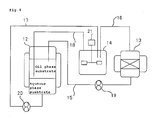
- Fig. 4 shows another example of an apparatus for carrying out the process for hydrolyzing fats and oils according to the present invention.
- the enzyme used in the reaction may be an enzyme immobilized by adsorption onto a carrier.
- the type of enzyme is not limited insofar as the enzyme hydrolyzes fats and oils, and the enzyme includes e.g. lipase, esterase etc.
- the method of conducting the enzyme to be adsorbed onto a carrier is not limited, and it is cited as the method described in JP-A 1-153090.
- the amount of the immobilized enzyme used may be an amount (activity) to meet productivity.
- the shape of the enzyme column is not limited insofar as the column endures the pressurization of a pump used. Further, the enzyme column is preferably a column which can be heated by a jacket to a suitable temperature for the enzyme reaction.
- the substrate-feeding chamber also serving as the oil-water separating chamber does not possess a stirrer. It has pipes for respectively (or separately from each other) removing an oil phase and an aqueous phase separated by being left stationarily and sending them to the enzyme column. Further, it has a pipe for returning a reaction solution flowing from the enzyme column.
- the oil phase-removing pipe is arranged such that its opening for removal is placed at a position over a middle portion of the oil phase.
- the aqueous phase-removing pipe is arranged such that its opening for removal is placed at the bottom of the substrate-feeding chamber.
- the reaction solution-returning pipe is arranged such that its opening for returning is placed at a position so as not to disturb an oil phase-aqueous phase interface.
- This substrate-feeding chamber is preferably a chamber which can be heated similarly to the enzyme column.
- Feeding of the substrate to the enzyme column may be conducted using either a downward stream from the top of the column to the bottom of the column or an upward stream from the bottom of the column to the top of the column, but it is necessary to let flow both the oil and aqueous phase substrates in the same direction.
- Reaction apparatuses in a countercurrent system have been proposed heretofore, but in a liquid (fats and oils)-liquid (water) type reaction, it is very difficult to make reactants countercurrently pass through a packed column, thus making it necessary to device and complicate the apparatus therefor.
- a liquid (fats and oils)-liquid (water) are allowed to flow in a cocurrent, that is, in the same direction, mixed at outlets of feeding pumps for oil and aqueous phases and then sent to the enzyme column.
- an outlet of a pump may be provided with a mixer such as an in-line mixer. Desired degrees of decomposition can be determined depending on the initial ratio of charged fats, oils and water, the positional selectivity of the enzyme (random type, or ⁇ -position-selective type). To obtain high degrees of decomposition, it is necessary to use a random-type immobilized enzyme and to increase the amount of water added. Feeding of oil and aqueous phases to the enzyme column is conducted desirably at the initial charge ratio.
- hydrolysis of fats and oils can be conducted with low investment without a loss in the enzyme. That is, expensive facilities such as a high-pressure decomposition column used in conventional facilities for producing aliphatic acids and a high-pressure boiler for generating heat transfer medium are not necessary, and furthermore the operation is easy due to the batch reaction, and the simplification of the apparatus can be realized.
- the formed aliphatic acids may be used as usual raw materials for oleo-chemicals, raw materials for producing foods and raw materials for cosmetics. Further, because the formed sweet water does not contain enzymes or contaminating proteins, it can be used as usual glycerol after concentration and subsequent simple purification.
- the present invention "3) a process for hydrolyzing fats and oils, which comprises feeding an oil phase substrate only to the enzyme column, introducing a reaction solution having passed through the enzyme column into a mixing chamber for bringing the reaction solution into contact with an aqueous phase substrate and after the reaction solution is brought into contact with the aqueous phase substrate in said mixing chamber, returning the mixture to the substrate-feeding chamber during which the fats and oils are hydrolyzed" is described.
- Fig. 4 shows an example of an apparatus for carrying out the present method.
- the solution of oil phase substrate is first fed from the substrate-feeding chamber in which the oil phase substrate and the aqueous phase substrate are accommodated, to the enzyme column charged with enzyme-immobilized carriers.
- the oil phase substrate is a mixture of triglycerides, diglycerides, monoglycerides, free aliphatic acids etc., preferably fats and oils, and particularly preferably it further contains a very small amount of water because the presence of water is necessary for hydrolysis.
- the oil phase substrate contains a large amount of water because the immobilized enzyme is left (or removed) with time to lower the enzyme activity.
- the water content in the oil phase substrate is preferably from saturation solubility (maximum amount of water dissolved in the oil phase substrate) to 5 % by weight (hereinafter referred to simply as "%"), more preferably saturation solubility to 4 %, particularly preferably saturation solubility to 3 %.
- the water content in the oil phase substrate can be made saturation solubility to 5 % by bringing the oil phase substrate into contact with the aqueous phase substrate upon accommodation of both the substrates in the substrate-feeding chamber or by bringing the aqueous phase substrate into contact with the reaction solution as described below.
- the aqueous phase substrate is a mixture of water and water-soluble materials such as glycerol, and it is preferably water.
- the water may be tap water, well water, distilled water and deionized water, and deionized water is particularly preferable.
- the both phases are separated from each other in the substrate-feeding chamber without adding shearing force such as stirring.
- the end (or terminal), at the side of the substrate-feeding chamber, of the oil phase substrate-removing line for feeding the oil phase substrate from the substrate-feeding chamber to the enzyme column is arranged preferably in the vicinity of the top surface of the oil phase substrate in the substrate-feeding chamber.
- the flow rate of the oil phase substrate can be determined suitably in consideration of the throughput capacity of the enzyme.
- feeding of the oil phase substrate to the enzyme column may be conducted using either an upward stream from the bottom of the column to the top of the column or a downward stream from the top of the column.
- the oil phase substrate sent to the enzyme column is decomposed with the immobilized enzyme in the enzyme column to form diglycerides, monoglycerides, fatty acids and glycerol. If the water content in the oil phase substrate is very small, the immobilized enzyme is not left (or removed) from the carriers, while the glycerol in the reaction solution after passing through the enzyme column is transferred to the aqueous phase substrate in the oil-water mixing chamber, so the reaction is not shifted to the side of fats and oils, and the degree of decomposition of fats and oils can thereby be raised.
- the reaction solution discharged from the enzyme column is brought into contact with the aqueous phase substrate in the oil-water mixing chamber provided separately from the substrate-feeding chamber.
- the diglycerides and monoglycerides and fatty acids remain in the oil phase substrate while the glycerol is transferred to the aqueous phase substrate, and due to the shearing force upon this contact, a very small amount of water is contained in the oil phase substrate.
- the oil-water mixing chamber is stirred, or the aqueous phase substrate as a downward stream from the top of the chamber to the bottom of the chamber is brought into contact with a countercurrent of the reaction solution as an upward stream from the bottom of the chamber to the top of the chamber, or both the means are combined, so that the reaction solution can be sufficiently brought into contact with the aqueous phase substrate. Then, a mixture of the reaction solution and the aqueous phase substrate in the oil-water mixing chamber is sent to the substrate-feeding chamber.
- the aqueous phase substrate in the substrate-feeding chamber is continuously fed to the oil-water mixing chamber, and the reaction solution and the aqueous phase substrate overflowed from the oil-water mixing chamber are returned to the substrate-feeding chamber.
- the oil phase substrate and the aqueous phase substrate are separated from each other by being left stationarily in the substrate-feeding chamber or by centrifugation.
- a centrifuge is arranged in a line before the substrate-feeding chamber, and the oil phase substrate and the aqueous phase substrate which were separated from each other are fed preferably through respective lines to the substrate-feeding chamber.
- a process for hydrolyzing fats and oils which comprises mixing an oil phase substrate with an aqueous phase substrate, feeding the mixture to the enzyme column, introducing a reaction solution having passed through the enzyme column into a mixing chamber for bringing the reaction solution into contact with an aqueous phase substrate, and after the reaction solution is brought into contact with the aqueous phase substrate in said mixing chamber, returning the mixture to the substrate-feeding chamber during which the fats and oils are hydrolyzed
- a reaction solution having passed through the enzyme column into a mixing chamber for bringing the reaction solution into contact with an aqueous phase substrate, and after the reaction solution is brought into contact with the aqueous phase substrate in said mixing chamber, returning the mixture to the substrate-feeding chamber during which the fats and oils are hydrolyzed
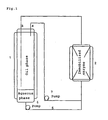
- the soybean oil was fed (, sent or charged) using pump 7 to the enzyme column at a flow rate of 5 g/min., and when the oil was flow-out (or discharged) from the returning line 3, 96 g distilled water was added to the substrate-feeding chamber 1. The amount of water added was 60 % by weight (being compared with the oil phase substrate). At this time, the water and the soybean oil were separated as lower and upper layers respectively (or separately from each other), to form a clear interface therebetween.
- the lower end of the oil phase-removing line 4 (having 3.5 mm of inner diameter) was arranged at a position apart by 10 mm from the upper end of the oil phase. Further, the lower end of the reaction solution-returning line 3 was arranged at a distance of 10 mm upwards from the interface. Thereafter, the oil phase and the aqueous phase were fed by pumps 7 and 6 through the substrate-feeding lines 4 and 5 at flow rates of 5 and 3 g/min., separately from each other. These flow rates were maintained until the reaction was finished, and the aqueous phase was made up to be 60 % by weight (being compared with the oil phase). The reaction solution flowing from returning line 3, when it was discharged from the lower end of the returning line, was separated into an oil phase and an aqueous phase without disturbing the oil-water interface.
- Fig. 2 shows a change with time in the degree of decomposition of the oil phase in the circulating stationary separable reactor shown in Fig. 1.
- substrate-feeding chamber 12 having inner diameter of 132 mm and height of 380 mm
- 2000 g of white soybean-squeezed oil 100 % of triglycerides
- the aqueous phase substrate was fed using pump 20 continuously from the lower end of substrate-feeding chamber 12 to oil-water mixing chamber 14 (with a capacity of 200 ml, stirred at 400 rpm) at a flow rate of 0.24 L/min., and the aqueous substrate overflowed was returned through the reaction solution ⁇ aqueous phase returning line 18 to the oil-water separating interface in the substrate-feeding chamber 12.
- the oil phase substrate was fed at 0.24 L/min. using pump 19 from the upper end of the oil phase substrate to the enzyme column 13, to initiate the decomposition.
- the reaction solution discharged from the enzyme column 13 entered through the reaction solution-discharging line 16 to the oil-water mixing chamber 14 where the reaction solution was mixed with the aqueous phase substrate, and the formed glycerol was transferred to the aqueous phase substrate. Further, a part of the water was transferred by stirring to the oil phase substrate.
- the degree of decomposition of fats and oils was calculated using (acid value/saponification value) ⁇ 100 (%), and the water content was measured using a water content measuring apparatus (AQUACOUNTER AQ-7, Hiranuma Sangyo Co., Ltd.).
- the water content in the oil phase substrate in the substrate-feeding chamber 12 was in the range of 0.05 to 2.1 %.
- the operation described above was repeated 4 times.
- the time elapsed for the degree of hydrolysis to reach 95 % in each operation is shown in Table 1.
- the time elapsed for the degree of hydrolysis to reach 95 % (hr) the number of treatments
- Example 2 Comparative Example 1 1 24 24 2 23.9 26.3 3 24 29.8 4 24 32.7
- Hydrolysis treatment was conducted in the same manner as in Example 2 except that pump 20 was not driven, the aqueous phase substrate was not fed to the oil-water mixing chamber 14, and the contents in the substrate-feeding chamber 12 were stirred at 400 rpm.
- the mixture of oils and water in the substrate-feeding chamber 12 was sampled and centrifuged at 1000 G for 5 minutes, and from the acid value of the oil phase thus separated, hydrolysis of fats and oils was calculated.
- the time elapsed for the degree of hydrolysis to reach 95 % in each operation is shown in Table 1.
- Example 2 there was little difference in the time elapsed even after the number of treatments was increased, while in Comparative Example 1, the time elapsed was increased as the number of treatments was increased, and the time elapsed in the 4th treatment was longer by about 36 % than in Example 2.
- Hydrolysis treatment was conducted in the same manner as in Example 2 except that the oil-water mixing chamber 14, the aqueous phase substrate-feeding line 17 and the reaction solution ⁇ aqueous phase substrate mixture returning line 18 in Example 2 were not used, and that the end, at the side of the substrate-feeding chamber 12, of the reaction solution-discharging line 16 was arranged in the vicinity of the bottom of the substrate-feeding chamber 12.
- the degree of decomposition of fats and oils was measured from the acid value in the substrate-feeding chamber 12.
- the change with time in the degree of this hydrolysis is shown in Table 2. Hydrolysis time (hr) 2 5 10 24 48 Degree of hydrolysis (%) 18 58 65 70 72
- Example 2 the degree of hydrolysis of 95 % was obtained after about 24 hours, while in Comparative Example 2, glycerol in the reaction solution discharged from the enzyme column 13 was poorly extracted in the substrate-feeding chamber 12 so that the reaction was hardly shifted to the side of decomposition and the decomposition (or hydrolysis) time was very long.
- the process of the present invention can provide the hydrolysis of fats and oils, which has decomposition (or hydrolysis) rate being equivalent as a conventional hydrolysis process, which shows no reduction of enzyme activity caused by an increase in the number of treatments, and which is stable for a long period of time.
Landscapes
- Chemical & Material Sciences (AREA)
- Organic Chemistry (AREA)
- Life Sciences & Earth Sciences (AREA)
- Wood Science & Technology (AREA)
- Engineering & Computer Science (AREA)
- Zoology (AREA)
- Health & Medical Sciences (AREA)
- Bioinformatics & Cheminformatics (AREA)
- Genetics & Genomics (AREA)
- General Health & Medical Sciences (AREA)
- Microbiology (AREA)
- Biochemistry (AREA)
- General Engineering & Computer Science (AREA)
- Biotechnology (AREA)
- General Chemical & Material Sciences (AREA)
- Chemical Kinetics & Catalysis (AREA)
- Biomedical Technology (AREA)
- Oil, Petroleum & Natural Gas (AREA)
- Sustainable Development (AREA)
- Molecular Biology (AREA)
- Preparation Of Compounds By Using Micro-Organisms (AREA)
- Fats And Perfumes (AREA)
Applications Claiming Priority (4)
| Application Number | Priority Date | Filing Date | Title |
|---|---|---|---|
| JP33516498 | 1998-11-26 | ||
| JP33516498A JP3439675B2 (ja) | 1998-11-26 | 1998-11-26 | 油脂の加水分解方法 |
| JP10660799A JP4279939B2 (ja) | 1999-04-14 | 1999-04-14 | 油脂の加水分解方法 |
| JP10660799 | 1999-04-14 |
Publications (3)
| Publication Number | Publication Date |
|---|---|
| EP1004662A2 true EP1004662A2 (de) | 2000-05-31 |
| EP1004662A3 EP1004662A3 (de) | 2002-02-27 |
| EP1004662B1 EP1004662B1 (de) | 2006-02-08 |
Family
ID=26446734
Family Applications (1)
| Application Number | Title | Priority Date | Filing Date |
|---|---|---|---|
| EP99123232A Expired - Lifetime EP1004662B1 (de) | 1998-11-26 | 1999-11-26 | Verfahren zur Hydrolyse von Fetten und Ölen |
Country Status (3)
| Country | Link |
|---|---|
| US (1) | US6258575B1 (de) |
| EP (1) | EP1004662B1 (de) |
| DE (1) | DE69929740T2 (de) |
Cited By (3)
| Publication number | Priority date | Publication date | Assignee | Title |
|---|---|---|---|---|
| EP1736549A1 (de) * | 2005-06-21 | 2006-12-27 | Kao Corporation | Verfahren zur Herstellung von Fettsäuren |
| WO2007043552A1 (en) * | 2005-10-05 | 2007-04-19 | Kao Corporation | Method for producing a useful substance by use of an immobilized enzyme |
| US7452702B2 (en) | 2003-07-16 | 2008-11-18 | Archer-Daniels-Midland Company | Method for producing fats or oils |
Families Citing this family (12)
| Publication number | Priority date | Publication date | Assignee | Title |
|---|---|---|---|---|
| US6716610B2 (en) | 1998-12-07 | 2004-04-06 | Kao Corporation | Esterification or hydrolysis with substrate treated un-dried immobilized lipolytic enzyme |
| US20030054509A1 (en) * | 2001-04-06 | 2003-03-20 | Archer-Daniels-Midland Company | Method for producing fats or oils |
| JP3764855B2 (ja) * | 2001-06-22 | 2006-04-12 | 花王株式会社 | 油脂類の加水分解方法 |
| KR20050083570A (ko) * | 2002-05-06 | 2005-08-26 | 아처 다니엘 미드랜드 캄파니 | 디아실글리세롤을 함유하는 식음료 |
| BR0302166A (pt) | 2002-07-02 | 2004-09-08 | Kao Corp | Processo para preparação de enzima imobilizada |
| DE102004019472A1 (de) * | 2004-04-22 | 2005-11-17 | Bayer Healthcare Ag | Phenylacetamide |
| UA97127C2 (uk) * | 2006-12-06 | 2012-01-10 | Бандж Ойлз, Инк. | Спосіб безперервної ферментативної обробки композиції, що містить ліпід, та система для його здійснення |
| JP4915732B2 (ja) * | 2006-12-15 | 2012-04-11 | 花王株式会社 | 固定化酵素を用いた有用物質の製造方法 |
| KR20090097870A (ko) * | 2006-12-15 | 2009-09-16 | 카오카부시키가이샤 | 고정화 효소를 사용한 유용 물질의 제조 방법 |
| WO2011018802A1 (en) | 2009-08-13 | 2011-02-17 | Council Of Scientific & Industrial Research | Process for producing fatty acids |
| GB201416283D0 (en) * | 2014-09-15 | 2014-10-29 | Norprocess As | Enzymatic processing plant and method of enzymatic processing |
| EP3875594A4 (de) * | 2018-10-30 | 2022-05-18 | Wuhan Wuyao Pharmaceutical Co., Ltd. | Verfahren zur herstellung von (r)-o-chloromandelsäure und zyklisches katalytisches bioenzymreaktionssystem für das herstellungsverfahren |
Family Cites Families (6)
| Publication number | Priority date | Publication date | Assignee | Title |
|---|---|---|---|---|
| JPS58146284A (ja) | 1982-02-25 | 1983-08-31 | Nippon Oil & Fats Co Ltd | リパ−ゼによる油脂の加水分解法 |
| JPS6185195A (ja) | 1984-10-02 | 1986-04-30 | Agency Of Ind Science & Technol | 脂質の連続加水分解法 |
| US4678580A (en) * | 1986-01-27 | 1987-07-07 | Akzo America Inc. | Hydrolysis of fats |
| JPS6359896A (ja) | 1986-09-01 | 1988-03-15 | Agency Of Ind Science & Technol | 固定化リパ−ゼによる油脂加水分解法 |
| JPH0198494A (ja) | 1987-10-09 | 1989-04-17 | Agency Of Ind Science & Technol | バイオリアクター |
| JP2897966B2 (ja) | 1991-05-14 | 1999-05-31 | 日本碍子株式会社 | 酵素固定化型バイオリアクター |
-
1999
- 1999-11-24 US US09/448,140 patent/US6258575B1/en not_active Expired - Lifetime
- 1999-11-26 EP EP99123232A patent/EP1004662B1/de not_active Expired - Lifetime
- 1999-11-26 DE DE69929740T patent/DE69929740T2/de not_active Expired - Lifetime
Cited By (7)
| Publication number | Priority date | Publication date | Assignee | Title |
|---|---|---|---|---|
| US7452702B2 (en) | 2003-07-16 | 2008-11-18 | Archer-Daniels-Midland Company | Method for producing fats or oils |
| EP1736549A1 (de) * | 2005-06-21 | 2006-12-27 | Kao Corporation | Verfahren zur Herstellung von Fettsäuren |
| US8241875B2 (en) | 2005-06-21 | 2012-08-14 | Kao Corporation | Method for producing fatty acids with an immobilized enzyme packed column |
| WO2007043552A1 (en) * | 2005-10-05 | 2007-04-19 | Kao Corporation | Method for producing a useful substance by use of an immobilized enzyme |
| CN101278046B (zh) * | 2005-10-05 | 2011-02-09 | 花王株式会社 | 使用固定化酶制造有用物质的方法 |
| US8377664B2 (en) | 2005-10-05 | 2013-02-19 | Kao Corporation | Method for producing a useful substance by use of an immobilized enzyme |
| KR101294474B1 (ko) * | 2005-10-05 | 2013-08-07 | 카오카부시키가이샤 | 고정화 효소를 이용한 유용 물질의 제조 방법 |
Also Published As
| Publication number | Publication date |
|---|---|
| US6258575B1 (en) | 2001-07-10 |
| DE69929740D1 (de) | 2006-04-20 |
| EP1004662B1 (de) | 2006-02-08 |
| EP1004662A3 (de) | 2002-02-27 |
| DE69929740T2 (de) | 2006-10-26 |
Similar Documents
| Publication | Publication Date | Title |
|---|---|---|
| US6258575B1 (en) | Hydrolyzing fats and oils using an immobilized enzyme column and substrate-feeding chamber that separates phases | |
| Kim et al. | Production of medium-chain glycerides by immobilized lipase in a solvent-free system | |
| US20070077635A1 (en) | Obtaining fatty acid esters from native oils and fats | |
| JP3439675B2 (ja) | 油脂の加水分解方法 | |
| JPH0198494A (ja) | バイオリアクター | |
| Arcos et al. | Continuous enzymatic esterification of glycerol with (poly) unsaturated fatty acids in a packed‐bed reactor | |
| Stark et al. | Dependence of the activity of a Rhizopus lipase on microemulsion composition | |
| CN121271973B (zh) | 一种酶法富集高纯度微拟球藻极性脂及其制备方法 | |
| CN113684126A (zh) | 一种多液相体系连续化全酶法合成甘油二酯的装置及方法 | |
| Stamatis et al. | Enantiomeric selectivity of a lipase from Penicillium simplicissimum in the esterification of menthol in microemulsions | |
| US7517674B2 (en) | Process of hydrolyzing oil or fat using a packed layer of immobilized enzyme | |
| EP0694073B1 (de) | Verbessertes verfahren zur fettspaltung | |
| Xu | Modification of oils and fats by lipase‐catalyzed interesterification: Aspects of process engineering | |
| Habulin et al. | Enzymatic synthesis of n-butyl oleate in a hollow fiber membrane reactor | |
| Hayes et al. | 1, 3‐specific lipolysis ofLesquerella fendleri oil by immobilized and reverse‐micellar encapsulated enzymes | |
| JP4279939B2 (ja) | 油脂の加水分解方法 | |
| Knez et al. | Enzymatic synthesis of oleyl oleate in dense fluids | |
| JPS6251111B2 (de) | ||
| Vikbjerg et al. | Strategies for lipase‐catalyzed production and the purification of structured phospholipids | |
| JPS62278988A (ja) | 酵素もしくは微生物反応方法 | |
| Gan et al. | Analysis of a direct contact membrane reactor for lipase catalysed oil hydrolysis in a dynamic emulsion system | |
| Kosugi et al. | Continuous lipolysis reactor with a loop connecting an immobilized lipase column and an oil-water separator | |
| CN118086414B (zh) | 一种酶法制备高含量epa、低含量dha脂肪酸产品的方法 | |
| Knez et al. | Lipase catalysed esterification in supercritical carbon dioxide | |
| Knezevic et al. | Lipase immobilization in a hollow fibre membrane reactor: kinetics characterization and application for palm oil hydrolysis |
Legal Events
| Date | Code | Title | Description |
|---|---|---|---|
| PUAI | Public reference made under article 153(3) epc to a published international application that has entered the european phase |
Free format text: ORIGINAL CODE: 0009012 |
|
| AK | Designated contracting states |
Kind code of ref document: A2 Designated state(s): AT BE CH CY DE DK ES FI FR GB GR IE IT LI LU MC NL PT SE Kind code of ref document: A2 Designated state(s): DE FR GB NL |
|
| AX | Request for extension of the european patent |
Free format text: AL;LT;LV;MK;RO;SI |
|
| PUAL | Search report despatched |
Free format text: ORIGINAL CODE: 0009013 |
|
| AK | Designated contracting states |
Kind code of ref document: A3 Designated state(s): AT BE CH CY DE DK ES FI FR GB GR IE IT LI LU MC NL PT SE |
|
| AX | Request for extension of the european patent |
Free format text: AL;LT;LV;MK;RO;SI |
|
| 17P | Request for examination filed |
Effective date: 20020612 |
|
| AKX | Designation fees paid |
Free format text: DE FR GB NL |
|
| 17Q | First examination report despatched |
Effective date: 20030709 |
|
| GRAP | Despatch of communication of intention to grant a patent |
Free format text: ORIGINAL CODE: EPIDOSNIGR1 |
|
| GRAS | Grant fee paid |
Free format text: ORIGINAL CODE: EPIDOSNIGR3 |
|
| GRAA | (expected) grant |
Free format text: ORIGINAL CODE: 0009210 |
|
| RIN1 | Information on inventor provided before grant (corrected) |
Inventor name: YAMADA, NAOTO, KAO CORPORATION Inventor name: KOMATSU, TOSHITERU, KAO CORPORATION Inventor name: SHIMIZU, MASAMI, KAO CORPORATION |
|
| AK | Designated contracting states |
Kind code of ref document: B1 Designated state(s): DE FR GB NL |
|
| REG | Reference to a national code |
Ref country code: GB Ref legal event code: FG4D |
|
| REF | Corresponds to: |
Ref document number: 69929740 Country of ref document: DE Date of ref document: 20060420 Kind code of ref document: P |
|
| ET | Fr: translation filed | ||
| PLBE | No opposition filed within time limit |
Free format text: ORIGINAL CODE: 0009261 |
|
| STAA | Information on the status of an ep patent application or granted ep patent |
Free format text: STATUS: NO OPPOSITION FILED WITHIN TIME LIMIT |
|
| 26N | No opposition filed |
Effective date: 20061109 |
|
| PGFP | Annual fee paid to national office [announced via postgrant information from national office to epo] |
Ref country code: FR Payment date: 20141110 Year of fee payment: 16 Ref country code: DE Payment date: 20141118 Year of fee payment: 16 Ref country code: GB Payment date: 20141126 Year of fee payment: 16 |
|
| PGFP | Annual fee paid to national office [announced via postgrant information from national office to epo] |
Ref country code: NL Payment date: 20141010 Year of fee payment: 16 |
|
| REG | Reference to a national code |
Ref country code: DE Ref legal event code: R119 Ref document number: 69929740 Country of ref document: DE |
|
| GBPC | Gb: european patent ceased through non-payment of renewal fee |
Effective date: 20151126 |
|
| REG | Reference to a national code |
Ref country code: NL Ref legal event code: MM Effective date: 20151201 |
|
| REG | Reference to a national code |
Ref country code: FR Ref legal event code: ST Effective date: 20160729 |
|
| PG25 | Lapsed in a contracting state [announced via postgrant information from national office to epo] |
Ref country code: NL Free format text: LAPSE BECAUSE OF NON-PAYMENT OF DUE FEES Effective date: 20151201 |
|
| PG25 | Lapsed in a contracting state [announced via postgrant information from national office to epo] |
Ref country code: GB Free format text: LAPSE BECAUSE OF NON-PAYMENT OF DUE FEES Effective date: 20151126 Ref country code: DE Free format text: LAPSE BECAUSE OF NON-PAYMENT OF DUE FEES Effective date: 20160601 |
|
| PG25 | Lapsed in a contracting state [announced via postgrant information from national office to epo] |
Ref country code: FR Free format text: LAPSE BECAUSE OF NON-PAYMENT OF DUE FEES Effective date: 20151130 |