EP1004769B1 - Taumelscheibenkompressor mit veränderlicher Förderleistung - Google Patents
Taumelscheibenkompressor mit veränderlicher Förderleistung Download PDFInfo
- Publication number
- EP1004769B1 EP1004769B1 EP99308846A EP99308846A EP1004769B1 EP 1004769 B1 EP1004769 B1 EP 1004769B1 EP 99308846 A EP99308846 A EP 99308846A EP 99308846 A EP99308846 A EP 99308846A EP 1004769 B1 EP1004769 B1 EP 1004769B1
- Authority
- EP
- European Patent Office
- Prior art keywords
- swash plate
- piston
- cylinder block
- pistons
- compressor
- Prior art date
- Legal status (The legal status is an assumption and is not a legal conclusion. Google has not performed a legal analysis and makes no representation as to the accuracy of the status listed.)
- Expired - Lifetime
Links
Images


Classifications
-
- F—MECHANICAL ENGINEERING; LIGHTING; HEATING; WEAPONS; BLASTING
- F04—POSITIVE - DISPLACEMENT MACHINES FOR LIQUIDS; PUMPS FOR LIQUIDS OR ELASTIC FLUIDS
- F04B—POSITIVE-DISPLACEMENT MACHINES FOR LIQUIDS; PUMPS
- F04B27/00—Multi-cylinder pumps specially adapted for elastic fluids and characterised by number or arrangement of cylinders
- F04B27/08—Multi-cylinder pumps specially adapted for elastic fluids and characterised by number or arrangement of cylinders having cylinders coaxial with, or parallel or inclined to, main shaft axis
- F04B27/10—Multi-cylinder pumps specially adapted for elastic fluids and characterised by number or arrangement of cylinders having cylinders coaxial with, or parallel or inclined to, main shaft axis having stationary cylinders
- F04B27/1036—Component parts, details, e.g. sealings, lubrication
- F04B27/1081—Casings, housings
-
- F—MECHANICAL ENGINEERING; LIGHTING; HEATING; WEAPONS; BLASTING
- F04—POSITIVE - DISPLACEMENT MACHINES FOR LIQUIDS; PUMPS FOR LIQUIDS OR ELASTIC FLUIDS
- F04B—POSITIVE-DISPLACEMENT MACHINES FOR LIQUIDS; PUMPS
- F04B27/00—Multi-cylinder pumps specially adapted for elastic fluids and characterised by number or arrangement of cylinders
- F04B27/08—Multi-cylinder pumps specially adapted for elastic fluids and characterised by number or arrangement of cylinders having cylinders coaxial with, or parallel or inclined to, main shaft axis
-
- F—MECHANICAL ENGINEERING; LIGHTING; HEATING; WEAPONS; BLASTING
- F04—POSITIVE - DISPLACEMENT MACHINES FOR LIQUIDS; PUMPS FOR LIQUIDS OR ELASTIC FLUIDS
- F04B—POSITIVE-DISPLACEMENT MACHINES FOR LIQUIDS; PUMPS
- F04B27/00—Multi-cylinder pumps specially adapted for elastic fluids and characterised by number or arrangement of cylinders
- F04B27/08—Multi-cylinder pumps specially adapted for elastic fluids and characterised by number or arrangement of cylinders having cylinders coaxial with, or parallel or inclined to, main shaft axis
- F04B27/0873—Component parts, e.g. sealings; Manufacturing or assembly thereof
- F04B27/0878—Pistons
-
- F—MECHANICAL ENGINEERING; LIGHTING; HEATING; WEAPONS; BLASTING
- F04—POSITIVE - DISPLACEMENT MACHINES FOR LIQUIDS; PUMPS FOR LIQUIDS OR ELASTIC FLUIDS
- F04B—POSITIVE-DISPLACEMENT MACHINES FOR LIQUIDS; PUMPS
- F04B27/00—Multi-cylinder pumps specially adapted for elastic fluids and characterised by number or arrangement of cylinders
- F04B27/08—Multi-cylinder pumps specially adapted for elastic fluids and characterised by number or arrangement of cylinders having cylinders coaxial with, or parallel or inclined to, main shaft axis
- F04B27/10—Multi-cylinder pumps specially adapted for elastic fluids and characterised by number or arrangement of cylinders having cylinders coaxial with, or parallel or inclined to, main shaft axis having stationary cylinders
- F04B27/1036—Component parts, details, e.g. sealings, lubrication
- F04B27/1045—Cylinders
-
- F—MECHANICAL ENGINEERING; LIGHTING; HEATING; WEAPONS; BLASTING
- F04—POSITIVE - DISPLACEMENT MACHINES FOR LIQUIDS; PUMPS FOR LIQUIDS OR ELASTIC FLUIDS
- F04B—POSITIVE-DISPLACEMENT MACHINES FOR LIQUIDS; PUMPS
- F04B27/00—Multi-cylinder pumps specially adapted for elastic fluids and characterised by number or arrangement of cylinders
- F04B27/08—Multi-cylinder pumps specially adapted for elastic fluids and characterised by number or arrangement of cylinders having cylinders coaxial with, or parallel or inclined to, main shaft axis
- F04B27/10—Multi-cylinder pumps specially adapted for elastic fluids and characterised by number or arrangement of cylinders having cylinders coaxial with, or parallel or inclined to, main shaft axis having stationary cylinders
- F04B27/1036—Component parts, details, e.g. sealings, lubrication
- F04B27/1054—Actuating elements
Definitions
- the present invention relates to a variable capacity swash plate type compressor adapted for use in an air conditioner for a vehicle, and more particularly, to a piston suitable for use in an automotive air conditioning compressor in which the piston includes an associated swash plate to minimize the bending moment exerted thereon.
- a piston type compressor for use in an automotive air conditioning system comprises a cylinder block having a plurality of cylinder bores.
- a plurality of pistons are slidably disposed in the respective cylinder bores and reciprocate by, for example, a swash plate in the cylinder bores.
- a single-headed piston is generally used in a variable capacity swash plate type compressor with a mechanism varying an inclination angle of the swash plate.
- the single-headed piston includes a body with a head, and support portion for receiving shoes which convert rotation of the swash plate into reciprocation of the pistons.
- a bending moment acts on the pistons due to force exerted deflectively on the pistons during operation of the compressor. Accordingly, the bending moment causes the deformation of pistons, and thus, a contact portion between the pistons and the cylinder bores is abraded deflectively.
- variable capacity swash plate type compressor comprising:
- a swash plate type compressor embodying the invention is provided with a piston having a construction to minimize a bending moment by which high durability of the piston and compressor can be accomplished.
- the compressor 1 of this type has a cylinder block 2 with a plurality of cylinder bores 4, and front and rear ends of the cylinder block 2 are sealingly closed by front and rear housings 6 and 8.
- the cylinder block 2 and the front housing 6 define an airtight sealed crank chamber 10.
- a valve plate 12 is intervened between the rear end of the cylinder block 2 and the rear housing 8.
- the rear housing has formed therein inlet and outlet ports 14 and 16 for input and output of a refrigerant gas, a suction chamber 18, and a discharge chamber 20.
- a drive shaft 22 is centrally arranged to extend through the front housing 6 to the cylinder block 2 and rotatably supported by bearings 24 mounted in the front housing 6 and the cylinder block 2.
- the cylinder block 2 and the front and rear housings 6 and 8 are combined by a long screw 25.
- a rotor 26 is mounted on the drive shaft 22 in the crank chamber 10 to be rotatable with the drive shaft 22, and supported by a thrust bearing 28 seated on an inner end of the front housing 6.
- a spherical sleeve 30 having an outer spherical surface formed as a support surface is slidably supported by the drive shaft 22.
- a spring 32 mounted around the drive shaft 22 is interposed between the rotor 26 and the spherical sleeve 30, and pushes the spherical sleeve 30 toward the rear housing 8.
- a swash plate 34 is rotatably supported on the outer surface of the spherical sleeve 30.
- the swash plate 34 is connected to the rotor 26 via a hinge mechanism so as to be rotated with the rotor 26.
- a support arm 36 protrudes axially outwardly from one side surface of the rotor 26, and an arm 38 protrudes from one side surface of the swash plate 34 toward the support arm 36 of the rotor 26.
- the support arm 36 and the arm 38 overlap each other and are connected to each other by a pin 40.
- the pin 40 extends into a pin hole 42 formed through the support arm 36 of the rotor 26 and a rectangular shaped hole 43 formed through the arm 38 of the swash plate 34. In this manner, the rotor 26 and the swash plate 34 are hinged to each other, and the sliding motion of the pin 40 within the rectangular hole 43 changes an inclination angle of the swash plate 34 so as to change the capacity of the compressor.
- Pistons 44 are slidably disposed in the respective cylinder bores 4.
- Each piston 44 has a body 46 with a head portion which is slidably disposed in the corresponding cylinder bore 4, and a bridge portion 48 which has formed therein a recess 50.
- Semi-spherical shoes 52 are disposed in shoe pockets 54 formed in the bridge portion of the piston 44 and slidably engaged with a peripheral portion of the swash plate 34. Therefore, the swash plate 34 is rotated together with the rotation of the drive shaft 22, and the rotation of the swash plate 34 is converted into the reciprocation of the pistons 44.
- a cutout portion 56 is formed at a lower left end portion of the piston 44 to prevent a contact between a side surface of the swash plate 34 and the body 46 of the piston 44 when a piston 44 is in its bottom dead center.
- a control valve means 60 is provided with the compressor to adjust a pressure level in the crank chamber 10.
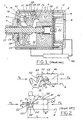
- FIG. 2 is an enlarged partial view of FIG. 1 to illustrate various forces acting on the pistons.
- the pressure P c in the crank chamber 10 acts on one end of the piston 44 while a compression reaction force P d acts on the other end of the piston 44.
- the pressure P c in the crank chamber 10 and the compression reaction force P d act on the swash plate from the piston via the shoes 52, and the action force exerted on the swash plate 34 reversely acts on the piston 44 via the shoes 52 as a reaction force which is equal in magnitude and oppositely directed to the action force.
- the force F exerted from the swash plate 34 on the piston 44 acts on the piston 44 at an angle perpendicular to surfaces of the swash plate 34 at a contact position at which the semi-spherical outer surface of the shoe 52 adjacent the body of the piston 44 comes into contact with the semi-spherical inner surface of the shoe pocket 54, i.e., at an apex of the shoe pocket 54 lying on the central axis CA of the piston 44.
- the force F exerted from the swash plate 34 on the piston 44 is composed of two components, horizontal and vertical components, the horizontal component F x lying on the central axis CA of the piston 44 and the vertical component FY being perpendicular to the central axis CA of the piston 44.
- m be the mass of the piston 44
- a be the acceleration of the piston 44 during the compression stroke
- A be the cross sectional area of the piston 44
- ⁇ be the angle from horizontal the force F is acting on the piston 44
- d be the diameter of the piston 44.
- the vertical component F y acts on the piston 44 as a bending moment which is maximized at the lower back edge designated by "P".
- Each piston 44 is provided with the cutout portion 56 to prevent a piston 44 from coming into contact with one side surface (front surface) of the swash plate 34 when a piston 44 approaches its bottom dead center during the suction stroke.
- the cutout portion 56 provides a distance x between an operating point of the force F acting on the piston and an operating point of a reaction force acting on the cutout portion 56, i.e. the lower back edge of the piston 44, as shown in FIG. 2, and the distance x causes a bending moment which acts on the piston 44.
- the piston 44 is deformed by the distance x about the bridge portion 48 of the piston 44 in a counterclockwise direction with respect to the reaction force-operating point P, and at the same time, deflected abnormal abrasion also occurs in the body of the piston about the reaction force-operating point P and in an edge portion diagonally opposed thereto.
- the pressure P c ' in the crank chamber 10' acts on one end of the piston 44' while a suction force P s ' acts on the other end of the piston 44'.
- the pressure P c ' in the crank chamber 10' and the suction force P s ' act on the swash plate from the piston via the shoe 52', and the action force exerted on the swash plate 34' reversely acts on the piston 44' via the shoe 52' as a reaction force which is equal in magnitude and oppositely directed to the action force.
- the force F' exerted from the swash plate 34' on the piston 44' is composed of two components, horizontal and vertical, the horizontal component F x ' lying on the central axis CA' of the piston 44' and the vertical component F y ' being perpendicular to the central axis CA' of the piston 44'.
- m be the mass of the piston 44'
- a be the acceleration of the piston 44' during the suction stroke
- A be the cross-sectional area of the piston 44'
- ⁇ be the angle from horizontal the force F' is acting on the piston 44'
- “d” be the diameter of the piston 44'.
- ⁇ F x ' -ma
- ⁇ F x ' AP c ' - AP s ' - F x '
- the vertical component F y ' acts on the piston 44' as a bending moment.
- the depth of the piston 44' inserted into the cylinder bore 4' when the piston 44' reaches the maximum suction stroke position be W', and the length L' between the contact position, at which the outer surface of the shoe 52' remote from the piston body 46' comes into contact with the inner surface of the corresponding shoe pocket 54', and the rightmost front end of the piston 44'.
- the maximum bending moment M' max acts on the piston at a position P' away by N' from the front end of the piston 44'.
- M' max (L'-W')
- F y ' (L'-W') tan ⁇ [ma + ( ⁇ /4) * d 2 (P c ' - P s ')]
- FIG. 3 shows a compressor, for example, a variable capacity swash plate type compressor having a mechanism for minimizing a bending moment.
- a variable capacity swash plate type compressor 70 has a cylinder block 72 provided with a plurality of cylinder bores 74, a front housing 76 and a rear housing 78. Both front and rear ends of the cylinder block 72 are sealingly closed by the front and rear housings 76 and 78.
- a valve plate 80 is intervened between the cylinder block 72 and the rear housing 78.
- the cylinder block 72 and the front housing 76 define an air-tight sealed crank chamber 82.
- a drive shaft 84 is centrally arranged to extend through the front housing 76 to the cylinder block 72, and rotatably supported by radial bearings 86 and 87.
- the cylinder block 72 and the front and rear housings 76 and 78 are tightly combined by a long screw 89.
- a rotor 90 is fixedly mounted on the drive shaft 84 within the crank chamber 82 to be rotatable with the drive shaft 84, and supported by a thrust bearing 92 seated on an inner end of the front housing 76.
- a swash plate 94 is rotatably supported on the drive shaft 84. If desired, a spherical sleeve (not illustrated) can be intervened between the drive shaft 84 and the swash plate 94. In this case, the swash plate 94 is rotatably supported on an outer support surface of the rotor 90.
- a spherical sleeve (not illustrated) can be intervened between the drive shaft 84 and the swash plate 94. In this case, the swash plate 94 is rotatably supported on an outer support surface of the rotor 90.
- the swash plate 94 is in its largest inclination angle position, and at this time a spring 98 is most compressed and a stop surface 96a of a projection 96 comes into contact with the rotor 90 so that a further increase of inclination angle of the swash plate 94 is restricted by the rotor 90.
- a further decrease of inclination angle of the swash plate 94 is restricted by a stopper 97 provided with the drive shaft 84.
- the swash plate 94 is connected to the rotor 90 via a hinge mechanism to be rotated with the rotor 90. That is, a support arm 100 protrudes axially outwardly from one side surface of the rotor 90, and an arm 102 protrudes from one side surface of the swash plate 94 toward the support arm 100 of the rotor 90.
- the support arm 100 and the arm 102 overlap each other and are connected to each other by a pin 104.
- the pin 102 extends into a pin hole 106 formed through the support arm 100 of the rotor 90 and a rectangular shaped hole 108 formed through the arm 102 of the swash plate 94. With this arrangement, the rotor 90 and the swash plate 94 are hinged to each other, and the sliding motion of the pin 104 within the rectangular hole 108 changes an inclination angle of the swash plate 94 so as to change the capacity of the compressor.
- each cylindrical piston 110 has a body 112 with a head and a bridge portion 122.
- the bridge portion 122 has a recess 124, and opposed walls defined in the recess 124 have spherical shoe pockets 126 into which spherical outer surfaces of two semi-spherical flat surfaces of the shoes 128 are slidably disposed.
- the inner flat surfaces of the shoes 128 are slidably engaged with side surfaces of the peripheral portion of the swash plate 94.
- the force F exerted on the piston 110 from the swash plate 94 via the shoe 128 adjacent to the body 112 of the piston acts on the piston 110 at a right angle to a front surface of the swash plate 94 at a contact surface (in case of a line contact) or a contact point (in case of a point contact) (both will be referred as a contact position or an apex hereinafter) at which the semispherical outer surface of the shoe 128 adjacent to the body 112 comes into contact with the semi-spherical inner surface of the shoe pocket 126.
- the force F exerted from the swash plate 94 on the piston 110 is composed of two components, the horizontal component F x lying on the central axis CA of the piston 110 and the vertical component F y perpendicular to the central axis CA of the piston 110.
- the vertical component F y acts on the piston 110 as a bending moment.
- a cutout portion is not formed in the body 112 of the piston 110. That is, in the construction of the piston in accordance with the present invention, the lower back edge P of the body 112 of the piston 110 lies on the line S which passes through the apex Q 2 of the shoe pocket 126 and is perpendicular to the central axis CA of the piston 110. Moreover, the lower back edge P of the piston body 112 is able to be further extended up to an entrance Q 1 of the shoe pocket 126 near the piston body 112. Therefore, the lower back edge portion is between the entrance Q 1 and apex Q 2 of the shoe pocket 126 near the piston body 112. As a result, the piston body 112 is compensated by the distance X compared to the piston body of prior art, and thus, the maximum bending moment acting on the piston does not occur from the above equation (3).
- the swash plate 94 has a depressed portion 130 formed in the side surface thereof confronting the piston body 112.
- the depressed portion 130 may be formed evenly in a central region of the swash plate 94 as shown in FIG. 3 and 4, or only in a region 130' in which the contact interference occurs as shown in FIG. 5.
- the depths of the depressed portions 130 and 130' are determined in response to the projection size of a center region of the cylinder block 72 as described hereinafter.
- a thin swash plate or restriction on the smallest inclination angle of the swash plate can be employed to avoid the interference between the swash plate and the piston body.
- FIG. 6 shows a cylinder block for use in the compressor of the present invention.
- the cylinder block 72 has an annular projecting portion 73 protruding from an entrance of each cylinder bore 74 as a reference surface B toward the depressed portion 130 of the swash plate 94.
- the projecting portion 73 is formed in a central region of the cylinder bore 74 between a central hole 77 for the drive shaft 84 and the cylinder bores 74.
- the projecting portion 73 may be formed over the entire central region.
- FIG. 7 shows another embodiment of the cylinder block in which a circumferential portion of the cylinder block 72 between the outer circumferential surface 88 and the cylinder bores 74 is extended from the cylinder block 72 in response to the projection of the inner projecting portion 73 so as to form an outer projecting portion 79.
- the pistons are stably slid in their cylinder bores during the suction and compression strokes thereof.
- the projecting portion 73 protrudes by the depth of the depressed portion 130 from the central region. Therefore, the insertion depth N' of the piston increases in response to the projection of the causes of the bending moment acting on the piston 110 during the suction stroke thereof to be reduced as seen from the equation (6).
- the rear housing 78 is provided with inlet and outlet ports 134 and 136, and divided into suction and discharge chambers 138 and 140.
- the valve plate 80 has suction and discharge ports 142 and 144. Each cylinder bore 74 is communicated with the suction chamber 138 and the discharge chamber 140 via the suction ports 142 and the discharge ports 144. Each suction port 142 is opened and closed by a suction valve 146, and each discharge port 144 is opened and closed by a discharge valve 148, in response to the reciprocal movement of the respective pistons 110. The opening motion of the discharge valve 148 is restricted by a retainer 150.
- a control valve means 152 is provided with the compressor 70 for adjusting a pressure level within the crank chamber 82 as shown in FIG. 3.
- the swash plate 94 having a certain inclination angle is also rotated via the hinge mechanism, and thus, the rotation of the swash plate 94 is converted into the reciprocation of the pistons 110 within the respective cylinder bores 74 via the shoes 128.
- This reciprocating motion causes the refrigerant gas to be introduced from the suction chamber 138 of the rear housing 78 into the respective cylinder bores 74 in which the refrigerant gas is compressed by the reciprocating motion of the pistons 110.
- the compressed refrigerant gas is discharged from the respective cylinder bores 74 into the discharge chamber 140.
- the capacity of the compressed refrigerant gas discharged from the cylinder bores 74 into the discharge chamber 140 is controlled by the control valve means 152 which adjustably changes the pressure level P cc within the crank chamber 82. Namely, when the pressure level P sc in the suction chamber 138 is raised with increase of the thermal load of an evaporator, the control valve means 152 cuts off the refrigerant gas at pressure level P dc traveling from the discharge chamber 140 into the crank chamber 82 so that the pressure level P cc in the crank chamber 82 is lowered.
- the control valve means 152 passes the compressed refrigerant gas at pressure level P dc of the discharge chamber 140 into the crank chamber 82.
- the pressure level P cc in the crank chamber 82 is raised, a back pressure acting on the respective piston 110 is increased, and therefore, the angle of inclination of the swash plate 94 is decreased.
- the pin 104 of the hinge means is moved slidably and upwardly within the rectangular hole 108. Accordingly, the swash plate 94 is moved in a rearward direction yielding to the force of the spring 98.
- the pressure in the crank chamber 82' acts on the piston, and this force acts on the swash plate 94' via the shoe 128' remote from the piston body 112' which, in turn, act on the piston from the swash plate 94' as a reaction force.
- the maximum bending moment acts on the piston at a contact surface between the outer surface of the piston 110' and the inner surface of the cylinder bore 74' when the piston 110' is inserted into the corresponding cylinder bore 74' by a certain depth.
- the central region of the cylinder block 72' is projected in response to the depth of the depressed portion 130' of the swash plate 94'.
- the insertion depth W' of the piston 110' into the cylinder bore 74' at the maximum suction stroke is increased so as to reduce the maximum bending moment acting on the piston 110'.
Landscapes
- Engineering & Computer Science (AREA)
- Mechanical Engineering (AREA)
- General Engineering & Computer Science (AREA)
- Manufacturing & Machinery (AREA)
- Compressors, Vaccum Pumps And Other Relevant Systems (AREA)
Claims (4)
- Ein Kompressor variabler Leistungsfähigkeit vom Taumelscheibentyp, der umfaßt:dadurch gekennzeichnet, daß ein unterer Hinterkanten-Abschnitt (P) des Körpers (112) jedes dieser Kolben (110) auf einer Linie (S) liegt, welche (a) durch einen Scheitelpunkt Q2 und einen Eingang Q1 der entsprechenden, an diesen Körper (112) angrenzenden Schuhtasche (126) läuft, und (b) senkrecht zu der Mittelachse (CA) dieses Kolbens (110) ist, wodurch Berührung zwischen dieser Taumelscheibe (94) und dem unteren Hinterkanten-Abschnitt (P) dieser Kolben (110) verhindert wird.einen Zylinderblock (72), der eine Mehrzahl von Zylinderbohrungen (74) radial und um den Umfang herum darin angeordnet aufweist;ein angrenzend an diesen Zylinderblock (72) montiertes und mit diesem Zylinderblock zusammenwirkendes Gehäuse (76, 78), um eine luftdicht abgedichtete Kurbelkammer (82) abzugrenzen;eine durch dieses Gehäuse (76, 78) und diesen Zylinderblock (72) drehbar getragene Antriebswelle (84);einen auf dieser Antriebswelle (84) montierten Rotor (90);eine an diesen Rotor (90) angeschlossene und auf dieser Antriebswelle (84) montierte Taumelscheibe (94), um dadurch einen Neigungswinkel davon in Reaktion auf die Änderungen des Drucks in der Kurbelkammer dieses Gehäuses zu verändern;eine zwischen diesem Rotor (90) und dieser Taumelscheibe (94) angeordnete Scharniervorrichtung (100, 102, 104), um den Neigungswinkel dieser Taumelscheibe zu ändern;eine Mehrzahl von sich hin- und herbewegend in jeder der Zylinderbohrungen (74) dieses Blocks (72) angeordneten Kolben (110), wobei jeder dieser Kolben einen zylindrischen Körper (112) mit einem Kopf aufweist, und einen Brückenabschnitt (122), der an dem Körper (112) angeschlossen ist; und eine Aussparung (124), und ein in gegenüberliegenden Wänden gebildetes Paar Schuhtaschen (126), das die Aussparung (124) begrenzt;eine Mehrzahl von in den Schuhtaschen (126) der Aussparung jedes dieser Kolben (110) angeordneten Schuhen (128); um mit dieser Taumelscheibe (94) in Berührung zu kommen, um die Umdrehung dieser Taumelscheibe in Hin- und Herbewegungen dieser Kolben umzuwandeln; undeine Regelventil-Vorrichtung (152), um ein Druckniveau in der Kurbelkammer (82) dieses Gehäuses einzustellen;
- Ein Kompressor wie in Anspruch 1 beansprucht, in dem Kontakt zwischen dieser Taumelscheibe (94) und diesem unteren Hinterkanten-Abschnitt (P) durch einen in dieser Taumelscheibe (94) entsprechend dem unteren Hinterkanten-Abschnitt (P) dieses Kolbens gebildeten, vertieften Abschnitt (130) verhindert wird.
- Ein Kompressor wie in Anspruch 2 beansprucht, einschließlich eines ersten vorspringenden Abschnitts (73), der von diesem Zylinderblock (72) von einem Eingang jeder Zylinderbohrung (74) zu diesem vertieften Abschnitt (130) dieser Taumelscheibe (94) hin hinausragt, und der zwischen dieser Antriebswelle (84) und den Zylinderbohrungen (74) dieses Zylinderblocks (72) liegt.
- Ein Kompressor wie in Anspruch 3 beansprucht, in dem dieser Zylinderblock (72) weiterhin einen äußeren vorspringenden Abschnitt (79) einschließt, der zwischen diesen Zylinderbohrungen (74) und einer äußeren Umfangsfläche (88) in Reaktion auf einen Vorsprung dieses ersten Vorsprungabschnitts (73) hervorragt.
Applications Claiming Priority (2)
| Application Number | Priority Date | Filing Date | Title |
|---|---|---|---|
| KR1019980048043A KR100282043B1 (ko) | 1998-11-10 | 1998-11-10 | 가변용량 사판식 압축기 |
| KR4800043 | 1998-11-10 |
Publications (3)
| Publication Number | Publication Date |
|---|---|
| EP1004769A2 EP1004769A2 (de) | 2000-05-31 |
| EP1004769A3 EP1004769A3 (de) | 2000-10-25 |
| EP1004769B1 true EP1004769B1 (de) | 2005-01-19 |
Family
ID=36500595
Family Applications (1)
| Application Number | Title | Priority Date | Filing Date |
|---|---|---|---|
| EP99308846A Expired - Lifetime EP1004769B1 (de) | 1998-11-10 | 1999-11-05 | Taumelscheibenkompressor mit veränderlicher Förderleistung |
Country Status (5)
| Country | Link |
|---|---|
| US (1) | US6227811B1 (de) |
| EP (1) | EP1004769B1 (de) |
| JP (1) | JP3084528B2 (de) |
| KR (1) | KR100282043B1 (de) |
| DE (1) | DE69923279T2 (de) |
Families Citing this family (6)
| Publication number | Priority date | Publication date | Assignee | Title |
|---|---|---|---|---|
| KR100558704B1 (ko) * | 1999-03-20 | 2006-03-10 | 한라공조주식회사 | 가변용량 사판식 압축기 |
| KR100558705B1 (ko) * | 1999-03-20 | 2006-03-10 | 한라공조주식회사 | 가변용량 사판식 압축기 |
| JP2000283028A (ja) * | 1999-03-26 | 2000-10-10 | Toyota Autom Loom Works Ltd | 可変容量型圧縮機 |
| DE10051420B4 (de) * | 2000-10-17 | 2009-03-05 | Valeo Compressor Europe Gmbh | Zylinderblock eines Axialkolbenverdichters mit verlängerter Zylinderlauffläche |
| US7172393B2 (en) * | 2002-09-05 | 2007-02-06 | Sanden Corporation | Multi-cylinder compressors and methods for designing such compressors |
| EP2669518B1 (de) * | 2012-05-28 | 2016-11-09 | Valeo Japan Co., Ltd. | Zylinderblock für einen Verdichter, insbesondere Schrägscheibenverdichter, und Schrägscheibenverdichter |
Family Cites Families (10)
| Publication number | Priority date | Publication date | Assignee | Title |
|---|---|---|---|---|
| JP2626292B2 (ja) * | 1991-03-30 | 1997-07-02 | 株式会社豊田自動織機製作所 | 容量可変型斜板式圧縮機 |
| KR970003251B1 (ko) * | 1992-08-21 | 1997-03-15 | 가부시끼가이샤 도요다 지도쇽끼 세이사꾸쇼 | 용량 가변형 사판식 압축기 |
| JP2684931B2 (ja) * | 1992-08-21 | 1997-12-03 | 株式会社豊田自動織機製作所 | 片頭ピストン型圧縮機 |
| JP3125952B2 (ja) * | 1993-04-08 | 2001-01-22 | 株式会社豊田自動織機製作所 | 容量可変型斜板式圧縮機 |
| JP3301159B2 (ja) * | 1993-05-10 | 2002-07-15 | 株式会社豊田自動織機 | クラッチレス圧縮機における潤滑方法及び潤滑構造 |
| KR100202784B1 (ko) * | 1995-03-30 | 1999-06-15 | 이소가이 치세이 | 가변용량 압축기 |
| JPH08326655A (ja) * | 1995-06-05 | 1996-12-10 | Calsonic Corp | 斜板式コンプレッサ |
| TW353705B (en) * | 1995-06-05 | 1999-03-01 | Toyoda Automatic Loom Works | Reciprocating piston compressor |
| JPH0968162A (ja) * | 1995-06-20 | 1997-03-11 | Toyota Autom Loom Works Ltd | 容量可変型斜板式圧縮機 |
| CN1125932C (zh) * | 1996-07-17 | 2003-10-29 | 株式会社丰田自动织机制作所 | 压缩机的轴封结构 |
-
1998
- 1998-11-10 KR KR1019980048043A patent/KR100282043B1/ko not_active Expired - Lifetime
-
1999
- 1999-10-07 US US09/414,197 patent/US6227811B1/en not_active Expired - Lifetime
- 1999-11-04 JP JP11314112A patent/JP3084528B2/ja not_active Expired - Lifetime
- 1999-11-05 DE DE69923279T patent/DE69923279T2/de not_active Expired - Lifetime
- 1999-11-05 EP EP99308846A patent/EP1004769B1/de not_active Expired - Lifetime
Also Published As
| Publication number | Publication date |
|---|---|
| DE69923279D1 (de) | 2005-02-24 |
| DE69923279T2 (de) | 2006-06-14 |
| EP1004769A3 (de) | 2000-10-25 |
| KR100282043B1 (ko) | 2001-02-15 |
| US6227811B1 (en) | 2001-05-08 |
| EP1004769A2 (de) | 2000-05-31 |
| KR20000031816A (ko) | 2000-06-05 |
| JP3084528B2 (ja) | 2000-09-04 |
| JP2000145628A (ja) | 2000-05-26 |
Similar Documents
| Publication | Publication Date | Title |
|---|---|---|
| US5785503A (en) | Variable displacement compressor | |
| EP0550228B1 (de) | Schiefscheibenverdichter mit veränderlicher Verdrängung | |
| US5181453A (en) | Variable displacement compressor | |
| US6629823B2 (en) | Compressors | |
| US5556261A (en) | Piston type compressor | |
| EP1323923B1 (de) | Gelenkvorrichtung für einen Taumelscheibenverdichter | |
| EP1004769B1 (de) | Taumelscheibenkompressor mit veränderlicher Förderleistung | |
| US5364232A (en) | Variable displacement compressor | |
| US20080028927A1 (en) | Variable Displacement Swash Plate Type Compressor With Smooth Inclined Moving Feature | |
| US6260469B1 (en) | Piston for use in a compressor | |
| US6338613B1 (en) | Piston-type compressor | |
| US20030025276A1 (en) | Shaft sealing devices, compressors comprising the shaft sealing devices, and methods for sealing a rotational shaft | |
| EP0987436B1 (de) | Kühlverdichter mit Einzelkopf-Kolben und mit Mitteln zur Verhinderung der Rotation des Kolbens um seine eigene Achse im Zylinder | |
| EP1531266B1 (de) | Kompressor mit veränderlicher Verdrängung | |
| CN1136389C (zh) | 可变容量压缩机 | |
| JP2946717B2 (ja) | 揺動斜板型圧縮機の軸受装置 | |
| KR100558702B1 (ko) | 가변용량 사판식 압축기 | |
| US6912948B2 (en) | Swash plate compressor | |
| CN1072314C (zh) | 可变容量压缩机 | |
| KR100558703B1 (ko) | 응력을 최소화하기 위한 피스톤 | |
| JP3033341B2 (ja) | 斜板式圧縮機 | |
| KR100558701B1 (ko) | 용량가변형 사판식 압축기용 피스톤 | |
| JP3277580B2 (ja) | 揺動斜板式可変容量圧縮機 | |
| EP1041284A2 (de) | Einlassventil für Kompressor | |
| JP4128656B2 (ja) | 斜板式圧縮機 |
Legal Events
| Date | Code | Title | Description |
|---|---|---|---|
| PUAI | Public reference made under article 153(3) epc to a published international application that has entered the european phase |
Free format text: ORIGINAL CODE: 0009012 |
|
| AK | Designated contracting states |
Kind code of ref document: A2 Designated state(s): DE FR GB |
|
| AX | Request for extension of the european patent |
Free format text: AL;LT;LV;MK;RO;SI |
|
| PUAL | Search report despatched |
Free format text: ORIGINAL CODE: 0009013 |
|
| AK | Designated contracting states |
Kind code of ref document: A3 Designated state(s): AT BE CH CY DE DK ES FI FR GB GR IE IT LI LU MC NL PT SE |
|
| AX | Request for extension of the european patent |
Free format text: AL;LT;LV;MK;RO;SI |
|
| RIC1 | Information provided on ipc code assigned before grant |
Free format text: 7F 04B 27/10 A, 7F 04B 27/08 B |
|
| 17P | Request for examination filed |
Effective date: 20010307 |
|
| AKX | Designation fees paid |
Free format text: DE FR GB |
|
| 17Q | First examination report despatched |
Effective date: 20040128 |
|
| GRAP | Despatch of communication of intention to grant a patent |
Free format text: ORIGINAL CODE: EPIDOSNIGR1 |
|
| GRAS | Grant fee paid |
Free format text: ORIGINAL CODE: EPIDOSNIGR3 |
|
| GRAA | (expected) grant |
Free format text: ORIGINAL CODE: 0009210 |
|
| AK | Designated contracting states |
Kind code of ref document: B1 Designated state(s): DE FR GB |
|
| PG25 | Lapsed in a contracting state [announced via postgrant information from national office to epo] |
Ref country code: FR Free format text: LAPSE BECAUSE OF NON-PAYMENT OF DUE FEES Effective date: 20050119 |
|
| REG | Reference to a national code |
Ref country code: GB Ref legal event code: FG4D |
|
| REF | Corresponds to: |
Ref document number: 69923279 Country of ref document: DE Date of ref document: 20050224 Kind code of ref document: P |
|
| RAP2 | Party data changed (patent owner data changed or rights of a patent transferred) |
Owner name: HALLA CLIMATE CONTROL CORP Owner name: VISTEON GLOBAL TECHNOLOGIES, INC. |
|
| PLBE | No opposition filed within time limit |
Free format text: ORIGINAL CODE: 0009261 |
|
| STAA | Information on the status of an ep patent application or granted ep patent |
Free format text: STATUS: NO OPPOSITION FILED WITHIN TIME LIMIT |
|
| 26N | No opposition filed |
Effective date: 20051020 |
|
| EN | Fr: translation not filed | ||
| PGFP | Annual fee paid to national office [announced via postgrant information from national office to epo] |
Ref country code: GB Payment date: 20071120 Year of fee payment: 9 |
|
| GBPC | Gb: european patent ceased through non-payment of renewal fee |
Effective date: 20081105 |
|
| PG25 | Lapsed in a contracting state [announced via postgrant information from national office to epo] |
Ref country code: GB Free format text: LAPSE BECAUSE OF NON-PAYMENT OF DUE FEES Effective date: 20081105 |
|
| PGFP | Annual fee paid to national office [announced via postgrant information from national office to epo] |
Ref country code: DE Payment date: 20110127 Year of fee payment: 12 |
|
| REG | Reference to a national code |
Ref country code: DE Ref legal event code: R119 Ref document number: 69923279 Country of ref document: DE Effective date: 20120601 |
|
| PG25 | Lapsed in a contracting state [announced via postgrant information from national office to epo] |
Ref country code: DE Free format text: LAPSE BECAUSE OF NON-PAYMENT OF DUE FEES Effective date: 20120601 |