EP1005017A2 - Formant Sprachsynthetisierer unter Verwendung von Verkettung von Halbsilben mit unabhängiger Überblendung im Filterkoeffizienten- und Quellenbereich - Google Patents
Formant Sprachsynthetisierer unter Verwendung von Verkettung von Halbsilben mit unabhängiger Überblendung im Filterkoeffizienten- und Quellenbereich Download PDFInfo
- Publication number
- EP1005017A2 EP1005017A2 EP99309293A EP99309293A EP1005017A2 EP 1005017 A2 EP1005017 A2 EP 1005017A2 EP 99309293 A EP99309293 A EP 99309293A EP 99309293 A EP99309293 A EP 99309293A EP 1005017 A2 EP1005017 A2 EP 1005017A2
- Authority
- EP
- European Patent Office
- Prior art keywords
- filter
- demi
- syllable
- cross fade
- source
- Prior art date
- Legal status (The legal status is an assumption and is not a legal conclusion. Google has not performed a legal analysis and makes no representation as to the accuracy of the status listed.)
- Granted
Links
Images


Classifications
-
- G—PHYSICS
- G10—MUSICAL INSTRUMENTS; ACOUSTICS
- G10L—SPEECH ANALYSIS TECHNIQUES OR SPEECH SYNTHESIS; SPEECH RECOGNITION; SPEECH OR VOICE PROCESSING TECHNIQUES; SPEECH OR AUDIO CODING OR DECODING
- G10L13/00—Speech synthesis; Text to speech systems
- G10L13/06—Elementary speech units used in speech synthesisers; Concatenation rules
- G10L13/07—Concatenation rules
Definitions
- the present invention relates generally to speech synthesis and more particularly to a concatenative synthesizer based on a source-filter model in which the source signal and filter parameters are generated by independent cross fade mechanisms.
- Modern day speech synthesis involves many tradeoffs. For limited vocabulary applications, it is usually feasible to store entire words as digital samples to be concatenated into sentences for playback. Given a good prosody algorithm to place the stress on the appropriate words, these systems tend to sound quite natural, because the individual words can be accurate reproductions of actual human speech. However, for larger vocabularies it is not feasible to store complete word samples of actual human speech. Therefore, a number of speech synthesists have been experimenting with breaking speech into smaller units and concatenating those units into words, phrases and ultimately sentences.
- the formant-based speech synthesizer of the invention is based upon a source-filter model that closely ties the source and filter synthesizer components to physical structures within the human vocal tract.
- the source model is based on a best estimate of the source signal produced at the glottis
- the filter model is based on the resonant (formant-producing) structures generally above the glottis. For this reason, we call our synthesis technique "formant-based" synthesis.
- Formant-based synthesis technique
- Our synthesis technique involves identifying and extracting the formants from an actual speech signal (labeled to identify approximate demi-syllable areas) and then using this information to construct demi-syllable segments each represented by a set of filter parameters and a source signal waveform.
- the invention provides a novel cross fade technique to smoothly concatenate consecutive demi-syllable segments.
- our system allows us to perform cross fade in the filter parameter domain while simultaneously but independently performing "cross fade" (parameter interpolation) of the source waveforms in the time domain.
- the filter parameters model vocal tract effects, while the source waveforms model the glottal source.
- the technique has the advantage of restricting prosodic modification to only the glottal source, if desired. This can reduce distortion usually associated with the conventional blending techniques.
- the invention further provides a system whereby interaction between initial and final demi-syllables can be taken into account.
- Demi-syllables represent the presently preferred concatenation unit. Ideally, concatenation units are selected at points of least co-articulatory effect.
- the syllable is a natural unit for this purpose, but choosing the syllable requires a large amount of memory. For systems with limited available memory, the demi-syllable is preferred.
- This interaction information is stored in a waveform database containing not only the source waveform data and filter parameter data, but also the necessary label or marker data and context data used by the system in applying formant modification rules.
- the system operates upon an input phoneme string by first performing unit selection, then building an acoustic string of syllable objects and then rendering those objects by performing the cross fade operations in both source signal and filter parameter domains.
- the resulting output are source waveforms and filter parameters that may then be used in a source-filter model to generate synthesized speech.
- the result is a natural sounding speech synthesizer that can be incorporated into many different consumer products.
- the techniques can be applied to any speech coding application, the invention is well suited for use as a concatenative speech synthesizer, suitable for use in text-to-speech applications.
- This system is designed to work within the current memory and processor constraints found in many consumer applications.
- the synthesizer is designed to fit into a small memory footprint, while providing better sounding synthesis than other synthesizers of larger size.
- Speech can be modeled as an initial source component 10 , processed through a subsequent filter component 12 .
- either source or filter, or both can be very simple or very complex.
- PCM Pulse Code Modulated
- a very simple filter In the PCM synthesizer all apriori knowledge was imbedded in the source and none in the filter.
- another synthesis method used a simple repeating pulse train as the source and a comparatively complex filter based on LPC (Linear Predictive Coding). Note that neither of these conventional synthesis techniques attempted to model the physical structures within the human vocal tract that are responsible for producing human speech.
- the present invention employs a formant-based synthesis model that closely ties the source and filter synthesizer components to the physical structures within the human vocal tract.
- the synthesizer of the present invention bases the source model on a best estimate of the source signal produced at the glottis.
- the filter model is based on the resonant (formant producing) structures located generally above the glottis. For these reasons, we call our synthesis technique "formant-based".
- Figure 2 summarizes various source-filter combinations, showing on the vertical axis a comparative measure of the complexity of the corresponding source or filter component.
- the source and filter components are illustrated as side-by-side vertical axes.
- the source axis relative complexity decreases from top to bottom, whereas along the filter axis relative complexity increases from top to bottom.
- Several generally horizontal or diagonal lines connect a point on the source axis with a point on the filter axis to represent a particular type of speech synthesizer.
- the horizontal line 14 connects a fairly complex source with a fairly simple filter to define the TD-PSOLA synthesizer, an example of one type of well-known synthesizer technology in which a PCM source waveform is applied to an identity filter.
- horizontal line 16 connects a relatively simple source with a relatively complex filter to define another known synthesizer of the phase vocorder, harmonic synthesizer.
- This synthesizer in essence uses a simple form of pulse train source waveform and a complex filter designed using spectral analysis techniques such as Fast Fourier Transforms (FFT).
- FFT Fast Fourier Transforms
- the classic LPC synthesizer is represented by diagonal line 17 , which connects a pulse train source with an LPC filter.
- the Klatt synthesizer 18 is defined by a parametric source applied through a filter comprised of formants and zeros.
- the present invention occupies a location within Figure 2 illustrated generally by the shaded region 20 .
- the present invention can use a source waveform ranging from a pure glottal source to a glottal source with nasal effects present.
- the filter can be a simple formant filter bank or a somewhat more complex filter having formants and zeros.
- Region 20 corresponds as close as practical to the natural separation in humans between the glottal voice source and the vocal tract (filter).
- TD-PSOLA pure time domain representation
- pure frequency domain representation such as the phase vocorder or harmonic synthesizer
- the presently preferred implementation of our formant-based synthesizer uses a technique employing a filter and an inverse filter to extract source signal and formant parameters from human speech.
- the extracted signals and parameters are then used in the source-filter model corresponding to region 20 in Figure 2 .
- the presently preferred procedure for extracting source and filter parameters from human speech is described later in this specification.
- the present description will focus on other aspects of the formant-based synthesizer, namely those relating to selection of concatenative units and cross fade.
- the formant-based synthesizer of the invention defines concatenation units representing small pieces of digitized speech that are then concatenated together for playback through a synthesizer sound module.
- the cross fade techniques of the invention can be employed with concatenation units of various sizes.
- the syllable is a natural unit for this purpose, but where memory is limited choosing the syllable as the basic concatenation unit may be prohibitive in terms of memory requirements. Accordingly, the present implementation uses the demi-syllable as the basic concatenation unit.
- An important part of the formant-based synthesizer involves performing a cross fade to smoothly join adjacent demi-syllables so that the resulting syllables sound natural and without glitches or distortion. As will be more fully explained below, the present system performs this cross fade in both the time domain and the frequency domain, involving both components of the source-filter model: the source waveforms and the formant filter parameters.
- the preferred embodiment stores source waveform data and filter parameter data in a waveform database.
- the database in its maximal form stores digitized speech waveforms and filter parameter data for at least one example of each demi-syllable found in the natural language (e.g. English).
- the database can be pruned to eliminate redundant speech waveforms. Because adjacent demi-syllables can significantly affect one another, the preferred system stores data for each different context encountered.
- Figure 3 shows the presently preferred technique for constructing the waveform database.
- the boxes with double-lined top edges are intended to depict major processing block headings.
- the single-lined boxes beneath these headings represent the individual steps or modules that comprise the major block designated by the heading block.
- data for the waveform database is constructed as at 40 by first compiling a list of demi-syllables and boundary sequences as depicted at step 42 . This is accomplished by generating all possible combinations of demi-syllables (step 44 ) and by then excluding any unused combinations as at 46 .
- Step 44 may be a recursive process whereby all different permutations of initial and final demi-syllables are generated. This exhaustive list of all possible combinations is then pruned to reduce the size of the database. Pruning is accomplished in step 46 by consulting a word dictionary 48 that contains phonetic transcriptions of all words that the synthesizer will pronounce. These phonetic transcriptions are used to weed out any demi-syllable combinations that do not occur in the words the synthesizer will pronounce.
- the preferred embodiment also treats boundaries between syllables, such as those that occur across word boundaries or sentence boundaries. These boundary units (often consonant clusters) are constructed from diphones sampled from the correct context.
- One way to exclude unused boundary unit combinations is to provide a text corpus 50 containing exemplary sentences formed using the words found in word dictionary 48 . These sentences are used to define different word boundary contexts such that boundary unit combinations not found in the text corpus may be excluded at step 46 .
- the sampled waveform data associated with each demi-syllable is recorded and labeled at step 52 .
- This entails applying phonetic markers at the beginning and ending of the relevant portion of each demi-syllable, as indicated at step 54 .
- the relevant parts of the sampled waveform data are extracted and labeled by associating the extracted portions with the corresponding demi-syllable or boundary unit from which the sample was derived.
- the next step involves extracting source and filter data from the labeled waveform data as depicted generally at step 56 .
- Step 56 involves a technique described more fully below in which actual human speech is processed through a filter and its inverse filter using a cost function that helps extract an inherent source signal and filter parameters from each of the labeled waveform data.
- the extracted source and filter data are then stored at step 58 in the waveform database 60 .
- the maximal waveform database 60 thus contains source (waveform) data and filter parameter data for each of the labeled demi-syllables and boundary units. Once the waveform database has been constructed, the synthesizer may now be used.
- the input string may be a phoneme string representing a phrase or sentence, as indicated diagrammatically at 64 .
- the phoneme string may include aligned intonation patterns 66 and syllable duration information 68 .
- the intonation patterns and duration information supply prosody information that the synthesizer may use to selectively alter the pitch and duration of syllables to give a more natural human-like inflection to the phrase or sentence.
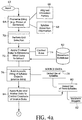
- the phoneme string is processed through a series of steps whereby information is extracted from the waveform database 60 and rendered by the cross fade mechanisms.
- unit selection is performed as indicated by the heading block 70 .
- This entails applying context rules as at 72 to determine what data to extract from waveform database 60 .
- the context rules depicted diagrammatically at 74 , specify which demi-syllable or boundary units to extract from the database under certain conditions. For example, if the phoneme string calls for a demi-syllable that is directly represented in the database, then that demi-syllable is selected.
- the context rules take into account the demi-syllables of neighboring sound units in making selections from the waveform database.
- the context rules will specify the closest approximation to the required demi-syllable.
- the context rules are designed to select the demi-syllables that will sound most natural when concatenated. Thus the context rules are based on linguistic principles.
- the context rules will specify the next-most desirable context.
- the rules may choose a segment preceded by a differnet bilabial, such as /p/.
- the synthesizer builds an acoustic string of syllable objects corresponding to the phoneme string supplied as input.
- This step is indicated generally at 76 and entails constructing source data for the string of demi-syllables as specified during unit selection.
- This source data corresponds to the source component of the source-filter model.
- Filter parameters are also extracted from the database and manipulated to build the acoustic string. The details of filter parameter manipulation are discussed more fully below.
- the presently preferred embodiment defines the string of syllable objects as a linked list of syllables 78 , which in turn, comprises a linked list of demi-syllables 80 .
- the demi-syllables contain waveform snippets 82 obtained from waveform database 60 .
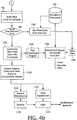
- a series of rendering steps are performed to cross fade the source data in the time domain and independently cross fade the filter parameters in the frequency domain.
- the rendering steps applied in the time domain appear beginning at step 84 .
- the rendering steps applied in the frequency domain appear beginning at step 110 (Fig. 4B ).
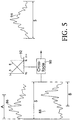
- Figure 5 illustrates the presently preferred technique for performing a cross fade of the source data in the time domain.
- a syllable of duration S is comprised of initial and final demi-syllables of duration A and B.
- the waveform data of demi-syllable A appears at 86 and the waveform data of demi-syllable B appears at 88 .
- These waveform snippets are slid into position (arranged in time) so that both demi-syllables fit within syllable duration S. Note that there is some overlap between demi-syllables A and B.
- the cross fade mechanism of the preferred embodiment performs a linear cross fade in the time domain.
- This mechanism is illustrated diagrammatically at 90 , with the linear cross fade function being represented at 92 .
- demi-syllable A receives full emphasis while demi-syllable B receives zero emphasis.
- demi-syllable A receives full emphasis while demi-syllable B receives zero emphasis.
- demi-syllable B receives zero emphasis.
- demi-syllable A is gradually reduced in emphasis while demi-syllable B is gradually increased in emphasis.
- a separate cross fade process is performed on the filter parameter data associated with the extracted demi-syllables.
- the procedure begins by applying filter selection rules 98 to obtain filter parameter data from database 60 . If the requested syllable is directly represented in a syllable exception component of database 60 , then filter data corresponding to that syllable is used as at step 100 . Alternatively, if the filter data is not directly represented as a full syllable in the database, then new filter data are generated as at step 102 by applying a cross fade operation upon data from two demi-syllables in the frequency domain.
- the cross fade operation entails selecting a cross fade region across which the filter parameters of successive demi-syllables will be cross faded and by then applying a suitable cross fade function as at 106 .
- the cross fade function is applied in the filter domain and may be a linear function (similar to that illustrated in Figure 5 ), a sigmoidal function or some other suitable function. Whether derived from the syllable exception component of the database directly (as at set 100 ) or generated by the cross fade operation, the filter parameter data are stored at 108 for later use in the source-filter model synthesizer.
- cross fade region and the cross fade function is data dependent.
- the objective of performing cross fade in the frequency domain is to eliminate unwanted glitches or resonances without degrading important dipthongs.
- cross-fade regions must be identified in which the trajectories of the speech units to be joined are as similar as possible. For example, in the construction of the word "house”, disyllabic filter units for /haw/- and - /aws/ could be concatentated with overlap in the nuclear /a/ region.
- the source data and filter data have been compiled and rendered according to the preceding steps, they are output as at 110 to the respective source waveform databank 112 and filter parameters databank 114 for use by the source filter model synthesizer 116 to output synthesized speech.
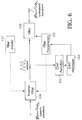
- Figure 6 illustrates a system according to the invention by which the source waveform may be extracted from a complex input signal.
- a filter/inverse-filter pair are used in the extraction process.
- filter 110 is defined by its filter model 112 and filter parameters 114 .
- the present invention also employs an inverse filter 116 that corresponds to the inverse of filter 110 .
- Filter 116 would, for example, have the same filter parameters as filter 110 , but would substitute zeros at each location where filter 110 has poles.
- the filter 110 and inverse filter 116 define a reciprocal system in which the effect of inverse filter 116 is negated or reversed by the effect of filter 110 .
- a speech waveform input to inverse filter 16 and subsequently processed by filter 110 results in an output waveform that, in theory, is identical to the input waveform.
- slight variations in filter tolerance or slight differences between filters 116 and 110 would result in an output waveform that deviates somewhat from the identical match of the input waveform.
- the output residual signal at node 120 is processed by employing a cost function 122 .
- this cost function analyzes the residual signal according to one or more of a plurality of processing functions described more fully below, to produce a cost parameter.
- the cost parameter is then used in subsequent processing steps to adjust filter parameters 114 in an effort to minimize the cost parameter.
- the cost minimizer block 124 diagrammatically represents the process by which filter parameters are selectively adjusted to produce a resulting reduction in the cost parameter. This may be performed iteratively, using an algorithm that incrementally adjusts filter parameters while seeking the minimum cost.
- the resulting residual signal at node 120 may then be used to represent an extracted source signal for subsequent source-filter model synthesis.
- the filter parameters 114 that produced the minimum cost are then used as the filter parameters to define filter 110 for use in subsequent source-filter model synthesis.
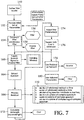
- Figure 7 illustrates the process by which the source signal is extracted, and the filter parameters identified, to achieve a source-filter model synthesis system in accordance with the invention.
- a filter model is defined at step 150 . Any suitable filter model that lends itself to a parameterized representation may be used.
- An initial set of parameters is then supplied at step 152 . Note that the initial set of parameters will be iteratively altered in subsequent processing steps to seek the parameters that correspond to a minimized cost function. Different techniques may be used to avoid a sub-optimal solution corresponding to a local minima.
- the initial set of parameters used at step 152 can be selected from a set or matrix of parameters designed to supply several different starting points in order to avoid the local minima. Thus in Figure 7 note that step 152 may be performed multiple times for different initial sets of parameters.
- the filter model defined at 150 and the initial set of parameters defined at 152 are then used at step 154 to construct a filter (as at 156 ) and an inverse filter (as at 158 ).
- the speech signal is applied to the inverse filter at 160 to extract a residual signal as at 164 .
- the preferred embodiment uses a Hanning window centered on the current pitch epoch and adjusted so that it covers two-pitch periods. Other windows are also possible.
- the residual signal is then processed at 166 to extract data points for use in the arc-length calculation.
- the residual signal may be processed in a number of different ways to extract the data points. As illustrated at 168 , the procedure may branch to one or more of a selected class of processing routines. Examples of such routines are illustrated at 170 . Next the arc-length (or square-length) calculation is performed at 172 . The resultant value serves as a cost parameter.
- the filter parameters are selectively adjusted at step 174 and the procedure is iteratively repeated as depicted at 176 until a minimum cost is achieved.
- the extracted residual signal corresponding to that minimum cost is used at step 178 as the source signal.
- the filter parameters associated with the minimum cost are used as the filter parameters (step 180 ) in a source-filter model.
Landscapes
- Engineering & Computer Science (AREA)
- Computational Linguistics (AREA)
- Health & Medical Sciences (AREA)
- Audiology, Speech & Language Pathology (AREA)
- Human Computer Interaction (AREA)
- Physics & Mathematics (AREA)
- Acoustics & Sound (AREA)
- Multimedia (AREA)
- Compression, Expansion, Code Conversion, And Decoders (AREA)
- Electrophonic Musical Instruments (AREA)
- Reduction Or Emphasis Of Bandwidth Of Signals (AREA)
Priority Applications (1)
| Application Number | Priority Date | Filing Date | Title |
|---|---|---|---|
| EP03008984A EP1347440A3 (de) | 1998-11-25 | 1999-11-22 | Formant Sprachsynthetisierer unter Verwendung von Verkettung von Halbsilben mit unabhängiger Überblendung im Filterkoeffizienten- und Quellenbereich |
Applications Claiming Priority (2)
| Application Number | Priority Date | Filing Date | Title |
|---|---|---|---|
| US200327 | 1998-11-25 | ||
| US09/200,327 US6144939A (en) | 1998-11-25 | 1998-11-25 | Formant-based speech synthesizer employing demi-syllable concatenation with independent cross fade in the filter parameter and source domains |
Related Child Applications (1)
| Application Number | Title | Priority Date | Filing Date |
|---|---|---|---|
| EP03008984A Division EP1347440A3 (de) | 1998-11-25 | 1999-11-22 | Formant Sprachsynthetisierer unter Verwendung von Verkettung von Halbsilben mit unabhängiger Überblendung im Filterkoeffizienten- und Quellenbereich |
Publications (3)
| Publication Number | Publication Date |
|---|---|
| EP1005017A2 true EP1005017A2 (de) | 2000-05-31 |
| EP1005017A3 EP1005017A3 (de) | 2000-12-20 |
| EP1005017B1 EP1005017B1 (de) | 2003-07-23 |
Family
ID=22741247
Family Applications (2)
| Application Number | Title | Priority Date | Filing Date |
|---|---|---|---|
| EP03008984A Withdrawn EP1347440A3 (de) | 1998-11-25 | 1999-11-22 | Formant Sprachsynthetisierer unter Verwendung von Verkettung von Halbsilben mit unabhängiger Überblendung im Filterkoeffizienten- und Quellenbereich |
| EP99309293A Expired - Lifetime EP1005017B1 (de) | 1998-11-25 | 1999-11-22 | Formant Sprachsynthetisierer unter Verwendung von Verkettung von Halbsilben mit unabhängiger Überblendung im Filterkoeffizienten- und Quellenbereich |
Family Applications Before (1)
| Application Number | Title | Priority Date | Filing Date |
|---|---|---|---|
| EP03008984A Withdrawn EP1347440A3 (de) | 1998-11-25 | 1999-11-22 | Formant Sprachsynthetisierer unter Verwendung von Verkettung von Halbsilben mit unabhängiger Überblendung im Filterkoeffizienten- und Quellenbereich |
Country Status (5)
| Country | Link |
|---|---|
| US (2) | US6144939A (de) |
| EP (2) | EP1347440A3 (de) |
| JP (1) | JP3408477B2 (de) |
| DE (1) | DE69909716T2 (de) |
| ES (1) | ES2204071T3 (de) |
Cited By (1)
| Publication number | Priority date | Publication date | Assignee | Title |
|---|---|---|---|---|
| GB2392592A (en) * | 2002-08-27 | 2004-03-03 | 20 20 Speech Ltd | Speech synthesis |
Families Citing this family (144)
| Publication number | Priority date | Publication date | Assignee | Title |
|---|---|---|---|---|
| US6266638B1 (en) * | 1999-03-30 | 2001-07-24 | At&T Corp | Voice quality compensation system for speech synthesis based on unit-selection speech database |
| US7369994B1 (en) | 1999-04-30 | 2008-05-06 | At&T Corp. | Methods and apparatus for rapid acoustic unit selection from a large speech corpus |
| JP2001034282A (ja) * | 1999-07-21 | 2001-02-09 | Konami Co Ltd | 音声合成方法、音声合成のための辞書構築方法、音声合成装置、並びに音声合成プログラムを記録したコンピュータ読み取り可能な媒体 |
| JP3361291B2 (ja) * | 1999-07-23 | 2003-01-07 | コナミ株式会社 | 音声合成方法、音声合成装置及び音声合成プログラムを記録したコンピュータ読み取り可能な媒体 |
| US7941481B1 (en) | 1999-10-22 | 2011-05-10 | Tellme Networks, Inc. | Updating an electronic phonebook over electronic communication networks |
| US6807574B1 (en) | 1999-10-22 | 2004-10-19 | Tellme Networks, Inc. | Method and apparatus for content personalization over a telephone interface |
| US8645137B2 (en) | 2000-03-16 | 2014-02-04 | Apple Inc. | Fast, language-independent method for user authentication by voice |
| JP3728172B2 (ja) * | 2000-03-31 | 2005-12-21 | キヤノン株式会社 | 音声合成方法および装置 |
| US6963841B2 (en) * | 2000-04-21 | 2005-11-08 | Lessac Technology, Inc. | Speech training method with alternative proper pronunciation database |
| US6865533B2 (en) * | 2000-04-21 | 2005-03-08 | Lessac Technology Inc. | Text to speech |
| US7280964B2 (en) * | 2000-04-21 | 2007-10-09 | Lessac Technologies, Inc. | Method of recognizing spoken language with recognition of language color |
| US6847931B2 (en) | 2002-01-29 | 2005-01-25 | Lessac Technology, Inc. | Expressive parsing in computerized conversion of text to speech |
| US7308408B1 (en) * | 2000-07-24 | 2007-12-11 | Microsoft Corporation | Providing services for an information processing system using an audio interface |
| US7143039B1 (en) | 2000-08-11 | 2006-11-28 | Tellme Networks, Inc. | Providing menu and other services for an information processing system using a telephone or other audio interface |
| US7451087B2 (en) * | 2000-10-19 | 2008-11-11 | Qwest Communications International Inc. | System and method for converting text-to-voice |
| US6990450B2 (en) * | 2000-10-19 | 2006-01-24 | Qwest Communications International Inc. | System and method for converting text-to-voice |
| US6990449B2 (en) * | 2000-10-19 | 2006-01-24 | Qwest Communications International Inc. | Method of training a digital voice library to associate syllable speech items with literal text syllables |
| US6871178B2 (en) * | 2000-10-19 | 2005-03-22 | Qwest Communications International, Inc. | System and method for converting text-to-voice |
| JP3901475B2 (ja) * | 2001-07-02 | 2007-04-04 | 株式会社ケンウッド | 信号結合装置、信号結合方法及びプログラム |
| US7546241B2 (en) * | 2002-06-05 | 2009-06-09 | Canon Kabushiki Kaisha | Speech synthesis method and apparatus, and dictionary generation method and apparatus |
| JP4178319B2 (ja) * | 2002-09-13 | 2008-11-12 | インターナショナル・ビジネス・マシーンズ・コーポレーション | 音声処理におけるフェーズ・アライメント |
| CN1604077B (zh) * | 2003-09-29 | 2012-08-08 | 纽昂斯通讯公司 | 对发音波形语料库的改进方法 |
| US7571104B2 (en) | 2005-05-26 | 2009-08-04 | Qnx Software Systems (Wavemakers), Inc. | Dynamic real-time cross-fading of voice prompts |
| US8677377B2 (en) | 2005-09-08 | 2014-03-18 | Apple Inc. | Method and apparatus for building an intelligent automated assistant |
| US9318108B2 (en) | 2010-01-18 | 2016-04-19 | Apple Inc. | Intelligent automated assistant |
| US8024193B2 (en) * | 2006-10-10 | 2011-09-20 | Apple Inc. | Methods and apparatus related to pruning for concatenative text-to-speech synthesis |
| US8977255B2 (en) | 2007-04-03 | 2015-03-10 | Apple Inc. | Method and system for operating a multi-function portable electronic device using voice-activation |
| CN101281744B (zh) | 2007-04-04 | 2011-07-06 | 纽昂斯通讯公司 | 语音分析方法和装置以及语音合成方法和装置 |
| US8321222B2 (en) * | 2007-08-14 | 2012-11-27 | Nuance Communications, Inc. | Synthesis by generation and concatenation of multi-form segments |
| US9330720B2 (en) | 2008-01-03 | 2016-05-03 | Apple Inc. | Methods and apparatus for altering audio output signals |
| US8996376B2 (en) | 2008-04-05 | 2015-03-31 | Apple Inc. | Intelligent text-to-speech conversion |
| US10496753B2 (en) | 2010-01-18 | 2019-12-03 | Apple Inc. | Automatically adapting user interfaces for hands-free interaction |
| US20100030549A1 (en) | 2008-07-31 | 2010-02-04 | Lee Michael M | Mobile device having human language translation capability with positional feedback |
| US8332215B2 (en) * | 2008-10-31 | 2012-12-11 | Fortemedia, Inc. | Dynamic range control module, speech processing apparatus, and method for amplitude adjustment for a speech signal |
| US20100131268A1 (en) * | 2008-11-26 | 2010-05-27 | Alcatel-Lucent Usa Inc. | Voice-estimation interface and communication system |
| WO2010067118A1 (en) | 2008-12-11 | 2010-06-17 | Novauris Technologies Limited | Speech recognition involving a mobile device |
| US10241752B2 (en) | 2011-09-30 | 2019-03-26 | Apple Inc. | Interface for a virtual digital assistant |
| US10241644B2 (en) | 2011-06-03 | 2019-03-26 | Apple Inc. | Actionable reminder entries |
| US20120311585A1 (en) | 2011-06-03 | 2012-12-06 | Apple Inc. | Organizing task items that represent tasks to perform |
| US9858925B2 (en) | 2009-06-05 | 2018-01-02 | Apple Inc. | Using context information to facilitate processing of commands in a virtual assistant |
| US9431006B2 (en) | 2009-07-02 | 2016-08-30 | Apple Inc. | Methods and apparatuses for automatic speech recognition |
| US10679605B2 (en) | 2010-01-18 | 2020-06-09 | Apple Inc. | Hands-free list-reading by intelligent automated assistant |
| US10705794B2 (en) | 2010-01-18 | 2020-07-07 | Apple Inc. | Automatically adapting user interfaces for hands-free interaction |
| US10553209B2 (en) | 2010-01-18 | 2020-02-04 | Apple Inc. | Systems and methods for hands-free notification summaries |
| US10276170B2 (en) | 2010-01-18 | 2019-04-30 | Apple Inc. | Intelligent automated assistant |
| US8977584B2 (en) | 2010-01-25 | 2015-03-10 | Newvaluexchange Global Ai Llp | Apparatuses, methods and systems for a digital conversation management platform |
| US8682667B2 (en) | 2010-02-25 | 2014-03-25 | Apple Inc. | User profiling for selecting user specific voice input processing information |
| US10762293B2 (en) | 2010-12-22 | 2020-09-01 | Apple Inc. | Using parts-of-speech tagging and named entity recognition for spelling correction |
| US9262612B2 (en) | 2011-03-21 | 2016-02-16 | Apple Inc. | Device access using voice authentication |
| US8559813B2 (en) | 2011-03-31 | 2013-10-15 | Alcatel Lucent | Passband reflectometer |
| US8666738B2 (en) | 2011-05-24 | 2014-03-04 | Alcatel Lucent | Biometric-sensor assembly, such as for acoustic reflectometry of the vocal tract |
| US10057736B2 (en) | 2011-06-03 | 2018-08-21 | Apple Inc. | Active transport based notifications |
| US8994660B2 (en) | 2011-08-29 | 2015-03-31 | Apple Inc. | Text correction processing |
| EP2634769B1 (de) * | 2012-03-02 | 2018-11-07 | Yamaha Corporation | Tongenerierungsvorrichtung und Tongenerierungsverfahren |
| US10134385B2 (en) | 2012-03-02 | 2018-11-20 | Apple Inc. | Systems and methods for name pronunciation |
| US9483461B2 (en) | 2012-03-06 | 2016-11-01 | Apple Inc. | Handling speech synthesis of content for multiple languages |
| US9280610B2 (en) | 2012-05-14 | 2016-03-08 | Apple Inc. | Crowd sourcing information to fulfill user requests |
| US9721563B2 (en) | 2012-06-08 | 2017-08-01 | Apple Inc. | Name recognition system |
| US9495129B2 (en) | 2012-06-29 | 2016-11-15 | Apple Inc. | Device, method, and user interface for voice-activated navigation and browsing of a document |
| US9576574B2 (en) | 2012-09-10 | 2017-02-21 | Apple Inc. | Context-sensitive handling of interruptions by intelligent digital assistant |
| US9547647B2 (en) | 2012-09-19 | 2017-01-17 | Apple Inc. | Voice-based media searching |
| EP3809407A1 (de) | 2013-02-07 | 2021-04-21 | Apple Inc. | Sprachauslöser für digitalen assistent |
| US9368114B2 (en) | 2013-03-14 | 2016-06-14 | Apple Inc. | Context-sensitive handling of interruptions |
| WO2014144579A1 (en) | 2013-03-15 | 2014-09-18 | Apple Inc. | System and method for updating an adaptive speech recognition model |
| CN105027197B (zh) | 2013-03-15 | 2018-12-14 | 苹果公司 | 训练至少部分语音命令系统 |
| WO2014197334A2 (en) | 2013-06-07 | 2014-12-11 | Apple Inc. | System and method for user-specified pronunciation of words for speech synthesis and recognition |
| WO2014197336A1 (en) | 2013-06-07 | 2014-12-11 | Apple Inc. | System and method for detecting errors in interactions with a voice-based digital assistant |
| US9582608B2 (en) | 2013-06-07 | 2017-02-28 | Apple Inc. | Unified ranking with entropy-weighted information for phrase-based semantic auto-completion |
| WO2014197335A1 (en) | 2013-06-08 | 2014-12-11 | Apple Inc. | Interpreting and acting upon commands that involve sharing information with remote devices |
| WO2014200728A1 (en) | 2013-06-09 | 2014-12-18 | Apple Inc. | Device, method, and graphical user interface for enabling conversation persistence across two or more instances of a digital assistant |
| US10176167B2 (en) | 2013-06-09 | 2019-01-08 | Apple Inc. | System and method for inferring user intent from speech inputs |
| JP2016521948A (ja) | 2013-06-13 | 2016-07-25 | アップル インコーポレイテッド | 音声コマンドによって開始される緊急電話のためのシステム及び方法 |
| CN105453026A (zh) | 2013-08-06 | 2016-03-30 | 苹果公司 | 基于来自远程设备的活动自动激活智能响应 |
| US9620105B2 (en) | 2014-05-15 | 2017-04-11 | Apple Inc. | Analyzing audio input for efficient speech and music recognition |
| US10592095B2 (en) | 2014-05-23 | 2020-03-17 | Apple Inc. | Instantaneous speaking of content on touch devices |
| US9502031B2 (en) | 2014-05-27 | 2016-11-22 | Apple Inc. | Method for supporting dynamic grammars in WFST-based ASR |
| US9842101B2 (en) | 2014-05-30 | 2017-12-12 | Apple Inc. | Predictive conversion of language input |
| US9734193B2 (en) | 2014-05-30 | 2017-08-15 | Apple Inc. | Determining domain salience ranking from ambiguous words in natural speech |
| US9633004B2 (en) | 2014-05-30 | 2017-04-25 | Apple Inc. | Better resolution when referencing to concepts |
| US10289433B2 (en) | 2014-05-30 | 2019-05-14 | Apple Inc. | Domain specific language for encoding assistant dialog |
| US10078631B2 (en) | 2014-05-30 | 2018-09-18 | Apple Inc. | Entropy-guided text prediction using combined word and character n-gram language models |
| US9715875B2 (en) | 2014-05-30 | 2017-07-25 | Apple Inc. | Reducing the need for manual start/end-pointing and trigger phrases |
| US9430463B2 (en) | 2014-05-30 | 2016-08-30 | Apple Inc. | Exemplar-based natural language processing |
| US9785630B2 (en) | 2014-05-30 | 2017-10-10 | Apple Inc. | Text prediction using combined word N-gram and unigram language models |
| CN110797019B (zh) | 2014-05-30 | 2023-08-29 | 苹果公司 | 多命令单一话语输入方法 |
| US10170123B2 (en) | 2014-05-30 | 2019-01-01 | Apple Inc. | Intelligent assistant for home automation |
| US9760559B2 (en) | 2014-05-30 | 2017-09-12 | Apple Inc. | Predictive text input |
| US9338493B2 (en) | 2014-06-30 | 2016-05-10 | Apple Inc. | Intelligent automated assistant for TV user interactions |
| US10659851B2 (en) | 2014-06-30 | 2020-05-19 | Apple Inc. | Real-time digital assistant knowledge updates |
| US10446141B2 (en) | 2014-08-28 | 2019-10-15 | Apple Inc. | Automatic speech recognition based on user feedback |
| US9818400B2 (en) | 2014-09-11 | 2017-11-14 | Apple Inc. | Method and apparatus for discovering trending terms in speech requests |
| US10789041B2 (en) | 2014-09-12 | 2020-09-29 | Apple Inc. | Dynamic thresholds for always listening speech trigger |
| US9668121B2 (en) | 2014-09-30 | 2017-05-30 | Apple Inc. | Social reminders |
| US9886432B2 (en) | 2014-09-30 | 2018-02-06 | Apple Inc. | Parsimonious handling of word inflection via categorical stem + suffix N-gram language models |
| US10074360B2 (en) | 2014-09-30 | 2018-09-11 | Apple Inc. | Providing an indication of the suitability of speech recognition |
| US9646609B2 (en) | 2014-09-30 | 2017-05-09 | Apple Inc. | Caching apparatus for serving phonetic pronunciations |
| US10127911B2 (en) | 2014-09-30 | 2018-11-13 | Apple Inc. | Speaker identification and unsupervised speaker adaptation techniques |
| US10552013B2 (en) | 2014-12-02 | 2020-02-04 | Apple Inc. | Data detection |
| US9711141B2 (en) | 2014-12-09 | 2017-07-18 | Apple Inc. | Disambiguating heteronyms in speech synthesis |
| US9865280B2 (en) | 2015-03-06 | 2018-01-09 | Apple Inc. | Structured dictation using intelligent automated assistants |
| US9721566B2 (en) | 2015-03-08 | 2017-08-01 | Apple Inc. | Competing devices responding to voice triggers |
| US10567477B2 (en) | 2015-03-08 | 2020-02-18 | Apple Inc. | Virtual assistant continuity |
| US9886953B2 (en) | 2015-03-08 | 2018-02-06 | Apple Inc. | Virtual assistant activation |
| US9899019B2 (en) | 2015-03-18 | 2018-02-20 | Apple Inc. | Systems and methods for structured stem and suffix language models |
| US9842105B2 (en) | 2015-04-16 | 2017-12-12 | Apple Inc. | Parsimonious continuous-space phrase representations for natural language processing |
| US10083688B2 (en) | 2015-05-27 | 2018-09-25 | Apple Inc. | Device voice control for selecting a displayed affordance |
| US10127220B2 (en) | 2015-06-04 | 2018-11-13 | Apple Inc. | Language identification from short strings |
| US9578173B2 (en) | 2015-06-05 | 2017-02-21 | Apple Inc. | Virtual assistant aided communication with 3rd party service in a communication session |
| US10101822B2 (en) | 2015-06-05 | 2018-10-16 | Apple Inc. | Language input correction |
| US10255907B2 (en) | 2015-06-07 | 2019-04-09 | Apple Inc. | Automatic accent detection using acoustic models |
| US10186254B2 (en) | 2015-06-07 | 2019-01-22 | Apple Inc. | Context-based endpoint detection |
| US11025565B2 (en) | 2015-06-07 | 2021-06-01 | Apple Inc. | Personalized prediction of responses for instant messaging |
| US10747498B2 (en) | 2015-09-08 | 2020-08-18 | Apple Inc. | Zero latency digital assistant |
| US10671428B2 (en) | 2015-09-08 | 2020-06-02 | Apple Inc. | Distributed personal assistant |
| US9697820B2 (en) | 2015-09-24 | 2017-07-04 | Apple Inc. | Unit-selection text-to-speech synthesis using concatenation-sensitive neural networks |
| US11010550B2 (en) | 2015-09-29 | 2021-05-18 | Apple Inc. | Unified language modeling framework for word prediction, auto-completion and auto-correction |
| US10366158B2 (en) | 2015-09-29 | 2019-07-30 | Apple Inc. | Efficient word encoding for recurrent neural network language models |
| US11587559B2 (en) | 2015-09-30 | 2023-02-21 | Apple Inc. | Intelligent device identification |
| US10691473B2 (en) | 2015-11-06 | 2020-06-23 | Apple Inc. | Intelligent automated assistant in a messaging environment |
| US10049668B2 (en) | 2015-12-02 | 2018-08-14 | Apple Inc. | Applying neural network language models to weighted finite state transducers for automatic speech recognition |
| US10223066B2 (en) | 2015-12-23 | 2019-03-05 | Apple Inc. | Proactive assistance based on dialog communication between devices |
| US10446143B2 (en) | 2016-03-14 | 2019-10-15 | Apple Inc. | Identification of voice inputs providing credentials |
| US9934775B2 (en) | 2016-05-26 | 2018-04-03 | Apple Inc. | Unit-selection text-to-speech synthesis based on predicted concatenation parameters |
| US9972304B2 (en) | 2016-06-03 | 2018-05-15 | Apple Inc. | Privacy preserving distributed evaluation framework for embedded personalized systems |
| US10249300B2 (en) | 2016-06-06 | 2019-04-02 | Apple Inc. | Intelligent list reading |
| US10049663B2 (en) | 2016-06-08 | 2018-08-14 | Apple, Inc. | Intelligent automated assistant for media exploration |
| DK179309B1 (en) | 2016-06-09 | 2018-04-23 | Apple Inc | Intelligent automated assistant in a home environment |
| US10509862B2 (en) | 2016-06-10 | 2019-12-17 | Apple Inc. | Dynamic phrase expansion of language input |
| US10192552B2 (en) | 2016-06-10 | 2019-01-29 | Apple Inc. | Digital assistant providing whispered speech |
| US10067938B2 (en) | 2016-06-10 | 2018-09-04 | Apple Inc. | Multilingual word prediction |
| US10490187B2 (en) | 2016-06-10 | 2019-11-26 | Apple Inc. | Digital assistant providing automated status report |
| US10586535B2 (en) | 2016-06-10 | 2020-03-10 | Apple Inc. | Intelligent digital assistant in a multi-tasking environment |
| DK179415B1 (en) | 2016-06-11 | 2018-06-14 | Apple Inc | Intelligent device arbitration and control |
| DK179049B1 (en) | 2016-06-11 | 2017-09-18 | Apple Inc | Data driven natural language event detection and classification |
| DK201670540A1 (en) | 2016-06-11 | 2018-01-08 | Apple Inc | Application integration with a digital assistant |
| DK179343B1 (en) | 2016-06-11 | 2018-05-14 | Apple Inc | Intelligent task discovery |
| US10043516B2 (en) | 2016-09-23 | 2018-08-07 | Apple Inc. | Intelligent automated assistant |
| US10593346B2 (en) | 2016-12-22 | 2020-03-17 | Apple Inc. | Rank-reduced token representation for automatic speech recognition |
| DK201770439A1 (en) | 2017-05-11 | 2018-12-13 | Apple Inc. | Offline personal assistant |
| DK179745B1 (en) | 2017-05-12 | 2019-05-01 | Apple Inc. | SYNCHRONIZATION AND TASK DELEGATION OF A DIGITAL ASSISTANT |
| DK179496B1 (en) | 2017-05-12 | 2019-01-15 | Apple Inc. | USER-SPECIFIC Acoustic Models |
| DK201770432A1 (en) | 2017-05-15 | 2018-12-21 | Apple Inc. | Hierarchical belief states for digital assistants |
| DK201770431A1 (en) | 2017-05-15 | 2018-12-20 | Apple Inc. | Optimizing dialogue policy decisions for digital assistants using implicit feedback |
| DK179549B1 (en) | 2017-05-16 | 2019-02-12 | Apple Inc. | FAR-FIELD EXTENSION FOR DIGITAL ASSISTANT SERVICES |
Family Cites Families (22)
| Publication number | Priority date | Publication date | Assignee | Title |
|---|---|---|---|---|
| FR2553555B1 (fr) * | 1983-10-14 | 1986-04-11 | Texas Instruments France | Procede de codage de la parole et dispositif pour sa mise en oeuvre |
| JPS62100027A (ja) * | 1985-10-28 | 1987-05-09 | Hitachi Ltd | 音声符号化方式 |
| JPS62102294A (ja) | 1985-10-30 | 1987-05-12 | 株式会社日立製作所 | 音声符号化方式 |
| JPS62194296A (ja) * | 1986-02-21 | 1987-08-26 | 株式会社日立製作所 | 音声符号化方式 |
| JPH0638192B2 (ja) | 1986-04-24 | 1994-05-18 | ヤマハ株式会社 | 楽音発生装置 |
| JPS63127630A (ja) * | 1986-11-18 | 1988-05-31 | Hitachi Ltd | 音声圧縮処理装置 |
| US4910781A (en) * | 1987-06-26 | 1990-03-20 | At&T Bell Laboratories | Code excited linear predictive vocoder using virtual searching |
| US5400434A (en) * | 1990-09-04 | 1995-03-21 | Matsushita Electric Industrial Co., Ltd. | Voice source for synthetic speech system |
| JP3175179B2 (ja) * | 1991-03-19 | 2001-06-11 | カシオ計算機株式会社 | デジタルピッチシフター |
| JPH06175692A (ja) | 1992-12-08 | 1994-06-24 | Meidensha Corp | 音声合成装置のデータ接続方法 |
| US5536902A (en) * | 1993-04-14 | 1996-07-16 | Yamaha Corporation | Method of and apparatus for analyzing and synthesizing a sound by extracting and controlling a sound parameter |
| JPH07177031A (ja) | 1993-12-20 | 1995-07-14 | Fujitsu Ltd | 音声符号化制御方式 |
| GB2296846A (en) * | 1995-01-07 | 1996-07-10 | Ibm | Synthesising speech from text |
| JP2976860B2 (ja) * | 1995-09-13 | 1999-11-10 | 松下電器産業株式会社 | 再生装置 |
| US5729694A (en) * | 1996-02-06 | 1998-03-17 | The Regents Of The University Of California | Speech coding, reconstruction and recognition using acoustics and electromagnetic waves |
| SG65729A1 (en) * | 1997-01-31 | 1999-06-22 | Yamaha Corp | Tone generating device and method using a time stretch/compression control technique |
| US6041300A (en) * | 1997-03-21 | 2000-03-21 | International Business Machines Corporation | System and method of using pre-enrolled speech sub-units for efficient speech synthesis |
| US6119086A (en) * | 1998-04-28 | 2000-09-12 | International Business Machines Corporation | Speech coding via speech recognition and synthesis based on pre-enrolled phonetic tokens |
| CA2354871A1 (en) * | 1998-11-13 | 2000-05-25 | Lernout & Hauspie Speech Products N.V. | Speech synthesis using concatenation of speech waveforms |
| US6266638B1 (en) * | 1999-03-30 | 2001-07-24 | At&T Corp | Voice quality compensation system for speech synthesis based on unit-selection speech database |
| US6496801B1 (en) * | 1999-11-02 | 2002-12-17 | Matsushita Electric Industrial Co., Ltd. | Speech synthesis employing concatenated prosodic and acoustic templates for phrases of multiple words |
| US6725190B1 (en) * | 1999-11-02 | 2004-04-20 | International Business Machines Corporation | Method and system for speech reconstruction from speech recognition features, pitch and voicing with resampled basis functions providing reconstruction of the spectral envelope |
-
1998
- 1998-11-25 US US09/200,327 patent/US6144939A/en not_active Ceased
-
1999
- 1999-11-22 ES ES99309293T patent/ES2204071T3/es not_active Expired - Lifetime
- 1999-11-22 EP EP03008984A patent/EP1347440A3/de not_active Withdrawn
- 1999-11-22 DE DE69909716T patent/DE69909716T2/de not_active Expired - Fee Related
- 1999-11-22 EP EP99309293A patent/EP1005017B1/de not_active Expired - Lifetime
- 1999-11-24 JP JP33263399A patent/JP3408477B2/ja not_active Expired - Fee Related
-
2002
- 2002-11-05 US US10/288,029 patent/USRE39336E1/en not_active Expired - Lifetime
Non-Patent Citations (3)
| Title |
|---|
| CHI-SHI LIU ET AL: "MANDARIN SPEECH SYNTHESIS BY THE UNIT OF COARTICULATORY DEMI-SYLLABLE" PROCEEDINGS OF THE INTERNATIONAL CONFERENCE ON SPOKEN LANGUAGE PROCESSING (ICSLP),JP,TOKYO, ASJ, 18 November 1990 (1990-11-18), pages 781-784, XP000506889 * |
| GIMENEZ DE LOS GALANES F M ET AL: "New algorithm for spectral smoothing and envelope modification for LP-PSOLA synthesis" ICASSP-94. 1994 IEEE INTERNATIONAL CONFERENCE ON ACOUSTICS, SPEECH AND SIGNAL PROCESSING (CAT. NO.94CH3387-8), PROCEEDINGS OF ICASSP '94. IEEE INTERNATIONAL CONFERENCE ON ACOUSTICS, SPEECH AND SIGNAL PROCESSING, ADELAIDE, SA, AUSTRALIA, 19-22 APRIL 1, pages I/573-6 vol.1, XP002150725 1994, New York, NY, USA, IEEE, USA ISBN: 0-7803-1775-0 * |
| KENJI MATSUI ET AL: "IMPROVING NATURALNESS IN TEXT-TO-SPEECH SYNTHESIS USING NATURAL GLOTTAL SOURCE" INTERNATIONAL CONFERENCE ON ACOUSTICS, SPEECH & SIGNAL PROCESSING. ICASSP,US,NEW YORK, IEEE, vol. CONF. 16, 14 May 1991 (1991-05-14), pages 769-772, XP000222197 ISBN: 0-7803-0003-3 * |
Cited By (2)
| Publication number | Priority date | Publication date | Assignee | Title |
|---|---|---|---|---|
| GB2392592A (en) * | 2002-08-27 | 2004-03-03 | 20 20 Speech Ltd | Speech synthesis |
| GB2392592B (en) * | 2002-08-27 | 2004-07-07 | 20 20 Speech Ltd | Speech synthesis apparatus and method |
Also Published As
| Publication number | Publication date |
|---|---|
| EP1347440A3 (de) | 2004-11-17 |
| JP3408477B2 (ja) | 2003-05-19 |
| EP1347440A2 (de) | 2003-09-24 |
| US6144939A (en) | 2000-11-07 |
| ES2204071T3 (es) | 2004-04-16 |
| DE69909716D1 (de) | 2003-08-28 |
| DE69909716T2 (de) | 2004-08-05 |
| JP2000172285A (ja) | 2000-06-23 |
| EP1005017B1 (de) | 2003-07-23 |
| EP1005017A3 (de) | 2000-12-20 |
| USRE39336E1 (en) | 2006-10-10 |
Similar Documents
| Publication | Publication Date | Title |
|---|---|---|
| US6144939A (en) | Formant-based speech synthesizer employing demi-syllable concatenation with independent cross fade in the filter parameter and source domains | |
| Valbret et al. | Voice transformation using PSOLA technique | |
| US5400434A (en) | Voice source for synthetic speech system | |
| EP1704558B1 (de) | Corpus-gestützte sprachsynthese auf der basis von segmentrekombination | |
| US4912768A (en) | Speech encoding process combining written and spoken message codes | |
| AU772874B2 (en) | Speech synthesis using concatenation of speech waveforms | |
| DE19610019C2 (de) | Digitales Sprachsyntheseverfahren | |
| JP3588302B2 (ja) | 連結型音声合成のための単位重複領域の識別方法および連結型音声合成方法 | |
| KR100811568B1 (ko) | 대화형 음성 응답 시스템들에 의해 스피치 이해를 방지하기 위한 방법 및 장치 | |
| JPH031200A (ja) | 規則型音声合成装置 | |
| Moulines et al. | A real-time French text-to-speech system generating high-quality synthetic speech | |
| EP0561752B1 (de) | Verfahren und Anordnung zur Sprachsynthese | |
| JP3281266B2 (ja) | 音声合成方法及び装置 | |
| Carlson | Models of speech synthesis. | |
| Mandal et al. | Epoch synchronous non-overlap-add (ESNOLA) method-based concatenative speech synthesis system for Bangla. | |
| US6829577B1 (en) | Generating non-stationary additive noise for addition to synthesized speech | |
| van Rijnsoever | A multilingual text-to-speech system | |
| JP3281281B2 (ja) | 音声合成方法及び装置 | |
| Furtado et al. | Synthesis of unlimited speech in Indian languages using formant-based rules | |
| JPH1195796A (ja) | 音声合成方法 | |
| Ng | Survey of data-driven approaches to Speech Synthesis | |
| EP1501075B1 (de) | Sprachsynthese mittels Verknüpfung von Sprachwellenformen | |
| Pearson et al. | A synthesis method based on concatenation of demisyllables and a residual excited vocal tract model | |
| Christogiannis et al. | Construction of the acoustic inventory for a greek text-to-speech concatenative synthesis system | |
| Gros et al. | Segmentation and labelling of Slovenian diphone inventories |
Legal Events
| Date | Code | Title | Description |
|---|---|---|---|
| PUAI | Public reference made under article 153(3) epc to a published international application that has entered the european phase |
Free format text: ORIGINAL CODE: 0009012 |
|
| AK | Designated contracting states |
Kind code of ref document: A2 Designated state(s): DE ES FR GB IT |
|
| AX | Request for extension of the european patent |
Free format text: AL;LT;LV;MK;RO;SI |
|
| PUAL | Search report despatched |
Free format text: ORIGINAL CODE: 0009013 |
|
| AK | Designated contracting states |
Kind code of ref document: A3 Designated state(s): AT BE CH CY DE DK ES FI FR GB GR IE IT LI LU MC NL PT SE |
|
| AX | Request for extension of the european patent |
Free format text: AL;LT;LV;MK;RO;SI |
|
| 17P | Request for examination filed |
Effective date: 20010214 |
|
| AKX | Designation fees paid |
Free format text: DE ES FR GB IT |
|
| 17Q | First examination report despatched |
Effective date: 20020612 |
|
| GRAH | Despatch of communication of intention to grant a patent |
Free format text: ORIGINAL CODE: EPIDOS IGRA |
|
| GRAH | Despatch of communication of intention to grant a patent |
Free format text: ORIGINAL CODE: EPIDOS IGRA |
|
| GRAA | (expected) grant |
Free format text: ORIGINAL CODE: 0009210 |
|
| AK | Designated contracting states |
Designated state(s): DE ES FR GB IT |
|
| REG | Reference to a national code |
Ref country code: GB Ref legal event code: FG4D |
|
| REF | Corresponds to: |
Ref document number: 69909716 Country of ref document: DE Date of ref document: 20030828 Kind code of ref document: P |
|
| PG25 | Lapsed in a contracting state [announced via postgrant information from national office to epo] |
Ref country code: ES Free format text: LAPSE BECAUSE OF NON-PAYMENT OF DUE FEES Effective date: 20031124 |
|
| REG | Reference to a national code |
Ref country code: ES Ref legal event code: FG2A Ref document number: 2204071 Country of ref document: ES Kind code of ref document: T3 |
|
| ET | Fr: translation filed | ||
| PLBE | No opposition filed within time limit |
Free format text: ORIGINAL CODE: 0009261 |
|
| STAA | Information on the status of an ep patent application or granted ep patent |
Free format text: STATUS: NO OPPOSITION FILED WITHIN TIME LIMIT |
|
| PG25 | Lapsed in a contracting state [announced via postgrant information from national office to epo] |
Ref country code: DE Free format text: LAPSE BECAUSE OF NON-PAYMENT OF DUE FEES Effective date: 20040602 |
|
| 26N | No opposition filed |
Effective date: 20040426 |
|
| REG | Reference to a national code |
Ref country code: ES Ref legal event code: FD2A Effective date: 20031124 |
|
| GBPC | Gb: european patent ceased through non-payment of renewal fee |
Effective date: 20041122 |
|
| REG | Reference to a national code |
Ref country code: FR Ref legal event code: ST Effective date: 20051130 |
|
| REG | Reference to a national code |
Ref country code: ES Ref legal event code: NE1A Effective date: 20051122 |
|
| REG | Reference to a national code |
Ref country code: GB Ref legal event code: 728V |
|
| REG | Reference to a national code |
Ref country code: GB Ref legal event code: 728Y |
|
| REG | Reference to a national code |
Ref country code: FR Ref legal event code: FC |
|
| PGFP | Annual fee paid to national office [announced via postgrant information from national office to epo] |
Ref country code: FR Payment date: 20061108 Year of fee payment: 8 |
|
| PGFP | Annual fee paid to national office [announced via postgrant information from national office to epo] |
Ref country code: GB Payment date: 20061122 Year of fee payment: 8 |
|
| PGFP | Annual fee paid to national office [announced via postgrant information from national office to epo] |
Ref country code: IT Payment date: 20061130 Year of fee payment: 8 |
|
| GBPC | Gb: european patent ceased through non-payment of renewal fee |
Effective date: 20071122 |
|
| REG | Reference to a national code |
Ref country code: FR Ref legal event code: ST Effective date: 20080930 |
|
| PG25 | Lapsed in a contracting state [announced via postgrant information from national office to epo] |
Ref country code: GB Free format text: LAPSE BECAUSE OF NON-PAYMENT OF DUE FEES Effective date: 20071122 |
|
| PG25 | Lapsed in a contracting state [announced via postgrant information from national office to epo] |
Ref country code: FR Free format text: LAPSE BECAUSE OF NON-PAYMENT OF DUE FEES Effective date: 20071130 |
|
| PG25 | Lapsed in a contracting state [announced via postgrant information from national office to epo] |
Ref country code: IT Free format text: LAPSE BECAUSE OF NON-PAYMENT OF DUE FEES Effective date: 20071122 |