EP1005147A2 - Verfahren und Schaltungsanordnung zur Ermittlung einer optimalen Verstärkung des Integrators eines Drehzahlreglers - Google Patents
Verfahren und Schaltungsanordnung zur Ermittlung einer optimalen Verstärkung des Integrators eines Drehzahlreglers Download PDFInfo
- Publication number
- EP1005147A2 EP1005147A2 EP99122197A EP99122197A EP1005147A2 EP 1005147 A2 EP1005147 A2 EP 1005147A2 EP 99122197 A EP99122197 A EP 99122197A EP 99122197 A EP99122197 A EP 99122197A EP 1005147 A2 EP1005147 A2 EP 1005147A2
- Authority
- EP
- European Patent Office
- Prior art keywords
- controller
- gain
- branch
- electric motor
- speed
- Prior art date
- Legal status (The legal status is an assumption and is not a legal conclusion. Google has not performed a legal analysis and makes no representation as to the accuracy of the status listed.)
- Granted
Links
- 238000000034 method Methods 0.000 title claims abstract description 28
- 238000011156 evaluation Methods 0.000 claims abstract description 35
- 230000010355 oscillation Effects 0.000 claims abstract description 17
- 238000012360 testing method Methods 0.000 claims description 28
- 238000005259 measurement Methods 0.000 claims description 8
- 238000004458 analytical method Methods 0.000 claims description 7
- 230000002787 reinforcement Effects 0.000 claims description 6
- 230000008859 change Effects 0.000 claims description 3
- 230000002829 reductive effect Effects 0.000 claims description 3
- 230000002349 favourable effect Effects 0.000 abstract 1
- 230000005284 excitation Effects 0.000 description 7
- 101100154842 Danio rerio twsg1b gene Proteins 0.000 description 6
- 230000003321 amplification Effects 0.000 description 5
- 230000000712 assembly Effects 0.000 description 5
- 238000000429 assembly Methods 0.000 description 5
- 238000003199 nucleic acid amplification method Methods 0.000 description 5
- 230000001105 regulatory effect Effects 0.000 description 4
- 101150028791 taf4 gene Proteins 0.000 description 4
- 230000008901 benefit Effects 0.000 description 3
- 230000004044 response Effects 0.000 description 3
- 238000012546 transfer Methods 0.000 description 2
- 230000001052 transient effect Effects 0.000 description 2
- 238000011144 upstream manufacturing Methods 0.000 description 2
- 238000013459 approach Methods 0.000 description 1
- 230000009286 beneficial effect Effects 0.000 description 1
- 230000005540 biological transmission Effects 0.000 description 1
- 230000001276 controlling effect Effects 0.000 description 1
- 230000008878 coupling Effects 0.000 description 1
- 238000010168 coupling process Methods 0.000 description 1
- 238000005859 coupling reaction Methods 0.000 description 1
- 238000013016 damping Methods 0.000 description 1
- 230000007423 decrease Effects 0.000 description 1
- 230000003247 decreasing effect Effects 0.000 description 1
- 230000001419 dependent effect Effects 0.000 description 1
- 230000006866 deterioration Effects 0.000 description 1
- 238000010586 diagram Methods 0.000 description 1
- 230000000670 limiting effect Effects 0.000 description 1
- 238000005457 optimization Methods 0.000 description 1
- 230000000737 periodic effect Effects 0.000 description 1
- 238000012545 processing Methods 0.000 description 1
- 238000011002 quantification Methods 0.000 description 1
- 230000000284 resting effect Effects 0.000 description 1
- 230000002441 reversible effect Effects 0.000 description 1
- 238000005070 sampling Methods 0.000 description 1
Images
Classifications
-
- G—PHYSICS
- G05—CONTROLLING; REGULATING
- G05B—CONTROL OR REGULATING SYSTEMS IN GENERAL; FUNCTIONAL ELEMENTS OF SUCH SYSTEMS; MONITORING OR TESTING ARRANGEMENTS FOR SUCH SYSTEMS OR ELEMENTS
- G05B13/00—Adaptive control systems, i.e. systems automatically adjusting themselves to have a performance which is optimum according to some preassigned criterion
- G05B13/02—Adaptive control systems, i.e. systems automatically adjusting themselves to have a performance which is optimum according to some preassigned criterion electric
- G05B13/0205—Adaptive control systems, i.e. systems automatically adjusting themselves to have a performance which is optimum according to some preassigned criterion electric not using a model or a simulator of the controlled system
- G05B13/024—Adaptive control systems, i.e. systems automatically adjusting themselves to have a performance which is optimum according to some preassigned criterion electric not using a model or a simulator of the controlled system in which a parameter or coefficient is automatically adjusted to optimise the performance
Definitions
- the invention relates to a method for determining the optimal gain of the integrating part of a speed control according to claim 1 and an arrangement for performing the method according to claim 14.
- the disadvantage here is that the frequency range is set during the runtime in which the servo system starts to oscillate, the tendency to oscillate but is not reduced. So there is no optimization the controller parameters. Under different stress conditions the set frequency range shift, resulting in an oscillation and so that the regulated assemblies can be damaged.
- US Pat. No. 4,549,123 describes a method for setting a PID controller known.
- a non-linear module is connected upstream of the PID controller, whose output signal is either a constant negative or positive Has amplitude.
- the controller parameters are then like this changed that the transfer function of the nonlinear assembly multiplies with the common transfer function of controller and controlled system for a certain amplitude and a certain frequency Value -1 results and the control loop changed in this way at this point can oscillate.
- the formulas from Ziegler and Nichols calculates different parameters and the controller depends set from the calculated parameters.
- a second test signal is supplied as a reference variable. It will be the timing again Course of the speed of the electric motor determined in a measurement interval and evaluated using a second evaluation function. Furthermore, means an error function a deviation from the target speed in the measuring interval determined and starting from a gain in the integral branch, in which there is an oscillation, the gain is reduced until a minimum the error function is reached. The gain determined in this way becomes then set in the integral branch.
- the disadvantage here is that when setting the gain in the integral branch Oscillations of the mechanical components with which the electric motor connected, do not fade away quickly enough in the measuring interval. As a result, the gain in the integral branch is regularly too low set. This creates the dynamics of the overall system from control loop and machine components, deteriorated unnecessarily.
- the task thus arises, a method for automatic determination the gain in the integral branch of a controller of a speed control loop specify, with the amplification an oscillation of the entire Drive assembly is reliably prevented and at the same time if possible exactly the required torque of the electric motor is available, so that the target speed is reached as quickly as possible.
- the reinforcement should be determined in such a way that influences are taken into account that both through the electric motor as well as through further assemblies of the Drive assembly caused.
- the procedure should also be as possible be easy and inexpensive to implement.
- the method according to the invention has the advantage that for determination the gain in the integral branch of the controller also the reset time of the controller is taken into account.
- the gain in the integral branch of the controller is initially according to the unpublished procedure determined by the applicant and then proportional to the reset time of the controller selected. This is achieved by multiplying the according to DE 197 34 208.6 determined gain for the integral branch with the reset time reached.
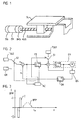
- Fig. 1 shows an example of a possible drive assembly in which an electric motor EM with a rotary encoder DG and other mechanical assemblies such as an assembly BKG that is coupled Brake, a clutch and a transmission for the electric motor EM include can. It is not absolutely necessary that the assembly BKG all realized three functions.
- the generated by the electric motor EM Rotary motion is transmitted to a KUS ball screw Carriage SL forwarded on which a workpiece can be clamped so that these two assemblies also belong to the drive assembly.
- Fig. 2 shows a possible control loop for speed control of the electric motor EM.
- the electric motor EM has an upstream current regulator on, but which is not important for the present invention.
- the actual speed ni of the electric motor EM is differentiated by time Position values of an encoder DG determined in a differentiator DR and with a negative sign in an adder to the predetermined target speed ns, which represents the reference variable, is added.
- the control deviation ns-ni is controlled by a controller PI, which in particular a proportional and integral branch (P and I branch) with the corresponding one P and I control characteristics, the gains separately are adjustable, fed to the electric motor EM.
- PI which in particular a proportional and integral branch (P and I branch) with the corresponding one P and I control characteristics, the gains separately are adjustable, fed to the electric motor EM.
- the controller PI inputs around the one set in the P branch Gain amplified input signal and one around that in the I branch set gain amplified sum of input signals that during of a certain duration.
- the present controller PI points essentially such a PI characteristic, but there is Possibility that the controller PI also has other characteristics.
- switches S1 and S2 and two test signal generators are according to the invention TSG1 and TSG2 provided.
- S1 becomes a test signal generator TSG1 connected to an adder, which is the sum of the output signals of the controller PI and the test signal generator TSG1 the Electric motor EM feeds.
- the output signal can be used as a reference variable through 82 of the test signal generator TSG2 can be selected.
- one Analysis unit AE is provided, the input signal of the controller PI and the output signal of the differentiator via a tap not shown in FIG. 2 DR is fed and which is both a computing unit as well a control unit for controlling the switches S1 and S2 and the test signal generators TSG1 and TSG2 included.
- the computing unit of the analysis unit AE performs the sampling and quantification of the input signal during short measuring intervals of the controller PI and the output signal of the differentiator DR as well as their evaluation and the determination of the different error functions by.
- the first step is to determine the optimal reinforcements in the P branch of the controller PI does not use the reference variable set speed ns Position control loop LR specified, as in conventional operation, but it becomes a constant value, in particular via a second switch S2 Zero is specified as the target speed ns.
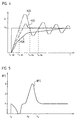
- a first Switch S1 the signal of a first test signal generator TSG 1 to the control loop fed to the controller PI. This will make the electric motor EM current impulses specified, which the maximum permissible current for Do not exceed the electric motor EM and any current limiting circuit is not activated. This current is for very short Predefined time, for example the duration of a time constant of the control loop, so that a current pulse is output to the electric motor EM becomes, as shown in Fig. 3 from the time to. Following the 3 is a possible evaluation function BFP for the actual speed ni that after the current pulse through the control loop in the electric motor EM is shown.
- the electric motor Before the current pulse is output, the electric motor is in the Standstill. Since the tendency to oscillate from standstill is greater than in Operation, it ensures that the stability in the most unstable condition of the electric motor EM is determined.
- the speed of the electric motor EM is sampled and quantized during a short measuring time tm. If the oscillation is not desired, the actual speed ni has an undamped or only weakly damped curve. If there is no oscillation, the actual speed ni decreases rapidly, since meanwhile the first test signal generator TSG1 has set the target speed ns to zero, or it is separated from the control circuit via switch S1. If, according to formula (1), the ratio V is calculated from samples of the actual speed ni multiplied by an evaluation function BFP to unweighted samples of the actual speed ni, then there is no oscillation if the ratio V ⁇ 1.
- the selected evaluation function BFP it is only necessary to ensure that that they have a value close to zero at the beginning of the measuring interval should and the quotient of the sum of the evaluation factors of the evaluation function BFP a result through the number of evaluation factors must have of one. Otherwise, the BFP evaluation function can largely can be chosen arbitrarily.
- This first step is first for a small gain in the P branch of the controller, so that oscillation is not possible.
- the I branch is deactivated during the measurement by increasing its gain very small values or zero is set. After that, the reinforcement increased only in the P branch until the ratio V is almost the same Has reached value 1. Then the value of the gain determined in this way for the P branch with a factor less than 1, for example with the Factor 0.45 according to Ziegler and Nichols, multiplied and in the P branch of the PI controller set. This ensures that through the P branch no oscillation of the electric motor EM and the connected ones mechanical components can be caused.
- the control loop In a second step to determine the controller parameters, the control loop a target speed ns to determine the gain in the I branch predefined by a second test signal generator TSG 2, which according to a Jump function runs.
- the test signal generator TSG 2 is used Switch S2 connected to the input of the control loop.
- the target speed jump is calculated so that the electric motor EM is not overloaded and there is no limitation of the current. It is during a short jump interval sampled the step response of the electric motor EM and quantized.
- an error function F is calculated according to formula (2), which consists of the sum of the speeds that are above the target speed ns and the square of the sum of the speeds that are below the target speed ns.
- the transient response of the control loop is evaluated over time by an evaluation function BFI.
- an evaluation function BFI is used for weighting in formula (2) the deviations from the speed.
- the summands are multiplied by a coefficient bfi.
- Fig. 4 shows different courses of the actual speed ni. From the second test signal generator TSG 2 becomes the reference speed as the reference variable at time to ns spent. If the amplification in the I branch of the Controller PI, the speed will run according to the curve KIG and many have large overshoots and undershoots around the target speed ns. In to If there is little gain in the I branch, the speed will run according to the curve KIK and only slowly approach the target speed ns. At approximately optimal gain in the I branch of the controller PI shows the actual speed ni an almost optimal course according to the curve KIO on and reached the target speed ns as quickly as possible without reverberation.
- the specified Time points ta, te and tu refer to the curve KIG.
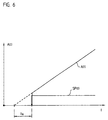
- the reset time tn of the controller PI which is defined in accordance with FIG. 6, is also taken into account according to the invention.
- 6 shows the controller output signal A (t) with an open control loop when the controller PI is excited with a step function Sp (t).
- the reset time tn clearly results from the time between the point in time at which the controller output signal A (t) is not equal to zero and the point in time at which the increase in the slope of the controller output signal A (t) is zero.
- the reset time tn is calculated from the quotient of the gain factor in the P branch by the gain factor in the I branch of the controller PI.
- the coefficients bfi (i) of the evaluation function BFI are multiplied by the reset time tn.
- the calculation of the reset time tn and the coefficients bfi (i) of the evaluation function BFI is carried out iteratively until an optimal gain for the I branch has been determined.
- bfi New ( i ) bfi old ( i ) * t p n
- the excitation signals for the test signal generator TSG 1 the electric motor EM can in such an advantageous embodiment be trained that immediately after the pulse-shaped specification a speed that triggers a current pulse I, an identical excitation signal is specified with a negative sign, as shown in Fig. 3.
- the additional negative pulse-shaped speed specification leads to Freeing up the drive assembly for significantly improved results. This results from the fact that due to the elastic mechanical Coupling of the electric motor EM with the other assemblies of the drive assembly a rotational angle-dependent force on the rotor of the electric motor EM can be exercised. By striking with positive and negative current pulses, the rotor of the electric motor EM moves in a force-free position, in both positive and negative directions of rotation can lie.
- test signal generator is used for the step-by-step speed setting TSG2 immediately after the first excitation signal an additional excitation signal of the same amount but with a negative sign spent.
- Such an addition to the pulse and jump-shaped Excitation signals has the advantage that during the determination the reinforcements in the P and I branches of the rotor of the electric motor EM again has the same starting position. This will make one in normal Operation of superimposed position controller not stimulated to control.
- the gain in the I branch also increases for the reverse direction of rotation determine and the gain to be set for the I branch based on the to determine both values of the error function FF. This is particularly the case with Electric motors EM advantageous, the load of which depends on the direction of rotation, such as motors for vertical axes.
Landscapes
- Engineering & Computer Science (AREA)
- Health & Medical Sciences (AREA)
- Artificial Intelligence (AREA)
- Computer Vision & Pattern Recognition (AREA)
- Evolutionary Computation (AREA)
- Medical Informatics (AREA)
- Software Systems (AREA)
- Physics & Mathematics (AREA)
- General Physics & Mathematics (AREA)
- Automation & Control Theory (AREA)
- Control Of Electric Motors In General (AREA)
- Feedback Control In General (AREA)
Abstract
Description
- Fig. 1:
- eine elektromechanische Antriebsbaugruppe,
- Fig. 2:
- ein Blockschaltbild einer Drehzahlregelung für einen Elektromotor,
- Fig. 3
- ein Testsignal zur Bestimmung der Verstärkung des P-Anteils des Drehzahlreglers und eine Bewertungsfunktion zur Beurteilung dessen Stabilität,
- Fig. 4
- ein Soll-Drehzahlverlauf und mögliche Ist-Drehzahlverläufe für unterschiedliche Verstärkungen des I-Anteils,
- Fig. 5
- eine Bewertungsfunktion zur Beurteilung der Stabilität des I-Anteils des Drehzahlreglers und
- Fig. 6
- die Definition der Nachstellzeit tn bei einem PI-Regler.


Claims (18)
- Verfahren zur Ermittlung einer optimalen Verstärkung des Integrators einer Drehzahlregelung für einen Elektromotor (EM) einer Antriebsbaugruppe, bei dem Parameter in Zweigen unterschiedlicher Regelcharakteristik, welche einen Regler (PI) eines Regelkreises für den Elektromotor (EM) bilden, bestimmt werden und wobei der Regelkreis durch Testsignale angeregt wird, welche derart gewählt werden, daß nur ein einzelner oder mehrere spezielle Zweige des Reglers (PI) angeregt werden und anschließend die Parameter so lange verändert werden, bis der Regelkreis ein optimales Regelverhalten aufweist und die derart für einen oder mehrere Zweige des Reglers (PI) ermittelten Parameter im entsprechenden Zweig des Reglers (PI) eingestellt werden, dadurch gekennzeichnet, daß zur Bestimmung einer optimalen Verstärkung zumindest im Integralzweig des Reglers (PI) eine Bewertungsfunktion (BFI) auf die Differenz zwischen Solldrehzahl (ns) und Istdrehzahl (ni, nj) angewendet wird, in die auch die Nachstellzeit (tn) des Regelkreises eingeht.
- Verfahren nach Anspruch 1, dadurch gekennzeichnet,daß in einem ersten Schritt zur Einstellung einer Verstärkung im Proportional-Zweig des Reglers (PI) dem Elektromotor (EM) ein erstes Testsignal zugeleitet wird,daß der zeitliche Verlauf der Ist-Drehzahl (ni) des Elektromotors (EM) in einem Meßintervall ermittelt und durch eine erste Bewertungsfunktion (BFP) bewertet wird,daß die Verstärkung im Proportional-Zweig des Reglers (PI), ausgehend von einer geringen Verstärkung im Proportional- und Integral-Zweig des Reglers (PI), so lange erhöht wird, bis aufgrund der Bewertung mit der Bewertungsfunktion (BFP) eine beginnende Oszillation des Regelkreises detektiert wird,daß die im Proportional-Zweig des Reglers (PI) bei beginnender Oszillation eingestellte Verstärkung mit einem Faktor kleiner eins multipliziert und im Proportional-Zweig des Reglers (PI) eingestellt wird,daß in einem zweiten Schritt zur Einstellung der Verstärkung im Integral-Zweig des Reglers (PI) ein zweites Testsignal dem Regelkreis als Führungsgröße zugeleitet wird,daß der zeitliche Verlauf der Ist-Drehzahl (ni) des Elektromotors (EM) in einem Meßintervall ermittelt, durch eine zweite Bewertungsfunktion (BFI), in die auch die Nachstellzeit (tn) eingeht, bewertet wird und aufgrund einer Fehlerfunktion (FF) ein Abweichen von der Soll-Drehzahl (ns) im Meßintervall quantifiziert wird,daß die Verstärkung im Integral-Zweig des Reglers (PI) ausgehend von einer großen Verstärkung, bei der eine Oszillation vorliegt, so lange verringert wird, bis ein Minimum der Fehlerfunktion (FF) vorliegt, und diese Verstärkung eingestellt wird.
- Verfahren nach Anspruch 2, dadurch gekennzeichnet, daß die Verstärkung im Integral-Zweig des Reglers (PI) so lange erhöht wird, bis der Wert der Fehlerfunktion (FF) sich um einen bestimmten Prozentsatz erhöht hat und daß diese Verstärkung eingestellt wird.
- Verfahren nach einem der Ansprüche 1 bis 3, dadurch gekennzeichnet, daß als erstes Testsignal ein Stromimpuls benutzt wird.
- Verfahren nach einem der Ansprüche 1 bis 3, dadurch gekennzeichnet, daß als erstes Testsignal zwei unmittelbar aufeinanderfolgende Stromimpulse benutzt werden, die gleichen Betrag aber unterschiedliche Polarität aufweisen.
- Verfahren nach einem der Ansprüche 4 oder 5, dadurch gekennzeichnet, daß die Amplitude der Stromimpulse auf die für den Elektromotor maximal zulässige Stromstärke oder auf eine Stromstärke, bei der eine eventuell vorhandene Strombegrenzung einsetzt, begrenzt werden.
- Verfahren nach Anspruch 2, dadurch gekennzeichnet, daß die erste Bewertungsfunktion (BFP) am Anfang des Meßintervalls einen Wert nahe Null aufweist und der Quotient aus der Summe der Bewertungsfaktoren der ersten Bewertungsfunktion (BFP) und der Anzahl der Bewertungsfaktoren den Wert Eins aufweist.
- Verfahren nach einem der Ansprüche 2 bis 7, dadurch gekennzeichnet, daß die Koeffizienten (bfi(i)) der Bewertungsfunktion (BFI) mit der Nachstellzeit (tn) multipliziert werden.
- Verfahren nach Anspruch 2 oder 8, dadurch gekennzeichnet, daß das Verhältnis (V) des mit der ersten Bewertungsfunktion (BFP) bewerteten Drehzahlverlaufs zu dem unbewerteten Drehzahlverlauf ermittelt wird und bei einem Verhältnis kleiner eins keine Oszillation detektiert wird.
- Verfahren nach Anspruch 2, dadurch gekennzeichnet, daß die im Proportional-Zweig des Reglers (PI) bei beginnender Oszillation eingestellte Verstärkung mit einem Faktor im Bereich von 0,45 multipliziert wird.
- Verfahren nach Anspruch 1 oder 2, dadurch gekennzeichnet, daß als zweites Testsignal eine Sprungfunktion benutzt wird.
- Verfahren nach Anspruch 11, dadurch gekennzeichnet, daß die Sprunghöhe der Sprungfunktion aufgrund der im Proportional-Zweig eingestellten Verstärkung und der für den Elektromotor (EM) maximal zulässigen Stromstärke berechnet wird.
- Verfahren Anspruch 11 oder 12, dadurch gekennzeichnet, daß als zweites Testsignal zwei Sprungfunktionen benutzt werden, wobei die zweite Sprungfunktion zeitlich unmittelbar an die erste Sprungfunktion anschließt, die gleiche Sprunghöhe aber unterschiedliches Vorzeichen aufweist.
- Schaltungsanordnung zur Durchführung eines Verfahrens nach Anspruch 1, welche einen Drehzahlregelkreis bestehend aus einem Elektromotor (EM) mit integriertem Stromregler, einem Drehgeber (DG), einem Differenzierer DR, welcher die Ist-Drehzahl (ni) ausgibt, einem Addierer, welcher das invertierte Ausgangssignal des Differenzierers DR zur vorgegebenen Führungsgröße Soll-Drehzahl (ns) addiert und mit einem Regler (PI), welcher aufgrund der Summe von Soll-Drehzahl (ns) und invertierter Ist-Drehzahl (ni) den Motorstrom regelt, dadurch gekennzeichnet, daß ein zweiter Schalter (S2) vorgesehen ist, durch den die Führungsgröße des Regelkreises ausgewählt wird, daß ein zweiter Testsignalgenerator (TSG2) vorgesehen ist, welcher durch den Schalter (S2) ausgewählt wird, daß zwischen Regler (PI) und Elektromotor (EM) ein Addierer vorgesehen ist, dessen einer Eingang über einen ersten Schalter (S1) mit einem ersten Testsignalgenerator (TSG1) verbunden ist und daß Abgriffe des Eingangssignals des Reglers (PI) und des Ausgangssignals des Differenzierers (DR) vorgesehen sind, die eine Verbindung zu einer Analyseeinheit (AE) herstellen.
- Schaltungsanordnung nach Anspruch 14, dadurch gekennzeichnet, daß die Analyseeinheit (AE) eine Steuereinrichtung zur Steuerung des ersten und zweiten Schalters (S1, S2) und des ersten und zweiten Testsignalgenerators (TSG1, TSG2) beinhaltet und daß die Analyseeinheit (AE) mit dem Regler (PI) zur Veränderung von Reglerparametern verbunden ist.
- Schaltungsanordnung nach Anspruch 14 oder 15, dadurch gekennzeichnet, daß die Analyseeinheit (AE) eine Recheneinheit, eine Steuereinheit und eine Speichereinheit beinhaltet.
- Schaltungsanordnung nach einem der Ansprüche 14 bis 16, dadurch gekennzeichnet, daß die verwendeten Baugruppen digital realisiert werden.
- Werkzeugmaschine nach einem der Ansprüche 14 bis 17, dadurch gekennzeichnet, daß die erfindungsgemäße Schaltungsanordnung verwendet wird zur Drehzahlregelung der Achsenantriebe und/oder der Spindelantriebe.
Applications Claiming Priority (2)
| Application Number | Priority Date | Filing Date | Title |
|---|---|---|---|
| DE19854750A DE19854750A1 (de) | 1998-11-27 | 1998-11-27 | Verfahren und Schaltungsanordnung zur Ermittlung einer optimalen Verstärkung des Integrators eines Drehzahlreglers |
| DE19854750 | 1998-11-27 |
Publications (3)
| Publication Number | Publication Date |
|---|---|
| EP1005147A2 true EP1005147A2 (de) | 2000-05-31 |
| EP1005147A3 EP1005147A3 (de) | 2002-01-09 |
| EP1005147B1 EP1005147B1 (de) | 2011-03-02 |
Family
ID=7889210
Family Applications (1)
| Application Number | Title | Priority Date | Filing Date |
|---|---|---|---|
| EP99122197A Expired - Lifetime EP1005147B1 (de) | 1998-11-27 | 1999-11-06 | Verfahren und Schaltungsanordnung zur Ermittlung einer optimalen Verstärkung des Integrators eines Drehzahlreglers |
Country Status (3)
| Country | Link |
|---|---|
| US (1) | US6236182B1 (de) |
| EP (1) | EP1005147B1 (de) |
| DE (2) | DE19854750A1 (de) |
Cited By (1)
| Publication number | Priority date | Publication date | Assignee | Title |
|---|---|---|---|---|
| WO2020104118A1 (de) * | 2018-11-21 | 2020-05-28 | Ebm-Papst Landshut Gmbh | Drehzahladaptionsregelung |
Families Citing this family (9)
| Publication number | Priority date | Publication date | Assignee | Title |
|---|---|---|---|---|
| US6912426B1 (en) * | 1999-09-24 | 2005-06-28 | Dr. Johannes Heidenhain Gmbh | Method for determining time constants of a reference model in a cascade controlling circuit |
| JPWO2004008624A1 (ja) * | 2002-07-11 | 2005-11-17 | 株式会社安川電機 | サーボ制御装置のゲイン調整方法 |
| JP2008029177A (ja) * | 2006-07-25 | 2008-02-07 | Ricoh Co Ltd | 半導体装置 |
| US8299744B2 (en) * | 2009-02-09 | 2012-10-30 | Analog Devices, Inc. | Control techniques for motor driven systems |
| US8766565B2 (en) * | 2009-02-09 | 2014-07-01 | Analog Devices, Inc. | Control techniques for motor driven systems |
| EP2216899B1 (de) * | 2009-02-09 | 2017-11-08 | Analog Devices, Inc. | Steuerungsverfahren für motorbetriebene Systeme |
| US8228017B2 (en) | 2009-02-09 | 2012-07-24 | Analog Devices, Inc. | Control techniques for motor driven systems |
| EP2372312B1 (de) * | 2010-03-31 | 2013-11-20 | SICK STEGMANN GmbH | Feedback-Anordnung und Feedback-Verfahren zur Regelung eines Servomotors |
| CN115202193B (zh) * | 2022-08-03 | 2024-07-09 | 中国航空工业集团公司沈阳飞机设计研究所 | 一种数字积分器限幅重置实现方法及装置 |
Citations (4)
| Publication number | Priority date | Publication date | Assignee | Title |
|---|---|---|---|---|
| US5157597A (en) | 1988-12-23 | 1992-10-20 | Fanuc Ltd. | Method of detecting oscillation of a servo system and automatically adjusting speed loop gain thereof |
| US5475291A (en) | 1992-12-10 | 1995-12-12 | Matsushita Electric Industrial Co., Ltd. | Adjustment device for adjusting control parameters of a servo motor and an adjustment method therefor |
| US5587896A (en) | 1990-07-16 | 1996-12-24 | The Foxboro Company | Self-tuning controller |
| DE19734208A1 (de) | 1997-08-07 | 1999-02-11 | Heidenhain Gmbh Dr Johannes | Verfahren und Schaltungsanordnung zur Ermittlung optimaler Reglerparamter für eine Drehzahlregelung |
Family Cites Families (15)
| Publication number | Priority date | Publication date | Assignee | Title |
|---|---|---|---|---|
| US4109190A (en) * | 1976-12-30 | 1978-08-22 | General Electric Company | Circuit for increasing the operating speed range of a velocity servo system |
| SE427508B (sv) * | 1981-08-24 | 1983-04-11 | Naf Ab | Forfarande for instellning av en pid-regulator for en process |
| US4733149A (en) * | 1985-05-31 | 1988-03-22 | Kollmorgen Technologies Corporation | Adaptive control system |
| JPS6266301A (ja) * | 1985-09-18 | 1987-03-25 | Yamatake Honeywell Co Ltd | オ−トチユ−ニングコントロ−ラ |
| JP2514669B2 (ja) * | 1987-10-14 | 1996-07-10 | ファナック株式会社 | サ―ボモ―タの制御方式 |
| US5063335A (en) * | 1990-09-11 | 1991-11-05 | Allen-Bradley Company, Inc. | Two-input control with independent proportional and integral gains for velocity error and velocity feedforward including velocity command limiting |
| JPH04145886A (ja) * | 1990-10-02 | 1992-05-19 | Toshiba Corp | 電動機の速度制御装置 |
| US5223778A (en) * | 1992-09-16 | 1993-06-29 | Allen-Bradley Company, Inc. | Automatic tuning apparatus for PID controllers |
| JPH06113578A (ja) * | 1992-09-30 | 1994-04-22 | Fuji Electric Co Ltd | 電動機の速度制御方法 |
| JP3127688B2 (ja) * | 1993-12-03 | 2001-01-29 | トヨタ自動車株式会社 | フィードバックゲイン決定方法 |
| US5684375A (en) * | 1995-06-20 | 1997-11-04 | Allen-Bradley Company, Inc. | Method and apparatus for tuning a motion control system |
| JP3509413B2 (ja) * | 1995-10-30 | 2004-03-22 | 株式会社デンソー | モータ制御装置 |
| DE19617867A1 (de) * | 1996-04-24 | 1997-11-06 | Cegelec Aeg Anlagen Und Antrie | Hochdynamischer, überschwingfreier Drehzahlregler |
| JP3291224B2 (ja) * | 1997-06-30 | 2002-06-10 | オークマ株式会社 | 速度制御装置 |
| DE19748993A1 (de) * | 1997-11-06 | 1999-05-12 | Bosch Gmbh Robert | Verfahren und Vorrichtung zur Steuerung eines Stellelements |
-
1998
- 1998-11-27 DE DE19854750A patent/DE19854750A1/de not_active Withdrawn
-
1999
- 1999-11-06 DE DE59915252T patent/DE59915252D1/de not_active Expired - Lifetime
- 1999-11-06 EP EP99122197A patent/EP1005147B1/de not_active Expired - Lifetime
- 1999-11-29 US US09/451,203 patent/US6236182B1/en not_active Expired - Fee Related
Patent Citations (4)
| Publication number | Priority date | Publication date | Assignee | Title |
|---|---|---|---|---|
| US5157597A (en) | 1988-12-23 | 1992-10-20 | Fanuc Ltd. | Method of detecting oscillation of a servo system and automatically adjusting speed loop gain thereof |
| US5587896A (en) | 1990-07-16 | 1996-12-24 | The Foxboro Company | Self-tuning controller |
| US5475291A (en) | 1992-12-10 | 1995-12-12 | Matsushita Electric Industrial Co., Ltd. | Adjustment device for adjusting control parameters of a servo motor and an adjustment method therefor |
| DE19734208A1 (de) | 1997-08-07 | 1999-02-11 | Heidenhain Gmbh Dr Johannes | Verfahren und Schaltungsanordnung zur Ermittlung optimaler Reglerparamter für eine Drehzahlregelung |
Cited By (1)
| Publication number | Priority date | Publication date | Assignee | Title |
|---|---|---|---|---|
| WO2020104118A1 (de) * | 2018-11-21 | 2020-05-28 | Ebm-Papst Landshut Gmbh | Drehzahladaptionsregelung |
Also Published As
| Publication number | Publication date |
|---|---|
| US6236182B1 (en) | 2001-05-22 |
| DE19854750A1 (de) | 2000-05-31 |
| EP1005147B1 (de) | 2011-03-02 |
| DE59915252D1 (de) | 2011-04-14 |
| EP1005147A3 (de) | 2002-01-09 |
Similar Documents
| Publication | Publication Date | Title |
|---|---|---|
| EP0896263B1 (de) | Verfahren und Schaltungsanordnung zur Ermittlung optimaler Reglerparameter für eine Drehzahlregelung | |
| DE102009058443B4 (de) | Trägheitsschätzsteuerungseinrichtung und Steuerungssystem | |
| DE102010036500B4 (de) | Steuervorrichtung für einen Elektromotor mit einer Funktion zum zeitgleichen Bestimmen von Trägheit und Reibung | |
| DE60110673T2 (de) | Servosteuerung | |
| DE19643909B4 (de) | Motorsteuervorrichtung | |
| DE69027648T2 (de) | Anordnung zur regelung eines servomotors | |
| DE3134002C2 (de) | Vorrichtung zur Steuerung der Drehzahl eines Induktionsmotors | |
| DE102010012424A1 (de) | Servo-Steuergerät mit zweifacher Stellungsrückkopplung | |
| DE102004064143B3 (de) | Scanner-System | |
| DE1463038C3 (de) | Steuerungsvorrichtung für spanabhebende Werkzeugmaschinen mit drehbarer Werkzeug- bzw. Werkstückspindel | |
| DE102016007404A1 (de) | Servosteuervorrichtung mit Funktion zur Online-Optimierung der Regelungsverstärkung unter Verwendung einer Bewertungsfunktion | |
| DE102009038155B4 (de) | Servomotorsteuergerät | |
| EP1005147B1 (de) | Verfahren und Schaltungsanordnung zur Ermittlung einer optimalen Verstärkung des Integrators eines Drehzahlreglers | |
| EP1388732A1 (de) | Verfahren zur Bestimmung des Massenträgheitsmomentes eines elektromotorischen Antriebssystems | |
| EP0520233B1 (de) | Einrichtung zur Identifikation einer Übertragungsstrecke | |
| EP1118043B1 (de) | Verfahren und schaltungsanordnung zur automatischen parametrierung eines schnellen digitalen drehzahlregelkreises | |
| WO2000002103A1 (de) | Verfahren zum betreiben einer regelungseinrichtung und vorrichtung zur durchführung des verfahrens | |
| DE3504889A1 (de) | Vorrichtung und verfahren zum regeln von synchronantriebseinrichtungen | |
| DE3143512C2 (de) | Regelsystem für Magnetschwebefahrzeuge | |
| EP1229411B1 (de) | Steuerungsverfahren sowie Regelungsstruktur zur Bewegungsführung, Vorsteuerung und Feininterpolation von Objekten in einem Drehzahlreglertakt, der schneller als der Lagereglertakt ist | |
| DE602006000731T2 (de) | Autoadaptives Einstellungsgerät zur Positionssteuerung von Aktuatoren in einem Antriebssystem mittels Gleitmodusverfahren und entsprechendes Betriebsverfahren | |
| DE2805989C2 (de) | Selbsttätige Steuerung für den Schaltmotor von elektromechanischen, selbsteinspielenden Waagen | |
| DE10340400B4 (de) | Verfahren und Vorrichtung zur Dämpfung von niederfrequenten Lastschwingungen bei einem geregelten Antrieb | |
| DE2528313C2 (de) | Verfahren zur schrittregelung mit einem dreipunktschalter mit einstellbarer totzonenbreite | |
| DE2914732C2 (de) | Verfahren zur strukturoptimalen Regleranpassung stochastisch gestörter elektrischer Regelkreise |
Legal Events
| Date | Code | Title | Description |
|---|---|---|---|
| PUAI | Public reference made under article 153(3) epc to a published international application that has entered the european phase |
Free format text: ORIGINAL CODE: 0009012 |
|
| AK | Designated contracting states |
Kind code of ref document: A2 Designated state(s): AT BE CH CY DE DK ES FI FR GB GR IE IT LI LU MC NL PT SE Kind code of ref document: A2 Designated state(s): CH DE FR GB IT LI |
|
| AX | Request for extension of the european patent |
Free format text: AL;LT;LV;MK;RO;SI |
|
| PUAL | Search report despatched |
Free format text: ORIGINAL CODE: 0009013 |
|
| AK | Designated contracting states |
Kind code of ref document: A3 Designated state(s): AT BE CH CY DE DK ES FI FR GB GR IE IT LI LU MC NL PT SE |
|
| AX | Request for extension of the european patent |
Free format text: AL;LT;LV;MK;RO;SI |
|
| 17P | Request for examination filed |
Effective date: 20020709 |
|
| AKX | Designation fees paid |
Free format text: CH DE FR GB IT LI |
|
| 17Q | First examination report despatched |
Effective date: 20071112 |
|
| RIC1 | Information provided on ipc code assigned before grant |
Ipc: G05B 13/02 20060101ALI20100930BHEP Ipc: H02P 7/28 20060101AFI20100930BHEP |
|
| GRAP | Despatch of communication of intention to grant a patent |
Free format text: ORIGINAL CODE: EPIDOSNIGR1 |
|
| GRAS | Grant fee paid |
Free format text: ORIGINAL CODE: EPIDOSNIGR3 |
|
| GRAA | (expected) grant |
Free format text: ORIGINAL CODE: 0009210 |
|
| AK | Designated contracting states |
Kind code of ref document: B1 Designated state(s): CH DE FR GB IT LI |
|
| REG | Reference to a national code |
Ref country code: GB Ref legal event code: FG4D Free format text: NOT ENGLISH |
|
| REG | Reference to a national code |
Ref country code: CH Ref legal event code: EP |
|
| REF | Corresponds to: |
Ref document number: 59915252 Country of ref document: DE Date of ref document: 20110414 Kind code of ref document: P |
|
| REG | Reference to a national code |
Ref country code: DE Ref legal event code: R096 Ref document number: 59915252 Country of ref document: DE Effective date: 20110414 |
|
| PLBE | No opposition filed within time limit |
Free format text: ORIGINAL CODE: 0009261 |
|
| STAA | Information on the status of an ep patent application or granted ep patent |
Free format text: STATUS: NO OPPOSITION FILED WITHIN TIME LIMIT |
|
| 26N | No opposition filed |
Effective date: 20111205 |
|
| REG | Reference to a national code |
Ref country code: DE Ref legal event code: R097 Ref document number: 59915252 Country of ref document: DE Effective date: 20111205 |
|
| PG25 | Lapsed in a contracting state [announced via postgrant information from national office to epo] |
Ref country code: IT Free format text: LAPSE BECAUSE OF FAILURE TO SUBMIT A TRANSLATION OF THE DESCRIPTION OR TO PAY THE FEE WITHIN THE PRESCRIBED TIME-LIMIT Effective date: 20110302 |
|
| REG | Reference to a national code |
Ref country code: CH Ref legal event code: PL |
|
| GBPC | Gb: european patent ceased through non-payment of renewal fee |
Effective date: 20111106 |
|
| PG25 | Lapsed in a contracting state [announced via postgrant information from national office to epo] |
Ref country code: LI Free format text: LAPSE BECAUSE OF NON-PAYMENT OF DUE FEES Effective date: 20111130 Ref country code: CH Free format text: LAPSE BECAUSE OF NON-PAYMENT OF DUE FEES Effective date: 20111130 |
|
| REG | Reference to a national code |
Ref country code: FR Ref legal event code: ST Effective date: 20120731 |
|
| PG25 | Lapsed in a contracting state [announced via postgrant information from national office to epo] |
Ref country code: GB Free format text: LAPSE BECAUSE OF NON-PAYMENT OF DUE FEES Effective date: 20111106 |
|
| PG25 | Lapsed in a contracting state [announced via postgrant information from national office to epo] |
Ref country code: FR Free format text: LAPSE BECAUSE OF NON-PAYMENT OF DUE FEES Effective date: 20111130 |
|
| PGFP | Annual fee paid to national office [announced via postgrant information from national office to epo] |
Ref country code: DE Payment date: 20161121 Year of fee payment: 18 |
|
| REG | Reference to a national code |
Ref country code: DE Ref legal event code: R119 Ref document number: 59915252 Country of ref document: DE |
|
| PG25 | Lapsed in a contracting state [announced via postgrant information from national office to epo] |
Ref country code: DE Free format text: LAPSE BECAUSE OF NON-PAYMENT OF DUE FEES Effective date: 20180602 |