EP1005180B1 - Verfahren und Gerät zur drahtlosen Kommunikation mit Code Verschachtelung duplex Übertragung und CDMA mit Zeitschlitzen - Google Patents
Verfahren und Gerät zur drahtlosen Kommunikation mit Code Verschachtelung duplex Übertragung und CDMA mit Zeitschlitzen Download PDFInfo
- Publication number
- EP1005180B1 EP1005180B1 EP99309123A EP99309123A EP1005180B1 EP 1005180 B1 EP1005180 B1 EP 1005180B1 EP 99309123 A EP99309123 A EP 99309123A EP 99309123 A EP99309123 A EP 99309123A EP 1005180 B1 EP1005180 B1 EP 1005180B1
- Authority
- EP
- European Patent Office
- Prior art keywords
- codes
- code division
- division duplex
- base station
- subscriber units
- Prior art date
- Legal status (The legal status is an assumption and is not a legal conclusion. Google has not performed a legal analysis and makes no representation as to the accuracy of the status listed.)
- Expired - Lifetime
Links
- 238000000034 method Methods 0.000 title claims description 62
- 238000000926 separation method Methods 0.000 claims description 10
- 230000007480 spreading Effects 0.000 description 12
- 238000007796 conventional method Methods 0.000 description 4
- 230000007246 mechanism Effects 0.000 description 3
- 230000008569 process Effects 0.000 description 3
- 230000001413 cellular effect Effects 0.000 description 2
- 230000000694 effects Effects 0.000 description 2
- 238000005070 sampling Methods 0.000 description 2
- 238000001228 spectrum Methods 0.000 description 2
- 230000003044 adaptive effect Effects 0.000 description 1
- 239000000969 carrier Substances 0.000 description 1
- 230000001419 dependent effect Effects 0.000 description 1
- 238000009434 installation Methods 0.000 description 1
- 230000002452 interceptive effect Effects 0.000 description 1
- 230000000116 mitigating effect Effects 0.000 description 1
Images






Classifications
-
- H—ELECTRICITY
- H04—ELECTRIC COMMUNICATION TECHNIQUE
- H04L—TRANSMISSION OF DIGITAL INFORMATION, e.g. TELEGRAPHIC COMMUNICATION
- H04L5/00—Arrangements affording multiple use of the transmission path
- H04L5/14—Two-way operation using the same type of signal, i.e. duplex
- H04L5/143—Two-way operation using the same type of signal, i.e. duplex for modulated signals
-
- H—ELECTRICITY
- H04—ELECTRIC COMMUNICATION TECHNIQUE
- H04L—TRANSMISSION OF DIGITAL INFORMATION, e.g. TELEGRAPHIC COMMUNICATION
- H04L5/00—Arrangements affording multiple use of the transmission path
- H04L5/02—Channels characterised by the type of signal
- H04L5/023—Multiplexing of multicarrier modulation signals, e.g. multi-user orthogonal frequency division multiple access [OFDMA]
Definitions
- the present invention relates generally to communication systems, and more particularly to wireless communication systems such as code division multiple access (CDMA) systems for fixed wireless loop (FWL) and other applications.
- CDMA code division multiple access
- WNL fixed wireless loop
- narrow beams of this type are susceptible to increased interference from effects such as shadowing and problematic sidelobes.
- Use of narrow beams in conjunction with a TDMA technique within a given cell can lead to catastrophic interference. For example, if beams from adjacent cells overlap, there is catastrophic interference since the signals are neither separated in frequency nor in time among the different cells, but are instead separated in the spatial domain. In a high density environment, this limitation can severely restrict capacity.
- conventional FDD techniques such as those used to separate uplink and downlink in FIG.
- the invention provides apparatus and methods for wireless communication in fixed wireless loop (FWL) and other types of systems in which, e.g., information is communicated in a given cell of the system between subscriber units and a base station over an uplink and a downlink.
- a code division duplex (CDD) time-slotted CDMA wireless communication system is provided. Communications on the uplink are separated from communications on the downlink using code division duplexing, and communications with different subscriber units in the cell are separated using a code division multiple access technique, e.g., time-slotted CDMA.
- CDD code division duplex
- the code division duplexing may be implemented by, e.g., assigning a first subset of a set of codes to the uplink and a second subset of the set of codes to the downlink.
- the code assignment process may be repeated for different time slots, such that the number of codes in the first and second subsets varies across the time slots in accordance with uplink and downlink traffic demands.
- the system may utilize electronically-steered beams generated by antennas associated with the base stations. Any particular beam at a given time may have a width sufficient to provide simultaneous coverage for at least n of the subscriber units at that time, where n is greater than or equal to two.
- the n subscriber units are assigned different codes as part of the code division multiple access technique.
- the invention provides improved performance in wireless communication systems, particularly in applications involving heterogeneous traffic, e.g., mixed voice and data traffic, and other applications in which uplink and downlink capacity requirements are subject to large fluctuations.
- the invention is particularly well suited for use in applications such as omni-beam and narrow-beam FWL systems, although it can provide similar advantages in numerous other wireless communication applications.
- the present invention will be illustrated below in conjunction with exemplary wireless communication systems and communication techniques. It should be understood, however, that the invention is not limited to use with any particular type of communication system, but is instead more generally applicable to any wireless system in which it is desirable to provide improved performance without unduly increasing system complexity. For example, it will be apparent to those skilled in the art that the techniques are applicable to omni-beam and narrow-beam fixed wireless loop (FWL) systems, CDMA systems, as well as to other types of wideband and narrowband wireless systems.
- the term "subscriber unit" as used herein is intended to include fixed terminals such as fixed wireless installations, mobile terminals such as cellular telephones and portable computers, as well as other types of system terminals.
- separating refers generally to implementing the system such that interference between, e.g., the uplink and downlink or the subscriber units, is reduced, minimized, or eliminated.
- a number of communication techniques will be described for overcoming the above-noted problems of the prior art.
- the techniques differ in terms of the manner in which uplink and downlink portions of the system are separated, and/or the manner in which users are separated within a given cell.
- conventional techniques generally separate uplink and downlink portions of the system using frequency, e.g., FDD as shown in FIG. 7 , and separate users within a given cell using, e.g., time slots as shown in FIG. 7 or codes.
- code division duplex (CDD) time-slotted CDMA uplink and downlink portions of the system are separated using codes, while the users are also separated using codes.
- time division duplex (TDD) time-slotted CDMA uplink and downlink portions of the system are separated using time slots, while the users are separated using codes.
- OFDM orthogonal frequency division multiplexing
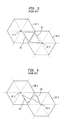
- FIG. 8 shows a single cell 80-1 of a wireless system.
- the cell includes a base station 82-1 and a number of subscriber units 84.
- a single antenna beam 86 generated by the base station 82-1 is directed to several subscriber units, i.e., five subscriber units in this example.
- the beam 86 is approximately 40° wide, such that there will be a total of nine beams generated in each cell.
- the additional beams are omitted from FIG. 8 for clarity of illustration. It is also assumed that the beams in the cell 80-1 and the other cells of the corresponding system are electronically steerable.
- the beam 8 is purposely made wider than the typical single-user narrow beam in a conventional system such as system 30 of FIG. 3 , in order to target more than one subscriber unit.
- the beam 86 is broader than, e.g., the beam 63 or 65 in FIG. 6 , it can be configured to span a smaller portion of its sector.
- codes i.e., assigned different codes to prevent the users in the beam 86 from interfering with one another.
- adjacent cells users are also separated by codes. Thus, when beams from adjacent cells collide, the interference will not be catastrophic since the users in adjacent cells are separated by codes.
- Standard CDMA techniques such as those described in the above-cited CDMA references, may be used to separate the users within a cell and among adjacent cells.
- the technique is "time-slotted" in that the beams are steerable, such that different beams can be activated in different time slots, and may also be referred to as “discontinuous-transmission" CDMA.
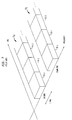
- FIG. 9 shows an exemplary CDD mechanism suitable for use in the CDD time-slotted CDMA technique of the invention.
- the CDD mechanism is implemented by using different codes for the uplink and downlink portions of the system.
- the uplink uses code N, code N-1, etc., while code 1, code 2, etc., are used for the downlink.
- the boundary 90 between the uplink codes and the downlink codes is variable, such that the capacity allocated to uplink and downlink can be adaptively altered to account for demand variations.
- the boundary 90 can vary for each time slot, or for each group of a predetermined number of time slots.
- the CDD time-slotted CDMA technique described above provides a number of advantages over conventional,techniques. For example, a system implemented using such a technique does not require an unduly narrow beam designed to target a single subscriber unit.
- uplink and downlink can be traded off by reassignment of uplink and downlink codes, and an efficient closed loop power control process can be maintained since both the uplink and downlink can be on the same frequency.
- a fixed quality of service (QoS) can be provided for a given user by utilizing the same uplink-downlink code boundary for each slot assigned to that user.
- the variable boundary makes it easier to accommodate variable rate users, e.g., through multicode or variable rate spreading, and to transmit heterogeneous traffic, e.g., voice and data traffic.
- FIG. 10 illustrates a TDD time-slotted CDMA technique in accordance with an alternate proposal.
- This technique is the same as the CDD time-slotted CDMA technique described in conjunction with FIGS. 8 and 9 , except that a different duplexing mechanism, i.e., a time division rather than code division technique, is used to separate the uplink and downlink portions of the system.
- FIG. 10 illustrates the duplexing used in the TDD time-slotted CDMA technique.
- One or more of the time slots are assigned to the downlink, while others are assigned to the uplink.
- the assignment of time slots to uplink or downlink may be varied adaptively, so as to accommodate variations in uplink and downlink traffic demands.
- the other aspects of the system are otherwise the same as in the CDD time-slotted CDMA technique, i.e., beams of the type described in FIG. 8 may be used, and users are separated within a given cell and among adjacent cells through the use of codes.
- FIG. 11 illustrates an OFDM technique in accordance with an alternate proposal.
- duplexing between the uplink and downlink portions is performed adaptively in the frequency domain, using orthogonal frequency tones, rather than the conventional FDD as described in conjunction with FIG. 7 .
- This technique allows for asymmetric uplink and downlink capacity.
- a downlink portion 102 and an uplink portion 104 are separated in frequency by a variable boundary 106.
- tones 1 through k are assigned to the uplink portion 104, while tones k +I to M are assigned to the downlink portion 102.
- this OFDM technique allows frequencies to be assigned adaptively between uplink and downlink in order to accommodate variations in demand.
- uplink and downlink portions may be separated, e.g., in the discrete Fourier transform (DFT) domain based on assignment of OFDM carriers.
- DFT discrete Fourier transform
- Users within a given beam can be separated, e.g., by using different time slots or different codes, or other suitable techniques. Users separation among different beams of a given cell may be implemented using different codes.
- frequencies or codes may be used to separate the various users.
- timing synchronization is generally required between the base station and the subscriber unit in order to maintain tone orthogonality.
- This timing synchronization can be easily achieved through a "sync" control channel transmitted by the base station to the subscriber unit.
- Frequency synchronization is also generally required between the base station and the subscriber unit. Since the subscriber unit in the illustrative embodiment is fixed, there is no frequency offset due to Doppler effects. Hence, frequency synchronization in such a system can be implemented in a straightforward manner.
- Accurate power control is also generally required between the base station and the subscriber unit. Again, since the subscriber unit is fixed, the time variation of the wireless channel is very slow, which allows for straightforward implementation of accurate power control.
- FIG. 12 shows a downlink, i.e., base-to-subscriber, transmitter 120, suitable for use with the OFDM technique of FIG. 11 .
- the transmitter 120 includes an inverse DFT (IDFT) or inverse fast Fourier transform (IFFT) element 124, a parallel-to-serial converter 126, and multipliers 128, 130 and 132.
- IDFT inverse DFT
- IFFT inverse fast Fourier transform
- the M orthogonal frequency tones are applied to the IDFT or IFFT element 124.
- the first k of the M tones which are assigned to the uplink portion 104, contain no data, e.g., all zero levels.
- Tones k +1 to M which are assigned to the downlink portion 102, contain the downlink data, e.g., +1 and -1 levels.
- the element 124 generates the inverse transform of the M applied tones, and its output is supplied to the parallel-to-serial converter 126.
- the serial output of converter 126 is supplied to multiplier 128 in which the serial output is multiplied by a user-specific spreading code.
- the multiplier 128 is shown in a dashed box to indicate that it is an optional element. It presence will depend on whether the users in a beam are separated using codes, i.e., multiplier 128 will be present if the users in a beam are separated using codes.
- the output of the multiplier 128 is then multiplied by a sector-specific spreading code in multiplier 130, and the resulting signal is modulated onto a carrier corresponding to frequency ⁇ 0 in multiplier 132.
- the output of multiplier 132 is a downlink signal which is transmitted from the base station to a subscriber unit.
- FIG. 13 shows a corresponding downlink receiver 140 which may be implemented in the subscriber unit.
- the receiver 140 demodulates the received downlink signal using multiplier 142, and the demodulated signal is low-pass filtered using integrator 144.
- the filtered signal is de-spread by multiplying it by the sector-specific spreading code in multiplier 146, and summing in a sum element 148. If necessary, i.e., if the users in a beam are separated using codes, the output of sum element 148 is multiplied by the user-specific spreading code in multiplier 150 and then summed in a sum element 152. Otherwise, the elements 150, 152 may be eliminated and the output of sum element 148 is applied directly to a serial-to-parallel converter 154.
- the parallel outputs of the converter 154 are applied to a DFT or FFT element 156, which performs a DFT or FFT operation to recover the M tones.
- the first k tones, assigned to the uplink, do not include downlink data and are therefore discarded.
- the downlink data is present on tones k +1 to M.
- FIGS. 14 and 15 show an uplink, i.e., subscriber-to-base, transmitter and an uplink receiver, respectively, for implementing the OFDM technique of FIG. 11 .
- the uplink transmitter 220 of FIG. 14 includes an IDFT or IFFT element 224, a parallel-to-serial converter 226, an optional user-specific spreading code multiplier 228, a sector-specific spreading code multiplier 230, and a multiplier 232 for modulating the downlink signal onto a carrier.
- These elements operate in substantially the same manner as the corresponding elements of the downlink transmitter 120 of FIG. 12 , but the uplink data is applied to the first k tones, while tones k +1 through M contain no data.
- the output of multiplier 232 is an uplink signal which is transmitted from a subscriber unit to a base station.
- FIG. 15 shows the corresponding uplink receiver 240 which may be implemented in a base station.
- the receiver 240 includes a demodulating multiplier 242, an integrator 244, a sector-specific spreading code multiplier 246 and associated sum element 248, an optional user-specific spreading code multiplier 250 and its associated sum element 252, a serial-to-parallel converter 254, and a DFT or FFT element 256.
- These elements operate in substantially the same manner as the corresponding elements of the downlink receiver 140 of FIG. 13 , but the uplink data is present on the first k tones, while the tones k +1 through M do not include uplink data and are discarded.
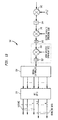
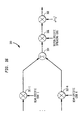
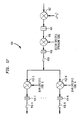
- FIGS. 16 and 17 show a multi-code CDMA transmitter 300 and a multi-code CDMA receiver 400, respectively, in accordance with the invention.
- the transmitter 300 and receiver 400 are suitable for use with, e.g., the above-described CDD time-slotted CDMA and TDD time-slotted CDMA techniques.
- N spreading codes per beam in a given sector or cell of the system.
- the outputs of the multipliers 302- i are summed in element 304, and then multiplied by a sector-specific spreading code in multiplier 306.
- the output of multiplier 306 is modulated onto a carrier corresponding to frequency ⁇ 0 in multiplier 308.
- the resulting output signal may be transmitted from a base station to one or more subscriber units.
- the multi-code CDMA receiver 400 receives an input signal which is demodulated in multiplier 402, low-pass filtered in integrator 404, and then de-spread using the sector-specific spreading code in a multiplier 406 and associated sum element 408.
- the receiver 400 may be implemented in a base station to process signals received from multiple subscriber units of the system.
- a system in accordance with the invention may include additional elements, such as, for example, mobile switching centers (MSCs) for connecting one of more of the base stations to a public switched telephone network (PSTN), and a memory for storing, e.g., user data and billing information.
- MSCs mobile switching centers
- PSTN public switched telephone network
- transmitters and receivers shown herein for purposes of illustrating the invention may be implemented in many different ways, and may include a number of additional elements, e.g., diplexers, downconverters, upconverters, signal sources, filters, demodulators, modulators, baseband signal processors, etc., configured in a conventional manner.
- additional elements e.g., diplexers, downconverters, upconverters, signal sources, filters, demodulators, modulators, baseband signal processors, etc.
Landscapes
- Engineering & Computer Science (AREA)
- Signal Processing (AREA)
- Computer Networks & Wireless Communication (AREA)
- Mobile Radio Communication Systems (AREA)
- Bidirectional Digital Transmission (AREA)
Claims (9)
- Verfahren zur Kommunikation von Information zwischen einer Basisstation und mehreren Teilnehmereinheiten, wobei das Verfahren die folgenden Schritte aufweist:Teilen mehrerer Code Division Duplex-Codes in erste und zweite Teilsätze;Zuweisen des ersten Teilsatzes der mehreren Code Division Duplex-Codes zu einer Aufwärtsverbindung zwischen den Teilnehmereinheiten und der Basisstation und des zweiten Teilsatzes der mehreren Code Division Duplex-Codes zu einer Abwärtsverbindung zwischen der Basisstation und den Teilnehmereinheiten;Empfangen von Kommunikationen in der Basisstation von einer oder von mehreren der Teilnehmereinheiten unter Verwenden des zugewiesenen ersten Teilsatzes von Code Division Duplex-Codes;Übertragen von Kommunikationen von der Basisstation zu einer oder mehreren der Teilnehmereinheiten unter Verwenden des zugewiesenen zweiten Teilsatzes von Code Division Duplex-Codes, und gekennzeichnet durchWiederholen der Schritte des Teilens, Zuweisens, Empfangens und Übertragens für aufeinander folgende Kommunikationen unter Verwenden einer unterschiedlichen Teilung der Code Division Duplex-Codes in den ersten und den zweiten Code-Teilsatz.
- Verfahren nach Anspruch 1, wobei die Basisstation und die mehreren Teilnehmereinheiten Elemente eines festen drahtlosen Schleifensystems sind.
- Verfahren nach Anspruch 1, wobei die mehreren Code Division Duplex-Codes insgesamt N Codes aufweisen, die in den ersten und den zweiten Teilsatz geteilt sind, und wobei weiterhin eine unterschiedliche Teilung von N Codes in den ersten und den zweiten Teilsatz für jeden der mehreren unterschiedlichen Sätze der aufeinander folgenden Kommunikationen verwendet wird.
- Gerät für den Gebrauch in einem Kommunikationssystem, wobei das Gerät Folgendes aufweist:eine Basisstation, die mit mehreren Teilnehmereinheiten kommunizieren kann;wobei die Basisstation konfiguriert ist, um mehrere Code Division Duplex-Codes in erste und zweite Teilsätze zu teilen und den ersten Teilsatz der mehreren Code Division Duplex-Codes einer Aufwärtsverbindung zwischen den Teilnehmereinheiten und der Basisstation zuzuweisen und den zweiten Teilsatz der mehreren Code Division Duplex-Codes einer Abwärtsverbindung zwischen der Basisstation und den Teilnehmereinheiten zuzuweisen;um Kommunikationen von einer oder von mehreren der Teilnehmereinheiten unter Verwenden des zugewiesenen ersten Teilsatzes von Code Division Duplex-Codes zu empfangen;um Kommunikationen von der Basisstation zu einer oder mehreren der Teilnehmereinheiten unter Verwenden des zugewiesenen zweiten Teilsatzes von Code Division Duplex-Codes zu übertragen, und dadurch gekennzeichnet dassdie Basisstation weiterhin konfiguriert ist, um die Vorgänge des Teilens, Zuweisens, Empfangens und Übertragens für aufeinander folgende Kommunikationen unter Verwenden einer unterschiedlichen Teilung der Code Division Duplex-Codes in den ersten und den zweiten Teilsatz von Codes zu wiederholen.
- Gerät nach Anspruch 4, wobei die Basisstation eine Basisstation eines festen drahtlosen Schleifensystems ist.
- Gerät nach Anspruch 4, wobei die mehreren Code Division Duplex-Codes insgesamt N Codes aufweisen, die in den ersten und den zweiten Teilsatz geteilt sind, und wobei weiterhin eine unterschiedliche Teilung der N Codes in den ersten und den zweiten Teilsatz für jeden von mehreren unterschiedlichen Sätze der aufeinander folgenden Kommunikationen verwendet wird.
- Kommunikationssystem umfassend:mehrere Teilnehmereinheiten, undeine Basisstation, die mit mehreren Teilnehmereinheiten kommunizieren kann;wobei die Basisstation konfiguriert ist, um mehrere Code Division Duplex-Codes in erste und zweite Teilsätze zu teilen und den ersten Teilsatz der mehreren Code Division Duplex-Codes einer Aufwärtsverbindung zwischen den Teilnehmereinheiten und der Basisstation zuzuweisen und den zweiten Teilsatz der mehreren Code Division Duplex-Codes einer Abwärtsverbindung zwischen der Basisstation und den Teilnehmereinheiten zuzuweisen;um Kommunikationen von einer oder mehreren der Teilnehmereinheiten unter Verwenden des zugewiesenen ersten Teilsatzes von Code Division Duplex-Codes zu empfangen;um Kommunikationen zu einer oder mehreren der Teilnehmereinheiten unter Verwenden des zugewiesenen zweiten Teilsatzes der Code Division Duplex-Codes zu übertragen, und dadurch gekennzeichnet, dassdie Basisstation weiterhin konfiguriert ist, um die Vorgänge des Teilens, Zuweisens, Empfangens und Übertragens für aufeinander folgende Kommunikationen unter Verwenden einer unterschiedlichen Teilung der Code Division Duplex-Codes in den ersten und den zweiten Teilsatz von Codes zu wiederholen.
- System nach Anspruch 7, wobei das System ein festes drahtloses Schleifensystem ist.
- System nach Anspruch 7, wobei die mehreren Code Division Duplex-Codes insgesamt N Codes aufweisen, die in den ersten und den zweiten Teilsatz geteilt sind und wobei weiterhin für jeden der mehreren unterschiedlichen Sätze der aufeinander folgenden Kommunikationen eine unterschiedliche Teilung der N Codes in den ersten und den zweiten Teilsatz verwendet wird.
Applications Claiming Priority (2)
| Application Number | Priority Date | Filing Date | Title |
|---|---|---|---|
| US09/200,521 US6813254B1 (en) | 1998-11-25 | 1998-11-25 | Methods and apparatus for wireless communication using code division duplex time-slotted CDMA |
| US200521 | 1998-11-25 |
Publications (3)
| Publication Number | Publication Date |
|---|---|
| EP1005180A2 EP1005180A2 (de) | 2000-05-31 |
| EP1005180A3 EP1005180A3 (de) | 2006-03-15 |
| EP1005180B1 true EP1005180B1 (de) | 2011-02-09 |
Family
ID=22742063
Family Applications (1)
| Application Number | Title | Priority Date | Filing Date |
|---|---|---|---|
| EP99309123A Expired - Lifetime EP1005180B1 (de) | 1998-11-25 | 1999-11-16 | Verfahren und Gerät zur drahtlosen Kommunikation mit Code Verschachtelung duplex Übertragung und CDMA mit Zeitschlitzen |
Country Status (5)
| Country | Link |
|---|---|
| US (1) | US6813254B1 (de) |
| EP (1) | EP1005180B1 (de) |
| JP (2) | JP2000165940A (de) |
| CA (1) | CA2286417C (de) |
| DE (1) | DE69943180D1 (de) |
Families Citing this family (13)
| Publication number | Priority date | Publication date | Assignee | Title |
|---|---|---|---|---|
| FI104135B (fi) * | 1997-06-24 | 1999-11-15 | Nokia Mobile Phones Ltd | Aikajakoiset monikäyttöradiojärjestelmät |
| EP1089512A1 (de) * | 1999-09-30 | 2001-04-04 | Sony International (Europe) GmbH | Telekommunikationseinrichtung mit analoger Fouriertransformeinheit |
| US7227850B2 (en) * | 2001-04-04 | 2007-06-05 | Telefonaktiebolaget Lm Ericsson (Publ) | Cellular radio communication system with frequency reuse |
| US20040004951A1 (en) | 2002-07-05 | 2004-01-08 | Interdigital Technology Corporation | Method for performing wireless switching |
| KR100474849B1 (ko) * | 2002-11-01 | 2005-03-11 | 삼성전자주식회사 | 어레이 안테나를 이용한 빔포밍 방법에 의한코드분할다중접속 이동통신 시스템에서 코드를 재사용하는방법 및 장치 |
| US7493133B2 (en) * | 2004-02-05 | 2009-02-17 | Qualcomm, Incorporated | Power control in ad-hoc wireless networks |
| US20060289439A1 (en) * | 2005-03-21 | 2006-12-28 | Samantha Dreimann | Food steamer with plurality of compartments |
| US7957327B2 (en) | 2005-05-18 | 2011-06-07 | Qualcomm Incorporated | Efficient support for TDD beamforming via constrained hopping and on-demand pilot |
| JP2008017341A (ja) * | 2006-07-07 | 2008-01-24 | Ntt Docomo Inc | 無線通信装置および無線通信方法 |
| CN100594689C (zh) * | 2006-09-20 | 2010-03-17 | 北京大学 | 一种码分双工的通信方法 |
| US9681455B2 (en) * | 2010-01-28 | 2017-06-13 | Alcatel Lucent | Methods for reducing interference in a communication system |
| US9086472B2 (en) * | 2012-09-26 | 2015-07-21 | Gennadii Ivtsenkov | Multi-transceiver RF alert system for preventing hunting accidents |
| KR101817014B1 (ko) * | 2015-09-18 | 2018-01-10 | 한국과학기술원 | 다중 빔 코드 분할 다중 접속 통신 방법 및 이를 수행하는 장치 |
Family Cites Families (27)
| Publication number | Priority date | Publication date | Assignee | Title |
|---|---|---|---|---|
| US5627880A (en) * | 1992-11-02 | 1997-05-06 | Motorola, Inc. | MAHO method for SFH-CDMA/TDMA using punctured frames |
| SE9203384L (sv) | 1992-11-13 | 1993-10-25 | Televerket | Förfarande och anordning för dynamisk allokering av multipla bärvågskanaler för multipelaccess genom frekvensmultiplexering |
| US5420851A (en) * | 1993-11-24 | 1995-05-30 | At&T Corp. | Method of multiple access |
| SG48266A1 (en) | 1993-12-22 | 1998-04-17 | Philips Electronics Nv | Multicarrier frequency hopping communications system |
| JPH07226978A (ja) * | 1994-02-14 | 1995-08-22 | Matsushita Electric Ind Co Ltd | 多重通信装置 |
| WO1995024086A2 (en) | 1994-02-25 | 1995-09-08 | Philips Electronics N.V. | A multiple access digital transmission system and a radio base station and a receiver for use in such a system |
| US6018528A (en) * | 1994-04-28 | 2000-01-25 | At&T Corp | System and method for optimizing spectral efficiency using time-frequency-code slicing |
| US5596333A (en) * | 1994-08-31 | 1997-01-21 | Motorola, Inc. | Method and apparatus for conveying a communication signal between a communication unit and a base site |
| US5614914A (en) | 1994-09-06 | 1997-03-25 | Interdigital Technology Corporation | Wireless telephone distribution system with time and space diversity transmission for determining receiver location |
| JP3480761B2 (ja) * | 1995-03-30 | 2003-12-22 | 株式会社東芝 | 無線通信方法 |
| US6049535A (en) * | 1996-06-27 | 2000-04-11 | Interdigital Technology Corporation | Code division multiple access (CDMA) communication system |
| GB2307621B (en) * | 1995-11-21 | 1997-12-03 | At & T Corp | Cdma air interface for radio local loop system |
| CA2216761C (en) * | 1996-11-08 | 2002-01-01 | Lucent Technologies Inc. | Tdm-based fixed wireless loop system |
| JPH10190616A (ja) * | 1996-12-20 | 1998-07-21 | Oki Electric Ind Co Ltd | ハンドオーバ制御装置 |
| EP0960544B1 (de) * | 1997-02-13 | 2004-12-15 | Nokia Corporation | Verfahren und vorrichtung zur gerichteten funkübertragung |
| US6122266A (en) * | 1997-02-19 | 2000-09-19 | Lucent Technologies Inc. | Multi-level sectorized CDMA communications |
| JP3392704B2 (ja) * | 1997-05-09 | 2003-03-31 | 株式会社東芝 | 無線通信システム及び無線基地局 |
| US6005854A (en) * | 1997-08-08 | 1999-12-21 | Cwill Telecommunication, Inc. | Synchronous wireless access protocol method and apparatus |
| US6282179B1 (en) * | 1997-10-17 | 2001-08-28 | At&T Corp. | Method and system for reducing multipath fading in bent-pipe satellite communications systems |
| US6118767A (en) * | 1997-11-19 | 2000-09-12 | Metawave Communications Corporation | Interference control for CDMA networks using a plurality of narrow antenna beams and an estimation of the number of users/remote signals present |
| US6067315A (en) * | 1997-12-04 | 2000-05-23 | Telefonaktiebolaget Lm Ericsson | Method and apparatus for coherently-averaged power estimation |
| US6208871B1 (en) * | 1998-02-27 | 2001-03-27 | Motorola, Inc. | Method and apparatus for providing a time adjustment to a wireless communication system |
| US6178333B1 (en) * | 1998-04-15 | 2001-01-23 | Metawave Communications Corporation | System and method providing delays for CDMA nulling |
| US6181276B1 (en) * | 1998-10-09 | 2001-01-30 | Metawave Communications Corporation | Sector shaping transition system and method |
| US6542485B1 (en) * | 1998-11-25 | 2003-04-01 | Lucent Technologies Inc. | Methods and apparatus for wireless communication using time division duplex time-slotted CDMA |
| US6091757A (en) * | 1998-12-03 | 2000-07-18 | Motorola, Inc. | Data transmission within a spread-spectrum communication system |
| AU2001238646A1 (en) * | 2000-02-24 | 2001-09-03 | Tantivy Communications, Inc. | Method and system for economical beam forming in a radio communication system |
-
1998
- 1998-11-25 US US09/200,521 patent/US6813254B1/en not_active Expired - Lifetime
-
1999
- 1999-10-18 CA CA002286417A patent/CA2286417C/en not_active Expired - Lifetime
- 1999-11-16 DE DE69943180T patent/DE69943180D1/de not_active Expired - Lifetime
- 1999-11-16 EP EP99309123A patent/EP1005180B1/de not_active Expired - Lifetime
- 1999-11-24 JP JP11333385A patent/JP2000165940A/ja active Pending
-
2009
- 2009-01-22 JP JP2009011705A patent/JP4598132B2/ja not_active Expired - Fee Related
Also Published As
| Publication number | Publication date |
|---|---|
| JP2000165940A (ja) | 2000-06-16 |
| CA2286417A1 (en) | 2000-05-25 |
| EP1005180A3 (de) | 2006-03-15 |
| JP2009135953A (ja) | 2009-06-18 |
| CA2286417C (en) | 2006-01-03 |
| US6813254B1 (en) | 2004-11-02 |
| EP1005180A2 (de) | 2000-05-31 |
| DE69943180D1 (de) | 2011-03-24 |
| JP4598132B2 (ja) | 2010-12-15 |
Similar Documents
| Publication | Publication Date | Title |
|---|---|---|
| CA2287022C (en) | Methods and apparatus for wireless communication using orthogonal frequency division multiplexing | |
| CA2287004C (en) | Method and apparatus for wireless communication using time division duplex time-slotted cdma | |
| JP4598132B2 (ja) | ワイアレスセルラ通信システムにおいて情報を通信する方法 | |
| AU760505B2 (en) | Orthogonal frequency division multiplexing based spread spectrum multiple access system using directional antenna | |
| CN101248608B (zh) | 多入多出-正交频分复用发送装置和多入多出-正交频分复用发送方法 | |
| JP2992670B2 (ja) | 移動体通信装置 | |
| KR100883942B1 (ko) | Ofdm 시스템의 실시간 서비스 및 비-실시간 서비스의멀티플렉싱 | |
| US6600776B1 (en) | Vertical adaptive antenna array for a discrete multitone spread spectrum communications system | |
| US6621851B1 (en) | Priority messaging method for a discrete multitone spread spectrum communications system | |
| US6782039B2 (en) | Vertical adaptive antenna array for a discrete multitone spread spectrum communications system | |
| KR100983687B1 (ko) | 다중반송파 통신 시스템에서 톤들의 할당 | |
| US6160839A (en) | Adaptive weight update method for a discrete multitone spread spectrum communications system | |
| US20050237989A1 (en) | Method of allocating subcarriers in orthogonal frequency division multiplexing (OFDM) cellular system | |
| EP1908200B1 (de) | Sdma für wcdma mit vergrösserter kapazität durch verwendung mehrerer verwürfelungscodes | |
| JP2006522503A (ja) | Ofdmセルラー環境においてセル間の干渉を低減するための副搬送波割当方法 | |
| US8116691B2 (en) | Systems and methods for improving reference signals for spatially multiplexed cellular systems | |
| US20080232486A1 (en) | Systems and methods for extending zadoff-chu sequences to a non-prime number length to minimize average correlation | |
| EP0966797B1 (de) | Sehr bandbreiteneffiziente kommunikation | |
| Dalela et al. | Beam Division Multiple Access (BDMA) and modulation formats for 5G: Heir of OFDM? | |
| US7961587B2 (en) | Systems and methods for reducing peak to average cross-correlation for sequences designed by alternating projections | |
| Lee | CS-OFDMA: A new wireless CDD physical layer scheme | |
| CN100370720C (zh) | 在通信系统中传输数据的方法和装置 | |
| Lei et al. | A multi-carrier allocation (MCA) scheme for variable rate cellular systems |
Legal Events
| Date | Code | Title | Description |
|---|---|---|---|
| PUAI | Public reference made under article 153(3) epc to a published international application that has entered the european phase |
Free format text: ORIGINAL CODE: 0009012 |
|
| AK | Designated contracting states |
Kind code of ref document: A2 Designated state(s): AT BE CH CY DE DK ES FI FR GB GR IE IT LI LU MC NL PT SE |
|
| AX | Request for extension of the european patent |
Free format text: AL;LT;LV;MK;RO;SI |
|
| PUAL | Search report despatched |
Free format text: ORIGINAL CODE: 0009013 |
|
| AK | Designated contracting states |
Kind code of ref document: A3 Designated state(s): AT BE CH CY DE DK ES FI FR GB GR IE IT LI LU MC NL PT SE |
|
| AX | Request for extension of the european patent |
Extension state: AL LT LV MK RO SI |
|
| AKX | Designation fees paid |
Designated state(s): DE FR GB |
|
| 17P | Request for examination filed |
Effective date: 20060901 |
|
| 17Q | First examination report despatched |
Effective date: 20070829 |
|
| RAP3 | Party data changed (applicant data changed or rights of an application transferred) |
Owner name: LUCENT TECHNOLOGIES INC. |
|
| GRAP | Despatch of communication of intention to grant a patent |
Free format text: ORIGINAL CODE: EPIDOSNIGR1 |
|
| RAP1 | Party data changed (applicant data changed or rights of an application transferred) |
Owner name: ALCATEL-LUCENT USA INC. |
|
| GRAS | Grant fee paid |
Free format text: ORIGINAL CODE: EPIDOSNIGR3 |
|
| GRAA | (expected) grant |
Free format text: ORIGINAL CODE: 0009210 |
|
| AK | Designated contracting states |
Kind code of ref document: B1 Designated state(s): DE FR GB |
|
| REG | Reference to a national code |
Ref country code: GB Ref legal event code: FG4D |
|
| REF | Corresponds to: |
Ref document number: 69943180 Country of ref document: DE Date of ref document: 20110324 Kind code of ref document: P |
|
| REG | Reference to a national code |
Ref country code: DE Ref legal event code: R096 Ref document number: 69943180 Country of ref document: DE Effective date: 20110324 |
|
| PLBE | No opposition filed within time limit |
Free format text: ORIGINAL CODE: 0009261 |
|
| STAA | Information on the status of an ep patent application or granted ep patent |
Free format text: STATUS: NO OPPOSITION FILED WITHIN TIME LIMIT |
|
| 26N | No opposition filed |
Effective date: 20111110 |
|
| REG | Reference to a national code |
Ref country code: DE Ref legal event code: R097 Ref document number: 69943180 Country of ref document: DE Effective date: 20111110 |
|
| REG | Reference to a national code |
Ref country code: GB Ref legal event code: 732E Free format text: REGISTERED BETWEEN 20131024 AND 20131030 |
|
| REG | Reference to a national code |
Ref country code: FR Ref legal event code: GC Effective date: 20140715 |
|
| REG | Reference to a national code |
Ref country code: FR Ref legal event code: RG Effective date: 20141015 |
|
| REG | Reference to a national code |
Ref country code: FR Ref legal event code: PLFP Year of fee payment: 17 |
|
| REG | Reference to a national code |
Ref country code: FR Ref legal event code: PLFP Year of fee payment: 18 |
|
| REG | Reference to a national code |
Ref country code: FR Ref legal event code: PLFP Year of fee payment: 19 |
|
| PGFP | Annual fee paid to national office [announced via postgrant information from national office to epo] |
Ref country code: DE Payment date: 20171121 Year of fee payment: 19 |
|
| PGFP | Annual fee paid to national office [announced via postgrant information from national office to epo] |
Ref country code: GB Payment date: 20171123 Year of fee payment: 19 |
|
| REG | Reference to a national code |
Ref country code: FR Ref legal event code: PLFP Year of fee payment: 20 |
|
| PGFP | Annual fee paid to national office [announced via postgrant information from national office to epo] |
Ref country code: FR Payment date: 20181011 Year of fee payment: 20 |
|
| REG | Reference to a national code |
Ref country code: DE Ref legal event code: R119 Ref document number: 69943180 Country of ref document: DE |
|
| GBPC | Gb: european patent ceased through non-payment of renewal fee |
Effective date: 20181116 |
|
| PG25 | Lapsed in a contracting state [announced via postgrant information from national office to epo] |
Ref country code: DE Free format text: LAPSE BECAUSE OF NON-PAYMENT OF DUE FEES Effective date: 20190601 |
|
| PG25 | Lapsed in a contracting state [announced via postgrant information from national office to epo] |
Ref country code: GB Free format text: LAPSE BECAUSE OF NON-PAYMENT OF DUE FEES Effective date: 20181116 |