EP1005223A2 - Verfahren zur Anpassung der Bilddetails um die Gradationskurve zu kompensieren - Google Patents
Verfahren zur Anpassung der Bilddetails um die Gradationskurve zu kompensieren Download PDFInfo
- Publication number
- EP1005223A2 EP1005223A2 EP99203810A EP99203810A EP1005223A2 EP 1005223 A2 EP1005223 A2 EP 1005223A2 EP 99203810 A EP99203810 A EP 99203810A EP 99203810 A EP99203810 A EP 99203810A EP 1005223 A2 EP1005223 A2 EP 1005223A2
- Authority
- EP
- European Patent Office
- Prior art keywords
- tone scale
- signal
- image
- scale function
- detail
- Prior art date
- Legal status (The legal status is an assumption and is not a legal conclusion. Google has not performed a legal analysis and makes no representation as to the accuracy of the status listed.)
- Withdrawn
Links
- 238000000034 method Methods 0.000 title claims abstract description 48
- 230000004048 modification Effects 0.000 claims description 10
- 238000012986 modification Methods 0.000 claims description 10
- 230000004044 response Effects 0.000 claims description 3
- NJPPVKZQTLUDBO-UHFFFAOYSA-N novaluron Chemical compound C1=C(Cl)C(OC(F)(F)C(OC(F)(F)F)F)=CC=C1NC(=O)NC(=O)C1=C(F)C=CC=C1F NJPPVKZQTLUDBO-UHFFFAOYSA-N 0.000 description 15
- 238000010586 diagram Methods 0.000 description 6
- 238000012545 processing Methods 0.000 description 5
- 238000001914 filtration Methods 0.000 description 4
- 230000009466 transformation Effects 0.000 description 3
- 230000007704 transition Effects 0.000 description 3
- 230000003466 anti-cipated effect Effects 0.000 description 2
- 230000008901 benefit Effects 0.000 description 2
- 238000000354 decomposition reaction Methods 0.000 description 2
- 230000000694 effects Effects 0.000 description 2
- 230000000873 masking effect Effects 0.000 description 2
- 239000011159 matrix material Substances 0.000 description 2
- 230000002411 adverse Effects 0.000 description 1
- 230000009286 beneficial effect Effects 0.000 description 1
- 238000004364 calculation method Methods 0.000 description 1
- 230000015556 catabolic process Effects 0.000 description 1
- 230000003247 decreasing effect Effects 0.000 description 1
- 238000006731 degradation reaction Methods 0.000 description 1
- 238000011161 development Methods 0.000 description 1
- 238000013507 mapping Methods 0.000 description 1
- 238000010606 normalization Methods 0.000 description 1
- 238000002360 preparation method Methods 0.000 description 1
- 238000012552 review Methods 0.000 description 1
Images


Classifications
-
- H—ELECTRICITY
- H04—ELECTRIC COMMUNICATION TECHNIQUE
- H04N—PICTORIAL COMMUNICATION, e.g. TELEVISION
- H04N1/00—Scanning, transmission or reproduction of documents or the like, e.g. facsimile transmission; Details thereof
- H04N1/46—Colour picture communication systems
- H04N1/56—Processing of colour picture signals
- H04N1/58—Edge or detail enhancement; Noise or error suppression, e.g. colour misregistration correction
-
- H—ELECTRICITY
- H04—ELECTRIC COMMUNICATION TECHNIQUE
- H04N—PICTORIAL COMMUNICATION, e.g. TELEVISION
- H04N1/00—Scanning, transmission or reproduction of documents or the like, e.g. facsimile transmission; Details thereof
- H04N1/40—Picture signal circuits
- H04N1/409—Edge or detail enhancement; Noise or error suppression
Definitions
- the invention relates generally to the field of digital image processing and, more particularly, to a method for modifying image detail to compensate for an applied tone scale or for the tonal characteristics of an output device.
- tone scale function modifies the amplitudes of high frequency detail information. This phenomenon occurs when the tone scale function is applied to each of the color channels independently, or when the tone scale function is applied to the luminance channel of a luminance-chrominance transformed digital image.
- the resultant image detail will also be adversely modified with respect to the original image.
- the tonal characteristics of an output device such as a display monitor and a digital printer, can have the same affect on image detail as an applied tone scale function.
- any spatial filtering operations designed to compensate for the device characteristics must be applied before the image is passed to the device.
- the prior art contains several examples which address the problem of detail distortion by tone scale application. Many of these examples utilize frequency decomposition methods in the application of the tone scale function.
- the present invention is directed to overcoming one or more of the problems set forth above.
- the invention resides in a method for modifying the spatial frequency detail of a digital image channel, the method comprising: (a) receiving a digital image channel; (b) providing a tone scale function; and (c) modifying the spatial frequency detail of the digital image channel based on the characteristics of the tone scale function.
- the present invention has the advantage of modifying the spatial frequency detail of a digital image to compensate for the effects of the application of a tone scale function.
- the tone scale function may be applied to the digital image either before or after the application of the present invention in an image processing chain. As a result of the application of the present invention, the digital image displayed on the final output medium will appear more natural than a similar image processed without the present invention.
- a digital image which is typically a two-dimensional array of red, green, and blue pixel values, or a single monochrome pixel value corresponding to light intensities.
- a digital representation of an image typically in RGB color space consisting of separate red, green, and blue image channels, is transformed to a luminance-chrominance color space by a color space matrix transformation resulting in a luminance image channel and two chrominance image channels.
- the present invention operates on only the luminance channel or individually on each chrominance channel, for example red, green and blue. This transformation into a luminance-chrominance is well known in the art.
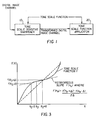
- a digital image channel is input into a tone scale sensitive sharpener 10 where the image is divided into two portions by a pedestal splitter 30 ⁇ a pedestal signal and a texture signal, as will be described in detail below.
- the texture signal includes image high frequency information excluding the high frequency component of sharp edges, and the pedestal signal is the slowly varying signal except in the neighborhood of sharp edges.
- the texture multiplier generator 40 receives a user-defined tone scale function, and as illustrated in Fig. 3, calculates the local slope of the tone scale function evaluated at the value of the received pedestal signal.
- the tone scale function shown in Fig. 3 may be a tone scale function that is digitally applied, or may be the characteristic response of an input or output device.
- the texture multiplier generator 40 then transforms the calculated local slope into a texture multiplier value, as will be described in detail hereinbelow.
- the texture signal is an example of a spatial frequency detail signal.
- Another example of a spatial frequency detail signal that is simpler to compute is the highpass image signal.
- the multiplier 50 receives the texture signal and the texture multiplier value from the texture multiplier generator 40, and generates the product of the two signals. Multiplication of one signal by another signal is well known in the art, and will not be further discussed.
- the adder 60 receives the pedestal signal from the pedestal splitter 30 and the signal output of the multiplier 50, and adds the two signals for forming a transformed image channel. Addition of two signals is well known in the art and will not be further discussed.
- the signal output from the adder 60 is the transformed digital image channel.
- the transformed digital image channel is input into the tone scale applicator 20 that applies the tone scale function, such that the application of the expected tone scale will not significantly alter the detail of the image as compared with the original image.
- the digital image channel input into the pedestal splitter 30 is split into a highpass signal and a lowpass signal by spatial filtering procedure performed by a frequency splitter 70.
- the frequency splitter 70 uses well-known convolution to convolve the digital image channel with a digital filter, as will be described below.
- the convolved signal is the lowpass signal.
- the frequency splitter 70 then creates the highpass signal by subtracting the lowpass signal from the original image channel.
- the digital filter is a Gaussian filter with a standard deviation (sigma) of 2.5 pixels. The preferred value of the standard deviation of the Gaussian filter may vary with image size.
- the pedestal generator 100 receives the original image channel and the texture signal and subtracts the texture signal from the original image channel, which produces a pedestal signal.
- Anon-linear spatial filter herein described shall be defined as a spatial filter which can not be described by the linear spatial filter equation.
- the output of applying a generalized control signal to an input signal bears a multiplicative relationship to the input signal.
- y ij a ij x ij , where the x ij values represent the input signal ij th pixel values and the a ij values represent the ij th pixel values of the control signal.
- the result of applying a control signal to an input signal falls into the general category of a non-linear spatial filter if the control signal is derived from a spatial filtered version of the input signal.
- the avoidance signal a ( x ) is an example of a control signal created from a spatially filtered version of the digital image channel.
- the texture signal q ( x ) described in the preferred embodiment is an example of a non-liner spatial filter produced with the application of a control signal to the highpass signal.
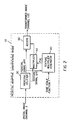
- the avoidance signal generator 80 there is illustrated an exploded block diagram of the avoidance signal generator 80.
- the low pass signal is input into a non-directional squared gradient calculator 110 for producing a non-directional gradient signal.
- This calculation is performed by first calculating the difference between the pixel and its upper vertical neighbor, as well as the difference between the pixel and its horizontal neighbor to the right.
- the non-directional squared gradient is the sum of the squares of these two differences.
- the non-directional squared gradient signal is then mapped by an artifact avoidance function applicator 120 to produce an artifact avoidance signal as the output of the avoidance signal generator 80.
- This output signal of the avoidance signal generator 80 will from now on be referred to as a ( x ).
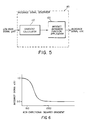
- this mapping function is performed by passing the non-directional squared gradient signal, ndg ( x ), through an artifact avoidance function av () formed in the following manner.
- the preferred values for C o and C 1 will vary according to the range of the input data.
- the input data range in the images used in the development of this preferred embodiment ranged from 0 to 4095.
- the preferred value for C o is 148
- the preferred value for C 1 is 1300.
- av ( y ) 1 - sqrt (( y - C o ) /( C 1 - C o ))
- av ( y ) 1 for y ⁇ C o
- av ( y ) 0 for y > C 1 .
- the artifact avoidance function is most efficiently implemented as a look-up-table (LUT).
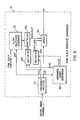
- Fig. 6 therein is illustrated an exploded view of the texture multiplier generator 40.
- the user-defined tone scale function f ( x ) and the pedestal signal p ( x ) are applied to the inputs of the slope calculator 130.
- the slope calculator 130 evaluates the slope of the tone scale function at the value of the pedestal signal.
- the slope calculator 130 may then index into such a LUT with the value of the pedestal signal in order to derive the local slope of the tone scale function.
- the value of the slope output from the slope calculator 130 is input to the texture factor calculator 140.
- the texture factor calculator 140 converts the slope from the slope calculator 130 into the texture multiplier factor by which the texture signal will be scaled with the multiplier 50 in Fig. 2.
- the digital image signal is passed through a frequency splitter 70, creating a lowpass signal and a highpass signal from the original digital image channel.
- the lowpass signal is then passed though the avoidance signal generator 80 in order to generate the artifact avoidance signal.
- the lowpass signal and tone scale function f ( x ) are passed into the slope multiplier generator 40b, which performs substantially the same operation as the texture multiplier generator 40 previously described hereinabove.
- the slope calculator 130 evaluates the slope at the value of the lowpass signal rather than the pedestal signal value.
- the texture signal output from the slope multiplier generator 40b then is multiplied by a multiplier 50c with the product of the multiplier 50a of the avoidance signal and the highpass signal.
- the product so formed is applied to the input of the adder 60.
- the lowpass signal is also applied to the input of the adder 60 as well as the output of multiplier 50b which formed the product of the highpass signal and (1 - a ( x )).
- the output of the adder 60 is a processed image channel in which texture content has been adjusted to compensate for the application of a tone scale function to the processed image.
- the output of the adder 60 is very similar to the output of the preferred embodiment of the present invention.
- the input to the tone scale sensitive sharpener 10 is the tone scaled image channel that was output from the tone scale function applicator 20.
- a mathematical analysis of the present invention may be used to show the operation of the present invention in regions of the image where the a ( x ) signal is 1, and regions of the image where the a ( x ) is 0.
- the present invention is shown to be nearly equivalent in each case. Those skilled in the art will realize that there exist many possible embodiments that result in equivalent operation to the present invention when analyzed by the following method.
- the artifact avoidance signal a ( x ) is 1 for pixels in regions of the image which are generally flat.
- the signal a ( x ) becomes 0 for pixels in regions of the image that contain high transition edges.
- the signal a ( x ) may take on any value within the range of 0.0 to 1.0 depending upon the structure of the local region of the image.
- the processed pixel will be bounded by f ( x ) and f ( g ( x )) + h ( x ).
- the method of the current invention allows an image to be preprocessed in anticipation of a specific tone scale function.
- the image is sharpened with a gain factor related to the inverse of the local slope of the tone scale function, except in those regions of the image where sharpening of the detail would produce unnatural artifacts.
- the tone scale function is applied to the processed image, the detail of the resultant image will be similar to the detail of the original image.
- t ( x ) g ( x ) + [1 - a ( x )] h ( x ) + a ( x )( h ( x ))/ f '( g ( x )).
- the digital image is preferably transformed back into RGB color space by an inverse color space matrix transformation for permitting printing a hardcopy or displaying on an output device.
Landscapes
- Engineering & Computer Science (AREA)
- Multimedia (AREA)
- Signal Processing (AREA)
- Image Processing (AREA)
- Facsimile Image Signal Circuits (AREA)
- Compression Of Band Width Or Redundancy In Fax (AREA)
Applications Claiming Priority (2)
| Application Number | Priority Date | Filing Date | Title |
|---|---|---|---|
| US09/199,510 US6167165A (en) | 1998-11-25 | 1998-11-25 | Method for adjusting image detail to compensate for an applied tone scale |
| US199510 | 1998-11-25 |
Publications (2)
| Publication Number | Publication Date |
|---|---|
| EP1005223A2 true EP1005223A2 (de) | 2000-05-31 |
| EP1005223A3 EP1005223A3 (de) | 2002-10-09 |
Family
ID=22737837
Family Applications (1)
| Application Number | Title | Priority Date | Filing Date |
|---|---|---|---|
| EP99203810A Withdrawn EP1005223A3 (de) | 1998-11-25 | 1999-11-15 | Verfahren zur Anpassung der Bilddetails um die Gradationskurve zu kompensieren |
Country Status (3)
| Country | Link |
|---|---|
| US (1) | US6167165A (de) |
| EP (1) | EP1005223A3 (de) |
| JP (1) | JP2000187728A (de) |
Cited By (3)
| Publication number | Priority date | Publication date | Assignee | Title |
|---|---|---|---|---|
| EP1413985A3 (de) * | 2002-10-25 | 2004-10-13 | Eastman Kodak Company | Verbessern der tonalen, räumlichen, sowie farblichen Charakteristika von Digitalbildern mittels expansiver und komprimierender Tonwertskalenfunktionen |
| US7076111B2 (en) | 2000-11-30 | 2006-07-11 | Canon Kabushiki Kaisha | Image processing apparatus, image processing method, storage medium, and program |
| US7079700B2 (en) | 2000-11-30 | 2006-07-18 | Canon Kabushiki Kaisha | Image processing apparatus, image processing method, storage medium, and program |
Families Citing this family (21)
| Publication number | Priority date | Publication date | Assignee | Title |
|---|---|---|---|---|
| US6438264B1 (en) * | 1998-12-31 | 2002-08-20 | Eastman Kodak Company | Method for compensating image color when adjusting the contrast of a digital color image |
| US6549678B1 (en) * | 1999-01-29 | 2003-04-15 | Eastman Kodak Company | Method for preserving spatial detail when applying a multidimensional tonal transform to a digital color image |
| US6580835B1 (en) * | 1999-06-02 | 2003-06-17 | Eastman Kodak Company | Method for enhancing the edge contrast of a digital image |
| AU2002258683A1 (en) * | 2001-03-30 | 2002-10-15 | Kodak Polychrome Graphics | Automated sharpening of images for soft proofing |
| EP2267582B1 (de) * | 2002-02-06 | 2012-05-09 | Soundtouch Limited | Touch pad |
| FR2841022B1 (fr) * | 2002-06-12 | 2004-08-27 | Centre Nat Rech Scient | Procede pour localiser un impact sur une surface et dispositif pour la mise en oeuvre de ce procede |
| US7228004B2 (en) * | 2002-09-05 | 2007-06-05 | Eastman Kodak Company | Method for sharpening a digital image |
| US7130485B2 (en) * | 2002-10-02 | 2006-10-31 | Eastman Kodak Company | Enhancing the tonal and color characteristics of digital images using expansive and compressive tone scale functions |
| US7043090B2 (en) | 2002-10-02 | 2006-05-09 | Eastman Kodak Company | Enhancing the tonal characteristics of digital images using expansive and compressive tone scale functions |
| US7116838B2 (en) * | 2002-10-25 | 2006-10-03 | Eastman Kodak Company | Enhancing the tonal and spatial characteristics of digital images using selective spatial filters |
| US7280703B2 (en) * | 2002-11-14 | 2007-10-09 | Eastman Kodak Company | Method of spatially filtering a digital image using chrominance information |
| US7266229B2 (en) * | 2003-07-24 | 2007-09-04 | Carestream Health, Inc. | Method for rendering digital radiographic images for display based on independent control of fundamental image quality parameters |
| US7245781B2 (en) * | 2003-10-23 | 2007-07-17 | Eastman Kodak Companny | Applying a tone scale function to a digital image |
| US7269300B2 (en) * | 2003-10-24 | 2007-09-11 | Eastman Kodak Company | Sharpening a digital image in accordance with magnification values |
| US7558433B1 (en) | 2003-12-30 | 2009-07-07 | Adobe Systems Incorporated | Healing by texture synthesis in differential space |
| JP4538358B2 (ja) * | 2005-03-30 | 2010-09-08 | パイオニア株式会社 | 画像処理装置 |
| TW201001334A (en) * | 2008-06-20 | 2010-01-01 | Altek Corp | Adjustment method of color tone for digital image and electronic apparatus thereof |
| CN101621608B (zh) * | 2008-07-04 | 2012-09-19 | 华晶科技股份有限公司 | 数字影像的色调调整方法及其电子装置 |
| US20100002145A1 (en) * | 2008-07-07 | 2010-01-07 | Spence John P | Adaptive optimization of a video signal |
| US9129388B2 (en) | 2012-11-21 | 2015-09-08 | Apple Inc. | Global approximation to spatially varying tone mapping operators |
| US9646366B2 (en) * | 2012-11-30 | 2017-05-09 | Change Healthcare Llc | Method and apparatus for enhancing medical images |
Family Cites Families (9)
| Publication number | Priority date | Publication date | Assignee | Title |
|---|---|---|---|---|
| US5012333A (en) * | 1989-01-05 | 1991-04-30 | Eastman Kodak Company | Interactive dynamic range adjustment system for printing digital images |
| JP2663189B2 (ja) * | 1990-01-29 | 1997-10-15 | 富士写真フイルム株式会社 | 画像のダイナミックレンジ圧縮処理方法 |
| US5341228A (en) * | 1990-12-04 | 1994-08-23 | Research Corporation Technologies | Method and apparatus for halftone rendering of a gray scale image using a blue noise mask |
| US5081692A (en) * | 1991-04-04 | 1992-01-14 | Eastman Kodak Company | Unsharp masking using center weighted local variance for image sharpening and noise suppression |
| DE4126751A1 (de) * | 1991-08-13 | 1993-02-04 | Agfa Gevaert Ag | Verfahren und vorrichtung zur automatischen dichtekorrektur von bildsignalen bei einer elektronischen bildverarbeitung |
| JP3359390B2 (ja) * | 1993-09-27 | 2002-12-24 | 株式会社リコー | 空間フィルタ装置 |
| JP3489796B2 (ja) * | 1994-01-14 | 2004-01-26 | 株式会社リコー | 画像信号処理装置 |
| DE4415990A1 (de) * | 1994-05-06 | 1995-11-23 | Philips Patentverwaltung | Verfahren zur Wiedergabe insbesondere einer digitalen Röntgenaufnahme als sichtbares Bild sowie Anordnung zur Durchführung des Verfahrens |
| US6343158B1 (en) * | 1996-12-18 | 2002-01-29 | Fujitsu Limited | Apparatus for converting gray levels of an image, a method thereof, a program storage device thereof, and an infrared camera |
-
1998
- 1998-11-25 US US09/199,510 patent/US6167165A/en not_active Expired - Lifetime
-
1999
- 1999-11-15 EP EP99203810A patent/EP1005223A3/de not_active Withdrawn
- 1999-11-24 JP JP11333359A patent/JP2000187728A/ja active Pending
Cited By (8)
| Publication number | Priority date | Publication date | Assignee | Title |
|---|---|---|---|---|
| US7076111B2 (en) | 2000-11-30 | 2006-07-11 | Canon Kabushiki Kaisha | Image processing apparatus, image processing method, storage medium, and program |
| US7079700B2 (en) | 2000-11-30 | 2006-07-18 | Canon Kabushiki Kaisha | Image processing apparatus, image processing method, storage medium, and program |
| US7248748B2 (en) | 2000-11-30 | 2007-07-24 | Canon Kabushiki Kaisha | Image processing apparatus, image processing method, storage medium, and program |
| US7447376B2 (en) | 2000-11-30 | 2008-11-04 | Canon Kabushiki Kaisha | Image processing apparatus, image processing method, storage medium, and program |
| US7558434B2 (en) | 2000-11-30 | 2009-07-07 | Canon Kabushiki Kaisha | Image processing apparatus, image processing method, storage medium, and program |
| US7561750B2 (en) | 2000-11-30 | 2009-07-14 | Canon Kabushiki Kaisha | Image processing apparatus, image processing method, storage medium, and program |
| EP1413985A3 (de) * | 2002-10-25 | 2004-10-13 | Eastman Kodak Company | Verbessern der tonalen, räumlichen, sowie farblichen Charakteristika von Digitalbildern mittels expansiver und komprimierender Tonwertskalenfunktionen |
| US7058234B2 (en) | 2002-10-25 | 2006-06-06 | Eastman Kodak Company | Enhancing the tonal, spatial, and color characteristics of digital images using expansive and compressive tone scale functions |
Also Published As
| Publication number | Publication date |
|---|---|
| JP2000187728A (ja) | 2000-07-04 |
| US6167165A (en) | 2000-12-26 |
| EP1005223A3 (de) | 2002-10-09 |
Similar Documents
| Publication | Publication Date | Title |
|---|---|---|
| EP0971314B1 (de) | Verfahren zur Erhaltung von Bilddetails bei Kontrastveränderung | |
| US6167165A (en) | Method for adjusting image detail to compensate for an applied tone scale | |
| EP1111907B1 (de) | Verfahren zur Verbesserung eines digitalen Bildes mit rauschabhängiger Kontrolle der Textur | |
| JP4210577B2 (ja) | 選択的空間フィルタを使用するディジタル画像の階調及び空間特性の向上方法 | |
| US5793885A (en) | Computationally efficient low-artifact system for spatially filtering digital color images | |
| US7529425B2 (en) | Denoising method, apparatus, and program | |
| US5818975A (en) | Method and apparatus for area selective exposure adjustment | |
| US7280703B2 (en) | Method of spatially filtering a digital image using chrominance information | |
| EP1209621A2 (de) | Auf Pixelfarben basiertes Verbesserungsverfahren für digitalen Bildern | |
| JP2004129265A (ja) | 拡張トーンスケール関数及び圧縮トーンスケール関数を用いてデジタル画像の色調特性をエンハンスする方法 | |
| US6731823B1 (en) | Method for enhancing the edge contrast of a digital image independently from the texture | |
| EP1017229B1 (de) | Verfahren zur Bewahrung der räumlichen Einzelheiten und des Farbinhalts während die Tonskala eines digitalen Farbildes verändert wird | |
| US6275605B1 (en) | Method for adjusting the tone scale of a digital image | |
| JP2004129266A (ja) | 拡張トーンスケール関数及び圧縮トーンスケール関数を用いてデジタル画像の色調特性及び色特性をエンハンスする方法 | |
| JP2003264699A (ja) | レンダリングデジタル画像の色、輝度及び階調スケールの調整方法 | |
| US7133157B2 (en) | Image processing method and apparatus | |
| EP1024454B1 (de) | Verfahren zur Erhaltung eines räumlichen Details bei der Anwendung einer multidimensionalen Transformation für ein digitales Farbbild | |
| WO2005043462A1 (en) | Adjusting images based on previous modifications | |
| EP1017228A2 (de) | Verfahren zur Beibehaltung der Bildeinzelheiten bei der Einstellung der Grauskala eines digitalen Farbbildes | |
| EP2472850B1 (de) | Bildverarbeitunsvorrichtung | |
| US20070086650A1 (en) | Method and Device for Color Saturation and Sharpness Enhancement | |
| US7760957B2 (en) | Sharpness enhancement | |
| US20040012799A1 (en) | Method for making an exposure adjustment on a rendered image | |
| Guarnieri et al. | Color rendering in high dynamic range images | |
| LEE et al. | An Introduction of HDR Image Printing Oriented Technology |
Legal Events
| Date | Code | Title | Description |
|---|---|---|---|
| PUAI | Public reference made under article 153(3) epc to a published international application that has entered the european phase |
Free format text: ORIGINAL CODE: 0009012 |
|
| AK | Designated contracting states |
Kind code of ref document: A2 Designated state(s): AT BE CH CY DE DK ES FI FR GB GR IE IT LI LU MC NL PT SE |
|
| AX | Request for extension of the european patent |
Free format text: AL;LT;LV;MK;RO;SI |
|
| PUAL | Search report despatched |
Free format text: ORIGINAL CODE: 0009013 |
|
| AK | Designated contracting states |
Kind code of ref document: A3 Designated state(s): AT BE CH CY DE DK ES FI FR GB GR IE IT LI LU MC NL PT SE |
|
| AX | Request for extension of the european patent |
Free format text: AL;LT;LV;MK;RO;SI |
|
| RIC1 | Information provided on ipc code assigned before grant |
Free format text: 7H 04N 1/58 A, 7H 04N 1/409 B, 7G 06T 5/20 B |
|
| 17P | Request for examination filed |
Effective date: 20030313 |
|
| 17Q | First examination report despatched |
Effective date: 20030424 |
|
| AKX | Designation fees paid |
Designated state(s): CH DE FR GB LI |
|
| STAA | Information on the status of an ep patent application or granted ep patent |
Free format text: STATUS: THE APPLICATION IS DEEMED TO BE WITHDRAWN |
|
| 18D | Application deemed to be withdrawn |
Effective date: 20030907 |