EP1005571B1 - In-vitro Verfahren zur Bereitstellung von Fragmenten für die DNS Sequenzierung - Google Patents
In-vitro Verfahren zur Bereitstellung von Fragmenten für die DNS Sequenzierung Download PDFInfo
- Publication number
- EP1005571B1 EP1005571B1 EP98935045A EP98935045A EP1005571B1 EP 1005571 B1 EP1005571 B1 EP 1005571B1 EP 98935045 A EP98935045 A EP 98935045A EP 98935045 A EP98935045 A EP 98935045A EP 1005571 B1 EP1005571 B1 EP 1005571B1
- Authority
- EP
- European Patent Office
- Prior art keywords
- dna
- primer
- transposon
- reaction
- sequencing
- Prior art date
- Legal status (The legal status is an assumption and is not a legal conclusion. Google has not performed a legal analysis and makes no representation as to the accuracy of the status listed.)
- Expired - Lifetime
Links
- 238000000034 method Methods 0.000 title claims abstract description 53
- 238000001712 DNA sequencing Methods 0.000 title claims abstract description 18
- 238000000338 in vitro Methods 0.000 title claims abstract description 15
- 238000006243 chemical reaction Methods 0.000 claims abstract description 162
- 238000012163 sequencing technique Methods 0.000 claims abstract description 63
- 230000017105 transposition Effects 0.000 claims abstract description 62
- 230000003321 amplification Effects 0.000 claims abstract description 56
- 238000003199 nucleic acid amplification method Methods 0.000 claims abstract description 56
- 230000000295 complement effect Effects 0.000 claims abstract description 38
- 239000002773 nucleotide Substances 0.000 claims description 49
- 125000003729 nucleotide group Chemical group 0.000 claims description 49
- 102000008579 Transposases Human genes 0.000 claims description 43
- 108010020764 Transposases Proteins 0.000 claims description 43
- 238000005304 joining Methods 0.000 claims description 26
- 239000013598 vector Substances 0.000 claims description 26
- 108020004414 DNA Proteins 0.000 claims description 24
- 238000003780 insertion Methods 0.000 claims description 17
- 230000037431 insertion Effects 0.000 claims description 17
- 108091028043 Nucleic acid sequence Proteins 0.000 claims description 9
- 108020004638 Circular DNA Proteins 0.000 claims description 4
- 230000002285 radioactive effect Effects 0.000 claims description 4
- 238000013461 design Methods 0.000 abstract description 4
- 238000010187 selection method Methods 0.000 abstract description 3
- 230000013819 transposition, DNA-mediated Effects 0.000 abstract description 3
- 239000013615 primer Substances 0.000 description 159
- 239000000047 product Substances 0.000 description 37
- 108020004707 nucleic acids Proteins 0.000 description 34
- 102000039446 nucleic acids Human genes 0.000 description 34
- 150000007523 nucleic acids Chemical class 0.000 description 34
- 239000012634 fragment Substances 0.000 description 26
- 239000000499 gel Substances 0.000 description 23
- 230000000692 anti-sense effect Effects 0.000 description 17
- TWRXJAOTZQYOKJ-UHFFFAOYSA-L Magnesium chloride Chemical compound [Mg+2].[Cl-].[Cl-] TWRXJAOTZQYOKJ-UHFFFAOYSA-L 0.000 description 14
- 239000011543 agarose gel Substances 0.000 description 14
- 108010014303 DNA-directed DNA polymerase Proteins 0.000 description 9
- 102000016928 DNA-directed DNA polymerase Human genes 0.000 description 9
- IAZDPXIOMUYVGZ-UHFFFAOYSA-N Dimethylsulphoxide Chemical compound CS(C)=O IAZDPXIOMUYVGZ-UHFFFAOYSA-N 0.000 description 9
- PEDCQBHIVMGVHV-UHFFFAOYSA-N Glycerine Chemical compound OCC(O)CO PEDCQBHIVMGVHV-UHFFFAOYSA-N 0.000 description 9
- 239000003550 marker Substances 0.000 description 9
- 230000001351 cycling effect Effects 0.000 description 7
- 229910001629 magnesium chloride Inorganic materials 0.000 description 7
- 239000013612 plasmid Substances 0.000 description 7
- 239000011541 reaction mixture Substances 0.000 description 7
- 102000012330 Integrases Human genes 0.000 description 6
- 108010061833 Integrases Proteins 0.000 description 6
- FAPWRFPIFSIZLT-UHFFFAOYSA-M Sodium chloride Chemical compound [Na+].[Cl-] FAPWRFPIFSIZLT-UHFFFAOYSA-M 0.000 description 6
- 102000004190 Enzymes Human genes 0.000 description 5
- 108090000790 Enzymes Proteins 0.000 description 5
- 239000002987 primer (paints) Substances 0.000 description 5
- QKNYBSVHEMOAJP-UHFFFAOYSA-N 2-amino-2-(hydroxymethyl)propane-1,3-diol;hydron;chloride Chemical compound Cl.OCC(N)(CO)CO QKNYBSVHEMOAJP-UHFFFAOYSA-N 0.000 description 4
- 239000007983 Tris buffer Substances 0.000 description 4
- 229920004890 Triton X-100 Polymers 0.000 description 4
- 239000013504 Triton X-100 Substances 0.000 description 4
- 239000000203 mixture Substances 0.000 description 4
- 238000012360 testing method Methods 0.000 description 4
- LENZDBCJOHFCAS-UHFFFAOYSA-N tris Chemical compound OCC(N)(CO)CO LENZDBCJOHFCAS-UHFFFAOYSA-N 0.000 description 4
- 241000588724 Escherichia coli Species 0.000 description 3
- LFQSCWFLJHTTHZ-UHFFFAOYSA-N Ethanol Chemical compound CCO LFQSCWFLJHTTHZ-UHFFFAOYSA-N 0.000 description 3
- 239000007984 Tris EDTA buffer Substances 0.000 description 3
- 238000000246 agarose gel electrophoresis Methods 0.000 description 3
- 238000003776 cleavage reaction Methods 0.000 description 3
- 238000005520 cutting process Methods 0.000 description 3
- ZMMJGEGLRURXTF-UHFFFAOYSA-N ethidium bromide Chemical compound [Br-].C12=CC(N)=CC=C2C2=CC=C(N)C=C2[N+](CC)=C1C1=CC=CC=C1 ZMMJGEGLRURXTF-UHFFFAOYSA-N 0.000 description 3
- 229960005542 ethidium bromide Drugs 0.000 description 3
- 108090000623 proteins and genes Proteins 0.000 description 3
- 238000000746 purification Methods 0.000 description 3
- 238000011160 research Methods 0.000 description 3
- 239000011780 sodium chloride Substances 0.000 description 3
- OSBLTNPMIGYQGY-UHFFFAOYSA-N 2-amino-2-(hydroxymethyl)propane-1,3-diol;2-[2-[bis(carboxymethyl)amino]ethyl-(carboxymethyl)amino]acetic acid;boric acid Chemical compound OB(O)O.OCC(N)(CO)CO.OC(=O)CN(CC(O)=O)CCN(CC(O)=O)CC(O)=O OSBLTNPMIGYQGY-UHFFFAOYSA-N 0.000 description 2
- FWMNVWWHGCHHJJ-SKKKGAJSSA-N 4-amino-1-[(2r)-6-amino-2-[[(2r)-2-[[(2r)-2-[[(2r)-2-amino-3-phenylpropanoyl]amino]-3-phenylpropanoyl]amino]-4-methylpentanoyl]amino]hexanoyl]piperidine-4-carboxylic acid Chemical compound C([C@H](C(=O)N[C@H](CC(C)C)C(=O)N[C@H](CCCCN)C(=O)N1CCC(N)(CC1)C(O)=O)NC(=O)[C@H](N)CC=1C=CC=CC=1)C1=CC=CC=C1 FWMNVWWHGCHHJJ-SKKKGAJSSA-N 0.000 description 2
- KDCGOANMDULRCW-UHFFFAOYSA-N 7H-purine Chemical compound N1=CNC2=NC=NC2=C1 KDCGOANMDULRCW-UHFFFAOYSA-N 0.000 description 2
- 229920000936 Agarose Polymers 0.000 description 2
- 241000894006 Bacteria Species 0.000 description 2
- HEDRZPFGACZZDS-UHFFFAOYSA-N Chloroform Chemical compound ClC(Cl)Cl HEDRZPFGACZZDS-UHFFFAOYSA-N 0.000 description 2
- 102000053602 DNA Human genes 0.000 description 2
- KCXVZYZYPLLWCC-UHFFFAOYSA-N EDTA Chemical compound OC(=O)CN(CC(O)=O)CCN(CC(O)=O)CC(O)=O KCXVZYZYPLLWCC-UHFFFAOYSA-N 0.000 description 2
- 241000701959 Escherichia virus Lambda Species 0.000 description 2
- 108060002716 Exonuclease Proteins 0.000 description 2
- ISWSIDIOOBJBQZ-UHFFFAOYSA-N Phenol Chemical compound OC1=CC=CC=C1 ISWSIDIOOBJBQZ-UHFFFAOYSA-N 0.000 description 2
- 239000008051 TBE buffer Substances 0.000 description 2
- 230000001580 bacterial effect Effects 0.000 description 2
- 238000005251 capillar electrophoresis Methods 0.000 description 2
- 238000004850 capillary HPLC Methods 0.000 description 2
- OPTASPLRGRRNAP-UHFFFAOYSA-N cytosine Chemical compound NC=1C=CNC(=O)N=1 OPTASPLRGRRNAP-UHFFFAOYSA-N 0.000 description 2
- 230000000694 effects Effects 0.000 description 2
- 238000001962 electrophoresis Methods 0.000 description 2
- 238000005516 engineering process Methods 0.000 description 2
- 102000013165 exonuclease Human genes 0.000 description 2
- 238000002474 experimental method Methods 0.000 description 2
- 238000000605 extraction Methods 0.000 description 2
- 238000001502 gel electrophoresis Methods 0.000 description 2
- UYTPUPDQBNUYGX-UHFFFAOYSA-N guanine Chemical compound O=C1NC(N)=NC2=C1N=CN2 UYTPUPDQBNUYGX-UHFFFAOYSA-N 0.000 description 2
- 238000001727 in vivo Methods 0.000 description 2
- PHTQWCKDNZKARW-UHFFFAOYSA-N isoamylol Chemical compound CC(C)CCO PHTQWCKDNZKARW-UHFFFAOYSA-N 0.000 description 2
- 238000002955 isolation Methods 0.000 description 2
- 238000004519 manufacturing process Methods 0.000 description 2
- 230000001915 proofreading effect Effects 0.000 description 2
- 230000002441 reversible effect Effects 0.000 description 2
- RWQNBRDOKXIBIV-UHFFFAOYSA-N thymine Chemical compound CC1=CNC(=O)NC1=O RWQNBRDOKXIBIV-UHFFFAOYSA-N 0.000 description 2
- 241001430294 unidentified retrovirus Species 0.000 description 2
- 229930024421 Adenine Natural products 0.000 description 1
- GFFGJBXGBJISGV-UHFFFAOYSA-N Adenine Chemical compound NC1=NC=NC2=C1N=CN2 GFFGJBXGBJISGV-UHFFFAOYSA-N 0.000 description 1
- 102000012410 DNA Ligases Human genes 0.000 description 1
- 108010061982 DNA Ligases Proteins 0.000 description 1
- 108020001019 DNA Primers Proteins 0.000 description 1
- 239000003155 DNA primer Substances 0.000 description 1
- 241000702189 Escherichia virus Mu Species 0.000 description 1
- 229920001917 Ficoll Polymers 0.000 description 1
- 108010010803 Gelatin Proteins 0.000 description 1
- 108010002747 Pfu DNA polymerase Proteins 0.000 description 1
- 240000009305 Pometia pinnata Species 0.000 description 1
- 235000017284 Pometia pinnata Nutrition 0.000 description 1
- CZPWVGJYEJSRLH-UHFFFAOYSA-N Pyrimidine Chemical compound C1=CN=CN=C1 CZPWVGJYEJSRLH-UHFFFAOYSA-N 0.000 description 1
- 241000231739 Rutilus rutilus Species 0.000 description 1
- 240000004808 Saccharomyces cerevisiae Species 0.000 description 1
- 235000014680 Saccharomyces cerevisiae Nutrition 0.000 description 1
- 238000012300 Sequence Analysis Methods 0.000 description 1
- VMHLLURERBWHNL-UHFFFAOYSA-M Sodium acetate Chemical compound [Na+].CC([O-])=O VMHLLURERBWHNL-UHFFFAOYSA-M 0.000 description 1
- 239000008049 TAE buffer Substances 0.000 description 1
- HGEVZDLYZYVYHD-UHFFFAOYSA-N acetic acid;2-amino-2-(hydroxymethyl)propane-1,3-diol;2-[2-[bis(carboxymethyl)amino]ethyl-(carboxymethyl)amino]acetic acid Chemical compound CC(O)=O.OCC(N)(CO)CO.OC(=O)CN(CC(O)=O)CCN(CC(O)=O)CC(O)=O HGEVZDLYZYVYHD-UHFFFAOYSA-N 0.000 description 1
- 229960000643 adenine Drugs 0.000 description 1
- BFNBIHQBYMNNAN-UHFFFAOYSA-N ammonium sulfate Chemical compound N.N.OS(O)(=O)=O BFNBIHQBYMNNAN-UHFFFAOYSA-N 0.000 description 1
- 229910052921 ammonium sulfate Inorganic materials 0.000 description 1
- 238000013459 approach Methods 0.000 description 1
- 108010058966 bacteriophage T7 induced DNA polymerase Proteins 0.000 description 1
- UDSAIICHUKSCKT-UHFFFAOYSA-N bromophenol blue Chemical compound C1=C(Br)C(O)=C(Br)C=C1C1(C=2C=C(Br)C(O)=C(Br)C=2)C2=CC=CC=C2S(=O)(=O)O1 UDSAIICHUKSCKT-UHFFFAOYSA-N 0.000 description 1
- 239000000872 buffer Substances 0.000 description 1
- 210000004027 cell Anatomy 0.000 description 1
- 238000004113 cell culture Methods 0.000 description 1
- 239000007795 chemical reaction product Substances 0.000 description 1
- 239000003795 chemical substances by application Substances 0.000 description 1
- 229940104302 cytosine Drugs 0.000 description 1
- 230000003247 decreasing effect Effects 0.000 description 1
- 230000029087 digestion Effects 0.000 description 1
- 238000009826 distribution Methods 0.000 description 1
- 238000001035 drying Methods 0.000 description 1
- IYGDRNNNWIKNHO-UHFFFAOYSA-N gag-28 Chemical compound O=C1NC(=O)C(C)=CN1C1OC(COP(O)(=S)OC2C(OC(C2)N2C(N=C(N)C=C2)=O)COP(O)(=S)OC2C(OC(C2)N2C(NC(=O)C(C)=C2)=O)COP(O)(=S)OC2C(OC(C2)N2C(NC(=O)C(C)=C2)=O)COP(O)(=S)OC2C(OC(C2)N2C(N=C(N)C=C2)=O)COP(O)(=S)OC2C(OC(C2)N2C(N=C(N)C=C2)=O)COP(O)(=S)OC2C(OC(C2)N2C(N=C(N)C=C2)=O)COP(O)(=S)OC2C(OC(C2)N2C(NC(=O)C(C)=C2)=O)COP(O)(=S)OC2C(OC(C2)N2C(N=C(N)C=C2)=O)COP(O)(=S)OC2C(OC(C2)N2C(NC(=O)C(C)=C2)=O)COP(O)(=S)OC2C(OC(C2)N2C(N=C(N)C=C2)=O)COP(O)(=S)OC2C(OC(C2)N2C(NC(=O)C(C)=C2)=O)COP(O)(=S)OC2C(OC(C2)N2C3=NC=NC(N)=C3N=C2)COP(O)(=S)OC2C(OC(C2)N2C(N=C(N)C=C2)=O)COP(O)(=S)OC2C(OC(C2)N2C(N=C(N)C=C2)=O)COP(O)(=S)OC2C(OC(C2)N2C(N=C(N)C=C2)=O)COP(O)(=S)OC2C(OC(C2)N2C3=NC=NC(N)=C3N=C2)COP(O)(=S)OC2C(OC(C2)N2C(N=C(N)C=C2)=O)COP(O)(=S)OC2C(OC(C2)N2C3=C(C(NC(N)=N3)=O)N=C2)COP(O)(=S)OC2C(OC(C2)N2C(N=C(N)C=C2)=O)COP(O)(=S)OC2C(OC(C2)N2C(NC(=O)C(C)=C2)=O)COP(O)(=S)OC2C(OC(C2)N2C(N=C(N)C=C2)=O)COP(O)(=S)OC2C(OC(C2)N2C(NC(=O)C(C)=C2)=O)COP(O)(=S)OC2C(OC(C2)N2C(N=C(N)C=C2)=O)COP(S)(=O)OC2C(OC(C2)N2C3=C(C(NC(N)=N3)=O)N=C2)COP(O)(=S)OC2C(OC(C2)N2C(N=C(N)C=C2)=O)COP(O)(O)=S)C(OP(O)(=S)OCC2C(CC(O2)N2C3=NC=NC(N)=C3N=C2)O)C1 IYGDRNNNWIKNHO-UHFFFAOYSA-N 0.000 description 1
- 239000008273 gelatin Substances 0.000 description 1
- 229920000159 gelatin Polymers 0.000 description 1
- 235000019322 gelatine Nutrition 0.000 description 1
- 235000011852 gelatine desserts Nutrition 0.000 description 1
- 230000002068 genetic effect Effects 0.000 description 1
- PCHJSUWPFVWCPO-UHFFFAOYSA-N gold Chemical compound [Au] PCHJSUWPFVWCPO-UHFFFAOYSA-N 0.000 description 1
- 239000010931 gold Substances 0.000 description 1
- 229910052737 gold Inorganic materials 0.000 description 1
- 238000010438 heat treatment Methods 0.000 description 1
- 238000007849 hot-start PCR Methods 0.000 description 1
- 238000011068 loading method Methods 0.000 description 1
- 238000013507 mapping Methods 0.000 description 1
- 102000016470 mariner transposase Human genes 0.000 description 1
- 108060004631 mariner transposase Proteins 0.000 description 1
- 108020004999 messenger RNA Proteins 0.000 description 1
- 238000007857 nested PCR Methods 0.000 description 1
- 229920002401 polyacrylamide Polymers 0.000 description 1
- 150000003212 purines Chemical class 0.000 description 1
- 150000003230 pyrimidines Chemical class 0.000 description 1
- 108091008146 restriction endonucleases Proteins 0.000 description 1
- 150000003839 salts Chemical class 0.000 description 1
- 238000005070 sampling Methods 0.000 description 1
- 230000007017 scission Effects 0.000 description 1
- 230000035945 sensitivity Effects 0.000 description 1
- 235000017281 sodium acetate Nutrition 0.000 description 1
- 239000001632 sodium acetate Substances 0.000 description 1
- 239000000243 solution Substances 0.000 description 1
- 239000003381 stabilizer Substances 0.000 description 1
- 239000012089 stop solution Substances 0.000 description 1
- RYYWUUFWQRZTIU-UHFFFAOYSA-K thiophosphate Chemical compound [O-]P([O-])([O-])=S RYYWUUFWQRZTIU-UHFFFAOYSA-K 0.000 description 1
- 229940113082 thymine Drugs 0.000 description 1
- 230000001131 transforming effect Effects 0.000 description 1
Images



Classifications
-
- C—CHEMISTRY; METALLURGY
- C12—BIOCHEMISTRY; BEER; SPIRITS; WINE; VINEGAR; MICROBIOLOGY; ENZYMOLOGY; MUTATION OR GENETIC ENGINEERING
- C12Q—MEASURING OR TESTING PROCESSES INVOLVING ENZYMES, NUCLEIC ACIDS OR MICROORGANISMS; COMPOSITIONS OR TEST PAPERS THEREFOR; PROCESSES OF PREPARING SUCH COMPOSITIONS; CONDITION-RESPONSIVE CONTROL IN MICROBIOLOGICAL OR ENZYMOLOGICAL PROCESSES
- C12Q1/00—Measuring or testing processes involving enzymes, nucleic acids or microorganisms; Compositions therefor; Processes of preparing such compositions
- C12Q1/68—Measuring or testing processes involving enzymes, nucleic acids or microorganisms; Compositions therefor; Processes of preparing such compositions involving nucleic acids
- C12Q1/6869—Methods for sequencing
Definitions
- the present invention relates to the sequencing of DNA and in particular to the selection of unique templates for DNA sequencing.
- the selection methods of this invention can be performed fully in vitro.
- the invention further relates to a kit which can be used when employing the selection method of this invention.
- DNA sequencing is a widely used method which is indispensable within modem molecular biology.
- One factor limiting sequencing is the shortness of the sequence to be read using one primer.
- Present-day techniques make it possible to read about 1000 bases starting from the primer. In practice, the range to be read covers about 400 to 800 bases.
- the problem has been solved by transforming the sequencing vector comprising the examined DNA into a bacterial cell, usually into Escherichia coli, and by isolating single colonies from the culture plate.
- the present invention aims at eliminating the problems relating to the prior art and, therefore, it is an object of the present invention to provide a simple method for fragmenting larger DNA segments into pieces enabling the sequencing of whole segment by using one or a few sequencing primers.
- the examined DNA is subjected to a DNA transposition reaction and to an amplification reaction as defined in claim 1.
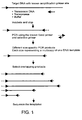
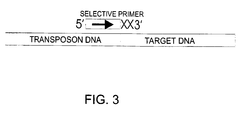
- the amplification reaction is carried out in the presence of a first, fixed primer, hybridizing at a known position in the examined DNA or if the examined DNA is part of a vector for example, adjacent to the examined DNA, and a second, selective primer, hybridizing at the insertion site of a transposon.
- These reactions result in amplification products which can be separated on the basis of their size difference.
- the amplification products whose size difference is in the range of the reading capacity of the sequencing system used, normally in the range of 200 to 600 bp, overlapping DNA templates can be obtained for sequencing.
- the target DNA can range from a few base pairs up to 40 kilo base pairs. The only limiting factor for not choosing as target DNA even longer DNA segments is the inability of the present amplification reactions, such as PCR, to produce longer DNA segments.
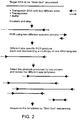
- a transposition reaction is carried out in the presence of the examined DNA and in the presence of a transposon or transposons which have different ends enabling the design of selective primers for both ends.
- the transposon ends can be part of the same molecule or separate molecules.
- the amplification reaction is carried out in the presence of the selective primers designed for both transposon ends.
- the amplification products are situated at random positions in the target DNA. To be able to cover the whole sequence of the target DNA, a sufficient number of the amplification products needs to be selected for sequencing. Very long DNA segments can be sequenced by selecting the templates according to this embodiment.
- the present-day amplification reactions, such as PCR are not a limiting factor.
- One advantage is that no sequence data of the target DNA is needed, nor is any subcloning procedure necessary.
- One object of this invention is to provide a kit as defined in claim 17 which comprises a transposon recognizable by a transposase enzyme, the transposase enzyme, a fixed primer hybridizing at a known position in the examined DNA or if the examined DNA is part of a vector for example, adjacent to the examined DNA, and a selective primer including a sequence complementary to the transposon joining end.
- kits as defined in claim 19 which comprises a selective primer, a fixed primer, a transposon recognizable by a transposase enzyme, and the transposase enzyme, and wherein the transposon and the transposase enzyme are provided as a transposition complex.
- One still further object of this invention is to provide a kit as defined in claim 21 which comprises two different transposon ends recognizable by a transposase enzyme or transposase enzymes, the transposase enzyme or transposase enzymes, and selective primers including a sequence complementary to the transposon joining ends.
- this invention provides an in vitro method for selecting templates for DNA sequencing.
- DNA sequencing refers to the determination of the sequence of purine and pyrimidine bases constituting a deoxyribonucleic acid segment.
- the purines commonly found in DNA are adenine (A) and guanine (G), the pyrimidines commonly found are cytosine (C) and thymine (T).
- a DNA sequence analysis results in a variation of the four bases designated as ATCGTGC etc.
- the sequencing method can be any sequencing method known in the prior art like the nucleotide specific chemical reaction and cleavage reactions of Maxam and Gilbert (1977) and the primer extension reactions in the presence of nucleotide specific terminators as disclosed by Sanger et al (1977) preferably by using the cycle sequencing method.
- the target DNA is a linear DNA or part of a linear DNA.
- a partial sequence of the target DNA or a DNA adjacent to the insertion site of the target DNA is known enabling the design of a fixed primer having a sequence complementary to the known partial sequence. Accordingly, the position of the fixed primer is known within the target DNA or within the linear DNA comprising the target DNA.
- the embodiment B comprises the same method steps as the embodiment A except that there is no linearization step of the target DNA as in the embodiment A.
- the method comprises the following steps (Figure 2):
- the sequencing method can be any sequencing method known in the prior art like the nucleotide specific chemical reaction and cleavage reactions of Maxam and Gilbert (1977) and the primer extension reactions in the presence of nucleotide specific terminators as disclosed by Sanger et al (1977) preferably using cycle sequencing.
- One of the advantages of the third embodiment (C) is that very long DNA segments can be sequenced by selecting the templates according to this embodiment.
- the present-day amplification reactions such as PCR, are not a limiting factor, although more sequencing work is needed as compared to the first two embodiments (A and B).
- Another advantage is that no sequence data of the target DNA is needed nor any subcloning procedure is necessary.
- One further object of the present invention is to provide a kit for selecting templates for DNA sequencing.
- the kit may also comprise other components needed in the transposition reaction.
- Such components may be other enzymes involved in the transposition reaction, or buffers, salts and/or stabilizers which have been chosen depending on the transposase/integrase system.
- the transposon comprises the Mu transposon ends, recognizable by the MuA transposase.
- the target DNA is pUC19 plasmid (GeneBank access no. X02514).
- the transposition reaction has been carried out as essentially as described in Savilahti et al ( 1995) using a double stranded transposon DNA of the following sequence (SEQ ID 1):
- the 3' end of the complementary strand of the above sequence is joined to the target DNA in a transposition reaction.
- reaction conditions were the following:
- the reaction volume was 25 ⁇ l.
- the reaction mixture was incubated at 30 °C for 1 h and frozen after the reaction.
- a selective PCR reaction was carried out by using primer 1 and 2 as the fixed PCR primers and primers 3, 4 or 5 as the selective PCR primers according to Table 2.
- the sequences of the primers are shown in Table 1.
- Table 1. DNA sequences of the primers Primer number Sequence SEQ ID 1 AGCTGGCGAAAGGGGGATGTG 2 2 TTATGCTTCCGGCTCGTATGTTGTGT 3 3 GTTTTTCGTGCGCCGCTTCA 4 4 GTTTTTCGTGCCGCTTCAG 5 5 GTTTTTCGTGCGCCGCTTCAGA 6 6 GTTTTTCGTGCGCCGCTTCAGAG 7 7 GTTTTTCGTGCGCCGCTTCAGAGT 8 8 GTTTTTCGTGCCGCTTCAGATCT 9 9 CGGCGGGAGTTTGGGAGGTT 10 10 GCGGCGGGAGTTTGGGAG 11 11 CGCTTTCGTACTTCAAGTGAATCAATACA 12 12 CGCTTTCGTACTTCAAGTGAATCAATACAG 13 13 CGCTTTCGTACTTCAAGTGAATCAATACAGA
- the PCR reaction conditions were the following:
- the reaction volume was 50 ⁇ l. Prior to adding the primers the reaction mixture was incubated 10 min at 72 °C to fill in the gap at the insertion site between the 3 'end of the target DNA and the 5'end of the transposon DNA.
- Step Time T 1 1 min 30 s 96 °C 2 45 s 96 °C 3 2 min 72 °C 4 29 times to step 2 5 5 min 72 °C 6 kept until removed 4 °C
- the PCR equipment was a DNA Engine from MJ-Research, MA, USA.
- the target DNA to be sequenced is the 6557 bp DNA fragment from Lambda DNA- Hind III digestion inserted into pUC 19 at the Hind III site.
- transposition reaction was carried out as described in Savilahti et al (1995) using a double stranded transposon DNA (donor A) of the following sequence (SEQ ID 1):
- the 3' end of the complementary strand of the above sequence is joined to the target DNA in a transposition reaction.
- reaction conditions were the following:
- the reaction volume was 50 ⁇ l .
- the reaction mixture was incubated at 30 °C for 1 h and frozen after the reaction.
- the PCR reaction conditions were the following:
- Step Time T 1 1 min 30 s 96 °C 2 45 s 96 °C 3 8 min 72 °C 4 29 times to step 2 5 8 min 72 °C 6 kept until removed 4 °C
- the PCR instrument was a PTC-200 DNA Engine from MJ-Research, MA, USA.
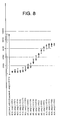
- PCR reactions were loaded and run on 1 % Seakem LE agarose gel (FMC) in TBE buffer. The gel was stained after the run with 1:10,000 diluted SYBR Green gel stain (FMC) for 30 minutes in a low speed shaker at room temperature. SYBR Green gel stain is more sensitive than ethidium bromide and facilitates sampling of especially large lower intensity PCR products from the gel. The results are shown in Figure 6.
- Reactions A3, A4, A5, A8, B5 - B16 had several fragments in the same reaction.
- the desired fragments were isolated and purified from the gel using Qiaex II Gel Extraction Kit (Qiagen, USA) according to manufacturer's instructions.
- Reactions A6, A9, A12, A13, A14, A 15, A16 and A 17 showed only one main band and they were purified directly by Qiaquick PCR purification kit (Qiagen, USA) according to the manufacturer's instructions.
- the purified DNA templates were sequenced by using SequiTherm EXCEL II Long-Read DNA Sequencing Kit (Epicentre Technologies, USA) according to their Cycle Sequencing Protocol for Li-Cor automated DNA sequencer. The used amount of each DNA template was 7.8 ⁇ l.
- the sequencing primer was IRD800 labeled primer 3 (Table 1).
- the cycling parameters were: Step time temperature 1 5 min 95 °C 2 30 sec 95 °C 3 15 sec 67 °C 4 1 min 70 °C 5 29 times to step 2 6 kept until removed 4 °C
- the automated DNA sequencing apparatus was a Li-Cor Long Read IR 4200.
- the used gel length was 66 cm and the gel was 4 % Long Ranger (FMC).
- This example shows that according to the method of this invention it is possible to rapidly sequence in vitro a larger DNA insert in a vector. To get more complete sequence it is preferable to use several different selective primers to produce more templates to be sequenced.
- the target DNA was pUC19 plasmid.
- the transposition reaction was carried out essentially as described in Savilahti et al (1995) using a mixture of two different double stranded transposon DNAs (donor A and donor B) of the following sequences (SEQ ID 1 and SEQ ID 17) capable of forming a functional transposon complex with MuA transposase:
- the 3' end of the complementary strand of the above sequences is joined to the target DNA in a transposition reaction.
- reaction conditions were the following:
- reaction mixture was incubated at 30 °C for 4 h.
- 10 ⁇ l of MuA stop solution, 2.5 % SDS, 25 % Ficoll 400, 0.025% bromophenol blue and 50 mM EDTA were added to the reaction.
- 10 ⁇ l samples of the reaction were loaded in to 5 lanes on a 0.8 % Seaplaque agarose gel (FMC) and run on a standard horizontal gel apparatus in TAE buffer.
- FMC Seaplaque agarose gel
- the first transposon hit to the circular pUC19 plasmid causes the linearization of the plasmid.
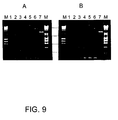
- Two or more transposon hits to the same plasmid molecule result in different random size products that are seen on the Figure 9 as a smear under the linearized plasmid DNA. That DNA was isolated by cutting off that part of the gel and solubilized and extracted twice with an equal volume of phenol solution and once with an equal volume of chloroform/isoamylalcohol (24:1). Sodium acetate was added to 300 mM final concentration and DNA was precipitated by adding two volumes of ethanol. After drying the DNA was dissolved in 120 ⁇ l of TE buffer (10 mM Tris, 0.1 mM EDTA, pH 8.0).
- PCR was done in two steps. In the first step the PCR was done using primer 3 or primer 4 and primer 9 or 10 according to the Table 1 and 4. Primer 3 and 4 are complementary to the joining end of donor A having 0 or 1 selective nucleotide. Primer 9 and 10 are complementary to the non joining end of donor B having no selective nucleotides. Control reactions having only one primer were also done.
- the PCR reaction conditions were the following:
- the PCR instrument was a PTC-200 DNA Engine from MJ-Research, MA, USA. 9 ⁇ l of each reaction were run on regular 2 % agarose gel electrophoresis stained with ethidium bromide. The results are shown in Figure 10.
- the PCR reaction number 6 showed a good distribution of different size PCR products. Reaction 6 was used in the second step PCR. The aim was to study what selection strength is needed.
- the PCR reaction conditions were the following:
- Step Time T 1 1 min 30 s 96 °C 2 45 s 96 °C 3 1 min 68 °C 4 2 min 72 °C 5 29 times to step 2 6 5 min 72 °C 7 kept until removed 4 °C
- the purified DNA templates were sequenced by using the Thermo Sequenase cycle sequencing kit according to the manufacturer's instructions using IRD800 labeled primer 3 (Table 1).
- the cycling parameters were: Step time temperature 1 30 sec 95 °C 2 30 sec 67 °C 3 1 min 30 sec 72 °C 4 60 times to step 2 5 kept until removed 4 °C
- the automated DNA sequencing apparatus was a Li-Cor Long Read IR 4200., The used gel length was 41 cm and the gel was 6 % Gene Page (Amresco, USA).
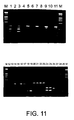
- the experiment shows that the method works and could be employed to select templates for sequencing of an unknown DNA without any subcloning and completely in vitro.
Landscapes
- Life Sciences & Earth Sciences (AREA)
- Chemical & Material Sciences (AREA)
- Proteomics, Peptides & Aminoacids (AREA)
- Organic Chemistry (AREA)
- Zoology (AREA)
- Wood Science & Technology (AREA)
- Health & Medical Sciences (AREA)
- Engineering & Computer Science (AREA)
- Microbiology (AREA)
- Immunology (AREA)
- Biotechnology (AREA)
- Molecular Biology (AREA)
- Biophysics (AREA)
- Analytical Chemistry (AREA)
- Physics & Mathematics (AREA)
- Biochemistry (AREA)
- Bioinformatics & Cheminformatics (AREA)
- General Engineering & Computer Science (AREA)
- General Health & Medical Sciences (AREA)
- Genetics & Genomics (AREA)
- Measuring Or Testing Involving Enzymes Or Micro-Organisms (AREA)
Claims (23)
- In vitro-Verfahren für die Bereitstellung von Matrizen für die DNA-Sequenzierung, umfassend die Schritte des- Ausführens einer Transpositionsreaktion in der Gegenwart einer Ziel-DNA und in der Gegenwart eines Transposons, wobei die Transpositionsreaktion zumindest zu einer Insertion in der Ziel-DNA führt;- Ausführens einer Amplifikationsreaktion unter Verwendung, als Primer, eines ersten fixierten Primers, der an eine bekannte Stelle in der Ziel-DNA hybridisiert oder, wenn die Ziel-DNA Teil eines Vektors ist, angrenzend an die Ziel-DNA, und eines zweiten selektiven Primers, der an die Transposoninsertionsstelle hybridisiert, mit einer Sequenz, die komplementär ist zu dem verbindenden Ende des Transposons, und der ein zusätzliches Nucleotid oder zusätzliche Nucleotide bekannter Identität an seinem 3'-Ende hat;- Auftrennens der Amplifikationsprodukte basierend auf deren Größe; und- Gewinnens der Amplifikationsprodukte, die geeignet sind für die Verwendung als Matrizen in der Sequenzierung der Ziel-DNA.
- Verfahren nach Anspruch 1, wobei der zweite selektive Primer 1 bis 5 zusätzliche Nucleotide bekannter Identität an seinem 3'-Ende hat.
- Verfahren nach Anspruch 1 oder 2, wobei die Amplifikationsprodukte, die geeignet sind als Matrizen, sich überlappen und sich in der Größe unterscheiden.
- Verfahren nach einem der Ansprüche 1 bis 3, wobei der erste fixierte Primer und der zweite, selektive Primer mit unterschiedlichen Markern, wie radioaktive Marker oder fluoreszente Marker, markiert sind und aus den Amplifikationsprodukten selektiert werden für die Verwendung als Matrizen zur Sequenzierung jener, welche beide Markierungen haben.
- Verfahren nach einem der Ansprüche 1 bis 4, wobei die Amplifikationsreaktion eine PCR-Reaktion ist.
- Verfahren nach einem der Ansprüche 1 bis 5, wobei die Ziel-DNA eine ringförmige DNA oder Teil einer ringförmigen DNA ist.
- Verfahren nach einem der Ansprüche 1 bis 5, wobei die Ziel-DNA eine lineare DNA oder Teil einer linearen DNA ist.
- Verfahren nach einem der Ansprüche 1 bis 7, wobei die Ziel-DNA in einen Vektor inseriert wird und der erste fixierte Primer eine Sequenz hat, die komplemetär ist zu der an die Insertionszielstelle angrenzende Sequenz des Vektors.
- Verfahren nach einem der Ansprüche 1 bis 8, wobei das Transposon eine DNA-Sequenz umfasst, welche erkennbar ist für ein Transposase-Enzym, wobei die Transposon-DNA und das Transposase-Enzym in der Lage sind, einen funktionellen Komplex zu bilden, der in der Transpositionsreaktion benötigt wird.
- Verfahren nach einem der Ansprüche 1 bis 9, wobei das Transposon die Mu-Transpositionsenden umfasst, die für die MuA-Transposase erkennbar sind.
- In vitro-Verfahren für die Bereitstellung von Matrizen für die DNA-Sequenzierung, umfassend die Schritte des:- Ausführens einer Transpositionsreaktion in der Gegenwart von zumindest einem Transposon, das zwei unterschiedliche verbindende Enden hat, wobei die verbindende Enden sich voneinander in zumindest einem Nucleotid unterscheiden;- Ausführens einer Amplifikationsreaktion unter Verwendung, als Primer, eines ersten selektiven Primers mit einer Sequenz, die komplementär ist zu dem ersten verbindenden Ende, und eines zweiten selektiven Primers, wobei der zweite Primer eine Sequenz hat, die komplementär ist zu dem zweiten verbindenden Ende, wobei zumindest der erste oder der zweite selektive Primer ein zusätzliches Nucleotid oder zusätzliche Nucleotide bekannter Identität an seinem 3'-Ende hat;- Auftrennens der Amplifikationsprodukte basierend auf deren Größe;- Auswählens der Matrizen für DNA-Sequenzierung aus den Amplifikationsprodukten, welche unterschiedliche Enden haben und welche ausschliesslich gemeinsam von beiden Primern hergestellt werden; und- Gewinnens der Amplifikationsprodukte, die geeignet sind für die Verwendung als Matrize zur Sequenzierung der Ziel-DNA.
- Verfahren nach Anspruch 11, wobei zumindest der erste oder der zweite selektive Primer 1 bis 5 zusätzliche Nucleotide bekannter Identität an seinem 3'-Ende hat.
- Verfahren nach Anspruch 11 oder 12, wobei der erste Primer und der zweite Primer mit unterschiedlichen Markern, wie radioaktive Marker oder fluoreszente Marker, markiert sind und aus den Amplifikationsprodukten ausgewählt werden für die Verwendung als Matrizen zur Sequenzierung jener, welche beide Markierungen haben.
- Verfahren nach einem der Ansprüche 11 bis 13, wobei die Amplifikationsreaktion eine PCR-Reaktion ist.
- Verfahren nach einem der Ansprüche 11 bis 14, wobei das Transposon oder die Transposons für ein Transposase-Enzym erkennbar ist/sind, wobei die Transposon-DNA und das Transposase-Enzym in der Lage sind, einen funktionellen Komplex zu bilden, der in der Transpositionsreaktion benötigt wird.
- Verfahren nach einem der Ansprüche 11 bis 15, wobei das Transposon die Mu-Transposonenden umfasst, die für die MuA-Transposase erkennbar sind.
- Kit für die Bereitstellung von Matrizen für die DNA-Sequenzierung, umfassend:- ein Transposon, umfassend eine DNA-Sequenz, welche erkennbar ist für ein Transposase-Enzym, wobei die Transposon-DNA und das Transposase-Enzym in der Lage sind, einen funktionellen Komplex zu bilden, der in der Transpositionsreaktion benötigt wird;- ein Transposase-Enzym für die Ausführung der Transpositionsreaktion;- einen fixierten Primer mit einer Sequenz, die komplementär ist zu einer bekannten Sequenz in der Ziel-DNA oder, wenn die Ziel-DNA ein Teil eines Vektors ist, die komplementär zu einer Vektorsequenz angrenzend an eingefügte Ziel-DNA ist; und- einen selektiven Primer mit einer Sequenz, die komplementär ist zu dem verbindenden Ende des Transposons und dem 3'-Ende des Primers, das ein zusätzliches Nucleotid oder zusätzliche Nucleotide bekannter Identität hat.
- Kit nach Anspruch 17, wobei der selektive Primer 1 bis 5 zusätzliche Nucleotide bekannter Identität an seinem 3'-Ende hat.
- Kit für die Bereitstellung von Matrizen für die DNA-Sequenzierung, umfassend:- einen Transpositionskomplex, umfassend ein Transposon und ein Transposase-Enzym, wobei das Transposon eine DNA-Sequenz umfasst, welche für das Transposase-Enzym erkennbar ist,- einen fixierten Primer mit einer Sequenz, die komplementär ist zu einer bekannten Sequenz in der Ziel-DNA oder, wenn die Ziel-DNA Teil eines Vektors ist, die komplementär zu einer Vektor-Sequenz angrenzend an eingefügte Ziel-DNA ist; und- einen selektiven Primer mit einer Sequenz, die komplementär ist zu dem verbindenden Ende des Transposons und dem 3'-Ende des Primers, das ein zusätzliches Nucleotid oder zusätzliche Nucleotide bekannter Identität hat.
- Kit nach Anspruch 19, wobei der selektive Primer 1 bis 5 zusätzliche Nucleotide bekannter Identität an seinem 3'-Ende hat.
- Kit für die Bereitstellung von Matrizen für die DNA-Sequenzierung, umfassend:- zumindest ein Transposon, das zwei verschiedene verbindende Enden hat, umfassend eine DNA-Sequenz oder -Sequenzen, welche erkennbar ist/sind für ein Transposase-Enzym, wobei das Transposon und das Transposase-Enzym in der Lage sind, einen funktionellen Komplex zu bilden, der in einer Transpositionsreaktion benötigt wird;- ein Transposase-Enzym für die Durchführung der Transpositionsreaktion;- einen ersten selektiven Primer, mit einer Sequenz, die komplementär ist zu dem ersten verbindenden Ende, und einen zweiten selektiven Primer, wobei der zweite selektive Primer eine Sequenz hat, die komplementär ist zu dem zweiten verbindenden Ende, wobei zumindest der erste oder der zweite selektive Primer ein zusätzliches Nucleotid oder zusätzliche Nucleotide bekannter Identität an seinem 3'-Ende hat.
- Sequenzierungskit nach Anspruch 21, wobei zumindest der erste oder der zweite selektive Primer 1 bis 5 zusätzliche Nucleotide bekannter Identität an seinem 3'-Ende hat.
- Sequenzierungskit nach einem der Ansprüche 17 bis 22, wobei das Transposon die Mu-Transposonenden umfasst, die für die MuA-Transposase erkennbar sind.
Applications Claiming Priority (3)
| Application Number | Priority Date | Filing Date | Title |
|---|---|---|---|
| FI972992 | 1997-07-14 | ||
| FI972992A FI103809B1 (fi) | 1997-07-14 | 1997-07-14 | In vitro -menetelmä templaattien tuottamiseksi DNA-sekventointia varten |
| PCT/FI1998/000586 WO1999004035A1 (en) | 1997-07-14 | 1998-07-10 | In vitro method for providing templates for dna sequencing |
Publications (2)
| Publication Number | Publication Date |
|---|---|
| EP1005571A1 EP1005571A1 (de) | 2000-06-07 |
| EP1005571B1 true EP1005571B1 (de) | 2007-12-26 |
Family
ID=8549258
Family Applications (1)
| Application Number | Title | Priority Date | Filing Date |
|---|---|---|---|
| EP98935045A Expired - Lifetime EP1005571B1 (de) | 1997-07-14 | 1998-07-10 | In-vitro Verfahren zur Bereitstellung von Fragmenten für die DNS Sequenzierung |
Country Status (9)
| Country | Link |
|---|---|
| US (1) | US6593113B1 (de) |
| EP (1) | EP1005571B1 (de) |
| JP (1) | JP2001510055A (de) |
| AT (1) | ATE382095T1 (de) |
| AU (1) | AU738345B2 (de) |
| CA (1) | CA2295968C (de) |
| DE (1) | DE69838911D1 (de) |
| FI (1) | FI103809B1 (de) |
| WO (1) | WO1999004035A1 (de) |
Families Citing this family (63)
| Publication number | Priority date | Publication date | Assignee | Title |
|---|---|---|---|---|
| US7727744B2 (en) * | 2004-03-30 | 2010-06-01 | Epicentre Technologies Corporation | Methods for obtaining directionally truncated polypeptides |
| US7901889B2 (en) | 2007-07-26 | 2011-03-08 | Pacific Biosciences Of California, Inc. | Molecular redundant sequencing |
| US8383345B2 (en) | 2008-09-12 | 2013-02-26 | University Of Washington | Sequence tag directed subassembly of short sequencing reads into long sequencing reads |
| US9080211B2 (en) | 2008-10-24 | 2015-07-14 | Epicentre Technologies Corporation | Transposon end compositions and methods for modifying nucleic acids |
| EP3272879B1 (de) | 2008-10-24 | 2019-08-07 | Epicentre Technologies Corporation | Transposonendenzusammensetzungen und verfahren zur modifizierung von nukleinsäuren |
| US9074251B2 (en) | 2011-02-10 | 2015-07-07 | Illumina, Inc. | Linking sequence reads using paired code tags |
| US8829171B2 (en) | 2011-02-10 | 2014-09-09 | Illumina, Inc. | Linking sequence reads using paired code tags |
| CA2821299C (en) * | 2010-11-05 | 2019-02-12 | Frank J. Steemers | Linking sequence reads using paired code tags |
| EP3037536B1 (de) | 2011-01-28 | 2019-11-27 | Illumina, Inc. | Oligonukleotidersatz für di-markierte und direktionale bibliotheken |
| US10457936B2 (en) | 2011-02-02 | 2019-10-29 | University Of Washington Through Its Center For Commercialization | Massively parallel contiguity mapping |
| US20130017978A1 (en) | 2011-07-11 | 2013-01-17 | Finnzymes Oy | Methods and transposon nucleic acids for generating a dna library |
| US9145623B2 (en) | 2011-07-20 | 2015-09-29 | Thermo Fisher Scientific Oy | Transposon nucleic acids comprising a calibration sequence for DNA sequencing |
| US10323279B2 (en) | 2012-08-14 | 2019-06-18 | 10X Genomics, Inc. | Methods and systems for processing polynucleotides |
| US9951386B2 (en) | 2014-06-26 | 2018-04-24 | 10X Genomics, Inc. | Methods and systems for processing polynucleotides |
| US10221442B2 (en) | 2012-08-14 | 2019-03-05 | 10X Genomics, Inc. | Compositions and methods for sample processing |
| US10752949B2 (en) | 2012-08-14 | 2020-08-25 | 10X Genomics, Inc. | Methods and systems for processing polynucleotides |
| US9701998B2 (en) | 2012-12-14 | 2017-07-11 | 10X Genomics, Inc. | Methods and systems for processing polynucleotides |
| US11591637B2 (en) | 2012-08-14 | 2023-02-28 | 10X Genomics, Inc. | Compositions and methods for sample processing |
| BR112015003354A8 (pt) | 2012-08-14 | 2018-01-16 | 10X Genomics Inc | métodos e composições de microcápsula |
| US10584381B2 (en) | 2012-08-14 | 2020-03-10 | 10X Genomics, Inc. | Methods and systems for processing polynucleotides |
| US10273541B2 (en) | 2012-08-14 | 2019-04-30 | 10X Genomics, Inc. | Methods and systems for processing polynucleotides |
| AU2013359165B2 (en) | 2012-12-14 | 2019-09-12 | 10X Genomics, Inc. | Methods and systems for processing polynucleotides |
| US10533221B2 (en) | 2012-12-14 | 2020-01-14 | 10X Genomics, Inc. | Methods and systems for processing polynucleotides |
| US9683230B2 (en) | 2013-01-09 | 2017-06-20 | Illumina Cambridge Limited | Sample preparation on a solid support |
| CA2900543C (en) | 2013-02-08 | 2023-01-31 | 10X Genomics, Inc. | Partitioning and processing of analytes and other species |
| ES2887177T3 (es) | 2013-03-13 | 2021-12-22 | Illumina Inc | Método de preparación de una biblioteca de secuenciación de ácidos nucleicos |
| US9328382B2 (en) | 2013-03-15 | 2016-05-03 | Complete Genomics, Inc. | Multiple tagging of individual long DNA fragments |
| HK1222416A1 (zh) | 2013-05-23 | 2017-06-30 | The Board Of Trustees Of The Leland Stanford Junior University | 用於个人表观基因组学的至天然染色质的转座 |
| EP3083994B1 (de) | 2013-12-20 | 2021-08-18 | Illumina, Inc. | Konservierung von genom-verbindungsinformationen in fragmentierten genomischen dna-proben |
| US11136576B2 (en) | 2014-02-03 | 2021-10-05 | Thermo Fisher Scientific Baltics Uab | Method for controlled DNA fragmentation |
| US20170009288A1 (en) | 2014-02-03 | 2017-01-12 | Thermo Fisher Scientific Baltics Uab | Method for controlled dna fragmentation |
| DE202015009609U1 (de) | 2014-04-10 | 2018-08-06 | 10X Genomics, Inc. | Mikrofluidisches System zur Erzeugung von Emulsionen |
| CN106536756A (zh) | 2014-06-26 | 2017-03-22 | 10X基因组学有限公司 | 核酸序列的分析 |
| WO2015200893A2 (en) | 2014-06-26 | 2015-12-30 | 10X Genomics, Inc. | Methods of analyzing nucleic acids from individual cells or cell populations |
| US12312640B2 (en) | 2014-06-26 | 2025-05-27 | 10X Genomics, Inc. | Analysis of nucleic acid sequences |
| ES2713153T3 (es) | 2014-06-30 | 2019-05-20 | Illumina Inc | Métodos y composiciones que utilizan la transposición unilateral |
| US11873480B2 (en) | 2014-10-17 | 2024-01-16 | Illumina Cambridge Limited | Contiguity preserving transposition |
| EP3212807B1 (de) | 2014-10-29 | 2020-09-02 | 10X Genomics, Inc. | Verfahren und zusammensetzungen zur gezielten nukleinsäuresequenzierung |
| US9975122B2 (en) | 2014-11-05 | 2018-05-22 | 10X Genomics, Inc. | Instrument systems for integrated sample processing |
| FI3628732T3 (fi) * | 2014-11-05 | 2023-05-31 | Illumina Inc | Transposaasikoostumuksia insertiovääristymän vähentämiseksi |
| AU2016207023B2 (en) | 2015-01-12 | 2019-12-05 | 10X Genomics, Inc. | Processes and systems for preparing nucleic acid sequencing libraries and libraries prepared using same |
| EP3262407B1 (de) | 2015-02-24 | 2023-08-30 | 10X Genomics, Inc. | Partitionsverarbeitungsverfahren und -systeme |
| CN115651972A (zh) | 2015-02-24 | 2023-01-31 | 10X 基因组学有限公司 | 用于靶向核酸序列覆盖的方法 |
| US10344336B2 (en) | 2015-06-09 | 2019-07-09 | Life Technologies Corporation | Methods, systems, compositions, kits, apparatus and computer-readable media for molecular tagging |
| DK3882357T3 (da) | 2015-12-04 | 2022-08-29 | 10X Genomics Inc | Fremgangsmåder og sammensætninger til analyse af nukleinsyrer |
| WO2017197343A2 (en) | 2016-05-12 | 2017-11-16 | 10X Genomics, Inc. | Microfluidic on-chip filters |
| WO2017197338A1 (en) | 2016-05-13 | 2017-11-16 | 10X Genomics, Inc. | Microfluidic systems and methods of use |
| US10815525B2 (en) | 2016-12-22 | 2020-10-27 | 10X Genomics, Inc. | Methods and systems for processing polynucleotides |
| US10550429B2 (en) | 2016-12-22 | 2020-02-04 | 10X Genomics, Inc. | Methods and systems for processing polynucleotides |
| US10011872B1 (en) | 2016-12-22 | 2018-07-03 | 10X Genomics, Inc. | Methods and systems for processing polynucleotides |
| US12110545B2 (en) | 2017-01-06 | 2024-10-08 | Editas Medicine, Inc. | Methods of assessing nuclease cleavage |
| US12264411B2 (en) | 2017-01-30 | 2025-04-01 | 10X Genomics, Inc. | Methods and systems for analysis |
| EP4029939B1 (de) | 2017-01-30 | 2023-06-28 | 10X Genomics, Inc. | Verfahren und systeme für eine einzelzellbarcodierung auf tröpfchenbasis |
| US10400235B2 (en) | 2017-05-26 | 2019-09-03 | 10X Genomics, Inc. | Single cell analysis of transposase accessible chromatin |
| CN116064732A (zh) | 2017-05-26 | 2023-05-05 | 10X基因组学有限公司 | 转座酶可接近性染色质的单细胞分析 |
| WO2019014564A1 (en) | 2017-07-14 | 2019-01-17 | Editas Medicine, Inc. | SYSTEMS AND METHODS OF TARGETED INTEGRATION AND GENOME EDITING AND DETECTION THEREOF WITH INTEGRATED PRIMING SITES |
| WO2019099751A1 (en) | 2017-11-15 | 2019-05-23 | 10X Genomics, Inc. | Functionalized gel beads |
| US10829815B2 (en) | 2017-11-17 | 2020-11-10 | 10X Genomics, Inc. | Methods and systems for associating physical and genetic properties of biological particles |
| US12359223B2 (en) | 2018-01-30 | 2025-07-15 | Editas Medicine, Inc. | Systems and methods for modulating chromosomal rearrangements |
| US12377396B2 (en) | 2018-02-05 | 2025-08-05 | The Board Of Trustees Of The Leland Stanford Junior University | Systems and methods for multiplexed measurements in single and ensemble cells |
| EP3775271B1 (de) | 2018-04-06 | 2025-03-12 | 10X Genomics, Inc. | Systeme und verfahren zur qualitätskontrolle in einer einzelzellenverarbeitung |
| WO2019217452A1 (en) | 2018-05-08 | 2019-11-14 | Mgi Tech Co., Ltd. | Single tube bead-based dna co-barcoding for accurate and cost-effective sequencing, haplotyping, and assembly |
| CN119546761A (zh) | 2022-05-18 | 2025-02-28 | 因美纳有限公司 | 大小受控的核酸片段的制备 |
Family Cites Families (1)
| Publication number | Priority date | Publication date | Assignee | Title |
|---|---|---|---|---|
| US5677170A (en) | 1994-03-02 | 1997-10-14 | The Johns Hopkins University | In vitro transposition of artificial transposons |
-
1997
- 1997-07-14 FI FI972992A patent/FI103809B1/fi not_active IP Right Cessation
-
1998
- 1998-07-10 AU AU84429/98A patent/AU738345B2/en not_active Expired
- 1998-07-10 DE DE69838911T patent/DE69838911D1/de not_active Expired - Lifetime
- 1998-07-10 CA CA002295968A patent/CA2295968C/en not_active Expired - Lifetime
- 1998-07-10 EP EP98935045A patent/EP1005571B1/de not_active Expired - Lifetime
- 1998-07-10 AT AT98935045T patent/ATE382095T1/de not_active IP Right Cessation
- 1998-07-10 US US09/462,013 patent/US6593113B1/en not_active Expired - Lifetime
- 1998-07-10 JP JP2000503240A patent/JP2001510055A/ja active Pending
- 1998-07-10 WO PCT/FI1998/000586 patent/WO1999004035A1/en not_active Ceased
Also Published As
| Publication number | Publication date |
|---|---|
| FI103809B (fi) | 1999-09-30 |
| JP2001510055A (ja) | 2001-07-31 |
| DE69838911D1 (de) | 2008-02-07 |
| FI103809B1 (fi) | 1999-09-30 |
| FI972992L (fi) | 1999-01-15 |
| US6593113B1 (en) | 2003-07-15 |
| AU8442998A (en) | 1999-02-10 |
| WO1999004035A1 (en) | 1999-01-28 |
| FI972992A0 (fi) | 1997-07-14 |
| EP1005571A1 (de) | 2000-06-07 |
| AU738345B2 (en) | 2001-09-13 |
| CA2295968A1 (en) | 1999-01-28 |
| CA2295968C (en) | 2008-11-25 |
| ATE382095T1 (de) | 2008-01-15 |
Similar Documents
| Publication | Publication Date | Title |
|---|---|---|
| EP1005571B1 (de) | In-vitro Verfahren zur Bereitstellung von Fragmenten für die DNS Sequenzierung | |
| US11555220B2 (en) | Methods of lowering the error rate of massively parallel DNA sequencing using duplex consensus sequencing | |
| Post et al. | DNA sequences of promoter regions for the str and spc ribosomal protein operons in E. coli | |
| Knapp et al. | Transcription and processing of intervening sequences in yeast tRNA genes | |
| KR100559098B1 (ko) | Dna 의 합성방법 | |
| Davison et al. | Specificity of promoter site utilization in vitro by bacterial RNA polymerases on Bacillus phage phi 29 DNA. Transcription mapping with exonuclease III. | |
| Beier et al. | Two nucleotides next to the anticodon of cytoplasmic rat tRNA Asp are likely generated by RNA editing | |
| KR20200081318A (ko) | 멀티플렉스 시스템을 이용한 인간 객체의 y str 유전좌위 분석방법 및 이를 이용한 분석 키트 | |
| US20090215034A1 (en) | Method for selectively detecting subsets of nucleic acid molecules | |
| Grimm et al. | Ribonucleic acid splicing in Neurospora mitochondria: secondary structure of the 35S ribosomal precursor ribonucleic acid investigated by digestion with ribonuclease III and by electron microscopy | |
| US6849410B2 (en) | Method for detecting DNA polymorphism applying triple strand DNA formation technique | |
| WO2025049432A1 (en) | Methods for editing hla-a in cells pre-screened for the absence of one or both alleles of hla-h*01 | |
| Oppegard et al. | Direct visualisation of RNA editing within a Leishmaniatarentolae mitochondrial extract | |
| JPH08322598A (ja) | Dna分子索引法 | |
| JPH0928399A (ja) | Dna分子索引法 |
Legal Events
| Date | Code | Title | Description |
|---|---|---|---|
| PUAI | Public reference made under article 153(3) epc to a published international application that has entered the european phase |
Free format text: ORIGINAL CODE: 0009012 |
|
| 17P | Request for examination filed |
Effective date: 20000119 |
|
| AK | Designated contracting states |
Kind code of ref document: A1 Designated state(s): AT BE CH CY DE DK ES FI FR GB GR IE IT LI LU MC NL PT SE |
|
| 17Q | First examination report despatched |
Effective date: 20060315 |
|
| GRAP | Despatch of communication of intention to grant a patent |
Free format text: ORIGINAL CODE: EPIDOSNIGR1 |
|
| RTI1 | Title (correction) |
Free format text: IN-VITRO METHOD FOR PROVIDING TEMPLATES FOR DNA SEQUENCING |
|
| GRAS | Grant fee paid |
Free format text: ORIGINAL CODE: EPIDOSNIGR3 |
|
| RIN1 | Information on inventor provided before grant (corrected) |
Inventor name: MULTANEN, KIRSI Inventor name: SAVILAHTI, HARRI Inventor name: SOININEN, TIMO Inventor name: TENKANEN, TUOMAS |
|
| GRAA | (expected) grant |
Free format text: ORIGINAL CODE: 0009210 |
|
| RAP1 | Party data changed (applicant data changed or rights of an application transferred) |
Owner name: FINNZYMES OY |
|
| AK | Designated contracting states |
Kind code of ref document: B1 Designated state(s): AT BE CH CY DE DK ES FI FR GB GR IE IT LI LU MC NL PT SE |
|
| REG | Reference to a national code |
Ref country code: GB Ref legal event code: FG4D |
|
| REG | Reference to a national code |
Ref country code: IE Ref legal event code: FG4D |
|
| REG | Reference to a national code |
Ref country code: CH Ref legal event code: EP |
|
| REF | Corresponds to: |
Ref document number: 69838911 Country of ref document: DE Date of ref document: 20080207 Kind code of ref document: P |
|
| PG25 | Lapsed in a contracting state [announced via postgrant information from national office to epo] |
Ref country code: SE Free format text: LAPSE BECAUSE OF FAILURE TO SUBMIT A TRANSLATION OF THE DESCRIPTION OR TO PAY THE FEE WITHIN THE PRESCRIBED TIME-LIMIT Effective date: 20080326 Ref country code: LI Free format text: LAPSE BECAUSE OF FAILURE TO SUBMIT A TRANSLATION OF THE DESCRIPTION OR TO PAY THE FEE WITHIN THE PRESCRIBED TIME-LIMIT Effective date: 20071226 Ref country code: CH Free format text: LAPSE BECAUSE OF FAILURE TO SUBMIT A TRANSLATION OF THE DESCRIPTION OR TO PAY THE FEE WITHIN THE PRESCRIBED TIME-LIMIT Effective date: 20071226 |
|
| PG25 | Lapsed in a contracting state [announced via postgrant information from national office to epo] |
Ref country code: NL Free format text: LAPSE BECAUSE OF FAILURE TO SUBMIT A TRANSLATION OF THE DESCRIPTION OR TO PAY THE FEE WITHIN THE PRESCRIBED TIME-LIMIT Effective date: 20071226 Ref country code: FI Free format text: LAPSE BECAUSE OF FAILURE TO SUBMIT A TRANSLATION OF THE DESCRIPTION OR TO PAY THE FEE WITHIN THE PRESCRIBED TIME-LIMIT Effective date: 20071226 |
|
| NLV1 | Nl: lapsed or annulled due to failure to fulfill the requirements of art. 29p and 29m of the patents act | ||
| REG | Reference to a national code |
Ref country code: CH Ref legal event code: PL |
|
| PG25 | Lapsed in a contracting state [announced via postgrant information from national office to epo] |
Ref country code: AT Free format text: LAPSE BECAUSE OF FAILURE TO SUBMIT A TRANSLATION OF THE DESCRIPTION OR TO PAY THE FEE WITHIN THE PRESCRIBED TIME-LIMIT Effective date: 20071226 |
|
| PG25 | Lapsed in a contracting state [announced via postgrant information from national office to epo] |
Ref country code: ES Free format text: LAPSE BECAUSE OF FAILURE TO SUBMIT A TRANSLATION OF THE DESCRIPTION OR TO PAY THE FEE WITHIN THE PRESCRIBED TIME-LIMIT Effective date: 20080406 |
|
| PG25 | Lapsed in a contracting state [announced via postgrant information from national office to epo] |
Ref country code: BE Free format text: LAPSE BECAUSE OF FAILURE TO SUBMIT A TRANSLATION OF THE DESCRIPTION OR TO PAY THE FEE WITHIN THE PRESCRIBED TIME-LIMIT Effective date: 20071226 |
|
| PG25 | Lapsed in a contracting state [announced via postgrant information from national office to epo] |
Ref country code: PT Free format text: LAPSE BECAUSE OF FAILURE TO SUBMIT A TRANSLATION OF THE DESCRIPTION OR TO PAY THE FEE WITHIN THE PRESCRIBED TIME-LIMIT Effective date: 20080526 |
|
| EN | Fr: translation not filed | ||
| PG25 | Lapsed in a contracting state [announced via postgrant information from national office to epo] |
Ref country code: DK Free format text: LAPSE BECAUSE OF FAILURE TO SUBMIT A TRANSLATION OF THE DESCRIPTION OR TO PAY THE FEE WITHIN THE PRESCRIBED TIME-LIMIT Effective date: 20071226 Ref country code: DE Free format text: LAPSE BECAUSE OF FAILURE TO SUBMIT A TRANSLATION OF THE DESCRIPTION OR TO PAY THE FEE WITHIN THE PRESCRIBED TIME-LIMIT Effective date: 20080327 |
|
| PLBE | No opposition filed within time limit |
Free format text: ORIGINAL CODE: 0009261 |
|
| STAA | Information on the status of an ep patent application or granted ep patent |
Free format text: STATUS: NO OPPOSITION FILED WITHIN TIME LIMIT |
|
| 26N | No opposition filed |
Effective date: 20080929 |
|
| PG25 | Lapsed in a contracting state [announced via postgrant information from national office to epo] |
Ref country code: GR Free format text: LAPSE BECAUSE OF FAILURE TO SUBMIT A TRANSLATION OF THE DESCRIPTION OR TO PAY THE FEE WITHIN THE PRESCRIBED TIME-LIMIT Effective date: 20080327 |
|
| PG25 | Lapsed in a contracting state [announced via postgrant information from national office to epo] |
Ref country code: MC Free format text: LAPSE BECAUSE OF NON-PAYMENT OF DUE FEES Effective date: 20080731 |
|
| PG25 | Lapsed in a contracting state [announced via postgrant information from national office to epo] |
Ref country code: FR Free format text: LAPSE BECAUSE OF FAILURE TO SUBMIT A TRANSLATION OF THE DESCRIPTION OR TO PAY THE FEE WITHIN THE PRESCRIBED TIME-LIMIT Effective date: 20081017 |
|
| PG25 | Lapsed in a contracting state [announced via postgrant information from national office to epo] |
Ref country code: IE Free format text: LAPSE BECAUSE OF NON-PAYMENT OF DUE FEES Effective date: 20080710 Ref country code: CY Free format text: LAPSE BECAUSE OF FAILURE TO SUBMIT A TRANSLATION OF THE DESCRIPTION OR TO PAY THE FEE WITHIN THE PRESCRIBED TIME-LIMIT Effective date: 20071226 |
|
| PG25 | Lapsed in a contracting state [announced via postgrant information from national office to epo] |
Ref country code: LU Free format text: LAPSE BECAUSE OF NON-PAYMENT OF DUE FEES Effective date: 20080710 |
|
| PG25 | Lapsed in a contracting state [announced via postgrant information from national office to epo] |
Ref country code: IT Free format text: LAPSE BECAUSE OF NON-PAYMENT OF DUE FEES Effective date: 20080731 |
|
| PGFP | Annual fee paid to national office [announced via postgrant information from national office to epo] |
Ref country code: GB Payment date: 20170705 Year of fee payment: 20 |
|
| REG | Reference to a national code |
Ref country code: GB Ref legal event code: PE20 Expiry date: 20180709 |
|
| PG25 | Lapsed in a contracting state [announced via postgrant information from national office to epo] |
Ref country code: GB Free format text: LAPSE BECAUSE OF EXPIRATION OF PROTECTION Effective date: 20180709 |