EP1005677B9 - Systeme et procede pour la tomographie du courant electrique primaire du cerveau et du coeur - Google Patents
Systeme et procede pour la tomographie du courant electrique primaire du cerveau et du coeur Download PDFInfo
- Publication number
- EP1005677B9 EP1005677B9 EP98941221A EP98941221A EP1005677B9 EP 1005677 B9 EP1005677 B9 EP 1005677B9 EP 98941221 A EP98941221 A EP 98941221A EP 98941221 A EP98941221 A EP 98941221A EP 1005677 B9 EP1005677 B9 EP 1005677B9
- Authority
- EP
- European Patent Office
- Prior art keywords
- calculating
- eeg
- image
- following
- meg
- Prior art date
- Legal status (The legal status is an assumption and is not a legal conclusion. Google has not performed a legal analysis and makes no representation as to the accuracy of the status listed.)
- Expired - Lifetime
Links
- 0 CCCCCC1C*CC1 Chemical compound CCCCCC1C*CC1 0.000 description 3
Images




Classifications
-
- A—HUMAN NECESSITIES
- A61—MEDICAL OR VETERINARY SCIENCE; HYGIENE
- A61B—DIAGNOSIS; SURGERY; IDENTIFICATION
- A61B5/00—Measuring for diagnostic purposes; Identification of persons
- A61B5/24—Detecting, measuring or recording bioelectric or biomagnetic signals of the body or parts thereof
- A61B5/242—Detecting biomagnetic fields, e.g. magnetic fields produced by bioelectric currents
- A61B5/245—Detecting biomagnetic fields, e.g. magnetic fields produced by bioelectric currents specially adapted for magnetoencephalographic [MEG] signals
-
- A—HUMAN NECESSITIES
- A61—MEDICAL OR VETERINARY SCIENCE; HYGIENE
- A61B—DIAGNOSIS; SURGERY; IDENTIFICATION
- A61B5/00—Measuring for diagnostic purposes; Identification of persons
- A61B5/24—Detecting, measuring or recording bioelectric or biomagnetic signals of the body or parts thereof
- A61B5/316—Modalities, i.e. specific diagnostic methods
- A61B5/369—Electroencephalography [EEG]
- A61B5/372—Analysis of electroencephalograms
Definitions
- the present invention consists of a system and method for obtaining Tomographic Images of the Primary Electric Currents (PEC) produced by the neurons of the brain and the muscle cells of the heart.
- PEC Primary Electric Currents
- N is the vector of dimension N of ones, I n denotes the identity matrix of order n, ⁇ the matrix Kronecker product; ".*" the Hadamaard product, and o represents the dyadic product among vectors. If x is a matrix or a vector, x t denotes x transposed x; x* denotes x conjugate transposed.
- the operation vech(X) applied to X consists of forming a vector with the columns of X, eliminating repeated elements or those considered constant in the context of the problem.
- PEC Primary Electric current
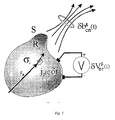
- Electroencephalogram (EEG) and Electro-cardiogram (EKG) time series obtained by measuring the voltage difference V er ( t ) that is created in a pair of electrodes localized on the body in the positions r e (recording electrode) and r r (reference) on the head and the thorax respectively.
- V er ( t ) is measured at N e sites on the body.
- a vector of measurements of this type will be denoted by v(t).
- Magneto-encephalogram (MEG) and Magneto-cardiogram (MKG) time series obtained by measuring the projection b cn ( t ) of the magnetic field density vector at the center r c of a simple coil on n c , the perpendicular vector to the plane that contains it. These simple coils are connected to Superconducting Quantum interference Devices (dc SQUID) by means of a group of magnetic flow detection transformers. b cn ( t ) are measured at N c sites of the body. The vector of measurements of this type will be denoted by b(t).
- Anatomical images type of medical images that offer structural information about the body such as the Computed Axial Tomography (CAT), of Magnetic Resonance Images (MRI), post-mortem sections of the head using cryotomy, etc.
- CAT Computed Axial Tomography
- MRI Magnetic Resonance Images
- post-mortem sections of the head using cryotomy etc.
- Anatomical atlas is an anatomical image of the brain or of the heart in a reference system of the head or the torso, respectively.
- a particular instance of a reference system for the brain is the "Talairach" international system.
- Possible types of anatomical atlases are:
- Functional images types of medical images that offer information on the hemodynamics corporal metabolism such as Functional Magnetic Resonance (fMRI), Positron Emission Tomography (PET) and the Single Photon Emission Tomography (SPECT).
- fMRI Functional Magnetic Resonance
- PET Positron Emission Tomography
- SPECT Single Photon Emission Tomography
- Observations o ( t ) [ o ( t ) m ] 1 ⁇ m ⁇ M : the group of M measurements of different modalities (EEG, MEG, and functional image) that will be used for the construction of the TPEC. All the measurements are referred to the reference system of the selected anatomical atlas.
- the EEG/EKG ( o 1 ( t )) and/or the MEG/MKG ( o 2 ( t )) and optionally the fMRI, PET, and SPECT ( o m ( t ), m>2) will be always included in o ( t) , being these observations defined for the coordinates y ⁇ m , where ⁇ m is the Space of Measurement of the modality m.
- x is of dimension 1
- the notation x ⁇ N R 2 , p ⁇ X ⁇ ⁇ X is used to express that x is a sample from a multivariate real gaussian distribution.
- Functional space is a set of functions with common properties ( Triebel, H. 1990. Theory of Function Spaces II. Basel: Birkhauser ). Membership in a function space is used to specify desirable properties in the TPEC under consideration.
- the function spaces are considered to be consisting of the combination of atoms.
- Besov Space B n , s m ⁇ ⁇ R n is a collection of functions defined on the space ⁇ and taking values in R n that possess a degree of smoothness specified by means of the triple (m, n, s) (Triebel, H. 1990. Theory of Function Spaces II. Basel: Birkhauser).
- Reference group consists of a reference group, the membership to which is to be established for a given TPEC image.
- This invention has as antecedents the work directed to quantify and to make objective the detection of abnormal states of the brain and heart by applying multivariate statistical analysis to the EEG and EKG.
- electroencephalography and quantitative electrocardiography abbreviated respectively as qEEG and qEKG.
- Systems and methods for qEEG were described in the patents US 4,846,190 ; US 4,913,160 ; US 5,282,474 and US 5,083,571 .
- Methods for qEKG were described in the US Patent 4,974,598 .
- pre-processed series are obtained by means of the calculation of the cross-covariance function of v(t) with respect to a time series s(t), marker of external events.
- s(t) may be taken as a sequence of Dirac delta functions, indicative of the moments at which certain stimuli are presented to the subject examined.
- the resulting time series is known as the Average Evoked Potential (AEP).
- AEP Average Evoked Potential
- the EKG s(t) may signal the occurrence of the R wave of the EKG itself and the resulting PPS is the average EKG (AEKG).
- the DP specified for the EEG are the averages in broad bands of the frequency of spectrum, elementary transformations of these DP being included also.
- the DP of the Broad Band Spectral Analysis (BBSA) are defined formally as follows: let S o ( ⁇ ) be the crosspectral or variance and covariances matrices of the coefficients of Fourier of V(t) (where ⁇ denotes frequency).
- the DP-BBSA are: ⁇ a b s O , i ⁇ j ⁇ ⁇ d ⁇ ⁇ , where a and b specify the limits of the broad band and s o, ij ( ⁇ ) is the element i, j of the matrix S o ( ⁇ ).
- the DP for the AEP and AEKG are defined as the coefficients of a Karhunen-Loeve bases. These parameters are known as Factorial Analysis loadings.
- a comparison of the DP is carried out with respect to the normal variability (inferred from normative databases) by means of the univariate z transform that expresses the DP as a deviation measured in units of standard deviation ⁇ x , with respect to the populational average ⁇ x .
- the effect of concomitant variables that originate variability that is not of diagnostic interest is eliminated by means of homoscedastic polynomial regression.
- TM brain and heart Topographic Maps
- the evaluation of the normality of the TM is carried out by means of univariate statistics without taking into account the need for the control of Type I errors caused by the multiple comparisons for all point of the map. This increases to uncontrollable levels the probability of false anomaly detection.
- the procedure for the statistical classification of subjects is based on the assumption that x ⁇ N R 2 , p ⁇ X ⁇ ⁇ X . This implies that the decision frontiers between the groups are linear which is too restrictive. In addition, optimal procedures for the selection of the DPs with highest classification power have not been applied.
- Additional components of the time series s (t) are included in the form of markers of external events of more general type such as can be derived from the subject's own voluntary or involuntary reactions, or those obtained by the analysis of their own o (t).
- the series derived by such a pre-processing will be named the Event Related Components (ERC) derived from o (t).
- Expansion of the ERC in tensor products of functional space-time bases include not only the basis of Fourier, but also wavelets (for the description of non-stationary processes) among other sets of DP that increase flexibility in the description of physiological processes.
- the starting point for the development of the TPEC is the establishment of a model that relates the observed data with the quantity to estimate, this model known as the Direct Problem.
- the direct problem postulates how the o (t) are generated the from j (t). This model has two components:
- volume Conductor assumed, that is to say, of the conductive properties of the head and the torso, in particular their geometry, conductivity, electric and magnetic permeability, etc.
- R O ⁇ o t ⁇ K ⁇ j t ⁇ ⁇ E ⁇ E p O is the functional of the Direct Problem in the norm p o . l ( o ( t )
- the central objective of the TPEC is the estimation of j (t) by means of the minimization of (4), which is the "Inverse Problem". It is well known that (4) lacks, in general, a unique solution since the LF operator has a non-trivial null space, even when simultaneous electric and magnetic measurements are available.
- ⁇ g ( t ) is the activity of the generator g and ⁇ g (t) its orientation.
- a model of this type was described in the US patents 4,949,725 ; 5,285,385 ; 5,524,086 , and 5,361,774 . The advantages of these models are:
- the formulation leads to simple least squares estimation methods.
- the set of resulting DP of the estimates is very compact, comprising the positions and orientations of each current dipole.
- the dipolar model estimates an equivalent dipole located at the center of mass of the actual region, and therefore produces an artifact
- a TPEC was proposed for the first time in the US Patent 5,307,807 of Valguers-Sosa et al., giving place to a new modality of medical image.
- This invention consists on a method and system to create three-dimensional maps of the amplitude, orientation and connectivity of the generators of neural/cardiac PEC with the following innovations:
- the information available from other types of Structural Medical images is used to specify the conductive properties of the subject's body. It is also used to define the spatial extent of a lattice for which PEC are defined (thus limiting the possible sites where the PEC are to be estimated) and to determine the orientation of the PEC.
- the subject's corporal geometric characteristics are incorporated in the TPEC in a quantitative manner with the use of parametric models.
- the generators that are modeled include not only discrete sources (dipoles) but also diffuse generators that desribe background generator noise, in occasions of higher amplitude than the discrete generators.
- Frequency domain estimation is introduced for the generators of CRE, in particular the cross-spectral matrix, S j ( ⁇ ), of the generators is introduced.
- S j ( ⁇ ) the cross-spectral matrix
- the improvements for the evaluation of brain activity introduced in this patent were later verified by studies on the origin of abnormal electric activities in patient with focal neurological lesions. See for example Harmony, T.; Fernández-Bouzas, A.; Marosi, E.; Fernández, T.; Valdés, P.; Bosch, J.; Riera, J.; Rodr ⁇ guez, M.; Reyes, A.; Silva, J; Alonso, M. and Sánchez, J.M. (1995): Frequency Source Analysis in Patients with Brain Lesions. Brain Topography, vol 8. No.2 .
- the parametric description employed to characterize the geometry of the subject's body is based on the use of quantitative descriptors of a functional form that are not sufficiently flexible to adequately describe inter-individual morphometric variability.
- this method does not allow the inclusion of probabilistic anatomical information in those cases for which the acquisition of structural images of the particular subject under study is either undesirable or impracticable.
- the estimator of generic TPEC is formulated as a Spline type solution (Riera, J.J., Aubert, E., Valdés, P., Casanova, R. and Lins, O. Discrete Spline Electric-Magnetic Tomography (DSPET) based on Realistic Neuronatomy.
- LORETA Low resolution electric Tomography
- the object of the present invention is to provide a system and a method for calculating an estimate of j(t) based on o(t), said estimate being denoted as TPEC.
- TPEC Tomography of the Cerebral Primary Electric Current
- TPECk Tomography of the Heart Primary Electric Current
- the map is the inverse solution of the EEG/MEG/EKG/MKG problem based upon: a) the restriction of the solution to structures with high probability of generating electric activity using for this restriction an Anatomical Atlas and b) imposing that the solution belong to a pre-specified functional space, of Besov type or is defined by a Megadictionary.
- the probability is determined that this map, or a subset of the same, belongs to a test group. For this determination, the spatial and temporal correlations of the map are modeled as well as their dependence on experimental covariables.
- the resulting probabilities are coded in a pseudocolor scale and they are superimposed on an Anatomical Atlas for their interactive three-dimensional visualization.
- the Atlases used in the solution of the inverse problem and for visualization can be individual Structural Neuroimages, Probabilistic Atlases, or plastic deformations from a Probabilistic Atlas to the morphology of an individual.
- One of the aspects of the present invention consists then, of a System for the Tomography of the Primary Electric Current (TPEC) of the brain (TPECc) and of the heart (TPECk) comprising the following elements:
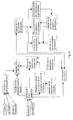
- the present invention provides a calculation method that will be used in conjunction with the aforementioned system, and that it is comprises the following steps:
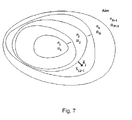
- IPHC isotropic piecewise homogeneous volume conductor
- c k ( r ) ⁇ j k ( r ), j k ( r , ⁇ c ) ⁇ .
- the (3 N j.j+1 ⁇ 1) vectors c j ⁇ and c i are formed by the evaluation of c j ⁇ ( r ) and c j ( r ) at the centers of mass of the triangles of the surface S j,j+1 .
- c k is a (3 N k ,k+1 ⁇ 1) vector built by the evaluation of in the centers of mass of the triangles of the surface S k,k +1 .
- the (3 N j.j +1 ⁇ 3 N k,k +1 ) matrix ⁇ jk contains the numerical evaluation of ⁇ n k r at the centers of masses of the triangles of the surface S j,j +1 .
- ⁇ j ⁇ k ⁇ 1 k r 1 j ⁇ ⁇ N k , k + 1 k r 1 j ⁇ ⁇ ⁇ ⁇ 1 k ⁇ r N j , j + 1 j ⁇ ⁇ N k , k + 1 k ⁇ r N j , j + 1 j
- the model comprises the following components:
- the estimation of all the parameters A , ⁇ A , F , ⁇ ⁇ , ⁇ E of the model will be carried out by the Maximum method a Posteriori (MAP) method.
- MAP Posteriori
- explicit estimators will exist. Otherwise the estimate will be obtained by one of the following iterative methods, taking as initial values those estimated of a simpler model or simply random values:
- the advantage of the formulation (20) is that it allows the combination, in a statistically optimal manner, of information provided by imaging modalities with different temporal and spatial resolution.
- the weight that should be assigned to each modality is obtained in an automatic. In particular, it is possible to find the optimal relative weights with which the EEG and MEG should be combined.
- the form of the likelihood is specified by means of the form of the Risk R
- ⁇ e m ⁇ ⁇ ln ⁇ I O m e m t
- This class of risks includes the norms (L p ) of order p>1 used previously: R x L p x
- ⁇ vech M ⁇ ⁇ ⁇ A , B n , s m ⁇ g ⁇ R 3 , ⁇ ⁇ ⁇ t ⁇ ⁇ ⁇ A , B n , s m ⁇ ⁇ R , ⁇ ⁇ such that compatibility is enforced with the cerebral activation A, and a functional smoothness predefined by a Besov space . Selecting in this case a Besov Space with index (1,1,s) leads to a Variable Resolution TPEC (VARETA). VARETA allows the estimation of both point source generators as well as distributed source generators in the same framework.
- VARETA VARETA
- the quantity of smoothness enforced in the solution be variable from one point to another inside the generating volume.
- This variable resolution allows spatially adaptive nonlinear estimates of the current sources that eliminate those "ghost” solutions present in the usual linear distributed solutions. It also allows the achievement of "super-resolution,” the capacity to distinguish discrete sources very near one to the other.
- Particular, but not exclusive realizations, of the a priori probabilities of the equation (26) are:
- test groups that represent different embodiments of this invention are:
- F -1 is the inverse Gaussian distribution function
- the resultant is a scale of probability corresponding to a univariate gaussian distribution. The advantage of this is that the user can make an evaluation without having to keep in mind the distribution type f or the corresponding degrees of freedom.
- One preferred, but non-exclusive, embodiment of this invention will be the TPECc in the frequency domain for the EEG.
- This embodiment is developed for situations in situations in which it is not convenient to obtain an individual MRI and therefore the use of Probabilistic Brain Atlas becomes necessary.
- the object of primary interest is the estimation of ⁇ J, ( ⁇ ) which is carried out by choosing the appropriate a priori probabilities.
- a J i ⁇ ⁇ k ⁇ ⁇ J i ⁇ ⁇ k ⁇ 1 ⁇ K t ⁇ K ⁇ ⁇ ⁇ J i k ⁇ 1 ⁇ K t + ⁇ E i ⁇ ⁇ 1 ⁇ S i 1 2 ⁇ 2.
- ⁇ ⁇ ⁇ J i ⁇ ⁇ k N seg ⁇ A J i ⁇ ⁇ k ⁇ A J i ⁇ ⁇ k + 1 ⁇ i 2 ⁇ ⁇ 2 G m + N seg
- the first term corresponds to the likelihood
- the second term ⁇ r 1 N seg j i ⁇ r ⁇ ⁇ t ⁇ ⁇ J i ⁇ 1 ⁇ ⁇ j i ⁇ r ⁇ , to the usual regularizing term with the hyperparameter matrix.
- Equation (28) is applied to each one of these descriptive parameters using the natural logarithm as T.
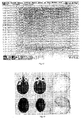
- Figure 10 a) the Z image of the TPECc in the frequency domain is shown, said image being obtained from a 27-year-old female patient for whom an astrocytoma in the left fronto-parietal region had been diagnosed.
- TCEPc Cerebrovascular accidents
- LCMA Left
- RCMA Right
- TCEPc the frequency domain and the CAT were applied to all patients.
- Examples of the obtained TPECc-FD are shown in Figure 11, there being a complete correspondence with the clinical diagnosis.
- Table1 all the results obtained are summarized.
- the CAT is to date the imaging method of election for evaluation of CVA in spite of its invasive nature.
- TPECc in the time domain.
- the method is used to identify activated cerebral regions and their functional connections when one has an individual anatomical brain atlas for the subject under study. Once the ⁇ ( x , t ) are estimated they are analyzed as non-linear time series.
- ⁇ t F ⁇ t q ⁇ t + ⁇ ⁇ t q ⁇ t
- ⁇ t q ⁇ t ⁇ k 1 ⁇ k ⁇ q is the matrix of pasts which constitutes the previous state of the Markovian system (q is the maximal order of the past included).
- Both the Autoregressive function F as well as the matrix of covariances, ⁇ ⁇ ⁇ t q ⁇ t of ⁇ ⁇ t q ⁇ t are dependent both on the previous state as well as on the time instant t, for which reason the model is also non-stationary and heteroscedastic.
- Both the Autoregressive function F as well as the matrix of covariances, ⁇ ⁇ ⁇ t q ⁇ t are estimated using non parametric methods (Hastie and Tibshirani, 1990) in the form of Splines (Wahba, 1990), local polynomials ( Fan J. and Gibjels. I., Local Polynomimal Modeling and its Applications.
- the estimate of F allows the calculation of estimates of Granger causality among generators of PEC by means of the following non-linear and non-stationary generalization of influence measures introduced by Geweke (1984).
- A, B and C as subsets (with an empty intersection) of the time series of that comprise ⁇ t .
- B . C as the one obtained from A when the influence of B is eliminated by non parametric regression conditional on C.
Landscapes
- Health & Medical Sciences (AREA)
- Life Sciences & Earth Sciences (AREA)
- Biomedical Technology (AREA)
- Molecular Biology (AREA)
- Veterinary Medicine (AREA)
- Biophysics (AREA)
- Pathology (AREA)
- Engineering & Computer Science (AREA)
- Public Health (AREA)
- Heart & Thoracic Surgery (AREA)
- Medical Informatics (AREA)
- Physics & Mathematics (AREA)
- Surgery (AREA)
- Animal Behavior & Ethology (AREA)
- General Health & Medical Sciences (AREA)
- Psychiatry (AREA)
- Psychology (AREA)
- Magnetic Resonance Imaging Apparatus (AREA)
- Measurement And Recording Of Electrical Phenomena And Electrical Characteristics Of The Living Body (AREA)
Abstract
Claims (16)
- Procédé d'obtention d'une Tomographie du Courant Electrique Primaire (CEP) à partir des signaux provenant du cerveau ou bien du coeur, par l'intermédiaire d'un réseau de capteurs électriques et biomagnétiques externes et d'un ensemble d'images anatomiques et médicales, le procédé comprenant les étapes qui consistent à :a) mesurer les signaux électriques et/ou magnétiques d'un sujet examiné à partir du réseau de capteurs, définir des observations pour un instant commun t, désigner respectivement l'EEG/ECG par o1(t) et le MEG/MCG par o2(t), obtenir en résultat une série de vecteurs temps définie sur l'intervalle de temps= [0, T] ;
 b) spécifier les coordonnées des capteurs du réseau de capteurs pour le sujet examiné par rapport au système de référence de la tête ou du torse, ledit ensemble de coordonnées étant respectivement désigné ℵ1 et ℵ2 pour l'EEG/ECG et pour le MEG/MCG ;c) sélectionner une image anatomique, soit une image du sujet examiné, soit une image de référence appropriée, et spécifier les coordonnées cartésiennes, dans le système de référence commun, de ses voxels constitutifs en tant que treillis du conducteur volumique
 d) spécifier pour chaque point rv de
 e) étiqueter chaque point rv du treillis du conducteur volumique avec le type de tissu ;f) spécifier pour chaque point rv du treillis du conducteur volumique
 g) sélectionner les points du Rv de génération afin de défmir l'ensemble
 h) calculer les matrices de champ électrique évoqué K1 et de champ magnétique évoqué K2, par les versions vectorielles de la Méthode des Eléments Finis (MEF) ou la Méthode des Différences Finies (MDF), ce pour un conducteur volumique non homogène et anisotrope, de telle sorte que, avec des σ, ℵ1, ℵ2,
 i) sélectionner, lorsqu'elles sont disponibles, une ou plusieurs des images des modalités fonctionnelles suivantes : la résonance magnétique fonctionnelle (IRMf), la tomographie par émission de positrons (TEP) et la tomographie par émission de photon unique (TEPU), en définissant les observations respectives o3(t), o4(t) et o5(t) comme étant celles du sujet examiné ou d'une certaine image de référence appropriée ;j) spécifier les positions des voxels en tant qu'ensemble de coordonnées cartésiennes, dans le système de référence commun, pour chaque image fonctionnelle sélectionnée, ledit ensemble de position étant respectivement désigné ℵ3, ℵ4, et ℵ5 pour les modalités IRMf, TEP et TEPU ;k) spécifier les instants auxquels chaque image fonctionnelle sélectionnée m a été échantillonnée, dans une échelle temporelle commune avec les modalités respectives IRMf, TEP et TEPU ;l) calculer le noyau Km qui exprime notre connaissance du fait que l'indicateur fonctionnel idéal fm(t), qui est associé à la mième modalité d'imagerie (m = 3, 4, 5), défini sur
 - réduit la résolution spatiale de fm(t) de celle de
 - réduit la résolution temporelle de fm(t) de celle des données électrophysiologiques (m = 1) à celle de l'une quelconque des autres modalités m ;m) calculer l'opérateur physiologique Hm qui exprime notre connaissance du fait que l'activation des tissus neuronaux ou cardiaques A(t) qui est définie sur
 n) calculer des estimations du CEP par estimation conjointe de tous les fm(t) et A(t) pour toutes les m observées, ladite estimation comprenant les étapes qui consistent à :i. attribuer des valeurs initiales arbitraires aux fm(t) et A(t) ;ii. modifier de manière itérative les valeurs de fm(t) et A(t) ;iii. calculer une mesure de probabilité p qui augmente lorsque les valeurs de fm(t) et A(t), simultanément :- permettent une reconstruction de om(t) avec une petite erreur telle que quantifiée par une fonction de risque ; et- ont une petite norme dans un espace de Besov donné ;iv. continuer l'étape ii jusqu'à ce que la mesure de p n'augmente plus ;o) calculer les paramètres descriptifs suivants :- γm(t) = fm(t), m = 1, 2, 3, 4, 5 et γ6(t) = A(t)): pour
 - une valeur I B→A/C qui quantifie l'influence dirigée de la région B du cerveau ou du coeur sur la région A, qui n'est pas due à l'activité provenant de la région C ;p) spécifier des groupes de référence de sujets pour lesquels les paramètres descriptifs ont été statistiquement résumés, et calculer :- les probabilités p(γm) que les paramètres descriptifs mesurés obtenus dans l'étape o pour le sujet examiné soient typiques d'un groupe de référence donné ;- les probabilités
 q) coder les valeurs de p(γm) et
- Procédé selon la revendication 1, dans lequel le système de référence commun est le système de coordonnées de Talairach.
- Procédé selon la revendication 1, dans lequel l'atlas anatomique est obtenu selon l'une des variantes suivantes :a) par l'extraction des probabilités des tissus depuis des images anatomiques obtenues pour le sujet spécifique étudié, ces images étant de l'un quelconque des types suivants : une tomodensitométrie (TDM), des images de résonance magnétique (IRM), des sections post-mortem de la tête obtenues par cryotomie, etc., ledit atlas étant appelé "Atlas Anatomique Individuel" ;b) par une transformation rigide ou élastique du treillis du conducteur volumique du sujet, afin de garantir la meilleure correspondance possible avec un treillis d'un conducteur volumique canonique, pour lequel une distribution des probabilités des tissus a été obtenue à partir d'un échantillon d'images anatomiques normales ou pathologiques, ledit atlas étant appelé "Atlas Anatomique Probabiliste".
- Procédé selon la revendication 1, dans lequel le calcul des matrices de champ électrique évoqué et de champ magnétique évoqué par les versions vectorielles de la Méthode des Eléments Finis (MEF) ou la Méthode des Différences Finies (MDF), pour un conducteur volumique non homogène et anisotrope, comprennent les étapes qui consistent à :a) spécifier les positions des capteurs pour le treillis des modalités EEG/ECG et MEG/MCG, respectivement ℵ1 et ℵ2, telles que définies dans l'étape b de la revendication 1 ;b) spécifier les positions rg et rv dans le treillis du volume de génération

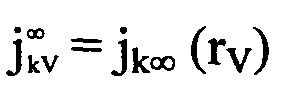
 c) spécifier le profil de conductivité, tel que défini dans l'étape g de la revendication 1, au moyen d'une approximation, de telle sorte que chaque ensemble d'étiquettes de tissus constitue une collection de régions incluses N pour lesquelles la valeur de conductivité est constante, σ = {σ1, ..., σN} ;d) calculer numériquement les densités de courants ohmiques jkV = jk (rv) et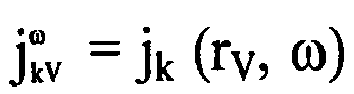

 e)
e)
 f) où
f) où


 g)
g) h)
h) i) la fonction
 j) calculer le champ électrique évoqué et le champ magnétique évoqué dans chaque compartiment d'un IPHC au moyen des théorèmes de réciprocité :

 k) le champ électrique évoqué :
 l) le champ magnétique évoqué :
 m) calculer les matrices de champ électrique évoqué


- Procédé selon la revendication 1, dans lequel le calcul de l'opérateur de noyau Km est spécifié comme étant dans la résolution spatiale et temporelle associée à la mième modalité d'imagerie (i = 3, 4, 5).
- Procédé selon la revendication 1, dans lequel l'estimation du CEP f1(t) pour un sujet donné comprend les étapes qui consistent à :a) attribuer des valeurs initiales aux ensembles de variables suivants :1. l'activation des tissus

 2. les indicateurs fonctionnels
 3. l'hyperparamètre de l'activation ΘA ;4. l'hyperparamètre du bruit intrinsèque des indicateurs fonctionnels Θβ = [Θβ
m ]1≤m≤M ;5. l'hyperparamètre du bruit des instruments Θe = [Θem ]1≤m≤M ;b) calculer la probabilité a posteriori : 1) les termes de vraisemblance lo
m pour chaque modalité m 2) les probabilités a priori pour les indicateurs fonctionnels
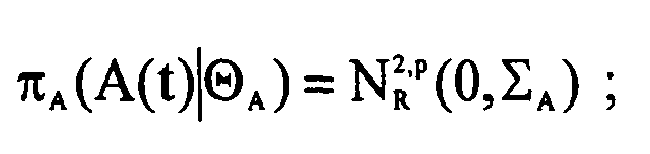
 3) la probabilité a priori pour l'activation πA(A(t)|ΘA)4) la probabilité a priori pour les hyperparamètres de l'activation πΘ
A (ΘA)5) les probabilités a priori pour les hyperparamètres du bruit intrinsèque des indicateurs fonctionnels 6) les probabilités a priori pour les hyperparamètres du bruit des instruments
 c) modifier de manière itérative les paramètres A(t), ΘA, f(t), Θβ, Θe jusqu'à ce qu'une valeur maximale de la probabilité a posteriori soit obtenue, ladite modification étant effectuée selon l'un des mécanismes suivants :1. Maximisations successives de P(A(t),ΘA,f(t),Θβ,Θe|o(t)) pour des sous-ensembles de paramètres, tout en maintenant tous les autres fixes, "Maximisation Conditionnelle par Itérations" (MCI) ;2. Maximisations successives de P(A(t),ΘA,f(t),Θβ,Θe|0(t)) pour des sous-ensembles de paramètres, en fixant les autres paramètres à leur valeur espérée, "Maximisation par Espérances" (ME) ;3. Choix du mode de distribution de P(A(t),ΘA,f(t),Θβ,Θe|o(t)) obtenu au moyen des méthode Monte Carlo par Chaînes de Markov (MCCM).
 - Procédé selon la revendication 6, dans lequel les observations électrophysiologiques om(t) m = 1, 2 pour l'estimation de f1(t) comprennent l'une quelconque des combinaisons suivantes : EEG seul, MEG seul, EEG et MEG ensemble.
- Procédé selon la revendication 6, dans lequel :- soit aucune des images fonctionnelles om(t) m = 3, 4, 5 n'est utilisée pour l'estimation de f1(t), soit, d'une autre manière,- certaines de ces mesures sont utilisées dans l'une quelconque des combinaisons suivantes : IRMf seule, TEP seule, TEPU seule, IRMf et TEPU, IRMf et TEPU, TEP et TEPU.
- Procédé selon la revendication 6, dans lequel le calcul des vraisemblances lo
m (om(t) - Km * fm(t)|Θem ) comprend les étapes consistant à:a) sélectionner l'utilisation d'un risque polynomial insensible ε ou bien d'un risque polynomial généralisé Rx[x|Θx] dans le but spécifique d'évaluer des vraisemblances non gaussiennes ;b) calculer le vecteur de divergence Δ = om(t) - Km * fm(t) ;c) remettre le Δ à l'échelle en fonction des hyperparamètres Θem ;d) calculer e) calculer
- Procédé selon la revendication 6, dans lequel le calcul de la probabilité a priori πf
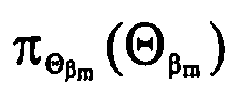
m (fm(t)-Hm ∘ A(t)|Θβm ) pour les indicateurs fonctionnels comprend les étapes qui consistent à :a) sélectionner les indices m, n, s de l'espace de Besov b) calculer le vecteur divergence Δ = fm(t) - Hm ∘ A(t) ;c) remettre le Δ à l'échelle en fonction des hyperparamètres Θβ
m ;d) calculer

ledit calcul étant effectué tout d'abord par développement de Δ sous la forme de
 e) calculer
- Procédé selon la revendication 6, dans lequel le calcul de la probabilité a priori de l'activation πA(A(t)|ΘA) comprend les étapes qui consistent à :a) calculer une fonction non décroissante h(□) de l'atlas probabiliste h(pg);b) calculer la norme
 c) calculer
- Procédé selon la revendication 6, dans lequel la probabilité a priori pour le CEP prend la forme spécifique suivante :


- Procédé selon la revendication 6, dans lequel la probabilité a priori π2(µ|Θ2) définie dans la revendication 12 est calculée par l'une ou l'autre des expressions suivantes :-

 - au moyen d'évaluations successives des distributions marginales de


- Procédé selon la revendication 6, dans lequel les calculs sont effectués pour o1(t) et/ou o2(t), dans le domaine fréquentiel, par spécification :- du fait que les signaux électriques ont été soumis à la transformée de Fourier, t désignant maintenant la fréquence ;
 -
- -
- -
- -
-

- Procédé selon la revendication 1, dans lequel le calcul de l'élément IB→A/C qui quantifie l'influence dirigée de la région B du cerveau ou du coeur sur la région A, qui n'est pas due à l'activité provenant de la région C, comprend les étapes qui consistent à :a) définir les régions A, B, C sous la forme d'ensembles de voxels arbitraires
 b) définir, pour toute modalité d'imagerie donnée m, la matrice de passage
 c) calculer les résidus

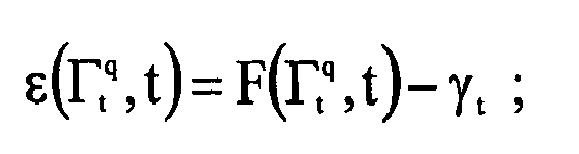 d) calculer la matrice
 e) calculer la matrice Σγ(Γt q, t; A|B.C) sous la forme de la covariance des résidus du modèle autorégressif non paramétrique sur l'ensemble constitué de l'union des régions A et C, sans la région B ;f) calculer l'influence de la région A sur la région B lorsque l'influence de la région C est éliminée, sous la forme de l'expression :

- Procédé défini dans la revendication 1, dans lequel les calculs mis en jeu comprennent les étapes consistant à :a) spécifier des groupes de sujets de référence pour lesquels des paramètres descriptifs γm(t) ont été obtenus et pour lesquels certaines covariantes ont été mesurées ; lesdites covariantes (dont un exemple spécifique mais non exclusif est l'âge) étant désignées par ω̅ ;b) transformer, vers la gaussianité, les paramètres descriptifs du sujet examiné ainsi que ceux des sujets des groupes de référence au moyen de l'expression : γ'm(t) = T(γm(t)), dans laquelle les paramètres descriptifs γm(t) sont transformés par une fonction non linéaire T pour donner le vecteur γ'm(t) ;c) calculer la moyenne conditionnelle µ(γ'm ; ω̅) et la variance conditionnelle σ(γ'm; ω̅) de chaque paramètre descriptif sous la forme d'une fonction des paramètres de réglage ω̅, dans chaque groupe de référence, au moyen d'une régression non paramétrique ;d) calculer la transformée z de chaque paramètre descriptif au moyen de l'expression :

 e) calculer les probabilités que zmax et zmin, les valeurs maximale et minimale de z dans une région d'intérêt C, excèdent respectivement des valeurs seuil Umax, Umin ; lesdits seuils Umax, Umin étant respectivement des seuils choisis en fonction de connaissances antérieures ;f) calculer les quantités transformées suivantes :
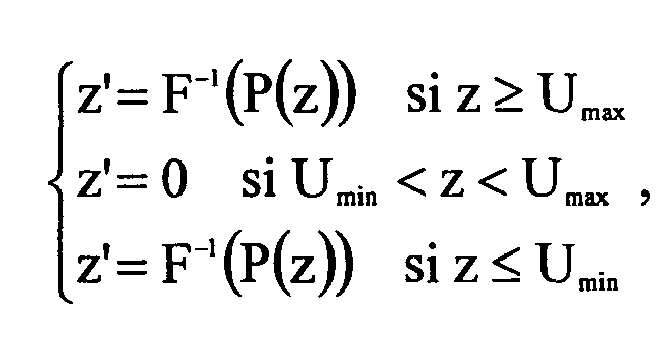 g) afficher les courbes z, définies sur des graphes dimensionnels de z' tracés pour un point fixe du treillis de génération
afficher les valeurs z' sous la forme d'images bidimensionnelles ou tridimensionnelles pour un instant fixe ou une fréquence fixe, ladite image étant appelée "image z" de la tomographie du CEP, l'image étant rendue selon un code couleur qui indique le degré de déviation des valeurs par rapport aux groups de référence, ladite image étant superposée sur un atlas anatomique, qui constitue l'arrière-plan de l'image.
Applications Claiming Priority (3)
| Application Number | Priority Date | Filing Date | Title |
|---|---|---|---|
| CU8797 | 1997-08-22 | ||
| CU1997087A CU22550A1 (es) | 1997-08-22 | 1997-08-22 | Sistema y método para la tomografía de la corriente eléctrica primaria del cerebro y del corazón |
| PCT/CU1998/000006 WO1999010816A1 (fr) | 1997-08-22 | 1998-08-24 | Systeme et procede pour la tomographie du courant electrique primaire du cerveau et du coeur |
Publications (3)
| Publication Number | Publication Date |
|---|---|
| EP1005677A1 EP1005677A1 (fr) | 2000-06-07 |
| EP1005677B1 EP1005677B1 (fr) | 2006-10-04 |
| EP1005677B9 true EP1005677B9 (fr) | 2007-12-26 |
Family
ID=5459328
Family Applications (1)
| Application Number | Title | Priority Date | Filing Date |
|---|---|---|---|
| EP98941221A Expired - Lifetime EP1005677B9 (fr) | 1997-08-22 | 1998-08-24 | Systeme et procede pour la tomographie du courant electrique primaire du cerveau et du coeur |
Country Status (12)
| Country | Link |
|---|---|
| EP (1) | EP1005677B9 (fr) |
| JP (1) | JP4414591B2 (fr) |
| AR (1) | AR016854A1 (fr) |
| AT (1) | ATE341790T1 (fr) |
| CA (1) | CA2301712C (fr) |
| CO (1) | CO4790140A1 (fr) |
| CU (1) | CU22550A1 (fr) |
| DE (1) | DE69836086T8 (fr) |
| DK (1) | DK1005677T3 (fr) |
| ES (1) | ES2274576T4 (fr) |
| PT (1) | PT1005677E (fr) |
| WO (1) | WO1999010816A1 (fr) |
Cited By (1)
| Publication number | Priority date | Publication date | Assignee | Title |
|---|---|---|---|---|
| WO2022187388A1 (fr) * | 2021-03-03 | 2022-09-09 | Lvis Corporation | Systèmes, procédés et appareils d'analyse de données d'activité neurologique |
Families Citing this family (10)
| Publication number | Priority date | Publication date | Assignee | Title |
|---|---|---|---|---|
| US6622036B1 (en) * | 2000-02-09 | 2003-09-16 | Cns Response | Method for classifying and treating physiologic brain imbalances using quantitative EEG |
| US8150497B2 (en) | 2006-09-08 | 2012-04-03 | Medtronic, Inc. | System for navigating a planned procedure within a body |
| US8160677B2 (en) | 2006-09-08 | 2012-04-17 | Medtronic, Inc. | Method for identification of anatomical landmarks |
| US8150498B2 (en) | 2006-09-08 | 2012-04-03 | Medtronic, Inc. | System for identification of anatomical landmarks |
| US8160676B2 (en) | 2006-09-08 | 2012-04-17 | Medtronic, Inc. | Method for planning a surgical procedure |
| US11103174B2 (en) | 2013-11-13 | 2021-08-31 | Biosense Webster (Israel) Ltd. | Reverse ECG mapping |
| CN109753754B (zh) * | 2019-01-22 | 2023-03-24 | 国网浙江省电力有限公司电力科学研究院 | 一种基于希红诺夫正则化的发电机动态参数在线辨识方法 |
| CN110610458B (zh) * | 2019-04-30 | 2023-10-20 | 北京联合大学 | 一种基于岭回归的gan图像增强交互处理方法及系统 |
| CN110390724B (zh) * | 2019-07-12 | 2023-06-02 | 杭州凌像科技有限公司 | 一种带有实例分割的slam方法 |
| JP7585655B2 (ja) * | 2019-10-30 | 2024-11-19 | 株式会社リコー | 波形発生特定方法およびプログラム |
Family Cites Families (2)
| Publication number | Priority date | Publication date | Assignee | Title |
|---|---|---|---|---|
| JPH0542116A (ja) * | 1991-08-13 | 1993-02-23 | Hitachi Ltd | 生体表面電位分布から生体内電流分布を推定する信号処理方法 |
| US5370126A (en) * | 1992-01-22 | 1994-12-06 | Neurotech, Inc. | Method and apparatus for three-dimensional mapping of evoked potentials |
-
1997
- 1997-08-22 CU CU1997087A patent/CU22550A1/es unknown
-
1998
- 1998-08-21 AR ARP980104151A patent/AR016854A1/es active IP Right Grant
- 1998-08-21 CO CO98047931A patent/CO4790140A1/es unknown
- 1998-08-24 AT AT98941221T patent/ATE341790T1/de active
- 1998-08-24 PT PT98941221T patent/PT1005677E/pt unknown
- 1998-08-24 DK DK98941221T patent/DK1005677T3/da active
- 1998-08-24 JP JP2000508064A patent/JP4414591B2/ja not_active Expired - Fee Related
- 1998-08-24 CA CA002301712A patent/CA2301712C/fr not_active Expired - Fee Related
- 1998-08-24 ES ES98941221T patent/ES2274576T4/es not_active Expired - Lifetime
- 1998-08-24 DE DE69836086T patent/DE69836086T8/de active Active
- 1998-08-24 WO PCT/CU1998/000006 patent/WO1999010816A1/fr not_active Ceased
- 1998-08-24 EP EP98941221A patent/EP1005677B9/fr not_active Expired - Lifetime
Cited By (1)
| Publication number | Priority date | Publication date | Assignee | Title |
|---|---|---|---|---|
| WO2022187388A1 (fr) * | 2021-03-03 | 2022-09-09 | Lvis Corporation | Systèmes, procédés et appareils d'analyse de données d'activité neurologique |
Also Published As
| Publication number | Publication date |
|---|---|
| DE69836086T8 (de) | 2008-04-03 |
| DE69836086T2 (de) | 2007-11-22 |
| EP1005677A1 (fr) | 2000-06-07 |
| EP1005677B1 (fr) | 2006-10-04 |
| JP2001514031A (ja) | 2001-09-11 |
| CO4790140A1 (es) | 1999-05-31 |
| WO1999010816A1 (fr) | 1999-03-04 |
| AR016854A1 (es) | 2001-08-01 |
| CA2301712A1 (fr) | 1999-03-04 |
| DE69836086D1 (de) | 2006-11-16 |
| JP4414591B2 (ja) | 2010-02-10 |
| PT1005677E (pt) | 2007-01-31 |
| ATE341790T1 (de) | 2006-10-15 |
| ES2274576T3 (es) | 2007-05-16 |
| CU22550A1 (es) | 1999-03-31 |
| DK1005677T3 (da) | 2007-02-05 |
| ES2274576T4 (es) | 2008-04-16 |
| CA2301712C (fr) | 2009-12-22 |
Similar Documents
| Publication | Publication Date | Title |
|---|---|---|
| US7092748B2 (en) | System and method for the tomography of the primary electric current of the brain and of the heart | |
| Samuelsson et al. | Spatial fidelity of MEG/EEG source estimates: A general evaluation approach | |
| EP1049402B1 (fr) | Procede servant a mesurer, a evaluer et a afficher des cartes de densite de courant de valeur efficace | |
| Phillips et al. | Imaging neural activity using MEG and EEG | |
| US6697660B1 (en) | Method for functional brain imaging from magnetoencephalographic data by estimation of source signal-to-noise ratio | |
| US8032209B2 (en) | Localizing neural sources in a brain | |
| EP0504027A2 (fr) | Méthode et dispositif pour la tomographie à trois dimensions de l'activité et de l'étendue des connexions des générateurs électromagnétiques dans le cerveau et le coeur | |
| Liu et al. | Bayesian electromagnetic spatio-temporal imaging of extended sources based on matrix factorization | |
| Im et al. | Spatial resolution of EEG cortical source imaging revealed by localization of retinotopic organization in human primary visual cortex | |
| Darvas et al. | Investigations of dipole localization accuracy in MEG using the bootstrap | |
| EP1005677B9 (fr) | Systeme et procede pour la tomographie du courant electrique primaire du cerveau et du coeur | |
| van't Ent et al. | A fast method to derive realistic BEM models for E/MEG source reconstruction | |
| Ding et al. | Low resolution brain electromagnetic tomography in a realistic geometry head model: a simulation study | |
| He et al. | Electrophysiological mapping and source imaging | |
| Li et al. | Source extent estimation in OPM-MEG: A two-stage Champagne approach | |
| Halchenko et al. | Multimodal integration: fMRI, mri, EEG, MEG | |
| Ustinin et al. | Functional tomography of complex systems using spectral analysis of multichannel measurement data | |
| George et al. | Anatomical constraints for neuromagnetic source models | |
| Pascarella et al. | An inversion method based on random sampling for real-time MEG neuroimaging | |
| Ramírez et al. | Neuroelectromagnetic source imaging of brain dynamics | |
| Sohrabpour et al. | Estimating underlying neuronal activity from EEG using an iterative sparse technique | |
| US20250169739A1 (en) | Reconstruction of brain electrical activity using spatially resolved electroencephalography | |
| Valdés-Sosa et al. | The statistical analysis of brain images | |
| Hasson et al. | A Bayesian test for the appropriateness of a model in the biomagnetic inverse problem | |
| Aburidi et al. | Normalized Cumulative Periodogram Method For Tuning A Regularization Parameter of The EEG Inverse Problem |
Legal Events
| Date | Code | Title | Description |
|---|---|---|---|
| PUAI | Public reference made under article 153(3) epc to a published international application that has entered the european phase |
Free format text: ORIGINAL CODE: 0009012 |
|
| 17P | Request for examination filed |
Effective date: 20000222 |
|
| AK | Designated contracting states |
Kind code of ref document: A1 Designated state(s): AT BE CH CY DE DK ES FI FR GB GR IE IT LI LU MC NL PT SE |
|
| RIN1 | Information on inventor provided before grant (corrected) |
Inventor name: SOLER MCCOOK, JORGE MIGUEL Inventor name: FUENTES MONTERO, MARIA ELENA CALLE 30 NO. 773 Inventor name: TRUJILLO BARRETO, NELSON JESUS Inventor name: MORALES AGUILERA, FRANK APARTAMENTO D Inventor name: VIRUES ALBA, CALLE 39, NO.273, APTO.3M, Inventor name: AUBERT VAZQUEZ, EDUARDO FRANCISCO Inventor name: BOSCH BAYARD, JORGE FRANCISCO EDIFICIO 131 Inventor name: VALDES SOSA, PEDRO ANTONIO |
|
| 17Q | First examination report despatched |
Effective date: 20010307 |
|
| GRAP | Despatch of communication of intention to grant a patent |
Free format text: ORIGINAL CODE: EPIDOSNIGR1 |
|
| GRAS | Grant fee paid |
Free format text: ORIGINAL CODE: EPIDOSNIGR3 |
|
| GRAA | (expected) grant |
Free format text: ORIGINAL CODE: 0009210 |
|
| AK | Designated contracting states |
Kind code of ref document: B1 Designated state(s): AT BE CH CY DE DK ES FI FR GB GR IE IT LI LU MC NL PT SE |
|
| REG | Reference to a national code |
Ref country code: GB Ref legal event code: FG4D |
|
| REG | Reference to a national code |
Ref country code: CH Ref legal event code: EP |
|
| REG | Reference to a national code |
Ref country code: IE Ref legal event code: FG4D |
|
| REF | Corresponds to: |
Ref document number: 69836086 Country of ref document: DE Date of ref document: 20061116 Kind code of ref document: P |
|
| REG | Reference to a national code |
Ref country code: GR Ref legal event code: EP Ref document number: 20060404483 Country of ref document: GR |
|
| REG | Reference to a national code |
Ref country code: SE Ref legal event code: TRGR |
|
| REG | Reference to a national code |
Ref country code: PT Ref legal event code: SC4A Free format text: AVAILABILITY OF NATIONAL TRANSLATION Effective date: 20061221 |
|
| REG | Reference to a national code |
Ref country code: DK Ref legal event code: T3 |
|
| ET | Fr: translation filed | ||
| REG | Reference to a national code |
Ref country code: ES Ref legal event code: FG2A Ref document number: 2274576 Country of ref document: ES Kind code of ref document: T3 |
|
| PLBE | No opposition filed within time limit |
Free format text: ORIGINAL CODE: 0009261 |
|
| STAA | Information on the status of an ep patent application or granted ep patent |
Free format text: STATUS: NO OPPOSITION FILED WITHIN TIME LIMIT |
|
| 26N | No opposition filed |
Effective date: 20070705 |
|
| REG | Reference to a national code |
Ref country code: SE Ref legal event code: RPOT |
|
| NLR4 | Nl: receipt of corrected translation in the netherlands language at the initiative of the proprietor of the patent | ||
| PG25 | Lapsed in a contracting state [announced via postgrant information from national office to epo] |
Ref country code: CY Free format text: LAPSE BECAUSE OF NON-PAYMENT OF DUE FEES Effective date: 20070315 |
|
| PGFP | Annual fee paid to national office [announced via postgrant information from national office to epo] |
Ref country code: NL Payment date: 20100831 Year of fee payment: 13 Ref country code: MC Payment date: 20100914 Year of fee payment: 13 Ref country code: IE Payment date: 20100831 Year of fee payment: 13 Ref country code: ES Payment date: 20100923 Year of fee payment: 13 Ref country code: CH Payment date: 20100915 Year of fee payment: 13 |
|
| PGFP | Annual fee paid to national office [announced via postgrant information from national office to epo] |
Ref country code: SE Payment date: 20100831 Year of fee payment: 13 Ref country code: LU Payment date: 20100902 Year of fee payment: 13 Ref country code: IT Payment date: 20100831 Year of fee payment: 13 Ref country code: FR Payment date: 20100921 Year of fee payment: 13 Ref country code: FI Payment date: 20100831 Year of fee payment: 13 Ref country code: DE Payment date: 20100913 Year of fee payment: 13 Ref country code: AT Payment date: 20100914 Year of fee payment: 13 |
|
| PGFP | Annual fee paid to national office [announced via postgrant information from national office to epo] |
Ref country code: GR Payment date: 20100831 Year of fee payment: 13 Ref country code: GB Payment date: 20100921 Year of fee payment: 13 |
|
| PGFP | Annual fee paid to national office [announced via postgrant information from national office to epo] |
Ref country code: PT Payment date: 20100910 Year of fee payment: 13 Ref country code: DK Payment date: 20100913 Year of fee payment: 13 |
|
| PGFP | Annual fee paid to national office [announced via postgrant information from national office to epo] |
Ref country code: BE Payment date: 20100913 Year of fee payment: 13 |
|
| BERE | Be: lapsed |
Owner name: CENTRO NACIONAL DE INVESTIGACIONES CIENTIFICAS Effective date: 20110831 |
|
| REG | Reference to a national code |
Ref country code: PT Ref legal event code: MM4A Free format text: LAPSE DUE TO NON-PAYMENT OF FEES Effective date: 20120224 |
|
| REG | Reference to a national code |
Ref country code: NL Ref legal event code: V1 Effective date: 20120301 |
|
| PG25 | Lapsed in a contracting state [announced via postgrant information from national office to epo] |
Ref country code: MC Free format text: LAPSE BECAUSE OF NON-PAYMENT OF DUE FEES Effective date: 20110831 |
|
| REG | Reference to a national code |
Ref country code: CH Ref legal event code: PL |
|
| REG | Reference to a national code |
Ref country code: SE Ref legal event code: EUG |
|
| GBPC | Gb: european patent ceased through non-payment of renewal fee |
Effective date: 20110824 |
|
| REG | Reference to a national code |
Ref country code: GR Ref legal event code: ML Ref document number: 20060404483 Country of ref document: GR Effective date: 20120302 |
|
| PG25 | Lapsed in a contracting state [announced via postgrant information from national office to epo] |
Ref country code: CH Free format text: LAPSE BECAUSE OF NON-PAYMENT OF DUE FEES Effective date: 20110831 Ref country code: LI Free format text: LAPSE BECAUSE OF NON-PAYMENT OF DUE FEES Effective date: 20110831 |
|
| REG | Reference to a national code |
Ref country code: DK Ref legal event code: EBP |
|
| REG | Reference to a national code |
Ref country code: FR Ref legal event code: ST Effective date: 20120430 |
|
| REG | Reference to a national code |
Ref country code: IE Ref legal event code: MM4A |
|
| PG25 | Lapsed in a contracting state [announced via postgrant information from national office to epo] |
Ref country code: FI Free format text: LAPSE BECAUSE OF NON-PAYMENT OF DUE FEES Effective date: 20110824 Ref country code: NL Free format text: LAPSE BECAUSE OF NON-PAYMENT OF DUE FEES Effective date: 20120301 Ref country code: GR Free format text: LAPSE BECAUSE OF NON-PAYMENT OF DUE FEES Effective date: 20120302 Ref country code: PT Free format text: LAPSE BECAUSE OF NON-PAYMENT OF DUE FEES Effective date: 20120224 Ref country code: IT Free format text: LAPSE BECAUSE OF NON-PAYMENT OF DUE FEES Effective date: 20110824 Ref country code: BE Free format text: LAPSE BECAUSE OF NON-PAYMENT OF DUE FEES Effective date: 20110831 |
|
| REG | Reference to a national code |
Ref country code: DE Ref legal event code: R119 Ref document number: 69836086 Country of ref document: DE Effective date: 20120301 |
|
| PG25 | Lapsed in a contracting state [announced via postgrant information from national office to epo] |
Ref country code: IE Free format text: LAPSE BECAUSE OF NON-PAYMENT OF DUE FEES Effective date: 20110824 Ref country code: DK Free format text: LAPSE BECAUSE OF NON-PAYMENT OF DUE FEES Effective date: 20110831 |
|
| PG25 | Lapsed in a contracting state [announced via postgrant information from national office to epo] |
Ref country code: GB Free format text: LAPSE BECAUSE OF NON-PAYMENT OF DUE FEES Effective date: 20110824 Ref country code: FR Free format text: LAPSE BECAUSE OF NON-PAYMENT OF DUE FEES Effective date: 20110831 |
|
| REG | Reference to a national code |
Ref country code: AT Ref legal event code: MM01 Ref document number: 341790 Country of ref document: AT Kind code of ref document: T Effective date: 20110824 |
|
| PG25 | Lapsed in a contracting state [announced via postgrant information from national office to epo] |
Ref country code: AT Free format text: LAPSE BECAUSE OF NON-PAYMENT OF DUE FEES Effective date: 20110824 |
|
| PG25 | Lapsed in a contracting state [announced via postgrant information from national office to epo] |
Ref country code: SE Free format text: LAPSE BECAUSE OF NON-PAYMENT OF DUE FEES Effective date: 20110825 |
|
| PG25 | Lapsed in a contracting state [announced via postgrant information from national office to epo] |
Ref country code: LU Free format text: LAPSE BECAUSE OF NON-PAYMENT OF DUE FEES Effective date: 20110824 |
|
| REG | Reference to a national code |
Ref country code: ES Ref legal event code: FD2A Effective date: 20130531 |
|
| PG25 | Lapsed in a contracting state [announced via postgrant information from national office to epo] |
Ref country code: DE Free format text: LAPSE BECAUSE OF NON-PAYMENT OF DUE FEES Effective date: 20120301 |
|
| PG25 | Lapsed in a contracting state [announced via postgrant information from national office to epo] |
Ref country code: ES Free format text: LAPSE BECAUSE OF NON-PAYMENT OF DUE FEES Effective date: 20110825 |