EP1006089B1 - Kristalline optische Infrarotfaser - Google Patents
Kristalline optische Infrarotfaser Download PDFInfo
- Publication number
- EP1006089B1 EP1006089B1 EP99124876A EP99124876A EP1006089B1 EP 1006089 B1 EP1006089 B1 EP 1006089B1 EP 99124876 A EP99124876 A EP 99124876A EP 99124876 A EP99124876 A EP 99124876A EP 1006089 B1 EP1006089 B1 EP 1006089B1
- Authority
- EP
- European Patent Office
- Prior art keywords
- fiber
- core
- optical fiber
- preform
- extrusion
- Prior art date
- Legal status (The legal status is an assumption and is not a legal conclusion. Google has not performed a legal analysis and makes no representation as to the accuracy of the status listed.)
- Expired - Lifetime
Links
- 239000013307 optical fiber Substances 0.000 title claims description 12
- 239000000835 fiber Substances 0.000 claims description 73
- 238000005253 cladding Methods 0.000 claims description 21
- 229910052709 silver Inorganic materials 0.000 claims description 20
- 239000004332 silver Substances 0.000 claims description 20
- -1 silver halide Chemical class 0.000 claims description 20
- 239000000463 material Substances 0.000 claims description 9
- 229920000642 polymer Polymers 0.000 claims description 8
- 229910052751 metal Inorganic materials 0.000 claims description 7
- 239000002184 metal Substances 0.000 claims description 7
- 239000006104 solid solution Substances 0.000 claims description 6
- 229910052793 cadmium Inorganic materials 0.000 claims description 5
- 229910052745 lead Inorganic materials 0.000 claims description 5
- 150000001768 cations Chemical class 0.000 claims description 4
- 230000003247 decreasing effect Effects 0.000 claims description 4
- 239000002019 doping agent Substances 0.000 claims description 4
- 229910052753 mercury Inorganic materials 0.000 claims description 4
- 229910052788 barium Inorganic materials 0.000 claims description 3
- 229910052794 bromium Inorganic materials 0.000 claims description 3
- 229910052791 calcium Inorganic materials 0.000 claims description 3
- 229910052801 chlorine Inorganic materials 0.000 claims description 3
- 229910052740 iodine Inorganic materials 0.000 claims description 3
- 229910052749 magnesium Inorganic materials 0.000 claims description 3
- 229910052712 strontium Inorganic materials 0.000 claims description 3
- 229910052792 caesium Inorganic materials 0.000 claims description 2
- 229910052744 lithium Inorganic materials 0.000 claims description 2
- 229910052700 potassium Inorganic materials 0.000 claims description 2
- 229910052701 rubidium Inorganic materials 0.000 claims description 2
- 229910052708 sodium Inorganic materials 0.000 claims description 2
- 229910052727 yttrium Inorganic materials 0.000 claims description 2
- 230000002093 peripheral effect Effects 0.000 claims 1
- 238000001125 extrusion Methods 0.000 description 30
- 238000000034 method Methods 0.000 description 28
- 230000008569 process Effects 0.000 description 13
- 230000007547 defect Effects 0.000 description 9
- 230000005540 biological transmission Effects 0.000 description 8
- 239000013078 crystal Substances 0.000 description 7
- 230000003287 optical effect Effects 0.000 description 5
- 230000005855 radiation Effects 0.000 description 5
- 230000015572 biosynthetic process Effects 0.000 description 4
- 238000011109 contamination Methods 0.000 description 4
- 239000007789 gas Substances 0.000 description 4
- 239000007788 liquid Substances 0.000 description 4
- 239000000314 lubricant Substances 0.000 description 4
- 238000009792 diffusion process Methods 0.000 description 3
- 150000004820 halides Chemical class 0.000 description 3
- 238000004519 manufacturing process Methods 0.000 description 3
- ADZWSOLPGZMUMY-UHFFFAOYSA-M silver bromide Chemical compound [Ag]Br ADZWSOLPGZMUMY-UHFFFAOYSA-M 0.000 description 3
- HKZLPVFGJNLROG-UHFFFAOYSA-M silver monochloride Chemical compound [Cl-].[Ag+] HKZLPVFGJNLROG-UHFFFAOYSA-M 0.000 description 3
- XKRFYHLGVUSROY-UHFFFAOYSA-N Argon Chemical compound [Ar] XKRFYHLGVUSROY-UHFFFAOYSA-N 0.000 description 2
- XUIMIQQOPSSXEZ-UHFFFAOYSA-N Silicon Chemical compound [Si] XUIMIQQOPSSXEZ-UHFFFAOYSA-N 0.000 description 2
- BQCADISMDOOEFD-UHFFFAOYSA-N Silver Chemical compound [Ag] BQCADISMDOOEFD-UHFFFAOYSA-N 0.000 description 2
- 229910021607 Silver chloride Inorganic materials 0.000 description 2
- 229910052783 alkali metal Inorganic materials 0.000 description 2
- 150000001340 alkali metals Chemical class 0.000 description 2
- 238000005452 bending Methods 0.000 description 2
- 230000008901 benefit Effects 0.000 description 2
- 239000000460 chlorine Substances 0.000 description 2
- 239000011248 coating agent Substances 0.000 description 2
- 238000000576 coating method Methods 0.000 description 2
- 239000000084 colloidal system Substances 0.000 description 2
- 239000012530 fluid Substances 0.000 description 2
- 239000012535 impurity Substances 0.000 description 2
- 239000011159 matrix material Substances 0.000 description 2
- 239000000203 mixture Substances 0.000 description 2
- 239000003921 oil Substances 0.000 description 2
- 239000004033 plastic Substances 0.000 description 2
- 229920003023 plastic Polymers 0.000 description 2
- 238000001953 recrystallisation Methods 0.000 description 2
- 229910052710 silicon Inorganic materials 0.000 description 2
- 239000010703 silicon Substances 0.000 description 2
- ZCYVEMRRCGMTRW-UHFFFAOYSA-N 7553-56-2 Chemical compound [I] ZCYVEMRRCGMTRW-UHFFFAOYSA-N 0.000 description 1
- WKBOTKDWSSQWDR-UHFFFAOYSA-N Bromine atom Chemical compound [Br] WKBOTKDWSSQWDR-UHFFFAOYSA-N 0.000 description 1
- ZAMOUSCENKQFHK-UHFFFAOYSA-N Chlorine atom Chemical compound [Cl] ZAMOUSCENKQFHK-UHFFFAOYSA-N 0.000 description 1
- 238000004566 IR spectroscopy Methods 0.000 description 1
- 239000004698 Polyethylene Substances 0.000 description 1
- FOIXSVOLVBLSDH-UHFFFAOYSA-N Silver ion Chemical compound [Ag+] FOIXSVOLVBLSDH-UHFFFAOYSA-N 0.000 description 1
- 238000010521 absorption reaction Methods 0.000 description 1
- 239000003513 alkali Substances 0.000 description 1
- 229910052786 argon Inorganic materials 0.000 description 1
- 230000004888 barrier function Effects 0.000 description 1
- 239000002585 base Substances 0.000 description 1
- GDTBXPJZTBHREO-UHFFFAOYSA-N bromine Substances BrBr GDTBXPJZTBHREO-UHFFFAOYSA-N 0.000 description 1
- 230000000052 comparative effect Effects 0.000 description 1
- 150000001875 compounds Chemical class 0.000 description 1
- 238000007796 conventional method Methods 0.000 description 1
- 238000001816 cooling Methods 0.000 description 1
- 229910052802 copper Inorganic materials 0.000 description 1
- 239000010949 copper Substances 0.000 description 1
- 230000007812 deficiency Effects 0.000 description 1
- 230000001419 dependent effect Effects 0.000 description 1
- 238000009826 distribution Methods 0.000 description 1
- 230000000694 effects Effects 0.000 description 1
- 230000007613 environmental effect Effects 0.000 description 1
- 230000003631 expected effect Effects 0.000 description 1
- 230000002349 favourable effect Effects 0.000 description 1
- 238000007380 fibre production Methods 0.000 description 1
- 239000002657 fibrous material Substances 0.000 description 1
- 238000005755 formation reaction Methods 0.000 description 1
- 239000011261 inert gas Substances 0.000 description 1
- 238000003780 insertion Methods 0.000 description 1
- 230000037431 insertion Effects 0.000 description 1
- 238000011835 investigation Methods 0.000 description 1
- 239000011630 iodine Substances 0.000 description 1
- 238000005461 lubrication Methods 0.000 description 1
- 230000007246 mechanism Effects 0.000 description 1
- 239000000155 melt Substances 0.000 description 1
- 150000002736 metal compounds Chemical class 0.000 description 1
- 238000005191 phase separation Methods 0.000 description 1
- 238000001782 photodegradation Methods 0.000 description 1
- 229920000573 polyethylene Polymers 0.000 description 1
- 230000008092 positive effect Effects 0.000 description 1
- 238000003825 pressing Methods 0.000 description 1
- 238000012545 processing Methods 0.000 description 1
- 239000011253 protective coating Substances 0.000 description 1
- 230000001681 protective effect Effects 0.000 description 1
- 238000005096 rolling process Methods 0.000 description 1
- 230000000087 stabilizing effect Effects 0.000 description 1
- 229910052716 thallium Inorganic materials 0.000 description 1
- 230000007704 transition Effects 0.000 description 1
Images


Classifications
-
- G—PHYSICS
- G02—OPTICS
- G02B—OPTICAL ELEMENTS, SYSTEMS OR APPARATUS
- G02B6/00—Light guides; Structural details of arrangements comprising light guides and other optical elements, e.g. couplings
- G02B6/10—Light guides; Structural details of arrangements comprising light guides and other optical elements, e.g. couplings of the optical waveguide type
- G02B6/102—Light guides; Structural details of arrangements comprising light guides and other optical elements, e.g. couplings of the optical waveguide type for infrared and ultraviolet radiation
-
- C—CHEMISTRY; METALLURGY
- C03—GLASS; MINERAL OR SLAG WOOL
- C03B—MANUFACTURE, SHAPING, OR SUPPLEMENTARY PROCESSES
- C03B37/00—Manufacture or treatment of flakes, fibres, or filaments from softened glass, minerals, or slags
- C03B37/01—Manufacture of glass fibres or filaments
- C03B37/02—Manufacture of glass fibres or filaments by drawing or extruding, e.g. direct drawing of molten glass from nozzles; Cooling fins therefor
- C03B37/022—Manufacture of glass fibres or filaments by drawing or extruding, e.g. direct drawing of molten glass from nozzles; Cooling fins therefor from molten glass in which the resultant product consists of different sorts of glass or is characterised by shape, e.g. hollow fibres, undulated fibres, fibres presenting a rough surface
- C03B37/023—Fibres composed of different sorts of glass, e.g. glass optical fibres, made by the double crucible technique
-
- C—CHEMISTRY; METALLURGY
- C03—GLASS; MINERAL OR SLAG WOOL
- C03C—CHEMICAL COMPOSITION OF GLASSES, GLAZES OR VITREOUS ENAMELS; SURFACE TREATMENT OF GLASS; SURFACE TREATMENT OF FIBRES OR FILAMENTS MADE FROM GLASS, MINERALS OR SLAGS; JOINING GLASS TO GLASS OR OTHER MATERIALS
- C03C13/00—Fibre or filament compositions
- C03C13/04—Fibre optics, e.g. core and clad fibre compositions
- C03C13/041—Non-oxide glass compositions
-
- C—CHEMISTRY; METALLURGY
- C03—GLASS; MINERAL OR SLAG WOOL
- C03C—CHEMICAL COMPOSITION OF GLASSES, GLAZES OR VITREOUS ENAMELS; SURFACE TREATMENT OF GLASS; SURFACE TREATMENT OF FIBRES OR FILAMENTS MADE FROM GLASS, MINERALS OR SLAGS; JOINING GLASS TO GLASS OR OTHER MATERIALS
- C03C3/00—Glass compositions
- C03C3/32—Non-oxide glass compositions, e.g. binary or ternary halides, sulfides or nitrides of germanium, selenium or tellurium
-
- C—CHEMISTRY; METALLURGY
- C30—CRYSTAL GROWTH
- C30B—SINGLE-CRYSTAL GROWTH; UNIDIRECTIONAL SOLIDIFICATION OF EUTECTIC MATERIAL OR UNIDIRECTIONAL DEMIXING OF EUTECTOID MATERIAL; REFINING BY ZONE-MELTING OF MATERIAL; PRODUCTION OF A HOMOGENEOUS POLYCRYSTALLINE MATERIAL WITH DEFINED STRUCTURE; SINGLE CRYSTALS OR HOMOGENEOUS POLYCRYSTALLINE MATERIAL WITH DEFINED STRUCTURE; AFTER-TREATMENT OF SINGLE CRYSTALS OR A HOMOGENEOUS POLYCRYSTALLINE MATERIAL WITH DEFINED STRUCTURE; APPARATUS THEREFOR
- C30B29/00—Single crystals or homogeneous polycrystalline material with defined structure characterised by the material or by their shape
- C30B29/10—Inorganic compounds or compositions
- C30B29/12—Halides
-
- C—CHEMISTRY; METALLURGY
- C30—CRYSTAL GROWTH
- C30B—SINGLE-CRYSTAL GROWTH; UNIDIRECTIONAL SOLIDIFICATION OF EUTECTIC MATERIAL OR UNIDIRECTIONAL DEMIXING OF EUTECTOID MATERIAL; REFINING BY ZONE-MELTING OF MATERIAL; PRODUCTION OF A HOMOGENEOUS POLYCRYSTALLINE MATERIAL WITH DEFINED STRUCTURE; SINGLE CRYSTALS OR HOMOGENEOUS POLYCRYSTALLINE MATERIAL WITH DEFINED STRUCTURE; AFTER-TREATMENT OF SINGLE CRYSTALS OR A HOMOGENEOUS POLYCRYSTALLINE MATERIAL WITH DEFINED STRUCTURE; APPARATUS THEREFOR
- C30B33/00—After-treatment of single crystals or homogeneous polycrystalline material with defined structure
-
- C—CHEMISTRY; METALLURGY
- C03—GLASS; MINERAL OR SLAG WOOL
- C03B—MANUFACTURE, SHAPING, OR SUPPLEMENTARY PROCESSES
- C03B2201/00—Type of glass produced
- C03B2201/80—Non-oxide glasses or glass-type compositions
- C03B2201/84—Halide glasses other than fluoride glasses, i.e. Cl, Br or I glasses, e.g. AgCl-AgBr "glass"
Definitions
- the present invention relates to a silver halide crystalline fiber capable of transmitting infrared light.
- the invention infrared fibers are of technical interest for the transmission fo low power radiation signals from the environment, such as heat radiation to infrared tectors. They are of further interest in remote infrared spectroscopy and in the transmission of laser energy from CO 2 and CO lasers in particular. it involves such products which relate to improved AgCl x Br 1-x fibers (where x is 0 to 1.0).
- Silver halide fibers consisting of silver chloride (AgCl), silver bromide (AgBr), and their solid solutions (AgCl x Br 1-x ) show promising properties for the transmission of middle infrared radiation.
- the fibers can either be bare core fibers, with gas functioning as the lower refractive index, total reflecting medium or polymer coated fibers or core/clad fibers where the cladding contains more AgCl for total internal reflection.
- JP 59 121 003 A discloses an infrared fiber comprising AgCl and/or AgBr as an essential component and one of Pb and Cd elements to it or them.
- DE 31 01 998 A discloses an infrared optical fiber comprising a core consisting mainly of a halide to which a small amount of a supplementary other halide is added.
- DE 31 18 361 A discloses an infrared optical fiber which is manufactured by hot extruding of an alkali halide, silver halide or thallium halide crystal containing an earth alkali metal.
- the core/cladding boundary also shows defects if the process of successive rolling by grooved rolls is applied as suggested in some of the above prior art, probably due to the non-symmetric deformation mechanism. Additionally, trace contamination by lubricants or other extrinsic impurities is generally observed when multiple deformation methods are employed and these methods are more complicated and less productive than the conventional extrusion process.
- the present invention is directed to a silver halide optical fiber having decreased and stabilized optical losses and a higher elasticity of fibers.
- One object of the present invention is to provide an infrared light transmitting crystalline fiber having good and stable elasticity and a stable, low level of optical losses.
- the fiber should possess a grain structure reacting favorable to multiple bending of the fibers. At the same time, the current shortcomings of core/clad intermeshing and microcracks/microvoids as well as surface contamination should be avoided.
- the present invention achieves these objectives and overcomes the deficiencies of conventional techniques by stabilizing the composition of the main silver halide components by suitable dopants, by a pre extrusion treatment of the preform to form a strengthened profile of texture elongated along the preform axis, and by maintaining laminar flow conditions during the extrusion process by applying the extrusion pressure to the prepared preform in a direction opposite to the fiber flow.
- Metal compounds suitable for doping are MY, type compound wherein M is a metal selected from Li, Na, K, Rb, Cs, or they are MeY 2 type where Me is selected from Mg, Ca, Sr, Ba, Cd, Pb or Hg, and Y is Cl, Br or I.
- the positive effect of the doping of the silver halide crystals on the transmission stability of the fibers can be observed with any chosen fiber structure (for examples, core only with gas as lower index surrounding, core with polymer cladding, core/clad fiber with silver halide core and lower refractive index silver halide compositions, cladding or graded index silver halide fiber).
- the grain structure in the finished fiber can be influenced by procreating the preform used for the fiber extrusion. If the preform is carefully deformed by exerting pressure to its lateral surface by preextrusion or by other methods with a low extent of deformation ( ⁇ 2) a texture with elongated grains is achieved. The texture is finer at the outside of the deformed preform while larger crystalline grains are prevailing at the inner core area. We have observed that fibers extruded from above described preforms exhibit similar texture and show improved transmission and stability.
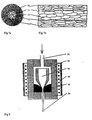
- FIG. 1 a conventional prior art extrusion process is shown for a step-index type preform. This involves applying pressure with a plunger 1 and heat with heater 3 in high pressure chamber 2 to the crystalline preform comprising preform core 4 and cladding preform 5 to force the material in the direction of the applied force and to afterwards deform it through the orifice of a die 6 to obtain a fiber 7 with the desired diameter.
- Figure 2 shows a cut cross section of fiber 7 from the method shown in Figure 1. It is observed, unfortunately, that the resulting fiber 7 shows pronounced deformations of the geometry of core 8 and clad 9 and shows intermeshing of core 8 and clad 9 materials. This rough core-cladding interface frequently causes high scattering losses in the fiber.
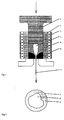
- Figure 3 shows one method with apparatus 21.
- high pressure chamber 22 includes heater 23, core preform 24, and cladding preform 25.
- plunger 29 is below the preforms and moves upwardly, i.e. against the flow.
- Cap 27 holds the preforms in place and, as plunger 29 moves die 28 upwardly, fiber 30 is extruded downwardly therefrom.
- Figure 4 shows a cross-sectional cut of fiber 30 from the Figure 3 process, wherein clad 31 and core 32 have a smooth, consistent interface with a relatively consistent clad thickness and core shape.
- the main advantage of this method is probably the fixed position of a preform in the chamber which eliminates the friction at the lateral surface of the preform and, therefore, also eliminates the release of friction energy.
- the inhomogeneous deformation of complex step-index or gradient-index preforms due to friction-caused turbulence is practically inhomogeneous.
- the intermeshing between core and cladding layers is remarkably reduced.
- Figure 5 shows a further advance.
- the same equipment as shown in Figure 3 is used, with like parts identically numbered.
- additional cladding material 35 can be inserted not only at the side but also below the cylindrical core preform 36, as shown as base 37.
- Figure 6 illustrates a cross-section of a preform successively deformed of its periphery consisting of a core 74 and a crystalline cladding 75, a layer of polymer lubrication 72 and a protective coating 73 of metal or polymer.
- This preform is particularly advantageous for the present inventive method.
- the enhanced quality of the core/cladding boundary in step-index fibers and the improved symmetry in gradient index fibers can also be realized by applying isotropic pressure through gaseous or liquid media.
- Figure 8 illustrates a cross section of present system which includes chamber 92, fluid inlet 91, heater 94, die 95, preform 93 and pressurized fluid 91, to produce fiber 96.
- a lubricant which could be used to reduce friction, can also serve as the liquid medium. Silicon oil or liquid flouropolymers could be used for this purpose.
- Argon or other inert gases seem particularly suitable for gas extrusion purposes.
- the core/clad preform being subjected to extrusion by a plunger moving in a direction opposite to the fiber flow or to liquid or gas extrusion may also be surrounded by an additional layer of relatively soft metal. This metal layer can then be extruded together with the core/clad (or gradient index) crystalline preform to form a fiber already protected by an external metal sheath against light, stresses or contamination.
- the above described types of essentially friction free extrusion substantially suppress lateral surface friction-one of the main causes of macrostructure defects and turbulence intermeshing at the core/cladding boundary.
- a crystal of solid solution of silver halide with a 50/50 ratio of chlorine and bromine, i.e. AgCl 0.5 : Br 0.5 was grown with a Hg ++ dopant (concentration' 0.0003%) by known silver halide crystal growing methods and prepared as an extrusion billet in cylindrical form (15 mm in diameter and 40 mm long).
- the billet was extruded into a fiber with 1 mm diameter by the present invention friction free process as shown in Figure 3 and described above, i.e. by moving the plunger of 14 mm in diameter in the direction opposite to the fiber flow at about 200°C.
- optical losses measured in the fiber by the cut-back method at 10.6 ⁇ m were 0.2 dB/m immediately after the extrusion and 0.5 dB/m 1 year later.
- a fiber of equal diameter was manufactured at the same temperature from a crystal of AgCl 0.5 : AgBr 0.5 solid solution by conventional extrusion in Figure 1 above. Its optical losses were measured as 1 dB/m right after the extrusion and 2.4 dB/m 1 year later. Both fibers were stored in black loose polymer tubes at controlled laboratory conditions to avoid environmental damages.
- Structure 73 was formed from a AgCl 0.5 : AgBr 0.5 core rod (diameter 15 mm), and a AgCl 0.7 : AgBr 0.3 cladding tube (15/18 mm diameter), a polyethylene coating tube (18/19 mm diameter) and a OFHC-copper ductile tube (19/20 mm diameter) with a bottom part in a form, suitable for laminar extrusion. Two successive extrusions of this preform through the raw of conical dies were realized with silicon oil as outer lubricant, and the diameters of the orifices were successively decreased from 17 mm to 15 mm.
- a final friction free extrusion using the Figure 3 method was realized to obtain 1 mm diameter fiber.
- the optical losses in the fiber were 1.5 dB/m at 10.6 ⁇ m.
- the tensile strength was remarkably high (120 MPa).
- Structure investigations of chemically etched fiber samples revealed a texture similar to that shown in Figures 7a and 7b, showing a fiber 50 with a core 51 and cladding 54. Note that large, elongated grains 52 are formed toward the center and smaller elongated grains are formed toward and in the cladding, such as grains 53.
- a step-index type fiber was produced by the method illustrated in Figure 3 from a predeformed preform (as shown in Figure 5).
- the extrusion billet (15 mm diameter and 40 mm long) consisted of a single crystalline rod of AgCl 0.24 : Br 0.76 solid solution (10 mm diameter and 38 mm long) being inserted in a hollow cylinder cladding of AgCl 0.5 : Br 0.5 solid solution (inner diameter 10 mm, outer diameter 15 mm, length 38 mm) and a disk of cladding material was placed at the bottom (diameter 15 mm and 2 mm thickness).
- the billet was hot extruded (at about 200°C) by friction free extrusion into a fiber of 0.7 mm outside diameter and 0.47 mm core diameter. Good quality of the core-cladding boundary was observed over the length of about 10 m.
Landscapes
- Chemical & Material Sciences (AREA)
- Engineering & Computer Science (AREA)
- Materials Engineering (AREA)
- Organic Chemistry (AREA)
- Geochemistry & Mineralogy (AREA)
- Life Sciences & Earth Sciences (AREA)
- Physics & Mathematics (AREA)
- Crystallography & Structural Chemistry (AREA)
- General Chemical & Material Sciences (AREA)
- Chemical Kinetics & Catalysis (AREA)
- Optics & Photonics (AREA)
- Metallurgy (AREA)
- Health & Medical Sciences (AREA)
- Toxicology (AREA)
- General Physics & Mathematics (AREA)
- General Life Sciences & Earth Sciences (AREA)
- Manufacturing & Machinery (AREA)
- Inorganic Chemistry (AREA)
- Glass Compositions (AREA)
Claims (6)
- Eine optische Faser, dadurch gekennzeichnet, dass sie einen Silberhalogenid-Mischkristall mit der Summenformel AgClxBr1-x, wobei x sich zwischen 0 und 1,0 bewegt, und eine oder mehrere Dotierungen, ausgewählt aus der Gruppe AgI und denen mit der Formel MY, wobei M Li, Na, K, Rb, Cs sein kann, oder MY2, wobei M aus Mg, Ca, Sr, Ba, Cd, Pb oder Hg gewählt werden kann, und Y Cl, Br oder I sein kann, beinhaltet, und dass die kristallinen Körner der Faser entlang der Faserachse langgestreckt sind.
- Eine optische Faser nach Anspruch 1, worin die kristallinen Körner in der inneren Kernregion grösser und in den äusseren Schichten der Faser von verringerter Größe sind.
- Eine optische Faser nach den Ansprüchen 1 und 2, mit einer AgI-Dotierung, wobei die AgI-Konzentration auf 5% oder weniger des Fasergewichts begrenzt ist und/oder der resultierende Gehalt zweiwertiger Metallkationen Mg, Ca, Sr, Ba, Cd, Pb oder Hg auf 0,001% oder weniger des Gewichtes der Faser beschränkt ist.
- Eine optische Faser entsprechend einem der Ansprüche 1 bis 3, wobei besagte Faser einen Kern aufweist, der mit einem Polymer ummantelt ist, welches einen niedrigeren Brechungsindex als besagter Kern hat.
- Eine optische Faser gemäß einem der Ansprüche 1 bis 3, wobei besagte Faser keinen Fasermantel aufweist.
- Eine optische Faser nach einem der Ansprüche 1 bis 3, wobei besagte Faser mit einem Silberhalogenid-Mantelmaterial der Summenformel AgClzBr1-z, wobei z zwischen 0 und 1,0 liegt, mit niedrigerem Brechungsindex ummantelt ist.
Priority Applications (1)
| Application Number | Priority Date | Filing Date | Title |
|---|---|---|---|
| DE1993634047 DE69334047T2 (de) | 1993-11-23 | 1993-11-23 | Kristalline optische Infrarotfaser |
Applications Claiming Priority (1)
| Application Number | Priority Date | Filing Date | Title |
|---|---|---|---|
| EP93118812A EP0655423B1 (de) | 1992-11-23 | 1993-11-23 | Verfahren zum Herstellen einer kristallinen Infrarotfaser und das so erhaltene Produkt |
Related Parent Applications (1)
| Application Number | Title | Priority Date | Filing Date |
|---|---|---|---|
| EP93118812A Division EP0655423B1 (de) | 1992-11-23 | 1993-11-23 | Verfahren zum Herstellen einer kristallinen Infrarotfaser und das so erhaltene Produkt |
Publications (2)
| Publication Number | Publication Date |
|---|---|
| EP1006089A1 EP1006089A1 (de) | 2000-06-07 |
| EP1006089B1 true EP1006089B1 (de) | 2006-07-12 |
Family
ID=8213433
Family Applications (1)
| Application Number | Title | Priority Date | Filing Date |
|---|---|---|---|
| EP99124876A Expired - Lifetime EP1006089B1 (de) | 1993-11-23 | 1993-11-23 | Kristalline optische Infrarotfaser |
Country Status (3)
| Country | Link |
|---|---|
| EP (1) | EP1006089B1 (de) |
| DE (1) | DE69330522T2 (de) |
| ES (1) | ES2159514T3 (de) |
Cited By (1)
| Publication number | Priority date | Publication date | Assignee | Title |
|---|---|---|---|---|
| RU2780763C1 (ru) * | 2021-08-04 | 2022-09-30 | Акционерное общество "Государственный научно-исследовательский и проектный институт редкометаллической промышленности АО "Гиредмет" | Способ получения оболочечного поликристаллического волоконного световода инфракрасного диапазона |
Family Cites Families (6)
| Publication number | Priority date | Publication date | Assignee | Title |
|---|---|---|---|---|
| US4171400A (en) * | 1976-01-15 | 1979-10-16 | The Harshaw Chemical Company | Shaped press-forged normally frangible inorganic crystals |
| JPS585407B2 (ja) * | 1980-01-22 | 1983-01-31 | 工業技術院長 | 赤外用光フアイバ− |
| JPS56158303A (en) * | 1980-05-12 | 1981-12-07 | Sumitomo Electric Ind Ltd | Fiber for transmission of infrared ray |
| JPS59121003A (ja) * | 1982-12-28 | 1984-07-12 | Asahi Glass Co Ltd | 赤外フアイバ− |
| JPS6095404A (ja) * | 1983-10-28 | 1985-05-28 | Aloka Co Ltd | 赤外光用光フアイバ |
| US4955689A (en) * | 1987-12-17 | 1990-09-11 | Fuller Research Corporation | IR transmitting optical fiber |
-
1993
- 1993-11-23 EP EP99124876A patent/EP1006089B1/de not_active Expired - Lifetime
- 1993-11-23 ES ES93118812T patent/ES2159514T3/es not_active Expired - Lifetime
- 1993-11-23 DE DE69330522T patent/DE69330522T2/de not_active Expired - Lifetime
Cited By (1)
| Publication number | Priority date | Publication date | Assignee | Title |
|---|---|---|---|---|
| RU2780763C1 (ru) * | 2021-08-04 | 2022-09-30 | Акционерное общество "Государственный научно-исследовательский и проектный институт редкометаллической промышленности АО "Гиредмет" | Способ получения оболочечного поликристаллического волоконного световода инфракрасного диапазона |
Also Published As
| Publication number | Publication date |
|---|---|
| DE69330522D1 (de) | 2001-09-06 |
| DE69330522T2 (de) | 2002-05-08 |
| EP1006089A1 (de) | 2000-06-07 |
| ES2159514T3 (es) | 2001-10-16 |
Similar Documents
| Publication | Publication Date | Title |
|---|---|---|
| EP0655423B1 (de) | Verfahren zum Herstellen einer kristallinen Infrarotfaser und das so erhaltene Produkt | |
| US4504298A (en) | Process for producing infrared light transmitting optical fiber | |
| CA1246913A (en) | Low loss cladded optical fibers from halides and process for making same | |
| DE69319999T2 (de) | Verfahren zur Herstellung eines grossen Quarzglasrohres, sowie einer Vorform und einer optischen Faser | |
| US4253731A (en) | Infrared fiber of AgCl clad AgBr and method of fabrication | |
| DE2349906B2 (de) | Glasfaser-Übertragungsleitung | |
| DE2300013B2 (de) | Verfahren zur Herstellung optischer Wellenleiter | |
| DE60032363T2 (de) | Optische faser mit niedrigen polarisationsmodendispersion sowie dämpfung und ihre herstelungsverfahren | |
| CA1283568C (en) | Crystalline optical fiber and its method of manufacture | |
| EP3766840B1 (de) | Verfahren zur herstellung einer hohlkernfaser und zur herstellung einer vorform für eine hohlkernfaser | |
| DE3229432C2 (de) | ||
| DE69031607T2 (de) | Faseroptisches Bündel zur Bildübertragung und sein Herstellungsverfahren | |
| CA1236718A (en) | Crystalline fiber and a process for the production of the same | |
| EP1705157A1 (de) | Verfahren zur Herstellung einer Mikrostrukturglasfaser | |
| EP4030204B1 (de) | Mikrostrukturierte optische faser und vorform dafür | |
| EP1006089B1 (de) | Kristalline optische Infrarotfaser | |
| US4532000A (en) | Fabrication of single crystal fibers from congruently melting polycrystalline fibers | |
| EP2545009B1 (de) | Verfahren sowie rohrförmiges halbzeug zur herstellung einer optischen faser | |
| US10118853B2 (en) | Systems and methods for producing robust chalcogenide optical fibers | |
| DE69408021T2 (de) | Verfahren zur Erhöhung des Brechungsindex von Glas | |
| EP1184339A2 (de) | Optische Faser und Herstellungsverfahren für eine optische Faser | |
| DE69334047T2 (de) | Kristalline optische Infrarotfaser | |
| RU2780763C1 (ru) | Способ получения оболочечного поликристаллического волоконного световода инфракрасного диапазона | |
| DE9321581U1 (de) | Silberhalogenid-Kristallinfasern | |
| Klejch et al. | Preparation, properties and application of sapphire single-crystal fibers grown by the EFG method |
Legal Events
| Date | Code | Title | Description |
|---|---|---|---|
| PUAI | Public reference made under article 153(3) epc to a published international application that has entered the european phase |
Free format text: ORIGINAL CODE: 0009012 |
|
| 17P | Request for examination filed |
Effective date: 19991216 |
|
| AC | Divisional application: reference to earlier application |
Ref document number: 655423 Country of ref document: EP |
|
| AK | Designated contracting states |
Kind code of ref document: A1 Designated state(s): DE ES FR GB IT |
|
| RIN1 | Information on inventor provided before grant (corrected) |
Inventor name: NEUBERGER, WOLFGANG, DR. Inventor name: ARTJUSHENKO, VJACHESLAV, DR. Inventor name: KUZIN, EUGENY Inventor name: NABATOV, ALEXEY |
|
| 17Q | First examination report despatched |
Effective date: 20001222 |
|
| AKX | Designation fees paid |
Free format text: DE ES FR GB IT |
|
| GRAP | Despatch of communication of intention to grant a patent |
Free format text: ORIGINAL CODE: EPIDOSNIGR1 |
|
| GRAS | Grant fee paid |
Free format text: ORIGINAL CODE: EPIDOSNIGR3 |
|
| GRAA | (expected) grant |
Free format text: ORIGINAL CODE: 0009210 |
|
| AC | Divisional application: reference to earlier application |
Ref document number: 0655423 Country of ref document: EP Kind code of ref document: P |
|
| AK | Designated contracting states |
Kind code of ref document: B1 Designated state(s): DE ES FR GB IT |
|
| PG25 | Lapsed in a contracting state [announced via postgrant information from national office to epo] |
Ref country code: IT Free format text: LAPSE BECAUSE OF FAILURE TO SUBMIT A TRANSLATION OF THE DESCRIPTION OR TO PAY THE FEE WITHIN THE PRESCRIBED TIME-LIMIT;WARNING: LAPSES OF ITALIAN PATENTS WITH EFFECTIVE DATE BEFORE 2007 MAY HAVE OCCURRED AT ANY TIME BEFORE 2007. THE CORRECT EFFECTIVE DATE MAY BE DIFFERENT FROM THE ONE RECORDED. Effective date: 20060712 |
|
| REG | Reference to a national code |
Ref country code: GB Ref legal event code: FG4D |
|
| REF | Corresponds to: |
Ref document number: 69334047 Country of ref document: DE Date of ref document: 20060824 Kind code of ref document: P |
|
| PG25 | Lapsed in a contracting state [announced via postgrant information from national office to epo] |
Ref country code: ES Free format text: LAPSE BECAUSE OF FAILURE TO SUBMIT A TRANSLATION OF THE DESCRIPTION OR TO PAY THE FEE WITHIN THE PRESCRIBED TIME-LIMIT Effective date: 20061023 |
|
| EN | Fr: translation not filed | ||
| PLBE | No opposition filed within time limit |
Free format text: ORIGINAL CODE: 0009261 |
|
| STAA | Information on the status of an ep patent application or granted ep patent |
Free format text: STATUS: NO OPPOSITION FILED WITHIN TIME LIMIT |
|
| 26N | No opposition filed |
Effective date: 20070413 |
|
| PG25 | Lapsed in a contracting state [announced via postgrant information from national office to epo] |
Ref country code: FR Free format text: LAPSE BECAUSE OF FAILURE TO SUBMIT A TRANSLATION OF THE DESCRIPTION OR TO PAY THE FEE WITHIN THE PRESCRIBED TIME-LIMIT Effective date: 20070511 |
|
| PG25 | Lapsed in a contracting state [announced via postgrant information from national office to epo] |
Ref country code: FR Free format text: LAPSE BECAUSE OF FAILURE TO SUBMIT A TRANSLATION OF THE DESCRIPTION OR TO PAY THE FEE WITHIN THE PRESCRIBED TIME-LIMIT Effective date: 20060712 |
|
| PGFP | Annual fee paid to national office [announced via postgrant information from national office to epo] |
Ref country code: GB Payment date: 20121122 Year of fee payment: 20 |
|
| PGFP | Annual fee paid to national office [announced via postgrant information from national office to epo] |
Ref country code: DE Payment date: 20130122 Year of fee payment: 20 |
|
| REG | Reference to a national code |
Ref country code: DE Ref legal event code: R071 Ref document number: 69334047 Country of ref document: DE |
|
| REG | Reference to a national code |
Ref country code: GB Ref legal event code: PE20 Expiry date: 20131122 |
|
| PG25 | Lapsed in a contracting state [announced via postgrant information from national office to epo] |
Ref country code: DE Free format text: LAPSE BECAUSE OF EXPIRATION OF PROTECTION Effective date: 20131126 Ref country code: GB Free format text: LAPSE BECAUSE OF EXPIRATION OF PROTECTION Effective date: 20131122 |