EP1006196B1 - Retrovirale, mit LCMV-Glykoprotein pseudotypisierte Hybrid-Vektoren - Google Patents
Retrovirale, mit LCMV-Glykoprotein pseudotypisierte Hybrid-Vektoren Download PDFInfo
- Publication number
- EP1006196B1 EP1006196B1 EP99250415A EP99250415A EP1006196B1 EP 1006196 B1 EP1006196 B1 EP 1006196B1 EP 99250415 A EP99250415 A EP 99250415A EP 99250415 A EP99250415 A EP 99250415A EP 1006196 B1 EP1006196 B1 EP 1006196B1
- Authority
- EP
- European Patent Office
- Prior art keywords
- lcmv
- retroviral
- packaging cell
- gene
- retroviral packaging
- Prior art date
- Legal status (The legal status is an assumption and is not a legal conclusion. Google has not performed a legal analysis and makes no representation as to the accuracy of the status listed.)
- Expired - Lifetime
Links
- 241000712899 Lymphocytic choriomeningitis mammarenavirus Species 0.000 title claims abstract description 173
- 230000001177 retroviral effect Effects 0.000 title claims abstract description 129
- 239000013598 vector Substances 0.000 title claims abstract description 93
- 108090000288 Glycoproteins Proteins 0.000 title claims abstract description 38
- 102000003886 Glycoproteins Human genes 0.000 title claims abstract description 38
- 210000004027 cell Anatomy 0.000 claims abstract description 175
- 108090000623 proteins and genes Proteins 0.000 claims abstract description 121
- 102000004169 proteins and genes Human genes 0.000 claims abstract description 28
- 210000002845 virion Anatomy 0.000 claims abstract description 24
- 150000007523 nucleic acids Chemical group 0.000 claims abstract description 17
- 238000002360 preparation method Methods 0.000 claims abstract description 10
- 108091028043 Nucleic acid sequence Proteins 0.000 claims abstract description 8
- 238000004806 packaging method and process Methods 0.000 claims description 122
- 208000015181 infectious disease Diseases 0.000 claims description 31
- 238000000034 method Methods 0.000 claims description 23
- 238000001415 gene therapy Methods 0.000 claims description 20
- 108700019146 Transgenes Proteins 0.000 claims description 19
- 230000008569 process Effects 0.000 claims description 13
- 108010078428 env Gene Products Proteins 0.000 claims description 12
- 241001430294 unidentified retrovirus Species 0.000 claims description 12
- 241000713666 Lentivirus Species 0.000 claims description 10
- 102100034353 Integrase Human genes 0.000 claims description 9
- 206010028980 Neoplasm Diseases 0.000 claims description 9
- 108700004025 env Genes Proteins 0.000 claims description 9
- 230000035772 mutation Effects 0.000 claims description 8
- 238000001890 transfection Methods 0.000 claims description 8
- 108700004026 gag Genes Proteins 0.000 claims description 7
- 239000000825 pharmaceutical preparation Substances 0.000 claims description 7
- 108700004029 pol Genes Proteins 0.000 claims description 7
- 101150030339 env gene Proteins 0.000 claims description 6
- 239000013613 expression plasmid Substances 0.000 claims description 6
- 208000035473 Communicable disease Diseases 0.000 claims description 5
- 238000002560 therapeutic procedure Methods 0.000 claims description 5
- 102000000311 Cytosine Deaminase Human genes 0.000 claims description 4
- 108010080611 Cytosine Deaminase Proteins 0.000 claims description 4
- 101100288095 Klebsiella pneumoniae neo gene Proteins 0.000 claims description 4
- 102000011931 Nucleoproteins Human genes 0.000 claims description 4
- 108010061100 Nucleoproteins Proteins 0.000 claims description 4
- 239000000969 carrier Substances 0.000 claims description 4
- 230000002950 deficient Effects 0.000 claims description 4
- 238000000338 in vitro Methods 0.000 claims description 4
- 239000003550 marker Substances 0.000 claims description 4
- 239000000546 pharmaceutical excipient Substances 0.000 claims description 4
- 230000001105 regulatory effect Effects 0.000 claims description 4
- 208000030507 AIDS Diseases 0.000 claims description 3
- 208000031886 HIV Infections Diseases 0.000 claims description 3
- 230000000840 anti-viral effect Effects 0.000 claims description 3
- 230000037430 deletion Effects 0.000 claims description 3
- 238000012217 deletion Methods 0.000 claims description 3
- 208000037265 diseases, disorders, signs and symptoms Diseases 0.000 claims description 3
- 108010048367 enhanced green fluorescent protein Proteins 0.000 claims description 3
- 101150066555 lacZ gene Proteins 0.000 claims description 3
- 201000001441 melanoma Diseases 0.000 claims description 3
- 230000009870 specific binding Effects 0.000 claims description 3
- 101150069452 z gene Proteins 0.000 claims description 3
- 102000053642 Catalytic RNA Human genes 0.000 claims description 2
- 108090000994 Catalytic RNA Proteins 0.000 claims description 2
- 108090000695 Cytokines Proteins 0.000 claims description 2
- 102000004163 DNA-directed RNA polymerases Human genes 0.000 claims description 2
- 108090000626 DNA-directed RNA polymerases Proteins 0.000 claims description 2
- 241001663880 Gammaretrovirus Species 0.000 claims description 2
- 241000700584 Simplexvirus Species 0.000 claims description 2
- 102000006601 Thymidine Kinase Human genes 0.000 claims description 2
- 108020004440 Thymidine kinase Proteins 0.000 claims description 2
- 230000000692 anti-sense effect Effects 0.000 claims description 2
- 230000003394 haemopoietic effect Effects 0.000 claims description 2
- 108091092562 ribozyme Proteins 0.000 claims description 2
- 210000000130 stem cell Anatomy 0.000 claims description 2
- 230000005714 functional activity Effects 0.000 claims 3
- 201000009030 Carcinoma Diseases 0.000 claims 2
- 208000037357 HIV infectious disease Diseases 0.000 claims 2
- 101150118742 NP gene Proteins 0.000 claims 2
- 210000000481 breast Anatomy 0.000 claims 2
- 208000035269 cancer or benign tumor Diseases 0.000 claims 2
- 208000035475 disorder Diseases 0.000 claims 2
- 208000033519 human immunodeficiency virus infectious disease Diseases 0.000 claims 2
- -1 antisense sequences Proteins 0.000 claims 1
- 241000700605 Viruses Species 0.000 abstract description 39
- 101710177291 Gag polyprotein Proteins 0.000 abstract description 12
- 108010089520 pol Gene Products Proteins 0.000 abstract description 10
- 101710125418 Major capsid protein Proteins 0.000 abstract description 7
- 125000003275 alpha amino acid group Chemical group 0.000 abstract description 6
- 210000004698 lymphocyte Anatomy 0.000 abstract description 3
- 238000012856 packing Methods 0.000 abstract 2
- 241000714177 Murine leukemia virus Species 0.000 description 41
- 230000014509 gene expression Effects 0.000 description 29
- 238000012546 transfer Methods 0.000 description 24
- 108020004414 DNA Proteins 0.000 description 21
- 241000713772 Human immunodeficiency virus 1 Species 0.000 description 20
- 230000002458 infectious effect Effects 0.000 description 15
- 239000002245 particle Substances 0.000 description 15
- 241000282414 Homo sapiens Species 0.000 description 14
- 108091032973 (ribonucleotides)n+m Proteins 0.000 description 12
- 230000010354 integration Effects 0.000 description 12
- 238000004519 manufacturing process Methods 0.000 description 12
- 102100034349 Integrase Human genes 0.000 description 11
- 239000005090 green fluorescent protein Substances 0.000 description 11
- 241000725303 Human immunodeficiency virus Species 0.000 description 10
- 239000006228 supernatant Substances 0.000 description 10
- 238000010361 transduction Methods 0.000 description 10
- 230000026683 transduction Effects 0.000 description 10
- 101710091045 Envelope protein Proteins 0.000 description 9
- 108700026244 Open Reading Frames Proteins 0.000 description 9
- 101710188315 Protein X Proteins 0.000 description 9
- 241000713869 Moloney murine leukemia virus Species 0.000 description 8
- 230000004927 fusion Effects 0.000 description 8
- 108020003175 receptors Proteins 0.000 description 8
- 102000005962 receptors Human genes 0.000 description 8
- 238000005199 ultracentrifugation Methods 0.000 description 8
- 108010043121 Green Fluorescent Proteins Proteins 0.000 description 7
- 102000004144 Green Fluorescent Proteins Human genes 0.000 description 7
- 230000008901 benefit Effects 0.000 description 7
- 210000002950 fibroblast Anatomy 0.000 description 7
- 108020004707 nucleic acids Proteins 0.000 description 7
- 102000039446 nucleic acids Human genes 0.000 description 7
- 241000699666 Mus <mouse, genus> Species 0.000 description 6
- 230000027455 binding Effects 0.000 description 6
- 238000004113 cell culture Methods 0.000 description 6
- 108020004999 messenger RNA Proteins 0.000 description 6
- 230000010415 tropism Effects 0.000 description 6
- 108010029973 Lymphocytic choriomeningitis virus glycoprotein peptide Proteins 0.000 description 5
- 108010003533 Viral Envelope Proteins Proteins 0.000 description 5
- 230000003472 neutralizing effect Effects 0.000 description 5
- 239000000047 product Substances 0.000 description 5
- OPIFSICVWOWJMJ-AEOCFKNESA-N 5-bromo-4-chloro-3-indolyl beta-D-galactoside Chemical compound O[C@@H]1[C@@H](O)[C@@H](O)[C@@H](CO)O[C@H]1OC1=CNC2=CC=C(Br)C(Cl)=C12 OPIFSICVWOWJMJ-AEOCFKNESA-N 0.000 description 4
- 101710132601 Capsid protein Proteins 0.000 description 4
- 101710094648 Coat protein Proteins 0.000 description 4
- 108091026890 Coding region Proteins 0.000 description 4
- 241000713800 Feline immunodeficiency virus Species 0.000 description 4
- 101710141454 Nucleoprotein Proteins 0.000 description 4
- 101710083689 Probable capsid protein Proteins 0.000 description 4
- 241000713311 Simian immunodeficiency virus Species 0.000 description 4
- 230000005101 cell tropism Effects 0.000 description 4
- 230000000694 effects Effects 0.000 description 4
- 238000011194 good manufacturing practice Methods 0.000 description 4
- 210000003958 hematopoietic stem cell Anatomy 0.000 description 4
- 210000005260 human cell Anatomy 0.000 description 4
- 239000002243 precursor Substances 0.000 description 4
- 238000000746 purification Methods 0.000 description 4
- 230000010076 replication Effects 0.000 description 4
- 238000001228 spectrum Methods 0.000 description 4
- 230000003612 virological effect Effects 0.000 description 4
- 102100021181 Golgi phosphoprotein 3 Human genes 0.000 description 3
- 108010017080 Granulocyte Colony-Stimulating Factor Proteins 0.000 description 3
- 108010002386 Interleukin-3 Proteins 0.000 description 3
- 241001045988 Neogene Species 0.000 description 3
- 101710149951 Protein Tat Proteins 0.000 description 3
- 238000003556 assay Methods 0.000 description 3
- 230000015572 biosynthetic process Effects 0.000 description 3
- 210000004369 blood Anatomy 0.000 description 3
- 239000008280 blood Substances 0.000 description 3
- 230000008859 change Effects 0.000 description 3
- 239000012228 culture supernatant Substances 0.000 description 3
- 210000000805 cytoplasm Anatomy 0.000 description 3
- 231100000433 cytotoxic Toxicity 0.000 description 3
- 230000001472 cytotoxic effect Effects 0.000 description 3
- 238000010790 dilution Methods 0.000 description 3
- 239000012895 dilution Substances 0.000 description 3
- LOKCTEFSRHRXRJ-UHFFFAOYSA-I dipotassium trisodium dihydrogen phosphate hydrogen phosphate dichloride Chemical compound P(=O)(O)(O)[O-].[K+].P(=O)(O)([O-])[O-].[Na+].[Na+].[Cl-].[K+].[Cl-].[Na+] LOKCTEFSRHRXRJ-UHFFFAOYSA-I 0.000 description 3
- 239000013604 expression vector Substances 0.000 description 3
- 238000000684 flow cytometry Methods 0.000 description 3
- 239000000463 material Substances 0.000 description 3
- 101150091879 neo gene Proteins 0.000 description 3
- 239000002953 phosphate buffered saline Substances 0.000 description 3
- 210000002966 serum Anatomy 0.000 description 3
- XZNXVSDNACTASG-RZNNTOFGSA-M sodium;3,5-diacetamido-2,4,6-triiodobenzoate;3,5-diacetamido-2,4,6-triiodobenzoic acid;(2r,3r,4r,5s)-6-(methylamino)hexane-1,2,3,4,5-pentol Chemical compound [Na+].CNC[C@H](O)[C@@H](O)[C@H](O)[C@H](O)CO.CC(=O)NC1=C(I)C(NC(C)=O)=C(I)C(C(O)=O)=C1I.CC(=O)NC1=C(I)C(NC(C)=O)=C(I)C(C([O-])=O)=C1I XZNXVSDNACTASG-RZNNTOFGSA-M 0.000 description 3
- 230000010473 stable expression Effects 0.000 description 3
- 238000010186 staining Methods 0.000 description 3
- 230000009385 viral infection Effects 0.000 description 3
- 239000013607 AAV vector Substances 0.000 description 2
- 241000699800 Cricetinae Species 0.000 description 2
- 241000702421 Dependoparvovirus Species 0.000 description 2
- 239000006144 Dulbecco’s modified Eagle's medium Substances 0.000 description 2
- 101710103942 Elongation factor 1-alpha Proteins 0.000 description 2
- 101710170658 Endogenous retrovirus group K member 10 Gag polyprotein Proteins 0.000 description 2
- 101710186314 Endogenous retrovirus group K member 21 Gag polyprotein Proteins 0.000 description 2
- 101710162093 Endogenous retrovirus group K member 24 Gag polyprotein Proteins 0.000 description 2
- 102100039715 Endogenous retrovirus group K member 6 Gag polyprotein Human genes 0.000 description 2
- 101710094596 Endogenous retrovirus group K member 8 Gag polyprotein Proteins 0.000 description 2
- 101710177443 Endogenous retrovirus group K member 9 Gag polyprotein Proteins 0.000 description 2
- YQYJSBFKSSDGFO-UHFFFAOYSA-N Epihygromycin Natural products OC1C(O)C(C(=O)C)OC1OC(C(=C1)O)=CC=C1C=C(C)C(=O)NC1C(O)C(O)C2OCOC2C1O YQYJSBFKSSDGFO-UHFFFAOYSA-N 0.000 description 2
- 101001065501 Escherichia phage MS2 Lysis protein Proteins 0.000 description 2
- 101150000419 GPC gene Proteins 0.000 description 2
- 102000004269 Granulocyte Colony-Stimulating Factor Human genes 0.000 description 2
- 102100021519 Hemoglobin subunit beta Human genes 0.000 description 2
- 108091005904 Hemoglobin subunit beta Proteins 0.000 description 2
- 101710203526 Integrase Proteins 0.000 description 2
- 102000000646 Interleukin-3 Human genes 0.000 description 2
- 108010064171 Lysosome-Associated Membrane Glycoproteins Proteins 0.000 description 2
- 102000014944 Lysosome-Associated Membrane Glycoproteins Human genes 0.000 description 2
- 241001529936 Murinae Species 0.000 description 2
- 229930193140 Neomycin Natural products 0.000 description 2
- 238000000636 Northern blotting Methods 0.000 description 2
- 108090001074 Nucleocapsid Proteins Proteins 0.000 description 2
- 101710192141 Protein Nef Proteins 0.000 description 2
- 101710150344 Protein Rev Proteins 0.000 description 2
- 101710149136 Protein Vpr Proteins 0.000 description 2
- 101710119335 Sliding-clamp-loader large subunit Proteins 0.000 description 2
- 238000002105 Southern blotting Methods 0.000 description 2
- 150000001413 amino acids Chemical class 0.000 description 2
- 238000004458 analytical method Methods 0.000 description 2
- 238000013459 approach Methods 0.000 description 2
- 210000000170 cell membrane Anatomy 0.000 description 2
- 230000001413 cellular effect Effects 0.000 description 2
- 238000002512 chemotherapy Methods 0.000 description 2
- 230000007547 defect Effects 0.000 description 2
- 210000000981 epithelium Anatomy 0.000 description 2
- 210000003527 eukaryotic cell Anatomy 0.000 description 2
- 239000012634 fragment Substances 0.000 description 2
- 108020001507 fusion proteins Proteins 0.000 description 2
- 102000037865 fusion proteins Human genes 0.000 description 2
- 108010027225 gag-pol Fusion Proteins Proteins 0.000 description 2
- 230000002068 genetic effect Effects 0.000 description 2
- 230000012010 growth Effects 0.000 description 2
- 210000002443 helper t lymphocyte Anatomy 0.000 description 2
- 206010073071 hepatocellular carcinoma Diseases 0.000 description 2
- 210000003494 hepatocyte Anatomy 0.000 description 2
- 238000003125 immunofluorescent labeling Methods 0.000 description 2
- 239000003446 ligand Substances 0.000 description 2
- 230000007774 longterm Effects 0.000 description 2
- 230000001404 mediated effect Effects 0.000 description 2
- 239000002609 medium Substances 0.000 description 2
- 238000010369 molecular cloning Methods 0.000 description 2
- 210000003643 myeloid progenitor cell Anatomy 0.000 description 2
- 239000013642 negative control Substances 0.000 description 2
- 229960004927 neomycin Drugs 0.000 description 2
- 230000000644 propagated effect Effects 0.000 description 2
- 230000006337 proteolytic cleavage Effects 0.000 description 2
- 238000005215 recombination Methods 0.000 description 2
- 230000006798 recombination Effects 0.000 description 2
- 238000011084 recovery Methods 0.000 description 2
- 238000011160 research Methods 0.000 description 2
- 239000000523 sample Substances 0.000 description 2
- 230000009261 transgenic effect Effects 0.000 description 2
- 210000004881 tumor cell Anatomy 0.000 description 2
- 239000013603 viral vector Substances 0.000 description 2
- 102000040650 (ribonucleotides)n+m Human genes 0.000 description 1
- 241000710929 Alphavirus Species 0.000 description 1
- 206010003445 Ascites Diseases 0.000 description 1
- 108091003079 Bovine Serum Albumin Proteins 0.000 description 1
- 241000283707 Capra Species 0.000 description 1
- 108090000565 Capsid Proteins Proteins 0.000 description 1
- 241000282693 Cercopithecidae Species 0.000 description 1
- 241000701022 Cytomegalovirus Species 0.000 description 1
- 102000053602 DNA Human genes 0.000 description 1
- 239000012983 Dulbecco’s minimal essential medium Substances 0.000 description 1
- 101710121417 Envelope glycoprotein Proteins 0.000 description 1
- 102000004190 Enzymes Human genes 0.000 description 1
- 108090000790 Enzymes Proteins 0.000 description 1
- 101150117028 GP gene Proteins 0.000 description 1
- 241000701044 Human gammaherpesvirus 4 Species 0.000 description 1
- 206010061598 Immunodeficiency Diseases 0.000 description 1
- 208000029462 Immunodeficiency disease Diseases 0.000 description 1
- 239000007760 Iscove's Modified Dulbecco's Medium Substances 0.000 description 1
- 108010025815 Kanamycin Kinase Proteins 0.000 description 1
- 108010052285 Membrane Proteins Proteins 0.000 description 1
- 102000018697 Membrane Proteins Human genes 0.000 description 1
- 241000699670 Mus sp. Species 0.000 description 1
- 241000283973 Oryctolagus cuniculus Species 0.000 description 1
- 102000002508 Peptide Elongation Factors Human genes 0.000 description 1
- 108010068204 Peptide Elongation Factors Proteins 0.000 description 1
- 102000017143 RNA Polymerase I Human genes 0.000 description 1
- 108010013845 RNA Polymerase I Proteins 0.000 description 1
- 108010092799 RNA-directed DNA polymerase Proteins 0.000 description 1
- 108700005075 Regulator Genes Proteins 0.000 description 1
- 241001068263 Replication competent viruses Species 0.000 description 1
- 239000006146 Roswell Park Memorial Institute medium Substances 0.000 description 1
- 101710172711 Structural protein Proteins 0.000 description 1
- 101710100170 Unknown protein Proteins 0.000 description 1
- 108020000999 Viral RNA Proteins 0.000 description 1
- 230000004913 activation Effects 0.000 description 1
- 201000008275 breast carcinoma Diseases 0.000 description 1
- 229910000389 calcium phosphate Inorganic materials 0.000 description 1
- 239000001506 calcium phosphate Substances 0.000 description 1
- 235000011010 calcium phosphates Nutrition 0.000 description 1
- 201000011510 cancer Diseases 0.000 description 1
- 210000000234 capsid Anatomy 0.000 description 1
- 230000034303 cell budding Effects 0.000 description 1
- 230000032823 cell division Effects 0.000 description 1
- 210000003855 cell nucleus Anatomy 0.000 description 1
- 238000005119 centrifugation Methods 0.000 description 1
- 230000000295 complement effect Effects 0.000 description 1
- 239000003636 conditioned culture medium Substances 0.000 description 1
- 230000000120 cytopathologic effect Effects 0.000 description 1
- 230000003247 decreasing effect Effects 0.000 description 1
- 230000001419 dependent effect Effects 0.000 description 1
- 238000001514 detection method Methods 0.000 description 1
- 238000011161 development Methods 0.000 description 1
- 201000010099 disease Diseases 0.000 description 1
- 241001493065 dsRNA viruses Species 0.000 description 1
- 230000005014 ectopic expression Effects 0.000 description 1
- 238000004520 electroporation Methods 0.000 description 1
- 210000001163 endosome Anatomy 0.000 description 1
- 238000002474 experimental method Methods 0.000 description 1
- 239000012894 fetal calf serum Substances 0.000 description 1
- MHMNJMPURVTYEJ-UHFFFAOYSA-N fluorescein-5-isothiocyanate Chemical compound O1C(=O)C2=CC(N=C=S)=CC=C2C21C1=CC=C(O)C=C1OC1=CC(O)=CC=C21 MHMNJMPURVTYEJ-UHFFFAOYSA-N 0.000 description 1
- 230000007813 immunodeficiency Effects 0.000 description 1
- 238000010166 immunofluorescence Methods 0.000 description 1
- 238000001727 in vivo Methods 0.000 description 1
- 238000011534 incubation Methods 0.000 description 1
- 230000002401 inhibitory effect Effects 0.000 description 1
- 238000011081 inoculation Methods 0.000 description 1
- 230000002452 interceptive effect Effects 0.000 description 1
- 238000011835 investigation Methods 0.000 description 1
- 238000002955 isolation Methods 0.000 description 1
- 239000002502 liposome Substances 0.000 description 1
- 230000000527 lymphocytic effect Effects 0.000 description 1
- 229940126601 medicinal product Drugs 0.000 description 1
- 244000005700 microbiome Species 0.000 description 1
- 210000001616 monocyte Anatomy 0.000 description 1
- 238000002703 mutagenesis Methods 0.000 description 1
- 231100000350 mutagenesis Toxicity 0.000 description 1
- 230000009826 neoplastic cell growth Effects 0.000 description 1
- 210000002569 neuron Anatomy 0.000 description 1
- 230000002276 neurotropic effect Effects 0.000 description 1
- 238000006386 neutralization reaction Methods 0.000 description 1
- KJONHKAYOJNZEC-UHFFFAOYSA-N nitrazepam Chemical compound C12=CC([N+](=O)[O-])=CC=C2NC(=O)CN=C1C1=CC=CC=C1 KJONHKAYOJNZEC-UHFFFAOYSA-N 0.000 description 1
- 210000000633 nuclear envelope Anatomy 0.000 description 1
- 239000002773 nucleotide Substances 0.000 description 1
- 125000003729 nucleotide group Chemical group 0.000 description 1
- 238000005457 optimization Methods 0.000 description 1
- 230000001717 pathogenic effect Effects 0.000 description 1
- 239000013612 plasmid Substances 0.000 description 1
- 238000011533 pre-incubation Methods 0.000 description 1
- 230000008707 rearrangement Effects 0.000 description 1
- 230000009467 reduction Effects 0.000 description 1
- 238000010561 standard procedure Methods 0.000 description 1
- 230000008685 targeting Effects 0.000 description 1
- 238000012360 testing method Methods 0.000 description 1
- 238000010257 thawing Methods 0.000 description 1
- 210000001541 thymus gland Anatomy 0.000 description 1
- 210000001519 tissue Anatomy 0.000 description 1
- 238000004448 titration Methods 0.000 description 1
- 231100000331 toxic Toxicity 0.000 description 1
- 230000002588 toxic effect Effects 0.000 description 1
- 238000013518 transcription Methods 0.000 description 1
- 230000035897 transcription Effects 0.000 description 1
- QORWJWZARLRLPR-UHFFFAOYSA-H tricalcium bis(phosphate) Chemical compound [Ca+2].[Ca+2].[Ca+2].[O-]P([O-])([O-])=O.[O-]P([O-])([O-])=O QORWJWZARLRLPR-UHFFFAOYSA-H 0.000 description 1
- 241001529453 unidentified herpesvirus Species 0.000 description 1
- 210000000605 viral structure Anatomy 0.000 description 1
Images


Classifications
-
- C—CHEMISTRY; METALLURGY
- C12—BIOCHEMISTRY; BEER; SPIRITS; WINE; VINEGAR; MICROBIOLOGY; ENZYMOLOGY; MUTATION OR GENETIC ENGINEERING
- C12N—MICROORGANISMS OR ENZYMES; COMPOSITIONS THEREOF; PROPAGATING, PRESERVING, OR MAINTAINING MICROORGANISMS; MUTATION OR GENETIC ENGINEERING; CULTURE MEDIA
- C12N15/00—Mutation or genetic engineering; DNA or RNA concerning genetic engineering, vectors, e.g. plasmids, or their isolation, preparation or purification; Use of hosts therefor
- C12N15/09—Recombinant DNA-technology
- C12N15/63—Introduction of foreign genetic material using vectors; Vectors; Use of hosts therefor; Regulation of expression
- C12N15/79—Vectors or expression systems specially adapted for eukaryotic hosts
- C12N15/85—Vectors or expression systems specially adapted for eukaryotic hosts for animal cells
- C12N15/86—Viral vectors
-
- A—HUMAN NECESSITIES
- A61—MEDICAL OR VETERINARY SCIENCE; HYGIENE
- A61P—SPECIFIC THERAPEUTIC ACTIVITY OF CHEMICAL COMPOUNDS OR MEDICINAL PREPARATIONS
- A61P31/00—Antiinfectives, i.e. antibiotics, antiseptics, chemotherapeutics
- A61P31/12—Antivirals
- A61P31/14—Antivirals for RNA viruses
- A61P31/18—Antivirals for RNA viruses for HIV
-
- A—HUMAN NECESSITIES
- A61—MEDICAL OR VETERINARY SCIENCE; HYGIENE
- A61P—SPECIFIC THERAPEUTIC ACTIVITY OF CHEMICAL COMPOUNDS OR MEDICINAL PREPARATIONS
- A61P35/00—Antineoplastic agents
-
- A—HUMAN NECESSITIES
- A61—MEDICAL OR VETERINARY SCIENCE; HYGIENE
- A61P—SPECIFIC THERAPEUTIC ACTIVITY OF CHEMICAL COMPOUNDS OR MEDICINAL PREPARATIONS
- A61P37/00—Drugs for immunological or allergic disorders
- A61P37/02—Immunomodulators
-
- C—CHEMISTRY; METALLURGY
- C07—ORGANIC CHEMISTRY
- C07K—PEPTIDES
- C07K14/00—Peptides having more than 20 amino acids; Gastrins; Somatostatins; Melanotropins; Derivatives thereof
- C07K14/005—Peptides having more than 20 amino acids; Gastrins; Somatostatins; Melanotropins; Derivatives thereof from viruses
-
- A—HUMAN NECESSITIES
- A61—MEDICAL OR VETERINARY SCIENCE; HYGIENE
- A61K—PREPARATIONS FOR MEDICAL, DENTAL OR TOILETRY PURPOSES
- A61K48/00—Medicinal preparations containing genetic material which is inserted into cells of the living body to treat genetic diseases; Gene therapy
-
- C—CHEMISTRY; METALLURGY
- C12—BIOCHEMISTRY; BEER; SPIRITS; WINE; VINEGAR; MICROBIOLOGY; ENZYMOLOGY; MUTATION OR GENETIC ENGINEERING
- C12N—MICROORGANISMS OR ENZYMES; COMPOSITIONS THEREOF; PROPAGATING, PRESERVING, OR MAINTAINING MICROORGANISMS; MUTATION OR GENETIC ENGINEERING; CULTURE MEDIA
- C12N2740/00—Reverse transcribing RNA viruses
- C12N2740/00011—Details
- C12N2740/10011—Retroviridae
- C12N2740/13011—Gammaretrovirus, e.g. murine leukeamia virus
- C12N2740/13041—Use of virus, viral particle or viral elements as a vector
- C12N2740/13043—Use of virus, viral particle or viral elements as a vector viral genome or elements thereof as genetic vector
-
- C—CHEMISTRY; METALLURGY
- C12—BIOCHEMISTRY; BEER; SPIRITS; WINE; VINEGAR; MICROBIOLOGY; ENZYMOLOGY; MUTATION OR GENETIC ENGINEERING
- C12N—MICROORGANISMS OR ENZYMES; COMPOSITIONS THEREOF; PROPAGATING, PRESERVING, OR MAINTAINING MICROORGANISMS; MUTATION OR GENETIC ENGINEERING; CULTURE MEDIA
- C12N2740/00—Reverse transcribing RNA viruses
- C12N2740/00011—Details
- C12N2740/10011—Retroviridae
- C12N2740/13011—Gammaretrovirus, e.g. murine leukeamia virus
- C12N2740/13041—Use of virus, viral particle or viral elements as a vector
- C12N2740/13045—Special targeting system for viral vectors
-
- C—CHEMISTRY; METALLURGY
- C12—BIOCHEMISTRY; BEER; SPIRITS; WINE; VINEGAR; MICROBIOLOGY; ENZYMOLOGY; MUTATION OR GENETIC ENGINEERING
- C12N—MICROORGANISMS OR ENZYMES; COMPOSITIONS THEREOF; PROPAGATING, PRESERVING, OR MAINTAINING MICROORGANISMS; MUTATION OR GENETIC ENGINEERING; CULTURE MEDIA
- C12N2740/00—Reverse transcribing RNA viruses
- C12N2740/00011—Details
- C12N2740/10011—Retroviridae
- C12N2740/13011—Gammaretrovirus, e.g. murine leukeamia virus
- C12N2740/13051—Methods of production or purification of viral material
- C12N2740/13052—Methods of production or purification of viral material relating to complementing cells and packaging systems for producing virus or viral particles
-
- C—CHEMISTRY; METALLURGY
- C12—BIOCHEMISTRY; BEER; SPIRITS; WINE; VINEGAR; MICROBIOLOGY; ENZYMOLOGY; MUTATION OR GENETIC ENGINEERING
- C12N—MICROORGANISMS OR ENZYMES; COMPOSITIONS THEREOF; PROPAGATING, PRESERVING, OR MAINTAINING MICROORGANISMS; MUTATION OR GENETIC ENGINEERING; CULTURE MEDIA
- C12N2760/00—MICROORGANISMS OR ENZYMES; COMPOSITIONS THEREOF; PROPAGATING, PRESERVING, OR MAINTAINING MICROORGANISMS; MUTATION OR GENETIC ENGINEERING; CULTURE MEDIA ssRNA viruses negative-sense
- C12N2760/00011—Details
- C12N2760/10011—Arenaviridae
- C12N2760/10022—New viral proteins or individual genes, new structural or functional aspects of known viral proteins or genes
-
- C—CHEMISTRY; METALLURGY
- C12—BIOCHEMISTRY; BEER; SPIRITS; WINE; VINEGAR; MICROBIOLOGY; ENZYMOLOGY; MUTATION OR GENETIC ENGINEERING
- C12N—MICROORGANISMS OR ENZYMES; COMPOSITIONS THEREOF; PROPAGATING, PRESERVING, OR MAINTAINING MICROORGANISMS; MUTATION OR GENETIC ENGINEERING; CULTURE MEDIA
- C12N2810/00—Vectors comprising a targeting moiety
- C12N2810/50—Vectors comprising as targeting moiety peptide derived from defined protein
- C12N2810/60—Vectors comprising as targeting moiety peptide derived from defined protein from viruses
Definitions
- the present invention generally relates to the pseudotyping of retroviruses with lymphocytic choriomeningitis virus (LCMV).
- the invention relates to pseudotyping in MLV packaging cells, optionally env- deleted, or in packaging cells derived from lentiviruses.
- the pseudotyping is carried out by infection with LCMV or by transfection with the gp gene of the LCMV or a part thereof and optionally additionally the np , the l and / or z gene of the LCMV-containing expression plasmid.
- the invention further relates to the use of such pseudotypes for the infection of cells, in particular the use in gene therapy.
- Retroviral vectors are increasingly used in the art, for example for gene transfer in genetic or medical research or in gene therapy approaches (cf., for example, C. Baum et al., In Seminars in Oncology: Gene Therapy of Cancer: Translational Approaches from Preclinical Studies to clinical implementations ., eds. Gerson, & Lattime, Academic Press, 1998).
- the retroviral vectors are mostly derived from murine leukemia viruses (MLV) and contain all the sequences necessary for the integration of the LTR regions and the für-element responsible for the packaging.
- the virus protein coding regions are replaced by foreign genes and control sequences that one wishes to introduce into human cells.
- helper cell lines packing cell lines
- the vectors are produced in so-called helper cell lines (packaging cell lines) which contain a copy of a complete retrovirus genome. It synthesizes all proteins necessary for replication and infection, but can not package its genomic viral RNA into particles because it has a defect in the ⁇ sequences.
- the retroviral vectors are introduced into these helper cells and transcribed, the transgenic mRNA formed can interact through its own ⁇ -region with the structural proteins of the helper virus and be packaged into particles.
- the recombinant virions which have no genetic information for virus components, adsorb on their surface proteins to cells, the capsids are taken up in the cytoplasm, and the transgenic RNA is overwritten into double-stranded DNA and integrated into the host cell genome.
- the advantage of this system is the stable integration of the foreign genes, which are passed on to the daughter cells during divisions.
- a disadvantage is the retroviruses own nonspecific integration at arbitrary sites of the cell genome.
- Retroviral vectors mediate a stable, coolinear Integration (i.e., without recombinations and rearrangement of the coding sequences in the vector genome) and thereby a long-term Expression of the transgene.
- a long-term Gene expression is otherwise so far only by the episomalen Herpesvirus vectors or the adeno-associated virus vectors (AAV vectors) possible.
- AAV vectors adeno-associated virus vectors
- packaging systems packaging cell lines
- AAV vectors also have a low Packaging capacity (about 5 kb for AAV compared to about 10-12 kb for retroviral vectors).
- the vector genome which contains retroviral cis elements, is formed by transcription.
- This genomic vector transcript encodes the gene to be transferred but not retroviral proteins. However, it is incorporated in the packaging lines with the aid of the gag, pol and env gene products in an infectious, but not replicable virion.
- This virion can then be used as a retroviral vector for the transfer of the transgene integrated into the vector genome into the desired target cells, without there being any further multiplication of the vector. In other words, the viral vector can infect the target cells but can not multiply there.
- MLV packaging cell lines contain the retroviral genes gag, pol and env (Fig. 1), and those used for packaging the retroviral RNA required sequences are deleted (C. Baum et al. (1998), loc. cit.).
- the second type of known packaging systems is derived from lentiviruses (Carroll, R., et al., J. Virol., 68 (1994) 6047-6051; P. Corbeau et al., Proc. Natl. Acad Sci. 1996) 14070-14075; L. Naldini et al., Science 272 (1996) 263-267; C. Parolin et al., J. Virol. 68 (1994) 3888-3895; J. Reiser et al., Proc. Natl. Acad Sci USA 93 (1996) 15266-15271; J Richardson et al., J. Gen. Virol 76 (1995) 691-696; T.
- Lentiviruses are complex retroviruses that express a range of regulatory genes in addition to the gag, pol and env gene products.
- Examples of lentiviruses from which packaging systems have been derived are the Human Immunodeficiency Virus (HIV), the Simian Immunodeficiency Virus (SIV) and the Feline Immunodeficiency Virus (FIV).
- HIV Human Immunodeficiency Virus
- SIV Simian Immunodeficiency Virus
- FMV Feline Immunodeficiency Virus
- the structure of the lentiviral packaging systems is in principle similar to that of the MLV vectors.
- lentiviral vectors can also infect dormant cells.
- the vector genome can only be transported into the cell nucleus during cell division, ie when the nuclear membrane is dissolved.
- packaging systems derived from lentiviruses have disadvantages due to the complex structure of the lentiviral genome, which are expressed in a comparatively low titer and lower safety. Due to the complex genome structure, cis and trans elements in the genome can not be clearly separated.
- the packaging constructs which express lentiviral gag, pol and env genes therefore also contain important cis-regulatory sequences (eg parts of the packaging signal) which must also be present in the vector genome.
- Retroviral vectors are usually only in insufficient titers produced and may be due to the instability of their envelope proteins not be further concentrated.
- Vector particles can not without loss due to the instability of their envelope proteins the infectivity be purified. Such a purification is essential, since the cell culture supernatants from which Vectors are harvested by cellular components are contaminated.
- 3. Become by their envelope proteins inactivates retroviral vectors of human serum complement.
- 4. The receptor for the coat protein of classical, amphotropic Vectors will be examined on almost all of them Cell lines expressed. However, many have primary human Cells, such as hepatocytes and hematopoietic stem cells, which attractive goals of gene therapy are a lack of functional amphotropic receptors on, causing a transduction difficult or prevented.
- the object of the present invention is therefore retroviral To provide packaging systems that have the disadvantages the packaging cell lines known in the art are not exhibit.
- the object is achieved according to the invention by pseudotyping retroviruses with lymphocytic choriomeningitis virus (LCMV).
- LCMV lymphocytic choriomeningitis virus
- the present invention therefore relates to a recombinant Virion, preferably the gene transfer of one or mediated by several foreign genes and that by pseudotyping originated with LCMV.
- Retroviral pseudotype vectors arise through expression of foreign viral Envelope proteins in MLV packaging lines.
- conventional MLV packaging cell lines contain the retroviral genes gag, pole and env. Sequences used for packaging retroviral Genomic RNA are necessary, have been deleted. In such A vector is placed next to the packaging lines Gene to be transferred, also the retroviral Contains packaging sequence and other retroviral cis elements (LTR, leader).
- the retroviral RNA genome is using the Gag, Pol and Env gene products in an infectious, but not replication-capable virion incorporated. This virion can then used as a retroviral vector for the transduction of cells become.
- Pseudo-type packaging lines additionally contain the Coat protein rings of a foreign virus.
- the invention Pseudotype packaging lines contain the coat protein gene of the LCMV and expression of the LCMV glycoproteins.
- vector systems are provided for the first time, which are produced in high titers and can be concentrated.
- the vector particles according to the invention can also be purified without or without significant loss of infectivity. It has surprisingly been found in the context of the present invention that the inventive pseudotyping for the packaging cells is not cytotoxic.
- new, stable packaging cell lines are provided which are based on the use of LCMV glycoproteins and which lead to greater stability of retroviral gene transfer particles.
- the retroviral pseudotype vectors according to the invention are furthermore distinguished by a broad, species-spanning host cell spectrum (cell tropism).
- a key advantage of the present invention is the fact that single mutations in the coat protein of the LCMV can lead to a change in the tropism of LCMV. That is, by single point mutations in gp, viruses that are more likely to infect nerve cells become viruses that more likely to infect lymphocytes or those that are more likely to infect monocytes.
- LCMV is used for pseudotyping. It is possible or even preferable to use other LCMV strains instead of the wild-type LCMV. Thus, slight variations in the gp nucleic acid sequence or in the amino acid sequence of the expressed envelope protein in different strains of LCMV can significantly alter the cell tropism (host cell spectrum) of LCMV (Matloubian, M., et al., J. Virol., 67 (1993) 7340 MN Teng, J. Virol 70 (1996) 8438-8443; King et al., J. Virol 64 (1990) 5611-5616).
- Such tropism variants in the glycoprotein can not be found in any of the previously known retroviral vector systems, and according to the invention, a more targeted transduction of the desired cell type is made possible for the first time. According to a preferred embodiment of the invention, it may therefore be advantageous to create packaging systems with different glycoprotein variants (GP variants) for different applications.
- GP variants glycoprotein variants
- LCMV is an RNA virus that does not have a core phase in the growth cycle, it appears very likely that "cryptic splice regions" are in the RNA sequence. The removal (purification) of such regions can be exploited to achieve improved expression. Such "splice-cleaned” variants are therefore also included according to the invention.
- optimization of GP expression may improve pseudotyping, with the additional support of at least one other LCMV protein being dispensed with.
- a preferred variant is that in the context of the present Invention first described LCMV glycoprotein WB-HPI.
- the encoding nucleic acid sequence gp (Open reading frame (ORF) in SEQ ID NO: 25) contains WE over the LCMV strain Mutations at positions 281, 329, 385, 397, 463, 521, 543, 631, 793, 1039, 1363 and 1370 and thus has over the Glycoprotein from the LCMV strain WE amino acid exchanges at the Positions 94, 110, 129, 133, 155, 174, 181, 211, 265, 347, 455 and 457.
- This GP variant having the sequence shown in SEQ ID NO: 26 Amino acid sequence has the advantage that it is also without additional LCMV auxiliary proteins is stable and opposite to the Strain WE causes an improved pseudotyping.
- the invention therefore further relates to a variant of the lymphocytic Chroriomeningitis virus containing the gene gp coding for the sequence shown in SEQ ID NO: 26 or a part thereof, the gp gene preferably having the sequence shown in SEQ ID NO: 25 or a part thereof.
- a protein having the amino acid sequence shown in SEQ ID NO: 26 or a part thereof is expressed, wherein a nucleic acid sequence coding for this protein is preferably the sequence shown in SEQ ID NO: 25 or a part thereof.
- This virus variant as well as the latter nucleic acid and amino acid sequences are obtainable, for example starting from the LCMV variant WE, by methods which are generally known to the person skilled in the art (for example by introduction of point mutations).
- LCMV glycoprotein For the expression of LCMV glycoprotein are generally suitable Expression vectors showing high stable gene expression in allow eukaryotic cells.
- the choice of expression vector is for the packaging of retroviral LCMV pseudotypes but only insofar as it is a high and to ensure stable expression level, i. one Expression level high enough to prevent the formation of To enable pseudotypes, and that is permanent (stable), without causing the shutdown of the promoter.
- the o.g. Expression cassettes included with changes in the respective nucleic acid sequences are possible, as long as the Functionality of the expression cassettes is maintained, i. their use according to the invention the pseudotyping of Packaging cells allows and also the transfection of Target cells and the stable integration of the transgenes in the Host genome not handicapped.
- an episomal EBV expression vector (Epstein-Barr virus, cf F. Langle-Rouault et al., Virol 72 (7) 6181-5 (1998)) (pCep4) from Invitrogen also shows high expression and therefore comes from in the context of the present invention preferred.
- the present invention thus further provides a packaging cell comprising the retroviral genes gag (coding for SEQ ID NO: 12, see Appendix to the sequence listing, TO SEQ ID NO: 11), pol (SEQ ID NO: 13 coding region; see Appendix to the Sequence Listing, SEQ ID NO: 11) and optionally the retroviral gene env (for SEQ ID NO: 14 coding region, see Appendix to the sequence listing, TO SEQ ID NO: 11) and / or regulatory retroviral genes (im See, for example, the lentiviral Rev protein-encoding gene which prevents splicing of the retroviral genomic RNA), and also the gp gene coding for the glycoproteins GP-1 and GP-2 of the LCMV (for SEQ ID NO 4 coding region, see Annex to the Sequence Listing, TO SEQ ID NO: 3) or a part thereof.
- nucleic acid sequences that have deviations (point mutations, deletions) in the sequences (derivatives), as long as the pseudotyping of retroviral gene transfer particles is ensured in the inventive use and the transduction of the target cells and the stable integration of the transgenes is not hindered in the host genome ,
- these derivatives should always be included when mentioning any gene as such.
- GP or "GP protein” the GP-C precursor protein of LCMV, from which proteolytic cleavage then arise GP-1 and GP-2, the hereinafter simply referred to as “LCMV glycoprotein” become.
- pseudo-type packaging systems are further provided in which in addition to the gp gene product (SEQ ID NO: 4) one or more other genes of LCMV are expressed, such as the nucleoprotein-encoding gene np (coding for SEQ ID NO: 5) See Appendix to the Sequence Listing, SEQ ID NO: 3), the gene coding for a protein of unknown function z (coding for SEQ ID NO: 8, see Appendix to the Sequence Listing, TO SEQ ID NO: 6) and the gene coding for the RNA polymerase I (coding for SEQ ID NO: 7 range, see Appendix to the sequence listing, TO SEQ ID NO: 6).
- genes can be derived either from the WE or Armstrong strain of the LCMV according to a particular embodiment of the invention.
- the complete sequences of the genes np, z and / or l can be used (SEQ ID NOs: see above) or parts of them can be used.
- Included in the invention are nucleic acid sequences which have deviations (point mutations, deletions, etc.) in the sequences (derivatives) as long as the pseudotyping of retroviral gene transfer particles is ensured and also the transfection of the target cells and the stable integration of the transgenes into the host genome is not hindered.
- these derivatives should always be included when mentioning any gene as such.
- the subject of the present invention is therefore also a Packaging cell which in addition to the LCMV gp gene at least a gene from the group consisting of the for the Nucleoprotein-encoding gene np, the one for RNA polymerase coding gene 1 and that for a protein with unknown Function coding gene z contains the LCMV.
- the packaging cells of the invention are the MLV / LCMV pseudotypes are produced, i. recombinant retroviral Virions that incorporated the LCMV glycoprotein in their sheath contain.
- the viral packaging cell lines are preferably started from all cell lines which produce high titers of retroviral vectors.
- Preferred cell lines used are NIH3T3, Te671, 293T, HT1080 (PL Cosset et al., J. Virol. 69 (1995) 7430-7436, D. Markowitz et al., Virology 167 (1988) 400-406, WSPear et al. , PNAS 90 (1993) 8392-8396).
- the choice of cell line is irrelevant to the specific advantages of the invention, since it has been shown that GP is toxic in no cell line so far investigated. Therefore, should lines be found in the future that allow more efficient vector production (ie, stable titer at least as high as in the aforementioned lines,> 10 6 / ml), these too can be used.
- the gag and pol genes of the Moloney strain of murine leukemia viruses are expressed ( gag: coding region for SEQ ID NO: 12; pol: SEQ ID NO: 11, nucleotides 1970-5573; See Appendix to the Sequence Listing, SEQ ID NO: 11).
- MLV Moloney strain of murine leukemia viruses
- other gag and pol variants of MLV are also included as long as they have the above-mentioned advantages for vector production.
- the above-mentioned gene derivatives are included according to the invention.
- the packaging systems may also contain the gag and pol gene products of lentiviruses, ie lentiviral packaging systems (packaging cell lines) may be used. It does not matter which lentivirus the packaging system is derived from.
- lentiviral packaging cells are, for example, cell lines whose packaging systems have been derived from human immunodeficiency virus (HIV), monkey immunodeficiency virus (SIV) or Feline immunodeficiency virus (PIV).
- lentiviral genes such as rev (coding region for SEQ ID NO: 21: see Appendix to the Sequence Listing, SEQ ID NO: 15) or tat (for SEQ ID NO 20 coding region, see attachment to the Sequence Listing, SEQ ID NO: 15) in HIV vectors.
- LCMV proteins can be used in all lentiviral packaging systems for pseudotyping.
- the subject of the present invention is therefore also a (viral) packaging cell or a pseudotyped virion, in which the virus belongs to the family Retroviridiae, in particular the MLV-related viruses and the lentiviruses, is selected.
- the retroviral packaging cell from the group whose packaging system is manufactured by MLV, HIV, SIV, or FIV.
- a pseudotyped virion is also used for Provided by retroviral packaging cells which express no ENV protein, wherein the Pseudotyping the mutant L (ARM) of LCMV is used.
- the Pseudotyping the mutant L (ARM) of LCMV is used.
- other variants of LCMV can be used become.
- the present invention furthermore relates to a process for the preparation of the packaging cells / packaging cell lines according to the invention, in which a retroviral packaging cell line transfected with one or more foreign genes is isolated by known methods (cf., for example, Maniatis, Sambrook, Fritsch: Molecular cloning, a laboratory manual; Cold Spring Harbor Laboratory Press, 1982) with LCMV.
- a retroviral packaging cell line transfected with one or more foreign genes is isolated by known methods (cf., for example, Maniatis, Sambrook, Fritsch: Molecular cloning, a laboratory manual; Cold Spring Harbor Laboratory Press, 1982) with LCMV.
- the virions containing LCMV glycoprotein incorporated in their sheath are formed by the packaging lines.
- the pseudotype-producing packaging cells can be prepared by transfecting a transfected with one or more foreign genes retroviral packaging cell line with an expression plasmid containing the gp gene of the LCMV or a part thereof and optionally one or more genes from the group consisting of np, l and z of the LCMV.
- the present invention thus further relates to a process for the preparation of retroviral pseudotype vectors, which comprises first producing retroviral packaging cells containing at least the gp gene of the LCMV or a part thereof (see above ), and then cultivating them under conditions conducive to production of virions are suitable.
- retroviral packaging cell line preferably an MLV packaging cell line, that does not express functional ENV protein; and as LCMV for pseudotyping the mutant NOISE).
- ENV-negative packaging cell line can also of the by Laer et al. (Virol J. 72 (1998) 1424-1430) Cell line can be used.
- the packaging cell lines of the invention can be in advantageously for generating viral pseudotype vectors which can be used advantageously for the transduction of Cell lines but also of primary eukaryotic cells too Research (in vitro) or gene therapy can use.
- Gene therapy can be used in this context Therapy of infectious diseases (such as HIV infections or AIDS) and neoplasias (such as mammary carcinoma) or melanoma and other diseases accessible by gene therapy include.
- infectious diseases such as HIV infections or AIDS
- neoplasias such as mammary carcinoma
- melanoma and other diseases accessible by gene therapy include.
- the recombinant virion or recombinant packaging cell (cell line) of the present invention comprises one or more transgenes.
- these transgenes are selected from the group consisting of marker genes such as neo , lacZ or enhanced green fluorescent protein (EGFP) gene and / or therapeutically useful genes, such as the suicide genes herpes simplex virus thymidine kinase (HSV-tk), cytosine deaminase (CD), and antiviral sequences such as ribozymes, antisense sequences and transdominant-negative genes and tumor-elicable genes such as mdr-1 for the protection of hematopoietic cells in chemotherapy, and cytokine genes.
- HSV-tk herpes simplex virus thymidine kinase
- CD cytosine deaminase
- antiviral sequences such as ribozymes, antisense sequences and transdominant-negative genes and tumor-elicable genes
- Also included according to the invention is a method for Preparation of a pharmaceutical preparation for gene therapy, in which viral pseudotype vectors according to the invention or optionally retroviral packaging cells with pharmaceutical compatible excipients and / or carriers.
- the present invention is further a pharmaceutical preparation for gene therapy, the inventive retroviral packaging cells and optionally pharmaceutically compatible excipients and / or carriers.
- a suicide gene should only enter tumor cells and not healthy cells, a chemotherapy resistance gene only in healthy blood stem cells and not in contaminating tumor cells.
- a chemotherapy resistance gene only in healthy blood stem cells and not in contaminating tumor cells.
- ligands into the envelope of retroviral vectors or into liposomes. Targeted gene transfer has thus far not succeeded, since the ligands only mediate binding to the target cell but no entry of the vector genome into the cytoplasm (FL Cosset et al., J. Virol. 69 (1995) 6314-6322), ie no fusion with the lysosomal membrane.
- LCMV GP unlike other fusion proteins - does not mediate fusion of cell membranes, it is not cytotoxic and does not result in giant cell formation (see C. di Simone et al., Virology 198 (1994) 455-465).
- retroviral packaging cells which contain the retroviral genes gag, pol and env and / or regulatory retroviral genes and also the gene gp coding for the glycoproteins GP-1 and GP-2 of the LCMV or a part thereof, where env is modified to encode an Env protein that mediates specific binding to the target cell (so-called targeting env) and wherein gp is a variant that encodes a GP protein having fusion activity (so-called fusion helper ). Also included are methods of making these packaging cells and the retroviral pseudotype vectors they form.
- these pseudotype vectors may include the use of neutralizing antibodies to GP which are capable of neutralizing receptor binding without inhibiting pH-dependent fusion by GP.
- the stable packaging cell lines made available for the first time in the context of the present invention now make it possible to identify the receptor binding site by targeted mutagenesis of the GP-1. This method is well known to those skilled in the art as well as the isolation of the mentioned neutralizing antibodies.
- vector systems are used with the present invention provided in high titers and can be concentrated.
- the invention Vector particles can also be without or without significant Clean up loss of infectivity.
- the invention Cell lines are further characterized by a broad, cross-species host cell spectrum (cell tropism). It has become within the scope of the present invention Surprisingly, that the inventive Pseudotyping for the packaging cells not cytotoxic is.
- the env negative packaging cell line TELCeB was developed by F.-L. Cosset (F.L. Cosset et al., J. Virol. 69 (1995) 7430-7436) Provided.
- the env-negative cell line 293gp2 was previously described (D. von Laer et al., J. Virol (1997) 1424-1430).
- the mouse fibroblast cell line Sc-1 was in Minimal Essential Medium (Sigma, Deisenhofen, Germany), the with 10% fetal calf serum (PCS, PAN Systems, Aidenbach, Germany) had been enriched, cultivated.
- the humane Renal cell line 293, the human hepatoma line HUH-7, the human Fibroblast cell line Te671 and TELCeB and mouse fibroblast cell line L-929 were in Dulbecco's Minimal Essential Medium (DMEM, Gibco, Paisley, Great Britain) cultivated at 10% FCS had been enriched.
- the humane hematopoietic Precursor cell line TP-1 was made in Iscove's Modified Dulbecco's Medium (Gibco, Paisley, UK), that with 10% FCS and IL-3 had been enriched.
- conditioned Medium of NIH3T3 cells infected with a BPV vector were transfected, which carries the IL-3 gene were as Source of IL-3 at concentrations used for the maximal growth of TF-1 are necessary (H. Karasuyama et al., Eur. J. Immunol. 18 (1988) 97-104).
- the humane Precursor cell line K562 was maintained in RPMI (Gibco) co-primed with 10% FCS was enriched.
- LCMV was launched on 10.11.1998 at the European Collection of Cell Cultures (ECACC), Salisbury, Wiltshire SP4 OJG, United Kingdom, under the accession number V98111005 under the Budapest Treaty deposited.
- the MESV-like retroviral vector carrying the neomycin phosphotransferase gene has been previously described (H.-G. Bckert, Blood 88 (1996) 3407-3415).
- the amphotropic helper was a recombinant replication-competent Moloney MLV in which portions of the pol and most of the env genes are identical to those of the MLV strain 4070A (Mo-Ampho-MP, R320 (C.Kink, Proc. Natl.
- LCMV glycoprotein 3 ⁇ 10 5 to 10 6 cells were harvested, pelleted and resuspended in 50 ⁇ l of a 1:40 dilution of mouse ascites containing a murine monoclonal antibody to LCMV GP-1 (Bruns, M. et al ., Virology 130 (1983) 247-251). After 20 minutes of incubation on ice, the cells were washed three times with phosphate buffered saline (PBS) and then incubated for a further 20 minutes in a 1:80 dilution of a FITC-labeled goat anti-mouse antibody (Dako, Glostrup, Denmark). After three final washes in PBS, the cells were analyzed by FACScalibur instrument (Becton Dickinson, Heidelberg).
- X-gal (5-bromo-4-chloro-3-indolyl- ⁇ -D-galactopyranoside) staining was described two days after inoculation as described earlier (GR McGregor, Methods Mol. Biol. 7 (1989) 1-19).
- the titer was expressed in LacZ transfer units (LTU) per ml. Plaque-forming units of LCMV were assayed on L-929 cells as previously described (Lehmann-Grube F., J. Gen. Virol 37 (1977) 85-92). ,
- MLV (LCMV) pseudotypes were identified by pre-incubation of a same Volume of a virus-positive supernatant with an anti-LCMV gp44 neutralizing monoclonal antibody neutralized 1: 100 (M. Bruns et al., Virology 130 (1983) 247-251). Titers were then in LTU per ml as described certainly.
- the virions were separated by gradient ultracentrifugation as in Detail previously described (L. Martinez-Peralta et al., J. Gen. Virol. 55 (1981) 475-479). In short, were infectious Cell culture supernatants by centrifugation at low and high Speeds cleaned. The virus was by ultracentrifugation pelleted and then in a 0-40% urografin Gradients (Schering AG, Berlin, Germany) cleaned.
- TELCeB a Coat Protein-negative Murine Leukemia Virus Vector with Lymphocytic Choriomeningitis Virus
- LTU LacZ transferring units
- Sc-1 mouse fibroblast target cells
- PFU plaque assay
- This discrepancy may be due to the production of defective interfering LCMV particles that inhibit the replication of wild type LCMV, but most likely not the release of infectious retroviral vector particles. There was no apparent cytopathic effect during replication of LCMV in the packaging cell lines, although high levels of LCMV glycoproteins were expressed (data not shown).
- Infectious retroviral vector particles produced by LCMV-infected packaging cell lines can be neutralized by anti-LCMV glycoprotein monoclonal antibodies (mAbs).
- virus anti-LCMV mAb Titre (LTU / ml) Amphotropic helper No 2 ⁇ 10 5 Amphotropic helper Yes 2 ⁇ 10 5 LCMV No 7 ⁇ 10 4 LCMV Yes 3 ⁇ 10 1
- MLV (LCMV) pseudotypes retain infectivity upon concentration by ultracentrifugation through a gradient: Amphotropic retroviruses lose infectivity after ultracentrifugation, most likely due to the lability of the retroviral envelope glycoproteins (Moenning V. et al., Virology 61 (1974) 100-111). It was investigated whether the MLV (LCMV) pseudotypes are more stable. TELCeB were infected with LCMV or amphotrophic helper virus. Titers of the viral vector in the direct supernatant were 5x10 6 LTU per ml for both pseudotypes.
- Viruses were pelleted from 60 ml of supernatant and purified by ultracentrifugation over a 0-40% urografin gradient.
- the pseudotype titers (in LTU per ml) are shown in FIG.
- the total expected yield of 3 x 10 6 LTU for the LCMV pseudotype was fully preserved, as opposed to 1 x 10 3 LTU for the amphotropic virus.
- the reverse transcriptase activity in the bands showed that the amount of virus particles recovered from the gradient was similar for both pseudotypes (data not shown).
- the infectivity of MLV (LCMV) pseudotypes was at least a factor of 1000 more stable in ultracentrifugation.
- LCMV pseudotypes were stable even when stored at 4 ° C. Within the observation period of three days was the Titre loss twice lower than (compared to the starting titer of the MLV (LCMV)). A deep freeze cycle (-80 ° C) and thawing led to a loss of pseudotyptiter, which was two times lower was.
- Gag and pol gene products are required for the packaging of retroviral RNA into the LCMV glycoprotein pseudotypes
- MLV (LCMV) pseudotypes mediate transfer and stable integration of the retroviral vector genome: The transfer of G418 resistance by the retroviral LCMV pseudotype demonstrated that the marker gene had been stably integrated into the host genome.
- MLV (LCMV) pseudotypes can mediate stable transduction with integration of the transgene into the target cell genome, a retroviral vector containing the neomycin resistance gene ( neo ) was reconstituted by LCMV infection of the env negative packaging cell line 293gp2MP1N. Titers were measured by transfer of G418 resistance to Sc-1 cells ranging between 1 x 10 3 and 1 x 10 4 G418 transfer units (GTU) per ml.
- GTU G418 transfer units
- Resistant cell clones appeared after eight days of selection and were maintained for a further three weeks cultured.
- the DNA of 12 G418-resistant clones was subjected to Southern blot analysis after restriction with HindIII, an enzyme that cuts only once, using a Neo probe.
- HindIII an enzyme that cuts only once
- a Neo probe an enzyme that cuts only once
- 10 clones one copy of the integrated retroviral vector genome per cell was detected, and two copies in the remaining two clones (data not shown).
- Transduction with the MLV (LCMV) pseudotype therefore led to stable integration of the transgene.
- the plant of the env-negative packaging line TeLCeb which contains gag and pol of MLV and a retroviral vector genome with LacZ as transgene, has already been described in detail (FL Cosset et al., J. Virol. 69 (1995) 7430-7436).
- the titering of the vector supernatants was carried out as previously described on 293 cells by X-Gal staining (GR McGregor, Methods Mol. Biol. 7 (1989) 1-19).
- the cells were cultured in DMEM with 10% FCS.
- the L (arm) strain of LCMV emerges after several passages of LCMV into L929 cells (Bruns, M., et al., Virology 177 (1990) 615-624).
- LCMV nucleoprotein (LCMV-NP) of L (arm) was detected by immunofluorescent staining of the cells on slides with a polyclonal anti-LCMV rabbit serum. This standard method has already been described in detail previously (M. Bruns et al., Virology 177 (1990) 615-624).
- LCMV-GP the gp gene was cloned into the episomal EBV vector pCep4 (Invitrogen) carrying a hygromycin resistance gene.
- This defective strain lacks the functional Glycoprotein, and therefore it does not form plaques, is not pathogenic for mice and spreads only over several weeks within a cell culture (LCM wild virus, however, within of 24 hours). All other gene products of L (ARM) (NP, L and Z) have no detectable defects.
- TeLCeb were infected with L (arm) -containing cell culture supernatant and then passaged for 5 weeks. Experience has shown that this is the period of time it takes for the defective virus to infect all cells of a culture. Complete infection of all cells was detected by immunofluorescent staining with an anti-LCMV serum. TeLCeb-L (arm) were transfected with pCep-GP by electroporation (electroporator from Dr. Fischer, Heidelberg) and selected for 2 weeks with hygromycin. As a control, cells were transfected with pCep4 (without GP gene). In TeLCeb-L (arm) transfected with pCep-GP, production of pseudotypes transferred lacZ to 293 cells after selection. The titer was between 10 2 and 10 3 / ml. This result clearly shows that the LCMV-GP in the expression plasmid described was functional and capable of pseudotyping retroviral vectors.
- the lentiviral vector HIV-GFP is derived from the infectious DNA clone pNL4-3 of HIV and has already been described in detail ( Figure 5) (RI Connor et al., Virology 206 (1995) 935-944).
- Figure 5 the NdeI site was filled in and religated, which shifts the reading frame and does not synthesize functional envelope protein.
- the gene for the green fluorescent protein (GFP) was also cloned.
- the titer of the LCMV WE strain used was determined by a plaque assay on L929, which has already been described in detail (Lehmann-Grube F. et al., J. Gen. Virol 37 (1977) 85-92).
- the calcium phosphate transfections were performed at 293 using a standard protocol (Maniatis, et al .: Molecular cloning, a laboratory manual, Cold Spring Harbor Laboratory Press, 1982).
- 293 cells were infected with a moi of 0.1 of the LCMV WE strain. After one hour transfection with HIV-GFP was carried out and after two days the supernatants were harvested and transferred to 293 cells. The titer was determined by GFP expression in the 293 target cells by immunofluorescence and was between 10 2 and 10 3 per ml. After transfection with HIV-GFP alone (without prior infection with LCMV), it was not expected to produce infectious vector particles.
- MLV (LCMV) pseudotypes infect various human cell lines: The tropism of MLV (LCMV) pseudotypes was analyzed. Various human cell lines derived from cells that are attractive targets for gene therapy, such as hematopoietic progenitor cells and hepatocytes, were analyzed. The transfer efficiency with respect to mouse fibroblasts is shown in Tab. All cell lines analyzed were susceptible to MLV (LCMV) pseudotypes. Also hamster cells, which are normally resistant to transduction with MLV-derived vectors, could be efficiently transduced with the MLV (LCMV) pseudotypes.
- LCMV Host spectrum of MLV (LCMV) pseudotypes cell line origin transduction 293 Epithelium, human + + + K-562 myeloid progenitor cells, human + + + TF-1 myeloid progenitor cells, human + HUH-1 Hepatoma, human + + Jurkat Lymphocyte, human + + SC 1 Fibroblast, mouse + + + CHO Epithelium, hamster + + + Cf2Th Thymus stroma, dog + + + + +
Landscapes
- Health & Medical Sciences (AREA)
- Life Sciences & Earth Sciences (AREA)
- Chemical & Material Sciences (AREA)
- Organic Chemistry (AREA)
- Genetics & Genomics (AREA)
- Engineering & Computer Science (AREA)
- General Health & Medical Sciences (AREA)
- Virology (AREA)
- Molecular Biology (AREA)
- Medicinal Chemistry (AREA)
- Bioinformatics & Cheminformatics (AREA)
- Wood Science & Technology (AREA)
- Biomedical Technology (AREA)
- Biophysics (AREA)
- Zoology (AREA)
- General Engineering & Computer Science (AREA)
- Biochemistry (AREA)
- Biotechnology (AREA)
- Animal Behavior & Ethology (AREA)
- Chemical Kinetics & Catalysis (AREA)
- General Chemical & Material Sciences (AREA)
- Nuclear Medicine, Radiotherapy & Molecular Imaging (AREA)
- Pharmacology & Pharmacy (AREA)
- Public Health (AREA)
- Veterinary Medicine (AREA)
- Plant Pathology (AREA)
- Proteomics, Peptides & Aminoacids (AREA)
- Physics & Mathematics (AREA)
- Immunology (AREA)
- Gastroenterology & Hepatology (AREA)
- Microbiology (AREA)
- AIDS & HIV (AREA)
- Oncology (AREA)
- Communicable Diseases (AREA)
- Tropical Medicine & Parasitology (AREA)
- Micro-Organisms Or Cultivation Processes Thereof (AREA)
- Peptides Or Proteins (AREA)
- Medicines Containing Material From Animals Or Micro-Organisms (AREA)
- Medicines Containing Antibodies Or Antigens For Use As Internal Diagnostic Agents (AREA)
Description
Die Aufgabe wird erfindungsgemäß dadurch gelöst, daß man Retroviren mit Lymphozytärem Choriomeningitisvirus (LCMV) pseudotypisiert.
Die erfindungsgemäßen retroviralen Pseudotypvektoren zeichnen sich ferner durch ein breites, speziesübergreifendes Wirtszellspektrum (Zelltropismus) aus. Ein entscheidender Vorteil der vorliegenden Erfindung ist die Tatsache, daß einzelne Mutationen im Hüllprotein des LCMV zu einer Änderung des Tropismus von LCMV führen können. D.h., durch einzelne Punktmutationen in gp werden Viren, die eher Nervenzellen infizieren, zu Viren, die eher Lymphozyten infizieren oder zu solchen, die eher Monozyten infizieren.
Durch eine solche Optimierung der GP-Expression kann die Pseudotypisierung verbessert werden, wobei auf eine zusätzliche Unterstützung durch mindestens ein weiteres LCMV-Protein verzichtet werden kann.
(M. Boshart et al., Cell 41 (1958) 521-530; F. Langle-Rouault et al., Virol. 72(7) 6181-5 (1998))
(Jeffreys, A.J. et al., Cell 12 (1977) 1097-1108)
(M. Boshart et al., Cell 41 (1958) 521-530; F. Langle-Rouault et al., Virol. 72(7) 6181-5 (1998))
(S. Mizushima, Nucleic Acids Res. 18 (1990) 5322, T. Uetsuki, J. Biol. Chem. 264 (1989) 5791-5798).
(S. Mizushima, Nucleic Acids Res. 18 (1990) 5322, T. Uetsuki, J. Biol. Chem. 264 (1989) 5791-5798).
Gegenstand der vorliegenden Erfindung ist somit ferner eine Verpackungszelle, die die retroviralen Gene gag (für SEQ ID NO: 12 kodierender Bereich; vgl. Anlage zum Sequenzprotokoll, ZU SEQ ID NO: 11), pol (für SEQ ID NO: 13 kodierender Bereich; vgl. Anlage zum Sequenzprotokoll, ZU SEQ ID NO: 11) und gegebenenfalls das retrovirale Gen env (für SEQ ID NO: 14 kodierender Bereich; vgl. Anlage zum Sequenzprotokoll, ZU SEQ ID NO: 11) und/oder regulatorische retrovirale Gene (im Falle lentiviraler Verpackungssysteme, s.u., z.B. das für das lentivirale Rev-Protein kodierende Gen, das ein Spleißen der retroviralen genomischen RNA verhindert) umfaßt und ferner das für die Glykoproteine GP-1 und GP-2 des LCMV kodierende Gen gp (für SEQ ID NO: 4 kodierender Bereich; vgl. Anlage zum Sequenzprotokoll, ZU SEQ ID NO: 3) oder einen Teil desselben umfaßt. Ferner eingeschlossen sind Nukleinsäuresequenzen, die Abweichungen (Punktmutationen, Deletionen) in den Sequenzen aufweisen (Derivate), solange bei der erfindungsgemäßen Verwendung die Pseudotypisierung von retroviralen Gentransferpartikeln gewährleistet bleibt und auch die Transduktion der Zielzellen sowie die stabile Integration der Transgene in das Wirtsgenom nicht behindert wird. Im folgenden sollen diese Derivate stets mitumfaßt sein, wenn ein beliebiges Gen als solches erwähnt wird.
| Infektiöse retrovirale Vektor-Partikel, die von LCMV-infizierten Verpackungszellinien produziert werden, lassen sich durch anti-LCMV-Glykoprotein monoklonale Antikörper (mAb) neutralisieren. | ||
| Virus | anti-LCMV mAb | Titer (LTU/ml) |
| Amphotroper Helfer | nein | 2 · 105 |
| Amphotroper Helfer | ja | 2 · 105 |
| LCMV | nein | 7 · 104 |
| LCMV | ja | 3 · 101 |
| Gag- und/oder pol-Genprodukte sind für die Wiederherstellung (rescue) eines retroviralen Vektors durch LCMV essentiell | |||
| Zellinie | freigesetzter Vektortiter nach Infektion mit | ||
| LCMV | amphotrop. Helfer | (Kontrolle) | |
| 293MP1N | 0 | 1 · 104 | 0 |
| 293gp2MP1N | 2 · 103 | 6 · 104 | 0 |
| Wirtsspektrum von MLV(LCMV)-Pseudotypen | ||
| Zellinie | Herkunft | Transduktionseffizienz |
| 293 | Epithel, Mensch | + + + |
| K-562 | myeloide Progenitorzellen, Mensch | + + + |
| TF-1 | myeloide Progenitorzellen, Mensch | + |
| HUH-1 | Hepatom, Mensch | + + |
| Jurkat | Lymphozyt, Mensch | + + |
| Sc-1 | Fibroblast, Maus | + + + |
| CHO | Epithel, Hamster | + + + |
| Cf2Th | Thymus stroma, Hund | + + + |
- Fig. 1:
- Retrovirale Verpackungslinien
Die retroviralen Gene gag, pol und env sind stabil in das Genom der retroviralen Verpackungslinien integriert. Env wird in der Regel getrennt von gag und pol exprimiert. Außerdem wird das Vektorgenom mit dem Transgen und regulatorischen cis-Elementen exprimiert (1). Die genomische RNA des Vektor enthält ein Verpackungssignal, das auf den gag, pol und env Genen deletiert wurde. Im Zytoplasma verpacken die retroviralen Proteine daher selektiv das Vektorgenom (2). Ein komplettes retrovirales Nukleokapsid bildet sich (3), und wird durch Sprossung an der Zellmembran freigesetzt (4). Hierbei wird retrovirales Hüllprotein, bzw. bei den Pseudotypen ein fremdes virales Hüllprotein, mitgenommen. Außerhalb der Zelle reift das Virus durch proteolytische Spaltung der retroviralen Vorläuferproteine im Nukleokapsid. - Fig. 2:
- Die genomische RNA des LCM-Virus Das Genom von LCMV besteht aus 2 ambisense RNA Molekülen mit je zwei offenen Leserahmen. Die 4 Gene und ihre Orientierung sind angegeben.
- Fig. 3:
- Die Herstellung von MLV(LCMV) Pseudotypen. Verpackungslinien, die keine viralen Hüllproteine produzieren, setzen auch keine infektiösen retroviralen Vektoren frei. Wird eine solche env-negative Verpackungslinie mit LCM-Virus infiziert, so können die Retroviren das LCMV-Glykoprotein in ihre Hülle einbauen. Es entstehen sogenannte Pseudotypen. Außerdem wird während der LCMV-Replikation auch LCM-Wildvirus freigesetzt.
- Fig. 4:
- Diskrepanz von hoher mRNA und niedriger Proteinkonzentration bei ektoper GP-C-Expression. 293-Zellen wurden mit unterschiedlichen Expressionskonstrukten für LCMV Glykoprotein transfiziert (Ef-1 alpha Promoter, Alphavirus-Vektor von Invitrogen, CMV-Promoter+Beta-Globin-Intron, s.o.: bevorzugte Expressionskassetten). Nach 2 Tagen wurden parallel die gp-mRNA Konzentration im Northern Blot und die GP-1/GP-2 Protein-Mengen auf den Zellen mittels Durchflußzytometrie gemessen. Als Kontrolle dienten 293-Zellen, die mit LCMV Wild-Typ infiziert waren. Bei der Wildvirusinfektion lag die GP-1/GP-2 Protein-Expression 2-3 Logstufen über der Negativkontrolle, bei einer relativ schwachen mRNA-Bande im Northern Blot (obere Bande LCMV-genomische RNA, untere Bande gp-mRNA). Bei ektoper Expression lag trotz höherer mRNA-Konzentrationen als bei der Wildvirus-Infektion die Proteinkonzentration für GP-1/GP-2 nur maximal eine Log-Stufe über.der Negativkontrolle.
- Fig. 5:
- HIV-GFP
Der infektiöse DNA-Klon von HIV pNL4-3 wurde am Anfang des env Genes mit NdeI geschnitten, die Schnittstelle aufgefüllt und religiert (s). Hierdurch verschiebt sich der Leserahmen und es entsteht kein funktionelles env Genprodukt. Zwischen XhoI und BamHI wurde anstelle von nef das Gen für das "green fluorescent protein" kloniert (GFP). - Fig. 6:
- Wiederherstellung (rescue) des retroviralen Vektors
MFGlnsLacZ durch LCMV.
Die retrovirale env-negative Verpackungszellinie TELCeB wurde durch LCMV bei einer m.o.i. von 0.01 infiziert. Zwischen Tag 1 und 7 nach Infektion wurden die Überstände täglich ersetzt, und es wurden die Titer des LCMV-Wildtyps und des LacZ-Vektors durch einen Plaque-Assay auf L-929 bzw. durch LacZ-Gentransfer auf Sc-1 ermittelt. Zusätzlich wurde ein Teil der LCMV-infizierten TELCeB-Zellen täglich mit einem gegen das LCMV-Glykoprotein GP-1 gerichteten monoklonalen Antikörper gefärbt und mittels Durchflußzytometrie analysiert. Es ist die mittlere Fluoreszenz gezeigt. O-O LCMV-Wildtyp-Titer; □-□ LacZ-Transfereinheiten; Δ-Δ mittlere Fluoreszenz der LCMV Glykoprotein GP-Expression. - Fig. 7:
- MLV(LCMV)-Pseudotypen bewahren ihre Infektivität nach
Ultrazentrifugation.
TELCeB wurden mit LCMV oder amphotropem Helfervirus infiziert. Die Überstände wurden geerntet und eingefroren. Es wurden die MLV(LCMV)- und amphotropen Pseudotyp-Titer bestimmt. Gleiche Mengen des infectiösen Virus wurde mittels Ultrazentrifugation pelletiert und dann einer Reinigung an einem 0 % - 40 % Urografin-Gradienten unterworfen. Vektor-Titer und -dichten wurden in jeder Fraktion bestimmt. O-O amphotroper Pseudotyp; □-□ MLV(LCMV)-Pseudotyp.
<141>
<151> 1998-11-26
<211> 3375
<212> DNA
<213> Lymphocytic choriomeningitis virus


<211> 498
<212> PRT
<213> Lymphocytic choriomeningitis virus
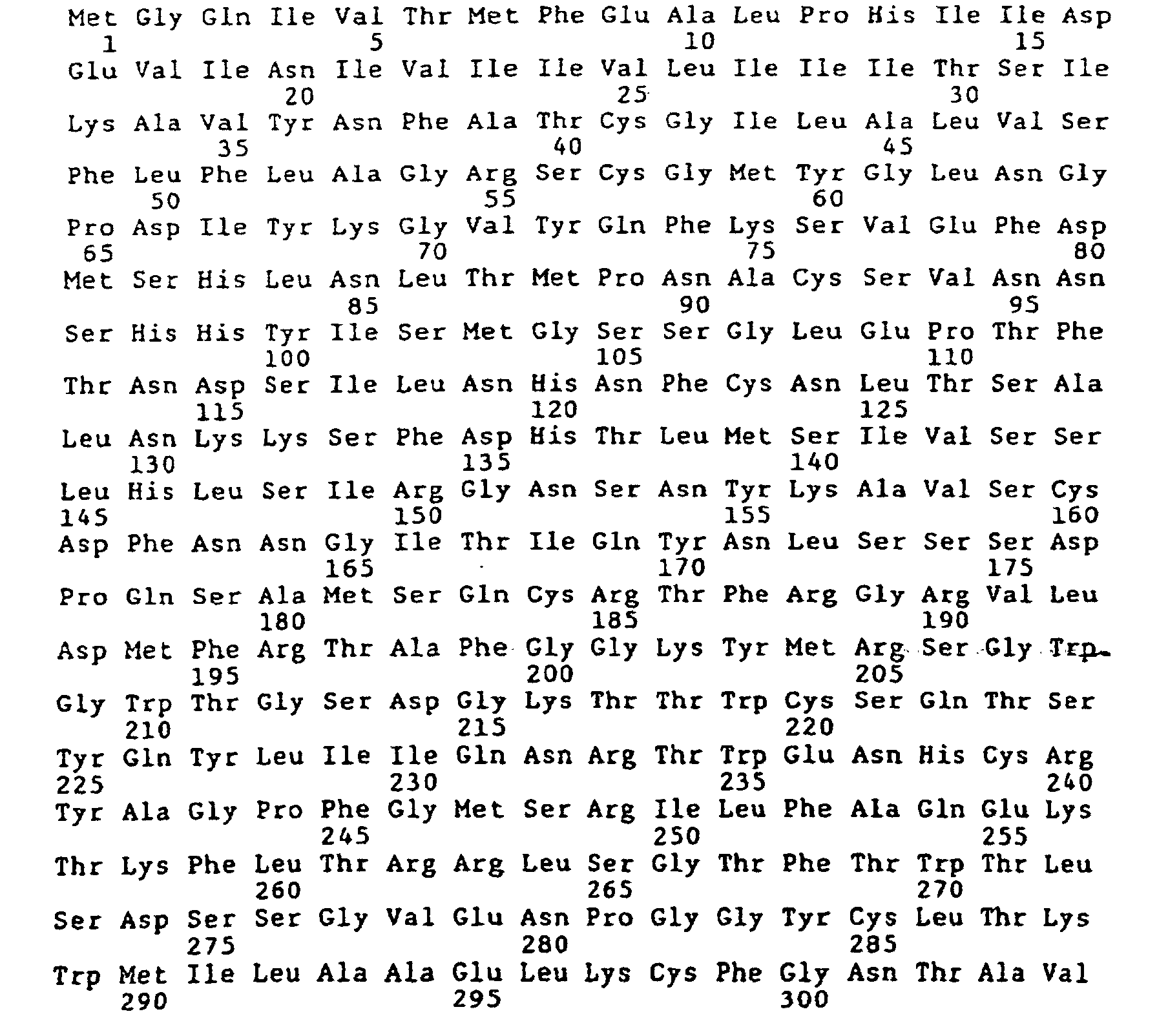
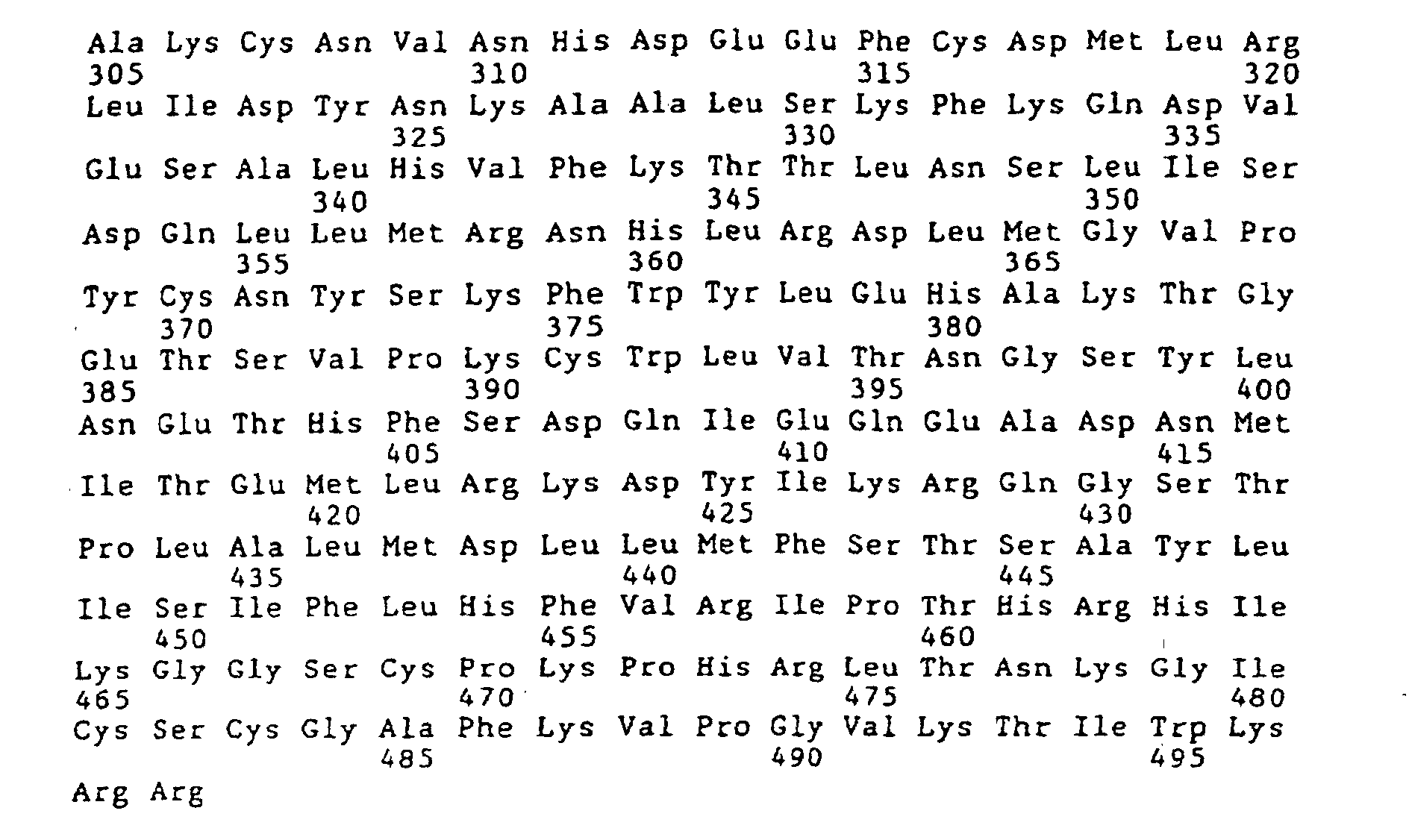
<211> 3376
<212> DNA
<213> Lymphocytic choriomeningitis virus


<211> 498
<212> PRT
<213> Lymphocytic choriomeningitis virus
<223> Huell-Glycoprotein
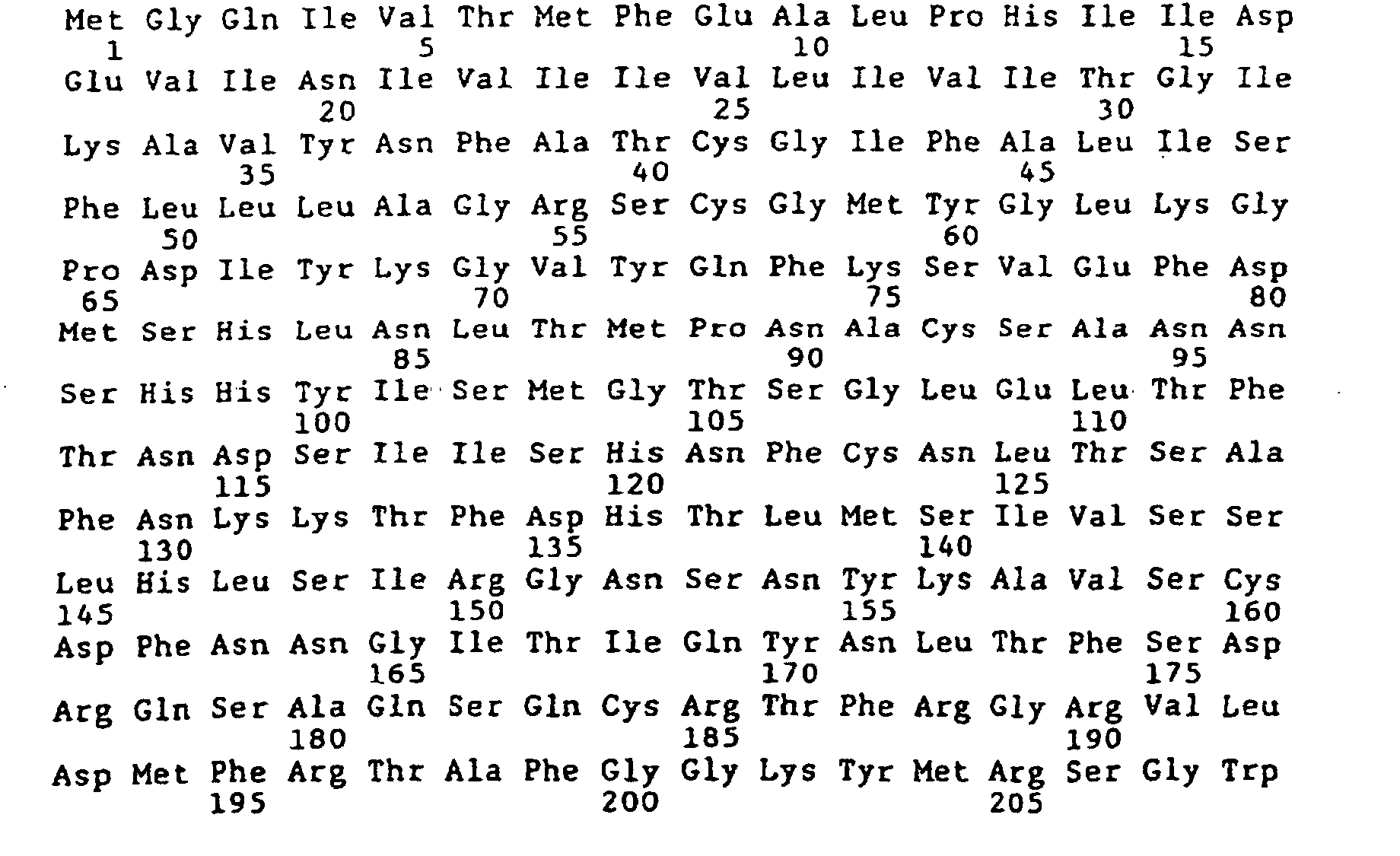

<211> 558
<212> PRT
<213> Lymphocytic choriomeningitis virus
<223> Nucleoprotein
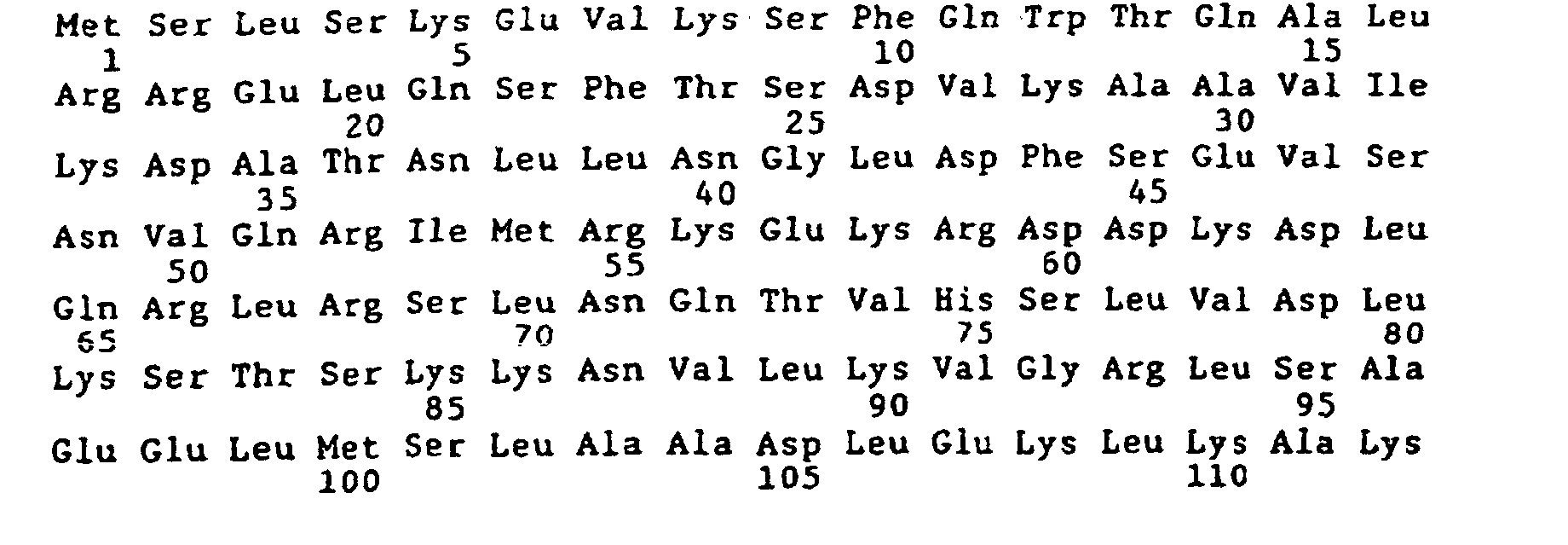

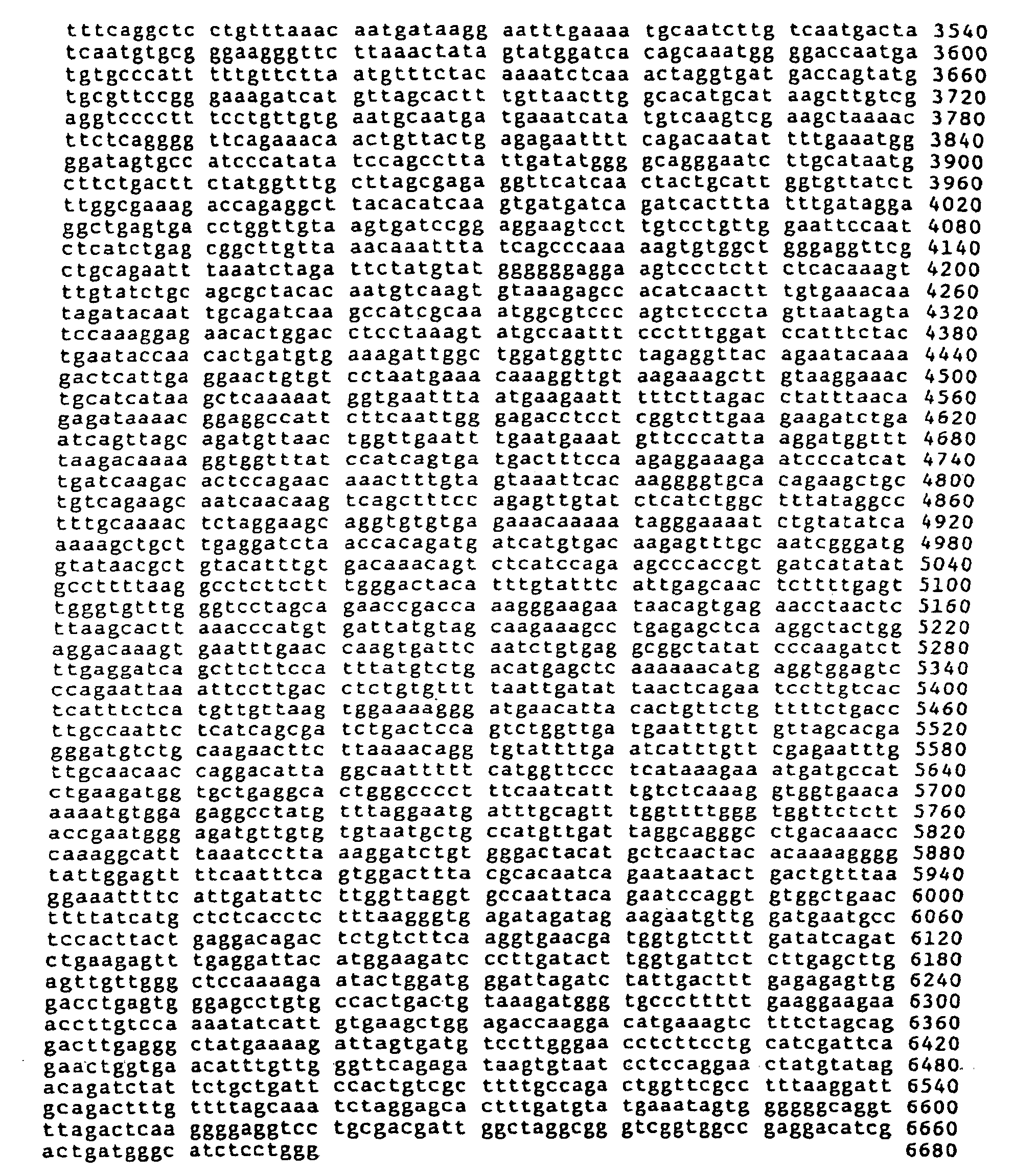
<211> 6680
<212> DNA
<213> Lymphocytic choriomeningitis virus

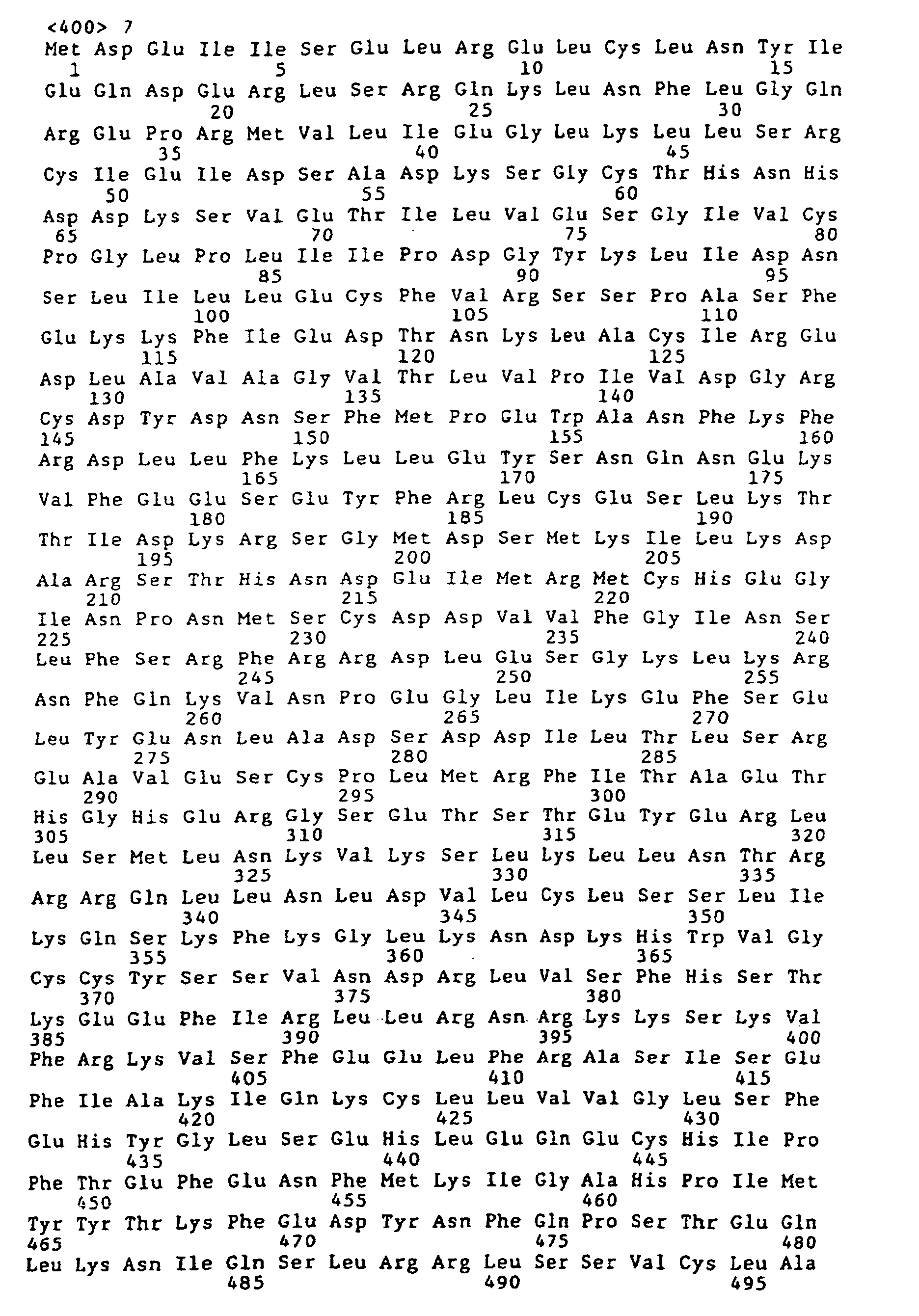
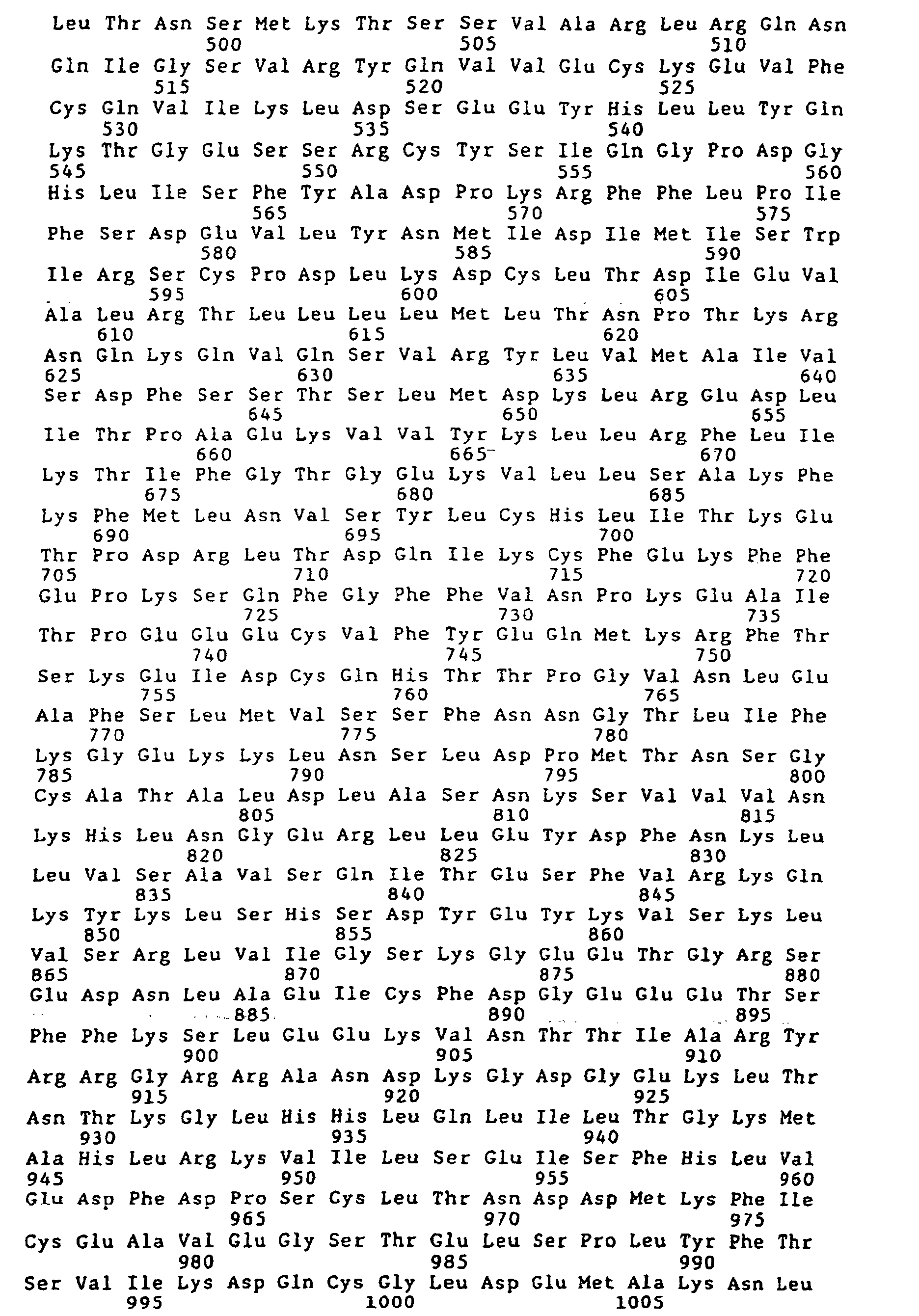
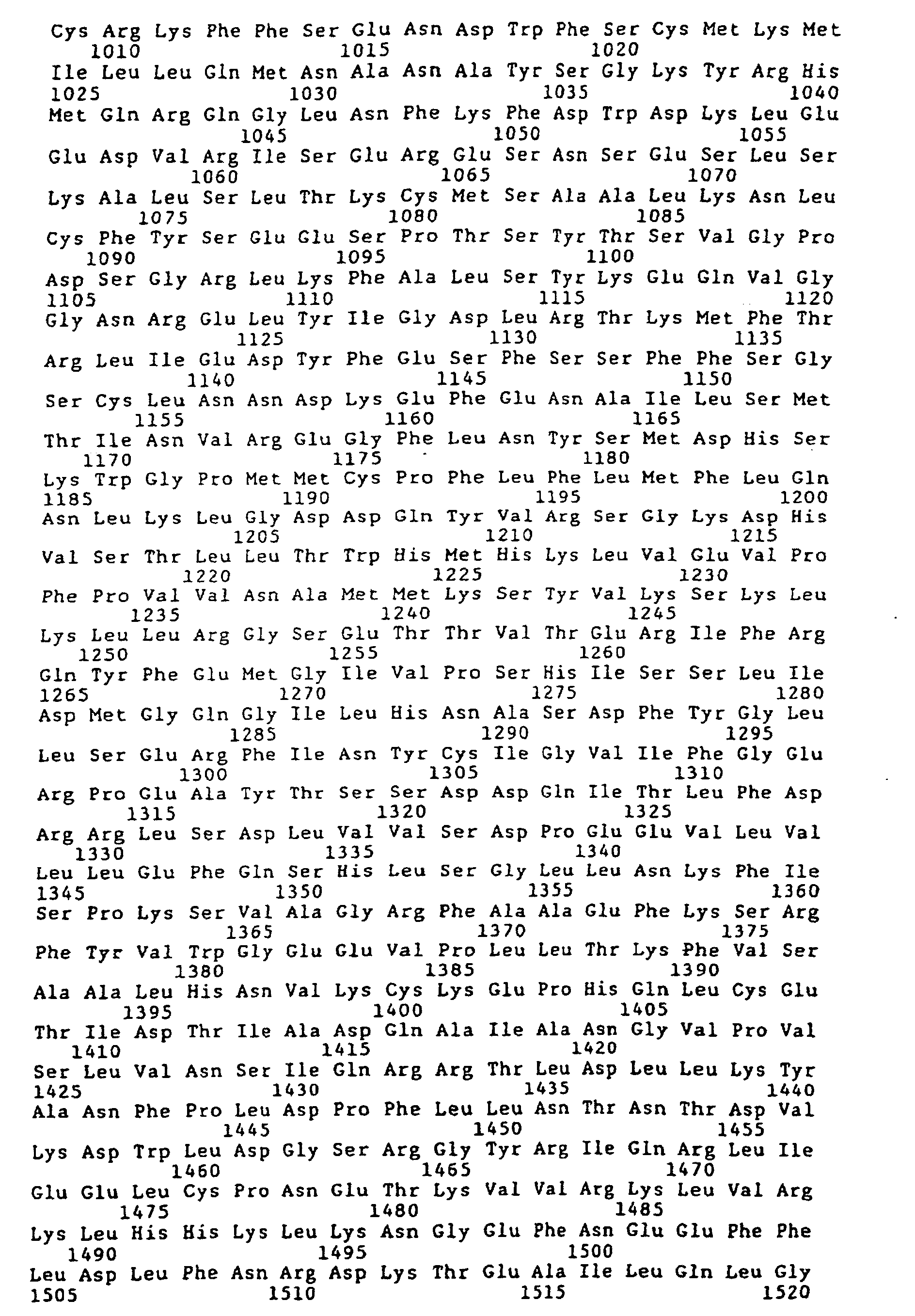
<211> 2210
<212> PRT
<213> Lymphocytic choriomeningitis virus
<223> L-Protein


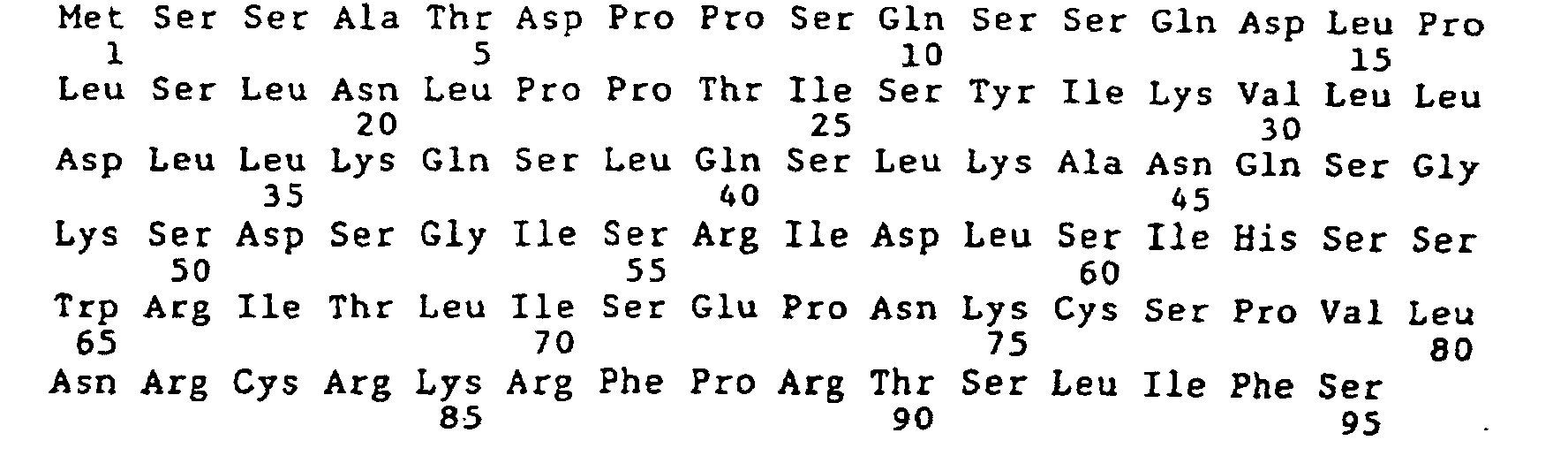
<211> 95
<212> PRT
<213> Lymphocytic choriomeningitis virus
<223> Unbekanntes Protein
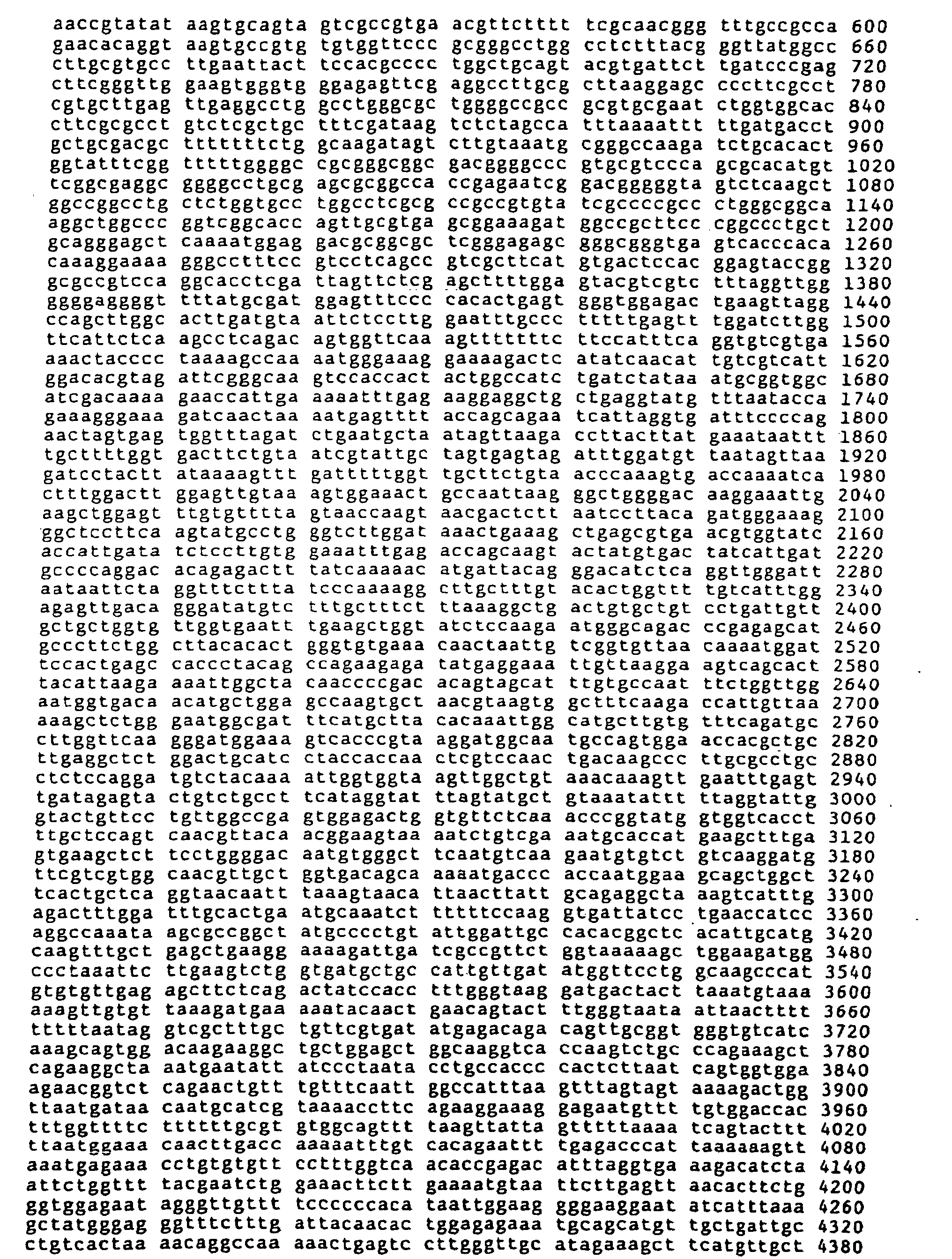
<211> 4695
<212> DNA
<213> Homo sapiens


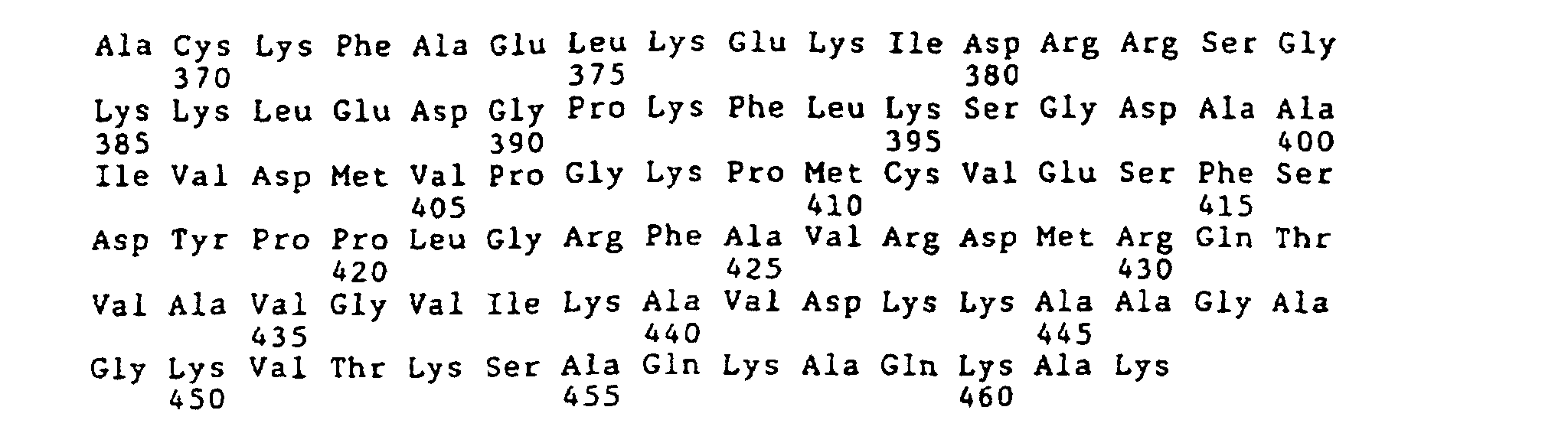
<211> 462
<212> PRT
<213> Homo sapiens
<223> Elongationsfaktor EF-1-alpha

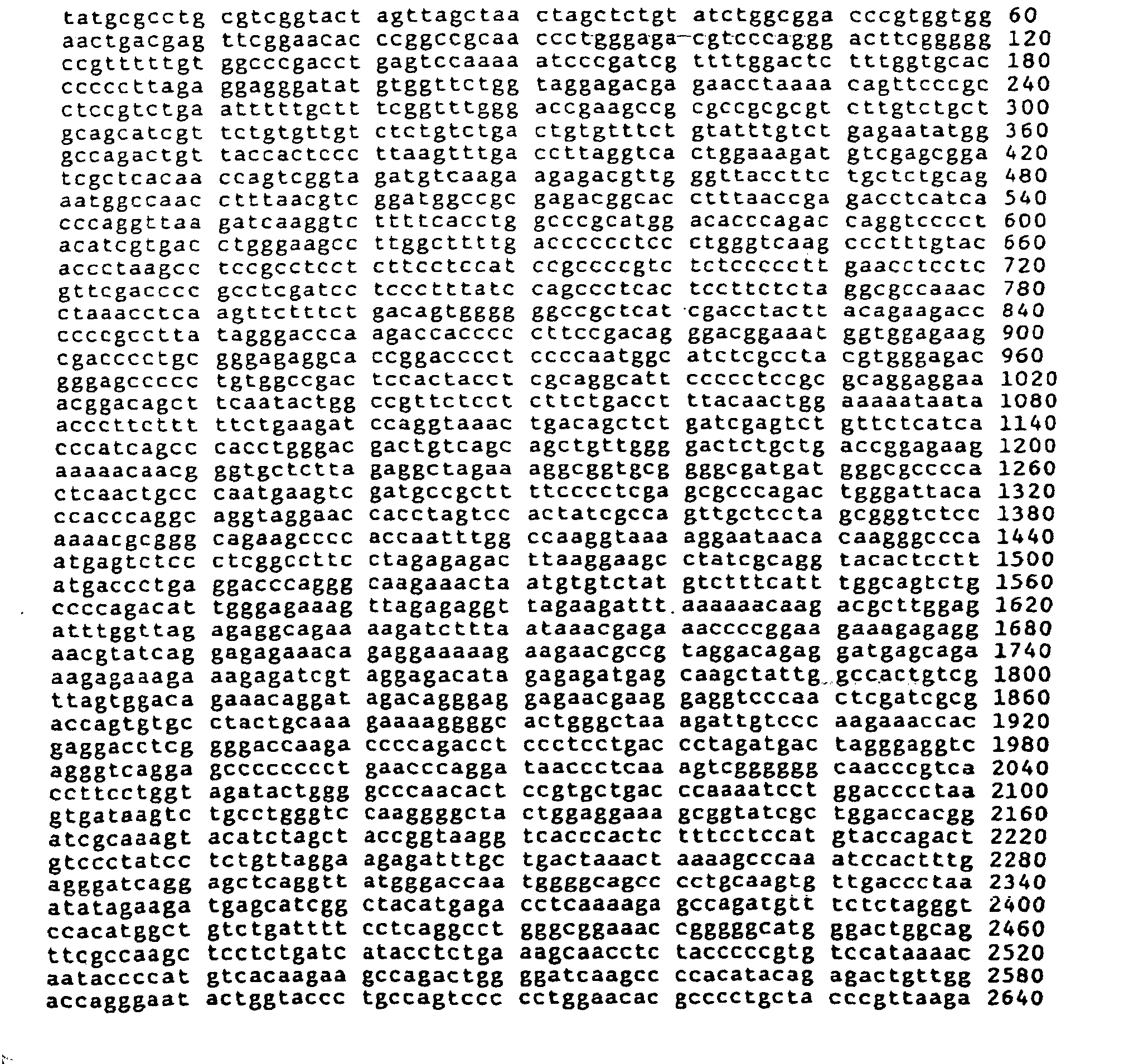
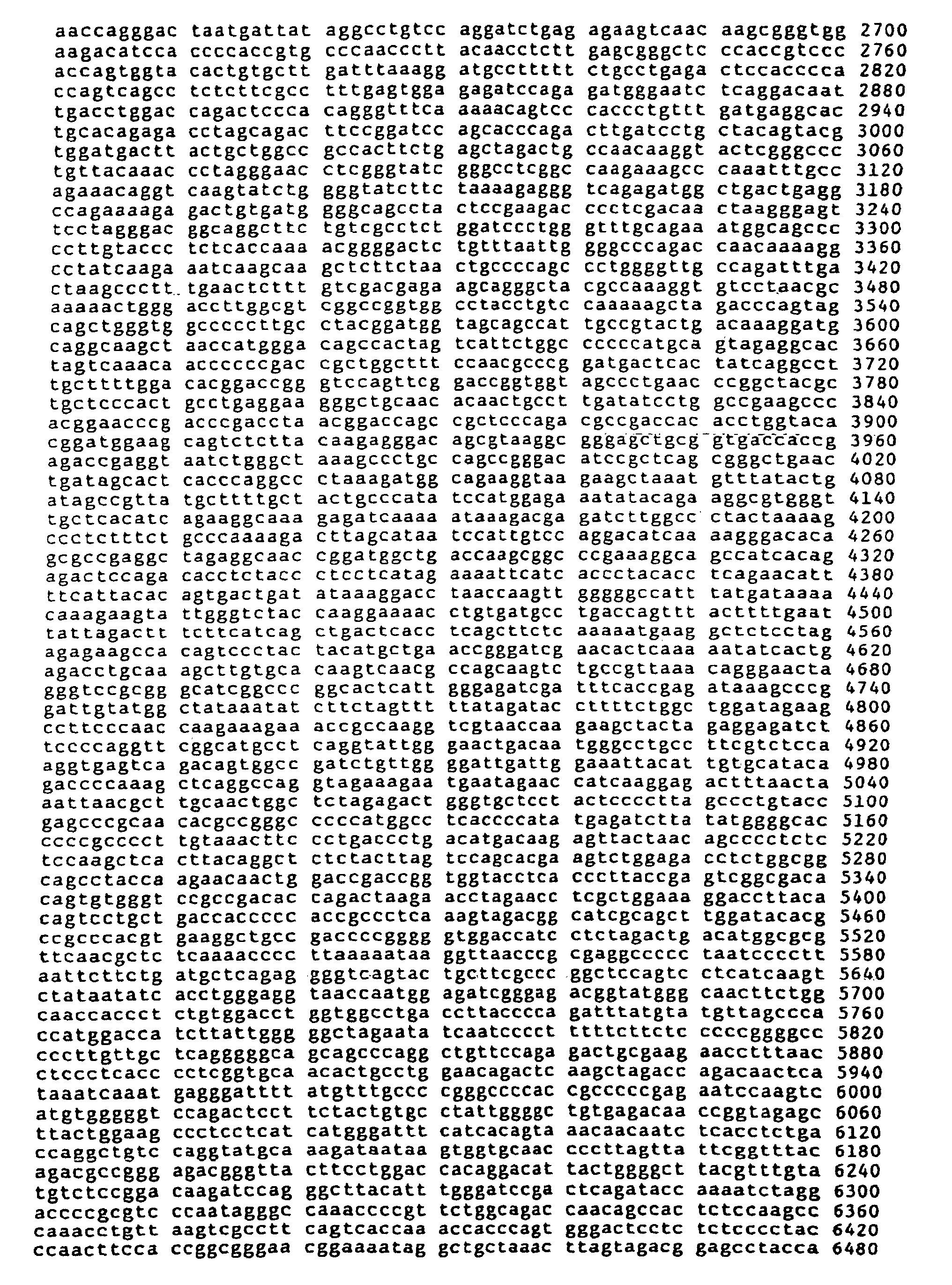
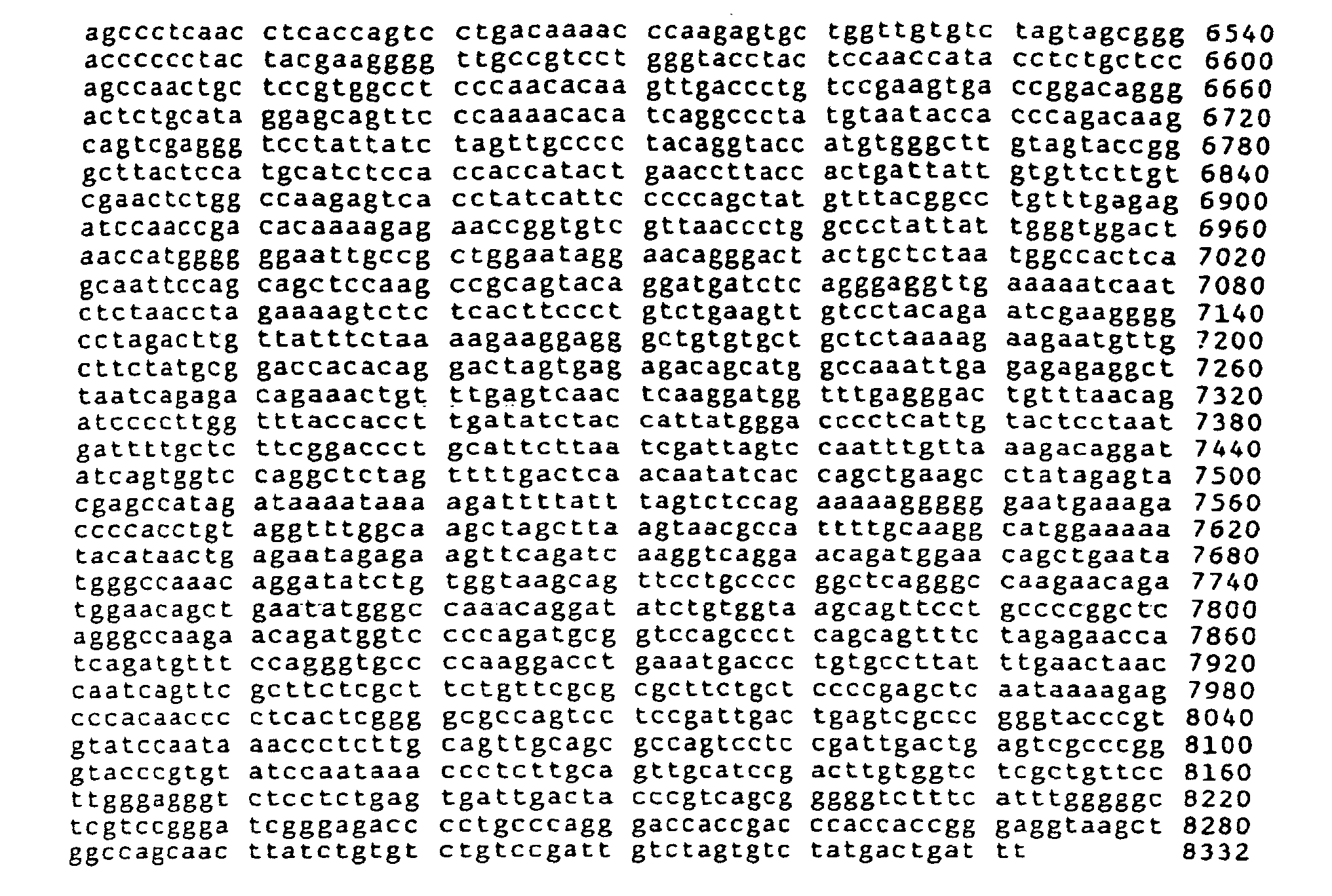
<211> 8332
<212> DNA
<213> Moloney murine leukemia virus
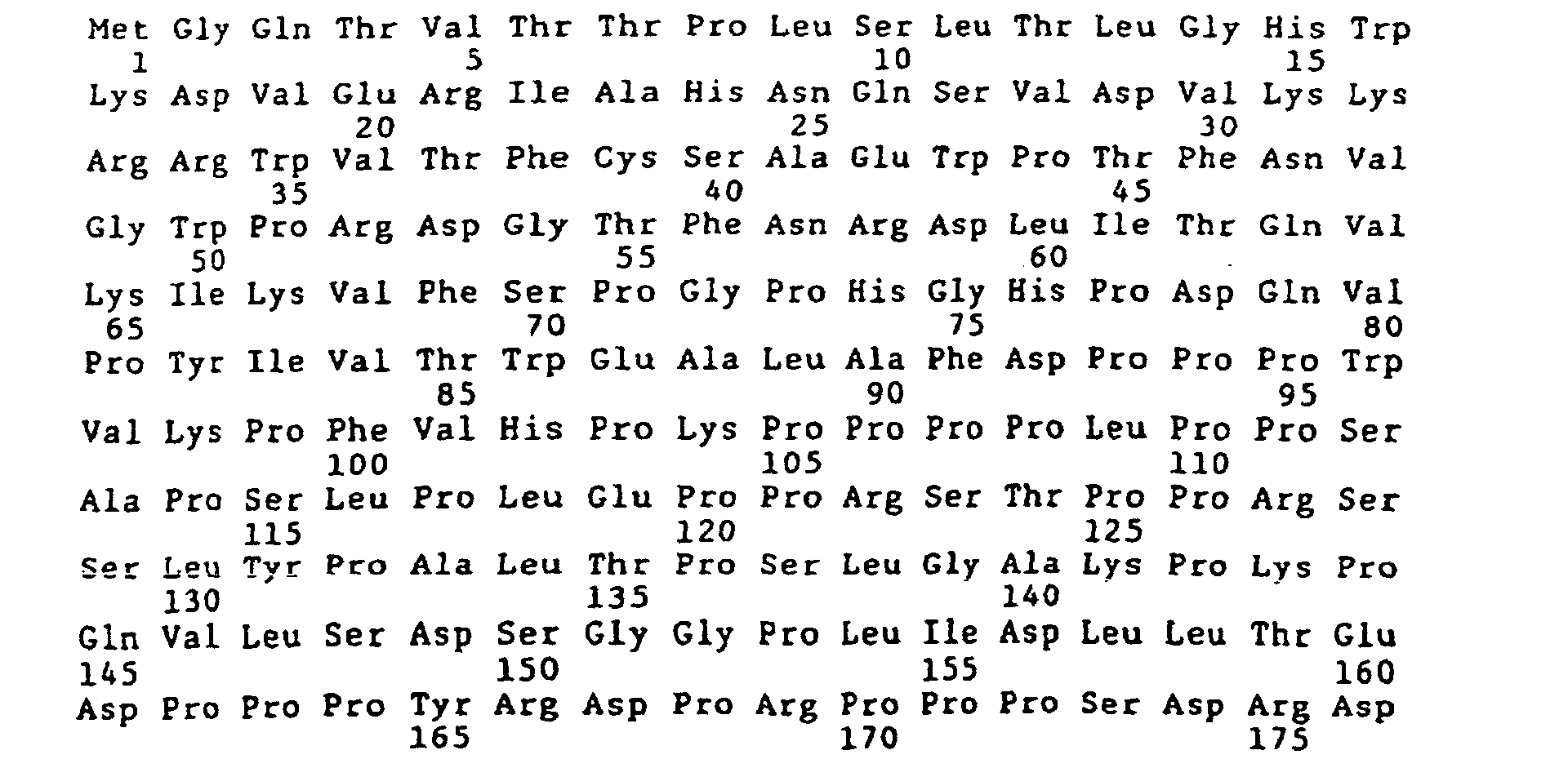
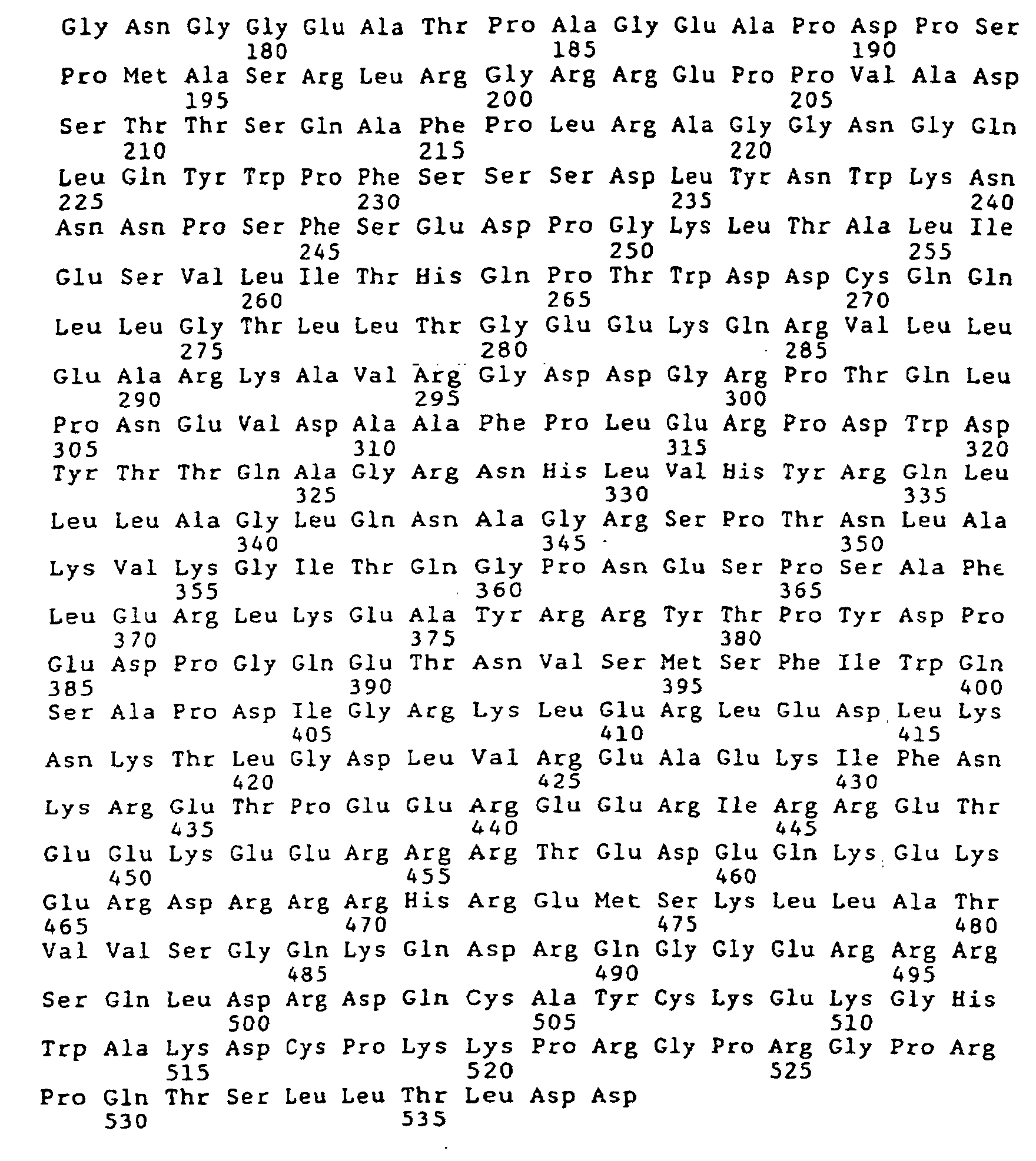
<211> 538
<212> PRT
<213> Moloney murine leukemia virus
<223> gag-Protein
<211> 1737
<212> PRT
<213> Moloney murine leukemia virus
<223> gag-pol-Protein

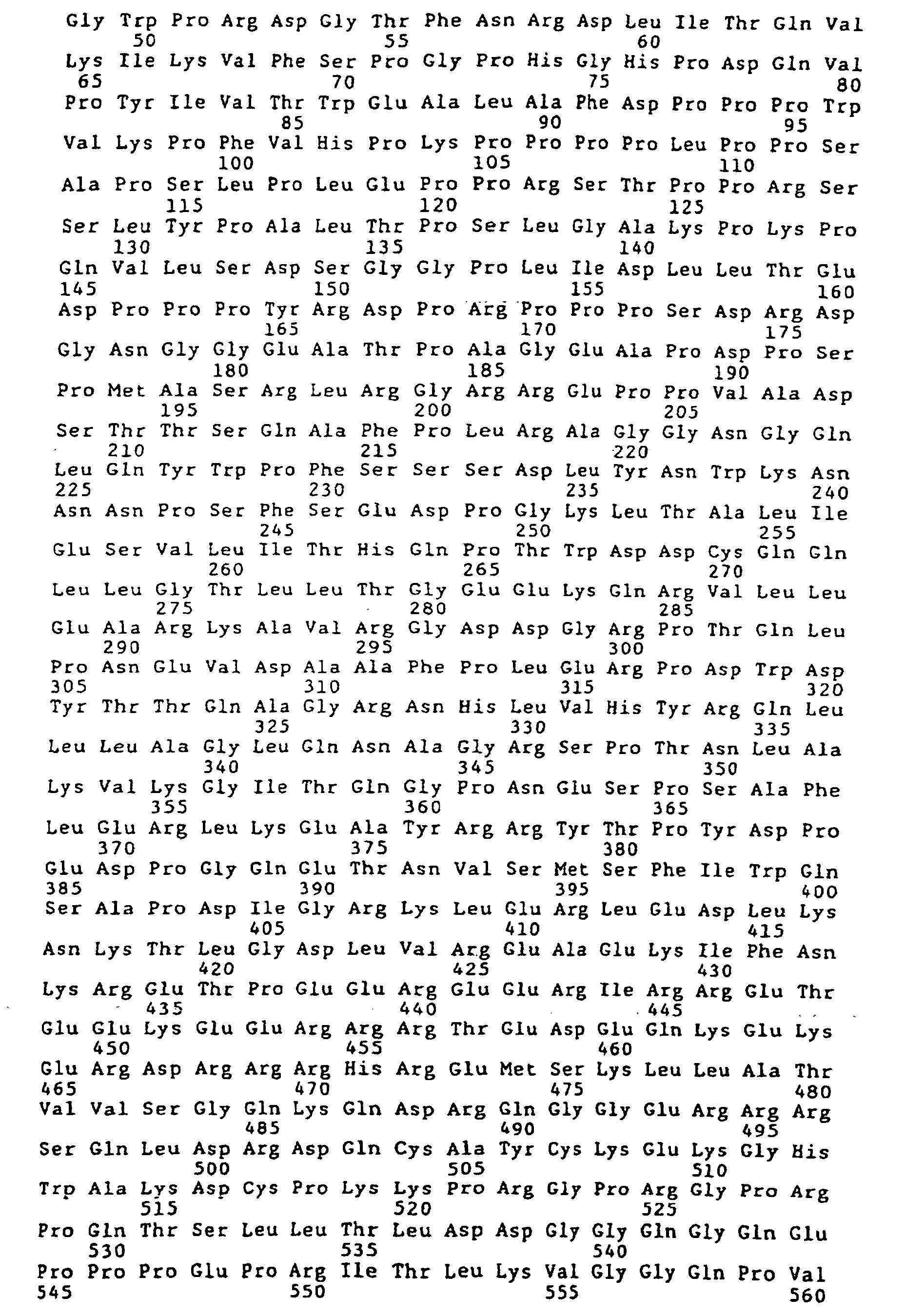


<211> 665
<212> PRT
<213> Moloney murine leukemia virus
<223> env-Protein
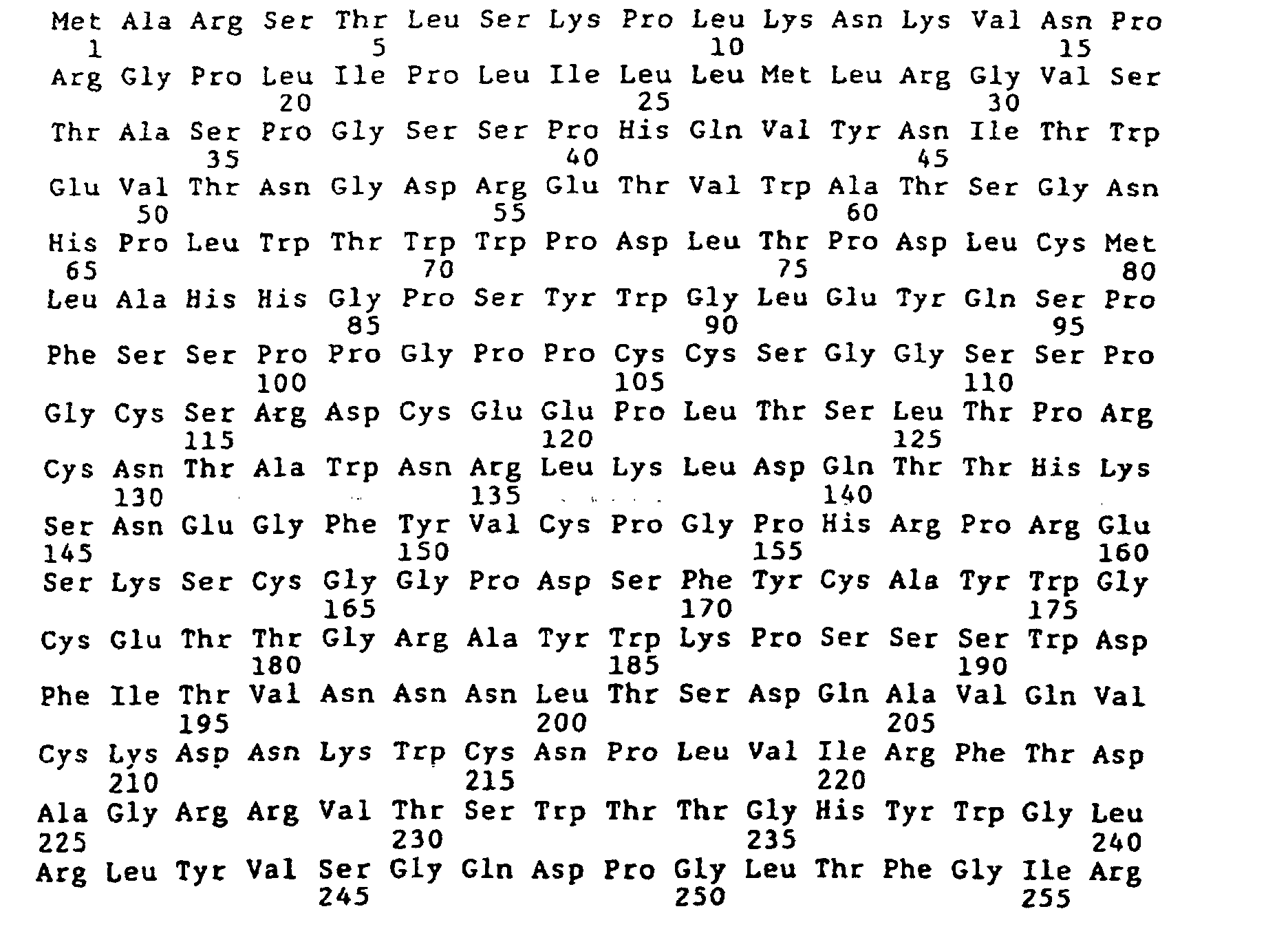
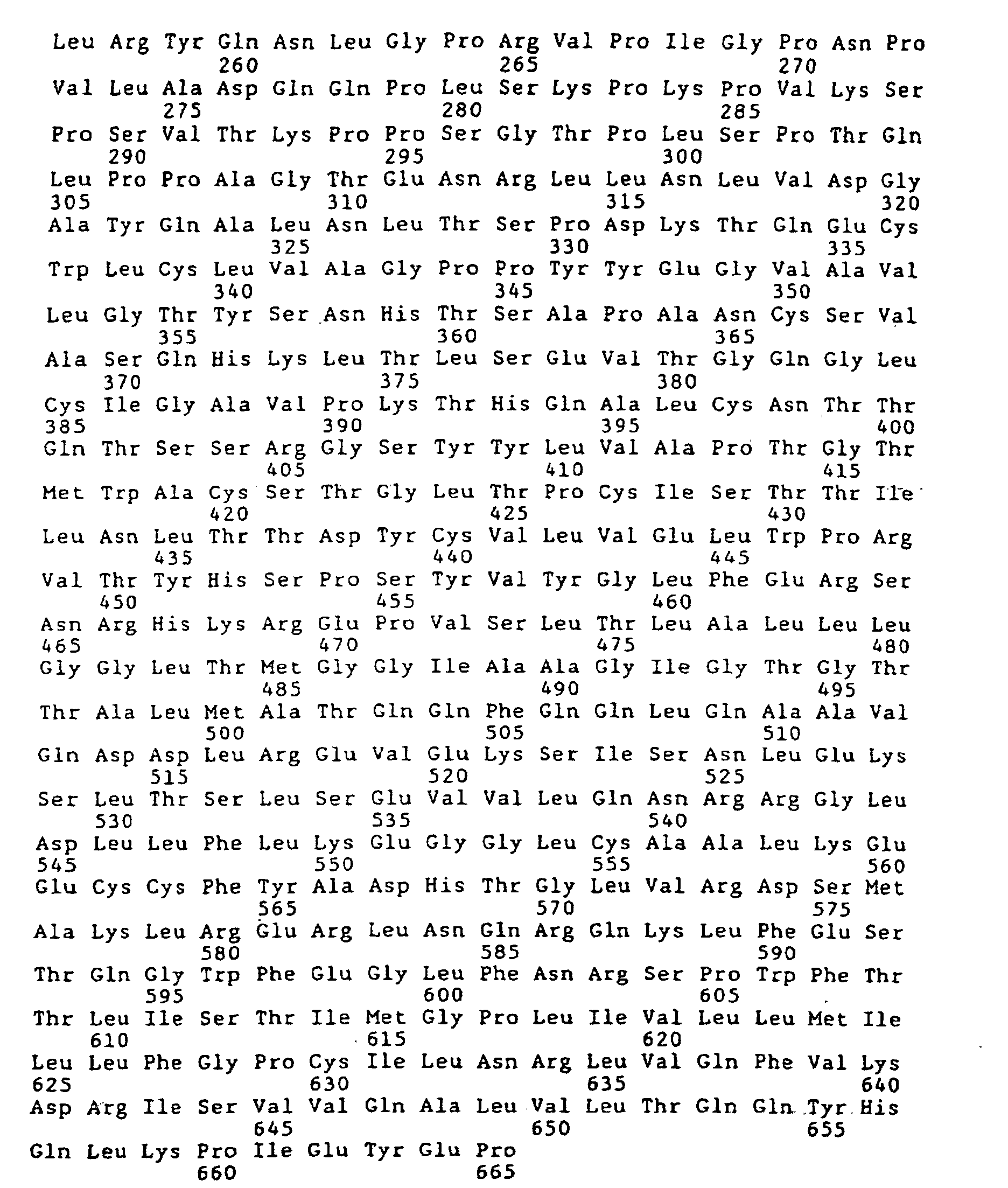
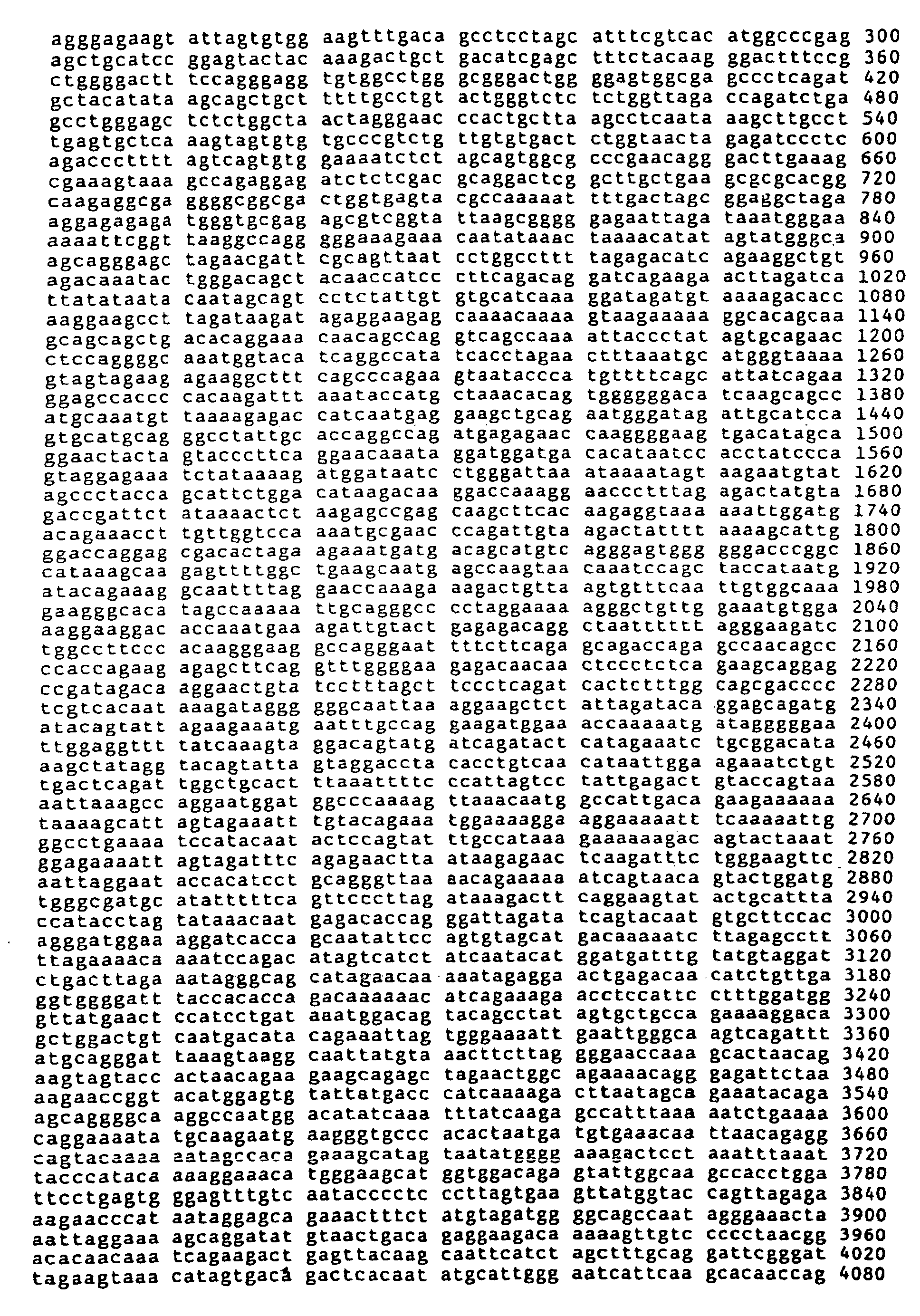
<211> 9709
<212> DNA
<213> Human immunodeficiency virus type 1

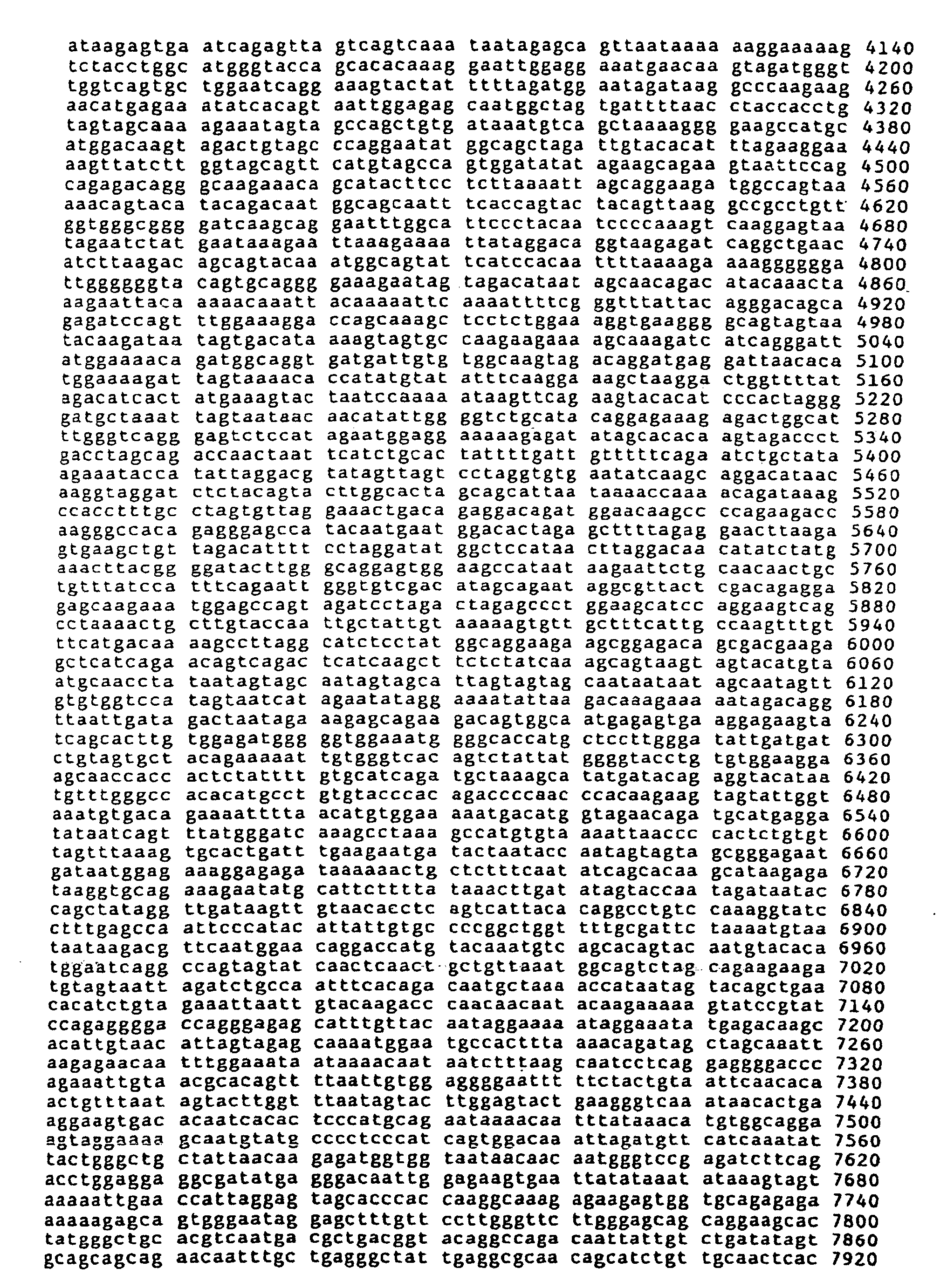

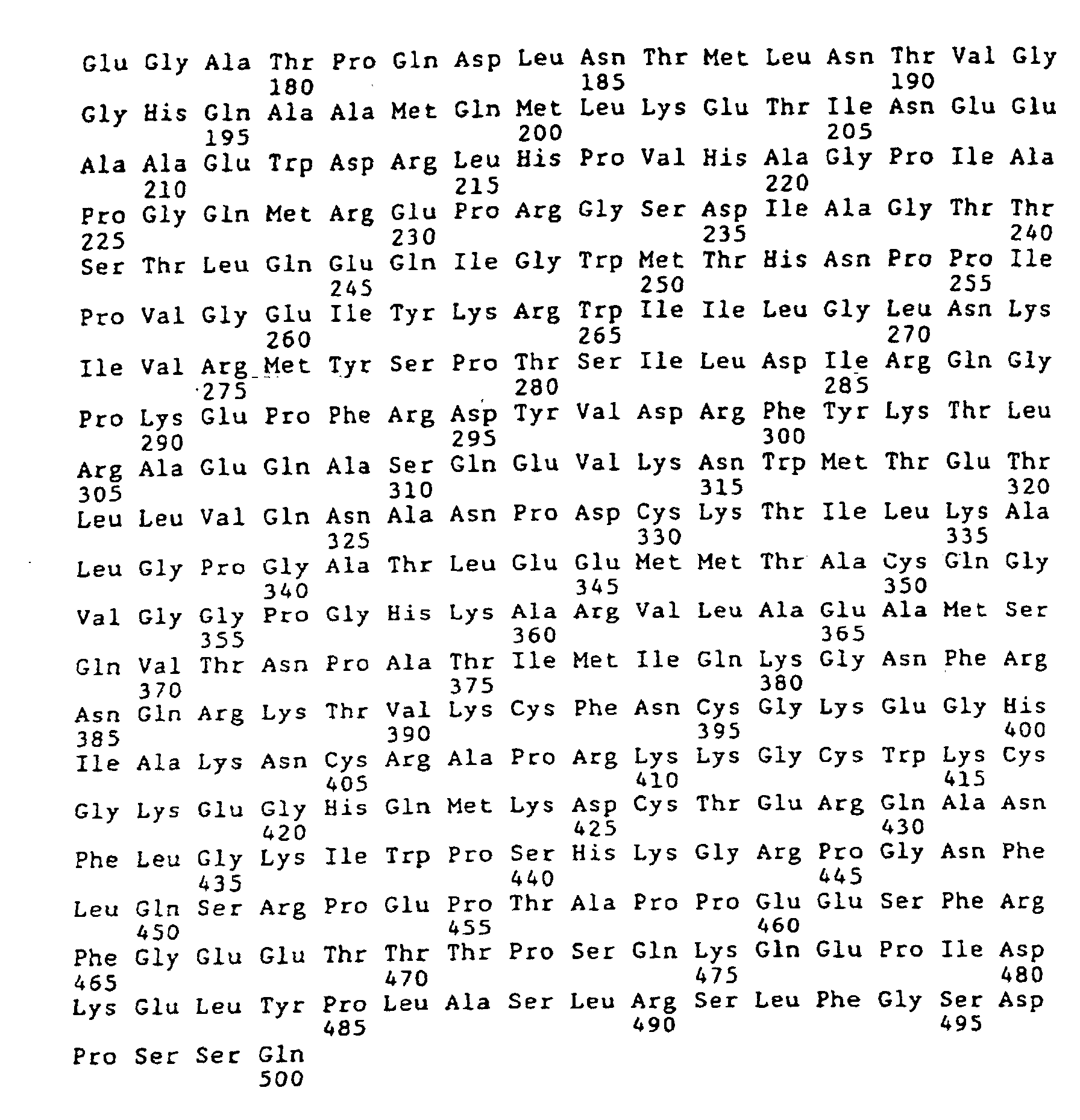
<211> 500
<212> PRT
<213> Human immunodeficiency virus type 1
<223> gag-Polyprotein

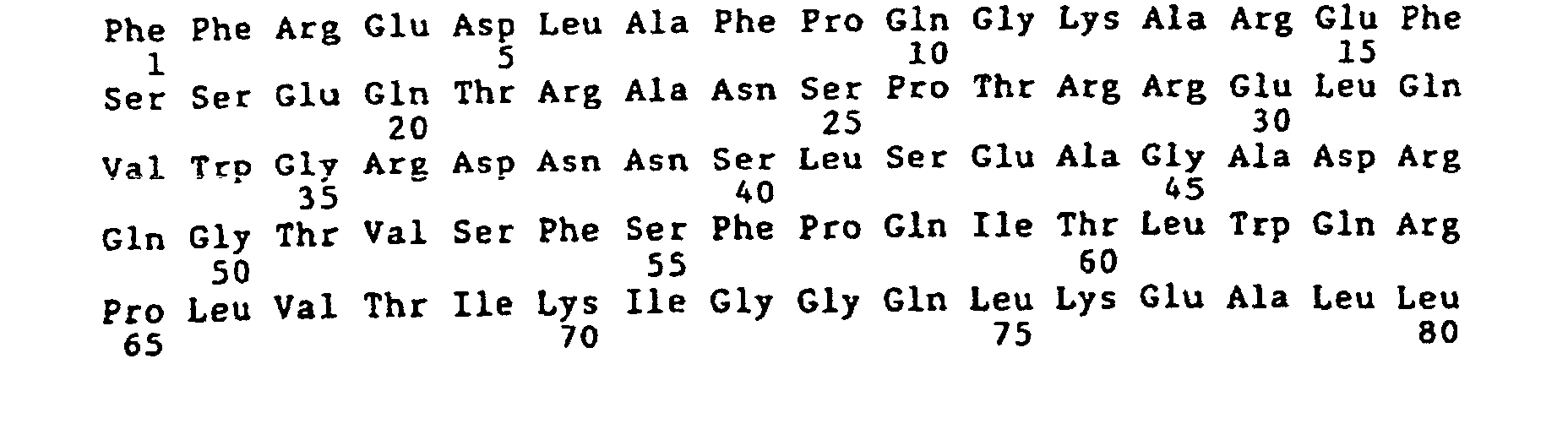
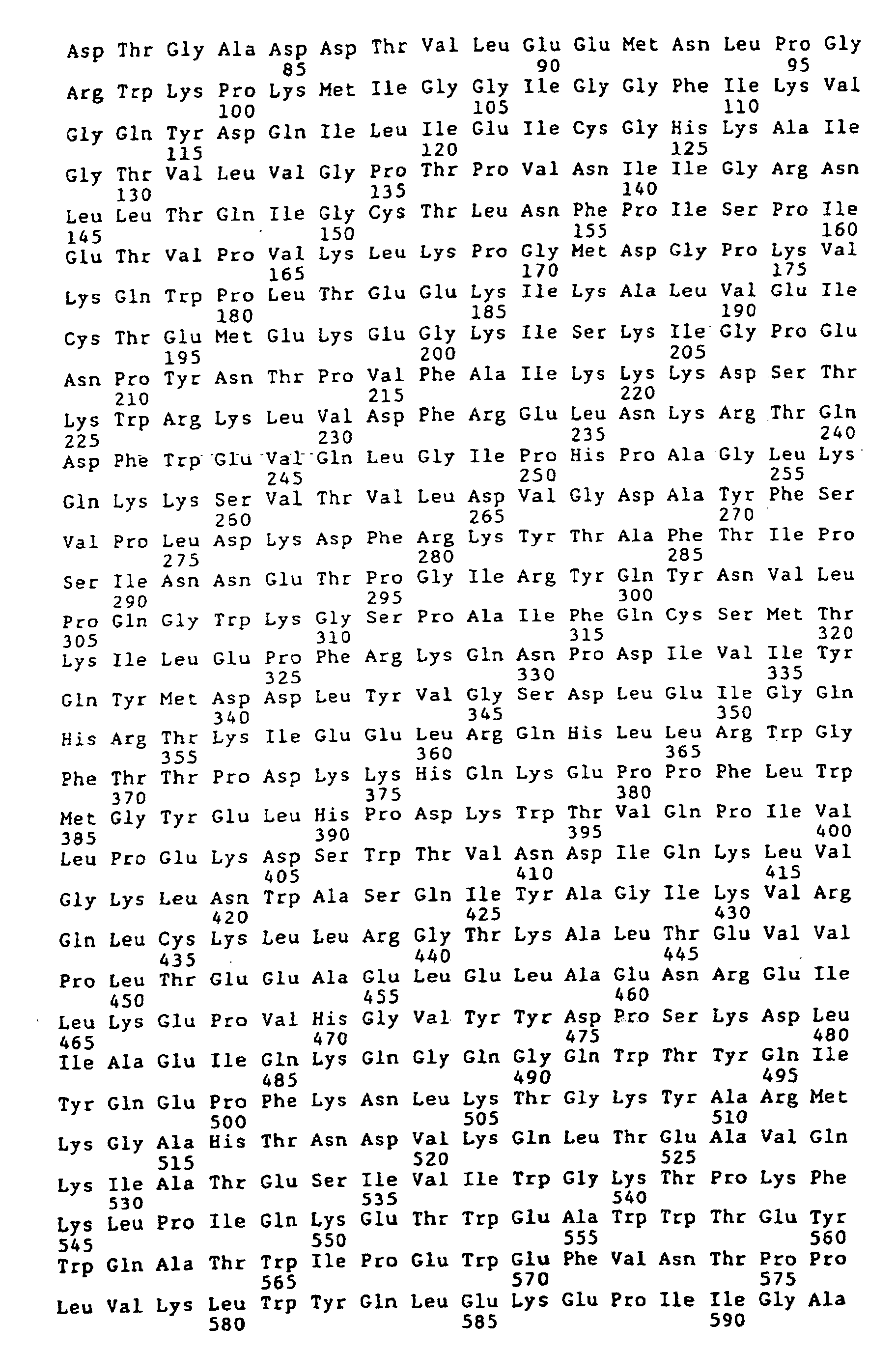
<211> 1003
<212> PRT
<213> Human immunodeficiency virus type 1
<223> pol-Polyprotein

<211> 192
<212> PRT
<213> Human immunodeficiency virus type 1
<223> viv-Protein

<211> 96
<212> PRT
<213> Human immunodeficiency virus type 1
<223> vpr-Protein
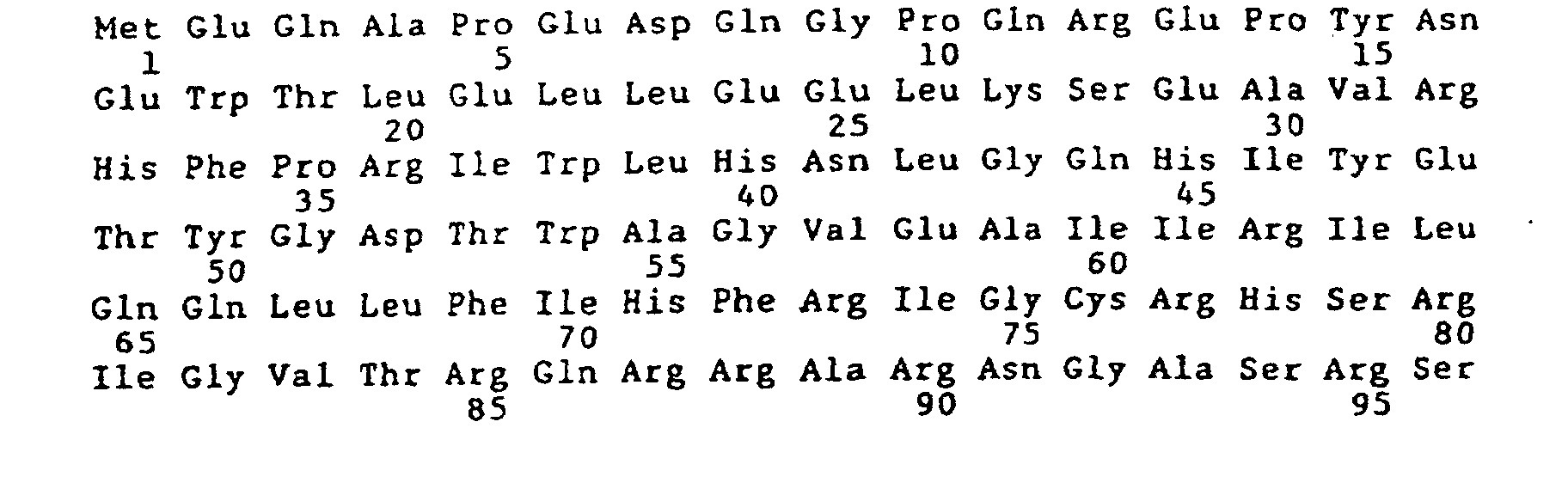
<211> 86
<212> PRT
<213> Human immunodeficiency virus type 1
<223> tat-Protein

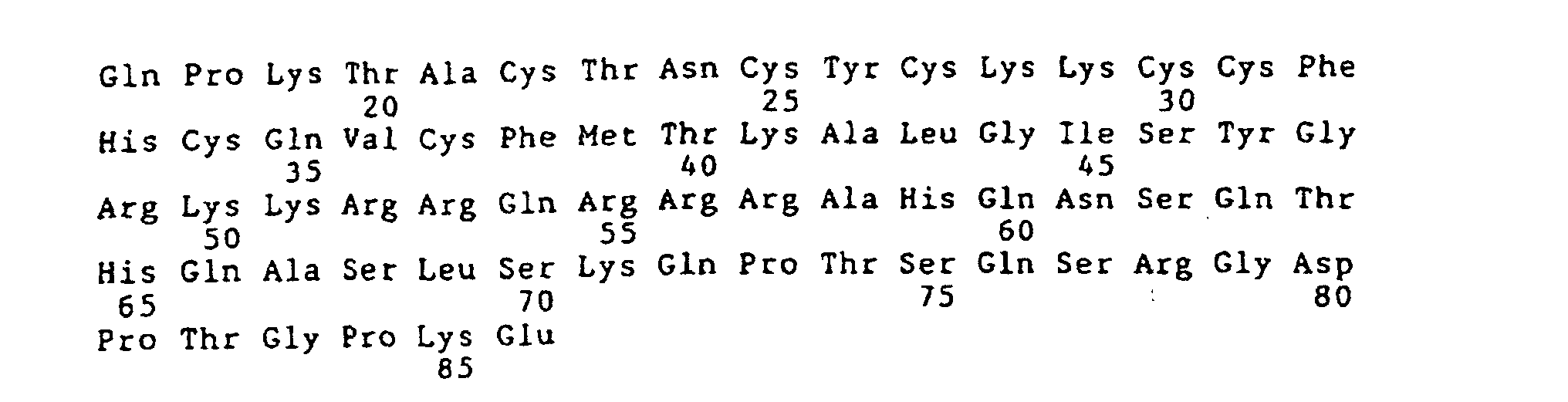
<211> 116
<212> PRT
<213> Human immunodeficiency virus type 1
<223> rev-Protein

<211> 81
<212> PRT
<213> Human immunodeficiency virus type 1
<223> vpu-Protein

<211> 854
<212> PRT
<213> Human immunodeficiency virus type 1
<223> Huell-Protein
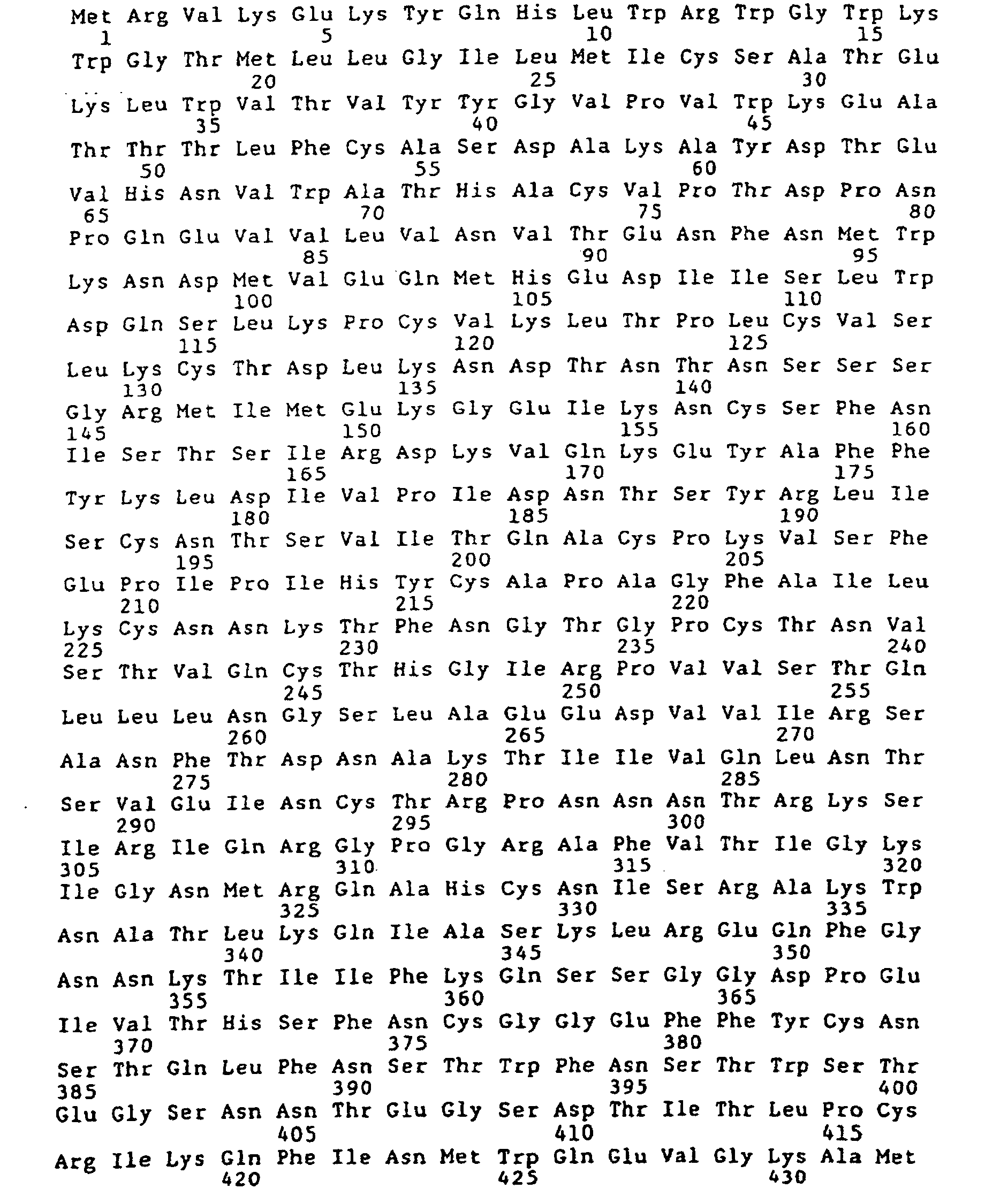
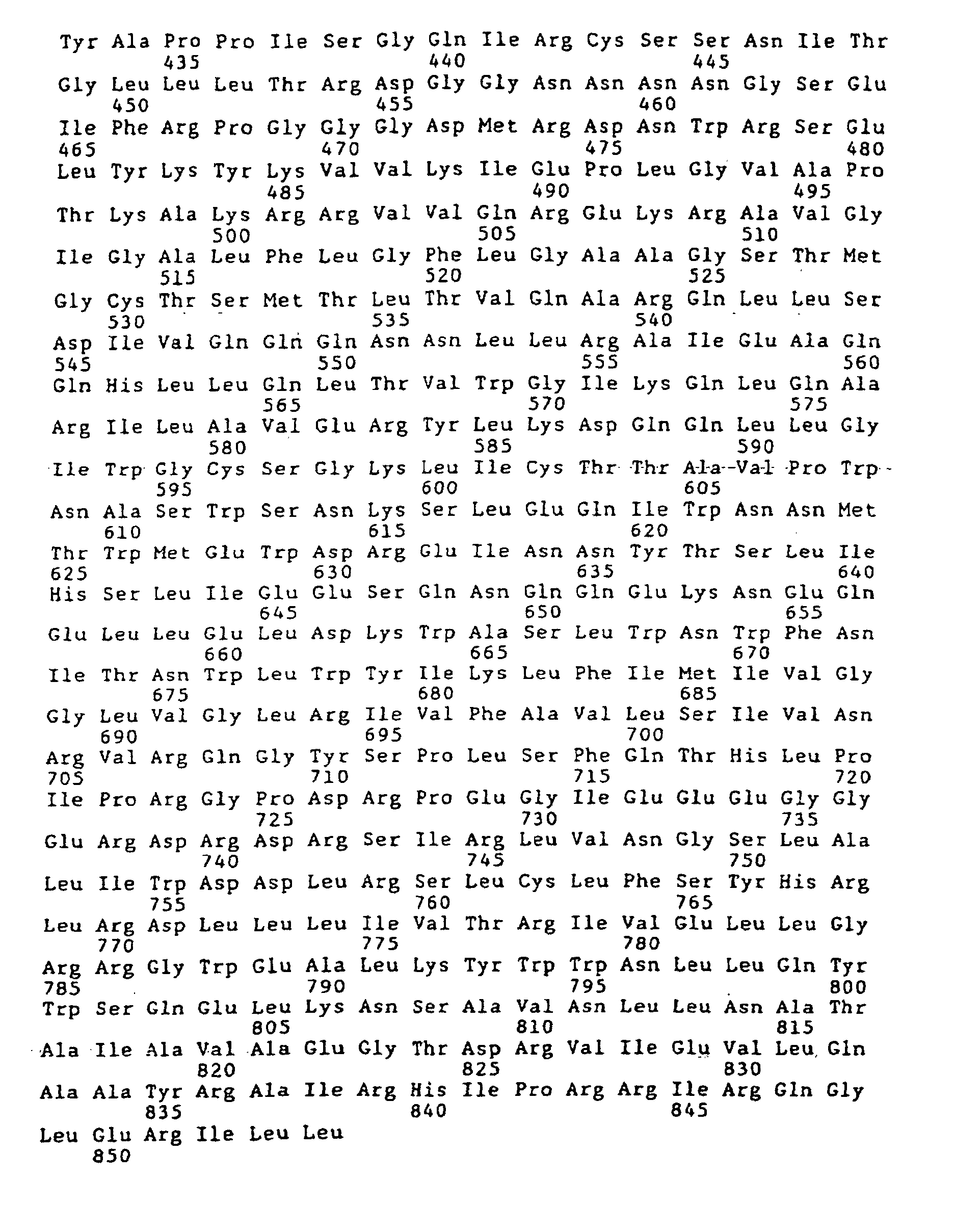
<211> 206
<212> PRT
<213> Human immunodeficiency virus type 1
<223> nef-Protein
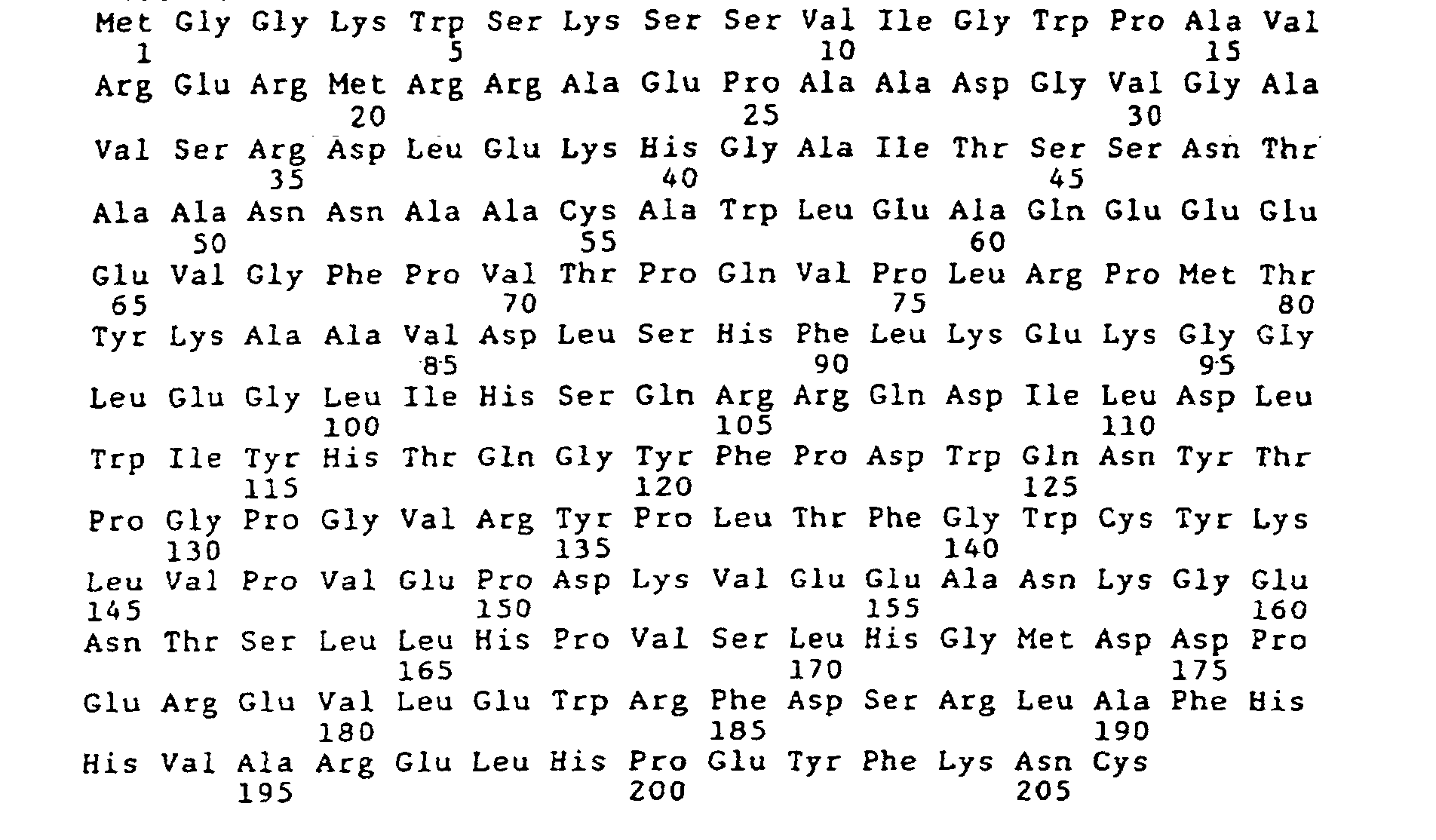
<211> 1497
<212> DNA
<213> Kuenstliche Sequenz
<223> Beschreibung der kuenstlichen Sequenz: LCMV-Variante WE-HPI
<221> CDS
<222> ()..(1497)
<223> LCMV GP-Variante (Open reading frame)


<211> 498
<212> PRT
<213> Kuenstliche Sequenz
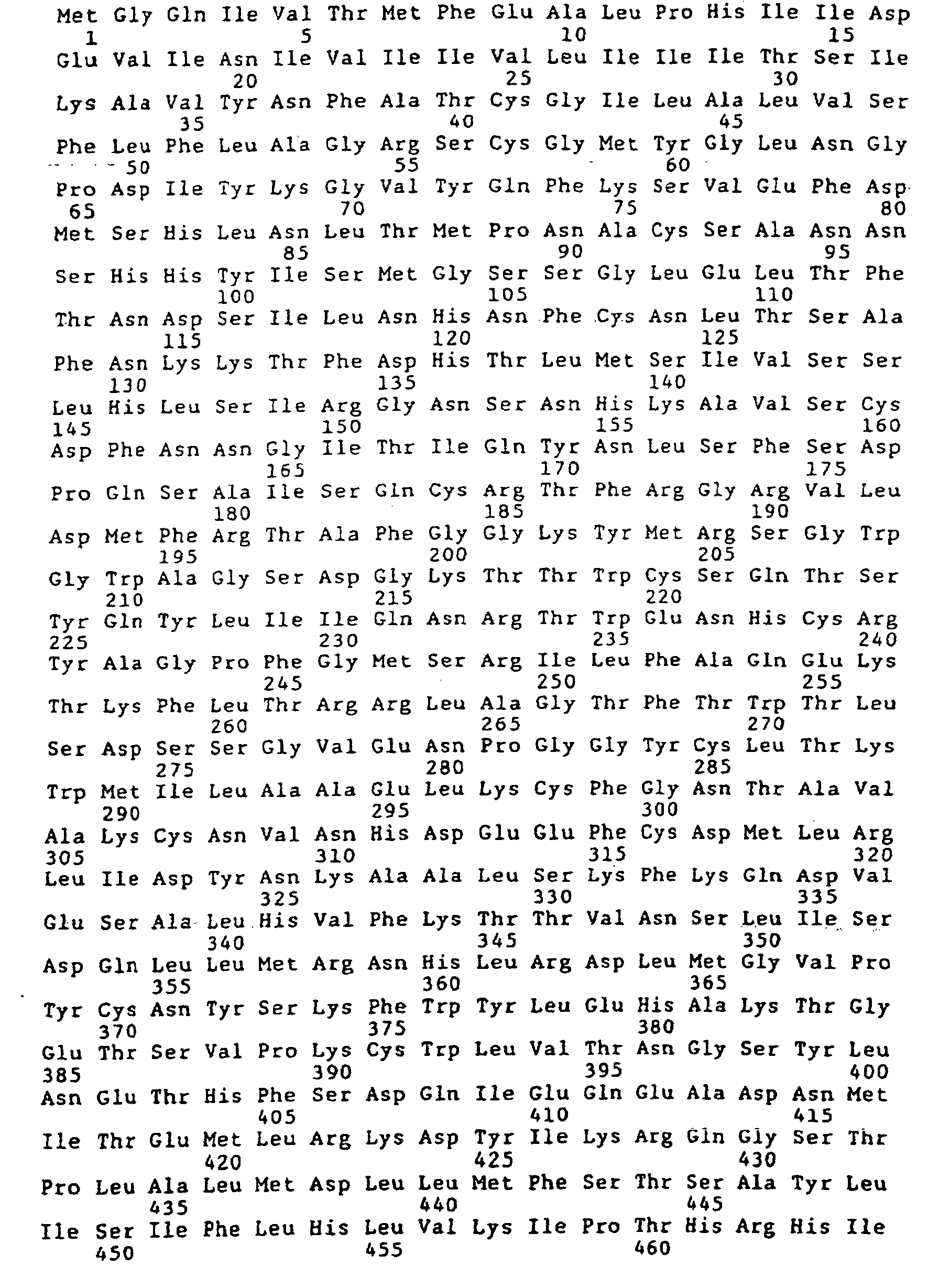
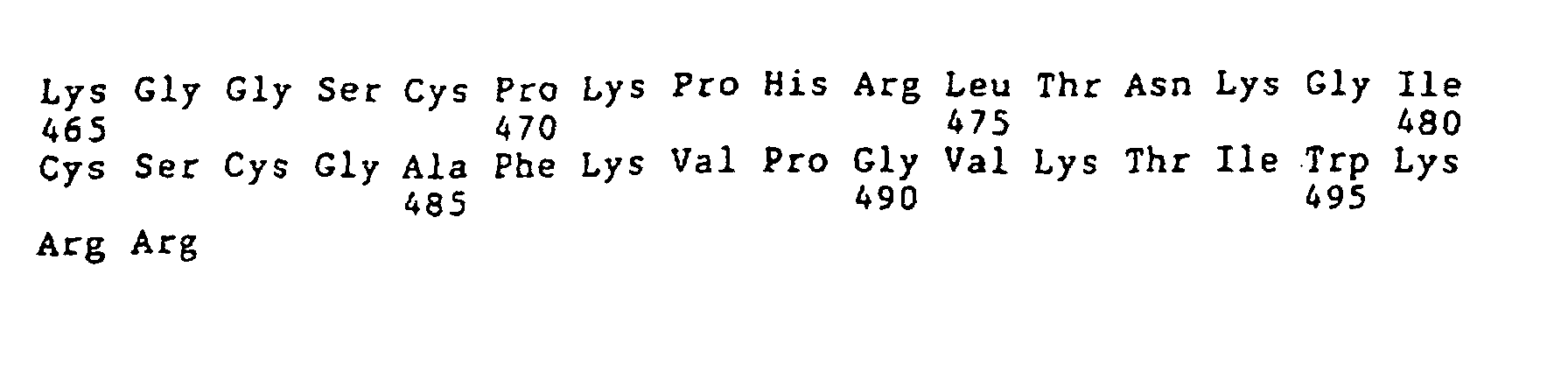
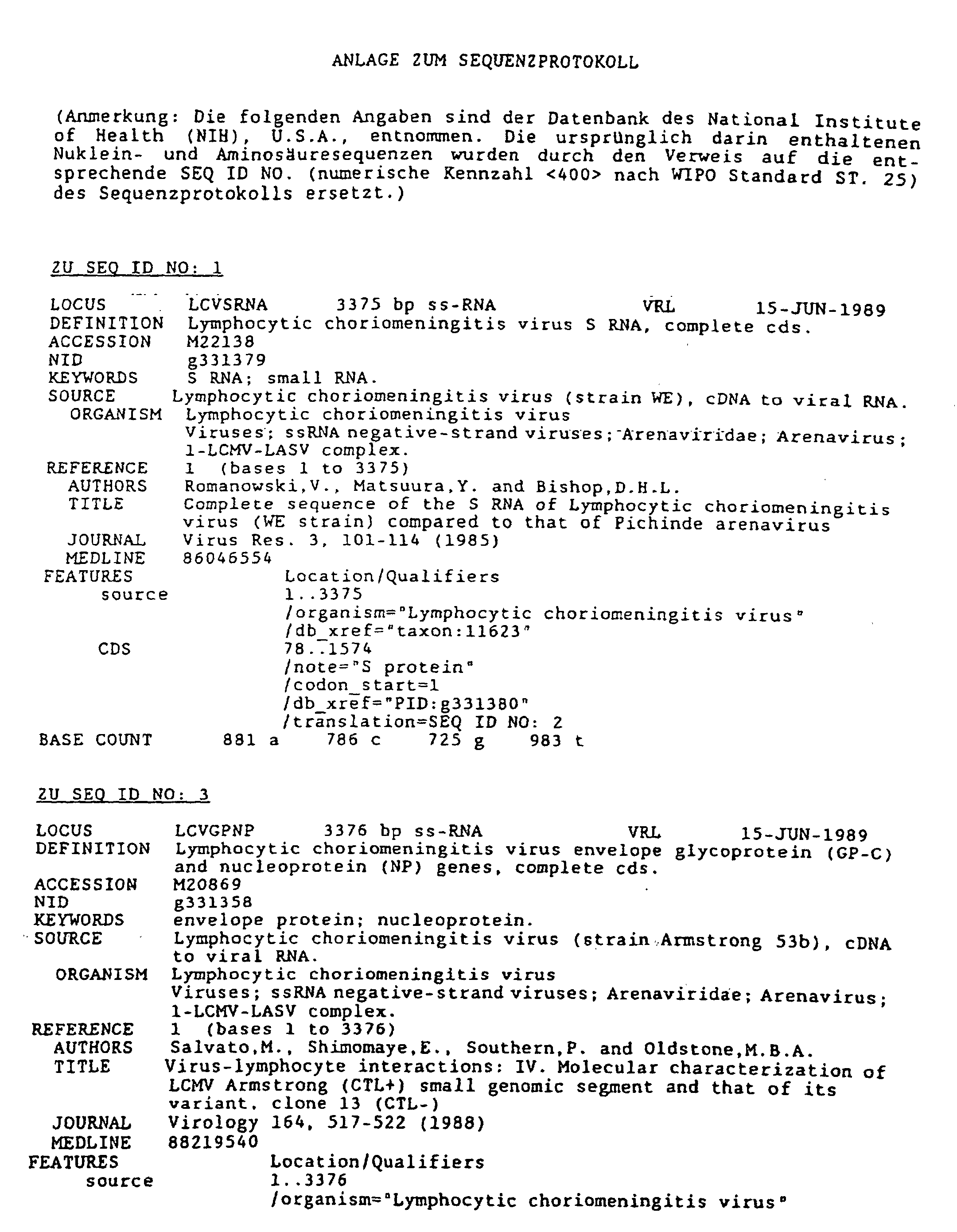
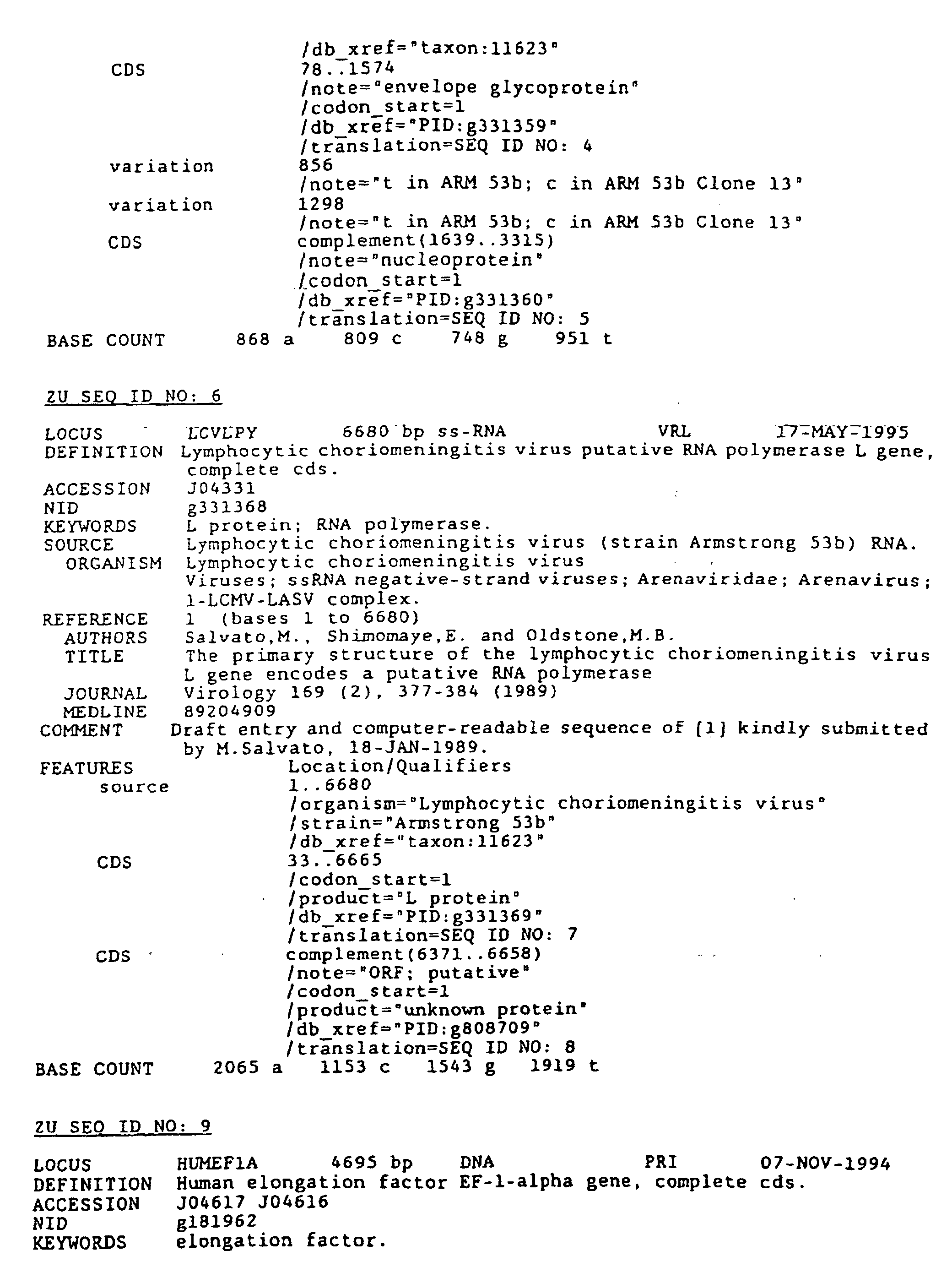
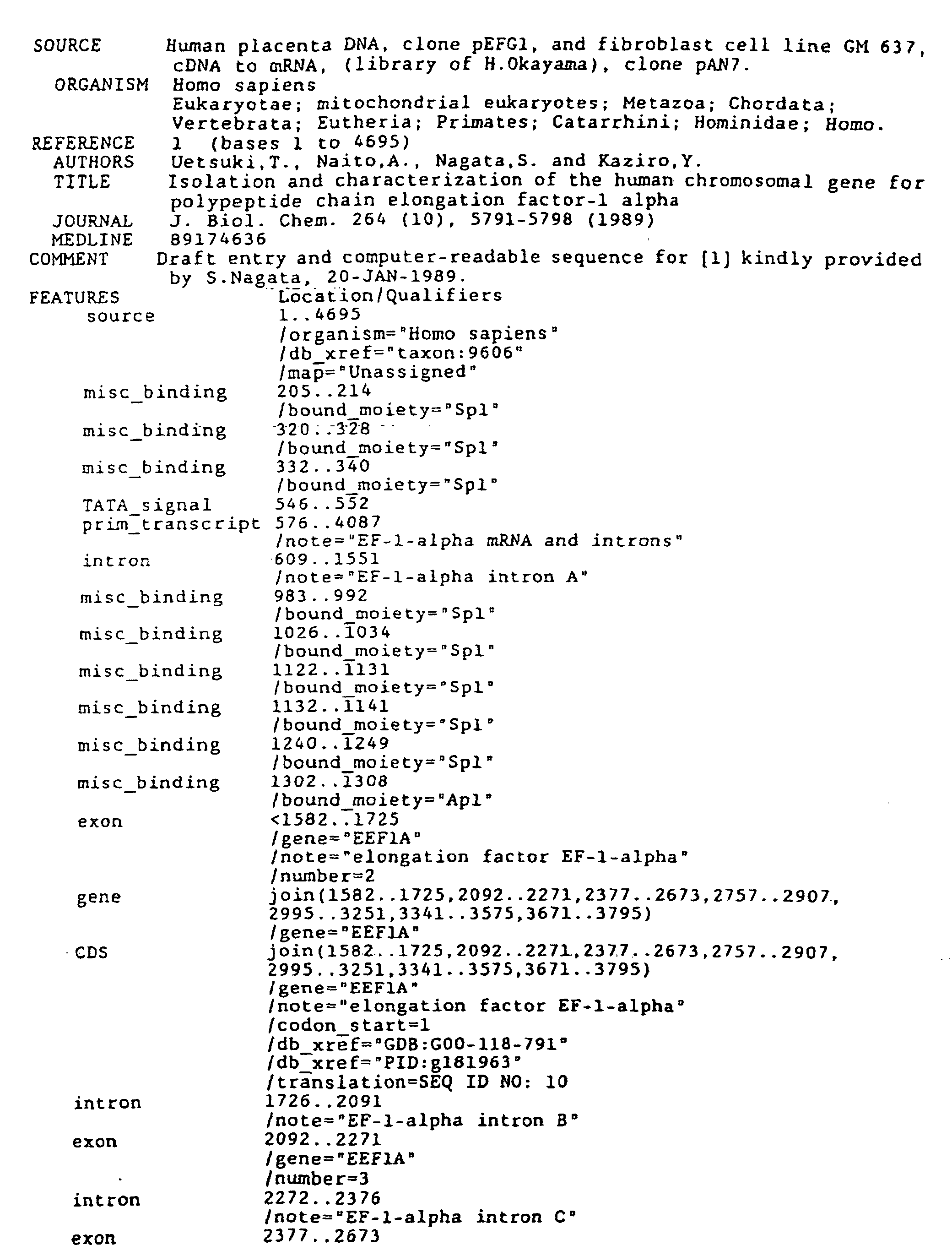
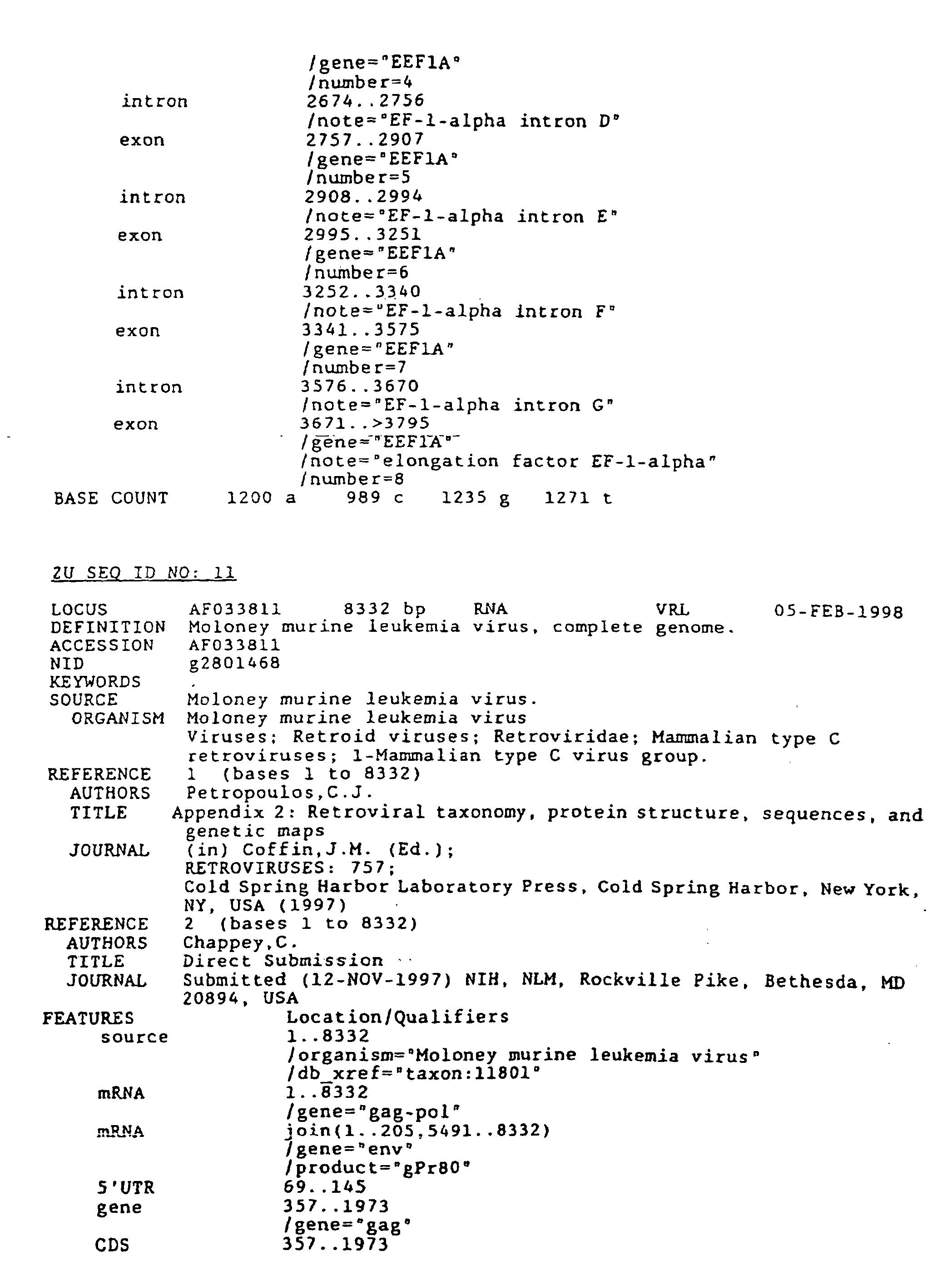


Claims (41)
- Retrovirale verpackungszelle, dadurch gekennzeichnet, daß sie die retroviralen Gene gag, pol und ferner das für die Glykoproteine GP-1 und GP-2 des LCMV kodierende Gen gp enthält.
- Retrovirale Verpackungszelle nach Anspruch 1, dadurch gekennzeichnet, daß der LCMV-Stamm LCMV-Wildtyp, LCMV-Armstrong, LCMV-WE oder LCMV WE-HPI ist.
- Retrovirale Verpackungszelle nach Anspruch 1 und 2, dadurch gekennzeichnet, daß die gp-Nukleinsäureseqüenz eine Nukleinsäuresequenz ist, die gegenüber der Nukleinsäuresequenz von LCMV Punktmutationen oder Deletionen aufweist.
- Retrovirale Verpackungszelle nach den Ansprüchen 1 bis 3, dadurch gekennzeichnet, daß sie ferner das retrovirale Gen env und/oder regulatorische retrovirale Gene enthält.
- Retrovirale Verpackungszelle nach den Ansprüchen 1 bis 4, dadurch gekennzeichnet, daß sie ferner mindestens ein Gen aus der Gruppe bestehend aus dem für das Nukleoprotein kodierenden Gen np, dem für die RNA-Polymerase kodierenden Gen 1 und dem für ein Protein mit unbekannter Funktion kodierenden Gen z des LCMV enthält.
- Retrovirale Verpackungszelle nach den Ansprüchen 1 bis 5, dadurch gekennzeichnet, daß das Retrovirus aus der Gruppe bestehend aus MLV-related viruses und Lentiviren ausgewählt ist.
- Retrovirale Verpackungszelle nach Anspruch 6, dadurch gekennzeichnet, daß das Retrovirus aus MLV, HIV, SIV oder FIV ausgewählt ist.
- Retrovirale Verpackungszelle nach den Ansprüchen 1 bis 7, dadurch gekennzeichnet, daß sie ein Transgen oder mehrere Transgene enthält, das/die aus der Gruppe bestehend aus Markergenen und/oder therapeutisch einsetzbaren Genen - ausgewählt ist/sind.
- Retrovirale Verpackungszelle nach Anspruch 8, dadurch gekennzeichnet, daß die Markergene aus der Gruppe bestehend aus neo, lacz oder EGFP ausgewählt sind.
- Retrovirale Verpackungszelle nach Anspruch 8 oder 9, dadurch gekennzeichnet, daß die therapeutisch einsetzbaren Gene aus der Gruppe bestehend aus den Suizidgenen Herpes Simplex Virus Thymidin Kinase (HSV-tk) und Cytosin Deaminase (CD), antiviral wirksamen Sequenzen und in der Tumortherapie entsetzbaren Genen ausgewählt sind.
- Retrovirale Verpackungszelle nach Anspruch 10, dadurch gekennzeichnet, daß die antiviral wirksamen Sequenzen aus der Gruppe bestehend aus Ribozymen, antisense Sequenzen, transdominant-negativ wirkenden Genen und Zytokin-Genen ausgewählt sind.
- Retrovirale Verpackungszelle nach Anspruch 10, dadurch gekennzeichnet, daß das in der Tumortherapie entsetzbare Gen mdr-1 ist.
- Retrovirale verpackungszelle nach den Ansprüchen 1 bis 12, die mit Lymphozytärem Choriomeningitisvirus infiziert ist und die Fremdgene enthält.
- Retrovirale Verpackungszelle nach den Ansprüchen 1 bis 12, dadurch gekennzeichnet, daß sie durch Transfektion einer Verpackungszelle mit einem Expressionsplasmid erhältlich ist, das das gp-Gen des LCMV nach Anspruch 1 bis 3 und gegebenenfalls zusätzlich das np-Gen, das l-Gen und/oder das z-Gen des LCMV oder Teile derselben umfaßt.
- Retrovirale Verpackungszelle nach den Ansprüchen 1 bis 14, dadurch gekennzeichnet, daß sie das retrovirale Gen env enthält, das für ein Env-Protein kodiert, das eine spezifische Bindung an die Zielzelle vermittelt, und wobei gp von LCMV eine Variante ist, die für ein GP-Protein kodiert, das Fusionsaktivität aufweist.
- Retrovirale Verpackungszelle nach den Ansprüchen 1 bis 15, dadurch gekennzeichnet, daß gp für die in SEQ ID NO: 26 dargestellte Sequenz kodiert.
- Retrovirale Verpackungszelle nach den Ansprüchen 1 bis 16, dadurch gekennzeichnet, daß gp die in SEQ ID NO: 25 dargestellte Sequenz aufweist.
- Retrovirale Verpackungszelle nach den Ansprüchen 8 bis 13, dadurch gekennzeichnet, daß das Retrovirus MLV ist, das kein Env-Protein exprimiert und LCMV die defekte Mutante L(ARM) ist.
- Retrovirale Verpackungszelle, die die retroviralen Gene gag und pol enthält, dadurch gekennzeichnet, daß sie pseudotypisierte Virionen bildet, die LCMV-Glykoprotein in ihrer Hülle enthalten.
- Pseudotypisiertes retrovirales Virion, dadurch gekennzeichnet, daß es die Glykoproteine GP-1 und GP-2 des LCMV umfaßt.
- Retroviraler Pseudotyp-Vektor, dadurch gekennzeichnet, daß er die Glykoproteine GP-1 und GP-2 des LCMV umfaßt.
- Verfahren zur Herstellung einer retroviralen Verpackungszelle, bei dem man eine retrovirale Verpackungszelle, die die retroviralen Gene gag und pol enthält, unter Bedingungen mit LCMV in Kontakt bringt, die die Infektion der retrovira-len Verpackungszelle mit LCMV erlauben, wobei die von der Zelle produzierten Virionen mit LCMV-Glycoproteinen pseudotypisiert sind.
- Verfahren nach Anspruch 22, dadurch gekennzeichnet, daß man als retrovirale Verpackungszelle eine verpackungszelle einsetzt, die das retrovirale Gen env enthält, wobei env so modifiziert ist, daß es für ein Env-Protein kodiert, das eine spezifische Bindung an die zielzelle vermittelt und wobei LCMV eine gp-Variante enthält, die für ein GP-Protein kodiert, das Fusionsaktivität aufweist.
- Verfahren nach den Ansprüchen 22 und 23, dadurch gekennzeichnet, daß gp für die in SEQ ID NO: 26 dargestellte Sequenz kodiert.
- verfahren nach den Ansprüchen 22 bis 24, dadurch gekennzeichnet, daß gp die in SEQ ID NO: 25 dargestellte Sequenz aufweist.
- Verfahren nach den Ansprüchen 22 und 23, dadurch gekennzeichnet, daß man als LCMV die deletierte Mutante L(ARM) verwendet.
- Verfahren zur Herstellung einer retroviralen Verpackungszelle nach den Ansprüchen 8 bis 19, dadurch gekennzeichnet, daß man eine mit einem oder mehreren Fremdgenen transfizierte retrovirale Verpackungszelle mit einem Expressionsplasmid transfiziert, das das gp-Gen des LCMV nach Anspruch 1 bis 3 und gegebenenfalls zusätzlich ein oder mehrere Gene aus der Gruppe bestehend aus np, l und z des LCMV enthält.
- Verfahren nach Anspruch 27, dadurch gekennzeichnet, daß man als retrovirale Verpackungszelle eine Verpackungszelle einsetzt, die das retrovirale Gen env enthält, :das so modifiziert ist, daß es für ein Env-Protein kodiert, das eine spezifische Bindung an die Zielzelle vermittelt und wobei gp eine Variante ist, die für ein GP-Protein kodiert, das Fusionsaktivität aufweist.
- Verfahren nach den Ansprüchen 27 und 28, dadurch gekennzeichnet, daß gp für die in SEQ ID NO: 26 dargestellte Sequenz kodiert.
- Verfahren nach den Ansprüchen 27 bis 29, dadurch gekennzeichnet, daß gp die in SEQ ID NO: 25 dargestellte Sequenz aufweist.
- Verfahren zur Herstellung retroviraler Pseudotyp-Vektoren, dadurch gekennzeichnet, daß man ein Verfahren nach den Ansprüchen 22 bis 30 durchführt und anschließend die Verpackungszellen unter Bedingungen kultiviert, die zur Produktion von Virionen geeignet sind.
- Verwendung einer retroviralen Verpackungszelle nach den Ansprüchen 8 bis 19 zur in vitro-Infektion, von Zellen und zur Expression des Transgens in diesen Zellen.
- Verwendung einer retroviralen verpackungszelle nach den Ansprüchen 8 bis 19, gegebenenfalls formuliert mit pharmazeutisch verträglichen Hilfs- und/oder Trägerstoffen, zur Herstellung eines pharmazeutischen Präparates zur Gentherapie.
- Verwendung nach Anspruch 32 und 33 zur in vitro-Transfektion hämatopoetischer Stammzellen.
- Verwendung nach den Anspruch 33 und 34, wobei die Gentherapie die Therapie von infektiösen Erkrankungen, Neoplasien, Melanomen sowie anderen durch Gentherapie zugänglichen Erkrankungen umfaßt.
- Verwendung nach Anspruch 35, dadurch gekennzeichnet, daß die infektiöse Erkrankung eine HIV-Infektion oder AIDS ist.
- Verwendung nach Anspruch 35, dadurch gekennzeichnet, daß die Neoplasie das Mamma-Karzinom ist.
- Pharmazeutisches Präparat zur Gentherapie, dadurch gekennzeichnet, daß es retrovirale Verpackungszellen nach einem der Ansprüche 8 bis 19 und gegebenenfalls pharmazeutisch verträgliche Hilfs- und/oder Trägerstoffe umfaßt.
- Pharmazeutisches Präparat nach Anspruch 38, dadurch gekennzeichnet, daß die Gentherapie die Therapie von infektiösen Erkrankungen, Neoplasien, Melanomen sowie anderen durch Gentherapie zugänglichen Erkrankungen umfaßt.
- Pharmazeutisches Präparat nach Anspruch 39, dadurch gekennzeichnet, daß die infektiöse Erkrankung eine HIV-Infektion oder AIDS ist.
- Pharmazeutisches Präparat nach Anspruch 39, dadurch gekennzeichnet, daß die Neoplasie das Mamma-Karzinom ist.
Priority Applications (1)
| Application Number | Priority Date | Filing Date | Title |
|---|---|---|---|
| US09/718,096 US6589763B1 (en) | 1998-11-26 | 2000-11-22 | Retroviral hybrid vectors pseudotyped with LCMV |
Applications Claiming Priority (2)
| Application Number | Priority Date | Filing Date | Title |
|---|---|---|---|
| DE19856463 | 1998-11-26 | ||
| DE19856463A DE19856463B4 (de) | 1998-11-26 | 1998-11-26 | Retrovirale, mit LCMV pseudotypisierte Hybrid-Vektoren |
Publications (3)
| Publication Number | Publication Date |
|---|---|
| EP1006196A2 EP1006196A2 (de) | 2000-06-07 |
| EP1006196A3 EP1006196A3 (de) | 2000-06-21 |
| EP1006196B1 true EP1006196B1 (de) | 2005-04-13 |
Family
ID=7890295
Family Applications (1)
| Application Number | Title | Priority Date | Filing Date |
|---|---|---|---|
| EP99250415A Expired - Lifetime EP1006196B1 (de) | 1998-11-26 | 1999-11-25 | Retrovirale, mit LCMV-Glykoprotein pseudotypisierte Hybrid-Vektoren |
Country Status (4)
| Country | Link |
|---|---|
| US (1) | US6440730B1 (de) |
| EP (1) | EP1006196B1 (de) |
| AT (1) | ATE293171T1 (de) |
| DE (2) | DE19856463B4 (de) |
Cited By (2)
| Publication number | Priority date | Publication date | Assignee | Title |
|---|---|---|---|---|
| US9650649B2 (en) | 2008-10-08 | 2017-05-16 | Viratherapeutics Gmbh | LCMV-GP-VSV-pseudotyped vectors and tumor-infiltrating virus-producing cells for the therapy of tumors |
| US10265357B2 (en) | 2008-10-08 | 2019-04-23 | Viratherapeutics Gmbh | Compositions, methods and uses for treating solid tumors using LCMV-GP-VSV pseudotype vectors |
Families Citing this family (22)
| Publication number | Priority date | Publication date | Assignee | Title |
|---|---|---|---|---|
| US8293224B2 (en) * | 2000-02-07 | 2012-10-23 | Trustees Of Dartmouth College | Attenuated uracil auxotroph of an apicomplexan and use thereof |
| EP1201750A1 (de) * | 2000-10-26 | 2002-05-02 | Genopoietic | Synthetische Viren und ihre Verwendungen |
| US7575924B2 (en) | 2000-11-13 | 2009-08-18 | Research Development Foundation | Methods and compositions relating to improved lentiviral vectors and their applications |
| WO2002050264A2 (en) * | 2000-12-18 | 2002-06-27 | Wyeth | Promoters and recombinant expression constructs |
| KR100465589B1 (ko) * | 2001-04-20 | 2005-01-13 | 허만욱 | 비만 억제 폴리펩타이드 |
| ATE527347T1 (de) | 2001-08-02 | 2011-10-15 | Inst Clayton De La Rech | Verfahren und zusammensetzungen im zusammenhang mit verbesserten lentivirusvektor- produktionssystemen |
| RU2305708C2 (ru) * | 2001-10-02 | 2007-09-10 | Энститю Клейтон Де Ля Решерш | Рекомбинантный лентивирусный вектор, клетка-хозяин, трансдуцированная лентивирусным вектором, способ ее трансдукции и применение |
| US20050014166A1 (en) * | 2002-11-22 | 2005-01-20 | Institut Clayton De La Recherche | Compositions and systems for the regulation of genes |
| WO2004104032A2 (en) * | 2003-05-14 | 2004-12-02 | The University Of Iowa Research Foundation | Methods and compositions related to high-titer pseudotyped retroviruses |
| WO2005038035A2 (en) * | 2003-10-15 | 2005-04-28 | University Of Iowa Research Foundation | Methods for producing and using in vivo pseudotyped retroviruses |
| US7135339B2 (en) * | 2003-11-20 | 2006-11-14 | University Of Iowa Research Foundation | Methods for producing and using in vivo pseudotyped retroviruses using envelope glycoproteins from lymphocytic choriomeningitis virus (LCMV) |
| DE102004034461B4 (de) * | 2004-07-16 | 2008-02-07 | Chemotherapeutisches Forschungsinstitut Georg-Speyer-Haus | Gentherapie solider Tumore durch retrovirale, mit Arenavirus-Glykoprotein pseudotypisierte Vektoren |
| SI2604695T1 (sl) * | 2007-12-27 | 2023-03-31 | Universitaet Zuerich Prorektorat Forschung | Replikacijsko defektni arenavirusni vektorji |
| US20100076061A1 (en) * | 2008-04-30 | 2010-03-25 | University Of Iowa Research Foundation | Repeated administration of lentiviral vectors to respiratory cells |
| CN102174478B (zh) * | 2011-01-05 | 2014-08-06 | 复旦大学 | 一种光敏剂结合蛋白/多肽及其在光动力基因治疗中的应用 |
| HUE037408T2 (hu) | 2011-06-10 | 2018-08-28 | Univ Oregon Health & Science | CMV glikoproteinek és rekombináns vektorok |
| CA2889659C (en) * | 2011-11-11 | 2023-03-14 | Variation Biotechnologies Inc. | Compositions and methods for treatment of cytomegalovirus |
| EP4056686A1 (de) | 2012-09-11 | 2022-09-14 | Corning Incorporated | Verbrauchbare kryokonservierte zellen mit vorübergehender überexpression von gen(en), die für wirkstofftransporterprotein(e) und/oder wirkstoffmetabolisierende enzym(e) codieren |
| US10179154B2 (en) | 2013-11-22 | 2019-01-15 | Yale University | Chimeric VSV virus compositions and methods of use thereof for treatment of cancer |
| CN104830820A (zh) * | 2015-05-07 | 2015-08-12 | 浙江泰晶生物科技有限公司 | 用于常温等温快速检测核糖核酸的蛋白酶及检测方法 |
| KR20240137107A (ko) | 2019-07-16 | 2024-09-19 | 길리애드 사이언시즈, 인코포레이티드 | Hiv 백신, 및 이의 제조 및 사용 방법 |
| US12053517B2 (en) | 2021-01-14 | 2024-08-06 | Gilead Sciences, Inc. | HIV vaccines and methods of using |
Family Cites Families (1)
| Publication number | Priority date | Publication date | Assignee | Title |
|---|---|---|---|---|
| US5591624A (en) * | 1988-03-21 | 1997-01-07 | Chiron Viagene, Inc. | Retroviral packaging cell lines |
-
1998
- 1998-11-26 DE DE19856463A patent/DE19856463B4/de not_active Expired - Fee Related
-
1999
- 1999-05-11 US US09/309,572 patent/US6440730B1/en not_active Expired - Lifetime
- 1999-11-25 EP EP99250415A patent/EP1006196B1/de not_active Expired - Lifetime
- 1999-11-25 DE DE59911900T patent/DE59911900D1/de not_active Expired - Lifetime
- 1999-11-25 AT AT99250415T patent/ATE293171T1/de not_active IP Right Cessation
Cited By (3)
| Publication number | Priority date | Publication date | Assignee | Title |
|---|---|---|---|---|
| US9650649B2 (en) | 2008-10-08 | 2017-05-16 | Viratherapeutics Gmbh | LCMV-GP-VSV-pseudotyped vectors and tumor-infiltrating virus-producing cells for the therapy of tumors |
| US9963718B2 (en) | 2008-10-08 | 2018-05-08 | Viratherapeutics Gmbh | LCMV-GP-VSV-pseudotyped vectors and tumor-infiltrating virus-producing cells for the therapy of tumors |
| US10265357B2 (en) | 2008-10-08 | 2019-04-23 | Viratherapeutics Gmbh | Compositions, methods and uses for treating solid tumors using LCMV-GP-VSV pseudotype vectors |
Also Published As
| Publication number | Publication date |
|---|---|
| DE19856463B4 (de) | 2006-02-02 |
| US6440730B1 (en) | 2002-08-27 |
| DE19856463A1 (de) | 2000-06-08 |
| ATE293171T1 (de) | 2005-04-15 |
| EP1006196A2 (de) | 2000-06-07 |
| EP1006196A3 (de) | 2000-06-21 |
| DE59911900D1 (de) | 2005-05-19 |
Similar Documents
| Publication | Publication Date | Title |
|---|---|---|
| EP1006196B1 (de) | Retrovirale, mit LCMV-Glykoprotein pseudotypisierte Hybrid-Vektoren | |
| DE69131908T2 (de) | Viruspartikel mit veraendertem wirtspektrum | |
| DE69830798T2 (de) | Retrovirale vektoren, die funktionelle spleiss-donor- und spleiss-akzeptor-stellen enthalten | |
| Shimada et al. | Targeted and highly efficient gene transfer into CD4+ cells by a recombinant human immunodeficiency virus retroviral vector. | |
| JP4190579B2 (ja) | 非分裂細胞への核酸運搬のためのベクターおよび使用方法 | |
| DE69838758T2 (de) | Verfahren und mittel zur herstellung von sicheren, rekombinanten lentivirusvektoren mit hohem titer | |
| AU2005266221B2 (en) | Non-integrative and non-replicative lentivirus, preparation and uses thereof | |
| DE69032841T2 (de) | Rekombinante zellen für therapien von infektionen und hyperprolieferative störungen und deren herstellung | |
| DE68929122T2 (de) | Rekombinante Retroviren | |
| DE69636581T2 (de) | Retrovirale Vektoren | |
| JPH08502901A (ja) | 真核細胞における、治療を目的とした遺伝子の移入と発現のためのレトロウィルスベクター | |
| JPH08511685A (ja) | Vsv−g偽型レトロウイルスベクターの生成、濃縮および効率的な転移 | |
| EP2430167B1 (de) | Aslv-vektorsystem | |
| JP2002516065A (ja) | ウマ伝染性貧血ウイルス(eiav)系 | |
| DE69614527T2 (de) | Retrovirale vektoren aus gefluegel-sarcom-leukoseviren ermoeglichen den transfer von genen in saeugetierzellen und ihre therapeutischen anwendungen | |
| DE102004034461B4 (de) | Gentherapie solider Tumore durch retrovirale, mit Arenavirus-Glykoprotein pseudotypisierte Vektoren | |
| WO1998027217A1 (en) | Method for preparing retrovirus vector for gene therapy | |
| JPWO1998027217A1 (ja) | 遺伝子治療用レトロウイルスベクターの作製法 | |
| US11993782B2 (en) | Lentivirus packaging system, lentivirus produced by the same, cell transduced by the lentivirus, method for improving lentivirus production in a host cell, and method of using the cell for treating cancer | |
| US12286639B2 (en) | LDLR negative packaging cell line for the production of VSV-G pseudotyped retroviral vector particles or virus particles thereof | |
| EP0975783B1 (de) | Retrovirale vektoren, verfahren zu ihrer herstellung und ihre verwendung zur genübertragung in cd4-positive zellen | |
| US20220228169A1 (en) | Small ruminant lentivirus vector | |
| DE69829174T2 (de) | Exprimierung eines modifiziertem "foamy virus envelope protein" (hüllenprotein) | |
| DE69621949T2 (de) | Toxisches protein exprimierende viren und produktionszellinien | |
| JP2002510204A (ja) | バキュロウイルス発現系内で作製されるレトロウイルスベクター粒子 |
Legal Events
| Date | Code | Title | Description |
|---|---|---|---|
| PUAI | Public reference made under article 153(3) epc to a published international application that has entered the european phase |
Free format text: ORIGINAL CODE: 0009012 |
|
| PUAL | Search report despatched |
Free format text: ORIGINAL CODE: 0009013 |
|
| AK | Designated contracting states |
Kind code of ref document: A2 Designated state(s): AT BE CH CY DE DK ES FI FR GB GR IE IT LI LU MC NL PT SE |
|
| AX | Request for extension of the european patent |
Free format text: AL;LT;LV;MK;RO;SI |
|
| AK | Designated contracting states |
Kind code of ref document: A3 Designated state(s): AT BE CH CY DE DK ES FI FR GB GR IE IT LI LU MC NL PT SE |
|
| AX | Request for extension of the european patent |
Free format text: AL;LT;LV;MK;RO;SI |
|
| GBC | Gb: translation of claims filed (gb section 78(7)/1977) | ||
| 17P | Request for examination filed |
Effective date: 20001207 |
|
| AKX | Designation fees paid |
Free format text: AT BE CH CY DE DK ES FI FR GB GR IE IT LI LU MC NL PT SE |
|
| RIN1 | Information on inventor provided before grant (corrected) |
Inventor name: BEYER WINFRIED Inventor name: LAER, MEIKE-DOROTHEE VON |
|
| 17Q | First examination report despatched |
Effective date: 20020301 |
|
| GRAP | Despatch of communication of intention to grant a patent |
Free format text: ORIGINAL CODE: EPIDOSNIGR1 |
|
| GRAJ | Information related to disapproval of communication of intention to grant by the applicant or resumption of examination proceedings by the epo deleted |
Free format text: ORIGINAL CODE: EPIDOSDIGR1 |
|
| GRAP | Despatch of communication of intention to grant a patent |
Free format text: ORIGINAL CODE: EPIDOSNIGR1 |
|
| RIN1 | Information on inventor provided before grant (corrected) |
Inventor name: BEYER WINFRIED Inventor name: LAER, MEIKE-DOROTHEE VON |
|
| GRAS | Grant fee paid |
Free format text: ORIGINAL CODE: EPIDOSNIGR3 |
|
| GRAA | (expected) grant |
Free format text: ORIGINAL CODE: 0009210 |
|
| AK | Designated contracting states |
Kind code of ref document: B1 Designated state(s): AT BE CH CY DE DK ES FI FR GB GR IE IT LI LU MC NL PT SE |
|
| PG25 | Lapsed in a contracting state [announced via postgrant information from national office to epo] |
Ref country code: NL Free format text: LAPSE BECAUSE OF FAILURE TO SUBMIT A TRANSLATION OF THE DESCRIPTION OR TO PAY THE FEE WITHIN THE PRESCRIBED TIME-LIMIT Effective date: 20050413 Ref country code: IE Free format text: LAPSE BECAUSE OF FAILURE TO SUBMIT A TRANSLATION OF THE DESCRIPTION OR TO PAY THE FEE WITHIN THE PRESCRIBED TIME-LIMIT Effective date: 20050413 Ref country code: FI Free format text: LAPSE BECAUSE OF FAILURE TO SUBMIT A TRANSLATION OF THE DESCRIPTION OR TO PAY THE FEE WITHIN THE PRESCRIBED TIME-LIMIT Effective date: 20050413 |
|
| REG | Reference to a national code |
Ref country code: GB Ref legal event code: FG4D Free format text: NOT ENGLISH |
|
| REG | Reference to a national code |
Ref country code: CH Ref legal event code: EP |
|
| REG | Reference to a national code |
Ref country code: IE Ref legal event code: FG4D Free format text: LANGUAGE OF EP DOCUMENT: GERMAN |
|
| REF | Corresponds to: |
Ref document number: 59911900 Country of ref document: DE Date of ref document: 20050519 Kind code of ref document: P |
|
| PG25 | Lapsed in a contracting state [announced via postgrant information from national office to epo] |
Ref country code: GR Free format text: LAPSE BECAUSE OF FAILURE TO SUBMIT A TRANSLATION OF THE DESCRIPTION OR TO PAY THE FEE WITHIN THE PRESCRIBED TIME-LIMIT Effective date: 20050713 Ref country code: DK Free format text: LAPSE BECAUSE OF FAILURE TO SUBMIT A TRANSLATION OF THE DESCRIPTION OR TO PAY THE FEE WITHIN THE PRESCRIBED TIME-LIMIT Effective date: 20050713 |
|
| PG25 | Lapsed in a contracting state [announced via postgrant information from national office to epo] |
Ref country code: ES Free format text: LAPSE BECAUSE OF FAILURE TO SUBMIT A TRANSLATION OF THE DESCRIPTION OR TO PAY THE FEE WITHIN THE PRESCRIBED TIME-LIMIT Effective date: 20050724 |
|
| REG | Reference to a national code |
Ref country code: SE Ref legal event code: TRGR |
|
| GBT | Gb: translation of ep patent filed (gb section 77(6)(a)/1977) |
Effective date: 20050804 |
|
| PG25 | Lapsed in a contracting state [announced via postgrant information from national office to epo] |
Ref country code: PT Free format text: LAPSE BECAUSE OF FAILURE TO SUBMIT A TRANSLATION OF THE DESCRIPTION OR TO PAY THE FEE WITHIN THE PRESCRIBED TIME-LIMIT Effective date: 20050913 |
|
| NLV1 | Nl: lapsed or annulled due to failure to fulfill the requirements of art. 29p and 29m of the patents act | ||
| PG25 | Lapsed in a contracting state [announced via postgrant information from national office to epo] |
Ref country code: CY Free format text: LAPSE BECAUSE OF FAILURE TO SUBMIT A TRANSLATION OF THE DESCRIPTION OR TO PAY THE FEE WITHIN THE PRESCRIBED TIME-LIMIT Effective date: 20051125 Ref country code: AT Free format text: LAPSE BECAUSE OF NON-PAYMENT OF DUE FEES Effective date: 20051125 |
|
| PG25 | Lapsed in a contracting state [announced via postgrant information from national office to epo] |
Ref country code: MC Free format text: LAPSE BECAUSE OF NON-PAYMENT OF DUE FEES Effective date: 20051130 Ref country code: LU Free format text: LAPSE BECAUSE OF NON-PAYMENT OF DUE FEES Effective date: 20051130 Ref country code: LI Free format text: LAPSE BECAUSE OF NON-PAYMENT OF DUE FEES Effective date: 20051130 Ref country code: CH Free format text: LAPSE BECAUSE OF NON-PAYMENT OF DUE FEES Effective date: 20051130 Ref country code: BE Free format text: LAPSE BECAUSE OF NON-PAYMENT OF DUE FEES Effective date: 20051130 |
|
| REG | Reference to a national code |
Ref country code: IE Ref legal event code: FD4D |
|
| ET | Fr: translation filed | ||
| PLBE | No opposition filed within time limit |
Free format text: ORIGINAL CODE: 0009261 |
|
| STAA | Information on the status of an ep patent application or granted ep patent |
Free format text: STATUS: NO OPPOSITION FILED WITHIN TIME LIMIT |
|
| 26N | No opposition filed |
Effective date: 20060116 |
|
| REG | Reference to a national code |
Ref country code: CH Ref legal event code: PL |
|
| BERE | Be: lapsed |
Owner name: HEINRICH-PETTE-INSTITUT Effective date: 20051130 |
|
| PG25 | Lapsed in a contracting state [announced via postgrant information from national office to epo] |
Ref country code: IT Free format text: LAPSE BECAUSE OF NON-PAYMENT OF DUE FEES Effective date: 20081125 |
|
| PGFP | Annual fee paid to national office [announced via postgrant information from national office to epo] |
Ref country code: GB Payment date: 20101124 Year of fee payment: 12 |
|
| PGFP | Annual fee paid to national office [announced via postgrant information from national office to epo] |
Ref country code: IT Payment date: 20101120 Year of fee payment: 12 |
|
| PGRI | Patent reinstated in contracting state [announced from national office to epo] |
Ref country code: IT Effective date: 20110616 |
|
| PGFP | Annual fee paid to national office [announced via postgrant information from national office to epo] |
Ref country code: SE Payment date: 20111115 Year of fee payment: 13 Ref country code: FR Payment date: 20111118 Year of fee payment: 13 |
|
| GBPC | Gb: european patent ceased through non-payment of renewal fee |
Effective date: 20121125 |
|
| PG25 | Lapsed in a contracting state [announced via postgrant information from national office to epo] |
Ref country code: SE Free format text: LAPSE BECAUSE OF NON-PAYMENT OF DUE FEES Effective date: 20121126 |
|
| REG | Reference to a national code |
Ref country code: FR Ref legal event code: ST Effective date: 20130731 |
|
| PG25 | Lapsed in a contracting state [announced via postgrant information from national office to epo] |
Ref country code: IT Free format text: LAPSE BECAUSE OF NON-PAYMENT OF DUE FEES Effective date: 20121125 |
|
| PG25 | Lapsed in a contracting state [announced via postgrant information from national office to epo] |
Ref country code: GB Free format text: LAPSE BECAUSE OF NON-PAYMENT OF DUE FEES Effective date: 20121125 Ref country code: FR Free format text: LAPSE BECAUSE OF NON-PAYMENT OF DUE FEES Effective date: 20121130 |
|
| PGFP | Annual fee paid to national office [announced via postgrant information from national office to epo] |
Ref country code: DE Payment date: 20131120 Year of fee payment: 15 |
|
| REG | Reference to a national code |
Ref country code: DE Ref legal event code: R119 Ref document number: 59911900 Country of ref document: DE |
|
| PG25 | Lapsed in a contracting state [announced via postgrant information from national office to epo] |
Ref country code: DE Free format text: LAPSE BECAUSE OF NON-PAYMENT OF DUE FEES Effective date: 20150602 |