EP1006442A2 - Verfahren und System zum Programmieren von Anwendungen für Gebrauch mit Geräten mit beschränkter Unterstützung höherer Programmierkonzepte - Google Patents
Verfahren und System zum Programmieren von Anwendungen für Gebrauch mit Geräten mit beschränkter Unterstützung höherer Programmierkonzepte Download PDFInfo
- Publication number
- EP1006442A2 EP1006442A2 EP99122477A EP99122477A EP1006442A2 EP 1006442 A2 EP1006442 A2 EP 1006442A2 EP 99122477 A EP99122477 A EP 99122477A EP 99122477 A EP99122477 A EP 99122477A EP 1006442 A2 EP1006442 A2 EP 1006442A2
- Authority
- EP
- European Patent Office
- Prior art keywords
- application
- programming
- smartcard
- item
- objects
- Prior art date
- Legal status (The legal status is an assumption and is not a legal conclusion. Google has not performed a legal analysis and makes no representation as to the accuracy of the status listed.)
- Withdrawn
Links
Images




Classifications
-
- G—PHYSICS
- G06—COMPUTING OR CALCULATING; COUNTING
- G06F—ELECTRIC DIGITAL DATA PROCESSING
- G06F8/00—Arrangements for software engineering
- G06F8/20—Software design
- G06F8/24—Object-oriented
Definitions
- the present invention relates to programming and operation of applications for use with devices having a reduced support of high-level programming concepts, particularly for use with SmartCards, it relates in particular to improvements for programming such applications.
- PCSC and OpenCard Framework In order to handle this problem, two different standardization processes, PCSC and OpenCard Framework, begin to come up both defining a card independent and terminal independent application programming interface (API) in order to achieve interoperability between such components of SmartCard systems.
- API application programming interface
- PCSC and OpenCard Framework In order to handle this problem, two different standardization processes, PCSC and OpenCard Framework, begin to come up both defining a card independent and terminal independent application programming interface (API) in order to achieve interoperability between such components of SmartCard systems.
- API application programming interface
- any citation of the expression 'object' is deemed to refer to object-oriented programming (OOP) except such citations as done shortly above which are typically used in patent field. Nevertheless, such OOP-objects are frequently referred to as 'programming objects'. Further, citations of 'method(s)' associated with OOP-techniques are sometimes supplemented by 'programming' in order to distinguish them from the terminus technicus of patent claim category.
- OOP object-oriented programming
- the present invention takes use of the facilities provided by visual programming techniques and selects some features of that techniques in order to facilitate and to accelerate the object oriented development of SmartCard applications in JAVA.
- SmartCard abstract interfaces representing data types of a plurality of SmartCards are used for realizing SmartCard access operations. That data types, referred to herein after as "items" can be amongst others primitive JAVA types, arrays, structures, cryptographic keys, counters or, complex, self defined object types, as well.
- the interfaces each determine the functionality of the programming objects and are used for integration of the plurality of potential SmartCards into the application by visual programming: the interfaces representing the SmartCard objects are associated with objects of the application by event control.
- SmartCards hide details specific to SmartCards, such as attributes as file paths, offsets, addresses or similar things, which are not relevant for the programming of the application itself or which are dependent of the SmartCard type.
- the actual implementation of that interfaces for the current SmartCard types is done, however, specific for each card and independently of the development of the application and is bound dynamically and automatically by an item factory at runtime, dependent and specific for each of the applied SmartCards.
- all card specific operations are encapsulated and one and the same application is compliant to a plurality of different SmartCard types, including JAVA cards or the commonly used file system-oriented SmartCards, as well.
- the method of the present invention with the characteristics of claim 1 has the advantage, in relation to the method sketched out in the discussion of prior art technique that it closes a gap between the OpenCard PSC API and visual programming techniques.
- the application designer is provided with handsome components with which he is able to map complex data types of his application onto any SmartCard without having to take care of technical details, know how and SmartCard specific particularities.
- the development of SmartCard applications and solutions becomes clearly more simple and more efficient by making the application engineering independent of SmartCards and terminal constraints.
- a plurality of different file system based SmartCards as well as JavaCards can be included into an application to be programmed, without the application designer being required to adapt the application to a plurality of SmartCards.
- the method according to the invention provides advantageously a number of components as JavaBeans or Java interfaces. They can be assembled in a visual programming environment. There are components which are application independent and components which are customized for a specific application context. To avoid a manual programming of these specific components, a tool for automatic generation of customized Beans can optionally be made part of the Application Framework.
- Each application needs a specific JavaBean, which lists all objects on a matching smart card.
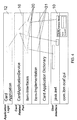
- Said Bean is inherited from a class CardApplicationService 16, provided by the framework. This class is application specific but card type independent. It represents the objects on the card which can be accessed by the application and their methods.
- Another application specific Bean is the CardApplicationDictionary 18, defining particular card type specific information about the objects on the card.
- Said dictionary 18 can advantageously be structured like a table and contains for each application programming object, i.e. the parameters needed to select the proper parameter setting when implementing the high-level item on a particular SmartCard.
- application programming object i.e. the parameters needed to select the proper parameter setting when implementing the high-level item on a particular SmartCard.
- file system-oriented card file name and addresses can be addressed as an table entry, for a JAVACard a respective applet name.
- a programming environment using the method according to the present invention contains a layout editor which generates these application specific components from a high-level description.
- card application component 12 derived from CardApplication.
- the current state of an application can be distributed from this Bean and used by other listeners.
- a very important feature of the present invention is to work with high-level data objects further referred to as well as high-level item 20 during design-time.
- Said high-level objects 20 form the universal part of an interface formed between host application and SmartCard application.
- Such high-level items describe each object's attributes and functionality for (later) run-time usage by said device application.
- an abstract SmartCard 21 is addressed by the application programmer which actually does not exist but represents a plurality of different SmartCards from different manufacturers.
- This feature enables application independence from the used card type and helps the application programmer to concentrate on important issues of his specific application instead of spending time on converting his application data into common primitive types normally supported by smart cards - usually byte arrays.
- the application framework view depicted symbolically in Fig. 4 provides for each supported item type the item interface 20, which can be used to represent objects on said generic card 21.
- These items can be primitive Java types, arrays, structures or cryptographic keys and counters. They are accessed via said user-interface 10 as is indicated by the connection lines.
- the interfaces 20 each comprise data or items 32 and methods 34 and thus describe the methods to be performed with the respective item, e.g. methods to access or modify the items.
- the high-level items 20 or interfaces can be used as a facade for visual programming of smart card access: They represent real objects of any compliant smart card.
- item-Interfaces hide all card specific details, which are not of interest for the application programmer. At this point it is not necessary to care, how the abstract item will be implemented for performing card access to a real smart card.
- each defined item interface 20 needs an implementation 22, 24, 25 for each specific card type, which maps the high-level objects into the primitive data types supported by the used card. Since all card specific operations like address management, file names, card architecture data are encapsulated in item implementations, the same application can work with multiple cards.
- the item implementations 22, 24, 25 are application independent and have to be provided only once for each card type. As such they can have a multiple usage by a plurality of different cards, particularly when multiple applications are implemented on a single card.
- the item interfaces define the methods the user is provided with. For example, a getFirst() and a getLast()-method is defined for the StringArrayItem, an increase() and a decrease() method is defined for the CounterItem. With the help of these methods the SmartCard accesses of the above said exemplary application are implemented.
- the implementation of the particular item interfaces 20 and by that the implementation of the particular methods 34 has to be done only once for each SmartCard type and can then be used for a plurality of different applications.
- a StringItemArray can be implemented by a RecordFile. That getFirst()-method has to read out the first record and than to convert the read ASCII characters into a string, which is returned to the application.
- An implementation of the increase()-method of a counter item could, for example, consist of reading a byte in a file, increasing the value by one and storing back the new value.
- the implementation can advantageously take use of SmartCard specific counter-functionality, as it is the case, e.g. with the MFC 4.0 SmartCard.
- a high-level item interface 20 for a data field consisting of strings could be constructed, for example, as follows:
- CardInsertedEvent a particular event, called "CardInsertedEvent”.
- the Open Card Framework application programming interface is used with the help of which such events can be generated independently of the terminal.
- Said CardApplicationService prepares the SmartCard fed into the terminal by selecting the proper implementation which is specific for the SmartCard type and for all item interfaces used by the SmartCard user, and by generating a specific instantiation. This selection procedure is described in more detail down below.
- the above described method is defined in the "CardApplicationService"-Bean as well.
- the Bean checks the SmartCard type. In order to do that, a plurality of procedures can be used:
- ATR Answer To Reset
- OCF OpenCard Framework
- the CardApplicationService loads a "CardApplicationDictionary" specific for this SmartCard type, e.g. with the help of a further class or in form of a configuration file.
- Said dictionary comprises essential information concerning the initialisation of the card specific item implementations 22, 24, 25.
- the specific SmartCard type determined by, e.g. ATR check, the following information required for the instantiation is read per item from the card specific 'CardApplicationDictionary':
- the list of the parameters depends on the item type - see Fig. 3-and of the SmartCard type, e.g., if file system oriented card or JAVA card, etc.
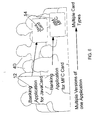
- Fig. 7 there is only one person 42 depicted skilled in SmartCard file system management. Said person can accumulate his work and can create a library full of item implementations specific for his 'own'SmartCard - here the IBM MFC Card. He does not need to know anything on any application logic because a plurality of developers 46, 47, 48 from different applications can use the library in order to manage their required SmartCard accesses.
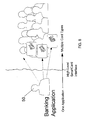
- Fig. 8 there is only one person 50 competent for a particular (e.g. banking) application development. His work, a single application, becomes universal and card independent in usage for a plurality of SmardCard programmers. They are thus able to use the universal high-level items 20 defined by the interfaces for their individual job to accommodate the file accesses on their specific card.
- a configuration file or a hard coded adaptation could be performed also in order to convert the high-level items into data structures applicable on cards. This, however is not that comfortable because it requires more program maintenance.
Landscapes
- Engineering & Computer Science (AREA)
- Software Systems (AREA)
- General Engineering & Computer Science (AREA)
- Theoretical Computer Science (AREA)
- Physics & Mathematics (AREA)
- General Physics & Mathematics (AREA)
- Stored Programmes (AREA)
Priority Applications (1)
| Application Number | Priority Date | Filing Date | Title |
|---|---|---|---|
| EP99122477A EP1006442A3 (de) | 1998-11-30 | 1999-11-11 | Verfahren und System zum Programmieren von Anwendungen für Gebrauch mit Geräten mit beschränkter Unterstützung höherer Programmierkonzepte |
Applications Claiming Priority (3)
| Application Number | Priority Date | Filing Date | Title |
|---|---|---|---|
| EP98122659 | 1998-11-30 | ||
| EP98122659 | 1998-11-30 | ||
| EP99122477A EP1006442A3 (de) | 1998-11-30 | 1999-11-11 | Verfahren und System zum Programmieren von Anwendungen für Gebrauch mit Geräten mit beschränkter Unterstützung höherer Programmierkonzepte |
Publications (2)
| Publication Number | Publication Date |
|---|---|
| EP1006442A2 true EP1006442A2 (de) | 2000-06-07 |
| EP1006442A3 EP1006442A3 (de) | 2003-09-03 |
Family
ID=26149837
Family Applications (1)
| Application Number | Title | Priority Date | Filing Date |
|---|---|---|---|
| EP99122477A Withdrawn EP1006442A3 (de) | 1998-11-30 | 1999-11-11 | Verfahren und System zum Programmieren von Anwendungen für Gebrauch mit Geräten mit beschränkter Unterstützung höherer Programmierkonzepte |
Country Status (1)
| Country | Link |
|---|---|
| EP (1) | EP1006442A3 (de) |
Family Cites Families (2)
| Publication number | Priority date | Publication date | Assignee | Title |
|---|---|---|---|---|
| US5517635A (en) * | 1992-12-17 | 1996-05-14 | International Business Machines Corporation | System for designing an application program to be independent of I/O devices by utilizing application name, system name, and predetermined hardware specific parameters of data objects |
| DE19522527A1 (de) * | 1995-06-23 | 1997-01-02 | Ibm | Verfahren zur Vereinfachung der Kommunikation mit Chipkarten |
-
1999
- 1999-11-11 EP EP99122477A patent/EP1006442A3/de not_active Withdrawn
Also Published As
| Publication number | Publication date |
|---|---|
| EP1006442A3 (de) | 2003-09-03 |
Similar Documents
| Publication | Publication Date | Title |
|---|---|---|
| US7269822B2 (en) | Technique for enabling applications to use languages other than their built-in macro-languages without changing the applications | |
| Chen | Java card technology for smart cards: architecture and programmer's guide | |
| CA2077272C (en) | Managing class method names | |
| JP5483769B2 (ja) | 小面積装置において入力点オブジェクトを使用してコンテキスト障壁を横断するアクセスを許可する技術 | |
| US5390330A (en) | Control system and method for direct execution of software application information models without code generation | |
| JP5483768B2 (ja) | 小面積装置において実行時環境特権を使用してコンテキスト障壁を横断するアクセスを許可する技術 | |
| TWI533217B (zh) | 用於運行時間系統的電腦實施方法及電腦可讀取儲存記憶體 | |
| US8533207B2 (en) | Information processing method, apparatus and program in XML driven architecture | |
| TW521210B (en) | Modular computer system and related method | |
| US6850953B1 (en) | Creating multiple sets of data by spawning a secondary virtual machine | |
| AU710578B2 (en) | Method of modifying the instruction set of a smart card | |
| US7219341B2 (en) | Code analysis for selective runtime data processing | |
| US6378003B1 (en) | Method and system for deriving metaclasses in an object oriented system | |
| US6754886B1 (en) | Method and system for storing java objects in devices having a reduced support of high-level programming concepts | |
| Lhotka | Expert C# 2005 Business Objects | |
| US20060230379A1 (en) | System and method for generating a user interface based on metadata exposed by object classes | |
| US6842905B2 (en) | Method and system for implementing collection program interface for accessing a collection of data associated with a legacy enumeration application interface | |
| Giguère | Java 2 micro edition: professional developer's guide | |
| JP2000514215A (ja) | プログラム可能でインテリジェントなデバイスのための、移植可能な安全なトランザクションシステム | |
| KR100895929B1 (ko) | 애플리케이션 프레임워크를 비정형화한 비동기 컴포넌트를위한 메카니즘 | |
| US20020056075A1 (en) | System for a run-time engine capable for pager capable remote device | |
| JP7763022B2 (ja) | 情報処理装置、情報処理システム、制御方法、プログラム及び記録媒体 | |
| JP2001125855A (ja) | 動的Webページ生成プログラム | |
| Little et al. | Java transactions for the internet | |
| CN114817403B (zh) | 区块链的部署方法、装置、设备及存储介质 |
Legal Events
| Date | Code | Title | Description |
|---|---|---|---|
| PUAI | Public reference made under article 153(3) epc to a published international application that has entered the european phase |
Free format text: ORIGINAL CODE: 0009012 |
|
| AK | Designated contracting states |
Kind code of ref document: A2 Designated state(s): AT BE CH CY DE DK ES FI FR GB GR IE IT LI LU MC NL PT SE |
|
| AX | Request for extension of the european patent |
Free format text: AL;LT;LV;MK;RO;SI |
|
| PUAL | Search report despatched |
Free format text: ORIGINAL CODE: 0009013 |
|
| AK | Designated contracting states |
Kind code of ref document: A3 Designated state(s): AT BE CH CY DE DK ES FI FR GB GR IE IT LI LU MC NL PT SE |
|
| AX | Request for extension of the european patent |
Extension state: AL LT LV MK RO SI |
|
| 17P | Request for examination filed |
Effective date: 20040115 |
|
| AKX | Designation fees paid |
Designated state(s): AT BE CH CY DE DK ES FI FR GB GR IE IT LI LU MC NL PT SE |
|
| STAA | Information on the status of an ep patent application or granted ep patent |
Free format text: STATUS: THE APPLICATION IS DEEMED TO BE WITHDRAWN |
|
| 18D | Application deemed to be withdrawn |
Effective date: 20051201 |