EP1006676A2 - Frame synchronization in space time block coded transmit antenna diversity for WCDMA - Google Patents
Frame synchronization in space time block coded transmit antenna diversity for WCDMA Download PDFInfo
- Publication number
- EP1006676A2 EP1006676A2 EP99203292A EP99203292A EP1006676A2 EP 1006676 A2 EP1006676 A2 EP 1006676A2 EP 99203292 A EP99203292 A EP 99203292A EP 99203292 A EP99203292 A EP 99203292A EP 1006676 A2 EP1006676 A2 EP 1006676A2
- Authority
- EP
- European Patent Office
- Prior art keywords
- symbol
- signals
- estimate
- signal
- producing
- Prior art date
- Legal status (The legal status is an assumption and is not a legal conclusion. Google has not performed a legal analysis and makes no representation as to the accuracy of the status listed.)
- Granted
Links
- 238000005562 fading Methods 0.000 claims description 12
- 238000004891 communication Methods 0.000 claims description 7
- 238000000034 method Methods 0.000 claims description 6
- 238000010295 mobile communication Methods 0.000 claims description 5
- 238000010586 diagram Methods 0.000 description 10
- 230000005540 biological transmission Effects 0.000 description 8
- WABPQHHGFIMREM-OIOBTWANSA-N lead-204 Chemical compound [204Pb] WABPQHHGFIMREM-OIOBTWANSA-N 0.000 description 2
- WABPQHHGFIMREM-BJUDXGSMSA-N lead-206 Chemical compound [206Pb] WABPQHHGFIMREM-BJUDXGSMSA-N 0.000 description 2
- 230000000996 additive effect Effects 0.000 description 1
- 230000001427 coherent effect Effects 0.000 description 1
- 238000001514 detection method Methods 0.000 description 1
- 230000003292 diminished effect Effects 0.000 description 1
- 230000010363 phase shift Effects 0.000 description 1
Images

Classifications
-
- H—ELECTRICITY
- H04—ELECTRIC COMMUNICATION TECHNIQUE
- H04B—TRANSMISSION
- H04B1/00—Details of transmission systems, not covered by a single one of groups H04B3/00 - H04B13/00; Details of transmission systems not characterised by the medium used for transmission
- H04B1/69—Spread spectrum techniques
- H04B1/707—Spread spectrum techniques using direct sequence modulation
- H04B1/7073—Synchronisation aspects
- H04B1/7075—Synchronisation aspects with code phase acquisition
- H04B1/7077—Multi-step acquisition, e.g. multi-dwell, coarse-fine or validation
-
- H—ELECTRICITY
- H04—ELECTRIC COMMUNICATION TECHNIQUE
- H04B—TRANSMISSION
- H04B7/00—Radio transmission systems, i.e. using radiation field
- H04B7/02—Diversity systems; Multi-antenna system, i.e. transmission or reception using multiple antennas
- H04B7/04—Diversity systems; Multi-antenna system, i.e. transmission or reception using multiple antennas using two or more spaced independent antennas
- H04B7/08—Diversity systems; Multi-antenna system, i.e. transmission or reception using multiple antennas using two or more spaced independent antennas at the receiving station
- H04B7/0837—Diversity systems; Multi-antenna system, i.e. transmission or reception using multiple antennas using two or more spaced independent antennas at the receiving station using pre-detection combining
- H04B7/0842—Weighted combining
- H04B7/0845—Weighted combining per branch equalization, e.g. by an FIR-filter or RAKE receiver per antenna branch
-
- H—ELECTRICITY
- H04—ELECTRIC COMMUNICATION TECHNIQUE
- H04B—TRANSMISSION
- H04B1/00—Details of transmission systems, not covered by a single one of groups H04B3/00 - H04B13/00; Details of transmission systems not characterised by the medium used for transmission
- H04B1/69—Spread spectrum techniques
- H04B1/707—Spread spectrum techniques using direct sequence modulation
- H04B1/7097—Interference-related aspects
- H04B1/711—Interference-related aspects the interference being multi-path interference
-
- H—ELECTRICITY
- H04—ELECTRIC COMMUNICATION TECHNIQUE
- H04B—TRANSMISSION
- H04B7/00—Radio transmission systems, i.e. using radiation field
- H04B7/02—Diversity systems; Multi-antenna system, i.e. transmission or reception using multiple antennas
-
- H—ELECTRICITY
- H04—ELECTRIC COMMUNICATION TECHNIQUE
- H04B—TRANSMISSION
- H04B7/00—Radio transmission systems, i.e. using radiation field
- H04B7/02—Diversity systems; Multi-antenna system, i.e. transmission or reception using multiple antennas
- H04B7/04—Diversity systems; Multi-antenna system, i.e. transmission or reception using multiple antennas using two or more spaced independent antennas
- H04B7/06—Diversity systems; Multi-antenna system, i.e. transmission or reception using multiple antennas using two or more spaced independent antennas at the transmitting station
-
- H—ELECTRICITY
- H04—ELECTRIC COMMUNICATION TECHNIQUE
- H04L—TRANSMISSION OF DIGITAL INFORMATION, e.g. TELEGRAPHIC COMMUNICATION
- H04L1/00—Arrangements for detecting or preventing errors in the information received
- H04L1/02—Arrangements for detecting or preventing errors in the information received by diversity reception
- H04L1/06—Arrangements for detecting or preventing errors in the information received by diversity reception using space diversity
- H04L1/0618—Space-time coding
- H04L1/0625—Transmitter arrangements
-
- H—ELECTRICITY
- H04—ELECTRIC COMMUNICATION TECHNIQUE
- H04B—TRANSMISSION
- H04B1/00—Details of transmission systems, not covered by a single one of groups H04B3/00 - H04B13/00; Details of transmission systems not characterised by the medium used for transmission
- H04B1/69—Spread spectrum techniques
- H04B1/707—Spread spectrum techniques using direct sequence modulation
Definitions
- This invention relates to wideband code division multiple access (WCDMA) for a communication system and more particularly to space time block coded transmit antenna diversity for frame synchronization of WCDMA signals.
- WCDMA wideband code division multiple access
- CDMA code division multiple access
- FDMA frequency division multiple access
- TDMA time division multiple access
- WCDMA wideband code division multiple access
- These WCDMA systems are coherent communications systems with pilot symbol assisted channel estimation schemes. These pilot symbols are transmitted as quadrature phase shift keyed (QPSK) known data in predetermined time frames to any receivers within range.
- QPSK quadrature phase shift keyed
- the frames may propagate in a discontinuous transmission (DTX) mode.
- DTX discontinuous transmission
- voice traffic transmission of user data occurs when the user speaks, but no data symbol transmission occurs when the user is silent.
- packet data the user data may be transmitted only when packets are ready to be sent.
- the frames are subdivided into sixteen equal time slots of 0.625 milliseconds each.
- Each time slot is further subdivided into equal symbol times.
- each time slot includes twenty symbol times.
- Each frame includes pilot symbols as well as other control symbols such as transmit power control (TPC) symbols and rate information (RI) symbols. These control symbols include multiple bits otherwise known as chips to distinguish them from data bits.
- TPC transmit power control
- RI rate information
- OTD and TSTD systems have similar performance. Both use multiple transmit antennas to provide some diversity against fading, particularly at low Doppler rates and when there are insufficient paths for the rake receiver. Both OTD and TSTD systems, however, fail to exploit the extra path diversity that is possible for open loop systems.
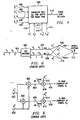
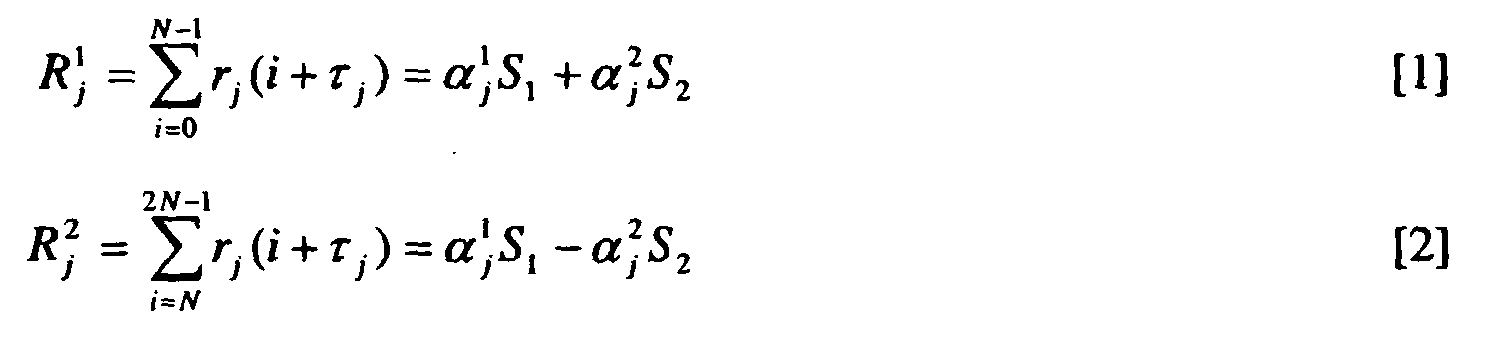
- the OTD encoder circuit of FIG. 5 receives symbols S 1 and S 2 on lead 500 and produces output signals on leads 504 and 506 for transmission by first and second antennas, respectively. These transmitted signals are received by a despreader input circuit (not shown). The despreader circuit sums received chip signals over a respective symbol time to produce first and second output signals R 1 / j and R 2 / j on leads 620 and 622 as in equations [1-2], respectively.
- the OTD phase correction circuit of FIG. 6 receives the output signals R 1 / j and R 2 / j corresponding to the j th of L multiple signal paths.
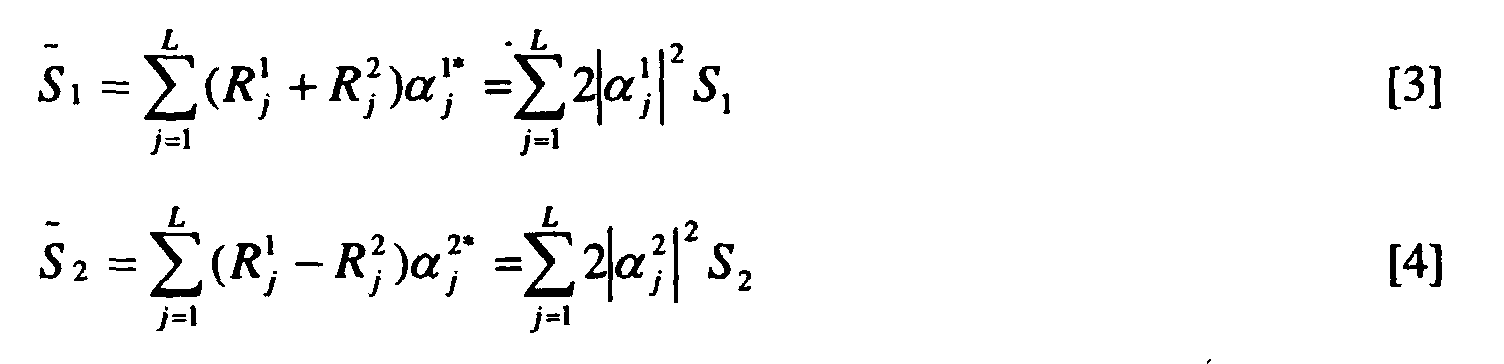
- the phase correction circuit produces soft outputs or signal estimates S ⁇ and S ⁇ for symbols S 1 and S 2 at leads 616 and 618 as shown in equations [3-4], respectively. Equations [3-4] show that the OTD method provides a single channel estimate ⁇ for each path j .
- a similar analysis for the TSTD system yields the same result.
- the OTD and TSTD methods therefore, are limited to a path diversity of L . This path diversity limitation fails to exploit the extra path diversity that is possible for open loop systems as will be explained in detail.
- a circuit is designed with a correction circuit coupled to receive a first estimate signal, a second estimate signal, and a plurality of input signals from an external source along plural signal paths.
- the plurality of input signals includes a first and a second input signal.
- the correction circuit produces a first symbol estimate in response to the first and second estimate signals and the first and second input signals.
- the correction circuit produces a second symbol estimate in response to the first and second estimate signals and the first and second input signals.
- a combining circuit is coupled to receive a plurality of first symbol estimates including the first symbol estimate and a plurality of second symbol estimates including the second symbol estimate.
- the combining circuit produces a first symbol signal in response to the plurality of first symbol estimates and a second symbol signal in response to the plurality of second symbol estimates.
- a synchronization circuit is coupled to receive the first and second symbol signals and a first known symbol and a second known symbol.
- the synchronization circuit produces a synchronization signal in response to an approximate match between the first symbol signal and the first known symbol and between the second symbol signal and the second known symbol.
- the present invention improves frame synchronization by providing at least 2L diversity over time and space. No additional transmit power or bandwidth is required. Power is balanced across multiple antennas.
- FIG. 1 there is a simplified block diagram of a typical transmitter using Space Time Transit Diversity (STTD) of the present invention.
- the transmitter circuit receives pilot symbols, TPC symbols, RI symbols and data symbols on leads 100, 102, 104 and 106, respectively.
- Each of the symbols is encoded by a respective STTD encoder as will be explained in detail.
- Each STTD encoder produces two output signals that are applied to multiplex circuit 120.
- the multiplex circuit 120 produces each encoded symbol in a respective symbol time of a frame.
- a serial sequence of symbols in each frame is simultaneously applied to each respective multiplier circuit 124 and 126.
- a channel orthogonal code C m is multiplied by each symbol to provide a unique signal for a designated receiver.
- the STTD encoded frames are then applied to antennas 128 and 130 for transmission.
- FIG. 2 there is a block diagram showing signal flow in an STTD encoder of the present invention that may be used with the transmitter of FIG. 1 for pilot symbol encoding.
- the pilot symbols are predetermined control signals that may be used for channel estimation and other functions as will be described in detail. Operation of the STTD encoder 112 will be explained with reference to TABLE 1.
- the STTD encoder receives pilot symbol 11 at symbol time T , pilot symbol S 1 at symbol time 2T , pilot symbol 11 at symbol time 3T and pilot symbol S 2 at symbol time 4T on lead 100 for each of sixteen time slots of a frame.
- the STTD encoder produces a sequence of four pilot symbols for each of two antennas corresponding to leads 204 and 206, respectively, for each of the sixteen time slots of TABLE 1.
- the STTD encoder produces pilot symbols B 1 , S 1 , B 2 and S 2 at symbol times T-4T , respectively, for a first antenna at lead 204.
- the STTD encoder simultaneously produces pilot symbols B 1 , - S * / 2 , - B 2 and S * / 1 at symbol times T-4T , respectively, at lead 206 for a second antenna.
- Each symbol includes two bits representing a real and imaginary component.
- An asterisk indicates a complex conjugate operation or sign change of the imaginary part of the symbol. Pilot symbol values for the first time slot for the first antenna at lead 204, therefore, are 11, 11, 11 and 11.
- Corresponding pilot symbols for the second antenna at lead 206 are 11, 01, 00 and 10.
- the bit signals r j ( i + ⁇ j ) of these symbols are transmitted serially along respective paths 208 and 210. Each bit signal of a respective symbol is subsequently received at a remote mobile antenna 212 after a transmit time ⁇ corresponding to the j th path.
- the signals propagate to a despreader input circuit (not shown) where they are summed over each respective symbol time to produce input signals R 1 / j , R 2 / j , R 3 / j and R 4 / j corresponding to the four pilot symbol time slots and the j th of L multiple signal paths as previously described.
- Received signal R 1 / j is produced by pilot symbols ( B 1 , B 1 ) having a constant value (11,11) at symbol time T for all time slots.
- the received signal is equal to the sum of respective Rayleigh fading parameters corresponding to the first and second antennas.
- received signal R 3 / j is produced by pilot symbols ( B 2 ,- B 2 ) having a constant value (11,00) at symbol time 3T for all time slots.
- FIG. 3 there is a schematic diagram of a phase correction circuit of the present invention that may be used with a remote mobile receiver.
- This phase correction circuit receives input signals R 2 / j and R 4 / j on leads 324 and 326 at symbol times 2T and 4T , respectively.
- Each input signal has a value determined by the transmitted pilot symbols as shown in equations [6] and [8], respectively.
- the phase correction circuit receives a complex conjugate of a channel estimate of a Rayleigh fading parameter ⁇ 1* / j corresponding to the first antenna on lead 302 and a channel estimate of another Rayleigh fading parameter ⁇ 2 / j corresponding to the second antenna on lead 306.
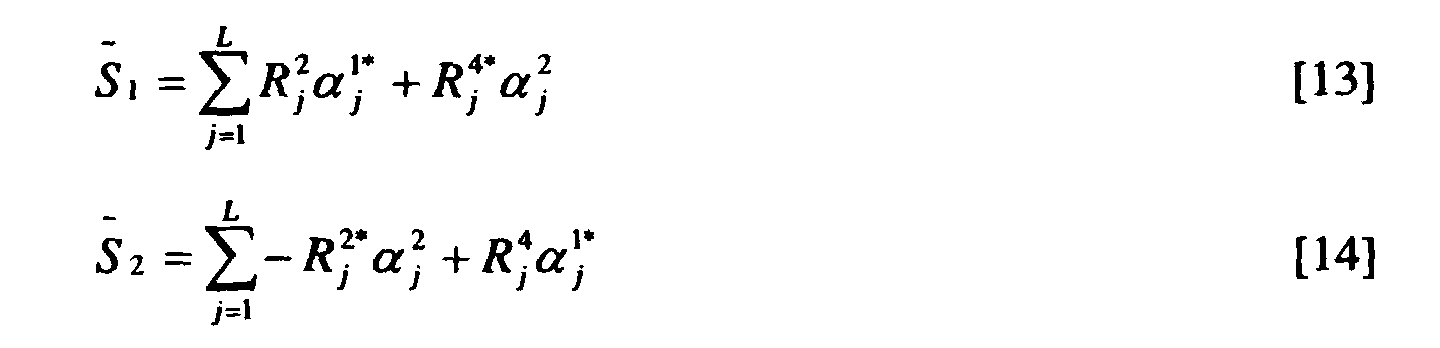
- Complex conjugates of the input signals are produced by circuits 308 and 330 at leads 310 and 322, respectively. These input signals and their complex conjugates are multiplied by Rayleigh fading parameter estimate signals and summed as indicated to produce path-specific first and second symbol estimates at respective output leads 318 and 322 as in equations [11] and [12].
- FIG. 4 there is a block diagram of a frame synchronization circuit that may be used with STTD of the present invention.
- the circuit compares soft symbol signals S ⁇ 1, i and S ⁇ 2, i at leads 400-406 to the complex conjugates of known pilot symbols S 1, k and S 2, k at leads 410-416 for each of the sixteen time slots as in equation [15].
- This comparison produces an approximate match when all soft symbol signals are multiplied by their respective known complex conjugate symbols, thereby producing a real result having a maximum value.
- the synchronization circuit produces frame synchronization signal FS on lead 418 in response to this real result. The reliability of this approximate match is substantially improved in view of the superior soft symbol signals obtained through the additional diversity provided by STTD.
- pilot symbol patterns of TABLE 1 are suitable for data rates of 16, 32, 64 and 128 KSPS having four pilot symbols in each time slot. Other patterns produce a similar result.
- the pattern of TABLE 2, for example, applied to the second antenna produces the same result.
- R 1 j ⁇ 1 j B 1 + ⁇ 2 j B * 1
- TABLE 3 and TABLE 4 give the pilot symbol patterns for data rates with two and eight pilot symbols in each time slot for the first and second antennas, respectively.
- TABLE 5 and TABLE 6 give the pilot symbol patterns for data rates with sixteen pilot symbols in each time slot for the first and second antennas, respectively.
Landscapes
- Engineering & Computer Science (AREA)
- Computer Networks & Wireless Communication (AREA)
- Signal Processing (AREA)
- Radio Transmission System (AREA)
- Mobile Radio Communication Systems (AREA)
- Synchronisation In Digital Transmission Systems (AREA)
- Time-Division Multiplex Systems (AREA)
Abstract


Description


| ANTENNA 1 | ANTENNA 2 | |||||||
| SLOT | B 1 | S 1 | B 2 | S 2 | B 1 | -S * / 2 | -B 2 | S * / 1 |
| 1 | 11 | 11 | 11 | 11 | 11 | 01 | 00 | 10 |
| 2 | 11 | 11 | 11 | 01 | 11 | 11 | 00 | 10 |
| 3 | 11 | 01 | 11 | 01 | 11 | 11 | 00 | 00 |
| 4 | 11 | 10 | 11 | 01 | 11 | 11 | 00 | 11 |
| 5 | 11 | 10 | 11 | 11 | 11 | 01 | 00 | 11 |
| 6 | 11 | 10 | 11 | 11 | 11 | 01 | 00 | 11 |
| 7 | 11 | 01 | 11 | 00 | 11 | 10 | 00 | 00 |
| 8 | 11 | 10 | 11 | 01 | 11 | 11 | 00 | 11 |
| 9 | 11 | 11 | 11 | 00 | 11 | 10 | 00 | 10 |
| 10 | 11 | 01 | 11 | 01 | 11 | 11 | 00 | 00 |
| 11 | 11 | 11 | 11 | 10 | 11 | 00 | 00 | 10 |
| 12 | 11 | 01 | 11 | 01 | 11 | 11 | 00 | 00 |
| 13 | 11 | 00 | 11 | 01 | 11 | 11 | 00 | 01 |
| 14 | 11 | 10 | 11 | 00 | 11 | 10 | 00 | 11 |
| 15 | 11 | 01 | 11 | 00 | 11 | 10 | 00 | 00 |
| 16 | 11 | 00 | 11 | 00 | 11 | 10 | 00 | 01 |

| SLOT | B * / 1 | -S * / 2 | -B * / 2 | S * / 1 |
| 1 | 10 | 01 | 01 | 10 |
| 2 | 10 | 11 | 01 | 10 |
| 3 | 10 | 11 | 01 | 00 |
| 4 | 10 | 11 | 01 | 11 |
| 5 | 10 | 01 | 01 | 11 |
| 6 | 10 | 01 | 01 | 11 |
| 7 | 10 | 10 | 01 | 00 |
| 8 | 10 | 11 | 01 | 11 |
| 9 | 10 | 10 | 01 | 10 |
| 10 | 10 | 11 | 01 | 00 |
| 11 | 10 | 00 | 01 | 10 |
| 12 | 10 | 11 | 01 | 00 |
| 13 | 10 | 11 | 01 | 01 |
| 14 | 10 | 10 | 01 | 11 |
| 15 | 10 | 10 | 01 | 00 |
| 16 | 10 | 10 | 01 | 01 |
| 8 KSPS | 256, 512, 1024 KSPS | |||||||||
| SLOT | 0 | 1 | 0 | 1 | 2 | 3 | 4 | 5 | 6 | 7 |
| 1 | 11 | 11 | 11 | 11 | 11 | 11 | 11 | 11 | 11 | 10 |
| 2 | 11 | 11 | 11 | 10 | 11 | 10 | 11 | 10 | 11 | 01 |
| 3 | 11 | 10 | 11 | 10 | 11 | 01 | 11 | 11 | 11 | 01 |
| 4 | 11 | 01 | 11 | 11 | 11 | 01 | 11 | 00 | 11 | 10 |
| 5 | 11 | 10 | 11 | 11 | 11 | 00 | 11 | 01 | 11 | 10 |
| 6 | 11 | 10 | 11 | 11 | 11 | 11 | 11 | 01 | 11 | 10 |
| 7 | 11 | 01 | 11 | 10 | 11 | 11 | 11 | 01 | 11 | 10 |
| 8 | 11 | 00 | 11 | 01 | 11 | 00 | 11 | 10 | 11 | 00 |
| 9 | 11 | 00 | 11 | 11 | 11 | 10 | 11 | 00 | 11 | 01 |
| 10 | 11 | 10 | 11 | 01 | 11 | 11 | 11 | 11 | 11 | 00 |
| 11 | 11 | 10 | 11 | 10 | 11 | 10 | 11 | 11 | 11 | 10 |
| 12 | 11 | 11 | 11 | 01 | 11 | 10 | 11 | 10 | 11 | 00 |
| 13 | 11 | 10 | 11 | 10 | 11 | 01 | 11 | 11 | 11 | 10 |
| 14 | 11 | 11 | 11 | 00 | 11 | 10 | 11 | 10 | 11 | 00 |
| 15 | 11 | 00 | 11 | 01 | 11 | 10 | 11 | 00 | 11 | 00 |
| 16 | 11 | 00 | 11 | 10 | 11 | 00 | 11 | 00 | 11 | 00 |
| 8 KSPS | 256, 512, 1024 KSPS | |||||||||
| SLOT | 0 | 1 | 0 | 1 | 2 | 3 | 4 | 5 | 6 | 7 |
| 1 | 11 | 11 | 11 | 01 | 00 | 10 | 11 | 00 | 00 | 10 |
| 2 | 11 | 11 | 11 | 00 | 00 | 11 | 11 | 11 | 00 | 11 |
| 3 | 11 | 10 | 11 | 11 | 00 | 11 | 11 | 11 | 00 | 10 |
| 4 | 11 | 01 | 11 | 11 | 00 | 10 | 11 | 00 | 00 | 01 |
| 5 | 11 | 10 | 11 | 10 | 00 | 10 | 11 | 00 | 00 | 00 |
| 6 | 11 | 10 | 11 | 01 | 00 | 10 | 11 | 00 | 00 | 00 |
| 7 | 11 | 01 | 11 | 01 | 00 | 11 | 11 | 00 | 00 | 00 |
| 8 | 11 | 00 | 11 | 10 | 00 | 00 | 11 | 10 | 00 | 11 |
| 9 | 11 | 00 | 11 | 00 | 00 | 10 | 11 | 11 | 00 | 01 |
| 10 | 11 | 10 | 11 | 01 | 00 | 00 | 11 | 10 | 00 | 10 |
| 11 | 11 | 10 | 11 | 00 | 00 | 11 | 11 | 00 | 00 | 10 |
| 12 | 11 | 11 | 11 | 00 | 00 | 00 | 11 | 10 | 00 | 11 |
| 13 | 11 | 10 | 11 | 11 | 00 | 11 | 11 | 00 | 00 | 10 |
| 14 | 11 | 11 | 11 | 00 | 00 | 01 | 11 | 10 | 00 | 11 |
| 15 | 11 | 00 | 11 | 00 | 00 | 00 | 11 | 10 | 00 | 01 |
| 16 | 11 | 00 | 11 | 10 | 00 | 11 | 11 | 10 | 00 | 01 |
| 2048, 4096 KSPS | ||||||||||||||||
| SLOT | 0 | 1 | 2 | 3 | 4 | 5 | 6 | 7 | 8 | 9 | 10 | 11 | 12 | 13 | 14 | 15 |
| 1 | 11 | 01 | 11 | 10 | 11 | 11 | 11 | 10 | 11 | 01 | 11 | 00 | 11 | 00 | 11 | 01 |
| 2 | 11 | 01 | 11 | 01 | 11 | 10 | 11 | 11 | 11 | 01 | 11 | 01 | 11 | 10 | 11 | 01 |
| 3 | 11 | 01 | 11 | 10 | 11 | 00 | 11 | 01 | 11 | 11 | 11 | 11 | 11 | 01 | 11 | 10 |
| 4 | 11 | 11 | 11 | 11 | 11 | 01 | 11 | 01 | 11 | 11 | 11 | 01 | 11 | 00 | 11 | 01 |
| 5 | 11 | 00 | 11 | 00 | 11 | 11 | 11 | 01 | 11 | 10 | 11 | 00 | 11 | 11 | 11 | 11 |
| 6 | 11 | 00 | 11 | 11 | 11 | 10 | 11 | 01 | 11 | 10 | 11 | 00 | 11 | 10 | 11 | 11 |
| 7 | 11 | 01 | 11 | 00 | 11 | 10 | 11 | 00 | 11 | 10 | 11 | 10 | 11 | 01 | 11 | 01 |
| 8 | 11 | 01 | 11 | 00 | 11 | 11 | 11 | 10 | 11 | 11 | 11 | 10 | 11 | 11 | 11 | 00 |
| 9 | 11 | 11 | 11 | 11 | 11 | 01 | 11 | 11 | 11 | 11 | 11 | 10 | 11 | 10 | 11 | 01 |
| 11 | 11 | 00 | 11 | 01 | 11 | 11 | 11 | 01 | 11 | 01 | 11 | 01 | 11 | 01 | 11 | 11 |
| 10 | 11 | 10 | 11 | 01 | 11 | 10 | 11 | 10 | 11 | 10 | 11 | 00 | 11 | 11 | 11 | 00 |
| 12 | 11 | 11 | 11 | 00 | 11 | 10 | 11 | 10 | 11 | 00 | 11 | 01 | 11 | 00 | 11 | 11 |
| 13 | 11 | 11 | 11 | 11 | 11 | 11 | 11 | 00 | 11 | 00 | 11 | 10 | 11 | 11 | 11 | 11 |
| 14 | 11 | 00 | 11 | 01 | 11 | 10 | 11 | 10 | 11 | 00 | 11 | 00 | 11 | 00 | 11 | 10 |
| 15 | 11 | 00 | 11 | 11 | 11 | 10 | 11 | 00 | 11 | 10 | 11 | 01 | 11 | 01 | 11 | 11 |
| 16 | 11 | 00 | 11 | 00 | 11 | 00 | 11 | 11 | 11 | 00 | 11 | 10 | 11 | 01 | 11 | 00 |
| 2048, 4096 KSPS | ||||||||||||||||
| SLOT | 0 | 1 | 2 | 3 | 4 | 5 | 6 | 7 | 8 | 9 | 10 | 11 | 12 | 13 | 14 | 15 |
| 1 | 11 | 00 | 00 | 00 | 11 | 00 | 00 | 10 | 11 | 10 | 00 | 00 | 11 | 11 | 00 | 01 |
| 2 | 11 | 11 | 00 | 00 | 11 | 01 | 00 | 11 | 11 | 11 | 00 | 00 | 11 | 11 | 00 | 11 |
| 3 | 11 | 00 | 00 | 00 | 11 | 11 | 00 | 01 | 11 | 01 | 00 | 10 | 11 | 00 | 00 | 00 |
| 4 | 11 | 01 | 00 | 10 | 11 | 11 | 00 | 00 | 11 | 11 | 00 | 10 | 11 | 11 | 00 | 01 |
| 5 | 11 | 10 | 00 | 01 | 11 | 11 | 00 | 10 | 11 | 10 | 00 | 11 | 11 | 01 | 00 | 10 |
| 6 | 11 | 01 | 00 | 01 | 11 | 11 | 00 | 11 | 11 | 10 | 00 | 11 | 11 | 01 | 00 | 11 |
| 7 | 11 | 10 | 00 | 00 | 11 | 10 | 00 | 11 | 11 | 00 | 00 | 11 | 11 | 11 | 00 | 00 |
| 8 | 11 | 10 | 00 | 00 | 11 | 00 | 00 | 10 | 11 | 00 | 00 | 10 | 11 | 10 | 00 | 10 |
| 9 | 11 | 01 | 00 | 10 | 11 | 01 | 00 | 00 | 11 | 00 | 00 | 10 | 11 | 11 | 00 | 11 |
| 10 | 11 | 11 | 00 | 11 | 11 | 00 | 00 | 11 | 11 | 10 | 00 | 11 | 11 | 10 | 00 | 10 |
| 11 | 11 | 11 | 00 | 01 | 11 | 11 | 00 | 10 | 11 | 11 | 00 | 00 | 11 | 01 | 00 | 00 |
| 12 | 11 | 10 | 00 | 10 | 11 | 00 | 00 | 11 | 11 | 11 | 00 | 01 | 11 | 01 | 00 | 01 |
| 13 | 11 | 01 | 00 | 10 | 11 | 10 | 00 | 10 | 11 | 00 | 00 | 01 | 11 | 01 | 00 | 10 |
| 14 | 11 | 11 | 00 | 01 | 11 | 00 | 00 | 11 | 11 | 10 | 00 | 01 | 11 | 00 | 00 | 01 |
| 15 | 11 | 01 | 00 | 01 | 11 | 10 | 00 | 11 | 11 | 11 | 00 | 11 | 11 | 01 | 00 | 00 |
| 16 | 11 | 10 | 00 | 01 | 11 | 01 | 00 | 01 | 11 | 00 | 00 | 01 | 11 | 10 | 00 | 00 |
- the estimate circuit, the correction circuit, the combining circuit and the synchronization circuit being formed on a single integrated circuit;
- an input circuit is coupled to receive a plurality of signals from the external source along the plural signal paths, the input circuit producing the plurality of input signals;
- each first input signal is transmitted by a first antenna and each said second input signal is transmitted by a second antenna;
- each of the first and second input signals are wideband code division multiple access signals;
- the total path diversity of each of the first and second symbol signals is at least twice a number of transmitting antennas;
- each predetermined signal of the plurality of predetermined signals comprises a pilot symbol;
- an input circuit is coupled to receive a plurality of external signals during a predetermined period, the input circuit producing a plurality of input signals including the first and second input signals, the plurality of input signals corresponding to the plural of signal paths.
- each of the first and second predetermined signals are pilot symbols;
Claims (12)
- Circuitry, comprising:a correction circuit for receiving a first estimate signal, a second estimate signal, and a plurality of input signals from an external source along plural signal paths, the plurality of input signals including a first and a second input signal, the correction circuit arranged for producing a first symbol estimate in response to the first and second estimate signals and the first and second input signals, the correction circuit further arranged for producing a second symbol estimate in response to the first and second estimate signals and the first and second input signals;a combining circuit for receiving a plurality of first symbol estimates including the first symbol estimate and a plurality of second symbol estimates including the second symbol estimate, the combining circuit arranged for producing a first symbol signal in response to the plurality of first symbol estimates and for producing a second symbol signal in response to the plurality of second symbol estimates; anda synchronization circuit for receiving the first and second symbol signals and a first known symbol and a second known symbol, the synchronization circuit arranged for producing a synchronization signal in response to an approximate match between the first symbol signal and the first known symbol and between the second symbol signal and the second known symbol.
- Circuitry as in claim 1, further comprising an estimate circuit for receiving at least a first predetermined signal and a second predetermined signal from the external source, each of the first and second predetermined signals having respective predetermined values, the estimate circuit arranged for producing the first estimate signal and the second estimate signal in response to the first and second predetermined signals.
- Circuitry as in claim 2, wherein each of the first and second predetermined signals are pilot symbols.
- Circuitry as in any preceding claim, wherein each of the first and second estimate signals is a Rayleigh fading parameter estimate.
- Circuitry comprising:an estimate circuit for receiving a plurality of predetermined signals from an external source along plural signal paths, the estimate circuit arranged for producing a first and a second estimate signal corresponding to each predetermined signal;a correction circuit for receiving the first and second estimate signals, a first input signal and a second input signal, the correction circuit arranged for producing a first symbol signal in response to the first and second estimate signals and the first and second input signals, the correction circuit further arranged for producing a second symbol signal in response to the first and second estimate signals and the first and second input signals; anda synchronization circuit for receiving a plurality of symbol signals including the first and second symbol signals and a plurality of first and second known symbols, the synchronization circuit arranged for producing a synchronization signal in response to an approximate match between the plurality of first symbol signals and the plurality of first known symbols and between the plurality of second symbol signals and the plurality of second known symbols.
- Circuitry as in claim 5, wherein each of the first and second estimate signals is a Rayleigh fading parameter estimate.
- A method of processing signals in communication circuitry comprising:receiving a plurality of groups of predetermined signals during a predetermined period from an external source along plural signal paths, the groups being equally spaced apart in time;producing at least two estimate signals in response to each said group of predetermined signals;producing a first and a second input signal corresponding to a signal path of the plural signal paths in response to each said group of predetermined signals;producing a plurality of first symbol signals in response to respective said at least two estimate signals and respective said first and second input signals;producing a plurality of second symbol signals in response to respective said at least two estimate signals and respective said first and second input signals;comparing the plurality of first symbol signals to a plurality of known first symbols;comparing the plurality of second symbol signals to a plurality of known second symbols; andproducing a synchronization signal in response to the comparing steps.
- A method of processing signals as in a claim 7, further comprising the steps of:producing a first of said at least two estimate signals from a sum of at least two predetermined signals of each respective said group; andproducing a second of said at least two estimate signals from a difference between said at least two other signals of each respective said group.
- A method of processing signals as in a claim 7 or claim 8, wherein the step of comparing the plurality of first symbol signals to a plurality of known first symbols includes comparing each known first symbol to each first symbol signal and wherein the step of comparing the plurality of second symbol signals to a plurality of known second symbols includes comparing each known second symbol to each second symbol signal.
- A mobile communication system, comprising:a mobile antenna arranged to receive a plurality of signals from an external source along a plurality of signal paths;an input circuit for receiving the plurality of signals from the mobile antenna, the input circuit arranged for producing a plurality of input signals including a first input signal and a second input signal corresponding to a respective signal path of the plurality of signal paths;a correction circuit coupled to receive a first estimate signal, a second estimate signal, and the first and second input signals, the correction circuit arranged for producing a first symbol estimate in response to the first and second estimate signals and the first and second input signals, the correction circuit further arranged for producing a second symbol estimate in response to the first and second estimate signals and the first and second input signals;a combining circuit for receiving a plurality of first symbol estimates including the first symbol estimate and a plurality of second symbol estimates including the second symbol estimate, the combining circuit arranged for producing a first symbol signal in response to the plurality of first symbol estimates and for producing a second symbol signal in response to the plurality of second symbol estimates; anda synchronization circuit for receiving the first and second symbol signals and a first known symbol and a second known symbol, the synchronization circuit arranged for producing a synchronization signal in response to an approximate match between the first symbol signal and the first known symbol and between the second symbol signal and the second known symbol.
- A mobile communication system as in claim 10, further comprising:an estimate circuit for receiving at least a first predetermined signal and a second predetermined signal from the external source, each of the first and second predetermined signals having respective predetermined values, the estimate circuit arranged for producing the first estimate signal and the second estimate signal in response to the first and second predetermined signals.
- A mobile communication system as in claim 10 or claim 11, wherein each of the first and second estimate signals is a Rayleigh fading parameter estimate.
Applications Claiming Priority (5)
| Application Number | Priority Date | Filing Date | Title |
|---|---|---|---|
| US10338398P | 1998-10-07 | 1998-10-07 | |
| US103383P | 1998-10-07 | ||
| US103383 | 1998-11-19 | ||
| US09/195,942 US6356605B1 (en) | 1998-10-07 | 1998-11-19 | Frame synchronization in space time block coded transmit antenna diversity for WCDMA |
| US195942 | 1998-11-19 |
Publications (3)
| Publication Number | Publication Date |
|---|---|
| EP1006676A2 true EP1006676A2 (en) | 2000-06-07 |
| EP1006676A3 EP1006676A3 (en) | 2004-05-06 |
| EP1006676B1 EP1006676B1 (en) | 2008-01-16 |
Family
ID=26800404
Family Applications (1)
| Application Number | Title | Priority Date | Filing Date |
|---|---|---|---|
| EP99203292A Expired - Lifetime EP1006676B1 (en) | 1998-10-07 | 1999-10-07 | Frame synchronization in space time transmit antenna diversity |
Country Status (5)
| Country | Link |
|---|---|
| US (1) | US6356605B1 (en) |
| EP (1) | EP1006676B1 (en) |
| JP (2) | JP4729155B2 (en) |
| KR (1) | KR100756679B1 (en) |
| DE (1) | DE69937987T2 (en) |
Cited By (4)
| Publication number | Priority date | Publication date | Assignee | Title |
|---|---|---|---|---|
| WO2004002036A1 (en) * | 2002-06-20 | 2003-12-31 | Da Tang Mobile Communications Equipment Co., Ltd. | Space-time coding/decoding method for frequency selective fading channel |
| WO2004062134A1 (en) * | 2003-01-03 | 2004-07-22 | Huawei Technologies Co., Ltd. | A predecessing method and device for feedback signal in closed-loop transmit diversity system |
| US6775260B1 (en) | 1999-02-25 | 2004-08-10 | Texas Instruments Incorporated | Space time transmit diversity for TDD/WCDMA systems |
| EP1133071A3 (en) * | 1999-02-25 | 2005-05-18 | Texas Instruments Incorporated | Space time transmit diversity for tdd/wcdma systems |
Families Citing this family (20)
| Publication number | Priority date | Publication date | Assignee | Title |
|---|---|---|---|---|
| US6724828B1 (en) * | 1999-01-19 | 2004-04-20 | Texas Instruments Incorporated | Mobile switching between STTD and non-diversity mode |
| KR100294711B1 (en) * | 1999-03-15 | 2001-07-12 | 서평원 | Frame Synchronization Method using Optimal Pilot Symbol |
| US7496132B2 (en) * | 1999-03-15 | 2009-02-24 | Kg Electronics Inc. | Pilot signals for synchronization and/or channel estimation |
| US7643540B2 (en) * | 1999-03-15 | 2010-01-05 | Lg Electronics Inc. | Pilot signals for synchronization and/or channel estimation |
| US6891815B1 (en) * | 1999-03-15 | 2005-05-10 | Young-Joon Song | Pilot signals for synchronization and/or channel estimation |
| US6804264B1 (en) * | 1999-03-15 | 2004-10-12 | Lg Information & Communications, Ltd. | Pilot signals for synchronization and/or channel estimation |
| US7012906B1 (en) * | 1999-03-15 | 2006-03-14 | Lg Information & Communications, Ltd. | Pilot signals for synchronization and/or channel estimation |
| US6791960B1 (en) | 1999-03-15 | 2004-09-14 | Lg Information And Communications, Ltd. | Pilot signals for synchronization and/or channel estimation |
| US6721299B1 (en) * | 1999-03-15 | 2004-04-13 | Lg Information & Communications, Ltd. | Pilot signals for synchronization and/or channel estimation |
| US7006581B2 (en) * | 2000-05-25 | 2006-02-28 | Vigil Armando J | Method for demodulating a digital signal subjected to multipath propagation impairment and an associated receiver |
| US7154958B2 (en) * | 2000-07-05 | 2006-12-26 | Texas Instruments Incorporated | Code division multiple access wireless system with time reversed space time block transmitter diversity |
| US7065156B1 (en) * | 2000-08-31 | 2006-06-20 | Nokia Mobile Phones Ltd. | Hopped delay diversity for multiple antenna transmission |
| EP1340331B1 (en) * | 2000-11-22 | 2007-01-24 | Nortel Networks Limited | Methods and apparatus for turbo space-time trellis coding |
| US7113745B2 (en) * | 2001-02-21 | 2006-09-26 | Ericsson Inc. | Method to achieve diversity in a communication network |
| KR100698199B1 (en) * | 2001-06-05 | 2007-03-22 | 엘지전자 주식회사 | Transmit Antenna Diversity Method |
| JP3530164B2 (en) | 2001-10-16 | 2004-05-24 | 松下電器産業株式会社 | STTD decoding method and STTD decoder |
| US7173992B2 (en) * | 2001-12-11 | 2007-02-06 | Sasken Communication Technologies Limited | Method for synchronization in wireless systems using receive diversity |
| WO2005078978A1 (en) | 2004-02-13 | 2005-08-25 | Matsushita Electric Industrial Co., Ltd. | Transmitter apparatus, receiver apparatus, and wireless communication method |
| RU2491717C2 (en) * | 2010-05-04 | 2013-08-27 | Попик Павел Иванович | Method of increasing signal-to-noise level (ratio) using "disturbance damping principle" |
| GB201317525D0 (en) | 2013-10-03 | 2013-11-20 | Fujifilm Mfg Europe Bv | Membranes |
Family Cites Families (10)
| Publication number | Priority date | Publication date | Assignee | Title |
|---|---|---|---|---|
| US5228054A (en) | 1992-04-03 | 1993-07-13 | Qualcomm Incorporated | Power-of-two length pseudo-noise sequence generator with fast offset adjustment |
| US5481572A (en) * | 1994-08-02 | 1996-01-02 | Ericsson Inc. | Method of and apparatus for reducing the complexitiy of a diversity combining and sequence estimation receiver |
| JP2689926B2 (en) * | 1994-12-05 | 1997-12-10 | 日本電気株式会社 | Diversity receiver |
| JP3582924B2 (en) * | 1996-01-19 | 2004-10-27 | 松下電器産業株式会社 | Demodulator |
| JPH1051354A (en) * | 1996-05-30 | 1998-02-20 | N T T Ido Tsushinmo Kk | DS-CDMA transmission method |
| US5767738A (en) * | 1996-10-21 | 1998-06-16 | Motorola, Inc. | Apparatus and method for demodulating a modulated signal |
| JPH10164652A (en) * | 1996-12-03 | 1998-06-19 | Matsushita Electric Ind Co Ltd | Mobile communication device |
| JPH10200508A (en) * | 1997-01-14 | 1998-07-31 | Sony Corp | Terminal apparatus and search method for wireless system |
| US6226315B1 (en) * | 1998-03-09 | 2001-05-01 | Texas Instruments Incorporated | Spread-spectrum telephony with accelerated code acquisition |
| US6166622A (en) * | 1998-10-28 | 2000-12-26 | Texas Instruments Incorporated | Time slot structure for improved TPC estimation in WCDMA |
-
1998
- 1998-11-19 US US09/195,942 patent/US6356605B1/en not_active Expired - Lifetime
-
1999
- 1999-10-07 JP JP32308999A patent/JP4729155B2/en not_active Expired - Fee Related
- 1999-10-07 KR KR1019990043273A patent/KR100756679B1/en not_active Expired - Fee Related
- 1999-10-07 DE DE69937987T patent/DE69937987T2/en not_active Expired - Lifetime
- 1999-10-07 EP EP99203292A patent/EP1006676B1/en not_active Expired - Lifetime
-
2011
- 2011-03-09 JP JP2011051802A patent/JP5162687B2/en not_active Expired - Fee Related
Cited By (7)
| Publication number | Priority date | Publication date | Assignee | Title |
|---|---|---|---|---|
| US6775260B1 (en) | 1999-02-25 | 2004-08-10 | Texas Instruments Incorporated | Space time transmit diversity for TDD/WCDMA systems |
| EP1133071A3 (en) * | 1999-02-25 | 2005-05-18 | Texas Instruments Incorporated | Space time transmit diversity for tdd/wcdma systems |
| US7701916B2 (en) | 1999-02-25 | 2010-04-20 | Texas Instruments Incorporated | Space time transmit diversity for TDD with cyclic prefix midamble |
| WO2004002036A1 (en) * | 2002-06-20 | 2003-12-31 | Da Tang Mobile Communications Equipment Co., Ltd. | Space-time coding/decoding method for frequency selective fading channel |
| US7606318B2 (en) | 2002-06-20 | 2009-10-20 | Da Tang Mobile Communications Equipment Co., Ltd. | Method of space-time encoding and decoding for frequency selective fading channel |
| WO2004062134A1 (en) * | 2003-01-03 | 2004-07-22 | Huawei Technologies Co., Ltd. | A predecessing method and device for feedback signal in closed-loop transmit diversity system |
| CN100426707C (en) * | 2003-01-03 | 2008-10-15 | 华为技术有限公司 | Method for processing feedback signal in closed-loop transmitting diversity system and its device |
Also Published As
| Publication number | Publication date |
|---|---|
| JP5162687B2 (en) | 2013-03-13 |
| EP1006676A3 (en) | 2004-05-06 |
| DE69937987D1 (en) | 2008-03-06 |
| JP4729155B2 (en) | 2011-07-20 |
| JP2011182406A (en) | 2011-09-15 |
| DE69937987T2 (en) | 2009-01-15 |
| KR100756679B1 (en) | 2007-09-10 |
| US6356605B1 (en) | 2002-03-12 |
| KR20000028904A (en) | 2000-05-25 |
| JP2000196511A (en) | 2000-07-14 |
| EP1006676B1 (en) | 2008-01-16 |
Similar Documents
| Publication | Publication Date | Title |
|---|---|---|
| US7613259B2 (en) | Mobile receiver phase correction circuit | |
| EP1006676A2 (en) | Frame synchronization in space time block coded transmit antenna diversity for WCDMA | |
| US6977910B1 (en) | Power control with space time transmit diversity | |
| US6804311B1 (en) | Diversity detection for WCDMA | |
| US6424642B1 (en) | Estimation of doppler frequency through autocorrelation of pilot symbols | |
| US6775260B1 (en) | Space time transmit diversity for TDD/WCDMA systems | |
| EP1028556A2 (en) | Space-time diversity for WCDMA | |
| US6724828B1 (en) | Mobile switching between STTD and non-diversity mode | |
| EP0993129B1 (en) | Channel estimation in space time block coded transmit antenna diversity for WCDMA | |
| US6862275B1 (en) | Cell selection with STTD and SSDT | |
| JP2000201102A5 (en) | ||
| EP1039658A2 (en) | Method of operating a communication circuit | |
| EP1056237B1 (en) | Diversity detection for WCDMA |
Legal Events
| Date | Code | Title | Description |
|---|---|---|---|
| PUAI | Public reference made under article 153(3) epc to a published international application that has entered the european phase |
Free format text: ORIGINAL CODE: 0009012 |
|
| AK | Designated contracting states |
Kind code of ref document: A2 Designated state(s): AT BE CH CY DE DK ES FI FR GB GR IE IT LI LU MC NL PT SE |
|
| AX | Request for extension of the european patent |
Free format text: AL;LT;LV;MK;RO;SI |
|
| PUAL | Search report despatched |
Free format text: ORIGINAL CODE: 0009013 |
|
| AK | Designated contracting states |
Kind code of ref document: A3 Designated state(s): AT BE CH CY DE DK ES FI FR GB GR IE IT LI LU MC NL PT SE |
|
| AX | Request for extension of the european patent |
Extension state: AL LT LV MK RO SI |
|
| 17P | Request for examination filed |
Effective date: 20041108 |
|
| AKX | Designation fees paid |
Designated state(s): DE FR GB |
|
| 17Q | First examination report despatched |
Effective date: 20050622 |
|
| GRAP | Despatch of communication of intention to grant a patent |
Free format text: ORIGINAL CODE: EPIDOSNIGR1 |
|
| RTI1 | Title (correction) |
Free format text: FRAME SYNCHRONIZATION IN SPACE TIME TRANSMIT ANTENNA DIVERSITY |
|
| GRAS | Grant fee paid |
Free format text: ORIGINAL CODE: EPIDOSNIGR3 |
|
| GRAA | (expected) grant |
Free format text: ORIGINAL CODE: 0009210 |
|
| AK | Designated contracting states |
Kind code of ref document: B1 Designated state(s): DE FR GB |
|
| REG | Reference to a national code |
Ref country code: GB Ref legal event code: FG4D |
|
| REF | Corresponds to: |
Ref document number: 69937987 Country of ref document: DE Date of ref document: 20080306 Kind code of ref document: P |
|
| ET | Fr: translation filed | ||
| PLBE | No opposition filed within time limit |
Free format text: ORIGINAL CODE: 0009261 |
|
| STAA | Information on the status of an ep patent application or granted ep patent |
Free format text: STATUS: NO OPPOSITION FILED WITHIN TIME LIMIT |
|
| 26N | No opposition filed |
Effective date: 20081017 |
|
| REG | Reference to a national code |
Ref country code: FR Ref legal event code: PLFP Year of fee payment: 18 |
|
| REG | Reference to a national code |
Ref country code: DE Ref legal event code: R082 Ref document number: 69937987 Country of ref document: DE Representative=s name: BOEHMERT & BOEHMERT ANWALTSPARTNERSCHAFT MBB -, DE Ref country code: DE Ref legal event code: R081 Ref document number: 69937987 Country of ref document: DE Owner name: INTEL CORPORATION, SANTA CLARA, US Free format text: FORMER OWNER: TEXAS INSTRUMENTS INC., DALLAS, TEX., US |
|
| REG | Reference to a national code |
Ref country code: FR Ref legal event code: PLFP Year of fee payment: 19 |
|
| PGFP | Annual fee paid to national office [announced via postgrant information from national office to epo] |
Ref country code: FR Payment date: 20170929 Year of fee payment: 19 |
|
| PGFP | Annual fee paid to national office [announced via postgrant information from national office to epo] |
Ref country code: DE Payment date: 20171004 Year of fee payment: 19 |
|
| PGFP | Annual fee paid to national office [announced via postgrant information from national office to epo] |
Ref country code: GB Payment date: 20171004 Year of fee payment: 19 |
|
| REG | Reference to a national code |
Ref country code: GB Ref legal event code: 732E Free format text: REGISTERED BETWEEN 20180726 AND 20180801 |
|
| REG | Reference to a national code |
Ref country code: DE Ref legal event code: R119 Ref document number: 69937987 Country of ref document: DE |
|
| GBPC | Gb: european patent ceased through non-payment of renewal fee |
Effective date: 20181007 |
|
| PG25 | Lapsed in a contracting state [announced via postgrant information from national office to epo] |
Ref country code: DE Free format text: LAPSE BECAUSE OF NON-PAYMENT OF DUE FEES Effective date: 20190501 |
|
| PG25 | Lapsed in a contracting state [announced via postgrant information from national office to epo] |
Ref country code: FR Free format text: LAPSE BECAUSE OF NON-PAYMENT OF DUE FEES Effective date: 20181031 |
|
| PG25 | Lapsed in a contracting state [announced via postgrant information from national office to epo] |
Ref country code: GB Free format text: LAPSE BECAUSE OF NON-PAYMENT OF DUE FEES Effective date: 20181007 |