EP1006677A1 - Datenübertragung mit Unterbrechung des Funkwegs im Verwaltungsmodus - Google Patents
Datenübertragung mit Unterbrechung des Funkwegs im Verwaltungsmodus Download PDFInfo
- Publication number
- EP1006677A1 EP1006677A1 EP98307974A EP98307974A EP1006677A1 EP 1006677 A1 EP1006677 A1 EP 1006677A1 EP 98307974 A EP98307974 A EP 98307974A EP 98307974 A EP98307974 A EP 98307974A EP 1006677 A1 EP1006677 A1 EP 1006677A1
- Authority
- EP
- European Patent Office
- Prior art keywords
- base station
- user terminal
- data
- communications channel
- send
- Prior art date
- Legal status (The legal status is an assumption and is not a legal conclusion. Google has not performed a legal analysis and makes no representation as to the accuracy of the status listed.)
- Withdrawn
Links
- 238000004891 communication Methods 0.000 title claims abstract description 149
- 238000012423 maintenance Methods 0.000 title claims abstract description 21
- 239000000725 suspension Substances 0.000 title 1
- 238000000034 method Methods 0.000 claims description 17
- 230000000977 initiatory effect Effects 0.000 claims description 8
- 230000001413 cellular effect Effects 0.000 claims description 7
- 230000000737 periodic effect Effects 0.000 claims description 5
- 230000011664 signaling Effects 0.000 claims description 5
- 238000012360 testing method Methods 0.000 description 29
- 238000012795 verification Methods 0.000 description 11
- 230000000694 effects Effects 0.000 description 6
- 230000005540 biological transmission Effects 0.000 description 5
- 230000002457 bidirectional effect Effects 0.000 description 2
- 238000012544 monitoring process Methods 0.000 description 1
- 230000002250 progressing effect Effects 0.000 description 1
- 238000012546 transfer Methods 0.000 description 1
- 239000002699 waste material Substances 0.000 description 1
Images


Classifications
-
- H—ELECTRICITY
- H04—ELECTRIC COMMUNICATION TECHNIQUE
- H04B—TRANSMISSION
- H04B7/00—Radio transmission systems, i.e. using radiation field
- H04B7/14—Relay systems
- H04B7/15—Active relay systems
- H04B7/185—Space-based or airborne stations; Stations for satellite systems
- H04B7/1851—Systems using a satellite or space-based relay
- H04B7/18513—Transmission in a satellite or space-based system
Definitions
- the present invention relates to data communications in a system where part of the communications path includes a radio path.
- the invention relates to such satellite communications system where an earth segment can communicate, via an orbiting satellite, with a user terminal elsewhere on the surface of the earth.
- an earth segment including an earth station and associated connective equipment to allow communications into and out of the terrestrial network, is in two-way communications with a user terminal, by means of signals relayed through a satellite which is visible both to the earth station and to the user terminal.
- the user terminal is (in general) battery powered. When sending signals to the satellite, the user terminal uses much more power than when the user terminal is simply receiving signals from the satellite.
- the satellite is (in general) power by solar panels which have a finite power output. At times of solar eclipse (as the satellite passes behind the earth so that the Sun is obscured), the satellite relies upon storage batteries to maintain its energy requirements. The satellite uses considerably more power when transmitting to a user terminal than when it receives signals from a user terminal. The finite nature of the available satellite power means that, should enough power not be available to transmit to all channels, the power in each channel must be reduced or it may not be possible to use some of the channels .
- Data communications is characterised by the possibility of there being long periods where neither side in the communication is actually transferring data.
- the system is therefore potentially inefficient and much of the transmission power is wasted doing nothing.
- the finite battery life of the user terminal and the finite available power of the satellite means that packet data communications can be needlessly wasteful of power from both ends of the communications link.
- the present inventions seeks to show a simple and direct means whereby the inefficiencies of data communication can be accommodated, with minimal detriment to the power capacities mentioned above.
- the present invention consists in method for conducting data communications between a base station and a user terminal, via a radio path, said method including the steps of: establishing a radio communications channel between said base station and said user terminal; establishing a data communications channel ,via said radio communications channel, between said base station and said user terminal; determining whether or not said base station or said user terminal has data to send; maintaining said data communications channel between said base station and said user terminal when either said base station or said user terminal has data to send; disestablishing said data communications channel when neither said user terminal nor said base station has data to send; reestablishing said data communications channel when either or both of said user terminal and said base station have data to send; and maintaining said radio communications channel in a minimal power maintenance mode whenever said data communications channel is disestablished.
- the present invention consists in a communications system for conducting data communications between a base station and a user terminal, via a radio path, said system being operative to establish a radio communications channel between said base station and said user terminal: said system being operative to establish a data communications channel ,via said radio communications channel, between said base station and said user terminal: said system being operative to determine whether or not said base station or said user terminal has data to send; maintaining said data communications channel between said base station and said user terminal when either said base station or said user terminal has data to send; said system being operative to disestablish said data communications channel when neither said user terminal nor said base station has data to send; said system being operative to reestablish said data communications channel when either or both of said user terminal and said base station have data to send; and said system being operative to maintaining said radio communications channel in a minimal power maintenance mode whenever said data communications channel is disestablished.
- the present invention consists in a user terminal for use in a communications system for conducting data communications between a base station and said user terminal, via a radio path, said system being operative to establish a radio communications channel between said base station and said user terminal; said system being operative to establish a data communications channel ,via said radio communications channel.
- said system being operative to determine whether or not said base station or said user terminal has data to send; maintaining said data communications channel between said base station and said user terminal when either said base station or said user terminal has data to send; said system being operative to disestablish said data communications channel when neither said user terminal nor said base station has data to send; said system being operative to reestablish said data communications channel when either or both of said user terminal and said base station have data to send; and said system being operative to maintaining said radio communications channel in a minimal power maintenance mode whenever said data communications channel is disestablished.
- the present invention consists in a base station, for use in a communications system for conducting data communications between said base station and a user terminal, via a radio path.
- said system being operative to establish a radio communications channel between said base station and said user terminal; said system being operative to establish a data communications channel ,via said radio communications channel, between said base station and said user terminal; said system being operative to determine whether or not said base station or said user terminal has data to send; maintaining said data communications channel between said base station and said user terminal when either said base station or said user terminal has data to send; said system being operative to disestablish said data communications channel when neither said user terminal nor said base station has data to send; said system being operative to reestablish said data communications channel when either or both of said user terminal and said base station have data to send: and said system being operative to maintaining said radio communications channel in a minimal power maintenance mode whenever said data communications channel is disestablished.
- the maintenance mode includes reducing the power of said radio communications channel to the minimum power which will maintain the radio communications channel in an open condition.
- the maintenance mode includes reducing the power of the radio communications channel to zero, and maintaining the radio communications channel in an open conditions via periodic messages on a signalling channel.
- the data communications includes packet data communication.
- the various aspects of the invention further. provide that determination is made whether or not the base station or the user terminal has data to send whenever the user terminal and the base station each have no data to send and neither the user terminal nor the base station has received any data for more than a predetermined period.
- the various aspects of the invention further provide that the user terminal and the base station are each independently operable to initiate disestablishment of the data communications channel.
- the various aspects of the invention further provide that determination that the user terminal or the base station has data to send for initiating reestablishment of the data communications channel is made whenever either the user terminal or the base station has accumulated more than a predetermined amount of data for sending.
- the various aspects of the invention further provide that both the user terminal and the base station are independently operable to initiate reestablishment of the data communications channel.
- the base station can be either a cellular radio base station, or can comprise an earth station and a communications satellite.
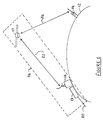
- Figure 1 is diagramatically representative of the environment within which the preferred embodiments of the invention function.
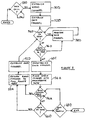
- Figure 2 is a flowchart of the activity of the earth station of Figure 1 when acting in accordance with a first embodiment of the invention.
- Figure 3 is a flowchart of the activity of the user terminal of Figure 1 when co-operating with the earth station of Figure 2.
- Figure 4 is a flowchart of the activity of the earth station of figure 1 when acting according to a second embodiment of the invention.
- Figure 5 is a flowchart of the activity of the user terminal when co-operating with the earth station of figure 4.
- Figure 1 shows the general environment of the preferred embodiments of the present invention.
- a communications satellite 10 is in orbit above the surface of the Earth 12.
- a user terminal 14, visible to the satellite 10 is situated at a first location on the surface of the earth 12.
- a satellite earth station 16 is situated at a second point on the surface of the Earth 12.
- the satellite 10 is also visible to the earth station 16.
- An earth station controller 18 controls the earth station 16 and also provides connection 20 to terrestrial telephone or data networks in the normal manner.
- a bidirectional satellite radio relay 22 allows the earth station 16 to exchange voice signals, data signals, messages and commands with the satellite 10.
- the earth station 16, controller 18 and satellite 10 together constitute a base station 24, separated in broken outline in Figure 1.
- the base station 24 communicates with the user terminal 14 by a bidirectional radio path 26 from the satellite 10.
- the radio path 26 can comprise signals of different frequencies, and, in the preferred embodiments, includes voice and data channels, and signalling channels, originating with the earth station 16 and using the satellite 10 as a relay to the user terminal 14, or originating from the user terminal 14 and using the satellite 10 as a relay to the earth station 16.
- the base station 14 is as described with respect to Figure 1. It is to be understood that the function of the base station 24, as shown in Figure 1, is no different from that of a cellular telephone base station, itself on the surface of the earth 12, and, in that respect, the present invention applies equally to terrestrial cellular radio telephone systems.
- the earth station 16 can co-operate with the user terminal 14 to establish and disestablish (shut down) a voice grade radio channel capable of carrying slow data, such as packet radio data, in either direction. So far as the invention is concerned, it is not essential that the radio channel is voice grade, and the invention applies equally to systems where wider, faster data radio channels can be established and disestablished. Equally, it is not an important feature of the present invention exactly which data exchange standard or protocol is used. The preferred embodiment is directed towards packet radio. As will become clear from the following description, all that is required is a protocol and standard where the user terminal 14 and the earth station 16 can co-operate to establish, disestablish and validate a data channel over the radio channel that has previously or simultaneously been established.
- Figure 2 is a flowchart of the activity of the earth station 16 in setting up and progressing a data exchange with the user terminal 16.
- the function can be contained within the earth station 16, the earth station controller 18, or in any other device capable of maintaining functional and message exchange control of the earth station 18.
- the data call may originate from the connection 20 and be destined for the user terminal 14, the earth station controller 18 receiving the call request in the normal way found in terrestrial networks.
- the data call can originate from the user terminal 14 by the user terminal 14 using the radio path 26 to signal to the earth station 16 to request a radio channel and indicating to the earth station 16 that a data exchange is required. This is indicated by setting a flag in a string of binary digits contained in the channel request. Other means can be used, such as a separate message. It is not really important how the earth station 18 learns that the radio channel request is for data exchange. It is simply necessary that the earth station 18 is made so aware.
- the protocol involves verification between the earth station 18 and the user terminal 14 where SIM card numbers, IMSIs TIMIS's and encryption keys and computational results are exchanged between the earth station 18 and the user terminal 14 according to the GSM system, known to those skilled in the art. Once verified, the user terminal 14 is allocated a frequency for a radio channel which is then used between the two.
- the earth station 18 causes the satellite 10 to use a first frequency for transmission and a second frequency for reception, and the user terminal 14 uses the second frequency for transmission and the first frequency for reception.
- TDMA Time Division Multiple Access
- GSM Global System for Mobile communications
- the first operation 30 passes control to a second operation 32 where the user terminal 14 and the earth station 16 co-operate to establish a data channel.
- the data channel is, conceptually, quite different from the radio channel. It does not really matter to the data channel what means is provided for the signals to be passed.
- a verification and set-up exchange passes between the user terminal 14 and the earth station 16 so that the identity of the user terminal 14 or its user and other operational and transactional data can be shared.
- the data exchange standard is GPRS (General Packet Radio System) for GSM. As was earlier stated, this is only the preferred standard, and any other data exchange standard, consistent with the properties of the radio channel, can be used.
- the second operation 32 remembers and stores the information it received during set-up and verification for later use in rapid re-establishment of the data channel.
- Control passes to a second test 34 where the earth station 16 checks to see if the earth station 16 has data to send.
- a minimum amount is required to pass the second test 34. In the preferred embodiments there require to be two or more complete packet data frames before the second test 34 is passed. The skilled man will be aware that other minimum criteria can be used.
- the communication is effectively inert, and neither the user terminal 14 nor the earth station 16 expends any energy in transmission.
- the frequency(s) previously used for the radio channel are also free to be allocated to other user terminals 14 for whatever kind of communication is required.
- Control then passes to a seventh operation 52 where, using the new radio channel, where the user terminal 14 and the earth station 16 co-operate to re-establish the data channel, but using the verification and functional data from the second operation to by-pass verification and set-up exchanges and thereby render the reestablishment of the data channel very rapid.
- the seventh operation passes control back to the second test 34.
- the progress of a data call involves a sequence of rapid setting up and tearing down of the radio channel, a new radio channel being allocated on each occasion. with the data channel being torn down and rapidly set up within the series of radio channels.
- the radio channels are totally non-transmissive when there is no data to send, thus overcoming the waste of power possible during gaps, and making radio channels available for re-allocation in the gaps.
- Figure 3 shows a flowchart giving the sequence of operations when the user terminal 14 co-operates with the earth station 16 during the sequence of Figure 2.
- either the user terminal 14 or the earth station 16 can be the driving force in initiating the disestablishment of the radio and data channels and the reestablishment of the radio and data channels.
- Figure 4 is a flowchart showing the activity of the earth station 16 in a second embodiment of the invention.
- Like numbers 28C to 52C relate to elements corresponding in their designation and description with the same numbers in figure 2.
- the fifth operation 42 is replaced with an eighth operation 56 where, instead of disestablishing the radio channel, the radio channel is kept and placed in a maintenance mode.
- the maintenance mode can take one of several forms:
- the sixth operation 50 is replaced with a ninth operation 58 where the earth station returns the radio channel to full operation by switching the power back on, or by turning the power back up, or by returning to a full duty cycle.
- the second embodiment of the invention has the advantage, over the first embodiment, of removing the necessity of finding a new radio channel on each instance of continuation of the data call, and the disadvantage of not freeing the earlier radio channel for re-allocation during gaps in the data.
- figure 5 is a flowchart of the operations of the user terminal 14 when cooperative with the earth station 16 when acting according to Figure 4.
- Like numbers correspond with like test and functions in relation to figure 3 and figure 4 and the same descriptions and limitations and changes exist between Figure 4 and Figure 5 as exist between Figure 2 and Figure 3, with the exception that the fifth operation 42 is replaced by an eighth operation 56A where the user terminal 14 co-operates with the earth station 16 to put the radio channel into maintenance mode, and the sixth operation 50A is replaced by a ninth operation 58A where the user terminal 14 co-operates with the earth station 16 to return the radio channel to full power.
- the present invention is envisaged for use with all types of data, including internet data.
- data including internet data.
- the above described embodiments are simply exemplary of the present invention, and do not constitute a limitation thereto.
Landscapes
- Engineering & Computer Science (AREA)
- Physics & Mathematics (AREA)
- Astronomy & Astrophysics (AREA)
- Aviation & Aerospace Engineering (AREA)
- General Physics & Mathematics (AREA)
- Computer Networks & Wireless Communication (AREA)
- Signal Processing (AREA)
- Mobile Radio Communication Systems (AREA)
- Radio Relay Systems (AREA)
Priority Applications (2)
| Application Number | Priority Date | Filing Date | Title |
|---|---|---|---|
| EP98307974A EP1006677A1 (de) | 1998-09-30 | 1998-09-30 | Datenübertragung mit Unterbrechung des Funkwegs im Verwaltungsmodus |
| PCT/GB1999/003256 WO2000019638A1 (en) | 1998-09-30 | 1999-09-30 | Satellite data communications with radio path interruption in a non transmission mode for maintenance |
Applications Claiming Priority (1)
| Application Number | Priority Date | Filing Date | Title |
|---|---|---|---|
| EP98307974A EP1006677A1 (de) | 1998-09-30 | 1998-09-30 | Datenübertragung mit Unterbrechung des Funkwegs im Verwaltungsmodus |
Publications (1)
| Publication Number | Publication Date |
|---|---|
| EP1006677A1 true EP1006677A1 (de) | 2000-06-07 |
Family
ID=8235082
Family Applications (1)
| Application Number | Title | Priority Date | Filing Date |
|---|---|---|---|
| EP98307974A Withdrawn EP1006677A1 (de) | 1998-09-30 | 1998-09-30 | Datenübertragung mit Unterbrechung des Funkwegs im Verwaltungsmodus |
Country Status (2)
| Country | Link |
|---|---|
| EP (1) | EP1006677A1 (de) |
| WO (1) | WO2000019638A1 (de) |
Citations (4)
| Publication number | Priority date | Publication date | Assignee | Title |
|---|---|---|---|---|
| US5410740A (en) * | 1993-03-24 | 1995-04-25 | Telefonaktiebolaget L M Ericsson | Control of a radio communications system base station |
| EP0650306A1 (de) * | 1993-10-26 | 1995-04-26 | Alcatel Mobile Communication France | Mitteilungstypanzeige zum Batteriesparen in einem mobilen Zellularfunkempfänger |
| EP0712214A2 (de) * | 1994-11-08 | 1996-05-15 | Space Systems / Loral, Inc. | Leistungssteuersystem einer Satellitenkommunikationsanordnung |
| US5794157A (en) * | 1996-08-28 | 1998-08-11 | Telefonaktiebolaget Lm Ericsson | Method and system for autonomously allocating transmit power levels for communication between a cellular terminal and a telephone base station |
-
1998
- 1998-09-30 EP EP98307974A patent/EP1006677A1/de not_active Withdrawn
-
1999
- 1999-09-30 WO PCT/GB1999/003256 patent/WO2000019638A1/en not_active Ceased
Patent Citations (4)
| Publication number | Priority date | Publication date | Assignee | Title |
|---|---|---|---|---|
| US5410740A (en) * | 1993-03-24 | 1995-04-25 | Telefonaktiebolaget L M Ericsson | Control of a radio communications system base station |
| EP0650306A1 (de) * | 1993-10-26 | 1995-04-26 | Alcatel Mobile Communication France | Mitteilungstypanzeige zum Batteriesparen in einem mobilen Zellularfunkempfänger |
| EP0712214A2 (de) * | 1994-11-08 | 1996-05-15 | Space Systems / Loral, Inc. | Leistungssteuersystem einer Satellitenkommunikationsanordnung |
| US5794157A (en) * | 1996-08-28 | 1998-08-11 | Telefonaktiebolaget Lm Ericsson | Method and system for autonomously allocating transmit power levels for communication between a cellular terminal and a telephone base station |
Also Published As
| Publication number | Publication date |
|---|---|
| WO2000019638A1 (en) | 2000-04-06 |
Similar Documents
| Publication | Publication Date | Title |
|---|---|---|
| CN1330195C (zh) | 移动通信网络中分组交换连接的管理 | |
| US20230208508A1 (en) | Transmission control method and apparatus, device, and storage medium | |
| AU730799B2 (en) | Satellite communications system with dual mode bandwidth control | |
| JP3204235B2 (ja) | 切断時間を考慮した無線データ通信システムとその方法 | |
| WO2002037771A3 (en) | Systems using mobile terminals having short link radios | |
| NO20023701L (no) | Höyhastighets kommunikasjonssystem med redusert behov for overvåking | |
| EP1067712A3 (de) | Kommunikationssystem mit Satelliten auf niedriger Bahn und verteilten Übergangstationen | |
| JP2014522164A (ja) | 通信端末及び方法 | |
| WO2000042806A3 (en) | Method and devices for implementing a continued packet-switched radio connection | |
| EP0920229B1 (de) | Verfahren und System zur Aufbaukontrolle einer Mobilverbindung | |
| KR20030088804A (ko) | Gprs의 rlc/mac 데이터 전송방법 | |
| US6574198B1 (en) | Systems and methods for maintaining a signaling link in a communications network | |
| WO1999057913A3 (en) | Error-recovery mechanism using a temporary forwarder in a wireless-atm network | |
| EP0332465A2 (de) | Konzentratorsystem mit Abruf-Antwort-Mittel zur Fehlerwahrnehmung für das Einstellen der Gebührenverrechnung für lokale Gespräche | |
| WO2000024217A3 (en) | Asynchronous transfer on the cellular radio link | |
| EP1006677A1 (de) | Datenübertragung mit Unterbrechung des Funkwegs im Verwaltungsmodus | |
| JP3840539B2 (ja) | 通信衛星装置及び衛星通信システム | |
| AU5053098A (en) | Packet transmission in telecommunication network | |
| US6393273B1 (en) | Method of and system for determining ARQ capability of a base station | |
| GB2313259A (en) | Channel de-allocation in discontinuous transmission mode | |
| CA2416443C (en) | Method for transmitting data in the access area | |
| EP4738723A1 (de) | Austausch von satelliteninformationen zur übertragung von benutzerdaten | |
| JP2658879B2 (ja) | 多方向多重通信システムの監視方法および監視方式と端局 | |
| JP2964970B2 (ja) | Dama衛星通信方式の回線解放方法とその装置 | |
| KR100512625B1 (ko) | 이동통신 시스템에서의 자원 관리 방법 |
Legal Events
| Date | Code | Title | Description |
|---|---|---|---|
| PUAI | Public reference made under article 153(3) epc to a published international application that has entered the european phase |
Free format text: ORIGINAL CODE: 0009012 |
|
| AK | Designated contracting states |
Kind code of ref document: A1 Designated state(s): DE FR GB |
|
| AX | Request for extension of the european patent |
Free format text: AL;LT;LV;MK;RO;SI |
|
| 17P | Request for examination filed |
Effective date: 20001207 |
|
| AKX | Designation fees paid |
Free format text: DE FR GB |
|
| STAA | Information on the status of an ep patent application or granted ep patent |
Free format text: STATUS: THE APPLICATION HAS BEEN WITHDRAWN |
|
| 18W | Application withdrawn |
Withdrawal date: 20021130 |