EP1006698A2 - Entzerrer, insbesondere für Systeme mit optischer Übertragung - Google Patents
Entzerrer, insbesondere für Systeme mit optischer Übertragung Download PDFInfo
- Publication number
- EP1006698A2 EP1006698A2 EP99440338A EP99440338A EP1006698A2 EP 1006698 A2 EP1006698 A2 EP 1006698A2 EP 99440338 A EP99440338 A EP 99440338A EP 99440338 A EP99440338 A EP 99440338A EP 1006698 A2 EP1006698 A2 EP 1006698A2
- Authority
- EP
- European Patent Office
- Prior art keywords
- monitor
- equalizer
- signal
- points
- comparison
- Prior art date
- Legal status (The legal status is an assumption and is not a legal conclusion. Google has not performed a legal analysis and makes no representation as to the accuracy of the status listed.)
- Withdrawn
Links
- 230000005540 biological transmission Effects 0.000 title claims abstract description 18
- 230000003287 optical effect Effects 0.000 title description 16
- 238000005259 measurement Methods 0.000 claims description 76
- 230000001419 dependent effect Effects 0.000 claims description 5
- 230000002123 temporal effect Effects 0.000 claims description 5
- 230000003111 delayed effect Effects 0.000 claims description 3
- 239000013307 optical fiber Substances 0.000 description 3
- 230000005693 optoelectronics Effects 0.000 description 3
- 229910000577 Silicon-germanium Inorganic materials 0.000 description 2
- 238000010586 diagram Methods 0.000 description 2
- 230000010287 polarization Effects 0.000 description 2
- 230000003044 adaptive effect Effects 0.000 description 1
- 230000001934 delay Effects 0.000 description 1
- 239000006185 dispersion Substances 0.000 description 1
- 230000000694 effects Effects 0.000 description 1
- 230000005684 electric field Effects 0.000 description 1
- 230000002452 interceptive effect Effects 0.000 description 1
- 239000000463 material Substances 0.000 description 1
Images


Classifications
-
- H—ELECTRICITY
- H04—ELECTRIC COMMUNICATION TECHNIQUE
- H04L—TRANSMISSION OF DIGITAL INFORMATION, e.g. TELEGRAPHIC COMMUNICATION
- H04L25/00—Baseband systems
- H04L25/02—Details ; arrangements for supplying electrical power along data transmission lines
- H04L25/03—Shaping networks in transmitter or receiver, e.g. adaptive shaping networks
- H04L25/03006—Arrangements for removing intersymbol interference
- H04L25/03012—Arrangements for removing intersymbol interference operating in the time domain
-
- H—ELECTRICITY
- H04—ELECTRIC COMMUNICATION TECHNIQUE
- H04L—TRANSMISSION OF DIGITAL INFORMATION, e.g. TELEGRAPHIC COMMUNICATION
- H04L25/00—Baseband systems
- H04L25/02—Details ; arrangements for supplying electrical power along data transmission lines
- H04L25/03—Shaping networks in transmitter or receiver, e.g. adaptive shaping networks
- H04L25/03006—Arrangements for removing intersymbol interference
- H04L2025/0335—Arrangements for removing intersymbol interference characterised by the type of transmission
- H04L2025/03375—Passband transmission
Definitions
- the present invention relates to an equalizer for equalizing an electrical Signals in optical transmission systems.
- optical fibers In such transmission systems, data can be transmitted at several Gbit / s become. These transmission systems usually use optical fibers to to be able to transmit the data at high bit rates over long distances. if the If there are data on the transmitter side as analog signals, these are transmitted by a A / D converter is first converted into binary electrical signals. The binary electrical signals are then converted into binary by an electro-optical converter optical signals converted and coupled into the optical fiber. On the The optical signals are decoupled from the optical waveguide on the receiving side and converted into electrical signals by an optoelectronic converter. Due to the distortion in the optical fiber, the optical signals are on the Receiving side no longer binary. For example, a decision maker changes in the recipient the distorted electrical signals back into binary signals. The electrical Signals may be converted into analog electrical signals by a D / A converter converted.
- the distorted optical signal is from the optoelectronic converter in the receiver converted into an electrical signal, that also has these distortions.
- the distorted electrical signal is due to converted a decision maker into a binary electrical signal. To the errors in To keep decision-makers as low as possible and thus to falsify them To avoid transmitting data, the signal must be in front of the decision maker be equalized.
- the PDM of the optical signal can reach up to a bit rate of around 40 Gbit / s Choice of suitable materials for the optical waveguide can be reduced. From one Bit rate of around 40 Gbit / sec, however, requires active equalization of the signal. The distortion of the signal due to other interfering influences must can also be reduced by means of active equalization.
- the signal can be equalized, for example, in the area of the optical transmission path respectively. However, this is very expensive because the polarization of the optical Signal must be influenced.
- the equalization of the signal can also in Area of the electrical transmission link, d. H. after the optoelectronic The converter has converted the optical signal into an electrical signal. At In the present invention, the equalization takes place in the electrical field Transmission link.
- the binary electrical signal ideally has a rectangular signal curve and has either the value 1 or the value 0 at the discrete times. If a binary electrical signal, which contains several 0 and 1 states, is superimposed on itself several times by being delayed by one bit period with each overlay, this results in a signal representation, which is referred to as an eye diagram.
- the disturbing influences on the optical transmission link also have an effect in the eye diagram of the electrical signal.
- a strongly disturbed transmission signal has a smaller eye opening than an undisturbed transmission signal.
- a measuring point is defined by setting the threshold and the phase of the associated monitor decision maker. Measuring means deciding whether that Signal at the decision points marked by the set phase is larger or smaller than the set threshold.
- the first monitor advantageously measures the course of the equalized signal several measuring points at the same time.
- the second monitor also measures the course of the electrical signal at several measuring points, preferably simultaneously.
- the equalizer that is equalized by the equalization unit Signal, the so-called "good" eye, measured in real time by the first monitor.
- the Measurements at the individual measuring points in the first monitor can be carried out simultaneously respectively.
- the measurements of the distorted signal, the so-called “raw” Eye in real time and simultaneously at the individual measuring points in the second Monitor.
- the measurement results of the first and second monitors are shown in the Comparison unit also compared in real time. That through the Comparison of the measurement results formed comparison signal is sent to the actuator forwarded, which then the equalization unit by means of an actuating signal in Controlled depending on the comparison signal.
- the equalizer according to the invention By measuring the signals in the monitors at all measuring points simultaneously, can with the equalizer according to the invention also signals with a particular high bit rate can be equalized. So it is easily possible with the equalizer signals according to the invention with a bit rate of approximately 40 Gbit / sec equalize.
- the equalizer have a delay unit that the electrical signal is delayed before it reaches the second monitor.
- the time delay caused by the delay unit is advantageously the same like the time delay caused by the equalization unit. That way be ensured that the electrical signal at the same time on the is applied to the second monitor, to which the equalized signal on the first monitor is present. This means that when comparing the measurement results at the measurement points, the two monitors no temporal shift of the two signals to each other be taken into account.
- the first monitor preferably has four arranged on the corners of a rectangle Measuring points.
- the second monitor also preferably has four on the corners of one Rectangular measuring points.
- the comparison unit preferably has means for comparing the measurement results of the Measuring points of the first monitor with the measuring results of the measuring points of the second Monitors on.
- the four measuring points per monitor enable a sufficiently precise Measurement of the eye pattern of the "good” eye and the "raw” eye.
- the measurements the eye patterns are made analogously. It becomes the amplitude and the temporal opening of the signals measured.
- the comparison signal depends on the result of the comparison of the measurement results the measuring points of the first monitor with the measuring results of the corresponding ones Measuring points of the second monitor.
- the first monitor and the second Monitor a fifth measuring point each, the center of the other four Measuring points is arranged. These fifth measuring points of the first and the second Monitors provide a reference measurement.
- the comparison unit preferably has means for comparing the measurement results of the first four measuring points with the measuring result of the fifth measuring point of the first Monitors and means for comparing the measurement results of the first four measurement points with the measurement result of the fifth measurement point of the second monitor.
- the Comparison of the measurement results of the first four measurement points with the measurement result of the fifth measuring point in the first monitor and in the second monitor at the same time he follows. That is, the comparison for all four measuring points with the fifth measuring point of the first monitor at the same time. The same applies to the comparison for the four Measuring points with the fifth measuring point of the second monitor.
- the The comparison signal depends on the result of the comparison of the measurement results first four measuring points with the measuring result of the fifth measuring point of the first Monitor and the second monitor.
- the invention proposes according to a particularly preferred Embodiment before that the equalization unit first means for setting the Runtime of the electrical signal and second means for adjusting the amplitude of the Electrical signal, the actuator unit the first means and the second Controlled means by means of an actuating signal.
- the equalization unit first means for setting the Runtime of the electrical signal and second means for adjusting the amplitude of the Electrical signal, the actuator unit the first means and the second Controlled means by means of an actuating signal.
- the equalization unit advantageously has two first means. Likewise, the Equalization unit two second means.
- the control unit controls the equalization unit in such a way that the eye opening of the equalized signal is as large as possible.
- control unit control the equalization unit such that a from the measurement results of the measurement points of the first monitor and the measurement results the measuring point of the second monitor derived comparison signal is as large as possible.
- the equalizer be designed as an integrated circuit.
- the Integrated circuit can be designed, for example, in SiGe technology.
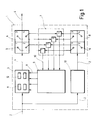
- the Equalizer 1 shows an equalizer according to the invention in accordance with a preferred one Embodiment marked in its entirety with reference number 1.
- the Equalizer 1 is used to equalize an electrical signal 2 in transmission systems with high bit rates.
- electrical Signals 2 with bit rates in the range of several 10 Gbit / sec are equalized.
- the Equalizer 1 works in the area of the electrical transmission line of the Transmission system.
- the equalizer 1 has an equalization unit 3 which generates the electrical signal 2 equalized.
- the equalized electrical signal 4 is fed into a first monitor A which the eye pattern of the equalized signal 4 at several measuring points 5 simultaneously measures.
- the equalizer 1 also has a second monitor B, which Eye pattern of the electrical signal 2 at several measuring points 6 simultaneously measures.
- a comparison unit 7 of the equalizer 1 the measurement results of the Measuring points 5, 6 of the first monitor A and the second monitor B together compared and a comparison signal 13 is generated.
- the comparison signal 13 is sent to a Actuating unit 9 of the equalizer 1, which the equalization unit 3 in dependence driven by the comparison signal 13.
- the equalizer 1 finally has one Delay unit 10, which delays the electrical signal 2 before it turns on reaches the second monitor B.
- the time delay of signal 2 due to Delay unit 10 corresponds to the time delay of the signal 2 due to the equalization unit 3.
- Fig. 2 the waveform of two distorted signals 2, as they are on the second Monitor B, shown as an example.
- One of the signals 2 shown has a Maximum within the represented bit period b, and the other has a minimum within the bit period b.
- the signal 2 with the maximum within the bit period b corresponds to the binary value 1, and the signal 2 with the minimum corresponds to that binary value 0.
- Fig. 3 the waveform of two equalized signals 4 is shown as they are the first monitor A.
- One of the signals 4 shown has a maximum within the shown bit period b and the other signal 4 to a minimum.
- the distorted signals 2 shown in FIG. 2 are one form a much smaller eye opening than the rectified ones shown in FIG. 3 Signals 4.
- the aim of equalization by the equalizer 1 according to the invention is enlarge the eye opening, d. H. the largest possible amplitude U and one to cause the greatest possible temporal opening ⁇ t of the equalized signal 4.
- the eye formed by the equalized signal 4 in the first monitor A one has a significantly better course than that formed by the distorted signal 2 Eye in the second monitor B.
- the equalization unit 3 has two first means 11 for setting the running time of the electrical signal 2 and two second means 12 for adjusting the amplitude of the electrical signal 2 (see FIG. 1).
- the actuating unit 9 controls the first means 11 and the second means 12 by means of an actuating signal 8 such that the difference between the measured values at measuring points 5 and at measuring points 6 as possible, d. that is, the amplitude U is as large as possible and the temporal Opening ⁇ t becomes as large as possible.
- the first monitor A and the second monitor B a fifth Have measurement point (not shown), for example in the center of the others four measuring points 5 and 6 is arranged.
- the comparison unit 3 could then Measurement results of the first four measurement points 5 with the measurement result of the fifth Measurement point of the first monitor A and the measurement results of the first four Measuring points 6 with the measuring result of the fifth measuring point of the second monitor B to compare.
- the comparison signal 13 would then be dependent on the result of the Comparison of the measurement results of the first four measurement points 5, 6 with the measurement result of the fifth measuring point of the first monitor A and the second monitor B.
- the dem fifth measuring point in monitor A assigned monitor decision maker can with the actual data decision maker will be identical.
- Fig. 4 shows a generalized embodiment of the comparison unit 7.
- the comparison unit is a control unit, all of which available measurement results of monitors A and B in any combination can evaluate.
- the entire equalizer 1 is designed as an integrated circuit using SiGe technology.
Landscapes
- Engineering & Computer Science (AREA)
- Power Engineering (AREA)
- Computer Networks & Wireless Communication (AREA)
- Signal Processing (AREA)
- Dc Digital Transmission (AREA)
- Cable Transmission Systems, Equalization Of Radio And Reduction Of Echo (AREA)
- Measuring Volume Flow (AREA)
- Paper (AREA)
Abstract
Description
Die störenden Einflüsse auf der optischen Übertragungsstrecke wirken sich auch in dem Augendiagramm des elektrischen Signals aus. Ein stark gestörtes Übertragungssignal weist einen geringere Augenöffnung auf als ein ungestörtes Übertragungssignal.
- eine Entzerrungseinheit, die das elektrische Signal entzerrt,
- einen ersten Monitor, der einen Verlauf des entzerrten Signals an mehreren Meßpunkten misst,
- einen zweiten Monitor, der einen Verlauf des elektrischen Signals an mehreren Meßpunkten misst,
- eine Vergleichseinheit zur Erzeugung eines Vergleichsignals, das abhängig ist von den Meßergebnissen der Meßpunkte des ersten Monitors und von den Meßergebnissen der Meßpunkte des zweiten Monitors, und
- eine Stelleinheit, die die Entzerrungseinheit in Abhängigkeit von dem Vergleichsignal ansteuert.
- Fig. 1
- einen erfindungsgemäßen Equalizer gemäß einer bevorzugten Ausführungsform;
- Fig. 2
- den Signalverlauf von zwei verzerrten Signalen; und
- Fig. 3
- den Signalverlauf von zwei entzerrten Signalen
- Fig. 4
- eine Equalizereinheit.
Claims (22)
- Equalizer (1) zum Entzerren eines elektrischen Signals (2) in Übertragungssystemen, gekennzeichnet durcheine Entzerrungseinheit (3), die das elektrische Signal (2) entzerrt,einen ersten Monitor (A), der das entzerrte Signal (4) an mehreren Meßpunkten (5) misst,einen zweiten Monitor (B), der das elektrischen Signal (2) an mehreren Meßpunkten (6) misst,eine Vergleichseinheit (7) zur Erzeugung mindestens eines Vergleichsignals (13), das abhängig ist von den Meßergebnissen der Meßpunkte (5) des ersten Monitors (A) und von den Meßergebnissen der Meßpunkte (6) des zweiten Monitors (B), undeine Stelleinheit (9), die die Entzerrungseinheit (3) in Abhängigkeit von dem Vergleichsignal(13) ansteuert.
- Equalizer (1) nach Anspruch 1, dadurch gekennzeichnet, dass der erste Monitor (A) den Verlauf des entzerrten Signals (4) an mehreren Meßpunkten (5) gleichzeitig misst.
- Equalizer (1) nach Anspruch 1 oder 2, dadurch gekennzeichnet, dass der zweite Monitor (B) den Verlauf des elektrischen Signals (2) an mehreren Meßpunkten (6) gleichzeitig misst.
- Equalizer (1) nach einem der Ansprüche 1 bis 3, dadurch gekennzeichnet, dass der Equalizer (1) eine Verzögerungseinheit (10) aufweist, die das elektrische Signal (2) zeitlich verzögert, bevor es an den zweiten Monitor (B) gelangt.
- Equalizer (1) nach Anspruch 4, dadurch gekennzeichnet, dass die zeitliche Verzögerung durch die Verzögerungseinheit (10) gleich groß ist wie die zeitliche Verzögerung durch die Entzerrungseinheit (3).
- Equalizer (1) nach einem der Ansprüche 1 bis 5, dadurch gekennzeichnet, dass der erste Monitor (A) vier auf den Ecken eines Rechtecks angeordnete Meßpunkte (5) aufweist.
- Equalizer (1) nach einem der Ansprüche 1 bis 6, dadurch gekennzeichnet, dass der zweite Monitor (B) vier auf den Ecken eines Rechtecks angeordnete Meßpunkte (6) aufweist.
- Equalizer (1) nach Anspruch 6 und 7, dadurch gekennzeichnet, daß die Vergleichseinheit (7) Mittel zum Vergleich der Meßergebnisse der Meßpunkte (5) des ersten Monitors (A) mit den Meßergebnissen der Meßpunkte (6) des zweiten Monitors (B) aufweist.
- Equalizer (1) nach Anspruch 8, dadurch gekennzeichnet, dass der Vergleich der Meßergebnisse der Meßpunkte (5) des ersten Monitors (A) mit den Meßergebnissen der entsprechenden Meßpunkte (6) des zweiten Monitors (B) zeitgleich erfolgt.
- Equalizer (1) nach Anspruch 8 oder 9, dadurch gekennzeichnet, dass das Vergleichsignal(13) abhängig ist von dem Ergebnis des Vergleichs der Meßergebnisse der Meßpunkte (5) des ersten Monitors (A) mit den Meßergebnissen der entsprechenden Meßpunkte (6) des zweiten Monitors (B).
- Equalizer (1) nach einem der Ansprüche 6 bis 10, dadurch gekennzeichnet, dass der erste Monitor (A) und der zweite Monitor (B) einen fünften Meßpunkt aufweisen, der im Mittelpunkt der anderen vier Meßpunkte (5; 6) angeordnet ist.
- Equalizer (1) nach Anspruch 11, dadurch gekennzeichnet, dass die Vergleichseinheit (7) Mittel zum Vergleich der Meßergebnisse der ersten vier Meßpunkte (5) mit dem Meßergebnis des fünften Meßpunktes des ersten Monitors (A) und Mittel zum Vergleich der Meßergebnisse der ersten vier Meßpunkte (6) mit dem Meßergebnis des fünften Meßpunktes des zweiten Monitors (B) aufweist.
- Equalizer (1) nach Anspruch 12, dadurch gekennzeichnet, dass der Vergleich der Meßergebnisse der ersten vier Meßpunkte (5; 6) mit dem Meßergenis des fünften Meßpunkts zeitgleich in dem ersten Monitor (A) und in dem zweiten Monitor (B) erfolgt.
- Equalizer (1) nach Anspruch 12 oder 13, dadurch gekennzeichnet, dass der Vergleich der Meßergebnisse der ersten vier Meßpunkte (5; 6) mit dem Meßergebnis des fünften Meßpunkts in dem ersten Monitor (A) und in dem zweiten Monitor (B) zeitgleich erfolgt.
- Equalizer (1) nach einem der Ansprüche 12 bis 14, dadurch gekennzeichnet, dass das Vergleichsignal(13) abhängig ist von dem Ergebnis des Vergleichs der Meßergebnisse der ersten vier Meßpunkte (5; 6) mit dem Meßergebnis des fünften Meßpunkts des ersten Monitors (A) und des zweiten Monitors (B).
- Equalizer (1) nach einem der Ansprüche 1 bis 15, dadurch gekennzeichnet, dass die Entzerrungseinheit (3) erste Mittel (11) zum Einstellen der Laufzeit (Ät) des elektrischen Signals (2) und zweite Mittel (12) zum Einstellen der Amplitude (U) des elektrischen Signals (2) aufweist, wobei die Stelleinheit (9) die ersten Mittel (11) und die zweiten Mittel (12) mittels eines Stellsignals (8) ansteuert.
- Equalizer (1) nach Anspruch 16, dadurch gekennzeichnet, dass die Entzerrungseinheit (3) dritte Mittel zum Aufspalten des elektrischen Signals (2) in ein Grundsignal und in ein Korrektursignal aufweist, dass durch die ersten Mittel (11) die Laufzeit (Ät) des Korrektursignals und durch die zweiten Mittel (12) die Amplitude (U) des Korrektursignals einstellbar ist, und dass die Entzerrungseinheit (3) vierte Mittel zum Addieren des Korrektursignals mit eingestellter Laufzeit (Ät) und eingestellter Amplitude (U) zu dem Grundsignal aufweist.
- Equalizer (1) nach einem der Ansprüche 16 oder 17, dadurch gekennzeichnet, dass die Entzerrungseinheit (3) zwei erste Mittel (11) aufweist.
- Equalizer (1) nach einem der Ansprüche 16 bis 18, dadurch gekennzeichnet, dass die Entzerrungseinheit zwei zweite Mittel (12) aufweist.
- Equalizer (1) nach einem der Ansprüche 1 bis 19, dadurch gekennzeichnet, dass die Stelleinheit (9) die Entzerrungseinheit (3) derart ansteuert, dass die Augenöffnung des entzerrten Signals (4) möglichst groß ist.
- Equalizer (1) nach Anspruch 20, sofern auf Anspruch 10 rückbezogen, dadurch gekennzeichnet, dass die Stelleinheit (9) die Entzerrungseinheit (3) derart ansteuert, dass der Betrag der Differenz der Meßergebnisse der Meßpunkte (5) des ersten Monitors (A) und der Meßergebnisse der entsprechenden Meßpunkte (6) des zweiten Monitors (B) möglichst groß ist.
- Equalizer (1) nach einem der Ansprüche 1 bis 21, dadurch gekennzeichnet, dass der Equalizer (1) als eine integrierte Schaltung ausgebildet ist.
Applications Claiming Priority (2)
| Application Number | Priority Date | Filing Date | Title |
|---|---|---|---|
| DE19855707 | 1998-12-03 | ||
| DE1998155707 DE19855707A1 (de) | 1998-12-03 | 1998-12-03 | Equalizer für Übertragungssysteme mit hohen Bitraten |
Publications (2)
| Publication Number | Publication Date |
|---|---|
| EP1006698A2 true EP1006698A2 (de) | 2000-06-07 |
| EP1006698A3 EP1006698A3 (de) | 2003-04-16 |
Family
ID=7889789
Family Applications (1)
| Application Number | Title | Priority Date | Filing Date |
|---|---|---|---|
| EP99440338A Withdrawn EP1006698A3 (de) | 1998-12-03 | 1999-12-02 | Entzerrer, insbesondere für Systeme mit optischer Übertragung |
Country Status (2)
| Country | Link |
|---|---|
| EP (1) | EP1006698A3 (de) |
| DE (1) | DE19855707A1 (de) |
Cited By (1)
| Publication number | Priority date | Publication date | Assignee | Title |
|---|---|---|---|---|
| US10092186B2 (en) | 2002-03-06 | 2018-10-09 | Cardiac Pacemakers, Inc. | Advanced patient management with environmental data |
Families Citing this family (1)
| Publication number | Priority date | Publication date | Assignee | Title |
|---|---|---|---|---|
| DE10210003B4 (de) | 2002-03-07 | 2005-09-01 | Phoenix Contact Gmbh & Co. Kg | Schaltungsanordnung zur gezielten Bitlängenmanipulation für eine serielle Datenübertragung |
Family Cites Families (2)
| Publication number | Priority date | Publication date | Assignee | Title |
|---|---|---|---|---|
| US5159282A (en) * | 1989-12-06 | 1992-10-27 | Kabushiki Kaisha Toshiba | Demodulation apparatus incorporating adaptive equalizer for digital communication |
| EP0912020A3 (de) * | 1997-10-25 | 2002-07-03 | Alcatel | Entscheidungsverfahren mit adaptiven Schwellwerten |
-
1998
- 1998-12-03 DE DE1998155707 patent/DE19855707A1/de not_active Ceased
-
1999
- 1999-12-02 EP EP99440338A patent/EP1006698A3/de not_active Withdrawn
Cited By (1)
| Publication number | Priority date | Publication date | Assignee | Title |
|---|---|---|---|---|
| US10092186B2 (en) | 2002-03-06 | 2018-10-09 | Cardiac Pacemakers, Inc. | Advanced patient management with environmental data |
Also Published As
| Publication number | Publication date |
|---|---|
| DE19855707A1 (de) | 2000-06-15 |
| EP1006698A3 (de) | 2003-04-16 |
Similar Documents
| Publication | Publication Date | Title |
|---|---|---|
| DE69834787T2 (de) | Verfahren und Vorrichtung zur automatischen Kompensation der Polarisationsmodendispersion erster Ordnung | |
| EP1199821B1 (de) | "Empfänger mit rückgekoppeltem Filter sowie Augenmonitor für den rückgekoppelten Filter" | |
| DE60026626T2 (de) | Verbesserter Verzerrungsanalysator für eine Vorrichtung zur Kompensation der Polarisationsmodendispersion erster Ordnung (PMD) | |
| EP0521342B1 (de) | Entzerrer für optische Nachrichtenübertragungssysteme | |
| DE69806874T2 (de) | Distortionsstrafemessverfahren in optischen Systemen mit Geräuschbelastung | |
| EP0798883A2 (de) | Optischer Empfänger mit einer Entzerrerschaltung für durch Polarisationsmodendispersion verursachte Störung und System mit einem solchen optischen Empfänger | |
| DE60315781T2 (de) | Verfahren und Vorrichtung zur optischen Dispersionsüberwachung | |
| EP1330066A2 (de) | Entzerrerschaltung für digital übertragene Signale | |
| DE2829277A1 (de) | Sendeanlage mit einem system zur kompensation von raeumlichen phasenverzerrungen | |
| DE2510566C2 (de) | Überwachungsschaltung für Regenerierverstärker | |
| WO2004034611A1 (de) | Verfahren und anordnung zur ermittlung von signaldegradationen in anwesenheit von signalverzerrungen | |
| DE60220432T2 (de) | Vorrichtung und Verfahren zu einer Augenmustermessung von einem digitalen Signal | |
| EP1324517A2 (de) | Anordnung und Verfahren zur Messung und zur Kompensation der Polarisationsmodendispersion eines optischen Signals | |
| DE60200017T2 (de) | Vorrichtung und Verfahren zur adaptiven Steuerung | |
| DE102007034574A1 (de) | Datenempfänger und Verfahren zum Verarbeiten von empfangenen Daten | |
| EP1006698A2 (de) | Entzerrer, insbesondere für Systeme mit optischer Übertragung | |
| DE69214703T2 (de) | Gerät zur Anzeige von entzerrten Augendiagrammen | |
| EP0028706A2 (de) | Vorrichtung zur automatischen Entzerrung elektrischer Datenübertragungswege | |
| DE10241848A1 (de) | Verfahren zur Erfassung von optischen bzw. elektrischen Signalfolgen und Augenmonitor zur Erfassung und Darstellung von Signalfolgen | |
| EP1063793B1 (de) | Verfahren zum Messen der Signalqualität eines optischen Datensignals | |
| EP1188263A1 (de) | Einrichtung zur detektion von polarisationsmodendispersion | |
| EP1116356B1 (de) | Vorrichtung und verfahren zur regelung des abtasttaktes in einem datenübertragungssystem | |
| EP1005731A2 (de) | Verfahren zur unterdrückung von störungen in einem bipolaren datenstrom und schaltungsanordnung zur durchführung des verfahrens | |
| DE10207315B4 (de) | Vorrichtung zur Datenrückgewinnung aus einem empfangenen Datensignal | |
| DE69822036T2 (de) | Entzerrung, Pulsformung und Regeneration von optischen Signalen |
Legal Events
| Date | Code | Title | Description |
|---|---|---|---|
| PUAI | Public reference made under article 153(3) epc to a published international application that has entered the european phase |
Free format text: ORIGINAL CODE: 0009012 |
|
| AK | Designated contracting states |
Kind code of ref document: A2 Designated state(s): AT BE CH CY DE DK ES FI FR GB GR IE IT LI LU MC NL PT SE |
|
| AX | Request for extension of the european patent |
Free format text: AL;LT;LV;MK;RO;SI |
|
| PUAL | Search report despatched |
Free format text: ORIGINAL CODE: 0009013 |
|
| AK | Designated contracting states |
Designated state(s): AT BE CH CY DE DK ES FI FR GB GR IE IT LI LU MC NL PT SE |
|
| AX | Request for extension of the european patent |
Extension state: AL LT LV MK RO SI |
|
| 17P | Request for examination filed |
Effective date: 20030305 |
|
| 17Q | First examination report despatched |
Effective date: 20030411 |
|
| GRAP | Despatch of communication of intention to grant a patent |
Free format text: ORIGINAL CODE: EPIDOSNIGR1 |
|
| RTI1 | Title (correction) |
Free format text: EQUALISER, PARTICULARLY FOR OPTICAL TRANSMISSION SYSTEMS |
|
| STAA | Information on the status of an ep patent application or granted ep patent |
Free format text: STATUS: THE APPLICATION HAS BEEN WITHDRAWN |
|
| 18W | Application withdrawn |
Effective date: 20030904 |