EP1006732A2 - Interpolation avec compensation de mouvement en traitement de signal vidéo numérique - Google Patents
Interpolation avec compensation de mouvement en traitement de signal vidéo numérique Download PDFInfo
- Publication number
- EP1006732A2 EP1006732A2 EP99122226A EP99122226A EP1006732A2 EP 1006732 A2 EP1006732 A2 EP 1006732A2 EP 99122226 A EP99122226 A EP 99122226A EP 99122226 A EP99122226 A EP 99122226A EP 1006732 A2 EP1006732 A2 EP 1006732A2
- Authority
- EP
- European Patent Office
- Prior art keywords
- image
- information
- blocks
- motion vector
- block
- Prior art date
- Legal status (The legal status is an assumption and is not a legal conclusion. Google has not performed a legal analysis and makes no representation as to the accuracy of the status listed.)
- Withdrawn
Links
Images



Classifications
-
- H—ELECTRICITY
- H04—ELECTRIC COMMUNICATION TECHNIQUE
- H04N—PICTORIAL COMMUNICATION, e.g. TELEVISION
- H04N19/00—Methods or arrangements for coding, decoding, compressing or decompressing digital video signals
- H04N19/50—Methods or arrangements for coding, decoding, compressing or decompressing digital video signals using predictive coding
- H04N19/503—Methods or arrangements for coding, decoding, compressing or decompressing digital video signals using predictive coding involving temporal prediction
- H04N19/51—Motion estimation or motion compensation
- H04N19/577—Motion compensation with bidirectional frame interpolation, i.e. using B-pictures
Definitions
- This invention relates to encoding and decoding of complex video image information including motion components which may be encountered, for example, in multimedia applications, such as video-conferencing, video-phone, and video games.
- video compression techniques One significant approach to achieving a high compression ratio is to remove the temporal and spatial redundancy which is present in a video sequence.
- an image can be divided into disjoint blocks of equal size. These blocks are then subjected to a transformation (e.g., Discrete Cosine Transformation or DCT), which decorrelates the data so that it is represented as discrete frequency components.
- DCT Discrete Cosine Transformation
- the block energy is more compact, hence the coding of each block can be more efficient.
- two-dimensional block elements are quantized.
- known run-length and Huffman coding schemes can be applied to convert the quantized data into a bit-stream. If the above process is applied to one block independent of any other block, the block is said to be intra-coded. On the other hand, if the block uses information from another block at a different time, then the block is said to be inter-coded. Intercoding techniques are used to remove temporal redundancy. The basic approach is that a residual block (or error block) is determined based on the difference between the current block and a block in a reference picture.
- a vector between these two blocks is then determined and is designated as a motion vector.
- block-matching algorithms BMAs
- BMAs block-matching algorithms
- video coding schemes encode each motion vector differentially with respect to its neighbors. The present inventors have observed that a piecewise continuous motion field can reduce the bit rate in this case. Hence, a rate-optimized motion estimation algorithm has been developed.
- the unique features of this proposal come from two elements: (1) the number of bits used for encoding motion vectors is incorporated into the minimization criterion, and (2) rather than counting the actual number of bits for motion vectors, the number of motion vector bits is estimated using the residues of the neighboring blocks.
- the bit-rate is lower than in prior encoders using full-search motion-estimation algorithms.
- the computational complexity is much lower than in a method in which rate-distortion is optimized.
- the resulting motion field is a true motion field, hence the subjective image quality is improved as well.
- the resulting true motion field can be used at the decoder, as well, in a variety of other ways. More specifically, it has been found that the true motion field can be used to reconstruct missing data, where the data may be a missing frame and/or a missing, field. In terms of applications, this translates into frame-rate up-conversion, error concealment and interlaced-to-progressive scan rate conversion capabilities, making use of the true motion information at the decoder end of the system.
- Frame-Rate Up-Conversion The use of frame-rate up-conversion has drawn considerable attention in recent years. To accomplish acceptable coding results at very low bit-rates, most encoders reduce the temporal resolution, i.e., instead of targeting the full frame rate of 30 frames/sec (fps), the frame rate may be reduced to 10 fps, which would mean that 2 out of every 3 frames are never even considered by the encoder.
- a recovery mechanism is needed. The simplest mechanism is to repeat each frame until a new one is received.
- the problem with that interpolation scheme is that the image sequence will appear very discontinuous or jerky, especially in areas where large or complex motion occurs.
- Another simple mechanism is linear-interpolation between coded frames. The problem with this mechanism is that the image sequence will appear blurry in areas of motion, resulting in what is referred to as ghost artifacts.
- the method proposed in the present case is applicable to most video coding standards in that it does not require any proprietary information to be transmitted and it does not require an extra motion estimation computation.
- the present motion-compensated interpolation scheme utilizes the decoded motion information which is used for inter-coding. Since the current true motion estimation process provides a more accurate representation of the motion within a scene, it becomes possible to more readily reconstruct information at the decoder which needs to be recovered before display. Besides quality, the major advantage of this method over other motion compensated interpolation methods is that significantly less computation is required on the decoder side.
- Error Concealment can also be employed to provide improved error concealment.
- post-processing operations at the decoder can be employed to recover damaged or lost video areas based on characteristics of images and video signals.
- Interlaced-to-Progressive Scan Conversion In addition to the above motion-compensated interpolation method, a related method for performing interlaced-to-progressive scan conversion also becomes available. In this scenario, rather than recovering an entire frame, an entire field is recovered. This type of conversion is necessary for cases in which a progressive display is intended to display compressed inter-frame, and motion-compensated inter-frame.
- Intraframe methods Simple intraframe techniques interpolate a missing line on the basis of two scanned lines which occur immediately before and after the missing line.
- One simple example is the "line averaging" which replaces a missing line by averaging the two lines adjacent to it.
- Some other improved intraframe methods which use more complicated filters or edge information have been proposed by M. H. Lee et al. (See “A New Algorithm for Interlaced to Progressive Scan Conversion Based on Directional Correlations and its IC Design," IEEE Transactions on Consumer Electronics, Vol. 40, No. 2, pp. 119-129, May 1994).
- Such intraframe techniques cannot predict information which is lost from the current field, but which appears in neighboring fields.
- Interframe techniques take into account the pixels in the previous frame in the interpolation procedure.
- Non-motion-compensated approaches which apply linear or nonlinear filters, are fine for stationary objects, but they result in severe artifacts for moving objects.
- motion compensation should be used in order to achieve higher quality.
- Some motion compensated de-interlacing techniques have been proposed. For example, it has been shown that motion compensated de-interlacing methods are better than the intraframe methods and non-motion-compensated interframe methods (see Lee et al., "Video Format Conversions between HDTV Systems," IEEE Transactions on Consumer Electronics, Vol. 39, No. 3, pp. 219-224, Aug. 1993).
- the system disclosed by the present inventors utilizes an accurate motion estimation/compensation algorithm so it is classified as a motion-compensated interframe method.
- the interlaced-to-progressive scan conversion procedure contains two parts: (1) a motion-based compensation, and (2) a generalized sampling theorem.
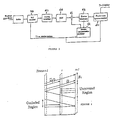
- the motion-based compensation essentially determines a set of samples at a time 2t , given samples at 2t - 1 and 2t + 1 . In general, these determined sets of samples will not lie on the image grid at time 2t , since the motion vector between 2t - 1 and 2t + 1 is arbitrary. Therefore, a generalized sampling theorem is used to compute the missing samples at the grid points given the motion compensated samples and the samples which already exist.
- this can be expressed as: first, find ⁇ I(m + ⁇ x , 2n + ⁇ y , 2t) ⁇ given ⁇ I(m,2n - 1 , 2t-1) ⁇ and ⁇ I(m,2n + 1,2t + 1) ⁇ , then find ⁇ I(m,2n + 1,2t) ⁇ given ⁇ I(m,2n,2t) ⁇ and ⁇ I(m + ⁇ x ,2n + ⁇ y ,2t) ⁇ .
- a method of image data interpolation comprises decoding true motion vector data associated with blocks of digitally encoded image information, with the true motion vector data being dependent in part on neighboring image block proximity weighting factors.
- the method further comprises interpolating from the supplied picture information, image sequence signal data corresponding to intermediate image time intervals absent from the supplied picture information, the absent image time intervals corresponding to intermediate image information occurring during the intermediate image time intervals in sequence between supplied image time intervals associated with the supplied picture information.
- the interpolation comprises the steps of constructing image pixels for image blocks in each intermediate image time interval, based upon corresponding pixels in corresponding blocks in the supplied picture information which occur immediately before and after the intermediate image time interval, by distributing to constructed image pixels a fractional portion of image intensity difference information between the corresponding pixels occurring before and after the intermediate time to produce averaged intensity pixels for the intermediate image time interval.
- each constructed image pixel in each intermediate time interval is associated with a corresponding true motion vector equal in magnitude to a fractional part of the true motion vector information associated with the block in which the corresponding pixel is located in a reference supplied time interval, the fractional part being determined according to the number of intermediate image time intervals inserted between supplied time intervals.
- Each constructed, averaged intensity pixel is then associated with a spatial location in the intermediate image time interval according to the fractional part of the corresponding decoded true motion vector.
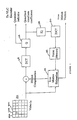
- a digital video signal representing a sequence of images 20, comprising spatially arranged video blocks 20A, 20B, 20C, etc., each made up of individual image pixels (or pels) - see Figure 7 - is supplied as a signal input to the video encoder.
- the video image information is supplied in a conventional sequence of luminance and chrominance information.
- the incoming digital video signal is supplied to a true motion estimation processor 22 to determine true motion vectors TMV representative of the "best match" between, for example, a block of the current frame and a "corresponding" block of a previous frame as illustrated in Figure 8.
- the processor 22 provides an appropriate motion compensated prediction for the video signal.
- "Difference image” information is then subjected to a Discrete Cosine Transformation (DCT) 24 and the transformed information is subjected to quantization (Q) 26, each of which operations is conventional.
- DCT Discrete Cosine Transformation
- Q quantization
- Quantized transform coefficients and quantizer indicator information are supplied to a variable length coding (VLC) encoder such as the general arrangement shown in Figure 2.
- VLC variable length coding
- the quantized transform coefficients are subjected to Inverse Quantization (IQ) 28 and then to Inverse Discrete Cosine Transformation (IDCT) 30.
- IQ Inverse Quantization
- IDCT Inverse Discrete Cosine Transformation
- the resulting information is coupled to a frame memory 32 to provide a delay.
- Image information from a current image and a frame delayed image from frame memory 32 are compared and processed, as will be explained below, to produce true motion vector information for application in accordance with the present invention at the decoder of a system (see Figure 3 ).
- An encoder arrangement of the general type shown in Figure 2, but not specifically directed to providing true motion vectors, is described in greater detail in the above-identified patent of Sun and Vetro, the disclosure of which is incorporated herein by reference.
- Algorithms for computing motion flow can be divided into two categories; those for removing temporal redundancy and those for tracking physical motion.
- the first set of motion estimation algorithms is aimed at removing temporal redundancy in the video compression process.
- similar scenes exist in a frame and a corresponding previous frame.
- the MPEG video coding standards code the displaced difference block instead of the original block. For example, assume a block in a current frame is similar to a displaced block in a previous frame. (See for example, Figure 5 showing two odd fields and an intermediate even field in an interlaced system, with the "similar" block shown by the dashed line outline).
- a motion prediction vector together with a residue (difference) is coded. Since an achieved compression ratio will depend on removal of redundancy, the displacement vector corresponding to minimal displaced frame difference (DFD) is often used in prior systems.
- a second type of motion estimation algorithm aims at accurately tracking the physical motion of features in video sequences.
- a video sequence arises from putting a three dimensional (3D) real world onto a series of 2D images.
- 3D three dimensional
- 2D images When objects in the 3D real world move, the brightness (pixel intensity) of the 2D images changes correspondingly.
- the 2D projection of the movement of a point in the 3D real world will be referred to herein as the "true motion.”
- Computer vision whose goal is to identify the unknown environment via the moving camera, is one of the many potential applications of true motion information.
- motion vectors are differentially encoded, therefore it is not always true that a smaller DFD will result in a reduced bit rate.
- the total number of bits which includes the number of bits for interframe residues, also includes the number of bits for coding motion vectors.
- Conventional BMAs treat the motion estimation problem as an optimization problem on DFD only, hence they suffer from the high price of the differential coding of motion vectors with large differences. The smaller the difference, the less bits that are required.
- a rate-optimized motion estimation algorithm such as is shown below, should account for the total number of bits: where is the motion vector of block i, represents the DFD of block i, and bits is the number of bits required for this frame difference.
- the true motion field may be considered piecewise continuous in the spatial domain. Therefore, the motion vectors can be more dependably estimated if the global motion trend of an entire neighborhood is considered, as opposed to that of one feature block itself. This approach enhances the chance that a singular and erroneous motion vector may be corrected by its surrounding motion vectors. For example, assume that there is an object moving in a certain direction and a tracker fails to track its central block due to noise, but successfully tracks its surrounding blocks. When a smoothness constraint is applied over the neighborhood, the true motion of the central block can be recovered.
- the true motion field may also be considered to be piecewise continuous in the temporal domain. That is, assuming that the motion of each block is much smaller than the size of the block, then the motion field is piecewise continuous in the temporal domain. Therefore, motion fields may not only be considered to be piecewise continuous in the spatial domain (2D) but also piecewise continuous in the temporal domain (1D).
- the initial search area for matching thus can be reduced by exploiting correlations of motion vectors between spatial and temporal adjacent blocks.
- a piecewise continuous motion field is advantageous in reducing the bit rate for differentially encoded motion vectors.
- a "true" motion tracker based on a neighborhood relaxation approach offers an effective approach for rate-optimized motion estimation.
- Eq. (2) can be written as: The coefficients ⁇ 1 and ⁇ 2 are selected to provide a desired approximation for the influence of neighboring blocks on the motion vector.
- a particular motion vector results in the DFDs of the center block and its neighbors dropping, then it is selected to be the motion vector for that block for the encoder. That is, when two motion vectors produce similar DFDs, the one that is much closer to the neighbors' motion will be selected.
- the motion field produced by this method will be smoother than that of Eq. (1).
- the larger the Q i the larger the ⁇ i,j .
- the larger the ⁇ i,j the larger the ⁇ i,j .
- the 4 nearest neighbors with higher weighting for DFD's closer to the center.
- the inclusion of the vector allows reasonable tracking of more complex motion such as rotation, zooming, shearing, and the like. Neighborhood relaxation will consider the global trend in object motion as well as provide some flexibility to accommodate non-translational motion.
- Local variations ⁇ among neighboring blocks of Eq.(9) are included in order to accommodate those other (i.e., non-translational) affine motions such as (a) rotation, and (b) zooming/approaching.
- a received signal bitstream is provided to a Variable Length (VLC) Decoder 38 and the output of Decoder 38 is coupled to an Inverse Quantizer (IQ) 40.
- the True Motion Vector (TMV) information provided by the encoder (Fig. 1) in accordance with the present invention is extracted and is supplied to motion compensation predictor 42.
- the main signal output of VLD 38/IQ 40 is subjected to Inverse Discrete Cosine Transformation (IDCT) 44 and is combined at adder 46 with an output from motion compensation block 42.
- IDCT Inverse Discrete Cosine Transformation
- the combined output from adder 46 is supplied to a frame memory 48, the output of which is supplied to remaining post processing stages of the information processing receiver for post-processing to produce a desired image on a display.
- the True Motion Vector information available at the decoder is also supplied to the post-processing stage 50 to accomplish, for example, a desired frame rate up-conversion or interlaced to progressive scan as explained below.
- Eq. (9) captures the true movement of the block in the scene more accurately than Eq. (1) does. Hence, it is most likely that v i /2 using Eq. (9) is more accurate than v i /2 using Eq. (1).
- the present arrangement is particularly suited for use in connection with interlaced-to-progressive scan conversion (see Figures 6 and 7).
- the first step is to perform true motion-based compensation at the video decoder (See Figure 3) and obtain a missing set of samples on the 2 t plane, and the second step is to use these samples and the samples which exist for the preceding field to determine the samples for the missing field (See Fig. 6).
- Some issues regarding motion-based compensation are discussed first. Then, our use of the generalized sampling theorem is explained. Finally, a variety of different scenarios are considered so that the two steps can be put together to achieve a practical scan conversion scheme that yields a high quality output.
- Prior methods which utilize a 3D recursive-search block matcher to estimate motion up to 1/4 to 1 ⁇ 2 pixel accuracy.
- the present method provides even higher accuracy using its generalized sampling theorem.
- the high precision TMT vertically integrates two parts: (1) a matching-based TMT as the base, and (2) a gradient-based motion vector refinement. Gradient-based approaches are accurate at finding motion vectors less one pixel resolution.
- previous methods use causal information (never use the next fields). They perform motion estimation based on the current field information.
- the present method uses non-causal information. The motion estimation is performed making use of the previous field and the next field. By assuming that the motion of a block is almost linear over a very small period of time, we can linearly interpolate the motion vectors related to the current field. In addition, because the information from previous and next fields is available, the non-grid pixels of the current field are bi-directionally interpolated for higher precision.
- previous or next odd fields are used for the motion estimation of the current odd field (See Figure 7). Previous or next even fields are used for the motion estimation of the current even field. Odd fields are not used for even field motion estimation or vice versa.
- the present method adaptively combines line averaging and motion compensated deinterlacing techniques. Based on the position of the motion compensated, sampled point, different weightings are assigned to it. When the motion compensated, sampled point has the same position as a missed pixel (e.g. non-motion region), it has the highest reliability. On the other hand, when the motion compensated, sampled point has the same position as the existing pixel, it has the lowest reliability. In addition, the reliability of the motion vector also influences the reliability of the motion compensated, sampled point.
- the first step of the deinterlacing approach is to perform motion-based compensation and obtain a missing set of samples on the 2t (even field) plane, as shown in Figure 5.
- True motion vectors can also be used for better error concealment.
- Error concealment is intended to recover the loss due to channel noise (e.g., bit-errors in noisy channels, cell-loss in ATM networks) by utilizing available picture information.
- the error concealment techniques can be categorized into two classes, according to the roles that the encoder and decoder play in the underlying approaches.
- Forward error concealment includes methods that add redundancy at the source (encoder) end to enhance error resilience of the coded bit streams. For example, I-picture motion vectors were introduced in MPEG-2 to improve error concealment. However, syntax changes are required.
- Error concealment by post-processing refers to operations at the decoder to recover damaged picture areas, based on characteristics of image and video signals.
- the present method is a post-processing error concealment method that uses motion-based temporal interpolation for damaged image regions.
- This method uses true motion estimation at the encoder. In this work, the syntax is not changed and thus no additional bits are required. Using the true motion vectors for video coding can even optimize the bit rate for residual and motion information. Using true motion vectors for coding offers significant improvement in motion-compensated frame-rate up-conversion over the minimal-residue BMA. The more accurate the motion estimation, the better the performance of frame-rate up-conversion. Because the error concealment problem is similar to the frame-rate up-conversion problem when the error is the whole frame, one can also interpolate the damaged image regions more readily making use of the true motion vectors as described above.
Landscapes
- Engineering & Computer Science (AREA)
- Multimedia (AREA)
- Signal Processing (AREA)
- Compression Or Coding Systems Of Tv Signals (AREA)
- Television Systems (AREA)
Applications Claiming Priority (2)
| Application Number | Priority Date | Filing Date | Title |
|---|---|---|---|
| US206032 | 1998-12-04 | ||
| US09/206,032 US6192080B1 (en) | 1998-12-04 | 1998-12-04 | Motion compensated digital video signal processing |
Publications (2)
| Publication Number | Publication Date |
|---|---|
| EP1006732A2 true EP1006732A2 (fr) | 2000-06-07 |
| EP1006732A3 EP1006732A3 (fr) | 2003-10-22 |
Family
ID=22764707
Family Applications (1)
| Application Number | Title | Priority Date | Filing Date |
|---|---|---|---|
| EP99122226A Withdrawn EP1006732A3 (fr) | 1998-12-04 | 1999-11-08 | Interpolation avec compensation de mouvement en traitement de signal vidéo numérique |
Country Status (3)
| Country | Link |
|---|---|
| US (1) | US6192080B1 (fr) |
| EP (1) | EP1006732A3 (fr) |
| JP (1) | JP3393832B2 (fr) |
Cited By (16)
| Publication number | Priority date | Publication date | Assignee | Title |
|---|---|---|---|---|
| US6192080B1 (en) * | 1998-12-04 | 2001-02-20 | Mitsubishi Electric Research Laboratories, Inc. | Motion compensated digital video signal processing |
| WO2002049365A3 (fr) * | 2000-12-15 | 2002-08-29 | Koninkl Philips Electronics Nv | Procede permettant d"ameliorer la precision de la compensation de mouvement par bloc |
| EP1369820A3 (fr) * | 2002-06-03 | 2004-03-03 | Microsoft Corporation | Prédiction spatio-temporelle pour les images à codage prédictif bidirectionell (B-pictures) et prédiction de vecteurs de mouvement pour la compensation du mouvement avec référence à plusieurs images |
| WO2005025213A1 (fr) * | 2003-09-04 | 2005-03-17 | Koninklijke Philips Electronics N.V. | Desentrelacement robuste de signaux video |
| WO2005094084A1 (fr) * | 2004-03-24 | 2005-10-06 | Koninklijke Philips Electronics, N.V. | Transmission video de codage a plusieurs descriptions au moyen de mecanismes de doublement de lignes |
| WO2005117446A1 (fr) * | 2004-05-25 | 2005-12-08 | Koninklijke Philips Electronics N.V. | Estimation du mouvement dans des images videos entrelacees |
| WO2007122589A3 (fr) * | 2006-04-25 | 2008-01-24 | Nokia Corp | Conversion élévatrice spatiale vidéo à compensation de mouvement |
| EP1422928A3 (fr) * | 2002-11-22 | 2009-03-11 | Panasonic Corporation | Interpolation pour un signal vidéo numérique avec compensation de mouvement |
| EP2134098A4 (fr) * | 2007-03-28 | 2010-12-08 | Pioneer Corp | Appareil de traitement d'image, procédé de traitement d'image, programme de traitement d'image, et support d'enregistrement |
| US8098944B2 (en) * | 2002-10-09 | 2012-01-17 | Sony Corporation | Image processing apparatus, method, storage medium, and program |
| CN101742310B (zh) * | 2008-11-05 | 2013-01-23 | 索尼株式会社 | 运动矢量检测装置和运动矢量处理方法 |
| US9131202B1 (en) | 2014-05-30 | 2015-09-08 | Paofit Holdings Pte. Ltd. | Systems and methods for motion-vector-aided video interpolation using real-time smooth video playback speed variation |
| US9888237B2 (en) | 2002-01-25 | 2018-02-06 | Microsoft Technology Licensing, Llc | Video coding |
| US10810798B2 (en) | 2015-06-23 | 2020-10-20 | Nautilus, Inc. | Systems and methods for generating 360 degree mixed reality environments |
| US10828570B2 (en) | 2011-09-08 | 2020-11-10 | Nautilus, Inc. | System and method for visualizing synthetic objects within real-world video clip |
| US20220044435A1 (en) * | 2018-09-17 | 2022-02-10 | Icometrix Nv | Analyzing symmetry in image data |
Families Citing this family (62)
| Publication number | Priority date | Publication date | Assignee | Title |
|---|---|---|---|---|
| JP2002535895A (ja) * | 1999-01-15 | 2002-10-22 | コーニンクレッカ フィリップス エレクトロニクス エヌ ヴィ | 画像シーケンスの符号化及びノイズフィルタリング |
| FR2809267B1 (fr) * | 2000-05-19 | 2002-09-27 | Thomson Multimedia Sa | Procede de detection de saturation d'un champ de vecteurs mouvement |
| US6650705B1 (en) * | 2000-05-26 | 2003-11-18 | Mitsubishi Electric Research Laboratories Inc. | Method for encoding and transcoding multiple video objects with variable temporal resolution |
| KR100364762B1 (ko) * | 2000-06-22 | 2002-12-16 | 엘지전자 주식회사 | 순차주사 영상 변환 장치 및 방법과, 그를 이용한 수직주사율 변환 장치 |
| WO2002019721A2 (fr) * | 2000-08-28 | 2002-03-07 | Thomson Licensing S.A. | Procede et dispositif d'interpolation temporelle compensee de mouvement de sequences video |
| JP3632591B2 (ja) * | 2000-11-13 | 2005-03-23 | 日本電気株式会社 | 画像処理装置、方法及びコンピュータ読み取り可能な記録媒体 |
| JP4011327B2 (ja) * | 2000-11-15 | 2007-11-21 | 株式会社レクサー・リサーチ | 表示オブジェクト提供装置、表示オブジェクト提供方式及び表示オブジェクト提供プログラム |
| US6873655B2 (en) | 2001-01-09 | 2005-03-29 | Thomson Licensing A.A. | Codec system and method for spatially scalable video data |
| JP3932379B2 (ja) * | 2001-10-02 | 2007-06-20 | 株式会社日立製作所 | 画像処理装置と撮像素子 |
| WO2003055226A1 (fr) * | 2001-12-21 | 2003-07-03 | Koninklijke Philips Electronics N.V. | Procede et appareil d'interpolation temporelle compensee de mouvement de sequences video |
| EP1486067B1 (fr) * | 2002-02-13 | 2015-04-15 | Reify Corporation | Procede et appareil pour l'acquisition, la compression et la caracterisation de signaux spatio-temporels |
| US7280700B2 (en) | 2002-07-05 | 2007-10-09 | Microsoft Corporation | Optimization techniques for data compression |
| US7154952B2 (en) | 2002-07-19 | 2006-12-26 | Microsoft Corporation | Timestamp-independent motion vector prediction for predictive (P) and bidirectionally predictive (B) pictures |
| US7362374B2 (en) * | 2002-08-30 | 2008-04-22 | Altera Corporation | Video interlacing using object motion estimation |
| KR100922941B1 (ko) * | 2002-11-04 | 2009-10-22 | 삼성전자주식회사 | 에너지에 기반한 적응적인 이산코사인 변환/역이산코사인변환 장치 및 방법 |
| CN1771736A (zh) * | 2003-04-04 | 2006-05-10 | 皇家飞利浦电子股份有限公司 | 视频编码、解码方法和相应设备 |
| EP1623576B1 (fr) * | 2003-05-06 | 2010-09-01 | Nxp B.V. | Procedes de codage et de decodage video et dispositifs de codage et de decodage correspondants |
| KR100579493B1 (ko) * | 2003-06-16 | 2006-05-15 | 삼성전자주식회사 | 움직임 벡터 생성 장치 및 방법 |
| KR100619007B1 (ko) * | 2003-06-24 | 2006-08-31 | 삼성전자주식회사 | 비디오 트랜스포트 스트림 동기화 제어 장치 및 방법 |
| US7609763B2 (en) | 2003-07-18 | 2009-10-27 | Microsoft Corporation | Advanced bi-directional predictive coding of video frames |
| KR100579542B1 (ko) * | 2003-07-29 | 2006-05-15 | 삼성전자주식회사 | 블럭 간의 상관성을 고려한 움직임 추정 장치 및 방법 |
| US8064520B2 (en) | 2003-09-07 | 2011-11-22 | Microsoft Corporation | Advanced bi-directional predictive coding of interlaced video |
| US7292283B2 (en) * | 2003-12-23 | 2007-11-06 | Genesis Microchip Inc. | Apparatus and method for performing sub-pixel vector estimations using quadratic approximations |
| KR20050075483A (ko) * | 2004-01-15 | 2005-07-21 | 삼성전자주식회사 | 비디오 코딩 및 디코딩 방법, 및 이를 위한 장치 |
| WO2005109902A1 (fr) * | 2004-05-06 | 2005-11-17 | Koninklijke Philips Electronics N.V. | Systeme et procede de sequençage de couleurs a compensation de mouvement et frequence de trame elevee |
| US7590059B2 (en) * | 2004-05-21 | 2009-09-15 | Broadcom Corp. | Multistandard video decoder |
| TWI280798B (en) * | 2004-09-22 | 2007-05-01 | Via Tech Inc | Apparatus and method of adaptive de-interlace of image |
| KR100679027B1 (ko) | 2005-01-19 | 2007-02-05 | 삼성전자주식회사 | Dc 성분의 손실 없이 영상을 코딩하는 방법 및 장치 |
| AU2006223287C1 (en) * | 2005-03-10 | 2010-10-21 | Qualcomm Incorporated | A decoder architecture for optimized error management in streaming multimedia |
| US9055298B2 (en) * | 2005-07-15 | 2015-06-09 | Qualcomm Incorporated | Video encoding method enabling highly efficient partial decoding of H.264 and other transform coded information |
| US8427578B2 (en) * | 2005-10-14 | 2013-04-23 | Broadcom Corporation | Method and system for frame rate adaptation |
| US8582660B2 (en) * | 2006-04-13 | 2013-11-12 | Qualcomm Incorporated | Selective video frame rate upconversion |
| US20080018788A1 (en) * | 2006-07-20 | 2008-01-24 | Samsung Electronics Co., Ltd. | Methods and systems of deinterlacing using super resolution technology |
| JP5254997B2 (ja) | 2007-01-26 | 2013-08-07 | テレフオンアクチーボラゲット エル エム エリクソン(パブル) | 発見フレーム領域についての動き推定 |
| JP2008244846A (ja) * | 2007-03-27 | 2008-10-09 | Toshiba Corp | フレーム補間装置及びその方法 |
| KR100919291B1 (ko) * | 2007-06-18 | 2009-10-01 | 주식회사 코아로직 | 멀티미디어 데이터 생성/재생 장치 및 방법과 그 기록매체 |
| US8254455B2 (en) | 2007-06-30 | 2012-08-28 | Microsoft Corporation | Computing collocated macroblock information for direct mode macroblocks |
| CN102067610B (zh) * | 2008-06-16 | 2013-07-10 | 杜比实验室特许公司 | 基于视频编码的切片依赖性的码率控制模型适配 |
| TWI477142B (zh) * | 2008-06-20 | 2015-03-11 | 晨星半導體股份有限公司 | 影像處理電路及相關方法 |
| JP5164714B2 (ja) * | 2008-07-24 | 2013-03-21 | キヤノン株式会社 | 送信装置及び方法、プログラム |
| US20100103323A1 (en) * | 2008-10-24 | 2010-04-29 | Ati Technologies Ulc | Method, apparatus and software for determining motion vectors |
| US8189666B2 (en) | 2009-02-02 | 2012-05-29 | Microsoft Corporation | Local picture identifier and computation of co-located information |
| WO2011043793A1 (fr) | 2009-10-05 | 2011-04-14 | Thomson Licensing | Procédés et appareil de réglage de paramètre de quantification intégré dans le codage et le décodage vidéo |
| TW201121335A (en) * | 2009-12-02 | 2011-06-16 | Sunplus Core Technology Co Ltd | Method and apparatus for adaptively determining compression modes to compress frames |
| JP4922418B2 (ja) * | 2010-02-16 | 2012-04-25 | 株式会社東芝 | 再生装置および再生装置の制御方法 |
| KR101665567B1 (ko) * | 2010-05-20 | 2016-10-12 | 삼성전자주식회사 | 3차원 뎁스 영상 시간 보간 방법 및 장치 |
| US9785653B2 (en) * | 2010-07-16 | 2017-10-10 | Shutterfly, Inc. | System and method for intelligently determining image capture times for image applications |
| US8559763B2 (en) * | 2010-12-14 | 2013-10-15 | The United States Of America As Represented By The Secretary Of The Navy | Method and apparatus for motion-compensated interpolation (MCI) with conservative motion model |
| CA2830036C (fr) | 2011-04-12 | 2019-03-05 | Panasonic Corporation | Procede de codage de video animee, appareil de codage de video animee, procede de decodage de video animee, appareil de decodage de video animee et appareil de codage/decodage de video animee |
| PL3751854T3 (pl) | 2011-05-24 | 2023-08-28 | Sun Patent Trust | Sposób kodowania obrazu, urządzenie do kodowania obrazu, sposób dekodowania obrazu, urządzenie do dekodowania obrazu oraz urządzenie do kodowania/dekodowania obrazu |
| JP5865366B2 (ja) | 2011-05-27 | 2016-02-17 | パナソニック インテレクチュアル プロパティ コーポレーション オブアメリカPanasonic Intellectual Property Corporation of America | 画像符号化方法、画像符号化装置、画像復号方法、画像復号装置、および、画像符号化復号装置 |
| US9485518B2 (en) | 2011-05-27 | 2016-11-01 | Sun Patent Trust | Decoding method and apparatus with candidate motion vectors |
| TW201304552A (zh) | 2011-05-31 | 2013-01-16 | 松下電器產業股份有限公司 | 動態圖像編碼方法、動態圖像編碼裝置、動態圖像解碼方法、動態圖像解碼裝置、及動態圖像編碼解碼裝置 |
| SG194746A1 (en) | 2011-05-31 | 2013-12-30 | Kaba Gmbh | Image encoding method, image encoding device, image decoding method, image decoding device, and image encoding/decoding device |
| KR101900986B1 (ko) | 2011-06-30 | 2018-09-20 | 선 페이턴트 트러스트 | 화상 복호 방법, 화상 부호화 방법, 화상 복호 장치, 화상 부호화 장치, 및, 화상 부호화 복호 장치 |
| GB2493212B (en) * | 2011-07-29 | 2015-03-11 | Canon Kk | Method and device for error concealment in motion estimation of video data |
| EP2741499A4 (fr) | 2011-08-03 | 2014-12-10 | Panasonic Ip Corp America | Procédé de codage vidéo, appareil de codage vidéo, procédé de décodage vidéo, appareil de décodage vidéo et appareil de codage/décodage vidéo |
| EP2770738A4 (fr) | 2011-10-19 | 2016-07-27 | Panasonic Ip Corp America | Procédé de codage d'image, dispositif de codage d'image, procédé de décodage d'image et dispositif de décodage d'image |
| JP2018191136A (ja) * | 2017-05-02 | 2018-11-29 | キヤノン株式会社 | 符号化装置、符号化方法およびプログラム |
| US11184648B2 (en) | 2019-08-30 | 2021-11-23 | Rovi Guides, Inc. | Systems and methods for providing content during reduced streaming quality |
| US11005909B2 (en) | 2019-08-30 | 2021-05-11 | Rovi Guides, Inc. | Systems and methods for providing content during reduced streaming quality |
| US10986378B2 (en) * | 2019-08-30 | 2021-04-20 | Rovi Guides, Inc. | Systems and methods for providing content during reduced streaming quality |
Family Cites Families (8)
| Publication number | Priority date | Publication date | Assignee | Title |
|---|---|---|---|---|
| US4383272A (en) | 1981-04-13 | 1983-05-10 | Bell Telephone Laboratories, Incorporated | Video signal interpolation using motion estimation |
| JP3123130B2 (ja) * | 1991-06-28 | 2001-01-09 | ソニー株式会社 | 動きベクトル検出装置 |
| GB9316153D0 (en) * | 1993-08-04 | 1993-09-22 | Avt Communications Ltd | Image processing |
| US5526054A (en) * | 1995-03-27 | 1996-06-11 | International Business Machines Corporation | Apparatus for header generation |
| US5764293A (en) * | 1995-12-26 | 1998-06-09 | C-Cube Microsystems, Inc. | Method of encoding video using master and slave encoders wherein bit budgets for frames to be encoded are based on encoded frames |
| US5969764A (en) * | 1997-02-14 | 1999-10-19 | Mitsubishi Electric Information Technology Center America, Inc. | Adaptive video coding method |
| US5991447A (en) * | 1997-03-07 | 1999-11-23 | General Instrument Corporation | Prediction and coding of bi-directionally predicted video object planes for interlaced digital video |
| US6192080B1 (en) * | 1998-12-04 | 2001-02-20 | Mitsubishi Electric Research Laboratories, Inc. | Motion compensated digital video signal processing |
-
1998
- 1998-12-04 US US09/206,032 patent/US6192080B1/en not_active Expired - Fee Related
-
1999
- 1999-11-08 EP EP99122226A patent/EP1006732A3/fr not_active Withdrawn
- 1999-12-03 JP JP34477799A patent/JP3393832B2/ja not_active Expired - Fee Related
Cited By (26)
| Publication number | Priority date | Publication date | Assignee | Title |
|---|---|---|---|---|
| US6192080B1 (en) * | 1998-12-04 | 2001-02-20 | Mitsubishi Electric Research Laboratories, Inc. | Motion compensated digital video signal processing |
| WO2002049365A3 (fr) * | 2000-12-15 | 2002-08-29 | Koninkl Philips Electronics Nv | Procede permettant d"ameliorer la precision de la compensation de mouvement par bloc |
| US6810081B2 (en) | 2000-12-15 | 2004-10-26 | Koninklijke Philips Electronics N.V. | Method for improving accuracy of block based motion compensation |
| US10284843B2 (en) | 2002-01-25 | 2019-05-07 | Microsoft Technology Licensing, Llc | Video coding |
| US9888237B2 (en) | 2002-01-25 | 2018-02-06 | Microsoft Technology Licensing, Llc | Video coding |
| EP1369820A3 (fr) * | 2002-06-03 | 2004-03-03 | Microsoft Corporation | Prédiction spatio-temporelle pour les images à codage prédictif bidirectionell (B-pictures) et prédiction de vecteurs de mouvement pour la compensation du mouvement avec référence à plusieurs images |
| US10116959B2 (en) | 2002-06-03 | 2018-10-30 | Microsoft Technology Licesning, LLC | Spatiotemporal prediction for bidirectionally predictive (B) pictures and motion vector prediction for multi-picture reference motion compensation |
| US8103114B2 (en) * | 2002-10-09 | 2012-01-24 | Sony Corporation | Image processing apparatus, method, storage medium, and program |
| US8098944B2 (en) * | 2002-10-09 | 2012-01-17 | Sony Corporation | Image processing apparatus, method, storage medium, and program |
| EP1422928A3 (fr) * | 2002-11-22 | 2009-03-11 | Panasonic Corporation | Interpolation pour un signal vidéo numérique avec compensation de mouvement |
| US7564902B2 (en) | 2002-11-22 | 2009-07-21 | Panasonic Corporation | Device, method and program for generating interpolation frame |
| US8189670B2 (en) | 2002-11-22 | 2012-05-29 | Panasonic Corporation | Device, method and program for generating interpolation frame |
| WO2005025213A1 (fr) * | 2003-09-04 | 2005-03-17 | Koninklijke Philips Electronics N.V. | Desentrelacement robuste de signaux video |
| WO2005094084A1 (fr) * | 2004-03-24 | 2005-10-06 | Koninklijke Philips Electronics, N.V. | Transmission video de codage a plusieurs descriptions au moyen de mecanismes de doublement de lignes |
| CN1957614B (zh) * | 2004-05-25 | 2010-04-14 | Nxp股份有限公司 | 在隔行扫描的视频图像中的运动估计 |
| WO2005117446A1 (fr) * | 2004-05-25 | 2005-12-08 | Koninklijke Philips Electronics N.V. | Estimation du mouvement dans des images videos entrelacees |
| US7701509B2 (en) | 2006-04-25 | 2010-04-20 | Nokia Corporation | Motion compensated video spatial up-conversion |
| WO2007122589A3 (fr) * | 2006-04-25 | 2008-01-24 | Nokia Corp | Conversion élévatrice spatiale vidéo à compensation de mouvement |
| EP2134098A4 (fr) * | 2007-03-28 | 2010-12-08 | Pioneer Corp | Appareil de traitement d'image, procédé de traitement d'image, programme de traitement d'image, et support d'enregistrement |
| CN101742310B (zh) * | 2008-11-05 | 2013-01-23 | 索尼株式会社 | 运动矢量检测装置和运动矢量处理方法 |
| US10828570B2 (en) | 2011-09-08 | 2020-11-10 | Nautilus, Inc. | System and method for visualizing synthetic objects within real-world video clip |
| US9659596B2 (en) | 2014-05-30 | 2017-05-23 | Paofit Holdings Pte. Ltd. | Systems and methods for motion-vector-aided video interpolation using real-time smooth video playback speed variation |
| US9131202B1 (en) | 2014-05-30 | 2015-09-08 | Paofit Holdings Pte. Ltd. | Systems and methods for motion-vector-aided video interpolation using real-time smooth video playback speed variation |
| US10810798B2 (en) | 2015-06-23 | 2020-10-20 | Nautilus, Inc. | Systems and methods for generating 360 degree mixed reality environments |
| US20220044435A1 (en) * | 2018-09-17 | 2022-02-10 | Icometrix Nv | Analyzing symmetry in image data |
| US11551371B2 (en) * | 2018-09-17 | 2023-01-10 | Icometrix Nv | Analyzing symmetry in image data |
Also Published As
| Publication number | Publication date |
|---|---|
| JP3393832B2 (ja) | 2003-04-07 |
| JP2000175193A (ja) | 2000-06-23 |
| US6192080B1 (en) | 2001-02-20 |
| EP1006732A3 (fr) | 2003-10-22 |
Similar Documents
| Publication | Publication Date | Title |
|---|---|---|
| US6192080B1 (en) | Motion compensated digital video signal processing | |
| US6618439B1 (en) | Fast motion-compensated video frame interpolator | |
| KR100600419B1 (ko) | 움직임 보상된 예측 영상 부호화 및 복호화 | |
| US6192079B1 (en) | Method and apparatus for increasing video frame rate | |
| US8369405B2 (en) | Method and apparatus for motion compensated frame rate up conversion for block-based low bit rate video | |
| US8514939B2 (en) | Method and system for motion compensated picture rate up-conversion of digital video using picture boundary processing | |
| US5689305A (en) | System for deinterlacing digitally compressed video and method | |
| Krishnamurthy et al. | Frame interpolation and bidirectional prediction of video using compactly encoded optical-flow fields and label fields | |
| WO2009087641A2 (fr) | Système et procédé pour une super-résolution en temps réel | |
| EP0734176B1 (fr) | Appareil de compensation de mouvement utilisé dans un système de codage vidéo | |
| US5654761A (en) | Image processing system using pixel-by-pixel motion estimation and frame decimation | |
| JP2001508632A (ja) | 動き補償予測画像符号化および復号化 | |
| Kubasov et al. | Mesh-based motion-compensated interpolation for side information extraction in distributed video coding | |
| JPH1066033A (ja) | 動画像符号化ビットストリーム変換装置 | |
| Sasai et al. | Frame-rate up-conversion using reliable analysis of transmitted motion information | |
| Ling et al. | A novel spatial and temporal correlation integrated based motion-compensated interpolation for frame rate up-conversion | |
| US20050013496A1 (en) | Video decoder locally uses motion-compensated interpolation to reconstruct macro-block skipped by encoder | |
| Chen | Refined boundary matching algorithm for temporal error concealment | |
| KR0185841B1 (ko) | 영상 부호기에서의 움직임 추정 장치 | |
| Vetro et al. | True motion vectors for robust video transmission | |
| JPH06153185A (ja) | 動き補償装置及びこれを用いた符号化装置 | |
| Heising et al. | Video coding using spatial extrapolation based motion field segmentation | |
| Tourapis et al. | Advanced deinterlacing techniques with the use of zonal-based algorithms | |
| KR100203638B1 (ko) | 반화소 단위 움직임 추정방법 | |
| Ratnottar et al. | Comparative study of motion estimation & motion compensation for video compression |
Legal Events
| Date | Code | Title | Description |
|---|---|---|---|
| PUAI | Public reference made under article 153(3) epc to a published international application that has entered the european phase |
Free format text: ORIGINAL CODE: 0009012 |
|
| AK | Designated contracting states |
Kind code of ref document: A2 Designated state(s): AT BE CH CY DE DK ES FI FR GB GR IE IT LI LU MC NL PT SE |
|
| AX | Request for extension of the european patent |
Free format text: AL;LT;LV;MK;RO;SI |
|
| PUAL | Search report despatched |
Free format text: ORIGINAL CODE: 0009013 |
|
| AK | Designated contracting states |
Kind code of ref document: A3 Designated state(s): AT BE CH CY DE DK ES FI FR GB GR IE IT LI LU MC NL PT SE |
|
| AX | Request for extension of the european patent |
Extension state: AL LT LV MK RO SI |
|
| AKX | Designation fees paid | ||
| REG | Reference to a national code |
Ref country code: DE Ref legal event code: 8566 |
|
| STAA | Information on the status of an ep patent application or granted ep patent |
Free format text: STATUS: THE APPLICATION IS DEEMED TO BE WITHDRAWN |
|
| 18D | Application deemed to be withdrawn |
Effective date: 20040423 |