EP1006863B1 - Verfahren und gerät zur adaptiven mittelwertbildung von datensignalen - Google Patents
Verfahren und gerät zur adaptiven mittelwertbildung von datensignalen Download PDFInfo
- Publication number
- EP1006863B1 EP1006863B1 EP97906319A EP97906319A EP1006863B1 EP 1006863 B1 EP1006863 B1 EP 1006863B1 EP 97906319 A EP97906319 A EP 97906319A EP 97906319 A EP97906319 A EP 97906319A EP 1006863 B1 EP1006863 B1 EP 1006863B1
- Authority
- EP
- European Patent Office
- Prior art keywords
- measurements
- measurement
- generating
- signal
- wavelength
- Prior art date
- Legal status (The legal status is an assumption and is not a legal conclusion. Google has not performed a legal analysis and makes no representation as to the accuracy of the status listed.)
- Expired - Lifetime
Links
Images



Classifications
-
- A—HUMAN NECESSITIES
- A61—MEDICAL OR VETERINARY SCIENCE; HYGIENE
- A61B—DIAGNOSIS; SURGERY; IDENTIFICATION
- A61B5/00—Measuring for diagnostic purposes; Identification of persons
- A61B5/145—Measuring characteristics of blood in vivo, e.g. gas concentration or pH-value ; Measuring characteristics of body fluids or tissues, e.g. interstitial fluid or cerebral tissue
- A61B5/1455—Measuring characteristics of blood in vivo, e.g. gas concentration or pH-value ; Measuring characteristics of body fluids or tissues, e.g. interstitial fluid or cerebral tissue using optical sensors, e.g. spectral photometrical oximeters
- A61B5/14551—Measuring characteristics of blood in vivo, e.g. gas concentration or pH-value ; Measuring characteristics of body fluids or tissues, e.g. interstitial fluid or cerebral tissue using optical sensors, e.g. spectral photometrical oximeters for measuring blood gases
Definitions
- This invention relates to a method and apparatus for measuring physiological parameters, in particular for reducing noise effects in a system for measuring a physiological parameter. It relates in particular to a method and apparatus for adaptively averaging data signals.
- the invention employs filtering techniques in pulse oximetry to estimate the oxygen saturation of haemoglobin in arterial blood.
- Pulse oximeters typically measure and display various blood flow characteristics including but not limited to the oxygen saturation of haemoglobin in arterial blood. Oximeters pass light through blood perfused tissue such as a finger or an ear, and optically sense the absorption of light in the tissue. The amount of light absorbed is then used to calculate the amount of the blood constituent (e.g., oxyhaemglobin) being measured.
- oxygen saturation of haemoglobin in arterial blood.
- Oximeters pass light through blood perfused tissue such as a finger or an ear, and optically sense the absorption of light in the tissue. The amount of light absorbed is then used to calculate the amount of the blood constituent (e.g., oxyhaemglobin) being measured.
- the light passed through the tissue is selected to be of one or more wavelengths that are absorbed by the blood in an amount representative of the amount of the blood constituent present in the blood.
- the amount of light passed through the tissue varies in accordance with the changing amount of blood constituent in the tissue and the related light absorption.
- the calculation of saturation can then be based on Beer-Lambert's law. Traditionally, the determination of saturation measures light absorption at two wavelengths, for example red and infra red. Saturation can then calculated by solving for the "ratio of ratios", as disclosed in US-4802486, US-4911167, US-4928692, US-4934372, US-4869254, US-5078136 and US-5485847.
- the optical signal through the tissue can be degraded by both noise and motion artifact.
- One source of noise is ambient light which reaches the light detector.
- Another source of noise is electromagnetic coupling from other electronic instruments.
- Motion of the patient also introduces noise and affects the signal. For example, the contact between the detector and the skin, or the emitter and the skin, can be temporarily disrupted when motion causes either to move away from the skin.
- blood since blood is a fluid, it responds differently than the surrounding tissue to inertial effects, thus resulting in momentary changes in volume at the point to which the oximeter probe is attached.
- Motion artifact can degrade a pulse oximetry signal relied upon by a physician, without the physician's awareness. This is especially true if the monitoring of the patient is remote, the motion is too small to be observed, or the doctor is watching the instrument or other parts of the patient, and not the sensor site.
- An oximeter system is disclosed in US-5025791 in which an accelerometer is used to detect motion. When motion is detected, readings influenced by motion are either eliminated or indicated as being corrupted. In a typical oximeter, measurements taken at the peaks and valleys of the blood pulse signal are used to calculate the desired characteristic. Motion can cause a false peak, resulting in a measurement having an inaccurate value and one which is recorded at the wrong time.
- US-5078136 involves the use of linear interpolation and rate of change techniques to analyze the oximeter signal, to limit the effect of noise and motion artifact.
- US-A-5 355 882 discloses the generic term of claim 1 and feature (a).
- the known method also comprises predicting absorbance and deriving a corrected absorbance based on a measured and predicted absorbance.
- the present invention provides a technique for reducing noise effects in a system for measuring a physiological parameter, for example blood oxygen saturation, in which varying weights are assigned to different measurements, and the weighted measurements are averaged to obtain a filtered measurement.
- a physiological parameter for example blood oxygen saturation
- the invention provides a method of reducing noise effects in a system for measuring a physiological parameter, the method comprising the steps of:
- the invention provides apparatus for reducing noise effects in a system for measuring a physiological parameter, comprising:
- the apparatus includes means for calibrating the system to measure the physiological parameter in response to a signal indicative of the at least one wavelength of electromagnetic energy, for example as disclosed in US-4621643, US-4700708 and US-4770179
- the apparatus includes a sensor with an emitter for the said at least one wavelength of electromagnetic energy, sensing means for sensing the electromagnetic energy and for generating a first signal representative thereof, means for detachably coupling the sensor to an oximeter and for communicating signals between the sensor and the oximeter, and means for providing a second signal indicative of the at least one wavelength of electromagnetic energy.
- the present invention makes use of filtering techniques which use mathematical models to describe how physiological parameters change in time, and how these parameters relate to measurement in a noisy environment.
- Such filters can modify a set of averaging weights and averaging times to arrive at an optimised estimation of the physiological parameter.
- the technique of the invention can be used in conjunction with a pulse oximeter to determine the oxygen saturation of haemoglobin in arterial blood.
- a band-pass filter can be used to attenuate data below 0.5 Hz and above 10 Hz in order to remove out of band noise, at least partially. Filtered data can then be processed using a saturation calculation algorithm as discussed in more detail below.
- the invention can employ adaptive filtering techniques (for example Kalman filtering) to calculate blood oxygen saturation.
- Kalman filtering allows one to fit parameters in a least squares sense when the parameters are varying in time.
- CLS classical least squares
- Kalman filtering achieves substantially the same result, but the Kalman filter calculates the optimal amount of averaging.
- Appropriate Kalman filter algorithms are disclosed in Introduction to Random Signals and Applied Kalman Filtering, Second edition (1992), by R G Brown and P Y C Hwang, published by John Wiley & Sons.
- a Kalman cardiac gated averaging processor employing Kalman filter theory can be used in the calculation of oxygen saturation, in which the processor can be gated by triggers based on the pulse rate, for example supplied by an algorithm for calculating the pulse rate, or from an ECG wave form.
- the method of the invention involves transforming appropriately pre-processed data into quantities corresponding to the oxyhaemglobin and total haemoglobin concentrations using appropriate extinction coefficients.
- the instantaneous ratio of these two transformed quantities gives the saturation.
- the instantaneous saturation value may be calculated directly by using the extinction coefficients, or from the ratio of ratios.
- the method need not search for maxima or minima like a pulse searching algorithm (although maxima or minima could be used and Kalman filtered if desired).
- maxima or minima could be used and Kalman filtered if desired.
- maxima/minima ratios that is, an event based algorithm
- the method of the present invention therefore has the advantage of being simpler to implement than a pulse-searching event-based saturation calculation algorithm.
- the number of the differently weighted measurements which are averaged varies in response to the assigning step.
- a first number of differently weighted measurements are averaged to obtain the filtered measurement, the first number varying according to weights assigned to a plurality of successive differently weighted measurements in the assigning step. It is preferred then that a plurality of filtered measurements are generated for each wavelength, over time.
- the plurality of variable weights comprises first and second sets of measurements corresponding to first and second wavelengths, respectively.
- the steps of comparing and assigning are then performed on the first set of measurements.
- the method includes the step of assigning to the second set of measurements weights identical to those assigned to the first set of measurements, thereby obtaining separate filtered measurements for each of the first and second wavelengths.
- the plurality of measurements are obtained by combining data from at least two wavelengths.
- variable weight assigned to each selected measurement is based in part on a rate of change between the selected measurement and a previous measurement.
- the generating step of the method comprises:
- the generating step then includes the step of normalizing the second signal to generate a third signal from which the plurality of measurements are derived.
- the generating step can then include the step of taking the derivative of the third signal to generate a fourth signal from which the plurality of measurements are derived.
- the similarity between each selected measurement and the corresponding previous measurement is compared to an expected value.
- the expected value might correspond to a physiological model. It might correspond to a rate of change between a plurality of corresponding previous measurements.
- the corresponding previous measurement, with which the selected measurement is compared for assigning the variable weights corresponds to a filtered measurement.
- the at least one expected measurement characteristic comprises a prediction corresponding to at least one previous filtered measurement.
- the selected measurements comprise digital signals.
- the plurality of measurements generated in step (a) of the method correspond to a series of cardiac pulses.
- variable weights of the generated weighted measurements comprise a plurality of different non-zero numbers.
- the plurality of measurements generated in step (a) of the method are time-based and not event driven.
- Each filtered time-based measurement might then correspond to at least one of the following:
- the plurality of time-based measurements can be normalized prior to the comparing step, thereby reducing noise effects corresponding to motion artifact on some of the time-based measurements.
- the method of the invention includes the step of providing a signal indicative of the at least one wavelength of electromagnetic energy
- the method of the invention includes the step of filtering data corresponding to the wavelength of electromagnetic energy so that motion and noise energy not at integer multiples of a heart rate of the patient are attenuated.
- the invention can involve reduction of noise effects when measuring a physiological parameter. It can include apparatus for reducing the noise effects which comprises:
- the invention also includes a monitor for measuring a physiological parameter, the monitor being for use with a sensor having emitting means for emitting at least one wavelength of electromagnetic energy, sensing means for sensing the electromagnetic energy and for generating a first signal representative thereof, means for detachably coupling the sensor to the oximeter and for providing communication of signals between the sensor and the oximeter, and means for providing a second signal indicative of the at least one wavelength of electromagnetic energy, the monitor comprising:
- FIG. 1 shows apparatus for measuring physiological parameters such as oxygen saturation of haemoglobin of a patient.
- a sensor/oximeter combination 60 comprises a sensor 61 and an oximeter monitor 62.
- Sensor 61 includes LEDs 63 and 64 typically having wavelength emission characteristics in the infrared and red ranges of the spectrum, respectively.
- Photodiode sensor 65 receives the light transmitted by LEDs 63 and 64.
- Resistor 66 (or a similar electrical impedance reference) is chosen to correspond to a specific wavelength or combination of wavelengths as specified by a table relating impedance values to wavelengths.
- Decoding means 67 determines the impedance value of resistor 66, and appropriate extinction coefficients are generated which correspond to the transmission characteristics of the particular sensor 61.
- the oximeter may be used with a variety of sensors having LEDs which emit varying wavelengths of light without recalibration.
- the sensor 61 is detachably coupled to oximeter monitor 62 by means of a connector.
- An example of such a sensor/oximeter combination is disclosed in US-4621643.
- the data received from the sensor is processed according to the scheme shown in Figure 2. It can be processed using apparatus of the type disclosed in US-5348004.
- initial process steps 1, 2 the natural logarithm of the data (usually from red and infra red LEDs) is taken, and the data is band pass filtered (step 1).
- the filtered data can then processed by algorithms for calculation of oxygen saturation.
- the algorithms for processing the filtered data can make use of Kalman filtering (step 11), with and without cardiac gated averaging (step 9). These filtering techniques are discussed in the "Introduction to Random Signals and Applied Kalman Filtering" publication mentioned above.
- the ability to estimate the value of x knowing z and the last estimate of x is related to the two noises quantified by R and Q .
- the Kalman filter quantifies the two noises in a parameter called the estimation error, P .
- the Kalman filter also uses an intermediate term called the Kalman gain, K .
- the saturation is allowed to vary, and the model is separated into two parts.
- the ratio of the transformed pre-processed data is the saturation value except for measurement noise.
- the spread of the data gives a real-time measurement of the noise variance.
- This second equation gives the Kalman filter the ability to recognize that if saturation changes by 10 points in two seconds, for example, it must be due to measurement noise. The Kalman filter then averages the calculated saturation more with previous values to bring the change more in line with what is expected from physiology. In contrast, if the change is within bounds the Kalman filter will average very little.
- the value of R is estimated from the difference between v and us over the last N points, where the user specifies the value N.
- the Kalman model for saturation also gives less weight to the smaller portions of a pulse, more weight to the larger portions, and adds a small incremental value to the actual variance to represent the error inherent in the measurement system (for example, hardware noise).
- a second Kalman filter the Kalman filter limits the changes to the time derivative of saturation.
- the equations for this filter say that the expected value of the time derivative of saturation should statistically be unchanged with time.
- dx k dt dx k -1 dt + n k Q
- dz k dt dx k dt + n k R
- z is the estimate of saturation from the first Kalman filter
- x is the estimate of saturation after limiting the changes to its time derivative.
- the parameter n Q is preferred to be chosen to correspond to the second derivative of the observed rate of change, and n R is estimated from the data.
- these two separate filters could be combined into one filter. By separating them, the need to use matrix algebra is eliminated and each Kalman filter is able to be tested separately.
- the measurement noise is estimated by centring a window around the data values being used. This centring gives a more accurate estimate of the noise, but delays the output of the Kalman filter by half the window length. When one second window is used, it appears that the filter can respond quickly to motion coming and going, and the one-half second delay in saturation estimation is not clinically significant.
- a Kalman CGA algorithm can be applied in series with a Kalman saturation algorithm (steps 8, 9).
- the Kalman CGA processor optimally averages successive plethysmograph pulses or waveforms to create an optimally filtered plethysmograph waveform.
- the first equation below correlates the measured plethysmograph shape with the averaged plethysmograph wave shape except for measurement noise.
- the Kalman cardiac gated averaging model automatically averages more data points if the incoming wave form varies significantly, yet has the ability to update quickly if the wave form obeys assumptions based on expected physiological variation.
- the Kalman cardiac gated averaging represents a significant improvement over prior art methods of calculating saturation as used in oximeters available from Nellcor Incorporated under the trade marks N200 and N3000, and as disclosed in US-4802486.
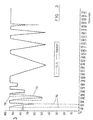
- Figure 4 shows an example of the inputs and outputs of a Kalman filter according to one embodiment of the invention.
- the trigger waveform 100 is from the R-wave of an ECG or from a pulse rate calculation method.
- the raw data waveform 102 is at times quite corrupted by motion, yet by variable averaging, the Kalman cardiac gated averaging technique is able to keep the filtered waveform 104 looking quite regular.
- the estimated residual 106 correlates well in time with the noise on the measured data.
- the Kalman cardiac gated averaging technique may be used to shape the oximetry data pulses for processing by either a CLS saturation calculation technique, the Kalman saturation calculation technique, or an alternate technique. Either embodiment could use an ECG pulse rate, or a pulse rate generated by an algorithm which processes oximeter data as the cardiac gated averaging trigger.
- the Kalman saturation calculation technique may be used without the Kalman cardiac gated averaging technique.
- two saturation values are calculated from the data from the band pass filter.
- One saturation value is obtained using a harmonic filter (step 7) and a Kalman filter with cardiac gated averaging, using triggers from an ECG waveform.
- the harmonic filter (step 7) digitally filters the IR and red waveforms such that only energy at integer multiples of the heart rate is allowed through the filter.
- the response of harmonic filter (step 7) varies with the heart rate signal supplied to it to attenuate motion and noise energy not at the heart rate.
- the subsequent filtering by Kalman CGA (step 9) and/or the saturation calculation (step 11) algorithm described below applies the same weighting and averaging to both the IR and red data streams on the basis of the filtered data stream.
- the second saturation value is obtained by application of a Kalman filter (step 11).
- the second filter In contrast to the first Kalman filter with cardiac gated averaging which is event based, the second filter is time based.
- the second filter operates on data from the band pass filter and on data from the first filter. Prior to application of the second filter, data points resulting in an impossible saturation calculation (for example negative saturation) are rejected (step 10). After application of the second filter, the best saturation value is chosen according to confidence levels associated with each value (step 12).
- the saturation value after the second filter is displayed after appropriate post-processing to determine whether and how it is to be displayed (step 14).
- Confidence levels in the oxygen saturation can be estimated from metrics available from the algorithms performed on the oximeter data, determining which saturation can be considered reliable. For example, the confidence level can be determined dependent on the age of the signal from which the saturation level is calculated and the deviation of that level from an estimated value.
Landscapes
- Health & Medical Sciences (AREA)
- Physics & Mathematics (AREA)
- Life Sciences & Earth Sciences (AREA)
- Medical Informatics (AREA)
- Surgery (AREA)
- Biophysics (AREA)
- Pathology (AREA)
- Engineering & Computer Science (AREA)
- Biomedical Technology (AREA)
- Heart & Thoracic Surgery (AREA)
- Spectroscopy & Molecular Physics (AREA)
- Molecular Biology (AREA)
- Optics & Photonics (AREA)
- Animal Behavior & Ethology (AREA)
- General Health & Medical Sciences (AREA)
- Public Health (AREA)
- Veterinary Medicine (AREA)
- Measurement Of The Respiration, Hearing Ability, Form, And Blood Characteristics Of Living Organisms (AREA)
- Radar Systems Or Details Thereof (AREA)
- Measurement And Recording Of Electrical Phenomena And Electrical Characteristics Of The Living Body (AREA)
- Cable Transmission Systems, Equalization Of Radio And Reduction Of Echo (AREA)
Claims (27)
- Verfahren zur Verringerung von Rauscheffekten in einem System zur Messung eines physiologischen Parameters, wobei das Verfahren die Schritte umfasst:(a) Erzeugen einer Mehrzahl von Messungen, die von mindestens einer Wellenlänge elektromagnetischer Energie abgeleitet sind, welche durch lebendes Gewebe übertragen wird;(b) Vergleichen von ausgewählten Messungen mit mindestens einer erwarteten Messcharakteristik;(c) Zuordnen eines einer Mehrzahl von variablen Gewichten zu jeder ausgewählten Messung auf der Grundlage des Vergleichsschrittes, wodurch eine Mehrzahl von verschieden gewichteten Messungen erzeugt wird; und(d) Mitteln einer Mehrzahl der verschieden gewichteten Messungen, um eine gefilterte Messung zur Verwendung bei der Abschätzung des physiologischen Parameters zu erhalten.
- Verfahren nach Anspruch 1, in dem eine Zahl der verschieden gewichteten gemittelten Messungen in Abhängigkeit von dem Zuordnungsschritt variiert.
- Verfahren nach Anspruch 1, in dem eine erste Zahl von verschieden gewichteten Messungen gemittelt wird, um die gefilterte Messung zu erhalten, wobei die erste Zahl gemäß den Gewichten variiert, die einer Mehrzahl von aufeinander folgenden verschieden gewichteten Messungen in dem Zuordnungsschritt zugeordnet wurde, und wobei über die Zeit eine Mehrzahl von gefilterten Messungen für jede Wellenlänge erzeugt wird.
- Verfahren nach Anspruch 1, in dem die Mehrzahl von Messungen einen ersten und einen zweiten Satz von Messungen umfasst, die einer ersten bzw. zweiten Wellenlänge entsprechen, und wobei die Schritte des Vergleichs und der Zuordnung bei dem ersten Satz von Messungen durchgeführt werden, und weiter umfassend den Schritt der Zuordnung von Gewichten zu dem zweiten Satz von Messungen, welche identisch sind mit denjenigen, die dem ersten Satz von Messungen zugeordnet wurden, wodurch getrennte gefilterte Messungen für sowohl die erste als auch die zweite Wellenlänge erhalten werden.
- Verfahren nach Anspruch 1, in dem die Mehrzahl der variablen Gewichte erhalten wird, indem man die Daten aus mindestens zwei Wellenlängen kombiniert.
- Verfahren nach Anspruch 1, in dem das variable Gewicht, das jeder ausgewählten Messung zugeordnet wird, teilweise auf einer Änderungsrate zwischen der ausgewählten Messung und einer vorangehenden Messung beruht.
- Verfahren nach Anspruch 1, in dem der Erzeugungsschritt umfasst:(a) Verwenden des Logarithmus eines Signals, das für die mindestens eine Wellenlänge elektromatischer Energie repräsentativ ist, wodurch ein erstes Signal erzeugt wird; und(b) Bandpass-Filtern des ersten Signals, wodurch ein zweites Signal erzeugt wird, aus dem die Mehrzahl von Messungen abgeleitet wird.
- Verfahren nach Anspruch 7, in dem der Erzeugungsschritt weiter die Normierung des zweiten Signals umfasst, wodurch ein drittes Signal erzeugt wird, aus dem die Mehrzahl von Messungen abgeleitet wird.
- Verfahren nach Anspruch 8, in dem der Erzeugungsschritt weiter die Verwendung der Ableitung des dritten Signals umfasst, wodurch ein viertes Signal erzeugt wird, aus dem die Mehrzahl von Messungen abgeleitet wird.
- Verfahren nach Anspruch 1, in dem die Ähnlichkeit zwischen jeder ausgewählten Messung und der entsprechenden vorangehenden Messung mit einem erwarteten Wert verglichen wird.
- Verfahren nach Anspruch 10, in dem der erwartete Wert einem physiologischen Modell entspricht.
- Verfahren nach Anspruch 10, in dem der erwartete Wert einer Änderungsrate zwischen einer Mehrzahl von entsprechenden vorangehenden Messungen entspricht.
- Verfahren nach Anspruch 1, in dem die entsprechende vorangehenden Messung einer gefilterten Messung entspricht.
- Verfahren nach Anspruch 1, in dem die mindestens eine erwartete Messcharakteristik eine Vorhersage umfasst, welche mindestens einer vorangehenden gefilterten Messung entspricht.
- Verfahren nach Anspruch 1, in dem die ausgewählte Messung digitale Signale umfasst.
- Verfahren nach Anspruch 1, in dem die Mehrzahl von Messungen, die in Schritt (a) erzeugt werden, einer Reihe von Herzpulsen entspricht.
- Verfahren nach Anspruch 1, in dem die variablen Gewichte der erzeugten gewichteten Messungen einer Mehrzahl von verschiedenen Zahlen ungleich Null entsprechen.
- Verfahren nach Anspruch 1, in dem die Mehrzahl von Messungen, die in Schritt (a) erzeugt werden, auf einer Zeit-Basis beruhen und nicht durch ein Ereignis angetrieben sind.
- Verfahren nach Anspruch 18, in dem jede gefilterte Messung auf Zeit-Basis einem aktuellen Wert eines Verhältnisses von Verhältnissen entspricht, welches für die Sauerstoffsättigung von Hämoglobin in arteriellem Blut repräsentativ ist.
- Verfahren nach Anspruch 18, in dem jede gefilterte Messung auf Zeit-Basis einem aktuellen Wert der Sauerstoffsättigung von Hämoglobin in arteriellem Blut entspricht.
- Verfahren nach Anspruch 20, in dem die mindestens eine erwartete Messcharakteristik einen konstanten Repräsentanten einer Änderungsrate des Sauerstoffsättigungswerts umfasst.
- Verfahren nach Anspruch 18, in dem die Mehrzahl der Messungen auf Zeit-Basis vor dem Vergleichsschritt normiert wird, wodurch Rauscheffekte verringert werden, die einem Bewegungsartefakt bei einigen der Messungen auf Zeit-Basis entsprechen.
- Verfahren nach Anspruch 1, welches die Bereitstellung eines Signals umfasst, das die mindestens eine Wellenlänge elektromagnetischer Strahlung anzeigt.
- Verfahren nach Anspruch 1, welches den Schritt des Filterns von Daten umfasst, die der Wellenlänge elektromagnetischer Strahlung entsprechen, so dass Bewegungs- und Rauschenergie, die nicht ganze Vielfache einer Herzfrequenz des Patienten ist, gedämpft wird.
- Vorrichtung zur Verringerung von Rauscheffekten in einem System zur Messung eines physiologischen Parameters, umfassend:(a) Mittel zum Erzeugen einer Mehrzahl von Messungen, die von mindestens einer Wellenlänge elektromagnetischer Strahlung abgeleitet sind, welche durch lebendes Gewebe übertragen wird;(b) Mittel zum Vergleichen ausgewählter Messungen mit mindestens einer erwarteter Messcharakteristik;(c) Mittel zum Zuordnen von einem einer Mehrzahl von variablen Gewichten zu jeder ausgewählten Messung auf der Grundlage des vergleichenden Schrittes, wodurch eine Mehrzahl von verschieden gewichteten Messungen erzeugt wird; und(d) Mittel zum Mitteln einer Mehrzahl der verschieden gewichteten Messungen, um eine gefilterte Messung zur Verwendung bei der Abschätzung des physiologischen Parameters zu erhalten.
- Vorrichtung nach Anspruch 25, welche Mittel zum Kalibrieren des Systems umfasst, um den physiologischen Parameter in Abhängigkeit von einem Signal zu messen, das die mindestens eine Wellenlänge elektromagnetischer Energie anzeigt.
- Vorrichtung nach Anspruch 25, welche einen Messfühler mit einer Sendeeinrichtung für die mindestens eine Wellenlänge elektromagnetischer Energie, Erfassungsmittel zum Erfassen der elektromagnetischen Energie und zum Erzeugen eines ersten Signals, welches dafür repräsentativ ist, Mittel zum lösbaren Koppeln des Messfühlers an ein Oximeter und zur Kommunikation von Signalen zwischen dem Messfühler und dem Oximeter und Mittel zur Bereitstellung eines zweiten Signals, das die mindestens eine Wellenlänge elektromagnetischer Energie anzeigt, umfasst.
Applications Claiming Priority (1)
| Application Number | Priority Date | Filing Date | Title |
|---|---|---|---|
| PCT/IB1997/000287 WO1998042249A1 (en) | 1997-03-21 | 1997-03-21 | Method and apparatus for adaptively averaging data signals |
Publications (2)
| Publication Number | Publication Date |
|---|---|
| EP1006863A1 EP1006863A1 (de) | 2000-06-14 |
| EP1006863B1 true EP1006863B1 (de) | 2003-10-15 |
Family
ID=11004541
Family Applications (1)
| Application Number | Title | Priority Date | Filing Date |
|---|---|---|---|
| EP97906319A Expired - Lifetime EP1006863B1 (de) | 1997-03-21 | 1997-03-21 | Verfahren und gerät zur adaptiven mittelwertbildung von datensignalen |
Country Status (8)
| Country | Link |
|---|---|
| EP (1) | EP1006863B1 (de) |
| JP (1) | JP2001517991A (de) |
| AT (1) | ATE251864T1 (de) |
| AU (1) | AU720450B2 (de) |
| CA (1) | CA2283858C (de) |
| DE (1) | DE69725621T2 (de) |
| ES (1) | ES2208876T3 (de) |
| WO (1) | WO1998042249A1 (de) |
Cited By (13)
| Publication number | Priority date | Publication date | Assignee | Title |
|---|---|---|---|---|
| US7477924B2 (en) | 2006-05-02 | 2009-01-13 | Nellcor Puritan Bennett Llc | Medical sensor and technique for using the same |
| US7483731B2 (en) | 2005-09-30 | 2009-01-27 | Nellcor Puritan Bennett Llc | Medical sensor and technique for using the same |
| US7486979B2 (en) | 2005-09-30 | 2009-02-03 | Nellcor Puritan Bennett Llc | Optically aligned pulse oximetry sensor and technique for using the same |
| US7499740B2 (en) | 2004-02-25 | 2009-03-03 | Nellcor Puritan Bennett Llc | Techniques for detecting heart pulses and reducing power consumption in sensors |
| US7522948B2 (en) | 2006-05-02 | 2009-04-21 | Nellcor Puritan Bennett Llc | Medical sensor and technique for using the same |
| US7555327B2 (en) | 2005-09-30 | 2009-06-30 | Nellcor Puritan Bennett Llc | Folding medical sensor and technique for using the same |
| US7574245B2 (en) | 2006-09-27 | 2009-08-11 | Nellcor Puritan Bennett Llc | Flexible medical sensor enclosure |
| US7574244B2 (en) | 2005-08-08 | 2009-08-11 | Nellcor Puritan Bennett Llc | Compliant diaphragm medical sensor and technique for using the same |
| US7590439B2 (en) | 2005-08-08 | 2009-09-15 | Nellcor Puritan Bennett Llc | Bi-stable medical sensor and technique for using the same |
| US7890154B2 (en) | 2004-03-08 | 2011-02-15 | Nellcor Puritan Bennett Llc | Selection of ensemble averaging weights for a pulse oximeter based on signal quality metrics |
| US8007441B2 (en) | 2004-03-08 | 2011-08-30 | Nellcor Puritan Bennett Llc | Pulse oximeter with alternate heart-rate determination |
| US8423109B2 (en) | 2005-03-03 | 2013-04-16 | Covidien Lp | Method for enhancing pulse oximery calculations in the presence of correlated artifacts |
| US8965473B2 (en) | 2005-09-29 | 2015-02-24 | Covidien Lp | Medical sensor for reducing motion artifacts and technique for using the same |
Families Citing this family (39)
| Publication number | Priority date | Publication date | Assignee | Title |
|---|---|---|---|---|
| MX9702434A (es) | 1991-03-07 | 1998-05-31 | Masimo Corp | Aparato de procesamiento de señales. |
| US5490505A (en) | 1991-03-07 | 1996-02-13 | Masimo Corporation | Signal processing apparatus |
| US7376453B1 (en) | 1993-10-06 | 2008-05-20 | Masimo Corporation | Signal processing apparatus |
| GB0014855D0 (en) * | 2000-06-16 | 2000-08-09 | Isis Innovation | Combining measurements from different sensors |
| US6575905B2 (en) | 2000-09-22 | 2003-06-10 | Knobbe, Lim & Buckingham | Method and apparatus for real-time estimation of physiological parameters |
| US9282925B2 (en) | 2002-02-12 | 2016-03-15 | Dexcom, Inc. | Systems and methods for replacing signal artifacts in a glucose sensor data stream |
| US9247901B2 (en) | 2003-08-22 | 2016-02-02 | Dexcom, Inc. | Systems and methods for replacing signal artifacts in a glucose sensor data stream |
| US8010174B2 (en) | 2003-08-22 | 2011-08-30 | Dexcom, Inc. | Systems and methods for replacing signal artifacts in a glucose sensor data stream |
| US8260393B2 (en) | 2003-07-25 | 2012-09-04 | Dexcom, Inc. | Systems and methods for replacing signal data artifacts in a glucose sensor data stream |
| US8275437B2 (en) | 2003-08-01 | 2012-09-25 | Dexcom, Inc. | Transcutaneous analyte sensor |
| US20190357827A1 (en) | 2003-08-01 | 2019-11-28 | Dexcom, Inc. | Analyte sensor |
| US7774145B2 (en) | 2003-08-01 | 2010-08-10 | Dexcom, Inc. | Transcutaneous analyte sensor |
| US8845536B2 (en) | 2003-08-01 | 2014-09-30 | Dexcom, Inc. | Transcutaneous analyte sensor |
| US20140121989A1 (en) | 2003-08-22 | 2014-05-01 | Dexcom, Inc. | Systems and methods for processing analyte sensor data |
| US7920906B2 (en) | 2005-03-10 | 2011-04-05 | Dexcom, Inc. | System and methods for processing analyte sensor data for sensor calibration |
| DE10343863A1 (de) * | 2003-09-23 | 2005-04-14 | Roche Diagnostics Gmbh | Verfahren und Gerät zur laufenden Überwachung der Konzentration eines Analyten |
| US9247900B2 (en) | 2004-07-13 | 2016-02-02 | Dexcom, Inc. | Analyte sensor |
| US8774886B2 (en) | 2006-10-04 | 2014-07-08 | Dexcom, Inc. | Analyte sensor |
| US8364231B2 (en) | 2006-10-04 | 2013-01-29 | Dexcom, Inc. | Analyte sensor |
| EP2316331B1 (de) | 2003-12-09 | 2016-06-29 | Dexcom, Inc. | Signalverarbeitung in einem durchgehenden Analytsensor |
| US8792955B2 (en) | 2004-05-03 | 2014-07-29 | Dexcom, Inc. | Transcutaneous analyte sensor |
| WO2006127694A2 (en) | 2004-07-13 | 2006-11-30 | Dexcom, Inc. | Analyte sensor |
| US8989833B2 (en) | 2004-07-13 | 2015-03-24 | Dexcom, Inc. | Transcutaneous analyte sensor |
| US7857760B2 (en) | 2004-07-13 | 2010-12-28 | Dexcom, Inc. | Analyte sensor |
| EP4111962B1 (de) * | 2004-07-13 | 2023-08-30 | Dexcom, Inc. | Transkutaner analytsensor |
| US8750953B2 (en) | 2008-02-19 | 2014-06-10 | Covidien Lp | Methods and systems for alerting practitioners to physiological conditions |
| US9895068B2 (en) | 2008-06-30 | 2018-02-20 | Covidien Lp | Pulse oximeter with wait-time indication |
| US8862194B2 (en) | 2008-06-30 | 2014-10-14 | Covidien Lp | Method for improved oxygen saturation estimation in the presence of noise |
| US8840562B2 (en) | 2009-09-24 | 2014-09-23 | Covidien Lp | Signal processing warping technique |
| US8855749B2 (en) | 2009-09-24 | 2014-10-07 | Covidien Lp | Determination of a physiological parameter |
| US8923945B2 (en) | 2009-09-24 | 2014-12-30 | Covidien Lp | Determination of a physiological parameter |
| US8571621B2 (en) | 2009-09-24 | 2013-10-29 | Covidien Lp | Minimax filtering for pulse oximetry |
| CN102740773B (zh) * | 2010-02-05 | 2014-11-26 | 日本电气株式会社 | 有机体信息测量工具、便携终端装置 |
| US8930145B2 (en) | 2010-07-28 | 2015-01-06 | Covidien Lp | Light focusing continuous wave photoacoustic spectroscopy and its applications to patient monitoring |
| US9848809B2 (en) | 2011-04-15 | 2017-12-26 | Dexcom, Inc. | Advanced analyte sensor calibration and error detection |
| US9770210B2 (en) | 2011-09-23 | 2017-09-26 | Nellcor Puritan Bennett Ireland | Systems and methods for analyzing a physiological sensor signal |
| US9833146B2 (en) | 2012-04-17 | 2017-12-05 | Covidien Lp | Surgical system and method of use of the same |
| ITUA20161519A1 (it) * | 2016-03-10 | 2017-09-10 | Michele Gallamini | Dispositivo di monitoraggio di parametri funzionali dell’organismo |
| EP4418999A4 (de) * | 2021-10-18 | 2025-07-02 | Vioptix Inc | In der hand gehaltenes oximeter mit anzeige von echtzeit-mittelwertmessungen und statusindikator |
Family Cites Families (6)
| Publication number | Priority date | Publication date | Assignee | Title |
|---|---|---|---|---|
| US4407290A (en) * | 1981-04-01 | 1983-10-04 | Biox Technology, Inc. | Blood constituent measuring device and method |
| US4911167A (en) * | 1985-06-07 | 1990-03-27 | Nellcor Incorporated | Method and apparatus for detecting optical pulses |
| US4960126A (en) * | 1988-01-15 | 1990-10-02 | Criticare Systems, Inc. | ECG synchronized pulse oximeter |
| EP0512987A4 (en) * | 1990-01-30 | 1993-02-24 | Medical Physics | Enhanced arterial oxygen saturation determination and arterial blood pressure monitoring |
| US5355880A (en) * | 1992-07-06 | 1994-10-18 | Sandia Corporation | Reliable noninvasive measurement of blood gases |
| JP3116252B2 (ja) * | 1992-07-09 | 2000-12-11 | 日本光電工業株式会社 | パルスオキシメータ |
-
1997
- 1997-03-21 DE DE69725621T patent/DE69725621T2/de not_active Expired - Fee Related
- 1997-03-21 AT AT97906319T patent/ATE251864T1/de not_active IP Right Cessation
- 1997-03-21 EP EP97906319A patent/EP1006863B1/de not_active Expired - Lifetime
- 1997-03-21 JP JP54531898A patent/JP2001517991A/ja active Pending
- 1997-03-21 WO PCT/IB1997/000287 patent/WO1998042249A1/en not_active Ceased
- 1997-03-21 CA CA002283858A patent/CA2283858C/en not_active Expired - Fee Related
- 1997-03-21 ES ES97906319T patent/ES2208876T3/es not_active Expired - Lifetime
- 1997-03-21 AU AU21049/97A patent/AU720450B2/en not_active Ceased
Cited By (18)
| Publication number | Priority date | Publication date | Assignee | Title |
|---|---|---|---|---|
| US7499740B2 (en) | 2004-02-25 | 2009-03-03 | Nellcor Puritan Bennett Llc | Techniques for detecting heart pulses and reducing power consumption in sensors |
| US7890154B2 (en) | 2004-03-08 | 2011-02-15 | Nellcor Puritan Bennett Llc | Selection of ensemble averaging weights for a pulse oximeter based on signal quality metrics |
| US8560036B2 (en) | 2004-03-08 | 2013-10-15 | Covidien Lp | Selection of ensemble averaging weights for a pulse oximeter based on signal quality metrics |
| US8007441B2 (en) | 2004-03-08 | 2011-08-30 | Nellcor Puritan Bennett Llc | Pulse oximeter with alternate heart-rate determination |
| US9351674B2 (en) | 2005-03-03 | 2016-05-31 | Covidien Lp | Method for enhancing pulse oximetry calculations in the presence of correlated artifacts |
| US8818475B2 (en) | 2005-03-03 | 2014-08-26 | Covidien Lp | Method for enhancing pulse oximetry calculations in the presence of correlated artifacts |
| US8423109B2 (en) | 2005-03-03 | 2013-04-16 | Covidien Lp | Method for enhancing pulse oximery calculations in the presence of correlated artifacts |
| US7590439B2 (en) | 2005-08-08 | 2009-09-15 | Nellcor Puritan Bennett Llc | Bi-stable medical sensor and technique for using the same |
| US7574244B2 (en) | 2005-08-08 | 2009-08-11 | Nellcor Puritan Bennett Llc | Compliant diaphragm medical sensor and technique for using the same |
| US8311602B2 (en) | 2005-08-08 | 2012-11-13 | Nellcor Puritan Bennett Llc | Compliant diaphragm medical sensor and technique for using the same |
| US8528185B2 (en) | 2005-08-08 | 2013-09-10 | Covidien Lp | Bi-stable medical sensor and technique for using the same |
| US8965473B2 (en) | 2005-09-29 | 2015-02-24 | Covidien Lp | Medical sensor for reducing motion artifacts and technique for using the same |
| US7555327B2 (en) | 2005-09-30 | 2009-06-30 | Nellcor Puritan Bennett Llc | Folding medical sensor and technique for using the same |
| US7486979B2 (en) | 2005-09-30 | 2009-02-03 | Nellcor Puritan Bennett Llc | Optically aligned pulse oximetry sensor and technique for using the same |
| US7483731B2 (en) | 2005-09-30 | 2009-01-27 | Nellcor Puritan Bennett Llc | Medical sensor and technique for using the same |
| US7477924B2 (en) | 2006-05-02 | 2009-01-13 | Nellcor Puritan Bennett Llc | Medical sensor and technique for using the same |
| US7522948B2 (en) | 2006-05-02 | 2009-04-21 | Nellcor Puritan Bennett Llc | Medical sensor and technique for using the same |
| US7574245B2 (en) | 2006-09-27 | 2009-08-11 | Nellcor Puritan Bennett Llc | Flexible medical sensor enclosure |
Also Published As
| Publication number | Publication date |
|---|---|
| AU2104997A (en) | 1998-10-20 |
| ES2208876T3 (es) | 2004-06-16 |
| DE69725621T2 (de) | 2004-08-19 |
| AU720450B2 (en) | 2000-06-01 |
| JP2001517991A (ja) | 2001-10-09 |
| CA2283858C (en) | 2005-07-26 |
| CA2283858A1 (en) | 1998-10-01 |
| EP1006863A1 (de) | 2000-06-14 |
| DE69725621D1 (de) | 2003-11-20 |
| ATE251864T1 (de) | 2003-11-15 |
| HK1031189A1 (en) | 2001-06-08 |
| WO1998042249A1 (en) | 1998-10-01 |
Similar Documents
| Publication | Publication Date | Title |
|---|---|---|
| AU720450B2 (en) | Method and apparatus for adaptively averaging data signals | |
| US5853364A (en) | Method and apparatus for estimating physiological parameters using model-based adaptive filtering | |
| CA2283856C (en) | Method and apparatus for harmonically filtering data | |
| US8423109B2 (en) | Method for enhancing pulse oximery calculations in the presence of correlated artifacts | |
| JP4571220B2 (ja) | データ信号適応平均化方法及び装置 | |
| HK1031189B (en) | Method and apparatus for adaptively averaging data signals | |
| AU720238C (en) | Method and apparatus for harmonically filtering data | |
| HK1031188B (en) | Method for harmonically filtering data |
Legal Events
| Date | Code | Title | Description |
|---|---|---|---|
| PUAI | Public reference made under article 153(3) epc to a published international application that has entered the european phase |
Free format text: ORIGINAL CODE: 0009012 |
|
| 17P | Request for examination filed |
Effective date: 19991020 |
|
| AK | Designated contracting states |
Kind code of ref document: A1 Designated state(s): AT BE CH DE DK ES FI FR GB GR IE IT LI LU MC NL PT SE |
|
| GRAH | Despatch of communication of intention to grant a patent |
Free format text: ORIGINAL CODE: EPIDOS IGRA |
|
| GRAS | Grant fee paid |
Free format text: ORIGINAL CODE: EPIDOSNIGR3 |
|
| GRAA | (expected) grant |
Free format text: ORIGINAL CODE: 0009210 |
|
| AK | Designated contracting states |
Kind code of ref document: B1 Designated state(s): AT BE CH DE DK ES FI FR GB GR IE IT LI LU MC NL PT SE |
|
| PG25 | Lapsed in a contracting state [announced via postgrant information from national office to epo] |
Ref country code: LI Free format text: LAPSE BECAUSE OF FAILURE TO SUBMIT A TRANSLATION OF THE DESCRIPTION OR TO PAY THE FEE WITHIN THE PRESCRIBED TIME-LIMIT Effective date: 20031015 Ref country code: FI Free format text: LAPSE BECAUSE OF FAILURE TO SUBMIT A TRANSLATION OF THE DESCRIPTION OR TO PAY THE FEE WITHIN THE PRESCRIBED TIME-LIMIT Effective date: 20031015 Ref country code: CH Free format text: LAPSE BECAUSE OF FAILURE TO SUBMIT A TRANSLATION OF THE DESCRIPTION OR TO PAY THE FEE WITHIN THE PRESCRIBED TIME-LIMIT Effective date: 20031015 Ref country code: BE Free format text: LAPSE BECAUSE OF FAILURE TO SUBMIT A TRANSLATION OF THE DESCRIPTION OR TO PAY THE FEE WITHIN THE PRESCRIBED TIME-LIMIT Effective date: 20031015 Ref country code: AT Free format text: LAPSE BECAUSE OF FAILURE TO SUBMIT A TRANSLATION OF THE DESCRIPTION OR TO PAY THE FEE WITHIN THE PRESCRIBED TIME-LIMIT Effective date: 20031015 |
|
| REG | Reference to a national code |
Ref country code: GB Ref legal event code: FG4D Ref country code: CH Ref legal event code: EP |
|
| REG | Reference to a national code |
Ref country code: IE Ref legal event code: FG4D |
|
| REF | Corresponds to: |
Ref document number: 69725621 Country of ref document: DE Date of ref document: 20031120 Kind code of ref document: P |
|
| PG25 | Lapsed in a contracting state [announced via postgrant information from national office to epo] |
Ref country code: SE Free format text: LAPSE BECAUSE OF FAILURE TO SUBMIT A TRANSLATION OF THE DESCRIPTION OR TO PAY THE FEE WITHIN THE PRESCRIBED TIME-LIMIT Effective date: 20040115 Ref country code: GR Free format text: LAPSE BECAUSE OF FAILURE TO SUBMIT A TRANSLATION OF THE DESCRIPTION OR TO PAY THE FEE WITHIN THE PRESCRIBED TIME-LIMIT Effective date: 20040115 Ref country code: DK Free format text: LAPSE BECAUSE OF FAILURE TO SUBMIT A TRANSLATION OF THE DESCRIPTION OR TO PAY THE FEE WITHIN THE PRESCRIBED TIME-LIMIT Effective date: 20040115 |
|
| PG25 | Lapsed in a contracting state [announced via postgrant information from national office to epo] |
Ref country code: LU Free format text: LAPSE BECAUSE OF NON-PAYMENT OF DUE FEES Effective date: 20040321 |
|
| PG25 | Lapsed in a contracting state [announced via postgrant information from national office to epo] |
Ref country code: IE Free format text: LAPSE BECAUSE OF NON-PAYMENT OF DUE FEES Effective date: 20040322 |
|
| PG25 | Lapsed in a contracting state [announced via postgrant information from national office to epo] |
Ref country code: MC Free format text: LAPSE BECAUSE OF NON-PAYMENT OF DUE FEES Effective date: 20040331 |
|
| REG | Reference to a national code |
Ref country code: CH Ref legal event code: PL |
|
| REG | Reference to a national code |
Ref country code: ES Ref legal event code: FG2A Ref document number: 2208876 Country of ref document: ES Kind code of ref document: T3 |
|
| ET | Fr: translation filed | ||
| PLBE | No opposition filed within time limit |
Free format text: ORIGINAL CODE: 0009261 |
|
| STAA | Information on the status of an ep patent application or granted ep patent |
Free format text: STATUS: NO OPPOSITION FILED WITHIN TIME LIMIT |
|
| 26N | No opposition filed |
Effective date: 20040716 |
|
| REG | Reference to a national code |
Ref country code: IE Ref legal event code: MM4A |
|
| PG25 | Lapsed in a contracting state [announced via postgrant information from national office to epo] |
Ref country code: PT Free format text: LAPSE BECAUSE OF NON-PAYMENT OF DUE FEES Effective date: 20040315 |
|
| PGFP | Annual fee paid to national office [announced via postgrant information from national office to epo] |
Ref country code: ES Payment date: 20080326 Year of fee payment: 12 |
|
| PGFP | Annual fee paid to national office [announced via postgrant information from national office to epo] |
Ref country code: NL Payment date: 20080324 Year of fee payment: 12 Ref country code: GB Payment date: 20080327 Year of fee payment: 12 |
|
| PGFP | Annual fee paid to national office [announced via postgrant information from national office to epo] |
Ref country code: FR Payment date: 20080317 Year of fee payment: 12 Ref country code: DE Payment date: 20080430 Year of fee payment: 12 |
|
| PGFP | Annual fee paid to national office [announced via postgrant information from national office to epo] |
Ref country code: IT Payment date: 20080328 Year of fee payment: 12 |
|
| GBPC | Gb: european patent ceased through non-payment of renewal fee |
Effective date: 20090321 |
|
| NLV4 | Nl: lapsed or anulled due to non-payment of the annual fee |
Effective date: 20091001 |
|
| REG | Reference to a national code |
Ref country code: FR Ref legal event code: ST Effective date: 20091130 |
|
| PG25 | Lapsed in a contracting state [announced via postgrant information from national office to epo] |
Ref country code: DE Free format text: LAPSE BECAUSE OF NON-PAYMENT OF DUE FEES Effective date: 20091001 |
|
| PG25 | Lapsed in a contracting state [announced via postgrant information from national office to epo] |
Ref country code: NL Free format text: LAPSE BECAUSE OF NON-PAYMENT OF DUE FEES Effective date: 20091001 |
|
| PG25 | Lapsed in a contracting state [announced via postgrant information from national office to epo] |
Ref country code: GB Free format text: LAPSE BECAUSE OF NON-PAYMENT OF DUE FEES Effective date: 20090321 Ref country code: FR Free format text: LAPSE BECAUSE OF NON-PAYMENT OF DUE FEES Effective date: 20091123 |
|
| REG | Reference to a national code |
Ref country code: ES Ref legal event code: FD2A Effective date: 20090323 |
|
| PG25 | Lapsed in a contracting state [announced via postgrant information from national office to epo] |
Ref country code: ES Free format text: LAPSE BECAUSE OF NON-PAYMENT OF DUE FEES Effective date: 20090323 |
|
| PG25 | Lapsed in a contracting state [announced via postgrant information from national office to epo] |
Ref country code: IT Free format text: LAPSE BECAUSE OF NON-PAYMENT OF DUE FEES Effective date: 20090321 |