EP1007576B1 - Syndiotaktische vinylaromatische polymerisation unter verwendung von mehrstufen-serienreaktoren - Google Patents
Syndiotaktische vinylaromatische polymerisation unter verwendung von mehrstufen-serienreaktoren Download PDFInfo
- Publication number
- EP1007576B1 EP1007576B1 EP98942049A EP98942049A EP1007576B1 EP 1007576 B1 EP1007576 B1 EP 1007576B1 EP 98942049 A EP98942049 A EP 98942049A EP 98942049 A EP98942049 A EP 98942049A EP 1007576 B1 EP1007576 B1 EP 1007576B1
- Authority
- EP
- European Patent Office
- Prior art keywords
- polymer
- vinylaromatic
- amount
- reactor
- syndiotactic
- Prior art date
- Legal status (The legal status is an assumption and is not a legal conclusion. Google has not performed a legal analysis and makes no representation as to the accuracy of the status listed.)
- Expired - Lifetime
Links
- 238000006116 polymerization reaction Methods 0.000 title claims abstract description 24
- 229920000642 polymer Polymers 0.000 claims abstract description 76
- 239000000178 monomer Substances 0.000 claims abstract description 71
- 239000003054 catalyst Substances 0.000 claims abstract description 46
- 238000006243 chemical reaction Methods 0.000 claims abstract description 44
- 239000000203 mixture Substances 0.000 claims abstract description 41
- 238000000034 method Methods 0.000 claims abstract description 37
- 238000002156 mixing Methods 0.000 claims abstract description 25
- 238000010008 shearing Methods 0.000 claims description 10
- 229920010524 Syndiotactic polystyrene Polymers 0.000 claims description 6
- 150000001875 compounds Chemical class 0.000 claims description 5
- 239000010936 titanium Substances 0.000 claims description 5
- RTAQQCXQSZGOHL-UHFFFAOYSA-N Titanium Chemical group [Ti] RTAQQCXQSZGOHL-UHFFFAOYSA-N 0.000 claims description 4
- 229910052719 titanium Inorganic materials 0.000 claims description 4
- 229920002554 vinyl polymer Polymers 0.000 claims description 4
- 238000004519 manufacturing process Methods 0.000 claims description 3
- 239000003085 diluting agent Substances 0.000 description 7
- PPBRXRYQALVLMV-UHFFFAOYSA-N Styrene Chemical compound C=CC1=CC=CC=C1 PPBRXRYQALVLMV-UHFFFAOYSA-N 0.000 description 4
- 239000003795 chemical substances by application Substances 0.000 description 4
- 238000010586 diagram Methods 0.000 description 4
- 230000000052 comparative effect Effects 0.000 description 3
- 238000001816 cooling Methods 0.000 description 3
- 239000000463 material Substances 0.000 description 3
- VLKZOEOYAKHREP-UHFFFAOYSA-N n-Hexane Chemical compound CCCCCC VLKZOEOYAKHREP-UHFFFAOYSA-N 0.000 description 3
- OFBQJSOFQDEBGM-UHFFFAOYSA-N n-pentane Natural products CCCCC OFBQJSOFQDEBGM-UHFFFAOYSA-N 0.000 description 3
- 125000001997 phenyl group Chemical group [H]C1=C([H])C([H])=C(*)C([H])=C1[H] 0.000 description 3
- 239000007787 solid Substances 0.000 description 3
- 238000003756 stirring Methods 0.000 description 3
- 229920001576 syndiotactic polymer Polymers 0.000 description 3
- IJGRMHOSHXDMSA-UHFFFAOYSA-N Atomic nitrogen Chemical compound N#N IJGRMHOSHXDMSA-UHFFFAOYSA-N 0.000 description 2
- 229910000831 Steel Inorganic materials 0.000 description 2
- 239000012190 activator Substances 0.000 description 2
- 238000013019 agitation Methods 0.000 description 2
- 238000010923 batch production Methods 0.000 description 2
- 238000009835 boiling Methods 0.000 description 2
- 150000004696 coordination complex Chemical class 0.000 description 2
- QWTDNUCVQCZILF-UHFFFAOYSA-N isopentane Chemical compound CCC(C)C QWTDNUCVQCZILF-UHFFFAOYSA-N 0.000 description 2
- 239000000843 powder Substances 0.000 description 2
- HJWLCRVIBGQPNF-UHFFFAOYSA-N prop-2-enylbenzene Chemical compound C=CCC1=CC=CC=C1 HJWLCRVIBGQPNF-UHFFFAOYSA-N 0.000 description 2
- 238000005507 spraying Methods 0.000 description 2
- 239000010959 steel Substances 0.000 description 2
- 239000000126 substance Substances 0.000 description 2
- 239000000758 substrate Substances 0.000 description 2
- 238000001644 13C nuclear magnetic resonance spectroscopy Methods 0.000 description 1
- SBYMUDUGTIKLCR-UHFFFAOYSA-N 2-chloroethenylbenzene Chemical compound ClC=CC1=CC=CC=C1 SBYMUDUGTIKLCR-UHFFFAOYSA-N 0.000 description 1
- DXIJHCSGLOHNES-UHFFFAOYSA-N 3,3-dimethylbut-1-enylbenzene Chemical compound CC(C)(C)C=CC1=CC=CC=C1 DXIJHCSGLOHNES-UHFFFAOYSA-N 0.000 description 1
- JLBJTVDPSNHSKJ-UHFFFAOYSA-N 4-Methylstyrene Chemical compound CC1=CC=C(C=C)C=C1 JLBJTVDPSNHSKJ-UHFFFAOYSA-N 0.000 description 1
- YMOONIIMQBGTDU-VOTSOKGWSA-N [(e)-2-bromoethenyl]benzene Chemical compound Br\C=C\C1=CC=CC=C1 YMOONIIMQBGTDU-VOTSOKGWSA-N 0.000 description 1
- 230000003213 activating effect Effects 0.000 description 1
- 238000005054 agglomeration Methods 0.000 description 1
- 230000002776 aggregation Effects 0.000 description 1
- 150000007824 aliphatic compounds Chemical class 0.000 description 1
- 125000000217 alkyl group Chemical group 0.000 description 1
- 238000004458 analytical method Methods 0.000 description 1
- QVGXLLKOCUKJST-UHFFFAOYSA-N atomic oxygen Chemical compound [O] QVGXLLKOCUKJST-UHFFFAOYSA-N 0.000 description 1
- 230000015572 biosynthetic process Effects 0.000 description 1
- 239000001273 butane Substances 0.000 description 1
- 239000011203 carbon fibre reinforced carbon Substances 0.000 description 1
- 238000004140 cleaning Methods 0.000 description 1
- 239000000356 contaminant Substances 0.000 description 1
- 229920001577 copolymer Polymers 0.000 description 1
- AFABGHUZZDYHJO-UHFFFAOYSA-N dimethyl butane Natural products CCCC(C)C AFABGHUZZDYHJO-UHFFFAOYSA-N 0.000 description 1
- 239000007789 gas Substances 0.000 description 1
- 125000001188 haloalkyl group Chemical group 0.000 description 1
- 125000001475 halogen functional group Chemical group 0.000 description 1
- 229920001519 homopolymer Polymers 0.000 description 1
- 239000012535 impurity Substances 0.000 description 1
- 239000003701 inert diluent Substances 0.000 description 1
- 239000007788 liquid Substances 0.000 description 1
- IJDNQMDRQITEOD-UHFFFAOYSA-N n-butane Chemical compound CCCC IJDNQMDRQITEOD-UHFFFAOYSA-N 0.000 description 1
- 229910052757 nitrogen Inorganic materials 0.000 description 1
- 239000001301 oxygen Substances 0.000 description 1
- 229910052760 oxygen Inorganic materials 0.000 description 1
- 239000002245 particle Substances 0.000 description 1
- 235000020030 perry Nutrition 0.000 description 1
- 238000002360 preparation method Methods 0.000 description 1
- 238000010298 pulverizing process Methods 0.000 description 1
- 238000010926 purge Methods 0.000 description 1
- 239000000376 reactant Substances 0.000 description 1
- 239000011541 reaction mixture Substances 0.000 description 1
- -1 that is Substances 0.000 description 1
- 238000009834 vaporization Methods 0.000 description 1
- 230000008016 vaporization Effects 0.000 description 1
- XLYOFNOQVPJJNP-UHFFFAOYSA-N water Substances O XLYOFNOQVPJJNP-UHFFFAOYSA-N 0.000 description 1
Images
Classifications
-
- C—CHEMISTRY; METALLURGY
- C08—ORGANIC MACROMOLECULAR COMPOUNDS; THEIR PREPARATION OR CHEMICAL WORKING-UP; COMPOSITIONS BASED THEREON
- C08F—MACROMOLECULAR COMPOUNDS OBTAINED BY REACTIONS ONLY INVOLVING CARBON-TO-CARBON UNSATURATED BONDS
- C08F12/00—Homopolymers and copolymers of compounds having one or more unsaturated aliphatic radicals, each having only one carbon-to-carbon double bond, and at least one being terminated by an aromatic carbocyclic ring
- C08F12/02—Monomers containing only one unsaturated aliphatic radical
- C08F12/04—Monomers containing only one unsaturated aliphatic radical containing one ring
-
- C—CHEMISTRY; METALLURGY
- C08—ORGANIC MACROMOLECULAR COMPOUNDS; THEIR PREPARATION OR CHEMICAL WORKING-UP; COMPOSITIONS BASED THEREON
- C08F—MACROMOLECULAR COMPOUNDS OBTAINED BY REACTIONS ONLY INVOLVING CARBON-TO-CARBON UNSATURATED BONDS
- C08F112/00—Homopolymers of compounds having one or more unsaturated aliphatic radicals, each having only one carbon-to-carbon double bond, and at least one being terminated by an aromatic carbocyclic ring
- C08F112/02—Monomers containing only one unsaturated aliphatic radical
- C08F112/04—Monomers containing only one unsaturated aliphatic radical containing one ring
- C08F112/06—Hydrocarbons
- C08F112/08—Styrene
-
- C—CHEMISTRY; METALLURGY
- C08—ORGANIC MACROMOLECULAR COMPOUNDS; THEIR PREPARATION OR CHEMICAL WORKING-UP; COMPOSITIONS BASED THEREON
- C08F—MACROMOLECULAR COMPOUNDS OBTAINED BY REACTIONS ONLY INVOLVING CARBON-TO-CARBON UNSATURATED BONDS
- C08F2420/00—Metallocene catalysts
- C08F2420/04—Cp or analog not bridged to a non-Cp X ancillary anionic donor
Definitions
- the present invention relates to a process for producing syndiotactic vinylaromatic polymers.
- Syndiotactic vinylaromatic polymers are typically prepared in the form of particulate polydispersed material, that is, powders. Such polymers can be made using various methods. For example, US-A-US-A-5,037,907 describes a vertical tank reactor equipped with a stirring agitator for making particulate syndiotactic polystyrene. Another technique is described in US-A-5,254,647, which is a process for preparing syndiotactic vinylaromatic polymers in a wiped surface reactor. In yet another example, in US-A-5,484,862, a process for preparing syndiotactic vinylaromatic polymers in a horizontally disposed, continuously agitated cylindrically shaped reactor is described.
- the catalysts used to make syndiotactic vinylaromatic polymers typically include a Group 4 metal complex and an activator, which are relatively expensive.
- the above mentioned prior art does not use catalysts as efficiently as is desired. It would be an advance in the art of syndiotactic vinylaromatic polymerization to provide a process which utilizes the catalyst more efficiently than in the above-mentioned prior art.
- the present invention is a method for making a syndiotactic vinylaromatic polymer comprising mixing a first amount of a vinylaromatic monomer with a catalyst under well stirred, back-mixed polymerization conditions such that the first amount of vinylaromatic monomer polymerizes to a conversion of from 60 to less than 90 percent to form a polymer-containing mixture; and contacting the polymer-containing mixture with a second amount of the same or a different vinylaromatic monomer under well stirred, back-mixed polymerization conditions such that the syndiotactic vinylaromatic polymer is formed, wherein the catalyst is added only to the first amount of vinylaromatic monomer.
- the present invention is a method for making a syndiotactic vinylaromatic polymer comprising mixing a first amount of a vinylaromatic monomer with a catalyst in a first reaction zone under well stirred, back-mixed polymerization conditions such that the first amount of the vinylaromatic monomer polymerizes to a conversion of from 60 to less than 90 percent to form a polymer-containing mixture; passing at least a portion of the polymer-containing mixture to one of at least two parallel reactors; passing at least a portion of the polymer-containing mixture to the second parallel reactor; mixing the polymer-containing mixture in the first and second parallel reactors with additional amounts of the same or a different vinylaromatic monomer under well stirred, back-mixed polymerization conditions to form the syndiotactic vinylaromatic polymer.
- the present invention is a method for making a syndiotactic vinylaromatic polymer comprising mixing a first amount of a vinyl aromatic monomer with a catalyst in a back-mixed first reaction zone of a reactor such that the vinylaromatic monomer polymerizes to a conversion of 60 to less than 90 percent to form a polymer-containing mixture; passing the polymer-containing mixture to at least one other back-mixed reaction zone of a reactor; and contacting the polymer-containing mixture with a second amount of the vinylaromatic monomer in the other reaction zone to form the syndiotactic vinylaromatic polymer.
- the present invention provides for a more efficient use of catalyst by feeding the vinylaromatic monomer to more than one reactor while at the same time back-mixing the contents within each reactor.
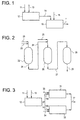
- Figure 1 is a schematic diagram of an embodiment of the method of the present invention.
- Figure 2 is a schematic diagram of an alternative embodiment of the present invention.
- Figure 3 is a schematic diagram of another alternative embodiment of the present invention.
- Figure 1 shows a schematic diagram of an embodiment of the method of the present invention.
- a first amount 11 of a vinyl aromatic monomer is fed to a first back-mixed reactor 12.
- a catalyst stream 13 is also fed to the first back-mixed reactor 12 such that the first amount 11 of the vinylaromatic monomer mixes with the catalyst 13 in the first reactor 12 under polymerization conditions to form a polymer-containing mixture which exits the first reactor 12 as exit stream 14.
- Exit stream 14 is then fed to a second back-mixed reactor 16.
- a second amount 15 of vinylaromatic monomer is also fed to the second back-mixed reactor 16 where it contacts the polymer-containing mixture from the first reactor and polymerizes to form the syndiotactic vinylaromatic polymer.
- the syndiotactic polymer exits the second reactor 16 as finished product stream 17.
- First reactor 12 and second reactor 16 are substantially back-mixed reactors, as opposed to plug flow reactors.
- the term "back-mix” is defined herein to mean that the feed entering the reactor quickly becomes dispersed throughout the reactor because of effective agitation inside the reactor.
- the composition is substantially the same at all points within the reactor.
- a plug flow reactor is one in which there is mixing in the radial direction but little mixing in the flow direction (that is, no back-mixing) so that the composition varies along the flow path in the reactor. More information types of reactors and reactor design can be found in Perry & Chilton, Chemical Engineer's Handbook, Fifth ed., p. 4-22, McGraw-Hill (1973).
- Back-mixing is desirable in the preparation of particulate syndiotactic vinylaromatic polymers because the mixing action reduces the problem of the polymer adhering to and building up on the sides of the reactor.
- plug flow reactor design is undesirable because the solid build-up on the reactor walls and internal surfaces is problematic.
- the exit stream 14 has substantially the same composition as the material inside the reactor 12.
- the second reactor 16 has a high degree of back-mixing, the finished product stream 17 has substantially the same composition as the material inside the second reactor 16.
- the first reactor 12 and second reactor 16 are advantageously equipped with means for agitation, such as stirring, rocking or shaking. If stirring is used, the shape of the agitator does not matter, so long as the mixing is sufficient to obtain the desired conversion rate, which is described hereinbelow.
- reactor 12 and/or reactor 16 does not matter in the successful operation of the invention.
- the reactor can be a vertical reactor, a horizontal reactor, a tank reactor or a cylindrical reactor, or any other desired type of reactor or combinations thereof.
- reactors which can be used for the present invention include a self-cleaning reactor, as described in US-A-5,254,647; a vertical tank reactor, as described in US-A-5,037,907; and a cylindrically shaped reactor equipped with plows, as described in US-A-5,484,862.
- the use of back-mixed reactors was believed to lead to low catalyst efficiency, because, in a back-mixed reactor, catalyst is dispersed throughout the reactor shortly after the catalyst is fed to the reactor, and it was believed that the catalyst did not remain in contact with the monomer molecules long enough to catalyze the polymerization.
- the catalyst efficiency is improved in the present invention by adding monomer to more than one well-stirred, back-mixed reactor. Additional quantities of catalyst may be added to each subsequent reactor as well.
- the molar ratio of catalyst:vinylaromatic monomer is from 10 -12 :1 to 10 -1 :1, more preferably from 10 -12 :1 to 10 -5 :1.
- the weight ratio of the first amount of the vinylaromatic monomer to the second amount is advantageously such that the second reactor zone has optimal conversion.
- the weight ratio of the first amount to the second amount is from 1:0.1 to 1:0.7, more preferably from 1:0.4 to 1:0.65, and even more preferably from 1:0.5 to 1:0.6.
- the reactors used for the present invention also include means to provide sufficient shearing force to prevent agglomeration of the powder particles.
- shearing means can include, for example, a pulverizing device as described in US-A-5,484,862.
- the conversion in each reaction zone is relatively high, so that there is a low amount of excess unpolymerized monomer.
- Conversion is defined herein to mean the weight percentage of monomer that is polymerized, or converted to polymer.
- the conversion in the first reactor zone is advantageously at least high enough to prevent buildup that is caused by polymerization of excess monomer on the internal surfaces of the reactor.
- the conversion in the first reactor zone is preferably greater than 60 percent, more preferably greater than 65 percent and even more preferably greater than 70 percent.
- the conversion in the first reactor zone is advantageously as high as possible such that as much of the available monomer as possible is polymerized.
- "Available monomer” is monomer that is not trapped within the crystalline structure of the syndiotactic polymer.
- the conversion in the first reactor zone is less than 90 percent, preferably less than 87 percent and more preferably less than 85 percent.
- the overall conversion for the entire process, that is, counting all of the reactor zones is from 60 percent to 85 percent, and more preferably from 70 percent to 80 percent.
- Exemplary vinylaromatic monomers include styrene, vinyltoluene, t-butyl styrene, chlorostyrene and bromostyrene.
- Preferred syndiotactic vinylaromatic polymers include syndiotactic polystyrene and syndiotactic copolymers of styrene and p-vinyltoluene containing up to 25 percent vinyltoluene by weight.
- the terms "syndiotactic” and “syndiotacticity” are defined herein to mean the stereostructure in which phenyl groups as side chains are located alternately at opposite directions relative to the main chain, which consists of carbon-carbon bonds. Tacticity may be determined by known techniques of 13C NMR analyses.
- Preferred syndiotactic polymers have greater than 75 percent, more preferably greater than 90 percent syndiotactic triads.
- Suitable catalysts employed in the present polymerization process include any substance previously known to be active in the polymerization of vinylaromatic monomers to form polymers of high syndiotacticity.
- catalyst systems comprise a Group 4 metal complex and one or more activating cocatalysts.
- the catalyst is a titanium-containing compound. More information the chemistry and the reaction occurring in syndiotactic vinylaromatic polymers is described in US-A-5,484,862, issued to Siddall et al.; US-A-5,037,907, issued to Imabayashie et al.; and US-A-5,254,647, issued to Yamamoto et al..
- reaction components such as other catalysts, catalyst activators, diluents, chain transfer agents and inerting agents may be introduced to any of the reactors, either together with the monomer and/or catalyst feed stream or through a separate line.
- the reactors used for the present invention include heat transfer means for cooling, such as, for example, a jacket, external and/or internal heat exchangers. More preferably, heat transfer can be accomplished by spraying a diluent directly into the polymer product. In this manner, the reaction can be cooled through the latent heat of vaporization of such diluent.
- suitable diluents are low boiling aliphatic compounds such as butane, pentane, isopentane and hexane. The low-boiling diluent can then be flashed off and recycled back through the process. Spraying a diluent directly into the particulate solid polymer product causes ebullient cooling and gas formation.
- the process can be run continuously or as a batch process. Preferably, the process is run continuously in order to reduce the operating cost and facilitate control of product quality.
- the surface level of the particulate solid inside the reactor is maintained by continuous removal of product and continuous addition of reactants. Remaining volume of the reactor not filled with polymer or liquid monomer is filled with vaporized monomer, diluent, chain transfer agents and/or inerting agents.
- one reactor When run as a batch process, one reactor may be used. In this manner, the second amount of the vinylaromatic monomer may be added to the reactor after the first amount of the vinylaromatic monomer has polymerized to the desired conversion.
- Gaseous, inert diluents may be present in any or all of the reactors to assist in preventing oxygen entry into the reactor.
- a positive pressure from 0.1 to 100 psi (0.7 to 700 kPa) above ambient is desirable inside the reactor to retain the reaction mixture under inert reaction conditions.
- Figure 2 shows three reactors in series.
- a feed stream 21 containing a first amount of a vinyl aromatic monomer is fed to a first back-mixed reactor 22.
- a catalyst stream 23 is also fed to the first back-mixed reactor 22 such that the first amount of the vinylaromatic monomer mixes with the catalyst in the first reactor 22 to polymerize and form a polymer-containing mixture which exits the first reactor 22 as first exit stream 24.
- Exit stream 24 is then fed to a second back-mixed reactor 26.
- a second feed stream 25 containing a second amount of vinylaromatic monomer is also fed to the second back-mixed reactor 26 where it is mixed with the product from the first reactor 22 and polymerizes to form a second polymer-containing mixture which exits the second reactor 26 as second exit stream 27.
- catalyst can be added to the second reactor 26.
- the second exit stream 27 is then fed to the third reactor 28.
- monomer and/or catalyst can be fed to the third reactor 28 where it can contact the second exit stream and polymerize to form the syndiotactic vinylaromatic polymer.
- the syndiotactic vinylaromatic polymer exits the third reactor 28 as finished product stream 29.
- the third reactor 28 is back-mixed.
- first reactor 22, second reactor 26 and third reactor 28 are all vertical reactors. However, if desired, any combination of vertical or horizontal reactors can be used. The chemistry and conversion rates are as described above.
- a first amount 11 of a vinylaromatic monomer is mixed with a catalyst 13 in a first back-mixed reactor 12 wherein the monomer polymerizes to form a polymer-containing mixture.
- the polymer-containing mixture exits the first reactor 12 as exit stream 14.
- a portion 14a of the exit stream 14 is then fed to a first parallel back-mixed reactor 31.
- a portion 14b of the exit stream 14 is also fed to a second parallel back-mixed reactor 32.
- a second amount 33 of the vinylaromatic monomer is fed to the first parallel reactor 31, and a third amount 34 of the vinylaromatic monomer is fed to the second parallel reactor 32.
- the ratio of portion 14a to portion 14b is advantageously approximately the same as the ratio of the second amount 33 to the third amount 34.
- Reactors 31 and 32 are parallel reactors as opposed to reactors in series.
- the advantage of using reactors in parallel is that, as reactor volume capacity is reached due to physical, mechanical or cost limitations, the volume of the overall process can be expanded by adding additional reactors.
- reactors 31 and 32 are highly back-mixed reactors and preferably include means for shearing. Moreover, reactors 31 and 32 preferably include means for cooling the polymer as it is formed. The chemistry and conversion rates are as described above.
- each agitator comprising an axially disposed shaft supporting four evenly spaced, dynamically balanced, radially projecting steel arms terminating in steel plows (Littleford model DVT-130), were filled with inert SPS to provide the substrate to begin polymerization.
- the agitator speeds were 100 rpm.
- Monomer and catalyst were added to the top of the mixing vessel in a continuous fashion and powdered polymer and unreacted monomers exited the reactor through an overflow weir on the front of the reactor.
- the monomer was freed from water and other polar compounds to less than 1 ppm. The system was allowed to reach steady state.
- the monomer feed rate to the first and second stages were then measured in kilograms per hour.
- the catalyst feed rate was also measured, the catalyst ratio being the moles of catalyst to the moles of monomer added to the process.
- the conversion in each of the first and second stages were also measured. The values are listed below in Table I.
- monomer and catalyst were both added to both reactors.
- monomer was added to both reactors, but catalyst was added only to the first reactor.
- Table I shows that, for Examples 1 and 2, the catalyst usage was reduced by 33 percent as compared to the Comparative Example.
- Example 1 st stage Monomer (kg/hr) 2 nd stage Monomer (kg/hr) Catalyst Ratio 1 st stage Conversion (percent) 2 nd stage Conversion (percent) Comparative 12.5 12.5 8.0 x 10 6 79 80 1 12.5 6.25 5.3 x 10 6 79 80 2 20 10 5.3 x 10 6 80 77
Landscapes
- Chemical & Material Sciences (AREA)
- Health & Medical Sciences (AREA)
- Chemical Kinetics & Catalysis (AREA)
- Medicinal Chemistry (AREA)
- Polymers & Plastics (AREA)
- Organic Chemistry (AREA)
- Polymerisation Methods In General (AREA)
- Addition Polymer Or Copolymer, Post-Treatments, Or Chemical Modifications (AREA)
Claims (20)
- Verfahren zur Herstellung eines syndiotaktischen aromatischen Vinylpolymers, umfassend;Mischen einer ersten Menge eines aromatischen Vinylmonomers mit einem Katalysator und Rückvermischen der Mischung unter Polymerisationsbedingungen, so dass die erste Menge des aromatischen Vinylmonomers zu einem Umsatz von 60 bis weniger als 90% polymerisiert, um eine polymerhaltige Mischung zu bilden, undInberührungbringen der polymerhaltigen Mischung mit einer zweiten Menge des aromatischen Vinylmonomers und Rückvermischen der zweiten Menge und der polymerhaltigen Mischung unter Polymerisationsbedingungen, so dass das syndiotaktische aromatische Vinylpolymer gebildet wird,
wobei der Katalysator nur zu der ersten Menge aromatischen Vinylmonomers gegeben wird. - Verfahren nach Anspruch 1, wobei das syndiotaktische aromatische Vinylpolymer syndiotaktisches Polystyrol ist.
- Verfahren nach Anspruch 2, wobei der Katalysator eine titanhaltige Verbindung ist.
- Verfahren nach Anspruch 1, das weiterhin den Schritt des Scherens der polymerhaltigen Mischung, wenn sie gebildet wird, umfasst.
- Verfahren nach Anspruch 1, das weiterhin den Schritt des Scherens des syndiotaktischen aromatischen Vinylpolymers, wenn es gebildet wird, umfasst.
- Verfahren nach Anspruch 1, wobei die zweite Menge des aromatischen Vinylmonomers und die polymerhaltige Mischung mit einer Umsatzrate von 60 bis 85% polymerisieren.
- Verfahren nach Anspruch 1, wobei das Verhältnis der ersten Menge des aromatischen Vinylmonomers zu der zweiten Menge 2:1 beträgt.
- Verfahren zur Herstellung eines syndiotaktischen aromatischen Vinylpolymers, umfassend:Mischen einer ersten Menge eines aromatischen Vinylmonomers mit einem Katalysator in einer ersten Reaktionszone unter Polymerisationsbedingungen;Rückvermischen der Mischung in der ersten Reaktionszone, so dass die erste Menge des aromatischen Vinylmonomers zu einem Umsatz von 60 bis weniger als 90% polymerisiert, um eine polymerhaltige Mischung zu bilden;Führen mindestens eines Teils der polymerhaltigen Mischung in einen ersten parallelen Reaktor;Führen mindestens eines Teils der polymerhaltigen Mischung in einen zweiten parallelen Reaktor;Mischen der polymerhaltigen Mischung in dem ersten parallelen Reaktor mit einer zweiten Menge des aromatischen Vinylmonomers unter Polymerisationsbedingungen;Mischen der polymerhaltigen Mischung in dem zweiten parallelen Reaktor mit einer dritten Menge des aromatischen Vinylmonomers unter Polymerisationsbedingungen undRückvermischen von jedem der parallelen Reaktoren, um das syndiotaktische aromatische Vinylpolymer zu bilden.
- Verfahren nach Anspruch 8, wobei das syndiotaktische aromatische Vinylpolymer syndiotaktisches Polystyrol ist.
- Verfahren nach Anspruch 8, wobei der Katalysator eine titanhaltige Verbindung ist.
- Verfahren nach Anspruch 8, weiterhin umfassend den Schritt:Scheren der polymerhaltigen Mischung, wenn sie in der ersten Reaktionszone gebildet wird.
- Verfahren nach Anspruch 11, weiterhin umfassend die Schritte:Scheren des syndiotaktischen aromatischen Vinylpolymers, wenn es in dem ersten parallelen Reaktor gebildet wird, undScheren des syndiotaktischen aromatischen Vinylpolymers. wenn es in dem zweiten parallelen Reaktor gebildet wird.
- Verfahren nach Anspruch 8. wobei die polymerhaltige Mischung und die zweite Menge des aromatischen Vinylmonomers in dem ersten parallelen Reaktor bis zu einem Umsatz von 60 bis 85% polymerisieren.
- Verfahren nach Anspruch 8, wobei die polymerhaltige Mischung und die dritte Menge des aromatischen Vinylmonomers in dem zweiten parallelen Reaktor bis zu einem Umsatz von 60 bis 85% polymerisieren.
- Verfahren nach Anspruch 8, wobei das Verhältnis der ersten Menge des aromatischen Vinylmonomers zu der zweiten Menge 2:1 beträgt und das Verhältnis der ersten Menge des aromatischen Vinylmonomers zu der dritten Menge 2:1 beträgt.
- Verfahren zur Herstellung eines syndiotaktischen aromatischen Vinylmonomers, umfassend:Mischen einer ersten Menge eines aromatischen Vinylmonomers mit einem Katalysator in einer rückvermischten ersten Reaktionszone, so dass das aromatische Vinylmonomer bis zu einem Umsatz von 60 bis weniger als 90% polymerisiert, um eine polymerhaltige Mischung zu bilden;Führen der polymerhaltigen Mischung in mindestens eine andere rückvermischte Reaktionszone;Inberührungbringen der polymerhaltigen Mischung mit einer zweiten Menge von aromatischem Vinylmonomer in der anderen Reaktionszone, um das syndiotaktische aromatische Vinylpolymer zu bilden.
- Verfahren nach Anspruch 16, worin das syndiotaktische aromatische Vinylpolymer syndiotaktisches Polystyrol ist.
- Verfahren nach Anspruch 16, worin der Katalysator eine titanhaltige Verbindung ist.
- Verfahren nach Anspruch 16, weiterhin umfassend die Schritte:Scheren der polymerhaltigen Mischung, wenn sie in der ersten Reaktionszone gebildet wird, undScheren des syndiotaktischen aromatischen Vinylpolymers. wenn es in der zweiten Reaktionszone gebildet wird.
- Verfahren nach Anspruch 16, wobei das Verhältnis der ersten Menge des aromatischen Vinylmonomers zu der zweiten Menge 2:1 beträgt.
Applications Claiming Priority (3)
| Application Number | Priority Date | Filing Date | Title |
|---|---|---|---|
| US5722697P | 1997-08-27 | 1997-08-27 | |
| US57226P | 1997-08-27 | ||
| PCT/US1998/016789 WO1999010394A1 (en) | 1997-08-27 | 1998-08-13 | Syndiotactic vinylaromatic polymerization using multiple reactors in series |
Publications (2)
| Publication Number | Publication Date |
|---|---|
| EP1007576A1 EP1007576A1 (de) | 2000-06-14 |
| EP1007576B1 true EP1007576B1 (de) | 2002-08-28 |
Family
ID=22009281
Family Applications (1)
| Application Number | Title | Priority Date | Filing Date |
|---|---|---|---|
| EP98942049A Expired - Lifetime EP1007576B1 (de) | 1997-08-27 | 1998-08-13 | Syndiotaktische vinylaromatische polymerisation unter verwendung von mehrstufen-serienreaktoren |
Country Status (10)
| Country | Link |
|---|---|
| US (1) | US6242542B1 (de) |
| EP (1) | EP1007576B1 (de) |
| JP (1) | JP2001514274A (de) |
| KR (1) | KR20010014263A (de) |
| CN (1) | CN1261900A (de) |
| AU (1) | AU9018698A (de) |
| CA (1) | CA2291699A1 (de) |
| DE (1) | DE69807497T2 (de) |
| TW (1) | TW512149B (de) |
| WO (1) | WO1999010394A1 (de) |
Cited By (1)
| Publication number | Priority date | Publication date | Assignee | Title |
|---|---|---|---|---|
| EP1590375A4 (de) * | 2003-02-05 | 2008-11-26 | Lg Chemical Ltd | Katalysatorsystem zur herstellung von styrolpolymer und verfahren zur herstellung von styrolpolymer unter verwendung des katalysatorsystems |
Families Citing this family (9)
| Publication number | Priority date | Publication date | Assignee | Title |
|---|---|---|---|---|
| DE19632779A1 (de) * | 1996-08-15 | 1998-02-19 | Hoechst Ag | Verfahren und Vorrichtung zum Untersuchen von chemischen Reaktionen in parallel geschalteten, miniaturisierten Reaktoren |
| ATE321973T1 (de) | 1998-12-31 | 2006-04-15 | Westfaelische Ferngas Ag | Georeferenziertes prüfsystem |
| US6242524B1 (en) * | 1999-06-02 | 2001-06-05 | The Goodyear Tire & Rubber Company | Binder for non-woven fabric |
| KR100328866B1 (ko) | 1999-07-02 | 2002-03-20 | 유현식 | 미세유동법을 사용한 스티렌계 중합체의 제조방법 |
| KR100349071B1 (ko) * | 2000-02-02 | 2002-08-14 | 삼성종합화학주식회사 | 생성물 순환 방식을 이용한 신디오탁틱 스티렌계 중합체의제조방법 |
| JP2004259452A (ja) * | 2003-02-24 | 2004-09-16 | Hitachi High-Technologies Corp | 質量分析装置及び質量分析方法 |
| CN1314717C (zh) * | 2004-05-28 | 2007-05-09 | 中国石油化工股份有限公司 | 制备间规聚乙烯基芳烃的连续方法 |
| WO2006107162A1 (en) * | 2005-04-02 | 2006-10-12 | Lg Chem, Ltd. | Method of producing styren polymers using high speed catalytic dispersion technology |
| JP6098859B2 (ja) * | 2015-03-30 | 2017-03-22 | 宇部興産株式会社 | ジエン系ポリマーの製造方法 |
Family Cites Families (4)
| Publication number | Priority date | Publication date | Assignee | Title |
|---|---|---|---|---|
| JPH0637534B2 (ja) * | 1988-09-28 | 1994-05-18 | 出光石油化学株式会社 | スチレン系重合体の製造方法 |
| JP2735596B2 (ja) * | 1989-01-20 | 1998-04-02 | 出光石油化学株式会社 | スチレン系重合体の製造方法 |
| JP2923383B2 (ja) * | 1991-10-01 | 1999-07-26 | 出光石油化学株式会社 | スチレン系重合体の製造方法 |
| JP3216734B2 (ja) * | 1992-08-14 | 2001-10-09 | 出光石油化学株式会社 | スチレン系重合体の製造方法 |
-
1998
- 1998-08-13 KR KR1019997012375A patent/KR20010014263A/ko not_active Ceased
- 1998-08-13 JP JP2000507717A patent/JP2001514274A/ja active Pending
- 1998-08-13 EP EP98942049A patent/EP1007576B1/de not_active Expired - Lifetime
- 1998-08-13 US US09/424,325 patent/US6242542B1/en not_active Expired - Fee Related
- 1998-08-13 DE DE69807497T patent/DE69807497T2/de not_active Expired - Fee Related
- 1998-08-13 AU AU90186/98A patent/AU9018698A/en not_active Abandoned
- 1998-08-13 WO PCT/US1998/016789 patent/WO1999010394A1/en not_active Ceased
- 1998-08-13 CN CN98806745A patent/CN1261900A/zh active Pending
- 1998-08-13 CA CA002291699A patent/CA2291699A1/en not_active Abandoned
- 1998-08-26 TW TW087114101A patent/TW512149B/zh not_active IP Right Cessation
Cited By (1)
| Publication number | Priority date | Publication date | Assignee | Title |
|---|---|---|---|---|
| EP1590375A4 (de) * | 2003-02-05 | 2008-11-26 | Lg Chemical Ltd | Katalysatorsystem zur herstellung von styrolpolymer und verfahren zur herstellung von styrolpolymer unter verwendung des katalysatorsystems |
Also Published As
| Publication number | Publication date |
|---|---|
| US6242542B1 (en) | 2001-06-05 |
| DE69807497D1 (de) | 2002-10-02 |
| EP1007576A1 (de) | 2000-06-14 |
| DE69807497T2 (de) | 2003-04-24 |
| AU9018698A (en) | 1999-03-16 |
| CA2291699A1 (en) | 1999-03-04 |
| JP2001514274A (ja) | 2001-09-11 |
| CN1261900A (zh) | 2000-08-02 |
| WO1999010394A1 (en) | 1999-03-04 |
| KR20010014263A (ko) | 2001-02-26 |
| TW512149B (en) | 2002-12-01 |
Similar Documents
| Publication | Publication Date | Title |
|---|---|---|
| US3954722A (en) | Manufacture of uniform polymers | |
| EP0068024B1 (de) | Verfahren zur kontinuierlichen massenkopolymerisation von vinylmonomeren | |
| US4414370A (en) | Process for continuous bulk copolymerization of vinyl monomers | |
| KR100487452B1 (ko) | 음이온 중합 방법 | |
| EP0041796B1 (de) | Mehrstufige Gasphasen-Polymerisation von Olefinen | |
| EP1007576B1 (de) | Syndiotaktische vinylaromatische polymerisation unter verwendung von mehrstufen-serienreaktoren | |
| JPH0931108A (ja) | 重合体の連続的製造方法およびこのための装置 | |
| JP2923383B2 (ja) | スチレン系重合体の製造方法 | |
| EP0576411B1 (de) | Verbessertes Katalysatorsystem zur Polymerisation von Olefinen | |
| US4665143A (en) | Co-catalyst dispersion method | |
| US5047490A (en) | High molecular weight copolymers of maleic anhydride and methyl vinyl ether | |
| EP0433711B1 (de) | Verfahren zur Herstellung von Terpolymere von Maleinsäureanhydrid | |
| JP3378563B2 (ja) | 生成物循環方式を用いたシンジオタクチックスチレン系重合体の製造方法 | |
| EP0466333B1 (de) | Katalysator | |
| JPH06329680A (ja) | アルミノキサンの製造方法およびアルミノキサン | |
| US7732538B2 (en) | Method for carrying out a mass polymerization | |
| US6979717B2 (en) | Anionic process design for rapid polymerization of polystyrene without gel formation and product produced there from | |
| JP3664576B2 (ja) | 熱可塑性共重合体の製造方法 | |
| EP1010710A1 (de) | Regelung des Molekulargewichtes von mit Katalysatoren der seltenen Erden in Gasphase polymerisiertem Polybutadien | |
| US3773726A (en) | Method for polymerizing alpha,alphadialkyl-beta-propiolactones in powder form | |
| EP0389939A2 (de) | Verfahren für Koordinationspolymerisation | |
| Meister et al. | Commercial processes for the manufacture of polystyrene | |
| CN101151284B (zh) | 采用高速催化分散技术制备苯乙烯聚合物的方法 | |
| JPH0820602A (ja) | 結晶性スチレン系重合体の製造法 | |
| EP0317812A1 (de) | Verfahren zur kontinuierlichen Herstellung von Polymeren von konjugierten Diolefinen mit niedrigem Molekulargewicht |
Legal Events
| Date | Code | Title | Description |
|---|---|---|---|
| PUAI | Public reference made under article 153(3) epc to a published international application that has entered the european phase |
Free format text: ORIGINAL CODE: 0009012 |
|
| 17P | Request for examination filed |
Effective date: 20000327 |
|
| AK | Designated contracting states |
Kind code of ref document: A1 Designated state(s): BE DE ES FR GB IT NL |
|
| GRAG | Despatch of communication of intention to grant |
Free format text: ORIGINAL CODE: EPIDOS AGRA |
|
| RTI1 | Title (correction) |
Free format text: SYNDIOTACTIC VINYLAROMATIC POLYMERIZATION USING MULTIPLE REACTORS IN SERIES |
|
| 17Q | First examination report despatched |
Effective date: 20011211 |
|
| GRAG | Despatch of communication of intention to grant |
Free format text: ORIGINAL CODE: EPIDOS AGRA |
|
| GRAH | Despatch of communication of intention to grant a patent |
Free format text: ORIGINAL CODE: EPIDOS IGRA |
|
| GRAH | Despatch of communication of intention to grant a patent |
Free format text: ORIGINAL CODE: EPIDOS IGRA |
|
| GRAA | (expected) grant |
Free format text: ORIGINAL CODE: 0009210 |
|
| AK | Designated contracting states |
Kind code of ref document: B1 Designated state(s): BE DE ES FR GB IT NL |
|
| PG25 | Lapsed in a contracting state [announced via postgrant information from national office to epo] |
Ref country code: NL Free format text: LAPSE BECAUSE OF FAILURE TO SUBMIT A TRANSLATION OF THE DESCRIPTION OR TO PAY THE FEE WITHIN THE PRESCRIBED TIME-LIMIT Effective date: 20020828 Ref country code: IT Free format text: LAPSE BECAUSE OF FAILURE TO SUBMIT A TRANSLATION OF THE DESCRIPTION OR TO PAY THE FEE WITHIN THE PRESCRIBED TIME-LIMIT;WARNING: LAPSES OF ITALIAN PATENTS WITH EFFECTIVE DATE BEFORE 2007 MAY HAVE OCCURRED AT ANY TIME BEFORE 2007. THE CORRECT EFFECTIVE DATE MAY BE DIFFERENT FROM THE ONE RECORDED. Effective date: 20020828 Ref country code: FR Free format text: LAPSE BECAUSE OF NON-PAYMENT OF DUE FEES Effective date: 20020828 Ref country code: BE Free format text: LAPSE BECAUSE OF FAILURE TO SUBMIT A TRANSLATION OF THE DESCRIPTION OR TO PAY THE FEE WITHIN THE PRESCRIBED TIME-LIMIT Effective date: 20020828 |
|
| REG | Reference to a national code |
Ref country code: GB Ref legal event code: FG4D |
|
| REF | Corresponds to: |
Ref document number: 69807497 Country of ref document: DE Date of ref document: 20021002 |
|
| NLV1 | Nl: lapsed or annulled due to failure to fulfill the requirements of art. 29p and 29m of the patents act | ||
| PG25 | Lapsed in a contracting state [announced via postgrant information from national office to epo] |
Ref country code: ES Free format text: LAPSE BECAUSE OF FAILURE TO SUBMIT A TRANSLATION OF THE DESCRIPTION OR TO PAY THE FEE WITHIN THE PRESCRIBED TIME-LIMIT Effective date: 20030228 |
|
| EN | Fr: translation not filed | ||
| PLBE | No opposition filed within time limit |
Free format text: ORIGINAL CODE: 0009261 |
|
| STAA | Information on the status of an ep patent application or granted ep patent |
Free format text: STATUS: NO OPPOSITION FILED WITHIN TIME LIMIT |
|
| PG25 | Lapsed in a contracting state [announced via postgrant information from national office to epo] |
Ref country code: GB Free format text: LAPSE BECAUSE OF NON-PAYMENT OF DUE FEES Effective date: 20030813 |
|
| 26N | No opposition filed |
Effective date: 20030530 |
|
| GBPC | Gb: european patent ceased through non-payment of renewal fee |
Effective date: 20030813 |
|
| PGFP | Annual fee paid to national office [announced via postgrant information from national office to epo] |
Ref country code: DE Payment date: 20040726 Year of fee payment: 7 |
|
| PG25 | Lapsed in a contracting state [announced via postgrant information from national office to epo] |
Ref country code: DE Free format text: LAPSE BECAUSE OF NON-PAYMENT OF DUE FEES Effective date: 20060301 |