EP1007749B1 - Metallo-thermisches verfahren und kontinuierliches ziehen von metallen oder legierungen in kalt-induktionsöfen - Google Patents
Metallo-thermisches verfahren und kontinuierliches ziehen von metallen oder legierungen in kalt-induktionsöfen Download PDFInfo
- Publication number
- EP1007749B1 EP1007749B1 EP98940320A EP98940320A EP1007749B1 EP 1007749 B1 EP1007749 B1 EP 1007749B1 EP 98940320 A EP98940320 A EP 98940320A EP 98940320 A EP98940320 A EP 98940320A EP 1007749 B1 EP1007749 B1 EP 1007749B1
- Authority
- EP
- European Patent Office
- Prior art keywords
- metal
- oxide
- salt
- metals
- reducing
- Prior art date
- Legal status (The legal status is an assumption and is not a legal conclusion. Google has not performed a legal analysis and makes no representation as to the accuracy of the status listed.)
- Expired - Lifetime
Links
- 229910052751 metal Inorganic materials 0.000 title claims abstract description 128
- 239000002184 metal Substances 0.000 title claims abstract description 128
- 238000000034 method Methods 0.000 title claims abstract description 35
- 230000006698 induction Effects 0.000 title claims abstract description 16
- 150000002739 metals Chemical class 0.000 title claims description 34
- 230000008569 process Effects 0.000 title claims description 27
- 229910045601 alloy Inorganic materials 0.000 title claims description 12
- 239000000956 alloy Substances 0.000 title claims description 12
- 150000003839 salts Chemical class 0.000 claims abstract description 66
- 239000002904 solvent Substances 0.000 claims abstract description 23
- 229910052770 Uranium Inorganic materials 0.000 claims abstract description 20
- JFALSRSLKYAFGM-UHFFFAOYSA-N uranium(0) Chemical compound [U] JFALSRSLKYAFGM-UHFFFAOYSA-N 0.000 claims abstract description 20
- 239000002893 slag Substances 0.000 claims abstract description 15
- 238000005868 electrolysis reaction Methods 0.000 claims abstract description 9
- 238000010438 heat treatment Methods 0.000 claims abstract description 6
- 229910000711 U alloy Inorganic materials 0.000 claims abstract description 4
- 239000000203 mixture Substances 0.000 claims description 23
- 238000006722 reduction reaction Methods 0.000 claims description 22
- 229910052749 magnesium Inorganic materials 0.000 claims description 20
- WCUXLLCKKVVCTQ-UHFFFAOYSA-M Potassium chloride Chemical compound [Cl-].[K+] WCUXLLCKKVVCTQ-UHFFFAOYSA-M 0.000 claims description 18
- 230000009467 reduction Effects 0.000 claims description 18
- KWGKDLIKAYFUFQ-UHFFFAOYSA-M lithium chloride Chemical compound [Li+].[Cl-] KWGKDLIKAYFUFQ-UHFFFAOYSA-M 0.000 claims description 16
- 230000008018 melting Effects 0.000 claims description 14
- 238000002844 melting Methods 0.000 claims description 14
- PQXKHYXIUOZZFA-UHFFFAOYSA-M lithium fluoride Chemical compound [Li+].[F-] PQXKHYXIUOZZFA-UHFFFAOYSA-M 0.000 claims description 13
- 239000007787 solid Substances 0.000 claims description 12
- 239000006228 supernatant Substances 0.000 claims description 12
- 229910052791 calcium Inorganic materials 0.000 claims description 10
- 229910052744 lithium Inorganic materials 0.000 claims description 10
- 239000000047 product Substances 0.000 claims description 10
- 229910052752 metalloid Inorganic materials 0.000 claims description 9
- 150000002738 metalloids Chemical class 0.000 claims description 9
- TWRXJAOTZQYOKJ-UHFFFAOYSA-L Magnesium chloride Chemical compound [Mg+2].[Cl-].[Cl-] TWRXJAOTZQYOKJ-UHFFFAOYSA-L 0.000 claims description 8
- FAPWRFPIFSIZLT-UHFFFAOYSA-M Sodium chloride Chemical compound [Na+].[Cl-] FAPWRFPIFSIZLT-UHFFFAOYSA-M 0.000 claims description 8
- 229910052708 sodium Inorganic materials 0.000 claims description 8
- 150000003671 uranium compounds Chemical class 0.000 claims description 8
- 239000007788 liquid Substances 0.000 claims description 7
- 239000000463 material Substances 0.000 claims description 7
- PUZPDOWCWNUUKD-UHFFFAOYSA-M sodium fluoride Chemical compound [F-].[Na+] PUZPDOWCWNUUKD-UHFFFAOYSA-M 0.000 claims description 7
- KRHYYFGTRYWZRS-UHFFFAOYSA-M Fluoride anion Chemical compound [F-] KRHYYFGTRYWZRS-UHFFFAOYSA-M 0.000 claims description 5
- WUKWITHWXAAZEY-UHFFFAOYSA-L calcium difluoride Chemical compound [F-].[F-].[Ca+2] WUKWITHWXAAZEY-UHFFFAOYSA-L 0.000 claims description 5
- 238000004519 manufacturing process Methods 0.000 claims description 5
- 229910052700 potassium Inorganic materials 0.000 claims description 5
- AIYUHDOJVYHVIT-UHFFFAOYSA-M caesium chloride Chemical compound [Cl-].[Cs+] AIYUHDOJVYHVIT-UHFFFAOYSA-M 0.000 claims description 4
- 229910001629 magnesium chloride Inorganic materials 0.000 claims description 4
- 239000011780 sodium chloride Substances 0.000 claims description 4
- WHXSMMKQMYFTQS-UHFFFAOYSA-N Lithium Chemical compound [Li] WHXSMMKQMYFTQS-UHFFFAOYSA-N 0.000 claims description 3
- 239000012768 molten material Substances 0.000 claims description 3
- 229910001626 barium chloride Inorganic materials 0.000 claims 4
- WDIHJSXYQDMJHN-UHFFFAOYSA-L barium chloride Chemical compound [Cl-].[Cl-].[Ba+2] WDIHJSXYQDMJHN-UHFFFAOYSA-L 0.000 claims 4
- 229910001632 barium fluoride Inorganic materials 0.000 claims 4
- 229910001634 calcium fluoride Inorganic materials 0.000 claims 4
- 229910001635 magnesium fluoride Inorganic materials 0.000 claims 3
- UXVMQQNJUSDDNG-UHFFFAOYSA-L Calcium chloride Chemical compound [Cl-].[Cl-].[Ca+2] UXVMQQNJUSDDNG-UHFFFAOYSA-L 0.000 claims 2
- 239000003513 alkali Substances 0.000 claims 2
- 239000001110 calcium chloride Substances 0.000 claims 2
- 229910001628 calcium chloride Inorganic materials 0.000 claims 2
- 239000011775 sodium fluoride Substances 0.000 claims 1
- 229910044991 metal oxide Inorganic materials 0.000 abstract description 2
- 150000004706 metal oxides Chemical class 0.000 abstract description 2
- 239000002923 metal particle Substances 0.000 abstract description 2
- 239000011777 magnesium Substances 0.000 description 21
- 238000006243 chemical reaction Methods 0.000 description 13
- FYYHWMGAXLPEAU-UHFFFAOYSA-N Magnesium Chemical compound [Mg] FYYHWMGAXLPEAU-UHFFFAOYSA-N 0.000 description 10
- 239000003638 chemical reducing agent Substances 0.000 description 10
- 230000004927 fusion Effects 0.000 description 9
- 239000011575 calcium Substances 0.000 description 7
- 230000001939 inductive effect Effects 0.000 description 7
- 239000012071 phase Substances 0.000 description 7
- CPLXHLVBOLITMK-UHFFFAOYSA-N Magnesium oxide Chemical compound [Mg]=O CPLXHLVBOLITMK-UHFFFAOYSA-N 0.000 description 6
- 239000011734 sodium Substances 0.000 description 6
- 229910016036 BaF 2 Inorganic materials 0.000 description 5
- 229910004261 CaF 2 Inorganic materials 0.000 description 5
- 238000009835 boiling Methods 0.000 description 5
- OKTJSMMVPCPJKN-UHFFFAOYSA-N Carbon Chemical compound [C] OKTJSMMVPCPJKN-UHFFFAOYSA-N 0.000 description 4
- 229910052799 carbon Inorganic materials 0.000 description 4
- PLDDOISOJJCEMH-UHFFFAOYSA-N neodymium(3+);oxygen(2-) Chemical compound [O-2].[O-2].[O-2].[Nd+3].[Nd+3] PLDDOISOJJCEMH-UHFFFAOYSA-N 0.000 description 4
- 238000002360 preparation method Methods 0.000 description 4
- -1 BaCl 2 Chemical compound 0.000 description 3
- NINIDFKCEFEMDL-UHFFFAOYSA-N Sulfur Chemical compound [S] NINIDFKCEFEMDL-UHFFFAOYSA-N 0.000 description 3
- 150000001805 chlorine compounds Chemical class 0.000 description 3
- 150000001875 compounds Chemical class 0.000 description 3
- 239000007791 liquid phase Substances 0.000 description 3
- 239000000395 magnesium oxide Substances 0.000 description 3
- 239000000843 powder Substances 0.000 description 3
- 238000011084 recovery Methods 0.000 description 3
- 239000011593 sulfur Substances 0.000 description 3
- 229910052717 sulfur Inorganic materials 0.000 description 3
- VEXZGXHMUGYJMC-UHFFFAOYSA-M Chloride anion Chemical compound [Cl-] VEXZGXHMUGYJMC-UHFFFAOYSA-M 0.000 description 2
- DGAQECJNVWCQMB-PUAWFVPOSA-M Ilexoside XXIX Chemical compound C[C@@H]1CC[C@@]2(CC[C@@]3(C(=CC[C@H]4[C@]3(CC[C@@H]5[C@@]4(CC[C@@H](C5(C)C)OS(=O)(=O)[O-])C)C)[C@@H]2[C@]1(C)O)C)C(=O)O[C@H]6[C@@H]([C@H]([C@@H]([C@H](O6)CO)O)O)O.[Na+] DGAQECJNVWCQMB-PUAWFVPOSA-M 0.000 description 2
- WZECUPJJEIXUKY-UHFFFAOYSA-N [O-2].[O-2].[O-2].[U+6] Chemical compound [O-2].[O-2].[O-2].[U+6] WZECUPJJEIXUKY-UHFFFAOYSA-N 0.000 description 2
- 239000000443 aerosol Substances 0.000 description 2
- 239000004020 conductor Substances 0.000 description 2
- 238000001816 cooling Methods 0.000 description 2
- 230000018109 developmental process Effects 0.000 description 2
- 229910052735 hafnium Inorganic materials 0.000 description 2
- 229910001338 liquidmetal Inorganic materials 0.000 description 2
- OOAWCECZEHPMBX-UHFFFAOYSA-N oxygen(2-);uranium(4+) Chemical compound [O-2].[O-2].[U+4] OOAWCECZEHPMBX-UHFFFAOYSA-N 0.000 description 2
- 230000009257 reactivity Effects 0.000 description 2
- 230000008929 regeneration Effects 0.000 description 2
- 238000011069 regeneration method Methods 0.000 description 2
- 238000000926 separation method Methods 0.000 description 2
- 229910052719 titanium Inorganic materials 0.000 description 2
- 239000010936 titanium Substances 0.000 description 2
- FCTBKIHDJGHPPO-UHFFFAOYSA-N uranium dioxide Inorganic materials O=[U]=O FCTBKIHDJGHPPO-UHFFFAOYSA-N 0.000 description 2
- 229910000439 uranium oxide Inorganic materials 0.000 description 2
- HPICRATUQFHULE-UHFFFAOYSA-J uranium(4+);tetrachloride Chemical compound Cl[U](Cl)(Cl)Cl HPICRATUQFHULE-UHFFFAOYSA-J 0.000 description 2
- 229910052726 zirconium Inorganic materials 0.000 description 2
- 229910052580 B4C Inorganic materials 0.000 description 1
- OYPRJOBELJOOCE-UHFFFAOYSA-N Calcium Chemical compound [Ca] OYPRJOBELJOOCE-UHFFFAOYSA-N 0.000 description 1
- 229910052684 Cerium Inorganic materials 0.000 description 1
- 235000008733 Citrus aurantifolia Nutrition 0.000 description 1
- 229910052692 Dysprosium Inorganic materials 0.000 description 1
- 229910052691 Erbium Inorganic materials 0.000 description 1
- 229910052693 Europium Inorganic materials 0.000 description 1
- 229910052688 Gadolinium Inorganic materials 0.000 description 1
- 229910052689 Holmium Inorganic materials 0.000 description 1
- 229910018068 Li 2 O Inorganic materials 0.000 description 1
- 229910052765 Lutetium Inorganic materials 0.000 description 1
- 229910052779 Neodymium Inorganic materials 0.000 description 1
- 229910052777 Praseodymium Inorganic materials 0.000 description 1
- 229910052772 Samarium Inorganic materials 0.000 description 1
- 229910052771 Terbium Inorganic materials 0.000 description 1
- 229910052775 Thulium Inorganic materials 0.000 description 1
- 235000011941 Tilia x europaea Nutrition 0.000 description 1
- RTAQQCXQSZGOHL-UHFFFAOYSA-N Titanium Chemical compound [Ti] RTAQQCXQSZGOHL-UHFFFAOYSA-N 0.000 description 1
- 150000001224 Uranium Chemical class 0.000 description 1
- 229910052769 Ytterbium Inorganic materials 0.000 description 1
- QCWXUUIWCKQGHC-UHFFFAOYSA-N Zirconium Chemical compound [Zr] QCWXUUIWCKQGHC-UHFFFAOYSA-N 0.000 description 1
- 239000006096 absorbing agent Substances 0.000 description 1
- 239000002253 acid Substances 0.000 description 1
- 230000009471 action Effects 0.000 description 1
- 238000013019 agitation Methods 0.000 description 1
- 238000010923 batch production Methods 0.000 description 1
- 229910052790 beryllium Inorganic materials 0.000 description 1
- 230000015572 biosynthetic process Effects 0.000 description 1
- 239000012455 biphasic mixture Substances 0.000 description 1
- INAHAJYZKVIDIZ-UHFFFAOYSA-N boron carbide Chemical compound B12B3B4C32B41 INAHAJYZKVIDIZ-UHFFFAOYSA-N 0.000 description 1
- 229910052810 boron oxide Inorganic materials 0.000 description 1
- 239000006227 byproduct Substances 0.000 description 1
- 238000005266 casting Methods 0.000 description 1
- 239000000919 ceramic Substances 0.000 description 1
- 238000005660 chlorination reaction Methods 0.000 description 1
- 229910052804 chromium Inorganic materials 0.000 description 1
- 239000000470 constituent Substances 0.000 description 1
- JKWMSGQKBLHBQQ-UHFFFAOYSA-N diboron trioxide Chemical compound O=BOB=O JKWMSGQKBLHBQQ-UHFFFAOYSA-N 0.000 description 1
- 238000009792 diffusion process Methods 0.000 description 1
- 238000004821 distillation Methods 0.000 description 1
- 238000001704 evaporation Methods 0.000 description 1
- 230000008020 evaporation Effects 0.000 description 1
- 238000001914 filtration Methods 0.000 description 1
- 239000010436 fluorite Substances 0.000 description 1
- 230000008014 freezing Effects 0.000 description 1
- 238000007710 freezing Methods 0.000 description 1
- 239000000446 fuel Substances 0.000 description 1
- 229910052732 germanium Inorganic materials 0.000 description 1
- VBJZVLUMGGDVMO-UHFFFAOYSA-N hafnium atom Chemical compound [Hf] VBJZVLUMGGDVMO-UHFFFAOYSA-N 0.000 description 1
- FHLKWVKFEHBUAK-UHFFFAOYSA-H hexachlorouranium Chemical compound Cl[U](Cl)(Cl)(Cl)(Cl)Cl FHLKWVKFEHBUAK-UHFFFAOYSA-H 0.000 description 1
- 238000011065 in-situ storage Methods 0.000 description 1
- 229910052746 lanthanum Inorganic materials 0.000 description 1
- 239000004571 lime Substances 0.000 description 1
- ORUIBWPALBXDOA-UHFFFAOYSA-L magnesium fluoride Chemical compound [F-].[F-].[Mg+2] ORUIBWPALBXDOA-UHFFFAOYSA-L 0.000 description 1
- 239000000155 melt Substances 0.000 description 1
- 150000002736 metal compounds Chemical class 0.000 description 1
- 238000005272 metallurgy Methods 0.000 description 1
- ATINCSYRHURBSP-UHFFFAOYSA-K neodymium(iii) chloride Chemical compound Cl[Nd](Cl)Cl ATINCSYRHURBSP-UHFFFAOYSA-K 0.000 description 1
- 229910052758 niobium Inorganic materials 0.000 description 1
- 239000002245 particle Substances 0.000 description 1
- 238000005191 phase separation Methods 0.000 description 1
- 239000002243 precursor Substances 0.000 description 1
- 230000000135 prohibitive effect Effects 0.000 description 1
- 239000012429 reaction media Substances 0.000 description 1
- 238000004064 recycling Methods 0.000 description 1
- 238000011946 reduction process Methods 0.000 description 1
- 230000001172 regenerating effect Effects 0.000 description 1
- 229910052706 scandium Inorganic materials 0.000 description 1
- 229910052710 silicon Inorganic materials 0.000 description 1
- 239000002910 solid waste Substances 0.000 description 1
- 238000007711 solidification Methods 0.000 description 1
- 230000008023 solidification Effects 0.000 description 1
- 230000007928 solubilization Effects 0.000 description 1
- 238000005063 solubilization Methods 0.000 description 1
- 239000007858 starting material Substances 0.000 description 1
- 238000003756 stirring Methods 0.000 description 1
- 238000003860 storage Methods 0.000 description 1
- 229910052715 tantalum Inorganic materials 0.000 description 1
- 229910052716 thallium Inorganic materials 0.000 description 1
- 230000009466 transformation Effects 0.000 description 1
- SANRKQGLYCLAFE-UHFFFAOYSA-H uranium hexafluoride Chemical compound F[U](F)(F)(F)(F)F SANRKQGLYCLAFE-UHFFFAOYSA-H 0.000 description 1
- 229910052720 vanadium Inorganic materials 0.000 description 1
- 238000009834 vaporization Methods 0.000 description 1
- 230000008016 vaporization Effects 0.000 description 1
- 239000002699 waste material Substances 0.000 description 1
- 229910052727 yttrium Inorganic materials 0.000 description 1
Images
Classifications
-
- B—PERFORMING OPERATIONS; TRANSPORTING
- B22—CASTING; POWDER METALLURGY
- B22D—CASTING OF METALS; CASTING OF OTHER SUBSTANCES BY THE SAME PROCESSES OR DEVICES
- B22D11/00—Continuous casting of metals, i.e. casting in indefinite lengths
- B22D11/10—Supplying or treating molten metal
- B22D11/11—Treating the molten metal
- B22D11/114—Treating the molten metal by using agitating or vibrating means
- B22D11/115—Treating the molten metal by using agitating or vibrating means by using magnetic fields
-
- C—CHEMISTRY; METALLURGY
- C22—METALLURGY; FERROUS OR NON-FERROUS ALLOYS; TREATMENT OF ALLOYS OR NON-FERROUS METALS
- C22B—PRODUCTION AND REFINING OF METALS; PRETREATMENT OF RAW MATERIALS
- C22B60/00—Obtaining metals of atomic number 87 or higher, i.e. radioactive metals
- C22B60/02—Obtaining thorium, uranium, or other actinides
-
- B—PERFORMING OPERATIONS; TRANSPORTING
- B22—CASTING; POWDER METALLURGY
- B22D—CASTING OF METALS; CASTING OF OTHER SUBSTANCES BY THE SAME PROCESSES OR DEVICES
- B22D11/00—Continuous casting of metals, i.e. casting in indefinite lengths
- B22D11/04—Continuous casting of metals, i.e. casting in indefinite lengths into open-ended moulds
- B22D11/0401—Moulds provided with a feed head
-
- B—PERFORMING OPERATIONS; TRANSPORTING
- B22—CASTING; POWDER METALLURGY
- B22D—CASTING OF METALS; CASTING OF OTHER SUBSTANCES BY THE SAME PROCESSES OR DEVICES
- B22D11/00—Continuous casting of metals, i.e. casting in indefinite lengths
- B22D11/04—Continuous casting of metals, i.e. casting in indefinite lengths into open-ended moulds
- B22D11/041—Continuous casting of metals, i.e. casting in indefinite lengths into open-ended moulds for vertical casting
-
- B—PERFORMING OPERATIONS; TRANSPORTING
- B22—CASTING; POWDER METALLURGY
- B22D—CASTING OF METALS; CASTING OF OTHER SUBSTANCES BY THE SAME PROCESSES OR DEVICES
- B22D23/00—Casting processes not provided for in groups B22D1/00 - B22D21/00
- B22D23/06—Melting-down metal, e.g. metal particles, in the mould
-
- B—PERFORMING OPERATIONS; TRANSPORTING
- B22—CASTING; POWDER METALLURGY
- B22D—CASTING OF METALS; CASTING OF OTHER SUBSTANCES BY THE SAME PROCESSES OR DEVICES
- B22D27/00—Treating the metal in the mould while it is molten or ductile ; Pressure or vacuum casting
- B22D27/04—Influencing the temperature of the metal, e.g. by heating or cooling the mould
-
- B—PERFORMING OPERATIONS; TRANSPORTING
- B22—CASTING; POWDER METALLURGY
- B22D—CASTING OF METALS; CASTING OF OTHER SUBSTANCES BY THE SAME PROCESSES OR DEVICES
- B22D41/00—Casting melt-holding vessels, e.g. ladles, tundishes, cups or the like
- B22D41/50—Pouring-nozzles
- B22D41/60—Pouring-nozzles with heating or cooling means
-
- C—CHEMISTRY; METALLURGY
- C22—METALLURGY; FERROUS OR NON-FERROUS ALLOYS; TREATMENT OF ALLOYS OR NON-FERROUS METALS
- C22B—PRODUCTION AND REFINING OF METALS; PRETREATMENT OF RAW MATERIALS
- C22B5/00—General methods of reducing to metals
- C22B5/02—Dry methods smelting of sulfides or formation of mattes
- C22B5/04—Dry methods smelting of sulfides or formation of mattes by aluminium, other metals or silicon
-
- C—CHEMISTRY; METALLURGY
- C22—METALLURGY; FERROUS OR NON-FERROUS ALLOYS; TREATMENT OF ALLOYS OR NON-FERROUS METALS
- C22B—PRODUCTION AND REFINING OF METALS; PRETREATMENT OF RAW MATERIALS
- C22B60/00—Obtaining metals of atomic number 87 or higher, i.e. radioactive metals
- C22B60/02—Obtaining thorium, uranium, or other actinides
- C22B60/0204—Obtaining thorium, uranium, or other actinides obtaining uranium
- C22B60/0213—Obtaining thorium, uranium, or other actinides obtaining uranium by dry processes
-
- C—CHEMISTRY; METALLURGY
- C22—METALLURGY; FERROUS OR NON-FERROUS ALLOYS; TREATMENT OF ALLOYS OR NON-FERROUS METALS
- C22B—PRODUCTION AND REFINING OF METALS; PRETREATMENT OF RAW MATERIALS
- C22B9/00—General processes of refining or remelting of metals; Apparatus for electroslag or arc remelting of metals
- C22B9/003—General processes of refining or remelting of metals; Apparatus for electroslag or arc remelting of metals by induction
-
- F—MECHANICAL ENGINEERING; LIGHTING; HEATING; WEAPONS; BLASTING
- F27—FURNACES; KILNS; OVENS; RETORTS
- F27B—FURNACES, KILNS, OVENS OR RETORTS IN GENERAL; OPEN SINTERING OR LIKE APPARATUS
- F27B14/00—Crucible or pot furnaces
- F27B14/06—Crucible or pot furnaces heated electrically, e.g. induction crucible furnaces with or without any other source of heat
- F27B14/061—Induction furnaces
- F27B14/063—Skull melting type
-
- H—ELECTRICITY
- H05—ELECTRIC TECHNIQUES NOT OTHERWISE PROVIDED FOR
- H05B—ELECTRIC HEATING; ELECTRIC LIGHT SOURCES NOT OTHERWISE PROVIDED FOR; CIRCUIT ARRANGEMENTS FOR ELECTRIC LIGHT SOURCES, IN GENERAL
- H05B6/00—Heating by electric, magnetic or electromagnetic fields
- H05B6/02—Induction heating
- H05B6/34—Arrangements for circulation of melts
-
- Y—GENERAL TAGGING OF NEW TECHNOLOGICAL DEVELOPMENTS; GENERAL TAGGING OF CROSS-SECTIONAL TECHNOLOGIES SPANNING OVER SEVERAL SECTIONS OF THE IPC; TECHNICAL SUBJECTS COVERED BY FORMER USPC CROSS-REFERENCE ART COLLECTIONS [XRACs] AND DIGESTS
- Y02—TECHNOLOGIES OR APPLICATIONS FOR MITIGATION OR ADAPTATION AGAINST CLIMATE CHANGE
- Y02P—CLIMATE CHANGE MITIGATION TECHNOLOGIES IN THE PRODUCTION OR PROCESSING OF GOODS
- Y02P10/00—Technologies related to metal processing
- Y02P10/25—Process efficiency
Definitions
- the present invention relates to metallothermy and continuous drawing, in crucibles inductive cold, of metals or alloys.
- Metals or alloys are made from oxides or salts metal.
- the invention relates in particular to preparation of uranium metal from an oxide or a uranium salt. It also concerns the preparation of an uranium alloy and another metal.
- uranium metal is obtained after transformation of the oxide UO 2 into UF 4 , followed by a step of reduction of the tetrafluoride into uranium metal.
- No current industrial process allows the direct obtaining of a solid uranium metal ingot from the dioxide. Indeed, the action on uranium dioxide of a reducing metal like Ca or Mg, in spite of its very strong exothermicity, does not allow to reach the fusion of lime or magnesia and uranium metal is obtained divided into an infusible solid. The slag can be dissolved in an acid, but the cost of treatment is prohibitive for mass production and the divided metal may be attacked.
- the slag consisting of fluorite or sellaite is relatively fusible.
- the uranium is collected in situ in the form of an ingot.
- the slag generates solid waste, treated by a wet process before its final storage in a controlled landfill.
- US-A-5 290 337 discloses a process for the reduction of uranium oxide with magnesium allowing the recovery of uranium metal and the regeneration of the metal reducing agent.
- C. MORANVILLE and J. DUBUISSON recommended in Lecade Traite de Chimie Minérale, published under the supervision of P. PASCAL, Tome XV, fascicule 1, 1960, Masson et Cie, page 187 and JH BUDDERY in Metallurgy and Fuels, 1956, vol.
- uranium oxide for example UO 2
- molten salts for example MgCl 2 / MgF 2 or MgCl 2 / NdCl 3 .
- the recovery of the metal takes place in a sheet of molten alloy ZnMg or CuMg.
- the UO 2 is added to the two-phase medium, stirred and heated to 750 ° C., consisting of the molten alloy (ZnMg) and the mixture of molten salts (MgCl 2 / NdCl 3 ). Part of the magnesium reduces UO 2 to form U and MgO.
- MgO then reacts with neodymium chloride to give magnesium chloride and neodymium oxide.
- uranium metal it is incorporated in the ZnMg phase.
- the denser metallic phase is deposited at the bottom of the crucible. After cooling and solidification, the phases are mechanically separated.
- the uranium metal is then separated by evaporation of ZnMg. Mg is regenerated by electrolysis of salt.
- Metal is usually introduced directly into the crucible draw. Its development takes place in other structures, for example by electrolysis, metallothermy, or reduction by metalloid (carbon, sulfur).
- the aerosol reduction process consists of a reaction between two jets of product.
- the reducing metal for example Na or Mg
- the reducing metal for example Na or Mg
- the medium temperature is stabilized around the boiling point of salt formed, typically 1100-1200 ° C.
- EP-A-0 521 608 discloses a metallothermic process and continuous drawing of a metal product including reduction of chloride uranium by magnesium, sodium or calcium in presence of molten salts containing chlorides of light metals such as chlorides of lithium, magnesium or sodium.
- the reaction is performed in a reactor where the solvent, that is to say the molten salts, is kept at a temperature less than 750 ° C.
- Uranium chloride powder and the reducing agent in the form of particles, in this case magnesium are respectively introduced into the reactor via supply lines.
- the reaction of reduction between magnesium and uranium chloride occurs and unreacted magnesium immediately dissolves in the solvent medium.
- Document FR-A-2 708 725 discloses a process of melting an electrically conductive material in an induction melting furnace in a cold crucible.
- the melting furnace consists of a first crucible to cold walls equipped with heating means by induction and material introduction means, and a second crucible with cold walls called “tube of casting "equipped with induction heating means, placed under the first crucible, the upper part of the second crucible communicating with the part bottom of the first crucible, the bottom of the second crucible being provided with an orifice allowing continuous metal product removal.
- Document FR-A-2 688 516 discloses a device for manufacturing metals and alloys of high purity metals.
- the device includes a cooled crucible which is surrounded by a coil induction.
- GB-A-2 279 543 discloses a crucible with two induction coils intended for the fusion of a solid layer of material electrically conductor to obtain a melt of molten material homogeneous.
- the invention overcomes the disadvantages of the prior art cited above by proposing a solution which allows a complete elaboration, in continuous, from salt or metal oxide up to the preformed metal.
- This determination of the maximum flow may be the result of testing and / or modeling providing abacuses.
- the middle supernatant reducer allows perfect control temperature and avoid reversibility of reactions.
- Induction heating from the first crucible and the second crucible can be done at different frequencies.
- the reducing medium may include a material chosen from a metal, a mixture of metals, a metalloid, a mixture of metalloids.
- the oxide or salt of said metal to be produced can be introduced into the first cold crucible above the tablecloth if this oxide or this salt is at solid state or liquid state. Oxide or salt of said metal to be produced can be introduced into the first cold crucible under the table if this oxide or salt is in the gaseous state.
- the first cold crucible can be fed with a mixture oxide (s) or salt (s) of these two metals.
- one of these metals is introduced into the first cold crucible directly in its form metallic, the other of these metals being introduced under form of oxide or salt.
- the method comprises in in addition to a step of regenerating the reducing medium by electrolysis of the slag present in the medium solvent.
- the withdrawal of the solvent medium is carried out in continued.
- the method according to the present invention applies particularly well to obtaining uranium metal or a uranium alloy.
- the reducing medium may consist of lithium
- the solvent medium may comprise at least one of the following salts: LiCl , KCl, BaCl 2 , LiF, CaF 2 , and BaF 2 .
- the reducing medium can be constituted by a metal chosen from Ca, Mg, Li, K, Na or by a Ca-Mg mixture
- the solvent medium can comprise at least one of the following salts: MgF 2 , MgCl 2 , LiCl, KCl, BaCl 2 , LiF, KF, CaCl 2 , CaF 2 , NaF, NaCl and BaF 2 .
- the reducing medium may be a metal chosen from Ca, Mg, Li, Na or K, or a mixture of at least two of these reducing metals
- the solvent medium can comprise at least one of the following salts: MgF 2 , MgCl 2 , LiCl, KCl, NaCl, NaF, BaCl 2 . LiF, KF, CaF 2 , CaCl 2 and BaF 2 .
- the reducing medium can be a metal chosen from Ca, Mg or Li or a mixture of at least two of these reducing metals
- the solvent medium can comprise minus one of the following salts: Licl, KCl, CsCl, BaCl 2 , LiF, CaF 2 , BaF 2 , MgF 2 and MgCl 2 .
- Metal production takes place by reduction of an oxide or a salt of this metal in the crucible superior.
- the reducing agent can for example be a metal or a mixture of more reducing metals than that to produce, or a metalloid: carbon or sulfur.
- a solvent medium ensures the settling of the metal formed, for example a molten salt or a non-liquid metal miscible with the reducing agent and the metal formed.
- the ingot is collected and drawn by the lower inductive cold crucible whose diameter or the section is determined according to the setting sought form: wire, bars, etc.
- the method according to the invention applies in particular for obtaining metal by reduction metallothermic and separation in molten salt bath.
- Salt or oxide is reduced in a sheet of metal reductant (pure body or mixture) in supernatant fusion a bath of molten salts.
- the reducer is chosen for its reduction capacity, density and absence of alloy with the metal to be produced. The latter crosses so the layer of reducing metal then settles in the bath of molten salts.
- the molten salt is determined by based on several criteria including its ability to solubilization of the slag, its density, its stability compared to the different metals present, and its melting and boiling temperatures.
- the slag being solubilized by salt, the metal is obtained pure at the bottom of the reaction crucible and is melted then drawn into the lower inductive crucible from a bath foot liquid.
- a variant of the process consists in reducing a mixture of salts or oxides of different metals and to directly pull an alloy of these metals.
- One of the metals can also be advantageously introduced under solid form (metallic powder).
- the physical separation of reduction and fusion zones by a buffer zone of molten salt allows to consider reactions for which the thermodynamic inversion temperature would be reached in batch system due to the exothermicity or melting of the metal produced.
- the intermediate salt bath allows to impose a gradient thermal to the system such that the temperature is higher high at the bottom of the first crucible.
- the setting of the reaction in an inductive cold crucible ensures the eventual evacuation of the extra calories generated by the reaction in the metal layer reducer.
- the exothermicity of the envisaged reaction is therefore controllable. It is also important to note that in this process it is not essential that it be high.
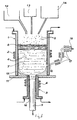
- the attached figure is a sectional view longitudinal of the cold crucibles used for setting implementing the method according to the invention, for example of reduction of an oxide by a reducing metal.
- She includes a first cold crucible 1 of form cylindrical surmounting a second cold crucible 3 of also cylindrical in shape but of smaller diameter.
- the crucibles 1 and 3 are assembled by a plate of ceramic 11 on which the crucible is placed 1.
- a orifice in the plate 11 allows the establishment of the second cold crucible 3.
- the proximity of the cooling of the two cold crucibles allows the formation of a settling autocone 15 consisting of solid salt.
- a high frequency induction coil 2 is arranged around the first crucible 1 and a coil medium frequency 4 is arranged around the second crucible 3.
- the first crucible 1 is filled with molten salts 7 on which a tablecloth floats of reducing metal 8.
- the metal compound to be treated 12 is introduced in solid form (for example in powder 9) or liquid on the reducing metal sheet 8.
- the solid metal particles produced 6 settle in the liquid salt bath 7 and are collected in the second crucible 3 then melted and drawn under form of an ingot 5.
- the ingot is discharged through the orifice 16 continuously.
- the salt bath 7 dissolves the slag (or by-product) and is discharged through port 10 made in crucible 1.
- the height of the orifice of racking must be calculated to avoid entraining the desired metal. Electromagnetic pressure forces which are exerted on the metal which settles allow to avoid this phenomenon.
- a filter 18 can be added to the withdrawal line to retain the metal to be produced in the first crucible.
- these are equipped with inductive or resistive heating 17.
- metal reducing agent 14 on the one hand and the salt 13 constituting the bath on the other hand are reintroduced into reactor 1.
- the process as described makes it possible to obtain this metal from in particular oxides (UO 2 , UO 3 , or U 3 O 8 ) or fluoride (UF 4 , fluoride double).
- the reducing metal is Ca, Mg, or Li alone or as a mixture for the oxides and Na, Li, K, Ca or Mg alone or as a mixture for the fluoride.
- UF 4 or a double uranium fluoride the possibility of feeding in the liquid phase will be a very advantageous point compared to the prior art. The reduction reaction will then take place in a single-phase, liquid-liquid system.
- the choice of reducing metal results, in addition to the requirements of reactivity with the compound to be reduced, its density in the liquid phase relative to the bath of molten salts, and the following considerations.
- the melting temperature of the reducing medium must be as low as possible to allow circulation in the liquid phase between the electrolyzer and the reactor, and as far as possible from the thermodynamic inversion temperature (for example below 850 ° C. Li reduced UO 2 , beyond U reduced Li 2 O).
- the boiling temperature of the reducing metal will be high enough to leave a large choice of compatible salts.
- the important points are: the melting temperature, their lack of reactivity with all of the metals present in the temperature range considered, and their capacity to integrate (solubility or mixture) a high proportion of slag.
- Li as a reducing metal
- various mixtures may be suitable, based on LiCl, KCl, BaCl 2 , BaF 2 , LiF or CaF 2 .
- the selected mixtures, binary or ternary at most, have melting temperatures below 500 ° C which allows to have an interface temperature Li - salts of the order of 600 ° C.
- the method according to the present invention can be used to obtain metals other than uranium, alone or in mixture from their oxides or salts.
- These metals are in particular Sc, Y, La, Ga, Tl, La, rare earths (Ce, Pr, Nd, Pm, Sm, Eu, Gd, Tb, Dy, Ho, Er, Tm, Yb, Lu), Be, Ti, Zr, Hf, Si, Ge, V, Nb, Ta, Cr, Fe, Pu, ...
- the list is not exhaustive and all the elements of the classification can do the object of an application in the context of the invention.
- reducing agents than alkaline or alkaline earth can be used. he they are either more reducing metals than that with produce either metalloids such as carbon or sulfur.
- the feeding of the compound to be treated is possible from solids or liquids above of the metal sheet, or gas below this tablecloth.
- the mixture of molten salts can play the role of solvent for the reaction.
- the metalloid is dispersed in the bath which then behaves like a fluidized bed.
- the process also applies for the development and the merger by fusion of materials other than metals or pure bodies from of their oxides or salts.
- materials other than metals or pure bodies from of their oxides or salts.
Landscapes
- Engineering & Computer Science (AREA)
- Mechanical Engineering (AREA)
- Chemical & Material Sciences (AREA)
- Manufacturing & Machinery (AREA)
- Materials Engineering (AREA)
- Metallurgy (AREA)
- Organic Chemistry (AREA)
- General Life Sciences & Earth Sciences (AREA)
- Life Sciences & Earth Sciences (AREA)
- Environmental & Geological Engineering (AREA)
- Geology (AREA)
- General Engineering & Computer Science (AREA)
- Physics & Mathematics (AREA)
- Electromagnetism (AREA)
- Manufacture And Refinement Of Metals (AREA)
- Electrolytic Production Of Metals (AREA)
- Physical Vapour Deposition (AREA)
- Metal Extraction Processes (AREA)
- Crucibles And Fluidized-Bed Furnaces (AREA)
- General Induction Heating (AREA)
- Continuous Casting (AREA)
- Casting Support Devices, Ladles, And Melt Control Thereby (AREA)
Claims (14)
- Verfahren für eine metallothermische Reaktion und ein kontinuierliches Abziehen eines metallischen Produkts, das aus mindestens einem Metall besteht, das die folgenden Stufen umfasst:dadurch gekennzeichnet, dass:eine Stufe der Gewinnung des Metalls durch die Reduktion des Metalloxids oder -salzes in einem Reduktionsmittel (8), das aus einer einem Schmelzmaterial aufschwimmenden Schicht besteht und wobei sich das gebildete Metall in einem Lösemittel (7), das dichter als das Reduktionsmittel und weniger dicht als das gebildete Metall ist und mit dem Reduktionsmittel unddem gebildeten Metall nicht mischbar ist, das aus einem Bad aus mindestens einem geschmolzenen Salz, das ein Absorbieren der bei der Reduktionsreaktion entstandenen Schlacke ermöglicht, besteht, absetzt;eine Stufe des Sammelns und Zusammenschmelzens des sich absetzenden Metalls, wodurch ein kontinuierliches Abziehen des metallischen Produkts (5) erreicht werden kann;die Stufe der Gewinnung des Metalls in einem ersten radioaktivitätsfreien Tiegel (1), der durch Induktion beheizt wird, durchgeführt wird, wobei die maximale Zufuhrmenge des Metalloxids oder -salzes zur aufschwimmenden Schicht durch die Dichte der aufschwimmenden Schicht und die Temperaturen deren oberer Oberfläche derart bestimmt wird, dass die Reduktion des Metalloxids oder -salzes vollständig in der aufschwimmenden Schicht erfolgt;die Stufe des Sammelns und Zusammenschmelzens in einem zweiten radioaktivitätsfreien Tiegel (3), der durch Induktion beheizt wird und sich unter dem ersten radioaktivitätsfreien Tiegel (1) befindet, durchgeführt wird.
- Verfahren nach Anspruch 1, dadurch gekennzeichnet, dass das Beheizen durch Induktion des ersten Tiegels (1) und des zweiten Tiegels (3) bei unterschiedlichen Frequenzen erfolgt.
- Verfahren nach einem der Ansprüche 1 oder 2, dadurch gekennzeichnet, dass das Reduktionsmittel (8) ein Material, das aus einem Metall, einem Metallgemisch, einem Nichtmetall, einem Nichtmetallgemisch ausgewählt ist, umfasst.
- Verfahren nach einem der Ansprüche 1 bis 3, dadurch gekennzeichnet, dass das Oxid oder das Salz des zu gewinnenden Metalls in den ersten radioaktivitätsfreien Tiegel (1) über der Schicht (8) eingeführt wird, wenn dieses Oxid oder dieses Salz im festen Zustand oder im flüssigen Zustand ist.
- Verfahren nach einem der Ansprüche 1 bis 3, dadurch gekennzeichnet, dass das Oxid oder das Salz des zu gewinnenden Metalls in den ersten radioaktivitätsfreien Tiegel (1) unter der Schicht (8) eingeführt wird, wenn dieses Oxid oder dieses Salz im gasförmigen Zustand ist.
- Verfahren nach einem der Ansprüche 1 bis 5, dadurch gekennzeichnet, dass für den Fall, dass das zu gewinnende metallische Produkt eine Legierung aus mindestens zwei Metallen ist, dem ersten radioaktivitätsfreien Tiegel (1) eine Mischung aus einem Oxid bzw. Oxiden oder einem Salz bzw. Salzen dieser beiden Metalle zugeführt wird.
- Verfahren nach einem der Ansprüche 1 bis 5, dadurch gekennzeichnet, dass für den Fall, dass das zu gewinnende metallische Produkt eine Legierung aus mindestens zwei Metalllen ist, das eine dieser Metalle in den ersten radioaktivitätsfreien Tiegel (1) direkt in metallischer Form eingeführt wird und das andere dieser Metalle in der Form eines Oxids oder Salzes eingeführt wird.
- Verfahren nach einem der Ansprüche 1 bis 7, dadurch gekennzeichnet, dass es ferner eine Stufe der Regeneration des Reduktionsmittels durch Elektrolyse des Lösemittels umfasst.
- Verfahren nach Anspruch 8, dadurch gekennzeichnet, dass zur Durchführung der Stufe der Regeneration des Reduktionsmittels das Lösemittel kontinuierlich abgezogen wird.
- Verwendung des Verfahrens gemäß Anspruch 1 zur Herstellung von Uranmetall oder einer Uranlegierung.
- Verwendung nach Anspruch 10, dadurch gekennzeichnet, dass die Uranverbindnung, die reduziert wird, das Oxid UO2 oder das Oxid U 3 O 8 ist, das Reduktionsmittel aus Lithium besteht, das Lösemittel mindestens eines der folgenden Salze: LiCl, KCl, BaCl2, LiF, CaF2 und BaF2 umfasst.
- Verwendung nach Anspruch 10, dadurch gekennzeichnet, dass die Uranverbindung, die reduziert wird, UF4 ist, das Reduktionsmittel aus mindestens einem Metall, das aus Ca, Mg, Li, K, Na ausgewählt ist, oder aus einem Gemisch Ca-Mg besteht, das Lösemittel mindestens eines der folgenden Salze: MgF2, MgCl2, LiCl, KCl, BaCl2, LiF, KF, CaF2, CaCl2 , NaF, NaCl und BaF2 umfasst.
- Verwendung nach Anspruch 10, dadurch gekennzeichnet, dass die Uranverbindung, die reduziert wird, ein Doppelfluorid von Uran und einem Alkali- oder Erdalkalielement ist, das Reduktionsmittel ein Metall, das aus Ca, Mg, Li, Na oder K ausgewählt ist, oder ein Gemisch von mindestens zwei von diesen reduzierenden Metallen ist, das Lösemittel mindestens eines der folgenden Salze: MgF2, MgCl2, LiCl, KCl, NaCl, NaF, BaCl2, LiF, KF, CaF2, CaCl2 und BaF2 enthält.
- Verwendung nach Anspruch 10, dadurch gekennzeichnet, dass die Uranverbindung, die reduziert wird, Cs2UCl6 ist, das Reduktionsmittel ein Metall, das aus Ca, Mg oder Li ausgewählt ist, oder ein Gemisch von mindestens zwei von diesen reduzierenden Metallen ist, das Lösemittel mindestens eines der folgenden Salze: LiCl, KCl, CsCl, BaCl2, LiF, CaF2, BaF2, MgF2 und MgCl2 umfasst.
Applications Claiming Priority (3)
| Application Number | Priority Date | Filing Date | Title |
|---|---|---|---|
| FR9709500A FR2766497B1 (fr) | 1997-07-25 | 1997-07-25 | Elaboration et tirage en continu, en creusets froids inductifs, de metaux ou d'alliages |
| FR9709500 | 1997-07-25 | ||
| PCT/FR1998/001630 WO1999005330A1 (fr) | 1997-07-25 | 1998-07-23 | Metallothermie et tirage en continu, en creusets froids inductifs, de metaux ou d'alliages |
Publications (2)
| Publication Number | Publication Date |
|---|---|
| EP1007749A1 EP1007749A1 (de) | 2000-06-14 |
| EP1007749B1 true EP1007749B1 (de) | 2002-11-06 |
Family
ID=9509640
Family Applications (1)
| Application Number | Title | Priority Date | Filing Date |
|---|---|---|---|
| EP98940320A Expired - Lifetime EP1007749B1 (de) | 1997-07-25 | 1998-07-23 | Metallo-thermisches verfahren und kontinuierliches ziehen von metallen oder legierungen in kalt-induktionsöfen |
Country Status (9)
| Country | Link |
|---|---|
| US (1) | US6409791B1 (de) |
| EP (1) | EP1007749B1 (de) |
| JP (1) | JP2001511480A (de) |
| KR (1) | KR20010022236A (de) |
| AT (1) | ATE227352T1 (de) |
| CA (1) | CA2297299A1 (de) |
| DE (1) | DE69809259D1 (de) |
| FR (1) | FR2766497B1 (de) |
| WO (1) | WO1999005330A1 (de) |
Families Citing this family (19)
| Publication number | Priority date | Publication date | Assignee | Title |
|---|---|---|---|---|
| DE10156336A1 (de) * | 2001-11-16 | 2003-06-05 | Ald Vacuum Techn Gmbh | Verfahren zur Herstellung von Legierungs-Ingots |
| AU2002225278A1 (en) * | 2002-01-14 | 2003-07-24 | Louis Johannes Fourie | Induction furnace control |
| KR100514094B1 (ko) * | 2003-03-19 | 2005-09-13 | 한국원자력연구소 | 우라늄 산화물 금속전환 및 여과회수 장치 |
| US7527669B2 (en) * | 2003-12-10 | 2009-05-05 | Babcock & Wilcox Technical Services Y-12, Llc | Displacement method and apparatus for reducing passivated metal powders and metal oxides |
| US7113535B2 (en) * | 2004-05-21 | 2006-09-26 | Ajax Tocco Magnethermic Corporation | Induction furnace for melting granular materials |
| WO2008073827A2 (en) | 2006-12-08 | 2008-06-19 | Wild River Consulting Group, Llc | Fusion process using an alkali metal metalate |
| FR2969660B1 (fr) * | 2010-12-28 | 2013-02-08 | Commissariat Energie Atomique | Procede de preparation d'une poudre d'un alliage a base d'uranium et de molybdene |
| WO2013183031A1 (en) * | 2012-06-08 | 2013-12-12 | Imp Automation (Pty) Ltd | Separating system and method |
| US9004151B2 (en) * | 2012-09-27 | 2015-04-14 | Apple Inc. | Temperature regulated melt crucible for cold chamber die casting |
| CN103834816B (zh) * | 2014-03-20 | 2015-10-07 | 湖南斯瑞摩科技有限公司 | 一种镁合金除硅熔剂及其制备方法 |
| KR102044305B1 (ko) * | 2017-09-07 | 2019-11-13 | 한양대학교 에리카산학협력단 | 고체산화물 멤브레인 공정(som)을 이용한 마그네슘 제련용 용융염 조성물 |
| JP7174235B2 (ja) * | 2018-11-14 | 2022-11-17 | シンフォニアテクノロジー株式会社 | コールドクルーシブル溶解炉、及びコールドクルーシブル溶解炉における凝固物の除去方法 |
| CN112048620A (zh) * | 2020-09-03 | 2020-12-08 | 中国原子能科学研究院 | 用于制备金属铀的系统和方法 |
| JP7617270B2 (ja) * | 2020-11-17 | 2025-01-17 | ケーエスエム テクノロジー カンパニー リミテッド | フッ化物系電解質を用いた高融点金属酸化物の還元方法およびシステム |
| CN113388865B (zh) * | 2021-05-26 | 2022-08-19 | 中国原子能科学研究院 | 一种制备金属铀的方法 |
| CN113264660B (zh) * | 2021-06-21 | 2022-07-01 | 中国原子能科学研究院 | 用于熔融玻璃的方法和装置 |
| KR102949405B1 (ko) * | 2023-06-28 | 2026-04-08 | 주식회사 케이에스엠테크놀로지 | 금속 처리 장치 및 이를 이용한 금속 처리 방법 |
| US20250154628A1 (en) * | 2023-11-14 | 2025-05-15 | Westinghouse Electric Company Llc | Recovery of uranium metal using eutectic compositions |
| KR102965166B1 (ko) * | 2023-12-27 | 2026-05-14 | 주식회사 케이에스엠테크놀로지 | 열환원 공정을 이용한 금속 처리 방법 |
Family Cites Families (10)
| Publication number | Priority date | Publication date | Assignee | Title |
|---|---|---|---|---|
| US2365346A (en) * | 1939-10-06 | 1944-12-19 | Kruh Osias | Apparatus for manufacturing metals |
| AT290859B (de) * | 1968-02-28 | 1971-05-15 | Halomet Ag | Verfahren zur gewinnung von metallen durch reduktion ihrer halogenide |
| US3847596A (en) | 1968-02-28 | 1974-11-12 | Halomet Ag | Process of obtaining metals from metal halides |
| FR2052082A5 (de) * | 1969-07-11 | 1971-04-09 | Commissariat Energie Atomique | |
| FR2665249A1 (fr) * | 1990-07-26 | 1992-01-31 | Dauphine Ets Bonmartin Laminoi | Four de fusion par induction en creuset froid. |
| GB9111666D0 (en) * | 1991-05-31 | 1991-07-24 | British Nuclear Fuels Plc | A method of producing uranium metal |
| DE4207694A1 (de) * | 1992-03-11 | 1993-09-16 | Leybold Durferrit Gmbh | Vorrichtung fuer die herstellung von metallen und metall-legierungen hoher reinheit |
| US5290337A (en) * | 1992-09-08 | 1994-03-01 | General Motors Corporation | Pyrochemical processes for producing Pu, Th and U metals with recyclable byproduct salts |
| DE4320766C2 (de) * | 1993-06-23 | 2002-06-27 | Ald Vacuum Techn Ag | Vorrichtung zum Einschmelzen einer festen Schicht aus elektrisch leitfähigem Material |
| FR2708725B1 (fr) * | 1993-07-29 | 1995-11-10 | Imphy Sa | Procédé de fusion d'un matériau électroconducteur dans un four de fusion par induction en creuset froid et four de fusion pour la mise en Óoeuvre de ce procédé. |
-
1997
- 1997-07-25 FR FR9709500A patent/FR2766497B1/fr not_active Expired - Fee Related
-
1998
- 1998-07-23 US US09/463,255 patent/US6409791B1/en not_active Expired - Fee Related
- 1998-07-23 JP JP2000504297A patent/JP2001511480A/ja active Pending
- 1998-07-23 EP EP98940320A patent/EP1007749B1/de not_active Expired - Lifetime
- 1998-07-23 WO PCT/FR1998/001630 patent/WO1999005330A1/fr not_active Ceased
- 1998-07-23 DE DE69809259T patent/DE69809259D1/de not_active Expired - Lifetime
- 1998-07-23 KR KR1020007000809A patent/KR20010022236A/ko not_active Ceased
- 1998-07-23 AT AT98940320T patent/ATE227352T1/de not_active IP Right Cessation
- 1998-07-23 CA CA002297299A patent/CA2297299A1/fr not_active Abandoned
Also Published As
| Publication number | Publication date |
|---|---|
| WO1999005330A1 (fr) | 1999-02-04 |
| EP1007749A1 (de) | 2000-06-14 |
| ATE227352T1 (de) | 2002-11-15 |
| FR2766497A1 (fr) | 1999-01-29 |
| US6409791B1 (en) | 2002-06-25 |
| CA2297299A1 (fr) | 1999-02-04 |
| JP2001511480A (ja) | 2001-08-14 |
| FR2766497B1 (fr) | 2001-05-11 |
| DE69809259D1 (de) | 2002-12-12 |
| KR20010022236A (ko) | 2001-03-15 |
Similar Documents
| Publication | Publication Date | Title |
|---|---|---|
| FR2766497A1 (fr) | Elaboration et tirage en continu, en creusets froids inductifs, de metaux ou d'alliages | |
| SU1331435A3 (ru) | Способ получени редкого тугоплавкого металла и устройство дл его осуществлени | |
| Fray et al. | Aspects of the application of electrochemistry to the extraction of titanium and its applications | |
| CH643000A5 (fr) | Procede de production d'aluminium d'extreme purete. | |
| EP2450311A1 (de) | Verfahren zur siliziumherstellung, silizium und tafel für solarzelle | |
| CA1245864A (en) | Process for reduction of zirconium, hafnium or titanium using a zinc or tin seal | |
| US5935295A (en) | Molten aluminum treatment | |
| WO2014143553A1 (en) | Process for producing tantalum alloys | |
| US6217632B1 (en) | Molten aluminum treatment | |
| RU2697122C1 (ru) | Способы получения танталовых сплавов и ниобиевых сплавов | |
| CA1245863A (en) | Continuous reactive metal reduction using a salt seal | |
| US4312846A (en) | Method of silicon purification | |
| EP0074871B1 (de) | Verfahren zur physikalischen Trennung der Metallphase von der Schlacke in einem Induktionsofen | |
| Deura et al. | Titanium powder production by TiCl4 gas injection into magnesium through molten salts | |
| RU2401874C2 (ru) | Способ волкова для производства химически активных металлов и устройство для его осуществления | |
| WO2009120108A1 (ru) | Способ для производства химически активных металлов и восстановления шлаков, а так же устройство для его осуществления | |
| US3243281A (en) | Extraction of aluminum using mercury containing mercuric halide | |
| JPH07252550A (ja) | チタンの製造方法 | |
| JP3763254B2 (ja) | アルミニウムの精製方法及びその用途 | |
| US3508914A (en) | Methods of forming and purifying nickel-titanium containing alloys | |
| US4294612A (en) | Fractional crystallization process | |
| US5735932A (en) | Process for the conversion of uranium oxide to uranium metal and uranium alloys | |
| NO783972L (no) | Fremgangsmaate og apparat til fremstilling av mg ut fra mgo ad kjemisk-termisk vei | |
| JP3695287B2 (ja) | アルミニウムの精製方法およびその用途 | |
| Carlson et al. | Preparation of yttrium metal by reduction of yttrium trifluoride with calcium |
Legal Events
| Date | Code | Title | Description |
|---|---|---|---|
| PUAI | Public reference made under article 153(3) epc to a published international application that has entered the european phase |
Free format text: ORIGINAL CODE: 0009012 |
|
| 17P | Request for examination filed |
Effective date: 20000117 |
|
| AK | Designated contracting states |
Kind code of ref document: A1 Designated state(s): AT BE DE DK ES FI FR GB IT NL PT SE |
|
| 17Q | First examination report despatched |
Effective date: 20010514 |
|
| GRAG | Despatch of communication of intention to grant |
Free format text: ORIGINAL CODE: EPIDOS AGRA |
|
| GRAG | Despatch of communication of intention to grant |
Free format text: ORIGINAL CODE: EPIDOS AGRA |
|
| GRAH | Despatch of communication of intention to grant a patent |
Free format text: ORIGINAL CODE: EPIDOS IGRA |
|
| GRAH | Despatch of communication of intention to grant a patent |
Free format text: ORIGINAL CODE: EPIDOS IGRA |
|
| GRAA | (expected) grant |
Free format text: ORIGINAL CODE: 0009210 |
|
| AK | Designated contracting states |
Kind code of ref document: B1 Designated state(s): AT BE DE DK ES FI FR GB IT NL PT SE |
|
| PG25 | Lapsed in a contracting state [announced via postgrant information from national office to epo] |
Ref country code: NL Free format text: LAPSE BECAUSE OF FAILURE TO SUBMIT A TRANSLATION OF THE DESCRIPTION OR TO PAY THE FEE WITHIN THE PRESCRIBED TIME-LIMIT Effective date: 20021106 Ref country code: IT Free format text: LAPSE BECAUSE OF FAILURE TO SUBMIT A TRANSLATION OF THE DESCRIPTION OR TO PAY THE FEE WITHIN THE PRESCRIBED TIME-LIMIT;WARNING: LAPSES OF ITALIAN PATENTS WITH EFFECTIVE DATE BEFORE 2007 MAY HAVE OCCURRED AT ANY TIME BEFORE 2007. THE CORRECT EFFECTIVE DATE MAY BE DIFFERENT FROM THE ONE RECORDED. Effective date: 20021106 Ref country code: FI Free format text: LAPSE BECAUSE OF FAILURE TO SUBMIT A TRANSLATION OF THE DESCRIPTION OR TO PAY THE FEE WITHIN THE PRESCRIBED TIME-LIMIT Effective date: 20021106 Ref country code: AT Free format text: LAPSE BECAUSE OF FAILURE TO SUBMIT A TRANSLATION OF THE DESCRIPTION OR TO PAY THE FEE WITHIN THE PRESCRIBED TIME-LIMIT Effective date: 20021106 |
|
| REF | Corresponds to: |
Ref document number: 227352 Country of ref document: AT Date of ref document: 20021115 Kind code of ref document: T |
|
| REG | Reference to a national code |
Ref country code: GB Ref legal event code: FG4D Free format text: NOT ENGLISH |
|
| REF | Corresponds to: |
Ref document number: 69809259 Country of ref document: DE Date of ref document: 20021212 |
|
| PG25 | Lapsed in a contracting state [announced via postgrant information from national office to epo] |
Ref country code: SE Free format text: LAPSE BECAUSE OF FAILURE TO SUBMIT A TRANSLATION OF THE DESCRIPTION OR TO PAY THE FEE WITHIN THE PRESCRIBED TIME-LIMIT Effective date: 20030206 Ref country code: PT Free format text: LAPSE BECAUSE OF FAILURE TO SUBMIT A TRANSLATION OF THE DESCRIPTION OR TO PAY THE FEE WITHIN THE PRESCRIBED TIME-LIMIT Effective date: 20030206 Ref country code: DK Free format text: LAPSE BECAUSE OF FAILURE TO SUBMIT A TRANSLATION OF THE DESCRIPTION OR TO PAY THE FEE WITHIN THE PRESCRIBED TIME-LIMIT Effective date: 20030206 |
|
| PG25 | Lapsed in a contracting state [announced via postgrant information from national office to epo] |
Ref country code: DE Free format text: LAPSE BECAUSE OF FAILURE TO SUBMIT A TRANSLATION OF THE DESCRIPTION OR TO PAY THE FEE WITHIN THE PRESCRIBED TIME-LIMIT Effective date: 20030207 |
|
| GBT | Gb: translation of ep patent filed (gb section 77(6)(a)/1977) |
Effective date: 20030212 |
|
| NLV1 | Nl: lapsed or annulled due to failure to fulfill the requirements of art. 29p and 29m of the patents act | ||
| PG25 | Lapsed in a contracting state [announced via postgrant information from national office to epo] |
Ref country code: ES Free format text: LAPSE BECAUSE OF FAILURE TO SUBMIT A TRANSLATION OF THE DESCRIPTION OR TO PAY THE FEE WITHIN THE PRESCRIBED TIME-LIMIT Effective date: 20030529 |
|
| PGFP | Annual fee paid to national office [announced via postgrant information from national office to epo] |
Ref country code: GB Payment date: 20030723 Year of fee payment: 6 |
|
| PGFP | Annual fee paid to national office [announced via postgrant information from national office to epo] |
Ref country code: FR Payment date: 20030728 Year of fee payment: 6 |
|
| PG25 | Lapsed in a contracting state [announced via postgrant information from national office to epo] |
Ref country code: BE Free format text: LAPSE BECAUSE OF NON-PAYMENT OF DUE FEES Effective date: 20030731 |
|
| PLBE | No opposition filed within time limit |
Free format text: ORIGINAL CODE: 0009261 |
|
| STAA | Information on the status of an ep patent application or granted ep patent |
Free format text: STATUS: NO OPPOSITION FILED WITHIN TIME LIMIT |
|
| 26N | No opposition filed |
Effective date: 20030807 |
|
| BERE | Be: lapsed |
Owner name: CIE GENERALE DES MATIERES *NUCLEAIRES Effective date: 20030731 |
|
| PG25 | Lapsed in a contracting state [announced via postgrant information from national office to epo] |
Ref country code: GB Free format text: LAPSE BECAUSE OF NON-PAYMENT OF DUE FEES Effective date: 20040723 |
|
| GBPC | Gb: european patent ceased through non-payment of renewal fee |
Effective date: 20040723 |
|
| PG25 | Lapsed in a contracting state [announced via postgrant information from national office to epo] |
Ref country code: FR Free format text: LAPSE BECAUSE OF NON-PAYMENT OF DUE FEES Effective date: 20050331 |
|
| REG | Reference to a national code |
Ref country code: FR Ref legal event code: ST |