EP1007938B1 - Dispositif et procede pour prelever des echantillons dans des phases fluides avec un corps de diffusion et une phase de fixation de l'analyte - Google Patents
Dispositif et procede pour prelever des echantillons dans des phases fluides avec un corps de diffusion et une phase de fixation de l'analyte Download PDFInfo
- Publication number
- EP1007938B1 EP1007938B1 EP98921347A EP98921347A EP1007938B1 EP 1007938 B1 EP1007938 B1 EP 1007938B1 EP 98921347 A EP98921347 A EP 98921347A EP 98921347 A EP98921347 A EP 98921347A EP 1007938 B1 EP1007938 B1 EP 1007938B1
- Authority
- EP
- European Patent Office
- Prior art keywords
- diffusion
- membrane
- analyte
- collector according
- diffusion collector
- Prior art date
- Legal status (The legal status is an assumption and is not a legal conclusion. Google has not performed a legal analysis and makes no representation as to the accuracy of the status listed.)
- Expired - Lifetime
Links
- 238000009792 diffusion process Methods 0.000 title claims description 73
- 239000012491 analyte Substances 0.000 title claims description 28
- 238000005070 sampling Methods 0.000 title claims description 25
- 238000000034 method Methods 0.000 title claims description 13
- 239000007791 liquid phase Substances 0.000 title 1
- 239000012071 phase Substances 0.000 title 1
- 239000012528 membrane Substances 0.000 claims description 51
- 239000000126 substance Substances 0.000 claims description 22
- 238000003795 desorption Methods 0.000 claims description 13
- 239000003463 adsorbent Substances 0.000 claims description 11
- 239000000463 material Substances 0.000 claims description 10
- 239000012530 fluid Substances 0.000 claims description 5
- 239000002250 absorbent Substances 0.000 claims description 4
- 230000002745 absorbent Effects 0.000 claims description 4
- 230000002209 hydrophobic effect Effects 0.000 claims description 3
- 239000012159 carrier gas Substances 0.000 claims description 2
- 238000011065 in-situ storage Methods 0.000 claims description 2
- 238000007373 indentation Methods 0.000 claims 6
- 230000007246 mechanism Effects 0.000 claims 2
- BRDWIEOJOWJCLU-LTGWCKQJSA-N GS-441524 Chemical compound C=1C=C2C(N)=NC=NN2C=1[C@]1(C#N)O[C@H](CO)[C@@H](O)[C@H]1O BRDWIEOJOWJCLU-LTGWCKQJSA-N 0.000 claims 1
- 230000009056 active transport Effects 0.000 claims 1
- 239000011248 coating agent Substances 0.000 claims 1
- 238000000576 coating method Methods 0.000 claims 1
- 238000000605 extraction Methods 0.000 claims 1
- 230000009057 passive transport Effects 0.000 claims 1
- 238000007614 solvation Methods 0.000 claims 1
- 239000007788 liquid Substances 0.000 description 13
- 230000032258 transport Effects 0.000 description 11
- 239000002904 solvent Substances 0.000 description 8
- OKTJSMMVPCPJKN-UHFFFAOYSA-N Carbon Chemical compound [C] OKTJSMMVPCPJKN-UHFFFAOYSA-N 0.000 description 7
- 239000011148 porous material Substances 0.000 description 7
- UHOVQNZJYSORNB-UHFFFAOYSA-N Benzene Chemical compound C1=CC=CC=C1 UHOVQNZJYSORNB-UHFFFAOYSA-N 0.000 description 6
- YXFVVABEGXRONW-UHFFFAOYSA-N Toluene Chemical compound CC1=CC=CC=C1 YXFVVABEGXRONW-UHFFFAOYSA-N 0.000 description 6
- 238000010828 elution Methods 0.000 description 6
- 238000010521 absorption reaction Methods 0.000 description 5
- 239000003153 chemical reaction reagent Substances 0.000 description 5
- 238000001514 detection method Methods 0.000 description 5
- 239000004033 plastic Substances 0.000 description 5
- 229920003023 plastic Polymers 0.000 description 5
- YNQLUTRBYVCPMQ-UHFFFAOYSA-N Ethylbenzene Chemical compound CCC1=CC=CC=C1 YNQLUTRBYVCPMQ-UHFFFAOYSA-N 0.000 description 4
- CTQNGGLPUBDAKN-UHFFFAOYSA-N O-Xylene Chemical group CC1=CC=CC=C1C CTQNGGLPUBDAKN-UHFFFAOYSA-N 0.000 description 4
- URLKBWYHVLBVBO-UHFFFAOYSA-N Para-Xylene Chemical group CC1=CC=C(C)C=C1 URLKBWYHVLBVBO-UHFFFAOYSA-N 0.000 description 4
- 238000004458 analytical method Methods 0.000 description 4
- 150000002500 ions Chemical class 0.000 description 4
- IVSZLXZYQVIEFR-UHFFFAOYSA-N m-xylene Chemical group CC1=CC=CC(C)=C1 IVSZLXZYQVIEFR-UHFFFAOYSA-N 0.000 description 4
- 229910052751 metal Inorganic materials 0.000 description 4
- 239000002184 metal Substances 0.000 description 4
- 229920001343 polytetrafluoroethylene Polymers 0.000 description 4
- 239000004810 polytetrafluoroethylene Substances 0.000 description 4
- 229920006362 Teflon® Polymers 0.000 description 3
- 238000010790 dilution Methods 0.000 description 3
- 239000012895 dilution Substances 0.000 description 3
- 230000007613 environmental effect Effects 0.000 description 3
- 239000007789 gas Substances 0.000 description 3
- 238000005259 measurement Methods 0.000 description 3
- 238000012544 monitoring process Methods 0.000 description 3
- 238000006116 polymerization reaction Methods 0.000 description 3
- NLKNQRATVPKPDG-UHFFFAOYSA-M potassium iodide Chemical compound [K+].[I-] NLKNQRATVPKPDG-UHFFFAOYSA-M 0.000 description 3
- 238000002360 preparation method Methods 0.000 description 3
- 238000000926 separation method Methods 0.000 description 3
- 238000012546 transfer Methods 0.000 description 3
- XLYOFNOQVPJJNP-UHFFFAOYSA-N water Substances O XLYOFNOQVPJJNP-UHFFFAOYSA-N 0.000 description 3
- 229910001369 Brass Inorganic materials 0.000 description 2
- 102000003939 Membrane transport proteins Human genes 0.000 description 2
- 108090000301 Membrane transport proteins Proteins 0.000 description 2
- CBENFWSGALASAD-UHFFFAOYSA-N Ozone Chemical compound [O-][O+]=O CBENFWSGALASAD-UHFFFAOYSA-N 0.000 description 2
- VYPSYNLAJGMNEJ-UHFFFAOYSA-N Silicium dioxide Chemical compound O=[Si]=O VYPSYNLAJGMNEJ-UHFFFAOYSA-N 0.000 description 2
- 239000004809 Teflon Substances 0.000 description 2
- 239000010951 brass Substances 0.000 description 2
- 238000010276 construction Methods 0.000 description 2
- 238000011156 evaluation Methods 0.000 description 2
- 239000000499 gel Substances 0.000 description 2
- 239000011521 glass Substances 0.000 description 2
- 239000002555 ionophore Substances 0.000 description 2
- 230000000236 ionophoric effect Effects 0.000 description 2
- YIXJRHPUWRPCBB-UHFFFAOYSA-N magnesium nitrate Chemical compound [Mg+2].[O-][N+]([O-])=O.[O-][N+]([O-])=O YIXJRHPUWRPCBB-UHFFFAOYSA-N 0.000 description 2
- 230000009061 membrane transport Effects 0.000 description 2
- 229940078552 o-xylene Drugs 0.000 description 2
- 229920000642 polymer Polymers 0.000 description 2
- 230000002441 reversible effect Effects 0.000 description 2
- 239000000741 silica gel Substances 0.000 description 2
- 229910002027 silica gel Inorganic materials 0.000 description 2
- -1 siloxanes Chemical class 0.000 description 2
- 238000004528 spin coating Methods 0.000 description 2
- 238000003860 storage Methods 0.000 description 2
- 230000002123 temporal effect Effects 0.000 description 2
- 238000004454 trace mineral analysis Methods 0.000 description 2
- VGHDRDKTBOCOOQ-UHFFFAOYSA-N 2,5-diphenyl-7-oxabicyclo[2.2.1]hepta-1(6),2,4-triene Chemical compound O1C2=CC(C=3C=CC=CC=3)=C1C=C2C1=CC=CC=C1 VGHDRDKTBOCOOQ-UHFFFAOYSA-N 0.000 description 1
- 229920001817 Agar Polymers 0.000 description 1
- 235000013162 Cocos nucifera Nutrition 0.000 description 1
- 244000060011 Cocos nucifera Species 0.000 description 1
- 230000005526 G1 to G0 transition Effects 0.000 description 1
- 241000206672 Gelidium Species 0.000 description 1
- 229920000544 Gore-Tex Polymers 0.000 description 1
- 229920005372 Plexiglas® Polymers 0.000 description 1
- 229920002472 Starch Polymers 0.000 description 1
- 229910000831 Steel Inorganic materials 0.000 description 1
- 235000010419 agar Nutrition 0.000 description 1
- 150000001299 aldehydes Chemical class 0.000 description 1
- 229910045601 alloy Inorganic materials 0.000 description 1
- 239000000956 alloy Substances 0.000 description 1
- 238000009835 boiling Methods 0.000 description 1
- 230000001914 calming effect Effects 0.000 description 1
- 239000006229 carbon black Substances 0.000 description 1
- 239000012876 carrier material Substances 0.000 description 1
- 229920002678 cellulose Polymers 0.000 description 1
- 238000004040 coloring Methods 0.000 description 1
- 239000008139 complexing agent Substances 0.000 description 1
- 150000001875 compounds Chemical class 0.000 description 1
- 238000011161 development Methods 0.000 description 1
- 230000018109 developmental process Effects 0.000 description 1
- 238000000502 dialysis Methods 0.000 description 1
- 238000002845 discoloration Methods 0.000 description 1
- KPUWHANPEXNPJT-UHFFFAOYSA-N disiloxane Chemical class [SiH3]O[SiH3] KPUWHANPEXNPJT-UHFFFAOYSA-N 0.000 description 1
- 230000000694 effects Effects 0.000 description 1
- 238000005265 energy consumption Methods 0.000 description 1
- 238000005516 engineering process Methods 0.000 description 1
- 238000004817 gas chromatography Methods 0.000 description 1
- 238000004519 manufacturing process Methods 0.000 description 1
- 150000002739 metals Chemical class 0.000 description 1
- 239000002808 molecular sieve Substances 0.000 description 1
- 230000007935 neutral effect Effects 0.000 description 1
- 210000002445 nipple Anatomy 0.000 description 1
- 230000009972 noncorrosive effect Effects 0.000 description 1
- 229920000620 organic polymer Polymers 0.000 description 1
- 229920001223 polyethylene glycol Polymers 0.000 description 1
- 229920001296 polysiloxane Polymers 0.000 description 1
- 229920001592 potato starch Polymers 0.000 description 1
- 239000000843 powder Substances 0.000 description 1
- 238000001556 precipitation Methods 0.000 description 1
- 239000000376 reactant Substances 0.000 description 1
- 239000005871 repellent Substances 0.000 description 1
- 238000007789 sealing Methods 0.000 description 1
- 229920002379 silicone rubber Polymers 0.000 description 1
- 239000004945 silicone rubber Substances 0.000 description 1
- URGAHOPLAPQHLN-UHFFFAOYSA-N sodium aluminosilicate Chemical compound [Na+].[Al+3].[O-][Si]([O-])=O.[O-][Si]([O-])=O URGAHOPLAPQHLN-UHFFFAOYSA-N 0.000 description 1
- 239000002689 soil Substances 0.000 description 1
- 239000007787 solid Substances 0.000 description 1
- 238000000638 solvent extraction Methods 0.000 description 1
- 238000001179 sorption measurement Methods 0.000 description 1
- 238000005507 spraying Methods 0.000 description 1
- 230000000087 stabilizing effect Effects 0.000 description 1
- 239000010935 stainless steel Substances 0.000 description 1
- 229910001220 stainless steel Inorganic materials 0.000 description 1
- 239000008107 starch Substances 0.000 description 1
- 235000019698 starch Nutrition 0.000 description 1
- 239000010959 steel Substances 0.000 description 1
- 239000012780 transparent material Substances 0.000 description 1
- 239000006163 transport media Substances 0.000 description 1
- 230000004304 visual acuity Effects 0.000 description 1
- 238000005406 washing Methods 0.000 description 1
Images
Classifications
-
- G—PHYSICS
- G01—MEASURING; TESTING
- G01N—INVESTIGATING OR ANALYSING MATERIALS BY DETERMINING THEIR CHEMICAL OR PHYSICAL PROPERTIES
- G01N1/00—Sampling; Preparing specimens for investigation
- G01N1/28—Preparing specimens for investigation including physical details of (bio-)chemical methods covered elsewhere, e.g. G01N33/50, C12Q
- G01N1/34—Purifying; Cleaning
-
- G—PHYSICS
- G01—MEASURING; TESTING
- G01N—INVESTIGATING OR ANALYSING MATERIALS BY DETERMINING THEIR CHEMICAL OR PHYSICAL PROPERTIES
- G01N1/00—Sampling; Preparing specimens for investigation
- G01N1/02—Devices for withdrawing samples
- G01N1/22—Devices for withdrawing samples in the gaseous state
- G01N1/2202—Devices for withdrawing samples in the gaseous state involving separation of sample components during sampling
- G01N1/2214—Devices for withdrawing samples in the gaseous state involving separation of sample components during sampling by sorption
- G01N2001/2217—Devices for withdrawing samples in the gaseous state involving separation of sample components during sampling by sorption using a liquid
-
- G—PHYSICS
- G01—MEASURING; TESTING
- G01N—INVESTIGATING OR ANALYSING MATERIALS BY DETERMINING THEIR CHEMICAL OR PHYSICAL PROPERTIES
- G01N1/00—Sampling; Preparing specimens for investigation
- G01N1/28—Preparing specimens for investigation including physical details of (bio-)chemical methods covered elsewhere, e.g. G01N33/50, C12Q
- G01N1/40—Concentrating samples
- G01N1/4005—Concentrating samples by transferring a selected component through a membrane
- G01N2001/4016—Concentrating samples by transferring a selected component through a membrane being a selective membrane, e.g. dialysis or osmosis
Definitions
- the present invention relates to a diffusion collector for the so-called passive sampling of gaseous or analytes dissolved in a liquid (donor phase) with a semi-permeable, analyte-preferred, transport-controlling diffusion membrane and an analytically selective adsorbent or absorbent to enrich the analytes (collection or Receiver phase).
- the main area of application of the device according to the invention is the monitoring of environmentally relevant substances, mainly in air and water samples (or collection of volatile analytes in soil samples).
- passive sampling such as simplicity (Badge construction) and no energy consumption well known.
- diffusion samplers for the detection of volatile substances are mainly based on activated carbon as a low-specific adsorbent, which is strongly disturbed, for example, by water vapor (moisture).
- the diffusion area is between 2 and 20 cm 2 and the diffusion distance is approximately 10 mm. This results in substance-specific absorption rates of only 5 to 50 cm 3 / min. Since the analytes can be desorbed from the activated carbon almost exclusively by solvent dilution, but dilution with the solvent takes place here, these collectors are almost exclusively suitable for high analyte concentrations and long sampling times (several hours to a few weeks).
- EP 0 714 020 A3 describes a device for taking samples volatile substances with a diffusion body and a volatile to be detected adsorbent Substances described.
- the diffusion distance is significantly shortened compared to conventional devices, which results in a better surface-diffusion path ratio results, however, is Diffusion path still over a millimeter and contains no precautions to increase selectivity the analytes to be recorded.
- this device that in the later Analysis of highly disruptive moisture in unhindered the collection phase.
- the structure is more central Collection cartridge and open side surfaces (Steel wire mesh) complicated and difficult to use fine-pored or liquid collection phases, the then fall out through the metal grille.
- Step wire mesh fine-pored or liquid collection phases
- the collection phase covered by the metal For reasons of stability become large surface areas the collection phase covered by the metal and reduce the effective diffusion surface.
- this device must be used in the later thermal desorption to be taken apart the collection phase quickly and effectively through close contact to be heated with heated surfaces. You can Penetrate interference components and falsify the result. Through the air gap between the cylindrical outer plastic body and the centrally symmetrical This device can be used for collecting tubes not for passive sampling with liquid samples use.
- a diffusion collector which has a collection phase, which over a channel-like calming section delimited by walls with the one containing the analyte to be detected Phase is in contact.
- the housing can be provided with perforations that the feed of water vapor to expel the in the collection phase Allow fortified substance.
- WO 96/07885 A1 is a collector for chemical analyzes known in which a recording for analytes with a membrane is covered and attached to the recording opposite ends each have an inlet and an outlet available.
- This collector is dealing is just a filter with which one membrane-specific separation and forwarding of the separated substances into a device with one chemical analysis is feasible.
- the invention has for its object a diffusion collector and a method for passive sampling using a diffusion collector, which are less prone to failure, even in liquids can be used and a complete evaluation of the Allow rehearsal.
- the device should be compact Have structure and be versatile.
- the diffusion collector according to the invention for in fluids Phases containing gaseous analytes has a planar one Housing with at least one channel-like recess in which a collection phase is stored.
- the collection phase is one that is permeable to the analyte Diffusion membrane covered.
- the planar structure and the in thin layer thickness applied collection phase essential for this device and in particular the fact that after sampling, the collected and enriched analytes by a gaseous one or liquid transport stream from the channel-like Deepening are removed, which is almost perpendicular to the direction of diffusion and the entire channel arranged collection phase flows.
- the collecting channel corresponds fluidically according to the invention a cut open chromatographic column.
- a carrier gas and temperature increase (thermal desorption) into the relevant analytical apparatus device according to the invention can not be dismantled.
- device according to the invention can not be dismantled.
- a closed structure ensures that no foreign substances enter.
- an advantageous larger diffusion cross section, a smaller diffusion distance and more efficient transfer of analyte to an analyzer can be achieved through several measures that alone or together the goal of more universal applicability to guarantee.
- the membrane can serve osmosis.
- hydrophilic membrane materials can be used preferentially transport through hydrophilic membrane materials and collect with it.
- hydrophilic or for the solvent in question permeable membrane typical thicknesses of 10-1000 ⁇ m and pore sizes of 10-1000 ⁇ m (e.g. dialysis membranes) are sufficient chemical-resistant materials such as cellulose esters, PVC, polyarethon or other plastics with diffusion channels in the micrometer range or chemically modified Fries into consideration.
- fluid-like transport capacity used.
- the selectivity of these diffusion membranes that in passive sampling initially only have the task of different convections compensate when sampling, thereby be increased in that the analyte molecules Membrane pore size and the polarity of those to be detected
- Analytes adjust, which for a specialist no adjusts the analytes, which is not a problem for a person skilled in the art Represents problem.
- a more or less selective carrier ionophore
- ionophore Either the ionophore itself or another membrane phase-bound counter ion Get charge balance so that the analytion as Ion pair transported through the thin membrane phase becomes.
- Complexing agents and guest molecules are also suitable itself as a membrane transport partner. According to the invention can all knowledge of active and passive Membrane transport on this new sampling device be applied.
- the collecting phases are preferred with thicknesses between 0.01 to 10 mm used, the one facing the membrane Surface can be maximized.
- the collecting phases can also be used on more than one side of be covered by a membrane.
- Another measure according to the invention additionally contributes to avoid interference and prevent an overload of the receiver or collection phase with Interference components especially when the latter is large There is excess.
- the ones to be determined Analytes in the area behind the diffusion membrane more or less selectively from one that remains stationary there Reactants are bound so that above the membrane only for the substances to be collected Concentration gradient that leads to an analyte-specific Diffusion rate leads from the Analyte concentration in the adjacent sample room (donor phase) depends.
- the receiver or collection phase through selective chemical, biochemical or physicochemical Measures are taken to ensure that at least during the sampling free analytes are orders of magnitude (>> 10) smaller than is held in the donor phase.
- stationary phases can be reversible or non-reversible.
- exemplary Collection phases for the first case are: Tenax® TA (polymer of 2,5-diphenyl-p-phenylene oxide), Activated carbon, coconut shell carbon, Carbotrap C (graphitized Carbon black), carboxes, carbowax phases, organic or inorganic molecular sieves, carrier-bound or free high-boiling polymer phases, silica gel, reversed phase stationary chromatographic material, reagent-coated carrier material Grain size (>> 100 ⁇ m) e.g. for aldehydes: with 2,4-denitrophenylhydrazine coated silica gel.
- the analyte selectively binding reagents in the collection phase all known detection reagents are suitable for relevant analytes, e.g. Precipitation, complexes or ion pairs arise.
- an electrochemical evaluation In addition to an electrochemical evaluation also a direct display of the amount of analyte on the Adsorbent possible if the selective analyte binding reagent a color that is visible to the eye supplies. The latter can then be compared using color charts evaluate semi-quantitatively.
- the analyte-specific Coloring can be inside or outside the Measure the device. With a measurement while staying in the device, the base body is made of one transparent material (glass, plastic).
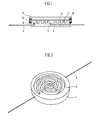
- One of the many possible realizations of the invention Device according to Figures 1 and 2 is designed so that the sampler has the shape has a portable badge and, for example from a flat brass disc 1 of approx. 40 mm Diameter and about 8 mm thick, in one spiral groove as elution channel 2 from one depth and width in the micro to millimeter range is. As shown in FIG. 2, this channel is at the two ends from the outside through the pipes 3 accessible in the form of stainless steel capillaries.
- the Diffusion membranes 4 are held with a holding O-ring 5 and a corresponding recess 6 in the base body 1 fixed.
- An additional transport cover 7 can by means of a further sealing ring 8 the sampling device seal for storage or transportation.
- thermal desorption temperatures> 200 ° C can be used.
- the materials should be up to at least 400 ° C temperature resistant.
- shape of the elution channels and the material of the base body is irrelevant and depends on the application in question.
- thermal desorption is performed will preferably be non-corrosive metals or alloys used for this. In the case of solvent extraction become chemically resistant Plastics used for this.
- the receiver phase used (adsorbent or other collection phase) is introduced into this groove up to its upper edge.
- the diffusion body can also be used in situ generated, i.e. one or more, regarding the analyte optimized (preferred transport) membranes can on the planar surface of the device by spraying or so-called spin coating with subsequent polymerization (photochemically or otherwise) can be applied.
- Stable Langmuir blottget films are by immersing the with the collection phase filled device in a Langmuir scales Trough with subsequent stabilizing polymerization (e.g. photopolymerization or chemical polymerization) receive.
- Inlets and outlets can continue to the device for the gaseous or liquid transport stream are incorporated, each at the two ends start the groove.
- the other end of these inlets and outlets can e.g. to the back or the side surface be performed.
- the absolute size of the device is irrelevant. There are also versions on a millimeter scale the modern production methods of microsystem technology producible, especially if the diffusion membranes by spin coating on a wafer with many Devices is carried out together.
- Such a device according to the invention in the form a badge for example Sample collection rates of approx. 1 1 / h for benzene, 2.5 1 / h for ethylbenzene, 2 1 / h for toluene, 2.5 1 / h for p-xylene, 2.3 1 / h for m-xylene and 1.6 1 / h for o-xylene.
- the detection limits that can be achieved are in the pg range.
- the invention shortens Passive sample collectors on the collection phase about 1/10. This is a big advantage because then also smaller temporal fluctuations of the analytes can be detected.
- the device according to the invention shortens the collection time compared to the prior art approx. ⁇ 20%.
- a basic body of the form mentioned above is used and dimensions in a clear plastic (e.g. Plexiglas®).
- a diffusion body serves a stretched Teflon membrane ⁇ 50 ⁇ m thick and an average pore diameter of ⁇ 10 ⁇ m.
- Receiver phase is an aqueous gel (agar-agar) with approx. 5% potassium iodide and ⁇ 5% starch (e.g. potato starch) used with an addition of 5% magnesium nitrate.
- the blue-black discoloration of the collection phase by comparison "converted" into an ozone concentration using color charts. So ppb amounts can be within a few Hours can be easily determined.
Landscapes
- Health & Medical Sciences (AREA)
- Life Sciences & Earth Sciences (AREA)
- Engineering & Computer Science (AREA)
- Biomedical Technology (AREA)
- Molecular Biology (AREA)
- Physics & Mathematics (AREA)
- Chemical & Material Sciences (AREA)
- Analytical Chemistry (AREA)
- Biochemistry (AREA)
- General Health & Medical Sciences (AREA)
- General Physics & Mathematics (AREA)
- Immunology (AREA)
- Pathology (AREA)
- Sampling And Sample Adjustment (AREA)
- Investigating Or Analyzing Non-Biological Materials By The Use Of Chemical Means (AREA)
Claims (24)
- Collecteur de diffusion pour des analytes gazeux contenus dans des phases fluides comprenant un boítier présentant au moins une cavité en forme de canal, qui est recouverte d'une membrane de diffusion perméable à l'analyte et sur laquelle il est prévu un conduit d'alimentation et un conduit d'évacuation, caractérisé en ce que, dans la cavité en forme de canal (2) recouverte par la membrane de diffusion hydrophobe, est placé un adsorbant ou absorbant sélectif de l'analyte pour enrichir les analytes.
- Collecteur de diffusion selon la revendication 1, caractérisé en ce que le conduit d'alimentation (3) et le conduit d'évacuation (3) sont disposés chacun à des extrémités opposées d'une cavité en forme de canal (2).
- Collecteur de diffusion selon l'une quelconque des revendications précédentes, caractérisé en ce que le conduit d'alimentation (3) et le conduit d'évacuation (3) sont en forme de capillaires.
- Collecteur de diffusion selon l'une quelconque des revendications précédentes, caractérisé en ce que la phase collectrice et la phase contenant l'analyte, séparées par la membrane (4), sont adjacentes l'une à l'autre à la manière d'un stratifié et en ce que la distance de diffusion entre les deux phases est inférieure à 1 mm.
- Collecteur de diffusion selon l'une quelconque des revendications précédentes, caractérisé en ce que la cavité au moins unique en forme de canal (2) est en spirale.
- Collecteur de diffusion selon l'une quelconque des revendications précédentes, caractérisé en ce que le boítier (1) et la membrane (4) sont réalisés dans un matériau résistant à La température.
- Collecteur de diffusion selon l'une quelconque des revendications précédentes, caractérisé en ce que le collecteur de diffusion présente, en outre, un couvercle fermant de manière étanche pour la phase collectrice.
- Collecteur de diffusion selon l'une quelconque des revendications précédentes, caractérisé en ce que la phase collectrice contient au moins une phase liant l'analyte de manière sélective.
- Collecteur de diffusion selon l'une quelconque des revendications précédentes, caractérisé en ce que la phase collectrice contient au moins une phase transformant l'analyte de manière sélective.
- Collecteur de diffusion selon l'une quelconque des revendications précédentes, caractérisé en ce que la phase collectrice est maximisée en surface sur un côté tourné vers la membrane (4).
- Collecteur de diffusion selon l'une quelconque des revendications précédentes, caractérisé en ce que la phase collectrice est recouverte sur deux côtés ou plus d'une membrane (4).
- Collecteur de diffusion selon l'une quelconque des revendications précédentes, caractérisé en ce que la membrane (4) est une membrane de diffusion semi-perméable.
- Collecteur de diffusion selon l'une quelconque des revendications précédentes, caractérisé en ce que la membrane (4) est fixée sur le boítier (1) au mayen d'un anneau torique (8).
- Collecteur de diffusion selon l'une quelconque des revendications précédentes 1 à 12, caractérisé en ce que la membrane (4) est posée sous forme d'un revêtement in situ.
- Collecteur de diffusion selon l'une quelconque des revendications précédentes, caractérisé en ce que le fluide traversant la cavité en forme de canal (2) est un gaz porteur ou une solution porteuse.
- Collecteur de diffusion selon l'une quelconque des revendications précédentes, caractérisé en ce que le collecteur de diffusion est constitué par une plaquette.
- Collecteur de diffusion selon l'une quelconque des revendications précédentes, caractérisé en ce que la phase collectrice contient au moins un adsorbant ou un absorbant adapté aux analytes.
- Procédé pour le prélèvement passif d'échantillons comprenant un collecteur de diffusion selon l'une des revendications 1 à 17, caractérisé en ce que l'analyte gazeux diffuse à travers une membrane (4) hydrophobe, perméable à l'analyte, à partir de la phase fluide dans un adsorbant ou un absorbant sélectif de l'analyte pour enrichir les analytes, la phase collectrice étant chargée, après le prélèvement d'échantillons, avec un fluide pour évacuer une substance à tester et l'évacuation de la substance à tester s'effectuant perpendiculairement à la direction de diffusion.
- Procédé selon la revendication 18, caractérisé en ce que, comme substance à tester, l'analyte lui-même ou l'analyte sous forme chimiquement ou biochimiquement transformée est évacué.
- Procédé selon l'une quelconque des revendications 18 ou 19, caractérisé en ce que pour évacuer la substance à tester, une libération de la substance à tester est effectuée au moyen d'une solvatation chimique ou d'une désorption thermique.
- Procédé selon l'une quelconque des revendications 18 à 20, caractérisé en ce que l'analyte est transporté à travers la membrane (4) par des mécanismes de transport actifs.
- Procédé selon l'une quelconque des revendications 18 à 20, caractérisé en ce que l'analyte est transporté à travers la membrane (4) par des mécanismes de transport passifs.
- Procédé selon l'une quelconque des revendications 18 à 20, caractérisé en ce que l'analyte est transporté à travers la membrane (4) par osmose.
- Procédé selon l'une des revendications 18 à 23, caractérisé en ce que la phase collectrice est évaluée par colorimétrie après le prélèvement d'échantillons.
Applications Claiming Priority (3)
| Application Number | Priority Date | Filing Date | Title |
|---|---|---|---|
| DE19710525 | 1997-03-14 | ||
| DE19710525A DE19710525C2 (de) | 1997-03-14 | 1997-03-14 | Passiv-Diffusionssammler für in Gasen enthaltene Analyte sowie Verfahren zur passiven Probenahme und Analyse |
| PCT/DE1998/000705 WO1998041838A1 (fr) | 1997-03-14 | 1998-03-09 | Dispositif et procede pour prelever des echantillons dans des phases fluides avec un corps de diffusion et une phase de fixation de l'analyte |
Publications (2)
| Publication Number | Publication Date |
|---|---|
| EP1007938A1 EP1007938A1 (fr) | 2000-06-14 |
| EP1007938B1 true EP1007938B1 (fr) | 2003-07-09 |
Family
ID=7823321
Family Applications (1)
| Application Number | Title | Priority Date | Filing Date |
|---|---|---|---|
| EP98921347A Expired - Lifetime EP1007938B1 (fr) | 1997-03-14 | 1998-03-09 | Dispositif et procede pour prelever des echantillons dans des phases fluides avec un corps de diffusion et une phase de fixation de l'analyte |
Country Status (5)
| Country | Link |
|---|---|
| US (1) | US6296685B1 (fr) |
| EP (1) | EP1007938B1 (fr) |
| JP (1) | JP2001515591A (fr) |
| DE (2) | DE19710525C2 (fr) |
| WO (1) | WO1998041838A1 (fr) |
Families Citing this family (17)
| Publication number | Priority date | Publication date | Assignee | Title |
|---|---|---|---|---|
| US6454840B1 (en) * | 1998-08-20 | 2002-09-24 | Siemens Aktiengesellschaft | Separation-column unit for a gas-chromatograph and method for making the same |
| DE19920233C2 (de) * | 1999-05-03 | 2002-11-07 | Siemens Ag | Vorrichtung zur Optimierung der Behandlung von Nierenleiden |
| GB9920170D0 (en) | 1999-08-25 | 1999-10-27 | Univ Portsmouth | A passive sampling device |
| DE20023183U1 (de) * | 2000-08-16 | 2003-03-20 | UFZ-Umweltforschungszentrum Leipzig-Halle GmbH, 04318 Leipzig | Passivsammler zur membrankontrollierten Extraktion gelöster organischer Substanzen im Wasser |
| US6663697B1 (en) * | 2001-11-02 | 2003-12-16 | Sandia Corporation | Microfabricated packed gas chromatographic column |
| US6666907B1 (en) * | 2002-01-31 | 2003-12-23 | Sandia Corporation | Temperature programmable microfabricated gas chromatography column |
| US6706091B1 (en) * | 2002-12-17 | 2004-03-16 | Sandia Corporation | Sub-to super-ambient temperature programmable microfabricated gas chromatography column |
| US7273517B1 (en) * | 2005-02-25 | 2007-09-25 | Sandia Corporation | Non-planar microfabricated gas chromatography column |
| US7513936B2 (en) * | 2005-05-03 | 2009-04-07 | Roques Ned J | Flat spiral capillary column assembly with thermal modulator |
| JP2006329777A (ja) * | 2005-05-25 | 2006-12-07 | Photo Precision Kk | チップ、および微量分析法 |
| DE102006008474A1 (de) * | 2006-02-23 | 2007-09-06 | Siemens Ag | Vorrichtung und Verfahren zur Untersuchung einer chemischen Zusammensetzung im Innern eines Behälters und Anordnung eines Behälters und der Vorrichtung |
| US7691325B2 (en) * | 2006-10-19 | 2010-04-06 | Xerox Corporation | Photonic crystal solvent vapor sensing device |
| US8845682B2 (en) | 2009-10-13 | 2014-09-30 | E-Pacing, Inc. | Vasculature closure devices and methods |
| ES2613885T3 (es) | 2009-11-04 | 2017-05-26 | Ssw Holding Company, Inc. | Superficies de aparatos de cocción que tienen un patrón de confinamiento de salpicaduras y procedimientos de fabricación de las mismas |
| DE102011053758A1 (de) * | 2011-09-19 | 2013-03-21 | BMA-Labor Gbr | Verfahren zur Untersuchung von Luft auf das Vorhandensein von biologischen Substanzen |
| US10085731B2 (en) | 2013-07-15 | 2018-10-02 | E-Pacing, Inc. | Vasculature closure devices and methods |
| CN109297867B (zh) * | 2018-10-15 | 2023-10-13 | 成都理工大学 | 一种污染区现场快速检测管及检测方法 |
Family Cites Families (20)
| Publication number | Priority date | Publication date | Assignee | Title |
|---|---|---|---|---|
| US3751879A (en) * | 1971-04-26 | 1973-08-14 | Instrumentation Specialties Co | Apparatus for reducing the dissolved gas concentration in a liquid |
| US3924219A (en) * | 1971-12-22 | 1975-12-02 | Minnesota Mining & Mfg | Gas detection device |
| US4040805A (en) * | 1976-10-22 | 1977-08-09 | Board Of Supervisors Louisiana State University Agricultural And Mechanical College | Personal monitoring device, or dosimeter, for measuring exposure of personnel to organic vapors |
| DE2650730C2 (de) * | 1976-11-05 | 1979-03-29 | Boehringer Mannheim Gmbh, 6800 Mannheim | Tauchdialysator |
| US4151060A (en) * | 1978-02-01 | 1979-04-24 | Westinghouse Electric Corp. | Solid state filter for gas sensors |
| US4208371A (en) * | 1978-07-07 | 1980-06-17 | E. I. Du Pont De Nemours And Company | Gaseous contaminant dosimeter with diffusion device therefor and method |
| US4269804A (en) * | 1979-08-24 | 1981-05-26 | E. I. Du Pont De Nemours And Company | Self-contained gaseous contaminant dosimeter |
| DE3009069C2 (de) * | 1980-03-10 | 1982-10-21 | Bundesrepublik Deutschland, Vertreten Durch Den Bundesminister Der Verteidigung, 5300 Bonn | Eingangs-Kopf eines Meß/Nachweissystems für chemische Agentien |
| DE3137765A1 (de) * | 1981-09-23 | 1983-03-31 | Bundesrepublik Deutschland, vertreten durch den Bundesminister der Verteidigung, dieser vertreten durch den Präsidenten des Bundesamtes für Wehrtechnik und Beschaffung, 5400 Koblenz | Verfahren und vorrichtung zur schnellen detektion, identifikation und quantifikation von spurenelementen in gasen, fluessigkeiten und festkoerpern |
| JPS6056261A (ja) | 1983-09-07 | 1985-04-01 | Toray Ind Inc | 検査用血漿採取器 |
| US4942135A (en) * | 1986-08-04 | 1990-07-17 | The United States Of America As Represented By The United States Department Of Energy | Method for preconcentrating a sample for subsequent analysis |
| US4856147A (en) * | 1986-12-16 | 1989-08-15 | E. I. Du Pont De Nemours And Company | Composites of stretch broken aligned fibers of carbon and glass reinforced resin |
| DE3709296C1 (de) | 1987-03-20 | 1988-09-22 | Draegerwerk Ag | Kolorimetrisches Gasmessgeraet |
| DE3735307A1 (de) * | 1987-10-17 | 1989-04-27 | Draegerwerk Ag | Diffusionssammler |
| US5053060A (en) * | 1990-06-29 | 1991-10-01 | Molecular Devices Corporation | Device and method for degassing, gassing and debubbling liquids |
| GB9316945D0 (en) * | 1993-08-14 | 1993-09-29 | Univ Lancaster | Probe device |
| SE504779C2 (sv) * | 1994-09-07 | 1997-04-21 | Danfoss As | Provtagningsanordning med membran och membranhållare |
| IT1269221B (it) * | 1994-11-25 | 1997-03-21 | Fondazione Clinica Del Lavoro | Campionatore diffusivo a simmetria radiale di sostanze volatili, ad alta capacita' di pompaggio equivalente ed utile per il desorbimento chimico e termico. |
| DE19533510C2 (de) * | 1995-08-30 | 1997-07-24 | Dirk Dr Thamm | Vorrichtung zur Entnahme und Bestimmung gelöster Komponenten in Flüssigkeiten oder Gasen |
| DE19538075C1 (de) * | 1995-10-13 | 1996-11-28 | Draegerwerk Ag | Verfahren und Vorrichtung zur Anreicherung von gasförmig, dampfförmig und/oder als Aerosol aus einem Gegenstand austretenden Stoffemissionen |
-
1997
- 1997-03-14 DE DE19710525A patent/DE19710525C2/de not_active Expired - Fee Related
-
1998
- 1998-03-09 EP EP98921347A patent/EP1007938B1/fr not_active Expired - Lifetime
- 1998-03-09 JP JP54002198A patent/JP2001515591A/ja not_active Ceased
- 1998-03-09 DE DE59808996T patent/DE59808996D1/de not_active Expired - Fee Related
- 1998-03-09 US US09/381,005 patent/US6296685B1/en not_active Expired - Fee Related
- 1998-03-09 WO PCT/DE1998/000705 patent/WO1998041838A1/fr not_active Ceased
Also Published As
| Publication number | Publication date |
|---|---|
| DE19710525A1 (de) | 1998-10-22 |
| WO1998041838A1 (fr) | 1998-09-24 |
| US6296685B1 (en) | 2001-10-02 |
| DE59808996D1 (de) | 2003-08-14 |
| DE19710525C2 (de) | 1999-11-11 |
| JP2001515591A (ja) | 2001-09-18 |
| EP1007938A1 (fr) | 2000-06-14 |
Similar Documents
| Publication | Publication Date | Title |
|---|---|---|
| EP1007938B1 (fr) | Dispositif et procede pour prelever des echantillons dans des phases fluides avec un corps de diffusion et une phase de fixation de l'analyte | |
| Gong et al. | Passive sampling for monitoring polar organic pollutants in water by three typical samplers | |
| Pedersen-Bjergaard et al. | Liquid-phase microextraction with porous hollow fibers, a miniaturized and highly flexible format for liquid–liquid extraction | |
| Armenta et al. | Green analytical chemistry | |
| He et al. | Recent developments in stir bar sorptive extraction | |
| Ouyang et al. | Configurations and calibration methods for passive sampling techniques | |
| Gjelstad et al. | Recent developments in electromembrane extraction | |
| Amiri et al. | Solid-phase extraction of non-steroidal anti-inflammatory drugs in human plasma and water samples using sol–gel-based metal-organic framework coating | |
| Goncalves et al. | Recent advances in membrane-aided extraction and separation for analytical purposes | |
| Zhou et al. | Generic liquid membranes for electromembrane extraction of bases with low or moderate hydrophilicity | |
| Vera et al. | A new extraction phase based on a polymer inclusion membrane for the detection of chlorpyrifos, diazinon and cyprodinil in natural water samples | |
| Kuswandi et al. | Water monitoring using polymer inclusion membranes: A review | |
| Miró et al. | Automated membrane-based sampling and sample preparation exploiting flow-injection analysis | |
| Sae-Khow et al. | Pervaporation in chemical analysis | |
| DE69309055T2 (de) | Vorrichtung und methode zur umkehrpermeationsmembranextraktion von verbindungen aus probelösungen | |
| Moradi et al. | A review in the sample preparation of aqueous solutions combined with X-ray fluorescence detection | |
| DE3833429A1 (de) | Kapillarmembranschnittstelle fuer massenspektrometer | |
| Seidi et al. | Miniaturized sample preparation methods for saliva analysis | |
| Chalavi et al. | Recent advances in microextraction procedures for determination of amphetamines in biological samples | |
| DE10234819A1 (de) | Testvorrichtung zur Untersuchung einer biologischen Probenflüssigkeit | |
| DE102006021333B4 (de) | Verbessertes Verfahren zur qualitativen und/oder quantitativen Bestimmung geringer Konzentrationen an organischen Spurenstoffen in wäßrigen Systemen und eine Analysevorrichtung zur Durchführung dieses Verfahrens | |
| DE69814895T2 (de) | Dosiereinheit und methode zur kontinuierlichen einführen von proben flüssiger lösungen in ein system | |
| Mukherjee et al. | Sampling and analysis of emerging pollutants in aquatic environment | |
| DE2000074A1 (de) | Analytisches Verfahren und hierfuer geeignete Vorrichtung | |
| Santos et al. | Membrane-based separation in flow analysis for environmental and food applications |
Legal Events
| Date | Code | Title | Description |
|---|---|---|---|
| PUAI | Public reference made under article 153(3) epc to a published international application that has entered the european phase |
Free format text: ORIGINAL CODE: 0009012 |
|
| 17P | Request for examination filed |
Effective date: 19991012 |
|
| AK | Designated contracting states |
Kind code of ref document: A1 Designated state(s): DE NL |
|
| GRAH | Despatch of communication of intention to grant a patent |
Free format text: ORIGINAL CODE: EPIDOS IGRA |
|
| GRAH | Despatch of communication of intention to grant a patent |
Free format text: ORIGINAL CODE: EPIDOS IGRA |
|
| GRAA | (expected) grant |
Free format text: ORIGINAL CODE: 0009210 |
|
| AK | Designated contracting states |
Designated state(s): DE NL |
|
| PG25 | Lapsed in a contracting state [announced via postgrant information from national office to epo] |
Ref country code: NL Free format text: LAPSE BECAUSE OF FAILURE TO SUBMIT A TRANSLATION OF THE DESCRIPTION OR TO PAY THE FEE WITHIN THE PRESCRIBED TIME-LIMIT Effective date: 20030709 |
|
| REF | Corresponds to: |
Ref document number: 59808996 Country of ref document: DE Date of ref document: 20030814 Kind code of ref document: P |
|
| NLV1 | Nl: lapsed or annulled due to failure to fulfill the requirements of art. 29p and 29m of the patents act | ||
| PLBE | No opposition filed within time limit |
Free format text: ORIGINAL CODE: 0009261 |
|
| STAA | Information on the status of an ep patent application or granted ep patent |
Free format text: STATUS: NO OPPOSITION FILED WITHIN TIME LIMIT |
|
| 26N | No opposition filed |
Effective date: 20040414 |
|
| PGFP | Annual fee paid to national office [announced via postgrant information from national office to epo] |
Ref country code: DE Payment date: 20060517 Year of fee payment: 9 |
|
| PG25 | Lapsed in a contracting state [announced via postgrant information from national office to epo] |
Ref country code: DE Free format text: LAPSE BECAUSE OF NON-PAYMENT OF DUE FEES Effective date: 20071002 |