EP1008008B1 - Integrierter strahlformer und seine verwendung - Google Patents
Integrierter strahlformer und seine verwendung Download PDFInfo
- Publication number
- EP1008008B1 EP1008008B1 EP98944470A EP98944470A EP1008008B1 EP 1008008 B1 EP1008008 B1 EP 1008008B1 EP 98944470 A EP98944470 A EP 98944470A EP 98944470 A EP98944470 A EP 98944470A EP 1008008 B1 EP1008008 B1 EP 1008008B1
- Authority
- EP
- European Patent Office
- Prior art keywords
- optical element
- light source
- transparent substrate
- beam shaper
- light
- Prior art date
- Legal status (The legal status is an assumption and is not a legal conclusion. Google has not performed a legal analysis and makes no representation as to the accuracy of the status listed.)
- Expired - Lifetime
Links
- 230000003287 optical effect Effects 0.000 claims abstract description 106
- 239000000758 substrate Substances 0.000 claims abstract description 99
- 238000000034 method Methods 0.000 claims abstract description 15
- 238000009826 distribution Methods 0.000 claims abstract description 6
- 238000007493 shaping process Methods 0.000 claims description 14
- 125000006850 spacer group Chemical group 0.000 claims description 7
- 241001270131 Agaricus moelleri Species 0.000 claims 1
- 230000008569 process Effects 0.000 abstract description 3
- 235000012431 wafers Nutrition 0.000 description 54
- 238000004519 manufacturing process Methods 0.000 description 18
- 239000000243 solution Substances 0.000 description 12
- 229910000679 solder Inorganic materials 0.000 description 10
- 239000002184 metal Substances 0.000 description 8
- 239000004593 Epoxy Substances 0.000 description 7
- 230000004075 alteration Effects 0.000 description 5
- XUIMIQQOPSSXEZ-UHFFFAOYSA-N Silicon Chemical compound [Si] XUIMIQQOPSSXEZ-UHFFFAOYSA-N 0.000 description 4
- 230000008859 change Effects 0.000 description 4
- 238000013461 design Methods 0.000 description 4
- 229910052710 silicon Inorganic materials 0.000 description 4
- 239000010703 silicon Substances 0.000 description 4
- 201000009310 astigmatism Diseases 0.000 description 3
- 238000012937 correction Methods 0.000 description 3
- 230000007423 decrease Effects 0.000 description 3
- 238000005530 etching Methods 0.000 description 3
- 230000010354 integration Effects 0.000 description 3
- 238000000206 photolithography Methods 0.000 description 3
- 230000009467 reduction Effects 0.000 description 3
- 239000000853 adhesive Substances 0.000 description 2
- 230000001070 adhesive effect Effects 0.000 description 2
- 230000002238 attenuated effect Effects 0.000 description 2
- 230000003247 decreasing effect Effects 0.000 description 2
- 230000000694 effects Effects 0.000 description 2
- 238000005516 engineering process Methods 0.000 description 2
- 239000000463 material Substances 0.000 description 2
- 238000001465 metallisation Methods 0.000 description 2
- 238000012986 modification Methods 0.000 description 2
- 230000004048 modification Effects 0.000 description 2
- 229920002120 photoresistant polymer Polymers 0.000 description 2
- 239000004065 semiconductor Substances 0.000 description 2
- VYPSYNLAJGMNEJ-UHFFFAOYSA-N Silicium dioxide Chemical compound O=[Si]=O VYPSYNLAJGMNEJ-UHFFFAOYSA-N 0.000 description 1
- 238000013459 approach Methods 0.000 description 1
- 230000000712 assembly Effects 0.000 description 1
- 238000000429 assembly Methods 0.000 description 1
- 230000005540 biological transmission Effects 0.000 description 1
- 238000002508 contact lithography Methods 0.000 description 1
- 238000007796 conventional method Methods 0.000 description 1
- 229910003460 diamond Inorganic materials 0.000 description 1
- 239000010432 diamond Substances 0.000 description 1
- -1 e.g Substances 0.000 description 1
- 238000004049 embossing Methods 0.000 description 1
- 230000007613 environmental effect Effects 0.000 description 1
- 239000005350 fused silica glass Substances 0.000 description 1
- 239000011521 glass Substances 0.000 description 1
- 238000010438 heat treatment Methods 0.000 description 1
- 238000001746 injection moulding Methods 0.000 description 1
- 238000010884 ion-beam technique Methods 0.000 description 1
- 239000007788 liquid Substances 0.000 description 1
- 238000002844 melting Methods 0.000 description 1
- 230000008018 melting Effects 0.000 description 1
- 230000003647 oxidation Effects 0.000 description 1
- 238000007254 oxidation reaction Methods 0.000 description 1
- 238000000059 patterning Methods 0.000 description 1
- 229920000642 polymer Polymers 0.000 description 1
- 238000012545 processing Methods 0.000 description 1
- 238000000926 separation method Methods 0.000 description 1
- 239000007787 solid Substances 0.000 description 1
- 239000000126 substance Substances 0.000 description 1
- 238000002834 transmittance Methods 0.000 description 1
Images


Classifications
-
- G—PHYSICS
- G02—OPTICS
- G02B—OPTICAL ELEMENTS, SYSTEMS OR APPARATUS
- G02B19/00—Condensers, e.g. light collectors or similar non-imaging optics
- G02B19/0004—Condensers, e.g. light collectors or similar non-imaging optics characterised by the optical means employed
- G02B19/0009—Condensers, e.g. light collectors or similar non-imaging optics characterised by the optical means employed having refractive surfaces only
-
- G—PHYSICS
- G02—OPTICS
- G02B—OPTICAL ELEMENTS, SYSTEMS OR APPARATUS
- G02B19/00—Condensers, e.g. light collectors or similar non-imaging optics
- G02B19/0033—Condensers, e.g. light collectors or similar non-imaging optics characterised by the use
- G02B19/0047—Condensers, e.g. light collectors or similar non-imaging optics characterised by the use for use with a light source
- G02B19/0052—Condensers, e.g. light collectors or similar non-imaging optics characterised by the use for use with a light source the light source comprising a laser diode
-
- G—PHYSICS
- G02—OPTICS
- G02B—OPTICAL ELEMENTS, SYSTEMS OR APPARATUS
- G02B27/00—Optical systems or apparatus not provided for by any of the groups G02B1/00 - G02B26/00, G02B30/00
- G02B27/09—Beam shaping, e.g. changing the cross-sectional area, not otherwise provided for
-
- G—PHYSICS
- G02—OPTICS
- G02B—OPTICAL ELEMENTS, SYSTEMS OR APPARATUS
- G02B27/00—Optical systems or apparatus not provided for by any of the groups G02B1/00 - G02B26/00, G02B30/00
- G02B27/09—Beam shaping, e.g. changing the cross-sectional area, not otherwise provided for
- G02B27/0938—Using specific optical elements
- G02B27/095—Refractive optical elements
-
- G—PHYSICS
- G02—OPTICS
- G02B—OPTICAL ELEMENTS, SYSTEMS OR APPARATUS
- G02B6/00—Light guides; Structural details of arrangements comprising light guides and other optical elements, e.g. couplings
- G02B6/24—Coupling light guides
- G02B6/42—Coupling light guides with opto-electronic elements
- G02B6/4201—Packages, e.g. shape, construction, internal or external details
- G02B6/4204—Packages, e.g. shape, construction, internal or external details the coupling comprising intermediate optical elements, e.g. lenses, holograms
- G02B6/4206—Optical features
-
- G—PHYSICS
- G11—INFORMATION STORAGE
- G11B—INFORMATION STORAGE BASED ON RELATIVE MOVEMENT BETWEEN RECORD CARRIER AND TRANSDUCER
- G11B7/00—Recording or reproducing by optical means, e.g. recording using a thermal beam of optical radiation by modifying optical properties or the physical structure, reproducing using an optical beam at lower power by sensing optical properties; Record carriers therefor
- G11B7/12—Heads, e.g. forming of the optical beam spot or modulation of the optical beam
- G11B7/135—Means for guiding the beam from the source to the record carrier or from the record carrier to the detector
- G11B7/1353—Diffractive elements, e.g. holograms or gratings
-
- G—PHYSICS
- G11—INFORMATION STORAGE
- G11B—INFORMATION STORAGE BASED ON RELATIVE MOVEMENT BETWEEN RECORD CARRIER AND TRANSDUCER
- G11B7/00—Recording or reproducing by optical means, e.g. recording using a thermal beam of optical radiation by modifying optical properties or the physical structure, reproducing using an optical beam at lower power by sensing optical properties; Record carriers therefor
- G11B7/12—Heads, e.g. forming of the optical beam spot or modulation of the optical beam
- G11B7/135—Means for guiding the beam from the source to the record carrier or from the record carrier to the detector
- G11B7/1362—Mirrors
-
- G—PHYSICS
- G11—INFORMATION STORAGE
- G11B—INFORMATION STORAGE BASED ON RELATIVE MOVEMENT BETWEEN RECORD CARRIER AND TRANSDUCER
- G11B7/00—Recording or reproducing by optical means, e.g. recording using a thermal beam of optical radiation by modifying optical properties or the physical structure, reproducing using an optical beam at lower power by sensing optical properties; Record carriers therefor
- G11B7/12—Heads, e.g. forming of the optical beam spot or modulation of the optical beam
- G11B7/135—Means for guiding the beam from the source to the record carrier or from the record carrier to the detector
- G11B7/1381—Non-lens elements for altering the properties of the beam, e.g. knife edges, slits, filters or stops
-
- G—PHYSICS
- G11—INFORMATION STORAGE
- G11B—INFORMATION STORAGE BASED ON RELATIVE MOVEMENT BETWEEN RECORD CARRIER AND TRANSDUCER
- G11B7/00—Recording or reproducing by optical means, e.g. recording using a thermal beam of optical radiation by modifying optical properties or the physical structure, reproducing using an optical beam at lower power by sensing optical properties; Record carriers therefor
- G11B7/12—Heads, e.g. forming of the optical beam spot or modulation of the optical beam
- G11B7/135—Means for guiding the beam from the source to the record carrier or from the record carrier to the detector
- G11B7/1398—Means for shaping the cross-section of the beam, e.g. into circular or elliptical cross-section
-
- G—PHYSICS
- G02—OPTICS
- G02B—OPTICAL ELEMENTS, SYSTEMS OR APPARATUS
- G02B6/00—Light guides; Structural details of arrangements comprising light guides and other optical elements, e.g. couplings
- G02B6/24—Coupling light guides
- G02B6/42—Coupling light guides with opto-electronic elements
- G02B6/4201—Packages, e.g. shape, construction, internal or external details
- G02B6/4204—Packages, e.g. shape, construction, internal or external details the coupling comprising intermediate optical elements, e.g. lenses, holograms
- G02B6/4214—Packages, e.g. shape, construction, internal or external details the coupling comprising intermediate optical elements, e.g. lenses, holograms the intermediate optical element having redirecting reflective means, e.g. mirrors, prisms for deflecting the radiation from horizontal to down- or upward direction toward a device
-
- G—PHYSICS
- G02—OPTICS
- G02B—OPTICAL ELEMENTS, SYSTEMS OR APPARATUS
- G02B6/00—Light guides; Structural details of arrangements comprising light guides and other optical elements, e.g. couplings
- G02B6/24—Coupling light guides
- G02B6/42—Coupling light guides with opto-electronic elements
- G02B6/4201—Packages, e.g. shape, construction, internal or external details
- G02B6/4219—Mechanical fixtures for holding or positioning the elements relative to each other in the couplings; Alignment methods for the elements, e.g. measuring or observing methods especially used therefor
- G02B6/422—Active alignment, i.e. moving the elements in response to the detected degree of coupling or position of the elements
- G02B6/4221—Active alignment, i.e. moving the elements in response to the detected degree of coupling or position of the elements involving a visual detection of the position of the elements, e.g. by using a microscope or a camera
- G02B6/4224—Active alignment, i.e. moving the elements in response to the detected degree of coupling or position of the elements involving a visual detection of the position of the elements, e.g. by using a microscope or a camera using visual alignment markings, e.g. index methods
-
- G—PHYSICS
- G02—OPTICS
- G02B—OPTICAL ELEMENTS, SYSTEMS OR APPARATUS
- G02B6/00—Light guides; Structural details of arrangements comprising light guides and other optical elements, e.g. couplings
- G02B6/24—Coupling light guides
- G02B6/42—Coupling light guides with opto-electronic elements
- G02B6/4201—Packages, e.g. shape, construction, internal or external details
- G02B6/4219—Mechanical fixtures for holding or positioning the elements relative to each other in the couplings; Alignment methods for the elements, e.g. measuring or observing methods especially used therefor
- G02B6/4228—Passive alignment, i.e. without a detection of the degree of coupling or the position of the elements
- G02B6/4232—Passive alignment, i.e. without a detection of the degree of coupling or the position of the elements using the surface tension of fluid solder to align the elements, e.g. solder bump techniques
-
- H—ELECTRICITY
- H01—ELECTRIC ELEMENTS
- H01S—DEVICES USING THE PROCESS OF LIGHT AMPLIFICATION BY STIMULATED EMISSION OF RADIATION [LASER] TO AMPLIFY OR GENERATE LIGHT; DEVICES USING STIMULATED EMISSION OF ELECTROMAGNETIC RADIATION IN WAVE RANGES OTHER THAN OPTICAL
- H01S5/00—Semiconductor lasers
- H01S5/02—Structural details or components not essential to laser action
- H01S5/022—Mountings; Housings
- H01S5/0225—Out-coupling of light
- H01S5/02255—Out-coupling of light using beam deflecting elements
-
- H—ELECTRICITY
- H01—ELECTRIC ELEMENTS
- H01S—DEVICES USING THE PROCESS OF LIGHT AMPLIFICATION BY STIMULATED EMISSION OF RADIATION [LASER] TO AMPLIFY OR GENERATE LIGHT; DEVICES USING STIMULATED EMISSION OF ELECTROMAGNETIC RADIATION IN WAVE RANGES OTHER THAN OPTICAL
- H01S5/00—Semiconductor lasers
- H01S5/02—Structural details or components not essential to laser action
- H01S5/022—Mountings; Housings
- H01S5/023—Mount members, e.g. sub-mount members
- H01S5/02325—Mechanically integrated components on mount members or optical micro-benches
Definitions
- the present invention is directed to using optical elements mounted on a transparent substrate to correct, circularize, collimate or otherwise beam shape input light beams.
- the present invention is directed to providing an optical element as close to a beam to be shaped as possible within a passively aligned, mass produced system.
- the present invention is further directed to providing optical elements, positioned on opposite sides of a transparent substrate, to separately circularize and collimate a non-circular, uncollimated input beam.
- Laser diodes are compact, efficient, inexpensive and capable of mass production. This has lead to an increasing number of applications for which laser diodes are used.
- the active region of the laser diodes is quite small and asymmetric. This results in a small and asymmetric beam waist. Consequently, the beam divergence is severe and asymmetric.
- Astigmatism is a further property of laser diodes which presents an additional potential disadvantage in many applications.
- An uncorrected astigmatic laser beam cannot be collimated by a single radially symmetric lens. With an astigmatic laser, each axis appears to be diverging from a different point. Thus, collimation of both axes simultaneously with a single element requires an anamorphic element with different focal lengths for each axis. This astigmatism is corrected most advantageously by a subsequent optical system.
- U.S. 5,229,883 discloses an integrated beam shaper according to the preamble of claim 1.
- a cylindrical lens 22 is used in conjunction with a binary optical element 28.
- the binary optical element 28 is designed such that each ray of light from the diverging input light source will travel the same optical path length or vary from the optical path length by a discrete multiple of the wavelength of the light traveling from its source to its exit from the front surface of the binary optical element. While the low horizontal divergence may typically be collimated with cylindrical optical elements with few resulting aberrations, collimation of the fast vertical divergence requires optical elements with increased optical power at a much lower f number which generally results in increased optical aberrations with the collimated output.
- the cylindrical lens 22 is used to collimate the laser diode's output in the fast axis.
- Binary optics 28 include a substrate on which a binary optical diffraction pattern is etched.
- the binary optic diffraction pattern is typically an eight phase level structure which corrects for optical path differences inherent in the divergent light.
- the binary optical element collimates the slow axis divergence and corrects for skew ray aberration of rays not in either the fast or slow axis. These additional corrections are inherent in a binary optical element whose diffraction pattern is chosen so as to have each optical ray travel in equal optical path lengths or an optical path length that varies from that equal optical path length by integer multiple of the wavelength of light traveling therethrough.
- the cylindrical lens 22 and the diffractive optical element 28 in US 5,229,883 configuration must be both properly positioned along the optical axis, but also rotationally aligned with one another. This rotation alignment is crucial, since the different axes are treated differently. This rotational alignment can be difficult and sensitive, requiring expensive continuous rotational alignment.
- US 5,638,469 A teaches an integrated beam shaper comprising: a light source emitting a light beam, a transparent substrate, a hologram provided on a surface of the substrate and adapted to receive the light beam and to shape it to achieve a predetermined intensity pattern, wherein the light source is provided in said substrate.
- reference US 5 465 265 A relates to a multichip module which provides both optical and electrical interconnections for parallel computational systems, and does not disclose any beam shaper.
- US 4 679 911 A merely describes a soft aperture device and does not refer to the position of a corresponding light source for generating the light beam which is to be shaped. Nevertheless, as can be gathered from Fig. 4 of US 4 679 911 A, the light source is not mounted to the surface of the transparent substrate.
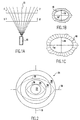
- a laser diode 10 outputs a beam along an optical axis 12.
- a beam profile 16 stays elliptical and gets larger, so that the difference between the beam size along the axes increases, as it propagates away from the laser diode 10.
- the beam is wider or more divergent along a fast axis 18, and is narrower or less divergent along a slow axis 19.
- Conventional configurations used to address this ellipticity were discussed above in the Background. As noted above, it is often desirable to shape this beam to obtain a more circular profile. Further, other desired profiles may be obtained.
- the general concept of one embodiment of the present invention involves providing an optical element 20 which increases power attenuation towards the outer edge thereof.
- Increasing power attenuation when used with diffractive embodiments of the present invention, means a decrease in the amount of power diffracted into a desired diffractive order.
- the desired diffractive order will be the first order, but the element 20 may be designed to utilize any order, including zero and orders higher than one.
- the term power attenuation means power reduction in a desired output beam.
- the soft aperture as shown in Figure 2 attenuates power in the fast axis at a faster rate than the Gaussian beam.
- the transmission in this soft aperture gradually decreases from one inside the center to zero at the edges. Therefore rather than being an all or nothing type hard aperture, a soft aperture serves to attenuate power as the beam is spread away from the central location.
- the path of the beam through the element 20 is illustrated by the dashed ellipses in Figure 2.
- the inner dashed ellipse 30 indicates the half intensity points of the Gaussian beam output by a laser diode, at which point the beam has one-half of the intensity of the peak intensity at the center of the beam.
- the outer dashed ellipse 32 illustrates the 1/e 2 points of the Gaussian beam output by the laser diode.
- the 1/e 2 point defines the beam radius and is the point at which the intensity of the beam has fallen to 13.5% of the maximum intensity at the center.
- the dashed ellipse 30 illustrate that for the region where the intensity of the beam is greater than half of the peak value, i.e., full width at half maximum, the beam along the slow axis 19 will encounter only the inner region 22, while along the fast axis 18, the beam will encounter both the inner 22 and the first 24 intermediate regions.
- the dashed ellipse 32 illustrates that for the region where the intensity of the beam is between 13.5% of the maximum intensity and half of the maximum intensity, the beam along the slow axis will encounter only the first intermediate region 24, while along the fast axis 18, the beam will encounter the second intermediate region 26 and the outer region 28.
- the power along the fast axis 18 is more greatly attenuated than the power along the slow axis 19, while not attenuating a region of the beam having the peak intensity.
- an increase in power attenuation away from a center of the soft aperture may be achieved by providing any of the following: a decreasing number of phase levels a number of phase levels away from the center, an increasing a number of phase levels away from the center, an increasing a density of scattering portions, e.g., metal patches, away from the center, and etchings varying in height and/or duty cycle away from the center.
- a diffractive optical element (DOE) 40 which alters divergence of a beam input thereto differently along different axes may be placed on the first surface 42a of a substrate 42.
- the DOE 40 incorporating a computer generated hologram is designed using the computer calculations and manufactured using lithographic techniques taught by U.S. 5,161,059 for a particular input and desired output beam.
- the DOE 40 on an input surface 42a of the substrate 42 is employed to further reduce the divergence angle of the input beam along the fast axis, as shown in Figures 3a, from ⁇ f ' to ⁇ f '' where ⁇ f ' > ⁇ f ''.
- the dashed lines illustrate the divergence angle ⁇ f ' of the input beam along the fast axis would take absent the DOE 40, while the solid lines indicate the divergence angle ⁇ f '' of the output beam from the DOE 40.
- the DOE 40 also increases the divergence angle of the input beam along the slow axis, as shown in Figure 3b, from ⁇ s ' to ⁇ s '' where ⁇ s ' ⁇ ⁇ s ''.
- the dashed lines illustrate the divergence angle ⁇ s of the input beam along the slow axis would take absent the DOE 40, while the solid lines indicate the divergence angle ⁇ s ' of the output beam from the DOE 40.
- the divergence angles along the respective axes may be altered in variety of ways. Unlike refractive elements, which can alter an incoming angle into a number of outgoing angles with little effect on the efficiency thereof, the more an incoming angle is deviated from, the more power is lost in the diffractive element. For example, in the solutions noted in the Background section, a refractive element was used to collimate the beam, along one axis, i.e., reduce the divergence to zero. However, such a reduction is not the most efficient use of a DOE. Therefore, determining the exact configuration of the beam exiting the diffractive element involves considering the amount of optical power desired along each axis.
- the first solution involves designing DOE 40 to output the beam along each axis as having the same divergence angle, i.e., in the output of the DOE 40, ⁇ s ' ⁇ ⁇ f '. This near equality is most efficiently achieved by increasing the divergence angle of the slow axis by approximately the same amount as the divergence angle of the fast axis is decreased. To a first order approximation, these angles will be equal. In other words, ⁇ s '' - ⁇ s ' ⁇ ⁇ f ' - ⁇ f ''.
- the beam along the fast axis is 40 microns larger than the beam along the slow axis
- the 40 micron difference which still exists between the beam along the slow axis and the beam along the fast axis will be negligible, i.e., the beam will be substantially circular.
- the DOE In order to keep the difference between the dimensions of the beam on the slow and fast axis on the DOE small, the DOE must be placed very close to the light source, typically a laser. For example, if the divergence angles of the laser are 11° and 33° of the slow and fast axis respectively, in order to keep the difference between the beam dimensions on DOE 40 less than 40 microns, the DOE 40 must be placed within approximately 100 microns of the laser. To keep the difference in beam dimensions to less than 200 microns, the DOE 40 must be placed within 500 microns of the laser.
- a laser diode is mounted inside a cylindrical housing called a can.
- the can is typically about 2 mm in length. Therefore, if the laser diode is to be placed within a can, the DOE 40 must also be placed within the can.
- the beam may be collimated by a conventional optical element anywhere after the DOE 40. Where such a conventional element is to be placed will be determined by the desired beam size. Assuming the desired spot size is 1 mm, and the divergence angles of the beam emerging from the DOE 40 are 22 degrees in each direction, then the distance between the DOE 40 and the collimating lens will be approximately 2.5 mm.
- the can slightly longer than a conventional can and placing the collimating lens on the output surface 42b of the substrate having a thickness of the desired distance from the DOE 40 to the collimating element, here, 2.5 mm all of the desired optics for shaping the beam are integrated with the laser itself inside the can.
- the collimating element may be placed outside the can.
- the distance from the DOE 40 assuming the same laser parameters as above, will be 25 mm.
- the collimating element is preferably placed outside the can.
- the collimating element may be placed on top of the can itself.
- DOE 40 used for circularizing the beam may be formed on a refractive, making the element on the input surface a hybrid.
- the beam may be made more divergent along the slow axis in order to more quickly provide sufficient circularization, i.e., minimize the effect of the initial dimensional difference of the input beam, thereby reducing the thickness d of the substrate 42. Since the beam for this configuration will not be perfectly circular, the use of a soft aperture at either surface 42a, 42b, integrated with any other element thereon, may be used to further aid in circularization. Further, a soft aperture may be used to reduce the thickness d of the substrate 42 by aiding in circularizing and shaping the beam.
- the second solution involves altering the divergence angles of the fast and slow axes such that at the output of the DOE 40, the slow axis has a divergence that is greater than the divergence angle of the fast axis.
- ⁇ s '' > ⁇ f ''.
- the divergence angles ⁇ f and ⁇ s are fixed. While the value s can be set, typically the laser will be placed as close as possible to the substrate 42. Therefore, for most systems, the value of X is fixed.
- the degrees of freedom in obtaining a desired diameter D are d, ⁇ f '' and ⁇ s ''.
- the smaller the value of d the larger the change in the divergence angles required, resulting in less efficient DOEs.
- the larger the value of d the larger the beam will be at the second surface 42b, making operation thereon of optics placed on this surface easier.
- the value of D is chosen by the application. Then, a value of d is chosen that is the largest value that can be accommodated by the manufacturing process. This then will determine the values of the change in divergence angles.
- the laser having divergence angles of approximately 11° ( ⁇ s ) by 33° ( ⁇ f ) is placed a distance of 200 microns (s) from the DOE 40.
- the spot size on DOE 40 would be approximately 60 microns (X 5 ) by 120 microns (X f ).
- the divergence angles upon exiting DOE 40 should be approximately 16° ( ⁇ f ''), or a decrease of 17 °, along the fast axis and 20° ( ⁇ s ''), or an increase of 9°, along the slow axis. This will result in a circular beam on the surface 42b of approximately 400 microns.
- a collimating element is located on the surface 42b to provide the desired 400 micron collimated beam output by the substrate 42.
- this collimating element will need to be anamorphic since the divergence angles of the beams along the two axes will be different. In other words, the collimating element will have different effective focal lengths along the two axes.
- This collimating element, or the DOE 40 can also be used to correct for astigmatism of other aberrations. If correction is used , the element will need to be aspheric.
- the use of soft apertures in conjunction with either type of the divergence angle varying DOEs is particularly useful. Divergence angle specifications for light sources, even from the same manufacturer, can vary widely. The proper operation of the divergence angle varying DOEs depends upon knowing the divergence angles of an incoming beam to be shaped. Separate design and manufacture of DOEs for each individual light source in clearly impractical. However, by incorporating a soft aperture on the transparent substrate, preferably on the input surface 42a thereof, uniformity of the divergence angles may be realized. In particular, for the specific example discussed above, a soft aperture that quickly attenuates light outside of the divergence of 11° by 11° may be used. Thus, even if the divergence angles from the light source were greater than these values, the circular beam shape and divergence angles thereof for which the second optical element was designed would still be provided to the second optical element.
- a first element on a first surface 42a of the substrate is used to provide a desired intensity pattern on a second element on a second surface 42b.
- this desired intensity pattern was a circular pattern.
- the second element is used to provide a desired phase profile, in the examples above, a collimated beam.
- the present invention may be used to create arbitrary intensity and phase profiles, with the first element, DOE 40, creating the desired intensity pattern on the second element and the second element creating the desired phase profile.
- the circular beam needs to be focussed at a particular distance, rather than collimated. This can be achieved by using a focussing element as the second element 48, rather than a collimating element.
- the DOE 40 can be used to create a variety of intensity patterns or beam shapes, such as a flat top, square, circular, rectangular, elliptical, axicon, a cross-hair, a pattern of multiple spots, a grey-scale image, other non-Gaussian intensity distributions, etc., on the second surface 42b. Any of refractive, diffractive or hybrid elements may be used to generate the desired phase transmittance.
- the shaping the light beam will be most effective when the dimensions of the beam entering the input surface 42a are small, i.e., the beam has not travelled very far from its source, such that the difference in axial dimensions will be minimized.
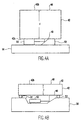
- a light source typically a laser, such as a laser diode, 50, shown as an edge emitting laser
- a precision mirror 52 both of which are mounted underneath the substrate 42.
- the precision mirror 52 receives the light output from the laser 50 and directs it upwards to the substrate 42. If the edge emitting laser 50 is replaced with a vertical cavity surface emitting laser, the precision mirror 52 will clearly no longer be required.
- the laser 50 and the mirror 52 may be mounted through additional conductive pads on a substrate 56, which acts as a heat sink. The bonding and alignment of the active elements 50, 52 on the heat sink 56 allows the active elements 50, 52 to be tested before the optical elements are integrated therewith.
- This clipping may be compensated for by integrating a soft aperture 20 with the DOE 40.
- the soft aperture 20 does not necessarily serve to circularize the beam, but shapes the beam to be more smoothly attenuated, thereby reducing ringing in the far field.
- the soft aperture may be provided by a diffractive element or with lithographically patterned metal patches as desired. These two techniques for achieving the soft aperture are particularly useful when mass producing the integrated beam shaper of the present invention, discussed below, since they allow the soft apertures to be efficiently produced on a wafer level.
- Figure 4b illustrates an alternative example to the configuration shown in Figure 4a not falling under the scope of the present invention.
- the mirror 52 may be integrated into the heat sink 56, thereby eliminating a mounting step.
- the heat sink 56 is a silicon wafer and the mirror can be formed by etching along a crystalline plane of the silicon.
- a monitor diode 51 placed behind the laser 50 and receiving light output from the back of the laser 50.
- a surface for directing the light output from the back of the laser 50 is also integrated into the heat sink 56.
- the monitor diode 51 is used to indicate that the laser 50 is operating within normal parameters. Alternatively, the monitor diode 51 can be integrated into the heat sink 56.
- Solder balls 53 are alignment features used for facilitating alignment between the substrate 42 and the heat sink 56. The placement of the solder balls insures the light to be corrected is provided on the DOE 40. The solder balls 53 also provide offset between the substrate 42 and the heat sink 56 in order to allow the required electrical connections to the active elements, e.g., the laser 50 and the monitor diode 51.
- the substrate 42 carrying the optical elements only needs to be provided over the mirror 52 in order to receive the light from the laser 50.
- Such mounting of the substrate facilitates connections to the laser 50, such as heat sinking and electrical leads.
- the substrate 42 can be thinner. Thus, this close proximity allows the differing divergences between the fast and slow axes of the beam output by the laser 50 to be shaped for more effectively. Further, the substrate 42 can be thinner and hence an overall device in which the beam shaper of the present invention is to be incorporated will be thinner.
- Figure 5 is a side view of another configuration, and better illustrates the passive alignment which may be used in producing any of the configurations.
- Fiducial marks are placed on a bottom surface 42a of the substrate 42. These fiducial marks are used to place mounting alignment features 54 on the bottom surface 42a for mounting the electrical components thereon, e.g., the laser 50 and the mirror 52.
- mounting alignment features 54 e.g., the laser 50 and the mirror 52.
- metalized pads advantageously serve as the alignment features.
- the optical elements 42 and 48 are advantageously created photolithographically using the same fiducial marks used to place the alignment features, for example, metalized pads 54. Alternately, additional fiducial marks that have been aligned with the first fiducial marks may be used to align the masks to create the optical elements. Since the wafer are all thin and transparent, use of the fiducial marks is easily realized.
- the optical element 48 is a diffractive element which separates the shaped beam from the DOE 40 into a plurality, e.g., three, beams to be focused separately on the intended object 58.
- the configurations shown in Figures 4a, 4b and 5 may all be mass produced.
- the DOES 40 may be mass produced directly using photolithographic techniques taught, for example, by U.S. 5,161,059, or by using photolithographic techniques to create a master for use in injection molding or embossing into a polymer. These production techniques are applied on a wafer level so that a plurality of the DOES may be made simultaneously and a corresponding plurality of light sources may be mounted adjacent thereto. On a wafer level, the plurality of elements produced is on the order of tens to thousands.
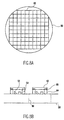
- FIG. 8a An elevational top view of a wafer 80 having a plurality of 5 elements 82 provided thereon is shown in Figure 8a.
- the wafer 80 may be the transparent substrate 42 and the elements 82 may be optical elements provided on either side thereof, or the wafer 80 may be the heat sink and the elements 82 may be active elements provided thereon.
- the transparent substrate wafer is glass, e.g, fused silica, and the heat sink wafer is silicon.
- Figure 8b is an elevational side view of a plurality of integrated beam shapers before they are diced to form the individual integrated beam shapers of the present invention.
- the transparent substrate containing the optical elements are diced and then mounted at appropriate positions adjacent the active elements on the heat sink, with spacer elements or stand-offs 84 therebetween.
- the die 42 may include notches 85 for receiving the stand-offs 84, to mechanically insure alignment.
- the dashed lines 86 indicate the lines along which the heat sink is to be diced.
- step 90 optical elements are formed on the wafer level on the transparent substrate 42.
- step 92 the process diverges based on whether a heat sink is used on the wafer level, as shown in Figures 4a and 4b, or not so used, as shown in Figure 5.
- the active elements are mounted on the transparent substrate wafer in step 94.
- the transparent substrate wafer is then diced to form individual integrated beam shapers in step 96. Typically, this die will then be mounted on a heat sink for dissipating heat from the active elements in step 97.
- step 98 the active elements are mounted on a heat sink wafer in step 98.
- step 100 either the transparent substrate wafer or the heat sink is diced.
- step 102 the dies from step 100 are mounted with the remaining intact wafer.
- step 104 the intact wafer is then diced to form individual integrated beam shapers.
- the transparent substrate wafer may be mounted with the heat sink wafer all at once, before either wafer is diced.
- a die from one of the wafers it is advantageous for a die from one of the wafers to be elongated compared to a die from the other wafer, as shown in Figure 8b, in order to facilitate the electrical connections of the active elements to respective circuitry thereof.
- This difference in dimension requirement makes use of wafer to wafer mounting less attractive except where dicing may be performed only on one wafer of the bonded pair.
- the use of the alignment features discussed below make the dicing prior to mounting on the other wafer shown in the flow chart of Figure 9 a more practical alternative.
- the provision of alignment features discussed above in connection with Figure 5 facilitates the provision of optical elements on either side of the substrate and the mounting of the laser and mirror in all of the various production methods noted above, as well as the bonding of dies to another wafer.
- the passive alignment eliminates the requirement that the elements be aligned with the laser turned on. The lasers may be easily tested prior to integration with the optical elements. Using the passive alignment features renders the production of the packages on a wafer level feasible. Only by eliminating the need for active alignment through use of the passive alignment techniques in accordance with the present invention can wafer level production of integrated beam shapers be realized.
- the alignment accuracy needed for the integrated beam shaper of the present invention is approximately one sixtieth the focal length of the DOE.
- the alignment accuracy of the laser to the DOE in the transverse direction would be approximately ⁇ 3 microns.
- Alignment precision of 25 microns or less is very difficult and, therefore, very expensive with conventional mechanical positioning.
- using the wafer level batch photolithographic processing discussed above with alignment features, very good alignment accuracy, down to ⁇ 1 micron can be achieved very economically.
- the lasers need to be precisely positioned on the heat sink wafer. This positioning may be accomplished by patterning metal on a wafer containing the lasers themselves in precise locations. Then the heat sink wafer is patterned with metal in corresponding locations. Solder is placed on each of the metal pads on the heat sink wafer. The laser wafer can then be diced and each laser die placed individually on each location on the heat sink wafer. The lasers can be placed on the wafer very quickly with low alignment precision. Then, when the solder is reflowed, surface tension will self-align all of the lasers very quickly.
- optical element dies can be attached to the heat sink wafer directly or to spacer elements placed on the heat sink wafer.
- the optical die when the optical die are placed down, they need also to be placed with great precision. Since the lasers are aligned precisely to the heat sink wafer, the optical die also can be aligned to the heat sink wafer. This can be done as above with solder and reflow, if metalization pads are placed on the optical die and on the heat sink wafer. To do this, however, again the optics must be made in a planar wafer form, so that the lithographic process for the metalization can be used to perform the metal patternization simultaneously on many dies. Alternatively, for the bonding of either the lasers or the optical die, mechanical features such as standoffs and notches could be used, as shown in Figure 8b, and other such alignment
- the optical die could be bonded with an adhesive or epoxy rather than with solder.
- Solder is preferable in many applications because it is smoother and flatter than epoxy, allows easier movement prior to bonding and self-alignment properties can be used.
- Epoxy has the advantages of being less expensive for a number of applications, it can be bonded with or without heating, it does not suffer with oxidation, and it can be transparent. If an adhesive, such as a UV cured epoxy, is used, it is useful to place ridges on the optical die to hold the epoxy before it is cured (when it is a liquid). If epoxy is used, it is useful to put alignment marks on each optical die and corresponding alignment marks on the silicon wafer.
- each optical die can be placed with a pick-and-place machine that will place the die to align the alignment marks on the die with those on the wafer.
- the patternization of these alignment marks means that such alignment marks will only be practical, allow for high volume, low cost applications, if both the optics and the heat sink wafer are made in planar wafer form.
- solder and reflow method may be used while providing metal pads on the bottom of the laser and mirror to directly mount these elements on corresponding metal pads on the transparent substrate as shown in Figure 5.
- a mirror is provided with an edge emitting laser in order to properly direct the light therefrom onto the optics, while allowing the profile to be flat.
- FIG. 6 An example of such a configuration is shown in Figure 6, in which an additional substrate 42' is added in the path of the beam.
- the substrate 42' is bonded to and aligned with the substrate 42 again using metalized pads 54.
- a UV cured epoxy may be used both as the alignment features and to bond the substrates 42 and 42' to one another.
- a DOE 40' may be placed on the input surface 42a' and the collimator 48 is now provided on the output surface of the additional substrate 42b'.
- Another optical element may also be placed on the output surface 42b, where the collimator 48 was positioned in Figure 5.
- a collimating element 62 shown as a refractive element, is placed away from the substrate 42 to achieve the desired spot size output from the can 60.
- Leads 64 are for connecting the laser 52 in the can 60 to appropriate electronics. Use of such a can also allows for easy alignment with other systems into which the laser is to be incorporated.
- a transparent cap 66 placed on an end thereof may be used to perform additional beam modifications.
- the collimating element may be incorporated thereon and other diffractive elements may be integrated thereon.
- the cap could be removable, to provide interchangeability thereof.
- the cap 66 may include a reference thereon for aiding in the alignment of other parts which are external to the can 60.
- attachment areas for attaching the substrates to one another are provided on at least one of the adjacent faces of the substrates.
- this refractive element may be created using photolithography. Creation of spherical refractive elements is known by melting a photoresist as taught in O. Wada, "Ion-Beam Etching of InP and it's Application to the Fabrication of High Radiance InGAsP/InP Light Emitting Diodes", General Electric Chemical Society, Solid State Science and Technology, Vol. 131, No. 10, October, 1984, pp. 2373-2380.
- Refractive elements of any shape may be made employing photolithographic techniques used for making DOEs, when the masks used therein are gray scale masks, such as high energy beam sensitive (HEBS) or absorptive gray scale masks, disclosed in Provisional Application Serial No. 60/041,042 entitled “Gray Mask Made of Absorptive Materials and for Fabricating Optical Elements Using a Photoresist Formed from Contact Printing of a Gray Mask” filed on April 11, 1997.
- HEBS high energy beam sensitive
- the diffractives designed in accordance with the present invention may also be deep diffractives.
- Deep diffractives are diffractives in which the phase depth is greater than 2 ⁇ .
- the diffractive optics of the present invention may be made by any known conventional methods, such as photolithography, diamond tuning, etc.
- the selection of the appropriate method will depend on the substrate material, the particulars of the design in accordance with the present invention, the intended application, degree of precision required, cost and time allocation, etc.
Landscapes
- Physics & Mathematics (AREA)
- Optics & Photonics (AREA)
- General Physics & Mathematics (AREA)
- Condensed Matter Physics & Semiconductors (AREA)
- Electromagnetism (AREA)
- Semiconductor Lasers (AREA)
- Optical Couplings Of Light Guides (AREA)
- Diffracting Gratings Or Hologram Optical Elements (AREA)
- Optical Head (AREA)
- Lasers (AREA)
- Radiation-Therapy Devices (AREA)
- Apparatus For Radiation Diagnosis (AREA)
- Diaphragms For Electromechanical Transducers (AREA)
Claims (23)
- Integrierter Strahlformer mit:a. einer Lichtquelle (50), die einen Lichtstrahl aussendet,b. einem transparenten Substrat (42), das der von der Lichtquelle emittierte Lichtstrahl passiert, wobei das Substrat (42) eine erste Eingangsoberfläche (42a) und eine zweite Ausgängsoberfläche (42b), die der ersten Oberfläche (42a) gegenüberliegt, aufweist, undc. einem ersten optischen Element (40), welches auf der ersten Eingangsoberfläche (42a) des transparenten Substrats (42) in einer Ebene bereitgestellt ist, die parallel zu der ersten Eingangsoberfläche angeordnet ist, und ausgebildet ist, den von der Lichtquelle ausgesendeten Lichtstrahl zu empfangen und den empfangenen Lichtstrahl derart zu formen, dass ein vorbestimmtes Intensitätsmuster an dessen Ausgang vorliegt,
dadurch gekennzeichnet, dassd. die Lichtquelle (50) an der ersten Eingangsoberfläche (42a) des transparenten Substrats (42) befestigt ist,e. ein zweites optisches Element (48) derart angeordnet ist, dass ein vorbestimmtes Phasenmuster auf dem Lichtstrahl bereitgestellt wird, der das erste optische Element und das Substrat passiert hat, undf. das zweite optische Element (48) auf dem transparenten Substrat (42) auf der zweiten, dem ersten optischen Element (40) gegenüberliegenden Oberfläche (42b) angeordnet ist. - Integrierter Strahlformer nach Anspruch 1, dadurch gekennzeichnet, dass das erste optische Element (40) auf der ersten Oberfläche (42a) des transparenten Substrats (42) der Lichtquelle (50) am nächsten angeordnet ist.
- Integrierter Strahlformer nach Anspruch 1, dadurch gekennzeichnet, dass das erste optische Element (40) den Lichtstrahl mit dem gewünschten Intensitätsmuster auf der zweiten, der ersten Oberfläche (42a) gegenüberliegenden Oberfläche (42b) bereitstellt.
- Integrierter Strahlformer nach Anspruch 1, dadurch gekennzeichnet, dass die Lichtquelle (50) direkt auf dem transparenten Substrat (42) befestigt ist.
- Integrierter Strahlformer nach Anspruch 1, dadurch gekennzeichnet, dass die Lichtquelle (50) derart angeordnet ist, dass ein ausgegebener Lichtstrahl mit einer elliptisch geformten Querschnittsfläche bereitgestellt wird und das erste optische Element (40) derart angeordnet ist, dass die elliptische Form des Querschnitts des Lichtstrahls reduziert wird.
- Integrierter Strahlformer nach Anspruch 1, dadurch gekennzeichnet, dass die Lichtquelle (50) einen ausgegebenen Lichtstrahl mit einem elliptisch geformten Querschnitt bereitstellt und das erste optische Element (40) einen Lichtstrahl mit einer kreisförmigen Querschnittsfläche zu dem zweiten optischen Element (48) bereitstellt.
- Integrierter Strahlformer nach Anspruch 1, dadurch gekennzeichnet, dass die Lichtquelle (50) ein Lichtquellenfarbstoff von einem Wafer ist, der eine Vielzahl von Lichtquellen enthält.
- Integrierter Strahlformer nach Anspruch 1, dadurch gekennzeichnet, dass die Lichtquelle (50) eine kantenemittierender Laser ist, der einen elliptischen Strahl erzeugt, und das erste optische Element (40) derart angeordnet ist, dass der elliptische Strahl kreisförmig gemacht wird.
- Integrierter Strahlformer nach Anspruch 1, gekennzeichnet durch einen Spiegel (52), der den Lichtstrahl von der Lichtquelle (50) auf das erste optische Element (40) lenkt.
- Integrierter Strahlformer nach Anspruch 1 oder 9, gekennzeichnet durch eine weiche Apertur auf dem transparenten Substrat (42).
- Integrierter Strahlformer nach Anspruch 1, dadurch gekennzeichnet dass, die gewünschte Intensitätsverteilung eine fadenkreuzförmige, eine kreisförmige, eine rechteckige oder eine nicht-gaussche Intensitätsverteilung ist.
- Integrierter Strahlformer nach Anspruch 1, dadurch gekennzeichnet, dass die gewünschte Intensitätsverteilung eine flache Oberfläche hat, ein Muster aus vielen Punkten aufweist oder ein Grauskalenbild ist.
- Integrierter Strahlenformer nach Anspruch 1, gekennzeichnet durch einen Abstandsblock (54), der auf dessen ersten Oberfläche zu dem transparenten Substrat (42) und auf dessen gegenüberliegender Oberfläche zu der Lichtquelle (50) befestigt ist.
- Integrierter Strahlformer nach Anspruch 1, dadurch gekennzeichnet, dass die Lichtquelle eine Wärmesenke (56) und einen Laserfarbstoff (50) aufweist, der auf der Wärmesenke angeordnet ist.
- Integrierter Lichtstrahlformer nach Anspruch 1, dadurch gekennzeichnet, dass die Wärmesenke (56) länger als das transparente Substrat (42) ist.
- Integrierter Strahlformer nach Anspruch 1, gekennzeichnet durch ein weiteres transparentes Substrat (42'), das mit dem transparenten Substrat (42) verbunden ist.
- Integrierter Strahlformer nach Anspruch1, gekennzeichnet durch ein Gehäuse (60), in dem das transparente Substrat (42) und die Lichtquelle (50) bereitgestellt sind.
- Integrierter Strahlformer nach Anspruch 1, dadurch gekennzeichnet, dass das zweite vorbestimmte Phasenmuster, welches von dem zweiten optischen Element (48) bereitgestellt wird, dazu ausgebildet ist, die gewünschte vorbestimmte Intensitätsverteilung in einem bestimmten Abstand zu fokusieren.
- Integrierter Strahlformer nach Anspruch 7, dadurch gekennzeichnet, dass der Lichtquellenfarbstoff auf einem Wafer (80) befestigt ist, der als das transparente Substrat dient.
- Integrierter Strahlformer nach Anspruch 14, dadurch gekennzeichnet, dass eine Vielzahl der Lichtquellen mit der Wärmesenke (56) verbunden sind und zerlegt sind, um vor dem Verbinden mit einem Wafer (80), der als das transparente Substrat dient, Lichtquellen-Wärmesenkenfarbstoffe auszubilden, wobei der Wafer (80) eine Vielzahl von ersten optischen Elementen (82) aufweist und der Wafer (80) mit den daran verbundenen Lichtquellen-Wärmesenkenfarbstoffen zerlegt ist, um den integrierten Strahlformer auszubilden.
- Integrierter Strahlformer nach Anspruch 14, dadurch gekennzeichnet, dass eine Vielzahl der ersten optischen Elemente (82) auf dem transparenten Substrat angeordnet sind und zerlegt sind, um erste optische Element-Substratfarbstoffe vor dem Verbinden mit einem Wafer (80), der als Wärmesenke dient, auszubilden, wobei der Wafer (80) eine Vielzahl der daran befestigten Lichtquellen enthält und der Wafer (80) mit den ersten optischen Element-Substratfarbstoffen, die daran befestigt sind, zerlegt ist, um einen integrierten Strahlformer auszubilden.
- Integrierter Strahlformer nach Anspruch 20 oder 21, dadurch gekennzeichnet, dass die Vielzahl der Lichtquellen lithographisch ausgebildete Ausrichtungsmarkierungen aufweist, die Hitzesenke entsprechend lithographisch ausgebildete Ausrichtungsmarkierungen aufweist und der Wafer (80) lithographisch ausgebildete Ausrichtungsmarkierungen aufweist, wobei die Ausrichtungsmarkierungen ausgebildet sind, beim Verbinden Abschnitte auszurichten, die verbunden werden.
- Strahlformungsverfahren, welches einen integrierten Strahlformer gemäß Anspruch 1 verwendet, mit den Schritten:a. Ausgeben eines Lichtstrahls mit einer Lichtquelle, die auf einem transparenten Substrat befestigt ist,b. Passieren lassen des Lichtstrahls durch das transparente Substrat,c. Formen des Lichtstrahls, um ein vorbestimmtes Intensitätsmuster mit einem ersten optischen Element zu erzielen, das auf einer Oberfläche des transparenten Substrats in einer Ebene parallel zu der Oberfläche bereitgestellt ist,d. Bereitstellen eines vorbestimmten Phasenmusters auf dem Lichtstrahl mittels eines zweiten optischen Elements, wobei das zweite optische Element auf dem zweiten transparenten Substrat auf einer Oberfläche, die dem ersten optischen Element gegenüberliegt, angeordnet ist.
Applications Claiming Priority (3)
| Application Number | Priority Date | Filing Date | Title |
|---|---|---|---|
| US08/917,865 US6128134A (en) | 1997-08-27 | 1997-08-27 | Integrated beam shaper and use thereof |
| US917865 | 1997-08-27 | ||
| PCT/US1998/017295 WO1999010765A1 (en) | 1997-08-27 | 1998-08-21 | Integrated beam shaper and use thereof |
Publications (2)
| Publication Number | Publication Date |
|---|---|
| EP1008008A1 EP1008008A1 (de) | 2000-06-14 |
| EP1008008B1 true EP1008008B1 (de) | 2003-06-25 |
Family
ID=25439437
Family Applications (1)
| Application Number | Title | Priority Date | Filing Date |
|---|---|---|---|
| EP98944470A Expired - Lifetime EP1008008B1 (de) | 1997-08-27 | 1998-08-21 | Integrierter strahlformer und seine verwendung |
Country Status (10)
| Country | Link |
|---|---|
| US (1) | US6128134A (de) |
| EP (1) | EP1008008B1 (de) |
| JP (1) | JP4221513B2 (de) |
| KR (1) | KR20010023457A (de) |
| CN (1) | CN1276064A (de) |
| AT (1) | ATE243855T1 (de) |
| AU (1) | AU9200598A (de) |
| CA (1) | CA2302528A1 (de) |
| DE (1) | DE69815860T2 (de) |
| WO (1) | WO1999010765A1 (de) |
Cited By (1)
| Publication number | Priority date | Publication date | Assignee | Title |
|---|---|---|---|---|
| RU2606702C1 (ru) * | 2015-07-02 | 2017-01-10 | Акционерное общество "Концерн радиостроения "Вега" | Способ изменения направления и уменьшения расходимости излучения полупроводникового вертикально излучающего лазера |
Families Citing this family (32)
| Publication number | Priority date | Publication date | Assignee | Title |
|---|---|---|---|---|
| US6235141B1 (en) | 1996-09-27 | 2001-05-22 | Digital Optics Corporation | Method of mass producing and packaging integrated optical subsystems |
| US6096155A (en) | 1996-09-27 | 2000-08-01 | Digital Optics Corporation | Method of dicing wafer level integrated multiple optical elements |
| US20040114035A1 (en) * | 1998-03-24 | 2004-06-17 | Timothy White | Focusing panel illumination method and apparatus |
| US6195485B1 (en) * | 1998-10-26 | 2001-02-27 | The Regents Of The University Of California | Direct-coupled multimode WDM optical data links with monolithically-integrated multiple-channel VCSEL and photodetector |
| JP2000276760A (ja) * | 1999-03-25 | 2000-10-06 | Sanyo Electric Co Ltd | 光ピックアップ |
| US6368890B1 (en) * | 1999-05-05 | 2002-04-09 | Mitel Semiconductor Ab | Top contact VCSEL with monitor |
| US6633433B2 (en) * | 1999-06-11 | 2003-10-14 | Symbol Technologies, Inc. | Beam shaping for optical scanners |
| US7227817B1 (en) | 1999-12-07 | 2007-06-05 | Dphi Acquisitions, Inc. | Low profile optical head |
| US7079472B2 (en) * | 1999-06-23 | 2006-07-18 | Dphi Acquisitions, Inc. | Beamshaper for optical head |
| US6276806B1 (en) * | 1999-08-24 | 2001-08-21 | Lionel John Skillicorn | Micro-etalon and associated methods |
| US6407870B1 (en) * | 1999-10-28 | 2002-06-18 | Ihar Hurevich | Optical beam shaper and method for spatial redistribution of inhomogeneous beam |
| EP1210723B1 (de) * | 2000-01-21 | 2009-03-18 | Fei Company | Fokussierte ionenstrahlen mit vorgegebener form und geringer dichte |
| TW591631B (en) * | 2000-07-04 | 2004-06-11 | Alps Electric Co Ltd | Composite optical component and composite optical unit thereof |
| FI116918B (fi) | 2000-12-13 | 2006-03-31 | Modines Ltd Oy | Säteenmuokkaaja |
| US6977386B2 (en) * | 2001-01-19 | 2005-12-20 | Fei Company | Angular aperture shaped beam system and method |
| US6487022B1 (en) * | 2001-08-24 | 2002-11-26 | Terabeam Corporation | Transmitter using uniform intensity transmission for a wireless optical communication system |
| US6898010B2 (en) * | 2001-09-13 | 2005-05-24 | Matsushita Electric Industrial Co., Ltd. | Beam-shaping device, optical disc device, and fabrication method of beam-shaping device |
| TWI238389B (en) * | 2001-11-21 | 2005-08-21 | Ind Tech Res Inst | High density micro-optical pickup head |
| US6939058B2 (en) * | 2002-02-12 | 2005-09-06 | Microalign Technologies, Inc. | Optical module for high-speed bidirectional transceiver |
| TWI295413B (en) * | 2002-11-13 | 2008-04-01 | Asml Netherlands Bv | Lithographic apparatus and method to determine beam size and divergence. |
| JP2004246279A (ja) * | 2003-02-17 | 2004-09-02 | Seiko Epson Corp | 光モジュール及びその製造方法、光通信装置、光電気混載集積回路、回路基板、電子機器 |
| US20070110361A1 (en) * | 2003-08-26 | 2007-05-17 | Digital Optics Corporation | Wafer level integration of multiple optical elements |
| CN101107501B (zh) * | 2005-03-04 | 2011-07-27 | 松下电器产业株式会社 | 激光加热装置及激光加热方法 |
| DE102006017293A1 (de) * | 2005-12-30 | 2007-07-05 | Osram Opto Semiconductors Gmbh | Verfahren zur Herstellung einer optisch pumpbaren Halbleitervorrichtung |
| US7686223B2 (en) | 2007-08-31 | 2010-03-30 | Symbol Technologies, Inc. | Selectable aiming pattern for an imaging-based bar code reader |
| US7580602B2 (en) * | 2007-09-17 | 2009-08-25 | Seagate Technology Llc | Beam apodization for a planar solid immersion mirror |
| US20090154872A1 (en) * | 2007-12-18 | 2009-06-18 | Sherrer David S | Electronic device package and method of formation |
| JP2014059222A (ja) * | 2012-09-18 | 2014-04-03 | Denso Corp | 光レーダ装置 |
| US9269603B2 (en) * | 2013-05-09 | 2016-02-23 | Globalfoundries Inc. | Temporary liquid thermal interface material for surface tension adhesion and thermal control |
| JP7258842B2 (ja) * | 2017-07-13 | 2023-04-17 | コーニンクレッカ フィリップス エヌ ヴェ | 回折光学素子を用いたレーザ発生器 |
| US12158570B2 (en) | 2019-08-14 | 2024-12-03 | Nlight, Inc. | High brightness fiber coupled diode lasers with circularized beams |
| IL284740B2 (en) | 2021-07-08 | 2023-05-01 | Elbit Systems Electro Optics Elop Ltd | Optical correction component for coherent beam combining systems and coherent beam combining methods and systems using an optical correction component |
Citations (2)
| Publication number | Priority date | Publication date | Assignee | Title |
|---|---|---|---|---|
| US4679911A (en) * | 1985-04-01 | 1987-07-14 | The University Of Rochester | Optical apparatus using liquid crystals for shaping the spatial intensity of optical beams having designated wavelengths |
| US5229883A (en) * | 1991-10-28 | 1993-07-20 | Mcdonnell Douglas Corporation | Hybrid binary optics collimation fill optics |
Family Cites Families (26)
| Publication number | Priority date | Publication date | Assignee | Title |
|---|---|---|---|---|
| US4497534A (en) * | 1983-02-28 | 1985-02-05 | International Business Machines Corporation | Holographic optical head |
| JPS6035701A (ja) * | 1983-08-06 | 1985-02-23 | Canon Inc | ホログラム素子の作成方法 |
| JPS6418103A (en) * | 1987-07-14 | 1989-01-20 | Murakami Kaimeido Kk | Colored mirror |
| US5161059A (en) * | 1987-09-21 | 1992-11-03 | Massachusetts Institute Of Technology | High-efficiency, multilevel, diffractive optical elements |
| US4813762A (en) * | 1988-02-11 | 1989-03-21 | Massachusetts Institute Of Technology | Coherent beam combining of lasers using microlenses and diffractive coupling |
| US5237451A (en) * | 1989-11-17 | 1993-08-17 | Minnesota Mining And Manufacturing Company | Beam shaping system using diffraction |
| US5056881A (en) * | 1990-04-12 | 1991-10-15 | Amp Incorporated | Collimated laser diode |
| US5061025A (en) * | 1990-04-13 | 1991-10-29 | Eastman Kodak Company | Hologon scanner with beam shaping stationary diffraction grating |
| US5111343A (en) * | 1990-05-29 | 1992-05-05 | Eastman Kodak Company | Gradient filter |
| US5237434A (en) * | 1991-11-05 | 1993-08-17 | Mcnc | Microelectronic module having optical and electrical interconnects |
| US5214535A (en) * | 1991-12-17 | 1993-05-25 | Xerox Corporation | Lens cover assembly for binary diffractive optic lenses |
| US5499262A (en) * | 1992-03-18 | 1996-03-12 | Rohm Co., Ltd. | Semiconductor laser light source unit |
| US5465265A (en) * | 1992-06-24 | 1995-11-07 | Fuji Xerox Co., Ltd. | Multi-beam laser light source and multi-beam semiconductor laser array |
| US5410468A (en) * | 1992-06-26 | 1995-04-25 | Matsushita Electric Industrial Co., Ltd. | Optical pick-up apparatus |
| US5504350A (en) * | 1992-08-12 | 1996-04-02 | Spectra-Physics Scanning Systems, Inc. | Lens configuration |
| US5422746A (en) * | 1992-09-11 | 1995-06-06 | Board Of Trustees Of The Leland Stanford Jr. University | Single and multiple element holographic devices for high-efficiency beam correction |
| JP3484543B2 (ja) * | 1993-03-24 | 2004-01-06 | 富士通株式会社 | 光結合部材の製造方法及び光装置 |
| US5748658A (en) * | 1993-10-22 | 1998-05-05 | Matsushita Electric Industrial Co., Ltd. | Semiconductor laser device and optical pickup head |
| US5606434A (en) * | 1994-06-30 | 1997-02-25 | University Of North Carolina | Achromatic optical system including diffractive optical element |
| JPH08124204A (ja) * | 1994-10-24 | 1996-05-17 | Sanyo Electric Co Ltd | 光ピックアップ装置 |
| KR100373801B1 (ko) * | 1994-07-29 | 2003-05-09 | 산요 덴키 가부시키가이샤 | 반도체레이저장치및이를이용한광픽업장치 |
| US5790730A (en) * | 1994-11-10 | 1998-08-04 | Kravitz; Stanley H. | Package for integrated optic circuit and method |
| JPH08235663A (ja) * | 1995-02-24 | 1996-09-13 | Sony Corp | 光学素子 |
| EP0767953A2 (de) * | 1995-03-29 | 1997-04-16 | Koninklijke Philips Electronics N.V. | Einheit mit strahlungsquelle, detektor und gitter, und abtastvorrichtung mit dieser optischen einheit |
| US5568574A (en) * | 1995-06-12 | 1996-10-22 | University Of Southern California | Modulator-based photonic chip-to-chip interconnections for dense three-dimensional multichip module integration |
| KR0179138B1 (ko) * | 1995-12-01 | 1999-04-15 | 구자홍 | 대물렌즈 |
-
1997
- 1997-08-27 US US08/917,865 patent/US6128134A/en not_active Expired - Lifetime
-
1998
- 1998-08-21 CN CN98809733A patent/CN1276064A/zh active Pending
- 1998-08-21 DE DE69815860T patent/DE69815860T2/de not_active Expired - Fee Related
- 1998-08-21 EP EP98944470A patent/EP1008008B1/de not_active Expired - Lifetime
- 1998-08-21 WO PCT/US1998/017295 patent/WO1999010765A1/en not_active Ceased
- 1998-08-21 KR KR1020007002100A patent/KR20010023457A/ko not_active Withdrawn
- 1998-08-21 JP JP2000508026A patent/JP4221513B2/ja not_active Expired - Fee Related
- 1998-08-21 AU AU92005/98A patent/AU9200598A/en not_active Abandoned
- 1998-08-21 AT AT98944470T patent/ATE243855T1/de not_active IP Right Cessation
- 1998-08-21 CA CA002302528A patent/CA2302528A1/en not_active Abandoned
Patent Citations (2)
| Publication number | Priority date | Publication date | Assignee | Title |
|---|---|---|---|---|
| US4679911A (en) * | 1985-04-01 | 1987-07-14 | The University Of Rochester | Optical apparatus using liquid crystals for shaping the spatial intensity of optical beams having designated wavelengths |
| US5229883A (en) * | 1991-10-28 | 1993-07-20 | Mcdonnell Douglas Corporation | Hybrid binary optics collimation fill optics |
Cited By (1)
| Publication number | Priority date | Publication date | Assignee | Title |
|---|---|---|---|---|
| RU2606702C1 (ru) * | 2015-07-02 | 2017-01-10 | Акционерное общество "Концерн радиостроения "Вега" | Способ изменения направления и уменьшения расходимости излучения полупроводникового вертикально излучающего лазера |
Also Published As
| Publication number | Publication date |
|---|---|
| EP1008008A1 (de) | 2000-06-14 |
| DE69815860D1 (de) | 2003-07-31 |
| US6128134A (en) | 2000-10-03 |
| CA2302528A1 (en) | 1999-03-04 |
| ATE243855T1 (de) | 2003-07-15 |
| DE69815860T2 (de) | 2004-05-19 |
| CN1276064A (zh) | 2000-12-06 |
| KR20010023457A (ko) | 2001-03-26 |
| JP2001514395A (ja) | 2001-09-11 |
| JP4221513B2 (ja) | 2009-02-12 |
| WO1999010765A1 (en) | 1999-03-04 |
| AU9200598A (en) | 1999-03-16 |
Similar Documents
| Publication | Publication Date | Title |
|---|---|---|
| EP1008008B1 (de) | Integrierter strahlformer und seine verwendung | |
| CN113557644B (zh) | 具有一体式微透镜的竖直发射器 | |
| JP4980329B2 (ja) | 少なくとも1つの高出力ダイオードレーザを含む高出力レーザダイオードアレイ、及びそれを含むレーザ光源 | |
| US5212707A (en) | Array of diffraction limited lasers and method of aligning same | |
| US10012806B2 (en) | Methods of forming a fiber coupling device and fiber coupling device | |
| US6522618B1 (en) | Integrated optical apparatus and associated methods | |
| US5771218A (en) | Passively aligned integrated optical head including light source, detector, and optical element and methods of forming same | |
| US20070147460A1 (en) | Vcsel with integrated lens | |
| US7213982B2 (en) | Optoelectronic module with high coupling efficiency | |
| JP3889247B2 (ja) | 光モジュールおよびその組立て方法 | |
| US5923481A (en) | Microlens frames for laser diode arrays | |
| CN101501543B (zh) | 晶片等级的光学组件对准 | |
| US5859942A (en) | Optical coupling device | |
| JPH06196816A (ja) | レンズ付きレーザダイオードおよびその製造方法 | |
| US5757830A (en) | Compact micro-optical edge-emitting semiconductor laser assembly | |
| US6157502A (en) | Optical bench circularizer having alignment indentations and associated methods | |
| JP3168297B2 (ja) | 光学素子取り付け方法 | |
| JPH0973041A (ja) | 自由空間光配線用のマイクロ光学系およびそのセッティング方法 | |
| US7218804B2 (en) | Method and device for establishing an optical connection between an optoelectronic component and an optical waveguide | |
| US6847761B2 (en) | Optical module and method of forming the optical module | |
| JP3999485B2 (ja) | 光接続モジュールの製造方法 | |
| JP2005250480A (ja) | 光結合システム | |
| KR100539545B1 (ko) | 미세 광학 결합기 및 그 제조방법 | |
| KR100413037B1 (ko) | 평면 집적 자유공간 광연결 장치 | |
| JPH05142453A (ja) | 光半導体アレイモジユール |
Legal Events
| Date | Code | Title | Description |
|---|---|---|---|
| PUAI | Public reference made under article 153(3) epc to a published international application that has entered the european phase |
Free format text: ORIGINAL CODE: 0009012 |
|
| 17P | Request for examination filed |
Effective date: 20000327 |
|
| AK | Designated contracting states |
Kind code of ref document: A1 Designated state(s): AT BE CH CY DE DK ES FI FR GB GR IE IT LI LU MC NL PT SE |
|
| AX | Request for extension of the european patent |
Free format text: AL PAYMENT 20000327;LT PAYMENT 20000327;LV PAYMENT 20000327;MK PAYMENT 20000327;RO PAYMENT 20000327;SI PAYMENT 20000327 |
|
| 17Q | First examination report despatched |
Effective date: 20000807 |
|
| GRAH | Despatch of communication of intention to grant a patent |
Free format text: ORIGINAL CODE: EPIDOS IGRA |
|
| GRAH | Despatch of communication of intention to grant a patent |
Free format text: ORIGINAL CODE: EPIDOS IGRA |
|
| GRAA | (expected) grant |
Free format text: ORIGINAL CODE: 0009210 |
|
| AK | Designated contracting states |
Designated state(s): AT BE CH CY DE DK ES FI FR GB GR IE IT LI LU MC NL PT SE |
|
| AX | Request for extension of the european patent |
Extension state: AL LT LV MK RO SI |
|
| PG25 | Lapsed in a contracting state [announced via postgrant information from national office to epo] |
Ref country code: NL Free format text: LAPSE BECAUSE OF FAILURE TO SUBMIT A TRANSLATION OF THE DESCRIPTION OR TO PAY THE FEE WITHIN THE PRESCRIBED TIME-LIMIT Effective date: 20030625 Ref country code: LI Free format text: LAPSE BECAUSE OF FAILURE TO SUBMIT A TRANSLATION OF THE DESCRIPTION OR TO PAY THE FEE WITHIN THE PRESCRIBED TIME-LIMIT Effective date: 20030625 Ref country code: IT Free format text: LAPSE BECAUSE OF FAILURE TO SUBMIT A TRANSLATION OF THE DESCRIPTION OR TO PAY THE FEE WITHIN THE PRESCRIBED TIME-LIMIT;WARNING: LAPSES OF ITALIAN PATENTS WITH EFFECTIVE DATE BEFORE 2007 MAY HAVE OCCURRED AT ANY TIME BEFORE 2007. THE CORRECT EFFECTIVE DATE MAY BE DIFFERENT FROM THE ONE RECORDED. Effective date: 20030625 Ref country code: FI Free format text: LAPSE BECAUSE OF FAILURE TO SUBMIT A TRANSLATION OF THE DESCRIPTION OR TO PAY THE FEE WITHIN THE PRESCRIBED TIME-LIMIT Effective date: 20030625 Ref country code: CH Free format text: LAPSE BECAUSE OF FAILURE TO SUBMIT A TRANSLATION OF THE DESCRIPTION OR TO PAY THE FEE WITHIN THE PRESCRIBED TIME-LIMIT Effective date: 20030625 Ref country code: BE Free format text: LAPSE BECAUSE OF FAILURE TO SUBMIT A TRANSLATION OF THE DESCRIPTION OR TO PAY THE FEE WITHIN THE PRESCRIBED TIME-LIMIT Effective date: 20030625 Ref country code: AT Free format text: LAPSE BECAUSE OF FAILURE TO SUBMIT A TRANSLATION OF THE DESCRIPTION OR TO PAY THE FEE WITHIN THE PRESCRIBED TIME-LIMIT Effective date: 20030625 |
|
| REG | Reference to a national code |
Ref country code: GB Ref legal event code: FG4D |
|
| RIC1 | Information provided on ipc code assigned before grant |
Ipc: 7G 11B 7/125 B Ipc: 7G 02B 6/42 B Ipc: 7H 01S 5/022 B Ipc: 7G 02B 27/09 A |
|
| REG | Reference to a national code |
Ref country code: CH Ref legal event code: EP |
|
| REG | Reference to a national code |
Ref country code: IE Ref legal event code: FG4D |
|
| PGFP | Annual fee paid to national office [announced via postgrant information from national office to epo] |
Ref country code: GB Payment date: 20030731 Year of fee payment: 6 |
|
| REF | Corresponds to: |
Ref document number: 69815860 Country of ref document: DE Date of ref document: 20030731 Kind code of ref document: P |
|
| PGFP | Annual fee paid to national office [announced via postgrant information from national office to epo] |
Ref country code: FR Payment date: 20030819 Year of fee payment: 6 Ref country code: DE Payment date: 20030819 Year of fee payment: 6 |
|
| PG25 | Lapsed in a contracting state [announced via postgrant information from national office to epo] |
Ref country code: LU Free format text: LAPSE BECAUSE OF NON-PAYMENT OF DUE FEES Effective date: 20030821 Ref country code: IE Free format text: LAPSE BECAUSE OF NON-PAYMENT OF DUE FEES Effective date: 20030821 Ref country code: CY Free format text: LAPSE BECAUSE OF FAILURE TO SUBMIT A TRANSLATION OF THE DESCRIPTION OR TO PAY THE FEE WITHIN THE PRESCRIBED TIME-LIMIT Effective date: 20030821 |
|
| PG25 | Lapsed in a contracting state [announced via postgrant information from national office to epo] |
Ref country code: MC Free format text: LAPSE BECAUSE OF NON-PAYMENT OF DUE FEES Effective date: 20030831 |
|
| PG25 | Lapsed in a contracting state [announced via postgrant information from national office to epo] |
Ref country code: SE Free format text: LAPSE BECAUSE OF FAILURE TO SUBMIT A TRANSLATION OF THE DESCRIPTION OR TO PAY THE FEE WITHIN THE PRESCRIBED TIME-LIMIT Effective date: 20030925 Ref country code: PT Free format text: LAPSE BECAUSE OF FAILURE TO SUBMIT A TRANSLATION OF THE DESCRIPTION OR TO PAY THE FEE WITHIN THE PRESCRIBED TIME-LIMIT Effective date: 20030925 Ref country code: GR Free format text: LAPSE BECAUSE OF FAILURE TO SUBMIT A TRANSLATION OF THE DESCRIPTION OR TO PAY THE FEE WITHIN THE PRESCRIBED TIME-LIMIT Effective date: 20030925 Ref country code: DK Free format text: LAPSE BECAUSE OF FAILURE TO SUBMIT A TRANSLATION OF THE DESCRIPTION OR TO PAY THE FEE WITHIN THE PRESCRIBED TIME-LIMIT Effective date: 20030925 |
|
| LTIE | Lt: invalidation of european patent or patent extension |
Effective date: 20030625 |
|
| NLV1 | Nl: lapsed or annulled due to failure to fulfill the requirements of art. 29p and 29m of the patents act | ||
| PG25 | Lapsed in a contracting state [announced via postgrant information from national office to epo] |
Ref country code: ES Free format text: LAPSE BECAUSE OF FAILURE TO SUBMIT A TRANSLATION OF THE DESCRIPTION OR TO PAY THE FEE WITHIN THE PRESCRIBED TIME-LIMIT Effective date: 20031222 |
|
| REG | Reference to a national code |
Ref country code: CH Ref legal event code: PL |
|
| PLBE | No opposition filed within time limit |
Free format text: ORIGINAL CODE: 0009261 |
|
| STAA | Information on the status of an ep patent application or granted ep patent |
Free format text: STATUS: NO OPPOSITION FILED WITHIN TIME LIMIT |
|
| ET | Fr: translation filed | ||
| REG | Reference to a national code |
Ref country code: IE Ref legal event code: MM4A |
|
| 26N | No opposition filed |
Effective date: 20040326 |
|
| PG25 | Lapsed in a contracting state [announced via postgrant information from national office to epo] |
Ref country code: GB Free format text: LAPSE BECAUSE OF NON-PAYMENT OF DUE FEES Effective date: 20040821 |
|
| PG25 | Lapsed in a contracting state [announced via postgrant information from national office to epo] |
Ref country code: DE Free format text: LAPSE BECAUSE OF NON-PAYMENT OF DUE FEES Effective date: 20050301 |
|
| GBPC | Gb: european patent ceased through non-payment of renewal fee |
Effective date: 20040821 |
|
| PG25 | Lapsed in a contracting state [announced via postgrant information from national office to epo] |
Ref country code: FR Free format text: LAPSE BECAUSE OF NON-PAYMENT OF DUE FEES Effective date: 20050429 |
|
| REG | Reference to a national code |
Ref country code: FR Ref legal event code: ST |