EP1008299A2 - Rouleau de moulage - Google Patents
Rouleau de moulage Download PDFInfo
- Publication number
- EP1008299A2 EP1008299A2 EP99309928A EP99309928A EP1008299A2 EP 1008299 A2 EP1008299 A2 EP 1008299A2 EP 99309928 A EP99309928 A EP 99309928A EP 99309928 A EP99309928 A EP 99309928A EP 1008299 A2 EP1008299 A2 EP 1008299A2
- Authority
- EP
- European Patent Office
- Prior art keywords
- inner layer
- moulding roller
- roller
- biscuits
- dough
- Prior art date
- Legal status (The legal status is an assumption and is not a legal conclusion. Google has not performed a legal analysis and makes no representation as to the accuracy of the status listed.)
- Withdrawn
Links
Images


Classifications
-
- A—HUMAN NECESSITIES
- A21—BAKING; EDIBLE DOUGHS
- A21C—MACHINES OR EQUIPMENT FOR MAKING OR PROCESSING DOUGHS; HANDLING BAKED ARTICLES MADE FROM DOUGH
- A21C11/00—Other machines for forming the dough into its final shape before cooking or baking
- A21C11/02—Embossing machines
- A21C11/08—Embossing machines with engraved moulds, e.g. rotary machines with die rolls
Definitions
- the present invention relates to moulding rollers suitable for use in the production of biscuits and a method for the production of such rollers.
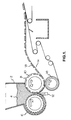
- FIG. 1 of the accompanying drawings A typical biscuit moulding apparatus is shown in Fig. 1 of the accompanying drawings.
- This apparatus comprises a dough hopper 2 from which dough 4 is fed between a pair of closely spaced apart cylindrical rollers 6, 8, which rotate in opposite directions.
- One of these rollers 6, known as the forcing roller has a grooved surface on which a layer of dough builds up.
- rollers 6, 8 rotate, the dough on the first roller is pressed into a number of recesses 10 (typically of the order of 200) in the surface of the second roller 8, which is known as the moulding roller.
- recesses 10 are each engraved with a brand or product name or other design which is to be embossed onto or impressed into the surface of the biscuits. Excess dough which protrudes from the recesses 10 above the surface of the moulding roller 8 is removed by a steel scraper 12 disposed tangentially with respect to the moulding roller 8.
- a moving web 14 is applied to moulding roller 8 by a roller 16 and moulded dough pieces 18, deposited from the moulding roller extraction pressure onto the web 14, are carried away by web 14 for further processing, packaging, etc.
- the moulding rollers have comprised a copper alloy sleeve 20 into which the moulding recesses 22 are engraved, mounted on a steel through-shaft, 24, as shown in Fig.2 of the attached drawings.
- Copper alloys, such as brass, are used for this purpose since they are safe to use in the food industry, they may be readily engraved with intricate patterns using traditional machining processes, they possess good wear properties in use with a steel scraper, and damage to recesses may be readily repaired.
- Moulding rollers of this type have the disadvantage however that, when producing biscuits having intricate designs, dough is prone to stick to the inner surfaces of the recesses 10, reducing productivity.
- the release of dough may be aided by the application of a release coating, e.g. the coating known as "Green Xylan", to the recesses.
- This practice has the disadvantage that the coating wears during production and must therefore be re-applied, incurring costs for materials and downtime and, over a number of coats, eroding the definition of the engraved pattern.
- This type of roller is also heavy and, since manufacturers often provide rollers worldwide, incurs high freight costs.
- Fig. 3 shows a detail of a second known type of roller which aims to overcome the dough release problem.
- the roller is produced as a copper alloy sleeve 26 which is mounted on a steel shaft (not shown).
- the copper alloy sleeve 26 is provided with a plurality of recesses 28 in its outer circumferential surface.
- an individual insert 30 of a plastics material having good wear and dough release properties is disposed, typically by casting, an individual insert 30 of a plastics material having good wear and dough release properties. The required design is engraved into the plastics insert 30 by traditional machining methods.
- rollers of this type have improved dough release properties compared with all-copper alloy rollers, their production is relatively expensive and time-consuming due to the increased processing costs associated with the machining of the recesses 28 in the copper alloy sleeve 26, the casting of the plastic inserts 30 and the engraving of the design, and the time required for the increased number of stages. They are also heavy and costly to transport.
- a third known type of roller is made wholly of a material having good dough release properties, e.g. polyurethane. Such rollers are light and cheap to transport, and have good dough release properties but wear quickly when used with a steel scraper.
- the present invention aims to alleviate the problems associated with known moulding rollers and their production.
- a moulding roller for forming biscuits comprising one or more laminated sleeve components mounted on a supporting shaft, each such sleeve component comprising an outer layer made of a material having strong wear properties, such as a copper alloy, and an inner layer made of a material having a non-stick characteristic for dough, such as a polyurethane plastics material, the outer layer having holes through it which expose areas of the inner layer on which patterns are formed which are to be embossed onto or impressed into the biscuits in use of the moulding roller.
- a moulding roller according to the present invention has the advantage that is has strong wear properties where it is used with a steel scraper while having good, continuous dough release characteristics throughout its life. Such rollers can also be light and may be transported cheaply.
- the present invention also provides a laminated sleeve component for use in the construction of a moulding roller for forming biscuits, the sleeve component comprising an outer layer made of a material having strong wear properties and an inner layer made of a material having a non-stick characteristic for dough, the outer layer having holes through it which expose areas of the inner layer on which patterns are formed which are to be embossed onto or impressed into the biscuits in use of the moulding roller.
- a method of forming a moulding roller for use in biscuit production comprising forming a laminated sleeve having an outer layer made of a material having strong wear properties and an inner layer made of a material having a non-stick characteristic for dough, machining holes through the outer layer to expose areas of the inner layer, and machining a pattern on the exposed areas of the inner layer corresponding to patterns to be embossed onto or impressed into biscuits in use of the moulding roller.
- the holes in the outer layer and the forming of the patterns in the exposed areas of the inner layer are formed in a single machining operation preferably by the same machining tool.
- the or a plurality of laminated sleeves are mounted side by side on a common support shaft in a number dependent on the required length of the moulding roller.
- the laminated structure is achieved by casting the material of the inner layer between an annular ring of said material having strong wear properties and an annular former positioned therewithin.
- the inner surface of the annular ring is provided with a bonding agent prior to casting so as to enhance the bond between the inner and outer laminated layers.
- the material having a non-stick characteristic for dough will normally be a plastics material.
- Polyurethane plastics are preferred but the invention is not limited to their use.
- the material having strong wearing properties can be any suitable material but is normally a metal which is safe to use in the food industry, the preferred metal being a copper alloy such as brass.
- Such a method of producing moulding rollers has the advantages that few process steps are required, reducing production time and costs; and that rollers produced by this method have the advantages hereinbefore described.
- the moulding roller 31 shown in Fig. 5 is made up from a plurality of the individual laminated roller sleeves 33 shown in Fig. 4.
- Each roller sleeve 33 is formed by coating the inner circumference of a plain copper alloy sleeve 34 (initially having no holes) with a bonding agent, placing a smaller diameter former ring (not shown) coaxially within the sleeve 34 and casting a suitable plastics material, e.g. a polyurethane plastics material, into the annular gap between the outer copper alloy sleeve 34 and the former ring.
- a suitable plastics material e.g. a polyurethane plastics material
- the former ring (which is preferably made of steel) is removed and the plastics material is turned and bored to form an inner annular plastics ring 32 within the outer copper alloy sleeve 34.
- the inner ring 32 has a thickness typically of around 12 mm.
- a keyway 36 is machined in the inner circumference of the inner ring to prevent rotation of the roller sleeve relative to a support roller in the form of a steel shaft 38, on which the roller sleeves 33 are mounted for use.
- the keyway 36 may be formed during casting of the inner ring 32 using a suitably shaped former.
- the copper alloy outer sleeve 34 typically has a thickness of about 3 mm.
- Holes 28 (circular in this example) are machined in the outer sleeve corresponding to the biscuit size to be produced. Machining these holes 28 exposes correspondingly shaped areas of the outer circumferential surface of the inner plastics ring 32.
- the machining tool extending through the holes 28 is used to engrave a pattern on these exposed plastics areas corresponding to a desired pattern to be embossed or impressed on the biscuits.
- the roller of Fig. 5 is formed by mounting a number of such roller sleeves 33 on the common support shaft 38, preferably made of steel.
- roller sleeves 33 is selected in accordance with the desired production requirements but could in principle be any number from one upwards.
- the individual holes 28 can be of any peripheral shape, dependent on the desired biscuit shape.
- the number of these holes 28 on the sleeve is again determined by production requirements in accordance with well known practices.
- roller of Fig. 5 is simply substituted for the roller 8 of Fig. 1.
- a roller made up from the roller sleeves 33 of Fig. 4 retains the advantages of having a copper alloy outer face, giving good wear resistance against the steel scraper 12, and engraved plastics faces in the recesses giving good product release properties, whilst being manufactured at a relatively low price that will be attractive in the market place.
- the present roller also has the advantage that it is possible to replace damaged sleeves easily in service, replacement sleeves being light and therefore easily and cheaply transportable, world wide.
- the copper alloy would be brass.
- the plastics material is chosen such as to display the required non-stick characteristic for doughs.
- Polyurethane plastics are suitable for this purpose, although the invention is not limited to the use of that particular type of plastics.
Landscapes
- Life Sciences & Earth Sciences (AREA)
- Engineering & Computer Science (AREA)
- Food Science & Technology (AREA)
- Delivering By Means Of Belts And Rollers (AREA)
- Rolls And Other Rotary Bodies (AREA)
- Rollers For Roller Conveyors For Transfer (AREA)
- Manufacturing And Processing Devices For Dough (AREA)
Applications Claiming Priority (2)
| Application Number | Priority Date | Filing Date | Title |
|---|---|---|---|
| GB9827324 | 1998-12-12 | ||
| GBGB9827324.6A GB9827324D0 (en) | 1998-12-12 | 1998-12-12 | Moulding roller |
Publications (2)
| Publication Number | Publication Date |
|---|---|
| EP1008299A2 true EP1008299A2 (fr) | 2000-06-14 |
| EP1008299A3 EP1008299A3 (fr) | 2001-03-07 |
Family
ID=10844064
Family Applications (1)
| Application Number | Title | Priority Date | Filing Date |
|---|---|---|---|
| EP99309928A Withdrawn EP1008299A3 (fr) | 1998-12-12 | 1999-12-09 | Rouleau de moulage |
Country Status (2)
| Country | Link |
|---|---|
| EP (1) | EP1008299A3 (fr) |
| GB (1) | GB9827324D0 (fr) |
Cited By (8)
| Publication number | Priority date | Publication date | Assignee | Title |
|---|---|---|---|---|
| ITRM20100076A1 (it) * | 2010-02-24 | 2011-08-25 | Zindo S R L | Dispositivo formatore per pasta fresca. |
| CN104365712A (zh) * | 2014-12-08 | 2015-02-25 | 广西大学 | 一种料理模具 |
| EP3395176A1 (fr) * | 2011-02-10 | 2018-10-31 | GEA Food Solutions Bakel B.V. | Rouleau de moulage pour produits alimentaires |
| EP3578050A1 (fr) * | 2018-06-04 | 2019-12-11 | Eti Gida Sanayi Ve Ticaret Anonim Sirketi | Moule en form de disque pour façonner la pâte |
| BE1027724B1 (nl) * | 2019-11-04 | 2021-06-07 | Biscuiterie Jules Destrooper Nv | Methode voor het produceren van een wafel |
| US20220176598A1 (en) * | 2019-05-16 | 2022-06-09 | Pulpac AB | Radial rotary |
| WO2024147889A1 (fr) | 2023-01-05 | 2024-07-11 | General Mills, Inc. | Rouleau d'alimentation à parties surélevées pour acheminer une pâte jusqu'à un rouleau de moulage |
| WO2024147888A1 (fr) | 2023-01-05 | 2024-07-11 | General Mills, Inc. | Rouleau à enveloppes remplaçables |
Family Cites Families (6)
| Publication number | Priority date | Publication date | Assignee | Title |
|---|---|---|---|---|
| US2075157A (en) * | 1934-11-02 | 1937-03-30 | Alberti Elio Joseph | Combined rolling pin and die |
| GB463697A (en) * | 1935-10-04 | 1937-04-05 | Otto Kremmling | Improvements in and relating to moulds or dies for moulding or embossing biscuit dough and the like |
| US3635638A (en) * | 1970-01-09 | 1972-01-18 | H B P Mfg Inc | Roll-forming machine |
| US4625612A (en) * | 1985-09-23 | 1986-12-02 | Riccobin & Martin | Rotary portapunch assembly |
| GB9614683D0 (en) * | 1996-07-12 | 1996-09-04 | Hill Brian D | Improvements relating to biscuit making |
| IES70442B2 (en) * | 1996-09-16 | 1996-11-27 | Oldbridge Investments Ltd | A biscuit manufacturing process |
-
1998
- 1998-12-12 GB GBGB9827324.6A patent/GB9827324D0/en not_active Ceased
-
1999
- 1999-12-09 EP EP99309928A patent/EP1008299A3/fr not_active Withdrawn
Cited By (8)
| Publication number | Priority date | Publication date | Assignee | Title |
|---|---|---|---|---|
| ITRM20100076A1 (it) * | 2010-02-24 | 2011-08-25 | Zindo S R L | Dispositivo formatore per pasta fresca. |
| EP3395176A1 (fr) * | 2011-02-10 | 2018-10-31 | GEA Food Solutions Bakel B.V. | Rouleau de moulage pour produits alimentaires |
| CN104365712A (zh) * | 2014-12-08 | 2015-02-25 | 广西大学 | 一种料理模具 |
| EP3578050A1 (fr) * | 2018-06-04 | 2019-12-11 | Eti Gida Sanayi Ve Ticaret Anonim Sirketi | Moule en form de disque pour façonner la pâte |
| US20220176598A1 (en) * | 2019-05-16 | 2022-06-09 | Pulpac AB | Radial rotary |
| BE1027724B1 (nl) * | 2019-11-04 | 2021-06-07 | Biscuiterie Jules Destrooper Nv | Methode voor het produceren van een wafel |
| WO2024147889A1 (fr) | 2023-01-05 | 2024-07-11 | General Mills, Inc. | Rouleau d'alimentation à parties surélevées pour acheminer une pâte jusqu'à un rouleau de moulage |
| WO2024147888A1 (fr) | 2023-01-05 | 2024-07-11 | General Mills, Inc. | Rouleau à enveloppes remplaçables |
Also Published As
| Publication number | Publication date |
|---|---|
| GB9827324D0 (en) | 1999-02-03 |
| EP1008299A3 (fr) | 2001-03-07 |
Similar Documents
| Publication | Publication Date | Title |
|---|---|---|
| US5189935A (en) | Rotary cutting die assembly | |
| EP1008299A2 (fr) | Rouleau de moulage | |
| EP4417424A3 (fr) | Procédé de fabrication additive | |
| EP0373481B1 (fr) | Rouleau de guidage de bande et procédé pour la réalisation d'un tel rouleau | |
| JP5042871B2 (ja) | 金属箔材の製造方法 | |
| US6196818B1 (en) | Mold section and die ribs for tire curing mold | |
| EP0938971A3 (fr) | Procédé de fabrication d'un ensemble stratifié | |
| JP2018526222A (ja) | 鋼製コア部を有する部品の製造方法 | |
| US5188030A (en) | Inking roller for a lithographic printing machine | |
| JP2005173558A (ja) | 円周面の加工方法、現像ローラ及び感光ドラムの製造方法並びに現像ローラ及び感光ドラム | |
| US6601992B2 (en) | Thrust bearing and method of fabricating a thrust bearing | |
| CN116917636A (zh) | 轴承组成部件 | |
| GB2308559A (en) | Removing aluminium films from a ladle of a gravity die casting machine using high pressure air | |
| EP1208953A2 (fr) | Moyens de décoration | |
| US20030061923A1 (en) | Cast ceramic edge or embossed surface for a cutting die | |
| JPH1177694A (ja) | タイヤ加硫成形用金型 | |
| JP6785733B2 (ja) | 型ロール及び型ロールの製造方法 | |
| EP0818147A1 (fr) | Fabrication de biscuits | |
| EP1083062A2 (fr) | Procédé de réalisation de matrices pour utilisation avec des carreaux céramiques décorés | |
| JP2510764B2 (ja) | 超硬合金製ダイスの製造法 | |
| JP3079399U (ja) | 樹脂製エンボスロール型 | |
| JP7425519B1 (ja) | 射出成形品の製造方法、模様形成体および射出成形品 | |
| JP2020040098A (ja) | アルミホイール製造ラインおよびアルミホイール製造ラインの個体管理方法 | |
| EP1834768A1 (fr) | Moyens de décoration tubulaire | |
| CN106476261A (zh) | 一种压花辊及其制造方法 |
Legal Events
| Date | Code | Title | Description |
|---|---|---|---|
| PUAI | Public reference made under article 153(3) epc to a published international application that has entered the european phase |
Free format text: ORIGINAL CODE: 0009012 |
|
| AK | Designated contracting states |
Kind code of ref document: A2 Designated state(s): AT BE CH CY DE DK ES FI FR GB GR IE IT LI LU MC NL PT SE |
|
| AX | Request for extension of the european patent |
Free format text: AL;LT;LV;MK;RO;SI |
|
| PUAL | Search report despatched |
Free format text: ORIGINAL CODE: 0009013 |
|
| AK | Designated contracting states |
Kind code of ref document: A3 Designated state(s): AT BE CH CY DE DK ES FI FR GB GR IE IT LI LU MC NL PT SE |
|
| AX | Request for extension of the european patent |
Free format text: AL;LT;LV;MK;RO;SI |
|
| AKX | Designation fees paid | ||
| STAA | Information on the status of an ep patent application or granted ep patent |
Free format text: STATUS: THE APPLICATION IS DEEMED TO BE WITHDRAWN |
|
| 18D | Application deemed to be withdrawn |
Effective date: 20010908 |
|
| REG | Reference to a national code |
Ref country code: DE Ref legal event code: 8566 |