EP1008306B1 - Polysaccharid zur Verminderung der psylliuminduzierten Viskosität, und Nahrungsmittel enthaltend Psyllium und dieses Polysaccharid - Google Patents
Polysaccharid zur Verminderung der psylliuminduzierten Viskosität, und Nahrungsmittel enthaltend Psyllium und dieses Polysaccharid Download PDFInfo
- Publication number
- EP1008306B1 EP1008306B1 EP99309906A EP99309906A EP1008306B1 EP 1008306 B1 EP1008306 B1 EP 1008306B1 EP 99309906 A EP99309906 A EP 99309906A EP 99309906 A EP99309906 A EP 99309906A EP 1008306 B1 EP1008306 B1 EP 1008306B1
- Authority
- EP
- European Patent Office
- Prior art keywords
- psyllium
- polysaccharide
- viscosity
- starch
- aqueous solution
- Prior art date
- Legal status (The legal status is an assumption and is not a legal conclusion. Google has not performed a legal analysis and makes no representation as to the accuracy of the status listed.)
- Expired - Lifetime
Links
- 235000003421 Plantago ovata Nutrition 0.000 title claims abstract description 235
- 239000009223 Psyllium Substances 0.000 title claims abstract description 235
- 229940070687 psyllium Drugs 0.000 title claims abstract description 235
- 150000004676 glycans Chemical class 0.000 title claims abstract description 147
- 229920001282 polysaccharide Polymers 0.000 title claims abstract description 147
- 239000005017 polysaccharide Substances 0.000 title claims abstract description 147
- 235000013305 food Nutrition 0.000 title claims abstract description 50
- 241001499733 Plantago asiatica Species 0.000 title abstract description 9
- 238000000034 method Methods 0.000 claims abstract description 46
- 238000010438 heat treatment Methods 0.000 claims abstract description 34
- 238000004519 manufacturing process Methods 0.000 claims abstract description 26
- 244000134552 Plantago ovata Species 0.000 claims description 227
- 229920002472 Starch Polymers 0.000 claims description 68
- 235000019698 starch Nutrition 0.000 claims description 67
- 239000008107 starch Substances 0.000 claims description 66
- 239000007864 aqueous solution Substances 0.000 claims description 50
- 229920000881 Modified starch Polymers 0.000 claims description 49
- 235000019426 modified starch Nutrition 0.000 claims description 49
- 239000000243 solution Substances 0.000 claims description 47
- 239000000203 mixture Substances 0.000 claims description 41
- 239000004368 Modified starch Substances 0.000 claims description 38
- 239000002253 acid Substances 0.000 claims description 35
- 240000003183 Manihot esculenta Species 0.000 claims description 34
- 235000016735 Manihot esculenta subsp esculenta Nutrition 0.000 claims description 34
- -1 hydroxypropyl Chemical group 0.000 claims description 34
- 235000021056 liquid food Nutrition 0.000 claims description 30
- 239000002245 particle Substances 0.000 claims description 21
- 229920002261 Corn starch Polymers 0.000 claims description 20
- 239000008120 corn starch Substances 0.000 claims description 20
- 229940099112 cornstarch Drugs 0.000 claims description 20
- 244000215068 Acacia senegal Species 0.000 claims description 17
- 229920000084 Gum arabic Polymers 0.000 claims description 17
- 235000010489 acacia gum Nutrition 0.000 claims description 17
- 239000000205 acacia gum Substances 0.000 claims description 17
- 230000001954 sterilising effect Effects 0.000 claims description 17
- GUOCOOQWZHQBJI-UHFFFAOYSA-N 4-oct-7-enoxy-4-oxobutanoic acid Chemical compound OC(=O)CCC(=O)OCCCCCCC=C GUOCOOQWZHQBJI-UHFFFAOYSA-N 0.000 claims description 16
- 229920001592 potato starch Polymers 0.000 claims description 14
- 238000012856 packing Methods 0.000 claims description 13
- 235000013325 dietary fiber Nutrition 0.000 claims description 12
- SATHPVQTSSUFFW-UHFFFAOYSA-N 4-[6-[(3,5-dihydroxy-4-methoxyoxan-2-yl)oxymethyl]-3,5-dihydroxy-4-methoxyoxan-2-yl]oxy-2-(hydroxymethyl)-6-methyloxane-3,5-diol Chemical compound OC1C(OC)C(O)COC1OCC1C(O)C(OC)C(O)C(OC2C(C(CO)OC(C)C2O)O)O1 SATHPVQTSSUFFW-UHFFFAOYSA-N 0.000 claims description 8
- 229920000189 Arabinogalactan Polymers 0.000 claims description 8
- 239000001904 Arabinogalactan Substances 0.000 claims description 8
- 235000019312 arabinogalactan Nutrition 0.000 claims description 8
- 235000013373 food additive Nutrition 0.000 claims description 7
- 239000002778 food additive Substances 0.000 claims description 7
- 238000007789 sealing Methods 0.000 claims description 6
- 229920002907 Guar gum Polymers 0.000 claims description 5
- 239000004373 Pullulan Substances 0.000 claims description 5
- 229920001218 Pullulan Polymers 0.000 claims description 5
- 238000006266 etherification reaction Methods 0.000 claims description 5
- 235000010417 guar gum Nutrition 0.000 claims description 5
- 239000000665 guar gum Substances 0.000 claims description 5
- 229960002154 guar gum Drugs 0.000 claims description 5
- 235000019423 pullulan Nutrition 0.000 claims description 5
- 230000003647 oxidation Effects 0.000 claims description 3
- 238000007254 oxidation reaction Methods 0.000 claims description 3
- 230000032050 esterification Effects 0.000 claims description 2
- 238000005886 esterification reaction Methods 0.000 claims description 2
- 235000019629 palatability Nutrition 0.000 abstract description 15
- 239000004615 ingredient Substances 0.000 abstract description 10
- 230000002829 reductive effect Effects 0.000 abstract description 5
- 230000009286 beneficial effect Effects 0.000 abstract description 4
- 230000002349 favourable effect Effects 0.000 abstract description 4
- XLYOFNOQVPJJNP-UHFFFAOYSA-N water Substances O XLYOFNOQVPJJNP-UHFFFAOYSA-N 0.000 description 53
- 230000000694 effects Effects 0.000 description 49
- 239000000499 gel Substances 0.000 description 32
- 239000000523 sample Substances 0.000 description 30
- 239000000843 powder Substances 0.000 description 25
- 230000036571 hydration Effects 0.000 description 22
- 238000006703 hydration reaction Methods 0.000 description 22
- 230000015572 biosynthetic process Effects 0.000 description 13
- 238000004659 sterilization and disinfection Methods 0.000 description 13
- HEMHJVSKTPXQMS-UHFFFAOYSA-M Sodium hydroxide Chemical compound [OH-].[Na+] HEMHJVSKTPXQMS-UHFFFAOYSA-M 0.000 description 12
- 230000004075 alteration Effects 0.000 description 12
- KRKNYBCHXYNGOX-UHFFFAOYSA-N citric acid Chemical compound OC(=O)CC(O)(C(O)=O)CC(O)=O KRKNYBCHXYNGOX-UHFFFAOYSA-N 0.000 description 12
- 230000036962 time dependent Effects 0.000 description 12
- 238000004090 dissolution Methods 0.000 description 11
- 235000013361 beverage Nutrition 0.000 description 10
- 239000000463 material Substances 0.000 description 10
- 229920001353 Dextrin Polymers 0.000 description 9
- 239000004375 Dextrin Substances 0.000 description 9
- 238000001816 cooling Methods 0.000 description 9
- 235000019425 dextrin Nutrition 0.000 description 9
- 238000005469 granulation Methods 0.000 description 9
- 230000003179 granulation Effects 0.000 description 9
- 150000002500 ions Chemical group 0.000 description 9
- 230000001766 physiological effect Effects 0.000 description 9
- 230000009467 reduction Effects 0.000 description 9
- 229920002245 Dextrose equivalent Polymers 0.000 description 8
- 239000006185 dispersion Substances 0.000 description 8
- 235000011389 fruit/vegetable juice Nutrition 0.000 description 8
- 239000000047 product Substances 0.000 description 8
- 235000009508 confectionery Nutrition 0.000 description 7
- 235000014109 instant soup Nutrition 0.000 description 7
- 230000000968 intestinal effect Effects 0.000 description 7
- 238000002360 preparation method Methods 0.000 description 7
- 230000008719 thickening Effects 0.000 description 7
- 238000009835 boiling Methods 0.000 description 6
- 238000009826 distribution Methods 0.000 description 6
- 230000029087 digestion Effects 0.000 description 5
- 235000021552 granulated sugar Nutrition 0.000 description 5
- 239000007788 liquid Substances 0.000 description 5
- 229920001817 Agar Polymers 0.000 description 4
- CIWBSHSKHKDKBQ-JLAZNSOCSA-N Ascorbic acid Chemical compound OC[C@H](O)[C@H]1OC(=O)C(O)=C1O CIWBSHSKHKDKBQ-JLAZNSOCSA-N 0.000 description 4
- 239000008272 agar Substances 0.000 description 4
- 230000006862 enzymatic digestion Effects 0.000 description 4
- 238000011156 evaluation Methods 0.000 description 4
- 239000000796 flavoring agent Substances 0.000 description 4
- 238000001641 gel filtration chromatography Methods 0.000 description 4
- 230000004048 modification Effects 0.000 description 4
- 238000012986 modification Methods 0.000 description 4
- 239000008363 phosphate buffer Substances 0.000 description 4
- 210000000813 small intestine Anatomy 0.000 description 4
- 210000002784 stomach Anatomy 0.000 description 4
- 235000000346 sugar Nutrition 0.000 description 4
- 239000006228 supernatant Substances 0.000 description 4
- 235000008429 bread Nutrition 0.000 description 3
- 230000001186 cumulative effect Effects 0.000 description 3
- 235000019634 flavors Nutrition 0.000 description 3
- 238000002156 mixing Methods 0.000 description 3
- 235000012149 noodles Nutrition 0.000 description 3
- 150000007524 organic acids Chemical class 0.000 description 3
- 238000012545 processing Methods 0.000 description 3
- 230000004044 response Effects 0.000 description 3
- 239000007787 solid Substances 0.000 description 3
- 239000000126 substance Substances 0.000 description 3
- 241000196324 Embryophyta Species 0.000 description 2
- 102100037815 Fas apoptotic inhibitory molecule 3 Human genes 0.000 description 2
- 239000005715 Fructose Substances 0.000 description 2
- 229930091371 Fructose Natural products 0.000 description 2
- RFSUNEUAIZKAJO-ARQDHWQXSA-N Fructose Chemical compound OC[C@H]1O[C@](O)(CO)[C@@H](O)[C@@H]1O RFSUNEUAIZKAJO-ARQDHWQXSA-N 0.000 description 2
- 244000068988 Glycine max Species 0.000 description 2
- 235000010469 Glycine max Nutrition 0.000 description 2
- 101000878510 Homo sapiens Fas apoptotic inhibitory molecule 3 Proteins 0.000 description 2
- 108010019160 Pancreatin Proteins 0.000 description 2
- 102000057297 Pepsin A Human genes 0.000 description 2
- 108090000284 Pepsin A Proteins 0.000 description 2
- 241001127637 Plantago Species 0.000 description 2
- 244000090599 Plantago psyllium Species 0.000 description 2
- 235000010451 Plantago psyllium Nutrition 0.000 description 2
- DLRVVLDZNNYCBX-UHFFFAOYSA-N Polydextrose Polymers OC1C(O)C(O)C(CO)OC1OCC1C(O)C(O)C(O)C(O)O1 DLRVVLDZNNYCBX-UHFFFAOYSA-N 0.000 description 2
- 235000009754 Vitis X bourquina Nutrition 0.000 description 2
- 235000012333 Vitis X labruscana Nutrition 0.000 description 2
- 240000006365 Vitis vinifera Species 0.000 description 2
- 235000014787 Vitis vinifera Nutrition 0.000 description 2
- 235000002017 Zea mays subsp mays Nutrition 0.000 description 2
- 230000009471 action Effects 0.000 description 2
- 230000002411 adverse Effects 0.000 description 2
- 239000011668 ascorbic acid Substances 0.000 description 2
- 235000010323 ascorbic acid Nutrition 0.000 description 2
- 229960005070 ascorbic acid Drugs 0.000 description 2
- 239000008280 blood Substances 0.000 description 2
- 210000004369 blood Anatomy 0.000 description 2
- 235000013339 cereals Nutrition 0.000 description 2
- 239000000470 constituent Substances 0.000 description 2
- 230000001276 controlling effect Effects 0.000 description 2
- 235000013365 dairy product Nutrition 0.000 description 2
- 230000002542 deteriorative effect Effects 0.000 description 2
- 230000035622 drinking Effects 0.000 description 2
- 235000005686 eating Nutrition 0.000 description 2
- 238000002474 experimental method Methods 0.000 description 2
- 239000000835 fiber Substances 0.000 description 2
- 235000021554 flavoured beverage Nutrition 0.000 description 2
- 230000009969 flowable effect Effects 0.000 description 2
- 239000011888 foil Substances 0.000 description 2
- 235000011194 food seasoning agent Nutrition 0.000 description 2
- 235000003599 food sweetener Nutrition 0.000 description 2
- 235000015203 fruit juice Nutrition 0.000 description 2
- 238000002523 gelfiltration Methods 0.000 description 2
- 235000019674 grape juice Nutrition 0.000 description 2
- 230000036541 health Effects 0.000 description 2
- 239000010903 husk Substances 0.000 description 2
- 210000002429 large intestine Anatomy 0.000 description 2
- 239000008141 laxative Substances 0.000 description 2
- 230000002475 laxative effect Effects 0.000 description 2
- 229910052751 metal Inorganic materials 0.000 description 2
- 239000002184 metal Substances 0.000 description 2
- 229940055695 pancreatin Drugs 0.000 description 2
- 239000001814 pectin Substances 0.000 description 2
- 229920001277 pectin Polymers 0.000 description 2
- 235000010987 pectin Nutrition 0.000 description 2
- 229940111202 pepsin Drugs 0.000 description 2
- 239000012071 phase Substances 0.000 description 2
- 239000002985 plastic film Substances 0.000 description 2
- 229920006255 plastic film Polymers 0.000 description 2
- 230000008569 process Effects 0.000 description 2
- 235000020991 processed meat Nutrition 0.000 description 2
- 238000000746 purification Methods 0.000 description 2
- 235000014102 seafood Nutrition 0.000 description 2
- 235000014347 soups Nutrition 0.000 description 2
- 239000003765 sweetening agent Substances 0.000 description 2
- 239000002562 thickening agent Substances 0.000 description 2
- 244000303965 Cyamopsis psoralioides Species 0.000 description 1
- FEWJPZIEWOKRBE-JCYAYHJZSA-N Dextrotartaric acid Chemical compound OC(=O)[C@H](O)[C@@H](O)C(O)=O FEWJPZIEWOKRBE-JCYAYHJZSA-N 0.000 description 1
- 239000004278 EU approved seasoning Substances 0.000 description 1
- WQZGKKKJIJFFOK-GASJEMHNSA-N Glucose Natural products OC[C@H]1OC(O)[C@H](O)[C@@H](O)[C@@H]1O WQZGKKKJIJFFOK-GASJEMHNSA-N 0.000 description 1
- 229920000161 Locust bean gum Polymers 0.000 description 1
- 235000003805 Musa ABB Group Nutrition 0.000 description 1
- 229910019142 PO4 Inorganic materials 0.000 description 1
- 241000013557 Plantaginaceae Species 0.000 description 1
- 235000015266 Plantago major Nutrition 0.000 description 1
- 229920001100 Polydextrose Polymers 0.000 description 1
- 108010009736 Protein Hydrolysates Proteins 0.000 description 1
- FAPWRFPIFSIZLT-UHFFFAOYSA-M Sodium chloride Chemical compound [Na+].[Cl-] FAPWRFPIFSIZLT-UHFFFAOYSA-M 0.000 description 1
- 239000005708 Sodium hypochlorite Substances 0.000 description 1
- FEWJPZIEWOKRBE-UHFFFAOYSA-N Tartaric acid Natural products [H+].[H+].[O-]C(=O)C(O)C(O)C([O-])=O FEWJPZIEWOKRBE-UHFFFAOYSA-N 0.000 description 1
- 229920001938 Vegetable gum Polymers 0.000 description 1
- 240000008042 Zea mays Species 0.000 description 1
- 235000005824 Zea mays ssp. parviglumis Nutrition 0.000 description 1
- 241000482268 Zea mays subsp. mays Species 0.000 description 1
- 229920002494 Zein Polymers 0.000 description 1
- 150000001242 acetic acid derivatives Chemical class 0.000 description 1
- 238000013019 agitation Methods 0.000 description 1
- 150000001413 amino acids Chemical class 0.000 description 1
- 238000004458 analytical method Methods 0.000 description 1
- 239000003963 antioxidant agent Substances 0.000 description 1
- 230000003078 antioxidant effect Effects 0.000 description 1
- 235000006708 antioxidants Nutrition 0.000 description 1
- 235000015197 apple juice Nutrition 0.000 description 1
- 239000008346 aqueous phase Substances 0.000 description 1
- 230000004888 barrier function Effects 0.000 description 1
- 230000009704 beneficial physiological effect Effects 0.000 description 1
- WQZGKKKJIJFFOK-VFUOTHLCSA-N beta-D-glucose Chemical compound OC[C@H]1O[C@@H](O)[C@H](O)[C@@H](O)[C@@H]1O WQZGKKKJIJFFOK-VFUOTHLCSA-N 0.000 description 1
- 238000011088 calibration curve Methods 0.000 description 1
- 150000001720 carbohydrates Chemical class 0.000 description 1
- 125000002057 carboxymethyl group Chemical group [H]OC(=O)C([H])([H])[*] 0.000 description 1
- 239000012876 carrier material Substances 0.000 description 1
- 238000012512 characterization method Methods 0.000 description 1
- 239000003153 chemical reaction reagent Substances 0.000 description 1
- 238000004140 cleaning Methods 0.000 description 1
- 230000015271 coagulation Effects 0.000 description 1
- 238000005345 coagulation Methods 0.000 description 1
- 239000013068 control sample Substances 0.000 description 1
- 238000007796 conventional method Methods 0.000 description 1
- 235000005822 corn Nutrition 0.000 description 1
- 230000002950 deficient Effects 0.000 description 1
- 230000003111 delayed effect Effects 0.000 description 1
- 238000001212 derivatisation Methods 0.000 description 1
- 201000010099 disease Diseases 0.000 description 1
- 208000037265 diseases, disorders, signs and symptoms Diseases 0.000 description 1
- 235000006694 eating habits Nutrition 0.000 description 1
- 150000002148 esters Chemical class 0.000 description 1
- 239000000284 extract Substances 0.000 description 1
- 239000012847 fine chemical Substances 0.000 description 1
- 239000012530 fluid Substances 0.000 description 1
- 230000037406 food intake Effects 0.000 description 1
- 238000005194 fractionation Methods 0.000 description 1
- 230000007760 free radical scavenging Effects 0.000 description 1
- 239000008103 glucose Substances 0.000 description 1
- 239000008187 granular material Substances 0.000 description 1
- 238000000265 homogenisation Methods 0.000 description 1
- 201000001421 hyperglycemia Diseases 0.000 description 1
- 230000006872 improvement Effects 0.000 description 1
- 238000000338 in vitro Methods 0.000 description 1
- 229910052500 inorganic mineral Inorganic materials 0.000 description 1
- 210000000936 intestine Anatomy 0.000 description 1
- 235000015110 jellies Nutrition 0.000 description 1
- 239000008274 jelly Substances 0.000 description 1
- 239000002648 laminated material Substances 0.000 description 1
- 235000010420 locust bean gum Nutrition 0.000 description 1
- 239000000711 locust bean gum Substances 0.000 description 1
- 238000005259 measurement Methods 0.000 description 1
- 235000013336 milk Nutrition 0.000 description 1
- 239000008267 milk Substances 0.000 description 1
- 210000004080 milk Anatomy 0.000 description 1
- 238000003801 milling Methods 0.000 description 1
- 239000011707 mineral Substances 0.000 description 1
- 235000010755 mineral Nutrition 0.000 description 1
- 239000011812 mixed powder Substances 0.000 description 1
- 238000002715 modification method Methods 0.000 description 1
- 235000016709 nutrition Nutrition 0.000 description 1
- 229920001542 oligosaccharide Polymers 0.000 description 1
- 150000002482 oligosaccharides Chemical class 0.000 description 1
- 235000021317 phosphate Nutrition 0.000 description 1
- 150000003013 phosphoric acid derivatives Chemical class 0.000 description 1
- 239000004033 plastic Substances 0.000 description 1
- 229920003023 plastic Polymers 0.000 description 1
- 235000013856 polydextrose Nutrition 0.000 description 1
- 239000001259 polydextrose Substances 0.000 description 1
- 229940035035 polydextrose Drugs 0.000 description 1
- 150000008442 polyphenolic compounds Chemical class 0.000 description 1
- 235000013824 polyphenols Nutrition 0.000 description 1
- 229940116317 potato starch Drugs 0.000 description 1
- 230000003389 potentiating effect Effects 0.000 description 1
- 230000002265 prevention Effects 0.000 description 1
- 230000002035 prolonged effect Effects 0.000 description 1
- 239000003531 protein hydrolysate Substances 0.000 description 1
- 108090000623 proteins and genes Proteins 0.000 description 1
- 102000004169 proteins and genes Human genes 0.000 description 1
- 239000008213 purified water Substances 0.000 description 1
- 235000021067 refined food Nutrition 0.000 description 1
- 230000000717 retained effect Effects 0.000 description 1
- 229940100486 rice starch Drugs 0.000 description 1
- 239000012488 sample solution Substances 0.000 description 1
- 230000036186 satiety Effects 0.000 description 1
- 235000019627 satiety Nutrition 0.000 description 1
- 239000000344 soap Substances 0.000 description 1
- 235000002639 sodium chloride Nutrition 0.000 description 1
- 239000011780 sodium chloride Substances 0.000 description 1
- 239000001509 sodium citrate Substances 0.000 description 1
- NLJMYIDDQXHKNR-UHFFFAOYSA-K sodium citrate Chemical compound O.O.[Na+].[Na+].[Na+].[O-]C(=O)CC(O)(CC([O-])=O)C([O-])=O NLJMYIDDQXHKNR-UHFFFAOYSA-K 0.000 description 1
- 235000011083 sodium citrates Nutrition 0.000 description 1
- SUKJFIGYRHOWBL-UHFFFAOYSA-N sodium hypochlorite Chemical compound [Na+].Cl[O-] SUKJFIGYRHOWBL-UHFFFAOYSA-N 0.000 description 1
- 238000005063 solubilization Methods 0.000 description 1
- 230000007928 solubilization Effects 0.000 description 1
- 230000002269 spontaneous effect Effects 0.000 description 1
- 239000007921 spray Substances 0.000 description 1
- 229940032147 starch Drugs 0.000 description 1
- 239000007858 starting material Substances 0.000 description 1
- 230000003068 static effect Effects 0.000 description 1
- 239000004094 surface-active agent Substances 0.000 description 1
- 230000002459 sustained effect Effects 0.000 description 1
- 230000008961 swelling Effects 0.000 description 1
- 230000002195 synergetic effect Effects 0.000 description 1
- 235000010491 tara gum Nutrition 0.000 description 1
- 239000000213 tara gum Substances 0.000 description 1
- 239000011975 tartaric acid Substances 0.000 description 1
- 235000002906 tartaric acid Nutrition 0.000 description 1
- 238000012360 testing method Methods 0.000 description 1
- 235000013311 vegetables Nutrition 0.000 description 1
- 235000013343 vitamin Nutrition 0.000 description 1
- 239000011782 vitamin Substances 0.000 description 1
- 229940088594 vitamin Drugs 0.000 description 1
- 229930003231 vitamin Natural products 0.000 description 1
- 229940100445 wheat starch Drugs 0.000 description 1
- 239000005019 zein Substances 0.000 description 1
- 229940093612 zein Drugs 0.000 description 1
Images


Classifications
-
- A—HUMAN NECESSITIES
- A23—FOODS OR FOODSTUFFS; TREATMENT THEREOF, NOT COVERED BY OTHER CLASSES
- A23L—FOODS, FOODSTUFFS OR NON-ALCOHOLIC BEVERAGES, NOT OTHERWISE PROVIDED FOR; PREPARATION OR TREATMENT THEREOF
- A23L2/00—Non-alcoholic beverages; Dry compositions or concentrates therefor; Preparation or treatment thereof
- A23L2/52—Adding ingredients
-
- A—HUMAN NECESSITIES
- A23—FOODS OR FOODSTUFFS; TREATMENT THEREOF, NOT COVERED BY OTHER CLASSES
- A23L—FOODS, FOODSTUFFS OR NON-ALCOHOLIC BEVERAGES, NOT OTHERWISE PROVIDED FOR; PREPARATION OR TREATMENT THEREOF
- A23L2/00—Non-alcoholic beverages; Dry compositions or concentrates therefor; Preparation or treatment thereof
- A23L2/385—Concentrates of non-alcoholic beverages
- A23L2/39—Dry compositions
-
- A—HUMAN NECESSITIES
- A23—FOODS OR FOODSTUFFS; TREATMENT THEREOF, NOT COVERED BY OTHER CLASSES
- A23L—FOODS, FOODSTUFFS OR NON-ALCOHOLIC BEVERAGES, NOT OTHERWISE PROVIDED FOR; PREPARATION OR TREATMENT THEREOF
- A23L29/00—Foods or foodstuffs containing additives; Preparation or treatment thereof
- A23L29/20—Foods or foodstuffs containing additives; Preparation or treatment thereof containing gelling or thickening agents
- A23L29/206—Foods or foodstuffs containing additives; Preparation or treatment thereof containing gelling or thickening agents of vegetable origin
- A23L29/212—Starch; Modified starch; Starch derivatives, e.g. esters or ethers
- A23L29/219—Chemically modified starch; Reaction or complexation products of starch with other chemicals
-
- A—HUMAN NECESSITIES
- A23—FOODS OR FOODSTUFFS; TREATMENT THEREOF, NOT COVERED BY OTHER CLASSES
- A23L—FOODS, FOODSTUFFS OR NON-ALCOHOLIC BEVERAGES, NOT OTHERWISE PROVIDED FOR; PREPARATION OR TREATMENT THEREOF
- A23L29/00—Foods or foodstuffs containing additives; Preparation or treatment thereof
- A23L29/20—Foods or foodstuffs containing additives; Preparation or treatment thereof containing gelling or thickening agents
- A23L29/206—Foods or foodstuffs containing additives; Preparation or treatment thereof containing gelling or thickening agents of vegetable origin
- A23L29/238—Foods or foodstuffs containing additives; Preparation or treatment thereof containing gelling or thickening agents of vegetable origin from seeds, e.g. locust bean gum or guar gum
-
- A—HUMAN NECESSITIES
- A23—FOODS OR FOODSTUFFS; TREATMENT THEREOF, NOT COVERED BY OTHER CLASSES
- A23L—FOODS, FOODSTUFFS OR NON-ALCOHOLIC BEVERAGES, NOT OTHERWISE PROVIDED FOR; PREPARATION OR TREATMENT THEREOF
- A23L29/00—Foods or foodstuffs containing additives; Preparation or treatment thereof
- A23L29/20—Foods or foodstuffs containing additives; Preparation or treatment thereof containing gelling or thickening agents
- A23L29/206—Foods or foodstuffs containing additives; Preparation or treatment thereof containing gelling or thickening agents of vegetable origin
- A23L29/25—Exudates, e.g. gum arabic, gum acacia, gum karaya or tragacanth
-
- A—HUMAN NECESSITIES
- A23—FOODS OR FOODSTUFFS; TREATMENT THEREOF, NOT COVERED BY OTHER CLASSES
- A23L—FOODS, FOODSTUFFS OR NON-ALCOHOLIC BEVERAGES, NOT OTHERWISE PROVIDED FOR; PREPARATION OR TREATMENT THEREOF
- A23L33/00—Modifying nutritive qualities of foods; Dietetic products; Preparation or treatment thereof
- A23L33/20—Reducing nutritive value; Dietetic products with reduced nutritive value
- A23L33/21—Addition of substantially indigestible substances, e.g. dietary fibres
Definitions
- the present invention relates to a polysaccharide which is useful as an ingredient of several kinds of foods containing psyllium which is known to result in high viscosity when incorporated into a hydrated condition.
- a polysaccharide which can reduce viscosity resulting from psyllium is provided.
- a food additive composition containing the polysaccharide and psyllium is provided, which can readily be incorporated into foods without a loss of beneficial effects of psyllium and without undesirable elevation of the viscosity of the foods.
- the present invention also provides a food product characterized by its ingredients which are the psyllium viscosity-reducing polysaccharide and psyllium, and a method for manufacturing thereof characterized by its excellent handling feasibility and favorable palatability of the product.
- psyllium among dietary fibers, which was reported to have excellent water-retaining capability and swelling ability, as well as various physiological effects such as intestinal function-controlling effect, blood lipid- controlling effect, hyperglycemia-suppressing effect, and blood cholesterol-reducing effect, and which is hardly digested and has low calories but allows to have a sense of satiety, whereby being expected to have a weight controlling effect.
- Psyllium is a naturally occurring vegetable gum derived from a seed of a plant of Plantago species, such as Plantago Ovata Forskal, which is a kind of plantains cultivated in Bengal and Gujarat states in India.
- Psyllium forms a highly viscous dispersion when hydrated, and it may form a dispersion having the viscosity as high as about 4000 cp (centipoise, determined using a type B viscometer with Rotor No. 3, at 30 rpm and 25° C) for example, even when added at a concentration as low as 1 % by weight. When it is hydrated at 2% by weight, it usually forms a gelatin-like clear gel.
- a hard gel mass When a 1% dispersion is heated to 90° C and then cooled, a hard gel mass may be formed.
- the viscosity which is exhibited as described above, is several or several ten times greater when compared with other thickening polysaccharides, added at the same concentration, such as guar gum, locust bean gum and tara gum.
- any of these thickening polysaccharides shows fluidity even when high viscosity was resulted, psyllium exhibits both of high viscosity and high gelling ability.
- psyllium when psyllium is incorporated into food products such as beverages, confectioneries, breads and noodles in an attempt to obtain the physiological effects such as the intestine function-controlling effect as described above, the psyllium may be swollen during the manufacturing process later than the step of mixing with water due to the physical characteristics described above, thereby resulting in high viscosity.
- the problems such as difficulties in processing and adverse effects on palatability are experienced, and the application to the field of a food processing industry has been hampered. Therefore, a technique to suppress the onset of the elevated viscosity and gel-forming characteristics in response to the hydration of psyllium is still desired for the purpose of obtaining a better handling of psyllium to be incorporated into various food products.
- a conventional method for suppressing the onset of the elevated viscosity resulting psyllium is shown in Japanese Patent Application Laid-Open NO. 5-15340, which disclosed a method for processing a dietary fiber psyllium in which an agar solution prepared by heating for dissolution is supplemented with psyllium powder and then solidified by cooling.
- the coagulated psyllium and agar should be used together actually as a pulverized solid, and thus the reduction in the gelling ability of the psyllium alone in a hydration system is not any how achieved.
- the usable form as a pulverized solid including agar the scope of the applicable food products is obliged to be limited.
- US Patent 5,073,370 describes an all-natural, low calorie, high natural fibre laxative containing psyllium husks, apple fibre, fructose, gum arabic and flavourants which is in the form of a dry powder to be mixed with water for ingestion; and US Patent 5,338,549 describes a powered drink mix composition containing psyllium husks, a carrier material selected from various saccharides, and a minor amount of a free radical-scavenging anti-oxidant, mixable with water to form a liquid laxative.
- US Patent 5,523,014 describes a procedure whereby an originally viscous, non-flowable and non-pumpable cleaning composition including an oil phase incorporating a soap surfactant and a water phase, is rendered less viscous, flowable and pumpable by addition of a thickening agent, one exemplified thickening agent being a combination of psyllium and hydroxypropyl guar.
- the present invention seeks to provide a procedure for suppressing the onset of the elevated viscosity and gel-forming characteristics (herein referred to simply as "viscosity”) resulting from psyllium in response to the hydration thereof without deteriorating the physiological effects associated naturally with psyllium, such as intestinal function-controlling effects.
- the invention is based on the unexpected discovery that when certain polysaccharides such as a specified starch is present in a hydration system of psyllium, the onset of elevated viscosity in psyllium hydrate can be significantly suppressed.
- a polysaccharide for reducing the viscosity resulting from psyllium having a molecular weight of 20,000 or more and a viscosity in 2% by weight aqueous solution of 9.0 cp or less (determined using a type B viscometer with Rotor No. 1, at 60 rpm and 25° C).
- an aspect of the present invention is to provide a polysaccharide for reducing the viscosity resulting from psyllium (i.e., "a psyllium viscosity-reducing polysaccharide") having a molecular weight of 20,000 or greater and viscosity of an aqueous solution at 2% by weight of 9.0 cp or less (determined using a type B viscometer with Rotor No. 1, at 60 rpm and 25° C).
- a polysaccharide having these characteristics can reduce the viscosity in a psyllium hydrate system without deteriorating any useful physiological property possessed naturally by psyllium and without causing any interference in the manufacturing process or any adverse effect on the palatability when incorporated into a water containing food.
- the psyllium viscosity-reducing polysaccharide according to the present invention may be preferably granulated to impart a desirable psyllium viscosity-reducing ability.
- Such polysaccharides can efficiently prolong the onset of the elevated viscosity upon hydration of psyllium, thus it is advantageously used for the manufacture of the powdered food for preparing the liquid food such as powdered juice mix or powdered instant soup mix, namely the food products which should be prepared by dissolving in water, or in hot or boiling water prior to drinking/eating them.
- the polysaccharide is granulated to yield 70% by weight or more of the particles being unable to pass through the 140 mesh sieve (140 mesh on), thereby the desirable psyllium viscosity-reducing effect, handling feasibility and solubility of the food product, as well as preferable dispersion property and bulk density may be achieved.
- the psyllium viscosity-reducing polysaccharide may be preferably one selected from the group consisting of a modified starch, gum arabic, arabinogalactan, partially decomposed guar gum, pullulan, a dietary fiber as well as combinations thereof, due to the excellent psyllium viscosity-reducing ability thereof.
- the method for the modification to obtain the modified starch may for example be one or more of oxidation, etherification, esterification and gelatinization.
- the polysaccharide particularly preferred in the present invention is selected from the group consisting of oxidized tapioca starch, oxidized potato starch, acid-treated gelatinized potato starch, waxy cornstarch octenyl succinate, acid-treated hydroxypropyl etherified tapioca starch as well as combinations thereof.
- Another aspect of the invention is to provide a food additive composition containing psyllium, and the psyllium viscosity-reducing polysaccharide. Since this food additive composition contains psyllium together with the polysaccharide described above, it can readily be incorporated into a food product, especially to a liquid food manufactured in a water-based system, or a food whose manufacturing process involves heating in a hydrated condition. Since the psyllium thus incorporated retains its beneficial physiological effect, it provides a desirable effect to a consumer of the food comprising the composition.
- the invention also provides a food product characterized by its ingredients, namely psyllium and the psyllium viscosity-reducing polysaccharide.
- a food product characterized by its ingredients, namely psyllium and the psyllium viscosity-reducing polysaccharide.
- Such food product may be preferably a food whose starting material itself contains water, a food prepared by adding water during its manufacturing process, or a food intended to be prepared or cooked with adding water just before eating, such as noodles, confectioneries, cereals, iced confectioneries, breads, chilled confectioneries, soups, processed seafoods, processed meats, beverages and dairy foods.
- another object of the present invention is to provide a liquid food comprising psyllium, and the polysaccharide for reducing the viscosity resulting from the psyllium wherein the polysaccharide having a molecular weight of 20,000 or greater and viscosity of an aqueous solution at 2% by weight of 9.0 cp or less (determined using a type B viscometer with Rotor No. 1, at 60 rpm and 25° C), being selected from a group of modified starches consisting of etherified starch, esterified starch, and any combination thereof.
- the onset of the elevated viscosity/gel formation in a psyllium hydrate can be suppressed and a reduction in the viscosity/gelling ability can be achieved even if the method includes a step of heating, besides the physiological effects associated naturally with psyllium such as intestinal function-controlling effect may not be deteriorated.
- a prominent suppressive effect on the onset of the elevated viscosity/gel formation in a psyllium hydrate can be achieved using the specified polysaccharide as described above (molecular weight: 20,000 or greater; and the viscosity of an aqueous solution at 2% by weight: 9.0 cp or less (determined using a type B viscometer with Rotor No.
- the modified starch may be preferably selected from the group consisting of acid-treated hydroxypropyl etherified tapioca starch, waxy cornstarch octenyl succinate and a combination thereof, which exert desirable effects to suppress the onset of the viscosity/gel formation, besides, they can suppress the remarkable onset of the elevated viscosity upon heating resulting from psyllium, and can significantly reduce gel strength.
- a method for manufacturing a liquid food comprising the steps of: (a) preparing an aqueous solution comprising psyllium and at least one modified starch selected from the group consisting of etherified starch, esterified starch, and any combination thereof, said modified starch has a molecular weight of 20,000 or greater and has viscosity of an aqueous solution at 2.0% by weight of 9.0 cp or less (determined using a type B viscometer with Rotor No. 1, at 60 rpm and 25°C), (b) packing the solution into a container followed by sealing; and (c) sterilizing the solution by heating any time of before, during or after the step (b) is conducted.
- psyllium may be preferably added after the dissolution of the modified starch during the step (a), thereby more efficient prevention of the onset of elevated viscosity/gel formation upon the addition followed by heating of the psyllium may be accomplished.
- the modified starch from the group consisting of acid-treated hydroxypropyl etherified tapioca starch, waxy cornstarch octenyl succinate and a combination thereof, because a liquid food comprising psyllium may be provided, which has less viscosity and gel strength while the physiologically beneficial effects associated naturally with psyllium such as intestinal function-controlling effect may be preserved, even if heat sterilization is conducted after preparing the solution which contains psyllium.
- manufacturing a liquid food which comprises psyllium is enabled, of which feasibility in handling and palatability in drinking are both excellent.
- another aspect of the present invention is to provide a powdered food for preparing a liquid food comprising psyllium, and a psyllium viscosity-reducing polysaccharide, wherein the polysaccharide is granulated, while having a molecular weight of 20,000 or greater and the viscosity of an aqueous solution at 2% by weight of 9.0 cp or less (determined using a type B viscometer with Rotor No. 1, at 60 rpm and 25° C).
- the polysaccharide having such characteristics can exert an efficient psyllium viscosity-reducing effect, it can be readily added to the psyllium containing food products such as a powdered food for preparing a liquid food (e.g., powdered juice mix or powdered instant soup mix) which should be prepared in a water containing system, and the food products which comprise water such as jelly or liquid beverage, while the physiologically advantageous effects of the psyllium may be preserved after preparing the food products, thus beneficial virtues will be imparted to the consumers of these food products.
- a powdered food for preparing a liquid food e.g., powdered juice mix or powdered instant soup mix
- Fig. 1 illustrates a graph showing the particle size distribution of the ungranulated polysaccharides.
- Fig. 2 illustrates a graph showing the particle size distribution of the polysaccharides as in Fig. 1, which were granulated in accordance with one embodiment of the present invention.
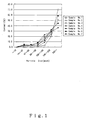
- Fig. 3 illustrates a graph showing time dependent alteration of the viscosity of the aqueous solution comprising the psyllium composition containing each of the polysaccharides shown in Figs. 1 and 2, or an aqueous solution of psyllium.
- Fig. 4 illustrates a graph showing time dependent alteration of the viscosity of the aqueous solution comprising the psyllium composition containing each of the polysaccharides granulated or ungranulated, and the granulated polysaccharides including particular fractions having the specified particle size.
- Fig. 5 illustrates a graph showing time dependent alteration of the viscosity of an aqueous solution of powdered juice mix in accordance with another embodiment of the present invention, following dissolution into water.
- Fig. 6 illustrates a graph showing time dependent alteration of the viscosity of an aqueous solution of powdered instant soup mix in accordance with further embodiment of the present invention, following dissolution into hot water.
- a psyllium in the invention may be a polysaccharide derived from the hull of a seed of Plantago ovata which is a plant of Plantago species, and includes commercially available psyllium and psyllium seed gum. Such psyllium is not particularly limited in respect to its purification method or particle size.
- viscosity-reducing means any alteration to impart both of the lower viscosity and gel strength than those possessed naturally by a psyllium hydrate.
- a viscosity-reducing polysaccharide according to the invention has a molecular weight of 20,000 or greater and the viscosity of an aqueous solution at 2% by weight of 9.0 cp or less when determined using a type B viscometer with Rotor No. 1 at 60 rpm and 25°C. Two or more polysaccharides having these characteristics may be used in combination.
- the molecular weight herein is calculated based on the calibration curve obtained by a gel filtration chromatography with a standard substance on a gel filtration column (for example, TSKgel TOYOPEARL manufactured by TOSO).
- the source of a polysaccharide according to the invention may not be particularly limited, and may include, in addition to the modified starch described below, gum arabic, arabinogalactan, dietary fibers such as those derived from soybean, pullulan and mixtures thereof (See Example 2).
- the sources of the modified starch may include for example, tapioca starch, potato starch, cornstarch, rice starch, wheat starch and the like.
- the method for modification of the starch to obtain the modified starch may be one of the followings:
- modified starches produced as above those preferred particularly due to their excellent psyllium viscosity-reducing effect may include oxidized tapioca starch, oxidized potato starch, acid-treated gelatinized potato starch, waxy cornstarch octenyl succinate and acid-treated hydroxypropyl etherified tapioca starch (See Example 1).
- acid-treated hydroxypropyl etherified tapioca starch is especially preferred because of its heat resistant property. Accordingly, this starch may be useful in preparing a food product since it retains a striking psyllium viscosity-reducing effect even after a high temperature treatment such as heat sterilization is carried out (See Example 5).
- the modified starch may be preferably selected form the group consisting of acid-treated hydroxypropyl etherified tapioca starch, waxy cornstarch octenyl succinate and a combination thereof.
- These modified starches may allow providing a liquid food comprising psyllium which has less viscosity and gel strength, while the physiological effects associated naturally with psyllium such as intestinal function-controlling effect are preserved even if heat sterilization is conducted after preparing the solution which contains psyllium.
- dextrin of which DE (Dextrose Equivalent) is 16 or lower may be preferably added because further improvement of the palatability of the liquid food can be expected.
- the amount of the polysaccharide to be added relative to the amount of psyllium may vary depending upon the concentration of the psyllium and the viscosity of the polysaccharide itself.
- the psyllium viscosity-reducing effect of the polysaccharide according to the invention may be increased corresponding to the increase in the amount added, to a certain extent of the concentration (amount added) which may vary depending on the source and the modification of the polysaccharide employed.
- the polysaccharide should be added in an amount which does not result in the excess viscosity over the value achieved as a result of the viscosity-reducing effect of the polysaccharide added, since the polysaccharide itself may exhibit some extent of viscosity.
- Example 3 when acid-treated hydroxypropyl etherified tapioca starch was used as the psyllium viscosity-reducing polysaccharide and added to a 1 or 2 % by weight aqueous solution of psyllium, the reduction in the viscosity of the psyllium was observed in the concentration range of 20 to 30 % by weight of the polysaccharide.
- the reduction in the viscosity of the psyllium was observed at a concentration up to 2 and 3 % by weight, respectively.
- a significant reduction in the viscosity in a hydration system of psyllium can be achieved with the polysaccharide according to the invention as discussed above.
- Such hydration system means a system in which the polysaccharide and psyllium coexist in an aqueous substance as a solution or as a dispersion, and in which any other additional food materials may be optionally included.
- a method for producing such a hydration system is not particularly limited, and may be for example:
- dissolution may be effected by heating, otherwise, previous gelatinization may be carried out to impart a desirable water solubility.
- the modified starch should be dissolved by heating, it is preferable to add psyllium after the solubilization of the modified starch so that the onset of the viscosity/gel formation upon the heating of psyllium may be avoided more efficiently.
- a particulate mixture of the polysaccharide and psyllium, or a hydrate of the both components formed by the method described above in Section 3 may be employed, and the ratio of each component to be added may appropriately be determined within the range allowing the polysaccharide to exert its psyllium viscosity-reducing effect.
- the food additive composition described above enables to prevent the thickening/gelling by psyllium associated with a heat treatment.
- a certain polysaccharide e.g., acid-treated hydroxypropyl etherified tapioca starch
- the polysaccharide according to the invention renders to reduce the thickening/gelling ability of psyllium significantly when its effect is exerted in the hydration system including the psyllium, it enables the use of psyllium particularly in a food for which the use thereof has been difficult because of its potent thickening/gelling behavior, such as a water-containing food or a food for which water should be added during its preparation process.
- Such foods may for example be noodles, confectioneries, breads, cereals, chilled confectioneries, iced confectioneries, soups, processed seafoods, processed meats, beverages and dairy foods.
- psyllium is incorporated at a higher amount into the food product, the amount of the viscosity-reducing polysaccharide is obliged to be increased in order to attain the desirable viscosity-reducing ability.
- the suitable amount of psyllium to be incorporated into the liquid food may be 5% by weight or less preferably, based on the handling feasibility, fluidity and palatability of the product.
- the temperature of the solution/dispersion of the viscosity-reducing polysaccharide to which psyllium is added can be of any range, however, it may be preferably between 30-80° C in view of the handling feasibility.
- sweeteners such as sugar, fructose and glucose
- flavouring materials such as fruit juice (e.g., grape juice, apple juice), acidulants (e.g., ascorbic acid, tartaric acid, sodium citrate)
- nutritional materials such as vitamins, polyphenols, oligosaccharides and minerals.
- the method for manufacturing the liquid food comprising the steps of: (a) preparing an aqueous solution comprising psyllium, and at least one modified starch selected from the group consisting of etherified starch, esterified starch, and a combination thereof; (b) packing the solution into a container followed by sealing; and (c) sterilizing the solution by heating any time of before, during or after the step (b) is conducted, the ingredients described above may be preferably added during and/or following the preparation step (a), and before the packing step (b).
- the given volume of the solution comprising psyllium and viscosity-reducing polysaccharide may be charged to a container and then sealed to manufacture a liquid food product.
- the material, shape and structure of the container are not specifically limited as long as having a structure that can be sealed after packing, and having enough properties which serve as a barrier, while it should be resistant to the elevated inner pressure which is imparted through heating when heat sterilization must be conducted after the packing and sealing step.
- a standing-pouch type, a gazette type, a flat pouch type, made of laminated material comprising paper and plastic film or comprising plastic film and metal foil such as alminium foil, as well as plastic container, metal can, bottle or the like may be suitably employed as the container.
- Heat sterilization of the solution comprising psyllium and viscosity-reducing polysaccharide may be conducted at any time of: prior to, during or following the above packing step (b).
- the condition for the sterilization may be suitably determined depending upon the pH of the liquid to be sterilized and the shape of the container. For example, when a liquid having pH 4 or lower is packed into a pouch type container made of alminium, the primary sterilization may be conducted prior to packing into the container, at 90° C for 2 minutes using a tubular type heat exchanger, then after the container is sealed following packing, steam sterilization may be carried out at 90° C for about 10 minutes in a sterilization steamer.
- psyllium may be any of which as described above, including commercially available powdered psyllium and psyllium seed gum.
- the purification method as well as particle size of the psyllium are not particularly limited.
- the particles may be preferably coarse, besides, the granulated psyllium as well as the coated psyllium using hydrogenated fat/oil or zein (a kind of protein derived from corn) may be suitably employed.
- zein a kind of protein derived from corn
- the particle size of psyllium or granulated psyllium may be similar to that of the granulated polysaccharide as detailed below, in view of the possible spontaneous sorting of the powder which occurs in a time-dependent manner.
- the larger particle size of the granulated viscosity-reducing polysaccharide in accordance with the present invention is apt to provide a stronger psyllium viscosity-reducing effect (see Example 12).
- the particle size distribution of the granulated polysaccharide is not specifically limited, however, if the polysaccharide comprises 70% by weight or more of the particles being unable to pass through the 140 mesh sieve (140 mesh on), the desirable psyllium viscosity-reducing effect, handling feasibility and solubility of the food product, as well as preferable dispersion property and bulk density may be provided (see Example 12).
- the method for granulation may not be limited any how, as long as granules can be yielded, thus for example, fluidized bed granulation, spray granulation, tumbling granulation, extruding granulation, agitation granulation, and disintegration granulation may be appropriately selected.
- fluidized bed granulation may be suitably employed using a fluidized bed granulator in view of a better producibility, costs for the manufacture, and a solubility of the resulting polysaccharide.
- the polysaccharide which may be used in this invention is not specifically limited, except for the limitation as described above, namely having a molecular weight of 20,000 or greater and the viscosity of an aqueous solution at 2% by weight of 9.0 cp or less, preferably 5.0 cp or less when determined using a type B viscometer with Rotor No. 1 at 60 rpm and 25°C.
- the molecular weight herein is calculated as above described.
- the source of a polysaccharide according to this invention may be those listed above in Section 1 .
- the polysaccharide may be gelatinized thereby leading to a suitable solubility.
- acid-treated gelatinized potato starch, waxy cornstarch octenyl succinate, acid-treated hydroxypropyl etherified tapioca starch, or any combination thereof may exert more advantageous effects.
- the amount of the polysaccharide to be added relative to the amount of psyllium may vary depending on the concentration of the psyllium and the viscosity of the polysaccharide itself.
- the psyllium viscosity-reducing effect of the polysaccharide according to the invention may be increased corresponding to the increase in the amount added, to a certain extent of the concentration (amount added) which may vary depending on the source and the modification of the polysaccharide employed.
- Example 3 when acid-treated hydroxypropyl etherified tapioca starch was used as a psyllium viscosity-reducing polysaccharide, the viscosity resulting from psyllium can be still reduced in an amount of the starch which is one-eighth by weight of psyllium. Besides, when the amount of the polysaccharide is increased to more than 30% by weight, the viscosity is apt to be elevated due to the viscosity of the polysaccharide itself. Accordingly, the amount of the polysaccharide to be added may be suitably adjusted to attain desirable viscosity resulting from psyllium.
- the psyllium composition in accordance with this invention may be prepared by mixing the powder of both of psyllium and the polysaccharide as above described in the foregoing section.
- the powdered food product may be for example, powdered juice mix and powdered instant soup mix, which may be manufactured by adding powdered ingredients suitably, such as fruit juice powdered, granulated sugar, seasoning/flavouring materials and the like, ad libitum.
- powdered ingredients suitably, such as fruit juice powdered, granulated sugar, seasoning/flavouring materials and the like, ad libitum.
- preceding gelatinization may be preferably conducted to improve the solubility of itself.
- psyllium may be granulated prior to mixing with or without the additional powdered ingredients, in order to avoid the formation of insoluble solid cakes.
- viscosity was determined using a type B viscometer (TOKYO KEIKI, Model B8L) at 25°C.
- Molecular weight was determined by subjecting a 0.2 ml sample to a gel filtration chromatography (Pharmacia Fine Chemicals, FPLC) equipped with a packed gel filtration column ( f ⁇ 15 mm x 75 cm, TOSO, TSKgel, TOYOPEARL HW-65), which was eluted with purified water and detected with a differential refractometer at the flow rate of 0.8 ml/min.
- pullulan WATERS Co.
- any % which indicates a content is % by weight.
- modified starches were examined for their psyllium viscosity-reducing abilities.
- 96 g of ion exchanged water was admixed with 2 g of each of the modified starches shown in Table 1 (Samples No. 1 to 13), which was dissolved with heating and then cooled, and the viscosity was determined using Rotor No. 1 at 60 rpm.
- 2 g of the psyllium powder (Dainippon Pharmaceutical Co., Ltd., HEALTHY GUMTM) was added to the aqueous solution, and the viscosity of the respective solution was determined using Rotor No. 2 at 1.5 rpm.
- Table 1 shown below.
- the psyllium viscosity-reducing ability was affected by the molecular weight of the starch and the viscosity of the aqueous solution of the starch, and such ability was observed with modified starches having a molecular weight of 20,000 or greater and viscosity of an aqueous solution at 2% by weight of 9.0 cp or less (determined using a type B viscometer with Rotor No. 1, at 60 rpm and 25°C).
- the concentration up to 20 % of the starch caused the reduction in the viscosity resulting from the psyllium.
- the 2 % psyllium solution tended to gain an elevation of the viscosity at a concentration of the starch exceeding 30 %, although some extent of viscosity-reducing effect was observed.
- An elevation of the viscosity of 1 % psyllium solution was observed, compared with the polysaccharide-free control when the starch was employed at a concentration exceeding 30 %. Such tendencies of elevated viscosity at higher concentration levels of the starch may be due to the viscosity of the polysaccharide itself.
- the viscosity of the psyllium solution tended to be reduced with gum arabic at 2 % or less, or with arabinogalactan at 3 % or less.
- Sample 1 Eighty eight gram of water was admixed with 10 g of the modified starch and heated to effect dissolution followed by cooling, and then admixed with 2 g of psyllium, heated, cooled and subjected to the determination of the viscosity.
- Sample 2 Mixture of 10 g of the modified starch and 2 g of psyllium was added to 88 g of water, thereafter heated followed by cooling, and then subjected to the determination of the viscosity.
- Sample 3 An aqueous solution of 10 g of the modified starch in 40 g of water obtained by heating to allow dissolution was admixed with the solution of 2 g of psyllium in 48 g of water also obtained by heating to allow dissolution, then heated, cooled and subjected to the determination of the viscosity.
- Sample 4 Eighty eight gram of water was admixed with 2 g of psyllium and heated to effect dissolution followed by cooling, and then admixed with 10 g of the modified starch, heated, cooled and subjected to the determination of the viscosity.
- the acid-treated hydroxypropyl etherified tapioca starch exerted psyllium viscosity-reducing effect regardless of the order of the addition of the psyllium and the polysaccharide, and regardless of the procedure for preparing the hydration system.
- Water employed was ion exchanged water.
- a psyllium was used at the concentration of 2 %, and acid-treated hydroxypropyl etherified tapioca starch was employed as the polysaccharide (the modified starch) at the concentration of 10 %.
- a polysaccharide according to the invention was added to the psyllium hydration system resulting in the reduced viscosity (thickening/gelling), and then the water-retaining capacity of the psyllium hydration system was determined.
- Various physiological effects exerted by psyllium such as an intestinal function-controlling effect is considered to be due to the water-retaining capacity of the psyllium, therefore, the water-retaining capacity in the hydration system was determined to ensure that the physiological effects of the psyllium were still preserved even after the addition of the polysaccharide according to the invention.
- a biological digestion model was employed in the determination procedure assuming the digestion in a stomach and a small intestine.
- aqueous solution containing the components described above 0.5 % by weight of psyllium
- 10 g of this aqueous solution was subjected to the following process.
- the solution was adjusted to pH 2 with 2N HCl and admixed with 50 mg of pepsin to effect enzymatic digestion at 37° C for 4 hours.
- 500 mM phosphate buffer, pH 7.2 was added at the final concentration of 20 mM, thereafter the solution was adjusted to pH 7.2 with 2N NaOH.
- pancreatin was added to effect enzymatic digestion at 37° C for 3 hours.
- the solution was centrifuged at 14,000 x G for 10 minutes, and the volume of the supernatant was measured.
- the volume after subtracting the volume of the supernatant thus obtained from the volume of the water added was divided by the amount of the psyllium, whereby obtaining the water-retaining capacity.
- composition of the present invention comprising the polysaccharide and psyllium can serve to retain water in a large intestine even after being eaten and digested in a stomach as well as in a small intestine, whereby bringing its excellent intestinal function-controlling effect.
- any of these modified starches was concluded to be unsuitable as an ingredient of a liquid food comprising psyllium, which is manufactured through a process comprising heat sterilization. Accordingly, when manufacturing the present liquid food is intended, etherified or esterified starch, particularly, acid-treated hydroxypropyl etherified tapioca starch or waxy cornstarch octenyl succinate may be efficiently added.
- Acid-treated hydroxypropyl etherified tapioca starch (as employed in Example 7) was admixed with ion exchanged water at the final concentrations ranging between 0 to 30%, then dissolved with heating followed by cooling.
- ion exchanged water as employed in Example 7.
- citric acid 11.85% of fructose-glucose-liquid sugar and 2% of psyllium were added and mixed, thereafter, heated for 10 minutes in a boiling water bath. Then, the fluidity and palatability of each of the samples were evaluated, both after the addition of psyllium and after heating. When the fluidity of the sample including the formed gel was evaluated, the gel was crushed prior to the evaluation.
- the gel was formed which could not be fractured by crushing due to its viscous/sticky property, thereby the fluidity of the solution could not be attained.
- the starch was added at a concentration of 1%, the fluidity could still be sustained after the addition of psyllium, however, the solution became viscous after heating, thus lead to gel formation and to inferior fluidity.
- the starch was added at a concentration of 2% or more, the reduction of viscosity/gel strength could be achieved both before and after the heating, and in the event of the appearance of the gel, such a gel could be easily dispersed and homogenized through crushing it.
- the solution having better fluidity could be obtained by the addition of the starch at such concentrations, therefore, the prepared solution will be readily passed into the instrument for packing, and thereby the liquid food of which handling feasibility is superior can be provided.
- the starch was added at more than or equal to 20%, the palatability may be inferior with gooey and sticky feelings. Therefore, based on the results of evaluation on handling feasibility (i.e., fluidity) and palatability, the suitable range of the modified starch may be preferably between 2 to 20%, and more preferably between 6 to 15%.
- Acid-treated hydroxypropyl etherified tapioca starch (as employed in Example 7) was admixed with ion exchanged water at the final concentrations of 10%, then dissolved with heating followed by cooling.
- ion exchanged water as employed in Example 7.
- citric acid 11.85% of fructose-glucose-liquid sugar and psyllium at concentrations between 0.5 to 10% were added and mixed, thereafter, heated for 10 minutes in a boiling water bath. Then, the fluidity and palatability of each of the samples were evaluated, both after the addition of psyllium and after heating. When the fluidity of the sample including the formed gel was evaluated, the gel was crushed prior to the evaluation.
- the viscosity elevated enormously leading to unfavorable palatability at a concentration of psyllium of 7.5% or more.
- psyllium was added at 3% or less, favorable fluidity was observed without any formation of the gel, even after the heat treatment was conducted.
- the preferable range of psyllium may be 5% or less, based on the results of evaluation on handling feasibility (fluidity) and palatability.
- Example 10 Water-retaining capacity of the beverage manufactured according to the present invention
- the mixture was then sterilized by heating at 90° C for 2 minutes, and the gel formed throughout this procedure was disrupted using a static mixer to prepare a beverage of 1000 g.
- This beverage was dispensed into a pouch type container made of alminium to be packed 200 g respectively. After sealing the container, heat sterilization was conducted again at 90° C for 10 minutes to manufacture a grape flavoured beverage product comprising psyllium.
- gum arabic was added in order to attain a synergistic effect of reducing viscosity by combining with the above described tapioca starch, and to improve the palatability of the product.
- the volume after subtracting the volume of the supernatant thus obtained from the volume of the water added was divided by the amount of the psyllium, whereby obtaining the water-retaining capacity.
- Table 12 and Fig.3 illustrate the results of determined viscosity of the aqueous solution comprising each of the polysaccharides and psyllium.
- Sample No. 2 in the above Example 11 was granulated followed by fractionation into: 42 mesh on, 60-100 mesh, and 140-200 mesh, and these fractions were subjected to the analysis as in the above Example 11 on the time dependent alteration of the viscosity of the aqueous solutions.
- the results are shown in Table 13 and Fig. 4.
- the granulated polysaccharide having the smaller (finer) particle size may tend to result in the similar time-dependent alteration of the viscosity to the ungranulated one, and may have a lower viscosity-reducing effect. Meanwhile, the granulated polysaccharide having the larger (coarser) particle size may tend to have a higher viscosity-reducing effect.
Landscapes
- Chemical & Material Sciences (AREA)
- Life Sciences & Earth Sciences (AREA)
- Food Science & Technology (AREA)
- Nutrition Science (AREA)
- Health & Medical Sciences (AREA)
- Engineering & Computer Science (AREA)
- Polymers & Plastics (AREA)
- Dispersion Chemistry (AREA)
- Mycology (AREA)
- Chemical Kinetics & Catalysis (AREA)
- Jellies, Jams, And Syrups (AREA)
- Coloring Foods And Improving Nutritive Qualities (AREA)
- Polysaccharides And Polysaccharide Derivatives (AREA)
Claims (15)
- Verwendung eines Polysaccharids zur Verringerung der durch Psyllium verursachten Viskosität, wobei das Polysaccharid ein Molekulargewicht von 20.000 oder mehr und eine Viskosität in 2 Gew.% wäßriger Lösung von 9,0 cp oder weniger (bestimmt unter Verwendung eines Viskosimeters vom Typ B mit Rotor Nr. 1 bei 60 Upm und 25 °C) aufweist.
- Verwendung nach Anspruch 1, wobei das Polysaccharid granuliert vorliegt.
- Verwendung nach Anspruch 1 oder Anspruch 2, wobei das Polysaccharid ausgewählt ist aus modifizierter Stärke, Gummi arabicum, Arabinogalactan, partiell abgebautem Guargummi, Pullulan, Ballaststoff und Kombinationen davon.
- Verwendung nach Anspruch 3, wobei die modifizierte Stärke einem oder mehrerer Verfahren der Oxidation, Veretherung, Veresterung und Gelatinisierung unterworfen worden ist.
- Verwendung nach Anspruch 3, wobei die modifizierte Stärke ausgewählt ist aus oxidierter Tapiokastärke, oxidierter Kartoffelstärke, säurebehandelter gelatinisierter Kartoffelstärke, Octenylsuccinat von wachsartiger Maisstärke, säurebehandelter Hydroxypropyl-veretherter Tapiokastärke und Kombinationen davon.
- Zusammensetzung, die zur Verwendung als Nahrungsmittelzusatzstoff geeignet ist, wobei die Zusammensetzung Psyllium und ein Polysaccharid umfaßt, welches ein Molekulargewicht von 20.000 oder mehr und eine Viskosität in 2 Gew.% wäßriger Lösung von 9,0 cp oder weniger (bestimmt unter Verwendung eines Viskosimeters vom Typ B mit Rotor Nr. 1 bei 60 Upm und 25 °C) aufweist.
- Nahrungsmittel, das Psyllium und ein Polysaccharid umfaßt, welches ein Molekulargewicht von 20.000 oder mehr und eine Viskosität in 2 Gew.% wäßriger Lösung von 9,0 cp oder weniger (bestimmt unter Verwendung eines Viskosimeters vom Typ B mit Rotor Nr. 1 bei 60 Upm und 25 °C) aufweist.
- Flüssiges Nahrungsmittel, das Psyllium und ein Polysaccharid umfaßt, welches ein Molekulargewicht von 20.000 oder mehr und eine Viskosität in 2 Gew.% wäßriger Lösung von 9,0 cp oder weniger (bestimmt unter Verwendung eines Viskosimeters vom Typ B mit Rotor Nr. 1 bei 60 Upm und 25 °C) aufweist, wobei das Polysaccharid wenigstens eine modifizierte Stärke ausgewählt aus veretherter Stärke, veresterter Stärke und Kombinationen davon ist.
- Flüssiges Nahrungsmittel nach Anspruch 8, wobei die modifizierte Stärke ausgewählt ist aus säurebehandelter Hydroxypropyl-veretherter Tapiokastärke, Octenylsuccinat von wachsartiger Maisstärke und Kombinationen davon.
- Verfahren zur Herstellung eines flüssigen Nahrungsmittels, welches die Schritte umfaßt:(a) Anfertigung einer wäßrigen Lösung, die Psyllium und wenigstens eine modifizierte Stärke ausgewählt aus veretherter Stärke, veresterter Stärke und Kombinationen davon umfaßt, wobei die modifizierte Stärke ein Molekulargewicht von 20.000 oder mehr und eine Viskosität in 2 Gew.% wäßriger Lösung von 9,0 cp oder weniger (bestimmt unter Verwendung eines Viskosimeters vom Typ B mit Rotor Nr. 1 bei 60 Upm und 25 °C) aufweist;(b) Verpackung der Lösung in einen Behälter und Verschluß des Behälters; und(c) Sterilisieren der Lösung durch Erhitzung vor, während oder nach dem Verpackungsschritt (b).
- Verfahren nach Anspruch 10, wobei Psyllium der wäßrigen Lösung modifizierter Stärke im Schritt (a) zugegeben wird.
- Verfahren nach Anspruch 10 oder Anspruch 11, wobei die modifizierte Stärke ausgewählt ist aus säurebehandelter Hydroxypropyl-veretherter Tapiokastärke, Octenylsuccinat von wachsartiger Maisstärke und Kombinationen davon.
- Pulverförmiges Nahrungsmittel, das zur Verwendung bei der Herstellung eines flüssigen Nahrungsmittels geeignet ist, welches Psyllium und ein Polysaccharid umfaßt, das ein Molekulargewicht von 20.000 oder mehr und eine Viskosität in 2 Gew.% wäßriger Lösung von 9,0 cp oder weniger (bestimmt unter Verwendung eines Viskosimeters vom Typ B mit Rotor Nr. 1 bei 60 Upm und 25 °C) aufweist, wobei das Polysaccharid granuliert ist.
- Pulverförmiges Nahrungsmittel nach Anspruch 13, wobei das Polysaccharid 70 Gew.% oder mehr Teilchen enthält, die ein Sieb einer Maschenweite von 140 nicht passieren können.
- Verwendung eines Polysaccharids zur Herstellung eines flüssigen Nahrungsmittels, das Psyllium enthält, wobei das Polysaccharid wenigstens eine modifizierte Stärke ausgewählt aus veretherter Stärke, veresterter Stärke und Kombinationen davon ist und ein Molekulargewicht von 20.000 oder mehr und eine Viskosität in 2 Gew.% wäßriger Lösung von 9,0 cp oder weniger (bestimmt unter Verwendung eines Viskosimeters vom Typ B mit Rotor Nr. 1 bei 60 Upm und 25 °C) aufweist.
Applications Claiming Priority (6)
| Application Number | Priority Date | Filing Date | Title |
|---|---|---|---|
| JP10351363A JP2977823B1 (ja) | 1998-12-10 | 1998-12-10 | サイリウム粘性低下用多糖類およびこれを含有する食品 |
| JP35136398 | 1998-12-10 | ||
| JP11026293A JP3068078B1 (ja) | 1999-02-03 | 1999-02-03 | サイリウム含有飲料およびその製造方法 |
| JP2629399 | 1999-02-03 | ||
| JP28442799 | 1999-10-05 | ||
| JP28442799A JP3487792B2 (ja) | 1999-10-05 | 1999-10-05 | サイリウム粘性低下用造粒多糖類およびこれを含有するサイリウム組成物または粉末飲料 |
Publications (3)
| Publication Number | Publication Date |
|---|---|
| EP1008306A2 EP1008306A2 (de) | 2000-06-14 |
| EP1008306A3 EP1008306A3 (de) | 2001-04-18 |
| EP1008306B1 true EP1008306B1 (de) | 2004-07-28 |
Family
ID=27285347
Family Applications (1)
| Application Number | Title | Priority Date | Filing Date |
|---|---|---|---|
| EP99309906A Expired - Lifetime EP1008306B1 (de) | 1998-12-10 | 1999-12-09 | Polysaccharid zur Verminderung der psylliuminduzierten Viskosität, und Nahrungsmittel enthaltend Psyllium und dieses Polysaccharid |
Country Status (6)
| Country | Link |
|---|---|
| EP (1) | EP1008306B1 (de) |
| CN (1) | CN1086114C (de) |
| AT (1) | ATE271787T1 (de) |
| CA (1) | CA2292056C (de) |
| DE (1) | DE69918929T2 (de) |
| ES (1) | ES2227976T3 (de) |
Families Citing this family (9)
| Publication number | Priority date | Publication date | Assignee | Title |
|---|---|---|---|---|
| WO2002100902A1 (en) | 2001-06-11 | 2002-12-19 | Rhodia, Inc | Galactomannan compositions and methods for making and using same |
| DE10214327A1 (de) * | 2001-10-23 | 2003-05-22 | Innogel Ag Zug | Netzwerk auf Polysaccharidbasis und Verfahren zu dessen Herstellung |
| GB0201552D0 (en) * | 2002-01-24 | 2002-03-13 | Cerestar Holding Bv | Texturizing agent for UHT treated products |
| MX2019008757A (es) | 2017-01-25 | 2020-01-27 | Unilever Nv | Concentrado salado que comprende sal inorganica, grasa y goma de cascara de semilla de psyllium. |
| CN107279454B (zh) * | 2017-06-20 | 2021-04-27 | 上海交通大学 | 一种新的粘性食品组合物及其制备方法 |
| CN109796946B (zh) * | 2017-11-17 | 2021-10-22 | 中石化石油工程技术服务有限公司 | 一种钻井液用改性车前籽壳增粘剂及其制备方法 |
| FR3084816B1 (fr) * | 2018-08-09 | 2021-09-24 | Claire De La Plume | Gelifiant alimentaire a base de composants naturels non perturbateurs de saveur a grande duree de conservation et grande flexibilite d'applications |
| JP2023544453A (ja) * | 2020-09-28 | 2023-10-23 | トリスコ アイキャップ ピーティーワイ リミテッド | 食品グレード増粘剤及び嚥下障害を治療するための方法 |
| CA3202545A1 (en) * | 2020-11-20 | 2022-05-27 | General Mills, Inc. | Texture-controlled fiber ingredient containing viscous soluble fiber and consumable food and fiber supplement products incorporating same |
Family Cites Families (7)
| Publication number | Priority date | Publication date | Assignee | Title |
|---|---|---|---|---|
| GB890207A (en) * | 1957-03-07 | 1962-02-28 | Ciba Ltd | Extraction of a new polysaccharide substance from crude fucoidin |
| US5073370A (en) * | 1988-11-23 | 1991-12-17 | Meer Corporation | Low calorie, high fiber laxative |
| NL9001980A (nl) * | 1990-09-07 | 1992-04-01 | Pharmalett Int Bv | Toepassing van polysacchariden in preparaten voor wondbehandeling. |
| JP3085739B2 (ja) * | 1991-04-25 | 2000-09-11 | 日澱化學株式会社 | 変性澱粉及びそれを用いた製紙用サイズ剤 |
| US5338549A (en) * | 1992-12-21 | 1994-08-16 | The Procter & Gamble Company | Powdered psyllium drink mix compositions containing antioxidant |
| NZ260933A (en) * | 1993-07-16 | 1996-07-26 | Hercules Inc | Cation-complexed polysaccharides; use in foods and pharmaceuticals |
| US5523014A (en) * | 1994-05-16 | 1996-06-04 | Gojo Industries, Inc. | Flowable, pumpable cleaning compositions and method for the preparation thereof |
-
1999
- 1999-12-09 EP EP99309906A patent/EP1008306B1/de not_active Expired - Lifetime
- 1999-12-09 DE DE69918929T patent/DE69918929T2/de not_active Expired - Fee Related
- 1999-12-09 AT AT99309906T patent/ATE271787T1/de not_active IP Right Cessation
- 1999-12-09 ES ES99309906T patent/ES2227976T3/es not_active Expired - Lifetime
- 1999-12-09 CA CA2292056A patent/CA2292056C/en not_active Expired - Fee Related
- 1999-12-10 CN CN99126137A patent/CN1086114C/zh not_active Expired - Fee Related
Also Published As
| Publication number | Publication date |
|---|---|
| CA2292056C (en) | 2010-02-09 |
| HK1025724A1 (en) | 2000-11-24 |
| EP1008306A3 (de) | 2001-04-18 |
| CA2292056A1 (en) | 2000-06-10 |
| ATE271787T1 (de) | 2004-08-15 |
| CN1086114C (zh) | 2002-06-12 |
| DE69918929D1 (de) | 2004-09-02 |
| CN1256901A (zh) | 2000-06-21 |
| EP1008306A2 (de) | 2000-06-14 |
| ES2227976T3 (es) | 2005-04-01 |
| DE69918929T2 (de) | 2005-07-28 |
Similar Documents
| Publication | Publication Date | Title |
|---|---|---|
| TW408153B (en) | Cellulose-containing composite, process for its preparation and use thereof | |
| JP4422726B2 (ja) | 満腹促進食品組成物 | |
| EP0144644B1 (de) | Psyllium-Mucilloid-Produkte | |
| AU2004200580B8 (en) | Method for reducing the glycemic index of food | |
| CN101594788A (zh) | 化学改性淀粉的天然等价物 | |
| EP2628396B1 (de) | Pulvermischung | |
| JP3874560B2 (ja) | 微細セルロース含有複合物 | |
| EP3284780B1 (de) | Celluloseverbundstoff | |
| JP6724104B2 (ja) | 大麦粉末を含む食品 | |
| JP2753726B2 (ja) | 低分子グアーガム、その製造法およびそれを含有する飲食品 | |
| JP2000316507A (ja) | 食物繊維強化麺類 | |
| CA2292056C (en) | Polysaccharide which can reduce viscosity resulting from psyllium, and foods containing the polysaccharide and psyllium | |
| US6682770B2 (en) | Polysaccharide capable of reducing the viscosity of a hydrated psyllium, and foods containing the polysaccharide and psyllium | |
| JP3506936B2 (ja) | セルロース含有複合体 | |
| JP7462280B2 (ja) | 組成物 | |
| EP1928269B1 (de) | Nahrungsergänzungsstoffprodukt | |
| JP2004024182A (ja) | 溶解性が改善された水溶性高分子 | |
| EP1447014A1 (de) | Methode zum Senken des glykämischen Index von Nahrungsmitteln | |
| JP3487792B2 (ja) | サイリウム粘性低下用造粒多糖類およびこれを含有するサイリウム組成物または粉末飲料 | |
| JP4131770B2 (ja) | 健康食品 | |
| JP2018174721A (ja) | タンパク質含有飲料 | |
| JP2001316274A (ja) | 経管栄養剤およびその製造方法 | |
| JP2006042805A (ja) | 麦若葉加工物を含有する造粒物 | |
| JP3068078B1 (ja) | サイリウム含有飲料およびその製造方法 | |
| JP2977823B1 (ja) | サイリウム粘性低下用多糖類およびこれを含有する食品 |
Legal Events
| Date | Code | Title | Description |
|---|---|---|---|
| PUAI | Public reference made under article 153(3) epc to a published international application that has entered the european phase |
Free format text: ORIGINAL CODE: 0009012 |
|
| AK | Designated contracting states |
Kind code of ref document: A2 Designated state(s): AT BE CH CY DE DK ES FI FR GB GR IE IT LI LU MC NL PT SE |
|
| AX | Request for extension of the european patent |
Free format text: AL;LT;LV;MK;RO;SI |
|
| PUAL | Search report despatched |
Free format text: ORIGINAL CODE: 0009013 |
|
| AK | Designated contracting states |
Kind code of ref document: A3 Designated state(s): AT BE CH CY DE DK ES FI FR GB GR IE IT LI LU MC NL PT SE |
|
| AX | Request for extension of the european patent |
Free format text: AL;LT;LV;MK;RO;SI |
|
| RIC1 | Information provided on ipc code assigned before grant |
Free format text: 7A 23L 1/0526 A, 7A 23L 1/0522 B, 7A 23L 1/308 B, 7A 23L 2/39 B, 7A 23L 2/52 B, 7A 61K 35/78 B |
|
| 17P | Request for examination filed |
Effective date: 20011016 |
|
| AKX | Designation fees paid |
Free format text: AT BE CH CY DE DK ES FI FR GB GR IE IT LI LU MC NL PT SE |
|
| 17Q | First examination report despatched |
Effective date: 20011228 |
|
| GRAP | Despatch of communication of intention to grant a patent |
Free format text: ORIGINAL CODE: EPIDOSNIGR1 |
|
| GRAS | Grant fee paid |
Free format text: ORIGINAL CODE: EPIDOSNIGR3 |
|
| GRAA | (expected) grant |
Free format text: ORIGINAL CODE: 0009210 |
|
| AK | Designated contracting states |
Kind code of ref document: B1 Designated state(s): AT BE CH CY DE DK ES FI FR GB GR IE IT LI LU MC NL PT SE |
|
| PG25 | Lapsed in a contracting state [announced via postgrant information from national office to epo] |
Ref country code: NL Free format text: LAPSE BECAUSE OF FAILURE TO SUBMIT A TRANSLATION OF THE DESCRIPTION OR TO PAY THE FEE WITHIN THE PRESCRIBED TIME-LIMIT Effective date: 20040728 Ref country code: LI Free format text: LAPSE BECAUSE OF FAILURE TO SUBMIT A TRANSLATION OF THE DESCRIPTION OR TO PAY THE FEE WITHIN THE PRESCRIBED TIME-LIMIT Effective date: 20040728 Ref country code: FI Free format text: LAPSE BECAUSE OF FAILURE TO SUBMIT A TRANSLATION OF THE DESCRIPTION OR TO PAY THE FEE WITHIN THE PRESCRIBED TIME-LIMIT Effective date: 20040728 Ref country code: CY Free format text: LAPSE BECAUSE OF FAILURE TO SUBMIT A TRANSLATION OF THE DESCRIPTION OR TO PAY THE FEE WITHIN THE PRESCRIBED TIME-LIMIT Effective date: 20040728 Ref country code: CH Free format text: LAPSE BECAUSE OF FAILURE TO SUBMIT A TRANSLATION OF THE DESCRIPTION OR TO PAY THE FEE WITHIN THE PRESCRIBED TIME-LIMIT Effective date: 20040728 Ref country code: BE Free format text: LAPSE BECAUSE OF FAILURE TO SUBMIT A TRANSLATION OF THE DESCRIPTION OR TO PAY THE FEE WITHIN THE PRESCRIBED TIME-LIMIT Effective date: 20040728 Ref country code: AT Free format text: LAPSE BECAUSE OF FAILURE TO SUBMIT A TRANSLATION OF THE DESCRIPTION OR TO PAY THE FEE WITHIN THE PRESCRIBED TIME-LIMIT Effective date: 20040728 |
|
| REG | Reference to a national code |
Ref country code: GB Ref legal event code: FG4D |
|
| REG | Reference to a national code |
Ref country code: CH Ref legal event code: EP |
|
| REG | Reference to a national code |
Ref country code: IE Ref legal event code: FG4D |
|
| REF | Corresponds to: |
Ref document number: 69918929 Country of ref document: DE Date of ref document: 20040902 Kind code of ref document: P |
|
| PG25 | Lapsed in a contracting state [announced via postgrant information from national office to epo] |
Ref country code: SE Free format text: LAPSE BECAUSE OF FAILURE TO SUBMIT A TRANSLATION OF THE DESCRIPTION OR TO PAY THE FEE WITHIN THE PRESCRIBED TIME-LIMIT Effective date: 20041028 Ref country code: GR Free format text: LAPSE BECAUSE OF FAILURE TO SUBMIT A TRANSLATION OF THE DESCRIPTION OR TO PAY THE FEE WITHIN THE PRESCRIBED TIME-LIMIT Effective date: 20041028 Ref country code: DK Free format text: LAPSE BECAUSE OF FAILURE TO SUBMIT A TRANSLATION OF THE DESCRIPTION OR TO PAY THE FEE WITHIN THE PRESCRIBED TIME-LIMIT Effective date: 20041028 |
|
| PG25 | Lapsed in a contracting state [announced via postgrant information from national office to epo] |
Ref country code: IE Free format text: LAPSE BECAUSE OF NON-PAYMENT OF DUE FEES Effective date: 20041209 |
|
| PG25 | Lapsed in a contracting state [announced via postgrant information from national office to epo] |
Ref country code: MC Free format text: LAPSE BECAUSE OF NON-PAYMENT OF DUE FEES Effective date: 20041231 Ref country code: LU Free format text: LAPSE BECAUSE OF NON-PAYMENT OF DUE FEES Effective date: 20041231 |
|
| NLV1 | Nl: lapsed or annulled due to failure to fulfill the requirements of art. 29p and 29m of the patents act | ||
| REG | Reference to a national code |
Ref country code: CH Ref legal event code: PL |
|
| REG | Reference to a national code |
Ref country code: ES Ref legal event code: FG2A Ref document number: 2227976 Country of ref document: ES Kind code of ref document: T3 |
|
| ET | Fr: translation filed | ||
| PLBE | No opposition filed within time limit |
Free format text: ORIGINAL CODE: 0009261 |
|
| STAA | Information on the status of an ep patent application or granted ep patent |
Free format text: STATUS: NO OPPOSITION FILED WITHIN TIME LIMIT |
|
| 26N | No opposition filed |
Effective date: 20050429 |
|
| REG | Reference to a national code |
Ref country code: IE Ref legal event code: MM4A |
|
| PGFP | Annual fee paid to national office [announced via postgrant information from national office to epo] |
Ref country code: DE Payment date: 20051201 Year of fee payment: 7 |
|
| PGFP | Annual fee paid to national office [announced via postgrant information from national office to epo] |
Ref country code: GB Payment date: 20051207 Year of fee payment: 7 |
|
| PGFP | Annual fee paid to national office [announced via postgrant information from national office to epo] |
Ref country code: FR Payment date: 20051208 Year of fee payment: 7 |
|
| PGFP | Annual fee paid to national office [announced via postgrant information from national office to epo] |
Ref country code: ES Payment date: 20060118 Year of fee payment: 7 |
|
| PGFP | Annual fee paid to national office [announced via postgrant information from national office to epo] |
Ref country code: IT Payment date: 20061231 Year of fee payment: 8 |
|
| PG25 | Lapsed in a contracting state [announced via postgrant information from national office to epo] |
Ref country code: DE Free format text: LAPSE BECAUSE OF NON-PAYMENT OF DUE FEES Effective date: 20070703 |
|
| GBPC | Gb: european patent ceased through non-payment of renewal fee |
Effective date: 20061209 |
|
| REG | Reference to a national code |
Ref country code: FR Ref legal event code: ST Effective date: 20070831 |
|
| PG25 | Lapsed in a contracting state [announced via postgrant information from national office to epo] |
Ref country code: GB Free format text: LAPSE BECAUSE OF NON-PAYMENT OF DUE FEES Effective date: 20061209 |
|
| PG25 | Lapsed in a contracting state [announced via postgrant information from national office to epo] |
Ref country code: PT Free format text: LAPSE BECAUSE OF NON-PAYMENT OF DUE FEES Effective date: 20041228 |
|
| REG | Reference to a national code |
Ref country code: ES Ref legal event code: FD2A Effective date: 20061211 |
|
| PG25 | Lapsed in a contracting state [announced via postgrant information from national office to epo] |
Ref country code: FR Free format text: LAPSE BECAUSE OF NON-PAYMENT OF DUE FEES Effective date: 20070102 Ref country code: ES Free format text: LAPSE BECAUSE OF NON-PAYMENT OF DUE FEES Effective date: 20061211 |
|
| PG25 | Lapsed in a contracting state [announced via postgrant information from national office to epo] |
Ref country code: IT Free format text: LAPSE BECAUSE OF NON-PAYMENT OF DUE FEES Effective date: 20071209 |