EP1008419A2 - Mécanisme de translation suivant un axe vertical - Google Patents
Mécanisme de translation suivant un axe vertical Download PDFInfo
- Publication number
- EP1008419A2 EP1008419A2 EP99309885A EP99309885A EP1008419A2 EP 1008419 A2 EP1008419 A2 EP 1008419A2 EP 99309885 A EP99309885 A EP 99309885A EP 99309885 A EP99309885 A EP 99309885A EP 1008419 A2 EP1008419 A2 EP 1008419A2
- Authority
- EP
- European Patent Office
- Prior art keywords
- translation mechanism
- elements
- vertical axis
- inclination
- fixing member
- Prior art date
- Legal status (The legal status is an assumption and is not a legal conclusion. Google has not performed a legal analysis and makes no representation as to the accuracy of the status listed.)
- Granted
Links
Images


Classifications
-
- B—PERFORMING OPERATIONS; TRANSPORTING
- B23—MACHINE TOOLS; METAL-WORKING NOT OTHERWISE PROVIDED FOR
- B23Q—DETAILS, COMPONENTS, OR ACCESSORIES FOR MACHINE TOOLS, e.g. ARRANGEMENTS FOR COPYING OR CONTROLLING; MACHINE TOOLS IN GENERAL CHARACTERISED BY THE CONSTRUCTION OF PARTICULAR DETAILS OR COMPONENTS; COMBINATIONS OR ASSOCIATIONS OF METAL-WORKING MACHINES, NOT DIRECTED TO A PARTICULAR RESULT
- B23Q5/00—Driving or feeding mechanisms; Control arrangements therefor
- B23Q5/22—Feeding members carrying tools or work
- B23Q5/28—Electric drives
-
- B—PERFORMING OPERATIONS; TRANSPORTING
- B23—MACHINE TOOLS; METAL-WORKING NOT OTHERWISE PROVIDED FOR
- B23Q—DETAILS, COMPONENTS, OR ACCESSORIES FOR MACHINE TOOLS, e.g. ARRANGEMENTS FOR COPYING OR CONTROLLING; MACHINE TOOLS IN GENERAL CHARACTERISED BY THE CONSTRUCTION OF PARTICULAR DETAILS OR COMPONENTS; COMBINATIONS OR ASSOCIATIONS OF METAL-WORKING MACHINES, NOT DIRECTED TO A PARTICULAR RESULT
- B23Q1/00—Members which are comprised in the general build-up of a form of machine, particularly relatively large fixed members
- B23Q1/03—Stationary work or tool supports
- B23Q1/032—Stationary work or tool supports characterised by properties of the support surface
-
- B—PERFORMING OPERATIONS; TRANSPORTING
- B23—MACHINE TOOLS; METAL-WORKING NOT OTHERWISE PROVIDED FOR
- B23Q—DETAILS, COMPONENTS, OR ACCESSORIES FOR MACHINE TOOLS, e.g. ARRANGEMENTS FOR COPYING OR CONTROLLING; MACHINE TOOLS IN GENERAL CHARACTERISED BY THE CONSTRUCTION OF PARTICULAR DETAILS OR COMPONENTS; COMBINATIONS OR ASSOCIATIONS OF METAL-WORKING MACHINES, NOT DIRECTED TO A PARTICULAR RESULT
- B23Q1/00—Members which are comprised in the general build-up of a form of machine, particularly relatively large fixed members
- B23Q1/25—Movable or adjustable work or tool supports
- B23Q1/44—Movable or adjustable work or tool supports using particular mechanisms
- B23Q1/56—Movable or adjustable work or tool supports using particular mechanisms with sliding pairs only, the sliding pairs being the first two elements of the mechanism
- B23Q1/58—Movable or adjustable work or tool supports using particular mechanisms with sliding pairs only, the sliding pairs being the first two elements of the mechanism a single sliding pair
-
- Y—GENERAL TAGGING OF NEW TECHNOLOGICAL DEVELOPMENTS; GENERAL TAGGING OF CROSS-SECTIONAL TECHNOLOGIES SPANNING OVER SEVERAL SECTIONS OF THE IPC; TECHNICAL SUBJECTS COVERED BY FORMER USPC CROSS-REFERENCE ART COLLECTIONS [XRACs] AND DIGESTS
- Y10—TECHNICAL SUBJECTS COVERED BY FORMER USPC
- Y10T—TECHNICAL SUBJECTS COVERED BY FORMER US CLASSIFICATION
- Y10T409/00—Gear cutting, milling, or planing
- Y10T409/30—Milling
- Y10T409/306664—Milling including means to infeed rotary cutter toward work
- Y10T409/307728—Milling including means to infeed rotary cutter toward work including gantry-type cutter-carrier
Definitions
- the present invention relates to improvements in a vertical axis translation mechanism for driving a table in a vertical direction.
- a tool is attached to a spindle, and work carried on a table is cut by causing the tool to rotate.
- a vertical axle is required in order to move the table linearly in a vertical direction to the table.
- a spindle head is caused to move vertically by attaching a movable slide to a guide fixed to a column, or the like.
- the weight of the spindle, the motor and other components for driving this spindle is supported by the column itself, and since the column has a cantilevered structure, flexing of the column is liable to occur, thereby leading to a decline in manufacturing precision. For this reason, such a mechanism is not suitable for ultra high precision machines for processing ultra high precision components.
- the spindle to which the tool is attached is fixed and is not capable of vertical movement, and a vertical axis translation mechanism is provided for performing infeed cutting operations by causing the table carrying the work to move in a vertical direction.
- Japanese Patent Application Laid-open No. 86026/1998 discloses a vertical axis translation mechanism for causing a table to move in a vertical direction, directly by means of a driving motor, via a large-diameter feed screw.
- This vertical axis translation mechanism has a merit in that the weight on the table is transferred directly to the full circumference of the feed screw, and hence the mechanism does not assume a cantilever state and it is capable of extremely fine positioning without receiving any offset weight effects.
- this mechanism does involve a problem in that the table surface may slope, depending on the movement position of the table, and be impossible to maintain in a horizontal attitude, due to the manufacturing accuracy of the screw and nut in the feed screw mechanism. In other words, it generates a yawing or pitching effect as seen generally in feeder mechanisms, whereby the table surface oscillates as the table moves vertically. Therefore, the table is held in an inclined state when it is positioned, causing processing accuracy to fall.
- the straightness of the movable slide has a great effect on the accuracy of the shape of the machined item.
- the machining precision of the feed screw and nut as well as the accuracy of the shape of the guide surface influence the accuracy of movement of the slide, and these factors, drawing together, affect the straightness of the machine tool.
- the invention disclosed in the aforementioned Japanese Patent Application Laid-open No. 86026/1998 is a vertical axis translation mechanism which uses a static pressure air screw type translation motor based on a large diameter screw.
- a feeder mechanism using a static pressure air screw slight oscillations occur in the nut as it moves along the screw, due to manufacturing errors in the screw and nut, unevenness in the air bearing gap, and the like, and hence even in a vertical axis translation mechanism using a static pressure air screw of this kind, the table surface may be inclined when the table is positioned, hence causing machining accuracy to decline.
- a vertical axis translation mechanism comprising: a servo motor containing a stator and a rotor positioned concentrically with respect to the stator; a table coupled via a table fixing member to the rotor of the servo motor; and movement direction restricting means, whereby screw thread sections provided respectively in the rotor and the table fixing member, in a concentric fashion, engage mutually and rotation of the table fixing member is prohibited whilst rotation of the rotor is converted to a feed movement in the axial direction of the table; wherein microdisplacement elements which cause the perimeter region of the table to move in a vertical direction are arranged between the perimeter region of the table and the table fixing member, so that the inclination of the surface of the table is adjusted by causing the microdisplacement elements to expand or contract in the axial direction.
- a second aspect of the present invention is provided by attached claim 7.
- the present invention In addition to enabling inclination of a table driven in the vertical direction by a vertical axis translation mechanism to be corrected such that the table surface lies parallel to a reference plane, the present invention also makes it possible to correct positioning errors. Moreover, it also enables positioning to be carried out to a very high degree of accuracy exceeding the resolution of a position detector in a vertical axis translation mechanism. Therefore, machining precision can be improved.
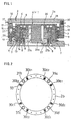
- Fig. 1 is a sectional diagram giving an approximate view of the composition of an air bearing-type vertical axis translation mechanism 1 based on a large-diameter feed screw according to one embodiment of the present invention, said sectional view being cut along a vertical plane containing the central axis of said mechanism.
- This vertical axis translation mechanism 1 comprises a table fixing member 3 for fixing the table 2, a rotational drive mechanism 4 installed therein, a base 5 for attaching the rotational drive mechanism 4, and the like, and as Fig. 1 clearly shows, these members are formed by tubular or ring-shaped bodies.
- the rotational drive mechanism 4 is constituted by a servo motor 4' provided with a stator 6 on the inner side thereof and a rotor 7 on the outer side thereof, the tubular stator 6 located on the inner side being fixed in an integral fashion to the base 5 by means of a plurality of bolts 8, in a position towards the inner side of the ring-shaped base 5.
- the tubular rotor 7 is installed rotatably on the base 5 in such a manner that it surrounds the outer circumference of the stator 6, and a male screw thread 9 is provided on the outer circumference of the rotor 7, which is a rotating section, and engages with a female screw thread 10 provided on the inner circumference of the tubular table fixing member 3.
- stator 6, rotor 7 and table fixing member 3 are each formed in a tubular shape, as stated previously, each of these members being positioned in a concentric fashion, and a static pressure air bearing is provided on the sliding surface between the lower face of the rotor 7 and the base 5.
- a stator core 11 comprising a wound coil is attached in an integral fashion to the outer circumference of the stator 6, whilst a rotor core 13 and magnet 14 are incorporated in a portion of the inner circumference of the rotor 7 having an enlarged diameter and are fixed integrally to the rotor 7 by means of a ring-shaped spacer 15 which interlocks with the upper end of the aforementioned enlarged diameter section.
- a static pressure air bearing is provided between the outer circumference of the stator 6 and the inner circumference of the rotor 7.
- a ring-shaped retainer 17 is fixed integrally to the upper end surface of the stator 6 by means of a plurality of bolts 8, and the air bearing provided between the lower face of the outer portion of the retainer 17 and the spacer 15 prohibits the movement of the rotor 7 in an axial direction.
- a rotation detector installation member 26 formed by a rotating member having an approximately T-shaped cross-section is fixed to the upper end surface of the rotor 7 in such a manner that it covers the retainer 17 in the radial direction thereof, and an encoder disk 27a, or the like, forming a constituent element of a pulse encoder 27, is fixed to the end of a projecting section 26a projecting in a downward direction from the central portion of the rotation detector installation member 26.
- symbol 27b denotes a base plate to which a photocoupler, or the like, forming a constituent element of the pulse encoder 27, is affixed, and this base plate 27b is fixed directly to the central portion of the base 5.
- a guide pin 19 fixed to the base 5 by a bolt 20 is provided at three points separated respectively by a pitch of 120° about the outer circumference of the base 5, which has a ring-shaped form.
- a hole 21 with which a guide pin 19 engages is provided respectively at positions in the table fixing member 3 which correspond to the guide pins 19, and the combination of the guide pin 19 and the bolt 20 constitutes movement direction restricting means for restricting the direction of movement of the table fixing member 3 with respect to the base 5. Since a static pressure air bearing is formed between each of the guide pin 19 and the holes 21, the outer circumference of each guide pin 19 does not contact directly the inner circumference of the respective hole 21.
- the present invention differs from the conventional vertical axis translation mechanism in that microdisplacement elements, such as electrostrictive elements or magnetostrictive elements are incorporated inside the table 2.
- electrostrictive elements are used as the microdisplacement elements.
- the table 2 is divided into a first table member 2a forming a flat surface of the table 2 and a second table member 2b which couples the table 2 to the table fixing member 3.
- the first table member 2a and the second table member 2b are coupled by electrostrictive elements 30a1 ⁇ 30d2.
- the second table member 2b is fixed to the table fixing member 3.
- Fig. 2 shows a plan view of the table member 2b in a state where the first table member 2a has been removed and the electrostrictive elements 30a1 ⁇ 30d2 and load cells 31a ⁇ 31d each of which serves as a force sensor as described hereinafter have been placed in position.
- the four pairs of electrostrictive elements are located equidistantly along the circumference of a circle having a centre at the central point of the table 2.
- a load cell 31a, 31b, 31c, 31d is positioned respectively between the two electrostrictive elements forming each pair (in other words, between electrostrictive elements 30a1 and 30a2, 30b1 and 30b2, 30c1 and 30c2, 30d1 and 30d2).
- the load cells 31a ⁇ 31d are placed equidistantly in four positions along the circumference of the circle on which the electrostrictive elements 30a1 ⁇ 30d2 are located.
- a single feedback control system is constituted by a load cell and the pair of electrostrictive elements positioned on either side of the load cell.
- a single feedback control system is formed by the load cell 31a and the pair of electrostrictive elements 30a1, 30a2 positioned on either side of that load cell 31a. (Consequently, a total of four feedback control systems are formed in the example in Fig. 2.)
- the rotor 7 will rotate about the stator 6, which is fixed to the base 5.
- the tubular table fixing member 3 which screws into the male screw thread 9 on the rotor 7 by means of the female screw thread 10 on the inner circumference thereof, performs vertical movement, since it is prevented from rotating by the guide pins, and hence an upward or downward motion is applied to the table 2.
- the present invention is devised in such a manner that the table 2 can be maintained in an attitude parallel to a reference plane by correcting inclination of the table 2 by means of the electrostrictive elements 30a1 ⁇ 30d2. Therefore, as illustrated in Fig. 1, the electrostrictive elements 30a1 ⁇ 30d2 are located in a compressed state between the first and second table members 2a, 2b, in such a manner that they expand and contract in a vertical direction. Moreover, as also shown in Fig. 1, the load cells 31a ⁇ 31d are positioned in such a manner that a pre-load is applied thereto from the side of the first table member 2a by means of pressure screws 32. In Fig. 2, reference numeral 33 denotes a groove for accommodating lead wires for supplying electric power to the electrostrictive elements 30a1 ⁇ 30d2.
- the rotational drive mechanism 4 (servo motor 4') is driven, the table 2 is moved to a target position and positioned, and the drive to the rotational drive mechanism 4 is halted, whereupon two level meters are positioned orthogonally on the table 2, the inclination of the table 2 is measured, and the degree of contraction of the electrostrictive elements 30a1 ⁇ 30d2 is adjusted in such a manner that the table 2 lies parallel to a reference plane, in other word, a vertical plane perpendicular to the central axis.
- Fig. 3 is an approximate diagram of the process of measuring the inclination of the table 2.
- one of the level meters 29a is placed on the straight line linking load cells 31a and 31c in Fig. 2
- the other level meter 29b is placed on the straight line linking load cells 31b and 31d
- electrostrictive elements 30a1 and 30a2, or electrostrictive elements 30c1 and 30c2 are adjusted in such a manner that the level meter 29a reads "0", in other words, level.
- the electrostrictive elements 30b1 and 30b2 or electrostrictive elements 30d1 and 30d2 are adjusted in such a manner that the other level meter 29b reads "0", or level.
- Fig. 4 is a block diagram of feedback control systems constituted respectively by load cells 31a ⁇ 31d and electrostrictive elements 30a1 ⁇ 30d2.
- the electrostrictive element control panel 40 is provided with volume controls 34a ⁇ 34d for setting the target voltage supplied to electrostrictive elements 30a1 ⁇ 30d2, subtracters 35a ⁇ 35d, and amplification calculators 36a ⁇ 36d having a primary delay transmission function.
- the outputs from the amplification calculators 36a - 36d are supplied respectively via electrostrictive element drive amplifiers 37a - 37d to the electrostrictive elements 30a1 and 30a2, 30b1 and 30b2, 30c1and 30c2, 30d1 and 30d2, forming the respective pairs.
- the load cells 31a ⁇ 31d are input respectively via distortion amplifiers 38a ⁇ 38d to the subtracters 35a ⁇ 35d.
- a single feedback control system (first feedback control system) is formed by load cell 31a, electrostrictive elements 30a1 and 30a2, volume control 34a, subtracter 35a, amplification calculator 36a, electrostrictive element drive amplifier 37a, and distortion amplifier 38a.
- a second feedback control system is formed by load cell 31b, electrostrictive elements 30b1 and 30b2, volume control 34b, subtracter 35b, amplification calculator 36b, electrostrictive element drive amplifier 37b, and distortion amplifier 38b.
- a third feedback control system is formed by load cell 31c, electrostrictive elements 30c1 and 30c2, volume control 34c, subtracter 35c, amplification calculator 36c, electrostrictive element drive amplifier 37c, and distortion amplifier 38c.
- a fourth feedback control system is formed by load cell 31d, electrostrictive elements 30d1 and 30d2, volume control 34d, subtracter 35d, amplification calculator 36d, electrostrictive element drive amplifier 37d, and distortion amplifier 38d.
- the volume control 34a is adjusted according to the inclination of the table 2 as measured by the level meters, and a target voltage is input to the subtracter 35a.
- the subtracter 35a subtracts the voltage output by the distortion amplifier 38a from the target voltage input via the volume control 34a to determine a voltage deviation, and this voltage deviation is then amplified by the amplification calculator 36a and passed through the electrostrictive element drive amplifiers 37a, thereby driving the two electrostrictive elements 30a1 and 30a2.
- each of the volume controls 34a-34d is adjusted according to the inclination of the table surface as measured by the level meters 29a, 29b, the table surface being adjusted such that it is parallel with a reference plane by causing the respective electrostrictive elements 30a1 and 30a2, 30b1 and 30b2, 30c1 and 30c2, 30d1 and 30d2, to expand or contract.
- any inclination of the table 2 arising from the processing accuracy of the screw section in the vertical axis translation mechanism can be corrected.
- the volume controls 34a-34d are adjusted, and all of the electrostrictive elements 30a1, 30a2 ⁇ 30d1, 30d2, are displaced by the aforementioned amount of correction, moving the table until the surface comes to a attitude parallel to the reference plane, and thereby making it possible to position the table at a target position with a very high degree of accuracy.
- the table 2 is divided into a first table member 2a and a second table member 2b, the electrostrictive elements 30a1 ⁇ 30d2 being positioned between these two table members, but it is also possible to provide electrostrictive elements 30a1 ⁇ 30d2 between the table 2 and table fixing member 3, without the table 2 being divided, in such a manner that the table 2 and the table fixing member 3 are coupled via the electrostrictive elements.
- feedback control was used as drive control means for the electrostrictive elements, but it is not necessary to implement feedback control, and open control may also be employed.
- power sensors for the load cells, and the like are not necessary, and the expansion and contraction of the electrostrictive elements should be controlled by inputting target voltages set by volume controls, or the like, to the electrostrictive element drive amplifiers.
Landscapes
- Engineering & Computer Science (AREA)
- Mechanical Engineering (AREA)
- Machine Tool Units (AREA)
Applications Claiming Priority (2)
| Application Number | Priority Date | Filing Date | Title |
|---|---|---|---|
| JP10368463A JP2000176761A (ja) | 1998-12-10 | 1998-12-10 | 垂直軸直動機構 |
| JP36846398 | 1998-12-10 |
Publications (3)
| Publication Number | Publication Date |
|---|---|
| EP1008419A2 true EP1008419A2 (fr) | 2000-06-14 |
| EP1008419A3 EP1008419A3 (fr) | 2002-04-10 |
| EP1008419B1 EP1008419B1 (fr) | 2004-10-20 |
Family
ID=18491889
Family Applications (1)
| Application Number | Title | Priority Date | Filing Date |
|---|---|---|---|
| EP99309885A Expired - Lifetime EP1008419B1 (fr) | 1998-12-10 | 1999-12-08 | Mécanisme de translation suivant un axe vertical |
Country Status (4)
| Country | Link |
|---|---|
| US (1) | US6232738B1 (fr) |
| EP (1) | EP1008419B1 (fr) |
| JP (1) | JP2000176761A (fr) |
| DE (1) | DE69921276T2 (fr) |
Cited By (2)
| Publication number | Priority date | Publication date | Assignee | Title |
|---|---|---|---|---|
| CN107052882A (zh) * | 2017-05-17 | 2017-08-18 | 杭州集智机电股份有限公司 | 用于全自动平衡修正设备的双丝杆翘板式进给机构 |
| CN112720307A (zh) * | 2021-01-15 | 2021-04-30 | 无锡职业技术学院 | 一种用于汽车零部件内外精加工的翻转辅助工装 |
Families Citing this family (9)
| Publication number | Priority date | Publication date | Assignee | Title |
|---|---|---|---|---|
| JP2008142860A (ja) * | 2006-12-12 | 2008-06-26 | Mitsui Seiki Kogyo Co Ltd | パレットテーブルの回転角補正装置及び方法 |
| JP5294016B2 (ja) * | 2009-01-30 | 2013-09-18 | 株式会社ニイガタマシンテクノ | 回転テーブルの振れ制御装置及びこれを備えた工作機械、回転テーブルの振れ制御方法 |
| KR100989555B1 (ko) | 2010-06-24 | 2010-10-25 | 주식회사 바로텍시너지 | 조종력 재현장치용 액츄에이터 |
| JP5401427B2 (ja) * | 2010-10-07 | 2014-01-29 | 株式会社日立ハイテクノロジーズ | 自動分析装置 |
| CN101954596A (zh) * | 2010-10-11 | 2011-01-26 | 烟台环球机床附件集团有限公司 | 一种数控直驱车铣复合回转工作台 |
| JP6121284B2 (ja) * | 2013-08-13 | 2017-04-26 | 株式会社ディスコ | 研磨装置 |
| CN104759753B (zh) * | 2015-03-30 | 2016-08-31 | 江苏大学 | 多系统自动化协调工作提高激光诱导空化强化的方法 |
| CN112548245B (zh) * | 2020-12-26 | 2022-02-08 | 景荣精密模具(深圳)有限公司 | 一种线切割机 |
| CN114102530B (zh) * | 2021-12-01 | 2023-05-02 | 扬州德云电气设备集团有限公司 | 一种具有转动功能的开关柜制造用夹持组件 |
Family Cites Families (5)
| Publication number | Priority date | Publication date | Assignee | Title |
|---|---|---|---|---|
| JPS62124842A (ja) * | 1985-11-27 | 1987-06-06 | Hitachi Seiko Ltd | テ−ブルの傾斜補正型工作機械 |
| JPH07106527B2 (ja) * | 1993-07-05 | 1995-11-15 | 功 庄田 | 複合加工機のテーブル移動装置 |
| US5669866A (en) * | 1996-06-10 | 1997-09-23 | W. A. Whitney Co. | Punch press with tool changer |
| JP2999964B2 (ja) * | 1996-09-11 | 2000-01-17 | ファナック株式会社 | 垂直軸直動機構 |
| US6110401A (en) * | 1998-08-24 | 2000-08-29 | Physical Optics Corporation | Method and apparatus for replicating light shaping surface structures on a rigid substrate |
-
1998
- 1998-12-10 JP JP10368463A patent/JP2000176761A/ja active Pending
-
1999
- 1999-12-08 US US09/456,543 patent/US6232738B1/en not_active Expired - Fee Related
- 1999-12-08 DE DE69921276T patent/DE69921276T2/de not_active Expired - Fee Related
- 1999-12-08 EP EP99309885A patent/EP1008419B1/fr not_active Expired - Lifetime
Cited By (2)
| Publication number | Priority date | Publication date | Assignee | Title |
|---|---|---|---|---|
| CN107052882A (zh) * | 2017-05-17 | 2017-08-18 | 杭州集智机电股份有限公司 | 用于全自动平衡修正设备的双丝杆翘板式进给机构 |
| CN112720307A (zh) * | 2021-01-15 | 2021-04-30 | 无锡职业技术学院 | 一种用于汽车零部件内外精加工的翻转辅助工装 |
Also Published As
| Publication number | Publication date |
|---|---|
| DE69921276T2 (de) | 2005-02-24 |
| DE69921276D1 (de) | 2004-11-25 |
| EP1008419B1 (fr) | 2004-10-20 |
| JP2000176761A (ja) | 2000-06-27 |
| EP1008419A3 (fr) | 2002-04-10 |
| US6232738B1 (en) | 2001-05-15 |
Similar Documents
| Publication | Publication Date | Title |
|---|---|---|
| EP1008419B1 (fr) | Mécanisme de translation suivant un axe vertical | |
| US6230070B1 (en) | Work position adjusting apparatus and adjusting method | |
| US9898000B2 (en) | Planar positioning system and method of using the same | |
| CN104317218B (zh) | 一种微纳操作环境下的精密宏动并联定位系统及方法 | |
| US10507532B2 (en) | Chuck for a high precision machine tool | |
| CN1871562B (zh) | 载物台装置 | |
| US20150280529A1 (en) | Positioning Device in Gantry Type of Construction | |
| JPH10138075A (ja) | ワーク姿勢調整装置、調整具及び調整方法 | |
| US6260285B1 (en) | Precision workpiece positioning device | |
| JP3194246B2 (ja) | X−yステージの制御装置 | |
| CN118443298A (zh) | 一种高精度丝杠检测浮动平台、调节方法及检测装置 | |
| US20070152391A1 (en) | Error corrected positioning stage | |
| JP2008103663A (ja) | 摩擦駆動搬送装置 | |
| US20110252930A1 (en) | Hard turning micro-machine tool | |
| CN114061618A (zh) | 一种光纤陀螺批量测试装置 | |
| JPH0329535B2 (fr) | ||
| JP2999964B2 (ja) | 垂直軸直動機構 | |
| JPH09317767A (ja) | 位置決め装置 | |
| CN120985529A (zh) | 数控回转工作台空间姿态测量调节方法及升降锁紧机构 | |
| US6307284B1 (en) | Positioning apparatus, information recording/reproducing apparatus, and inspection apparatus | |
| JPH09216137A (ja) | 位置決め装置 | |
| CN121946421A (zh) | 一种异构直线电机直驱的静压气浮与柔性铰链行程缩放式二维宏微复合定位系统 | |
| Mills et al. | Positional accuracy for ink jet deposition in digital fabrication | |
| CN118234132A (zh) | 电路板加工设备及其控制方法、控制装置及校准方法 | |
| JP2003336711A (ja) | 摩擦駆動装置 |
Legal Events
| Date | Code | Title | Description |
|---|---|---|---|
| PUAI | Public reference made under article 153(3) epc to a published international application that has entered the european phase |
Free format text: ORIGINAL CODE: 0009012 |
|
| AK | Designated contracting states |
Kind code of ref document: A2 Designated state(s): AT BE CH CY DE DK ES FI FR GB GR IE IT LI LU MC NL PT SE Kind code of ref document: A2 Designated state(s): DE |
|
| AX | Request for extension of the european patent |
Free format text: AL;LT;LV;MK;RO;SI |
|
| PUAL | Search report despatched |
Free format text: ORIGINAL CODE: 0009013 |
|
| AK | Designated contracting states |
Kind code of ref document: A3 Designated state(s): AT BE CH CY DE DK ES FI FR GB GR IE IT LI LU MC NL PT SE |
|
| AX | Request for extension of the european patent |
Free format text: AL;LT;LV;MK;RO;SI |
|
| RIC1 | Information provided on ipc code assigned before grant |
Free format text: 7B 23Q 5/28 A, 7B 23Q 5/34 B, 7B 23Q 1/56 B, 7B 23Q 1/26 B, 7B 25H 1/16 B, 7B 25H 1/18 B, 7B 23Q 1/03 B, 7B 23Q 1/58 B |
|
| 17P | Request for examination filed |
Effective date: 20020701 |
|
| AKX | Designation fees paid |
Free format text: DE |
|
| 17Q | First examination report despatched |
Effective date: 20031210 |
|
| GRAP | Despatch of communication of intention to grant a patent |
Free format text: ORIGINAL CODE: EPIDOSNIGR1 |
|
| RAP1 | Party data changed (applicant data changed or rights of an application transferred) |
Owner name: FANUC LTD |
|
| GRAS | Grant fee paid |
Free format text: ORIGINAL CODE: EPIDOSNIGR3 |
|
| GRAA | (expected) grant |
Free format text: ORIGINAL CODE: 0009210 |
|
| AK | Designated contracting states |
Kind code of ref document: B1 Designated state(s): DE |
|
| REG | Reference to a national code |
Ref country code: IE Ref legal event code: FG4D |
|
| REF | Corresponds to: |
Ref document number: 69921276 Country of ref document: DE Date of ref document: 20041125 Kind code of ref document: P |
|
| PLBE | No opposition filed within time limit |
Free format text: ORIGINAL CODE: 0009261 |
|
| STAA | Information on the status of an ep patent application or granted ep patent |
Free format text: STATUS: NO OPPOSITION FILED WITHIN TIME LIMIT |
|
| 26N | No opposition filed |
Effective date: 20050721 |
|
| PGFP | Annual fee paid to national office [announced via postgrant information from national office to epo] |
Ref country code: DE Payment date: 20061130 Year of fee payment: 8 |
|
| PG25 | Lapsed in a contracting state [announced via postgrant information from national office to epo] |
Ref country code: DE Free format text: LAPSE BECAUSE OF NON-PAYMENT OF DUE FEES Effective date: 20080701 |