EP1008432B1 - Procede de fabrication d'un article leger en resine thermoplastique renforcee de fibres, et article leger moule - Google Patents
Procede de fabrication d'un article leger en resine thermoplastique renforcee de fibres, et article leger moule Download PDFInfo
- Publication number
- EP1008432B1 EP1008432B1 EP97902665A EP97902665A EP1008432B1 EP 1008432 B1 EP1008432 B1 EP 1008432B1 EP 97902665 A EP97902665 A EP 97902665A EP 97902665 A EP97902665 A EP 97902665A EP 1008432 B1 EP1008432 B1 EP 1008432B1
- Authority
- EP
- European Patent Office
- Prior art keywords
- weight
- fiber
- product
- resin
- light
- Prior art date
- Legal status (The legal status is an assumption and is not a legal conclusion. Google has not performed a legal analysis and makes no representation as to the accuracy of the status listed.)
- Expired - Lifetime
Links
Images
Classifications
-
- B—PERFORMING OPERATIONS; TRANSPORTING
- B29—WORKING OF PLASTICS; WORKING OF SUBSTANCES IN A PLASTIC STATE IN GENERAL
- B29C—SHAPING OR JOINING OF PLASTICS; SHAPING OF MATERIAL IN A PLASTIC STATE, NOT OTHERWISE PROVIDED FOR; AFTER-TREATMENT OF THE SHAPED PRODUCTS, e.g. REPAIRING
- B29C45/00—Injection moulding, i.e. forcing the required volume of moulding material through a nozzle into a closed mould; Apparatus therefor
-
- B—PERFORMING OPERATIONS; TRANSPORTING
- B29—WORKING OF PLASTICS; WORKING OF SUBSTANCES IN A PLASTIC STATE IN GENERAL
- B29C—SHAPING OR JOINING OF PLASTICS; SHAPING OF MATERIAL IN A PLASTIC STATE, NOT OTHERWISE PROVIDED FOR; AFTER-TREATMENT OF THE SHAPED PRODUCTS, e.g. REPAIRING
- B29C45/00—Injection moulding, i.e. forcing the required volume of moulding material through a nozzle into a closed mould; Apparatus therefor
- B29C45/0005—Injection moulding, i.e. forcing the required volume of moulding material through a nozzle into a closed mould; Apparatus therefor using fibre reinforcements
-
- B—PERFORMING OPERATIONS; TRANSPORTING
- B29—WORKING OF PLASTICS; WORKING OF SUBSTANCES IN A PLASTIC STATE IN GENERAL
- B29C—SHAPING OR JOINING OF PLASTICS; SHAPING OF MATERIAL IN A PLASTIC STATE, NOT OTHERWISE PROVIDED FOR; AFTER-TREATMENT OF THE SHAPED PRODUCTS, e.g. REPAIRING
- B29C44/00—Shaping by internal pressure generated in the material, e.g. swelling or foaming ; Producing porous or cellular expanded plastics articles
- B29C44/34—Auxiliary operations
- B29C44/58—Moulds
- B29C44/586—Moulds with a cavity increasing in size during foaming
-
- B—PERFORMING OPERATIONS; TRANSPORTING
- B29—WORKING OF PLASTICS; WORKING OF SUBSTANCES IN A PLASTIC STATE IN GENERAL
- B29C—SHAPING OR JOINING OF PLASTICS; SHAPING OF MATERIAL IN A PLASTIC STATE, NOT OTHERWISE PROVIDED FOR; AFTER-TREATMENT OF THE SHAPED PRODUCTS, e.g. REPAIRING
- B29C45/00—Injection moulding, i.e. forcing the required volume of moulding material through a nozzle into a closed mould; Apparatus therefor
- B29C45/17—Component parts, details or accessories; Auxiliary operations
- B29C45/26—Moulds
-
- B—PERFORMING OPERATIONS; TRANSPORTING
- B29—WORKING OF PLASTICS; WORKING OF SUBSTANCES IN A PLASTIC STATE IN GENERAL
- B29C—SHAPING OR JOINING OF PLASTICS; SHAPING OF MATERIAL IN A PLASTIC STATE, NOT OTHERWISE PROVIDED FOR; AFTER-TREATMENT OF THE SHAPED PRODUCTS, e.g. REPAIRING
- B29C45/00—Injection moulding, i.e. forcing the required volume of moulding material through a nozzle into a closed mould; Apparatus therefor
- B29C45/17—Component parts, details or accessories; Auxiliary operations
- B29C45/46—Means for plasticising or homogenising the moulding material or forcing it into the mould
- B29C45/56—Means for plasticising or homogenising the moulding material or forcing it into the mould using mould parts movable during or after injection, e.g. injection-compression moulding
-
- B—PERFORMING OPERATIONS; TRANSPORTING
- B29—WORKING OF PLASTICS; WORKING OF SUBSTANCES IN A PLASTIC STATE IN GENERAL
- B29C—SHAPING OR JOINING OF PLASTICS; SHAPING OF MATERIAL IN A PLASTIC STATE, NOT OTHERWISE PROVIDED FOR; AFTER-TREATMENT OF THE SHAPED PRODUCTS, e.g. REPAIRING
- B29C45/00—Injection moulding, i.e. forcing the required volume of moulding material through a nozzle into a closed mould; Apparatus therefor
- B29C45/17—Component parts, details or accessories; Auxiliary operations
- B29C45/46—Means for plasticising or homogenising the moulding material or forcing it into the mould
- B29C45/56—Means for plasticising or homogenising the moulding material or forcing it into the mould using mould parts movable during or after injection, e.g. injection-compression moulding
- B29C45/561—Injection-compression moulding
- B29C2045/563—Enlarging the mould cavity during injection
-
- Y—GENERAL TAGGING OF NEW TECHNOLOGICAL DEVELOPMENTS; GENERAL TAGGING OF CROSS-SECTIONAL TECHNOLOGIES SPANNING OVER SEVERAL SECTIONS OF THE IPC; TECHNICAL SUBJECTS COVERED BY FORMER USPC CROSS-REFERENCE ART COLLECTIONS [XRACs] AND DIGESTS
- Y10—TECHNICAL SUBJECTS COVERED BY FORMER USPC
- Y10T—TECHNICAL SUBJECTS COVERED BY FORMER US CLASSIFICATION
- Y10T428/00—Stock material or miscellaneous articles
- Y10T428/249921—Web or sheet containing structurally defined element or component
- Y10T428/249953—Composite having voids in a component [e.g., porous, cellular, etc.]
- Y10T428/249955—Void-containing component partially impregnated with adjacent component
- Y10T428/249958—Void-containing component is synthetic resin or natural rubbers
-
- Y—GENERAL TAGGING OF NEW TECHNOLOGICAL DEVELOPMENTS; GENERAL TAGGING OF CROSS-SECTIONAL TECHNOLOGIES SPANNING OVER SEVERAL SECTIONS OF THE IPC; TECHNICAL SUBJECTS COVERED BY FORMER USPC CROSS-REFERENCE ART COLLECTIONS [XRACs] AND DIGESTS
- Y10—TECHNICAL SUBJECTS COVERED BY FORMER USPC
- Y10T—TECHNICAL SUBJECTS COVERED BY FORMER US CLASSIFICATION
- Y10T428/00—Stock material or miscellaneous articles
- Y10T428/249921—Web or sheet containing structurally defined element or component
- Y10T428/249953—Composite having voids in a component [e.g., porous, cellular, etc.]
- Y10T428/249962—Void-containing component has a continuous matrix of fibers only [e.g., porous paper, etc.]
- Y10T428/249964—Fibers of defined composition
-
- Y—GENERAL TAGGING OF NEW TECHNOLOGICAL DEVELOPMENTS; GENERAL TAGGING OF CROSS-SECTIONAL TECHNOLOGIES SPANNING OVER SEVERAL SECTIONS OF THE IPC; TECHNICAL SUBJECTS COVERED BY FORMER USPC CROSS-REFERENCE ART COLLECTIONS [XRACs] AND DIGESTS
- Y10—TECHNICAL SUBJECTS COVERED BY FORMER USPC
- Y10T—TECHNICAL SUBJECTS COVERED BY FORMER US CLASSIFICATION
- Y10T428/00—Stock material or miscellaneous articles
- Y10T428/249921—Web or sheet containing structurally defined element or component
- Y10T428/249953—Composite having voids in a component [e.g., porous, cellular, etc.]
- Y10T428/249987—With nonvoid component of specified composition
- Y10T428/249988—Of about the same composition as, and adjacent to, the void-containing component
- Y10T428/249989—Integrally formed skin
Definitions
- the present invention relates to a method of forming a light-weight, fiber-reinforced thermoplastic resin product, and a light-weight molded product.
- the invention relates to a method comprising injection molding of specific fiber-reinforced thermoplastic resin pellets or of specific fiber-reinforced thermoplastic resin pellets and a small amount of a foaming agent for forming a light-weight, fiber-reinforced, particularly glass fiber-reinforced, thermoplastic resin product with good surface condition, high strength and high stiffness, and also to a light-weight molded product.
- glass fiber-reinforced resins are of great use as various materials.
- injection-molded products of resins of the type are the most popular because of their good moldability.
- they are defective in that their specific gravity increases with the increase in the glass fiber content and that their strength is lowered since glass fibers are often cut during molding.
- they are further defective in that their warping deformation is great.
- a foaming injection molding method in which is used a foaming agent (see JP-A Hei-7-247679).
- this method is problematic in that it requires a large amount of a foaming agent, that it is not easy to attain a foaming magnification of from 2 to 5 times, and that the glass fiber content is naturally limited.
- an injection-press molding method comprising injecting a foaming agent-containing resin into the cavity of an opened split mold followed by closing the mold.
- Another method of forming fiber-reinforced resin moldings comprises plasticizing a mixture of reinforcing fibers and a thermoplastic resin followed by molding it under compression, and which is characterized in that the compression for the surface of the molding in which the reinforcing fibers are intended to be restored expanded is partly released thereby raising the fibers existing in the surface layer of the molding, and/or forming voids partly inside the molding to make the molding have a sound-absorbing region (see WO96/25280).
- this molding method is to produce moldings having a specific, raised surface condition, and could not produce moldings with smooth surface.
- this method is problematic in that its producibility is low, that the raw material mixture could not be highly homogenized, and that, if the mixture is highly homogenized, the reinforcing glass fibers are much broken. For those reasons, the use of the moldings produced by this method is limited.
- the document EP 0 658 410 A2 discloses a process for producing a multilayer molded article comprising a skin material laminated on the surface of a foamed thermoplastic resin comprising;
- the present inventors have assiduously studied in order to obtain light-weight, high-strength, fiber-reinforced thermoplastic resin products through injection molding, and, as a result, have found that the intended light-weight products are obtained by a combination of a specific molding material and a specific molding mode, and that the products obtained have good appearance with good surface characteristics of smooth skin.
- we have completed the present invention we have completed the present invention.
- the invention is to provide a light-weight, fiber-reinforced resin product, which has a skin layer with no void in its surface and of which the inside is highly uniform and has fiber-entangled, continuous open voids with no large hollow, and the product has a high relative bending strength.
- the invention provides a method of forming a light-weight, fiber-reinforced thermoplastic resin product, as defined in claims 1 to 7, and a molded, light-weight, fiber-reinforced thermoplastic resin product as defined in claims 8 to 10.
- (A) indicates the step of injecting a resin into the cavity of the mold
- (B) indicates the condition of a final molded product as formed after opening the mold.
- thermoplastic resin to be used herein is not specifically defined and may include, for example, polyolefin-based resins, polystyrene-based resins, polyvinyl chloride-based resins, polyamide-based resins, polyester-based resins, polyacetal-based resins, polycarbonate-based resins, polyaromatic ether or thioether-based resins, polyaromatic ester-based resins, polysulfone-based resins, acrylate-based resins, etc.
- the polyolefin-based resins include, for example, homopolymers and copolymers of ⁇ -olefins, such as ethylene, propylene, butene-1, 3-methylbutene-1, 3-methylpentene-1, 4-methylpentene-1; and copolymers of such ⁇ -olefins with other copolymerizable, unsaturated monomers.
- polyethylene-based resins such as high-density, middle-density or low-density polyethylene, linear polyethylene, ultra-high molecular polyethylene, ethylene-vinyl acetate copolymer, ethylene-ethyl acrylate copolymer; polypropylene-based resins such as syndiotactic polypropylene, isotactic polypropylene, propylene-ethylene block or random copolymer; poly-4-methylpentene-1, etc.
- polyethylene-based resins such as high-density, middle-density or low-density polyethylene, linear polyethylene, ultra-high molecular polyethylene, ethylene-vinyl acetate copolymer, ethylene-ethyl acrylate copolymer
- polypropylene-based resins such as syndiotactic polypropylene, isotactic polypropylene, propylene-ethylene block or random copolymer
- poly-4-methylpentene-1 etc
- the styrene-based resins include, for example, homopolymers and copolymers of styrene and ⁇ -methylstyrene; and copolymers thereof with other copolymerizable, unsaturated monomers.
- resins are general polystyrene, impact-resistant polystyrene, heat-resistant polystyrene ( ⁇ -methylstyrene polymer), syndiotactic polystyrene, acrylonitrile-butadiene-styrene copolymer (ABS), acrylonitrile-styrene copolymer (AS), acrylonitrile-polyethylene chloride-styrene copolymer (ACS), acrylonitrile-ethylene-propylene rubber-styrene copolymer (AES), acrylic rubber-acrylonitrile-styrene copolymer (AAS), etc.
- ABS acrylonitrile-butadiene-styrene copolymer
- AS acrylonitrile-styrene copolymer
- ACS acrylonitrile-polyethylene chloride-styrene copolymer
- AES acrylonitrile-ethylene-propylene rubber-
- the polyvinyl chloride-based resins include, for example, vinyl chloride homopolymers and copolymers of vinyl chloride with other copolymerizable, unsaturated monomers.
- the resins mentioned are vinyl chloride-acrylate copolymer, vinyl chloride-methacrylate copolymer, vinyl chloride-ethylene copolymer, vinyl chloride-propylene copolymer, vinyl chloride-vinyl acetate copolymer, vinyl chloride-vinylidene chloride copolymer, etc.
- These polyvinyl chloride-based resins may be post-chlorinated to increase their chlorine content, and the thus post-chlorinated resins are also be usable in the invention.
- the polyamide-based resins include, for example, polymers as prepared by ring-cleaving polymerization of cyclic aliphatic lactams, such as 6-nylon, 12-nylon; polycondensates of aliphatic diamines and aliphatic dicarboxylic acids, such as 6,6-nylon, 6,10-nylon, 6,12-nylon; polycondensates of m-xylenediamine and adipic acid; polycondensates of aromatic diamines and aliphatic dicarboxylic acids; polycondensates of p-phenylenediamine and terephthalic acid; polycondensates of m-phenylenediamine and isophthalic acid; polycondensates of aromatic diamines and aromatic dicarboxylic acids; polycondensates of amino acids, such as 11-nylon, etc.
- the polyester-based resins include, for example, polycondensates of aromatic dicarboxylic acids and alkylene glycols.
- the resins mentioned are polyethylene terephthalate, polybutylene terephthalate, etc.
- the polyacetal-based resins include, for example, homopolymers, such as polyoxymethylene; and formaldehyde-ethylene oxide copolymers to be obtained from trioxan and ethylene oxide.
- the polycarbonate-based resins include, for example, 4,4'-dihydroxy-diarylalkane-based polycarbonates.
- Preferred are bisphenol A-based polycarbonates to be prepared by phosgenation of reacting bisphenol A with phosgene, or by interesterification of reacting bisphenol A with dicarbonates such as diphenyl carbonate.
- modified bisphenol A-based polycarbonates of which the bisphenol A moiety is partly substituted with 2,2-bis(4-hydroxy-3,5-dimethylphenyl) propane or 2,2-bis(4-hydroxy-3,5-dibromophenyl) propane; and flame-retardant, bisphenol A-based polycarbonates.
- the polyaromatic ether or thioether-based resins have ether or thioether bonds in the molecular chain, and their examples include polyphenylene ether, styrene-grafted polyphenylene ether, polyether-ether-ketone, polyphenylene sulfide, etc.
- the polyaromatic ester-based resins include, for example, polyoxybenzoyl to be obtained by polycondensation of p-hydroxybenzoic acid; polyarylates to be obtained by polycondensation of bisphenol A with aromatic dicarboxylic acids such as terephthalic acid and isophthalic acid, etc.
- the polysulfone-based resins have sulfone groups in the molecular chain, and their examples include polysulfone to be obtained by polycondensation of bisphenol A with 4,4'-dichlorodiphenylsulfone; polyether-sulfones having phenylene groups as bonded at their p-positions via ether group and sulfone group; polyarylene-sulfones having diphenylene groups and diphenylene-ether groups as alternately bonded via sulfone group, etc.
- the acrylate-based resins include, for example, methacrylate polymers and acrylate polymers.
- the monomers for those polymers for example, used are methyl, ethyl, n-propyl, isopropyl and butyl methacrylates and acrylates.
- typically used are methyl methacrylate resins.
- thermoplastic resins mentioned above may be used either singly or as combined.
- polypropylene-based resins such as polypropylene, random or block copolymers of propylene with other olefins, and their mixtures.
- polypropylene-based resins containing acid-modified polyolefin-based resins as modified with unsaturated carboxylic acid or their derivatives are particularly preferred.
- the polyolefin-based resins for the acid-modified polyolefin-based resins include, for example, polypropylene, polyethylene, ethylene- ⁇ -olefin copolymers, propylene-ethylene random-copolymers, propylene-ethylene blockcopolymers, ethylene-a-olefin copolymer rubbers, ethylene- ⁇ -olefin-non-conjugated diene copolymers (e.g., EPDM), and ethylene-aromatic monovinyl compound-conjugated diene copolymer rubbers.
- polypropylene polyethylene
- polyethylene ethylene- ⁇ -olefin copolymers
- propylene-ethylene random-copolymers propylene-ethylene blockcopolymers
- ethylene-a-olefin copolymer rubbers ethylene- ⁇ -olefin-non-conjugated diene copolymers (e.g., EPDM)
- EPDM
- the ⁇ -olefins include, for example, propylene, butene-1, pentene-1, hexene-1, and 4-methylpentene-1, and one or more of these are usable either singly or as combined.
- polyolefin-based resins preferred are polypropylene-based or polyethylene-based resins containing copolymers, and more preferred are polypropylene-based resins.
- unsaturated carboxylic acids and their derivatives to be used for modifying the resins are unsaturated carboxylic acids such as acrylic acid, methacrylic acid, maleic acid, fumaric acid, itaconic acid, crotonic acid, citraconic acid, sorbic acid, mesaconic acid, angelic acid; as well as acid anhydrides, esters, amides, imides and metal salts, such as maleic anhydride, itaconic anhydride, citraconic anhydride, methyl acrylate, methyl methacrylate, ethyl acrylate, butyl acrylate, monoethyl acrylate, acrylamide, maleic acid monoamide, maleimide, N-butylmaleimide, sodium acrylate, sodium methacrylate.
- unsaturated dicarboxylic acids and their derivatives are preferred.
- one or more of the acids and their derivatives may be used either singly or as combined.
- the modification method is not specifically defined, but may be of any known conventional ones.
- a polyolefin-based resin to be modified is dissolved in a suitable organic solvent, to which is added an unsaturated carboxylic acid or its derivative along with a radical-generating agent, and stirred under heat; or those components are put into an extruder and melted and kneaded therein.
- the amount of the unsaturated carboxylic acid or its derivative added is preferably from 0.01 to 20 % by weight, more preferably from 0.1 to 10 % by weight.
- the amount of maleic anhydride added is from 0.1 to 10 % by weight.
- the fibers to be used in the invention are not specifically defined, but preferred are glass fibers
- glass fibers also usable are ceramic fibers such as boron fibers, silicon carbide fibers, alumina fibers, silicon nitride fibers, zirconia fibers, calcium silicate fibers, rock wool; inorganic fibers such as magnesium oxide fibers, magnesium oxysulfate fibers, magnesium hydroxide fibers, gypsum fibers; metal fibers such as copper fibers, brass fibers, steel fibers, stainless steel fibers, aluminium fibers, aluminium alloy fibers; organic fibers such as polyethylene fibers, polypropylene fibers, aramide fibers, polyarylate fibers; and carbon fibers.
- ceramic fibers such as boron fibers, silicon carbide fibers, alumina fibers, silicon nitride fibers, zirconia fibers, calcium silicate fibers, rock wool
- inorganic fibers such as magnesium oxide fibers, magnesium oxysulfate fibers, magnesium
- glass fibers organic fibers, carbon fibers, and metal fibers; and more preferred are glass fibers, and composite fibers consisting essentially of glass fibers.
- One or more, same or different types of those fibers are employable herein either singly or as combined.
- the glass fibers for use in the invention are preferably surface-treated with coupling agents.
- the coupling agents may be of any known, conventional, so-called silane or titanium coupling agents.
- silane coupling agents are triethoxysilane, vinyltris( ⁇ -methoxyethoxy)silane, ⁇ -methacryloxypropyltrimethoxysilane, ⁇ -glycidoxypropyltrimethoxysilane, ⁇ -(1,1-epoxycyclohexyl) ethyltrimethoxysilane, N-( ⁇ -(aminoethyl)- ⁇ -aminopropyltrimethoxysilane, N- ⁇ -(aminoethyl)- ⁇ -aminopropylmethyldimethoxysilane, ⁇ -aminopropyltriethoxysilane, N-phenyl- ⁇ -aminopropyltrimethoxysilane, ⁇ -mercaptoprop
- aminosilanes and epoxysilanes such as ⁇ -aminopropyltriethoxysilane, N- ⁇ -(aminoethyl)- ⁇ -aminopropyltrimethoxysilane, ⁇ -glycidoxypropyltrimethoxysilane, ⁇ -(3,4-epoxycyclohexyl)ethyltrimethoxysilane.
- aminosilanes and epoxysilanes such as those mentioned above.
- titanium coupling agents are isopropyltriisostearoyl titanate, isopropyltridodecylbenzenesulfonyl titanate, isopropyltris(dioctylpyrophosphate) titanate, tetraisopropylbis(dioctylphosphite) titanate, tetraoctylbis(ditridecylphosphite) titanate, tetra(1,1-diallyloxymethyl-1-butyl)bis(ditridecyl)phosphite titanate, bis(dioctylpyrophosphate)oxyacetate titanate, bis(dioctylpyrophosphate)ethylene titanate, isopropyltrioctanoyl titanate, isopropyldimethacrylisostearoyl titanate, isopropylisostearoyldiacryl titanate, isopropyltris
- the surface treatment of glass fibers with those coupling agents may be effected in any ordinary manner, and is not specifically defined.
- sizing treatment of applying a sizing agent, which is a solution or suspension of the coupling agent in an organic solvent, to glass fibers, dry mixing or spraying.
- the coupling agent may be combined with a film-forming substance for glass.
- the film-forming substance is not specifically defined, and includes, for example, polyester-based, urethane-based, epoxy-based, acrylic, vinyl acetate-based and isocyanate-based polymers.
- glass fibers are preferably used as the reinforcing fibers in view of the strength and the modulus (stiffness) of the light-weight molded products, and preferred embodiments of the invention using glass fibers are mentioned hereinunder.
- Glass fibers of E-glass, S-glass or the like are employable herein, which have a mean fiber diameter of not larger than 20 ⁇ m, preferably from 1 to 17 ⁇ m, more preferably from 3 to 14 ⁇ m. Using too thin glass fibers having a mean fiber diameter of smaller than 1 ⁇ m will make it difficult to wet them with resin or to infiltrate resin into them while producing resin pellets containing them.
- the thermoplastic resin especially the polypropylene-based polyolefin resin noted above is drawn and pelletized into pellets having a length of from 2 to 100 mm.
- the glass fibers may have the same length as each pellet, from 2 to 100 mm.
- used are those glass fiber-reinforced, thermoplastic resin pellets.
- the glass fibers in the resin to be pelletized are bound with a suitable binder into fiber strands each composed of from 100 to 10000 fibers, more preferably from 150 to 5000 fibers.
- the binder may be any of urethane-based, olefin-based, acrylic, butadiene-based and epoxy-based ones. Of those, preferred are urethane-based and olefin-based binders.
- the urethane-based binder generally contains a polyisocyanate, which is obtained through addition polymerization of a diisocyanate compound and a polyalcohol, in an amount of not smaller than 50 % by weight, and is grouped into a one-liquid type including oil-modified, moisture-curable and blocking binders, and a two-liquid type including catalyst-curable and polyol-curable binders. Any of those binders is usable in the invention.
- the polyolefin-based resin usable is any of modified polyolefin-based resins as modified with unsaturated carboxylic acids or their derivatives.
- the thermoplastic resin is infiltrated into those glass fiber strands, and pelletized into the glass fiber-containing thermoplastic resin pellets (A).
- A glass fiber-containing thermoplastic resin pellets
- employed is a method of dipping the glass fiber strands in a melt of the resin, a method of passing the glass fiber strands through a coating die along with the resin, or a method of extruding a melt of the resin through a die around the glass fiber strands.
- the pellets for use in the invention have a length of from 2 to 100 mm, in which the glass fibers have the same length as each pellet, from 2 to 100 mm.
- too short glass fibers having a length of smaller than 2 mm are used in the method of the invention, it is difficult to produce light-weight molded products, and the products produced often have poor mechanical strength and will be much warped and deformed.
- too long glass fibers having a length of larger than 100 mm are used, injection molding of the resin containing them is difficult and, in addition, the glass fibers could not be uniformly dispersed in the resin thereby worsening the surface characteristics of the molded products.
- the length of the resin pellets preferably falls between 3 and 80 mm for obtaining hardly-deformable, light-weight molded products having high mechanical strength and good outward appearance, but more preferably falls between 5 and 50 mm in consideration of the dispersibility of fibers in the resin and the outward appearance and surface characteristics of the molded products to be produced.
- the polypropylene-based resin to be formed into pellets preferably has a melt index (MI, at 230°C and 2.16 kgf) of from 10 to 1000 g/10 min, more preferably from 30 to 600 g/10 min, in view of its infiltrability into fibers and of its moldability.
- MI melt index
- the polypropylene-based resin may have a desired MI; or by adding a peroxide thereto and melting and kneading them, the resin may be controlled to have an increased MI.
- the pellets are not limited to those prepared by cutting resin strands. Shaped resin sheets, tapes or bands may be cut into pellets in which the fibers may substantially have a length of from 2 to 100 mm.
- the fiber-containing thermoplastic resin pellets (A) may be used; or the pellets (A) may be mixed with any other thermoplastic resins except (A) to give a mixture, and the resin mixture may also be used.
- the fiber content of the pellets (A) must be from 5 to 80 % by weight, preferably from 20 to 80 % by weight of the resin mixture.
- the fiber content must be from 20 to 80 % by weight in order to obtain light-weight molded products.
- the fiber content may be suitably determined, depending on the type, the density and the length of the fibers used.
- thermoplastic resins except (A) may the same as or different from the resins used in preparing (A), and are not specifically defined.
- additional resins usable are commercially-available, ordinary-grade resin pellets, granules and even powders, and their shape is not specifically defined. However, preferred are pellets. Even when the additional resins are of the same type as the resins of (A), their molecular weight and melt flowability may be different from those of the resins of (A).
- the molding material to be used may contain additives of reinforcing agent, filler, antioxidant, antistatic agent, flame retardant, pigment and dispersant, such as talc, mica, calcium carbonate, milled glass fibers, carbon fibers, magnesium sulfate fibers, potassium titanate fibers, titanium oxide fibers, organic fibers, etc.
- the molding material comprising the components mentioned hereinabove is molded through injection molding under a specific condition.
- the glass fibers in the molding material comprising the resin pellets are oriented in parallel to each other in each pellet while having a length of from 2 to 100 mm, preferably from 3 to 80 mm, and the glass fiber content of the molding material is from 20 to 80 % by weight, preferably from 30 to 70 % by weight. If too short glass fibers having a length of smaller than 2 mm are used, the products produced could not be light-weight.
- knead and inject the molding material for example, employed is any of (1) an injection-molding method comprising putting the molding material into the hot cylinder of an injection-molding machine, heating and melting it and dispersing the fibers in the resulting resin melt therein, and thereafter injecting the resin melt into the top of the machine with a plunger or the like, and shaping it in the cavity of the machine; (2) an injection-molding method comprising putting the molding material into the hot cylinder of an injection-molding machine, then heating and melting it therein, feeding the resulting resin melt into the screw area of the machine with a plunger or the like, then dispersing the fibers in the resin melt therein, and thereafter injecting the resin melt into the cavity of the machine; and (3) an injection-molding method comprising feeding the molding material into the top of an injection-molding machine with a screw having deep grooves and having a small reduction ratio, while the cylinder temperature is kept extremely high with preventing the fibers from being broken, and injecting the
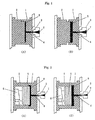
- Fig. 1 and Fig. 2 1 is a fixed mold, 2 is a mobile mold, 3 is an injection nozzle, 4 is a sprue, 5 is a working core, 6 is a forward-and-backward movable unit, 7 is a resin melt, 8 is an initial cavity, and 9 is a final cavity (for final products).
- (A) indicates the stage of injecting resin
- (B) indicates the final stage of molding.
- Fig. 1 shows one embodiment of the method of forming light-weight resin products of the invention.
- a melt mixture of a molding material is injected into the cavity 8 of the split mold, which is so closed that the volume of the cavity 8 is smaller than that of the final product.
- the resin adjacent to the surface of the mold is cooled to form a surface skin layer, as in ordinary injection molding.
- the mold is opened until its cavity volume is equal to the volume of the intended final product 9, as in Fig. 1 (B).
- the expandable resin melt containing entangled fibers expands to have a volume that is equal to the volume of the final product.
- this is cooled, and the mobile mold 2 is released to take out the final product. In that manner, obtained is the intended, light-weight resin product.
- the closed condition of the initial cavity and the opened condition of the final cavity may be suitably determined, depending on the fiber content of the molding material to be used, the length of fibers in the molding material, and the porosity (or specific gravity) of the product to be produced.
- the timing of opening the mold cavity may be suitably determined, depending on the mold temperature, the thickness of the skin layer formed on the surface of the product, and the thickness of the product.
- Fig. 2 shows another embodiment of the method of forming light-weight resin products of the invention.
- the molding machine for this embodiment comprises the fixed mold 1, the mobile mold 2, and the working core 5 which is disposed inside the mobile mold 2 in such a manner that it can be moved forward and backward in the same direction as the moving direction of the mobile mold but independently of the movement of the mobile mold.
- the cavity is formed by the fixed mold, the mobile mold and the working core, and its volume is variable by moving forward or backward the working core.
- the part of the mold cavity except its part for forming the edges of the final product is opened.
- the working core 5 is moved forward and backward by means of the forward-and-backward movable unit 6 (this is a hydraulic sliding system).
- a resin melt is injected into the closed mold cavity, and, just before the resin injection is completed and the cavity is filled with the resin, or after the resin injection is completed and the edges of the product are formed, the working core is moved backward until the volume of the mold cavity is equal to that of the final product.
- a smaller amount, relative to the volume of the closed mold cavity, of the resin melt is injected into the closed mold cavity, and, before, simultaneously with or after the completion of the resin injection, the mobile mold or the working core is once moved forward so that the cavity mold is completely filled with the resin, and, while or after the cavity mold is completely filled with the resin, the mobile mold or the working core 5 may be moved backward to thereby make the volume of the cavity core equal to that of the final product.
- the moving distance is preferably from 0.1 to 50 mm. More preferably, the moving distance is from 0.1 to 10 mm to prevent air from being introduced into the surface of the product being formed.
- the air introduction is unfavorable as forming flow marks on the surface of the product formed, and the products with such flow marks have bad outward appearance.
- the forward-moving speed may generally fall between 0.5 and 30 mm/sec.
- edges of the final product as produced according to the embodiment of Fig. 2 are the parts of the product except the part thereof to be formed by the backward movement of the working core.
- those edges are formed prior to the backward movement of the working core.
- the final product shall have good outward appearance at its edges, and its shape is faithful to the shape of the mold used.
- the backward moving speed of the working core varies, depending on the resin-containing molding material used and the shape of the final product to be produced, but may be generally from 0.1 to 10 mm/sec. It is not always necessary to make the speed constant. If desired, the speed may be gradually accelerated to be higher than that in the initial stage of the backward movement.
- the working core may be once moved backward to a position at which the volume of the opened mold cavity is larger than that of the final product, and thereafter it is moved forward, with compressing the resin product being produced, to the intended position at which the volume of the opened mold cavity is finally equal to that of the final product.
- the same type of the forward-and-backward movable unit 6 as that used in the embodiment of Fig. 2 may be disposed between the mobile mold and the holder for the mobile mold.
- the method of forming light-weight resin products of the invention is between 0.01 to 0.8 parts by weight relative to 100 parts by weight of the molding material when the fiber content of the material is from 30 to 80 % by weight, or between 0.05 and 1.5 parts by weight relative to the same when the fiber content of the material is from 20 to 30 % by weight.
- the type of the foaming agent to be used is not specifically defined, but must be decomposed under heat to generate gas.
- the foaming agent includes, for example, oxalic acid derivatives, azo compounds, hydrazine derivatives, semicarbazides, azide compounds, nitroso compounds, triazoles, urea and its related compounds, nitrites, hydrides, carbonates, bicarbonates, etc.
- the foaming agent could not generate a sufficient amount of gas, resulting in that, when the mobile mold is moved backward to enlarge the mold cavity, the inner pressure in the cavity could not be prevented from being reduced, and, in addition, its ability to assist the expansion of the molding material will be poor.
- the fiber content is 20 to 80 % by weight, preferably from 20 to 70 % by weight when the reinforcing fibers are glass fibers.
- the porosity of the product is from 10 to 80 %, preferably from 20 to 70 %. If it is smaller than 10 % by weight, the product could not be light-weight. If it is larger than 80 %, it will be difficult to surely form the skin layer with no void on the surface of the product, and, in addition, the strength of the product will be low.
- the porosity as referred to herein indicates the ratio of the volume of the product except the solid part of glass fibers and resin to the total volume of the product.
- the weight-average fiber length is from 1 to 20 mm, preferably from 1.5 to 15 mm, more preferably from 2.0 to 12 mm.
- the length of the fibers existing in the molded product is smaller than 1 mm, the resin melt to be molded into the product will poorly expand so that the product could hardly have the intended porosity, and, in addition, the strength of the product is poor.
- Such long fibers will be rather problematic and impracticable in that the molding condition must be mild, the molding time is prolonged and the producibility is low.
- the light-weight molded product of the invention has a specific bending strength (bending strength/specific gravity) of not smaller than 80 MPa, preferably not smaller than 90 MPa, more preferably not smaller than 100 MPa.
- the formation of the skin layer on the surface of the product and the incorporation of reinforcing glass fibers having a specific length into the product offer such a high specific bending strength of the product.
- the shape and the size of the fiber-reinforced, especially, glass fiber-reinforced, light-weight, thermoplastic resin product of the invention are not specifically defined.
- car parts e.g., instrument-panel cores, bumper beams, door steps, roof racks, rear quarter panels, air cleaner cases, sunshades, etc.
- various light-weight box-type products that are used in various places requiring high impact resistance and high strength, such as helmet boxes to be mounted on motorcycles
- parts of electric appliances for household use building materials (e.g., concrete panels or frames, cable troughs, wall materials, floor materials, floor materials for unit bathes, water pans, etc.); furniture (e.g., chairs, desks, benches, etc.), etc.
- the method of the invention for forming light-weight, fiber-reinforced, especially glass fiber-, organic fiber- or carbon fiber-reinforced, thermoplastic resin products requires a relatively mild mold-compressing condition, without requiring any specific foaming agent. Even if used, the amount of the foaming agent may be small.
- the molded products finally obtained according to the method of the invention are light in weight and have fibers uniformly entangled inside, providing good surface appearance. Further, they have a skin layer on their surface. These features combined with the reinforcement with glass fibers offer high strength and high stiffness. In addition, the outward appearance of the edges of the products is good and is faithful to the shape of the mold used.
- the glass fiber-containing thermoplastic resin pellets (long fiber-containing pellets) used in Examples and Comparative Examples were produced according to the methods mentioned below.
- Fiber strands Glass rovings each comprised of 170 glass fibers of 13 ⁇ m in diameter as surface-treated with ⁇ -aminopropyltriethoxysilane and bound with an urethane-based binder. Pre-heating temperature: 200°C.
- Thermoplastic resin 1.0 wt.% maleic anhydride-containing, modified polypropylene having a melt index (hereinafter referred to as MI) at 230°C and 2.16 kgf of 60 g/10 min. Melting temperature: 240°C.
- Rods Five rods each having a size of 6 mm (diameter) x 3 mm (length). Inclined angle: 25 degrees.
- the glass rovings were fed into the die, while being controlled between tension rolls, and dipped in the resin. After having been cooled, these were cut with a pelletizer. Thus were formed glass fiber-containing resin pellets having a glass fiber content of 41 % by weight and having a length of 20 mm. These are hereinafter referred to as long fiber-containing pellets A-1.
- the polypropylene-based, aqueous emulsion used herein was prepared by stirring and emulsifying 80 parts by weight of maleic anhydride-containing polypropylene having a maleic anhydride content of 5 % by weight and having a limiting viscosity [ ⁇ ] of 0.20 dl/g, 100 parts by weight of water, 20 parts by weight of a nonionic emulsifier and 10 parts by weight of a neutralizing agent, with heating them up to 150°C.
- These glass rovings were cut in the same manner as in Production Example 1.
- glass fiber-containing resin pellets having a glass fiber content of 69 % by weight and having a length of 12 mm. These are hereinafter referred to as long fiber-containing pellets A-2.
- Each molded product was ashed, and the ash sample was photographed with a universal projector at a magnification of 10 times. On the picture image, about 3000 glass fibers were measured with a digitizer, and the average of the data was obtained.
- the porosity of each molded product was calculated from the compositional ratio and the specific gravity of the product.
- the long fiber-containing pellets A-1 as the molding material, and an injection-molding machine (Mitsubishi Heavy Industries' 850-MGW Model equipped with Idemitsu's compression unit).
- the resin temperature was 280°C
- the mold was to form plates having a size of 400 mm x 800 mm x t mm thick.
- the mold was set to have a cavity clearance of 3 mm, and the molding material was injected thereinto in an amount corresponding to the cavity volume of 3 mm in thickness.
- the mold was opened to have a cavity of 6 mm, corresponding to the thickness of the final product being produced. Next, this was cooled, and released to obtain the intended, light-weight, molded product.
- the surface of the product was found to have a tight skin layer with no silver marks, and the inside thereof uniformly expanded with no large hollows.
- the product formed was light in weight and good.
- the porosity of the product, the weight-average fiber length of the glass fibers existing in the product, and the outward appearance, the specific gravity, the relative bending strength and the relative bending modulus of the product were measured and shown in Table 1.
- the surface of the product was found to have a tight skin layer with no silver marks.
- the product formed was light in weight and good.
- Table 1 The data of the product are shown in Table 1.
- a molded product was produced in the same manner as in Comparative Example 1, except that 4 parts by weight of foaming agent master batch pellets (Eiwa Chemical Industry's Polysuren TS-182, having a foaming agent content of 30 % by weight) were added to 100 parts by weight of the short fiber-reinforced pellets.
- the product had a porosity of 17 % and was light in weight. However, it had large hollows inside and had no skin layer on its surface. The product was not good.
- the data of the product are shown in Table 1.
- Example 3 Herein used was the same molding material as in Example 3, to which, however, added were 5 parts by weight of foaming agent master batch pellets (Eiwa Chemical Industry's Polysuren TS-182, having a foaming agent content of 30 % by weight).
- foaming agent master batch pellets Esiwa Chemical Industry's Polysuren TS-182, having a foaming agent content of 30 % by weight.
- This molding material was molded in an ordinary injection-molding process, in which the cavity clearance was fixed to be 3 mm in thickness and the molding material was injected thereinto in an amount corresponding to the cavity clearance of 3 mm in thickness.
- the data of the molded product are shown in Table 1.
- foaming agent master batch pellets (Eiwa Chemical Industry's Polysuren EE-206, having a foaming agent content of 20 % by weight) were added to 100 parts by weight of the long fiber-containing pellets A-1 produced in Production Example 1.
- the mobile mold is engaged with a working core at the position of 3 mm from its inner surface, and the working core is movable forward and backward in the same direction as the moving direction of the mobile mold but independently of the movement of the mobile mold. See Fig. 2.
- the molding operation is as follows:
- Example 4 The same process as in Example 4 was repeated, except that the working core was initially moved backward to the position for the final product. In this, a controlled amount of the resin melt was injected into the mold cavity to have a thickness of about 12 mm.
- Rectangular test plates having a size of 700 mm x 450 mm and a thickness, t mm were tested as follows:
- each test plate was put in an oven at 120°C for 24 hours, and thereafter taken out and left at 23°C for 1 hour. The drooping of the plate was measured at the most drooped part.
- each test plate was fixed, and the deformation of the plate in each of the three-dimensional directions based on the fixed sides was measured. Of the data, the largest one indicates the warping of the plate.
- each test plate was fixed, and an iron ball weighing 1 kg was dropped onto the plate with varying the distance between the ball and the plate. The height of the dropping ball by which the plate was broken was measured.
- Each test plate was cut in the thickness direction, and its section was visually checked.
- the porosity of each test plate was calculated from the compositional ratio and the specific gravity of the plate.
- polyarylate fibers Kuraray's Vectran, trade name
- the thus resin-impregnated fiber rovings were drawn out, cooled and cut into pellets having a length of 12 mm.
- the pellets had a fiber content of 42 % by weight.
- foaming agent master batch pellets (Eiwa Chemical Industry's Polysuren EV-306G, having a foaming agent content of 30 % by weight) were added to 100 parts by weight of these pellets, and molded in an injection-molding machine (Mitsubishi Heavy Industries' 850 MGW Model, equipped with Idemitsu's compression unit).
- injection-molding machine Mitsubishi Heavy Industries' 850 MGW Model, equipped with Idemitsu's compression unit.
- used were a mold for rectangular test plates and a mold for sunshades.
- the resin temperature was 200°C, and he mold temperature was 80°C.
- the mold was closed to have an initial cavity clearance of 2 mm, and the resin melt was injected into the cavity in an amount corresponding to the thickness of the cavity clearance of 2 mm.
- Pellets were prepared in the same manner as in Example 5-1, except that carbon fibers (Toray's Torayca, trade name) were used in place of polyarylate fibers. The pellets had a fiber content of 37 % by weight.
- the pellets were molded in the same manner as in Example 5-1, except that the mold was closed to have an initial cavity clearance of 3 mm, that the resin melt was injected into the cavity in an amount corresponding to the thickness of the cavity clearance of 3 mm, and that, 1 minute after the completion of the resin injection, the mold was opened to have a cavity of 6 mm, corresponding to the thickness of the final product being produced. After having been cooled, the intended final product having a thickness of 6 mm was obtained. The molded products obtained herein were tested, and the test data are shown in Table 2.
- Molded products were produced in the same manner as in Example 5-2, except that the mold was closed to have an initial cavity clearance of 3 mm, that the resin melt was injected into the cavity in an amount corresponding to the thickness of the cavity clearance of 3 mm, and that, 3 minutes after the completion of the resin injection, the mold was opened to have a cavity of 9 mm, corresponding to the thickness of the final product being produced. After having been cooled, the intended final product having a thickness of 9 mm was obtained. The molded products obtained herein were tested, and the test data are shown in Table 2.
- Molded products were produced in the same injection-molding method as in Example 5, except that a molding material as prepared by adding 2 parts by weight of a foaming agent to 100 parts by weight of the same pellets as in Comparative Example 5-1 was used.
- the molded products obtained herein were tested, and the test data are shown in Table 2.
- Each molded product was ashed, and the ash sample was photographed with a universal projector at a magnification of 10 times. On the picture image, about 3000 glass fibers were measured with a digitizer, and the average of the data was obtained.
- the mobile mold is engaged with a working core at the position of 3 mm from its inner surface, and the working core is movable forward and backward in the same direction as the moving direction of the mobile mold but independently of the movement of the mobile mold. See Fig. 2.
- the molding operation is as follows:
- the present invention produced are light-weight, fiber-reinforced, for example, glass fiber-reinforced resin products through injection molding with high producibility, substantially without using a foaming agent. Since the molding material to be used in the invention is previously impregnated with resin, it is uniformly melted and kneaded with ease, and the reinforcing fibers are prevented from being broken during kneading operation.
- the light-weight, molded product of the invention has a good skin layer on its surface, and its inside has many voids owing to the uniformly entangled fibers existing therein. Though being light in weight, the product has high strength, stiffness and hardness, and is widely usable in various fields of cars, furniture and building materials.
Landscapes
- Engineering & Computer Science (AREA)
- Manufacturing & Machinery (AREA)
- Mechanical Engineering (AREA)
- Injection Moulding Of Plastics Or The Like (AREA)
- Compositions Of Macromolecular Compounds (AREA)
- Reinforced Plastic Materials (AREA)
- Laminated Bodies (AREA)
Claims (10)
- Procédé de fabrication d'un produit léger en résine thermoplastique renforcée de fibres comprenant :fondre et pétrir une matière de moulage comprenant des boulettes en résine thermoplastique (A) contenant des fibres et présentant une teneur en fibres de 20 à 80 % en poids, les fibres étant alignées en parallèle les unes par rapport aux autres et présentant une longueur de 2 à 100 mm, ou comprenant un mélange des boulettes en résine thermoplastique (A) contenant des fibres et d'une résine thermoplastique à l'exception de (A), la teneur en fibres du mélange étant comprise entre 20 et 80 % en poids ;puis injecter la résine fondue dans la cavité d'une moule qui est fermée de sorte que le volume de sa cavité est plus faible que celui du produit final moulé ; etavant ou après avoir achevé l'injection de résine, ouvrir la moule jusqu'à ce que le volume de sa cavité soit égale à celui du produit final moulé,dans lequel on utilise un agent moussant dans une quantité comprise entre 0,01 parties et 0,8 parties en poids par rapport à 100 parties en poids de la matière de moulage, si la teneur en fibres de la matière est de 30 à 80 % en poids, et entre 0,05 et 1,5 parties en poids par rapport aux 100 parties en poids ci-dessus, si la teneur en fibres de la matière est de 20 à 30 % en poids, et
dans lequel le produit a une porosité de 10 à 80 % et présente une couche de peau dépourvue de vide à sa surface. - Procédé de fabrication d'un produit léger en résine thermoplastique renforcée de fibres selon la revendication 1, dans lequel les fibres sont des fibres de verre et la teneur en fibres est comprise entre 20 et 80 % en poids.
- Procédé de fabrication d'un produit léger en résine thermoplastique renforcée de fibres selon la revendication 1, dans lequel les fibres sont des fibres organiques et la teneur en fibres est comprise entre 20 et 80 % en poids.
- Procédé de fabrication d'un produit léger en résine thermoplastique renforcée de fibres selon la revendication 1, dans lequel les fibres sont des fibres de carbone et la teneur en fibres est comprise entre 20 et 80 % en poids.
- Procédé de fabrication d'un produit léger en résine thermoplastique renforcée de fibres selon l'une quelconque des revendications 1 à 4, dans lequel la résine thermoplastique est une résine sur base de polyoléfine qui contient facultativement une polyoléfine modifiée avec une acide carboxylique insaturée ou son dérivé.
- Procédé de fabrication d'un produit léger en résine thermoplastique renforcée de fibres selon la revendication 1, dans lequel à l'étape d'ouverture de la moule jusqu'à ce que le volume de sa cavité soit égale à celui du produit final moulé avant ou après achèvement de l'injection de résine, la cavité de moule est ouverte à l'exception de sa partie destinée à mouler les arêtes du produit.
- Procédé de fabrication d'un produit léger en résine thermoplastique renforcée de fibres selon la revendication 1, dans lequel à l'étape d'injection de la résine fondue dans la cavité d'une moule, qui est fermée de sorte que le volume de sa cavité est plus faible que celui du produit final moulé, suivi de l'étape d'ouverture de la moule jusqu'à ce que le volume de sa cavité soit égale à celui du produit final moulé avant ou après achèvement de l'injection de résine, l'injection de résine est réglée de sorte que le volume de la résine injectée est plus faible que celui de la cavité initiale de la moule, et puis la partie mobile de la moule est poussée une fois vers la résine injectée avant ou après achèvement de l'injection de résine pour ainsi remplir la cavité complètement avec la résine injectée et après la moule est ouverte jusqu'à ce que le volume de la cavité de moule soit égale à celui du produit final moulé.
- Produit moulé et léger en résine thermoplastique renforcée de fibres, tel qu'on peut l'obtenir par moyen du procédé selon l'une quelconque des revendications 1 à 7, comprenant une teneur en fibres comprise entre 20 et 80 % en poids et présentant une porosité de 10 à 80 % et ayant une longueur de fibre de poids moyen comprise entre 1 et 20 mm.
- Produit moulé et léger en résine thermoplastique renforcée de fibres selon la revendication 8, qui a une résistance relative à la flexion qui n'est pas inférieure à 80 MPa.
- Produit moulé et léger en résine thermoplastique renforcée de fibres selon la revendication 8 ou 9, qui est utilisable pour des parts d'automobile, des appareils électriques pour le ménage, des meubles et des matières de construction.
Applications Claiming Priority (9)
| Application Number | Priority Date | Filing Date | Title |
|---|---|---|---|
| JP2884196 | 1996-02-16 | ||
| JP2884196 | 1996-02-16 | ||
| JP25934996 | 1996-09-30 | ||
| JP25934996A JP4080556B2 (ja) | 1996-09-30 | 1996-09-30 | 繊維強化熱可塑性樹脂軽量成形品の製造法及び金型 |
| JP27792096 | 1996-10-21 | ||
| JP27792096A JPH09277335A (ja) | 1996-02-16 | 1996-10-21 | ガラス繊維強化熱可塑性樹脂軽量成形品の製造法及び軽量成形品 |
| JP28221596A JP3831026B2 (ja) | 1996-10-24 | 1996-10-24 | 繊維強化熱可塑性樹脂軽量成形品の製造方法 |
| JP28221596 | 1996-10-24 | ||
| PCT/JP1997/000371 WO1997029896A1 (fr) | 1996-02-16 | 1997-02-13 | Procede de fabrication d'un article leger en resine thermoplastique renforcee de fibres, et article leger moule |
Publications (3)
| Publication Number | Publication Date |
|---|---|
| EP1008432A1 EP1008432A1 (fr) | 2000-06-14 |
| EP1008432A4 EP1008432A4 (fr) | 2000-12-27 |
| EP1008432B1 true EP1008432B1 (fr) | 2006-05-10 |
Family
ID=27458958
Family Applications (1)
| Application Number | Title | Priority Date | Filing Date |
|---|---|---|---|
| EP97902665A Expired - Lifetime EP1008432B1 (fr) | 1996-02-16 | 1997-02-13 | Procede de fabrication d'un article leger en resine thermoplastique renforcee de fibres, et article leger moule |
Country Status (8)
| Country | Link |
|---|---|
| US (2) | US6010656A (fr) |
| EP (1) | EP1008432B1 (fr) |
| KR (1) | KR100475398B1 (fr) |
| CN (1) | CN1082423C (fr) |
| AT (1) | ATE325695T1 (fr) |
| CA (1) | CA2235881A1 (fr) |
| DE (1) | DE69735855T2 (fr) |
| WO (1) | WO1997029896A1 (fr) |
Families Citing this family (62)
| Publication number | Priority date | Publication date | Assignee | Title |
|---|---|---|---|---|
| NL1004268C2 (nl) * | 1996-10-14 | 1998-04-15 | Dsm Nv | Schaalvormig vormdeel, een werkwijze voor de vervaardiging en toepassingen ervan. |
| JP3432110B2 (ja) | 1997-05-07 | 2003-08-04 | 出光石油化学株式会社 | 繊維強化樹脂のガス注入成形方法および成形品 |
| TW438658B (en) * | 1997-05-07 | 2001-06-07 | Idemitsu Petrochemical Co | Method of obtaining a gas-introduced fiber-reinforced resin injection molding and molding obtained by the same |
| JPH1110673A (ja) * | 1997-06-24 | 1999-01-19 | Idemitsu Petrochem Co Ltd | 繊維強化樹脂の積層成形方法および積層成形品 |
| TW476697B (en) * | 1997-11-26 | 2002-02-21 | Idemitsu Petrochemical Co | Fiber-reinforced resin molded article and method of manufacturing the same |
| JP4146026B2 (ja) * | 1998-04-24 | 2008-09-03 | 株式会社プライムポリマー | 成形装置及び成形方法 |
| EP1023981A4 (fr) | 1998-07-16 | 2004-06-02 | Idemitsu Petrochemical Co | Produit en resine moulee, de faible poids, et son procede de fabrication |
| GB9902758D0 (en) * | 1999-02-08 | 1999-03-31 | H B Fuller Coatings Ltd | Heat transfer element |
| KR100823748B1 (ko) * | 2000-09-29 | 2008-04-21 | 트레셀 인코포레이티드 | 섬유 충전 성형품 |
| DE10048861A1 (de) * | 2000-10-02 | 2002-04-25 | Krauss Maffei Kunststofftech | Verfahren und Vorrichtung zum Herstellen von dickwandigen Formteilen |
| US6969478B1 (en) | 2000-10-12 | 2005-11-29 | Lion Apparel, Inc. | Fiberglass composite firefighting helmet and method for making a fiberglass composite firefighting helmet |
| US6511621B2 (en) * | 2001-01-11 | 2003-01-28 | Mitsubishi Heavy Industries, Ltd. | Method for injection-molding a propeller fan |
| JP2002238831A (ja) * | 2001-02-16 | 2002-08-27 | Fuji Photo Optical Co Ltd | 内視鏡 |
| JP4465929B2 (ja) | 2001-07-05 | 2010-05-26 | 株式会社プライムポリマー | 熱可塑性樹脂組成物発泡体の製造方法 |
| US6805828B2 (en) * | 2001-09-24 | 2004-10-19 | Meritor Light Vehicle Technology, Llc | Sunroof sunshade |
| KR100808722B1 (ko) * | 2001-12-24 | 2008-02-29 | 삼성토탈 주식회사 | 전도성이 우수한 고강성 폴리프로필렌 수지 조성물 |
| USD484080S1 (en) | 2002-02-15 | 2003-12-23 | Green Tokai Co., Ltd. | Automotive trim part having a bi-component show surface |
| KR100475212B1 (ko) * | 2002-08-06 | 2005-03-10 | 삼우기업 주식회사 | 경량화된 다층구조의 자동차용 선쉬이드 보드 |
| NL1021421C2 (nl) * | 2002-09-10 | 2004-03-11 | Fountain Patents B V | Inrichting en werkwijze voor het vervaardigen van producten uit een warm plastische massa. |
| NL1023365C2 (nl) * | 2003-05-08 | 2004-11-09 | Fountain Patents B V | Werkwijze en inrichting voor het vervaardigen van voertuigonderdelen. |
| CN100368470C (zh) * | 2003-11-17 | 2008-02-13 | 上海杰事杰新材料股份有限公司 | 连续高强涤纶纤维增强的热塑性树脂复合材料 |
| CN100386241C (zh) * | 2004-03-08 | 2008-05-07 | 李世鹏 | 以复合材料补强组接架体的制造方法及其成品 |
| DE102004022992A1 (de) * | 2004-05-10 | 2005-12-08 | Wacker-Chemie Gmbh | Kabelkomponenten aus Silicon mit Glasfasern |
| CN1980992B (zh) * | 2004-05-24 | 2011-01-12 | 普瑞曼聚合物有限公司 | 纤维强化树脂组合物及其成型品 |
| US7111551B2 (en) * | 2004-07-16 | 2006-09-26 | Bruce Arlen Borgen | Method and system for manufacturing a screen printing frame holding a screen using curable resin |
| US8464362B2 (en) * | 2004-08-13 | 2013-06-18 | Mine Safety Appliances Company | Protective helmets and method of manufacture thereof |
| NL1027076C2 (nl) * | 2004-09-20 | 2006-03-22 | Ecim Technologies Bv | Inrichting en werkwijze voor het vervaardigen van kunststof producten. |
| EP1645386A1 (fr) | 2004-10-06 | 2006-04-12 | Quadrant Plastic Composites AG | Procédé pour produire des pièces structurelles légères |
| DE102004051250A1 (de) * | 2004-10-20 | 2006-04-27 | Demag Ergotech Gmbh | Verfahren zum Herstellen von langfaserverstärkten Kunststoffformteilen |
| US20070006967A1 (en) * | 2005-07-07 | 2007-01-11 | Sanftleben Henry M | Adhesion system and method |
| US20070023956A1 (en) * | 2005-07-27 | 2007-02-01 | King Steel Machinery Co., Ltd. | Polymer molding method |
| JP4569417B2 (ja) * | 2005-08-23 | 2010-10-27 | 宇部興産機械株式会社 | 熱可塑性樹脂の射出発泡成形方法 |
| KR100703049B1 (ko) * | 2005-11-30 | 2007-04-06 | 한일이화주식회사 | 차량 내장재용 기재 및 이를 이용한 차량 내장재 |
| JP4259573B2 (ja) * | 2005-12-27 | 2009-04-30 | 積水化学工業株式会社 | 発泡成形体及び発泡成形体の製造方法 |
| US20070235901A1 (en) * | 2006-03-29 | 2007-10-11 | Razmik Akopyan | Apparatus and method for molding polymer parts by displacement-injection molding |
| US7846369B2 (en) * | 2006-03-29 | 2010-12-07 | Akopyan Razmik L | Apparatus and method for molding polymer parts by displacement injection molding |
| JP2008018677A (ja) * | 2006-07-14 | 2008-01-31 | Daikyo Nishikawa Kk | 発泡樹脂成形品の成形方法及び成形装置 |
| JP2008050555A (ja) * | 2006-07-24 | 2008-03-06 | Sumitomo Chemical Co Ltd | 熱伝導性樹脂組成物およびその用途 |
| US20080028499A1 (en) * | 2006-08-04 | 2008-02-07 | Sport Maska Inc. | Protective shell construction and method |
| WO2008094310A1 (fr) * | 2007-01-29 | 2008-08-07 | W.K. Industries, Inc. | Construction de pare-soleil |
| EP2148900B1 (fr) * | 2007-05-14 | 2018-07-25 | Eovations LLC | Composition polymère orienté basse densité à charge inorganique inerte |
| CH701342B1 (de) * | 2007-08-14 | 2011-01-14 | Kunststoffwerk Ag Buchs | Verfahren und Einrichtung zur Herstellung von Fertigteilen. |
| TW200934474A (en) * | 2008-02-05 | 2009-08-16 | Medela Holding Ag | Mouthpiece and process for production |
| CN102046711B (zh) * | 2008-03-27 | 2013-04-24 | 住友化学株式会社 | 发泡成型体及发泡成型体的制造方法 |
| US20100218907A1 (en) * | 2009-02-27 | 2010-09-02 | Adzima Leonard J | Non-Dried Continuous Bulk Packaged Roving For Long Fiber Thermoplastics And A System For Collecting Same |
| CH701126A1 (de) * | 2009-05-28 | 2010-11-30 | Kunststoffwerk Ag Buchs | Massstabglied aus thermoplastischem Kunststoff und Gliedermassstab. |
| KR101234364B1 (ko) * | 2009-08-21 | 2013-02-18 | 주식회사 엘지화학 | 압축코어를 이용한 사출압축 성형장치 및 방법 |
| US20110285058A1 (en) * | 2010-05-20 | 2011-11-24 | Sumitomo Chemical Company, Limited | Method for producing a molded article of an organic fiber-reinforced polyolefin resin |
| FR2975329A1 (fr) * | 2011-05-17 | 2012-11-23 | Valeo Vision | Moule et procede pour moulage par injection d'une piece avec une partie en saillie |
| US20150197615A1 (en) * | 2014-01-15 | 2015-07-16 | Presidium USA Inc. | Expandable and Expanded Thermoplastic Materials and Methods Thereof |
| US9762004B2 (en) * | 2014-03-24 | 2017-09-12 | Rocal Corporation | Shielded battery receptacle |
| DE102015212429A1 (de) * | 2015-07-02 | 2017-01-05 | Universität Stuttgart | Verfahren zur Beeinflussung der Orientierung von Füllstoffen in einer Kunststoffschmelze während einer Herstellung eines Formkörpers in einem Spritzgießverfahren |
| US20190118434A1 (en) * | 2016-04-21 | 2019-04-25 | Sabic Global Technologies B.V. | Process for producing parts having increased impact performance by use of an injection molding foaming process in combination with a mold core-back process |
| US20190263034A1 (en) * | 2016-07-29 | 2019-08-29 | Covestro Deutschland Ag | System and method for producing a foamed polymer |
| KR20200081080A (ko) | 2018-12-27 | 2020-07-07 | 한화글로벌에셋 주식회사 | 다공성 열가소성 시트 및 그 제조방법 |
| CN109648798A (zh) * | 2019-01-29 | 2019-04-19 | 金雨谷 | 一种高分子材料定量注射发泡成型模具 |
| CN111004437A (zh) * | 2019-11-08 | 2020-04-14 | 珠海格力绿色再生资源有限公司 | 一种增强型聚丙烯的制备方法及挤出机 |
| CN111421733B (zh) * | 2020-04-01 | 2021-11-16 | 国际竹藤中心 | 一种缠绕成型复合保温风管的制备方法 |
| JP2023547997A (ja) * | 2020-09-30 | 2023-11-15 | ビーエーエスエフ ソシエタス・ヨーロピア | 成形品の製造方法 |
| CN112811872A (zh) * | 2021-01-27 | 2021-05-18 | 江苏赞佳绿色建材科技有限公司 | 一种高效保温轻质陶粒墙板及其制备工艺 |
| CN113372706A (zh) * | 2021-06-24 | 2021-09-10 | 哈尔滨理工大学 | 一种基于复合纤维改性的电缆绝缘材料的制备方法 |
| CN114350111B (zh) * | 2021-12-24 | 2023-09-19 | 常州市贝美家居科技有限公司 | 一种地板及其制备方法 |
Family Cites Families (9)
| Publication number | Priority date | Publication date | Assignee | Title |
|---|---|---|---|---|
| DE3275637D1 (en) * | 1981-01-21 | 1987-04-16 | Ici Plc | Fibre-reinforced compositions and methods for producing such compositions |
| DE3309127A1 (de) * | 1983-03-15 | 1984-09-20 | Basf Ag, 6700 Ludwigshafen | Zellige polyurethan-formkoerper, verfahren zu deren herstellung durch thermoplastische verformung von polyester-polyurethan-schaumstoffen sowie deren verwendung |
| US4643940A (en) * | 1984-08-06 | 1987-02-17 | The Dow Chemical Company | Low density fiber-reinforced plastic composites |
| JP3282328B2 (ja) * | 1993-12-17 | 2002-05-13 | 住友化学工業株式会社 | 多層成形品の製造方法および多層成形品 |
| JPH07247679A (ja) * | 1994-03-14 | 1995-09-26 | Idemitsu Petrochem Co Ltd | コンクリート用型枠およびコンクリート用型枠の製造方法 |
| JP3015711B2 (ja) * | 1994-11-30 | 2000-03-06 | 東北パイオニア株式会社 | 発泡成形体の成形方法及び発泡成形体の成形装置 |
| JP3188131B2 (ja) | 1995-04-20 | 2001-07-16 | 三洋電機株式会社 | レベル変換回路装置 |
| JPH0947679A (ja) * | 1995-08-09 | 1997-02-18 | Babcock Hitachi Kk | ローラミル及びその運転方法 |
| EP0765722A1 (fr) * | 1995-09-28 | 1997-04-02 | Siebolt Hettinga | Procédé de contrÔle d'épaisseur de la peau d'un article plastique de densité contrÔlé |
-
1997
- 1997-02-13 US US09/125,037 patent/US6010656A/en not_active Expired - Lifetime
- 1997-02-13 CA CA 2235881 patent/CA2235881A1/fr not_active Abandoned
- 1997-02-13 CN CN97192313A patent/CN1082423C/zh not_active Expired - Lifetime
- 1997-02-13 KR KR10-1998-0706340A patent/KR100475398B1/ko not_active Expired - Fee Related
- 1997-02-13 EP EP97902665A patent/EP1008432B1/fr not_active Expired - Lifetime
- 1997-02-13 WO PCT/JP1997/000371 patent/WO1997029896A1/fr not_active Ceased
- 1997-02-13 DE DE1997635855 patent/DE69735855T2/de not_active Expired - Lifetime
- 1997-02-13 AT AT97902665T patent/ATE325695T1/de not_active IP Right Cessation
-
1999
- 1999-07-27 US US09/361,235 patent/US6457917B1/en not_active Expired - Lifetime
Also Published As
| Publication number | Publication date |
|---|---|
| DE69735855D1 (de) | 2006-06-14 |
| WO1997029896A1 (fr) | 1997-08-21 |
| US20020059706A1 (en) | 2002-05-23 |
| CN1082423C (zh) | 2002-04-10 |
| CN1211212A (zh) | 1999-03-17 |
| KR100475398B1 (ko) | 2005-05-16 |
| EP1008432A4 (fr) | 2000-12-27 |
| ATE325695T1 (de) | 2006-06-15 |
| EP1008432A1 (fr) | 2000-06-14 |
| DE69735855T2 (de) | 2006-09-14 |
| KR19990082602A (ko) | 1999-11-25 |
| US6010656A (en) | 2000-01-04 |
| US6457917B1 (en) | 2002-10-01 |
| CA2235881A1 (fr) | 1997-08-21 |
Similar Documents
| Publication | Publication Date | Title |
|---|---|---|
| EP1008432B1 (fr) | Procede de fabrication d'un article leger en resine thermoplastique renforcee de fibres, et article leger moule | |
| US6623838B1 (en) | Lightweight resin molded product and production method thereof | |
| EP0887168B1 (fr) | Procédé de moulage d'un stratifié en résine renforcée de fibres et produit moulée stratifié | |
| US6488871B2 (en) | Fiber-reinforced resin molded article and method of manufacturing the same | |
| JPH11156881A (ja) | 繊維強化軽量樹脂成形品およびその製造方法 | |
| JP2004130528A (ja) | 成形方法および樹脂成形体 | |
| JPH10138276A (ja) | 繊維強化熱可塑性樹脂軽量成形品の製造法 | |
| JP3831026B2 (ja) | 繊維強化熱可塑性樹脂軽量成形品の製造方法 | |
| JP2001088161A (ja) | 薄肉軽量樹脂成形品の製造方法および薄肉軽量樹脂成形品 | |
| JP3960660B2 (ja) | 繊維強化熱可塑性樹脂軽量成形品の製造法 | |
| JPH11179751A (ja) | 凸部を有する繊維強化軽量樹脂成形品およびその製造方法 | |
| JPH11226984A (ja) | 厚肉部を有する繊維強化樹脂成形品 | |
| JP2001162648A (ja) | 表皮一体軽量樹脂成形品の成形方法および成形品 | |
| JP4080556B2 (ja) | 繊維強化熱可塑性樹脂軽量成形品の製造法及び金型 | |
| JPH10305467A (ja) | ガラス繊維強化熱可塑性樹脂の成形方法および成形品 | |
| JP3828215B2 (ja) | 繊維強化熱可塑性樹脂軽量成形品の製造法 | |
| JPH09220730A (ja) | ガラス繊維強化熱可塑性樹脂軽量成形品の製造方法及び軽量成形品 | |
| JPH09277335A (ja) | ガラス繊維強化熱可塑性樹脂軽量成形品の製造法及び軽量成形品 | |
| JP3623616B2 (ja) | 繊維強化熱可塑性樹脂軽量収納容器及びその製造方法 | |
| JPH11333878A (ja) | 繊維含有軽量樹脂成形品の製造方法および成形品 | |
| KR102950047B1 (ko) | 시간단축 사출성형 장치 및 그를 이용한 시간단축 사출성형 방법 | |
| JPH10296772A (ja) | 発泡性繊維強化樹脂成形品の製造方法 | |
| JP2001353749A (ja) | 射出多層成形品および製造方法 | |
| JP2000033628A (ja) | 軽量樹脂成形品およびその製造方法 | |
| KR102950047B9 (ko) | 시간단축 사출성형 장치 및 그를 이용한 시간단축 사출성형 방법 |
Legal Events
| Date | Code | Title | Description |
|---|---|---|---|
| PUAI | Public reference made under article 153(3) epc to a published international application that has entered the european phase |
Free format text: ORIGINAL CODE: 0009012 |
|
| 17P | Request for examination filed |
Effective date: 19980518 |
|
| AK | Designated contracting states |
Kind code of ref document: A1 Designated state(s): AT BE CH DE DK ES FI FR GB GR IE IT LI LU MC NL PT SE |
|
| A4 | Supplementary search report drawn up and despatched |
Effective date: 20001114 |
|
| AK | Designated contracting states |
Kind code of ref document: A4 Designated state(s): AT BE CH DE DK ES FI FR GB GR IE IT LI LU MC NL PT SE |
|
| RIC1 | Information provided on ipc code assigned before grant |
Free format text: 7B 29C 45/00 A, 7B 29C 45/26 B, 7B 29C 45/56 B, 7B 29C 44/58 B |
|
| 17Q | First examination report despatched |
Effective date: 20040113 |
|
| RAP1 | Party data changed (applicant data changed or rights of an application transferred) |
Owner name: IDEMITSU KOSAN CO., LTD. |
|
| GRAP | Despatch of communication of intention to grant a patent |
Free format text: ORIGINAL CODE: EPIDOSNIGR1 |
|
| GRAS | Grant fee paid |
Free format text: ORIGINAL CODE: EPIDOSNIGR3 |
|
| GRAA | (expected) grant |
Free format text: ORIGINAL CODE: 0009210 |
|
| AK | Designated contracting states |
Kind code of ref document: B1 Designated state(s): AT BE CH DE DK ES FI FR GB GR IE IT LI LU MC NL PT SE |
|
| PG25 | Lapsed in a contracting state [announced via postgrant information from national office to epo] |
Ref country code: NL Free format text: LAPSE BECAUSE OF FAILURE TO SUBMIT A TRANSLATION OF THE DESCRIPTION OR TO PAY THE FEE WITHIN THE PRESCRIBED TIME-LIMIT Effective date: 20060510 Ref country code: LI Free format text: LAPSE BECAUSE OF FAILURE TO SUBMIT A TRANSLATION OF THE DESCRIPTION OR TO PAY THE FEE WITHIN THE PRESCRIBED TIME-LIMIT Effective date: 20060510 Ref country code: IT Free format text: LAPSE BECAUSE OF FAILURE TO SUBMIT A TRANSLATION OF THE DESCRIPTION OR TO PAY THE FEE WITHIN THE PRESCRIBED TIME-LIMIT;WARNING: LAPSES OF ITALIAN PATENTS WITH EFFECTIVE DATE BEFORE 2007 MAY HAVE OCCURRED AT ANY TIME BEFORE 2007. THE CORRECT EFFECTIVE DATE MAY BE DIFFERENT FROM THE ONE RECORDED. Effective date: 20060510 Ref country code: FI Free format text: LAPSE BECAUSE OF FAILURE TO SUBMIT A TRANSLATION OF THE DESCRIPTION OR TO PAY THE FEE WITHIN THE PRESCRIBED TIME-LIMIT Effective date: 20060510 Ref country code: CH Free format text: LAPSE BECAUSE OF FAILURE TO SUBMIT A TRANSLATION OF THE DESCRIPTION OR TO PAY THE FEE WITHIN THE PRESCRIBED TIME-LIMIT Effective date: 20060510 Ref country code: BE Free format text: LAPSE BECAUSE OF FAILURE TO SUBMIT A TRANSLATION OF THE DESCRIPTION OR TO PAY THE FEE WITHIN THE PRESCRIBED TIME-LIMIT Effective date: 20060510 Ref country code: AT Free format text: LAPSE BECAUSE OF FAILURE TO SUBMIT A TRANSLATION OF THE DESCRIPTION OR TO PAY THE FEE WITHIN THE PRESCRIBED TIME-LIMIT Effective date: 20060510 |
|
| REG | Reference to a national code |
Ref country code: GB Ref legal event code: FG4D |
|
| REG | Reference to a national code |
Ref country code: CH Ref legal event code: EP |
|
| REF | Corresponds to: |
Ref document number: 69735855 Country of ref document: DE Date of ref document: 20060614 Kind code of ref document: P |
|
| REG | Reference to a national code |
Ref country code: IE Ref legal event code: FG4D |
|
| PG25 | Lapsed in a contracting state [announced via postgrant information from national office to epo] |
Ref country code: SE Free format text: LAPSE BECAUSE OF FAILURE TO SUBMIT A TRANSLATION OF THE DESCRIPTION OR TO PAY THE FEE WITHIN THE PRESCRIBED TIME-LIMIT Effective date: 20060810 Ref country code: DK Free format text: LAPSE BECAUSE OF FAILURE TO SUBMIT A TRANSLATION OF THE DESCRIPTION OR TO PAY THE FEE WITHIN THE PRESCRIBED TIME-LIMIT Effective date: 20060810 |
|
| PG25 | Lapsed in a contracting state [announced via postgrant information from national office to epo] |
Ref country code: ES Free format text: LAPSE BECAUSE OF FAILURE TO SUBMIT A TRANSLATION OF THE DESCRIPTION OR TO PAY THE FEE WITHIN THE PRESCRIBED TIME-LIMIT Effective date: 20060821 |
|
| PG25 | Lapsed in a contracting state [announced via postgrant information from national office to epo] |
Ref country code: PT Free format text: LAPSE BECAUSE OF FAILURE TO SUBMIT A TRANSLATION OF THE DESCRIPTION OR TO PAY THE FEE WITHIN THE PRESCRIBED TIME-LIMIT Effective date: 20061010 |
|
| NLV1 | Nl: lapsed or annulled due to failure to fulfill the requirements of art. 29p and 29m of the patents act | ||
| REG | Reference to a national code |
Ref country code: CH Ref legal event code: PL |
|
| PG25 | Lapsed in a contracting state [announced via postgrant information from national office to epo] |
Ref country code: MC Free format text: LAPSE BECAUSE OF NON-PAYMENT OF DUE FEES Effective date: 20070228 |
|
| PLBE | No opposition filed within time limit |
Free format text: ORIGINAL CODE: 0009261 |
|
| STAA | Information on the status of an ep patent application or granted ep patent |
Free format text: STATUS: NO OPPOSITION FILED WITHIN TIME LIMIT |
|
| 26N | No opposition filed |
Effective date: 20070213 |
|
| EN | Fr: translation not filed | ||
| PG25 | Lapsed in a contracting state [announced via postgrant information from national office to epo] |
Ref country code: IE Free format text: LAPSE BECAUSE OF NON-PAYMENT OF DUE FEES Effective date: 20070213 |
|
| PG25 | Lapsed in a contracting state [announced via postgrant information from national office to epo] |
Ref country code: GR Free format text: LAPSE BECAUSE OF FAILURE TO SUBMIT A TRANSLATION OF THE DESCRIPTION OR TO PAY THE FEE WITHIN THE PRESCRIBED TIME-LIMIT Effective date: 20060811 Ref country code: FR Free format text: LAPSE BECAUSE OF FAILURE TO SUBMIT A TRANSLATION OF THE DESCRIPTION OR TO PAY THE FEE WITHIN THE PRESCRIBED TIME-LIMIT Effective date: 20070309 |
|
| PG25 | Lapsed in a contracting state [announced via postgrant information from national office to epo] |
Ref country code: FR Free format text: LAPSE BECAUSE OF FAILURE TO SUBMIT A TRANSLATION OF THE DESCRIPTION OR TO PAY THE FEE WITHIN THE PRESCRIBED TIME-LIMIT Effective date: 20060510 |
|
| PG25 | Lapsed in a contracting state [announced via postgrant information from national office to epo] |
Ref country code: LU Free format text: LAPSE BECAUSE OF NON-PAYMENT OF DUE FEES Effective date: 20070213 |
|
| PGFP | Annual fee paid to national office [announced via postgrant information from national office to epo] |
Ref country code: DE Payment date: 20160218 Year of fee payment: 20 |
|
| PGFP | Annual fee paid to national office [announced via postgrant information from national office to epo] |
Ref country code: GB Payment date: 20160217 Year of fee payment: 20 |
|
| REG | Reference to a national code |
Ref country code: DE Ref legal event code: R071 Ref document number: 69735855 Country of ref document: DE |
|
| REG | Reference to a national code |
Ref country code: GB Ref legal event code: PE20 Expiry date: 20170212 |
|
| PG25 | Lapsed in a contracting state [announced via postgrant information from national office to epo] |
Ref country code: GB Free format text: LAPSE BECAUSE OF EXPIRATION OF PROTECTION Effective date: 20170212 |