EP1008440A2 - Beschichtungsstruktur - Google Patents
Beschichtungsstruktur Download PDFInfo
- Publication number
- EP1008440A2 EP1008440A2 EP99124561A EP99124561A EP1008440A2 EP 1008440 A2 EP1008440 A2 EP 1008440A2 EP 99124561 A EP99124561 A EP 99124561A EP 99124561 A EP99124561 A EP 99124561A EP 1008440 A2 EP1008440 A2 EP 1008440A2
- Authority
- EP
- European Patent Office
- Prior art keywords
- brilliant
- color
- coating
- coating structure
- interference
- Prior art date
- Legal status (The legal status is an assumption and is not a legal conclusion. Google has not performed a legal analysis and makes no representation as to the accuracy of the status listed.)
- Granted
Links
Images




Classifications
-
- C—CHEMISTRY; METALLURGY
- C09—DYES; PAINTS; POLISHES; NATURAL RESINS; ADHESIVES; COMPOSITIONS NOT OTHERWISE PROVIDED FOR; APPLICATIONS OF MATERIALS NOT OTHERWISE PROVIDED FOR
- C09D—COATING COMPOSITIONS, e.g. PAINTS, VARNISHES OR LACQUERS; FILLING PASTES; CHEMICAL PAINT OR INK REMOVERS; INKS; CORRECTING FLUIDS; WOODSTAINS; PASTES OR SOLIDS FOR COLOURING OR PRINTING; USE OF MATERIALS THEREFOR
- C09D5/00—Coating compositions, e.g. paints, varnishes or lacquers, characterised by their physical nature or the effects produced; Filling pastes
- C09D5/36—Pearl essence, e.g. coatings containing platelet-like pigments for pearl lustre
-
- B—PERFORMING OPERATIONS; TRANSPORTING
- B32—LAYERED PRODUCTS
- B32B—LAYERED PRODUCTS, i.e. PRODUCTS BUILT-UP OF STRATA OF FLAT OR NON-FLAT, e.g. CELLULAR OR HONEYCOMB, FORM
- B32B27/00—Layered products comprising a layer of synthetic resin
- B32B27/06—Layered products comprising a layer of synthetic resin as the main or only constituent of a layer, which is next to another layer of the same or of a different material
- B32B27/08—Layered products comprising a layer of synthetic resin as the main or only constituent of a layer, which is next to another layer of the same or of a different material of synthetic resin
-
- B—PERFORMING OPERATIONS; TRANSPORTING
- B32—LAYERED PRODUCTS
- B32B—LAYERED PRODUCTS, i.e. PRODUCTS BUILT-UP OF STRATA OF FLAT OR NON-FLAT, e.g. CELLULAR OR HONEYCOMB, FORM
- B32B7/00—Layered products characterised by the relation between layers; Layered products characterised by the relative orientation of features between layers, or by the relative values of a measurable parameter between layers, i.e. products comprising layers having different physical, chemical or physicochemical properties; Layered products characterised by the interconnection of layers
- B32B7/02—Physical, chemical or physicochemical properties
- B32B7/023—Optical properties
-
- B—PERFORMING OPERATIONS; TRANSPORTING
- B32—LAYERED PRODUCTS
- B32B—LAYERED PRODUCTS, i.e. PRODUCTS BUILT-UP OF STRATA OF FLAT OR NON-FLAT, e.g. CELLULAR OR HONEYCOMB, FORM
- B32B2307/00—Properties of the layers or laminate
- B32B2307/40—Properties of the layers or laminate having particular optical properties
- B32B2307/418—Refractive
-
- Y—GENERAL TAGGING OF NEW TECHNOLOGICAL DEVELOPMENTS; GENERAL TAGGING OF CROSS-SECTIONAL TECHNOLOGIES SPANNING OVER SEVERAL SECTIONS OF THE IPC; TECHNICAL SUBJECTS COVERED BY FORMER USPC CROSS-REFERENCE ART COLLECTIONS [XRACs] AND DIGESTS
- Y10—TECHNICAL SUBJECTS COVERED BY FORMER USPC
- Y10T—TECHNICAL SUBJECTS COVERED BY FORMER US CLASSIFICATION
- Y10T428/00—Stock material or miscellaneous articles
- Y10T428/24—Structurally defined web or sheet [e.g., overall dimension, etc.]
- Y10T428/24942—Structurally defined web or sheet [e.g., overall dimension, etc.] including components having same physical characteristic in differing degree
Definitions
- the present invention relates to a coating structure applied on the surfaces of vehicles such as a car, a ship and a plane, a furniture, electric appliances, sporting goods, etc. More particularly, the present invention relates to a coating structure having a visual quality with brilliancy, hue varying with the angle, depth and profundity, and producing different tone from a color base that forms a lower layer of a coating film due to coloring interaction therewith.
- final coating for motor vehicles is generally in the form of a solid-color, metallic-color or peal-color film.
- the solid-color film produces a predetermined tint by a color pigment.
- the metallic-color film contains a color pigment and fine aluminum pieces to provide not only a color of the color pigment, but a design quality with sparkle due to irregular reflection of light produced by the aluminum pieces.
- the pearl-color film includes a color-base film and a transparent mica-base paint containing mica pieces applied thereon to provide not only sparkle like the metallic-color film generated under the action of light reflected by a mica-base film and light reflected by the color-base film, but softer reflected light than that of the metallic color film due to interference by the mica pieces.
- the use of special mica allows creation of a design quality with iridescence having a hue varying with the angle.
- an object of the present invention to provide a coating structure having not only a visual quality with high brilliancy, hue varying with the angle, depth and profundity, but novel design and ornamental qualities different from the earlier art.
- One aspect of the present invention lies in providing a coating structure, comprising:
- Another aspect of the present invention lies in providing a coating structure, comprising:
- an inventive coating structure includes a color base B and a coating layer 20 placed thereon and containing a predetermined concentration of transparent brilliant members 10.
- Each brilliant member 10 includes an alternate or regularly repeated lamination of at least two polymers having different refractive indexes as will be described later, and it controls interference light resulting from reflection and interference produced by the lamination and transmitted light other than interference light.
- the coating structure produces at least an interference color Ci resulting from reflection and interference of light or incident source spectrum L1 produced by the brilliant members 10 dispersed therein, a first object color Cb1 resulting from direct action of the spectrum L1 with the color base B, and a second object color Cb2 resulting from action of light or source spectrum L2 transmitting through the brilliant members 10 with the color base B.
- Mixing of the three colors Ci, Cb1, Cb2 causes a hue varying with the angle.
- semitransparent or non-transparent mica as a base material is coated with titanium dioxide or the like, which is often covered with a metallic layer.
- the semitransparent pearl-mica pigment absorbs or reflects part of incident light, and emits the remainder as transmitted light, which is low both in intensity and in purity.
- the non-transparent pearl-mica pigment absorbs or reflects most of incident light, and emits little transmitted light, resulting in higher hiding power but in lower level of the interference color. It is noted that the smaller is the hiding power of the pearl-mica pigment, the greater is the quantity of light transmitting therethrough.
- the inventive transparent brilliant member 10 does not aim to increase the hiding power by coating a semitransparent or non-transparent base material with titanium dioxide, but to minimize it.
- the brilliant member 10 includes an alternate lamination of at least two transparent polymers, and makes full use of both coloring due to reflection and interference of light (interference color) and coloring due to transmission of light other than reflection and interference thereof (transmission color) to improve the design and ornamental qualities.
- the light L1 incident on the brilliant member 10 travels generally in two separate optical paths.
- One part of the light L1 enters the alternate lamination of the brilliant member 10 to produce the interference color Ci resulting from reflection and interference of light.
- Another part of the light L1 transmits through the brilliant member 10 due to the fact that the brilliant member 10 is a transparent body, forming the transmitted light L2 of high purity.
- Action of the two parts of the light L1 plays an important role in providing a novel coating structure having a visual quality with high brilliancy, hue varying with the angle, profundity and transparency.
- interference of light resulting from the alternate lamination of the brilliant member 10 causes a hue varying with the angle.
- coloring due to those source spectrums L1, L2 there exists coloring due to light outgoing via complex paths made by repetition of reflection and interference produced by several brilliant members 10 and reflection produced by the color base B, which contributes to a complex hue change.
- the interference color Ci and the first and second object colors Cb1, Cb2 play a dominant role in a hue change, while as being attenuated every reflection, interference and transmission, outgoing light play a relatively small role therein.
- the color base B constitutes a base of the coating layer 20, including a surface of a desired color including white, gray or black.
- the color base B is obtained by applying an undercoat of a predetermined color on the surface of a work to be coated.
- the color base B is not limited to a coating film, and may be a surface of a work itself if the color thereof is available without applying an undercoat, which is a case of resin and metallic materials, for example.
- the brilliant member 10 not only produces interference and transmitted lights, but controls them with respect to the transmission color other than the interference color. It is noted that the alternate lamination of the brilliant member 10 can produce a strong interference color, having also a strong transmission color.
- the above control includes an arbitrary change in intensity or transmittance and peak wavelength of interference and transmitted lights, and concerns a kind of conversion of light intensity and wavelength. This becomes more remarkable by the measures depicted, for example, in claim 4, wherein the alternate lamination of the brilliant member 10 includes a layer containing an achromatic or chromatic coloring matter.
- the source spectrum L1 is reflected by and interfered with the brilliant member 10 to produce a very transparent tone peculiar to the interference color
- the transmitted light L2 other than interference light also produces a transparent tone corresponding to a complementary color of the interference color Ci, providing a peculiar composite color due to interaction with the color base B as will be described later.
- the brilliant member 10 has a section as shown in FIG. 1B, including therein an alternate lamination of two polymers 11, 12, for example.
- the refractive indexes of the polymers 11, 12 are na and nb, and that the thicknesses of the two are da and db.
- Determination of the primary reflection peak wavelength ⁇ 1 to satisfy such conditions allows not only generation of hues covering all color ranges of violet-green-red, but achievement of the very strong interference color Ci.
- the condition of na ⁇ 1.3 results from the material characteristics of the polymers 11, 12.
- the condition of 1.01 ⁇ nb/na results from the practical manufacturing condition with respect to formation of the alternate lamination of two polymers and the really visually recognizable level of tone in the region of visible light.
- the condition of nb/na ⁇ 1.40 also results from the manufacturing condition with respect to formation of the alternate lamination of two polymers.
- the polymers 11, 12 of the brilliant member 10 may be resins including polyester, polyacrylonitrile, polystyrene, nylon, polypropylene, polyvinyl alcohol, polycarbonate, polyethylene naphthalate, polyethylene terephthalate, polymethyl methacrylate, polyether etherketone, polyparaphenylene terephthal amide, polyphenylene sulfide, etc., or copolymer resins thereof, among which two resins with different refractive indexes are selected for application.
- the number of alternate polymer layers of the brilliant member 10 is not limited to a specific number, it is, preferably. 5 or more, particularly, 10 to 150. It is noted that when applying three polymers or more, the repeated lamination of the polymers is needed in a predetermined order and without changing the order.
- the method of manufacturing the brilliant members 10 including such alternate lamination may be selected from physical depositions such as vacuum or electron deposition, ion plating and molecular beam epitaxy, treating methods such as casting, spin coat, plasma polymerization and Langmuir-Blodgett technique, and spinning methods such as melt, wet and dry spinnings.
- a continuous coloring structure may be used, which is manufactured by a melt composite spinning device with a special spinneret for forming the alternate lamination. The continuous coloring structure is subjected to a drawing treatment, if required, to obtain a desired section, then cut to a predetermined length for application.
- a binder and a topcoat clear paint for the coating layer 20 containing the brilliant members 10 are, preferably, resins with transparency including coating-film forming polymers so called.
- the coating-film forming polymers may be acrylic, alkyd, polyester, polyurethane, and amino resins.
- a hardener may be alkoxymethylolmelamine resin, isocyanate or block isocyanate compound, polyacid anhydride, and polyepoxy resin.
- a solvent for dissolving or diffusing the polymers and the hardener also serves as a paint, which may be toluenen, xylene, butyl acetate, methyl acetate, methyl ethyl ketone, methyl isobutyl ketone, butyl alcohol, aliphatic hydrocarbon, and aromatic hydrocarbon.
- water can serve as a solventless paint. There is no particular limitation on the paint.
- the brilliant member 10 may contain not only a known pigment such as pearl-mica or organic or inorganic pigment concurrently, but a previously applied additive agent such as dispersing agent, plasticizer or surface regulator.
- a previously applied additive agent such as dispersing agent, plasticizer or surface regulator.
- adding of the organic or inorganic pigment is, preferably, avoided due to possible occurrence of muddiness or cloudiness of a hue.
- the light or source spectrum L1 incident on the brilliant member 10 contained in the coating layer 20 produces coloring due to reflection and interference or the interference color Ci.
- Light other than interference light is transmitted through the brilliant member 10 to form the transmitted light or source spectrum L2, which strikes the color base B.
- the transmitted light L2 is a remainder of the spectrum L1 with the interference color Ci removed, having a phase controlled and a very high purity like interference light.
- the transmitted light L2 is partly absorbed by the color base B, but mostly reflected thereby for emission from the coating layer 20, providing the second object color Cb2.
- the light or spectrum L1 directly incident on the color base B without transmitting through the brilliant member 10 is partly absorbed by the color base B, but mostly reflected thereby for emission from the coating layer 20, providing the first object color Cb1.
- the inventive coating structure produces lights outgoing via substantially three paths, i.e. the interference color Ci, the first object color Cb1, and the second object color Cb2.
- Visual recognition with respect to a hue is ensured by synthesis of the above three lights or by trigger light when an excitative value of one of the lights, e.g. the interference light Ci, is extremely great.
- the interference color produced optically has a very higher reflectance and a greater excitative value than those of the object color, enabling easier generation of sparkle.
- the alternate lamination of the brilliant member 10 can include a layer containing an achromatic or chromatic coloring matter, resulting in further controlled intensity or transmittance and wavelength of light transmitting through the brilliant member 10.
- achromatic colors are colors without hue but with only lightness of the three attributes of the color (hue, lightness, and saturation), including white, gray and black.
- the chromatic colors are colors other than the achromatic colors and with the three attributes of the color.
- FIG. 2 shows the coating structure and a coloring mechanism thereof, the coating structure including the coating layer 20 containing transparent brilliant members 30 each with a stray-light absorbing layer 31 including an achromatic pigment or a black pigment for absorbing 100% transmitted light.
- the incident light L1 is partly reflected by the brilliant member 30, which forms interference light, providing the interference color Ci.
- Light other than interference light is all absorbed by the stray-light absorbing layer 31.
- the light L1 directly incident on the color base B is partly absorbed with respect to light of a predetermined wavelength by the achromatic pigment of the color base B, but mostly reflected thereby, providing the object color Cb1.
- we perceive an additive mixture of the two colors which is slightly influenced by synthesis of interference lights produced by the brilliant members 30.
- the stray-light absorbing layer 31 arranged in the alternate lamination of the brilliant member 30 serves to shut off most of the light L2 that will transmit through the brilliant member 30, obtaining the enhanced interference color Ci. This results in achievement of more mysterious tone and visual quality than those of the brilliant member 30 with no stray-light absorbing layer 31.
- FIG. 3 shows the coating structure and a coloring mechanism thereof, the coating structure including the coating layer 20 containing transparent brilliant members 40 each with a stray-light absorbing layer 41 including a chromatic pigment.
- the incident light L1 is partly reflected by the brilliant member 40, which forms interference light, providing the interference color Ci.
- Light other than interference light is absorbed with respect to light of a predetermined wavelength by the stray-light absorbing layer 41 including the chromatic pigment, and the remainder of which forms transmitted light L3.
- the transmitted light L3 is partly absorbed with respect to light of a predetermined wavelength by the chromatic pigment of the color base B, but mostly reflected thereby, providing an object color Cb3.
- the light L1 directly incident on the color base B is partly absorbed with respect to light with a predetermined wavelength by the chromatic pigment of the color base B, but mostly reflected thereby, providing the object color Cb1.
- achromatic or gray pigment in place of a chromatic pigment enables adjustment of only the intensity of transmitted light without changing the wavelength thereof.
- the outer structure of brilliant member is not limited to a specific structure, it includes, preferably, a clad 13 arranged around the alternate lamination of the two polymers 11, 12 and including one of the polymers 11, 12 or a third polymer different therefrom in view of prevention of peeling of the alternate lamination and improvement in wear resistance and mechanical strength thereof.
- a double clad 14 may be arranged, which includes a combination of the polymers 11, 12, i.e. the first polymer 11 and the second polymer 12 arranged therearound.
- the shape of the brilliant member is determined, preferably, as depicted, for example, in claim 6, such that the brilliant member is of a substantially rectangular section as shown in FIG. 4A, wherein suppose that a length A of a side of the section perpendicular to the surface of the alternate lamination is 1, a length B of a side of the section parallel to the surface is between 0.8 and 25.0, and a length L of the brilliant member is between 0.8 and 250.0. This allows full achievement of the coloring effect due to reflection and interference of light without deteriorating the productivity of the brilliant members and the coating ability of the paint.
- the brilliant member has a high probability that the coloring surface fails to point upward when forming on a work a coating film containing the brilliant members, i.e. the surface of the alternate lamination fails to point in the direction of light when coated on a work, resulting in insufficient coloring effect due to reflection and interference of light.
- the ratio of the length B to the length A is greater than 25, there will arise a problem during manufacture of the brilliant members, resulting in impossible stable acquisition of the brilliant members for producing reflection of light of a predetermined wavelength.
- the ratio of the length L to the length A is greater than 250, a spray gun may be clogged with the brilliant members during coating, resulting in impossible implementation of normal coating.
- the content of the brilliant members in the coating structure is determined, as depicted, for example, in claim 7, such that the coating layer contains 0.1-30.0% brilliant members by weight.
- the content of the brilliant members is smaller than 0.1%, few coloring elements exist in the coating film, resulting in difficult achievement of a hue varying with the angle, depth and profundity.
- the content is greater than 30%, the pigment concentration exceeds a conventionally set value, having a tendency to exert a bad influence on the properties of the coating film such as spread performance.
- the inventive coating structure is formed, preferably, as depicted, for example, in claim 2, such that the first coating layer containing the brilliant members is placed on the color base, and a second or clear coating layer is placed on the first coating layer. This allows an improvement in brilliancy and durability of the coating surface.
- the inventive coating structure can be formed, as depicted in claim 8, such that two coating layers containing first and second brilliant members having different lengths are placed on the color base, the second brilliant members of the upper coating layer being greater in length than the first brilliant members of the lower coating layer. This allows an improvement in profundity and depth of the entire coating film.
- a third or clear coating layer is placed on the two coating layers, which contributes to an improvement in brilliancy and durability of the coating surface.
- a fourth or clear coating layer is interposed between the upper and lower coating layers, which contributes to a further improvement in profundity and depth of the coating film.
- the inventive coating structure provides not only a visual quality with high brilliancy, hue varying with the angle, depth and profundity, but novel design and ornamental qualities, and produces a tone different from a color base that forms a lower layer of a coating film due to coloring interaction therewith.
- the inventive coating structure finds various applications such as coating on bodies and/or parts of vehicles including a car, a ship and a plane, a furniture, electric appliances, sporting goods, building materials, signboards, and interior and fashion articles.
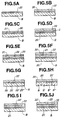
- the coating structure includes fundamentally the coating layer 20 placed on the color base B and containing transparent brilliant members.
- a clear coating layer 22 is, preferably, placed on the coating layer 20 in view of an increase in brilliancy and durability of the coating surface.
- the coating structure may include two or more coating layers 20, 21 placed on the color base B and containing brilliant members with different lengths, wherein the brilliant member contained in the upper coating layer 21 is longer than that one contained in the lower coating layer 20 to obtain improved depth and profundity of the entire coating film.
- the coating structure may further include a clear coating layer 22 on the two coating layers 20, 21 to obtain an improvement not only in depth and profundity of the entire coating film, but in brilliancy of the coating surface.
- the clear coating layer 22 is interposed between the two coating layers 20, 21 containing brilliant members with different lengths to obtain a further improvement in depth and profundity of the entire coating film.
- the coating structure may include another clear coating layer 22 on the structure as shown in FIG. 5E.
- FIGS. 5G-5J show variants of the coating structures as shown in FIGS. 5A-5F.
- the coating layer containing brilliant members may include a plurality of portions 20, 20', 20'', 20''' coloring differently or with different contents of the brilliant members.
- the color base may include a plurality of portions B, B', B'', B''' producing several tones with different hues, luminosities or saturations.
- a plurality of clear coating layers 22, 22' may be placed one upon another to obtain further improved brilliancy.
- a transparent base 23 with excellent adhesion may be arranged between the two clear coating layers 22, 22'.
- the coating structure may include an achromatic or chromatic non-planate base material 50 with transparency, a color base B, Bo arranged around the base material 50, and a coating layer 20 containing brilliant members and covering the color base B.
- such coating structure is in the form of a linear structure as shown in FIGS. 5K-5L.
- the color base B of the coating structure as shown in FIG. 5K has a transparency
- the color base Bo of the coating structure as shown in FIG. 5L has no transparency wherein most of incident light is absorbed.
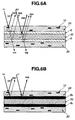
- optical paths will be described with regard to the coating structure as shown in FIG. 5K.
- Some optical paths are produced in connection with the brilliant member 10.
- an interference color Ci1 resulting from reflection and interference of an incident source spectrum L1 produced by the brilliant member 10 dispersed in the coating layer 20, a first object color Cb1 resulting from action of a source spectrum L2 transmitting through the brilliant member 10 with the first color base B, and a second object color Cb2 resulting from action of a source spectrum L3 transmitting through the first color base B with the second color base B.
- Other light or spectrum further transmits through the second color base B and the coating layer 20, and goes out of the coating structure as a transmitted light Ct1.
- the base material with transparency is colored or includes a transparent colored layer
- the colored layer absorbs incident light, resulting in excellent achievement of deepened color and visual quality with profundity in view of the visual optics.
- the optical paths of the coating structure as shown in FIG. 5L correspond to those of the coating structure as shown in FIG. 1A.
- FIG. 5M shows a variant of the coating structure as shown in FIGS. 5K-5L wherein the base material with transparency includes a color base B.
- the coating structure may include an achromatic or chromatic base material 50 with transparency, a color base B, Bo placed on one side of the base material 50, and a coating layer 20 placed on another side of the base material 50.
- the color base B of the coating structure as shown in FIG. 5N has a transparency
- the color base Bo of the coating structure as shown in FIG. 5O has no transparency wherein most of incident light is absorbed.
- the coating structures as shown in FIGS. 5N-5O produce complex optical paths in the same way as those as shown in FIGS. 5K-5L.
- optical paths will be described with regard to the coating structure as shown in FIG. 5M.
- Some optical paths are produced in connection with the brilliant member 10.
- an interference color Ci1 resulting from reflection and interference of an incident source spectrum L1 produced by the brilliant member 10 dispersed in the coating layer 20, and a first object color Cb1 resulting from action of the spectrum L1 transmitting through the brilliant member 10 with the first color base B.
- Other light or spectrum goes out of the coating structure as a transmitted light Ct1.
- optical paths of the coating structure as shown in FIG. 5N correspond to those of the coating structure as shown in FIG. 1A.
- the alternate lamination of the polymers 11, 12 of 30 layers each is formed, which is surrounded by the clad 13 of PEN.
- the brilliant member 10 as shown in FIG. 4A is obtained, wherein the thickness da of the first polymer 11 is equal to 0.072 ⁇ m, and the thickness db of the second polymer 12 is equal to 0.077 ⁇ m.
- the dimensional ratio of the brilliant member 10 is determined such that suppose that the length A of the side perpendicular to the surface of the alternate lamination of the polymers 11, 12 is 1, the length B of the side parallel to the surface is between 4 and 5, and the length L is between 15 and 20.
- a paint is prepared by mixing the brilliant members 10 in a two-liquid acrylic-urethane base paint known under the trade name of "R-241 Base” manufactured by NIPPON BEE CHEMICAL, CO., LTD. to have 10 weight % with respect to the entire coating film.
- the paint prepared in such a way is diluted with an acrylic-urethane thinner known under the trade name of "T 801 Thinner” manufactured by NIPPON BEE CHEMICAL, CO., LTD. to have an about 11-12 sec. viscosity in terms of Ford cup #4.
- the diluted paint is applied on a plate of black acrylonitrile-butadienne-styrene (ABS) resin as the color base B cleaned with isopropyl alcohol to have a 15-20 ⁇ m thickness, which is subjected to baking during 20 min. at 80°C to form the coating layer 20, obtaining the coating structure as shown in FIG. 5A.
- ABS black acrylonitrile-butadienne-styrene
- the coating layer 20 is obtained by applying the paint prepared in the same way as Example 1 on an ABS-resin plate as the color base B.
- An acrylic-urethane clear paint known under the trade name of "R-246 Clear” manufactured by NIPPON BEE CHEMICAL, CO., LTD. is diluted with the acrylic-urethane thinner to have an about 12-13 sec. viscosity in terms of Ford cup #4.
- the diluted clear paint is applied on the coating layer 20 in the wet-on-wet way to have a 30-35 ⁇ m thickness, which is subjected to baking during 20 min. at 80°C to form the clear coating layer 22 on the coating layer 20, obtaining the coating structure as shown in FIG. 5B.
- the first coating layer 20 containing the brilliant members 10 is formed on an ABS-resin plate as the color base B. Then, in order to have 10 weight % with respect to the entire coating film, the brilliant members 10' are mixed in the two-liquid acrylic-urethane base paint.
- the brilliant member 10' is formed in the same way as the brilliant member 10 contained in the first coating layer 20 to be greater only in length L than the brilliant member 10, i.e. wherein suppose that the length A of the side perpendicular to the surface of the alternate lamination is 1, the length B of the side parallel to the surface is between 4 and 5, and the length L is between 25 and 35.
- the paint is diluted with the acrylic-urethane thinner to have an about 11-12 sec.
- viscosity in terms of ford cup #4 is applied on the first coating layer 20 to have a 15-20 ⁇ m thickness, which is subjected to baking during 20 min. at 80°C to form the second coating layer, obtaining the coating structure including two coating layers 20, 21 containing the brilliant members 10, 10' with different lengths as shown in FIG. 5C.
- the second coating layer 21 is formed on the first coating layer 20.
- the acrylic-urethane clear paint in Example 2 is applied on the second coating layer 21 in the wet-on-wet way to have a 30-35 ⁇ m thickness, which is subjected to baking during 20 min. at 80°C to form the clear coating layer 22 on the coating layers 20, 21, obtaining the coating structure as shown in FIG. 5D.
- the first coating layer 20 containing the short brilliant members 10 and the clear coating layer 22 are obtained on an ABS-resin plate as the color base B. Then, the paint containing the long brilliant members 10' in Example 3 is applied on the clear coating layer 22 to have a 15-20 ⁇ m thickness, which is subjected to baking during 20 min. at 80°C to obtain the coating structure including the clear coating layer 22 interposed between the coating layers 20, 21 as shown in FIG. 5E.
- the first coating layer 20 containing the short brilliant members 10 and the clear coating layer 22 are obtained on an ABS-resin plate as the color base B.
- the second coating layer 21 containing the long brilliant members 10' is formed on the clear coating layer 22.
- the acrylic-urethane clear paint in Example 2 is applied on the second coating layer 21 in the wet-on-wet way to have a 30-35 ⁇ m thickness, which is subjected to baking during 20 min. at 80°C to form another clear coating layer 22 on the second coating layer 21, obtaining the coating structure as shown in FIG. 5F.
- Example 1 there is used the brilliant member 10 wherein suppose that the length A of the side perpendicular to the surface of the alternate lamination is 1, the length B of the side parallel to the surface is between 2 and 3, and the length L is between 15 and 20.
- a paint is prepared by mixing the brilliant members 10 in the two-liquid acrylic-urethane base paint and the acrylic-urethane thinner. The paint is applied on a black ABS-resin plate as the color base B, which is subjected to the same baking to form the coating layer 20, obtaining the coating structure as shown in FIG. 5A.
- Example 1 there is used the brilliant member 10 wherein suppose that the length A of the side perpendicular to the surface of the alternate lamination is 1, the length B of the side parallel to the surface is between 4 and 5, and the length L is between 1 and 3.
- a paint is prepared by mixing the brilliant members 10 in the two-liquid acrylic-urethane base paint and the acrylic-urethane thinner. The paint is applied on a black ABS-resin plate as the color base B, which is subjected to the same baking to form the coating layer 20, obtaining the coating structure as shown in FIG. 5A.
- Example 2 a paint is prepared by mixing the brilliant members 10 in the two-liquid acrylic-urethane base paint to have 1 weight % with respect to the entire coating film.
- the paint is diluted with the acrylic-urethane thinner to have the same viscosity, which is applied on an ABS-resin as the color base B to have the same thickness.
- the same clear paint is applied thereon in the same way as Example 2, which is subjected to the same baking to form the clear coating layer 22, obtaining the coating structure as shown in FIG. 5B.
- Example 2 a paint is prepared by mixing the brilliant members 10 in the two-liquid acrylic-urethane base paint to have 28 weight % with respect to the entire coating film.
- the paint is diluted with the acrylic-urethane thinner to have the same viscosity, which is applied on an ABS-resin as the color base B to have the same thickness,
- the same clear paint is applied thereon in the same way as Example 2, which is subjected to the same baking to form the clear coating layer 22, obtaining the coating structure as shown in FIG. 5B.
- the brilliant member 10 is formed, having a rectangular section as shown in FIG. 4B.
- the brilliant member 10 has a reflection peak wavelength ⁇ equal to 0.47 ⁇ m (blue), and a dimensional ratio determined such that suppose that the length A of the side perpendicular to the surface of the alternate lamination is 1, the length B of the side parallel to the surface is between 4 and 5, and the length L is between 10 and 15.
- a paint is prepared by mixing the brilliant members 10 in the two-liquid acrylic-urethane base paint to have 10 weight % with respect to the entire coating film.
- the paint is diluted with the acrylic-urethane thinner to have an about 11-12 sec. viscosity in terms of Ford cup #4.
- the diluted paint is applied on a black ABS-resin plate as the color base B to have a 15-20 ⁇ m thickness.
- the acrylic-urethane clear paint is diluted with the acrylic-urethane thinner to have an about 12-13 sec. viscosity in terms of Ford cup #4.
- the diluted paint is also applied on the above ABS-resin plate in the wet-on wet way to have a 30-35 ⁇ m thickness, which is subjected to baking during 20 min. at 80°C to form the clear coating layer 22 on the coating layer 20 , obtaining the coating structure as shown in FIG. 5B.
- the brilliant member 10 is formed, having a rectangular section as shown in FIG. 4B.
- the brilliant member 10 has a reflection peak wavelength ⁇ equal to 0.52 ⁇ m (green), and a dimensional ratio determined such that suppose that the length A of the side perpendicular to the surface of the alternate lamination is 1, the length B of the side parallel to the surface is between 4 and 5, and the length L is between 10 and 15.
- Coating is carried out in the same way as Example 11, obtaining the coating structure as shown in FIG. 5B.
- the brilliant members 10, 10' are formed, each having a rectangular section as shown in FIG. 4B.
- the brilliant members 10, 10' each have a reflection peak wavelength ⁇ equal to 0.52 ⁇ m (green), and a dimensional ratio determined such that suppose that the length A of the side perpendicular to the surface of the alternate lamination is 1, the length B of the side parallel to the surface is between 4 and 5.
- the brilliant members 10, 10' are of different dimensional ratios with respect to the length L, i.e. the lengths L of the two are between 10 and 15 and between 25 and 30, respectively.
- the first coating layer 20 containing the short brilliant members 10 is formed on a black ABS-resin plate as the color base B, on which the clear coating layer 22 is formed. Moreover, the second coating layer 21 containing the long brilliant members 10' is formed on the clear coating layer 22.
- the acrylic-urethane clear paint is applied on the second coating layer 21 in the wet-on-wet way to have a 30-35 ⁇ m thickness, which is subjected to baking during 20 min. at 80°C to form the clear coating layer 22 on the second coating layer 21, obtaining the coating structure as shown in FIG. 5F.
- a solid red two-liquid acrylic-urethane base paint known under the trade name of "R-241MB BAR2 Base” manufactured by NIPPON BEE CHEMICAL, CO., LTD. is diluted with the acrylic-urethane to have an about 11-12 sec. viscosity in terms of Ford cup #4.
- the diluted paint is applied on a black ABS-resin plate as the color base B to have a 15-20 ⁇ m thickness, forming a normal solid-color coating film with no brilliant member contained.
- the same clear paint as that one used in Example 2 is applied thereon in the wet-on-wet way, which is subjected to baking during 20 min. at 80°C to form the clear coating layer 22, obtaining a coating structure similar to that one as shown in FIG. 5B.
- a metallic-silver two-liquid acrylic-urethane base paint known under the trade name of "R-241 BKL0 Base” manufactured by NIPPON BEE CHEMICAL, CO., LTD. is diluted with the acrylic-urethane to have the same viscosity.
- the diluted paint is applied on a black ABS-resin plate as the color base B, forming a normal metallic-color coating film with no brilliant member contained.
- the same clear paint is applied thereon, which is subjected to the same baking to form the clear coating layer 22, obtaining a coating structure similar to that one as shown in FIG. 5B.
- a two-liquid acrylic-urethane base paint known under the trade name of "R-248 BQR2 Base” manufactured by NIPPON BEE CHEMICAL, CO., LTD., and a pearl-white two-liquid acrylic-urethane base paint known under the trade name of "R-241MB BQR2 Mica Base” manufactured by NIPPON BEE CHEMICAL, CO., LTD. are diluted with the acrylic-urethane thinner to have the same viscosity.
- the diluted mixture is applied on a black ABS-resin plate as the color base B, forming a normal pearl-color coating film with no brilliant member contained.
- the same clear paint is applied thereon, which is subjected to the same baking to form the clear coating layer 22, obtaining a coating structure similar to that one as shown in FIG. 5B.
- a varied-angle colorimeter of GCMS-4 Type manufactured by MURAKAMI COLOR RESERCH LABORATORY is used and fixed so that light is incident thereon at 0° angle or perpendicularly with respect to the surface of a sample.
- the spectral reflectances of lights acting at +15° and + 60° angles are measured in a 390-730 nm wavelength range and at a 10 nm pitch. The color is evaluated based on an XYZ value.
- the coating film After formed, the coating film is subjected to a 240 hr. load in the environment of 50°C temperature and 95% relative humidity, which is left standing during 24 hr. at an ambient temperature.
- the coating film is evaluated by the cross-cut adhesion test stipulated in Japanese Industrial Standards (JIS), K5400. The result of evaluation is given by the number of remaining ones of the 100 cross cut pieces after the adhesion test.
- the depth is pertinent to a feel induced with respect to the accommodative amounts of focus of two eyes when straightly observing points placed on the same plane.
- the depth is evaluated by a method introduced in the paper entitled "Depth Perception and Accommodation of The Human Eye” published at the 5th Symposium on Human Interface held on October 25-27, 1989 in Kyoto.
- the depth is evaluated based on a physiological response of 5 male subjects of 20-30 years with normal eyesight.
- the observation is carried out with a right eye and under 100-200 lux background lighting. Calling subject's attention to two points, i.e. the surface of the coating film and a brilliant point appearing thereabove, the accommodative amount of an eyeball is measured when looking at each point.
- the accommodative amount of the eyeball with respect to the two points is measured 2 or 3 times during continuous 10-15 sec. for every measurement to obtain an average of accommodative data during 1 sec. In such a way, 15 measurements are carried out with respect to each point. And it is checked based on the "t" or Welch's statistical test whether or not a difference between the accommodative amounts of the eyeball is significant when looking at the two points, If the difference is significant, it is evaluated that the depth is effective or existing. It is noted that in Table in FIG. 8, the cell with ⁇ designates that the depth is not effective, the cell with ⁇ designates that the depth is effective, and the cell with o ⁇ designates that the depth is highly effective.
- the profundity is pertinent to a feel induced with respect to a hue and a lightness and influenced, particularly, by low-lightness and low-saturation factors.
- the profundity is evaluated in changing a hue, a lightness, and a saturation that constitute the three attributes of the color. Specifically, using the same device and in the same way as the evaluation of the depth, the profundity is evaluated visually by the 5 male subjects. It is noted that in Table in FIG. 8, the cell with ⁇ designates that the profundity is not effective, the cell with ⁇ designates that the profundity is slightly effective, the cell with ⁇ designates that the profundity is effective, and the cell with o ⁇ designates that the profundity is highly effective.
- the brilliancy is evaluated visually by the 5 male subjects. It is noted that in Table in FIG. 8, the cell with ⁇ designates that the brilliancy is effective, and the cell with o ⁇ designates that the brilliancy is highly effective.
- each coating structure provides not only a novel visual quality with hue changing from blue to violet with the angle, depth and profundity, and also provides an excellent adhesion.
- the coating structures in Examples 2, 4, 6 and 9 with the clear coating layer 22 formed in the outermost surface are of excellent brilliancy, and that the coating structures in Examples 3-6 and 13 with the two coating layers 20, 21 containing the brilliant members 10, 10' with different lengths are of very excellent depth.
- the coating structures in Examples 7-8 with the dimensional ratios with respect to the side B parallel to the surface of the alternate lamination and the length L are rather small, and that one in Example 9 with relatively small content of the brilliant members 10, it is confirmed that they attain target levels of hue change, depth and profundity, which are, however, rather poor as compared with the other Examples due to insufficient reflection and interference produced by the brilliant members 10.
- the coating structure in Example 10 with relatively large content of the brilliant members 10 it is confirmed that it is excellent in hue change, depth and profundity, but slightly inferior in coating ability and adhesion as compared with the other Examples.
- PEN of 1.63 refractive index as the first polymer 11 and nylon 6 of 1.53 refractive index as the second polymer 12 two alternate laminations of the polymers 11, 12 of 15 layers each are formed.
- a stray-light absorbing layer 31 of nylon 6 containing a black pigment or carbon black and having a 2 ⁇ m thickness is interposed between the two alternate laminations.
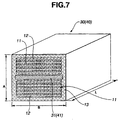
- the ensemble is surrounded by the clad 13 of PEN, obtaining the brilliant member 30 as shown in FIG. 7.
- the thicknesses of the first and second polymers 11, 12 are 0.072 and 0.077 ⁇ m, and the thickness of the clad 13 is 2 ⁇ m, Moreover, the dimensional ratio of the brilliant member 30 is determined such that suppose that the length A of the side perpendicular to the surface of the alternate lamination of the polymers 11, 12 is 1, the length B of the side parallel to the surface is between 4 and 5, and the length L is between 15 and 20.
- a paint is prepared by mixing the brilliant members 30 in a two-liquid acrylic-urethane base paint known under the trade name of "R-241MB Base” manufactured by NIPPON BEE CHEMICAL, CO., LTD. to have 10 weight % with respect to the entire coating film.
- the paint is diluted with the acrylic-urethane thinner to have an about 11-12 sec. viscosity in terms of Ford cup #4.
- the diluted paint is applied on a red-pigment or red-oxide layer formed on a black ABS-resin plate as the color base B to have a 15-20 ⁇ m thickness, which is subjected to baking during 20 min. at 80°C to form the coating layer 20, obtaining the coating structure as shown in FIG. 5A.
- the white incident light L1 produces the blue interference color Ci due to the upper alternate lamination of the brilliant member 30.
- Light transmitted through the upper alternate lamination is all absorbed by the stray-light absorbing layer 31.
- the white light L1 directly incident on the color base B without striking the brilliant member 30 produces a red color or the object color Cb1 due to red oxide contained in the color base B.
- a reduction in the amount of addition of carbon black to the stray-light absorbing layer 31 produces yellow transmitted light, which strikes the color base B to make a red color of red oxide more vivid.
- Example 14 using the same resins as those in Example 14, two alternate laminations of the polymers 11, 12 of 15 layers each are formed.
- a stray-light absorbing layer 41 of nylon 6 containing a green pigment or chromium oxide and having a 2 ⁇ m thickness is interposed between the two alternate laminations.
- the ensemble is surrounded by the clad 13 of PEN, obtaining the brilliant member 40 as shown in FIG. 7.
- the thicknesses of the first and second polymers 11, 12 are 0.072 and 0.007 ⁇ m, and the thickness of the clad 13 is 2 ⁇ m.
- the dimensional ratio of the brilliant member 40 is determined such that suppose that the length A of the side perpendicular to the surface of the alternate lamination of the polymers 11, 12 is 1, the length B of the side parallel to the surface is between 4 and 5, and the length L is between 15 and 20.
- a paint is prepared by mixing the brilliant members 40 in the two-liquid acrylic-urethane base, which is diluted with the acrylic-urethane thinner.
- the diluted paint is applied on a green-pigment or chromium-oxide layer formed on a black ABS-resin plate as the color base B to have a 15-20 ⁇ m thickness, which is subjected to baking during 20 min. at 80°C to form the coating layer 20, obtaining the coating structure as shown in FIG. 5A.
- the white incident light L1 produces the blue interference color Ci due to the alternate lamination of the brilliant member 40.
- the light L3 transmitted through the stray-light absorbing layer 41 of the brilliant member 40 produces a yellow color, which strikes the color base B to change a color of chromium oxide from green to yellow green (the object color Cb3).
- the white light L1 directly incident on the color base B without striking the brilliant member 40 produces a green color or the object color Cb1 due to chromium oxide contained in the color base B.
Landscapes
- Chemical & Material Sciences (AREA)
- Life Sciences & Earth Sciences (AREA)
- Engineering & Computer Science (AREA)
- Materials Engineering (AREA)
- Wood Science & Technology (AREA)
- Organic Chemistry (AREA)
- Application Of Or Painting With Fluid Materials (AREA)
- Laminated Bodies (AREA)
- Paints Or Removers (AREA)
- Optical Filters (AREA)
Applications Claiming Priority (4)
| Application Number | Priority Date | Filing Date | Title |
|---|---|---|---|
| JP35098598 | 1998-12-10 | ||
| JP35098598 | 1998-12-10 | ||
| JP34422899A JP3430094B2 (ja) | 1998-12-10 | 1999-12-03 | 塗装構造 |
| JP34422899 | 1999-12-03 |
Publications (3)
| Publication Number | Publication Date |
|---|---|
| EP1008440A2 true EP1008440A2 (de) | 2000-06-14 |
| EP1008440A3 EP1008440A3 (de) | 2001-05-30 |
| EP1008440B1 EP1008440B1 (de) | 2005-05-11 |
Family
ID=26577718
Family Applications (1)
| Application Number | Title | Priority Date | Filing Date |
|---|---|---|---|
| EP99124561A Expired - Lifetime EP1008440B1 (de) | 1998-12-10 | 1999-12-09 | Beschichtungsstruktur |
Country Status (4)
| Country | Link |
|---|---|
| US (1) | US6350509B1 (de) |
| EP (1) | EP1008440B1 (de) |
| JP (1) | JP3430094B2 (de) |
| DE (1) | DE69925229T2 (de) |
Cited By (10)
| Publication number | Priority date | Publication date | Assignee | Title |
|---|---|---|---|---|
| EP1162059A3 (de) * | 2000-06-07 | 2002-04-10 | Nissan Motor Company, Limited | Färbestruktur zur Herstellung von Farbe |
| US6641926B1 (en) | 1999-08-13 | 2003-11-04 | Premark Rwp Holdings, Inc. | Liquid resistant laminate with strong backer |
| WO2003093006A1 (en) * | 2002-04-30 | 2003-11-13 | Avery Dennison Corporation | Fluorescent articles having multiple film layers |
| WO2008027804A1 (en) * | 2006-08-30 | 2008-03-06 | 3M Innovative Properties Company | Multilayer polarizing fibers and polarizers using same |
| WO2008027803A1 (en) * | 2006-08-30 | 2008-03-06 | 3M Innovative Properties Company | Polymer fiber polarizers |
| WO2008027934A1 (en) * | 2006-08-30 | 2008-03-06 | 3M Innovative Properties Company | Polymer fiber polarizers with aligned fibers |
| AU2003224896B2 (en) * | 2002-04-30 | 2009-01-15 | Avery Dennison Corporation | Fluorescent articles having multiple film layers |
| US7618709B2 (en) | 2002-04-30 | 2009-11-17 | Avery Dennison Corporation | Fluorescent articles having multiple film layers |
| US8034436B2 (en) | 2002-04-30 | 2011-10-11 | Avery Dennison Corporation | Fluorescent article having multiple layers |
| DE102013108341A1 (de) * | 2013-08-02 | 2015-02-05 | Hella Kgaa Hueck & Co. | Oberflächen mit Glas-Optik an mobilen Bedienelementen für Kraftfahrzeuge |
Families Citing this family (11)
| Publication number | Priority date | Publication date | Assignee | Title |
|---|---|---|---|---|
| JP2002067239A (ja) * | 2000-09-01 | 2002-03-05 | Ge Plastics Japan Ltd | 塗装された物品 |
| JP4599711B2 (ja) * | 2000-12-27 | 2010-12-15 | 富士通株式会社 | 携帯情報機器の塗装方法及び、それを使用した携帯情報機器 |
| US7064159B2 (en) * | 2001-11-29 | 2006-06-20 | Honda Canada Inc. | Pearlescent white paint composition containing a film-former and a solid material comprising mica, titanium dioxide and aluminum, and process for using same |
| US20030151270A1 (en) * | 2002-02-14 | 2003-08-14 | Raymond Zappe | Liner apparatus and method of making a liner |
| US7209414B2 (en) * | 2002-11-15 | 2007-04-24 | Plasmon Lms, Inc | Spherical aberration compensation by wavelength |
| EP1917224A4 (de) * | 2005-08-24 | 2010-01-20 | Lg Chemical Ltd | Transparente chips enthaltender kunstmarmor unter verwendung von coextrusion und herstellungsverfahren dafür |
| JP4801508B2 (ja) * | 2006-06-01 | 2011-10-26 | Sriスポーツ株式会社 | ゴルフボールのマーク形成用インキ組成物、ゴルフボール、および、ゴルフボールの製造方法 |
| JP5086573B2 (ja) * | 2006-07-07 | 2012-11-28 | エスケー化研株式会社 | 積層体 |
| US11971564B2 (en) | 2017-12-15 | 2024-04-30 | Lg Chem, Ltd. | Decorative member and manufacturing method therefor |
| JP7433779B2 (ja) * | 2019-05-21 | 2024-02-20 | 日本ペイント・オートモーティブコーティングス株式会社 | コーティング部材及びコーティング部材の製造方法 |
| KR102403086B1 (ko) * | 2020-09-15 | 2022-05-26 | 도레이첨단소재 주식회사 | 색상변화시트 |
Family Cites Families (41)
| Publication number | Priority date | Publication date | Assignee | Title |
|---|---|---|---|---|
| US3711176A (en) * | 1971-01-14 | 1973-01-16 | Dow Chemical Co | Highly reflective thermoplastic bodies for infrared, visible or ultraviolet light |
| US4017326A (en) * | 1975-02-13 | 1977-04-12 | Chester Davis | Enhancement of iridescent colors to provide vivid recording colors |
| US5569535A (en) * | 1979-12-28 | 1996-10-29 | Flex Products, Inc. | High chroma multilayer interference platelets |
| JPS59223337A (ja) | 1983-06-02 | 1984-12-15 | 株式会社クラレ | ベルベツト調外観を有する織物 |
| JPS59228042A (ja) | 1983-06-03 | 1984-12-21 | 株式会社クラレ | 鱗片構造繊維を含む織物 |
| JPS6024847A (ja) | 1983-07-20 | 1985-02-07 | 大日本印刷株式会社 | 滅菌包装方法 |
| US4595634A (en) * | 1983-08-01 | 1986-06-17 | Gordon Roy G | Coating process for making non-iridescent glass |
| US4499143A (en) * | 1983-08-26 | 1985-02-12 | Inmont Corporation | Multilayer automative paint system |
| JPS62170510A (ja) | 1986-01-22 | 1987-07-27 | Toray Ind Inc | 干渉色を有する繊維 |
| JPS6364535A (ja) | 1986-09-01 | 1988-03-23 | Hitachi Ltd | 回転子線輪の支持構造 |
| JPS63120642A (ja) | 1986-11-10 | 1988-05-25 | 東レ株式会社 | 干渉色を有するシ−ト状物およびその製造方法 |
| JPH0672324B2 (ja) | 1988-06-30 | 1994-09-14 | 東レ株式会社 | 異形断面繊維 |
| US5049442A (en) * | 1990-01-23 | 1991-09-17 | Basf Corporation | Opalescent coatings containing foamed metal oxides |
| DE69111375T2 (de) * | 1990-11-02 | 1996-01-04 | Nisshin Steel Co Ltd | Pigment und Verfahren zur Herstellung. |
| JP2998202B2 (ja) | 1990-11-29 | 2000-01-11 | 東レ株式会社 | 発色性が良好な合成繊維 |
| DE4141069A1 (de) * | 1991-12-13 | 1993-06-17 | Basf Ag | Glanzpigmente auf der basis von mehrfach beschichteten plaettchenfoermigen silikatischen substraten |
| JP2890984B2 (ja) | 1992-06-30 | 1999-05-17 | 日産自動車株式会社 | 自然光の反射、干渉作用を有する構造体 |
| DE4321534A1 (de) * | 1993-06-29 | 1995-01-12 | Herberts Gmbh | Verfahren zur Mehrschichtlackierung |
| US5472798A (en) * | 1993-07-16 | 1995-12-05 | Nissan Motor Co., Ltd. | Coloring structure having reflecting and interfering functions |
| JP3036305B2 (ja) | 1993-07-16 | 2000-04-24 | 日産自動車株式会社 | 反射、干渉作用を有する発色構造体 |
| JP3036304B2 (ja) | 1993-07-16 | 2000-04-24 | 日産自動車株式会社 | 反射、干渉作用による発色構造体 |
| JPH0797766A (ja) | 1993-08-16 | 1995-04-11 | Toray Ind Inc | 干渉色を有する繊維布帛およびその製造方法 |
| JPH0797786A (ja) | 1993-08-16 | 1995-04-11 | Toray Ind Inc | 干渉色を有する繊維布帛およびその製造方法 |
| JP3182275B2 (ja) | 1993-12-15 | 2001-07-03 | 株式会社クラレ | 異色効果を呈する複合繊維 |
| WO1995017479A1 (en) * | 1993-12-23 | 1995-06-29 | Basf Corporation | Coating composition containing optically-variable pigment and black pigment |
| JP3158830B2 (ja) | 1993-12-29 | 2001-04-23 | 日産自動車株式会社 | 近紫外線と近赤外線の一方あるいは両方を反射する構造体 |
| FR2719052B1 (fr) * | 1994-04-26 | 1996-07-05 | Quadra Ind Sarl | Paillettes multicolores, leur procédé de fabrication et produit de décoration utilisant lesdites paillettes. |
| JP3166482B2 (ja) | 1994-06-07 | 2001-05-14 | 日産自動車株式会社 | 反射干渉作用を有する発色構造体 |
| US5912283A (en) * | 1995-07-19 | 1999-06-15 | Toyo Aluminium Kabushiki Kaisha | Surface-treated color pigment, colored substrate particles and production process thereof |
| DE19612975A1 (de) * | 1996-04-01 | 1997-10-02 | Hoechst Ag | Effektbeschichtungen mit vom Betrachtungswinkel abhängigem Farbeindruck |
| DE59704636D1 (de) * | 1996-04-25 | 2001-10-25 | Ciba Sc Holding Ag | Farbige Glanzpigmente |
| US5871827A (en) * | 1996-06-21 | 1999-02-16 | Ciba Specialty Chemicals Corporation | Finishes containing light interference pigments |
| US5958125A (en) * | 1996-07-05 | 1999-09-28 | Schmid; Raimund | Goniochromatic luster pigments based on transparent, nonmetallic, platelet-shaped substrates |
| US6132873A (en) * | 1996-09-21 | 2000-10-17 | Merck Patent Gesellschaft Mit Beschrankter Haftung | Multilayered interference pigments |
| US5849365A (en) * | 1997-02-18 | 1998-12-15 | Basf Lacke + Farben, Ag | Method for the production and repair of multicoat special-effect coating |
| DE19707805A1 (de) * | 1997-02-27 | 1998-09-03 | Merck Patent Gmbh | Multischicht-Interferenzpigment mit absorbierender Mittelschicht |
| DE19715993A1 (de) * | 1997-04-17 | 1998-10-22 | Clariant Gmbh | Polymerlaminate mit erhöhtem Deckvermögen |
| JPH11241223A (ja) * | 1997-12-25 | 1999-09-07 | Nissan Motor Co Ltd | 発色性複合短繊維及びそれを結合した発色性構造体 |
| DE19822046A1 (de) * | 1998-05-16 | 1999-11-18 | Basf Ag | Goniochromatische Glanzpigmente auf Basis in einer reduzierenden Atmosphäre erhitzter, titanbeschichteter silikatischer Plättchen |
| US6157489A (en) * | 1998-11-24 | 2000-12-05 | Flex Products, Inc. | Color shifting thin film pigments |
| US6150022A (en) * | 1998-12-07 | 2000-11-21 | Flex Products, Inc. | Bright metal flake based pigments |
-
1999
- 1999-12-03 JP JP34422899A patent/JP3430094B2/ja not_active Expired - Lifetime
- 1999-12-09 DE DE69925229T patent/DE69925229T2/de not_active Expired - Lifetime
- 1999-12-09 EP EP99124561A patent/EP1008440B1/de not_active Expired - Lifetime
- 1999-12-10 US US09/458,655 patent/US6350509B1/en not_active Expired - Lifetime
Cited By (15)
| Publication number | Priority date | Publication date | Assignee | Title |
|---|---|---|---|---|
| US6641926B1 (en) | 1999-08-13 | 2003-11-04 | Premark Rwp Holdings, Inc. | Liquid resistant laminate with strong backer |
| EP1162059A3 (de) * | 2000-06-07 | 2002-04-10 | Nissan Motor Company, Limited | Färbestruktur zur Herstellung von Farbe |
| US6577446B2 (en) | 2000-06-07 | 2003-06-10 | Nissan Motor Co., Ltd. | Coloring structure for producing colors |
| AU2003224896B2 (en) * | 2002-04-30 | 2009-01-15 | Avery Dennison Corporation | Fluorescent articles having multiple film layers |
| US7264880B2 (en) | 2002-04-30 | 2007-09-04 | Avery Dennison Corporation | Fluorescent articles having multiple film layers |
| AU2003230842B2 (en) * | 2002-04-30 | 2008-08-28 | Avery Dennison Corporation | Fluorescent articles having multiple film layers |
| WO2003093006A1 (en) * | 2002-04-30 | 2003-11-13 | Avery Dennison Corporation | Fluorescent articles having multiple film layers |
| US7618709B2 (en) | 2002-04-30 | 2009-11-17 | Avery Dennison Corporation | Fluorescent articles having multiple film layers |
| US7618710B2 (en) | 2002-04-30 | 2009-11-17 | Avery Dennison Corporation | Fluorescent articles having multiple film layers |
| US8034436B2 (en) | 2002-04-30 | 2011-10-11 | Avery Dennison Corporation | Fluorescent article having multiple layers |
| EP2620280A1 (de) * | 2002-04-30 | 2013-07-31 | Avery Dennison Corporation | Fluoreszierende Artikel mit mehreren Folienschichten |
| WO2008027804A1 (en) * | 2006-08-30 | 2008-03-06 | 3M Innovative Properties Company | Multilayer polarizing fibers and polarizers using same |
| WO2008027803A1 (en) * | 2006-08-30 | 2008-03-06 | 3M Innovative Properties Company | Polymer fiber polarizers |
| WO2008027934A1 (en) * | 2006-08-30 | 2008-03-06 | 3M Innovative Properties Company | Polymer fiber polarizers with aligned fibers |
| DE102013108341A1 (de) * | 2013-08-02 | 2015-02-05 | Hella Kgaa Hueck & Co. | Oberflächen mit Glas-Optik an mobilen Bedienelementen für Kraftfahrzeuge |
Also Published As
| Publication number | Publication date |
|---|---|
| EP1008440A3 (de) | 2001-05-30 |
| JP3430094B2 (ja) | 2003-07-28 |
| DE69925229T2 (de) | 2005-10-06 |
| DE69925229D1 (de) | 2005-06-16 |
| US6350509B1 (en) | 2002-02-26 |
| EP1008440B1 (de) | 2005-05-11 |
| JP2000229370A (ja) | 2000-08-22 |
Similar Documents
| Publication | Publication Date | Title |
|---|---|---|
| EP1008440B1 (de) | Beschichtungsstruktur | |
| KR100362985B1 (ko) | 색을 나타내기 위한 발색 구조체 | |
| US6577446B2 (en) | Coloring structure for producing colors | |
| US5472798A (en) | Coloring structure having reflecting and interfering functions | |
| RU2599305C1 (ru) | Ламинированная покрывная пленка и покрываемое изделие | |
| JP2004510013A (ja) | 増強されたカラーシフティング特性を有する光学的に可変であるピグメントおよびホイル | |
| US5407738A (en) | Minute structure for showing colors by reflection and interference of natural light | |
| KR100484468B1 (ko) | 광간섭 안료함유 마감코팅 | |
| JP3036304B2 (ja) | 反射、干渉作用による発色構造体 | |
| US20040115358A1 (en) | Coating method of plastic parts | |
| KR100324458B1 (ko) | 코팅 구조물 | |
| EP1006221A1 (de) | Winzige Strukturen mit optischer Funktion und Gewebe mit solchen Strukturen | |
| CN105408436B (zh) | 车辆内板部涂膜 | |
| JP2005305317A (ja) | 積層塗膜および塗膜形成方法 | |
| RU2664067C1 (ru) | Многослойная покровная пленка и покрытое изделие | |
| US20260131357A1 (en) | Multilayered coating film and coated article | |
| JP2007125822A (ja) | 積層塗膜および塗膜形成方法 | |
| KR200407946Y1 (ko) | 색상이 달라지는 주방기기 | |
| JP2007105602A (ja) | 積層塗膜および塗膜形成方法 | |
| JP2006045460A (ja) | 塗料用光輝材、積層塗膜および塗膜形成方法 | |
| JP2005187631A (ja) | 光輝材、その製造法及び光輝材含有塗料組成物 | |
| MXPA97004673A (en) | Finishes containing interference pigments |
Legal Events
| Date | Code | Title | Description |
|---|---|---|---|
| PUAI | Public reference made under article 153(3) epc to a published international application that has entered the european phase |
Free format text: ORIGINAL CODE: 0009012 |
|
| 17P | Request for examination filed |
Effective date: 19991209 |
|
| AK | Designated contracting states |
Kind code of ref document: A2 Designated state(s): DE FR GB IT |
|
| AX | Request for extension of the european patent |
Free format text: AL;LT;LV;MK;RO;SI |
|
| PUAL | Search report despatched |
Free format text: ORIGINAL CODE: 0009013 |
|
| RIC1 | Information provided on ipc code assigned before grant |
Free format text: 7B 32B 7/02 A, 7B 32B 27/00 B |
|
| AK | Designated contracting states |
Kind code of ref document: A3 Designated state(s): AT BE CH CY DE DK ES FI FR GB GR IE IT LI LU MC NL PT SE |
|
| AX | Request for extension of the european patent |
Free format text: AL;LT;LV;MK;RO;SI |
|
| RAP1 | Party data changed (applicant data changed or rights of an application transferred) |
Owner name: TEIJIN LIMITED Owner name: TANAKA KIKINZOKU KOGYO K.K. Owner name: NISSAN MOTOR COMPANY, LIMITED |
|
| AKX | Designation fees paid |
Free format text: DE FR GB IT |
|
| 17Q | First examination report despatched |
Effective date: 20030822 |
|
| GRAP | Despatch of communication of intention to grant a patent |
Free format text: ORIGINAL CODE: EPIDOSNIGR1 |
|
| GRAS | Grant fee paid |
Free format text: ORIGINAL CODE: EPIDOSNIGR3 |
|
| GRAA | (expected) grant |
Free format text: ORIGINAL CODE: 0009210 |
|
| AK | Designated contracting states |
Kind code of ref document: B1 Designated state(s): DE FR GB IT |
|
| REG | Reference to a national code |
Ref country code: GB Ref legal event code: FG4D |
|
| REF | Corresponds to: |
Ref document number: 69925229 Country of ref document: DE Date of ref document: 20050616 Kind code of ref document: P |
|
| ET | Fr: translation filed | ||
| PLBE | No opposition filed within time limit |
Free format text: ORIGINAL CODE: 0009261 |
|
| STAA | Information on the status of an ep patent application or granted ep patent |
Free format text: STATUS: NO OPPOSITION FILED WITHIN TIME LIMIT |
|
| 26N | No opposition filed |
Effective date: 20060214 |
|
| REG | Reference to a national code |
Ref country code: GB Ref legal event code: 732E Free format text: REGISTERED BETWEEN 20110512 AND 20110518 |
|
| REG | Reference to a national code |
Ref country code: FR Ref legal event code: TQ Ref country code: FR Ref legal event code: CA |
|
| REG | Reference to a national code |
Ref country code: FR Ref legal event code: PLFP Year of fee payment: 17 |
|
| REG | Reference to a national code |
Ref country code: FR Ref legal event code: PLFP Year of fee payment: 18 |
|
| REG | Reference to a national code |
Ref country code: FR Ref legal event code: PLFP Year of fee payment: 19 |
|
| PGFP | Annual fee paid to national office [announced via postgrant information from national office to epo] |
Ref country code: DE Payment date: 20181127 Year of fee payment: 20 |
|
| PGFP | Annual fee paid to national office [announced via postgrant information from national office to epo] |
Ref country code: GB Payment date: 20181205 Year of fee payment: 20 Ref country code: FR Payment date: 20181121 Year of fee payment: 20 |
|
| PGFP | Annual fee paid to national office [announced via postgrant information from national office to epo] |
Ref country code: IT Payment date: 20181220 Year of fee payment: 20 |
|
| REG | Reference to a national code |
Ref country code: DE Ref legal event code: R071 Ref document number: 69925229 Country of ref document: DE |
|
| REG | Reference to a national code |
Ref country code: GB Ref legal event code: PE20 Expiry date: 20191208 |
|
| PG25 | Lapsed in a contracting state [announced via postgrant information from national office to epo] |
Ref country code: GB Free format text: LAPSE BECAUSE OF EXPIRATION OF PROTECTION Effective date: 20191208 |