The present invention relates to silylating agents for
adding functional groups to materials containing silanol
groups, for example silanol terminated siloxanes and silica.
The present invention also relates to a method for making
said compounds, and a method for adding functional groups to
materials containing silanol groups using said compounds as
silylating agents.
High molecular weight organo-functional endblocked
polysiloxanes may be produced by condensation polymerisation
of relatively low molecular weight linear silanol functional
organosiloxanes in the presence of a low molecular weight
organo-functional endblocked organosiloxane and a suitable
catalyst. For example, GB Patent 2,252,975 describes a
method for making organopolysiloxanes from organosiloxanes
using a phosphonitrile halide catalyst. A problem
associated with such condensation polymerisation processes
is the amount of residual silanol functional
organopolysiloxane remaining in the reaction mixture after
completion of the polymerisation reaction, which amount
tends to increase as a function of the viscosity of the
desired product organopolysiloxane. There has thus been a
need for an effective silylating agent which can react with
such residual silanol to afford the desired functionality,
and which can also react with other silanol groups, such as
those on the surface of silica particles and other materials
for use as filler in, for example, silicone rubber, and
silanol on the surface of substrates such as glass.
Silylacetamide is an effective silylating agent but
generates acetamide, a solid by-product which is difficult
to remove from the reaction mixture. Cyclic trisilazane is
another effective silylating agent but is also a chain
extender which leads to broadening of molecular weight
distribution. U.S. Patent No. 4,059,559 discloses the use
of disilazanes as silylating agents
The present inventors have found bis-dimethylsilylcarbamates
to be effective silylating agents for adding
functional groups to silanol functional organopolysiloxanes,
silica, and other inorganic fillers and substrates,
providing a fast reaction with silanol groups and leaving
volatile by-products.
The word "comprises" where used herein is used in its
widest sense to mean and to encompass the notions of
"includes", "comprehends" and "consists of".
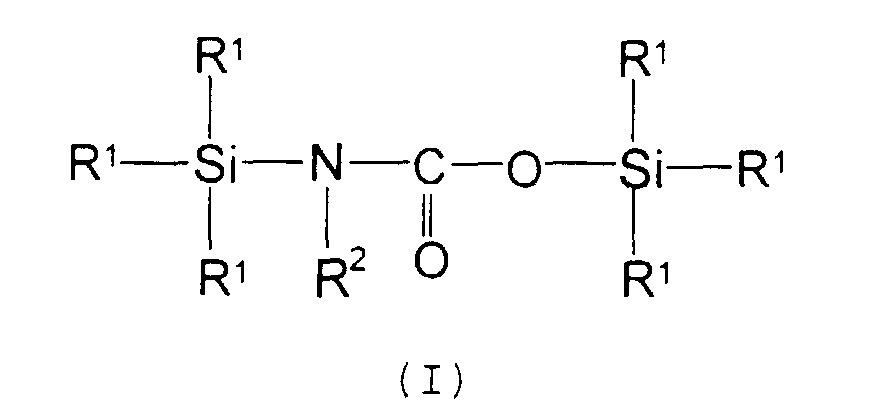
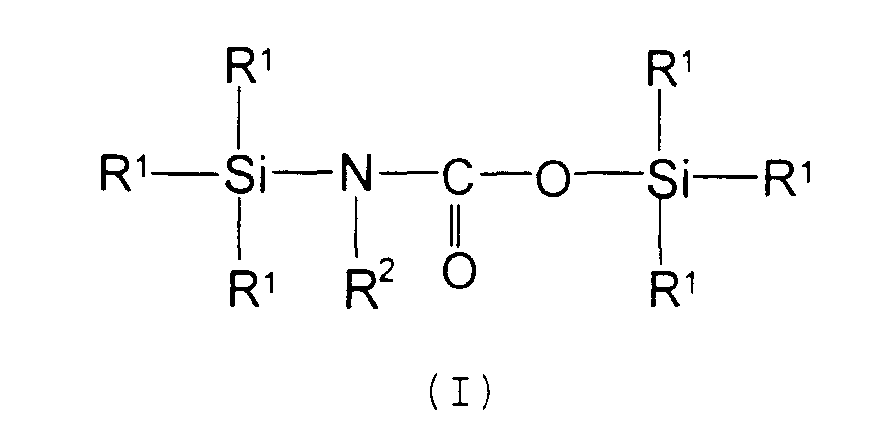
According to the present invention in a first aspect
there is provided a compound of formula (I) for use as a
silylating agent:
wherein each R
1 is independently a hydrogen atom, an alkyl
group or an alkenyl group with at least one R
1 being a
hydrogen atom or alkenyl group, and R
2 is a hydrogen atom or
an alkyl group.
Preferably each R1 in formula (I) above is
independently a methyl group, a hydrogen atom or an alkenyl
group.
As an alkenyl group, R1 may have from 2 to 6 carbon
atoms, i.e. vinyl, propenyl, butenyl, pentenyl and hexenyl,
and is preferably vinyl or hexenyl. R1 is most preferably a
hydrogen atom, a vinyl or a hexenyl group.
As an alkyl group, R1 may have from 1 to 6 carbon
atoms, i.e. methyl, ethyl, propyl, butyl, pentyl and hexyl,
and is preferably methyl.
As an alkyl group, R2 may be any of the groups
mentioned above in this regard for R1, and is preferably a
propyl group.
The compound of the present invention is preferably
N-Pr,bis(vinyldimethylsilyl)carbamate, N-Pr,bis(hydrogen-dimethylsilyl)carbamate,
or N-Pr,bis(hexenyldimethylsilyl)-carbamate.
According to the present invention there is provided in
a second aspect a method for making a compound of formula
(I)
which method comprises a first step of reacting a primary
amine with carbon dioxide in the presence of a tertiary
amine to form a trialkylammonium salt of an
N-alkylcarbamate, and a second step of reacting a silane
having the formula R
1 3SiX with the trialkylammonium salt to
form the compound of formula I, wherein each R
1 is
independently a hydrogen atom, an alkyl group or an alkenyl
group with at least one R
1 being a hydrogen atom or alkenyl
group, R
2 is an alkyl group and X is a leaving group.
The method of the second aspect of the present
invention may thus be represented by the reaction scheme:
(1) R2NH2 + CO2 + 2R3 3N → R2NHCO2 - R3 3NH+
(2) R2NHCO2 - R3 3N+ + 2R1 3SiX
→ R1 3SiNR2CO2SiR1 3 + 2R3 3N.HCl
wherein R1, R2 and X are as defined above and R3 is an alkyl
group, for example methyl or ethyl. X may be a halogen atom
(e.g. chlorine, bromine, iodine). R3 is preferably ethyl
and X is preferably a chlorine atom.
In step (1) of the method of the second aspect of the
present invention, a primary amine is reacted with CO2 in
the presence of a tertiary amine to trap the acid formed
during the reaction and to form a trialkylammonium salt of
an N-alkylcarbamate. The reaction is exothermic and hence
cooling of the reaction mixture may be required, for example
to 0°C or below (e.g. to a temperature between -20 and
-30°C). In step (2), reaction of the silane with the
trialkylammonium salt is also exothermic and the silane may
need to be added gradually, for example dropwise, with
cooling of the reaction mixture. The specific reaction
conditions to be employed will of course depend upon the
particular compound being made. Where the desired end-product
is an asymmetric carbamate, for example
hydrogendimethylsilyl-vinyldimethylsilylcarbamate, then
different silanes are used sequentially in different steps.
According to the present invention in a third aspect
there is provided a method for silylating a material having
a silanol group which method comprises reacting a compound
of formula (I) with the material having the silanol group:
wherein each R
1 is independently a hydrogen atom, an alkyl
group or an alkenyl group with at least one R
1 being a
hydrogen atom or alkenyl group, and R
2 is a hydrogen atom or
an alkyl group.
The reaction of the third aspect of the present
invention may thus be represented by the reaction scheme:
(a) -SiOH + R1 3SiNR2CO2SiR1 3
→ -SiOSiR1 3 + HNR2CO2SiR1 3
(b) HNR2CO2SiR1 3 + -SiOH → -SiOSiR1 3 + CO2 + R2NH2
wherein R1 and R2 are as defined above in relation to formula
(I).
The compounds of the first aspect of the present
invention are thus useful as silylating agents to reduce the
amount of silanol groups and optimise the functionality of
an organopolysiloxane, silicone resin, silica, other
inorganic filler or substrate by using the method of the
third aspect of the present invention.
In the method of the third aspect of the present
invention, the compounds of the first aspect can merely be
added to the silanol containing organopolysiloxane, silica
or other inorganic filler and mixed at room temperature.
For substrates such as a pane of glass the compounds of the
first aspect may simply be coated onto the substrate.
Materials silylated by the method of the third aspect
of the present invention may be end-products per se, or may
be further reacted to form further products. For example,
an organopolysiloxane having vinyl functionality may be
further reacted with an organosilicon compound having Si-H
groups in the presence of a noble metal catalyst by a
hydrosilylation reaction to cross-link the
organopolysiloxane and thus form a more highly structured
material.
The present invention will now be illustrated by way of
example.
Example 1 - synthesis of dimethylsilylcarbamates
a) N-Pr,bis(hydrogendimethylsilyl)carbamate
100ml of dry dichloromethane, 6g of isopropylamine and
10.1g of triethylamine were mixed in a flask and cooled to
between -20 and -30°C. Dry CO2 was then bubbled through the
solution until saturation. The CO2 inlet was then replaced
by a dropping funnel containing 20.1g of hydrogendimethylchlorosilane
which silane was slowly added to the mixture
with mixing whilst maintaining the temperature of the
mixture below 20°C. The mixture was then allowed to warm to
room temperature, and dichloromethane was removed by
distillation. A triethylammonium salt was removed from the
reaction mixture by selective precipitation using n-pentane.
After filtration, the solution was concentrated under vacuum
to give a transparent yellow liquid. 29Si NMR and FTIR
studies confirmed the product as N-Pr,
bis(hydrogendimethylsilyl)-carbamate.
b) N-Pr,bis(vinyldimethylsilyl)carbamate
N-Pr,bis(vinyldimethylsilyl)carbamate was prepared
using the method described in a) directly hereinabove with
the exception that vinyldimethylchlorosilane was used as the
silane.
c) N-Pr,bis (hexenyldimethylsilyl)carbamate
N-Pr,bis(hexenyldimethylsilyl)carbamate was prepared he
method described in a) directly hereinabove was followed to
with the exception that hexenyldimethylchlorosilane was used
as the silane.
Example 2 - endcapping of silanol-endblocked polydimethylsiloxane
A silanol-endblocked polydimethylsiloxane (PDMS) having
a degree of polymerisation of 100 was treated with N-Pr,bis-(hydrogendimethylsilyl)carbamate
and analysed by NMR. The
results are shown in Table 1:
| | PDMS (g) | Carbamate (g) | Silanol (ppm) | Silanol (mol) |
| Sample 1 | 5 | 0 | 9087 | 5.34 x 10⁻⁴ |
| Sample 2 | 5 | 0.15 | 7805 | 4.59 x 10⁻⁴ |
| Sample 3 | 5 | 0.5 | <50 | - |
Upon addition of the carbamate the PDMS became hazy and a
strong amine smell developed due to the release of
isopropylamine. As the amount of added carbamate was
increased the silanol signal decreased until at 10% wt.
carbamate it disappeared altogether.
Example 3 - polymer functionalisation and catalyst
neutralisation
2000g of silanol end-blocked PDMS of approximately 70
mm
2/s viscosity was polymerised in the presence of 40 ppm of
phosphonitrile chloride antimonate catalyst at 25°C and a
pressure of 10 kPa. N-r,bis(hydrogendimethylsilyl)carbamate
was injected into the reaction mixture to functionalise the
polymer and neutralise the catalyst when the desired polymer
viscosity was reached. The results are shown in Table 2
below. "BDSC" means N-Pr,bis(hydrogendimethylsilyl)-carbamate:
| Exp. 1 5.9g BDSC | Exp. 2 3.15g BDSC | Exp. 3 1.98g BDSC | Exp. 4 1.02g BDSC |
| Time (s) | Torque (A) | Time (s) | Torque (A) | Time (s) | Torque (A) | Time (s) | Torque (A) |
| 0 | 1.41 | 0 | 1.39 | 0 | 1.41 | 0 | 1.39 |
| 60 | 1.41 | 60 | 1.39 | 60 | 1.41 | 180 | 1.39 |
| 360 | 1.41 | 360 | 1.39 | 180 | 1.41 | 720 | 1.40 |
| 720 | 1.41 | 720 | 1.40 | 360 | 1.42 | 780 | 1.41 |
| 900 | 1.41 | 900 | 1.43 | 570 | 1.43 | 810 | 1.43 |
| 1200 | 1.42 | 930 | 1.45 | 660 | 1.45 | 840 | 1.46 |
| 1260 | 1.46 | 960 | 1.47 | 690 | 1.47 | 870 | 1.49 |
| 1290 | 1.48 | 990 | 1.54 | 720 | 1.52 | 900 | 1.55 |
| 1320 | 1.52 | 1020 | 1.66 | 750 | 1.60 | 930 | 1.62 |
| 1410 | 1.83 | 1050 | 1.95 | 780 | 1.75 | 960 | 1.68 |
| | | 1080 | 1.99 | 810 | 1.98 | 990 | 1.88 |
| | | | | | | 1020 | 1.95 |
| SiH ppm | 9.1 | | 9.9 | | 5.5 | | <3 |
| SiOH ppm | 403 | | 342 | | 366 | | 304 |
| Viscosity mm2/s | 36k | | 63.4k | | 57.8k | | 51.5k |
Hydroxy index method is used to determine the amount of
residual silanol remaining in a siloxane polymer. Silanol
containing organopolysiloxane is treated with excess
polymethylhydrogensiloxane in the presence of a tin
catalyst. Residual silanol groups react with the
polymethylhydrogen-siloxane to form a resin. The viscosity
of the mixture increases in proportion to the amount of
residual silanol present. The lower the hydroxy index the
higher the level of residual silanol. The hydroxy index
method was thus used to determine the levels of residual
silanol in Si-OH endblocked PDMS and Si-H terminated PDMS
which had been treated with different amounts of BDSC. The
results are shown in Tables 3 and 4 below:
| Sample | PDMS(g) | BDSC(g) | Temp(°C) | Time(s) | Viscosity (mm2/s) | Hydroxy index |
| 1 | 140 | - | - | - | 12300 | Gel |
| 2 | 140 | 0.21 | 60 | 900 | 12300 | Gel |
| 3 | 140 | 0.34 | 60 | 900 | 12300 | 0.47 |
| 4 | 140 | 0.52 | 60 | 900 | 12300 | 0.97 |
| Sample | Si-H PDMS(g) | BDSC(g) | Temp(°C) | Time(s ) | Viscosity (mm2/s) | Hydroxy index |
| 1 | 140 | - | - | - | 13,700 | 0.12 |
| 2 | 140 | 0.15 | 60 | 900 | 13,700 | 0.25 |
| 3 | 140 | 0.30 | 60 | 900 | 12,300 | 0.76 |
| Computed | 140 | 0.41 | | | 12,300 | 1.0 |
Tables 3 and 4 show how the hydroxy index increases as
the amount of added BDSC increases.
Example 5 - BDSC treatment of silica
150g of silica was placed in a 2 litre round bottomed
flask having a central stirrer. 34.7g BDSC was introduced
into the flask slowly with stirring at room temperature
under a nitrogen blanket.
The extent of surface modification of the silica was
determined by diffuse reflectance infared fourier transform
spectroscopy (DRIFTS). The DRIFTS spectrum indicated that
the silica had been substantially silylated by the BDSC -
silanol vibrations at 3740cm-1 had been substantially reduced
and a strong peak attributed to Si-H vibrations had appeared
at 2140cm-1.
The hydrophobicity of the silica was determined by
contact angle measurements with water. The silica was found
to be highly hydrophobic with a contact angle of 126 +/- 3
degrees.