EP1008657A2 - Method and reagent for quantitative determination of 1,5-anhydroglucitol - Google Patents
Method and reagent for quantitative determination of 1,5-anhydroglucitol Download PDFInfo
- Publication number
- EP1008657A2 EP1008657A2 EP99309932A EP99309932A EP1008657A2 EP 1008657 A2 EP1008657 A2 EP 1008657A2 EP 99309932 A EP99309932 A EP 99309932A EP 99309932 A EP99309932 A EP 99309932A EP 1008657 A2 EP1008657 A2 EP 1008657A2
- Authority
- EP
- European Patent Office
- Prior art keywords
- ndp
- ntp
- glucose
- reagent
- phosphofructokinase
- Prior art date
- Legal status (The legal status is an assumption and is not a legal conclusion. Google has not performed a legal analysis and makes no representation as to the accuracy of the status listed.)
- Withdrawn
Links
- MPCAJMNYNOGXPB-SLPGGIOYSA-N 1,5-anhydro-D-glucitol Chemical compound OC[C@H]1OC[C@H](O)[C@@H](O)[C@@H]1O MPCAJMNYNOGXPB-SLPGGIOYSA-N 0.000 title claims abstract description 71
- 239000003153 chemical reaction reagent Substances 0.000 title claims abstract description 67
- 238000000034 method Methods 0.000 title claims abstract description 66
- WQZGKKKJIJFFOK-GASJEMHNSA-N Glucose Natural products OC[C@H]1OC(O)[C@H](O)[C@@H](O)[C@@H]1O WQZGKKKJIJFFOK-GASJEMHNSA-N 0.000 claims abstract description 95
- 239000008103 glucose Substances 0.000 claims abstract description 95
- 102000004190 Enzymes Human genes 0.000 claims abstract description 81
- 108090000790 Enzymes Proteins 0.000 claims abstract description 81
- 239000005515 coenzyme Substances 0.000 claims abstract description 48
- 229910019142 PO4 Inorganic materials 0.000 claims abstract description 39
- 239000010452 phosphate Substances 0.000 claims abstract description 39
- 101710088194 Dehydrogenase Proteins 0.000 claims abstract description 23
- 230000009471 action Effects 0.000 claims abstract description 16
- RNBGYGVWRKECFJ-ZXXMMSQZSA-N alpha-D-fructofuranose 1,6-bisphosphate Chemical compound O[C@H]1[C@H](O)[C@](O)(COP(O)(O)=O)O[C@@H]1COP(O)(O)=O RNBGYGVWRKECFJ-ZXXMMSQZSA-N 0.000 claims abstract description 12
- 239000003795 chemical substances by application Substances 0.000 claims abstract description 12
- 229940025237 fructose 1,6-diphosphate Drugs 0.000 claims abstract description 12
- 238000006356 dehydrogenation reaction Methods 0.000 claims abstract description 3
- 230000001419 dependent effect Effects 0.000 claims description 63
- 102000005548 Hexokinase Human genes 0.000 claims description 60
- 108700040460 Hexokinases Proteins 0.000 claims description 60
- 238000006243 chemical reaction Methods 0.000 claims description 46
- 102000012435 Phosphofructokinase-1 Human genes 0.000 claims description 39
- 108010022684 Phosphofructokinase-1 Proteins 0.000 claims description 39
- 108010070600 Glucose-6-phosphate isomerase Proteins 0.000 claims description 38
- 102000005731 Glucose-6-phosphate isomerase Human genes 0.000 claims description 38
- 239000000126 substance Substances 0.000 claims description 31
- 239000012491 analyte Substances 0.000 claims description 27
- 102000030595 Glucokinase Human genes 0.000 claims description 23
- 108010021582 Glucokinase Proteins 0.000 claims description 23
- 125000003831 tetrazolyl group Chemical group 0.000 claims description 18
- -1 nucleoside diphosphate Chemical class 0.000 claims description 17
- 230000008030 elimination Effects 0.000 claims description 16
- 238000003379 elimination reaction Methods 0.000 claims description 16
- 238000005259 measurement Methods 0.000 claims description 5
- 239000000049 pigment Substances 0.000 claims description 5
- 238000006911 enzymatic reaction Methods 0.000 claims description 4
- 239000002777 nucleoside Substances 0.000 claims description 4
- 239000001177 diphosphate Substances 0.000 claims description 2
- 235000011180 diphosphates Nutrition 0.000 claims description 2
- 239000001226 triphosphate Substances 0.000 claims description 2
- 235000011178 triphosphate Nutrition 0.000 claims description 2
- 238000004737 colorimetric analysis Methods 0.000 claims 1
- 229940088598 enzyme Drugs 0.000 description 76
- 239000000523 sample Substances 0.000 description 36
- 239000000872 buffer Substances 0.000 description 25
- XTWYTFMLZFPYCI-KQYNXXCUSA-N 5'-adenylphosphoric acid Chemical compound C1=NC=2C(N)=NC=NC=2N1[C@@H]1O[C@H](COP(O)(=O)OP(O)(O)=O)[C@@H](O)[C@H]1O XTWYTFMLZFPYCI-KQYNXXCUSA-N 0.000 description 21
- XTWYTFMLZFPYCI-UHFFFAOYSA-N Adenosine diphosphate Natural products C1=NC=2C(N)=NC=NC=2N1C1OC(COP(O)(=O)OP(O)(O)=O)C(O)C1O XTWYTFMLZFPYCI-UHFFFAOYSA-N 0.000 description 21
- 239000000758 substrate Substances 0.000 description 13
- MHAJPDPJQMAIIY-UHFFFAOYSA-N Hydrogen peroxide Chemical compound OO MHAJPDPJQMAIIY-UHFFFAOYSA-N 0.000 description 12
- 239000012085 test solution Substances 0.000 description 12
- ZKHQWZAMYRWXGA-KQYNXXCUSA-J ATP(4-) Chemical compound C1=NC=2C(N)=NC=NC=2N1[C@@H]1O[C@H](COP([O-])(=O)OP([O-])(=O)OP([O-])([O-])=O)[C@@H](O)[C@H]1O ZKHQWZAMYRWXGA-KQYNXXCUSA-J 0.000 description 11
- ZKHQWZAMYRWXGA-UHFFFAOYSA-N Adenosine triphosphate Natural products C1=NC=2C(N)=NC=NC=2N1C1OC(COP(O)(=O)OP(O)(=O)OP(O)(O)=O)C(O)C1O ZKHQWZAMYRWXGA-UHFFFAOYSA-N 0.000 description 11
- 230000000694 effects Effects 0.000 description 11
- 239000012190 activator Substances 0.000 description 10
- 239000000203 mixture Substances 0.000 description 10
- 239000003755 preservative agent Substances 0.000 description 10
- 108010001816 pyranose oxidase Proteins 0.000 description 10
- 239000003381 stabilizer Substances 0.000 description 10
- 239000004094 surface-active agent Substances 0.000 description 10
- NBSCHQHZLSJFNQ-GASJEMHNSA-N D-Glucose 6-phosphate Chemical compound OC1O[C@H](COP(O)(O)=O)[C@@H](O)[C@H](O)[C@H]1O NBSCHQHZLSJFNQ-GASJEMHNSA-N 0.000 description 9
- VFRROHXSMXFLSN-UHFFFAOYSA-N Glc6P Natural products OP(=O)(O)OCC(O)C(O)C(O)C(O)C=O VFRROHXSMXFLSN-UHFFFAOYSA-N 0.000 description 9
- 230000002335 preservative effect Effects 0.000 description 9
- 241000193385 Geobacillus stearothermophilus Species 0.000 description 8
- TWRXJAOTZQYOKJ-UHFFFAOYSA-L Magnesium chloride Chemical compound [Mg+2].[Cl-].[Cl-] TWRXJAOTZQYOKJ-UHFFFAOYSA-L 0.000 description 8
- 102000004316 Oxidoreductases Human genes 0.000 description 8
- 108090000854 Oxidoreductases Proteins 0.000 description 8
- 238000002835 absorbance Methods 0.000 description 8
- XLYOFNOQVPJJNP-UHFFFAOYSA-N water Substances O XLYOFNOQVPJJNP-UHFFFAOYSA-N 0.000 description 8
- 150000001875 compounds Chemical class 0.000 description 6
- 239000008213 purified water Substances 0.000 description 6
- 108010015776 Glucose oxidase Proteins 0.000 description 5
- 239000004366 Glucose oxidase Substances 0.000 description 5
- 238000003556 assay Methods 0.000 description 5
- 238000011088 calibration curve Methods 0.000 description 5
- 229940116332 glucose oxidase Drugs 0.000 description 5
- 235000019420 glucose oxidase Nutrition 0.000 description 5
- 238000011534 incubation Methods 0.000 description 5
- 239000011541 reaction mixture Substances 0.000 description 5
- RLFWWDJHLFCNIJ-UHFFFAOYSA-N 4-aminoantipyrine Chemical compound CN1C(C)=C(N)C(=O)N1C1=CC=CC=C1 RLFWWDJHLFCNIJ-UHFFFAOYSA-N 0.000 description 4
- 241000205180 Thermococcus litoralis Species 0.000 description 4
- 239000012736 aqueous medium Substances 0.000 description 4
- 229910001629 magnesium chloride Inorganic materials 0.000 description 4
- 229930027945 nicotinamide-adenine dinucleotide Natural products 0.000 description 4
- 210000002966 serum Anatomy 0.000 description 4
- JUJBNYBVVQSIOU-UHFFFAOYSA-M sodium;4-[2-(4-iodophenyl)-3-(4-nitrophenyl)tetrazol-2-ium-5-yl]benzene-1,3-disulfonate Chemical compound [Na+].C1=CC([N+](=O)[O-])=CC=C1N1[N+](C=2C=CC(I)=CC=2)=NC(C=2C(=CC(=CC=2)S([O-])(=O)=O)S([O-])(=O)=O)=N1 JUJBNYBVVQSIOU-UHFFFAOYSA-M 0.000 description 4
- 238000012360 testing method Methods 0.000 description 4
- QKNYBSVHEMOAJP-UHFFFAOYSA-N 2-amino-2-(hydroxymethyl)propane-1,3-diol;hydron;chloride Chemical compound Cl.OCC(N)(CO)CO QKNYBSVHEMOAJP-UHFFFAOYSA-N 0.000 description 3
- 241000194107 Bacillus megaterium Species 0.000 description 3
- 241001452028 Escherichia coli DH1 Species 0.000 description 3
- PEDCQBHIVMGVHV-UHFFFAOYSA-N Glycerine Chemical compound OCC(O)CO PEDCQBHIVMGVHV-UHFFFAOYSA-N 0.000 description 3
- BAWFJGJZGIEFAR-NNYOXOHSSA-N NAD zwitterion Chemical compound NC(=O)C1=CC=C[N+]([C@H]2[C@@H]([C@H](O)[C@@H](COP([O-])(=O)OP(O)(=O)OC[C@@H]3[C@H]([C@@H](O)[C@@H](O3)N3C4=NC=NC(N)=C4N=C3)O)O2)O)=C1 BAWFJGJZGIEFAR-NNYOXOHSSA-N 0.000 description 3
- XJLXINKUBYWONI-NNYOXOHSSA-O NADP(+) Chemical compound NC(=O)C1=CC=C[N+]([C@H]2[C@@H]([C@H](O)[C@@H](COP(O)(=O)OP(O)(=O)OC[C@@H]3[C@H]([C@@H](OP(O)(O)=O)[C@@H](O3)N3C4=NC=NC(N)=C4N=C3)O)O2)O)=C1 XJLXINKUBYWONI-NNYOXOHSSA-O 0.000 description 3
- WQZGKKKJIJFFOK-VFUOTHLCSA-N beta-D-glucose Chemical compound OC[C@H]1O[C@@H](O)[C@H](O)[C@@H](O)[C@@H]1O WQZGKKKJIJFFOK-VFUOTHLCSA-N 0.000 description 3
- 238000004440 column chromatography Methods 0.000 description 3
- 206010012601 diabetes mellitus Diseases 0.000 description 3
- RAXXELZNTBOGNW-UHFFFAOYSA-N imidazole Natural products C1=CNC=N1 RAXXELZNTBOGNW-UHFFFAOYSA-N 0.000 description 3
- 229950006238 nadide Drugs 0.000 description 3
- 210000002381 plasma Anatomy 0.000 description 3
- 239000000243 solution Substances 0.000 description 3
- 239000012086 standard solution Substances 0.000 description 3
- BGFTWECWAICPDG-UHFFFAOYSA-N 2-[bis(4-chlorophenyl)methyl]-4-n-[3-[bis(4-chlorophenyl)methyl]-4-(dimethylamino)phenyl]-1-n,1-n-dimethylbenzene-1,4-diamine Chemical compound C1=C(C(C=2C=CC(Cl)=CC=2)C=2C=CC(Cl)=CC=2)C(N(C)C)=CC=C1NC(C=1)=CC=C(N(C)C)C=1C(C=1C=CC(Cl)=CC=1)C1=CC=C(Cl)C=C1 BGFTWECWAICPDG-UHFFFAOYSA-N 0.000 description 2
- 102100031126 6-phosphogluconolactonase Human genes 0.000 description 2
- 108010029731 6-phosphogluconolactonase Proteins 0.000 description 2
- 241000193830 Bacillus <bacterium> Species 0.000 description 2
- 102000016938 Catalase Human genes 0.000 description 2
- 108010053835 Catalase Proteins 0.000 description 2
- GSXOAOHZAIYLCY-UHFFFAOYSA-N D-F6P Natural products OCC(=O)C(O)C(O)C(O)COP(O)(O)=O GSXOAOHZAIYLCY-UHFFFAOYSA-N 0.000 description 2
- 108010050375 Glucose 1-Dehydrogenase Proteins 0.000 description 2
- 108010018962 Glucosephosphate Dehydrogenase Proteins 0.000 description 2
- DHMQDGOQFOQNFH-UHFFFAOYSA-N Glycine Chemical compound NCC(O)=O DHMQDGOQFOQNFH-UHFFFAOYSA-N 0.000 description 2
- CSNNHWWHGAXBCP-UHFFFAOYSA-L Magnesium sulfate Chemical compound [Mg+2].[O-][S+2]([O-])([O-])[O-] CSNNHWWHGAXBCP-UHFFFAOYSA-L 0.000 description 2
- 102000003992 Peroxidases Human genes 0.000 description 2
- XYFCBTPGUUZFHI-UHFFFAOYSA-N Phosphine Chemical compound P XYFCBTPGUUZFHI-UHFFFAOYSA-N 0.000 description 2
- 102000013009 Pyruvate Kinase Human genes 0.000 description 2
- 108020005115 Pyruvate Kinase Proteins 0.000 description 2
- PXIPVTKHYLBLMZ-UHFFFAOYSA-N Sodium azide Chemical compound [Na+].[N-]=[N+]=[N-] PXIPVTKHYLBLMZ-UHFFFAOYSA-N 0.000 description 2
- 229920004890 Triton X-100 Polymers 0.000 description 2
- 239000013504 Triton X-100 Substances 0.000 description 2
- QVGXLLKOCUKJST-UHFFFAOYSA-N atomic oxygen Chemical compound [O] QVGXLLKOCUKJST-UHFFFAOYSA-N 0.000 description 2
- BGWGXPAPYGQALX-ARQDHWQXSA-N beta-D-fructofuranose 6-phosphate Chemical compound OC[C@@]1(O)O[C@H](COP(O)(O)=O)[C@@H](O)[C@@H]1O BGWGXPAPYGQALX-ARQDHWQXSA-N 0.000 description 2
- 239000012472 biological sample Substances 0.000 description 2
- 230000003197 catalytic effect Effects 0.000 description 2
- 230000008859 change Effects 0.000 description 2
- 239000002738 chelating agent Substances 0.000 description 2
- 230000007423 decrease Effects 0.000 description 2
- 238000002474 experimental method Methods 0.000 description 2
- 239000007986 glycine-NaOH buffer Substances 0.000 description 2
- 150000002500 ions Chemical class 0.000 description 2
- 229910052751 metal Inorganic materials 0.000 description 2
- 239000002184 metal Substances 0.000 description 2
- 244000005700 microbiome Species 0.000 description 2
- 238000012986 modification Methods 0.000 description 2
- 230000004048 modification Effects 0.000 description 2
- VMGAPWLDMVPYIA-HIDZBRGKSA-N n'-amino-n-iminomethanimidamide Chemical compound N\N=C\N=N VMGAPWLDMVPYIA-HIDZBRGKSA-N 0.000 description 2
- JPXMTWWFLBLUCD-UHFFFAOYSA-N nitro blue tetrazolium(2+) Chemical compound COC1=CC(C=2C=C(OC)C(=CC=2)[N+]=2N(N=C(N=2)C=2C=CC=CC=2)C=2C=CC(=CC=2)[N+]([O-])=O)=CC=C1[N+]1=NC(C=2C=CC=CC=2)=NN1C1=CC=C([N+]([O-])=O)C=C1 JPXMTWWFLBLUCD-UHFFFAOYSA-N 0.000 description 2
- 239000001301 oxygen Substances 0.000 description 2
- 229910052760 oxygen Inorganic materials 0.000 description 2
- 108040007629 peroxidase activity proteins Proteins 0.000 description 2
- BOLDJAUMGUJJKM-LSDHHAIUSA-N renifolin D Natural products CC(=C)[C@@H]1Cc2c(O)c(O)ccc2[C@H]1CC(=O)c3ccc(O)cc3O BOLDJAUMGUJJKM-LSDHHAIUSA-N 0.000 description 2
- 230000035945 sensitivity Effects 0.000 description 2
- 235000000346 sugar Nutrition 0.000 description 2
- 150000008163 sugars Chemical class 0.000 description 2
- 210000002700 urine Anatomy 0.000 description 2
- QLAJNZSPVITUCQ-UHFFFAOYSA-N 1,3,2-dioxathietane 2,2-dioxide Chemical compound O=S1(=O)OCO1 QLAJNZSPVITUCQ-UHFFFAOYSA-N 0.000 description 1
- ZOFMBTCGGPDAIC-UHFFFAOYSA-N 2-(4-nitrophenyl)-5-phenyl-2h-tetrazol-2-ium;chloride Chemical compound [Cl-].C1=CC([N+](=O)[O-])=CC=C1N1[NH+]=C(C=2C=CC=CC=2)N=N1 ZOFMBTCGGPDAIC-UHFFFAOYSA-N 0.000 description 1
- ZTQGWROHRVYSPW-UHFFFAOYSA-N 3-(n-ethyl-3-methylanilino)-2-hydroxypropane-1-sulfonic acid Chemical compound OS(=O)(=O)CC(O)CN(CC)C1=CC=CC(C)=C1 ZTQGWROHRVYSPW-UHFFFAOYSA-N 0.000 description 1
- MTIMXJARBBCNGT-UHFFFAOYSA-N 4-methoxy-10-methyl-5h-phenazine Chemical compound CN1C2=CC=CC=C2NC2=C1C=CC=C2OC MTIMXJARBBCNGT-UHFFFAOYSA-N 0.000 description 1
- RXGJTUSBYWCRBK-UHFFFAOYSA-M 5-methylphenazinium methyl sulfate Chemical compound COS([O-])(=O)=O.C1=CC=C2[N+](C)=C(C=CC=C3)C3=NC2=C1 RXGJTUSBYWCRBK-UHFFFAOYSA-M 0.000 description 1
- 108020001657 6-phosphogluconate dehydrogenase Proteins 0.000 description 1
- 102000004567 6-phosphogluconate dehydrogenase Human genes 0.000 description 1
- 102000009027 Albumins Human genes 0.000 description 1
- 108010088751 Albumins Proteins 0.000 description 1
- 102000006942 B-Cell Maturation Antigen Human genes 0.000 description 1
- 108010008014 B-Cell Maturation Antigen Proteins 0.000 description 1
- BTBUEUYNUDRHOZ-UHFFFAOYSA-N Borate Chemical compound [O-]B([O-])[O-] BTBUEUYNUDRHOZ-UHFFFAOYSA-N 0.000 description 1
- IKECFYHQIOKZOE-UHFFFAOYSA-N C(=O)(O)CNC(=O)N1C2=CC=C(C=C2SC=2C=C(C=CC12)NC)NC Chemical compound C(=O)(O)CNC(=O)N1C2=CC=C(C=C2SC=2C=C(C=CC12)NC)NC IKECFYHQIOKZOE-UHFFFAOYSA-N 0.000 description 1
- ZWIADYZPOWUWEW-XVFCMESISA-N CDP Chemical compound O=C1N=C(N)C=CN1[C@H]1[C@H](O)[C@H](O)[C@@H](COP(O)(=O)OP(O)(O)=O)O1 ZWIADYZPOWUWEW-XVFCMESISA-N 0.000 description 1
- BVKZGUZCCUSVTD-UHFFFAOYSA-L Carbonate Chemical compound [O-]C([O-])=O BVKZGUZCCUSVTD-UHFFFAOYSA-L 0.000 description 1
- 101710184216 Cardioactive peptide Proteins 0.000 description 1
- RYGMFSIKBFXOCR-UHFFFAOYSA-N Copper Chemical compound [Cu] RYGMFSIKBFXOCR-UHFFFAOYSA-N 0.000 description 1
- PCDQPRRSZKQHHS-CCXZUQQUSA-N Cytarabine Triphosphate Chemical compound O=C1N=C(N)C=CN1[C@H]1[C@@H](O)[C@H](O)[C@@H](COP(O)(=O)OP(O)(=O)OP(O)(O)=O)O1 PCDQPRRSZKQHHS-CCXZUQQUSA-N 0.000 description 1
- FBPFZTCFMRRESA-KVTDHHQDSA-N D-Mannitol Chemical compound OC[C@@H](O)[C@@H](O)[C@H](O)[C@H](O)CO FBPFZTCFMRRESA-KVTDHHQDSA-N 0.000 description 1
- PHOQVHQSTUBQQK-SQOUGZDYSA-N D-glucono-1,5-lactone Chemical compound OC[C@H]1OC(=O)[C@H](O)[C@@H](O)[C@@H]1O PHOQVHQSTUBQQK-SQOUGZDYSA-N 0.000 description 1
- SDKQRNRRDYRQKY-UHFFFAOYSA-N Dioxacarb Chemical compound CNC(=O)OC1=CC=CC=C1C1OCCO1 SDKQRNRRDYRQKY-UHFFFAOYSA-N 0.000 description 1
- KCXVZYZYPLLWCC-UHFFFAOYSA-N EDTA Chemical compound OC(=O)CN(CC(O)=O)CCN(CC(O)=O)CC(O)=O KCXVZYZYPLLWCC-UHFFFAOYSA-N 0.000 description 1
- QGWNDRXFNXRZMB-UUOKFMHZSA-N GDP Chemical compound C1=2NC(N)=NC(=O)C=2N=CN1[C@@H]1O[C@H](COP(O)(=O)OP(O)(O)=O)[C@@H](O)[C@H]1O QGWNDRXFNXRZMB-UUOKFMHZSA-N 0.000 description 1
- 102000006395 Globulins Human genes 0.000 description 1
- 108010044091 Globulins Proteins 0.000 description 1
- 239000004471 Glycine Substances 0.000 description 1
- 239000006173 Good's buffer Substances 0.000 description 1
- XKMLYUALXHKNFT-UUOKFMHZSA-N Guanosine-5'-triphosphate Chemical compound C1=2NC(N)=NC(=O)C=2N=CN1[C@@H]1O[C@H](COP(O)(=O)OP(O)(=O)OP(O)(O)=O)[C@@H](O)[C@H]1O XKMLYUALXHKNFT-UUOKFMHZSA-N 0.000 description 1
- JPXZQMKKFWMMGK-KQYNXXCUSA-N IDP Chemical compound O[C@@H]1[C@H](O)[C@@H](COP(O)(=O)OP(O)(O)=O)O[C@H]1N1C(N=CNC2=O)=C2N=C1 JPXZQMKKFWMMGK-KQYNXXCUSA-N 0.000 description 1
- HAEJPQIATWHALX-KQYNXXCUSA-N ITP Chemical compound O[C@@H]1[C@H](O)[C@@H](COP(O)(=O)OP(O)(=O)OP(O)(O)=O)O[C@H]1N1C(N=CNC2=O)=C2N=C1 HAEJPQIATWHALX-KQYNXXCUSA-N 0.000 description 1
- 241000235649 Kluyveromyces Species 0.000 description 1
- XUJNEKJLAYXESH-REOHCLBHSA-N L-Cysteine Chemical compound SC[C@H](N)C(O)=O XUJNEKJLAYXESH-REOHCLBHSA-N 0.000 description 1
- JVTAAEKCZFNVCJ-UHFFFAOYSA-M Lactate Chemical compound CC(O)C([O-])=O JVTAAEKCZFNVCJ-UHFFFAOYSA-M 0.000 description 1
- 239000004472 Lysine Substances 0.000 description 1
- KDXKERNSBIXSRK-UHFFFAOYSA-N Lysine Natural products NCCCCC(N)C(O)=O KDXKERNSBIXSRK-UHFFFAOYSA-N 0.000 description 1
- FYYHWMGAXLPEAU-UHFFFAOYSA-N Magnesium Chemical compound [Mg] FYYHWMGAXLPEAU-UHFFFAOYSA-N 0.000 description 1
- 229930195725 Mannitol Natural products 0.000 description 1
- 241000047703 Nonion Species 0.000 description 1
- MUBZPKHOEPUJKR-UHFFFAOYSA-N Oxalic acid Chemical compound OC(=O)C(O)=O MUBZPKHOEPUJKR-UHFFFAOYSA-N 0.000 description 1
- 239000002202 Polyethylene glycol Substances 0.000 description 1
- 241000205156 Pyrococcus furiosus Species 0.000 description 1
- 241001115170 Pyrococcus furiosus DSM 3638 Species 0.000 description 1
- 102000009609 Pyrophosphatases Human genes 0.000 description 1
- 108010009413 Pyrophosphatases Proteins 0.000 description 1
- 241000235070 Saccharomyces Species 0.000 description 1
- 240000004808 Saccharomyces cerevisiae Species 0.000 description 1
- DBMJMQXJHONAFJ-UHFFFAOYSA-M Sodium laurylsulphate Chemical compound [Na+].CCCCCCCCCCCCOS([O-])(=O)=O DBMJMQXJHONAFJ-UHFFFAOYSA-M 0.000 description 1
- 229920002472 Starch Polymers 0.000 description 1
- GSEJCLTVZPLZKY-UHFFFAOYSA-N Triethanolamine Chemical compound OCCN(CCO)CCO GSEJCLTVZPLZKY-UHFFFAOYSA-N 0.000 description 1
- PGAVKCOVUIYSFO-XVFCMESISA-N UTP Chemical compound O[C@@H]1[C@H](O)[C@@H](COP(O)(=O)OP(O)(=O)OP(O)(O)=O)O[C@H]1N1C(=O)NC(=O)C=C1 PGAVKCOVUIYSFO-XVFCMESISA-N 0.000 description 1
- XCCTYIAWTASOJW-XVFCMESISA-N Uridine-5'-Diphosphate Chemical compound O[C@@H]1[C@H](O)[C@@H](COP(O)(=O)OP(O)(O)=O)O[C@H]1N1C(=O)NC(=O)C=C1 XCCTYIAWTASOJW-XVFCMESISA-N 0.000 description 1
- HCHKCACWOHOZIP-UHFFFAOYSA-N Zinc Chemical compound [Zn] HCHKCACWOHOZIP-UHFFFAOYSA-N 0.000 description 1
- 241000588901 Zymomonas Species 0.000 description 1
- DGEZNRSVGBDHLK-UHFFFAOYSA-N [1,10]phenanthroline Chemical compound C1=CN=C2C3=NC=CC=C3C=CC2=C1 DGEZNRSVGBDHLK-UHFFFAOYSA-N 0.000 description 1
- 239000008351 acetate buffer Substances 0.000 description 1
- 150000001412 amines Chemical class 0.000 description 1
- 239000007982 barbital buffer Substances 0.000 description 1
- HWYNRVXFYFQSID-UHFFFAOYSA-M benzo[a]phenoxazin-9-ylidene(dimethyl)azanium;chloride Chemical compound [Cl-].C1=CC=C2C(N=C3C=CC(C=C3O3)=[N+](C)C)=C3C=CC2=C1 HWYNRVXFYFQSID-UHFFFAOYSA-M 0.000 description 1
- 230000008033 biological extinction Effects 0.000 description 1
- 239000013060 biological fluid Substances 0.000 description 1
- 235000010290 biphenyl Nutrition 0.000 description 1
- 239000002981 blocking agent Substances 0.000 description 1
- 210000004369 blood Anatomy 0.000 description 1
- 239000008280 blood Substances 0.000 description 1
- 229940105657 catalase Drugs 0.000 description 1
- 210000001175 cerebrospinal fluid Anatomy 0.000 description 1
- 239000007979 citrate buffer Substances 0.000 description 1
- 229910052802 copper Inorganic materials 0.000 description 1
- 239000010949 copper Substances 0.000 description 1
- XUJNEKJLAYXESH-UHFFFAOYSA-N cysteine Natural products SCC(N)C(O)=O XUJNEKJLAYXESH-UHFFFAOYSA-N 0.000 description 1
- 235000018417 cysteine Nutrition 0.000 description 1
- 230000007547 defect Effects 0.000 description 1
- ZBCBWPMODOFKDW-UHFFFAOYSA-N diethanolamine Chemical compound OCCNCCO ZBCBWPMODOFKDW-UHFFFAOYSA-N 0.000 description 1
- 125000002147 dimethylamino group Chemical group [H]C([H])([H])N(*)C([H])([H])[H] 0.000 description 1
- 201000010099 disease Diseases 0.000 description 1
- 208000037265 diseases, disorders, signs and symptoms Diseases 0.000 description 1
- DPXDJGUFSPAFJZ-UHFFFAOYSA-L disodium;4-[3-methyl-n-(4-sulfonatobutyl)anilino]butane-1-sulfonate Chemical compound [Na+].[Na+].CC1=CC=CC(N(CCCCS([O-])(=O)=O)CCCCS([O-])(=O)=O)=C1 DPXDJGUFSPAFJZ-UHFFFAOYSA-L 0.000 description 1
- 235000012209 glucono delta-lactone Nutrition 0.000 description 1
- 229960003681 gluconolactone Drugs 0.000 description 1
- 150000004676 glycans Chemical class 0.000 description 1
- QGWNDRXFNXRZMB-UHFFFAOYSA-N guanidine diphosphate Natural products C1=2NC(N)=NC(=O)C=2N=CN1C1OC(COP(O)(=O)OP(O)(O)=O)C(O)C1O QGWNDRXFNXRZMB-UHFFFAOYSA-N 0.000 description 1
- 238000000338 in vitro Methods 0.000 description 1
- 229910017053 inorganic salt Inorganic materials 0.000 description 1
- PGLTVOMIXTUURA-UHFFFAOYSA-N iodoacetamide Chemical compound NC(=O)CI PGLTVOMIXTUURA-UHFFFAOYSA-N 0.000 description 1
- JDNTWHVOXJZDSN-UHFFFAOYSA-N iodoacetic acid Chemical compound OC(=O)CI JDNTWHVOXJZDSN-UHFFFAOYSA-N 0.000 description 1
- 238000005342 ion exchange Methods 0.000 description 1
- 150000002605 large molecules Chemical class 0.000 description 1
- 239000007788 liquid Substances 0.000 description 1
- 229910052749 magnesium Inorganic materials 0.000 description 1
- 239000011777 magnesium Substances 0.000 description 1
- 229910052943 magnesium sulfate Inorganic materials 0.000 description 1
- 235000019341 magnesium sulphate Nutrition 0.000 description 1
- 229940049920 malate Drugs 0.000 description 1
- BJEPYKJPYRNKOW-UHFFFAOYSA-N malic acid Chemical compound OC(=O)C(O)CC(O)=O BJEPYKJPYRNKOW-UHFFFAOYSA-N 0.000 description 1
- WPBNNNQJVZRUHP-UHFFFAOYSA-L manganese(2+);methyl n-[[2-(methoxycarbonylcarbamothioylamino)phenyl]carbamothioyl]carbamate;n-[2-(sulfidocarbothioylamino)ethyl]carbamodithioate Chemical compound [Mn+2].[S-]C(=S)NCCNC([S-])=S.COC(=O)NC(=S)NC1=CC=CC=C1NC(=S)NC(=O)OC WPBNNNQJVZRUHP-UHFFFAOYSA-L 0.000 description 1
- 239000000594 mannitol Substances 0.000 description 1
- 235000010355 mannitol Nutrition 0.000 description 1
- 239000003550 marker Substances 0.000 description 1
- 108010077372 mast cell degranulating peptide Proteins 0.000 description 1
- 229910021645 metal ion Inorganic materials 0.000 description 1
- VADCBWWRVPBNGE-UHFFFAOYSA-N n-methyl-3,7-bis(methylamino)phenothiazine-10-carboxamide Chemical compound CNC1=CC=C2N(C(=O)NC)C3=CC=C(NC)C=C3SC2=C1 VADCBWWRVPBNGE-UHFFFAOYSA-N 0.000 description 1
- 229940101270 nicotinamide adenine dinucleotide (nad) Drugs 0.000 description 1
- BOPGDPNILDQYTO-NNYOXOHSSA-N nicotinamide-adenine dinucleotide Chemical compound C1=CCC(C(=O)N)=CN1[C@H]1[C@H](O)[C@H](O)[C@@H](COP(O)(=O)OP(O)(=O)OC[C@@H]2[C@H]([C@@H](O)[C@@H](O2)N2C3=NC=NC(N)=C3N=C2)O)O1 BOPGDPNILDQYTO-NNYOXOHSSA-N 0.000 description 1
- 108010028584 nucleotidase Proteins 0.000 description 1
- 229920002114 octoxynol-9 Polymers 0.000 description 1
- 125000003854 p-chlorophenyl group Chemical group [H]C1=C([H])C(*)=C([H])C([H])=C1Cl 0.000 description 1
- ZUOUZKKEUPVFJK-UHFFFAOYSA-N phenylbenzene Natural products C1=CC=CC=C1C1=CC=CC=C1 ZUOUZKKEUPVFJK-UHFFFAOYSA-N 0.000 description 1
- NBIIXXVUZAFLBC-UHFFFAOYSA-K phosphate Chemical compound [O-]P([O-])([O-])=O NBIIXXVUZAFLBC-UHFFFAOYSA-K 0.000 description 1
- 239000008363 phosphate buffer Substances 0.000 description 1
- 229910000073 phosphorus hydride Inorganic materials 0.000 description 1
- XNGIFLGASWRNHJ-UHFFFAOYSA-L phthalate(2-) Chemical compound [O-]C(=O)C1=CC=CC=C1C([O-])=O XNGIFLGASWRNHJ-UHFFFAOYSA-L 0.000 description 1
- 239000002504 physiological saline solution Substances 0.000 description 1
- 229920001223 polyethylene glycol Polymers 0.000 description 1
- 229920001282 polysaccharide Polymers 0.000 description 1
- 239000005017 polysaccharide Substances 0.000 description 1
- 238000002360 preparation method Methods 0.000 description 1
- KCXFHTAICRTXLI-UHFFFAOYSA-N propane-1-sulfonic acid Chemical compound CCCS(O)(=O)=O KCXFHTAICRTXLI-UHFFFAOYSA-N 0.000 description 1
- 235000018102 proteins Nutrition 0.000 description 1
- 102000004169 proteins and genes Human genes 0.000 description 1
- 108090000623 proteins and genes Proteins 0.000 description 1
- 238000009790 rate-determining step (RDS) Methods 0.000 description 1
- 230000009467 reduction Effects 0.000 description 1
- 230000002441 reversible effect Effects 0.000 description 1
- 150000003839 salts Chemical class 0.000 description 1
- IRQRBVOQGUPTLG-UHFFFAOYSA-M sodium;3-(n-ethyl-3-methylanilino)-2-hydroxypropane-1-sulfonate Chemical compound [Na+].[O-]S(=O)(=O)CC(O)CN(CC)C1=CC=CC(C)=C1 IRQRBVOQGUPTLG-UHFFFAOYSA-M 0.000 description 1
- 239000008107 starch Substances 0.000 description 1
- 235000019698 starch Nutrition 0.000 description 1
- 239000008362 succinate buffer Substances 0.000 description 1
- 150000005846 sugar alcohols Chemical class 0.000 description 1
- 239000011678 thiamine pyrophosphate Substances 0.000 description 1
- 235000008170 thiamine pyrophosphate Nutrition 0.000 description 1
- IWLROWZYZPNOFC-UHFFFAOYSA-O thiamine triphosphate Chemical compound CC1=C(CCOP(O)(=O)OP(O)(=O)OP(O)(O)=O)SC=[N+]1CC1=CN=C(C)N=C1N IWLROWZYZPNOFC-UHFFFAOYSA-O 0.000 description 1
- YXVCLPJQTZXJLH-UHFFFAOYSA-N thiamine(1+) diphosphate chloride Chemical compound [Cl-].CC1=C(CCOP(O)(=O)OP(O)(O)=O)SC=[N+]1CC1=CN=C(C)N=C1N YXVCLPJQTZXJLH-UHFFFAOYSA-N 0.000 description 1
- LENZDBCJOHFCAS-UHFFFAOYSA-N tris Chemical compound OCC(N)(CO)CO LENZDBCJOHFCAS-UHFFFAOYSA-N 0.000 description 1
- 229950010342 uridine triphosphate Drugs 0.000 description 1
- PGAVKCOVUIYSFO-UHFFFAOYSA-N uridine-triphosphate Natural products OC1C(O)C(COP(O)(=O)OP(O)(=O)OP(O)(O)=O)OC1N1C(=O)NC(=O)C=C1 PGAVKCOVUIYSFO-UHFFFAOYSA-N 0.000 description 1
- 239000011701 zinc Substances 0.000 description 1
- 229910052725 zinc Inorganic materials 0.000 description 1
Images


Classifications
-
- C—CHEMISTRY; METALLURGY
- C12—BIOCHEMISTRY; BEER; SPIRITS; WINE; VINEGAR; MICROBIOLOGY; ENZYMOLOGY; MUTATION OR GENETIC ENGINEERING
- C12Q—MEASURING OR TESTING PROCESSES INVOLVING ENZYMES, NUCLEIC ACIDS OR MICROORGANISMS; COMPOSITIONS OR TEST PAPERS THEREFOR; PROCESSES OF PREPARING SUCH COMPOSITIONS; CONDITION-RESPONSIVE CONTROL IN MICROBIOLOGICAL OR ENZYMOLOGICAL PROCESSES
- C12Q1/00—Measuring or testing processes involving enzymes, nucleic acids or microorganisms; Compositions therefor; Processes of preparing such compositions
- C12Q1/26—Measuring or testing processes involving enzymes, nucleic acids or microorganisms; Compositions therefor; Processes of preparing such compositions involving oxidoreductase
- C12Q1/32—Measuring or testing processes involving enzymes, nucleic acids or microorganisms; Compositions therefor; Processes of preparing such compositions involving oxidoreductase involving dehydrogenase
-
- C—CHEMISTRY; METALLURGY
- C12—BIOCHEMISTRY; BEER; SPIRITS; WINE; VINEGAR; MICROBIOLOGY; ENZYMOLOGY; MUTATION OR GENETIC ENGINEERING
- C12Q—MEASURING OR TESTING PROCESSES INVOLVING ENZYMES, NUCLEIC ACIDS OR MICROORGANISMS; COMPOSITIONS OR TEST PAPERS THEREFOR; PROCESSES OF PREPARING SUCH COMPOSITIONS; CONDITION-RESPONSIVE CONTROL IN MICROBIOLOGICAL OR ENZYMOLOGICAL PROCESSES
- C12Q1/00—Measuring or testing processes involving enzymes, nucleic acids or microorganisms; Compositions therefor; Processes of preparing such compositions
- C12Q1/54—Measuring or testing processes involving enzymes, nucleic acids or microorganisms; Compositions therefor; Processes of preparing such compositions involving glucose or galactose
-
- Y—GENERAL TAGGING OF NEW TECHNOLOGICAL DEVELOPMENTS; GENERAL TAGGING OF CROSS-SECTIONAL TECHNOLOGIES SPANNING OVER SEVERAL SECTIONS OF THE IPC; TECHNICAL SUBJECTS COVERED BY FORMER USPC CROSS-REFERENCE ART COLLECTIONS [XRACs] AND DIGESTS
- Y10—TECHNICAL SUBJECTS COVERED BY FORMER USPC
- Y10S—TECHNICAL SUBJECTS COVERED BY FORMER USPC CROSS-REFERENCE ART COLLECTIONS [XRACs] AND DIGESTS
- Y10S435/00—Chemistry: molecular biology and microbiology
- Y10S435/966—Chemistry: molecular biology and microbiology involving an enzyme system with high turnover rate or complement magnified assay, e.g. multi-enzyme systems
-
- Y—GENERAL TAGGING OF NEW TECHNOLOGICAL DEVELOPMENTS; GENERAL TAGGING OF CROSS-SECTIONAL TECHNOLOGIES SPANNING OVER SEVERAL SECTIONS OF THE IPC; TECHNICAL SUBJECTS COVERED BY FORMER USPC CROSS-REFERENCE ART COLLECTIONS [XRACs] AND DIGESTS
- Y10—TECHNICAL SUBJECTS COVERED BY FORMER USPC
- Y10S—TECHNICAL SUBJECTS COVERED BY FORMER USPC CROSS-REFERENCE ART COLLECTIONS [XRACs] AND DIGESTS
- Y10S435/00—Chemistry: molecular biology and microbiology
- Y10S435/975—Kit
Definitions
- the present invention relates to a method for the quantitative determination of a specific component, e.g., 1,5-anhydroglucitol (hereinafter referred to as 1,5-AG) in a sample by utilizing an enzyme reaction.
- the method involves pretreatment which converts glucose in the sample into another substance.
- the invention also relates to a reagent and a reagent kit useful in the method.
- Biological samples contain glucose, sometimes at very high concentrations compared with analytes, which may reduce the accuracy of assay results for analytes. In such cases, prior to the determination of analytes, glucose in samples is removed therefrom or converted into substances which do not interfere with the determination of analytes.
- Previous methods for removing glucose from samples include methods in which glucose is separated by ion exchange column chromatography (Japanese Published Unexamined Patent Application No. 185397/88 and Japanese Published Examined Patent Application No. 6756/89).
- Previous methods for converting glucose in samples into other substances include (1) a method in which glucose is converted into glucose-6-phosphate by a reaction utilizing the action of a phosphorylated enzyme such as glucokinase or hexokinase in the presence of adenosine triphosphate (ATP), and (2) a method in which glucose is converted into gluconolactone by a reaction utilizing the action of oxidase such as glucose oxidase, pyranose oxidase or sorbose oxidase in the presence of oxygen.
- oxidase such as glucose oxidase, pyranose oxidase or sorbose oxidase in the presence of oxygen.
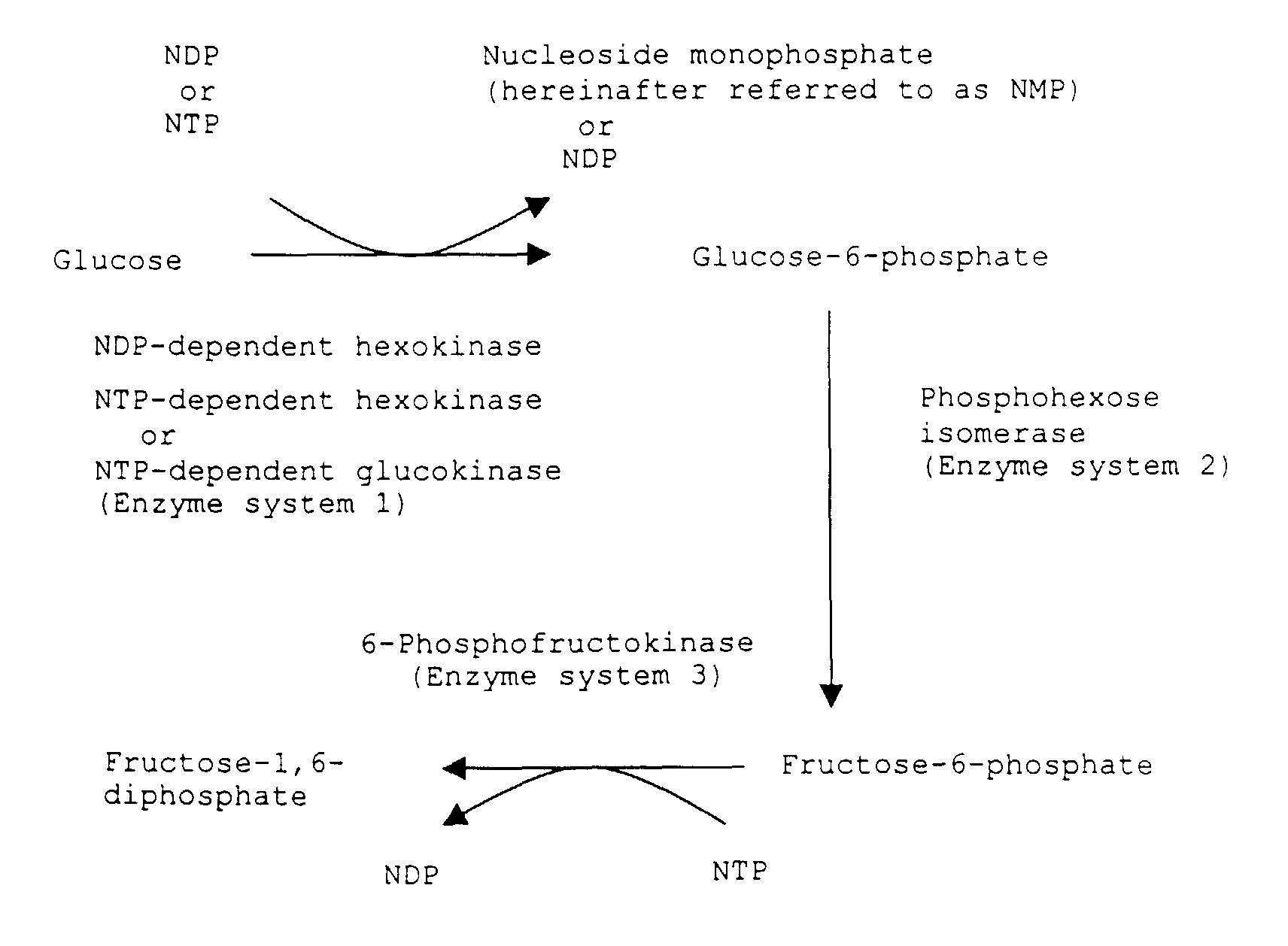
- modifications of the above method (1) using a phosphorylated enzyme include the following: a method in which glucose is converted into fructose-1,6-diphosphate by the action of phosphohexose isomerase and 6-phosphofructokinase in order to prevent the reconversion of glucose-6-phosphate into glucose by equilibrium reaction (Japanese Published Unexamined Patent Application No. 76397/93); methods using glucose-6-phosphate dehydrogenase in the presence of oxidized coenzymes (Japanese Published Unexamined Patent Applications Nos.
- 1,5-AG is present in biological fluids such as cerebrospinal fluid, blood plasma, serum and urine.
- the level of 1,5-AG in blood plasma decreases in patients of certain diseases, especially diabetes, and thus 1,5-AG is useful as a diagnostic marker for diabetes.
- the determination of 1,5-AG is very difficult because of the close similarity in structure between 1,5-AG and glucose and the small quantity of 1,5-AG compared with glucose.
- Some methods comprising the step of elimination of glucose are known for the 1,5-AG determination in which 1,5-AG is oxidized using the catalytic action of pyranose oxidase or sorbose oxidase and the formed hydrogen peroxide is determined.
- Examples of such methods are: (1) methods for 1,5-AG determination which comprise separating glucose in a sample by ion column chromatography, contacting the sample with pyranose oxidase, and determining the formed hydrogen peroxide (Japanese Published Unexamined Patent Applications Nos. 185307/88 and 6756/89); (2) methods for 1,5-AG determination which comprise converting glucose in a sample into a compound which does not react with pyranose oxidase by the action of glucokinase or hexokinase and glucose-6-phosphate dehydrogenase, contacting the sample with pyranose oxidase, and determining the formed hydrogen peroxide (Japanese Published Unexamined Patent Applications Nos.
- 1,5-AG determination in which 1,5-AG is phosphorylated using the catalytic action of hexokinase, glucokinase or ADP-dependent hexokinase and the formed substance is determined.
- Examples of such methods are: (5) a method for 1,5-AG determination which comprises separating glucose in a sample by ion column chromatography, contacting the sample with hexokinase or glucokinase, and determining the formed ADP (Japanese Published Unexamined Patent Application No.
- a method for 1,5-AG determination which comprises converting glucose in a sample into a compound which does not react with ADP-dependent hexokinase by the action of (a) glucose oxidase, or glucose oxidase and catalase, (b) glucose dehydrogenase, or (c) hexokinase or glucokinase, contacting the sample with ADP-dependent hexokinase and 1,5-AG-6-phosphate dehydrogenase, and determining the formed reduced nicotinamide adenine dinucleotide (phosphate) [NAD(P)H] (Japanese Published Unexamined Patent Application No. 191998/98).
- Method (5) requires complicated operations.
- oxygen supply is a rate-limiting step when glucose is present in a sample at a high concentration;
- glucose dehydrogenase a system for eliminating NAD(P)H formed from glucose is required;
- fractional determination can not be carried out because 1,5-AG-6-phosphate dehydrogenase acts on glucose-6-phosphate formed from glucose, and when the method is applied to samples containing a large quantity of glucose such as those from diabetes patients, ADP formed in the reaction system in a large quantity has an unfavorable effect on the accuracy of the assay for 1,5-AG.
- an object of the present invention is to provide a simple method for the determination of a specific component, e.g. 1,5-AG, in a sample containing glucose, a method for substantially completely eliminating glucose in a sample in the determination of a specific component in the sample, and a reagent and a kit useful in the methods.
- a specific component e.g. 1,5-AG
- the present invention relates to a method for determining 1,5-AG in a sample containing glucose, which comprises contacting the sample with an enzyme system which converts glucose into fructose-1,6-diphosphate and converts 1,5-AG into 1,5-AG-6-phosphate to form 1,5-AG-6-phosphate, dehydrogenating 1,5-AG-6-phosphate in the sample by the action of 1,5-AG-6-phosphate dehydrogenase in the presence of an oxidized coenzyme, and measuring the amount of the reduced coenzyme formed by the dehydrogenation reaction.
- the present invention also relates to a reagent for the determination of 1,5-AG, comprising (a) nucleoside diphosphate (hereinafter referred to as NDP), nucleoside triphosphate (hereinafter referred to as NTP), NDP-dependent hexokinase, phosphohexose isomerase, 6-phosphofructokinase, an oxidized coenzyme and 1,5-AG-6-phosphate dehydrogenase, or (b) one member selected from the group consisting of NTP-dependent hexokinase and NTP-dependent glucokinase, NTP, phosphohexose isomerase, 6-phosphofructokinase, an oxidized coenzyme and 1,5-AG-6-phosphate dehydrogenase.
- NDP nucleoside diphosphate
- NTP nucleoside triphosphate
- NTP nucleoside triphosphate
- NTP nucleoside triphosphate
- NTP nucleo
- the present invention further relates to a reagent kit for the determination of 1,5-AG, comprising (a) a reagent comprising NDP, NTP, NDP-dependent hexokinase, phosphohexose isomerase and 6-phosphofructokinase, or (b) a reagent comprising one member selected from the group consisting of NTP-dependent hexokinase and NTP-dependent glucokinase, NTP, phosphohexose isomerase and 6-phosphofructokinase, and a reagent comprising an oxidized coenzyme and 1,5-AG-6-phosphate dehydrogenase.
- a reagent kit for the determination of 1,5-AG comprising (a) a reagent comprising NDP, NTP, NDP-dependent hexokinase, phosphohexose isomerase and 6-phosphofructokinase, or (b) a reagent comprising one member selected
- the present invention further relates to a method for eliminating glucose in a sample, which comprises converting glucose in the sample into fructose-1,6-diphosphate by the action of NDP-dependent hexokinase, phosphohexose isomerase and 6-phosphofructokinase in the presence of NDP and NTP.
- the present invention further relates to a reagent for the elimination of glucose, comprising NDP, NTP, NDP-dependent hexokinase, phosphohexose isomerase and 6-phosphofructokinase.
- the present invention further relates to a method for determining an analyte in a sample containing glucose, which comprises converting glucose in the sample into fructose-1,6-diphosphate by the action of NDP-dependent hexokinase, phosphohexose isomerase and 6-phosphofructokinase in the presence of NDP and NTP, and determining the analyte in the sample by using a chemical or enzymatic reaction.
- the present invention further relates to a reagent for the determination of an analyte, comprising NDP, NTP, NDP-dependent hexokinase, phosphohexose isomerase, 6-phosphofructokinase, and an enzyme acting on the analyte or a substance reacting with the analyte.
- the present invention further relates to a reagent kit for the determination of an analyte, comprising a reagent comprising NDP, NTP, NDP-dependent hexokinase, phosphohexose isomerase and 6-phosphofructokinase, and a reagent comprising an enzyme acting on the analyte or a substance reacting with the analyte.
- a reagent kit for the determination of an analyte comprising a reagent comprising NDP, NTP, NDP-dependent hexokinase, phosphohexose isomerase and 6-phosphofructokinase, and a reagent comprising an enzyme acting on the analyte or a substance reacting with the analyte.
- Fig. 1 shows a calibration curve for 1,5-AG.
- 1,5-AG on the abscissa refers to 1,5-anhydroglucitol and mAbs on the ordinate refers to milli-absorbance.
- Fig. 2 is a graph showing the correlation between the 1,5-AG concentration determined by the method of the invention (a: ordinate) and the 1,5-AG concentration determined by the control method (Lana 1,5-AG Auto) (b: abscissa).
- Fig. 3 shows a calibration curve for 1,5-AG.
- the present invention is applicable to assays of any samples which may contain glucose, for example, biological samples such as blood, plasma, serum and urine.
- the enzyme system which converts glucose into fructose-1,6-diphosphate comprises an enzyme system for forming glucose-6-phosphate from glucose (hereinafter referred to as enzyme system 1), an enzyme system for forming fructose-6-phosphate from glucose-6-phosphate (hereinafter referred to as enzyme system 2) , and an enzyme system for forming fructose-1,6-diphosphate from fructose-6-phosphate (hereinafter referred to as enzyme system 3).
- Enzyme system 1 includes the following two systems: (a) in which the enzyme is NDP-dependent hexokinase and the coenzyme is NDP, which is converted into NMP, and (b) in which the enzyme is NTP-dependent hexokinase or NTP-dependent glucokinase and the coenzyme is NTP, which is converted into NDP.
- the enzyme is phosphohexose isomerase.
- enzyme system 3 the enzyme is 6-phosphofructokinase and the coenzyme is NTP, which is converted into NDP.
- enzyme system 1 is the system in which the enzyme is NDP-dependent hexokinase and the coenzyme is NDP which is converted into NMP, NDP is consumed according to the glucose concentration, but an equal amount of NDP to that consumed is formed from NTP by the action of 6-phosphofructokinase, whereby the NDP concentration can be kept constant.
- the NDP concentration in the reaction system is not subject to variation due to the change in glucose concentration in a sample.
- elimination of glucose is carried out by adding to a sample containing glucose (a) NDP, NTP, NDP-dependent hexokinase, phosphohexose isomerase and 6-phosphofructokinase, or (b) one member selected from the group consisting of NTP-dependent hexokinase and NTP-dependent glucokinase, NTP, phosphohexose isomerase and 6-phosphofructokinase, and subjecting the mixture to reaction at 10-50°C for 1-30 minutes, preferably 2-10 minutes, if necessary in the presence of an aqueous medium, an enzyme activity moderator, an activator, a preservative, a stabilizer, a surfactant, a chromogen, an electron acceptor, a tetrazolium salt, an additional enzyme, a substrate for said enzyme, a coenzyme, etc.
- the concentration of NDP-dependent hexokinase, NTP-dependent hexokinase and NTP-dependent glucokinase is preferably 0.1-100 U/ml, more preferably 0.5-50 U/ml, and most preferably 1-50 U/ml.
- the concentration of phosphohexose isomerase is preferably 0.1-100 U/ml, more preferably 0.5-50 U/ml, and most preferably 5-50 U/ml.
- the concentration of 6-phosphofructokinase is preferably 0.1-100 U/ml, more preferably 0.5-50 U/ml, and most preferably 5-50 U/ml.
- NDP-dependent hexokinase enzymes derived from Thermococcus litoralis and Pyrococcus furiosus are easily acquirable from Asahi Chemical Industry Co., Ltd.
- NTP-dependent hexokinase enzymes derived from microorganisms of the genera Saccharomyces, Kluyveromyces, Bacillus, etc. are easily acquirable from Oriental Yeast Co., Ltd., Toyobo Co., Ltd., Boehringer Mannheim GmbH, Asahi Chemical Industry Co., Ltd., etc.
- NTP-dependent glucokinase enzymes derived from microorganisms of the genera Zymomonas, Bacillus, etc. are easily acquirable from Unitika Ltd., etc.
- Phosphohexose isomerase derived from Bacillus stearothermophilus is available from Unitika Ltd.
- 6-phosphofructokinase derived from Bacillus stearothermophilus is also available from Unitika Ltd.
- the concentration of NDP and NTP is preferably 0.01-100 mM, more preferably 0.1-50 mM, and most preferably 1-10 mM.
- the activators include inorganic salts such as magnesium sulfate and magnesium chloride.
- the concentration of the inorganic salt is preferably 0.001-10 mg/ml, more preferably 0.01-5 mg/ml, and most preferably 0.1-2 mg/ml.
- a reaction is carried out in the presence of a reagent necessary for the determination of an analyte in the sample and the amount of a substance formed or consumed by the reaction is measured, whereby the analyte can be determined.
- a reagent necessary for the determination but it is appropriate to use a reagent containing an enzyme acting on the analyte or a substance reacting with the analyte, preferably, a reagent containing an enzyme acting on the analyte.
- enzymes include nucleotidase, 6-phosphogluconate dehydrogenase, NDP pyrophosphatase, NDP glucose pyrophosphorylase, NDP-dependent hexokinase and 1,5-AG-6-phosphate dehydrogenase.
- the enzyme system When the above enzyme system for glucose elimination is applied to the determination of 1,5-AG, the enzyme system simultaneously catalyzes the conversion of 1,5-AG into 1,5-AG-6-phosphate, and 1,5-AG in a sample can be detemined by measuring the amount of 1,5-AG-6-phosphate formed.
- 1,5-AG-6-phosphate dehydrogenase is added to the sample in the presence of an oxidized coenzyme and a reaction is carried out at 10-50°C for 1-30 minutes, preferably 2-10 minutes, if necessary in the presence of an aqueous medium, an enzyme activity moderator, an activator, a preservative, a stabilizer, a surfactant, a chromogen, an electron acceptor, a tetrazolium salt, an additional enzyme, a substrate for said enzyme, a coenzyme, etc.
- the concentration of 1,5-AG can be determined by directly determining the amount of the reduced coenzyme formed by the reaction, for example, by measuring the absorbance at 340 nm, or by converting the reduced coenzyme into another substance and then determining the amount of the substance.
- Either the oxidized coenzyme or 1,5-AG-6-phosphate dehydrogenase used in the determination of 1, 5-AG may be present in the step of glucose elimination, so far as it does not affect the reaction for eliminating glucose.
- any enzyme can be used which catalyzes the reaction for forming glucose-6-phosphate and NMP using glucose as the substrate and consuming NDP and also catalyzes the reaction for forming 1,5-AG-6-phosphate and NMP using 1,5-AG as the substrate and consuming NDP.
- suitable enzymes are the enzyme derived from a hyperthermophile, Pyrococcus furiosus DSM3638 (Japanese Published Unexamined Patent Application No. 234098/97) and the enzyme derived from Thermococcus litoralis (TLHK), which are acquirable from Asahi Chemical Industry Co., Ltd.
- any enzyme can be used which catalyzes the reaction for forming glucose-6-phosphate and NDP using glucose as the substrate and consuming NTP and also catalyzes the reaction for forming 1,5-AG-6-phosphate and NDP using 1,5-AG as the substrate and consuming NTP.
- suitable enzymes are the enzymes described above.
- 1,5-AG-6-phosphate dehydrogenase any enzyme can be used which catalyzes the reaction for forming a compound represented by C 6 H 11 O 8 P 1 and a reduced coenzyme from 1,5-AG-6-phosphate and an oxidized coenzyme.
- 1,5-AG-6-phosphate dehydrogenase which is the enzyme catalyzing the above reaction is the enzyme derived from Escherichia coli DH1 (ATCC 33849). This enzyme can be prepared, for example, according to the method described in Japanese Published Unexamined Patent Application No. 84953/98.
- the concentration of 1,5-AG-6-phosphate dehydrogenase in the reaction mixture is preferably 0.5-100 U/ml, more preferably 1-50 U/ml, and most preferably 2-40 U/ml.
- the concentration of the oxidized coenzyme in the reaction mixture is preferably 0.1-100 mM, more preferably 1-50 mM, and most preferably 2-20 mM.
- the concentrations of NDP-dependent hexokinase, NTP-dependent hexokinase, NTP-dependent glucokinase, phosphohexose isomerase, 6-phosphofructokinase, NDP and NTP in the reaction mixture are the same as those described above for the reaction for glucose elimination.
- oxidized coenzyme examples include oxidized nicotinamide adenine dinucleotide (NAD), oxidized nicotinamide adenine dinucleotide phosphate (NADP), thio NAD and thio NADP.
- NAD oxidized nicotinamide adenine dinucleotide
- NADP oxidized nicotinamide adenine dinucleotide phosphate
- thio NAD thio NADP
- NTP examples include adenosine triphosphate, guanosine triphosphate, cytidine triphosphate, thiamine triphosphate, uridine triphosphate and inosine triphosphate.
- NDP examples include adenosine diphosphate, guanosine diphosphate, cytidine diphosphate, thiamine diphosphate, uridine diphosphate and inosine diphosphate. Preferred is adenosine diphosphate.
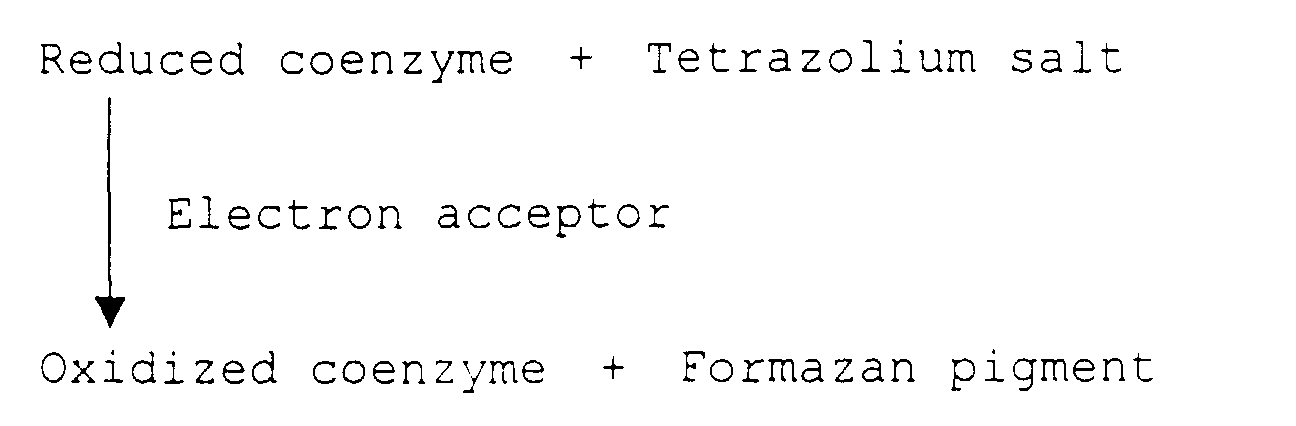
- the formed reduced coenzyme can be converted into another substance and determined with a high sensitivity. For example, as shown by the following equation, the reduced coenzyme is acted on by an electron acceptor in the presence of a tetrazolium salt and the formed formazan pigment is colorimetrically determined.
- Tetrazolium salts useful in this method include indonitro tetrazolium (INT), nitro blue tetrazolium (NBT), 2-(4-iodophenyl)-3-(4-nitrophenyl)-5-(2,4-disulfonyl)-2H-tetrazolium monosodium salt (hereinafter referred to as WST-1), 2-(4-iodophenyl)-3-(2,4-dinitrophenyl)-5-(2,4-disulfenyl)-2H-tetrazolium monosodium salt (hereinafter referred to as WST-3), 3,3'-[3,3'-dimethoxy-(1,1'-biphenyl)-4,4'-diyl]-bis[2-(4-nitrophenyl)-5-phenyl-2H tetrazolium chloride] (NTB) and 3-(4,5-dimethylthiazole-2-phenyl)-5-(3-carboxy
- Tetrazolium salts which are used as chromogens can also be used.
- the tetrazolium salt is used for the enhancement of sensitivity, those having high molecular extinction coefficient are preferred. Further, considering that the method will be applied usually to clinical assays, those which are converted into water-soluble formazan pigments after reduction are preferred.
- WST-1 and WST-3 are preferably used.
- the amount of the tetrazolium salt for clinical use is preferably 0.01-50 mM.
- the initial concentration of the tetrazolium salt in the reaction mixture is 0.01-50 mM, preferably 0.05-10 mM.
- phenazine methosulfate 1-methoxy-5-methylphenazine methosulfate, Meldola's Blue, diaphorase, etc.
- diaphorase is the enzyme derived from Bacillus megaterium, which is acquirable from Asahi Chemical Industry Co., Ltd. and Toyobo Co., Ltd.
- the initial concentration of the electron acceptor in the reaction mixture is 0.01-50 mM, preferably 0.05-10 mM.
- the reaction is carried out at 10-50°C for 1-30 minutes, preferably 2-10 minutes. This reaction may be carried out after the completion of the above reaction for forming the reduced coenzyme, but is preferably carried out simultaneously with the above reaction.
- the reduced coenzyme is acted on by reduced coenzyme oxidase and peroxidase in the presence of a chromogen and the formed pigment is colorimetrically determined.
- a chromogen chromogens used in combination with 4-aminoantipyrine or the like may be used, but those which can be used alone to produce pigments are preferred.
- chromogens which can be used alone are bis[3-bis(4-chlorophenyl)-methyl-4-dimethylaminophenyl]amine (BCMA), bis[3-bis(4-chlorophenyl)-methyl-4-carboxyethylaminophenyl]amine, 10-N-methylcarbamoyl-3,7-dimethylamino-10H-phenothiazine (MCDP) and 10-N-carboxymethylcarbamoyl-3,7-dimethylamino-10H-phenothiazine (CCAP).
- BCMA bis[3-bis(4-chlorophenyl)-methyl-4-dimethylaminophenyl]amine
- MCDP 10-N-methylcarbamoyl-3,7-dimethylamino-10H-phenothiazine
- CCAP 10-N-carboxymethylcarbamoyl-3,7-dimethylamino-10H-phenothiazine
- Examples of the chromogens to be used in combination with 4-aminoantipyrine are N-ethyl-N-(3-methylphenyl)-N'-succinylethylenediamine (EMSE), N-ethyl-N-(2-hydroxy-3-sulfopropyl)-m-toluidine (TOOS) and N,N-bis(4-sulfobutyl)-m-toluidine disodium salt.
- the reaction is carried out at 10-50°C for 1-30 minutes, preferably 2-10 minutes. This reaction may be carried out after the completion of the above reaction for forming the reduced coenzyme, but is preferably carried out simultaneously with the above reaction.
- aqueous medium water-containing liquids such as buffers and physiological saline can be used. Buffers are preferably used.
- buffers examples include lactate buffer, citrate buffer, acetate buffer, succinate buffer, phthalate buffer, phosphate buffer, triethanolamine buffer, diethanolamine buffer, lysine buffer, barbital buffer, tris(hydroxymethyl)aminomethane buffer, imidazole buffer, malate buffer, oxalate buffer, glycine buffer, borate buffer, carbonate buffer and Good's buffer.
- enzyme activity moderators examples include metal chelating agents such as 1,10-phenanthroline, sugar alcohols such as mannitol and glycerol, metal ions such as magnesium, manganese, zinc and copper, and SH-blocking agents such as iodoacetic acid and iodoacetamide.
- enzyme stabilizers examples include metal chelating agents such as ethylenediaminetetraacetic acid, polysaccharides such as soluble starch and derivatives thereof, proteins such as albumin and globulin, water-soluble high-molecular weight compounds such as polyethylene glycol, and SH group-containing compounds such as phosphine and cysteine.
- metal chelating agents such as ethylenediaminetetraacetic acid, polysaccharides such as soluble starch and derivatives thereof, proteins such as albumin and globulin, water-soluble high-molecular weight compounds such as polyethylene glycol, and SH group-containing compounds such as phosphine and cysteine.
- surfactants are polyoxyethylene octylphenyl ether (Nonion HS-210, Kao Corporation), 3-[(3-chloramidepropyl)dimethylamino]propanesulfonic acid, Triton X-100 and sodium dodecyl sulfate.
- An example of the preservatives is sodium azide.
- oxidized coenzyme oxidase As the additional enzyme, oxidized coenzyme oxidase, peroxidase, etc. can be used.
- the reagent for the determination of 1,5-AG comprises (a) NDP, NTP, NDP-dependent hexokinase, phosphohexose isomerase, 6-phosphofructokinase, an oxidized coenzyme and 1,5-AG-6-phosphate dehydrogenase, or (b) one member selected from the group consisting of NTP-dependent hexokinase and NTP-dependent glucokinase, NTP, phosphohexose isomerase, 6-phosphofructokinase, an oxidized coenzyme and 1,5-AG-6-phosphate dehydrogenase, and may additionally contain, if necessary, the above-mentioned buffer agent, enzyme activity moderator, activator, preservative, stabilizer, surfactant, chromogen, electron acceptor, tetrazolium salt, additional enzyme, substrate for said enzyme, coenzyme, etc.
- Said reagent can be a kit for the determination of 1,5-AG which comprises 1) the first reagent comprising (a) NDP, NTP, NDP-dependent hexokinase, phosphohexose isomerase and 6-phosphofructokinase, or (b) one member selected from the group consisting of NTP-dependent hexokinase and NTP-dependent glucokinase, NTP, phosphohexose isomerase and 6-phosphofructokinase, and if necessary, the above-mentioned buffer agent, enzyme activity moderator, activator, preservative, stabilizer, surfactant, chromogen, electron acceptor, tetrazolium salt, additional enzyme, substrate for said enzyme, coenzyme, etc., and 2) the second reagent comprising 1,5-AG-6-phosphate dehydrogenase and an oxidized coenzyme, and if necessary, the above-mentioned buffer agent, enzyme activity moderator, activ
- the reagent for the elimination of glucose comprises NDP, NTP, NDP-dependent hexokinase, phosphohexose isomerase and 6-phosphofructokinase, and if necessary, the above-mentioned buffer agent, enzyme activity moderator, activator, preservative, stabilizer, surfactant, chromogen, electron acceptor, tetrazolium salt, additional enzyme, substrate for said enzyme, coenzyme, etc.
- the reagent for the determination of an analyte comprises NDP, NTP, NDP-dependent hexokinase, phosphohexose isomerase, 6-phosphofructokinase, and an enzyme acting on the analyte or a substance reacting with the analyte, and if necessary, the above-mentioned buffer agent, enzyme activity moderator, activator, preservative, stabilizer, surfactant, chromogen, electron acceptor, tetrazolium salt, additional enzyme, substrate for said enzyme, coenzyme, etc.
- Said reagent can be a kit which comprises 1) the first reagent comprising NDP, NTP, NDP-dependent hexokinase, phosphohexose isomerase and 6-phosphofructokinase, and if necessary, the above-mentioned buffer agent, enzyme activity moderator, activator, preservative, stabilizer, surfactant, chromogen, electron acceptor, tetrazolium salt, additional enzyme, substrate for said enzyme, coenzyme, etc., and 2) the second reagent comprising an enzyme acting on the analyte or a substance reacting with the analyte, and if necessary, the above-mentioned buffer agent, enzyme activity moderator, activator, preservative, stabilizer, surfactant, chromogen, electron acceptor, tetrazolium salt, additional enzyme, substrate for said enzyme, coenzyme, etc.
- Each of the reagents according to the present invention may be provided in the form of a freeze-dried preparation or in the form of a solution in an aqueous medium such as water.
- a reagent for the elimination of glucose having the following composition was prepared.
- Tris-HCl buffer (pH 8.0) 50 mM
- Magnesium chloride 1 mg/ml ADP-dependent hexokinase (derived from Thermococcus litoralis, Asahi Chemical Industry Co., Ltd.) 10 U/ml Phosphohexose isomerase (derived from Bacillus stearothermophilus , Unitika Ltd.) 40 U/ml 6-Phosphofructokinase (derived from Bacillus stearothermophilus , Unitika Ltd.) 30 U/ml ADP (Oriental Yeast Co., Ltd.) 3 mM ATP (Sigma Chemical Co.) 10 mM
- Reagents for the determination of 1,5-AG having the following composition were prepared.
- Reagent 1 Tris-HCl buffer (pH 8.5) 50 mM Magnesium chloride 1 mg/ml NADP (Sigma Chemical Co.) 4 mM ADP (Oriental Yeast Co., Ltd.) 3 mM ATP (Sigma Chemical Co.) 10 mM Phosphohexose isomerase (derived from Bacillus stearothermophilus, Unitika Ltd.) 40 U/ml 6-Phosphofructokinase (derived from Bacillus stearothermophilus, Unitika Ltd.) 30 U/ml Diaphorase (derived from Bacillus megaterium, Asahi Chemical Industry Co., Ltd.) 10 U/ml ADP-dependent hexokinase (derived from Thermococcus litoralis, Asahi Chemical Industry Co., Ltd.) 10 U/ml Reagent 2 Glycine-NaOH buffer (pH 1
- a standard solution of 1,5-AG (25 ⁇ g/ml) was diluted to prepare five solutions having different concentrations.
- To 0.075 ml of each of the solutions and purified water was added 2.25 ml of reagent 1 prepared in Example 2, followed by incubation at 37°C for 5 minutes. After 0.75 ml of reagent 2 prepared in Example 2 was added to each mixture, the reaction was carried out for 5 minutes and the absorbance was measured at 438 nm. The obtained calibration curve is shown in Fig. 1.
- Reagent 1 prepared in Example 2 was poured into test tubes in 2.25 ml portions. To the test tubes were respectively added 0.075 ml each of (a) purified water, (b) a test solution containing 25 ⁇ g/ml 1,5-AG, (c) a test solution containing 2000 mg/dl glucose, and (d) a test solution containing 25 ⁇ g/ml 1,5-AG and 2000 mg/dl glucose, followed by incubation at 37°C for 5 minutes. After 0.75 ml of reagent 2 prepared in Example 2 was added to each mixture, the reaction was carried out for 5 minutes and the absorbance was measured at 438 nm. The results are shown in Table 1.
- Test solution Measurement result (a) Purified water (blank) 0.096 Abs (b) 1,5-AG 25 ⁇ g/ml 0.230 Abs (c) Glucose 2000 mg/dl 0.096 Abs (d) 1,5-AG + glucose 0.226 Abs
- Reagents were prepared in the same manner as in Example 2, except that the ADP concentration in the first reagent was varied as indicated in Table 2 and Triton X-100 was added to the composition of reagent 2 at a concentration of 0.4%.
- Test solutions containing 25 ⁇ g/ml 1,5-AG and glucose at the concentrations indicated in Table 2 were prepared.
- Glucose concentration (mg/dl) ADP concentration (mM) 0.5 1 2 3 4 5 6 10 0 25.2 25.1 25.0 25.0 25.2 25.1 25.1 25.0 400 25.0 25.1 25.1 25.0 25.1 25.1 25.1 25.0 800 24.9 25.2 25.0 25.0 25.2 25.0 25.1 25.1 1200 24.8 25.0 24.9 25.1 25.1 25.3 25.2 1600 24.8 25.0 24.8 25.0 25.1 25.2 25.2 25.3 2000 24.8 25.1 25.0 25.1 25.2 25.3 25.3 25.6
- 1,5-AG in samples can be accurately determined by employing the above method for glucose elimination using ADP-dependent hexokinase, regardless of ADP concentration in the reagents and glucose concentration in the samples.
- Reagents for the determination of 1,5-AG having the following composition were prepared.
- Reagent 1 Tris-HCl buffer (pH 8.0) 50 mM Magnesium chloride 1 mg/ml NADP (Sigma Chemical Co.) 4 mM ATP (Sigma Chemical Co.) 10 mM Phosphohexose isomerase (derived from Bacillus stearothermophilus , Unitika Ltd.) 40 U/ml 6-Phosphofructokinase (derived from Bacillus stearothermophilus , Unitika Ltd.) 30 U/ml Diaphorase (derived from Bacillus megaterium, Asahi Chemical Industry Co., Ltd.) 10 U/ml ATP-dependent hexokinase (derived from yeast, Oriental Yeast Co., Ltd.) 100 U/ml Reagent 2 Glycine-NaOH buffer (pH 10.0) 200 mM WST-1 (Dojindo Laboratories) 0.5 mM 1,5-AG-6
- Standard solutions respectively containing 50, 100, 150, 200 and 250 ⁇ g/ml 1,5-AG were prepared.
- To 0.075 ml of each of the standard solutions and purified water was added 2.25 ml of reagent 1 prepared in Example 7, followed by incubation at 37°C for 5 minutes. After 0.75 ml of reagent 2 prepared in Example 7 was added to each mixture, the reaction was carried out for 5 minutes and the absorbance was measured at 438 nm. The obtained calibration curve is shown in Fig. 3.
- Reagent 1 prepared in Example 7 was poured into test tubes in 2.25 ml portions. To the test tubes were respectively added 0.075 ml each of (a) purified water, (b) a test solution containing 250 ⁇ g/ml 1,5-AG, (c) a test solution containing 100 mg/dl glucose, and (d) a test solution containing 250 ⁇ g/ml 1,5-AG and 100 mg/dl glucose, followed by incubation at 37°C for 5 minutes. After 0.75 ml of reagent 2 prepared in Example 7 was added to each mixture, the reaction was carried out for 5 minutes and the absorbance was measured at 438 nm. The results are shown in Table 3.
- Test solution Measurement result (a) Purified water (blank) 0.280 Abs (b) 1,5-AG 250 ⁇ g/ml 0.440 Abs (c) Glucose 100 mg/dl 0.279 Abs (d) 1,5-AG + glucose 0.441 Abs
Landscapes
- Chemical & Material Sciences (AREA)
- Organic Chemistry (AREA)
- Life Sciences & Earth Sciences (AREA)
- Health & Medical Sciences (AREA)
- Zoology (AREA)
- Wood Science & Technology (AREA)
- Proteomics, Peptides & Aminoacids (AREA)
- Engineering & Computer Science (AREA)
- Microbiology (AREA)
- Biochemistry (AREA)
- Physics & Mathematics (AREA)
- Molecular Biology (AREA)
- Biotechnology (AREA)
- Biophysics (AREA)
- Analytical Chemistry (AREA)
- Immunology (AREA)
- Bioinformatics & Cheminformatics (AREA)
- General Engineering & Computer Science (AREA)
- General Health & Medical Sciences (AREA)
- Genetics & Genomics (AREA)
- Emergency Medicine (AREA)
- Measuring Or Testing Involving Enzymes Or Micro-Organisms (AREA)
Abstract
Description


| Tris-HCl buffer (pH 8.0) | 50 mM |
| Magnesium chloride | 1 mg/ml |
| ADP-dependent hexokinase (derived from Thermococcus litoralis, Asahi Chemical Industry Co., Ltd.) | 10 U/ml |
| Phosphohexose isomerase (derived from Bacillus stearothermophilus, Unitika Ltd.) | 40 U/ml |
| 6-Phosphofructokinase (derived from Bacillus stearothermophilus , Unitika Ltd.) | 30 U/ml |
| ADP (Oriental Yeast Co., Ltd.) | 3 mM |
| ATP (Sigma Chemical Co.) | 10 mM |
| Reagent 1 | |
| Tris-HCl buffer (pH 8.5) | 50 mM |
| Magnesium chloride | 1 mg/ml |
| NADP (Sigma Chemical Co.) | 4 mM |
| ADP (Oriental Yeast Co., Ltd.) | 3 mM |
| ATP (Sigma Chemical Co.) | 10 mM |
| Phosphohexose isomerase (derived from Bacillus stearothermophilus, Unitika Ltd.) | 40 U/ml |
| 6-Phosphofructokinase (derived from Bacillus stearothermophilus, Unitika Ltd.) | 30 U/ml |
| Diaphorase (derived from Bacillus megaterium, Asahi Chemical Industry Co., Ltd.) | 10 U/ml |
| ADP-dependent hexokinase (derived from Thermococcus litoralis, Asahi Chemical Industry Co., Ltd.) | 10 U/ml |
| Reagent 2 | |
| Glycine-NaOH buffer (pH 10.0) | 200 mM |
| WST-1 (Dojindo Laboratories) | 0.5 mM |
| 1,5-AG-6-phosphate dehydrogenase (derived from E. coli DH1 (ATCC 33849), Asahi Chemical Industry Co., Ltd.) | 20 U/ml |
| Test solution | Measurement result | |
| (a) | Purified water (blank) | 0.096 Abs |
| (b) | 1,5- | 0.230 Abs |
| (c) | Glucose 2000 mg/dl | 0.096 Abs |
| (d) | 1,5-AG + glucose | 0.226 Abs |
| Glucose concentration (mg/dl) | ADP concentration (mM) | |||||||
| 0.5 | 1 | 2 | 3 | 4 | 5 | 6 | 10 | |
| 0 | 25.2 | 25.1 | 25.0 | 25.0 | 25.2 | 25.1 | 25.1 | 25.0 |
| 400 | 25.0 | 25.1 | 25.1 | 25.0 | 25.1 | 25.1 | 25.1 | 25.0 |
| 800 | 24.9 | 25.2 | 25.0 | 25.0 | 25.2 | 25.0 | 25.1 | 25.1 |
| 1200 | 24.8 | 25.0 | 24.9 | 25.1 | 25.1 | 25.1 | 25.3 | 25.2 |
| 1600 | 24.8 | 25.0 | 24.8 | 25.0 | 25.1 | 25.2 | 25.2 | 25.3 |
| 2000 | 24.8 | 25.1 | 25.0 | 25.1 | 25.2 | 25.3 | 25.3 | 25.6 |
| Reagent 1 | |
| Tris-HCl buffer (pH 8.0) | 50 mM |
| Magnesium chloride | 1 mg/ml |
| NADP (Sigma Chemical Co.) | 4 mM |
| ATP (Sigma Chemical Co.) | 10 mM |
| Phosphohexose isomerase (derived from Bacillus stearothermophilus, Unitika Ltd.) | 40 U/ml |
| 6-Phosphofructokinase (derived from Bacillus stearothermophilus, Unitika Ltd.) | 30 U/ml |
| Diaphorase (derived from Bacillus megaterium, Asahi Chemical Industry Co., Ltd.) | 10 U/ml |
| ATP-dependent hexokinase (derived from yeast, Oriental Yeast Co., Ltd.) | 100 U/ml |
| Reagent 2 | |
| Glycine-NaOH buffer (pH 10.0) | 200 mM |
| WST-1 (Dojindo Laboratories) | 0.5 mM |
| 1,5-AG-6-phosphate dehydrogenase (derived from E. coli DH1 (ATCC 33849), Asahi Chemical Industry Co., Ltd.) | 20 U/ml |
| Test solution | Measurement result | |
| (a) | Purified water (blank) | 0.280 Abs |
| (b) | 1,5- | 0.440 Abs |
| (c) | | 0.279 Abs |
| (d) | 1,5-AG + glucose | 0.441 Abs |
Claims (11)
- A method for determining 1,5-anhydroglucitol (1,5-AG) in a sample containing glucose, which comprises contacting the sample with an enzyme system which converts glucose into fructose-1,6-diphosphate and converts 1,5-AG into 1,5-AG-6-phosphate to form 1,5-AG-6-phosphate, dehydrogenating 1,5-AG-6-phosphate in the sample by the action of 1,5-AG-6-phosphate dehydrogenase in the presence of an oxidized coenzyme, and measuring the amount of the reduced coenzyme formed by the dehydrogenation reaction.
- The method according to claim 1, wherein said enzyme system comprises (a) nucleoside diphosphate (NDP), nucleoside triphosphate (NTP), NDP-dependent hexokinase, phosphohexose isomerase and 6-phosphofructokinase, or (b) onemember selected from the group consisting of NTP-dependent hexokinase and NTP-dependent glucokinase, NTP, phosphohexose isomerase and 6-phosphofructokinase.
- The method according to claim 1, wherein said measurement of the amount of the reduced coenzyme is carried out by colorimetry of a pigment formed from a tetrazolium salt.
- A reagent for the determination of 1, 5-AG, comprising (a) NDP, NTP, NDP-dependent hexokinase, phosphohexose isomerase, 6-phosphofructokinase, an oxidized coenzyme and 1,5-AG-6-phosphate dehydrogenase, or (b) one member selected from the group consisting of NTP-dependent hexokinase and NTP-dependent glucokinase, NTP, phosphohexose isomerase, 6-phosphofructokinase, an oxidized coenzyme and 1,5-AG-6-phosphate dehydrogenase.
- The reagent according to claim 4, further comprising a tetrazolium salt and an electron acceptor.
- A reagent kit for the determination of 1,5-AG, comprising (a) a reagent comprising NDP, NTP, NDP-dependent hexokinase, phosphohexose isomerase and 6-phosphofructokinase, or (b) a reagent comprising one member selected from the group consisting of NTP-dependent hexokinase and NTP-dependent glucokinase, NTP, phosphohexose isomerase and 6-phosphofructokinase, and a reagent comprising an oxidized coenzyme and 1,5-AG-6-phosphate dehydrogenase.
- A method for eliminating glucose in a sample, which comprises converting glucose in the sample into fructose-1,6-diphosphate by the action of NDP-dependent hexokinase, phosphohexose isomerase and 6-phosphofructokinase in the presence of NDP and NTP.
- A reagent for the elimination of glucose, comprising NDP, NTP, NDP-dependent hexokinase, phosphohexose isomerase and 6-phosphofructokinase.
- A method for determining an analyte in a sample containing glucose, which comprises converting glucose in the sample into fructose-1,6-diphosphate by the action of NDP-dependent hexokinase, phosphohexose isomerase and 6-phosphofructokinase in the presence of NDP and NTP, and determining the analyte in the sample by using a chemical or enzymatic reaction.
- A reagent for the determination of an analyte, comprising NDP, NTP, NDP-dependent hexokinase, phosphohexose isomerase, 6-phosphofructokinase, and an enzyme acting on the analyte or a substance reacting with the analyte.
- A reagent kit for the determination of an analyte, comprising a reagent comprising NDP, NTP, NDP-dependent hexokinase, phosphohexose isomerase and 6-phosphofructokinase, and a reagent comprising an enzyme acting on the analyte or a substance reacting with the analyte.
Applications Claiming Priority (4)
| Application Number | Priority Date | Filing Date | Title |
|---|---|---|---|
| JP35358698 | 1998-12-11 | ||
| JP35358698 | 1998-12-11 | ||
| JP3943399 | 1999-02-18 | ||
| JP3943399 | 1999-02-18 |
Publications (2)
| Publication Number | Publication Date |
|---|---|
| EP1008657A2 true EP1008657A2 (en) | 2000-06-14 |
| EP1008657A3 EP1008657A3 (en) | 2002-01-09 |
Family
ID=26378822
Family Applications (1)
| Application Number | Title | Priority Date | Filing Date |
|---|---|---|---|
| EP99309932A Withdrawn EP1008657A3 (en) | 1998-12-11 | 1999-12-10 | Method and reagent for quantitative determination of 1,5-anhydroglucitol |
Country Status (4)
| Country | Link |
|---|---|
| US (2) | US6309852B1 (en) |
| EP (1) | EP1008657A3 (en) |
| CN (1) | CN1179051C (en) |
| CA (1) | CA2291912A1 (en) |
Cited By (2)
| Publication number | Priority date | Publication date | Assignee | Title |
|---|---|---|---|---|
| EP1491636A4 (en) * | 2002-03-29 | 2006-07-26 | Asahi Kasei Pharma Corp | Method of detecting mild impaired glucose tolerance or insulin hyposecretion |
| EP2405275B1 (en) * | 2009-03-05 | 2018-10-10 | BML, Inc. | Method for measuring glycated albumin contained in serum or plasma using mannitol as stabiliser for a control serum or plasma. |
Families Citing this family (13)
| Publication number | Priority date | Publication date | Assignee | Title |
|---|---|---|---|---|
| CA2291912A1 (en) * | 1998-12-11 | 2000-06-11 | Kyowa Medex Co., Ltd. | Method and reagent for quantitative determination of 1,5-anhydroglucitol |
| CA2614299C (en) | 2005-06-13 | 2014-06-03 | Nippon Kayaku Kabushiki Kaisha | Method of assaying blood component by using whole blood and measurement kit |
| WO2007110357A2 (en) * | 2006-03-24 | 2007-10-04 | Metanomics Gmbh | Means and method for diagnosing diabetes |
| KR20090023489A (en) * | 2006-06-22 | 2009-03-04 | 이케다 쇼쿠겐 가부시키가이샤 | Method for measuring 1,5-anhydroglucitol and reagent composition for measuring 1,5-anhydroglucitol |
| JP5166284B2 (en) * | 2006-12-14 | 2013-03-21 | 日本化薬株式会社 | Method for measuring 1,5-anhydroglucitol in whole blood, sensor chip and measurement kit used therefor |
| JP5646323B2 (en) * | 2008-07-23 | 2014-12-24 | 日本化薬株式会社 | Method for measuring components in blood using hemolyzed whole blood and kit thereof |
| CN101851665B (en) * | 2009-04-03 | 2012-07-11 | 哈尔滨医科大学 | Enzymatic Determination of 1,5-Sorbitol Kit |
| US20120077278A1 (en) * | 2009-06-08 | 2012-03-29 | Protea Biopharma N.V. | Methods and kits for detecting, diagnosing and monitoring diseases |
| CN102154442B (en) * | 2010-12-30 | 2017-02-08 | 北京九强生物技术股份有限公司 | Method for detecting 1,5-anhydro sorbitol and related diagnostic kit |
| CN108034694B (en) * | 2017-12-18 | 2019-01-04 | 广州市进德生物科技有限公司 | A kind of detection kit and its detection method of 1,5- anhydro sorbitol |
| CN108359710B (en) * | 2018-02-11 | 2019-04-30 | 山东大学齐鲁医院 | Enzyme chromogenic quantitative assay kit and assay method for glucose phosphate isomerase |
| CN113203805B (en) * | 2021-04-21 | 2022-08-30 | 深圳市第二人民医院(深圳市转化医学研究院) | Liquid chromatography tandem mass spectrometry method for simultaneously measuring glucose, fructose and 1, 5-deoxyglucitol in blood |
| WO2023097510A1 (en) * | 2021-11-30 | 2023-06-08 | 江苏品生医疗科技集团有限公司 | Marker for predicting subject's likelihood of suffering from diabetes, and use thereof |
Family Cites Families (20)
| Publication number | Priority date | Publication date | Assignee | Title |
|---|---|---|---|---|
| DE3784610T2 (en) | 1986-09-22 | 1993-09-23 | Nippon Kayaku Kk | METHOD FOR DETERMINING 1,5-ANHYDROGLUCITOL AND EQUIPMENT THEREFOR. |
| JP2812676B2 (en) * | 1986-09-22 | 1998-10-22 | 日本化薬株式会社 | Kit for determination of 1,5-anhydroglucitol |
| JPS646756A (en) | 1987-06-29 | 1989-01-11 | Nippon Kayaku Kk | Quantification of 1,5-anhydroglucitol |
| JP2665673B2 (en) | 1988-06-24 | 1997-10-22 | 日本化薬株式会社 | Method for measuring 1,5-anhydroglucitol in a sample containing glucose |
| JPH0771514B2 (en) | 1988-10-12 | 1995-08-02 | 天野製薬株式会社 | Method for quantifying 1,5-anhydroglucitol |
| JP2711721B2 (en) | 1989-06-22 | 1998-02-10 | 日本化薬株式会社 | Determination of 1,5-anhydroglucitol in samples containing glucose |
| JP3170320B2 (en) | 1991-09-19 | 2001-05-28 | 協和メデックス株式会社 | Substance measurement method |
| JPH07102154B2 (en) * | 1992-03-02 | 1995-11-08 | 日東紡績株式会社 | Method for quantifying 1,5-anhydroglucitol |
| DE4321807C2 (en) * | 1992-06-30 | 1996-08-14 | Nitto Boseki Co Ltd | Method for quantitative determination of 1,5-anhydroglucitol and test pack |
| JPH06237794A (en) | 1993-02-16 | 1994-08-30 | Nippon Kayaku Co Ltd | Determination of 1,5-anhydroglucitol |
| JPH06237795A (en) * | 1993-02-16 | 1994-08-30 | Nippon Kayaku Co Ltd | Determination of 1,5-anhydroglucitol |
| JP3644050B2 (en) | 1994-06-27 | 2005-04-27 | 栗田工業株式会社 | Method for treating water containing ammoniacal nitrogen and metal salts |
| JP2877703B2 (en) | 1994-10-13 | 1999-03-31 | 協和メデックス株式会社 | Method for quantifying 1,5-anhydroglucitol |
| JP3885977B2 (en) | 1995-12-27 | 2007-02-28 | 旭化成ファーマ株式会社 | Method for measuring biological samples |
| EP0881301B1 (en) | 1995-12-27 | 2008-07-02 | Asahi Kasei Pharma Corporation | Method for assaying vital sample |
| KR19990007908A (en) * | 1996-02-20 | 1999-01-25 | 히라다다다시 | Determination of 1,5-anhydroglycitol |
| JP3852991B2 (en) | 1996-09-11 | 2006-12-06 | 旭化成ファーマ株式会社 | 1,5-Anhydroglucitol-6-phosphate dehydrogenase, process for producing the same and use thereof |
| US5871949A (en) * | 1996-12-04 | 1999-02-16 | Daiichi Pure Chemicals Co., Ltd. | Method of quantitative assay for 1,5-anhydroglucitol and reagent for quantitative assay |
| JP4140929B2 (en) | 1997-01-17 | 2008-08-27 | 旭化成ファーマ株式会社 | Method for measuring 1,5AG or ADP |
| CA2291912A1 (en) * | 1998-12-11 | 2000-06-11 | Kyowa Medex Co., Ltd. | Method and reagent for quantitative determination of 1,5-anhydroglucitol |
-
1999
- 1999-12-07 CA CA002291912A patent/CA2291912A1/en not_active Abandoned
- 1999-12-07 US US09/456,998 patent/US6309852B1/en not_active Expired - Fee Related
- 1999-12-10 CN CNB99124799XA patent/CN1179051C/en not_active Expired - Lifetime
- 1999-12-10 EP EP99309932A patent/EP1008657A3/en not_active Withdrawn
-
2001
- 2001-08-15 US US09/929,038 patent/US6448029B1/en not_active Expired - Lifetime
Cited By (4)
| Publication number | Priority date | Publication date | Assignee | Title |
|---|---|---|---|---|
| EP1491636A4 (en) * | 2002-03-29 | 2006-07-26 | Asahi Kasei Pharma Corp | Method of detecting mild impaired glucose tolerance or insulin hyposecretion |
| EP1923469A1 (en) | 2002-03-29 | 2008-05-21 | Asahi Kasei Pharma Corporation | Method of detecting mild impaired glucose tolerance or insulin hyposecretion |
| US7452687B2 (en) | 2002-03-29 | 2008-11-18 | Asahi Kasei Pharma Corporation | Method of detecting mild impaired glucose tolerance or insulin secretory defect |
| EP2405275B1 (en) * | 2009-03-05 | 2018-10-10 | BML, Inc. | Method for measuring glycated albumin contained in serum or plasma using mannitol as stabiliser for a control serum or plasma. |
Also Published As
| Publication number | Publication date |
|---|---|
| EP1008657A3 (en) | 2002-01-09 |
| CN1257128A (en) | 2000-06-21 |
| US6448029B1 (en) | 2002-09-10 |
| CA2291912A1 (en) | 2000-06-11 |
| US20020031794A1 (en) | 2002-03-14 |
| US6309852B1 (en) | 2001-10-30 |
| CN1179051C (en) | 2004-12-08 |
Similar Documents
| Publication | Publication Date | Title |
|---|---|---|
| Bondar et al. | Evaluation of glucose-6-phosphate dehydrogenase from Leuconostoc mesenteroides in the hexokinase method for determining glucose in serum | |
| US6448029B1 (en) | Method and reagent for quantitative determination of 1,5-anhydroglucitol | |
| US4806415A (en) | Method and system for determining the presence of adenosine triphosphate or flavin mononucleotide | |
| CA1220122A (en) | Enzymatic urea assay | |
| US5962248A (en) | Quantitative determination method for chloride ions | |
| EP0043181A1 (en) | Measuring composition containing enzymes | |
| RU2184778C2 (en) | System of coenzyme reduction, set for enzymatic assay of concentration of analyzed substance and enzymatic method of assay of concentration of analyzed substance | |
| EP0639646B1 (en) | High precision determination of d-glucose-6-phosphate and composition therefor | |
| EP0089210B1 (en) | Reagent for assaying cholinsterase | |
| CN111575339A (en) | 1, 5-anhydroglucitol enzymatic quantitative method and reagent therefor | |
| EP1213357A2 (en) | Method and reagent for quantitative determination of 1, 5-Anhydroglucitol | |
| JP4412780B2 (en) | Quantitative method and quantitative reagent for 1,5-anhydroglucitol | |
| KR100715924B1 (en) | Method and reagent for quantitative determination of 1,5-anhydroglucitol | |
| US5468621A (en) | Method of quantitative assay for 1,5-anhydroglucitol | |
| US7407774B2 (en) | Method for reducing influence of hemoglobin with albumin in an assay | |
| US5972635A (en) | Sulfonic acid group buffered dry analytical element for quantitative analysis of creatine kinase or its MB isozyme | |
| EP0598620A2 (en) | An analytical system or kit for phosphatase | |
| EP0811692B1 (en) | Method of determining bile acid conjugated with sulfuric acid and kit therefor | |
| EP0989190B1 (en) | Dry analytical element for quantitative analysis of creatine kinase MB isozyme | |
| EP0989191B1 (en) | Dry analytical element for quantitative analysis of creatine kinase or its MB isozyme | |
| JP2002186497A (en) | Method for quantitative determination of 1,5- anhydroglucitol | |
| JP3034984B2 (en) | Highly sensitive method and composition for quantification of D-galactose | |
| US5998158A (en) | Glucose free, stable dry analytical element for quantitative analysis of creatine kinase MB isozyme | |
| JPH06303996A (en) | Determination of alkaline phosphatase and reagent therefor | |
| JPH0380478B2 (en) |
Legal Events
| Date | Code | Title | Description |
|---|---|---|---|
| PUAI | Public reference made under article 153(3) epc to a published international application that has entered the european phase |
Free format text: ORIGINAL CODE: 0009012 |
|
| AK | Designated contracting states |
Kind code of ref document: A2 Designated state(s): AT BE CH CY DE DK ES FI FR GB GR IE IT LI LU MC NL PT SE |
|
| AX | Request for extension of the european patent |
Free format text: AL;LT;LV;MK;RO;SI |
|
| PUAL | Search report despatched |
Free format text: ORIGINAL CODE: 0009013 |
|
| AK | Designated contracting states |
Kind code of ref document: A3 Designated state(s): AT BE CH CY DE DK ES FI FR GB GR IE IT LI LU MC NL PT SE |
|
| AX | Request for extension of the european patent |
Free format text: AL;LT;LV;MK;RO;SI |
|
| 17P | Request for examination filed |
Effective date: 20020621 |
|
| AKX | Designation fees paid |
Free format text: AT BE CH CY DE DK ES FI FR GB GR IE IT LI LU MC NL PT SE |
|
| 17Q | First examination report despatched |
Effective date: 20031016 |
|
| STAA | Information on the status of an ep patent application or granted ep patent |
Free format text: STATUS: THE APPLICATION IS DEEMED TO BE WITHDRAWN |
|
| 18D | Application deemed to be withdrawn |
Effective date: 20040227 |