EP1008693A1 - Baumaschine - Google Patents
Baumaschine Download PDFInfo
- Publication number
- EP1008693A1 EP1008693A1 EP98919524A EP98919524A EP1008693A1 EP 1008693 A1 EP1008693 A1 EP 1008693A1 EP 98919524 A EP98919524 A EP 98919524A EP 98919524 A EP98919524 A EP 98919524A EP 1008693 A1 EP1008693 A1 EP 1008693A1
- Authority
- EP
- European Patent Office
- Prior art keywords
- operating unit
- base platform
- cab
- construction machine
- traveling truck
- Prior art date
- Legal status (The legal status is an assumption and is not a legal conclusion. Google has not performed a legal analysis and makes no representation as to the accuracy of the status listed.)
- Withdrawn
Links
Images



Classifications
-
- E—FIXED CONSTRUCTIONS
- E02—HYDRAULIC ENGINEERING; FOUNDATIONS; SOIL SHIFTING
- E02F—DREDGING; SOIL-SHIFTING
- E02F9/00—Component parts of dredgers or soil-shifting machines, not restricted to one of the kinds covered by groups E02F3/00 - E02F7/00
- E02F9/08—Superstructures; Supports for superstructures
- E02F9/0808—Improving mounting or assembling, e.g. frame elements, disposition of all the components on the superstructures
-
- E—FIXED CONSTRUCTIONS
- E02—HYDRAULIC ENGINEERING; FOUNDATIONS; SOIL SHIFTING
- E02F—DREDGING; SOIL-SHIFTING
- E02F3/00—Dredgers; Soil-shifting machines
- E02F3/04—Dredgers; Soil-shifting machines mechanically-driven
- E02F3/28—Dredgers; Soil-shifting machines mechanically-driven with digging tools mounted on a dipper- or bucket-arm, i.e. there is either one arm or a pair of arms, e.g. dippers, buckets
- E02F3/30—Dredgers; Soil-shifting machines mechanically-driven with digging tools mounted on a dipper- or bucket-arm, i.e. there is either one arm or a pair of arms, e.g. dippers, buckets with a dipper-arm pivoted on a cantilever beam, i.e. boom
- E02F3/32—Dredgers; Soil-shifting machines mechanically-driven with digging tools mounted on a dipper- or bucket-arm, i.e. there is either one arm or a pair of arms, e.g. dippers, buckets with a dipper-arm pivoted on a cantilever beam, i.e. boom working downwardly and towards the machine, e.g. with backhoes
- E02F3/325—Backhoes of the miniature type
-
- E—FIXED CONSTRUCTIONS
- E02—HYDRAULIC ENGINEERING; FOUNDATIONS; SOIL SHIFTING
- E02F—DREDGING; SOIL-SHIFTING
- E02F3/00—Dredgers; Soil-shifting machines
- E02F3/04—Dredgers; Soil-shifting machines mechanically-driven
- E02F3/96—Dredgers; Soil-shifting machines mechanically-driven with arrangements for alternate or simultaneous use of different digging elements
- E02F3/963—Arrangements on backhoes for alternate use of different tools
- E02F3/964—Arrangements on backhoes for alternate use of different tools of several tools mounted on one machine
-
- E—FIXED CONSTRUCTIONS
- E02—HYDRAULIC ENGINEERING; FOUNDATIONS; SOIL SHIFTING
- E02F—DREDGING; SOIL-SHIFTING
- E02F9/00—Component parts of dredgers or soil-shifting machines, not restricted to one of the kinds covered by groups E02F3/00 - E02F7/00
- E02F9/16—Cabins, platforms, or the like, for drivers
Definitions
- the present invention relates to the structure of a construction machine for performing construction work, and the like, by means of a first operating unit and a second operating unit, which travels by means of a traveling truck.
- Figs. 4(a), (b) illustrate a construction machine for performing construction work equipped with a first and a second operating unit, where Fig. 4(a) is a plan view and Fig. 4(b) is a side view.
- this construction machine is provided with a back hoe 52, which is an excavating and earth-moving tool, in the rear area of the traveling truck 51, and a loader 54 which is loading tool, in the front area of the traveling truck 51.
- the back hoe 52 is supported by a first base platform 53, such that it is capable of upward and downward movement, and the first base platform 53 is capable of rotating 360° in a horizontal direction by turning within the range of the circle 55 indicated by the broken line in the diagram, when the back hoe 52 is in a retracted state.
- the back hoe 52 is an excavating tool consisting of an excavating bucket and a multiple-jointed arm.
- the loader 54 is a loading tool consisting of arms and a bucket installed at the end of these arms, the bases of the loader 54 being installed on attachment members 58, such that it is capable of upward and downward movement.
- the first base platform 53 supporting the back hoe 52 is fixed to a rotating unit 56, and is capable of rotating about an axis of rotation 57. Furthermore, the loader 54 is installed on the attachment members 58 in such a manner that it does not interfere with the first base platform 53, when the first base platform 53 rotates.
- the loader 54 will not be capable of a large reach, and hence it will not be able to provide a broad operating range. In other words, a new problem will arise in that working efficiency will decline.
- the present invention was devised with the foregoing in view, an object thereof being to provide a construction machine whereby the overall length of the machine can be shortened compared to a conventional construction machine, in such a manner that the machine is suitable for use in restricted spaces, whilst making it possible to achieve a broad operating range and to increase working efficiency.
- the present invention is a construction machine wherein a first base platform supporting a first operating unit is provided rotatably in a horizontal direction on an upper portion of a traveling truck, and a second operating unit is also provided on the upper portion of the traveling truck, characterized in that:
- a second operating unit 14 is installed on the upper part of a traveling truck 11 in such a manner that the bases 14a of the second operating unit 14 are positioned within areas 1d, 1e (diagonally shaded areas) in the vicinity of the swiveling circle 1a of the first base platform 13, to the outside thereof, extending between a tangent 1b to the swiveling circle 1a running in parallel to the widthwise direction of the traveling truck 11 and a straight line 1c passing through the center of the swiveling circle 1a and running in parallel with the widthwise direction of the traveling truck 11.
- the position of the second operating unit 14 can be moved further towards the inner portion of the vehicle compared to the position of a conventional second operating unit 15 (as depicted by the broken lines), and hence the overall vehicle length can be reduced without shortening the arms of the second operating unit 14.
- the construction machine according to the present invention has a shorter overall vehicle length than a conventional construction machine, and it is therefore suitable for use in restricted spaces. Moreover, since it is not necessary to reduce the length of the arms of the second operating unit 14, the second operating unit 14 is able to provide a large reach, thereby improving working efficiency.
- Fig. 1(a) is a side view of a construction machine according to an embodiment of the present invention
- Fig. 1(b) is a plan view of same.
- traveling truck 11 is a vehicle having a travelling function, which, for example, uses a caterpillar tread system, as shown in the drawings. Moreover, the vehicle may also be based on a wheel system, as illustrated in Fig. 4(a) and (b). The present embodiment is based on the presumption of a construction machine having an ultra-small swiveling circle, wherein the swiveling circle 1a of the first base platform 13 is restricted within the width of the traveling truck 11.
- the first base platform 13 is a cab in which an operator rides.
- a rotating unit 17 which rotates freely through 360° in a horizontal direction about a rotational axis 16 is installed on the upper part of the traveling truck 11, and the first base platform 13 is fixed to this rotating unit 17.
- a back hoe 12 forming a first operating unit is supported on the end portion of this base platform 13. Therefore, by operating the rotating unit 17 appropriately, the back hoe 12 can be positioned in any chosen direction in the horizontal plane.
- a loader 14 forming a second operating unit is also installed on the upper part of the traveling truck 11.
- the bases of this loader 14 are supported by attachment members 18 provided on the side faces of the first base platform 13.
- the attachment members 18 are fixed to a frame 19 positioned below the first base platform 13, and this frame 19 is fixed to the traveling truck 11.
- the loader 14 is installed on the attachment members 18 on the upper part of the traveling truck 11 in such a manner that the bases 14a, which are the sections where the loader 14 is connected to the attachment members 18, are located within areas 1d, 1e (indicated by diagonal shading) which lie in the vicinity of the swiveling circle 1a of the first base platform 13, to the outside thereof, extending between tangent 1b of the aforementioned swiveling circle 1a running in parallel with the widthwise direction of the traveling truck 11, and straight line 1c passing through the center of the aforementioned swiveling circle 1a and also running in parallel with the widthwise direction of the traveling truck 11.
- the bases 14a of the loader 14 are attached to attachment members 18 which are separate items from the frame 19, but it is also possible for the bases 14a of the loader 14 to be attached to attachment members formed integrally with the frame 19. In short, the bases 14a of the loader 14 should be attached to attachment members extending from a frame 19 provided between the traveling truck 11 and the first base platform 13.
- the bases 14a of the loader 14 may also be installed on attachment members extending from the traveling truck 11, without providing a frame 19 between the traveling truck 11 and the first base platform 13.
- the attachment members may be formed independently from the traveling truck 11, or they may be formed integrally with the traveling truck 11.
- the loader 14 forming the second operating unit may be installed in such a manner that it can rotate freely in a horizontal direction.
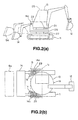
- Fig. 2(a) is a side view of an embodiment wherein a loader 14 is capable of rotating
- Fig. 2(b) is a plan view of same. Similar labels to Figs. 1(a) and (b) indicate the same parts.
- a rotating unit 27 which is capable of rotating freely through 360° in a horizontal direction about an axis of rotation 26 is installed on the upper part of a traveling truck 11, and a frame 28 is fixed to this rotating unit 27.
- Attachment members 29 for supporting the bases 14a of the loader 14 are installed on the aforementioned frame 28. Consequently, by operating the rotating unit 27 as necessary, it is possible to position the loader 14 in any direction in the horizontal plane.
- the frame 28 which supports the loader 14 by means of the attachment members 29 functions as a second base platform about which the loader 14 rotates.
- the bases 14a of the loader 14 are installed on attachment members 29 which are formed as independent units from the frame 28 representing the second base platform, but the bases 14a of the loader 14 may also be installed on attachment members which are formed integrally with the frame 28 representing the second base platform.
- the attachment members may fabricated integrally with, or independently from, the frame 28.
- a rotating unit 2a capable of rotating freely through 360° in a horizontal direction is installed on the upper part of the frame 28, and a first base platform 13 is fixed to this rotating unit 2a.
- a back hoe 12 forming a first operating unit is supported at the end portion of this first base platform 13. Consequently, by operating the rotating unit 2a in an appropriate manner, the back hoe 12 can be positioned in any direction in the horizontal plane.
- the axis of rotation of the rotating unit 2a which causes the first base platform 13 to turn may be set such that it is coaxial with the axis of rotation 26 of the rotating unit 27 which causes the frame 28 forming the second base platform to turn, or alternatively, these two axes of rotation may be offset from each other by an appropriate amount.
- the positional relationship between the loader 14 and the first base platform 13, as shown in Fig.2(b), is such that the bases 14a of the loader 14 are located within areas 1d, 1e lying close outside the swiveling circle 1a of the first base platform 13, similarly to Fig. 1(b).
- the loader forming the second operating unit comprises two arms, namely, a left and a right arm, but as shown in Fig. 3, the present invention may also be implemented in a construction machine comprising a loader 44 having only one arm.
- the base 44a of the loader 44 is located with a area 1e close outside the swiveling circle 1a of the first base platform 13.
- the bases 14a, 44a of the loader 14 or 44 are located within areas 1d, 1e (diagonally shaded areas) which lie in the vicinity of the swiveling circle 1a of the first base platform 13, to the outside thereof, extending between tangent 1b of the aforementioned swiveling circle 1a running in parallel with the widthwise direction of the traveling truck 11, and straight line 1c passing through the center of the aforementioned swiveling circle 1a and also running in parallel with the widthwise direction of the traveling truck 11, the position of the loader 14 or 44 can be moved towards the inner side of the vehicle compared to the position of a conventional loader 54 (indicated by broken lines in Fig. 1, Fig. 2 and Fig. 3), without giving rise to interference between the loader 14 or 44 and the first base platform 13. Consequently, the overall length of the vehicle can be shortened without reducing the length of the arms of the loader 14, 44.
- the overall vehicle length of the construction machine according to the present embodiments is shorter than that of a conventional construction machine, it is suitable for use in restricted spaces. Moreover, since it is not necessary to shorten the length of the arms of the loader 14, 44, it is possible to achieve a long reach for the loader 14, 44, and working efficiency can be improved.
- a frame 19, 28 covering the lower sides of the cab 13 is provided in addition to the attachment members 18, 29 installed on the side faces of the first base platform 13 formed by the cab, it is possible for the attachment members and frame to function as dirt-protection plates for shielding against dirt flying up when the traveling truck 11 is in motion. Furthermore, the attachment plates 18, 29 and frame 19, 28 can also be utilized as footholds for the operator when climbing into the cab 13.
- the aforementioned attachment members 18, 29 involve the following problems relating to the safety of the operator.
- the bases 14a of the loader 14 in other words, the attachment members 29 on which these bases 14a are installed, are located close outside the swiveling circle 13 of the cab 13 in which the operator rides, as described above (see Fig. 2(b)), then the distance B from the center of the vehicle to the end tip of arm 14b of the loader 14 can be shortened, thereby making it possible to achieve good stability, and good compactification during transport. Nevertheless, in order to ensure the length of reach A of the loader 14, it is necessary for the distance C' from ground level GL to the upper ends of the attachment members 29 to be long, such that the bases 14a forming the rotational fulcrums of the loader 14 are located in a high position.
- the floor height D representing the distance from ground level GL to the floor surface 30a of the cab 13 is made greater than the distance C from ground level GL to the upper ends of the attachment members 29, in other words, the cab 13 is installed on the upper part of the traveling truck 11 in such a manner that the base surface 30a of the cab 13 is higher than the upper ends of the attachment members 29
- a footrest 31 extending outside the cab 13 beyond the floor surface 30a of the cab 13 may be provided in a position above an attachment member 29, in such a manner that the footrest 31 does not interfere with the loader 14 (arms 14b).
- numeral 32 denotes a side cover made from resin
- 30 denotes a floor mat made from rubber
- 33 denotes an operating pedal for causing the loader 14 to rotate, for example
- 34 denotes a hand grip.
- the reason that the footrest 31 is provided extending beyond the floor surface 30a in this way is in order that the operator does not get his or her foot trapped between the attachment member 29 and the cab 13 due to the operator's foot falling down below the floor surface 30a. This is because in a vehicle wherein the cab 13 has a narrow floor surface 30a, the operator's foot is particularly liable to fall outside the floor surface 30a. Moreover, as illustrated in Fig. 6, it is also possible to provide a stopper 31a at the end of the footrest 31, in such a manner that the operator's foot does not project outside the footrest 31.
- the footrest 31 does not necessarily have to extend beyond the floor surface 30a, and a footrest may be provided in such a manner that it is contained within the existing floor surface 30a.
- the footrest described above may be provided on only one side of the floor surface 30a of the cab 13 (in particular, on the side where the operator's foot is liable to stray outside the cab,) or it may be provided on both the left and right-hand side of the floor surface 30a.
- the embodiment in Fig. 6 is based on the presumption of a vehicle of a type wherein the loader 14 illustrated in Figs. 2(a), (b) rotates, but it may also be applied suitably to a vehicle of a type wherein the loader 14 illustrated in Figs. 1(a), (b) does not rotate.
- the foregoing embodiment may be applied to a machine wherein the cab 13 rotates relatively with respect to the loader 14, and it may also be applied to a vehicle wherein the cab 13 does not rotate but the loader 14 does rotate.
- the foregoing embodiment is desirable in respect of ensuring the safety of the operator.
- the foregoing embodiment can be omitted.
- the loader 14 by positioning the loader 14 in the same direction as the rotational direction of the back hoe 12, and making it contact and fix to the ground surface, it is possible to utilize the loader 14 as an outrigger for ensuring the stability of the machine when work is being carried out using the back hoe 12.
- an excavating blade is generally affixed to a small-scale hydraulic shovel in a position in front of the vehicle, and this excavating blade can be utilized as an outrigger for ensuring the stability of the machine during digging work, but the stability of the machine can only be ensured sufficiently if the shovel is orientated towards the front of the machine similarly to the excavating blade.
- the loader 14 is also capable of turning fully through 360°, loading operations can be carried out in all horizontal directions. Therefore, the machine is capable of performing operations in a flexible range of loading positions, rather than being restricted in such a manner that loading operations can only be performed to the front side of the machine, as is the case with the conventional construction machine comprising two types of operating unit illustrated in Figs. 4(a), (b), and hence working efficiency can be improved dramatically.
- the loader 14 When performing loading operations by means of the loader 14 in this way, it is possible to carry out the loading operations in a smooth manner, if the first base platform 13 is caused to rotate in a direction where it will not impede operations and if the back hoe 12 is stored in a retracted state.
- the operating tools 12, 14 are rotatable through fully 360° in a horizontal direction, but it is also possible to adopt an embodiment wherein the range of rotation is restricted according to requirements.
- the range of rotation may be limited to 90° to left and right, respectively.
- the operating units are a loader 14 and a back hoe 12, but it is also possible to adopt embodiments wherein these are replaced by other appropriate types of operating unit, depending on the tasks to be performed.
- a vertically movable excavating blade may be provided in place of the vertically movable loader 14.
- a first operating unit 12 is provided, rotatably in a horizontal direction, on the upper part of a second operating unit 14 which is also rotatable in a horizontal direction, but the present invention is not limited to this, and other types of operating unit may also be provided, rotatably in a horizontal direction, on the upper part of the first operating unit 12, in accordance with the tasks to be performed.
Landscapes
- Engineering & Computer Science (AREA)
- Mining & Mineral Resources (AREA)
- Civil Engineering (AREA)
- General Engineering & Computer Science (AREA)
- Structural Engineering (AREA)
- Mechanical Engineering (AREA)
- Component Parts Of Construction Machinery (AREA)
- Shovels (AREA)
Applications Claiming Priority (5)
| Application Number | Priority Date | Filing Date | Title |
|---|---|---|---|
| JP11963297 | 1997-05-09 | ||
| JP11963297 | 1997-05-09 | ||
| JP18401797A JP3734197B2 (ja) | 1997-05-09 | 1997-07-09 | 建設機械 |
| JP18401797 | 1997-07-09 | ||
| PCT/JP1998/002047 WO1998051872A1 (en) | 1997-05-09 | 1998-05-08 | Construction machine |
Publications (2)
| Publication Number | Publication Date |
|---|---|
| EP1008693A1 true EP1008693A1 (de) | 2000-06-14 |
| EP1008693A4 EP1008693A4 (de) | 2000-06-28 |
Family
ID=26457320
Family Applications (1)
| Application Number | Title | Priority Date | Filing Date |
|---|---|---|---|
| EP98919524A Withdrawn EP1008693A4 (de) | 1997-05-09 | 1998-05-08 | Baumaschine |
Country Status (3)
| Country | Link |
|---|---|
| EP (1) | EP1008693A4 (de) |
| JP (1) | JP3734197B2 (de) |
| WO (1) | WO1998051872A1 (de) |
Cited By (6)
| Publication number | Priority date | Publication date | Assignee | Title |
|---|---|---|---|---|
| GB2395187A (en) * | 2002-11-14 | 2004-05-19 | Bamford Excavators Ltd | Excavating and loading machine |
| WO2005035882A3 (en) * | 2003-10-03 | 2005-07-28 | Charles Machine Works | Multi-function work machine |
| US7891933B2 (en) | 2007-05-26 | 2011-02-22 | J.C. Bamford Excavators Limited | Working machine |
| US7922438B2 (en) | 2007-05-26 | 2011-04-12 | J.C. Bamford Excavators Limited | Method of operating a working machine |
| US8075241B2 (en) | 2007-05-26 | 2011-12-13 | J.C. Bamford Excavators Limited | Method of operating a working machine |
| RU2812721C1 (ru) * | 2022-12-15 | 2024-02-01 | федеральное государственное автономное образовательное учреждение высшего образования "Пермский национальный исследовательский политехнический университет" | Способ разработки горно-добычного забоя с мерзлой и плохо разрыхленной породой, содержащей негабаритные куски |
Family Cites Families (6)
| Publication number | Priority date | Publication date | Assignee | Title |
|---|---|---|---|---|
| FR1483942A (fr) * | 1966-04-28 | 1967-06-09 | Poclain Sa | Nouvel engin pour travaux de terrassement |
| JPS5012882Y1 (de) * | 1972-10-03 | 1975-04-21 | ||
| FI760190A7 (de) * | 1975-01-28 | 1976-07-29 | Os Bad Rozwojowy Maszyn Budowl | |
| FR2558500B1 (fr) * | 1984-01-24 | 1986-10-17 | Fontana Jean Francois | Engin de travaux publics polyvalent |
| DE3932555A1 (de) * | 1989-09-29 | 1991-04-11 | Schaeff Karl Gmbh & Co | Baggerlader |
| JPH09189047A (ja) * | 1996-01-11 | 1997-07-22 | Komatsu Ltd | 建設機械 |
-
1997
- 1997-07-09 JP JP18401797A patent/JP3734197B2/ja not_active Expired - Fee Related
-
1998
- 1998-05-08 EP EP98919524A patent/EP1008693A4/de not_active Withdrawn
- 1998-05-08 WO PCT/JP1998/002047 patent/WO1998051872A1/ja not_active Ceased
Cited By (9)
| Publication number | Priority date | Publication date | Assignee | Title |
|---|---|---|---|---|
| GB2395187A (en) * | 2002-11-14 | 2004-05-19 | Bamford Excavators Ltd | Excavating and loading machine |
| GB2395187B (en) * | 2002-11-14 | 2006-08-02 | Bamford Excavators Ltd | Excavating and loading machine |
| WO2005035882A3 (en) * | 2003-10-03 | 2005-07-28 | Charles Machine Works | Multi-function work machine |
| CN1863971B (zh) * | 2003-10-03 | 2011-09-07 | 查尔斯机器制造厂有限公司 | 多功能作业机械 |
| US7891933B2 (en) | 2007-05-26 | 2011-02-22 | J.C. Bamford Excavators Limited | Working machine |
| US7922438B2 (en) | 2007-05-26 | 2011-04-12 | J.C. Bamford Excavators Limited | Method of operating a working machine |
| US8075241B2 (en) | 2007-05-26 | 2011-12-13 | J.C. Bamford Excavators Limited | Method of operating a working machine |
| EP1997964A3 (de) * | 2007-05-26 | 2012-04-11 | J.C. Bamford Excavators Limited | Arbeitsmaschine mit einer drehbaren Fahrerkabine |
| RU2812721C1 (ru) * | 2022-12-15 | 2024-02-01 | федеральное государственное автономное образовательное учреждение высшего образования "Пермский национальный исследовательский политехнический университет" | Способ разработки горно-добычного забоя с мерзлой и плохо разрыхленной породой, содержащей негабаритные куски |
Also Published As
| Publication number | Publication date |
|---|---|
| JP3734197B2 (ja) | 2006-01-11 |
| WO1998051872A1 (en) | 1998-11-19 |
| EP1008693A4 (de) | 2000-06-28 |
| JPH1121943A (ja) | 1999-01-26 |
Similar Documents
| Publication | Publication Date | Title |
|---|---|---|
| US5265995A (en) | Tractor-loader backhoe | |
| CN100537908C (zh) | 挖掘装载机 | |
| JPH0433930B2 (de) | ||
| US20030226293A1 (en) | Wheeled work vehicle | |
| EP0791693B1 (de) | Arbeitsfahrzeug | |
| EP1008693A1 (de) | Baumaschine | |
| CN101158166A (zh) | 推料附属装置的外部端板角撑板 | |
| JPH05202533A (ja) | バックホー・ロ−ダ− | |
| JP2004353301A (ja) | ドーザ装置付き油圧ショベル | |
| JP2001171977A (ja) | ホイール式建設機械 | |
| EP0875630A1 (de) | Baumaschine | |
| JP3538053B2 (ja) | 旋回作業機のトラックフレーム | |
| CN108517906A (zh) | 步履式挖掘机以及步履式挖掘机的工作方法和转运方法 | |
| JP7514202B2 (ja) | 建設機械 | |
| JPH0344826Y2 (de) | ||
| JP3170427B2 (ja) | バックホウ | |
| JP3424622B2 (ja) | 油圧ショベル | |
| JPS6235709Y2 (de) | ||
| JPS6231470Y2 (de) | ||
| JP2002002561A (ja) | 履帯式掘削車両 | |
| JPS6235710Y2 (de) | ||
| JPH0743194Y2 (ja) | パワーショベル | |
| JPS6035658Y2 (ja) | 建設機械におけるブレ−ドの衝撃破壊防止装置 | |
| JPH0354201Y2 (de) | ||
| JPH0345568Y2 (de) |
Legal Events
| Date | Code | Title | Description |
|---|---|---|---|
| PUAI | Public reference made under article 153(3) epc to a published international application that has entered the european phase |
Free format text: ORIGINAL CODE: 0009012 |
|
| 17P | Request for examination filed |
Effective date: 19991209 |
|
| AK | Designated contracting states |
Kind code of ref document: A1 Designated state(s): DE GB IT |
|
| A4 | Supplementary search report drawn up and despatched |
Effective date: 20000515 |
|
| AK | Designated contracting states |
Kind code of ref document: A4 Designated state(s): DE GB IT |
|
| STAA | Information on the status of an ep patent application or granted ep patent |
Free format text: STATUS: THE APPLICATION HAS BEEN WITHDRAWN |
|
| 18W | Application withdrawn |
Effective date: 20040601 |