EP1008823A2 - Erdgasverflüssigung mit Hilfe zweier Kühlmittelgemischkreisläufe - Google Patents
Erdgasverflüssigung mit Hilfe zweier Kühlmittelgemischkreisläufe Download PDFInfo
- Publication number
- EP1008823A2 EP1008823A2 EP99309813A EP99309813A EP1008823A2 EP 1008823 A2 EP1008823 A2 EP 1008823A2 EP 99309813 A EP99309813 A EP 99309813A EP 99309813 A EP99309813 A EP 99309813A EP 1008823 A2 EP1008823 A2 EP 1008823A2
- Authority
- EP
- European Patent Office
- Prior art keywords
- mixed refrigerant
- refrigerant
- heat exchange
- interstage
- stream
- Prior art date
- Legal status (The legal status is an assumption and is not a legal conclusion. Google has not performed a legal analysis and makes no representation as to the accuracy of the status listed.)
- Granted
Links
Images


Classifications
-
- F—MECHANICAL ENGINEERING; LIGHTING; HEATING; WEAPONS; BLASTING
- F25—REFRIGERATION OR COOLING; COMBINED HEATING AND REFRIGERATION SYSTEMS; HEAT PUMP SYSTEMS; MANUFACTURE OR STORAGE OF ICE; LIQUEFACTION SOLIDIFICATION OF GASES
- F25J—LIQUEFACTION, SOLIDIFICATION OR SEPARATION OF GASES OR GASEOUS OR LIQUEFIED GASEOUS MIXTURES BY PRESSURE AND COLD TREATMENT OR BY BRINGING THEM INTO THE SUPERCRITICAL STATE
- F25J5/00—Arrangements of cold exchangers or cold accumulators in separation or liquefaction plants
-
- F—MECHANICAL ENGINEERING; LIGHTING; HEATING; WEAPONS; BLASTING
- F25—REFRIGERATION OR COOLING; COMBINED HEATING AND REFRIGERATION SYSTEMS; HEAT PUMP SYSTEMS; MANUFACTURE OR STORAGE OF ICE; LIQUEFACTION SOLIDIFICATION OF GASES
- F25J—LIQUEFACTION, SOLIDIFICATION OR SEPARATION OF GASES OR GASEOUS OR LIQUEFIED GASEOUS MIXTURES BY PRESSURE AND COLD TREATMENT OR BY BRINGING THEM INTO THE SUPERCRITICAL STATE
- F25J1/00—Processes or apparatus for liquefying or solidifying gases or gaseous mixtures
- F25J1/0002—Processes or apparatus for liquefying or solidifying gases or gaseous mixtures characterised by the fluid to be liquefied
- F25J1/0022—Hydrocarbons, e.g. natural gas
-
- F—MECHANICAL ENGINEERING; LIGHTING; HEATING; WEAPONS; BLASTING
- F25—REFRIGERATION OR COOLING; COMBINED HEATING AND REFRIGERATION SYSTEMS; HEAT PUMP SYSTEMS; MANUFACTURE OR STORAGE OF ICE; LIQUEFACTION SOLIDIFICATION OF GASES
- F25J—LIQUEFACTION, SOLIDIFICATION OR SEPARATION OF GASES OR GASEOUS OR LIQUEFIED GASEOUS MIXTURES BY PRESSURE AND COLD TREATMENT OR BY BRINGING THEM INTO THE SUPERCRITICAL STATE
- F25J1/00—Processes or apparatus for liquefying or solidifying gases or gaseous mixtures
- F25J1/003—Processes or apparatus for liquefying or solidifying gases or gaseous mixtures characterised by the kind of cold generation within the liquefaction unit for compensating heat leaks and liquid production
- F25J1/0047—Processes or apparatus for liquefying or solidifying gases or gaseous mixtures characterised by the kind of cold generation within the liquefaction unit for compensating heat leaks and liquid production using an "external" refrigerant stream in a closed vapor compression cycle
- F25J1/0052—Processes or apparatus for liquefying or solidifying gases or gaseous mixtures characterised by the kind of cold generation within the liquefaction unit for compensating heat leaks and liquid production using an "external" refrigerant stream in a closed vapor compression cycle by vaporising a liquid refrigerant stream
-
- F—MECHANICAL ENGINEERING; LIGHTING; HEATING; WEAPONS; BLASTING
- F25—REFRIGERATION OR COOLING; COMBINED HEATING AND REFRIGERATION SYSTEMS; HEAT PUMP SYSTEMS; MANUFACTURE OR STORAGE OF ICE; LIQUEFACTION SOLIDIFICATION OF GASES
- F25J—LIQUEFACTION, SOLIDIFICATION OR SEPARATION OF GASES OR GASEOUS OR LIQUEFIED GASEOUS MIXTURES BY PRESSURE AND COLD TREATMENT OR BY BRINGING THEM INTO THE SUPERCRITICAL STATE
- F25J1/00—Processes or apparatus for liquefying or solidifying gases or gaseous mixtures
- F25J1/003—Processes or apparatus for liquefying or solidifying gases or gaseous mixtures characterised by the kind of cold generation within the liquefaction unit for compensating heat leaks and liquid production
- F25J1/0047—Processes or apparatus for liquefying or solidifying gases or gaseous mixtures characterised by the kind of cold generation within the liquefaction unit for compensating heat leaks and liquid production using an "external" refrigerant stream in a closed vapor compression cycle
- F25J1/0052—Processes or apparatus for liquefying or solidifying gases or gaseous mixtures characterised by the kind of cold generation within the liquefaction unit for compensating heat leaks and liquid production using an "external" refrigerant stream in a closed vapor compression cycle by vaporising a liquid refrigerant stream
- F25J1/0055—Processes or apparatus for liquefying or solidifying gases or gaseous mixtures characterised by the kind of cold generation within the liquefaction unit for compensating heat leaks and liquid production using an "external" refrigerant stream in a closed vapor compression cycle by vaporising a liquid refrigerant stream originating from an incorporated cascade
-
- F—MECHANICAL ENGINEERING; LIGHTING; HEATING; WEAPONS; BLASTING
- F25—REFRIGERATION OR COOLING; COMBINED HEATING AND REFRIGERATION SYSTEMS; HEAT PUMP SYSTEMS; MANUFACTURE OR STORAGE OF ICE; LIQUEFACTION SOLIDIFICATION OF GASES
- F25J—LIQUEFACTION, SOLIDIFICATION OR SEPARATION OF GASES OR GASEOUS OR LIQUEFIED GASEOUS MIXTURES BY PRESSURE AND COLD TREATMENT OR BY BRINGING THEM INTO THE SUPERCRITICAL STATE
- F25J1/00—Processes or apparatus for liquefying or solidifying gases or gaseous mixtures
- F25J1/006—Processes or apparatus for liquefying or solidifying gases or gaseous mixtures characterised by the refrigerant fluid used
- F25J1/0097—Others, e.g. F-, Cl-, HF-, HClF-, HCl-hydrocarbons etc. or mixtures thereof
-
- F—MECHANICAL ENGINEERING; LIGHTING; HEATING; WEAPONS; BLASTING
- F25—REFRIGERATION OR COOLING; COMBINED HEATING AND REFRIGERATION SYSTEMS; HEAT PUMP SYSTEMS; MANUFACTURE OR STORAGE OF ICE; LIQUEFACTION SOLIDIFICATION OF GASES
- F25J—LIQUEFACTION, SOLIDIFICATION OR SEPARATION OF GASES OR GASEOUS OR LIQUEFIED GASEOUS MIXTURES BY PRESSURE AND COLD TREATMENT OR BY BRINGING THEM INTO THE SUPERCRITICAL STATE
- F25J1/00—Processes or apparatus for liquefying or solidifying gases or gaseous mixtures
- F25J1/02—Processes or apparatus for liquefying or solidifying gases or gaseous mixtures requiring the use of refrigeration, e.g. of helium or hydrogen ; Details and kind of the refrigeration system used; Integration with other units or processes; Controlling aspects of the process
- F25J1/0211—Processes or apparatus for liquefying or solidifying gases or gaseous mixtures requiring the use of refrigeration, e.g. of helium or hydrogen ; Details and kind of the refrigeration system used; Integration with other units or processes; Controlling aspects of the process using a multi-component refrigerant [MCR] fluid in a closed vapor compression cycle
- F25J1/0214—Processes or apparatus for liquefying or solidifying gases or gaseous mixtures requiring the use of refrigeration, e.g. of helium or hydrogen ; Details and kind of the refrigeration system used; Integration with other units or processes; Controlling aspects of the process using a multi-component refrigerant [MCR] fluid in a closed vapor compression cycle as a dual level refrigeration cascade with at least one MCR cycle
-
- F—MECHANICAL ENGINEERING; LIGHTING; HEATING; WEAPONS; BLASTING
- F25—REFRIGERATION OR COOLING; COMBINED HEATING AND REFRIGERATION SYSTEMS; HEAT PUMP SYSTEMS; MANUFACTURE OR STORAGE OF ICE; LIQUEFACTION SOLIDIFICATION OF GASES
- F25J—LIQUEFACTION, SOLIDIFICATION OR SEPARATION OF GASES OR GASEOUS OR LIQUEFIED GASEOUS MIXTURES BY PRESSURE AND COLD TREATMENT OR BY BRINGING THEM INTO THE SUPERCRITICAL STATE
- F25J1/00—Processes or apparatus for liquefying or solidifying gases or gaseous mixtures
- F25J1/02—Processes or apparatus for liquefying or solidifying gases or gaseous mixtures requiring the use of refrigeration, e.g. of helium or hydrogen ; Details and kind of the refrigeration system used; Integration with other units or processes; Controlling aspects of the process
- F25J1/0228—Coupling of the liquefaction unit to other units or processes, so-called integrated processes
- F25J1/0229—Integration with a unit for using hydrocarbons, e.g. consuming hydrocarbons as feed stock
- F25J1/0231—Integration with a unit for using hydrocarbons, e.g. consuming hydrocarbons as feed stock for the working-up of the hydrocarbon feed, e.g. reinjection of heavier hydrocarbons into the liquefied gas
-
- F—MECHANICAL ENGINEERING; LIGHTING; HEATING; WEAPONS; BLASTING
- F25—REFRIGERATION OR COOLING; COMBINED HEATING AND REFRIGERATION SYSTEMS; HEAT PUMP SYSTEMS; MANUFACTURE OR STORAGE OF ICE; LIQUEFACTION SOLIDIFICATION OF GASES
- F25J—LIQUEFACTION, SOLIDIFICATION OR SEPARATION OF GASES OR GASEOUS OR LIQUEFIED GASEOUS MIXTURES BY PRESSURE AND COLD TREATMENT OR BY BRINGING THEM INTO THE SUPERCRITICAL STATE
- F25J1/00—Processes or apparatus for liquefying or solidifying gases or gaseous mixtures
- F25J1/02—Processes or apparatus for liquefying or solidifying gases or gaseous mixtures requiring the use of refrigeration, e.g. of helium or hydrogen ; Details and kind of the refrigeration system used; Integration with other units or processes; Controlling aspects of the process
- F25J1/0243—Start-up or control of the process; Details of the apparatus used; Details of the refrigerant compression system used
- F25J1/0257—Construction and layout of liquefaction equipments, e.g. valves, machines
- F25J1/0262—Details of the cold heat exchange system
- F25J1/0264—Arrangement of heat exchanger cores in parallel with different functions, e.g. different cooling streams
- F25J1/0265—Arrangement of heat exchanger cores in parallel with different functions, e.g. different cooling streams comprising cores associated exclusively with the cooling of a refrigerant stream, e.g. for auto-refrigeration or economizer
- F25J1/0267—Arrangement of heat exchanger cores in parallel with different functions, e.g. different cooling streams comprising cores associated exclusively with the cooling of a refrigerant stream, e.g. for auto-refrigeration or economizer using flash gas as heat sink
-
- F—MECHANICAL ENGINEERING; LIGHTING; HEATING; WEAPONS; BLASTING
- F25—REFRIGERATION OR COOLING; COMBINED HEATING AND REFRIGERATION SYSTEMS; HEAT PUMP SYSTEMS; MANUFACTURE OR STORAGE OF ICE; LIQUEFACTION SOLIDIFICATION OF GASES
- F25J—LIQUEFACTION, SOLIDIFICATION OR SEPARATION OF GASES OR GASEOUS OR LIQUEFIED GASEOUS MIXTURES BY PRESSURE AND COLD TREATMENT OR BY BRINGING THEM INTO THE SUPERCRITICAL STATE
- F25J1/00—Processes or apparatus for liquefying or solidifying gases or gaseous mixtures
- F25J1/02—Processes or apparatus for liquefying or solidifying gases or gaseous mixtures requiring the use of refrigeration, e.g. of helium or hydrogen ; Details and kind of the refrigeration system used; Integration with other units or processes; Controlling aspects of the process
- F25J1/0243—Start-up or control of the process; Details of the apparatus used; Details of the refrigerant compression system used
- F25J1/0257—Construction and layout of liquefaction equipments, e.g. valves, machines
- F25J1/0275—Construction and layout of liquefaction equipments, e.g. valves, machines adapted for special use of the liquefaction unit, e.g. portable or transportable devices
- F25J1/0277—Offshore use, e.g. during shipping
- F25J1/0278—Unit being stationary, e.g. on floating barge or fixed platform
-
- F—MECHANICAL ENGINEERING; LIGHTING; HEATING; WEAPONS; BLASTING
- F25—REFRIGERATION OR COOLING; COMBINED HEATING AND REFRIGERATION SYSTEMS; HEAT PUMP SYSTEMS; MANUFACTURE OR STORAGE OF ICE; LIQUEFACTION SOLIDIFICATION OF GASES
- F25J—LIQUEFACTION, SOLIDIFICATION OR SEPARATION OF GASES OR GASEOUS OR LIQUEFIED GASEOUS MIXTURES BY PRESSURE AND COLD TREATMENT OR BY BRINGING THEM INTO THE SUPERCRITICAL STATE
- F25J1/00—Processes or apparatus for liquefying or solidifying gases or gaseous mixtures
- F25J1/02—Processes or apparatus for liquefying or solidifying gases or gaseous mixtures requiring the use of refrigeration, e.g. of helium or hydrogen ; Details and kind of the refrigeration system used; Integration with other units or processes; Controlling aspects of the process
- F25J1/0243—Start-up or control of the process; Details of the apparatus used; Details of the refrigerant compression system used
- F25J1/0279—Compression of refrigerant or internal recycle fluid, e.g. kind of compressor, accumulator, suction drum etc.
- F25J1/0291—Refrigerant compression by combined gas compression and liquid pumping
-
- F—MECHANICAL ENGINEERING; LIGHTING; HEATING; WEAPONS; BLASTING
- F25—REFRIGERATION OR COOLING; COMBINED HEATING AND REFRIGERATION SYSTEMS; HEAT PUMP SYSTEMS; MANUFACTURE OR STORAGE OF ICE; LIQUEFACTION SOLIDIFICATION OF GASES
- F25J—LIQUEFACTION, SOLIDIFICATION OR SEPARATION OF GASES OR GASEOUS OR LIQUEFIED GASEOUS MIXTURES BY PRESSURE AND COLD TREATMENT OR BY BRINGING THEM INTO THE SUPERCRITICAL STATE
- F25J1/00—Processes or apparatus for liquefying or solidifying gases or gaseous mixtures
- F25J1/02—Processes or apparatus for liquefying or solidifying gases or gaseous mixtures requiring the use of refrigeration, e.g. of helium or hydrogen ; Details and kind of the refrigeration system used; Integration with other units or processes; Controlling aspects of the process
- F25J1/0243—Start-up or control of the process; Details of the apparatus used; Details of the refrigerant compression system used
- F25J1/0279—Compression of refrigerant or internal recycle fluid, e.g. kind of compressor, accumulator, suction drum etc.
- F25J1/0292—Refrigerant compression by cold or cryogenic suction of the refrigerant gas
-
- F—MECHANICAL ENGINEERING; LIGHTING; HEATING; WEAPONS; BLASTING
- F25—REFRIGERATION OR COOLING; COMBINED HEATING AND REFRIGERATION SYSTEMS; HEAT PUMP SYSTEMS; MANUFACTURE OR STORAGE OF ICE; LIQUEFACTION SOLIDIFICATION OF GASES
- F25J—LIQUEFACTION, SOLIDIFICATION OR SEPARATION OF GASES OR GASEOUS OR LIQUEFIED GASEOUS MIXTURES BY PRESSURE AND COLD TREATMENT OR BY BRINGING THEM INTO THE SUPERCRITICAL STATE
- F25J2220/00—Processes or apparatus involving steps for the removal of impurities
- F25J2220/60—Separating impurities from natural gas, e.g. mercury, cyclic hydrocarbons
- F25J2220/62—Separating low boiling components, e.g. He, H2, N2, Air
-
- F—MECHANICAL ENGINEERING; LIGHTING; HEATING; WEAPONS; BLASTING
- F25—REFRIGERATION OR COOLING; COMBINED HEATING AND REFRIGERATION SYSTEMS; HEAT PUMP SYSTEMS; MANUFACTURE OR STORAGE OF ICE; LIQUEFACTION SOLIDIFICATION OF GASES
- F25J—LIQUEFACTION, SOLIDIFICATION OR SEPARATION OF GASES OR GASEOUS OR LIQUEFIED GASEOUS MIXTURES BY PRESSURE AND COLD TREATMENT OR BY BRINGING THEM INTO THE SUPERCRITICAL STATE
- F25J2220/00—Processes or apparatus involving steps for the removal of impurities
- F25J2220/60—Separating impurities from natural gas, e.g. mercury, cyclic hydrocarbons
- F25J2220/64—Separating heavy hydrocarbons, e.g. NGL, LPG, C4+ hydrocarbons or heavy condensates in general
-
- F—MECHANICAL ENGINEERING; LIGHTING; HEATING; WEAPONS; BLASTING
- F25—REFRIGERATION OR COOLING; COMBINED HEATING AND REFRIGERATION SYSTEMS; HEAT PUMP SYSTEMS; MANUFACTURE OR STORAGE OF ICE; LIQUEFACTION SOLIDIFICATION OF GASES
- F25J—LIQUEFACTION, SOLIDIFICATION OR SEPARATION OF GASES OR GASEOUS OR LIQUEFIED GASEOUS MIXTURES BY PRESSURE AND COLD TREATMENT OR BY BRINGING THEM INTO THE SUPERCRITICAL STATE
- F25J2240/00—Processes or apparatus involving steps for expanding of process streams
- F25J2240/40—Expansion without extracting work, i.e. isenthalpic throttling, e.g. JT valve, regulating valve or venturi, or isentropic nozzle, e.g. Laval
-
- F—MECHANICAL ENGINEERING; LIGHTING; HEATING; WEAPONS; BLASTING
- F25—REFRIGERATION OR COOLING; COMBINED HEATING AND REFRIGERATION SYSTEMS; HEAT PUMP SYSTEMS; MANUFACTURE OR STORAGE OF ICE; LIQUEFACTION SOLIDIFICATION OF GASES
- F25J—LIQUEFACTION, SOLIDIFICATION OR SEPARATION OF GASES OR GASEOUS OR LIQUEFIED GASEOUS MIXTURES BY PRESSURE AND COLD TREATMENT OR BY BRINGING THEM INTO THE SUPERCRITICAL STATE
- F25J2245/00—Processes or apparatus involving steps for recycling of process streams
- F25J2245/02—Recycle of a stream in general, e.g. a by-pass stream
-
- Y—GENERAL TAGGING OF NEW TECHNOLOGICAL DEVELOPMENTS; GENERAL TAGGING OF CROSS-SECTIONAL TECHNOLOGIES SPANNING OVER SEVERAL SECTIONS OF THE IPC; TECHNICAL SUBJECTS COVERED BY FORMER USPC CROSS-REFERENCE ART COLLECTIONS [XRACs] AND DIGESTS
- Y02—TECHNOLOGIES OR APPLICATIONS FOR MITIGATION OR ADAPTATION AGAINST CLIMATE CHANGE
- Y02C—CAPTURE, STORAGE, SEQUESTRATION OR DISPOSAL OF GREENHOUSE GASES [GHG]
- Y02C20/00—Capture or disposal of greenhouse gases
- Y02C20/40—Capture or disposal of greenhouse gases of CO2
Definitions
- LNG production sites are usually located on land at remote sites having docking facilities for large LNG tankers which transport the LNG to end users.
- Such cycles typically utilise combinations of single-component refrigeration systems using propane or single chlorofluorocarbon refrigerants operated in combination with one or more mixed refrigerant (MR) systems.
- MR mixed refrigerant
- Well-known mixed refrigerants typically comprise light hydrocarbons and optionally nitrogen and utilise compositions tailored to the temperature and pressure levels of specific process steps.
- MR mixed refrigerant
- LNG cycles generally use a first refrigerant which vaporises at a higher temperature (i.e., the warm or high level MR) in a first heat exchanger (i.e., the warm or high level exchanger) and a second refrigerant which vaporises at a lower temperature (i.e., the cold or low level MR) in a second heat exchanger (i.e., the cold or low level exchanger).
- US-A-4,274,849 describes a dual mixed refrigerant process in which feed gas is first cooled in a separate exchanger using the refrigerant fluid exiting the cold or low level MR heat exchanger.
- the precooled feed is then further cooled and liquefied in the cold MR exchanger.
- the vaporised low level refrigerant after compression is cooled against the warm or high level refrigerant in the warm or high level MR exchanger.
- a disadvantage of this process is that an extra heat exchanger is required for feed precooling.
- US-A-4,112,700 discloses a dual MR process in which the high level MR is boiled at three different pressure levels with interstage compression. This requires the use of multiple heat exchangers or multiple heat exchange zones, which requires multiple return streams to the compressor. Such multiple heat exchange/compression stages have a disadvantage from a thermodynamic perspective, since non-equilibrium streams of differing compositions are mixed interstage in the warm mixed refrigerant compression train. The mixing of streams causes a thermodynamic irreversibility which will result in reduced cycle efficiency.
- US-A-4,545,795 discloses a dual MR process wherein the high level MR is boiled at three different pressure levels. This requires the use of multiple heat exchangers or heat exchange zones in the high level MR heat exchanger. In this process, the feed is first cooled using the fluid exiting the low level MR exchanger, and this requires an additional heat exchanger as in US-A-4,274,849 cited above.
- This flowsheet also has a disadvantage from a thermodynamic perspective, since non-equilibrium streams are mixed interstage in the high level MR compression train which causes thermodynamic irreversibility as earlier discussed.
- a dual mixed refrigerant process is described in US-A-4,539,028 in which the high level MR is boiled at three different pressure levels, which requires the use of multiple heat exchangers or heat exchange zones.
- the low level mixed MR is boiled at two different pressure levels, which also requires the use of multiple heat exchangers or heat exchange zones.
- the feed is first cooled using the low level MR, which requires an extra heat exchanger, a disadvantage shared by several of the processes cited above.
- This cycle also has a disadvantage from a thermodynamic perspective, since non-equilibrium streams are mixed interstage in the mixed refrigerant compression train. This mixing causes a thermodynamic irreversibility which will result in reduced cycle efficiency.
- US-A-4,911,741 discloses a dual MR process in which the high level MR is boiled at three different pressure levels. This requires the use of multiple heat exchangers or heat exchange zones and also has a disadvantage from a thermodynamic perspective as earlier discussed, since streams which are potentially at different temperatures are mixed interstage in the high level mixed refrigerant compression train. This mixing of streams causes thermodynamic irreversibility which will result in reduced cycle efficiency.
- US-A-4,094,655 describes a dual MR process where the low level MR is boiled at two different pressure levels, which requires the use of multiple heat exchangers or heat exchange zones.
- the high level MR is first cooled using the fluid from the low level MR exchangers, rather than being cooled by the high level mixed refrigerant loop itself.
- the disadvantage of this approach is that an extra heat exchanger is required.
- this process has a thermodynamic disadvantage since non-equilibrium streams are mixed interstage in the high level MR compression train. The mixing of streams into the main flow causes thermodynamic irreversibility which will result in reduced cycle efficiency.
- the present invention addresses the need for a natural gas liquefaction process having a minimum plot plan area which is suitable for offshore applications and which can operate at high efficiency without propane precooling in a cycle which is both compact and cost effective.
- a natural gas liquefaction process and system to meet these objectives is described below and defined in the claims which follow.
- the present invention is an efficient process and apparatus for gas liquefaction which is particularly useful for the liquefaction of natural gas on a ship or offshore platform where space is at a premium.
- the invention minimises both the size and number of required equipment items.
- a process for liquefying a pressurised feed gas which comprises:
- dual mixed component refrigerants are used to provide the refrigeration to the process, and no propane or other single hydrocarbon precooling systems are required.
- High level or warmer refrigeration can be provided in an optimum temperature range for removal of heavier hydrocarbons from the feed by distillation, and the refrigeration is provided at a single vaporising pressure for simultaneously precooling the natural gas feed and cooling the low level or cold mixed refrigerant.
- the low level mixed refrigerant provides refrigeration at a single vaporising pressure to achieve final cooling and liquefaction of the feed.
- the low level mixed refrigerant vapour preferably is compressed cold at approximately the minimum temperature provided by the high level mixed refrigerant.
- the high level refrigeration is provided using a mixed component circuit in which a high level mixed component stream is compressed and then cooled using an external cooling fluid such as air or cooling water.
- An external cooling fluid such as air or cooling water.
- a portion of the mixed refrigerant may be liquefied by external cooling between compression stages. In an efficient embodiment of the invention this liquid is pumped, mixed with the gas exiting the final stage of compression, and cooled using external cooling. A portion of the compressed high level mixed refrigerant stream is liquefied after the external cooling.
- At least a portion of the compressed and cooled mixed refrigerant stream is further cooled and then reduced in pressure and vaporised by heat exchange while cooling the feed gas and low level mixed refrigerant.
- the evaporated and warmed mixed refrigerant steam is compressed and recirculated.
- the high level mixed refrigerant circuit suitably provides refrigeration at temperature levels from -20 °C to -70 °C as a fraction of the total refrigeration needed for natural gas liquefaction.
- the low level refrigeration is provided using a mixed component circuit in which a mixed component stream is compressed and cooled using an external cooling fluid such as air or cooling water. At least a portion of the compressed and cooled mixed refrigerant stream is further cooled in a heat exchanger using the high level mixed refrigerant, and after further cooling is reduced in pressure (flashed) and vaporised by heat exchange against the cooling and condensing feed gas stream.
- the evaporated and warmed mixed refrigerant steam is compressed cold without further heat exchange and recirculated.
- the compressing of the first mixed refrigerant vapour in (c) can be carried out as required in at least two stages of compression which generates at least one interstage two-phase refrigerant stream; the interstage two-phase refrigerant stream is separated into an interstage refrigerant vapour and an interstage refrigerant liquid; the interstage refrigerant vapour is compressed to yield a further compressed refrigerant; the interstage liquid refrigerant is pumped to yield a further pressurised liquid refrigerant; the further compressed refrigerant and the further pressurised liquid refrigerant is combined; and the resulting combined first mixed refrigerant is cooled, condensed, optionally subcooled, and flashed to provide the first vaporising mixed refrigerant in
- compressing of the first mixed refrigerant vapour in (c) above can be carried out if required in at least two stages of compression which generates an interstage compressed refrigerant; the interstage compressed refrigerant is cooled, partially condensed, and separated into an interstage refrigerant vapour and an interstage refrigerant liquid; the interstage refrigerant vapour is compressed to yield a further compressed refrigerant which is cooled, condensed, optionally subcooled, and flashed to provide the first vaporising mixed refrigerant in (a) above; and the interstage liquid refrigerant is subcooled and flashed at the first essentially constant pressure to yield additional refrigeration in the first heat exchange zone.
- At least a portion of the refrigeration for the cooling and condensing of the first mixed refrigerant vapour after compression can be provided by indirect heat exchange in the first heat exchange zone with the first vaporising liquid mixed refrigerant.
- the first mixed refrigerant vapour normally comprises two or more components selected from nitrogen, methane, ethane, ethylene, propane, propylene, i-butane, butane, i-pentane, chlorinated hydrocarbons, and fluorinated hydrocarbons.
- the second mixed refrigerant vapour normally comprises two or more components selected from nitrogen, methane, ethane, ethylene, propane, propylene, i-butane, butane, i-pentane, chlorinated hydrocarbons, and fluorinated hydrocarbons.
- the pressurised feed gas is provided by treating a pressurised stream of natural gas to remove contaminants selected from water, carbon dioxide, sulphur-containing compounds, mercury, and mercury-containing compounds. If required, hydrocarbons heavier than methane can be removed from the pressurised feed gas by
- the process of the invention may comprise removing hydrocarbons heavier than methane from the pressurised feed gas prior to further cooling and condensing by indirect heat exchange in the second heat exchange zone in (b) by
- a portion of the pressurised feed gas can be introduced into the distillation column at a second location which is below the first location.
- the liquid product of (b) can be a methane-rich liquid, and the methane-rich liquid product can be flashed and separated to yield a further enriched liquid methane product and an offgas stream comprising components lighter than methane.
- a portion of the refrigeration for the cooling and condensing of the second mixed refrigerant vapour after compression can be provided at least in part by indirect heat exchange in a third heat exchange zone with the offgas stream comprising components lighter than methane.
- a portion of the refrigeration for the cooling and condensing of the second mixed refrigerant vapour after compression can be provided at least in part by indirect heat exchange in the second heat exchange zone with the second vaporising mixed refrigerant.
- the second mixed refrigerant vapour after compression can be cooled by indirect heat exchange in the first heat exchange zone and withdrawn therefrom at a first temperature; the resulting cooled second mixed refrigerant stream introduced into the second heat exchange zone and further cooled therein by indirect heat exchange; the second mixed refrigerant vapour withdrawn from the second heat exchange zone at a second temperature which is lower than the first temperature; and the resulting further cooled second mixed refrigerant vapour is compressed directly without preheating.
- cooling and condensing of the second mixed refrigerant vapour following compression can be effected by indirect heat exchange in the first heat exchange zone to yield a partially condensed second mixed refrigerant stream containing intermediate second mixed refrigerant vapour and intermediate second mixed refrigerant liquid;
- the invention includes an apparatus for liquefying a pressurised feed gas by the process of the invention, which apparatus comprises:
- the apparatus comprises:
- the first compression means can comprise, if required,
- the first compression means can comprise
- the apparatus can also include
- the apparatus may further comprise
- the apparatus may comprise
- the apparatus further comprises piping means for introducing a portion of the pressurised feed gas into the distillation means at a location which is below the location at which the cooled pressurised feed gas is introduced.
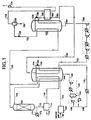
- Feed gas 90 typically a methane-containing gas and preferably natural gas, at a pressure up to 300 bar absolute (all pressures reported herein are absolute pressures) is dried and cleaned by known methods in pretreatment section 100 for the removal of acid gases such as CO 2 and H 2 S along with other contaminants such as mercury or mercury-containing compounds.
- Pretreated gas 102 enters the first heat exchanger or heat exchange zone 104 and is cooled therein to an intermediate temperature of -20°C to -70°C.
- the actual temperature level of this cooling step depends on the feed composition and desired LNG product specification (e.g. heating value), and sometimes is dictated by a desire to achieve a certain power split between compression services.
- Cooling in heat exchanger 104 is effected by the warming and vaporisation of high level mixed refrigerant stream 110, which typically contains one or more hydrocarbons selected from methane, ethane, propane, i-butane, butane, and possibly i-pentane, and may contain other components such as nitrogen.
- Cooled feed stream 108 is introduced into reboiled stripper or scrub column 106 for the removal of hydrocarbons heavier than methane.
- Bottoms product stream 112 enters fractionation section 114 in which pentane and heavier components are separated and recovered in stream 116.
- a portion of the bottoms stream from scrub column 106 is vaporised in heater 172 to provide boilup or stripping gas to the column.
- Butane and lighter components are recovered as stream 118, which is cooled in heat exchanger 104 and combined with the overhead product of scrub column 106 to yield precooled feed stream 120.
- fractionation may be carried out such that stream 118 contains propane and lighter components.
- Precooled feed stream 120 is further cooled and liquefied in heat exchanger 122 by indirect heat exchange by warming and vaporising low level mixed refrigerant stream 124.
- the resulting liquefied product stream 121 typically liquefied natural gas (LNG)
- LNG liquefied natural gas
- the pressure of liquefied product stream 121 may be reduced by work expansion across a turboexpander.
- the reduced pressure LNG product stream is introduced into storage tank 128, from which final liquefied product stream 130 is withdrawn.
- a significant quantity of light gas 132 can be evolved after the flashing across valve 126. Flash gas stream 132 typically is warmed, for example in heat exchanger 162, and compressed in offgas compressor 134 for use as fuel gas.
- Refrigeration to cool the natural gas feed from ambient temperature to a temperature of -20 °C to -70 °C is provided by a high level multi-component refrigeration loop as mentioned above.
- Stream 136 is the high level mixed refrigerant after compression and cooling, and typically contains some condensed liquid.
- the stream enters heat exchanger 104 at ambient temperature and an elevated pressure typically above 3 bar absolute, and is condensed, cooled, and optionally subcooled to a temperature of -20 °C to -70°C exiting as stream 138.
- Stream 138 is flashed adiabatically to a low pressure in the range of one to 30 bar absolute across throttling valve 150 and reduced pressure stream 110 is introduced to the cold end of heat exchanger 104.
- the pressure of cooled refrigerant stream 138 can be reduced by work expansion across a turboexpander.
- the flashing step which is defined as either isenthalpic or essentially isentropic pressure reduction, can include cooling or vaporisation and can be achieved either by throttling across a pressure reducing valve or by work expansion in a turboexpander or expansion engine.
- Flashed high level refrigerant stream 110 is warmed and vaporised in heat exchanger 104, and leaves the exchanger as vapour refrigerant stream 140, preferably at a temperature below the temperature of compressed refrigerant stream 136 returning to heat exchanger 104.
- Vapour refrigerant stream 140 is compressed in multi-staged intercooled compressor 142 to a pressure above 3 bar absolute.
- Liquid 144 can be formed in the intercooler(s) of staged compressor 142, and if so is preferably pumped and combined with compressed refrigerant vapour 146 from the final stage of compressor 142.
- Combined refrigerant stream 148 is cooled to near ambient temperature to provide high level mixed refrigerant stream 136 as earlier described. More than two stages of compression may be used as desired.
- Final cooling of gas feed stream 120 from -20 °C to -70 °C to the final liquefaction temperature is accomplished using a low level mixed refrigerant loop containing refrigerant components as earlier described.
- Compressed low level mixed refrigerant stream 152 at about ambient temperature and a pressure greater than 3 bar absolute enters exchanger 104 and is cooled therein by indirect heat exchange to a temperature of -20 °C to -70 °C, exiting as cooled low level mixed refrigerant stream 154.
- Refrigerant stream 154 is further cooled and optionally subcooled in heat exchanger 122 to a final temperature below -125°C, and the cooled stream 158 is flashed isenthalpically across throttling valve 156 to a pressure of about 3.3 bar absolute.
- the pressure of cooled stream 158 can be reduced by work expansion across a turboexpander or reciprocating expansion engine.
- a small portion of refrigerant stream 154, as stream 160, can be cooled in heat exchanger 162 by flash gas stream 132.
- Flashed low level mixed refrigerant stream 124 is introduced into the cold end of heat exchanger 122, where it vaporises to provide refrigeration therein.
- Vaporised low level mixed refrigerant stream 164 leaves heat exchanger 122 at a temperature below the temperature of cooled refrigerant stream 154 returning to heat exchanger 122.
- Vaporised refrigerant stream 164 then is compressed directly in multi-stage intercooled compressor 166 to greater than 5 bar absolute to provide low level mixed refrigerant stream 152.
- Vaporised low level mixed refrigerant stream 164 is not used to precool feed gas or other process streams, and therefore passes directly to compression without preheating.
- Heat exchangers 104 and 122 can utilise any suitable heat exchange devices such as wound coil, shell and tube, or plate-fin exchangers known in the art. Wound coil exchangers are preferred for their compact dimensions and efficient heat transfer performance.
- stream 118 containing butane and lighter components is recycled to exchanger 104, cooled therein, and divided into two portions 268 and 270.
- Portion 268 is used to as reflux in scrub column 106 for the removal of heavy components such as benzene to very low levels.
- Remaining portion 270 is combined with the overhead product of scrub column 106 to yield precooled feed stream 120.
- the relative flows of streams 268 and 270 will depend upon the feed composition and the required degree of contaminant removal from the feed stream.
- the system can be operated such that stream 118 contains predominantly propane and lighter components.
- FIG. 3 A second alternative embodiment of the present invention is shown in Fig. 3 wherein a small portion 374 of warm natural gas feed 102 is fed directly to scrub column 106 below the top location of feed stream 108 rather than being cooled in exchanger 104.
- This alternative reduces the amount of external heat required in reboiler exchanger 172 of scrub column 106 to generate stripping vapour.
- This alternative also decreases the refrigeration load in exchanger 104, and is beneficial when feed 102 contains high levels of heavier hydrocarbons and when the liquid fraction of stream 108 is high.
- FIG. 4 A third alternative embodiment of the present invention is shown in Figure 4.
- high level liquid refrigerant 144 condensing interstage in compressor 142 is fed directly to exchanger 404 rather than being pumped and combined with the compressor discharge as in Fig. 1.
- the compressed vapour refrigerant 146 is cooled and fed as stream 436 to exchanger 404, in which it is cooled and optionally subcooled to a temperature of -30 °C to -70 °C to provide stream 438, flashed across throttling valve 450, and fed to exchanger 404 as stream 410.
- Interstage refrigerant liquid stream 144 is fed to exchanger 404, cooled and optionally subcooled therein to a temperature warmer than stream 438, flashed across throttling valve 468, and introduced to exchanger 404 at an intermediate position in exchanger 404. Pressure drops across each of the throttling valves 450 and 468 are chosen such that the flashed fluids vaporise at essentially the same pressure.
- the term "essentially the same pressure" as used here means that the pressure of the vaporising refrigerant varies within an exchanger only by the small hydraulic or pneumatic pressure drops or variations caused by flowing liquid or vapour.
- the refrigerant is not vaporised in separate heat exchange conduits or zones at different pressures as described in many of the prior art processes earlier described.
- Fig. 4 can be operated at 3% - 4% higher efficiency than the embodiment of Fig. 1 but at higher capital cost. Also, heat exchanger 404 will be taller for a given surface area, potentially decreasing the attractiveness for shipboard applications.
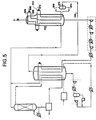
- FIG. 5 A fourth alternative embodiment of the invention is illustrated in Figure 5 wherein cooled low level mixed refrigerant stream 154 is a two-phase stream which is separated into vapour stream 568 and liquid stream 570 in drum 576. These refrigerant streams are introduced separately into heat exchanger 522. Vapour refrigerant stream 568 is liquefied and optionally subcooled to a low temperature to provide stream 558 and is flashed isenthalpically across throttling valve 556 to yield refrigerant stream 524, which is introduced into the cold end of heat exchanger 522 where it is vaporised to provide a portion of the refrigeration for product liquefaction.
- Liquid refrigerant stream 570 is subcooled in heat exchanger 522 to a temperature warmer than stream 558 and is flashed adiabatically across throttling valve 572 to low pressure refrigerant stream 574, which is introduced at an intermediate point into heat exchanger 522, where it is vaporised to provide the remaining portion of the refrigeration for product liquefaction.
- the vaporisation pressure of the two refrigerant streams in the heat exchanger is typically in the range of one to 30 bar absolute.
- Fig. 5 exhibits approximately 4% higher efficiency than the embodiment of Fig. 1, but will have a higher capital cost. Also, heat exchanger 522 will be taller for a given plot area, potentially decreasing the attractiveness for shipboard applications.
- Natural gas feed 90 is first cleaned and dried in pretreatment section 100 for the removal of acid gases such as CO 2 and H 2 S along with other contaminants such as mercury.
- Pretreated feed gas 102 at a flow rate of 17,470 kg-mole/h, a pressure of 52 bar absolute, and a temperature of 38 °C has a molar composition as given in Table 1 below.
- Pretreated feed gas 102 is precooled in heat exchanger 104 to a temperature of -36 °C and precooled feed stream 108 enters scrub column 106.
- the cooling in heat exchanger 104 is effected by the warming and vaporisation of high level mixed refrigerant stream 110 at a flow of 25,433 kg-mole/h.
- the composition of refrigerant stream 110 is as follows (in mole fractions): methane, 0.01; ethane, 0.47; propane, 0.06; i-butane, 0.16; and butane, 0.30.
- Pentane and heavier components of the feed are removed in scrub column 106. Bottoms product 112 of scrub column 106 enter fractionation section 114 in which components heavier than propane are recovered as stream 116. Propane and lighter components are recovered as stream 118 which is cooled to -36°C in heat exchanger 104 and recombined with the overhead product of the scrub column to form precooled feed stream 120 at a flow rate of 17,315 kg-mole/h.
- Precooled feed stream 120 is further cooled and liquefied in heat exchanger 122 to a temperature of -162 °C by indirect heat exchange with warming and vaporising low level mixed refrigerant stream 124, which enters heat exchanger 122 at a molar flow rate of 28,553 kg-mole/h, a temperature of -164 °C, a pressure of 3.35 bar absolute.
- the composition of refrigerant stream 120 is as follows (in mole fractions): nitrogen, 0.14; methane, 0.35; ethane, 0.41; and propane, 0.10.
- the resulting liquefied natural gas (LNG) stream (121) is then flashed adiabatically across throttling valve 126 to its bubble point pressure of 1.05 bar absolute.
- the flashed LNG stream enters tank 128 from which final LNG product stream 130 is withdrawn.
- no light gas 132 is evolved after flashing across valve 126, so that heat exchanger 162 and compressor 134 are not required.
- Refrigeration to cool the natural gas feed 102 from ambient temperature to a temperature of -36 °C is provided by a high level multi-component refrigeration loop as described earlier.
- High level mixed refrigerant stream 136 enters heat exchanger 104 at a temperature of 38 °C and a pressure of 24 bar absolute. It is cooled to a temperature of -36 °C in heat exchanger 104 then flashed across throttling valve 150 to yield reduced pressure refrigerant stream 110 at a temperature of -38 °C.
- Stream 110 is warmed and vaporised in heat exchanger 104, and exits therefrom at 34 °C and 3.8 bar absolute as refrigerant vapour stream 140.
- This low pressure refrigerant vapour is compressed in 2-stage intercooled compressor 142 to a final pressure of 24 bar absolute.
- Liquid 144 formed in the intercooler of the compressor is pumped and recombined with the compressed refrigerant 146 from the final compressor stage.
- the liquid flow of combined refrigerant stream 148 is 12,870 kg-mole/h.
- Final cooling of the natural gas feed from -36 °C to -162 °C in heat exchanger 122 is provided by a low level multi-component refrigeration loop as mentioned above.
- Compressed low level mixed refrigerant stream 152 enters heat exchanger 104 at a temperature of 38 °C and a pressure of 55 bar absolute, where it is cooled to a temperature of -36 °C as stream 154.
- This precooled low level refrigerant is further cooled to a temperature of -162 °C in heat exchanger 122 to yield stream 158, which is flashed across throttling valve 156.
- Reduced pressure refrigerant stream 124 is then warmed and vaporised in exchanger 122, finally exiting the exchanger 122 at -39 °C and 3.25 bar absolute as stream 164.
- This low pressure vapour refrigerant stream is then compressed in 3-stage intercooled compressor 166 to the final pressure of 55 bar absolute.
- the present invention provides for the liquefaction of feed gas using a minimum number of heat exchangers and utilises mixed refrigerants, wherein each refrigerant is vaporised at an essentially constant pressure in each of the exchangers.
- These characteristics reduce the process complexity and required plant plot plan area compared with known liquefaction processes.
- Each of the earlier described prior art processes utilises at least two refrigerant vaporisation pressure levels in at least one of the heat exchangers in low level and high level cooling service.
- the process and apparatus of the invention are especially well-suited for installation on ships and offshore platforms by virtue of simplified process features and minimum plot plan area requirements.
- the present invention includes the feature wherein feed precooling, low level refrigerant precooling, and high level refrigerant cooling are effected in a single heat exchanger against high level refrigerant vaporising at a single essentially constant pressure.
- the process does not require a separate feed precooling heat exchanger, since feed precooling is achieved in combination with low level refrigerant precooling and high level liquid refrigerant cooling.
- Low level mixed refrigerant is not used to precool the feed gas and therefore passes directly to compression without preheating. This results in a compressor which requires fewer intercoolers for a given overall pressure ratio, since the pressure ratio in the first stage can be quite high.
Landscapes
- Engineering & Computer Science (AREA)
- Physics & Mathematics (AREA)
- Mechanical Engineering (AREA)
- Thermal Sciences (AREA)
- General Engineering & Computer Science (AREA)
- General Chemical & Material Sciences (AREA)
- Chemical & Material Sciences (AREA)
- Chemical Kinetics & Catalysis (AREA)
- Ocean & Marine Engineering (AREA)
- Oil, Petroleum & Natural Gas (AREA)
- Separation By Low-Temperature Treatments (AREA)
- Organic Low-Molecular-Weight Compounds And Preparation Thereof (AREA)
- Filling Or Discharging Of Gas Storage Vessels (AREA)
- Catalysts (AREA)
- Sampling And Sample Adjustment (AREA)
- Fats And Perfumes (AREA)
Priority Applications (1)
| Application Number | Priority Date | Filing Date | Title |
|---|---|---|---|
| EP03007634A EP1323994B1 (de) | 1998-12-09 | 1999-12-07 | Doppel Kühlmittelgemischkreislauf zur Erdgasverflüssigung |
Applications Claiming Priority (2)
| Application Number | Priority Date | Filing Date | Title |
|---|---|---|---|
| US09/208,562 US6119479A (en) | 1998-12-09 | 1998-12-09 | Dual mixed refrigerant cycle for gas liquefaction |
| US208562 | 1998-12-09 |
Related Child Applications (1)
| Application Number | Title | Priority Date | Filing Date |
|---|---|---|---|
| EP03007634A Division EP1323994B1 (de) | 1998-12-09 | 1999-12-07 | Doppel Kühlmittelgemischkreislauf zur Erdgasverflüssigung |
Publications (3)
| Publication Number | Publication Date |
|---|---|
| EP1008823A2 true EP1008823A2 (de) | 2000-06-14 |
| EP1008823A3 EP1008823A3 (de) | 2000-11-15 |
| EP1008823B1 EP1008823B1 (de) | 2004-09-15 |
Family
ID=22775052
Family Applications (2)
| Application Number | Title | Priority Date | Filing Date |
|---|---|---|---|
| EP99309813A Expired - Lifetime EP1008823B1 (de) | 1998-12-09 | 1999-12-07 | Erdgasverflüssigung mit Hilfe zweier Kühlmittelgemischkreisläufe |
| EP03007634A Expired - Lifetime EP1323994B1 (de) | 1998-12-09 | 1999-12-07 | Doppel Kühlmittelgemischkreislauf zur Erdgasverflüssigung |
Family Applications After (1)
| Application Number | Title | Priority Date | Filing Date |
|---|---|---|---|
| EP03007634A Expired - Lifetime EP1323994B1 (de) | 1998-12-09 | 1999-12-07 | Doppel Kühlmittelgemischkreislauf zur Erdgasverflüssigung |
Country Status (15)
| Country | Link |
|---|---|
| US (2) | US6119479A (de) |
| EP (2) | EP1008823B1 (de) |
| JP (1) | JP3466977B2 (de) |
| KR (1) | KR100350934B1 (de) |
| CN (1) | CN1256392A (de) |
| AT (2) | ATE276498T1 (de) |
| AU (1) | AU736518B2 (de) |
| BR (1) | BR9905789A (de) |
| CA (1) | CA2291415C (de) |
| DE (2) | DE69920147T2 (de) |
| ES (1) | ES2246028T3 (de) |
| ID (1) | ID24002A (de) |
| MY (1) | MY117202A (de) |
| NO (1) | NO315534B1 (de) |
| TW (1) | TW421703B (de) |
Cited By (6)
| Publication number | Priority date | Publication date | Assignee | Title |
|---|---|---|---|---|
| FR2957407A1 (fr) * | 2010-03-15 | 2011-09-16 | Inst Francais Du Petrole | Procede de liquefaction d'un gaz naturel avec des melanges refrigerants contenant au moins un hydrocarbure insature |
| US8578734B2 (en) | 2006-05-15 | 2013-11-12 | Shell Oil Company | Method and apparatus for liquefying a hydrocarbon stream |
| EP2251625A3 (de) * | 2009-05-05 | 2014-11-26 | Air Products And Chemicals, Inc. | Vorgekühltes Erdgasverflüssigungsverfahren |
| US10539363B2 (en) | 2008-02-14 | 2020-01-21 | Shell Oil Company | Method and apparatus for cooling a hydrocarbon stream |
| US10852060B2 (en) | 2011-04-08 | 2020-12-01 | Pilot Energy Solutions, Llc | Single-unit gas separation process having expanded, post-separation vent stream |
| CZ308591B6 (cs) * | 2019-10-04 | 2020-12-16 | Siad Macchine Impianti S.P.A. | Zařízení pro zpracování zemního plynu |
Families Citing this family (87)
| Publication number | Priority date | Publication date | Assignee | Title |
|---|---|---|---|---|
| US6119479A (en) * | 1998-12-09 | 2000-09-19 | Air Products And Chemicals, Inc. | Dual mixed refrigerant cycle for gas liquefaction |
| US6742358B2 (en) * | 2001-06-08 | 2004-06-01 | Elkcorp | Natural gas liquefaction |
| FR2829569B1 (fr) * | 2001-09-13 | 2006-06-23 | Technip Cie | Procede de liquefaction de gaz naturel, mettant en oeuvre deux cycles de refrigeration |
| US6427483B1 (en) | 2001-11-09 | 2002-08-06 | Praxair Technology, Inc. | Cryogenic industrial gas refrigeration system |
| ATE311580T1 (de) | 2002-05-27 | 2005-12-15 | Air Prod & Chem | Wärmetauscher mit gewickelten rohrschlangen |
| US6666046B1 (en) * | 2002-09-30 | 2003-12-23 | Praxair Technology, Inc. | Dual section refrigeration system |
| US6945075B2 (en) * | 2002-10-23 | 2005-09-20 | Elkcorp | Natural gas liquefaction |
| WO2004076946A2 (en) * | 2003-02-25 | 2004-09-10 | Ortloff Engineers, Ltd | Hydrocarbon gas processing |
| US6889523B2 (en) | 2003-03-07 | 2005-05-10 | Elkcorp | LNG production in cryogenic natural gas processing plants |
| US6742357B1 (en) | 2003-03-18 | 2004-06-01 | Air Products And Chemicals, Inc. | Integrated multiple-loop refrigeration process for gas liquefaction |
| EP1613909B1 (de) | 2003-03-18 | 2013-03-06 | Air Products And Chemicals, Inc. | Integriertes mehrfachkreislauf-kühlverfahren zur gasverflüssigung |
| US6662589B1 (en) | 2003-04-16 | 2003-12-16 | Air Products And Chemicals, Inc. | Integrated high pressure NGL recovery in the production of liquefied natural gas |
| US7155931B2 (en) * | 2003-09-30 | 2007-01-02 | Ortloff Engineers, Ltd. | Liquefied natural gas processing |
| JP4912564B2 (ja) * | 2003-11-18 | 2012-04-11 | 日揮株式会社 | ガス液化プラント |
| DE102004011483A1 (de) * | 2004-03-09 | 2005-09-29 | Linde Ag | Verfahren zum Verflüssigen eines Kohlenwasserstoff-reichen Stromes |
| US7204100B2 (en) * | 2004-05-04 | 2007-04-17 | Ortloff Engineers, Ltd. | Natural gas liquefaction |
| US7866184B2 (en) * | 2004-06-16 | 2011-01-11 | Conocophillips Company | Semi-closed loop LNG process |
| KR101200611B1 (ko) * | 2004-07-01 | 2012-11-12 | 오르트로프 엔지니어스, 리미티드 | 액화 천연 가스 처리 |
| KR101259192B1 (ko) * | 2004-08-06 | 2013-04-29 | 비피 코포레이션 노쓰 아메리카 인코포레이티드 | 천연 가스 액화 공정 |
| US7228714B2 (en) * | 2004-10-28 | 2007-06-12 | Praxair Technology, Inc. | Natural gas liquefaction system |
| DE102004054674A1 (de) * | 2004-11-12 | 2006-05-24 | Linde Ag | Verfahren zum Verflüssigen eines Kohlenwasserstoff-reichen Stromes |
| PE20060989A1 (es) * | 2004-12-08 | 2006-11-06 | Shell Int Research | Metodo y dispositivo para producir una corriente de gas natural liquido |
| US20070107464A1 (en) * | 2005-11-14 | 2007-05-17 | Ransbarger Weldon L | LNG system with high pressure pre-cooling cycle |
| US20070204649A1 (en) * | 2006-03-06 | 2007-09-06 | Sander Kaart | Refrigerant circuit |
| MX2008013462A (es) * | 2006-06-02 | 2008-10-29 | Ortloff Engineers Ltd | Procesamiento de gas natural licuado. |
| AU2007275118B2 (en) * | 2006-07-21 | 2010-08-12 | Shell Internationale Research Maatschappij B.V. | Method and apparatus for liquefying a hydrocarbon stream |
| US9435583B2 (en) * | 2006-09-22 | 2016-09-06 | Shell Oil Company | Method and apparatus for liquefying a hydrocarbon stream |
| US20080078205A1 (en) * | 2006-09-28 | 2008-04-03 | Ortloff Engineers, Ltd. | Hydrocarbon Gas Processing |
| US8250883B2 (en) * | 2006-12-26 | 2012-08-28 | Repsol Ypf, S.A. | Process to obtain liquefied natural gas |
| US8590340B2 (en) * | 2007-02-09 | 2013-11-26 | Ortoff Engineers, Ltd. | Hydrocarbon gas processing |
| CA2681417C (en) * | 2007-05-03 | 2016-07-26 | Exxonmobil Upstream Research Company | Natural gas liquefaction process |
| US9869510B2 (en) * | 2007-05-17 | 2018-01-16 | Ortloff Engineers, Ltd. | Liquefied natural gas processing |
| EP2179234B1 (de) * | 2007-07-09 | 2019-06-26 | LNG Technology, LLC | Verfahren und system zur herstellung von flüssigerdgas |
| US8919148B2 (en) * | 2007-10-18 | 2014-12-30 | Ortloff Engineers, Ltd. | Hydrocarbon gas processing |
| KR101689525B1 (ko) * | 2007-12-28 | 2016-12-26 | 존슨 컨트롤스 테크놀러지 컴퍼니 | 증기 압축 시스템 |
| US20090282865A1 (en) | 2008-05-16 | 2009-11-19 | Ortloff Engineers, Ltd. | Liquefied Natural Gas and Hydrocarbon Gas Processing |
| DE102009018248A1 (de) * | 2009-04-21 | 2010-10-28 | Linde Aktiengesellschaft | Verfahren zum Verflüssigen einer Kohlenwasserstoff-reichen Fraktion |
| US8434325B2 (en) | 2009-05-15 | 2013-05-07 | Ortloff Engineers, Ltd. | Liquefied natural gas and hydrocarbon gas processing |
| US20100287982A1 (en) | 2009-05-15 | 2010-11-18 | Ortloff Engineers, Ltd. | Liquefied Natural Gas and Hydrocarbon Gas Processing |
| NO333898B1 (no) * | 2009-12-22 | 2013-10-14 | Waertsilae Oil & Gas Systems As | Fremgangsmåte og system for lasting av varm cargo |
| CN102115683A (zh) * | 2009-12-30 | 2011-07-06 | 中国科学院理化技术研究所 | 一种生产液化天然气的方法 |
| KR101266675B1 (ko) * | 2009-12-31 | 2013-05-28 | 엘지전자 주식회사 | 냉매사이클 연동 물 순환 시스템 |
| US9021832B2 (en) * | 2010-01-14 | 2015-05-05 | Ortloff Engineers, Ltd. | Hydrocarbon gas processing |
| US9441877B2 (en) | 2010-03-17 | 2016-09-13 | Chart Inc. | Integrated pre-cooled mixed refrigerant system and method |
| KR101009892B1 (ko) * | 2010-04-30 | 2011-01-20 | 한국가스공사연구개발원 | 천연가스 액화공정 |
| EP2575996A4 (de) | 2010-06-03 | 2015-06-10 | Ortloff Engineers Ltd | Behandlung von kohlenwasserstoffgas |
| EP2588822B1 (de) * | 2010-06-30 | 2021-04-14 | Shell Internationale Research Maatschappij B.V. | Verfahren zum behandeln eines kohlenwasserstoffstroms mit methan und eine vorrichtung dafür |
| KR101628841B1 (ko) * | 2010-07-08 | 2016-06-10 | 대우조선해양 주식회사 | 천연가스 액화방법 및 장치 |
| DE102011015433A1 (de) * | 2011-03-29 | 2012-10-04 | Linde Ag | Wärmetauschersystem |
| CN102954668A (zh) * | 2011-08-19 | 2013-03-06 | 李志远 | 一种利用多组分制冷剂双级压缩生产液化天然气的方法 |
| CN104024783B (zh) * | 2011-12-20 | 2016-08-31 | 科诺科菲利浦公司 | 用于抑制芯壳式热交换器中的晃动的内部挡板 |
| CN102564059A (zh) * | 2012-02-19 | 2012-07-11 | 中国石油集团工程设计有限责任公司 | 双级多组分混合冷剂制冷天然气液化系统及方法 |
| US20130269386A1 (en) | 2012-04-11 | 2013-10-17 | Air Products And Chemicals, Inc. | Natural Gas Liquefaction With Feed Water Removal |
| CN102706024B (zh) * | 2012-06-04 | 2015-06-17 | 上海森鑫新能源科技有限公司 | 一种油气回收的阶梯式制冷系统和制冷方法及除霜方法 |
| FR2993350B1 (fr) * | 2012-07-13 | 2018-06-15 | Air Liquide | Procede et appareil de refroidissement d'un debit contenant au moins 35% de dioxyde de carbone et du mercure |
| FR2993643B1 (fr) * | 2012-07-17 | 2014-08-22 | Saipem Sa | Procede de liquefaction de gaz naturel avec changement de phase |
| WO2014088810A1 (en) | 2012-12-04 | 2014-06-12 | Conocophillips Company | Use of low global-warming potential, low ozone depletion potential, low combustibility hydrofluoro-olefin, xenon or iodo compound refrigerants in lng processing |
| US20140157822A1 (en) * | 2012-12-06 | 2014-06-12 | L'air Liquide Societe Anonyme Pour L'etude Et L'exploitation Des Procedes Georges Claude | Thermal performing refrigeration cycle |
| US11428463B2 (en) | 2013-03-15 | 2022-08-30 | Chart Energy & Chemicals, Inc. | Mixed refrigerant system and method |
| CN108955084B (zh) | 2013-03-15 | 2020-10-30 | 查特能源化工公司 | 混合制冷剂系统和方法 |
| US11408673B2 (en) | 2013-03-15 | 2022-08-09 | Chart Energy & Chemicals, Inc. | Mixed refrigerant system and method |
| US10436505B2 (en) | 2014-02-17 | 2019-10-08 | Black & Veatch Holding Company | LNG recovery from syngas using a mixed refrigerant |
| US10443930B2 (en) | 2014-06-30 | 2019-10-15 | Black & Veatch Holding Company | Process and system for removing nitrogen from LNG |
| CN104457137B (zh) * | 2014-11-19 | 2015-07-15 | 杰瑞石油天然气工程有限公司 | 多组分制冷剂循环制冷液化天然气的系统及方法 |
| WO2016092593A1 (ja) | 2014-12-09 | 2016-06-16 | 千代田化工建設株式会社 | 天然ガスの液化システム |
| US20160187057A1 (en) * | 2014-12-23 | 2016-06-30 | Aspen Engineering Services, Llc | Liquefied natural gas from rich natural gas |
| KR102297865B1 (ko) * | 2015-01-26 | 2021-09-03 | 대우조선해양 주식회사 | 부유식 액화천연가스 생산저장하역시설의 증발가스 처리시스템 및 이를 포함하는 부유식 액화천연가스 생산저장하역시설 |
| AR105277A1 (es) | 2015-07-08 | 2017-09-20 | Chart Energy & Chemicals Inc | Sistema y método de refrigeración mixta |
| US10443927B2 (en) | 2015-09-09 | 2019-10-15 | Black & Veatch Holding Company | Mixed refrigerant distributed chilling scheme |
| EP3359895A1 (de) * | 2015-10-06 | 2018-08-15 | Exxonmobil Upstream Research Company | Konsolidiertes kühl- und verflüssigungsmodul in einer kohlenwasserstoffverarbeitungsanlage |
| CA2963649C (en) | 2016-04-11 | 2021-11-02 | Geoff Rowe | A system and method for liquefying production gas from a gas source |
| US10551119B2 (en) | 2016-08-26 | 2020-02-04 | Ortloff Engineers, Ltd. | Hydrocarbon gas processing |
| US10533794B2 (en) | 2016-08-26 | 2020-01-14 | Ortloff Engineers, Ltd. | Hydrocarbon gas processing |
| US10551118B2 (en) | 2016-08-26 | 2020-02-04 | Ortloff Engineers, Ltd. | Hydrocarbon gas processing |
| US10323880B2 (en) * | 2016-09-27 | 2019-06-18 | Air Products And Chemicals, Inc. | Mixed refrigerant cooling process and system |
| US10663220B2 (en) * | 2016-10-07 | 2020-05-26 | Air Products And Chemicals, Inc. | Multiple pressure mixed refrigerant cooling process and system |
| US11543180B2 (en) | 2017-06-01 | 2023-01-03 | Uop Llc | Hydrocarbon gas processing |
| US11428465B2 (en) | 2017-06-01 | 2022-08-30 | Uop Llc | Hydrocarbon gas processing |
| US10753676B2 (en) | 2017-09-28 | 2020-08-25 | Air Products And Chemicals, Inc. | Multiple pressure mixed refrigerant cooling process |
| US10852059B2 (en) * | 2017-09-28 | 2020-12-01 | Air Products And Chemicals, Inc. | Multiple pressure mixed refrigerant cooling system |
| US11248840B2 (en) | 2017-12-15 | 2022-02-15 | Saudi Arabian Oil Company | Process integration for natural gas liquid recovery |
| CN109181799B (zh) * | 2018-07-30 | 2020-12-25 | 杜宏鹏 | 一种低温脱除天然气中水和co2的装置 |
| TWI746977B (zh) * | 2019-01-22 | 2021-11-21 | 法商液態空氣喬治斯克勞帝方法研究開發股份有限公司 | 氣體液化方法及氣體液化裝置 |
| CN114008396A (zh) | 2019-08-02 | 2022-02-01 | 林德有限责任公司 | 用于制备液化天然气的方法和设备 |
| RU2725305C1 (ru) * | 2019-11-21 | 2020-06-30 | Игорь Анатольевич Мнушкин | Система подвода тепла в ректификационную колонну (варианты) |
| DE102020004821A1 (de) | 2020-08-07 | 2022-02-10 | Linde Gmbh | Verfahren und Anlage zur Herstellung eines Flüssigerdgasprodukts |
| CN113154796B (zh) * | 2021-03-23 | 2022-12-09 | 金川集团股份有限公司 | 一种回收氧氮资源的可变多循环氧氮冷能利用装置及方法 |
Family Cites Families (17)
| Publication number | Priority date | Publication date | Assignee | Title |
|---|---|---|---|---|
| US3763358A (en) * | 1971-10-21 | 1973-10-02 | D Cargille | Interweaved matrix updating coordinate converter |
| US3964891A (en) * | 1972-09-01 | 1976-06-22 | Heinrich Krieger | Process and arrangement for cooling fluids |
| US4094655A (en) | 1973-08-29 | 1978-06-13 | Heinrich Krieger | Arrangement for cooling fluids |
| DE2438443C2 (de) * | 1974-08-09 | 1984-01-26 | Linde Ag, 6200 Wiesbaden | Verfahren zum Verflüssigen von Erdgas |
| FR2292203A1 (fr) * | 1974-11-21 | 1976-06-18 | Technip Cie | Procede et installation pour la liquefaction d'un gaz a bas point d'ebullition |
| FR2471566B1 (fr) | 1979-12-12 | 1986-09-05 | Technip Cie | Procede et systeme de liquefaction d'un gaz a bas point d'ebullition |
| FR2545589B1 (fr) | 1983-05-06 | 1985-08-30 | Technip Cie | Procede et appareil de refroidissement et liquefaction d'au moins un gaz a bas point d'ebullition, tel que par exemple du gaz naturel |
| US4504296A (en) * | 1983-07-18 | 1985-03-12 | Air Products And Chemicals, Inc. | Double mixed refrigerant liquefaction process for natural gas |
| US4525185A (en) | 1983-10-25 | 1985-06-25 | Air Products And Chemicals, Inc. | Dual mixed refrigerant natural gas liquefaction with staged compression |
| US4545795A (en) | 1983-10-25 | 1985-10-08 | Air Products And Chemicals, Inc. | Dual mixed refrigerant natural gas liquefaction |
| US4541852A (en) * | 1984-02-13 | 1985-09-17 | Air Products And Chemicals, Inc. | Deep flash LNG cycle |
| US4809154A (en) | 1986-07-10 | 1989-02-28 | Air Products And Chemicals, Inc. | Automated control system for a multicomponent refrigeration system |
| US4755200A (en) | 1987-02-27 | 1988-07-05 | Air Products And Chemicals, Inc. | Feed gas drier precooling in mixed refrigerant natural gas liquefaction processes |
| US4911741A (en) * | 1988-09-23 | 1990-03-27 | Davis Robert N | Natural gas liquefaction process using low level high level and absorption refrigeration cycles |
| FR2751059B1 (fr) * | 1996-07-12 | 1998-09-25 | Gaz De France | Procede et installation perfectionnes de refroidissement, en particulier pour la liquefaction de gaz naturel |
| TW477890B (en) * | 1998-05-21 | 2002-03-01 | Shell Int Research | Method of liquefying a stream enriched in methane |
| US6119479A (en) * | 1998-12-09 | 2000-09-19 | Air Products And Chemicals, Inc. | Dual mixed refrigerant cycle for gas liquefaction |
-
1998
- 1998-12-09 US US09/208,562 patent/US6119479A/en not_active Expired - Lifetime
-
1999
- 1999-12-02 CA CA002291415A patent/CA2291415C/en not_active Expired - Lifetime
- 1999-12-03 BR BR9905789-1A patent/BR9905789A/pt not_active IP Right Cessation
- 1999-12-03 TW TW088121232A patent/TW421703B/zh not_active IP Right Cessation
- 1999-12-06 MY MYPI99005299A patent/MY117202A/en unknown
- 1999-12-07 NO NO19996007A patent/NO315534B1/no not_active IP Right Cessation
- 1999-12-07 ID IDP991124D patent/ID24002A/id unknown
- 1999-12-07 ES ES03007634T patent/ES2246028T3/es not_active Expired - Lifetime
- 1999-12-07 EP EP99309813A patent/EP1008823B1/de not_active Expired - Lifetime
- 1999-12-07 DE DE69920147T patent/DE69920147T2/de not_active Expired - Lifetime
- 1999-12-07 DE DE69927620T patent/DE69927620T2/de not_active Expired - Lifetime
- 1999-12-07 AT AT99309813T patent/ATE276498T1/de not_active IP Right Cessation
- 1999-12-07 AT AT03007634T patent/ATE306061T1/de not_active IP Right Cessation
- 1999-12-07 EP EP03007634A patent/EP1323994B1/de not_active Expired - Lifetime
- 1999-12-08 KR KR1019990055674A patent/KR100350934B1/ko not_active Expired - Lifetime
- 1999-12-09 JP JP35025399A patent/JP3466977B2/ja not_active Expired - Lifetime
- 1999-12-09 CN CN99126718A patent/CN1256392A/zh active Pending
- 1999-12-09 AU AU64410/99A patent/AU736518B2/en not_active Expired
-
2000
- 2000-08-07 US US09/633,794 patent/US6269655B1/en not_active Expired - Lifetime
Cited By (8)
| Publication number | Priority date | Publication date | Assignee | Title |
|---|---|---|---|---|
| US8578734B2 (en) | 2006-05-15 | 2013-11-12 | Shell Oil Company | Method and apparatus for liquefying a hydrocarbon stream |
| US10539363B2 (en) | 2008-02-14 | 2020-01-21 | Shell Oil Company | Method and apparatus for cooling a hydrocarbon stream |
| EP2251625A3 (de) * | 2009-05-05 | 2014-11-26 | Air Products And Chemicals, Inc. | Vorgekühltes Erdgasverflüssigungsverfahren |
| FR2957407A1 (fr) * | 2010-03-15 | 2011-09-16 | Inst Francais Du Petrole | Procede de liquefaction d'un gaz naturel avec des melanges refrigerants contenant au moins un hydrocarbure insature |
| WO2011114012A3 (fr) * | 2010-03-15 | 2015-06-04 | IFP Energies Nouvelles | Procédé de liquefaction d'un gaz naturel avec des melanges refrigerants contenant au moins un hydrocarbure insature |
| RU2556731C2 (ru) * | 2010-03-15 | 2015-07-20 | Ифп Энержи Нувелль | Способ сжижения природного газа охлаждающими смесями, содержащими по меньшей мере один ненасыщенный углеводород |
| US10852060B2 (en) | 2011-04-08 | 2020-12-01 | Pilot Energy Solutions, Llc | Single-unit gas separation process having expanded, post-separation vent stream |
| CZ308591B6 (cs) * | 2019-10-04 | 2020-12-16 | Siad Macchine Impianti S.P.A. | Zařízení pro zpracování zemního plynu |
Also Published As
| Publication number | Publication date |
|---|---|
| ID24002A (id) | 2000-06-14 |
| BR9905789A (pt) | 2000-08-08 |
| EP1008823B1 (de) | 2004-09-15 |
| EP1008823A3 (de) | 2000-11-15 |
| NO996007L (no) | 2000-06-13 |
| JP3466977B2 (ja) | 2003-11-17 |
| US6269655B1 (en) | 2001-08-07 |
| DE69927620T2 (de) | 2006-05-11 |
| CA2291415C (en) | 2003-10-28 |
| ATE306061T1 (de) | 2005-10-15 |
| AU736518B2 (en) | 2001-07-26 |
| MY117202A (en) | 2004-05-31 |
| CA2291415A1 (en) | 2000-06-09 |
| ATE276498T1 (de) | 2004-10-15 |
| NO996007D0 (no) | 1999-12-07 |
| CN1256392A (zh) | 2000-06-14 |
| AU6441099A (en) | 2000-08-17 |
| KR100350934B1 (ko) | 2002-08-30 |
| TW421703B (en) | 2001-02-11 |
| US6119479A (en) | 2000-09-19 |
| EP1323994A2 (de) | 2003-07-02 |
| JP2000180048A (ja) | 2000-06-30 |
| DE69920147D1 (de) | 2004-10-21 |
| NO315534B1 (no) | 2003-09-15 |
| EP1323994A3 (de) | 2003-11-26 |
| DE69920147T2 (de) | 2005-10-20 |
| ES2246028T3 (es) | 2006-02-01 |
| EP1323994B1 (de) | 2005-10-05 |
| KR20000052434A (ko) | 2000-08-25 |
| DE69927620D1 (de) | 2006-02-16 |
Similar Documents
| Publication | Publication Date | Title |
|---|---|---|
| EP1008823B1 (de) | Erdgasverflüssigung mit Hilfe zweier Kühlmittelgemischkreisläufe | |
| AU736738B2 (en) | Gas liquefaction process with partial condensation of mixed refrigerant at intermediate temperatures | |
| US6250105B1 (en) | Dual multi-component refrigeration cycles for liquefaction of natural gas | |
| EP1613910B1 (de) | Integriertes mehrfachkreislauf-kühlverfahren zur gasverflüssigung | |
| KR101568763B1 (ko) | Lng를 생산하는 방법 및 시스템 | |
| EP1092933B1 (de) | Gasverflüssigung mit Hilfe eines einzigen Kühlmittelgemischkreislaufs | |
| US4545795A (en) | Dual mixed refrigerant natural gas liquefaction | |
| AU744040B2 (en) | Hybrid cycle for liquefied natural gas | |
| US6253574B1 (en) | Method for liquefying a stream rich in hydrocarbons | |
| EP0131947B1 (de) | Verfahren und Vorrichtung zur Erdgasverflüssigung mit zwei Kältekreisläufen | |
| EP1613909B1 (de) | Integriertes mehrfachkreislauf-kühlverfahren zur gasverflüssigung | |
| EP0988497A4 (de) | Verbessertes mehrkomponentenkühlsverfahren für erdgasverflüssigung | |
| AU2007286291A1 (en) | Method and apparatus for cooling a hydrocarbon stream | |
| EP1939564A1 (de) | Verfahren zur Gewinnung von Flüssigerdgas | |
| MXPA99011424A (en) | Improved multi-component refrigeration process for liquefaction of natural gas |
Legal Events
| Date | Code | Title | Description |
|---|---|---|---|
| PUAI | Public reference made under article 153(3) epc to a published international application that has entered the european phase |
Free format text: ORIGINAL CODE: 0009012 |
|
| AK | Designated contracting states |
Kind code of ref document: A2 Designated state(s): AT BE CH CY DE DK ES FI FR GB GR IE IT LI LU MC NL PT SE |
|
| AX | Request for extension of the european patent |
Free format text: AL;LT;LV;MK;RO;SI |
|
| PUAL | Search report despatched |
Free format text: ORIGINAL CODE: 0009013 |
|
| AK | Designated contracting states |
Kind code of ref document: A3 Designated state(s): AT BE CH CY DE DK ES FI FR GB GR IE IT LI LU MC NL PT SE |
|
| AX | Request for extension of the european patent |
Free format text: AL;LT;LV;MK;RO;SI |
|
| RIC1 | Information provided on ipc code assigned before grant |
Free format text: 7F 25J 1/02 A, 7F 25J 3/02 B, 7F 25J 3/06 B, 7F 25J 3/08 B |
|
| 17P | Request for examination filed |
Effective date: 20001223 |
|
| AKX | Designation fees paid |
Free format text: AT BE CH CY DE DK ES FI FR GB GR IE IT LI LU MC NL PT SE |
|
| 17Q | First examination report despatched |
Effective date: 20021001 |
|
| GRAP | Despatch of communication of intention to grant a patent |
Free format text: ORIGINAL CODE: EPIDOSNIGR1 |
|
| GRAS | Grant fee paid |
Free format text: ORIGINAL CODE: EPIDOSNIGR3 |
|
| GRAA | (expected) grant |
Free format text: ORIGINAL CODE: 0009210 |
|
| AK | Designated contracting states |
Kind code of ref document: B1 Designated state(s): AT BE CH CY DE DK ES FI FR GB GR IE IT LI LU MC NL PT SE |
|
| PG25 | Lapsed in a contracting state [announced via postgrant information from national office to epo] |
Ref country code: LI Free format text: LAPSE BECAUSE OF FAILURE TO SUBMIT A TRANSLATION OF THE DESCRIPTION OR TO PAY THE FEE WITHIN THE PRESCRIBED TIME-LIMIT Effective date: 20040915 Ref country code: FI Free format text: LAPSE BECAUSE OF FAILURE TO SUBMIT A TRANSLATION OF THE DESCRIPTION OR TO PAY THE FEE WITHIN THE PRESCRIBED TIME-LIMIT Effective date: 20040915 Ref country code: CY Free format text: LAPSE BECAUSE OF FAILURE TO SUBMIT A TRANSLATION OF THE DESCRIPTION OR TO PAY THE FEE WITHIN THE PRESCRIBED TIME-LIMIT Effective date: 20040915 Ref country code: CH Free format text: LAPSE BECAUSE OF FAILURE TO SUBMIT A TRANSLATION OF THE DESCRIPTION OR TO PAY THE FEE WITHIN THE PRESCRIBED TIME-LIMIT Effective date: 20040915 Ref country code: AT Free format text: LAPSE BECAUSE OF FAILURE TO SUBMIT A TRANSLATION OF THE DESCRIPTION OR TO PAY THE FEE WITHIN THE PRESCRIBED TIME-LIMIT Effective date: 20040915 |
|
| REG | Reference to a national code |
Ref country code: GB Ref legal event code: FG4D Ref country code: CH Ref legal event code: EP |
|
| REG | Reference to a national code |
Ref country code: IE Ref legal event code: FG4D |
|
| REF | Corresponds to: |
Ref document number: 69920147 Country of ref document: DE Date of ref document: 20041021 Kind code of ref document: P |
|
| PG25 | Lapsed in a contracting state [announced via postgrant information from national office to epo] |
Ref country code: LU Free format text: LAPSE BECAUSE OF NON-PAYMENT OF DUE FEES Effective date: 20041207 Ref country code: IE Free format text: LAPSE BECAUSE OF NON-PAYMENT OF DUE FEES Effective date: 20041207 |
|
| PG25 | Lapsed in a contracting state [announced via postgrant information from national office to epo] |
Ref country code: SE Free format text: LAPSE BECAUSE OF FAILURE TO SUBMIT A TRANSLATION OF THE DESCRIPTION OR TO PAY THE FEE WITHIN THE PRESCRIBED TIME-LIMIT Effective date: 20041215 Ref country code: GR Free format text: LAPSE BECAUSE OF FAILURE TO SUBMIT A TRANSLATION OF THE DESCRIPTION OR TO PAY THE FEE WITHIN THE PRESCRIBED TIME-LIMIT Effective date: 20041215 Ref country code: DK Free format text: LAPSE BECAUSE OF FAILURE TO SUBMIT A TRANSLATION OF THE DESCRIPTION OR TO PAY THE FEE WITHIN THE PRESCRIBED TIME-LIMIT Effective date: 20041215 |
|
| PG25 | Lapsed in a contracting state [announced via postgrant information from national office to epo] |
Ref country code: ES Free format text: LAPSE BECAUSE OF FAILURE TO SUBMIT A TRANSLATION OF THE DESCRIPTION OR TO PAY THE FEE WITHIN THE PRESCRIBED TIME-LIMIT Effective date: 20041226 |
|
| PG25 | Lapsed in a contracting state [announced via postgrant information from national office to epo] |
Ref country code: MC Free format text: LAPSE BECAUSE OF NON-PAYMENT OF DUE FEES Effective date: 20041231 |
|
| REG | Reference to a national code |
Ref country code: CH Ref legal event code: PL |
|
| ET | Fr: translation filed | ||
| PLBE | No opposition filed within time limit |
Free format text: ORIGINAL CODE: 0009261 |
|
| STAA | Information on the status of an ep patent application or granted ep patent |
Free format text: STATUS: NO OPPOSITION FILED WITHIN TIME LIMIT |
|
| 26N | No opposition filed |
Effective date: 20050616 |
|
| REG | Reference to a national code |
Ref country code: IE Ref legal event code: MM4A |
|
| PG25 | Lapsed in a contracting state [announced via postgrant information from national office to epo] |
Ref country code: PT Free format text: LAPSE BECAUSE OF NON-PAYMENT OF DUE FEES Effective date: 20050215 |
|
| REG | Reference to a national code |
Ref country code: FR Ref legal event code: PLFP Year of fee payment: 17 |
|
| REG | Reference to a national code |
Ref country code: FR Ref legal event code: PLFP Year of fee payment: 18 |
|
| REG | Reference to a national code |
Ref country code: FR Ref legal event code: PLFP Year of fee payment: 19 |
|
| PGFP | Annual fee paid to national office [announced via postgrant information from national office to epo] |
Ref country code: NL Payment date: 20181203 Year of fee payment: 20 Ref country code: DE Payment date: 20181114 Year of fee payment: 20 |
|
| PGFP | Annual fee paid to national office [announced via postgrant information from national office to epo] |
Ref country code: FR Payment date: 20181119 Year of fee payment: 20 Ref country code: GB Payment date: 20181129 Year of fee payment: 20 Ref country code: BE Payment date: 20181213 Year of fee payment: 20 Ref country code: IT Payment date: 20181212 Year of fee payment: 20 |
|
| REG | Reference to a national code |
Ref country code: DE Ref legal event code: R071 Ref document number: 69920147 Country of ref document: DE |
|
| REG | Reference to a national code |
Ref country code: NL Ref legal event code: MK Effective date: 20191206 |
|
| REG | Reference to a national code |
Ref country code: GB Ref legal event code: PE20 Expiry date: 20191206 |
|
| REG | Reference to a national code |
Ref country code: BE Ref legal event code: MK Effective date: 20191207 |
|
| PG25 | Lapsed in a contracting state [announced via postgrant information from national office to epo] |
Ref country code: GB Free format text: LAPSE BECAUSE OF EXPIRATION OF PROTECTION Effective date: 20191206 |