EP1008894A1 - Zeituhr - Google Patents
Zeituhr Download PDFInfo
- Publication number
- EP1008894A1 EP1008894A1 EP98935330A EP98935330A EP1008894A1 EP 1008894 A1 EP1008894 A1 EP 1008894A1 EP 98935330 A EP98935330 A EP 98935330A EP 98935330 A EP98935330 A EP 98935330A EP 1008894 A1 EP1008894 A1 EP 1008894A1
- Authority
- EP
- European Patent Office
- Prior art keywords
- polarizing film
- liquid crystal
- type polarizing
- light
- substrate
- Prior art date
- Legal status (The legal status is an assumption and is not a legal conclusion. Google has not performed a legal analysis and makes no representation as to the accuracy of the status listed.)
- Ceased
Links
- 239000004973 liquid crystal related substance Substances 0.000 claims abstract description 115
- 230000005540 biological transmission Effects 0.000 claims abstract description 49
- 239000000758 substrate Substances 0.000 claims abstract description 47
- VYPSYNLAJGMNEJ-UHFFFAOYSA-N Silicium dioxide Chemical compound O=[Si]=O VYPSYNLAJGMNEJ-UHFFFAOYSA-N 0.000 claims description 10
- 239000004988 Nematic liquid crystal Substances 0.000 claims description 8
- NIXOWILDQLNWCW-UHFFFAOYSA-N acrylic acid group Chemical group C(C=C)(=O)O NIXOWILDQLNWCW-UHFFFAOYSA-N 0.000 claims description 6
- 239000000853 adhesive Substances 0.000 claims description 6
- 230000001070 adhesive effect Effects 0.000 claims description 6
- 238000005401 electroluminescence Methods 0.000 claims description 5
- 239000000377 silicon dioxide Substances 0.000 claims description 5
- 239000000049 pigment Substances 0.000 claims description 4
- MZZSDCJQCLYLLL-UHFFFAOYSA-N Secalonsaeure A Natural products COC(=O)C12OC3C(CC1=C(O)CC(C)C2O)C(=CC=C3c4ccc(O)c5C(=O)C6=C(O)CC(C)C(O)C6(Oc45)C(=O)OC)O MZZSDCJQCLYLLL-UHFFFAOYSA-N 0.000 claims 1
- 239000010408 film Substances 0.000 description 143
- 239000011521 glass Substances 0.000 description 7
- 230000001747 exhibiting effect Effects 0.000 description 4
- 238000002310 reflectometry Methods 0.000 description 3
- 238000002834 transmittance Methods 0.000 description 3
- 210000000707 wrist Anatomy 0.000 description 3
- 239000004925 Acrylic resin Substances 0.000 description 2
- 229920000178 Acrylic resin Polymers 0.000 description 2
- 229920002284 Cellulose triacetate Polymers 0.000 description 2
- 239000004372 Polyvinyl alcohol Substances 0.000 description 2
- NNLVGZFZQQXQNW-ADJNRHBOSA-N [(2r,3r,4s,5r,6s)-4,5-diacetyloxy-3-[(2s,3r,4s,5r,6r)-3,4,5-triacetyloxy-6-(acetyloxymethyl)oxan-2-yl]oxy-6-[(2r,3r,4s,5r,6s)-4,5,6-triacetyloxy-2-(acetyloxymethyl)oxan-3-yl]oxyoxan-2-yl]methyl acetate Chemical compound O([C@@H]1O[C@@H]([C@H]([C@H](OC(C)=O)[C@H]1OC(C)=O)O[C@H]1[C@@H]([C@@H](OC(C)=O)[C@H](OC(C)=O)[C@@H](COC(C)=O)O1)OC(C)=O)COC(=O)C)[C@@H]1[C@@H](COC(C)=O)O[C@@H](OC(C)=O)[C@H](OC(C)=O)[C@H]1OC(C)=O NNLVGZFZQQXQNW-ADJNRHBOSA-N 0.000 description 2
- 230000000694 effects Effects 0.000 description 2
- 238000004049 embossing Methods 0.000 description 2
- 238000005286 illumination Methods 0.000 description 2
- 229920005668 polycarbonate resin Polymers 0.000 description 2
- 239000004431 polycarbonate resin Substances 0.000 description 2
- 229920002451 polyvinyl alcohol Polymers 0.000 description 2
- 239000000565 sealant Substances 0.000 description 2
- 238000010521 absorption reaction Methods 0.000 description 1
- 239000011248 coating agent Substances 0.000 description 1
- 238000000576 coating method Methods 0.000 description 1
- 238000005516 engineering process Methods 0.000 description 1
- PNDPGZBMCMUPRI-UHFFFAOYSA-N iodine Chemical compound II PNDPGZBMCMUPRI-UHFFFAOYSA-N 0.000 description 1
- 230000031700 light absorption Effects 0.000 description 1
- 238000012986 modification Methods 0.000 description 1
- 230000004048 modification Effects 0.000 description 1
- 238000009877 rendering Methods 0.000 description 1
- 230000003595 spectral effect Effects 0.000 description 1
- 239000010409 thin film Substances 0.000 description 1
Images


Classifications
-
- G—PHYSICS
- G04—HOROLOGY
- G04G—ELECTRONIC TIME-PIECES
- G04G9/00—Visual time or date indication means
- G04G9/0023—Visual time or date indication means by light valves in general
- G04G9/0029—Details
- G04G9/0035—Details constructional
-
- G—PHYSICS
- G04—HOROLOGY
- G04G—ELECTRONIC TIME-PIECES
- G04G9/00—Visual time or date indication means
- G04G9/02—Visual time or date indication means by selecting desired characters out of a number of characters or by selecting indicating elements the position of which represent the time, e.g. by using multiplexing techniques
- G04G9/06—Visual time or date indication means by selecting desired characters out of a number of characters or by selecting indicating elements the position of which represent the time, e.g. by using multiplexing techniques using light valves, e.g. liquid crystals
-
- G—PHYSICS
- G02—OPTICS
- G02F—OPTICAL DEVICES OR ARRANGEMENTS FOR THE CONTROL OF LIGHT BY MODIFICATION OF THE OPTICAL PROPERTIES OF THE MEDIA OF THE ELEMENTS INVOLVED THEREIN; NON-LINEAR OPTICS; FREQUENCY-CHANGING OF LIGHT; OPTICAL LOGIC ELEMENTS; OPTICAL ANALOGUE/DIGITAL CONVERTERS
- G02F1/00—Devices or arrangements for the control of the intensity, colour, phase, polarisation or direction of light arriving from an independent light source, e.g. switching, gating or modulating; Non-linear optics
- G02F1/01—Devices or arrangements for the control of the intensity, colour, phase, polarisation or direction of light arriving from an independent light source, e.g. switching, gating or modulating; Non-linear optics for the control of the intensity, phase, polarisation or colour
- G02F1/13—Devices or arrangements for the control of the intensity, colour, phase, polarisation or direction of light arriving from an independent light source, e.g. switching, gating or modulating; Non-linear optics for the control of the intensity, phase, polarisation or colour based on liquid crystals, e.g. single liquid crystal display cells
- G02F1/133—Constructional arrangements; Operation of liquid crystal cells; Circuit arrangements
- G02F1/1333—Constructional arrangements; Manufacturing methods
- G02F1/1335—Structural association of cells with optical devices, e.g. polarisers or reflectors
- G02F1/1336—Illuminating devices
- G02F1/133602—Direct backlight
- G02F1/133603—Direct backlight with LEDs
-
- G—PHYSICS
- G02—OPTICS
- G02F—OPTICAL DEVICES OR ARRANGEMENTS FOR THE CONTROL OF LIGHT BY MODIFICATION OF THE OPTICAL PROPERTIES OF THE MEDIA OF THE ELEMENTS INVOLVED THEREIN; NON-LINEAR OPTICS; FREQUENCY-CHANGING OF LIGHT; OPTICAL LOGIC ELEMENTS; OPTICAL ANALOGUE/DIGITAL CONVERTERS
- G02F1/00—Devices or arrangements for the control of the intensity, colour, phase, polarisation or direction of light arriving from an independent light source, e.g. switching, gating or modulating; Non-linear optics
- G02F1/01—Devices or arrangements for the control of the intensity, colour, phase, polarisation or direction of light arriving from an independent light source, e.g. switching, gating or modulating; Non-linear optics for the control of the intensity, phase, polarisation or colour
- G02F1/13—Devices or arrangements for the control of the intensity, colour, phase, polarisation or direction of light arriving from an independent light source, e.g. switching, gating or modulating; Non-linear optics for the control of the intensity, phase, polarisation or colour based on liquid crystals, e.g. single liquid crystal display cells
- G02F1/133—Constructional arrangements; Operation of liquid crystal cells; Circuit arrangements
- G02F1/1333—Constructional arrangements; Manufacturing methods
- G02F1/1335—Structural association of cells with optical devices, e.g. polarisers or reflectors
- G02F1/1336—Illuminating devices
- G02F1/133621—Illuminating devices providing coloured light
-
- G—PHYSICS
- G02—OPTICS
- G02F—OPTICAL DEVICES OR ARRANGEMENTS FOR THE CONTROL OF LIGHT BY MODIFICATION OF THE OPTICAL PROPERTIES OF THE MEDIA OF THE ELEMENTS INVOLVED THEREIN; NON-LINEAR OPTICS; FREQUENCY-CHANGING OF LIGHT; OPTICAL LOGIC ELEMENTS; OPTICAL ANALOGUE/DIGITAL CONVERTERS
- G02F1/00—Devices or arrangements for the control of the intensity, colour, phase, polarisation or direction of light arriving from an independent light source, e.g. switching, gating or modulating; Non-linear optics
- G02F1/01—Devices or arrangements for the control of the intensity, colour, phase, polarisation or direction of light arriving from an independent light source, e.g. switching, gating or modulating; Non-linear optics for the control of the intensity, phase, polarisation or colour
- G02F1/13—Devices or arrangements for the control of the intensity, colour, phase, polarisation or direction of light arriving from an independent light source, e.g. switching, gating or modulating; Non-linear optics for the control of the intensity, phase, polarisation or colour based on liquid crystals, e.g. single liquid crystal display cells
- G02F1/133—Constructional arrangements; Operation of liquid crystal cells; Circuit arrangements
- G02F1/1333—Constructional arrangements; Manufacturing methods
- G02F1/1335—Structural association of cells with optical devices, e.g. polarisers or reflectors
- G02F1/133528—Polarisers
- G02F1/133536—Reflective polarizers
-
- G—PHYSICS
- G02—OPTICS
- G02F—OPTICAL DEVICES OR ARRANGEMENTS FOR THE CONTROL OF LIGHT BY MODIFICATION OF THE OPTICAL PROPERTIES OF THE MEDIA OF THE ELEMENTS INVOLVED THEREIN; NON-LINEAR OPTICS; FREQUENCY-CHANGING OF LIGHT; OPTICAL LOGIC ELEMENTS; OPTICAL ANALOGUE/DIGITAL CONVERTERS
- G02F1/00—Devices or arrangements for the control of the intensity, colour, phase, polarisation or direction of light arriving from an independent light source, e.g. switching, gating or modulating; Non-linear optics
- G02F1/01—Devices or arrangements for the control of the intensity, colour, phase, polarisation or direction of light arriving from an independent light source, e.g. switching, gating or modulating; Non-linear optics for the control of the intensity, phase, polarisation or colour
- G02F1/13—Devices or arrangements for the control of the intensity, colour, phase, polarisation or direction of light arriving from an independent light source, e.g. switching, gating or modulating; Non-linear optics for the control of the intensity, phase, polarisation or colour based on liquid crystals, e.g. single liquid crystal display cells
- G02F1/133—Constructional arrangements; Operation of liquid crystal cells; Circuit arrangements
- G02F1/1333—Constructional arrangements; Manufacturing methods
- G02F1/1335—Structural association of cells with optical devices, e.g. polarisers or reflectors
- G02F1/13356—Structural association of cells with optical devices, e.g. polarisers or reflectors characterised by the placement of the optical elements
- G02F1/133567—Structural association of cells with optical devices, e.g. polarisers or reflectors characterised by the placement of the optical elements on the back side
-
- G—PHYSICS
- G02—OPTICS
- G02F—OPTICAL DEVICES OR ARRANGEMENTS FOR THE CONTROL OF LIGHT BY MODIFICATION OF THE OPTICAL PROPERTIES OF THE MEDIA OF THE ELEMENTS INVOLVED THEREIN; NON-LINEAR OPTICS; FREQUENCY-CHANGING OF LIGHT; OPTICAL LOGIC ELEMENTS; OPTICAL ANALOGUE/DIGITAL CONVERTERS
- G02F1/00—Devices or arrangements for the control of the intensity, colour, phase, polarisation or direction of light arriving from an independent light source, e.g. switching, gating or modulating; Non-linear optics
- G02F1/01—Devices or arrangements for the control of the intensity, colour, phase, polarisation or direction of light arriving from an independent light source, e.g. switching, gating or modulating; Non-linear optics for the control of the intensity, phase, polarisation or colour
- G02F1/13—Devices or arrangements for the control of the intensity, colour, phase, polarisation or direction of light arriving from an independent light source, e.g. switching, gating or modulating; Non-linear optics for the control of the intensity, phase, polarisation or colour based on liquid crystals, e.g. single liquid crystal display cells
- G02F1/133—Constructional arrangements; Operation of liquid crystal cells; Circuit arrangements
- G02F1/1333—Constructional arrangements; Manufacturing methods
- G02F1/1335—Structural association of cells with optical devices, e.g. polarisers or reflectors
- G02F1/1336—Illuminating devices
- G02F1/133626—Illuminating devices providing two modes of illumination, e.g. day-night
Definitions
- the invention relates to a timepiece such as a wrist watch, a desk clock, and the like, for displaying time information and calendar information by use of a liquid crystal display panel, and more particularly, to a timepiece provided with a backlight for indicating transmission type display.
- a timepiece for indicating digital display of time information such as an hour, minute, and second, and calendar information such as a year, month, date, days of the week, has been in widespread use as a digital wrist watch, or desk clock.
- Such digital display is mostly executed by use of a liquid crystal display panel.
- supertwisted nematic (STN) liquid crystals are in use, however, in most of the liquid crystal display panels, twisted nematic (TN) liquid crystals are in use.
- a polarizing film is used in combination with the liquid crystal for providing good contrast in effecting actual display, and the polarizing film used in the liquid crystal display panel is an absorption-type polarizing film absorbing light linearly polarized in the direction orthogonal to the transmission axis thereof.
- liquid crystal display panel is used in most of common digital timepieces.
- Such liquid crystal display panels respectively combined with a light-emitting diode (LED) as a backlight are known to provide a sense of fun in design, and are commercialized in large numbers.
- LED light-emitting diode
- liquid crystal display panel in combination with the LEDs as a backlight thereof, a few units of the LEDs will suffice for digital display although it will depend on a surface area of a display part. Further, in terms of power consumption, use of the liquid crystal display panel is by far lower than and has an advantage over the case of executing all digital display by the LEDs only.
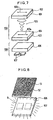
- Fig. 7 is a schematic perspective view showing a configuration example of a digital display portion of a conventional timepiece for displaying time information, calendar information, and so forth.
- a TN liquid crystal layer 105 having a twist angle of 90 degrees is sealed in a gap formed and sandwiched between a first glass substrate 101 and a second glass substrate 104, by a sealant (not shown), with a transparent electrode (omitted in the figure) formed on respective inner surfaces thereof, facing each other, thereby making up a liquid crystal display panel 100.
- a first absorption-type polarizing film 102 is disposed on the outer side of the first glass substrate 101 on the visible side of the liquid crystal display panel 100, and a second absorption-type polarizing film 103 is disposed on the outer side of the second glass substrate 104.
- the first and second absorption-type polarizing films 102, 103, and the liquid crystal display panel 100 are disposed such that the transmission axis 102a of the first absorption-type polarizing film 102 is parallel to the direction of the long axes of liquid crystal molecules on the first glass substrate 101 side of the TN liquid crystal layer 105 while the transmission axis 103a of the second absorption-type polarizing film 103 is orthogonal to the direction of the long axes of liquid crystal molecules on the second glass substrate 104 side of the TN liquid crystal layer 105.
- a backlight 108 comprising a light diffusing layer 106 and two units of red LEDs 107 is disposed on a side of the second absorption-type polarizing film 103, opposite from the visible side.
- the light diffusing layer 106 a thick plate made of polycarbonate or acrylic resin, a thick paper, or an adhesive containing grains to provide light diffusibility is used, and an embossing treatment is applied thereto as necessary in order to enhance light diffusibility.
- a display mode called normally-black display, is effected wherein transmission display of letters indicating time, and so forth is indicated against the background in black.
- Fig. 8 shows a display condition in the case wherein the backlight is lit up.
- the red LEDs 107 of the backlight are lit up with the configuration as shown in Fig. 7, a light component linearly polarized in the direction parallel to the transmission axis of the second absorption-type polarizing film 103, out of light emitted from the red LEDs 107, is transmitted through the second absorption-type polarizing film 103. Since display letters 51 shown in Fig.
- the linearly polarized light is transmitted through the TN liquid crystal layer 105 without being twisted, and then transmitted through the first absorption-type polarizing film 102 as the light linearly polarized in the direction parallel to the transmission axis thereof, thus reaching the visible side, so that display by red emitted light is effected.
- the linearly polarized light which is transmitted through the second absorption-type polarizing film 103 is twisted by 90 degrees while being transmitted through the TN liquid crystal layer 105, and turns into the light linearly polarized in the direction orthogonal to the transmission axis of the first absorption-type polarizing film 102, thereby being absorbed by the first absorption-type polarizing film 102, so that display in black is effected.
- Fig. 9 shows a display condition when the backlight is not lit up.
- the linearly polarized light is transmitted through the TN liquid crystal layer 105 without being twisted, and then transmitted through the second absorption-type polarizing film 103 as the light linearly polarized in the direction parallel to the transmission axis thereof, then reaching the light diffusing layer 106 of the backlight 108.
- the linearly polarized light that is incident on the light diffusing layer 106 is simply diffused in the direction of the red LEDs 107, and since there is not disposed a reflection layer exhibiting a strong reflectivity underneath the light diffusing layer 106, display in black is effected.
- the linearly polarized light which is transmitted through the first absorption-type polarizing film 102 is twisted by 90 degrees when transmitted through the TN liquid crystal layer 105, and turns into the light linearly polarized in the direction orthogonal to the transmission axis of the second absorption-type polarizing film 103, thereby being absorbed by the second absorption-type polarizing film 103, so that display in black is effected.
- both the portions of the display letters 61 and the portion of the background part 62 are displayed in black.
- a polarizing film used in the conventional liquid crystal display panel is an absorption-type polarizing film, and when the same is used in combination with the TN liquid crystals, display is effected by switching over into black by either transmission of light or absorption thereof by the polarizing film. More specifically, in Fig. 9, the background part 62 is displayed in black through absorption of light by the polarizing film while the display letters 61 are displayed in black due to the effect of the light diffusing layer 106. Accordingly, contrast can not be provided, rendering it difficult to visually recognize letters. As a result, every time it becomes difficult to visually recognize letters, the backlight has to be lit up to check display of time and so forth. This will not only impair operating ease but also result in an increase of power consumption, thereby posing a major problem with the conventional timepiece.
- the invention has been developed to solve the problems described in the foregoing, and it is an object of the invention to provide a timepiece using a liquid crystal display panel, whereby time information, calendar information, and so forth can be displayed with good contrast so as to be visually recognizable even when a back light is not lit up.
- the timepiece according to the invention comprises a liquid crystal display panel, made up of a liquid crystal layer sealed in a gap formed between a first substrate and a second substrate, both transparent, with an electrode formed on each of inner surfaces thereof, facing each other; and capable of displaying at least either time information or calendar information, a first polarizing film disposed on the outer side of the first substrate installed on the visible side of the liquid crystal display panel, a second polarizing film disposed on the outer side of the second substrate, and a backlight installed on a side of the second polarizing film, opposite from the visible side. Further, in order to achieve the object described above, the following configuration is adopted.
- the first polarizing film is made up of an absorption-type polarizing film absorbing the light linearly polarized in the direction orthogonal to the transmission axis thereof, a reflection-type polarizing film reflecting the light linearly polarized in the direction orthogonal to the transmission axis thereof, or the absorption-type polarizing film in combination with the reflection-type polarizing film.
- the second polarizing film is made up of the reflection-type polarizing film or the absorption-type polarizing film in combination with the reflection-type polarizing film.
- the first polarizing film is an absorption-type polarizing film absorbing the light linearly polarized in the direction orthogonal to the transmission axis thereof
- the second polarizing film is a reflection-type polarizing film reflecting the light linearly polarized in the direction orthogonal to the transmission axis thereof.
- the absorption-type polarizing film is preferably disposed relative to the liquid crystal display panel such that the transmission axis thereof is aligned substantially parallel or orthogonal to the direction of the long axes of liquid crystal molecules, located on the visible side of the twisted nematic liquid crystals while the reflection-type polarizing film is preferably disposed relative to the liquid crystal display panel such that the transmission axis thereof is aligned substantially parallel or orthogonal to the direction of the long axes of liquid crystal molecules, located on the backlight side of the twisted nematic liquid crystals.
- a retardation film is preferably installed between the first substrate of the liquid crystal display panel and the absorption-type polarizing film.
- a light diffusing layer is preferably installed on the liquid crystal display panel side of the reflection-type polarizing film.
- a color polarizing film using a dichroic pigment may be used.
- the backlight is preferably made up of a light source such as light emitting diodes, an electro-luminescence light, or the like, and the light diffusing layer for diffusing light emitted by the light source.
- a light source such as light emitting diodes, an electro-luminescence light, or the like
- the light diffusing layer for diffusing light emitted by the light source.
- the light diffusing layer may be made up of a coating comprised of a transparent adhesive with silica grains or acrylic grains diffused therein. Otherwise, a color filter may be used as the light diffusing layer.
- reflection-type display by use of external light can be effected with good contrast while display by transmission illumination by use of the backlight can be effected as well, providing sufficient brightness.
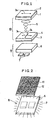
- Fig. 1 is a schematic perspective view showing a configuration of a digital display portion of the timepiece
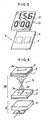
- Fig. 2 is a view showing a display condition of the timepiece when a backlight thereof is lit up
- Fig. 3 is a view showing a display condition thereof when the backlight is not lit up.
- a first substrate 1, and a second substrate 4, respectively made of glass 0.5 mm thick, are stuck with each other by providing a sealant (not shown) around the periphery of substrates, and a TN liquid crystal layer 5 having a twist angle of 90 degrees is sealed in a gap formed between the respective substrates, and is sandwiched therebetween, thereby making up a liquid crystal display panel 10.
- a display electrode and an opposite electrode are respectively formed on inner surfaces of the first substrate 1 and the second substrate 4, facing each other.
- An absorption-type polarizing film 2 as a first polarizing film is disposed on the outer side of the first substrate 1 installed on the visible side of the liquid crystal display panel 10, and a reflection-type polarizing film 3 as a second polarizing film is disposed on the outer side of the second substrate 4.
- the absorption-type polarizing film 2 is a sheet-like member absorbing the light linearly polarized in the direction orthogonal to the transmission axis thereof.
- a polarizing film composed of dyed PVA (polyvinyl alcohol) stretched with iodine, and sandwiched between TAC (triacetyl cellulose) films, having a transmittance at 46 % is used. This film has relatively high transmittance among common polarizing films.
- the absorption-type polarizing film 2 is disposed such that the direction of the long axes of liquid crystal molecules located on the visible side of the TN liquid crystal layer 5 of the liquid crystal display panel 10 (on the side of the first substrate 1) is aligned parallel with the transmission axis 2a of the absorption-type polarizing film 2.
- the reflection-type polarizing film 3 is a sheet-like member reflecting the light linearly polarized in the direction orthogonal to the transmission axis thereof, and is composed of a plurality of laminated thin films which are formed on a base film.
- D - BEF (trade name), marketed by Sumitomo 3M Co., Ltd., is used for the reflection-type polarizing film 3.
- the reflection-type polarizing film By use of the reflection-type polarizing film, the light conventionally absorbed by the absorption-type polarizing film can be reflected.
- the reflection-type polarizing film 3 is disposed such that the direction of the long axes of liquid crystal molecules located on a side of the TN liquid crystal layer 5, opposite from the visible side of the liquid crystal display panel 10 (on the side of the second substrate 4), is aligned orthogonal to the transmission axis 3a (that is, in parallel with the reflection axis 3b) of the reflection-type polarizing film 3.
- a backlight 8 comprising 2 units of red LEDs 7 and a light diffusing layer 6 for diffusing light emitted from the red LEDs 7 is disposed on a side of the reflection-type polarizing film 3, opposite from the visible side.
- An embossing treatment is applied on the surface thereto as necessary in order to enhance further light diffusibility.
- an acrylic thick plate 3 mm in thickness is adopted.
- a display mode is effected wherein transmission display of letters such as time information, and so forth is indicated in a reflected background part under the so-called normally reflection display.
- Such display will be described in more detail hereinafter.
- Fig. 2 shows a display condition when the backlight is lit up.
- display letters 11 shown in Fig. 2 represent portions of the liquid crystal display panel 10, where a voltage is applied between the electrodes (not shown), the linearly polarized light transmitted through the reflection-type polarizing film 3 is transmitted through the TN liquid crystal layer 5 without being twisted, and then transmitted through the absorption-type polarizing film 2 as the light linearly polarized in the direction parallel to the transmission axis 2a thereof, reaching the visible side, so that red emitted-light display is effected.
- the linearly polarized light which has been transmitted through the reflection-type polarizing film 3 is twisted by 90 degrees when transmitted through the TN liquid crystal layer 5, and consequently, turns into the light linearly polarized in the direction orthogonal to the transmission axis 2a of the absorption-type polarizing film 2. Accordingly, the light linearly polarized as above is absorbed by the absorption-type polarizing film 2, thereby effecting display in black.
- Fig. 3 shows a display condition when the backlight is not lit up.
- display letters 21 shown in Fig. 3 represent the portions of the liquid crystal display panel 10 in Fig. 1, where a voltage is applied between the electrodes, the linearly polarized light transmitted through the absorption-type polarizing film 2 is transmitted through the TN liquid crystal layer 5 without being twisted. Accordingly, the linearly polarized light as described is transmitted through the reflection-type polarizing film 3 as the light linearly polarized in the direction parallel to the transmission axis 3a of the reflection-type polarizing film 3, and reaches the light diffusing layer 6 disposed over the backlight 8.
- the linearly polarized light as above and incident on the light diffusing layer 6 is simply scattered in the backward direction, that is, simply diffused in the direction of the red LEDs 7, and since there is not disposed a reflection layer exhibiting a strong reflectivity underneath the light diffusing layer 6, display in black is effected.
- a background part 22 shown in Fig. 3 representing the portion of the liquid crystal display panel 10, where no voltage is applied between the electrodes
- the linearly polarized light transmitted through the absorption-type polarizing film 2 is twisted by 90 degrees when it is transmitted through the TN liquid crystal layer 5, and consequently, turns into the light linearly polarized in the direction orthogonal to the transmission axis 3a of the reflection-type polarizing film 3.
- the light linearly polarized as above is reflected fully by the reflection-type polarizing film 3, and sent back towards the visible side as it is, so that the background part 22 is displayed in a white metallic tone.
- the portions of the display letters are displayed in black, and the background part is displayed in white.
- the background will be in a display condition wherein light is reflected by the reflection-type polarizing film 3, the display condition thereof becomes visually recognizable even when the LEDs are turned off.
- the background is displayed in black, however, with the embodiment of the invention, it is possible to display the background in a white metallic tone.
- the LEDs are used as a light source of the backlight
- a fluorescent tube such as a cold cathode tube, a hot cathode tube, or the like may be used instead.
- an electro-luminescence light may be used. As it is a surface-emitting light source, uniform illumination can be provided thereby across a whole area, so that the light diffusing layer 6 may be dispensed with.
- a light diffusing layer is not disposed between the reflection-type polarizing film 3 and the second substrate 4, however, if the light diffusing layer is disposed therebetween, light subjected to specular reflection by the reflection-type polarizing film 3 can be diffused, thereby indicating display in a softer tone, so that dependence on a viewing angle is lessened.
- a common polarizing film is used for the absorption-type polarizing film 2, however, a color polarizing film using a dichroic pigment may be employed instead, so that the letters can be colored even at the time of viewing by use of external light.
- the red LEDs are used as the light source of the backlight 8, however, it is obvious that the same effect can be obtained regardless of whether a LED color is green or blue.
- a white light diffusing layer is used for the light diffusing layer 6, however, a color filter may be used instead for the light diffusing layer 6. Further, if a color filter for transmitting and scattering a light component having a wavelength substantially equivalent to that of the emitted light from the LEDs is used, light components other than that are absorbed, so that contrast at the time of viewing by use of external light can be further enhanced.
- the transmission axis 2a of the absorption-type polarizing film 2 is substantially parallel to or orthogonal to the direction of the long axes of liquid crystal molecules located on the visible side of the TN liquid crystal layer 5 of the liquid crystal display panel 10, this will be sufficient.
- the transmission axis 3a of the reflection-type polarizing film 3 is substantially parallel to or orthogonal to the direction of the long axes of liquid crystal molecules located on the backlight side of the TN liquid crystal layer 5 of the liquid crystal display panel 10, this will be sufficient.
- display can be reversed between white and black.
- Fig. 4 is a schematic perspective view showing a configuration of a digital display portion of the timepiece.
- parts corresponding to those in Fig. 1 are denoted by the same reference numerals, and description thereof is omitted.
- a STN liquid crystal layer 15 having a twist angle ranging 180 degrees to 270 degrees, is sealed in a gap formed between a first substrate 1 and a second substrate 4, and is sandwiched therebetween, thereby making up a liquid crystal display panel 20.
- a retardation film 9 is disposed on the visible side of the first substrate 1 of the liquid crystal display panel 20, and an absorption-type polarizing film 2 is disposed on top of the retardation film 9.
- a reflection-type polarizing film 3 and a backlight 8 comprising a light diffusing layer 6 and red LEDs 7 are disposed on a side of the second substrate 4, opposite from the visible side.
- the retardation film 9 and the absorption-type polarizing film 2 as well as the reflection-type polarizing film 3 are disposed on each side of the liquid crystal display panel 20, respectively, such that an angular alignment relationship among the STN liquid crystal layer 15, the retardation film 9, and the transmission axis 2a of the absorption-type polarizing film 2, and the same between the STN liquid crystal layer 15 and the transmission axis 3a (or the reflection axis 3b) of the reflection-type polarizing film 3 are optimally arranged taking into consideration spectral characteristic and transmittance.
- the reflection-type polarizing film 3 is disposed such that the transmission axis 2a of the absorption-type polarizing film 2 and the transmission axis 3a of the reflection-type polarizing film 3 are aligned in the same direction on the basis of the normally-black display condition in the case of a conventional configuration wherein an absorption-type polarizing film is used in place of the reflection-type polarizing film.
- Fig. 5 shows a display condition when the backlight is lit up.
- display letters 31 shown in Fig. 5 represent portions of the liquid crystal display panel 20 in Fig. 4, where a voltage is applied between the electrodes (not shown), the linearly polarized light transmitted through the reflection-type polarizing film 3 is transmitted through the STN liquid crystal layer 15 without being twisted, and then transmitted through the absorption-type polarizing film 2 as the light linearly polarized in the direction parallel to the transmission axis 2a of the absorption-type polarizing film 2, reaching the visible side. Accordingly, the display letters 31 are indicated in display by red emitted light
- a background part 32 shown in Fig. 5, representing a portion of the liquid crystal display panel 20 in Fig. 4, where no voltage is applied between the electrodes the linearly polarized light which is transmitted through the reflection-type polarizing film 3 is twisted when transmitted through the STN liquid crystal layer 15, so as to turn into the light linearly polarized in the direction orthogonal to the transmission axis 2a of the absorption-type polarizing film 2, and consequently, is absorbed by the absorption-type polarizing film 2, thereby effecting display in black.
- Fig. 6 shows a display condition when the backlight is not lit up.
- display letters 41 shown in Fig. 6 represent portions of the liquid crystal display panel 20, where a voltage is applied between the electrodes, the linearly polarized light transmitted trough the absorption-type polarizing film 2 is transmitted trough the STN liquid crystal layer 15 without being twisted. Accordingly, the linearly polarized light as described is transmitted trough the reflection-type polarizing film 3 and reaches the light diffusing layer 6 disposed over the backlight 8.
- the linearly polarized light incident on the light diffusing layer 6 is simply scattered in the backward direction, that is, diffused in the direction of the red LEDs 7, and since there is not disposed a reflection layer exhibiting a strong reflectivity underneath the light diffusing layer 6, display in black is indicated.
- a background part 42 shown in Fig. 6, representing a portion of the liquid crystal display panel 20 in Fig. 4, where no voltage is applied between the electrodes the linearly polarized light which is transmitted through the absorption-type polarizing film 2 is twisted when transmitted through the STN liquid crystal layer 15, and accordingly, is turned into the linearly polarized light in the direction orthogonal to the transmission axis 3a of the reflection-type polarizing film 3. Consequently, the linearly polarized light as above is reflected in full by the reflection-type polarizing film 3, and sent back to the visible side as it is, so that the background part 42 is displayed in a white metallic tone.
- the background part 42 is displayed in a metallic tone, and the portions of the display letters 41 are displayed in black.
- the background is indicated in a display condition exhibiting a reflection characteristic, the display condition thereof becomes visually recognizable even when the LEDs are turned off. Furthermore, in the case wherein the absorption-type polarizing film is used in the conventional way, the background is displayed in black, however, according to the embodiment of the invention, it is possible to indicate the background in a white color, effecting display with good contrast.
- a single absorption-type polarizing film is used for the first polarizing film disposed on the visible side of the liquid crystal display panel, and a single reflection-type polarizing film is used for the second polarizing film disposed on the backlight side.
- a plurality of the respective polarizing films may be disposed on both sides.
- the first polarizing film is not limited to an absorption-type polarizing film, but may be a reflection-type polarizing film, or may be made up of an absorption-type polarizing film in combination with a reflection-type polarizing film.
- the second polarizing film may also be made up of a reflection-type polarizing film in combination with an absorption-type polarizing film.
- the timepiece according to the invention provided with the absorption-type polarizing film, the liquid crystal display panel, the reflection-type polarizing film, and the backlight, it is possible to display time information and calendar information with contrast sufficient to visually recognize the display condition thereof in both a state wherein the backlight is not lit up and a state wherein the backlight is lit up.
- various digital timepieces such wrist watches, desk clocks, and so forth, it is possible to enhance considerably visibility of display, to reduce significantly frequency at which the backlight need be put to use, and to decrease consumption of a battery.
Landscapes
- Physics & Mathematics (AREA)
- General Physics & Mathematics (AREA)
- Nonlinear Science (AREA)
- Chemical & Material Sciences (AREA)
- Crystallography & Structural Chemistry (AREA)
- Mathematical Physics (AREA)
- Optics & Photonics (AREA)
- Liquid Crystal (AREA)
- Electric Clocks (AREA)
- Devices For Indicating Variable Information By Combining Individual Elements (AREA)
Applications Claiming Priority (3)
| Application Number | Priority Date | Filing Date | Title |
|---|---|---|---|
| JP20746097 | 1997-08-01 | ||
| JP20746097 | 1997-08-01 | ||
| PCT/JP1998/003446 WO1999006883A1 (en) | 1997-08-01 | 1998-08-03 | Timepiece |
Publications (2)
| Publication Number | Publication Date |
|---|---|
| EP1008894A4 EP1008894A4 (de) | 2000-06-14 |
| EP1008894A1 true EP1008894A1 (de) | 2000-06-14 |
Family
ID=16540145
Family Applications (1)
| Application Number | Title | Priority Date | Filing Date |
|---|---|---|---|
| EP98935330A Ceased EP1008894A1 (de) | 1997-08-01 | 1998-08-03 | Zeituhr |
Country Status (6)
| Country | Link |
|---|---|
| EP (1) | EP1008894A1 (de) |
| KR (1) | KR100322929B1 (de) |
| CN (1) | CN1158562C (de) |
| AU (1) | AU8462898A (de) |
| BR (1) | BR9811720A (de) |
| WO (1) | WO1999006883A1 (de) |
Cited By (2)
| Publication number | Priority date | Publication date | Assignee | Title |
|---|---|---|---|---|
| EP1217422A4 (de) * | 1999-10-01 | 2003-03-26 | Citizen Watch Co Ltd | Flüssigkristallanzeigeschirm und diesen verwendendes elektronisches gerät |
| US20110056354A1 (en) * | 2007-09-08 | 2011-03-10 | Lg Chem, Ltd. | Cutting frame of high cutting efficiency |
Families Citing this family (6)
| Publication number | Priority date | Publication date | Assignee | Title |
|---|---|---|---|---|
| JP2001264524A (ja) * | 2000-03-15 | 2001-09-26 | Kimoto & Co Ltd | 半透過半反射板、及び半透過半反射型液晶表示装置 |
| CN2748953Y (zh) * | 2004-09-28 | 2005-12-28 | 中惠国际发展(集团)有限公司 | 设有智能背光装置的计时器 |
| JP6359338B2 (ja) * | 2014-05-22 | 2018-07-18 | スタンレー電気株式会社 | 液晶表示装置 |
| CN106526951B (zh) * | 2016-11-29 | 2021-01-26 | 京东方科技集团股份有限公司 | 一种镜面显示装置及其控制方法 |
| CN110865494B (zh) * | 2019-12-04 | 2022-06-14 | 中国科学院宁波材料技术与工程研究所 | 一种液晶显示器及其制备方法 |
| EP4016172B1 (de) * | 2020-12-21 | 2025-05-14 | The Swatch Group Research and Development Ltd | Verfahren zur herstellung einer flüssigkristallanzeigevorrichtung und flüssigkristallanzeigevorrichtung |
Family Cites Families (9)
| Publication number | Priority date | Publication date | Assignee | Title |
|---|---|---|---|---|
| CA1278118C (en) * | 1986-02-05 | 1990-12-18 | Richard A. Pidsosny | Multicolor liquid crystal display system |
| KR100430351B1 (ko) * | 1993-12-21 | 2004-05-04 | 미네소타 마이닝 앤드 매뉴팩춰링 캄파니 | 휘도 향상 디바이스 |
| KR100344364B1 (ko) * | 1993-12-21 | 2002-11-30 | 미네소타 마이닝 앤드 매뉴팩춰링 캄파니 | 광학편광자및디스플레이장치 |
| EP0871923A1 (de) * | 1995-06-26 | 1998-10-21 | Minnesota Mining And Manufacturing Company | Transflektive anzeige mit reflektierendem polarisierendem transflektor |
| JP3526994B2 (ja) * | 1995-11-14 | 2004-05-17 | 株式会社エンプラス | 偏光変換素子を用いた偏光化機能付き面光源装置 |
| JP3331903B2 (ja) * | 1996-08-23 | 2002-10-07 | セイコーエプソン株式会社 | 表示素子及びそれを用いた電子機器 |
| CN1140835C (zh) * | 1997-05-07 | 2004-03-03 | 精工爱普生株式会社 | 显示元件和电子表 |
| EP0884621A3 (de) * | 1997-06-09 | 1999-10-27 | Seiko Epson Corporation | Elektronische Uhr |
| JP3204512B2 (ja) * | 1997-07-14 | 2001-09-04 | シチズン時計株式会社 | 液晶表示装置 |
-
1998
- 1998-08-03 KR KR1019997011856A patent/KR100322929B1/ko not_active Expired - Fee Related
- 1998-08-03 EP EP98935330A patent/EP1008894A1/de not_active Ceased
- 1998-08-03 AU AU84628/98A patent/AU8462898A/en not_active Abandoned
- 1998-08-03 CN CNB988064510A patent/CN1158562C/zh not_active Expired - Fee Related
- 1998-08-03 BR BR9811720-3A patent/BR9811720A/pt not_active IP Right Cessation
- 1998-08-03 WO PCT/JP1998/003446 patent/WO1999006883A1/ja not_active Ceased
Cited By (2)
| Publication number | Priority date | Publication date | Assignee | Title |
|---|---|---|---|---|
| EP1217422A4 (de) * | 1999-10-01 | 2003-03-26 | Citizen Watch Co Ltd | Flüssigkristallanzeigeschirm und diesen verwendendes elektronisches gerät |
| US20110056354A1 (en) * | 2007-09-08 | 2011-03-10 | Lg Chem, Ltd. | Cutting frame of high cutting efficiency |
Also Published As
| Publication number | Publication date |
|---|---|
| KR20010013836A (ko) | 2001-02-26 |
| WO1999006883A1 (en) | 1999-02-11 |
| EP1008894A4 (de) | 2000-06-14 |
| CN1261442A (zh) | 2000-07-26 |
| AU8462898A (en) | 1999-02-22 |
| CN1158562C (zh) | 2004-07-21 |
| HK1028108A1 (en) | 2001-02-02 |
| KR100322929B1 (ko) | 2002-02-02 |
| BR9811720A (pt) | 2000-09-26 |
Similar Documents
| Publication | Publication Date | Title |
|---|---|---|
| JP3405547B2 (ja) | 時 計 | |
| EP0936492B1 (de) | Flüssigkristall-anzeigevorrichtung | |
| US4196973A (en) | Transflector for illuminated electrooptic displays | |
| US6707515B1 (en) | Liquid crystal display | |
| US6271901B1 (en) | Liquid crystal display device with two reflective polarizers providing metallic appearance effects | |
| US20080030656A1 (en) | Transflective lc display with internal reflector and reflective polarizer | |
| JP2001083509A (ja) | 液晶表示装置およびそれを用いた電子機器 | |
| JPWO1999045427A1 (ja) | 時 計 | |
| US6643224B1 (en) | Timepiece including multiple liquid crystal displays | |
| JP3490096B2 (ja) | 液晶表示パネル | |
| US6930738B1 (en) | Liquid crystal display with particular reflective switched states | |
| EP1008894A1 (de) | Zeituhr | |
| JP2004354818A (ja) | 表示装置 | |
| EP1063562A1 (de) | Anzeigevorrichtung und elektronische uhr | |
| US6351297B1 (en) | Liquid crystal display panel for using in a timepiece comprising reflective polarizers and absorption film | |
| JP3419317B2 (ja) | 液晶表示装置およびそれを用いた電子機器 | |
| JPWO1998010327A1 (ja) | 液晶パネルおよびこれを用いた電子機器 | |
| JP3744195B2 (ja) | 液晶装置、電子機器及び時計 | |
| EP0890866B1 (de) | Elektronische Uhr | |
| JP4169066B2 (ja) | 液晶表示装置及び電子機器 | |
| JP4196976B2 (ja) | 液晶表示装置及びそれを用いた電子機器 | |
| JP3027612B2 (ja) | 液晶表示装置 | |
| JPWO1999006883A1 (ja) | 時計装置 | |
| JP3901205B2 (ja) | 液晶表示装置及び電子機器 | |
| JP2002236189A (ja) | 時 計 |
Legal Events
| Date | Code | Title | Description |
|---|---|---|---|
| PUAI | Public reference made under article 153(3) epc to a published international application that has entered the european phase |
Free format text: ORIGINAL CODE: 0009012 |
|
| 17P | Request for examination filed |
Effective date: 20000204 |
|
| A4 | Supplementary search report drawn up and despatched |
Effective date: 20000425 |
|
| AK | Designated contracting states |
Kind code of ref document: A4 Designated state(s): CH DE FR GB LI Kind code of ref document: A1 Designated state(s): CH DE FR GB LI |
|
| 17Q | First examination report despatched |
Effective date: 20001026 |
|
| RAP1 | Party data changed (applicant data changed or rights of an application transferred) |
Owner name: CITIZEN WATCH CO. LTD. |
|
| STAA | Information on the status of an ep patent application or granted ep patent |
Free format text: STATUS: THE APPLICATION HAS BEEN REFUSED |
|
| 18R | Application refused |
Effective date: 20020131 |