EP1008959B1 - Systeme et procede de traitement d'image - Google Patents
Systeme et procede de traitement d'image Download PDFInfo
- Publication number
- EP1008959B1 EP1008959B1 EP98940626A EP98940626A EP1008959B1 EP 1008959 B1 EP1008959 B1 EP 1008959B1 EP 98940626 A EP98940626 A EP 98940626A EP 98940626 A EP98940626 A EP 98940626A EP 1008959 B1 EP1008959 B1 EP 1008959B1
- Authority
- EP
- European Patent Office
- Prior art keywords
- image processing
- virtual
- fish
- positions
- calculating
- Prior art date
- Legal status (The legal status is an assumption and is not a legal conclusion. Google has not performed a legal analysis and makes no representation as to the accuracy of the status listed.)
- Expired - Lifetime
Links
Images





Classifications
-
- G—PHYSICS
- G06—COMPUTING OR CALCULATING; COUNTING
- G06T—IMAGE DATA PROCESSING OR GENERATION, IN GENERAL
- G06T13/00—Animation
- G06T13/20—Three-dimensional [3D] animation
- G06T13/40—Three-dimensional [3D] animation of characters, e.g. humans, animals or virtual beings
Definitions
- the present invention relates to an image processing system and image processing method. More particularly, the present invention relates to the image processing of an enjoyable game where such a creature as a live fish can be moved in a state close to nature in a three-dimensional virtual space so as to enjoy the creature just like an actual creature, and interaction between the movement of the creature and the player is implemented.
- a conventional system for this enjoyable game generally comprises a CPU for graphics processing and a monitor.
- a CPU for graphics processing and a monitor.
- position information on the movement of the fish in a tank set in a virtual game space is patterned in advance, and hundreds of patterns are determined.
- the CPU selects the position information of movement which is patterned according to the situation, calculates a position of the object simulating a fish based on this information, interpolates the movement by matrix (rotation, movement) based on the motion capture, and regenerates and displays the images.
- the positions and movements of the plurality of fish are calculated and displayed based on specific information representing the environment, that is, ocean current.
- the position information of movement of the mobile object is merely patterned or the position information is merely calculated along with such specific information as ocean current, and in the case of movement regenerated by the conventional predetermined matrix, such as motion capture, sufficient naturalness to express movement of a live creature is lacking.
- the conventional method is limited to express movement of a live creature.
- the player merely looks at a monitor, which is an artificial tank, and there is no interaction seen in nature, such as a fish in a tank approaching or swimming away, depending on the action of the player.
- Another object is to provide an enjoyable game which can express interaction which actually occurs in nature, between the mobile object simulating such a creature as a fish in a three-dimensional virtual space and the player, so that reality can be improved along with enhancing amusement.
- Tu X, Terzopoulos D "Artificial Fishes: Physics, Locomotion, Perception, Behavior”; Proceedings or 21 st International SIGGRAPH Conference, 24-29 July 1994, Orlando, FL, USA; Computer Graphics Proceedings. Annual Conference Series 1994, ACM, NY, USA; pp 43-50 discloses a technique of animation providing realistic appearance, movement and behaviour of animals.
- the article focuses on the synthesis of realistic fish locomotion, based on a dynamic fish model consisting of nodal point masses and springs.
- One described behaviour routine involves the fish performing random turns, based on random turn angles.
- an image processing unit for generating image data for displaying movements and/or motions of an object simulating a living creature by defining the object in a three-dimensional virtual space, setting successive target points in the three-dimensional virtual space with respect to the object, calculating movements and/or motions for the object in correspondence with each such successive set target point, and generating the image data based on the calculated result, characterized in that the target point is repeatedly updated by re-selecting each time from a table wherein a plurality of preset random values for positions in the three-dimensional virtual space are set in advance, and in that said calculation of movements and/or motions includes calculating the force of rotation exerted on the object.
- an image processing method for generating image data for displaying movements and/or motions of an object simulating a living creature comprising the steps of: defining the object in a three-dimensional virtual space, setting successive target points in the three-dimensional virtual space with respect to the object, calculating movements and/or motions of the object in correspondence with each such successive target point, and generating the image data based on the calculated result, CHARACTERIZED BY repeatedly updating the target point by reselecting each time from a table wherein a plurality of random values for positions in the three-dimensional virtual space are set in advance, and as part of said calculating step, calculating the force of rotation exerted on the object.
- Fig. 1 shows an example of a configuration of an image processing system in accordance with the embodiment. This image processing system is for executing an enjoyable game of tropical fish which move in a virtual game space.
- the image processing system comprises a monitor 1a for displaying images, the main body 1 for processing images to be displayed on the monitor 1a, a tank 2 which is mounted on the monitor 1a, and a sensor 3 which is mounted on the front face of the tank 2.
- the main body 1 has a game processing board 10, speaker 14, and various output devices 12 in a casing which is formed as a rectangular parallelepiped with the width longer than the height. The electric configuration and operation of these elements will be described later.
- the monitor 1a is a display device having a display screen with a width that is longer than the height, and is placed on the main body 1.
- the monitor 1a displays fish (tropical fish in this case) represented by polygons and background images.
- the size and shape of the display screen of the monitor 1a is not limited to one with a width that is longer than the height, but various sizes and shapes can be used depending on the intended use.
- the tank 2 is mounted to create an atmosphere of an actual tank, where water is expressed by generating bubbles.
- This tank 2 also has a shape, where the width is longer than the height and the depth is shallow, so as to match the shape of the monitor 1a, and is made of transparent glass.
- the tank 2 is mounted on the front face of the monitor 1a, as shown in Fig. 2, and a state to enjoy fish in an actual tank can be artificially created by viewing the fish and background displayed on the screen of the monitor 1a from the tank 2 side.
- the sensor 3 is comprised of a matrix sensor where infrared sensors are arranged in a matrix, and is disposed on the front face of the tank 2, as shown in Fig. 2.
- the display part of this system has a layered structure of a matrix sensor 3, tank 2 and monitor 1a. If the player lightly taps or touches the tank, the sensor 3 detects this operation and outputs a two-dimensional position signal corresponding to the detected position to the game processing board 10 of the main body 1 (see Fig. 3).
- the game processing board 10 executes such image processing as polygon (e.g. fish) movement processing, position control of the view point camera, and wave processing in the three-dimensional virtual space based on this position signal, which is described later.
- the game processing board 10 shown in Fig. 4 is in the main body 1.
- a monitor (display) 1a, sensor 2, such output devices 12 as a display, and such equipment as a speaker 14 are electrically connected to the game processing board 10. The player can play the enjoyable game by touching the sensor 2 at will while looking at the screen of the tropical fish displayed on the monitor 1a.
- the game processing board 10 comprises a counter 100, a CPU (Central Processing Unit) 101, ROM 102, RAM 103, sound unit 104, input/output interface 106, scroll data processing unit 107, coprocessor (auxiliary arithmetic processing unit) 108, topographic data ROM 109, geometrizer 110, shape data ROM 111, drawing unit 112, texture data ROM 113, texture map RAM 114, frame buffer 115, image synthesizer 116 and D/A converter 117.
- a CPU Central Processing Unit
- ROM 102 Read Only Memory
- RAM 103 random access memory
- sound unit 104 input/output interface
- scroll data processing unit 107 scroll data processing unit 107
- coprocessor (auxiliary arithmetic processing unit) 108 topographic data ROM 109
- geometrizer 110 shape data ROM 111
- drawing unit 112 texture data ROM 113
- texture map RAM 114 texture map RAM 114
- frame buffer 115 frame buffer 115
- image synthesizer 116 D/
- the CPU 101 is connected to the ROM 102, where predetermined programs and image processing programs are stored, and to the RAM 1 for storing operation data, sound unit 104, input/output interface 106, scroll data processing unit 107, coprocessor 108 and geometrizer 110 via bus lines.
- the RAM 103 functions as a buffer, and is used for writing various commands (e.g. to display objects) to the geometrizer and for writing of necessary data during various operations.
- the input/output interface 106 is connected to the sensor 3. By this, such control signals as position signals from the sensor 3 are digitally input to the CPU 101.
- the sound unit 104 is connected to the speaker 14 via a power amplifier 105. By this, the power of acoustic signals generated by the sound unit 104 is amplified and output from the speaker 14 as sound.
- the CPU 101 reads control signals from the sensor 3, topographic data from the topographic data ROM 109, or shape data (an “object simulating tropical fish", and such three-dimensional data as "background, including topography, sky, rocks, sea floor, and various structures") based on the programs stored in the ROM 102, and executes object behavior calculation (simulation) and other calculations.
- the behavior calculation is for simulating movement of an object (tropical fish) in a three-dimensional virtual space (game space).
- the coordinate values of the polygons of the object in the three-dimensional virtual space are determined, then the conversion matrix, to convert these coordinate values to a two-dimensional view field coordinate system and shape data (polygon data), are specified in the geometerizer 110.
- the topographic data ROM 109 is connected to the coprocessor 108, and the predetermined topological data is transferred to the coprocessor 108 and the CPU 101.
- the coprocessor 108 primarily executes the calculation of floating points. Since the coprocessor 108 executes various judgments and a judgment result is transferred to the CPU 110, the calculation load on the CPU can be decreased.
- the geometrizer 110 is connected to the shape data ROM 111 and the drawing unit 112.
- the shape data (three-dimensional data on an object comprised of each vertex, topology and background), comprised of a plurality of polygons, has been stored in advance in the shape data ROM 111. This shape data is transferred to the geometrizer 110.
- the geometrizer 110 executes perspective transformations for the specified shape data using the transformation matrixes sent from the CPU 110, so as to obtain data where the coordinate system in the three-dimensional virtual space has been transformed to a viewing coordinate system.
- the drawing unit 112 adds texture to the transformed shape data in the viewing coordinate system, and outputs it to the frame buffer 115.
- the drawing unit 112 is connected to the texture data ROM 113 and the texture map RAM 114, and is also connected to the frame buffer 115.
- Polygon data refers to the coordinate data group of relative or absolute coordinates of each vertex of polygons (primarily triangles and quadrangles), comprised of a plurality of sets of vertexes. Relatively rough polygon data, which is sufficient for executing a predetermined judgment (e.g. contact judgment) is stored in the topographic data ROM 109. In the shape data ROM 111, on the other hand, more detailed polygon data on shapes, such as objects and background of the screen, is stored.
- the scroll data processing unit 107 calculates data, such as characters, on the scroll screen (stored in the ROM 102).
- This processing unit 107 and the frame buffer 115 are connected to the monitor 1a via the image synthesizer 116 and the D/A converter 117. Because of this, the polygon screen on topography (background) temporarily stored in the frame buffer 115 and the scroll screen on character information are synthesized according to the specified priorities, and a final frame image data is generated at predetermined timing.
- This frame image data is converted to analog signals by the D/A converter 117, is sent to the monitor 1a, and is displayed as a game screen in real-time.
- Fig. 5 shows the main processing routine which is repeated for each interrupt (e.g. 1/60 seconds), synchronizing the display frame cycle of the monitor 1a, and Fig. 6 shows the detailed sub-routine of the target point determination processing in Fig. 5.
- the CPU 101 reads the output signal of the sensor 3 (Fig. 5, Step S1), then executes processing for determining the target point of the movement of the fish according to this reading result (Step S2).
- the target point determination processing is executed by the CPU 101, as shown in Fig. 6.
- the CPU 101 judges whether a signal has been output from the sensor 2 (Fig. 6, Step S2 - 1). If the result of this judgment is NO, that is, if the player did not touch the sensor, then the target point m (m.x, m.y, m.z) of the movement is selected as follows from the discrete table (random numbers) which has been preset (Step S2 - 2).
- the timer 1 is the counter to update the table.
- x, y and z denote the current coordinate position of the fish (tropical fish).
- This target point m is updated at each 30 - 40 interrupts, for example. When a plurality of fish are kept, the target point and the number of interrupts for updating are changed for each fish.
- This setting of the target point is one characteristic of the present invention, and expresses the natural behavior of fish.
- Step S2 - 1 If the result of the judgment in Step S2 - 1 is YES, then it is further judged whether the signal received from the player via the sensor 2 indicates a position or fish food in Step S2 - 3 (see Fig. 16).
- the sensor signal when the payer touches the sensor 2 is recognized as a signal indicating a position, and the sensor signal when touched by the player two or more times or for a different duration of time is recognized as a signal indicating fish food.
- the target point is further corrected (Step S 2 - 6).
- This correction processing is executed for (Xmax., Ymax, Zmax), which indicates the maximum value of the spatial position in the virtual tank, which is set in a three-dimensional virtual space, and (Xmin, Ymin, Zmin), which indicates the minimum value of the spatial position in the virtual tank.
- the target point m (m.x, m.y, m.z) which was set is set to:
- Step S3 the propelling speed of the fish (speed) is determined referring to the preset value, for example, in the table for each fish type. This propelling speed (speed) may be changed depending on the fish food which appears when the player touches the sensor 3, as mentioned above, or depending on the water temperature. In this way the degree of active movement of fish can be adjusted.
- Step S4 the CPU 101 calculates the force Fw (Fw.x, Fw.y, Fw.z) of the rotation component exerted on to the fish. Details are as follows.
- L denotes a distance between the point p and the point m in each x, y and z direction.
- the force Fw of the rotation component is calculated.
- F w . x m . y ⁇ p . y ⁇ k 1
- k0 and k1 are constants.
- (r.y) indicates the y coordinate component of the rotation angle r of the fish seen in the global coordinate.
- the rotation force to prevent contacting the wall is a value predetermined as a constant.
- the rotation force to prevent contacting other fish is also a predetermined value.
- the force Fw of the general rotation component is calculated as a synthesis of forces in each condition mentioned above.
- the CPU 101 then advances to Step S5, and calculates the rotation angle of the fish.
- the angular acceleration is aw (aw.x, aw.y, aw.z)
- the angular speed is w (w.x, w.y, w.z)
- the rotation angle is r (r.x, r.y, r.z)
- the resistance coefficient of water is resist.
- k is a constant.
- k is a constant.
- the CPU 101 calculates the force Fv (Fv.x, Fv.y, Fv.z) exerted on the fish in Step S6.
- the resultant force Fv exerted on a fish is calculated by synthesizing each force mentioned above.
- the CPU 101 advances to the Step S7 and calculates the position of the fish.
- the acceleration is av (av.x, av.y, av.z)
- the speed is v (v.x, v.y, v.z)
- the position is p (p.x, p.y, p.z)
- the resistance coefficient of water is resist.
- k is a constant.
- Fig. 8 shows an example of the virtual bones 1 - 6.
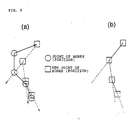
- Step S8 the position p of the fish determined in Step S7 is set as the first bone position closest to the head among the plurality of virtual bones 1 - 6, and the next bone is sequentially calculated.
- the conditions to determine the position of a bone at the next joint are:
- angular speed relevant to will of the fish
- this angular speed which is relevant to the will of the fish
- the bone for which angular speed, which is relevant to the will of the fish, is predetermined depending on the fish. Specifically, the following processing is repeated for the number of joints of the bones.
- the direction vector bone [i].v from the joint of the bone i-1 to the joint of the bone i is determined.
- Fig. 9 (a) and (b) show an example of the position control of the virtual bones.
- the CPU 101 sets the view point of a virtual camera, focusing on the fish and fish food, which the player is paying attention to. Because of this, the screen displayed on the monitor 1a via the later mentioned drawing processing is the view from the camera view point which is set here.
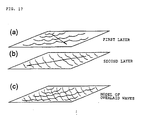
- Steps S12 - S13 These processings, which are for promoting the atmosphere of the fish in water, express a fish floating in waves using a simple model of waves, and creates light waves projected in the water using the rotation and position data of the simple model.
- Step S12 a simple model for a small wave is set, and the physical constant related to this model is calculated.
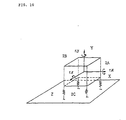
- the simple model which is preset and stored, as shown in Fig. 10, is read.
- This simple model has a rectangular parallelepiped shape, where sides are 2A, 2B and 2C, and a mass is M, and four corners of the base are supported by springs.
- the spring constants in the vertical direction and horizontal direction of each spring are k1 and k2 respectively.
- the position of the center of gravity is the origin, and moment of inertia is I1, I2 and I3.
- the acceleration vector is av (x, y, z), speed vector is v (x, y, z), speed vector is u (x, y, z), position is p (x, y, z), angular acceleration is aw (x, y, z), angular speed is w (x, y, z), and the angle is r (x, y, z).
- Moving waves can be expressed by reflecting the position p (x, y, z) and the rotation angle r (x, y, z) to the fish body, wave surfaces and background.
- Step S13 data to express the light waves is created.
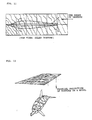
- the model where light wave texture is projected on the polygon model is drawn on the ordinary polygon model of a fish to express the waves projected on the fish.
- the light wave texture is always projected on the fish in global coordinate by X - Z plane projection, as shown in Figs. 11 and 12. (Actually a fish is in a state close to this X - Z plane projection since in the ocean it receives light from the top.) Since the position and rotation status of the fish changes in real-time, texture projection processing is executed in real-time.
- each polygon of the fish with parallel-projected texture is changed according to how light contacts the fish. For example, light is brighter when a fish is closer to the sea surface, and areas where light does not contact are set to be transparent polygons, as shown in Fig. 13.
- a light source vector is irradiated from the outside to the virtual tank at a predetermined angle, and this light source vector is calculated from the simple model of waves. In this way, the light source vector precesses when the light source vector enters the virtual tank (see Fig. 14). If the angle formed by the light source vector and normal vector of the polygon is an acute angle, as shown in Fig.
- the polygon is set to be a transparent polygon, judging that light does not contact the polygon. If the angle is an obtuse angle, on the other hand, as shown in Fig. 15 (a), transparency is set to be higher as the angle becomes smaller, since brightness increases as the angle increases.
- T 0 is set since light does not contact.
- the polygon is drawn with this texture pointer (U, V) and the polygon transparency T.
- Step S14 The various calculation information obtained in this way is transferred to the geometrizer 110 and the scroll data processing unit 107 in Step S14, where drawing processing for each interrupt is instructed.
- a fish moving in real-time can be expressed on the screen of the monitor 1a.
- the movement of this fish is controlled using a target point, and the target point is updated for each predetermined number of interrupts or is updated according to the touch of the player on the sensor.
- processing for expressing the behavior of such living creatures as a tropical fish is relatively easy, the processing volume is small, and creature movement looks more natural than the method for interpolating previously created data on movement (movement data, matrix data on rotation/enlargement or shrinkage).
- the player can signal a fish or feed a fish by tapping or touching the sensor, as shown in Fig. 16, with the fish responding by swimming away or approaching based on instructions from the player.
- the player can enjoy an enjoyable game while interactively communicating with fish in a tank in a three-dimensional virtual space, just like an actual tank.
- Images can be displayed with a camera view point, focusing on fish or fish food which the player is paying attention to. This means that a feeling of virtual reality, slightly different from an actual tank, can be created, and an enjoyable game offering considerable amusement can be provided.
- a living creature to be the subject of this enjoyable game is not limited to the above mentioned tropical fish (fish), but may be such creatures as a bird or insect.
- the target point can be set not only to a point around the virtual tank, as in the above mentioned embodiment, but to another fish which is different from the control target fish, or to a point, an area, or a range in a space outside the virtual tank.
- the target point can be moved according to the movement of the fish at an appropriate timing, period or time, whether the fish reaches the target point or not, and it is also possible to set a new target point. Because of this, the movement of various objects (fish) can be freely simulated using a small volume of data.
- the movement of the fish can be reproduced without calculating the angle as above.
- "b. The angle at which a bone can bend is limited (bones do not make a turn at a joint)" is changed to "Vn vector is pulled at a predetermined force in the direction to straighten the fish (vector f)". Because of this change, the modified embodiment has the advantage in that the calculation time for determining the angle can be omitted. One reason why calculation time can be omitted is because the calculation for the arc tangent is unnecessary.
- the modified embodiment also has the advantage in that the movement of the fish is smoother compared to the above mentioned case where the angle is limited. If the angle is limited, the movement of the fish at the limit of the angle becomes rigid, and the behavior of the fish becomes more unnatural compared with the behavior of a real fish. Since this embodiment does not set a limitation on the angle, the swimming behavior of the fish does not become unnatural.
- Fig. 19 shows the joint position control for fish according to this modified embodiment.
- the Vn vector in Fig. 18 is changed to the V'n vector. This vector is changed as follows.
- V'n vector The direction of the V'n vector is a direction where the Vn vector and the vector f are added.
- V ′ n . x P n . x ⁇ P n ⁇ 1. x + f . x
- V ′ n . y P n . y ⁇ P n ⁇ 1. y + f . y
- V ′ n . z P n . z ⁇ P n ⁇ 1. z + f . z
- the flexibility of the fish body can be changed.
- the position of the joint of the bone of the fish is determined as follows as described for the previous embodiment.
- P n . x P n ⁇ 1. x ⁇ U . x ⁇ distance between joint n and joint n ⁇ 1
- P n . y P n ⁇ 1. y + U . y ⁇ distance between joint n and joint n ⁇ 1
- P n . z P n ⁇ 1. z + U . z ⁇ distance between joint n and joint n ⁇ 1
- the vector U here is the unit vector of the vector V'n.
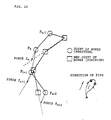
- Fig. 20 is a more advanced example than Fig. 19, where the number of joints is increased to 4.
- the vector f has a direction directing from the first joint Pn-1 (head of the fish) in the joint positions of the previous frame (shown by ⁇ ) to the center of the gravity of the fish.
- the center of the fish that is, the point between the joint Pn and the joint Pn + 1, is determined to be the center of gravity.
- Calculation of the new position of the joint of the bone can be sequentially executed for the continuous joints using the method described in Fig. 18.
- the vectors f+1 and f+2 for different joints can be changed respectively.
- Objects, other than fish, which behave as if joints exist include insects and reptiles.
- Other objects whose behavior can be controlled with virtual joints are long string type objects, the movement of hair and the movement of cloth.
- An object which moves by "snaking" is also included in this category.
- the behavior of these objects can be displayed as more real by providing a plurality of joints, and by calculating the positions of adjacent joints sequentially in real-time.
- the movement of a mobile object is simulated based on the target point of the movement of the mobile object so as to calculate image data and this image data is displayed, therefore the movement of a living creature, such as fish in a three-dimensional virtual space can be expressed as more real and natural, and a very realistic enjoyable game, which allows enjoying living creates as if they were real creatures, can be provided. It is also possible to express interaction between the mobile object and the player by simulating such living creatures as a fish in a three-dimensional virtual space, therefore a realistic feeling can be enhanced and an enjoyable game offering amusement can be provided.
- ROM 102 corresponds to a storage medium where programs for the game machine to implement the above explained image processing operations are stored.
- ROM includes CD-ROM and cassette ROM.
- a floppy disk, hard disk or communication medium may also be used.
- a RAN server may be included here.
Landscapes
- Physics & Mathematics (AREA)
- General Physics & Mathematics (AREA)
- Engineering & Computer Science (AREA)
- Theoretical Computer Science (AREA)
- Processing Or Creating Images (AREA)
Abstract
Claims (28)
- Unité de traitement d'image (10) pour générer des données d'image pour afficher des mouvements et/ou des déplacements d'un objet simulant une créature vivante en définissant l'objet dans un espace virtuel tridimensionnel, en positionnant des points cibles successifs dans l'espace virtuel tridimensionnel par rapport à l'objet, en calculant les mouvements et/ou les déplacements de l'objet en correspondance avec chaque point cible successif, et en générant les données d'image sur la base du résultat calculé, caractérisée en ce que le point cible est actualisé à répétition en re-sélectionnant à chaque fois dans un tableau dans lequel une pluralité de valeurs aléatoires prédéterminées pour des positions dans l'espace virtuel tridimensionnel sont établies à l'avance, et en ce que ledit calcul des mouvements et/ou des déplacements comprend le calcul de la force de rotation exercée sur l'objet.
- Unité de traitement d'image selon la revendication 1, dans laquelle le positionnement du point cible est répété à une période de temps prédéterminée.
- Unité de traitement d'image selon la revendication 1 ou 2, caractérisée en ce que les données d'image pour l'objet sont générées en définissant une pluralité d'os virtuels pour la créature vivante, en calculant les positions de l'objet dans l'espace virtuel tridimensionnel par rapport aux points cibles successifs, en calculant séquentiellement les positions des os virtuels pour l'objet en utilisant les positions de l'objet, en calculant les positions de sommets respectifs des polygones en utilisant les positions des os virtuels, et en générant des données d'image dudit objet sur la base des sommets respectifs.
- Unité de traitement d'image selon l'une quelconque des revendications 1 à 3, dans laquelle les données d'image pour exprimer des déplacements de l'objet sont générées en définissant une pluralité d'articulations virtuelles pour l'objet, en calculant les positions des articulations virtuelles, et en calculant des données d'image exprimant des déplacements de l'objet sur la base des positions des articulations virtuelles.
- Unité de traitement d'image selon l'une quelconque des revendications 1 à 4 comprenant en outre un capteur pour détecter la manipulation par un joueur,
dans laquelle les points cibles sont actualisés en réponse à des signaux du capteur. - Système de traitement d'image comprenant une unité de traitement d'image selon l'une quelconque des revendications 1 à 4, une unité d'affichage (la) sur laquelle l'image générée par l'unité de traitement d'image est affichée, et un capteur (3) disposé sur la face avant de l'unité d'affichage, dans lequel l'unité de traitement d'image est arrangée pour provoquer l'actualisation des points cibles en réponse à des signaux délivrés par le capteur détectant la manipulation par un joueur.
- Système de traitement d'image selon la revendication 6, caractérisé en ce qu'il comprend en outre un réservoir d'eau virtuel (2) disposé entre la face avant de l'unité d'affichage et le capteur.
- Système de traitement d'image selon la revendication 6 ou 7, dans lequel l'espace virtuel tridimensionnel comprend un réservoir d'eau virtuel et l'objet simule une créature vivante en déplacement dans le réservoir d'eau virtuel.
- Système de traitement d'image selon la revendication 7 ou 8, caractérisé en ce que l'unité de traitement d'image est arrangée pour provoquer le déplacement de l'objet affiché sur l'unité d'affichage vers une position à laquelle un joueur touche le capteur sur la face avant de l'unité d'affichage.
- Système de traitement d'image selon l'une quelconque des revendications 7 à 9,
dans lequel ladite unité de traitement d'image est arrangée pour calculer des informations d'atmosphère et pour les ajouter aux données d'image pour l'affichage sur l'unité d'affichage. - Système de traitement d'image selon la revendication 10, dans lequel les informations d'atmosphère comprennent des ondes d'eau dans le réservoir virtuel.
- Système de traitement d'image selon la revendication 10 ou 11, dans les informations d'atmosphère comprennent des ondes de lumière se déplaçant dans l'eau dans le réservoir virtuel.
- Système de traitement d'image selon la revendication 11, dans lequel un modèle simple des ondes est défini pour les ondes, lequel modèle est un modèle virtuel d'un parallélépipède rectangle où les trois côtés ont des valeurs prédéterminées, le poids est une valeur prédéterminée et chacun des quatre coins de la base est supporté par un ressort respectivement, et le mouvement des ondes est simulé en changeant les constantes de raideur des ressorts à chaque moment prédéterminé.
- Système de traitement d'image selon l'une quelconque des revendications 6 à 13, dans lequel le capteur est un capteur matriciel comprenant des capteurs infrarouges qui délivrent un signal lorsqu'ils sont touchés par un joueur.
- Procédé de traitement d'image pour générer des données d'image pour afficher des mouvements et/ou des déplacements d'un objet simulant une créature vivante, comprenant les étapes consistant à :définir l'objet dans un espace virtuel tridimensionnel,positionner des points cibles successifs dans l'espace virtuel tridimensionnel par rapport à l'objet,calculer les mouvements et/ou les déplacements de l'objet en correspondance avec chaque point cible successif, etgénérer les données d'image sur la base du résultat calculé,caractérisé parl'actualisation à répétition du point cible en re-sélectionnant à chaque fois dans un tableau dans lequel une pluralité de valeurs aléatoires prédéterminées pour des positions dans l'espace virtuel tridimensionnel sont établies à l'avance, etdans le cadre de ladite étape de calcul, le calcul de la force de rotation exercée sur l'objet.
- Procédé de traitement d'image selon la revendication 15, dans lequel le positionnement de point cible est répété à une période de temps prédéterminée.
- Procédé de traitement d'image selon la revendication 15 ou 16, comprenant en outre les étapes consistant à :définir une pluralité d'os virtuels pour la créature vivante,calculer les positions de l'objet dans l'espace virtuel tridimensionnel par rapport aux points cibles successifs,calculer séquentiellement les positions des os virtuels pour l'objet en utilisant les positions de l'objet,calculer les positions de sommets respectifs des polygones en utilisant les positions des os virtuels, etgénérer des données d'image dudit objet sur la base des sommets respectifs.
- Procédé de traitement d'image selon l'une quelconque des revendications 15 à 17, comprenant en outre les étapes consistant à :définir une pluralité d'articulations virtuelles pour l'objet,calculer les positions des articulations virtuelles, etcalculer des données d'image exprimant des déplacements de l'objet sur la base des positions des articulations virtuelles.
- Procédé de traitement d'image selon l'une quelconque des revendications 15 à 18, dans lequel les points cibles sont actualisés en réponse aux signaux provenant d'un capteur qui détecte une manipulation par un joueur.
- Procédé de traitement d'image selon la revendication 19, dans lequel le capteur est disposé sur la face avant d'une unité d'affichage.
- Procédé de traitement d'image selon la revendication 20, dans lequel un réservoir d'eau virtuel est disposé entre la face avant de l'unité d'affichage et le capteur.
- Procédé de traitement d'image selon la revendication 20 ou 21, dans l'espace virtuel tridimensionnel comprend un réservoir d'eau virtuel et l'objet simule une créature vivante en déplacement dans le réservoir d'eau virtuel.
- Procédé de traitement d'image selon la revendication 21 ou 22, dans lequel l'objet affiché sur l'unité d'affichage se déplace vers une position à laquelle un joueur touche le capteur sur la face avant de l'unité d'affichage.
- Procédé de traitement d'image selon l'une quelconque des revendications 21 à 23, dans lequel des informations d'atmosphère sont calculées et ajoutées à l'image affichée sur l'unité d'affichage.
- Procédé de traitement d'image selon la revendication 24, dans lequel les informations d'atmosphère comprennent des ondes d'eau dans le réservoir virtuel.
- Procédé de traitement d'image selon la revendication 24 ou 25, dans lequel les informations d'atmosphère comprennent des ondes de lumière se déplaçant dans l'eau dans le réservoir virtuel.
- Procédé de traitement d'image selon la revendication 25, comprenant en outre les étapes consistant à :définir un modèle simple des ondes, qui est un modèle virtuel d'un parallélépipède rectangle où les trois côtés ont des valeurs prédéterminées, le poids est une valeur prédéterminée et chacun des quatre coins de la base est supporté par un ressort respectivement, etsimuler le mouvement des ondes en changeant les constantes de raideur des ressorts à chaque moment prédéterminé.
- Support de stockage sur lequel sont stockés des programmes adaptés pour réaliser toutes les étapes du procédé selon l'une quelconque des revendications 15 à 27 lorsqu'ils sont exécutés sur une machine de jeux informatique.
Applications Claiming Priority (3)
| Application Number | Priority Date | Filing Date | Title |
|---|---|---|---|
| JP23481297 | 1997-08-29 | ||
| JP23481297 | 1997-08-29 | ||
| PCT/JP1998/003867 WO1999012129A1 (fr) | 1997-08-29 | 1998-08-28 | Systeme et procede de traitement d'image |
Publications (3)
| Publication Number | Publication Date |
|---|---|
| EP1008959A1 EP1008959A1 (fr) | 2000-06-14 |
| EP1008959A4 EP1008959A4 (fr) | 2001-04-18 |
| EP1008959B1 true EP1008959B1 (fr) | 2006-11-08 |
Family
ID=16976784
Family Applications (1)
| Application Number | Title | Priority Date | Filing Date |
|---|---|---|---|
| EP98940626A Expired - Lifetime EP1008959B1 (fr) | 1997-08-29 | 1998-08-28 | Systeme et procede de traitement d'image |
Country Status (7)
| Country | Link |
|---|---|
| US (1) | US6538655B1 (fr) |
| EP (1) | EP1008959B1 (fr) |
| KR (1) | KR100584706B1 (fr) |
| CN (1) | CN1171182C (fr) |
| DE (1) | DE69836383T2 (fr) |
| ES (1) | ES2280096T3 (fr) |
| WO (1) | WO1999012129A1 (fr) |
Families Citing this family (55)
| Publication number | Priority date | Publication date | Assignee | Title |
|---|---|---|---|---|
| WO2000049579A1 (fr) * | 1999-02-16 | 2000-08-24 | Sega Enterprises, Ltd. | Dispositif d'affichage et de traitement d'image et procede d'affichage d'image |
| US6924787B2 (en) * | 2000-04-17 | 2005-08-02 | Immersion Corporation | Interface for controlling a graphical image |
| JP4530312B2 (ja) * | 2000-07-27 | 2010-08-25 | 株式会社バンダイナムコゲームス | ゲームシステム及び情報記憶媒体 |
| JP4084057B2 (ja) * | 2002-03-01 | 2008-04-30 | 松下電器産業株式会社 | 表示装置、表示方法、プログラム、および記録媒体 |
| JP3780512B2 (ja) * | 2002-07-30 | 2006-05-31 | 株式会社光栄 | プログラム、記録媒体及びゲーム装置 |
| JP4667755B2 (ja) * | 2004-03-02 | 2011-04-13 | 任天堂株式会社 | ゲーム装置およびゲームプログラム |
| JP4671095B2 (ja) * | 2004-07-30 | 2011-04-13 | 富士フイルム株式会社 | 画像表示制御装置及び画像表示制御プログラム |
| US20060267952A1 (en) * | 2005-05-26 | 2006-11-30 | Steve Alcorn | Interactive display table top |
| US20070274607A1 (en) * | 2006-04-12 | 2007-11-29 | Jincheng Huang | Method of Creating a Reflection Effect in an Image |
| JP2007286669A (ja) * | 2006-04-12 | 2007-11-01 | Sony Corp | 画像処理装置および方法、並びにプログラム |
| KR100799271B1 (ko) | 2006-12-19 | 2008-01-30 | 박진홍 | 디지털 수족관 및 이를 위한 디지털 물고기 생성 시스템 |
| DE08713883T1 (de) * | 2007-01-22 | 2010-04-15 | Bell Helicopter Textron, Inc., Fort Worth | System und verfahren zur steuerung einer virtuellen realität durch einen darsteller in der virtuellen realität |
| US8599194B2 (en) * | 2007-01-22 | 2013-12-03 | Textron Innovations Inc. | System and method for the interactive display of data in a motion capture environment |
| WO2008091861A2 (fr) | 2007-01-22 | 2008-07-31 | Bell Helicopter Textron, Inc. | Système et procédé permettant d'effectuer de multiples simulations simultanées et indépendantes dans un environnement de capture de mouvements |
| EP2152377A4 (fr) * | 2007-04-17 | 2013-07-31 | Bell Helicopter Textron Inc | Système de réalité virtuelle collaboratif utilisant de multiples systèmes de capture de mouvement et de multiples clients interactifs |
| WO2009041622A1 (fr) * | 2007-09-28 | 2009-04-02 | Konami Digital Entertainment Co., Ltd. | Dispositif d'affichage d'image |
| US8648864B2 (en) * | 2008-02-05 | 2014-02-11 | Disney Enterprises, Inc. | System and method for blended animation enabling an animated character to aim at any arbitrary point in a virtual space |
| JP5073065B2 (ja) * | 2009-01-15 | 2012-11-14 | 三菱電機株式会社 | 衝突判定装置および衝突判定プログラム |
| KR101110190B1 (ko) * | 2009-07-14 | 2012-02-16 | 전국진 | 휴대폰과 연계되는 대형박물관용 가상현실 수족관장치 |
| KR101049470B1 (ko) | 2009-07-14 | 2011-07-19 | 전국진 | 대형박물관용 가상현실 수족관장치 |
| US10156455B2 (en) | 2012-06-05 | 2018-12-18 | Apple Inc. | Context-aware voice guidance |
| US8965696B2 (en) | 2012-06-05 | 2015-02-24 | Apple Inc. | Providing navigation instructions while operating navigation application in background |
| US9886794B2 (en) | 2012-06-05 | 2018-02-06 | Apple Inc. | Problem reporting in maps |
| US9482296B2 (en) | 2012-06-05 | 2016-11-01 | Apple Inc. | Rendering road signs during navigation |
| US9418672B2 (en) | 2012-06-05 | 2016-08-16 | Apple Inc. | Navigation application with adaptive instruction text |
| US9147286B2 (en) * | 2012-06-06 | 2015-09-29 | Apple Inc. | Non-static 3D map views |
| EP3062142B1 (fr) | 2015-02-26 | 2018-10-03 | Nokia Technologies OY | Appareil pour un dispositif d'affichage proche |
| JP6752007B2 (ja) * | 2015-10-06 | 2020-09-09 | チームラボ株式会社 | お絵かき画像表示システム |
| CN106362398B (zh) * | 2016-10-14 | 2020-02-07 | 网易(杭州)网络有限公司 | 摄像机镜头位置的确定方法及装置 |
| US10650552B2 (en) | 2016-12-29 | 2020-05-12 | Magic Leap, Inc. | Systems and methods for augmented reality |
| EP3343267B1 (fr) | 2016-12-30 | 2024-01-24 | Magic Leap, Inc. | Appareil de découplage de lumière polychromatique, affichages proches de l' il le comprenant et procédé de découplage de lumière polychromatique |
| US10578870B2 (en) | 2017-07-26 | 2020-03-03 | Magic Leap, Inc. | Exit pupil expander |
| JP7282090B2 (ja) | 2017-12-10 | 2023-05-26 | マジック リープ, インコーポレイテッド | 光学導波管上の反射防止性コーティング |
| CN111712751B (zh) | 2017-12-20 | 2022-11-01 | 奇跃公司 | 用于增强现实观看设备的插入件 |
| EP4415355A3 (fr) | 2018-03-15 | 2024-09-04 | Magic Leap, Inc. | Correction d'image due à la déformation de composants d'un dispositif de visualisation |
| CN112601975B (zh) | 2018-05-31 | 2024-09-06 | 奇跃公司 | 雷达头部姿势定位 |
| US10825424B2 (en) | 2018-06-05 | 2020-11-03 | Magic Leap, Inc. | Homography transformation matrices based temperature calibration of a viewing system |
| WO2020010097A1 (fr) | 2018-07-02 | 2020-01-09 | Magic Leap, Inc. | Modulation d'intensité de pixel en utilisant la modification de valeurs de gain |
| US11510027B2 (en) | 2018-07-03 | 2022-11-22 | Magic Leap, Inc. | Systems and methods for virtual and augmented reality |
| US11856479B2 (en) | 2018-07-03 | 2023-12-26 | Magic Leap, Inc. | Systems and methods for virtual and augmented reality along a route with markers |
| JP7374981B2 (ja) | 2018-07-10 | 2023-11-07 | マジック リープ, インコーポレイテッド | クロス命令セットアーキテクチャプロシージャ呼出のためのスレッドウィービング |
| US11598651B2 (en) | 2018-07-24 | 2023-03-07 | Magic Leap, Inc. | Temperature dependent calibration of movement detection devices |
| WO2020023543A1 (fr) | 2018-07-24 | 2020-01-30 | Magic Leap, Inc. | Dispositif de visualisation à intégrant un joint anti-poussière |
| EP4650919A3 (fr) | 2018-08-02 | 2026-01-21 | Magic Leap, Inc. | Système de visualisation avec compensation de distance interpupillaire sur la base du mouvement de la tête |
| EP3830631A4 (fr) | 2018-08-03 | 2021-10-27 | Magic Leap, Inc. | Correction de dérive basée sur une pose non fusionnée d'une pose fusionnée d'un totem dans un système d'interaction d'utilisateur |
| JP7487176B2 (ja) | 2018-08-22 | 2024-05-20 | マジック リープ, インコーポレイテッド | 患者視認システム |
| CN113196138B (zh) | 2018-11-16 | 2023-08-25 | 奇跃公司 | 用于保持图像清晰度的图像尺寸触发的澄清 |
| JP7543274B2 (ja) | 2018-12-21 | 2024-09-02 | マジック リープ, インコーポレイテッド | 導波管内の全内部反射を助長するための空気ポケット構造 |
| JP7515489B2 (ja) | 2019-02-06 | 2024-07-12 | マジック リープ, インコーポレイテッド | 複数のプロセッサによって発生される総熱を限定するための標的意図ベースのクロック速度の決定および調節 |
| EP3939030B1 (fr) | 2019-03-12 | 2025-10-29 | Magic Leap, Inc. | Enregistrement d'un contenu local entre des premier et second visualiseurs de réalité augmentée |
| CN120812326A (zh) | 2019-05-01 | 2025-10-17 | 奇跃公司 | 内容提供系统和方法 |
| WO2021021670A1 (fr) * | 2019-07-26 | 2021-02-04 | Magic Leap, Inc. | Systèmes et procédés de réalité augmentée |
| US12033081B2 (en) | 2019-11-14 | 2024-07-09 | Magic Leap, Inc. | Systems and methods for virtual and augmented reality |
| EP4058979A4 (fr) | 2019-11-15 | 2023-01-11 | Magic Leap, Inc. | Système de visualisation à utiliser dans un environnement chirurgical |
| JP7811228B2 (ja) * | 2024-01-30 | 2026-02-04 | 任天堂株式会社 | ゲームプログラム、情報処理システム、情報処理装置、および情報処理方法 |
Family Cites Families (4)
| Publication number | Priority date | Publication date | Assignee | Title |
|---|---|---|---|---|
| JP3179474B2 (ja) * | 1990-11-28 | 2001-06-25 | 株式会社日立製作所 | コンピュータグラフィックの表示方法及び情報処理装置 |
| JP3544268B2 (ja) * | 1995-10-09 | 2004-07-21 | 任天堂株式会社 | 三次元画像処理装置およびそれを用いた画像処理方法 |
| US5909218A (en) * | 1996-04-25 | 1999-06-01 | Matsushita Electric Industrial Co., Ltd. | Transmitter-receiver of three-dimensional skeleton structure motions and method thereof |
| US6480194B1 (en) * | 1996-11-12 | 2002-11-12 | Silicon Graphics, Inc. | Computer-related method, system, and program product for controlling data visualization in external dimension(s) |
-
1998
- 1998-08-28 EP EP98940626A patent/EP1008959B1/fr not_active Expired - Lifetime
- 1998-08-28 WO PCT/JP1998/003867 patent/WO1999012129A1/fr not_active Ceased
- 1998-08-28 US US09/486,644 patent/US6538655B1/en not_active Expired - Fee Related
- 1998-08-28 DE DE69836383T patent/DE69836383T2/de not_active Expired - Lifetime
- 1998-08-28 CN CNB988085895A patent/CN1171182C/zh not_active Expired - Fee Related
- 1998-08-28 ES ES98940626T patent/ES2280096T3/es not_active Expired - Lifetime
- 1998-08-28 KR KR1020007002053A patent/KR100584706B1/ko not_active Expired - Fee Related
Non-Patent Citations (1)
| Title |
|---|
| TU X.; TERZOPOULOS D.: "Artificial Fishes: Physics, Locomotion, Perception, Behavior", COMPUTER GRAPHICSSIGGRAPH PROCEEDINGS. ANNUAL CONFERENCE SERIES OF THE ACM, SIGGRAPH, 1994, NY, USA, pages 43 - 50 * |
Also Published As
| Publication number | Publication date |
|---|---|
| CN1171182C (zh) | 2004-10-13 |
| KR20010023411A (ko) | 2001-03-26 |
| EP1008959A1 (fr) | 2000-06-14 |
| KR100584706B1 (ko) | 2006-05-30 |
| ES2280096T3 (es) | 2007-09-01 |
| DE69836383D1 (de) | 2006-12-21 |
| US6538655B1 (en) | 2003-03-25 |
| DE69836383T2 (de) | 2007-10-11 |
| WO1999012129A1 (fr) | 1999-03-11 |
| EP1008959A4 (fr) | 2001-04-18 |
| CN1268236A (zh) | 2000-09-27 |
Similar Documents
| Publication | Publication Date | Title |
|---|---|---|
| EP1008959B1 (fr) | Systeme et procede de traitement d'image | |
| KR100518987B1 (ko) | 게임용화상처리장치 | |
| EP1047022B1 (fr) | Generateur d'image | |
| JP2006065877A5 (fr) | ||
| JP2006024236A5 (fr) | ||
| US20100190556A1 (en) | Information storage medium, game program, and game system | |
| JP2003022452A (ja) | 画像処理装置および立体形状表示プログラム | |
| JP2004078695A (ja) | アニメーション作成システム | |
| JPWO1999012129A1 (ja) | 画像処理システム、および画像処理方法 | |
| AU2002301127B2 (en) | Fictitious virtual centripetal calculation and simulation system | |
| JP4726355B2 (ja) | 画像処理装置および画像処理プログラム | |
| JP2002279444A (ja) | ゲーム情報、情報記憶媒体、および、ゲーム装置 | |
| HK1080771B (en) | Image processing for a game | |
| HK1081700A (en) | Image processing for a game | |
| HK1013920B (en) | Image processor for games | |
| JPWO1999027498A1 (ja) | 画像生成装置 | |
| JPWO1997046295A1 (ja) | ゲーム用画像処理 | |
| HK1077769B (en) | Image generating device and method |
Legal Events
| Date | Code | Title | Description |
|---|---|---|---|
| PUAI | Public reference made under article 153(3) epc to a published international application that has entered the european phase |
Free format text: ORIGINAL CODE: 0009012 |
|
| 17P | Request for examination filed |
Effective date: 20000320 |
|
| AK | Designated contracting states |
Kind code of ref document: A1 Designated state(s): DE ES FR GB IT |
|
| A4 | Supplementary search report drawn up and despatched |
Effective date: 20010307 |
|
| AK | Designated contracting states |
Kind code of ref document: A4 Designated state(s): DE ES FR GB IT |
|
| 17Q | First examination report despatched |
Effective date: 20030925 |
|
| GRAP | Despatch of communication of intention to grant a patent |
Free format text: ORIGINAL CODE: EPIDOSNIGR1 |
|
| GRAS | Grant fee paid |
Free format text: ORIGINAL CODE: EPIDOSNIGR3 |
|
| RAP1 | Party data changed (applicant data changed or rights of an application transferred) |
Owner name: KABUSHIKI KAISHA SEGA DOING BUSINESS AS SEGA CORPO |
|
| GRAA | (expected) grant |
Free format text: ORIGINAL CODE: 0009210 |
|
| AK | Designated contracting states |
Kind code of ref document: B1 Designated state(s): DE ES FR GB IT |
|
| PG25 | Lapsed in a contracting state [announced via postgrant information from national office to epo] |
Ref country code: IT Free format text: LAPSE BECAUSE OF FAILURE TO SUBMIT A TRANSLATION OF THE DESCRIPTION OR TO PAY THE FEE WITHIN THE PRESCRIBED TIME-LIMIT;WARNING: LAPSES OF ITALIAN PATENTS WITH EFFECTIVE DATE BEFORE 2007 MAY HAVE OCCURRED AT ANY TIME BEFORE 2007. THE CORRECT EFFECTIVE DATE MAY BE DIFFERENT FROM THE ONE RECORDED. Effective date: 20061108 |
|
| REG | Reference to a national code |
Ref country code: GB Ref legal event code: FG4D |
|
| REF | Corresponds to: |
Ref document number: 69836383 Country of ref document: DE Date of ref document: 20061221 Kind code of ref document: P |
|
| ET | Fr: translation filed | ||
| REG | Reference to a national code |
Ref country code: ES Ref legal event code: FG2A Ref document number: 2280096 Country of ref document: ES Kind code of ref document: T3 |
|
| PLBE | No opposition filed within time limit |
Free format text: ORIGINAL CODE: 0009261 |
|
| STAA | Information on the status of an ep patent application or granted ep patent |
Free format text: STATUS: NO OPPOSITION FILED WITHIN TIME LIMIT |
|
| 26N | No opposition filed |
Effective date: 20070809 |
|
| PGFP | Annual fee paid to national office [announced via postgrant information from national office to epo] |
Ref country code: ES Payment date: 20090821 Year of fee payment: 12 |
|
| PGFP | Annual fee paid to national office [announced via postgrant information from national office to epo] |
Ref country code: IT Payment date: 20090821 Year of fee payment: 12 |
|
| PG25 | Lapsed in a contracting state [announced via postgrant information from national office to epo] |
Ref country code: IT Free format text: LAPSE BECAUSE OF NON-PAYMENT OF DUE FEES Effective date: 20100828 |
|
| REG | Reference to a national code |
Ref country code: ES Ref legal event code: FD2A Effective date: 20111019 |
|
| PG25 | Lapsed in a contracting state [announced via postgrant information from national office to epo] |
Ref country code: ES Free format text: LAPSE BECAUSE OF NON-PAYMENT OF DUE FEES Effective date: 20100829 |
|
| PGFP | Annual fee paid to national office [announced via postgrant information from national office to epo] |
Ref country code: DE Payment date: 20110823 Year of fee payment: 14 |
|
| PGFP | Annual fee paid to national office [announced via postgrant information from national office to epo] |
Ref country code: GB Payment date: 20120821 Year of fee payment: 15 |
|
| PGFP | Annual fee paid to national office [announced via postgrant information from national office to epo] |
Ref country code: FR Payment date: 20120906 Year of fee payment: 15 |
|
| PG25 | Lapsed in a contracting state [announced via postgrant information from national office to epo] |
Ref country code: DE Free format text: LAPSE BECAUSE OF NON-PAYMENT OF DUE FEES Effective date: 20130301 |
|
| REG | Reference to a national code |
Ref country code: DE Ref legal event code: R119 Ref document number: 69836383 Country of ref document: DE Effective date: 20130301 |
|
| GBPC | Gb: european patent ceased through non-payment of renewal fee |
Effective date: 20130828 |
|
| REG | Reference to a national code |
Ref country code: FR Ref legal event code: ST Effective date: 20140430 |
|
| PG25 | Lapsed in a contracting state [announced via postgrant information from national office to epo] |
Ref country code: GB Free format text: LAPSE BECAUSE OF NON-PAYMENT OF DUE FEES Effective date: 20130828 |
|
| PG25 | Lapsed in a contracting state [announced via postgrant information from national office to epo] |
Ref country code: FR Free format text: LAPSE BECAUSE OF NON-PAYMENT OF DUE FEES Effective date: 20130902 |