EP1008968A2 - Machine de jeu - Google Patents
Machine de jeu Download PDFInfo
- Publication number
- EP1008968A2 EP1008968A2 EP99124082A EP99124082A EP1008968A2 EP 1008968 A2 EP1008968 A2 EP 1008968A2 EP 99124082 A EP99124082 A EP 99124082A EP 99124082 A EP99124082 A EP 99124082A EP 1008968 A2 EP1008968 A2 EP 1008968A2
- Authority
- EP
- European Patent Office
- Prior art keywords
- game
- displayed
- attraction
- display section
- ready
- Prior art date
- Legal status (The legal status is an assumption and is not a legal conclusion. Google has not performed a legal analysis and makes no representation as to the accuracy of the status listed.)
- Withdrawn
Links
Images


























































Classifications
-
- G—PHYSICS
- G07—CHECKING-DEVICES
- G07F—COIN-FREED OR LIKE APPARATUS
- G07F17/00—Coin-freed apparatus for hiring articles; Coin-freed facilities or services
- G07F17/32—Coin-freed apparatus for hiring articles; Coin-freed facilities or services for games, toys, sports, or amusements
- G07F17/3225—Data transfer within a gaming system, e.g. data sent between gaming machines and users
- G07F17/3227—Configuring a gaming machine, e.g. downloading personal settings, selecting working parameters
-
- G—PHYSICS
- G07—CHECKING-DEVICES
- G07F—COIN-FREED OR LIKE APPARATUS
- G07F17/00—Coin-freed apparatus for hiring articles; Coin-freed facilities or services
- G07F17/32—Coin-freed apparatus for hiring articles; Coin-freed facilities or services for games, toys, sports, or amusements
-
- G—PHYSICS
- G07—CHECKING-DEVICES
- G07F—COIN-FREED OR LIKE APPARATUS
- G07F17/00—Coin-freed apparatus for hiring articles; Coin-freed facilities or services
- G07F17/32—Coin-freed apparatus for hiring articles; Coin-freed facilities or services for games, toys, sports, or amusements
- G07F17/326—Game play aspects of gaming systems
- G07F17/3267—Game outcomes which determine the course of the subsequent game, e.g. double or quits, free games, higher payouts, different new games
Definitions
- the present invention relates to a gaming machine; and, in particular, to a gaming machine in which a player can reliably and effectively recognize game information.
- a slot machine 50 shown in Fig. 16, for example has conventionally been known.
- Fig. 16 is a front view of the conventional slot machine 50.
- the conventional slot machine 50 has a housing 3 whose front side is provided with a front door 2 which is adapted to open and close.
- the front door 2 is formed with a display window 4 at an upper part near the center of the front face thereof, whereas the respective outer peripheral faces of three reels 5a to 5c disposed within the housing 3 face the display window 4.
- five winning line indicators 6 for indicating respective effective winning lines are formed across the display window 4 so as to extend to the peripheries thereof.
- a replay display lamp 8 for indicating that a combination of symbols displayed in their stopped state is in a replay winning mode
- game stop display lamp 9 for indicating the wait time from the starting of the last game until the starting of the next game
- winning display lamp 10 for indicating that a combination of symbols displayed in their stopped state constitutes a predetermined winning mode
- game start display lamp 11 for indicating that a start switch 20 is operable
- game medal insertion lamp 12 for indicating that game medals are permitted to insert.
- the front door 2 is provided with display sections such as a credit number display section 51 for indicating the number of game medals stored (hereinafter referred to as credited), a chance display section 52 for indicating that there is a possibility of a special game occurring, a bonus number display section 53 for indicating the number of possible wins and number of playable general games in a special gaming state, a payout number display section 54 for displaying the number of game medals to be paid out at the time of winning, and the like. Also, an upper part on the front face of the housing 3 is provided with a dividend display section 26 for indicating the number of game medals to be paid out in reward for a winning. Further, the uppermost part in the front face of the housing 3 is provided with a decorating section 27 in which a plurality of decorating lamps (not depicted) are arranged.
- a credit number display section 51 for indicating the number of game medals stored (hereinafter referred to as credited)
- a chance display section 52 for indicating that there is a possibility of a special
- the front face of the front door 2 is provided with a medal insertion slot 14 for inserting game medals used for gaming, a first bet switch 16 for inserting, one by one, game medals used for gaming within a credited range, a second bet switch 17 for inserting, two by two, game medals used for gaming within the credited range, and a max bet switch 18 for inserting the game medals used for gaming up to the maximum permissible bet number (e.g., three) within the credited range.
- the maximum permissible bet number e.g., three
- the front face of the front door 2 is provided with a C/P (credit/payout) switch 19 for changeover between the credit and the payout of the medals acquired by the player, a start switch 20 for starting rotating each of the reels 5a to 5c on condition that a game medal is inserted, and three stop switches 21a to 21c for stopping rotating the respective reels 5a to 5c.
- C/P credit/payout
- the lowermost part of the front door 2 is provided with a medal tray 22 for receiving the game medals paid out as a prize, and a medal payout slot 23 facing the medal tray 22.
- a sound transmission hole 24 is formed on the right side of the medal payout slot 23, whereas a speaker (not depicted) is provided within the housing 3 so as to face the sound transmission hole 24.
- Such a conventional slot machine 50 can start a game when a game medal is inserted therein.
- a player operates the start switch 20 after a game starting condition is set in order, a plurality of reels 5a to 5c rotate, so that a plurality of symbols formed on the surface of each of the reels 5a to 5c move at a high speed.
- the player operates the respective stop switches 21a to 21c corresponding to the individual reels 5a to 5c, the latter stop rotating, whereby a plurality of symbols formed on the surfaces of reels 5a to 5c are displayed in their stopped state.
- winning modes include, as frequently occurring winning modes in general, so-called small roles such as cherry, orange, bell, and watermelon, and those known as replay by which the next game can be played without game medal insertion.
- small roles such as cherry, orange, bell, and watermelon
- replay by which the next game can be played without game medal insertion Usually, if no winning occurs in an internally elected game, the established internally elected role will not be transferred to the next and later games. Also, a relatively small number of game medals, i.e., 15 or less medals, are paid out.
- winning modes which are generated at the time of special games such as big bonuses (e.g., CT-attached big bonuses including games known as challenge time (CT) in which stop control for the reels 5a to 5c by random number sampling is stopped for a predetermined period after the completion of a big bonus game) known as a special winning mode, regular bonuses, and the like, and when combinations of special game starting symbols align on the winning lines, by which games can be played for a predetermined period in a state where winning roles occur at a higher probability than in normal games.
- big bonuses e.g., CT-attached big bonuses including games known as challenge time (CT) in which stop control for the reels 5a to 5c by random number sampling is stopped for a predetermined period after the completion of a big bonus game
- CT challenge time
- regular bonuses and the like
- stop mode refers to the stationary displaying of variably displayed symbols in their stopped state in response to a player's stopping operation regardless of whether winning roles align on a winning line or not, i.e., whether a game is won or not, or the state thereof
- winning mode refers to, of the stop mode, the stationary displaying of symbols in a state where a winning occurs, or the state thereof.
- established flag or “flag is established” refers to an internal elected state of each winning role according to a sampled random number and a probability sampling table, or occurrence of this state.
- the reels 5a to 5c are regulated to stop so as to construct the winning mode.
- the flag is not established, by contrast, even if the player carries out a stopping operation of the stop switches 21a to 21c so as to construct a winning mode, control is made so as not to attain the winning mode.
- the above-mentioned conventional slot machine 50 has not been able to reliably and effectively transmit game information to the player to be notified of such information.
- a plurality of display sections separately disposed on the front face of the slot machine 50 are respectively indicated, a decorating lamp is lit or blinked, or sound effects are generated from the speaker.
- the front face of the conventional slot machine 50 is provided with a plurality of display sections and decorating lamps for enhancing the fun of gaming, which are lit or blinked. Further, various sound effects are generated from the speaker. As a consequence, when indications are simply made in a display section which does not particularly stand out from the other display sections, or alarming sounds are generated between various sound effects, it has been difficult for the player to recognize game information reliably and effectively.
- the conventional slot machine 50 permits game medals to be inserted after preparations in a control unit for electrically controlling the slot machine have been completed. For example, when an electric power is supplied to the slot machine 50, after a predetermined initializing process is completed, game medals are permitted to be inserted; and, after starting a game, game medals are permitted to be inserted after the payout process for game medals in the last game and the like are completed.
- the permission to insert game medals has been displayed by blinking the game medal insertion lamp 12.
- Games in the slot machine 50 can be started not only when game medals are actually inserted, but also when the individual bet switches 16, 17, 18 are operated so as to insert credited game medals. In the latter case, lamps (not shown) disposed within the respective bet switches 16, 17, 18 are blinked so as to indicate that game medals are permitted to be inserted.
- games can be played while one to the maximum permissible bet number of, i.e., three, game medals are inserted. Also, as the number of inserted game medals increases, the number of effective winning lines increases, whereby the probability of winning enhances.
- the internal sampling rate of winning modes such as big bonus by which a large number of medals can be acquired is 1/700 when two game medals are inserted, and is 1/300 when three game medals are inserted. Therefore, as the number of inserted game medals increases, the player can play games under more advantageous conditions.
- the number of inserted game medals has been indicated by lighting the effective line display lamps 7a to 7e and also lighting, in response to the effective winning lines, back lamps (not depicted) for illuminating the respective reels 5a to 5c from therewithin.
- game medals will be returned if they are tried to be inserted in addition to three game medals which have already been inserted, so that useless actions will occur in gaming operations, whereby the player may fail to fully enjoy the fun of gaming.
- the conventional slot machine 50 not only lets game medals to be actually inserted so as to play games, but also allows game medals inserted from the medal insertion slot 14 and those paid out as a prize to be credited up to the maximum creditable number (e.g., 50 medals) so that games can be played within the limits of credited game medals.
- the maximum creditable number e.g., 50 medals
- the number of thus credited game medals has been displayed at the credit number display section 51 constituted by a seven-segment indicator or the like.
- the conventional slot machine 50 not only lets game medals to be actually inserted so as to play games, but also allows game medals inserted from the medal insertion slot 14 and those paid out as a prize to be credited up to the maximum creditable number (e.g., 50 medals) so that games can be played within the limits of credited game medals.
- the maximum creditable number e.g., 50 medals
- the C/P switch 19 is operated so as to select whether to credit the game medals inserted from the medal insertion slot 14 and those paid out as a prize or not.
- This insertion mode of game medals is indicated by whether a display is turned on or off in the credit number display section 51 or not. Namely, turning on the display in the credit number display section 51 indicates the insertion mode for crediting game medals, whereas turning off the display in the credit number display section 51 indicates the insertion mode without crediting game medals.
- the conventional slot machine 50 is configured such that, in the case where a predetermined time has not passed after the starting of the last game until the starting of the next game, the starting of the game is delayed for the remaining time so that the next game is permitted to start after the lapse of this wait time.
- This permission to start the game and wait time are indicated by turning on/off the game stop display lamp 9 and game start display lamp 11.
- turning on the game stop display lamp 9 while turning off the game start display lamp 11 indicates that it is a wait time
- turning off the game stop display lamp 9 while turning on the game start display lamp 11 indicates that a game is permitted to start.
- Whether the individual stop switches 21a to 21c are made effective or not is indicated by illumination lamps (not depicted) disposed within or around the respective stop switches 21a to 21c. Namely, turning off the respective illumination lamps within the stop switches 21a to 21c and the like indicates that their corresponding stop switches 21a to 21c are not made effective, whereas turning on or blinking the respective illumination lamps within the stop switches 21a to 21c and the like indicates that their corresponding stop switches 21a to 21c are made effective.
- the conventional slot machine 50 lets the player to start playing a special game which is more advantageous to the player than normal games.
- ready state i.e., a state in which, for example, among the laterally aligning three reels 5a to 5c, two reels 5a, 5b stop rotating while there is a possibility of a special winning mode occurring according to the symbol displayed on the remaining one reel 5c in its stopped state.
- ready state the player feels an expectation for the occurrence of a special game, thereby being able to enhance the fun of gaming.
- the conventional slot machine 50 does not indicate the occurrence of the ready state at all or indicates it simply by generating sound effects from a speaker or blinking the lamps in the decorating section 27, thus failing to reliably notify the player of the occurrence of the ready state. Therefore, the player may carelessly stop the remaining reel 5c without recognizing the occurrence of the ready state, thus failing to play a special game, thereby losing the fun of gaming.
- the conventional slot machine 50 lets the player to play a special game which is more advantageous to the player than normal games.
- the slot machine 50 allowing such a special game to play does not stop the reels 5a to 5c according to the operations of stop switches 21a to 21c alone. Namely, whether to permit a special game to occur or not is sampled beforehand, and the individual reels 5a to 5c are controlled to stop such that a combination of stopped symbols constitutes a special winning mode only when the sampled results permits the special game to occur.
- a rotation control operation for reels 5a to 5c known as so-called draw-in is effected such that the combination of stopped symbols constitutes the special winning mode.
- a rotation control operation for the reels 5a to 5c known as so-called slip is effected such that the combination of stopped symbols does not constitute the special winning mode.
- a so-called ready state i.e., a state in which, for example, among the laterally aligning three reels 5a to 5c, two reels 5a, 5b stop rotating while there is a possibility of a special winning mode occurring according to the symbol displayed on the remaining one reel 5c in its stopped state
- the combination of stopped symbols does not always constitute the special winning mode.
- the sampled result permits a special game to occur, i.e., in the case where so-called bonus internal election (also known as internal winning) occurs, the possibility of a special winning mode occurring is very strong.
- the conventional slot machine 50 lights the back lamps (not depicted) for illuminating the respective reels 5a to 5c from therewithin or blinks the chance display section 52.
- the conventional slot machine 50 lights the winning display lamp 10 and blinks the effective line display lamp 7a to 7e corresponding to the winning line along which the winning mode is constructed.
- game medals can be acquired as a prize.
- a combination of stopped symbols constitutes a winning mode such as a special winning mode
- game medals can be acquired as a prize.
- the combination of stopped symbols constitutes a special winning mode
- the conventional slot machine 50 when a combination of stopped symbols constitutes a winning mode such as a special winning mode, so that game medals are paid out as a prize, the number of game medals to be paid out is displayed in the payout number display section 54 constituted by a seven-segment indicator or the like.
- game medals can be acquired as a prize.
- a combination of stopped symbols constitutes a winning mode such as a special winning mode
- game medals can be acquired as a prize.
- the combination of stopped symbols constitutes a special winning mode
- a greater number of game medals can be acquired than in a normal game, whereby the player can fully enjoy the fun of gaming.
- a replay winning mode is set in addition to normal winning modes, such that, when a combination of stopped symbols constitutes the replay winning mode, a replay is allowed to be performed under the condition similar to that in the last game without requiring game medals to be newly inserted.
- the replay display lamp 8 is lit, so as to notify the player that a replay can be performed.
- the dividend game medal number paid out when a winning mode is attained in a normal game and the dividend game medal number paid out when a winning mode is attained in a special game are displayed by the dividend display section 26 disposed at the upper portion of the front face of the housing 3.
- the dividend display section 26 simply indicates these dividend game medal numbers and may fail to call the attention of the player, whereby the player may not reliably recognize the dividend game medal numbers.
- the gaming machine in accordance with the present invention is configured as follows.
- the gaming machine in accordance with the present invention comprises:
- the gaming machine may be a slot machine comprising:
- value information is information by which gaming is allowed in a gaming machine. When it is under the player's hand, it refers to cash, game medals, and information equivalent thereto stored in a prepaid card. When it is stored within a gaming machine, it refers to credited numbers.
- the gaming machine in accordance with the present invention may be configured such that:
- the gaming machine in accordance with the present invention may be configured such that:
- the bet information is information concerning whether a bet operation is effected or not.
- the input of bet information refers to inserting game medals or operating a bet button within a credited range.
- the gaming machine in accordance with the present invention may be configured such that:
- the gaming machine in accordance with the present invention may be configured such that:
- the gaming machine in accordance with the present invention may be configured such that:
- the gaming machine in accordance with the present invention may be configured such that:
- the gaming machine in accordance with the present invention may be configured such that:
- the gaming machine in accordance with the present invention may be configured such that:
- the gaming machine in accordance with the present invention may be configured such that:
- the gaming machine in accordance with the present invention may be configured such that:
- the gaming machine in accordance with the present invention may be configured such that:
- the gaming machine in accordance with the present invention may be configured such that:
- the gaming machine in accordance with the present invention may be configured such that:
- the gaming machine in accordance with the present invention may be configured such that:
- the gaming machine in accordance with the present invention may be configured such that:
- the gaming machine in accordance with the present invention may be configured such that:
- the gaming machine in accordance with the present invention may be configured such that:
- the gaming machine in accordance with the present invention may further comprise an indicating section for indicating related game information relating to the game information displayed in the image display section.
- the gaming machine in accordance with the present invention may be configured such that:
- the gaming machine in accordance with the present invention may be configured such that:
- a slot machine will be explained as a typical gaming machine in the following.
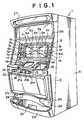
- Fig. 1 is a perspective view showing an embodiment of the slot machine in accordance with the present invention.
- the slot machine 1 in accordance with the present invention has a housing 3 whose front side is provided with a front door 2 which is adapted to open and close.
- the front door 2 is formed with a display window 4 located above near the center of the front face thereof, whereas the respective outer peripheral surfaces of three reels 5a to 5c disposed within the housing 3 face the display window 4.
- winning line indicators 6a to 6e for indicating respective effective winning lines are formed across the display window 4 so as to extend to the peripheries thereof.
- five winning line indicators 6a to 6e in total constituted by three horizontal ones and two oblique ones crossing the horizontal ones are provided.
- effective line indicator lamps 7a to 7e for indicating the respective effective winning lines are provided.
- the three reels 5a to 5c are disposed within one display window 4 in the embodiment shown in Fig. 1, discrete display windows may be provided so as to correspond to the respective reels 5a to 5c. Also, though five effective winning lines are provided here, they may have any number, such as seven, nine, and so forth.
- a replay display lamp 8 Disposed on the right end side of the winning line indicators 6a to 6e are a replay display lamp 8 which is lit at the time of a replay winning, a game stop display lamp 9 for displaying a wait time from the starting of the last reel rotation until the next reel rotation is permitted to start, a winning display lamp 10 for indicating that a winning is generated, a game start display lamp 11 for indicating that a start switch 20 is made effective, and a game medal insertion lamp 12 for indicating that game medals are permitted to insert.
- the image display section 13 Disposed in the front face of the front door 2 nearly at the center thereof below the display window 4 is an image display section 13 for displaying game information.
- the image display section 13 is made of, for example, a liquid-crystal display, a plasma display, an EL display, a CRT display, a dot-matrix indicator, or the like, and is capable of displaying each game information item which will be explained later in detail.
- reels 5a to 5c which are variable display means, and the image display section 13 are constructed as devices separate from each other, both of them may be displayed in the same display device by use of a CRT display having a size of about 17 inches, or the like. In this case, simulated reels can be displayed on the CRT in place of the reels 5a to 5c.
- a medal insertion slot 14 for inserting, one by one, game medals used for gaming; and a collective medal insertion slot 15 for simultaneously inserting a plurality of game medals used for gaming.
- a first bet switch 16 for inserting, one by one, game medals used for gaming within a credited range
- a second bet switch 17 for inserting, two by two, game medals used for gaming within the credited range
- a max bet switch 18 for inserting game medals used for gaming up to a maximum bet number (three in this embodiment) within the credited range.
- a card unit may be attached to the slot machine 1 so as to form a card type slot machine which accepts a valued medium such as a prepaid card or the like for loaning out game medals, so that credit can be made in a credit section as in the case where the game medals are inserted into the slot machine 1.
- the card type slot machine may be configured such that, while the card unit is attached to the slot machine 1, a hopper of the slot machine main body is actuated upon a game medal loan-out operation, so as to loan out a predetermined number of game medals to a medal tray 22.
- the front face of the front door 2 is provided with a C/P switch 19 for changeover between the credit and the payout of the medals acquired by the player, the start switch 20 for starting rotating each of the reels 5a to 5c on condition that a game medal is inserted, and three stop switches 21a to 21c for stopping rotating the respective reels 5a to 5c.
- the medal tray 22 for receiving the game medals paid out as a prize, and a medal payout slot 23 facing the medal tray 22.
- the front face of the front door 2 is provided with a pair of right and left sound transmission holes 24, 24, whereas speakers 25, 25 are provided within the housing 3 so as to face the respective sound transmission holes 24, 24.
- the upper part of the front face of the housing 3 is provided with a dividend display section 26 for displaying the number of dividend game medals to be paid out in reward for a winning, whereas a decorating section 27 provided with a plurality of decorating lamps (not depicted) is disposed above the dividend display section 26.
- the decorating section 27 is divided into a plurality of (e.g., 8) lateral sections, each section including a decorating lamp therewithin which is lit or blinked according to the state of gaming, thus being able to enhance the fun of gaming.
- the reels 5a to 5c are rotatably disposed at their respective positions where their outer peripheral surfaces face the display window 4, whereas a hopper (not depicted) for paying out game medals as a prize is disposed at a position communicating with the medal payout slot 23. Also, a control unit (not depicted) for electrically controlling the slot machine 1 is disposed within the housing 3.
- a light-transparent reel tape having a plurality of kinds of symbols displayed thereon at predetermined intervals is attached to the outer peripheral surface of each of the reels 5a to 5c.
- the kinds of symbols include “7,” “BAR,” “watermelon,” “cherry,” “plum,” and the like, for example, and each of the reels 5a to 5c displays 21 symbols.
- the kinds of symbols and the number of symbols displayed in each of the reels 5a to 5c can be changed as appropriate.
- the kinds of symbols may include, in addition to those mentioned above, "bell,” “orange,” person, animal,” “fish,” “JAC,” and the like.
- a plurality of colors may be applied to each symbol, such that the symbols are distinguishable from each other.
- each of the reels 5a to 5c Disposed inside each of the reels 5a to 5c are three back lamps (not depicted) in a vertical row for illuminating from inside the respective reel 5a to 5c in a transmitting manner the symbols seen through the display window 4. As the back lamps are lit, each of the reels 5a to 5c can be illuminated from inside, whereby the symbols displayed in their stopped state on effective winning lines can be highlighted.
- the combination of the symbols displayed on an effective winning line in their stopped state constitutes a predetermined winning mode
- the number of game medals corresponding to this winning mode are paid out as a prize or added as a credit.
- Predetermined winning modes include normal winning modes, and special winning modes to become a starting condition for special games which are more advantageous to the player than normal games. Further, the special winning modes include those of so-called big bonus and those of so-called regular bonus.
- the normal winning modes include, for example, the cases where the combination of the symbols displayed on an effective winning line in their stopped state is constituted by "watermelon,” “watermelon,” and “watermelon”; where "cherry” is displayed in its stopped state on the left side of the display window; and the like, whereby a predetermined number of, e.g., 2 to 10, game medals are paid out.
- 10 game medals are paid out when the combination of the symbols displayed on an effective winning line in their stopped state is constituted by "watermelon,” “watermelon,” and “watermelon”; 2 game medals are paid out when "cherry” is displayed in its stopped state on the left side of the display window; and so forth.
- replay winning modes are set, so as to allow the player to play a game again under the same condition as that of the last game when the combination of the symbols displayed on an effective winning line in their stopped state is constituted by "plum,” “plum,” and "plum.”
- the winning modes of big bonus are concerned with games started on condition that the combination of symbols displayed on an effective winning line in their stopped state is constituted by "7,” “7,” and “7,” for example, whereby a predetermined number of, e.g., 15, game medals are paid out, and then a big bonus game in which the player can advantageously acquire a greater number of game medals than in a normal game can be played is allowed to be played.
- normal games in a big bonus game games similar to a normal game with a raised sampling probability of small roles, i.e., normal games in a big bonus game (normal games in BB), can be played up to 30 times. While this game similar to a normal game is being played, if the combination of symbols displayed on an effective winning line in their stopped state is constituted by "watermelon,” “watermelon,” and “watermelon,” then 10 game medals are paid out; if "cherry” is displayed on the left side of the display window in its stopped state, then 2 game medals are paid out; and, if the combination of symbols displayed on an effective winning line in their stopped state is constituted by "plum,” “plum,” and “plum,” then 5 game medals are paid out and JAC games are allowed to play up to 3 times.
- the start switch 20 is operated so as to start rotating the reels 5a to 5c, and then the stop switches 21a to 21c are operated so as to stop rotating the respective reels 5a to 5c.
- a combination of stopped symbols constitute a predetermined combination, e.g., "plum,” “plum,” and “plum,” then a predetermined number of, e.g., 15, game medals are paid out.
- the maximum number of games and the maximum number of winnings are restricted. For example, when the above-mentioned game similar to a normal game is played 12 times, which constitute the maximum game number, or the number of the above-mentioned winnings reaches 8, which is the maximum winning number, then the JAC game ends.
- the winning modes of regular bonus are concerned with games started on condition that the combination of symbols displayed on an effective winning line in their stopped state is constituted by "BAR,” “BAR,” and “BAR,” for example, whereby a predetermined number of, e.g., 15, game medals are paid out, and then regular bonus games are allowed to be played.
- the acquirable profit is smaller than that in the above-mentioned big bonus game.
- the above-mentioned JAC game is allowed to be played only once.
- the foregoing series of gaming operations are controlled by the control unit disposed within the housing 3.
- Figs. 2A to 15 are explanatory views for explaining the game information displayed by the image display section 13 during games in the slot machine 1.
- the above-mentioned slot machine 1 permits game medals to be inserted after the preparation in the control unit is completed. For example, when the electric power is supplied to the slot machine 1 at the time of opening the parlor, game medals are permitted to be inserted after a predetermined initializing process is completed. After starting a game, game medals are permitted to be inserted after the game medal payout process and the like in the last game are completed.
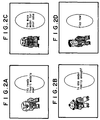
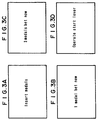
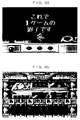
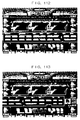
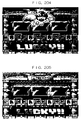
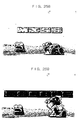
- the control unit When the control unit permits game medals to be inserted, then the permission to insert game medals is displayed in the image display section 13 as shown in Figs. 2A to 2D or 3A to 3D, so as to urge the player to insert game medals.
- Figs. 2A to 2D characters and messages are displayed in the display section 13 so as to indicate the permission to insert game medals.
- a male character is posed, and a message is displayed so as to indicate that the insertion of game medals is permitted (Fig. 2A).
- other male characters are posed, and the number of currently inserted medals is displayed (Figs. 2B and 2C).
- a male character is posed, and a message is displayed so as to urge the player to start a game (Fig. 2D).
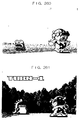
- Figs. 3A to 3D indicates the permission to insert game medals by displaying messages alone in the image display section 13.
- a message is displayed so as to indicate that game medals are permitted to insert (Fig. 3A).
- the number of currently inserted medals is displayed (Figs. 3B and 3C).
- a message is displayed so as to urge the player to start a game (Fig. 3D).
- the foregoing display of permission to insert game medals can be effected in any of the payout mode in which game medals are actually inserted into the medal insertion slots 14, 15 and the credit mode in which the individual bet switches 16, 17, 18 are operated so as to insert game medals within a credited range.
- the display of the number of inserted game medals can be omitted since it is clear that the maximum permissible bet number is attained.
- the game medal insertion lamp 12 may be blinked, or the lamps (not depicted) disposed within the respective bet switches 16, 17, 18 may be blinked.
- game medals are inserted into the medal insertion slots 14, 15, or the bet switches 16, 17, 18 are operated, so as to insert game medals for playing games, whereby games can be played.
- the maximum number of game medals which can be inserted in one game has been determined beforehand as the maximum permissible bet number. For example, when the maximum permissible bet number is three, then one, two, or three game medals can be inserted so as to play a game.
- characters and messages are displayed in the image display section 13, so as to indicate the number of inserted game medals, such that, in a series of messages relating to the permission to insert game medals, the number of currently inserted game medals is displayed, and the player is urged to insert game medals up to the maximum permissible bet number (Figs. 2B and 2C).
- the player is urged to insert the maximum permissible number of game medals since, as the number of inserted game medals increases, the number of effective winning lines increases, thus enhancing the probability of winning.
- the probability of winning is 1/700 when two game medals are inserted, and 1/300 when three game medals are inserted. Therefore, as the number of inserted game medals increases, the player can play games under more advantageous conditions. Also, as the number of inserted game medals increases, the game parlor makes a greater profit.
- the effective line indicator lamps 7a to 7e may be lit, or the back lamps (not depicted) for illuminating the respective reels 5a to 5c from inside may be lit so as to correspond to the effective winning lines.
- the example shown in Figs. 2A to 2D may be constituted by character displays alone with no messages. Also, messages may be expressed by voices.
- the above-mentioned slot machine 1 allows game medals inserted from the medal insertion slot 14, 15 and those paid out as a prize to be credited up to the maximum creditable number (e.g., 50 medals) so that games can be played within the limits of credited game medals.
- the maximum creditable number e.g. 50 medals
- the C/P switch 19 is a cyclic switch by which the credit mode and the payout mode can be changed over therebetween.
- the outline of number of credited game medals is displayed in the image display section 13 as shown in Figs. 4A to 4C.
- the face of the female character is shown, while 2 units of the indicator are displayed (Fig. 4A).
- the number of credited game medals is 30, the upper half of the female character is shown, while 6 units of the indicator are displayed (Fig. 4B).
- the number of credited game medals is 50, the whole body of the female character is shown, while 10 units of the indicator are displayed (Fig. 4C). In this case, either the character or indicator may be displayed alone.
- the front face of the front door 2 may be provided with a credit number display section made of a seven-segment indicator or the like, so as to display the number of credited game medals, while carrying out the above-mentioned display by the image display section 13.
- the insertion modes of game medals can be altered as selected by the player in the slot machine 1, while each game mode has its own merits.
- the labor of inserting the game medals into the medal insertion slot 14, 15 for each game can be omitted.
- the max bet switch 18 is operated so as to insert the maximum permissible bet number of (e.g., 3) game medals, the single switch operation allows the player to play a game with a higher winning probability advantageous to the player.
- the above-mentioned slot machine 1 displays which game mode of the credit mode and payout mode is selected in the image display section 13.
- the example shown in Fig. 5 indicates the insertion mode of game medals by displaying a character and a message in the image display section 13.
- a male character is posed, and a message is displayed so as to indicate that it is in the payout mode. If the credit mode is selected, another character and another message display the same.
- Figs. 6A and 6B indicate the insertion mode of game medals by displaying messages alone in the image display section 13. If the payout mode is selected, then larger letters of "PAYOUT MODE” are displayed while smaller letters of "CREDIT MODE” are displayed (Fig. 6A). If the credit mode is selected, then larger letters of " CREDIT MODE” are displayed while smaller letters of "PAYOUT MODE” are displayed (Fig. 6B).
- the display concerning the insertion mode of game medals is effected when the C/P switch 19 is operated, when there is a predetermined period of time or more from the end of one game until the start of the next game, and so forth.
- the insertion mode of game medals may be indicated by whether there is a display in the credit number display section or not, while the display in the image display section 13 is effected.
- a predetermined wait time is set from the starting of the last game until the starting of the next game, and the next game is permitted to start after the lapse of the wait time.
- the wait time is set to 4.1 seconds, for example. Until after 4.1 seconds from the starting of rotation of the reels 5a to 5c in the last game, the next game cannot be started even if the start switch 20 is operated.
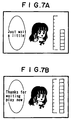
- the image display section 13 indicates that it is a wait time, and the state of progress of wait time.
- Figs. 7A and 7B indicates the progress of wait time by displaying a character and messages, so that, when the wait time has not completely passed, the face of a female character and a message indicating that it is a wait time are displayed, while an indicator is displayed by the amount corresponding to the lapse of wait time (Fig. 7A).
- Fig. 7A 6 units out of 10 units of the indicator are displayed, so as to indicate that 60% of the wait time has passed.
- the wait time is over
- the face of the female character and a message indicating that the wait time is over are displayed, while 10 units of the indicator are displayed, so as to indicate that the wait time is over (Fig. 7B).
- the character or the indicator may be displayed alone.
- the above-mentioned display of the permission to start a game and the wait time is not effected if the predetermined time has already been consumed in the last game.
- the game stop display lamp 9 and the game start display lamp 11 may be turned on/off, so as to indicate the wait time and the permission to start a game.
- being in a wait time may be indicated by turning on the game stop display lamp 9 while turning off the game start display lamp 11, and the permission to start a game may be indicated by turning off the game stop display lamp 9 while turning on the game start display lamp 11.
- Figs. 8A to 8D characters are displayed, so as to indicate whether the individual stop switches 21a to 21c are effective or not.
- the start switch 20 is operated, so that the reels 5a to 5c start rotating, three female characters corresponding to the respective reels 5a to 5c are displayed so as to show their backs, thereby indicating that none of operations of the stop switches 21a to 21c are made effective (Fig. 8A).
- the individual reels 5a to 5c have attained a predetermined rotational speed, their corresponding three female characters turn around so as to indicate that the respective stop switches 21a to 21c are made effective (Fig. 8B).
- the illumination lamps (not depicted) disposed within or around the respective stop switches 21a to 21c may be turned on, so as to indicate that the stop switches 21a to 21c are made effective.
- the above-mentioned slot machine 1 lets the player to play a special game which is more advantageous to the player than normal games.
- a special winning mode occurs, as the stop switches 21a, 21b are operated, there initially occurs a state where, for example, the left and center reels 5a, 5b stop rotating, with a possibility of the special winning mode being generated depending on the symbol displayed on the remaining right reel 5c, i.e., a so-called ready state.
- the ready state is attained, the player can feel an expectation for the occurrence of a special game, thereby being able to enhance the fun of gaming.
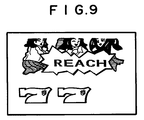
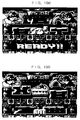
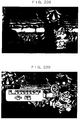
- the image display section 13 indicates that the ready state is generated as shown in Fig. 9.
- Fig. 9 displays characters and a message so as to indicate that the ready state is generated.
- the three female characters corresponding the respective reels 5a to 5c turn around, while letters of "REACH" are displayed, thereby indicating that it is the ready state.
- the stopped symbols of the respective reels 5a, 5b constituting the ready state may be displayed.
- the stopped symbols constituting the ready state it can be seen what mode of special game may occur.
- the above-mentioned display concerning the possibility of occurrence of special winning modes by the image display section 13 can be effected in either one or both of the ready state for big bonus and the ready state for regular bonus.
- the reels 5a to 5c are not stopped solely depending on the operations of stop switches 21a to 21c. Namely, whether to permit a special game to occur or not is sampled beforehand in the control unit, and the reels 5a to 5c are controlled to stop so as to constitute a special winning mode only if the result of sampling permits the special game to occur.
- a rotation control operation for reels 5a to 5c known as so-called draw-in is effected so as to stop the reels 5a to 5c such that the combination of stopped symbols constitutes the special winning mode.
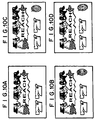
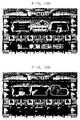
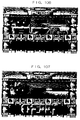
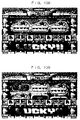
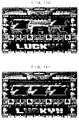
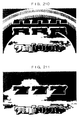
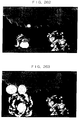
- the example shown in Figs. 10A to 10D displays characters and messages, so as to indicate the possibility of occurrence of the special winning mode in four steps, such that, while the three female characters corresponding to the respective reels 5a to 5c are posed, letters of "REACH" are displayed, and letters corresponding to respective degrees of reliability are further displayed (Figs. 10A to 10D).
- the reliability is the lowest in the case where no letters concerning the reliability is displayed as shown in Fig. 10A, the reliability is 15% in the case where the letters shown in Fig. 10B are displayed, the reliability is 50% in the case where the letters shown in Fig. 10C are displayed, and the reliability is 100% in the case where the letters shown in Fig. 10D are displayed.
- the stopped symbols of the respective reels 5a, 5b constituting the ready state may be displayed.
- the stopped symbols constituting the ready state it can be seen what mode of special game may occur.
- the above-mentioned display concerning the reliability of possibility of occurrence of the special winning mode by the image display section 13 can be effected in either one or both of the ready state for big bonus and the ready state for regular bonus.
- the front face of the front door 2 may be provided with a chance display section for indicating that the result of sampling permits a special game to occur; and, while the above-mentioned display by the image display section 13 is effected, sound effects may be generated from the speakers 25, back lamps (not depicted) for illuminating the respective reels 5a to 5c from inside may be lit, or the chance display section may be blinked, so as to indicate the reliability of possibility of occurrence of the special winning mode.
- the above-mentioned slot machine 1 allows the player to play a game in which game medals can be acquired as a prize.
- the combination of stopped symbols constitutes a special winning mode
- the player can play a game in which a greater number of game medals can be obtained than in a normal game.
- the image display section 13 indicates that the normal winning mode or special winning mode is generated.
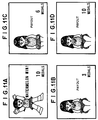
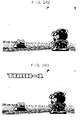
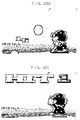
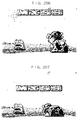
- Figs. 11A to 11D displays a character and messages, so as to indicate that a combination of stopped symbols constitutes a normal winning mode.
- a female character is posed, and it is indicated that the winning mode is composed of "watermelon,” “watermelon,” and “watermelon” in which 10 game medals are to be paid out (Fig. 11A).
- the female character successively changes her pose, the numbers of paid-out game medals are displayed (Figs. 11B to 11D).
- Figs. 11B to 11D indicate that 3, 6, and 10 game medals are paid out, respectively.
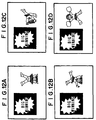
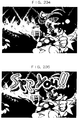
- Figs. 12A to 12D displays a character and a message, so as to indicate that a combination of stopped symbols constitutes a special winning mode, such that a female character is displayed with successively changing poses, while letters of "BIG WINNING" indicating the occurrence of the special winning mode are displayed (Figs. 12A to 12D).
- the winning display lamp 10 may be lit, or the effective line indicator lamp 7a to 7e corresponding to the winning line constituting the normal or special winning mode may be blinked, so as to indicate that the normal winning mode or special winning mode is generated.
- the front face of the front door 2 may be provided with a payout number display section comprising a seven-segment indicator or the like for displaying the number of game medals to be paid out as a prize; and, while the above-mentioned display by the image display section 13 is effected, the number of paid-out game medals may be displayed in the payout number display section.
- the above-mentioned slot machine 1 allows a replay under a condition similar to that in the last game.
- the image display section 13 indicates that a replay winning mode is generated as shown in Figs. 13A and 13B.
- the example shown in Fig. 13A displays a character and a message, so as to indicate that a replay winning mode is generated.
- a male character is posed, and a message is displayed so as to indicate that it is a replay winning mode.
- the example shown in Fig. 13B displays a message alone, so as to indicate that a replay winning mode is generated, i.e., letters of "REPLAY" are displayed.
- any of the examples shown in Figs. 13A and 13B may be displayed alone, or both of them may be displayed alternately.
- the replay display lamp 8 may be lit, so as to indicate that the replay winning mode is generated.
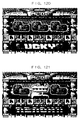
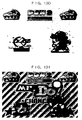
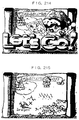
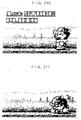
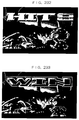
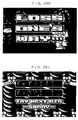
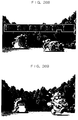
- the above-mentioned slot machine 1 displays a demonstration, which is gaming machine information, in the image display section 13 as shown in Figs. 14A to 14C.
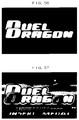
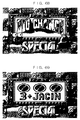
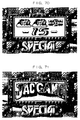
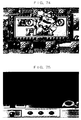
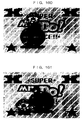
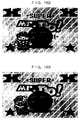
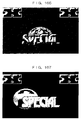
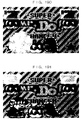
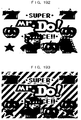
- Figs. 14A to 14C alternately displays two kinds of title logos (Figs. 14A and 14B) and the ranking of the number of acquired medals in big bonus (Fig. 14C).
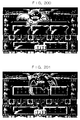
- the ranking of the number of acquired medals in big bonus displays as shown in Fig. 14C, the first to third places in each of the total number of acquired game medals and the net number of acquired game medals in the slot machine 1 on the same day, which the player can refer to in order to determine if this slot machine 1 is advantageous to the player or not.
- the total number of acquired game medals refers to the total number of game medals paid out as a prize in a big bonus game
- the net number of acquired game medals refers to the number obtained when the number of game medals used for gaming is subtracted from the total number of acquired game medals.
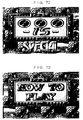
- the gaming machine information displayed in the image display section 13 is not limited to that mentioned above. For example, how to play games in the slot machine 1, the ranking of the number of acquired game medals including those in normal games, information from the game parlor, and the like may be displayed as well.
- the gaming machine information may be displayed at any timing.
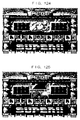
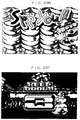
- the image display section 13 displays the number of dividend game medals to be paid out as a prize when a combination of stopped symbols constitutes a predetermined winning mode.
- the display of the number of dividend game medals is constituted by the numbers of dividend game medals to be paid out when winning modes are attained in a normal game (Fig. 15A) and the numbers of dividend game medals to be paid out when winning modes are attained in special games (Figs. 15B and 15C), which are selectively displayed according to the state of each game.
- Fig. 15C displays the number of dividend game medals to be paid out when a winning mode is attained in a JAC game during a special game.
- the dividend display varies in synchronization with changes in the combination of symbols constituting a winning mode and in the number of dividend game medals along with changes in the state of gaming, the player can easily grasp which winning modes should be targeted in the current game, or how many the dividend game medals are.
- the numbers of dividend game medals can be displayed at any timing. For example, all the dividend game medal numbers may be successively displayed together with the above-mentioned gaming machine information, the dividend game medal number concerning a special game may be displayed when a special winning mode is attained, and the dividend game medal number concerning the JAC game may be displayed when the winning mode for the JAC game is attained.
- the dividend game medal numbers are also displayed in the dividend display section 26.
- an indicating section for indicating related game information relating to the game information displayed in the image display section 13 may be provided, so as to indicate the related game information.
- This indicating section is constituted, for example, by the effective line indicator lamps 7a to 7e, the replay display lamp 8, the game stop lamp 9, the winning display lamp 10, the game start display lamp 11, the game medal insertion lamp 12, the speakers 25, a plurality of lamps disposed in the decorating section 27, and the like.
- the lamps disposed inside the respective bet switches 16, 17, 18, the illumination lamps disposed within the respective stop switches 21a to 21c, the illumination lamps disposed around the respective stop switches 21a to 21c, the back lamps for illuminating the respective reels 5a to 5c from inside, the credit number display section, the chance display section, the payout number display section, and the like may constitute the indicating section as well.
- any one of these indicating sections or a combination of a plurality of indicating sections may indicate the related game information. Also, one indicating section may indicate a plurality of related game information items.
- the above-mentioned embodiment explains the display of each game information in the image display section 13 in the case where a normal game is played, the above-mentioned display of each game information can also be effected in the case where a special game is played.
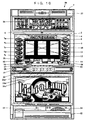
- FIG. 17 is a front view of the slot machine in accordance with this embodiment.
- this slot machine 60 has a configuration substantially similar to that of the above-mentioned slot machine 1, and the front face of its housing 3 is provided with an image display section 13 made of a liquid crystal display device for displaying game information.
- symbols such as "cherry,” “diamond,” “ball,” “dragon,” “EXTRA,” white “7,” red “7,” and the like are displayed on each of reels 5a to 5c; and, a combination of these symbols constitutes a winning mode or special winning mode.
- Gaming operations in the slot machine 60 is controlled by a control unit.
- control unit comprises a main control board 100, a sub-control board 200, and an image control board 300.
- the main control board 100 is a board for carrying out the main control of gaming operations in the slot machine; and comprises a CPU 101, a ROM 102, a RAM 103, a clock circuit 104 for generating an operating clock signal for the CPU 101, and a probability setting section 105 for setting the probability of election of big bonus and the like.
- the ROM 102 stores therein not only the procedure of processing in games of the slot machine 60 as a sequence program but also data such as a winning probability table for determining the probability of sampling, internally elected roles, a stop control table for controlling the reels 5a to 5c to stop according to the state of gaming, and the like. As the CPU 101 and the like operate according to the sequence program, games in the slot machine 60 are controlled.
- the clock circuit 104 comprises a clock pulse generator 106 for generating a reference clock at a predetermined frequency, and a divider 107 for generating an operating clock signal for the CPU 101 by dividing the reference clock signal.
- the probability setting section 105 comprises a random number generator 108 for generating random numbers within a predetermined range under the control of the CPU 101, and a random number sampling circuit 109 for extracting a given random number from the random numbers generated in the random number generator 108 and transmitting thus extracted random number to the CPU 101. Also, a setting switch 110 for setting the probability of occurrence of big bonus is connected to the probability setting section 105.
- the probability setting section 105 generates random numbers used for normal games, big bonus, and the like.
- the random number value extracted at the instant when the start switch 20 is operated and the winning probability table stored in the ROM 102 are compared with each other, and whether there is an internal election or not, i.e., whether there is an internally elected role or not, and the winning role are determined according to the result of comparison.
- Internally elected bonus roles which are the results of internal election of big bonus or regular bonus, can be transferred to the next and later games, whereas small roles and internally elected replay roles are only valid in the game in which they are internally elected.
- the first bet switch 16 Connected to a plurality of I/O ports provided with the CPU 101 are the first bet switch 16, the second bet switch 17, the max bet switch 18, the C/P switch 19, the start switch 20, a medal sensor 111 for detecting game medals inserted from the medal insertion slot 14 or collective medal insertion slot 15, a play-out setting switch 112 for selecting whether to effect a play-out process or not, a play-out cancel switch 113 for canceling the play-out state, a motor driving circuit 114, a reel position detecting circuit 115, a reel stop signal circuit 116, a hopper driving circuit 117, a payout completion signal circuit 118, a speaker driving circuit 119, and a lamp driving circuit 120.
- stepping motors 121a to 121c Connected to the motor driving circuit 114 are stepping motors 121a to 121c for driving the respective reels 5a to 5c to rotate. As driving pulses are supplied or stopped being supplied to the individual stepping motors 121a to 121c under the control of the CPU 101, the respective reels 5a to 5c are caused to start or stop rotating.
- the reel position detecting circuit 115 is provided with a position detecting sensor (not depicted) comprising an optical sensor or the like for detecting the rotating position of each of the reels 5a to 5c, so that the position detection signals concerning the reels 5a to 5c detected by the position detecting sensor are transmitted to the CPU 101.
- a position detecting sensor (not depicted) comprising an optical sensor or the like for detecting the rotating position of each of the reels 5a to 5c, so that the position detection signals concerning the reels 5a to 5c detected by the position detecting sensor are transmitted to the CPU 101.
- stop switches 21a to 21c Connected to the reel stop signal circuit 116 are stop switches 21a to 21c. As the player operates the stop switches 21a to 21c, the operation is detected, and the resulting stop switch detection signal is transmitted to the CPU 101. In a specific control operation, after the individual reels 5a to 5c attain a constant-speed rotation after the start switch 20 was operated, operations of the respective stop switches 21a to 21c are permitted. When each of the stop switches 21a to 21c is pressed, seven frames in total extending to the fourth frame from the shortest stoppable position are inspected according to the stop switch detection signal, the position detection signal, and the stop control table stored in the ROM 102.
- the individual reels 5a to 5c are stopped so as to carry out a draw-in control operation such that this symbol aligns on the effective winning line, while carrying out a kick control operation so as not to establish any other winning roles which are not internally elected.
- the individual reels 5a to 5c are stopped such that no internally elected role is established.
- internally elected roles other than the internally elected bonus role are sampled; and, if a small role or replay is internally elected, then a draw-in control operation is carried out so as to preferentially attain the small role or replay.
- a hopper 122 Connected to the hopper driving circuit 117 is a hopper 122 for storing game medals.
- the medal storage section 123 is a section for storing the game medals inserted from the medal insertion slot 14 or collective medal insertion slot 15 or the game medals to be paid out as a prize, and is adapted to store the game medals until they reach a predetermined maximum permissible storage number.
- the maximum permissible storage number is 50, for example, so that up to 50 game medals are stored, whereas the 51st and later game medals are actually paid out from the hopper 122 to the medal tray 22.
- the actually paid-out medals are counted by the medal detecting section 124 at the time when being paid out from the hopper 122 to the medal tray 22.
- back lamps 125 Connected to the lamp driving circuit 120 are back lamps 125 for illuminating from inside the reels 5a to 5c in a transmitting manner the symbols seen through the display window 4.
- Three back lamps 125 in a vertical row are provided for each of the reels 5a to 5c, whereby nine back lamps 125 in total illuminate the reels 5a to 5c from inside in a transmitting manner.
- the sub-control board 200 and the image control board 300 are mainly used for controlling the image display section 13; and, while receiving a signal from the main control board 100 so as to generate sound effects and the like out of the speaker 25, carry out image display operations in the image display section 13.
- the sub-control board 200 is mounted with a sub-CPU 201, a program ROM 202, and a control RAM 203; and receives a signal from the main control board 100 at the sub-CPU 201 by way of an IN port 204. Further, according to the data received from the main control board 100, selection tables stored in the program ROM 202, and the like, the sub-CPU 201 determines various attraction images for an attraction image selecting process, an appearing symbol attraction selecting process, and the like which will be explained later, and sends out a signal to the image control board 300 by way of an OUT port 205. Also, the sub-control board 200 is mounted with a sound IC 206, whereby sound effects and the like are generated from the speaker 25 by way of a power amplifier 207.
- the image control board 300 is mounted with an image control CPU 301, a program ROM 302, a control RAM 303, an image control IC 304, a character ROM 305, and a video RAM 306.
- the image control board 300 receives a signal from the sub-control board 200 by way of an IN port 307, and transmits a driving signal to the image control IC 304.
- the image control IC 304 Under the control of the image control CPU 301, the image control IC 304 receives signal inputs from the character ROM 305 and video RAM 306, and controls the image display section 13 (e.g., color liquid crystal panel), thereby effecting image displays.
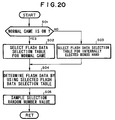
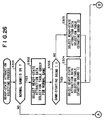
- Fig. 20 is a flowchart showing a procedure of selecting flash data and a selection random number value to be transmitted to the sub-control board 200.
- flash data refers to data for determining combinations between a pattern for blinking the back lamps 125, the sound effects generated from the speaker 25, and whether or not to light a definition lamp for notifying the player of the fact that a bonus role (BB or RB) is internally elected, in order to foretell the player, under a predetermined condition, which winning role is internally elected now.
- BB or RB bonus role
- the main control board 100 determines whether a normal game is being played or not (S01). If the normal game is being played, i.e., no internally elected role for permitting a special winning mode to occur is established, then a flash data table for normal game is selected (S02). If the normal game is not being played, i.e., if a big bonus, a regular bonus, or the like is internally elected, on the other hand, then a flash data table for internally elected bonus role is selected (S03). Further, thus selected flash data table is used, so as to determine flash data to be transmitted to the sub-control board 200 according to the internally elected role (S04). Finally, a flash data selecting random number value to be transmitted to the sub-control board 200 together with thus determined flash data is sampled (S05).
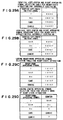
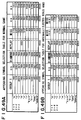
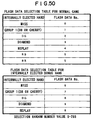
- the flash data selection table comprises two kinds of tables, i.e., a flash data selection table for normal game and a flash data selection table for internally elected bonus.
- any of "0” to “5" in the flash data selection table corresponds to each of seven patterns of internally elected roles constituted by “miss,” “group 1 (group election of “DB” or “cherry"), " "DG,” “diamond,” “replay,” “RB,” and “BB.”
- any of "6” to “9” in the flash data selection table corresponds to each of five patterns of internally elected roles constituted by "miss,” “DB,” “DG,” “diamond,” and “replay.”
- the flash date selecting random number value is selected from 256 random number values from 0 to 255.
- miss refers to the case where no winning roles are internally elected, i.e., no winning roles are permitted to occur
- group 1 group election of "DB (dragon break)” or "cherry" refers to the case where the winning role composed of “dragon,” “dragon,” and “EXTRA,” or the winning role of "cherry” is internally elected, i.e., the case where the winning mode in which symbols of "dragon,” “dragon,” and “EXTRA” are displayed in their stopped state is permitted to occur, or the winning mode in which "cherry” is stopped at any of the upper, center, and lower stages of the left reel is permitted to occur;
- DG dragon
- diamond refers to the case where the winning role composed
- the reel blinking pattern refers to a pattern by which nine in total of the back lamps 125 arranged in a vertical row of three within each reel are turned on/off or blinked.
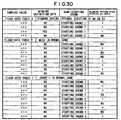
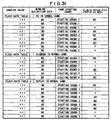
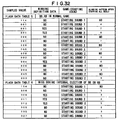
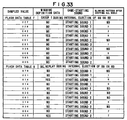
- flash data are classified into 10 kinds of flash data tables from “0" to “9.”
- Each flash data table is selected according to the state of gaming and internally elected role in the slot machine 60. More specifically, the flash data table “9” is selected when “diamond” occurring during internal election of a big bonus (BB) or regular bonus (RB) is internally elected; the flash data table “0” is selected when a miss is elected (no winning roles are elected) in a normal game; the flash data table “1” is selected when group 1 is internally elected in a normal game; the flash data “2” is selected when “dragon” is internally elected in a normal game; the flash data "3” is selected when "diamond” is internally elected in a normal game; the flash data "4" is selected when a replay is internally elected in a normal game; the flash data "5" is selected when a big bonus (BB) or regular bonus (RB) is internally elected in a normal game; the flash data table “6" is selected when a miss is internally elected
- each flash data selects, according to the flash data selecting random number value, a combination of whether there is a winning definition data or not (whether the definition lamp is lit or not), one of two kinds of game-starting sounds constituted by "game-starting sound 1" and “game starting sound 2," and one of nine kinds of reel blinking patters constituted by "1" to "8" and "no blinking.”
- the definition data is data concerning whether to definitely display that a bonus role is internally elected (i.e., the bonus role is always internally elected if this display is effected) or not.
- the internal election may be indicated at a predetermined probability.
- an indication pattern emerging when a big bonus is internally elected may be executed (the internal election may be indicated at a predetermined reliability).
- a plurality of internal elections may be provided with a common indication pattern.
- the game-starting sound refers to sound effects generated from the speaker at the time when a game is started.
- game-starting sound 1 there are two kinds of different game-starting sound, i.e., game-starting sound 1 and game-starting sound 2.
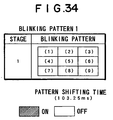
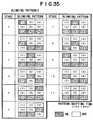
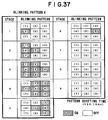
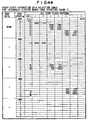
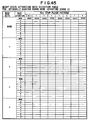
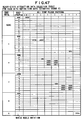
- all the back lamps 125 are turned off during a period of 103.25 ms in the reel blinking pattern "1" (Fig. 34); the back lamps 125 are blinked such that 11 kinds of blinking patterns are successively repeated with a shifting time of 150.18 ms in the reel blinking pattern "2" (Fig. 35); the back lamps 125 are blinked such that 11 kinds of blinking patterns are successively repeated with a shifting time of 75.09 ms in the reel blinking pattern "3" (Fig. 36); the back lamps 125 are blinked such that 9 kinds of blinking patterns are successively repeated with a shifting time of 150.18 ms in the reel blinking pattern "4" (Fig.
- the back lamps 125 are blinked such that 9 kinds of blinking patterns are successively repeated with a shifting time of 103.25 ms in the reel blinking pattern "5" (Fig. 38); the back lamps 125 are blinked such that 15 kinds of blinking patterns are successively repeated with a shifting time of 150.18 ms in the reel blinking pattern "6" (Fig. 39); the back lamps 125 are blinked such that 15 kinds of blinking patterns are successively repeated with a shifting time of 75.09 ms in the reel blinking pattern "7" (Fig. 40); and the back lamps 125 are blinked such that 15 kinds of blinking patterns are successively repeated with a shifting time of 103.25 ms in the reel blinking pattern "8" (Fig. 41).
- there is "no blinking" pattern in which no back lamps 125 are blinked, i.e., their lit state is kept.
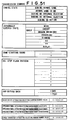
- Fig. 51 there are eight kinds of transmission commands transmitted from the main control board 100 to the sub-control board 200, which are constituted by a command concerning the state of gaming, a command concerning internally elected roles, a command concerning the game-starting sound, a command concerning the all stop flash pattern, a command concerning definition data, a random number value for selecting a ready-state attraction, random number values (left, right, and center) for selecting appearing symbol attractions, and a random number value for selecting a single character attraction.
- a command concerning the state of gaming a command concerning internally elected roles
- a command concerning the game-starting sound a command concerning the all stop flash pattern
- a command concerning definition data a random number value for selecting a ready-state attraction
- random number values left, right, and center
- the command concerning the state of gaming indicates whether the state is during a normal game, during a normal game in a big bonus (BB), during internal election of a regular bonus (RB), during internal election of a big bonus (BB), or during the action of a regular bonus (RB).
- BB big bonus
- RB regular bonus
- RB regular bonus
- the command concerning internally elected roles indicates any of the internally elected roles of "miss,” "group 1 ("cherry” or “dragon break” (DB: "dragon,” “dragon,” and “EXTRA”)),” "diamond,” “regular bonus (RB),” “big bonus (BB),” and "replay.”
- the command concerning the game-starting sound indicates whether the sound effects generated from the speaker 25 at the time of starting a game is game-starting sound 1 or game-starting sound 2.
- the command concerning the all stop flash pattern indicates that the blinking pattern of the back lamps 125 effected when all the reels are stopped is any of nine patterns comprising the patterns from "1" to "8" and no blinking pattern ("0").
- the command concerning definition data indicates whether to turn on or off the definition lamp for notifying the player of the fact that BB or RB is internally elected ("1" when turning on, and "0" when turning off).
- the random number value for selecting a ready-state attraction, random number values (left, right, and center) for selecting appearing symbol attractions, and random value for selecting a single character attraction are random numbers to be used for selecting the ready-state attraction, selecting appearing symbol attractions, and selecting a single character attraction, which will be explained later in detail, each being selected from 65536 random number values from 0 to 65535.
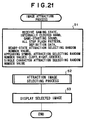
- the image attraction process in the image display section 13 is carried out in the sub-control board 200.
- the commands concerning the gaming state, internally elected roles, game-starting sound, all stop flash pattern, definition data, ready-state attraction selecting random number, appearing symbol attraction selecting random numbers (left, right, and center), and single character attraction selecting random number value are received (S1), an attraction image selecting process (S2) for selecting an attraction image is carried out, and the selected image is displayed in the image display section 13 (S3).
- the attraction image selecting process (S2) is a process for selecting whether to carry out a ready-state attraction or not, and determining which mode of attraction is to be carried out.
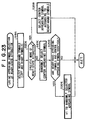
- a ready-state attraction (ready-state attraction noticing symbol) selecting process is initially carried out (S11). Then, it is determined whether to carry out a ready-state attraction or not (S12). If no ready-state attraction is carried out, then an appearing symbol attraction selecting process (S13) is to be carried out, and a single character attraction selecting process (S14) is further carried out.
- a ready-state attraction data selection table for the case where with the definition data is selected or not S15. If the ready-state attraction data selection table for the case where with the definition data is selected, then it is further determined whether a big bonus (hereinafter referred to as BB) is internally elected or not (S16).
- BB big bonus
- BB is internally elected, then appearing symbols are selected from an identical left, center, and right appearing symbol selection table for ready-state attraction for the internally elected big bonus (S17), and the flow shifts to the single character attraction selecting process (S14). If BB is not internally elected, on the other hand, appearing symbols are selected from an identical left, center, and right appearing symbol selection table for ready-state attraction for the internally elected regular bonus (S18), and the flow shifts to the single character attraction selecting process (S14).
- ready-state attraction data selection table for the case with definition data is not selected, then ready-hand appearing symbols at the time of losing are selected from a losing ready-hand appearing symbol selection table for ready-state attraction (S19), a losing center appearing symbol in conformity to the ready-state attraction is selected (S20), and the flow shifts to the single character attraction selecting process (S14).
- ready-hand appearing symbols (left and right appearing symbols) are initially selected (S19A).
- the ready-hand symbols refer to a combination of appearing symbols in which, of the laterally-aligning three appearing symbols, those on the left and right sides are identical appearing symbols, so as to indicate a so-called ready-hand state.
- the specific mode of ready-state attraction refers to a specific mode of ready-state attraction selected beforehand from a plurality of ready-state attractions. For example, in this embodiment, three kinds of ready-hand attractions from “f" to "h” among nine kinds of ready-state attractions from “a” to “i” are defined as specific modes of ready-state attractions.
- the specific mode of ready-state attraction is a ready-state attraction including such a mode of an appearing symbol attraction that one frame each on the plus side and minus side of the reference appearing symbol is displayed so as to fluctuate in a reciprocating manner.
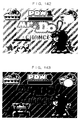
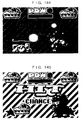
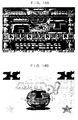
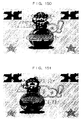
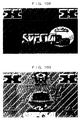
- Specific examples thereof include a ready-state attraction in which a leading character balances itself on a ball as shown in Fig. 149 and later. In such a case, if the center appearing symbol, which is the last-stopping appearing symbol, is separated from the left and right appearing symbols displayed in their stopped state in terms of arrangement of symbols, they will not match each other in terms of attraction.
- a losing center appearing symbol selection table for specific mode of ready-state attraction is used, so as to select the appearing symbol at the center (hereinafter referred to as center appearing symbol) corresponding to the ready-state appearing symbol (S20B). If it is not a specific mode of ready-state attraction, then the center appearing symbol is randomly selected (S20C), and it is further determined whether the ready-hand appearing symbols and the center appearing symbol are identical or not (S20D). If the ready-hand appearing symbols and the center appearing symbol are identical, i.e., all of the left, center, and right appearing symbols are the same, the randomly selected appearing symbol (center appearing symbol) is processed to shift by one frame (S20E). As the center appearing symbol is shifted by one frame, all the three appearing symbols are prevented from becoming identical.
- identical left, center, and right appearing symbol selection table for ready-state attraction for the internally elected big bonus identical left, center, and right appearing symbols are stored in order to indicate that a big bonus is internally elected. Specifically, four kinds of identical left, center, and right appearing symbols constituted by "7,” “Do,” “cake,” and “cookie” exist, and the center appearing symbol is selected therefrom according to a random number value.
- identical left, center, and right appearing symbol selection table for ready-state attraction for the internally elected regular bonus identical left, center, and right appearing symbols are stored in order to indicate that a big bonus is internally elected.
- the appearing symbol attraction selecting random number value (left) shown in Fig. 51 is used as the random number.
- the losing ready-hand appearing symbol selection table for ready-state attraction is used.
- the appearing symbol attraction selecting random number value (center) shown in Fig. 51 is used.
- the numbers indicated in the columns of identical left, center, and right appearing symbol and ready-hand appearing symbol show reference values to be compared with random number values. According to the comparison of the reference values with random number values, the identical left, center, and right appearing symbols and the ready-hand appearing symbols are determined.
- the first identical left, center, and right appearing symbol "7” is selected when any random number value from 0 to 6553 is sampled.
- the second identical left, center, and right appearing symbol "Do” is selected.
- the third identical left, center, and right appearing symbol "cake” is selected.
- the fourth identical left, center, and right appearing symbol "cookie” is selected.
- a first computation result is initially determined by subtracting the reference value on the first line, 6553, from the sampled random number value. If this first computation result is 0 or less, then the identical left, center, and right appearing symbol on the first line, "7,” is selected. If the first computation result is a positive value, then a second computation result is determined by subtracting the reference value on the second line, 26214, from the first computation result. If this second computation result is 0 or less, then the identical left, center, and right appearing symbol on the second line, "Do,” is selected. If the second computation result is a positive value, then a third computation result is determined by subtracting the reference value on the third line, 19661, from the second computation result.
- this third computation result is 0 or less, then the identical left, center, and right appearing symbol on the third line, "cake,” is selected. Similar computations are successively carried out, so as to select the identical left, center, and right appearing symbols and ready-hand appearing symbols according to random number values up to 65535.
- the above-mentioned ready-state attraction (ready-state attraction noticing symbol) selecting process (S11) is a process for displaying the possibility of occurrence of a winning mode to the player before all the reels 5a to 5c stop, in which whether a normal game is being played or not or whether definition data exist or not is determined, and whether to carry out a ready-state attraction or not or what ready-state attraction is carried out is determined depending on each case.
- the ready-state attraction (ready-state attraction noticing symbol) selecting process S11
- a ready-state attraction data selection table group for internally elected bonus role is selected (S402), and it is further determined whether the command concerning the game-starting sound transmitted from the main control board 100 indicates game-starting sound 1 or not (S403). If game-starting sound 1 is indicated, then the ready-state attraction data selection table for internally elected bonus role (starting sound 1) is selected (S404). If game-starting sound 2 is indicated, then the ready-state attraction data selection table for internally elected bonus role (starting sound 2) is selected (S405).
- a ready-state attraction data selection table group for the case with definition data is selected (S501), and it is further determined whether the command concerning the game-starting sound transmitted from the main control board 100 indicates game-starting sound 1 or not (S502). If game-starting sound 1 is indicated, then the ready-state attraction data selection table for the case with definition data (starting sound 1) is selected (S503). If game-starting sound 2 is indicated, then the ready-state attraction data selection table for the case with definition data (starting sound 2) is selected (S504).
- Figs. 42 to 47 show the ready-state attraction data selection table groups used in the above-mentioned ready-state attraction (ready-state attraction noticing symbol) selecting process (S11), which are constituted by three kinds of ready-state attraction data selection table groups, i.e., the ready-state attraction data selection table group for normal game (Figs. 42 and 43), the ready-state attraction data selection table group for internally elected bonus role (Figs. 44 and 45), and the ready-state attraction data selection table group for the case with definition data (Figs. 46 and 47). Further, each data table group is composed of two kinds of data tables for starting sound 1 and starting sound 2, respectively.
- each data table there are 5 kinds of ready-state attraction noticing pattern data constituted by “none” and “A” to “D.” Further, in each ready-state attraction noticing pattern data, there are 10 kinds of ready-state attraction pattern data constituted by “none” and “a” to “i.” Each ready-state attraction pattern data corresponds to any of the all stop flash patterns "0" to "8.”
- the number listed on the column of each all stop flash pattern indicates the reference values to be compared with ready-state attraction selecting random number values. According to the comparison of the reference values with ready-state attraction selecting random number values, the ready-state attraction noticing pattern and ready-state attraction pattern are determined.
- the first ready-state attraction noticing pattern "none” and the first line of ready-state attraction pattern “none” in this ready-state attraction noticing pattern are selected. If any random number value from 60116 to 65115 is sampled, then the first ready-state attraction noticing pattern "none” and the second line of ready-state attraction pattern "a” in this ready-state attraction noticing pattern are selected. Further, if any random number value from 65116 to 65165 is sampled, then the first ready-state attraction noticing pattern "none” and the third line of ready-state attraction pattern "b” in this ready-state attraction noticing pattern are selected. Similarly, according to the random number values up to 65535, ready-state attraction noticing patterns and ready-state attraction patterns are selected.
- a first computation result is initially determined by subtracting the reference value on the first line, 60115, from the sampled random number value. If this first computation result is 0 or less, then the ready-state attraction noticing pattern "none” and ready-state attraction pattern “none” on the first line are selected. If the first computation result is a positive value, then a second computation result is determined by subtracting the reference value on the second line, 5000, from the first computation result. If this second computation result is 0 or less, then the ready-state attraction noticing pattern "none” and ready-state attraction pattern "a” on the second line are selected.
- a third computation result is determined by subtracting the reference value on the third line, 50, from the second computation result. If this third computation result is 0 or less, then the ready-state attraction noticing pattern "none" and ready-state attraction pattern "b" on the third line are selected. Similar computations are successively carried out, so as to select ready-state attraction noticing patterns and ready-state attraction patterns according to the random number values up to 65535.
- the above-mentioned appearing symbol attraction selecting process (S13) is a process executed when no ready-state attraction is carried out (S12: Yes) in the above-mentioned ready-state attraction selecting process (S11), so as to carry out an attraction concerning whether the respective stop modes of reels 5a to 5c permit a predetermined winning mode to occur or not, i.e., whether each winning role is internally elected or not.
- Figs. 49A and 49B show the appearing symbol selection tables used in the above-mentioned appearing symbol attraction selecting process (S13).
- “basically correspond” indicates that, though a specific appearing symbol is more likely to be selected for each internally elected role since the width of random number value for determining the selection of each appearing symbol is biased, the specific appearing symbol is not always selected when the internally elected role is determined, and appearing symbols other than the specific appearing symbol may be selected.
- the numbers listed on each column of internally elected roles indicate reference values to be compared with appearing symbol attraction selecting random number values. According to the comparison of the reference values with the appearing symbol attraction selecting random number values, appearing symbols are determined.
- the first line of appearing symbol "E” is selected if any random number value from 0 to 1966 is sampled. If any random number value from 1967 to 3276 is sampled, then the second line of appearing symbol "X” is selected. Further, if any random number value from 3277 to 43252 is sampled, then the third line of appearing symbol "T" is selected.
- a first computation result is initially determined by subtracting the reference value on the first line, 1966, from the sampled random number value. If this first computation result is 0 or less, then the first line of appearing symbol "E" is selected. If the first computation result is a positive value, then a second computation result is determined by subtracting the reference value on the second line, 1310, from the first computation result. If this second computation result is 0 or less, then the second line of appearing symbol "X" is selected. Further, if the second computation result is a positive value, then a third computation result is determined by subtracting the reference value on the third line, 39976, from the second computation result. If this third computation result is 0 or less, then the third line of appearing symbol "T” is selected. Similar computations are successively carried out, so as to select appearing symbols according to the random number values up to 65535.
- both appearing symbols are identical or not (S205). If both appearing symbols are identical, then it is further determined whether both appearing symbols are appearing symbols other than a specific appearing symbol or not. Namely, in this case, the specific appearing symbol is any of "7,” “BAR,” “cake,” “cookie,” and “Do,” and it is determined whether both appearing symbols are any of the other appearing symbols “E,” “X,” “T,” “R,” and “A” or not (S206). If both appearing symbols are a specific appearing symbol, i.e., any of the appearing symbols other than "E,” “X,” “T,” “R,” and “A,” one frame is added to the left appearing symbol (S207).
- BB or RB is internally elected or not (S101). If BB or RB is internally elected, then a single character attraction selection table for internally elected bonus role is selected (S102). If not, then a single character attraction selection table for normal game is selected (S103).
- Figs. 48A and 48B show the single character attraction selection tables used in the above-mentioned single character attraction selecting process (S14).
- S14 single character attraction selecting process
- “basically correspond” indicates that, though a specific single character is more likely to be selected for each internally elected role since the width of random number value for determining the selection of each single character is biased, the specific appearing symbol is not always selected when the internally elected role is determined, and single characters other than the specific single character may be selected.
- the numbers listed on each column of internally elected role patterns indicate reference values to be compared with single character attraction selecting random number values. According to the comparison of the reference values with the single character attraction selecting random number values, single characters are determined.
- the first appearing symbol noticing pattern "a” is selected if any random number value from 0 to 52427 is sampled. If any random number value from 52428 to 58981 is sampled, then the second appearing symbol noticing pattern "b” is selected. Further, if any random number value from 58982 to 65535 is sampled, then the third appearing symbol noticing pattern "none" is selected.
- a first computation result is initially determined by subtracting the reference value on the first line, 52427, from the sampled random number value. If this first computation result is 0 or less, then the first line of single character "a” is selected. If the first computation result is a positive value, then a second computation result is determined by subtracting the reference value on the second line, 6554, from the first computation result. If this second computation result is 0 or less, then the second line of single character "b” is selected. Further, if the second computation result is a positive value, then the remaining single character, i.e., the eighth line of single character "none" is selected.
- Figs. 292A to 292H are charts showing relationships between the overall flows of game information displayed in the image display section 13 of the above-mentioned slot machine and the drawings used for their explanations.
- Fig. 292A "wait for client” indicates the contents displayed when no game is being played.
- Fig. 292B "one game” explains the flow from starting gaming until one game is consumed and the flow in the case entering a big bonus (BB).
- Figs. 292C to 292G further fragmentally show the flows shown in Fig. 292B.
- Fig. 292H "error display” lists the contents displayed when errors have occurred.
- the game information displayed in the image display section 13 in this slot machine is expressed by a series of moving images, such that various kinds of game information are displayed as a story progresses along with the progress of gaming.
- a designed maker name is initially displayed (Fig. 52), a bird appears on the screen (Fig. 53), and this bird is trapped in the maker name, whereby a logo of the maker name is completed (Fig. 54).
- the model name of the slot machine is displayed.
- the dividend display indicating the numbers of game medals to be paid out to the player according to stop modes of the reels 5a to 5c are displayed.
- a background is initially displayed (Fig. 58), it is indicated that the following dividends are for a normal game (Fig. 59), and then the stop mode in which a replay in this normal game is attained (Fig. 60), the stop mode in which 2 game medals are paid out (Fig. 61), the stop mode in which 7 game medals are paid out (Fig. 62), the stop mode in which 1 game medal is paid out (Fig. 63), and the stop mode in which 15 game medals are paid out (Fig. 64) are successively displayed.
- the stop mode for shifting to a regular bonus game and its number of game medals to be paid out (Fig. 65)
- the first stop mode for shifting to a big bonus game and its number of game medals to be paid out (Fig. 66)
- the second stop mode for shifting to a big bonus game and its number of game medals to be paid out (Fig. 67) are successively displayed.
- a dividend table has simply been printed on a panel in the upper part of the housing or the like. Such a printed display has exhibited a lower degree of visual impact. Also, in the case where dividends vary depending on the state of gaming even in similar winning modes or the like, it has been difficult for the player to understand from the printed display at which timing the reels 5a to 5c should be stopped.
- the dividends are explained by an animated display and the like in the image display section 13 as mentioned above, then not only the degree of visual impression on the player enhances, but also the dividends are easier to understand since they are explained in sequence for each gaming state or each winning mode.
- the specific game explanation is successively carried out for how to insert medals (Figs. 77 to 79) or how to operate the bet switches 16, 17, and 18 (Figs. 80 and 81), how to operate the start switch 20 (Fig. 82), and how to operate the stop switches 21a to 21c (Fig. 83), whereby the game explanation for one game ends (Fig. 84).
- a game explanation sheet attached to the housing or the like is used for the game explanation. In a dim parlor or the like, it has been difficult or impossible for the player to read the contents of explanation. Also, the player may have failed to notice the game explanation sheet attached to the housing.
- Fig. 290 is an enlarged view of the image display section.
- an appearing symbol variable display area 400 in which a left appearing symbol 400a, a center appearing symbol 400b, and a right appearing symbol 400c are displayed.
- Each appearing symbol is any of "E,” “X,” “T,” “R,” “A,” “7,” “BAR,” “cake,” and “cookie” as shown on the left-end column of the appearing symbol selection tables of Figs. 49A and 49B.
- These symbols are displayed in a scrolling manner from the upper side to the lower side upon the starting operation by the player, and then are displayed in their stopped state according to the stopping operation by the player.
- variable display of appearing symbols is stated at the timing at which the variable display of reels 5a to 5c is started in the above-mentioned embodiment, without being restricted thereto, it may be started at any timing, for example, when the insertion of game medals is detected, when the first stopping operation for the stop switches 21a to 21c is effected, when all the reels 5a to 5c are displayed in their stopped state, or at a totally random timing using a random number.
- the appearing symbols being variably displayed are stopped at stopping timings of the reels 5a to 5c, without being restricted thereto, they may be stopped at any timing, for example, after the lapse of a predetermined time from the starting of the variable display, when the first stopping operation for the stop switches 21a to 21c is effected, when all the reels 5a to 5c are displayed in their stopped state, or at a totally random timing using a random number.
- Fig. 107 shows a case where the winning role "cherry” is internally elected, and letters of "CHERRY” and the winning mode are displayed, whereby the internally elected role ("CHERRY” indicating that group 1 including "DB” is internally elected) is indicated. None is displayed when there is no internally elected role (i.e., a miss).
- three frames of "BAR” are displayed from side to side in their stopped state, so as to indicate that a regular bonus has been internally elected (Fig. 115); three frames of "Do! are displayed from side to side in their stopped state, so as to indicate that a big bonus or regular bonus has been internally elected (Fig. 116); three frames of "R” are displayed from side to side in their stopped state, so as to indicate that a replay winning mode has been internally elected (Fig. 117); three frames of "X” are displayed from side to side in their stopped state, so as to indicate that a so-called small role winning mode has been internally elected (Fig.
- the ranking of appearing symbols is raised from the BB/ RB common appearing symbols to the BB definition appearing symbols in the above-mentioned embodiment, it may be conversely lowered from the BB definition appearing symbols to the BB/RB common appearing symbols.
- a ready-state attraction which is one of attractions concerning whether a big bonus or regular bonus is internally elected or not, is carried out.
- broadly-classified seven modes of ready-state attraction will be explained.
- the possibility of internal election of the big bonus or regular bonus is noticed with a predetermined reliability, and the noticed bonus role is not always internally elected.
- ready-state attraction 2 of three appearing symbols displayed from side to side, identical appearing symbols "BAR” are initially displayed on the left and right sides in their stopped state, and then, while the appearing symbol “BAR” identical to the left and right is displayed at the center in its stopped state, letters of "REACH” are displayed on the lower side of the screen, so as to indicate that it is a ready state (Fig. 123). Further, after letters of "SUPER" are displayed on the lower side of the screen (Fig. 124), the gaming state shifts to a so-called super ready state in which the reliability is higher than that in the normal ready state (Fig. 125), so as to effect a display similar to the above-mentioned ready-state attraction 1, thereby indicating that there is a possibility of a bonus role being internally elected.
- This hyper ready state include three patterns.
- the leading character emerges and acts to throw balls at a target.
- the third ball hits the target, whereby all the three appearing symbols displayed on the screen become identical, and letters of "HIT" are displayed, so as to indicate that there is a possibility of a bonus role being internally elected (Figs. 129 to 136).
- the leading character emerges and acts to throw balls at a target. After the first and second balls miss the target, the third ball also misses the target, and the leading character falls down, thereby indicating that the possibility of a bonus role being internally elected is weaker (Figs. 137 to 139).
- This hyper ready state includes four patterns.
- the leading character emerges, starts balancing itself on a ball, and then falls down from the ball. At this instant, while all the three appearing symbols displayed on the screen become identical, the leading character makes a V sign, so as to indicate that there is a possibility of a bonus role being internally elected (Figs. 159 to 163).
- the leading character emerges, starts balancing itself on a ball, and jumps up. Then, letters of "SPECIAL" are displayed, so as to indicate that the gaming state has shifted to a so-called special ready state in which the reliability is higher than that in the hyper ready state (Figs. 164 to 166).
- this special ready state the ball is displayed in a laterally moving state. Then, the leading character descends from thereabove, jumps on the ball, and lands on the ground. At this instant, all the three appearing symbols displayed on the screen become identical, and the leading character makes a V sign, so as to indicate that a bonus role is internally elected (Figs. 167 to 171).
- This hyper ready state includes three patterns.
- Examples (a) to (g) of the single character are shown in Figs. 291A to 291G, respectively.
- the single character is displayed at the center of the screen with a predetermined probability according to the internally elected role, whereby a notice of the internally elected role is given to the player.
- the display of the single character is as explained with reference to the single character attraction selection tables of Figs. 48A and 48B. For example, when "group 1 (cherry or DB)" is internally elected during a normal game, the character (a) or the character (b) is displayed or no character is displayed. Conversely, if the character (a) or the character (b) appears, any of group 1, BB, and RB is internally elected.
- the player can see that there is a possibility of any of group 1, BB, and RB being internally elected, whereby the player not only feels an expectation but also is able to operate the reels 5a to 5c to stop in response thereto.
- the single character can be displayed at any location on the screen. Also, without being restricted to the period from the starting of changes in appearing symbols to the stopping thereof, the single character can be displayed at any timing.
- the current state is such that the gaming state is during a normal game, the internally elected role is "diamond," the flash data selecting random number value is 114, the ready-state attraction selecting random number value is 64500, the appearing symbol attraction selecting random number values are 5050 for left, 740 for right, and 30000 for center, and the single character attraction selecting random number value is 20000;
- the individual ready-state attractions described in "Notification of Internally Elected Role by Ready-State Attraction" for ready states a to i in the ready-state attraction data selection table are ready-state attraction 2 for a, ready-state attraction 6 for b, the first pattern of ready-state attraction 3 for c, the second pattern of ready-state attraction 3 for d, the third pattern of ready-state attraction 3 for e, the first pattern of ready-state attraction 4 for f, the second pattern of ready-state attraction 4 for g, the
- the flash data selecting random number value 114 the second flash data from the upper side in the flash data table 3 (diamond in normal game) in Fig. 31, i.e., "no winning definition data, game-starting sound 1, blinking pattern 4 after stopping all reels," is selected. Subsequently, on the sub-control board 200 side, the flow shifts to the attraction image selecting process in the image attraction process. In its ready-state attraction selecting process, the ready-state attraction data selection table for normal game (starting sound 1) in Fig.
- ready-state notice B i.e., "ready-state attraction notice 2”
- ready-state attraction d i.e., "the second pattern of ready-state attraction 3"
- the flash data selecting random number value 164 the first flash data from the upper side in the flash data table 0 (miss in normal game) in Fig. 30, i.e., "no winning definition data, game-starting sound 1, no blinking pattern after stopping all reels," is selected. Subsequently, on the sub-control board 200 side, the flow shifts to the attraction image selecting process in the image attraction process. In its ready-state attraction selecting process, the ready-state attraction data selection table for normal game (starting sound 1) in Fig. 42 is selected; and, according to the blinking pattern 0 after stopping all reels and the ready-state attraction selecting random number value of 35000, "no ready-state attraction” and "no ready-state notice" are selected.
- a third specific example will now be explained.
- the current state is such that the gaming state is during a normal game, the internally elected role is "BB and replay," the flash data selecting random number value is 252, the ready-state attraction selecting random number value is 18000, the appearing symbol attraction selecting random number values are 2000 for left, 10050 for right, and 4520 for center, and the single character attraction selecting random number value is 8200 (the relation of the items of ready state and ready-state notice in the ready-state attraction data selection table to the actual ready-state attraction and ready-state notice is assumed to be identical to the above-mentioned first specific example).
- the eleventh flash data from the upper side in the flash data table 8 (DG, replay during internal election of BB or RB) in Fig. 33, i.e., "winning definition data exist, game-starting sound 2, blinking pattern 7 after stopping all reels," is selected.
- the flow shifts to the attraction image selecting process in the image attraction process.
- the ready-state attraction data selection table for the case with definition data (starting sound 2) in Fig.
- normal games in a big bonus game games similar to a normal game with a raised sampling probability of small roles, i.e., normal games in a big bonus game (normal games in BB), can be played up to 30 times.
- normal games in BB if the appearing symbols displayed on an effective winning line in their stopped state constitute a predetermined combination, then a predetermined number of game medals are paid out. Also, if the appearing symbols displayed on an effective winning line in their stopped state constitute a specific combination for shifting to a JAC game, then JAC games are allowed to play up to 3 times.
- This attraction is constituted by four patterns, i.e., a first normal game attraction in BB, a second normal game attraction in BB, a third normal game attraction in BB, and a big bonus ending attraction.
- the leading character lands on a plain, and picks up an object from the ground (Figs. 216 and 217).
- This action of the leading character for picking up the object from the ground corresponds to the payout of game medals when a winning mode is attained in an actual game (reels 5a to 5c).
- the number of game medals to be paid out is displayed as an image (Figs. 218 and 219), the kind of winning role is displayed.
- the number of game medals to be paid out is displayed within a speech balloon as if the leading character is speaking.
- simulated voices may be employed to express: "It's a winning of 10-medal role," “Sorry, it's a miss, " and so forth. While the payout of game medals occurs at the time of winning, a character may be animated as the game medals are paid out.
- a display may be effected so as to indicate that it is a miss.
- a specific symbol e.g., similar to a replay symbol
- the first normal game in BB refers to a normal game from the starting of the big bonus game until the starting of the first JAC game.
- the second normal game in BB refers to a normal game from the ending of the first JAC game until the starting of the second JAC game
- the third normal game in BB refers to a normal game after the ending of the second JAC game.
- the number of consumed normal games in a big bonus game has been displayed by a seven-segment indicator or lamps.
- a background image or character which varies by a predetermined unit is used for carrying out attractions, then the player can correctly grasp the progress of gaming. Also, along therewith, the player can correctly determine whether to execute replay avoidance or enter the JAC game. (If the replay avoidance is executed so much that the big bonus game is terminated while not fully consuming the JAC games, then it is meaningless to acquire may small roles during normal games; thus making it necessary to acquire the default number of JAC games while acquiring small roles in the normal game as much as possible.)
- a map is displayed, so as to indicate the current position of the leading character (Fig. 223), thereby starting an adventure story of the leading character.
- the leading character lands on a forest (Fig. 224), and an attraction similar to the first normal game attraction in BB is effected.
- a winning mode is attained in an actual game (reels 5a to 5c)
- the number of game medals to be paid out in response to thus attained winning mode is displayed as the leading character picks up an object from the ground (Fig. 225), for example, and letters of "FIGHT" are displayed when shifting to a JAC game (Fig. 226).
- a map is displayed, so as to indicate the current position of the leading character (Fig. 227), thereby starting an adventure story of the leading character.
- the leading character enters a cavern (Fig. 228), and an attraction similar to the first normal game attraction in BB is effected.
- a winning mode is attained in an actual game (reels 5a to 5c)
- the number of game medals to be paid out in response to thus attained winning mode is displayed as the leading character picks up an object from the ground (Fig. 229), for example, and letters of "I'm BOSS" are displayed when shifting to a JAC game so as to indicate that it is the final JAC game, together with a dragon character which is an opponent in the story (Fig. 230).
- the big bonus ending attraction is constituted by two patterns, i.e., so-called completion attraction for the case where the player has succeeded in obtaining the acquirable profits, and so-called puncture attraction for the case where the big bonus game has ended before the player obtains the acquirable profits.
- This attraction is constituted by three patterns, i.e., the first JAC game attraction, the second JAC game attraction, and the third JAC game attraction.
- each JAC game attraction is constituted by three patterns, i.e., a winning attraction in the JAC game, a losing attraction in the JAC game, and a so-called puncture attraction for the case where the JAC game has ended before the acquirable profits are obtained.
- the leading character and a monster oppose each other at the timing when the player operates the start switch 20, and the number of games in the JAC game is displayed (Figs. 242 and 243).
- the leading character stores energy, and throws an energy ball at the monster at the timing when the player carries out the third stopping operation of the stop switches 21a to 21c (Figs. 244 to 247).
- the energy ball hits the monster, whereby the monster disappears, and coins emerge.
- the number of acquired coins (game medals) is displayed, and the number of winnings in the JAC game is displayed (Figs. 248 to 251).
- the leading character and a monster 1 oppose each other, and the number of games in the JAC game is displayed (Figs. 252 and 253). Subsequently, the leading character stores energy, and throws an energy ball at the monster 1 (Figs. 254 and 255). Then, the energy ball misses the monster 1 with a large margin, letters of "MISS" are displayed, and the leading character falls down, so as to indicate that it is a miss (Figs. 256 and 257).
- the stopping operations of the stop switches 21a to 21c by the player and the starting of attraction display in the image display section 13 may be carried out at any timing.
- the puncture attraction in the first JAC game is effected when the maximum permissible number of (e.g., 8) winnings are not obtained at the time when the maximum number of (e.g., 12) games are consumed.
- the leading character falls down, letters of "ESCAPE" are displayed, and the leading character runs away, thereby indicating that it is so-called puncture (Figs. 258 to 260).
- the puncture in the JAC game refers to the case where the maximum permissible number of (e.g., 8) winnings are not obtained in the maximum number of (e.g., 12) games.
- the winning attraction in the third JAC game an attraction substantially similar to that in the first JAC game is carried out. Namely, the leading character and a dragon, which is the final opponent, oppose each other, and the number of games in the JAC game is displayed (Fig. 270). Subsequently, the leading character throws an energy ball at the dragon. Then, the energy ball hits the dragon, and the number of winnings in the JAC is displayed together with the number of acquired coins (game medals) (Figs. 271 to 273).
- the above-mentioned game information indicated in the slot machine 60 is an example of game information indicated in the gaming machine in accordance with the present invention.
- the gaming machine in accordance with the present invention can indicate other modes of game information. For example, the appearing characters, the progressing story, and the like can appropriately be changed, so as to indicate game information.
- the gaming machine in accordance with the present invention can achieve effects as mentioned in the following.
- the gaming machine in accordance with the first aspect of the present invention comprises an image display section for displaying game information for a player, whereas game information corresponding to the state of gaming is displayed in the image display section.
- the game information corresponding to the gaming state can correctly be displayed, whereby the game information can be reported to the player reliably and effectively. Therefore, according to the reported game information, the player can fully enjoy the fun of gaming.
- the gaming machine is constituted by a slot machine.
- the slot machine can achieve the effects of the first aspect of the present invention.
- its winning mode includes a special winning mode which becomes a starting condition for playing a special game which is more advantageous to the player than a normal game, and the image display section displays the game information in the normal game.
- the game information corresponding to the gaming state can reliably be displayed, whereby the player can fully enjoy the fun of gaming according to the displayed game information.
- the image display section displays game information concerning the permission to input bet information.
- the permission to input bet information can reliably be reported to the player, whereby the player is kept from feeling fretfulness by failing to recognize the permission to input bet information, and is kept from incurring a loss by lowering the total number of games without knowing the permission to insert a game medium. Hence, the player can fully enjoy the fun of gaming.
- the image display section displays game information concerning the input unit of bet information.
- the input unit of bet information can reliably be reported to the player, whereby the player is kept from feeling fretfulness by misidentifying the input unit of bet information, and is kept from incurring a loss by lowering the unit of value information which should have been acquired. Hence, the player can fully enjoy the fun of gaming.
- the image display section displays game information concerning the unit of value information stored in the gaming machine.
- the unit of value information stored in the gaming machine can reliably be reported to the player, whereby the player is kept from feeling fretfulness by misidentifying the unit of stored value information, and no uselessness occurs in gaming operations. Hence, the player can fully enjoy the fun of gaming.
- the image display section displays game information concerning the mode of input of bet information.
- the currently selected mode of input of bet information can reliably be reported to the player, whereby the player is kept from feeling fretfulness by misidentifying the mode of input of bet information, and no uselessness occurs in gaming operations. Hence, the player can fully enjoy the fun of gaming.
- the image display section displays game information concerning whether a game is permitted to start or not.
- the image display section displays game information concerning the wait time until the game is permitted to start.
- the end of wait time can be awaited without feeling fretfulness, whereby the fun of gaming can further be enhanced.
- the image display section displays game information concerning whether the operation of the stopping means is effective or not.
- the image display section displays game information concerning the possibility of occurrence of a special winning mode.
- the image display section displays game information concerning the possibility of occurrence of a special winning mode and the reliability thereof.
- the possibility of occurrence of a special winning mode and its reliability can reliably be reported to the player, whereby the player can intuitively recognize the reliability of the probability of occurrence of the special winning mode.
- the fun of gaming can be enhanced.
- the player is kept from failing to play the special game and thereby incurring loss by lowering the number of gaming media which should have been acquired. Hence, the player can fully enjoy the fun of gaming.
- the image display section displays game information for indicating the occurrence of a winning mode.
- the image display section displays game information for indicating only the occurrence of a special winning mode.
- the occurrence of the normal winning mode or special winning mode can reliably be reported to the player, whereby the player can fully enjoy the fun of winning.
- the image display section displays game information for indicating the state of provision of value information provided for the player.
- the state of provision of the value information provided for the player can reliably be reported to the player, whereby the player can fully enjoy the fun of winning.
- the image display section displays game information for indicating that a replay winning mode is generated.
- the fact that the replay winning mode is generated can reliably be reported to the player, so that the player can immediately carry out a replay, whereby there is no uselessness in gaming operations, and the player can fully enjoy the fun of gaming.
- the image display section displays gaming machine information in the gaming machine.
- the gaming machine information of the gaming machine can be provided for the player, whereby the player can refer to the gaming machine information for gaming, thus being able to fully enjoy the fun of gaming.
- the image display section displays game information concerning the unit of value information provided for the player when the winning mode is attained.
- the image display section selectively displays a game information item concerning the unit of value information provided for the player when the winning mode is attained in the normal game and a game information item concerning the unit of value information provided for the player when the winning mode is attained in the special game.
- the unit of value information provided for the player can reliably be reported to the player, whereby the player can refer to the provided unit of value information for gaming, thus being able to fully enjoy the fun of gaming.
- the gaming machine in accordance with the twentieth aspect of the present invention is provided with an indicating section for indicating related game information relating to the game information displayed in the image display section, so as to indicate the related game information.
- the indication by the indicating section is carried out in addition to the display of game information in the image display section, game information corresponding to the gaming state can further reliably be reported to the player, whereby the player can fully enjoy the fun of normal games according to the indicated game information.
- the image display section also displays each game information item while the special game is being played.
- each game information item can reliably be reported to the player, whereby the player can refer to each game information item, thus being able to fully enjoy the fun of gaming.
- a gaming machine (1) comprising a variable display device (5a to 5c) for variably displaying a plurality of kinds of symbols necessary for gaming, a starting device (20) for starting variably displaying the symbols, and a stopping device (21), disposed so as to be operable by a player, for stopping the symbols being variably displayed, wherein the player is provided with a profit if a combination of symbols displayed when the symbols are stopped constitutes a predetermined winning mode; an image display section (13) for displaying game information to the player is provided.
Landscapes
- Physics & Mathematics (AREA)
- General Physics & Mathematics (AREA)
- Slot Machines And Peripheral Devices (AREA)
- Display Devices Of Pinball Game Machines (AREA)
Applications Claiming Priority (10)
| Application Number | Priority Date | Filing Date | Title |
|---|---|---|---|
| JP35101598 | 1998-12-10 | ||
| JP35101598 | 1998-12-10 | ||
| JP36038298 | 1998-12-18 | ||
| JP36038298 | 1998-12-18 | ||
| JP31232499 | 1999-11-02 | ||
| JP11312324A JP2000229145A (ja) | 1998-12-10 | 1999-11-02 | 遊技機 |
| JP32197399 | 1999-11-12 | ||
| JP32197399 | 1999-11-12 | ||
| JP34020199A JP2001198258A (ja) | 1998-12-18 | 1999-11-30 | 遊技機 |
| JP34020199 | 1999-11-30 |
Publications (2)
| Publication Number | Publication Date |
|---|---|
| EP1008968A2 true EP1008968A2 (fr) | 2000-06-14 |
| EP1008968A3 EP1008968A3 (fr) | 2002-07-10 |
Family
ID=27531043
Family Applications (2)
| Application Number | Title | Priority Date | Filing Date |
|---|---|---|---|
| EP99124083A Ceased EP1008969A3 (fr) | 1998-12-10 | 1999-12-10 | Machine de jeu |
| EP99124082A Withdrawn EP1008968A3 (fr) | 1998-12-10 | 1999-12-10 | Machine de jeu |
Family Applications Before (1)
| Application Number | Title | Priority Date | Filing Date |
|---|---|---|---|
| EP99124083A Ceased EP1008969A3 (fr) | 1998-12-10 | 1999-12-10 | Machine de jeu |
Country Status (1)
| Country | Link |
|---|---|
| EP (2) | EP1008969A3 (fr) |
Cited By (4)
| Publication number | Priority date | Publication date | Assignee | Title |
|---|---|---|---|---|
| GB2383271A (en) * | 2001-12-19 | 2003-06-25 | Anchor Gaming | Gaming method and system with bonus game |
| EP1591972A1 (fr) * | 2004-04-26 | 2005-11-02 | Aruze Corp. | Machine de jeu |
| US6964416B2 (en) | 2001-12-21 | 2005-11-15 | Igt | Method of playing a matching bonus game |
| US7052392B2 (en) | 2001-12-31 | 2006-05-30 | Igt | Method and apparatus for providing an advantage to a player in a bonus game |
Family Cites Families (6)
| Publication number | Priority date | Publication date | Assignee | Title |
|---|---|---|---|---|
| GB2083936A (en) * | 1980-09-12 | 1982-03-31 | Coin Operated Parts Service Lt | Amusement machine |
| GB2157047A (en) * | 1984-04-05 | 1985-10-16 | David Jones | Entertainment machines |
| GB8617044D0 (en) * | 1986-07-12 | 1986-08-20 | Bell Fruit Mfg Co Ltd | Gaming & amusement machines |
| JP2634474B2 (ja) * | 1990-02-10 | 1997-07-23 | ユニバーサル販売株式会社 | スロットマシン |
| GB9126815D0 (en) * | 1991-12-18 | 1992-02-19 | Maygay Machines | Gaming and amusement machines |
| JPH119761A (ja) * | 1997-04-30 | 1999-01-19 | Aruze Kk | 遊技機 |
-
1999
- 1999-12-10 EP EP99124083A patent/EP1008969A3/fr not_active Ceased
- 1999-12-10 EP EP99124082A patent/EP1008968A3/fr not_active Withdrawn
Cited By (5)
| Publication number | Priority date | Publication date | Assignee | Title |
|---|---|---|---|---|
| GB2383271A (en) * | 2001-12-19 | 2003-06-25 | Anchor Gaming | Gaming method and system with bonus game |
| US6939229B2 (en) | 2001-12-19 | 2005-09-06 | Igt | Gaming method, device, and system including adventure bonus game |
| US6964416B2 (en) | 2001-12-21 | 2005-11-15 | Igt | Method of playing a matching bonus game |
| US7052392B2 (en) | 2001-12-31 | 2006-05-30 | Igt | Method and apparatus for providing an advantage to a player in a bonus game |
| EP1591972A1 (fr) * | 2004-04-26 | 2005-11-02 | Aruze Corp. | Machine de jeu |
Also Published As
| Publication number | Publication date |
|---|---|
| EP1008969A2 (fr) | 2000-06-14 |
| EP1008968A3 (fr) | 2002-07-10 |
| EP1008969A3 (fr) | 2002-07-24 |
Similar Documents
| Publication | Publication Date | Title |
|---|---|---|
| AU774365B2 (en) | Gaming machine | |
| US7066813B1 (en) | Gaming machine with progressive story | |
| US6267669B1 (en) | Hybrid gaming apparatus and method | |
| US6012981A (en) | Game machine for single player | |
| JP2000254272A (ja) | 遊技機 | |
| US20080287175A1 (en) | Multiplayer Competition Game Device, Game Machine and Game Program | |
| JPH11333088A (ja) | 抽選遊戯装置の入賞実績表示装置、及びこれを備えた抽選遊戯装置 | |
| WO2005026894A2 (fr) | Dispositif de jeu comprenant plusieurs interfaces d'affichage pouvant etre selectionnees par l'utilisateur | |
| KR20060059196A (ko) | 게임기 | |
| JP2006198096A (ja) | スロットマシン | |
| JP2002052132A (ja) | スロットマシン | |
| JP2000271265A (ja) | 遊技機 | |
| JP2002052130A (ja) | スロットマシン | |
| JP4259783B2 (ja) | 遊技機 | |
| US20080139293A1 (en) | Gaming machine | |
| US20090111567A1 (en) | Reel game apparatus for playing sub game and the method thereof | |
| JP4265881B2 (ja) | 遊技機 | |
| EP1008969A2 (fr) | Machine de jeu | |
| JP2018099406A (ja) | 遊技機 | |
| JP2002291986A (ja) | 遊技機 | |
| JP2006239306A (ja) | 遊技機 | |
| AU2004201790B2 (en) | Gaming machine | |
| JP2004201968A (ja) | 遊技機及び遊技場 | |
| JP4997388B2 (ja) | スロットマシン | |
| JP2004024676A (ja) | 遊技機 |
Legal Events
| Date | Code | Title | Description |
|---|---|---|---|
| PUAI | Public reference made under article 153(3) epc to a published international application that has entered the european phase |
Free format text: ORIGINAL CODE: 0009012 |
|
| AK | Designated contracting states |
Kind code of ref document: A2 Designated state(s): AT BE CH CY DE DK ES FI FR GB GR IE IT LI LU MC NL PT SE |
|
| AX | Request for extension of the european patent |
Free format text: AL;LT;LV;MK;RO;SI |
|
| PUAL | Search report despatched |
Free format text: ORIGINAL CODE: 0009013 |
|
| AK | Designated contracting states |
Kind code of ref document: A3 Designated state(s): AT BE CH CY DE DK ES FI FR GB GR IE IT LI LU MC NL PT SE |
|
| AX | Request for extension of the european patent |
Free format text: AL;LT;LV;MK;RO;SI |
|
| 17P | Request for examination filed |
Effective date: 20021126 |
|
| AKX | Designation fees paid |
Designated state(s): AT CH DE FR GB LI |
|
| 17Q | First examination report despatched |
Effective date: 20031022 |
|
| STAA | Information on the status of an ep patent application or granted ep patent |
Free format text: STATUS: THE APPLICATION IS DEEMED TO BE WITHDRAWN |
|
| 18D | Application deemed to be withdrawn |
Effective date: 20040405 |