EP1009015A2 - Méthode de contrôle de la charge d' espace procurant une isolation élevée des ions dans un spectromètre de masse de type piège à ions par échantillonage adaptif - Google Patents
Méthode de contrôle de la charge d' espace procurant une isolation élevée des ions dans un spectromètre de masse de type piège à ions par échantillonage adaptif Download PDFInfo
- Publication number
- EP1009015A2 EP1009015A2 EP00101210A EP00101210A EP1009015A2 EP 1009015 A2 EP1009015 A2 EP 1009015A2 EP 00101210 A EP00101210 A EP 00101210A EP 00101210 A EP00101210 A EP 00101210A EP 1009015 A2 EP1009015 A2 EP 1009015A2
- Authority
- EP
- European Patent Office
- Prior art keywords
- ion
- trap
- ions
- ion trap
- mass
- Prior art date
- Legal status (The legal status is an assumption and is not a legal conclusion. Google has not performed a legal analysis and makes no representation as to the accuracy of the status listed.)
- Withdrawn
Links
- 238000005040 ion trap Methods 0.000 title claims abstract description 102
- 238000000034 method Methods 0.000 title claims description 81
- 238000002955 isolation Methods 0.000 title description 12
- 230000008859 change Effects 0.000 title description 6
- 230000003044 adaptive effect Effects 0.000 title description 2
- 238000005070 sampling Methods 0.000 title 1
- 150000002500 ions Chemical class 0.000 claims abstract description 216
- 238000002474 experimental method Methods 0.000 claims description 21
- 238000004885 tandem mass spectrometry Methods 0.000 claims description 15
- 230000000153 supplemental effect Effects 0.000 description 29
- 239000003153 chemical reaction reagent Substances 0.000 description 23
- 239000007789 gas Substances 0.000 description 13
- 239000011159 matrix material Substances 0.000 description 12
- 238000010894 electron beam technology Methods 0.000 description 11
- 238000001514 detection method Methods 0.000 description 8
- 230000008569 process Effects 0.000 description 7
- 238000001360 collision-induced dissociation Methods 0.000 description 6
- 238000001819 mass spectrum Methods 0.000 description 6
- 238000006243 chemical reaction Methods 0.000 description 5
- 238000005259 measurement Methods 0.000 description 5
- 238000013459 approach Methods 0.000 description 4
- 238000000451 chemical ionisation Methods 0.000 description 4
- 230000000694 effects Effects 0.000 description 4
- 238000001228 spectrum Methods 0.000 description 4
- 230000015572 biosynthetic process Effects 0.000 description 3
- 150000001875 compounds Chemical class 0.000 description 3
- 230000006872 improvement Effects 0.000 description 3
- RVZRBWKZFJCCIB-UHFFFAOYSA-N perfluorotributylamine Chemical compound FC(F)(F)C(F)(F)C(F)(F)C(F)(F)N(C(F)(F)C(F)(F)C(F)(F)C(F)(F)F)C(F)(F)C(F)(F)C(F)(F)C(F)(F)F RVZRBWKZFJCCIB-UHFFFAOYSA-N 0.000 description 3
- 230000035945 sensitivity Effects 0.000 description 3
- 230000008901 benefit Effects 0.000 description 2
- 230000001419 dependent effect Effects 0.000 description 2
- 238000010586 diagram Methods 0.000 description 2
- 238000010494 dissociation reaction Methods 0.000 description 2
- 230000005593 dissociations Effects 0.000 description 2
- 239000012634 fragment Substances 0.000 description 2
- 239000001307 helium Substances 0.000 description 2
- 229910052734 helium Inorganic materials 0.000 description 2
- SWQJXJOGLNCZEY-UHFFFAOYSA-N helium atom Chemical compound [He] SWQJXJOGLNCZEY-UHFFFAOYSA-N 0.000 description 2
- 239000007788 liquid Substances 0.000 description 2
- 230000010355 oscillation Effects 0.000 description 2
- 239000002243 precursor Substances 0.000 description 2
- 230000003595 spectral effect Effects 0.000 description 2
- 238000003860 storage Methods 0.000 description 2
- 238000012442 analytical experiment Methods 0.000 description 1
- 238000004458 analytical method Methods 0.000 description 1
- 238000010420 art technique Methods 0.000 description 1
- 239000012159 carrier gas Substances 0.000 description 1
- 239000000470 constituent Substances 0.000 description 1
- 238000010276 construction Methods 0.000 description 1
- 230000002939 deleterious effect Effects 0.000 description 1
- 238000013461 design Methods 0.000 description 1
- 238000009826 distribution Methods 0.000 description 1
- 238000010828 elution Methods 0.000 description 1
- 238000005516 engineering process Methods 0.000 description 1
- 238000003987 high-resolution gas chromatography Methods 0.000 description 1
- 230000010354 integration Effects 0.000 description 1
- 230000003993 interaction Effects 0.000 description 1
- 230000002452 interceptive effect Effects 0.000 description 1
- 230000037427 ion transport Effects 0.000 description 1
- 230000002045 lasting effect Effects 0.000 description 1
- 238000004519 manufacturing process Methods 0.000 description 1
- 238000004949 mass spectrometry Methods 0.000 description 1
- 239000002245 particle Substances 0.000 description 1
- 230000035484 reaction time Effects 0.000 description 1
- 230000009467 reduction Effects 0.000 description 1
- 238000010079 rubber tapping Methods 0.000 description 1
- 238000000926 separation method Methods 0.000 description 1
- 238000002366 time-of-flight method Methods 0.000 description 1
- 230000032258 transport Effects 0.000 description 1
Images



Classifications
-
- H—ELECTRICITY
- H01—ELECTRIC ELEMENTS
- H01J—ELECTRIC DISCHARGE TUBES OR DISCHARGE LAMPS
- H01J49/00—Particle spectrometers or separator tubes
- H01J49/26—Mass spectrometers or separator tubes
- H01J49/34—Dynamic spectrometers
- H01J49/42—Stability-of-path spectrometers, e.g. monopole, quadrupole, multipole, farvitrons
- H01J49/426—Methods for controlling ions
- H01J49/4265—Controlling the number of trapped ions; preventing space charge effects
-
- H—ELECTRICITY
- H01—ELECTRIC ELEMENTS
- H01J—ELECTRIC DISCHARGE TUBES OR DISCHARGE LAMPS
- H01J49/00—Particle spectrometers or separator tubes
- H01J49/0027—Methods for using particle spectrometers
- H01J49/0031—Step by step routines describing the use of the apparatus
Definitions
- the present invention relates to the field of mass spectrometry, and is particularly related to methods for controlling space charge effects in a three-dimensional quadrupole ion trap mass spectrometer for improved ion isolation and mass resolution.
- the present invention relates to methods of using the three-dimensional quadrupole ion trap mass spectrometer ("ion trap") which was initially patented in 1960 by Paul, et al., (U.S. Pat. No. 2,939,952).
- ion trap three-dimensional quadrupole ion trap mass spectrometer
- use of the ion trap mass spectrometer has grown dramatically, in part due to its relatively low cost, ease of manufacture, and its unique ability to store ions over a large range of masses for relatively long periods of time.
- ion trap especially useful in isolating and manipulating individual ion species, as in a so-called tandem MS or "MS/MS” experiment where a "parent" ion species is isolated and fragmented or dissociated to create "daughter” ions which may then be identified using traditional ion trap detection methods or further fragmented to create granddaughter ions, etc. Nonetheless, there is a need to improve high mass resolution and reproducibility of results in ion traps.
- a major factor limiting the mass resolution and reproducibility is space charge which can alter the trapping conditions from one experiment to the next unless held at a constant level. conditions from one experiment to the next unless held at a constant level.
- the quadrupole ion trap comprises a ring-shaped electrode and two end cap electrodes. Ideally, both the ring electrode and the end cap electrodes have hyperbolic surfaces that are coaxially aligned and symmetrically spaced.
- a quadrupole trapping field is created.
- a trapping field may be simply created by applying a fixed frequency (conventionally designated “f") AC voltage between the ring electrode and the end caps to create a quadrupole trapping field.
- f fixed frequency
- the use of an additional DC voltage is optional, and in commercial embodiments of the ion trap no DC voltage is normally used. It is well known that by using an AC voltage of proper frequency and amplitude, a wide range of masses can be simultaneously trapped.
- the typical method of using an ion trap consists of applying voltages to the trap electrodes to establish a trapping field which will retain ions over a wide mass range, introducing a sample into the ion trap, ionizing the sample, and then scanning the contents of the trap so that the ions stored in the trap are ejected and detected in order of increasing mass.
- ions are ejected through perforations in one of the end cap electrodes and are detected with an electron multiplier.
- sample molecules are introduced into the trap and an electron beam is turned on, ionizing the sample within the trap volume. This is referred to as electron impact ionization or "EI".
- EI electron impact ionization
- ions of a reagent compound can be created within or introduced into the ion trap to cause ionization of the sample due to interactions between the reagent ions and sample molecules. This technique is referred to as chemical ionization or "CI”.
- Other methods of ionizing the sample such as photoionization using a laser beam or other light source, are also known. For purposes of the present invention the specific ionization technique used to create ions is generally not important.
- ionization parameters that effect the number of ions created or introduced into the ion trap.
- the number of ions stored within the trap volume determines the space charge within the trap, since the space charge in the trap is a function of the overall ion population.
- Various ionization parameters may be used to control the number of ions introduced in the trap depending on the specific method of ion introduction. For example, when using EI, the number of ions created in the trap is a function of the intensity of the electron beam used to create the ions as well as the length of time the beam is turned on.
- both of these are ionization parameters as that term is used in the present specification, since the ion population in the trap can be controlled by varying the intensity of the beam or by varying the length of time the beam is turned on. Likewise, when using photoionization, both the length of time the light beam is turned on and the intensity of the beam are considered ionization parameters.
- the reaction time between the sample molecules and the reagent ions is an ionization parameter.
- reagent ions are normally created within the ion trap by ionizing reagent molecules using an electron beam.
- the reagent ions are normally created by EI.
- the quantity of reagent ions created in the ion trap is dependent on the same ionization parameters described above, i.e. , the length of time the electron beam is turned on and the intensity of the beam.
- measures are normally taken to eliminate any sample ions simultaneously formed in the ion trap.
- another method of creating reagent ions for a CI experiment is to allow initial precursor ions to react with a reagent gas to form the desired reagent ions.
- the reagent ions are themselves formed by chemical ionization.
- ions While in most instances sample ions are created within the trap volume, in some instances ions may be created externally by any of the foregoing methods and transported into the ion trap using known ion transport means. In such instances, an electronic gating arrangement may be used to control the flow of ions into the trap, and the length of time the ion gate is "open" can be used to control the ion population introduced into the ion trap. Thus, this would also be considered an ionization parameter according to the present invention.
- ions may be introduced into the ion trap either by formation within the trap volume, as by traditional in-trap EI or CI techniques, or by formation outside of the ion trap and transport into the trap volume.
- MS/MS experiments an isolated ion or group of ions, called “parent” ions, are fragmented creating "daughter” ions, which may be detected themselves or fragmented to create “granddaughter” ions, etc.
- Techniques for isolating parent, daughter, etc., ions in an ion trap involve manipulating the trapping voltage(s) and/or using supplemental voltages as described in greater detail below.
- One particularly useful method of isolating an individual ion species in an ion trap is described in U.S. Pat. No. 5,198,665 (the '665 patent) issued to the present inventor and coassigned herewith. The disclosure of the '665 patent is hereby incorporated by reference.
- Obtaining a mass spectrum generally involves scanning the trap so that ions are removed from the ion trap and detected.
- U.S. Pat. No. 4,540,884 to Stafford, et al. describes a technique for scanning one or more of the basic trapping parameters of the quadrupole trapping field, i.e. , U, V or f, to sequentially cause trapped ions to become unstable and leave the trap.
- Unstable ions tend to leave in the axial direction and can be detected using a number of techniques, for example, as mentioned above, a electron multiplier or Faraday collector connected to standard electronic amplifier circuitry.
- the DC voltage, U is set at 0.
- a z 0 for all mass values.
- the value of q z is directly proportional to V and inversely proportional to the mass of the particle.
- the higher the value of V the higher the value of q z .
- the scanning technique of the '884 patent is implemented by ramping the value of V. As V is increased positively, the value of q z for a particular mass increases to the point where it passes from a region of stability to one of instability. Consequently, the trajectories of ions of increasing mass to charge ratio become unstable sequentially, and are detected when they exit the ion trap.
- a supplemental AC voltage is applied across the end caps of the trap to create an oscillating dipole field supplemental to the quadrupole field.
- the supplemental AC voltage has a different frequency than the primary AC voltage V.
- the supplemental AC voltage can cause trapped ions of specific mass to resonate at their so-called “secular" frequency in the axial direction.
- axial modulation is also frequently used to eject unwanted ions from the trap, and in connection with MS/MS experiments to cause parent ions in the trap to collide with molecules of a background buffer gas and fragment into daughter ions. This latter technique is commonly referred to as collision induced dissociation (CID).
- CID collision induced dissociation
- the secular frequency of an ion of a particular mass in an ion trap depends on the magnitude of the fundamental trapping voltage V.
- V fundamental trapping voltage
- the frequency of the supplemental AC voltage is held constant and V is ramped so that ions of successively higher mass are brought into resonance and ejected.
- the advantage of ramping the value of V is that it is relatively simple to perform and provides better linearity than can be attained by changing the frequency of the supplemental voltage.
- the method of scanning the trap by using a supplemental voltage will be referred to as resonance ejection scanning.
- Resonance ejection scanning of trapped ions provides better sensitivity than can be attained using the mass instability technique taught by the '884 patent and produces narrower, better defined peaks. In other words, this technique produces better overall mass resolution. Resonance ejection scanning also substantially increases the ability to analyze ions over a greater mass range.
- the frequency of the supplemental AC voltage is set at approximately one half of the frequency of the AC trapping voltage. It can be shown that the relationship of the frequency of the trapping voltage and the supplemental voltage determines the value of q z (as defined in Eq. 2 above) of ions that are at resonance. Indeed, sometimes the supplemental voltage is characterized in terms of the value of q z at which it operates.
- ion traps are sold in connection with gas chromatographs (GC's) which serve, essentially, as input filters to the ion traps.
- a GC serves to separate a complex sample into its constituent compounds thereby facilitating the interpretation of mass spectra.
- ion trap technology is not limited to use with GC's, and other sample input sources are known.
- a liquid chromatograph can be used as a sample source. For some applications, no sample separation is required, and sample may be introduced directly into the ion trap.
- Ion trap mass spectrometers are extremely susceptible to deleterious effects of space charge and ion molecule reactions.
- the space charge in the ion trap alters the overall trapping field, interfering with mass resolution and calibration.
- space charge affects the trapping efficiency and ion molecular reactions. If too few ions are present in the trap, sensitivity is low and peaks may be overwhelmed by noise. If too many ions are present in the trap, space charge effects can significantly distort the trapping field, and peak resolution can suffer.
- AGC automatic gain control
- prior art AGC methods that have been used to control the space charge levels in ion traps so as to optimize the performance of the trap for various applications.
- These prior art methods all have in common a two-step process of conducting each sample analysis: performing a prescan to estimate the concentration of sample ions present in the trap using fixed, predetermined ionization parameters, followed by an analytical scan of the trap performed using optimized the ionization parameters, based on information obtained from the prescan.
- the goal of these techniques is to always store approximately the same total number of ions in the trap as the sample concentration levels change.
- prescan refers to a scan of the contents of the trap which is performed for the purpose of optimizing an ionization parameter.
- a prescan no mass spectrum for use by the spectroscopist is created.
- a prescan is normally performed so rapidly that meaningful mass spectral data would not be discernable due to the very poor mass resolution associated with rapid scanning.
- analytical scan refers to a scan intended to collect mass spectral data of the contents of the ion trap.
- Kelley also discloses a prescan which uses a short, fixed ionization time as in the method of Stafford, et al, with the improvement being the additional step of applying notched-filtered noise to the trap to resonantly eject undesired ions.
- the ion ejection, by means of filtered noise, to isolate parent ions, is performed in connection with both the prescan and the analytical scan.
- Kelley also teaches use of this process with MS/MS experiments.
- matrix includes, e.g. , those molecules eluting from the GC at any given which are different from the sample compound(s) of interest. Such background molecules may be present for a variety of reasons.
- the method of the '109 patent has the additional limitation in that the prescan measures the integrated ion signal from a broad mass range of ions that are trapped during the ionization period of the prescan.
- the ratio of sample to matrix can change dramatically during the elution of a sample peak from the chromatograph.
- Fixed ionization conditions during the prescan may increase the error in the sample level determination by including undesired ions from the matrix. Ionization of the matrix will often produce large numbers of ions with masses below that of the parent ion. Low mass ions in particular are troublesome in an ion trap, because they decrease the trapping efficiency of the higher mass parent ions.
- use of a fixed prescan may cause the number of sample ions that are trapped to change with the level of the matrix, even if the sample level is constant.
- the method of Kelley attempts to reduce the sample/matrix problem by improving upon the method of the '109 patent by adding the additional step of applying notched filtered noise to the trap during ionization to eject unwanted ions and to isolate the parent ion.
- This method has the limitation of applying the notched filtered noise field to the trap during the ionization period, when the RF trapping voltage is set at a relatively low level in order to trap a broad range of masses. At low RF trapping voltages the resonance line widths of adjacent high mass ions overlap so that even the narrow frequency notches disclosed in the Kelley patent, ( e.g. , 1 kHz), would trap ions over range of several masses.
- notched filtered noise is used to both eject unwanted ions during the ionization period and to isolate parent ions for subsequent dissociation in an MS/MS experiment. Used in this way, notched filtered noise is non-optimum for both ion ejection and ion isolation since they are done simultaneously. Moreover, because of the continuous frequency distribution of noise, large power levels are required in order to have enough power at the secular frequency of all unwanted ions in order to eject them completely. This will result in power broadening of the ion resonance.
- the notch width is made smaller to improve the resolution of the ion isolation of the parent ion, the result will be a dramatic loss in parent ion storage. This is because the line width under the trapping conditions taught by Kelley is approximately 1.5 kHz, i.e. , a given ion of interest will be resonated by all frequencies within a band of frequencies 1.5 kHz wide. Under these conditions high resolution tapping is not possible.
- An alternate embodiment of the method of the Kelley patent applies to MS/MS processes wherein the prescan includes the step of parent ion dissociation to form daughter ions and the subsequent integration of the daughter ion signal as a means of determining the optimizing parameters for the analytical scan.
- a limitation in the use of daughter ions is that the formation of daughter ions and the reproducibility of the daughter ion spectra depends on, among other factors, parent ion level and the conversion efficiency from parent to daughter ions.
- one of the parameters that is most affected by changes in sample level and space charge levels in the tap is the one selected by Kelley to use in the determination of the ionization parameters for the analytical scan.
- Still another object of the present invention is to provide a method of performing MS/MS experiments in an ion trap in a manner that will produce highly uniform, reproducible results.
- Yet another object of the present invention is to maintain a constant population of sample ions in an ion trap during multiple analytical scans notwithstanding changes in the sample/matrix ratio.
- the method of the present invention involves use of a prescan which is adaptive, i.e. , wherein the ionization parameters used during the prescan are not fixed but rather are based on a determination of the contents of the ion trap from a previous measurement.
- the method of the present invention involves establishing a trapping field in an ion trap, introducing sample ions into the ion trap, performing a prescan of the contents of the ion trap, adjusting an ionization parameter to optimize the number of ions in the ion trap, introducing more sample ions into the ion trap based upon the adjusted ionization parameter, performing an analytical scan of the ion trap, introducing more sample ions into the ion trap based upon said adjusted ionization parameter and, thereafter, performing a subsequent prescan of the contents of the ion trap for the next analytical experiment.
- the step of introducing sample ions into the ion trap will simply involve subjecting sample molecules within the trap volume to a beam of electrons, and the ionization parameter that will be adjusted will be the length of time that the electron beam is on.
- the method of the present invention has particular application to performing MS/MS experiments where a desired ion species is isolated in the ion trap.
- the present invention is directed to improving the mass resolution, signal-to-noise ratio and mass calibration accuracy of commercial quadrupole ion trap mass spectrometers so that they can be used for high mass resolution scanning.
- the quadrupole ion trap mass spectrometer (referred to herein as the "ion trap") is a well-known device which is both commercially and scientifically important. The general means of operation of the ion trap has been discussed above and need not be described in further detail as it is a well-established scientific tool which has been the subject of extensive literature.
- the preferred embodiment of the present invention involves repetitively scanning the trap, as is common in the art, especially when the ion trap is used with a GC. In each scan, a narrow mass range or ranges, covering the masses of sample ions of interest are isolated in the ion trap as described above.
- FIG. 1 shows the isolation of a single mass (m/z 414) of a sample of perfluorotributylamine (PFTBA) ionized using EI and isolated using the method of the '665 patent.
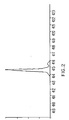
- FIG. 2 shows the result of increasing the ion population in the trap by a factor of three. To increase the ion population in the experiment of FIG. 2, the ionization time has been increased by a factor of three. In both instances, a prescan was first performed using fixed ionization parameters. Due to the increased space charge within the trap it can be seen that the isolation of mass 414 has been affected, as evidenced by the appearance of mass 415.
- PFTBA perfluorotributylamine
- Ion trap 10 shown schematically in cross-section, comprises a ring electrode 20 coaxially aligned with upper and lower end cap electrodes 30 and 35, respectively. These electrodes define an interior trapping volume.
- the trap electrodes have hyperbolic inner surfaces, although other shapes, for example, electrodes having a cross-sections forming an arc of a circle, may also be used to create trapping fields.
- the design and construction of ion trap mass spectrometers is well-known to those skilled in the art and need not be described in detail.
- a commercial model ion trap of the type described herein is sold by the assignee hereof under the model designation Saturn.
- Sample for example from a gas chromatograph 40, is introduced into the ion trap 10. Since GCs typically operate at atmospheric pressure while ion traps operate at greatly reduced pressures, pressure reducing means (e.g. , a vacuum pump, not shown) are required. Such pressure reducing means are conventional and well known to those skilled in the art. While the present invention is described using a GC as a sample source, the source of the sample is not considered a part of the invention and there is no intent to limit the invention to use with gas chromatographs. Other sample sources, such as, for example, liquid chromatographs with specialized interfaces, may also be used.
- pressure reducing means e.g. , a vacuum pump, not shown
- a source of reagent gas 50 may also be connected to the ion trap for conducting chemical ionization experiments.
- Sample and reagent gas that is introduced into the interior of ion trap 10 may be ionized by using a beam of electrons, such as from a thermionic filament 60 powered by filament power supply 65, and controlled by a gate electrode 70.
- the center of upper end cap electrode 30 is perforated (not shown) to allow the electron beam generated by filament 60 and control gate electrode 70 to enter the interior of the trap.
- the electron beam collides with sample and reagent molecules within the trap thereby ionizing them. Electron impact ionization of sample and reagent gases is also a well-known process that need not be described in greater detail.
- the method of the present invention is not limited to the use of electron beam ionization within the trap volume.
- more than one source of reagent gas may be connected to the ion trap to allow experiments using different reagent ions, or to use one reagent gas as a source of precursor ions to chemically ionize another reagent gas.
- a background gas may be introduced into the ion trap to dampen oscillations of trapped ions.
- Such a gas may also be used for CID, and preferably comprises a species, such as helium, with a high ionization potential above the energy of the electron beam or other ionizing source.
- helium is preferably used as the carrier gas.
- a trapping field is created by the application of an AC voltage having a desired frequency and amplitude to stably trap ions within a desired range of masses.
- RF generator 80 is used to create this field, and is applied to the ring electrode.
- a DC voltage source (not shown) may be used to apply a DC component to the trapping field as is well known in the art.
- the preferred method of scanning the trap involves use of a supplemental AC dipole voltage applied across end caps 30 and 35 of ion trap 10.
- a supplemental AC dipole voltage applied across end caps 30 and 35 of ion trap 10.
- Such a voltage may be created by a supplemental waveform generator 100, coupled to the end cap electrodes by transformer 110.
- the supplemental AC field is used to resonantly eject ions in the trap as described above.
- Each ion in the trap has a resonant frequency which is a function of its mass and of the trapping field parameters.
- When an ion is excited by a supplemental RF field at its resonant frequency it gains energy from the field and, if sufficient energy is coupled to the ion, its oscillations exceed the bounds of the trap, i.e. , his ejected from the trap.
- Ions which are ejected from the trap are detected by electron multiplier 90 or an equivalent detector.
- the technique of mass instability scanning (described above in connection with the '884 patent) may be used to determine the contents of the ion trap or methods based on the simultaneous ejection of contents of the trap by the application of a supplemental field as in a time-of-flight technique.
- in-trap detection methods such as those described in Kelley, or involving measurement of induced currents may also be used for determining the contents of ion trap 10 after an experiment.
- Supplemental waveform generator 100 is of the type which is capable of generating a broadband signal composed of a wide range of discrete frequency components.
- a broadband waveform created by generator 100 is applied to the end cap electrodes of the ion trap so as to simultaneously resonantly eject a broad range of ion masses from the trap.
- Supplemental waveform generator 100 may also be used to fragment parent ions in the trap by CID, as is well known in the art.
- the method of '665 patent is capable of isolating a single ion in the trap with high resolution but suffers from the sensitivity of the mass calibration due to variable levels of space charge in the trap. Even though ions of only a single mass are present in the trap after isolation, the exact storage conditions (RF voltage) that will cause the applied supplemental frequency to resonate a particular mass, will depend on the space charge level of the ion that was isolated. Thus, mass calibration will be affected with the result that some of the desired parent ions will inadvertently be ejected, and the ejection of the adjacent masses will be incomplete.
- the daughter ion spectra will also depend on the amount of parent ion present in the trap due to variations in the amount of energy coupled into the parent ion motion during the collision induced dissociation step (CID). To remedy this situation, it is desirable to very precisely maintain a constant level of parent ion in the trap at all sample concentrations. This can be accomplished by utilizing prescan steps that adapt to changing conditions based on the ion level measured in the previous analytical scan of the isolated parent ion.
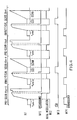
- FIG. 4 is a timing diagram which shows the prescan (S p -1) in which the ionization time is given by T p(s-1) .
- a trapping field is created (500) and the ion of interest is isolated using the method of the '665 patent (510), and the resulting parent ion population level is measured by detecting the number of parent ions in the trap (520).
- Measurement of the parent ion population can be accomplished by raising the trapping RF level slightly above the value required to eject the ion either by resonant ejection, instability ejection or by applying a DC pulse to an end cap or any other of the well known methods of ion ejection or detection, Of course, methods of in-tap detection may also be utilized.
- the appropriate ionization parameters such as ionization time, are calculated and used in the subsequent analytical scan (530).
- the ionization time for the analytical scan (S a -1) is given as T a(s-1) .
- T a(s) T p(s) *X a /I p(s) ;
- X a is a user defined "target" ion level and I p(s) is the measured parent ion level from the prescan, and
- T p(s) X p *T a(s-1) .
- the quantity X p is a user defined prescan target ion population and may be set equal to unity.
- the prescan Adapting the prescan ionization parameters to the sample level, by using the previous analytical scan values, allows the parent ion level that is isolated in both the prescan and the analytical scan to be essentially the same constant value.
- the prescan is done under nearly identical conditions as the analytical scan so that space charge conditions are nearly identical.
- the principal difference between the prescan and the analytical scan is that the prescan ejects the parent ions for detection, while the analytical scan adds the additional steps of dissociating the parent ions into daughter ions followed by a scan of the ions to determine the daughter ion spectrum.
- the trapping voltage is reduced slightly so as to eliminate all ions above the mass of the parent ion.
- the broadband signal may be composed of a series of discrete frequency components and may include gaps between frequency components. The reduction of the trapping voltage effectively sweeps the resonant frequencies of the trapped ions.
- Other constructed or noise type broadband signals may also be used. It is noted that ion isolation in this manner has much higher mass resolution than the notched-filtered noise approach shown in the prescan step of the Kelley patent since the unwanted ions in mass proximity to the parent ion are ejected under much different trapping conditions.
- the low mass scanning may be conducted in two stages.
- the scan rate is slowed.
- the slowed rate may, for example, be the rate at which analytical scanning is normally performed.
- the downscan of the broadband signal which is used to eliminate higher mass ions from the ion trap, is preferably conducted in two similar stages, i.e. , a rapid sweep followed by a slow scan as the signal approaches the resonant frequency of the selected ion.
- the broadband signal continues to be applied for a short period of time (e.g. , 3 - 5 ms) after the scan has been stopped.
- the advantages of the invention over prior art are: (1) improved reproducibility of the concentration level of the isolated parent ions by using optimized ionization parameters determined by use of a prescan in which the parent ions were isolated prior to being detected; (2) the isolation of the parent ion at the same ion level and under substantially the same conditions for the prescan as is used for the analytical scan by using optimized ionization parameters for the prescan ionization that were determined from the previous prescan; (3) improved reproducibility of the daughter ion spectra as a result of dissociating the parent ions under conditions of substantially constant parent ion levels; (4) a method of space charge control of the parent ion level without the use of a prescan; and (5) improved trapping efficiency by ejecting the low mass ions below the parent ion by means of a broad band waveform applied to the trap.
Landscapes
- Chemical & Material Sciences (AREA)
- Analytical Chemistry (AREA)
- Electron Tubes For Measurement (AREA)
- Other Investigation Or Analysis Of Materials By Electrical Means (AREA)
Applications Claiming Priority (3)
| Application Number | Priority Date | Filing Date | Title |
|---|---|---|---|
| US178698 | 1994-01-10 | ||
| US08/178,698 US5448061A (en) | 1992-05-29 | 1994-01-10 | Method of space charge control for improved ion isolation in an ion trap mass spectrometer by dynamically adaptive sampling |
| EP95908457A EP0711453B1 (fr) | 1994-01-10 | 1995-01-10 | Procede de commande de la charge spatiale pour ameliorer l'isolation d'ions dans un spectrometre de masse a piege a ions par echantillonnage dynamiquement adaptatif |
Related Parent Applications (1)
| Application Number | Title | Priority Date | Filing Date |
|---|---|---|---|
| EP95908457A Division EP0711453B1 (fr) | 1994-01-10 | 1995-01-10 | Procede de commande de la charge spatiale pour ameliorer l'isolation d'ions dans un spectrometre de masse a piege a ions par echantillonnage dynamiquement adaptatif |
Publications (2)
| Publication Number | Publication Date |
|---|---|
| EP1009015A2 true EP1009015A2 (fr) | 2000-06-14 |
| EP1009015A3 EP1009015A3 (fr) | 2006-01-25 |
Family
ID=22653581
Family Applications (2)
| Application Number | Title | Priority Date | Filing Date |
|---|---|---|---|
| EP95908457A Expired - Lifetime EP0711453B1 (fr) | 1994-01-10 | 1995-01-10 | Procede de commande de la charge spatiale pour ameliorer l'isolation d'ions dans un spectrometre de masse a piege a ions par echantillonnage dynamiquement adaptatif |
| EP00101210A Withdrawn EP1009015A3 (fr) | 1994-01-10 | 1995-01-10 | Méthode de contrôle de la charge d' espace procurant une isolation élevée des ions dans un spectromètre de masse de type piège à ions par échantillonage adaptif |
Family Applications Before (1)
| Application Number | Title | Priority Date | Filing Date |
|---|---|---|---|
| EP95908457A Expired - Lifetime EP0711453B1 (fr) | 1994-01-10 | 1995-01-10 | Procede de commande de la charge spatiale pour ameliorer l'isolation d'ions dans un spectrometre de masse a piege a ions par echantillonnage dynamiquement adaptatif |
Country Status (4)
| Country | Link |
|---|---|
| US (1) | US5448061A (fr) |
| EP (2) | EP0711453B1 (fr) |
| DE (1) | DE69518890T2 (fr) |
| WO (1) | WO1995019041A1 (fr) |
Families Citing this family (31)
| Publication number | Priority date | Publication date | Assignee | Title |
|---|---|---|---|---|
| DE19501835C2 (de) * | 1995-01-21 | 1998-07-02 | Bruker Franzen Analytik Gmbh | Verfahren zur Anregung der Schwingungen von Ionen in Ionenfallen mit Frequenzgemischen |
| DE19501823A1 (de) * | 1995-01-21 | 1996-07-25 | Bruker Franzen Analytik Gmbh | Verfahren zur Regelung der Erzeugungsraten für massenselektives Einspeichern von Ionen in Ionenfallen |
| US5714755A (en) * | 1996-03-01 | 1998-02-03 | Varian Associates, Inc. | Mass scanning method using an ion trap mass spectrometer |
| JP3624419B2 (ja) * | 1996-09-13 | 2005-03-02 | 株式会社日立製作所 | 質量分析計 |
| US5793038A (en) * | 1996-12-10 | 1998-08-11 | Varian Associates, Inc. | Method of operating an ion trap mass spectrometer |
| DE19709086B4 (de) * | 1997-03-06 | 2007-03-15 | Bruker Daltonik Gmbh | Verfahren der Raumladungsregelung von Tochterionen in Ionenfallen |
| DE19709172B4 (de) * | 1997-03-06 | 2007-03-22 | Bruker Daltonik Gmbh | Verfahren der vergleichenden Analyse mit Ionenfallenmassenspektrometern |
| US6147348A (en) * | 1997-04-11 | 2000-11-14 | University Of Florida | Method for performing a scan function on quadrupole ion trap mass spectrometers |
| DE69825789T2 (de) * | 1997-12-04 | 2005-09-01 | University Of Manitoba, Winnipeg | Vorrichtung und verfahren zur stoss-induzierten dissoziation von ionen in einem quadrupol-ionenleiter |
| ES2155396B1 (es) * | 1999-06-04 | 2001-12-16 | Consejo Superior Investigacion | Procedimiento de identificacion de toxinas psp mediante espectrometria de masas con ionizacion por nanospray. |
| WO2002025265A1 (fr) * | 2000-09-20 | 2002-03-28 | Hitachi, Ltd. | Procede de sondage faisant intervenir un spectrometre de masse a piege ionique et dispositif de sondage |
| US6710336B2 (en) * | 2002-01-30 | 2004-03-23 | Varian, Inc. | Ion trap mass spectrometer using pre-calculated waveforms for ion isolation and collision induced dissociation |
| US20040119014A1 (en) * | 2002-12-18 | 2004-06-24 | Alex Mordehai | Ion trap mass spectrometer and method for analyzing ions |
| US6884996B2 (en) * | 2003-06-04 | 2005-04-26 | Thermo Finnigan Llc | Space charge adjustment of activation frequency |
| US6982417B2 (en) * | 2003-10-09 | 2006-01-03 | Siemens Energy & Automation, Inc. | Method and apparatus for detecting low-mass ions |
| JP4653972B2 (ja) * | 2004-06-11 | 2011-03-16 | 株式会社日立ハイテクノロジーズ | イオントラップ/飛行時間型質量分析装置および質量分析方法 |
| WO2006002027A2 (fr) | 2004-06-15 | 2006-01-05 | Griffin Analytical Technologies, Inc. | Instruments analytiques, assemblages et methodes associees |
| US7312441B2 (en) * | 2004-07-02 | 2007-12-25 | Thermo Finnigan Llc | Method and apparatus for controlling the ion population in a mass spectrometer |
| US7238936B2 (en) * | 2004-07-02 | 2007-07-03 | Thermo Finnigan Llc | Detector with increased dynamic range |
| CN101317246A (zh) * | 2005-04-25 | 2008-12-03 | 格里芬分析技术有限责任公司 | 分析仪器、装置和方法 |
| GB0511083D0 (en) * | 2005-05-31 | 2005-07-06 | Thermo Finnigan Llc | Multiple ion injection in mass spectrometry |
| JP4636943B2 (ja) * | 2005-06-06 | 2011-02-23 | 株式会社日立ハイテクノロジーズ | 質量分析装置 |
| US7992424B1 (en) | 2006-09-14 | 2011-08-09 | Griffin Analytical Technologies, L.L.C. | Analytical instrumentation and sample analysis methods |
| WO2008126383A1 (fr) | 2007-04-09 | 2008-10-23 | Shimadzu Corporation | Spectrographe de masse à piège ionique |
| EP2136389B1 (fr) | 2007-04-12 | 2019-12-04 | Shimadzu Corporation | Spectromètre de masse à piège à ions |
| US8334506B2 (en) | 2007-12-10 | 2012-12-18 | 1St Detect Corporation | End cap voltage control of ion traps |
| US7973277B2 (en) | 2008-05-27 | 2011-07-05 | 1St Detect Corporation | Driving a mass spectrometer ion trap or mass filter |
| US8258462B2 (en) * | 2008-09-05 | 2012-09-04 | Thermo Finnigan Llc | Methods of calibrating and operating an ion trap mass analyzer to optimize mass spectral peak characteristics |
| JP5083160B2 (ja) * | 2008-10-06 | 2012-11-28 | 株式会社島津製作所 | 四重極型質量分析装置 |
| US8552365B2 (en) * | 2009-05-11 | 2013-10-08 | Thermo Finnigan Llc | Ion population control in a mass spectrometer having mass-selective transfer optics |
| US11355328B2 (en) | 2016-04-13 | 2022-06-07 | Purdue Research Foundation | Systems and methods for isolating a target ion in an ion trap using a dual frequency waveform |
Family Cites Families (7)
| Publication number | Priority date | Publication date | Assignee | Title |
|---|---|---|---|---|
| EP0409362B1 (fr) * | 1985-05-24 | 1995-04-19 | Finnigan Corporation | Méthode de mise en oeuvre d'un piège à ions |
| US4771172A (en) * | 1987-05-22 | 1988-09-13 | Finnigan Corporation | Method of increasing the dynamic range and sensitivity of a quadrupole ion trap mass spectrometer operating in the chemical ionization mode |
| US5128542A (en) * | 1991-01-25 | 1992-07-07 | Finnigan Corporation | Method of operating an ion trap mass spectrometer to determine the resonant frequency of trapped ions |
| US5198665A (en) * | 1992-05-29 | 1993-03-30 | Varian Associates, Inc. | Quadrupole trap improved technique for ion isolation |
| US5397894A (en) * | 1993-05-28 | 1995-03-14 | Varian Associates, Inc. | Method of high mass resolution scanning of an ion trap mass spectrometer |
| US5381006A (en) * | 1992-05-29 | 1995-01-10 | Varian Associates, Inc. | Methods of using ion trap mass spectrometers |
| DE69321165T2 (de) * | 1992-05-29 | 1999-06-02 | Varian Associates, Inc., Palo Alto, Calif. | Verfahren zur Verwendung eines Massenspektrometers |
-
1994
- 1994-01-10 US US08/178,698 patent/US5448061A/en not_active Expired - Lifetime
-
1995
- 1995-01-10 DE DE69518890T patent/DE69518890T2/de not_active Expired - Lifetime
- 1995-01-10 WO PCT/US1995/000286 patent/WO1995019041A1/fr not_active Ceased
- 1995-01-10 EP EP95908457A patent/EP0711453B1/fr not_active Expired - Lifetime
- 1995-01-10 EP EP00101210A patent/EP1009015A3/fr not_active Withdrawn
Also Published As
| Publication number | Publication date |
|---|---|
| DE69518890D1 (de) | 2000-10-26 |
| EP1009015A3 (fr) | 2006-01-25 |
| EP0711453A1 (fr) | 1996-05-15 |
| WO1995019041A1 (fr) | 1995-07-13 |
| EP0711453A4 (fr) | 1997-08-20 |
| EP0711453B1 (fr) | 2000-09-20 |
| DE69518890T2 (de) | 2001-04-26 |
| US5448061A (en) | 1995-09-05 |
Similar Documents
| Publication | Publication Date | Title |
|---|---|---|
| EP0711453B1 (fr) | Procede de commande de la charge spatiale pour ameliorer l'isolation d'ions dans un spectrometre de masse a piege a ions par echantillonnage dynamiquement adaptatif | |
| EP0701471B1 (fr) | Procede de commande de la charge spatiale dans un spectrometre de masse a piege a ions | |
| US5397894A (en) | Method of high mass resolution scanning of an ion trap mass spectrometer | |
| EP0747929B1 (fr) | Procédé d'utilisation pour un spectromètre de masse à piège à ions quadripolaire | |
| US5572022A (en) | Method and apparatus of increasing dynamic range and sensitivity of a mass spectrometer | |
| US7291845B2 (en) | Method for controlling space charge-driven ion instabilities in electron impact ion sources | |
| EP0237268B1 (fr) | Procédé d'analyse de masse d'un échantillon | |
| JP2608100B2 (ja) | イオン・トラップ質量分析計を化学的イオン化方式で使用する方法 | |
| US5128542A (en) | Method of operating an ion trap mass spectrometer to determine the resonant frequency of trapped ions | |
| US9698002B2 (en) | Method and apparatus for mass analysis utilizing ion charge feedback | |
| US5714755A (en) | Mass scanning method using an ion trap mass spectrometer | |
| US7759655B2 (en) | Pulsed ion source for quadrupole mass spectrometer and method | |
| JP3558365B2 (ja) | イオントラップ質量分析計の使用方法 | |
| US5789747A (en) | Three dimensional quadrupole mass spectrometry and mass spectrometer | |
| CA2528300C (fr) | Ajustement de la charge d'espace pour une frequence d'activation | |
| EP0575777B1 (fr) | Methode de mise en oeuvre d'un spectromètre de masse | |
| JPH07169439A (ja) | CIDを使用するMSn |
Legal Events
| Date | Code | Title | Description |
|---|---|---|---|
| PUAI | Public reference made under article 153(3) epc to a published international application that has entered the european phase |
Free format text: ORIGINAL CODE: 0009012 |
|
| AC | Divisional application: reference to earlier application |
Ref document number: 711453 Country of ref document: EP |
|
| AK | Designated contracting states |
Kind code of ref document: A2 Designated state(s): CH DE FR GB IT LI |
|
| PUAL | Search report despatched |
Free format text: ORIGINAL CODE: 0009013 |
|
| AK | Designated contracting states |
Kind code of ref document: A3 Designated state(s): CH DE FR GB IT LI |
|
| 17P | Request for examination filed |
Effective date: 20060531 |
|
| AKX | Designation fees paid |
Designated state(s): CH DE FR GB IT LI |
|
| RIC1 | Information provided on ipc code assigned before grant |
Ipc: H01J 49/42 20060101AFI20101220BHEP |
|
| GRAP | Despatch of communication of intention to grant a patent |
Free format text: ORIGINAL CODE: EPIDOSNIGR1 |
|
| RTI1 | Title (correction) |
Free format text: SPACE CHARGE CONTROL METHOD FOR IMPROVED ION ISOLATION IN ION TRAP MASS SPECTROMETER BY DYNAMICALLY ADAPTIVE SAMPLING |
|
| STAA | Information on the status of an ep patent application or granted ep patent |
Free format text: STATUS: THE APPLICATION IS DEEMED TO BE WITHDRAWN |
|
| 18D | Application deemed to be withdrawn |
Effective date: 20110713 |