EP1009140A2 - Data transmission method, data transmission system, data receiving method, and data receiving apparatus - Google Patents
Data transmission method, data transmission system, data receiving method, and data receiving apparatus Download PDFInfo
- Publication number
- EP1009140A2 EP1009140A2 EP99124627A EP99124627A EP1009140A2 EP 1009140 A2 EP1009140 A2 EP 1009140A2 EP 99124627 A EP99124627 A EP 99124627A EP 99124627 A EP99124627 A EP 99124627A EP 1009140 A2 EP1009140 A2 EP 1009140A2
- Authority
- EP
- European Patent Office
- Prior art keywords
- data
- scene
- transmission
- receiving
- information
- Prior art date
- Legal status (The legal status is an assumption and is not a legal conclusion. Google has not performed a legal analysis and makes no representation as to the accuracy of the status listed.)
- Withdrawn
Links
Images






Classifications
-
- H—ELECTRICITY
- H04—ELECTRIC COMMUNICATION TECHNIQUE
- H04N—PICTORIAL COMMUNICATION, e.g. TELEVISION
- H04N21/00—Selective content distribution, e.g. interactive television or video on demand [VOD]
- H04N21/20—Servers specifically adapted for the distribution of content, e.g. VOD servers; Operations thereof
- H04N21/23—Processing of content or additional data; Elementary server operations; Server middleware
- H04N21/234—Processing of video elementary streams, e.g. splicing of video streams or manipulating encoded video stream scene graphs
- H04N21/2343—Processing of video elementary streams, e.g. splicing of video streams or manipulating encoded video stream scene graphs involving reformatting operations of video signals for distribution or compliance with end-user requests or end-user device requirements
- H04N21/234318—Processing of video elementary streams, e.g. splicing of video streams or manipulating encoded video stream scene graphs involving reformatting operations of video signals for distribution or compliance with end-user requests or end-user device requirements by decomposing into objects, e.g. MPEG-4 objects
-
- H—ELECTRICITY
- H04—ELECTRIC COMMUNICATION TECHNIQUE
- H04L—TRANSMISSION OF DIGITAL INFORMATION, e.g. TELEGRAPHIC COMMUNICATION
- H04L65/00—Network arrangements, protocols or services for supporting real-time applications in data packet communication
- H04L65/60—Network streaming of media packets
- H04L65/61—Network streaming of media packets for supporting one-way streaming services, e.g. Internet radio
- H04L65/613—Network streaming of media packets for supporting one-way streaming services, e.g. Internet radio for the control of the source by the destination
-
- H—ELECTRICITY
- H04—ELECTRIC COMMUNICATION TECHNIQUE
- H04L—TRANSMISSION OF DIGITAL INFORMATION, e.g. TELEGRAPHIC COMMUNICATION
- H04L65/00—Network arrangements, protocols or services for supporting real-time applications in data packet communication
- H04L65/60—Network streaming of media packets
- H04L65/65—Network streaming protocols, e.g. real-time transport protocol [RTP] or real-time control protocol [RTCP]
-
- H—ELECTRICITY
- H04—ELECTRIC COMMUNICATION TECHNIQUE
- H04L—TRANSMISSION OF DIGITAL INFORMATION, e.g. TELEGRAPHIC COMMUNICATION
- H04L65/00—Network arrangements, protocols or services for supporting real-time applications in data packet communication
- H04L65/80—Responding to QoS
-
- H—ELECTRICITY
- H04—ELECTRIC COMMUNICATION TECHNIQUE
- H04L—TRANSMISSION OF DIGITAL INFORMATION, e.g. TELEGRAPHIC COMMUNICATION
- H04L67/00—Network arrangements or protocols for supporting network services or applications
- H04L67/50—Network services
- H04L67/60—Scheduling or organising the servicing of application requests, e.g. requests for application data transmissions using the analysis and optimisation of the required network resources
- H04L67/62—Establishing a time schedule for servicing the requests
-
- H—ELECTRICITY
- H04—ELECTRIC COMMUNICATION TECHNIQUE
- H04L—TRANSMISSION OF DIGITAL INFORMATION, e.g. TELEGRAPHIC COMMUNICATION
- H04L69/00—Network arrangements, protocols or services independent of the application payload and not provided for in the other groups of this subclass
- H04L69/30—Definitions, standards or architectural aspects of layered protocol stacks
- H04L69/32—Architecture of open systems interconnection [OSI] 7-layer type protocol stacks, e.g. the interfaces between the data link level and the physical level
- H04L69/322—Intralayer communication protocols among peer entities or protocol data unit [PDU] definitions
- H04L69/326—Intralayer communication protocols among peer entities or protocol data unit [PDU] definitions in the transport layer [OSI layer 4]
-
- H—ELECTRICITY
- H04—ELECTRIC COMMUNICATION TECHNIQUE
- H04L—TRANSMISSION OF DIGITAL INFORMATION, e.g. TELEGRAPHIC COMMUNICATION
- H04L9/00—Cryptographic mechanisms or cryptographic arrangements for secret or secure communications; Network security protocols
- H04L9/40—Network security protocols
-
- H—ELECTRICITY
- H04—ELECTRIC COMMUNICATION TECHNIQUE
- H04N—PICTORIAL COMMUNICATION, e.g. TELEVISION
- H04N21/00—Selective content distribution, e.g. interactive television or video on demand [VOD]
- H04N21/40—Client devices specifically adapted for the reception of or interaction with content, e.g. set-top-box [STB]; Operations thereof
- H04N21/43—Processing of content or additional data, e.g. demultiplexing additional data from a digital video stream; Elementary client operations, e.g. monitoring of home network or synchronising decoder's clock; Client middleware
- H04N21/44—Processing of video elementary streams, e.g. splicing a video clip retrieved from local storage with an incoming video stream or rendering scenes according to encoded video stream scene graphs
- H04N21/44012—Processing of video elementary streams, e.g. splicing a video clip retrieved from local storage with an incoming video stream or rendering scenes according to encoded video stream scene graphs involving rendering scenes according to scene graphs, e.g. MPEG-4 scene graphs
-
- H—ELECTRICITY
- H04—ELECTRIC COMMUNICATION TECHNIQUE
- H04L—TRANSMISSION OF DIGITAL INFORMATION, e.g. TELEGRAPHIC COMMUNICATION
- H04L65/00—Network arrangements, protocols or services for supporting real-time applications in data packet communication
- H04L65/1066—Session management
- H04L65/1101—Session protocols
-
- H—ELECTRICITY
- H04—ELECTRIC COMMUNICATION TECHNIQUE
- H04L—TRANSMISSION OF DIGITAL INFORMATION, e.g. TELEGRAPHIC COMMUNICATION
- H04L69/00—Network arrangements, protocols or services independent of the application payload and not provided for in the other groups of this subclass
- H04L69/30—Definitions, standards or architectural aspects of layered protocol stacks
- H04L69/32—Architecture of open systems interconnection [OSI] 7-layer type protocol stacks, e.g. the interfaces between the data link level and the physical level
-
- H—ELECTRICITY
- H04—ELECTRIC COMMUNICATION TECHNIQUE
- H04L—TRANSMISSION OF DIGITAL INFORMATION, e.g. TELEGRAPHIC COMMUNICATION
- H04L69/00—Network arrangements, protocols or services independent of the application payload and not provided for in the other groups of this subclass
- H04L69/30—Definitions, standards or architectural aspects of layered protocol stacks
- H04L69/32—Architecture of open systems interconnection [OSI] 7-layer type protocol stacks, e.g. the interfaces between the data link level and the physical level
- H04L69/322—Intralayer communication protocols among peer entities or protocol data unit [PDU] definitions
- H04L69/329—Intralayer communication protocols among peer entities or protocol data unit [PDU] definitions in the application layer [OSI layer 7]
Definitions
- the present invention relates to a data transmission method, a data transmission system, a data receiving method, and a data receiving apparatus and, more particularly, to a method for transmitting image data of MPEG4, through the Internet, according to a transmission mode adapted to the type of the image data.
- multimedia in which audio, video, and other data are integrally handled
- conventional information media i.e., means for transmitting information to men, such as newspapers, magazines, televisions, radios, and telephones
- multimedia means media in which, not only characters, but also diagrams, speeches, and especially images are simultaneously expressed in relation with each other.
- the quantity of data possessed by each of the above-described information media is estimated as the quantity of digital data
- the data quantity per character is only 1 ⁇ 2 byte.
- the data quantity is 64kbits per second (quality for telecommunication).
- the required data quantity is more than 100Mbits per second (quality for current television broadcasting). So, in the above-described information media, it is not practical to handle such massive data as it is in the digital format.
- visual telephones have already been put to practical use by the ISDN (Integrated Services Digital Network) having a transmission rate of 64kbps ⁇ 1.5Mbps, it is impossible to transmit an image from a television camera as it is by the ISDN.
- ISDN Integrated Services Digital Network
- MPEG Motion Picture Experts Group
- MPEG1 is the standard for compressing moving picture data to 1.5Mbps, i.e., data of a television signal to about 1/100. Since the transmission rate of the targets to which the MPEG1 standard is directed is limited to about 1.5Mbps, in MPEG2 which has been standardized to meet the demand for higher image quality, moving picture data is compressed to 2 ⁇ 15 Mbps.
- MPEG4 enables coding and signal processing in object units, and thereby realizes new functions required in the age of multimedia.
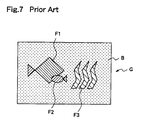
- Figures 7, and 8(a)-8(d) are diagrams for explaining the object-by-object coding process.
- an image G corresponding to one frame shown in figure 7 is treated as a composite image which is obtained by compositing plural objects.
- the image G is composed of a background B (figure 8(a)), a big fish F1 as a first foreground (figure 8(b)), a small fish F2 as a second foreground (figure 8 (c)), and a seaweed F3 as a third foreground (figure 8(d)).
- image data corresponding to the respective objects constituting the composite image G are encoded object by object.
- coded image data (object data) corresponding to the respective objects are transmitted through a transmission medium.
- the coded image data corresponding to the respective objects are received object by object or in the multiplexed state, through the transmission medium.
- the received coded image data are decoded object by object, thereby generating decoded image data corresponding to each object.
- the decoded image data corresponding to the respective objects are composited, thereby generating reproduced image data (scene data) corresponding to the composite image (decoded and reproduced image) G.
- control information includes, for example, scene description information which indicates the locations of the respective objects in one frame for compositing and displaying the objects, i.e., the display area of the composite image (refer to figure 15(b)).
- a video distribution system has spread, in which the user can gain access to his/her favorite moving picture through a computer network.
- Figure 9 is a schematic diagram for explaining such video distribution system.
- a plurality of networks 701, 702 and 703 are connected to each other, and a plurality of servers 705, 706 and 707 which distribute video information are connected to the networks 701, 702 and 703, respectively.
- a plurality of video reception and reproduction terminal units (hereinafter referred to simply as "terminal units") which receive the distributed video information are connected to the respective networks 701 ⁇ 703.
- terminal units 704 connected to the network 701 is shown in figure 9.
- the terminal unit 704 receives video information distributed from the server 705, initially, the terminal unit 704 contacts the server 705, and effectuates a circuit connection with the server 705. Thereafter, the terminal unit 704 receives coded image data distributed from the server 705, and reproduces the image data by decoding.
- a plurality of information sources are connected to the Internet which forms the network in the current information distribution system, and the respective information sources contain, for example, information of home pages relating to various subjects.
- the terminal unit 704 is connected to an information source having information of a home page HP the title of which is "World of Dinosaurs", and this home page HP is displayed on a display of the terminal unit 704.
- a video file (image data) transmitted from a distribution server is once copied at the terminal and, thereafter, the image corresponding to the video file is reproduced. So, the terminal cannot start image reproduction until the file transmission is completed. That is, there is a latency time for transmission and, therefore, the download type transmission is not suitable for long-hours reproduction of video and audio.
- the stream type transmission while transmitting video data or the like from the distribution server to the terminal, image reproduction is carried out on the basis of the received data at the terminal end.
- data to be processed in real time such as video data and audio data, are transmitted by the stream type transmission.
- RTP Real-time Transport Protocol
- processes for the respective packets are synchronized between the transmitting end and the receiving end by using time stamps as time information, and asynchronous (late arrival) packets and error packets in which transmission errors have occurred are discarded at the receiving end. Further, discarded or lost packets are detected at the receiving end, according to the absences of sequence numbers given to these packets.
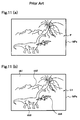
- the video scene P shown in figure 11(a) is treated as a composite image G1 which is composed of four objects ob1, ob2, ob3, and ob4 (refer to figure 11(b)). That is, in this composite image G1, the object ob1 is a background as a still picture showing the sky or the like (figure 12(a)), the object ob2 is a first foreground as a cyclic moving picture showing a volcano (figure 12(b)), the object ob3 is a second foreground as a moving picture showing a big dinosaur (figure 12(c)), and the object ob4 is a third foreground as a moving picture showing a small dinosaur (figure 12(d)).
- the object ob1 is a background as a still picture showing the sky or the like
- the object ob2 is a first foreground as a cyclic moving picture showing a volcano
- the object ob3 is a second foreground as
- a data transmission method based on MPEG4, which is currently examined, will be described by using figures 15(a) and 15(b).
- a plurality of servers may be connected to the terminal T.
- image data corresponding to one scene (composite image) treated in MPEG4 is obtained for each of plural objects constituting the scene, from a predetermined server, by the RTP, through the Internet.
- the type of data is described in association with a transmission mode and an URL (Uniform Resource Locator) of the data, which are required for reproduction of the composite image.
- object data entity data
- URL Uniform Resource Locator
- IOD initial object descriptor
- ODS object descriptor stream
- SDS scene description stream
- IOD information data of the object descriptor (OD) corresponding to the ODS itself, and data of the object descriptor (OD) corresponding to the SDS itself, are stored.
- ODS information data of object descriptors (OD) of all objects constituting the scene are stored.
- SDS information data of scene descriptions SD1 ⁇ SDn corresponding to predetermined times t1 ⁇ tn are stored.
- the terminal T When the SDP information and the IOD information are transmitted to the terminal T, the terminal T requests the server S to transmit the ODS information corresponding to the respective objects (i.e., object descriptors OD1 ⁇ OD4) and the entity data, by specifying their uniform resource locators (URL) and synchronization sources (hereinafter referred to simply as SSRC). Further, the terminal T requests the server S to transmit the SDS information corresponding to the scene G1 (i.e., the scene descriptions SD1 ⁇ SDn), by specifying its URL and SSRC.
- the SSRC is a channel ID for identifying a channel of the RTP packet.
- the server S On receipt of the request from the terminal T, the server S packetizes the requested data, gives the SSRC specified by the terminal to each packet, and transmits the packets to the terminal T according to the RTP.
- the terminal T receives the image data (object data) of the respective objects constituting the scene G1, the object descriptors OD1 ⁇ OD4, and the scene descriptions SD1 ⁇ SDn. Based on these data, the terminal T reproduces and displays the image of the scene G1.
- the image data according to MPEG4 includes data (control information) which prevents image reproduction if a transmission error occurs in this data, such as the SDP information, the IOD information, the SDS information, and the ODS information.
- data control information
- the image data according to MPEG4 includes data (control information) which prevents image reproduction if a transmission error occurs in this data, such as the SDP information, the IOD information, the SDS information, and the ODS information.
- the download type transmission and the stream type transmission are performed in arbitrary order, the image data are sometimes transmitted by the download transmission while reproducing the image data transmitted by the stream type transmission.
- the data transmission quantity during scene reproduction increases significantly, and the consumption of the transmission band of the network cannot be minimized.
- the correspondence between the address (URL) of the object data (image data corresponding to each object) and each object cannot be obtained.
- the present invention is made to solve the above-described problems and has for its object to provide a data transmission method, a data transmission system, a data receiving method, and a data receiving apparatus, which avoid that image reproduction at a receiving terminal becomes unreliable due to transmission error, and assure reliable image reproduction at the receiving terminal even when some transmission error occurs.
- URL Uniform Resource Locator
- SDP Session Description Protocol
- a data transmission method of transmitting plural pieces of object data for reproducing plural objects constituting a scene from the transmitting end to the receiving end.
- This method comprises a first transmission process of transmitting first object data, amongst the plural pieces of object data, such that reproduction of the scene is performed at the receiving end on the basis of the first object data after the transmission of the first object data has been completed; and a second transmission process of transmitting second object data other than the first object data, amongst the plural pieces of object data, such that reproduction of the scene is performed at the receiving end on the basis of the second object data during the transmission of the second object data. Therefore, extreme increase in the data transmission quantity during scene reproduction is avoided, and the consumption of the transmission band of the network is minimized.
- a data transmission method for transmitting scene data for reproducing a scene comprises a first transmission process of transmitting first data which is a part of the scene data, in accordance with a first transmission protocol which does not necessarily perform retransmission against transmission errors; and a second transmission process of transmitting second data which is a part of the scene data, in accordance with a second transmission protocol which performs retransmission against transmission errors.
- the second data is scene description information and object relevant information, the scene description information indicating the hierarchy of the respective objects constituting the scene, by object identifiers which are given to the respective objects for identifying these objects, and the object relevant information indicating additional information relating to the respective objects, in association with the object identifiers of the respective objects. Therefore, this method can prevent image reproduction at the receiving end from becoming unreliable due to transmission error, and the receiving end can perform reliable image reproduction even when some transmission error occurs.
- a data transmission method for transmitting scene data for reproducing a scene from the transmitting end to the receiving end.
- This method comprises the steps of transmitting object data for reproducing plural objects constituting the scene, object by object, from the transmitting end to the receiving end; and transmitting table information from the transmitting end to the receiving end, the table information associating an object identifier given to each object for identifying the object, with location information indicating the location of object data corresponding to the object. Therefore, the receiving end can associate each object with the location of object data corresponding to the object, on the basis of the table information.
- a data transmission system comprising a data transmission apparatus for transmitting plural pieces of object data for reproducing plural objects constituting a scene; and a data receiving apparatus for receiving the plural pieces of object data and reproducing the scene on the basis of the object data.
- the data transmission apparatus comprises a first transmission unit for transmitting first object data, amongst the plural pieces of object data, such that reproduction of the scene is performed at the receiving end on the basis of the first object data after the transmission of the first object data has been completed; and a second transmission unit for transmitting second object data other than the first object data, amongst the plural pieces of object data, such that reproduction of the scene is performed at the receiving end on the basis of the second object data during the transmission of the second object data. Therefore, extreme increase in the data transmission quantity during scene reproduction is avoided, and the consumption of the transmission band of the network is minimized.
- the data transmission apparatus transmits, by using the first transmission unit, control information for controlling transmission of the object data and reproduction of the objects, as initial data to be transmitted to the receiving end in the transmission process for data corresponding to one scene, the control information including transmission mode identification information indicating that the object data corresponding to each of the objects constituting one scene is to be transmitted by the first transmission unit or the second transmission unit. Therefore, in addition to the effect of minimizing the consumption of the transmission band of the network, this system can prevent image reproduction at the receiving end from becoming unreliable due to transmission error.
- a data transmission system comprising a data transmission apparatus for transmitting scene data for reproducing a scene; and a data receiving apparatus for receiving the scene data and reproducing the scene.
- the data transmission apparatus comprises a first transmission unit for transmitting first data which is a part of the scene data, in accordance with a first transmission protocol which does not necessarily perform retransmission against transmission errors; and a second transmission unit for transmitting second data which is a part of the scene data, in accordance with a second transmission protocol which performs retransmission against transmission errors.
- the second transmission unit transmits, as the second data, scene description information and object relevant information, the scene description information indicating the hierarchy of the respective objects constituting the scene, by object identifiers which are given to the respective objects for identifying these objects, and the object relevant information indicating additional information relating to the respective objects, in association with the object identifiers of the respective objects. Therefore, this system can prevent image reproduction at the receiving end from becoming unreliable due to transmission error, and the receiving end can perform reliable image reproduction regardless of some transmission error.
- a data transmission system comprising a data transmission apparatus for transmitting, object by object, object data for reproducing plural objects constituting a scene; and a data receiving apparatus for receiving the object data and reproducing the scene on the basis of the object data.
- the data transmission apparatus comprises an information transmission unit for transmitting table information which associates an object identifier given to each object for identifying the object, with location information indicating the location of object data corresponding to the object. Therefore, the receiving end can associate each object with the location of object data corresponding to the object, on the basis of the table information.
- the information transmission unit transmits the table information in such a manner that the table information is included in control information for controlling transmission of the object data and reproduction of the objects, the control information being initial information to be transmitted to the receiving end in the transmission process for data corresponding to the scene. Therefore, the receiving end can associate each object with the location of object data corresponding to the object, on the basis of the table information.
- the information transmission unit transmits the table information in such a manner that the table information is included in object relevant information which indicates additional information relating to the respective objects in association with object identifiers of the respective objects. Therefore, the receiving end can associate each object with the location of object data corresponding to the object, on the basis of the table information.
- a data receiving method for receiving plural pieces of object data for reproducing plural objects constituting a scene, transmitted from the transmitting end, and reproducing the scene on the basis of the object data.
- This method comprises a first receiving process of receiving first object data amongst the plural pieces of object data, and reproducing the scene on the basis of the first object data after the reception of the object data has been completed; and a second receiving process of receiving second object data other than the first object data amongst the plural pieces of object data and, simultaneously, reproducing the scene on the basis of the second object data. Therefore, extreme increase in the data transmission quantity during scene reproduction is avoided, and the consumption of the transmission band of the network is minimized.
- a data receiving method for receiving scene data for reproducing a scene, transmitted from the transmitting end, and reproducing the scene.
- This method comprises a first receiving process of receiving first data which is a part of the scene data, transmitted according to a first transmission protocol which does not necessarily perform retransmission against transmission errors; and a second receiving process of receiving second data which is a part of the scene data, transmitted according to a second transmission protocol which performs retransmission against transmission errors.
- the second data is scene description information and object relevant information, the scene description information indicating the hierarchy of the respective objects constituting the scene, by object identifiers corresponding to the respective objects, and the object relevant information indicating additional information relating to the respective objects, in association with the object identifiers of the respective objects. Therefore, this method can prevent image reproduction at the receiving end from becoming unreliable due to transmission error, and satisfactory scene reproduction is performed regardless of some transmission error.
- a data receiving method for receiving scene data for reproducing a scene, transmitted from the transmitting end, and reproducing the scene comprises the steps of receiving object data for reproducing plural objects constituting the scene, which are transmitted object by object from the transmitting end; and receiving table information transmitted from the transmitting end, the table information associating an object identifier given to each object for identifying the object, with location information indicating the location of object data corresponding to the object. Therefore, during scene reproduction, each object can be associated with the location of object data corresponding to the object, on the basis of the table information.
- a data receiving apparatus for receiving plural pieces of object data for reproducing plural objects constituting a scene, transmitted from the transmitting end, and reproducing the scene on the basis of the object data.
- This apparatus comprises a first receiving unit for receiving first object data amongst the plural pieces of object data; a second receiving unit for receiving second object data other than the first object data amongst the plural pieces of object data; and a reproduction unit for reproducing the scene on the basis of the first object data and the second object data, in which scene reproduction based on the first object data is performed after reception of the first object data has been completed, while scene reproduction based on the second object data is performed in parallel with the reception of the second object data. Therefore, extreme increase in the data transmission quantity during scene reproduction is avoided.
- control information for controlling transmission of the object data and reproduction of the objects is received by the first receiving unit, as initial data transmitted to the receiving end in the transmission process for data corresponding to the scene; and the object data corresponding to each object is received by one of the first and second receiving units, according to transmission mode identification information which is included in the control information and indicates that the object data is to be received by the first receiving unit or the second receiving unit. Therefore, in addition to the effect of minimizing the consumption of the transmission band of the network, this apparatus can prevent image reproduction at the receiving from becoming unreliable due to transmission error.
- a data receiving apparatus for receiving scene data for reproducing a scene, transmitted from the transmitting end, and reproducing the scene.
- This apparatus comprises a first receiving unit for receiving first data which is transmitted as a part of the scene data in accordance with a first transmission protocol that does not necessarily perform retransmission against transmission errors; a second receiving unit for receiving second data which is transmitted as a part of the scene data in accordance with a second transmission protocol that performs retransmission against transmission errors.
- the second receiving unit receives, as the second data, scene description information and object relevant information, the scene description information indicating the hierarchy of the respective objects constituting the scene, by object identifiers corresponding to the respective objects, and the object relevant information indicating additional information relating to the respective objects, in association with the object identifiers of the respective objects. Therefore, this apparatus can prevent image reproduction at the receiving end from becoming unstable due to transmission error.
- a data receiving apparatus for receiving object data for reproducing objects constituting a scene, transmitted object by object from the transmitting end, and reproducing the scene.
- This apparatus comprises a first receiving unit for receiving first data which is transmitted as a part of the scene data in accordance with a first transmission protocol that does not necessarily perform retransmission against transmission errors; and a second receiving unit for receiving second data which is transmitted as a part of the scene data in accordance with a second transmission protocol that performs retransmission against transmission errors.
- the second receiving unit receives, as the second data, table information transmitted from the transmitting end, the table information associating an object identifier given to each object for identifying the object, with location information indicating the location of object data corresponding to the object. Therefore, even when some transmission error occurs, each object can be associated with the location of object data corresponding to the object on the basis of the table information.
- the second receiving unit receives the table information as information included in control information for controlling transmission of object data corresponding to the respective objects and reproduction of the objects, the control information being received first as the scene data corresponding to one scene. Therefore, even when some transmission error occurs, each object can be associated with the location of object data corresponding to the object on the basis of the table information.
- the second receiving unit receives the table information as information included in object relevant information transmitted from the transmitting end, the object relevant information indicating additional information relating to the respective objects, in association with object identifiers of the respective objects. Therefore, even when some transmission error occurs, each object can be associated with the location of object data corresponding to the object on the basis of the table information.
- the inventors of the present invention have discovered that, in the process of transmitting image data based on MPEG4, when control information which may cause unreliable scene reproduction due to transmission errors (i.e., SDP information, IOD information, SDS information, ODS information, etc.) is transmitted according to a highly reliable protocol that performs data retransmission or the like when a transmission error has occurred, bad influences of the transmission error on the scene reproduction can be minimized.
- control information which may cause unreliable scene reproduction due to transmission errors (i.e., SDP information, IOD information, SDS information, ODS information, etc.) is transmitted according to a highly reliable protocol that performs data retransmission or the like when a transmission error has occurred, bad influences of the transmission error on the scene reproduction can be minimized.
- identifiers for identifying the data formats of the image data (object data) corresponding to the respective objects constituting the scene are described in control information or the like which is to be downloaded initially in the scene data transmission process, and the identifiers are downloaded before starting scene reproduction at the receiving end, whereby the quantity of data transmitted during the scene reproduction can be reduced.
- the download type object data is image data of an object, such as a background still picture, a cyclic moving picture, audio, or text. Once the download type object data has been transmitted to the receiving end, the receiving end can utilize it until a scene change occurs. Such object data is transmitted such that reproduction of the scene is performed on the basis of the data at the receiving end after the transmission has been completed.
- the stream type object data is image data of a moving picture (object) which changes with time, and it takes time to download all the data from the change of one scene to the change of next scene.
- object data is transmission such that the scene is reproduced on the basis of the data at the receiving end during the transmission.
- the inventors of the present invention have discovered that, by transmitting table information which associates an object identifier given to each object for identifying the object with image data (object data) of each object, the receiving end can reproduce the scene by associating each object with the object data corresponding to the object.
- Figures 1 ⁇ 5 are diagrams for explaining a data transmission system 1000 according to a first embodiment of the present invention.
- Figure 1 is a schematic diagram illustrating the entire structure of the data transmission system.
- the data transmission system 1000 of this first embodiment performs data transmission from a predetermined server to a client terminal according to one of the following two processes: a download type transmission process in which download type object data amongst object data, such as video data, audio data, and text data, is transmitted such that reproduction of information is performed at the receiving end on the basis of the download type object data after transmission of the data has been completed; and a stream type transmission process in which stream type object data amongst the object data is transmitted such that reproduction of information is performed at the receiving end during transmission of the stream type object data.
- the download type (hereinafter also referred to as pre-download type) object data is object data constituting a scene and having a relatively small quantity of data
- the stream type object data is object data constituting a scene and having a relatively large quantity of data.
- This system 1000 includes first to third servers 100a, 100b, and 100c having predetermined data, and a client (display terminal) 200 which requests each server to send necessary data. These servers 100a ⁇ 100c are connectable to the client 200 through the Internet.
- the first server (server A) 100a holds stream type video data
- the second server (server B) 100b holds pre-download type video data
- IOD information IOD information
- SDP information SDP information
- the third server (server C) 100c holds data of a predetermined home page.
- the video data are image data for reproducing objects constituting a scene.
- the IOD information includes SDS information which comprises scene descriptions SD1 ⁇ SDn corresponding to predetermined times t1 ⁇ tn in one scene, and ODS information which comprises object descriptors OD corresponding to all objects constituting one scene.
- the URL of the IOD information and the transmission mode thereof are described in association with the data type (IOD).
- the URL of the ODS information and the transmission mode thereof are described in association with the data type (ODS) and, furthermore, the URL of the SDS information and the transmission mode thereof are described in association with the data type (SDS).
- the transmission modes of the IOD information, the ODS information, and the SDS information are download type.
- the URL of each entity data and the transmission mode thereof are described in association with the data type (video, audio, or text) and, further, an identifier of the object descriptor corresponding to each entity data is described.
- the entity data corresponding to the object such as a background still picture, a cyclic moving picture, text, or audio
- the transmission mode of the entity data is described as download type.
- the transmission mode of the entity data is described as stream type.
- Figure 3 shows the specific contents of the SDP information. In figure 3, the specific descriptions of the data types are omitted.
- data of ODods (object descriptor) corresponding to the ODS information itself and data of ODsds (object descriptor) corresponding to the SDS information itself are described with the corresponding header information, respectively.
- ODS information data of object descriptors (OD) corresponding to the respective objects constituting one scene are described together with the corresponding header information.
- SDS information data of scene descriptions SD1 ⁇ SDn indicating the scene construction of one scene corresponding to predetermined times t1 ⁇ tn are described together with the corresponding header information.
- the contents of the object descriptors (OD) having other object identifiers are similar to that shown in figure 15(a).
- the description of ODods (object descriptor) corresponding to the ODS information itself and the description of ODsds (object descriptor) corresponding to the SDS information itself are similar to that shown in figure 15(a).
- the home page HP held by the third server 100c is displayed on the display unit of the client terminal 200 as shown in figure 10
- the user selects the character string "scene 1" in this home page HP by using a mouse pointer MP and clicks the mouse
- a request for the SDP information corresponding to the scene 1 is output to the second server 100b which holds the SDP information linked to the character string "scene 1".
- the SDP information is transmitted from the second server 100b to the client terminal 200.
- the client terminal 200 starts the process to obtain the IOD information, the ODS information, the SDS information, and the entity data (object data) of the respective objects.
- the client terminal 200 outputs a request for the IOD information to the server B which holds the IOD information described at the beginning of the SDP information, by specifying the location (URL) and the transmission mode (download type transmission) of the IOD information. Then, the server B transmits the requested IOD information to the client terminal 200 by download type transmission. Thereby, the client terminal 200 receives the IOD information from the server B.
- the download type transmission employs HTTP (Hyper Text Transfer Protocol) based on TCP (Transport Control Protocol).
- the IOD information contains data of ODiod corresponding to the ODS itself, and data of ODsds corresponding to the SDS itself.
- the client terminal 200 outputs a request for the ODS information and the SDS information which are described in the SDP information, to the server B which holds the ODS information and the SDS information, by specifying the locations (URL) and the transmission mode (download type transmission). Then, the server B transmits the requested ODS information and SDS information to the client terminal 200 by download type transmission. Thereby, the client terminal 200 receives the ODS information and the SDS information from the server B.
- the ODS information is information including the object descriptors (OD) of all objects corresponding to one scene
- the SDS information is information including scene descriptions SD1 ⁇ SDn corresponding to predetermined times t1 ⁇ tn in one scene.
- the request and acquisition of the ODS information and the SDS information are performed according to the HTTP based on the TCP.
- the client terminal 200 outputs a request for the image data (entity data) of each object, on the basis of the contents of the SDP information, by specifying the transmission mode.
- the client terminal 200 outputs a request for the image data (entity data) corresponding to the object such as a background still picture or a cyclic moving picture, to the second server 100b, by specifying the download type transmission as the transmission mode (the process shown by [1] in figure 1). Then, the server 100b transmits the requested data to the client terminal 200 by the specified transmission mode, i.e., the HTTP based on the TCP (the process shown by [2] in figure 1).
- the specified transmission mode i.e., the HTTP based on the TCP (the process shown by [2] in figure 1).
- the IOD information, the ODS information (object descriptors OD of all the objects constituting one scene), and the SDS information (scene descriptions SD1 ⁇ SDn at predetermined times in one scene) are transmitted according to the highly reliable transmission protocol and, further, the image data of the download type objects are transmitted before transmission of the image data of the stream type objects.
- the client terminal 200 outputs a request for the image data (entity data) corresponding to the object as a moving picture, to the first server 100a, by specifying the stream type transmission as the transmission mode (the process shown by [3] in figure 1). Then, the server 100b transmits the requested data to the client terminal 200 by the specified stream type transmission (the process shown by [4] in figure 1).
- the stream type transmission is performed according to RTP (Real Time Transport Protocol) based on UDP (User Datagram Protocol).
- FIG 4 is a diagram for explaining the construction of the server 100 and the client terminal 200 in the system.
- the server 100 is shown as the first and second servers 100a and 100b shown in figure 1.
- the server 100 includes a hard disk (HDD) 110, an HTTP message exchange unit 131, and an RTSP message exchange unit 141.
- the hard disk 110 contains the entity data of the respective objects (object data), the SDP information, the ODS information, the SDS information, and the like.
- the HTTP message exchange unit 131 exchanges an message transmitted by the HTTP (HTTP message) with the client terminal 200, and outputs the URL of requested data, which is included in the message.
- the RTSP message exchange unit 141 exchanges a message transmitted by the RTSP (RTSP message) with the client terminal 200, and outputs the URL of requested data and the SSRC (channel id of the RTP), which are included in the message. Further, the RTSP message exchange unit 141 receives an acknowledge (ACK) of the URL from a data reading unit 120 which is described later.
- ACK acknowledge
- the server 100 further includes a data reading unit 120, an HTTP header generation unit 132, and an HTTP data output unit 133.
- the data reading unit 120 reads data from the hard disk 110 on the basis of the locations (URL) of the requested data from the exchange units 131 and 141.
- the HTTP header generation unit 132 generates an HTTP header corresponding to the read data.
- the HTTP data output unit 133 adds the HTTP header to the read data and outputs the data.
- the server 100 further includes an RTP packet generation unit 142 and an RTP packet output unit 143.
- the RTP packet generation unit 142 generates an RTP packet corresponding to the read data, and gives the SSRC specified by the exchange unit 141 to the RTP packet.
- the RTP packet output unit 143 receives the RTP packet with the SSRC, and outputs the RTP packet in accordance with a port signal from the message exchange unit 141.
- the client terminal 200 includes an HTTP data receiving unit 212 and an HTTP message exchange unit 211.
- the HTTP data receiving unit 212 receives the output from the HTTP data output unit 133 of the server 100, and outputs the URL of the entity data of each object and the object descriptor id thereof and, further, outputs the object descriptor OD.
- the HTTP message exchange unit 211 receives the output from the data receiving unit 212 (the URL of the entity data of the download type object), exchanges an HTTP message with the HTTP message exchange unit 131 of the server 100, and outputs the URL.
- the client terminal 200 includes an RTSP message exchange unit 213 and an RTP data receiving unit 214.
- the RTSP message exchange unit 213 receives the output from the HTTP data receiving unit 212 (the URL of the entity data of the stream type object) and the object descriptor id, exchanges an RTSP message with the RTSP message exchange unit 141 of the server 100, and outputs the RTP port number, the SSRC, and other data.
- the RTP data receiving unit 214 receives the RTP packet from the RTP packet output unit 143 of the server 100, and outputs the RTP data on the basis of the RTP port number, the SSRC, and other data which are output from the message exchange unit 213.
- the client terminal 200 includes a video decoding unit 220 and a video composition unit 230.
- the video decoding unit 220 decodes the coded image data (entity data) of each object on the basis of the output from the HTTP data receiving unit 212 and the output from the RTP receiving unit 214.
- the video composition unit 230 composites the decoded image data of the respective objects on the basis of the scene description information SD from the HTTP data receiving unit 212, and outputs reproduced image data corresponding to one scene to the display unit.
- Figure 3 is a diagram showing the contents of the SDP information, the contents of the scene description information SD, and the relation of the scenes to be reproduced, which are treated in the data transmission system.
- Figure 5 is a diagram for explaining the procedure of session set up in the data transmission system, i.e., the procedure to obtain image data of the respective objects constituting one scene.
- the client terminal 200 obtains the respective objects ob1 ⁇ ob4 constituting the composite image G1 shown in figure 11(b), and reproduces and displays the composite image G1.
- RTP protocol
- the scene description (SD) indicates the hierarchy of the objects constituting the scene G1.
- the object having the ODid of 100 and the object having the ODid of 200 belong to the layer lower than the first layer, i.e., the second layer
- the HTTP message exchange unit 211 outputs a request for the SDP information, by specifying the URL of the SDP information, to the HTTP message exchange unit 131 of the server 100. Then, the exchange unit 131 of the server 100 transmits the URL of the SDP information to the data reading unit 120, and the data reading unit 120 reads the SDP information from the hard disk 110.
- the read SDP information is given a header which is generated in the HTTP header generation unit 132, and the SDP information with the header is transmitted from the HTTP data output unit 133 to the client terminal 200.
- the request and output of the SDP information are performed according to the HTTP.
- the receiving unit 212 analyzes the SDP information.
- the receiving unit 212 instructs the message exchange unit 211 to make a request for the IOD information which is described at the beginning of the SDP information, and the message exchange unit 211 outputs a request for the IOD information, by specifying the URL of the IOD information, to the HTTP message exchange unit 131 at the server end.
- the IOD information is output from the output unit 133 at the server end to the receiving unit 212 at the client end.
- the request and output of the IOD information are also performed according to the HTTP.
- the receiving unit 212 analyzes the IOD information, thereby obtaining the data of ODods corresponding to the ODS information and the data of ODsds corresponding to the SDS information.
- the receiving unit 212 at the client end instructs the message exchange unit 211 to make a request for the ODS information and the SDS information which are described after the IOD information in the SDP information, and the message exchange unit 211 outputs a request for the ODS information and the SDS information, by specifying their locations (URL), to the HTTP message exchange unit 131 at the server end.
- the ODS information and the SDS information are output from the output unit 133 at the server end to the receiving unit 212 at the client end.
- the request and output of the ODS information and the SDS information are also performed according to the HTTP.
- the receiving unit 212 analyzes the ODS information and the SDS information in accordance with their object descriptors ODods and ODsds, thereby obtaining the object descriptors DS of all objects corresponding to one scene, and the scene descriptions SD1 ⁇ SDn corresponding to times t1 ⁇ tn of the scene.
- These ODS information and SDS information are transmitted from the server B to the client end, in the same manner as described for the SDP information and the IOD information.
- the request and acquisition of the ODS information and the SDS information are performed according to the HTTP based on the TCP.
- the client end obtains the object descriptors (OD) of all objects constituting the selected scene, and the scene descriptions SD1 ⁇ SDn corresponding to times t1 ⁇ tn of the scene.
- the object descriptors (OD) are output to the video decoding unit 220 while the scene descriptions SD1 ⁇ SDn are output to the video composition unit 230.
- the HTTP data receiving unit 212 and the HTTP message exchange unit 211 make a request for the entity data D_VO#1 of the download type object ob1, on the basis of the contents of the SDP information, by specifying that the data transmission should be performed by the download type transmission using the HTTP, as well as the URL of the entity data.
- the exchange unit 131 transmits the URL of the entity data D_VO#1 to the data reading unit 120, and the data reading unit 120 reads the entity data D_VO#1 from the hard disk 110.
- the entity data D_VO#1 output from the data reading unit 120 is given a predetermined header by the HTTP header generation unit 132, and the entity data D_VO#1 with the header is output from the HTTP data output unit 133 to the client end.
- request and acquisition of the entity data D_VO#2 of the next object are performed in the same manner as described for the entity data D_VO#1.
- the entity data received by the receiving unit 212 are successively supplied to the video decoding unit 220 and then output to the video composition unit 230.
- the RTSP message exchange unit 213 and the RTSP data receiving unit 214 make a request for the image data (entity data) S_VO#1 corresponding to the object as a moving picture, on the basis of the SDP information, by specifying that the data transmission should be performed by the stream type transmission using the RTP, as well as the URL of the entity data, the RTP port signal, and the SSRC.
- the exchange unit 141 When this request has arrived at the RTSP message exchange unit 141 of the server B, the exchange unit 141 outputs the URL of the entity data S_VO#1 to the data reading unit 120. At this time, the SSRC is output to the RTP packet generation unit 142 while the port signal is output to the RTP packet output unit 143.
- the data reading unit 120 checks as to whether the entity data exists in the specified URL or not.
- an ACK signal is output to the RTSP message exchange unit 141.
- a request for the image data (entity data) S_VO#2 is made by specifying that the data transmission should be performed by the stream type transmission using the RTP, as well as the URL of the entity data, the RTP port signal, and the SSRC.
- an ACK signal is output to the RTSP message exchange unit 141.
- the entity data of each stream type object is transmitted from the server to the client.
- the PLAY signals (reproduction start signals) for the respective stream type objects way be transmitted object by object, or in a lump.
- the data reading unit 120 reads the above-described entity data S_VO#1 and S_VO#2 from the hard disk 110, and the read entity data S_VO#1 and S_VO#2 are output from the data reading unit 120 to the RTP packet generation unit 142.
- the entity data S_VO#1 and S_VO#2 are packetized, and each RTP packet is given the SSRC as the channel id specified by the client. These RTP packets are output from the RTP packet generation unit 143 to the client end according to the RTP.
- the download type entity data D_VO#1 and D_VO#2 and the stream type entity data S_VO#1 and S_VO#2 are composited according to the scene description information. Then, scene data corresponding to one scene is output to the display unit, and the scene is displayed.
- the image data (entity data) corresponding to the respective objects constituting one scene are transmitted before reproduction of the scene data corresponding to one scene is started at the receiving end. Therefore, extreme increase in the data transmission quantity during scene reproduction is avoided, and the consumption of the transmission band of the network is minimized.
- control information (SDP information) for performing transmission and reproduction of the image data corresponding to the respective objects includes the transmission mode identification information indicating whether the object data corresponding to each object should be transmitted by the download type transmission or the stream type transmission, and the SDP information is transmitted as the initial transmission data to the receiving end in the transmission process for the scene data corresponding to one scene, by the transmission mode using the highly reliable protocol, while the scene description information (SDS) and the object relevant information (ODS) are transmitted by the transmission mode using the highly reliable protocol. Therefore, reliable image reproduction at the receiving terminal is assured.
- the SDP information includes the table information which associates the object identifier given to each object for identifying the object with the URL corresponding to each object which indicated the location of the object data for reproduction and display of the object. Therefore, at the receiving end, each object can be associated with the URL of the corresponding object data, on the basis of the table information.
- ODS information i.e., object descriptors OD of all objects
- SDS information scene descriptions SD1 ⁇ SDn at times t1 ⁇ tn
- Figure 6 is a diagram for explaining a data transmission system according to a second embodiment of the present invention, illustrating the procedure of session setup in this data transmission system.
- the above-described SDP information, IOD information, ODS information (object descriptors OD of all objects) and SDS information (scene descriptions SD1 ⁇ SDn at times t1 ⁇ tn) are stored together, as setup file information (MSF information) in a predetermined server.
- the client terminal 200 starts the process of obtaining the IOD information and the entity data of the respective objects.
- the subsequent transmission process is identical to that described for the first embodiment.
- the process of obtaining the control information is facilitated as compared with that of the first embodiment in which the SDP information, the IOD information, the ODS information, the SDS information, and the like are separately obtained.
- image data has been described as object data corresponding to each of plural objects constituting one scene
- the object data may be audio data.
- the image data is not restricted to data of an image (natural image). It may be CG (computer graphics) data or text data.
- the table information which associates the URL of the entity data of each object with the ODid of the object is stored in the SDP information
- this table information may be separated from the SDP information and transmitted from the server to the client before or after sending the SDP information.
- the table information which associates the URL of the entity data of each object with the ODid of the object is stored in the SDP information in the MSF information
- this table information may be stored in the MSF information separately from the SDP information.
- control information for specifying the hierarchy of plural objects constituting a scene and the locations of these objects in the scene
- control information is not restricted to the SDS information.
- SMIL Synchronized Multimedia Integration Language
- object data corresponding to objects such as audio, video, and text can be transmitted or received by the download type transmission or the stream type transmission.
- the SMIL includes information identical to the IOD information, the ODS information, or the SDP information, it is not necessary to transmit the information.
- the server and the client terminal may be personal computers, and the server may be a workstation. Further, in the case of data transmission between a first visual phone and a second visual phone, both of the data transmitting end and the data receiving end are client terminals.
- the download type transmission is performed according to HTTP (Hyper Text Transfer Protocol) based on TCP (Transport Control Protocol) while the stream type transmission is performed according to RTP (Real Time Transport Protocol) based on UDP (User Datagram Protocol).
- HTTP Hyper Text Transfer Protocol
- RTP Real Time Transport Protocol
- UDP User Datagram Protocol
- the band width or the error rate in the network is at a fixed level, it is possible to perform the stream type transmission according to HTTP based on TCP.
Landscapes
- Engineering & Computer Science (AREA)
- Multimedia (AREA)
- Signal Processing (AREA)
- Computer Networks & Wireless Communication (AREA)
- Computer Security & Cryptography (AREA)
- Two-Way Televisions, Distribution Of Moving Picture Or The Like (AREA)
Abstract
Description
Further, a plurality of video reception and reproduction terminal units (hereinafter referred to simply as "terminal units") which receive the distributed video information are connected to the
Claims (18)
- A data transmission method for transmitting plural pieces of object data for reproducing plural objects constituting a scene, from the transmitting end to the receiving end, said method comprising:a first transmission process of transmitting first object data, amongst the plural pieces of object data, such that reproduction of the scene is performed at the receiving end on the basis of the first object data after the transmission of the first object data has been completed; anda second transmission process of transmitting second object data other than the first object data, amongst the plural pieces of object data, such that reproduction of the scene is performed at the receiving end on the basis of the second object data during the transmission of the second object data.
- A data transmission method for transmitting scene data for reproducing a scene, from the transmitting end to the receiving end, said method comprising:a first transmission process of transmitting first data which is a part of the scene data, in accordance with a first transmission protocol which does not necessarily perform retransmission against transmission errors; anda second transmission process of transmitting second data which is a part of the scene data, in accordance with a second transmission protocol which performs retransmission against transmission errors;wherein said second data is scene description information and object relevant information, said scene description information indicating the hierarchy of the respective objects constituting the scene, by object identifiers which are given to the respective objects for identifying these objects, and said object relevant information indicating additional information relating to the respective objects, in association with the object identifiers of the respective objects.
- A data transmission method for transmitting scene data for reproducing a scene, from the transmitting end to the receiving end, said method comprising the steps of:transmitting object data for reproducing plural objects constituting the scene, object by object, from the transmitting end to the receiving end; andtransmitting table information from the transmitting end to the receiving end, said table information associating an object identifier given to each object for identifying the object, with location information indicating the location of object data corresponding to the object.
- A data transmission system comprising:a data transmission apparatus for transmitting plural pieces of object data for reproducing plural objects constituting a scene; anda data receiving apparatus for receiving the plural pieces of object data and reproducing the scene on the basis of the object data;said data transmission apparatus comprising;a first transmission unit for transmitting first object data, amongst the plural pieces of object data, such that reproduction of the scene is performed at the receiving end on the basis of the first object data after the transmission of the first object data has been completed, anda second transmission unit for transmitting second object data other than the first object data, amongst the plural pieces of object data, such that reproduction of the scene is performed at the receiving end on the basis of the second object data during the transmission of the second object data.
- The data transmission system of Claim 4, wherein said data transmission apparatus transmits, by using the first transmission unit, control information for controlling transmission of the object data and reproduction of the objects, as initial data to be transmitted to the receiving end in the transmission process for data corresponding to one scene, said control information including transmission mode identification information indicating that the object data corresponding to each of the objects constituting one scene is to be transmitted by the first transmission unit or the second transmission unit.
- A data transmission system comprising:a data transmission apparatus for transmitting scene data for reproducing a scene; anda data receiving apparatus for receiving the scene data and reproducing the scene;said data transmission apparatus comprising;a first transmission unit for transmitting first data which is a part of the scene data, in accordance with a first transmission protocol which does not necessarily perform retransmission against transmission errors, anda second transmission unit for transmitting second data which is a part of the scene data, in accordance with a second transmission protocol which performs retransmission against transmission errors, andsaid second transmission unit transmitting, as the second data, scene description information and object relevant information, said scene description information indicating the hierarchy of the respective objects constituting the scene, by object identifiers which are given to the respective objects for identifying these objects, and said object relevant information indicating additional information relating to the respective objects, in association with the object identifiers of the respective objects.
- A data transmission system comprising:a data transmission apparatus for transmitting, object by object, object data for reproducing plural objects constituting a scene; anda data receiving apparatus for receiving the object data and reproducing the scene on the basis of the object data; andsaid data transmission apparatus comprising an information transmission unit for transmitting table information which associates an object identifier given to each object for identifying the object, with location information indicating the location of object data corresponding to the object.
- The data transmission system of Claim 7, wherein said information transmission unit transmits the table information in such a manner that the table information is included in control information for controlling transmission of the object data and reproduction of the objects, said control information being initial information to be transmitted to the receiving end in the transmission process for data corresponding to the scene.
- The data transmission system of Claim 7, wherein said information transmission unit transmits the table information in such a manner that the table information is included in object relevant information which indicates additional information relating to the respective objects in association with object identifiers of the respective objects.
- A data receiving method for receiving plural pieces of object data for reproducing plural objects constituting a scene, transmitted from the transmitting end, and reproducing the scene on the basis of the object data, said method comprising:a first receiving process of receiving first object data amongst the plural pieces of object data, and reproducing the scene on the basis of the first object data after the reception of the object data has been completed; anda second receiving process of receiving second object data other than the first object data amongst the plural pieces of object data and, simultaneously, reproducing the scene on the basis of the second object data.
- A data receiving method for receiving scene data for reproducing a scene, transmitted from the transmitting end, and reproducing the scene, said method comprising:a first receiving process of receiving first data which is a part of the scene data, transmitted according to a first transmission protocol which does not necessarily perform retransmission against transmission errors; anda second receiving process of receiving second data which is a part of the scene data, transmitted according to a second transmission protocol which performs retransmission against transmission errors;wherein said second data is scene description information and object relevant information, said scene description information indicating the hierarchy of the respective objects constituting the scene, by object identifiers corresponding to the respective objects, and said object relevant information indicating additional information relating to the respective objects, in association with the object identifiers of the respective objects.
- A data receiving method for receiving scene data for reproducing a scene, transmitted from the transmitting end, and reproducing the scene, said method comprising the steps of:receiving object data for reproducing plural objects constituting the scene, which are transmitted object by object from the transmitting end; andreceiving table information transmitted from the transmitting end, said table information associating an object identifier given to each object for identifying the object, with location information indicating the location of object data corresponding to the object.
- A data receiving apparatus for receiving plural pieces of object data for reproducing plural objects constituting a scene, transmitted from the transmitting end, and reproducing the scene on the basis of the object data, said apparatus comprising:a first receiving unit for receiving first object data amongst the plural pieces of object data;a second receiving unit for receiving second object data other than the first object data amongst the plural pieces of object data; anda reproduction unit for reproducing the scene on the basis of the first object data and the second object data, in which scene reproduction based on the first object data is performed after reception of the first object data has been completed, while scene reproduction based on the second object data is performed in parallel with the reception of the second object data.
- The data receiving apparatus of Claim 13 wherein:control information for controlling transmission of the object data and reproduction of the objects is received by the first receiving unit, as initial data transmitted to the receiving end in the transmission process for data corresponding to the scene; andthe object data corresponding to each object is received by one of the first and second receiving units, according to transmission mode identification information which is included in the control information and indicates that the object data is to be received by the first receiving unit or the second receiving unit.
- A data receiving apparatus for receiving scene data for reproducing a scene, transmitted from the transmitting end, and reproducing the scene, said apparatus comprising:a first receiving unit for receiving first data which is transmitted as a part of the scene data in accordance with a first transmission protocol that does not necessarily perform retransmission against transmission errors; anda second receiving unit for receiving second data which is transmitted as a part of the scene data in accordance with a second transmission protocol that performs retransmission against transmission errors; andsaid second receiving unit receiving, as the second data, scene description information and object relevant information, said scene description information indicating the hierarchy of the respective objects constituting the scene, by object identifiers corresponding to the respective objects, and said object relevant information indicating additional information relating to the respective objects, in association with the object identifiers of the respective objects.
- A data receiving apparatus for receiving object data for reproducing objects constituting a scene, transmitted object by object from the transmitting end, and reproducing the scene, said apparatus comprising:a first receiving unit for receiving first data which is transmitted as a part of the scene data in accordance with a first transmission protocol that does not necessarily perform retransmission against transmission errors; anda second receiving unit for receiving second data which is transmitted as a part of the scene data in accordance with a second transmission protocol that performs retransmission against transmission errors; andsaid second receiving unit receiving, as the second data, table information transmitted from the transmitting end, said table information associating an object identifier given to each object for identifying the object, with location information indicating the location of object data corresponding to the object.
- The data receiving apparatus of Claim 16, wherein said second receiving unit receives the table information as information included in control information for controlling transmission of object data corresponding to the respective objects and reproduction of the objects, said control information being received first as the scene data corresponding to one scene.
- The data receiving apparatus of Claim 16, wherein said second receiving unit receives the table information as information included in object relevant information transmitted from the transmitting end, said object relevant information indicating additional information relating to the respective objects, in association with object identifiers of the respective objects.
Applications Claiming Priority (2)
| Application Number | Priority Date | Filing Date | Title |
|---|---|---|---|
| JP35331898 | 1998-12-11 | ||
| JP35331898 | 1998-12-11 |
Publications (2)
| Publication Number | Publication Date |
|---|---|
| EP1009140A2 true EP1009140A2 (en) | 2000-06-14 |
| EP1009140A3 EP1009140A3 (en) | 2005-12-07 |
Family
ID=18430042
Family Applications (1)
| Application Number | Title | Priority Date | Filing Date |
|---|---|---|---|
| EP99124627A Withdrawn EP1009140A3 (en) | 1998-12-11 | 1999-12-10 | Data transmission method, data transmission system, data receiving method, and data receiving apparatus |
Country Status (2)
| Country | Link |
|---|---|
| US (1) | US6580756B1 (en) |
| EP (1) | EP1009140A3 (en) |
Cited By (2)
| Publication number | Priority date | Publication date | Assignee | Title |
|---|---|---|---|---|
| US7958535B2 (en) | 2003-09-25 | 2011-06-07 | Sharp Laboratories Of America, Inc. | URI pointer system and method for the carriage of MPEG-4 data in an MPEG-2 transport stream |
| US8046795B2 (en) | 2000-02-03 | 2011-10-25 | Sony Corporation | Method and system for directing the generation of a video media event in a generation system based on a media event protocol file such that the video media event remains visible at a predetermined location in a second web page while a user navigates from a first web page to the second web page which does not refer to the video media event |
Families Citing this family (26)
| Publication number | Priority date | Publication date | Assignee | Title |
|---|---|---|---|---|
| US7051110B2 (en) * | 1999-12-20 | 2006-05-23 | Matsushita Electric Industrial Co., Ltd. | Data reception/playback method and apparatus and data transmission method and apparatus for providing playback control functions |
| AU2233801A (en) * | 1999-12-22 | 2001-07-16 | Neomtel Co., Ltd. | A system for moving image data using wireless communication and the method of the same |
| CN1187929C (en) * | 2000-01-24 | 2005-02-02 | 松下电器产业株式会社 | Data receiving device, data receiving method, data transmission method and data storage medium |
| AUPQ867700A0 (en) * | 2000-07-10 | 2000-08-03 | Canon Kabushiki Kaisha | Delivering multimedia descriptions |
| US8121296B2 (en) | 2001-03-28 | 2012-02-21 | Qualcomm Incorporated | Method and apparatus for security in a data processing system |
| US8077679B2 (en) * | 2001-03-28 | 2011-12-13 | Qualcomm Incorporated | Method and apparatus for providing protocol options in a wireless communication system |
| US7693508B2 (en) * | 2001-03-28 | 2010-04-06 | Qualcomm Incorporated | Method and apparatus for broadcast signaling in a wireless communication system |
| US9100457B2 (en) | 2001-03-28 | 2015-08-04 | Qualcomm Incorporated | Method and apparatus for transmission framing in a wireless communication system |
| US7216288B2 (en) * | 2001-06-27 | 2007-05-08 | International Business Machines Corporation | Dynamic scene description emulation for playback of audio/visual streams on a scene description based playback system |
| US7352868B2 (en) | 2001-10-09 | 2008-04-01 | Philip Hawkes | Method and apparatus for security in a data processing system |
| US7649829B2 (en) | 2001-10-12 | 2010-01-19 | Qualcomm Incorporated | Method and system for reduction of decoding complexity in a communication system |
| KR20030095048A (en) * | 2002-06-11 | 2003-12-18 | 엘지전자 주식회사 | Multimedia refreshing method and apparatus |
| US7260601B1 (en) | 2002-06-28 | 2007-08-21 | Cisco Technology, Inc. | Methods and apparatus for transmitting media programs |
| KR100449742B1 (en) * | 2002-10-01 | 2004-09-22 | 삼성전자주식회사 | Apparatus and method for transmitting and receiving SMIL broadcasting |
| US7222185B1 (en) * | 2002-10-03 | 2007-05-22 | Cisco Technology, Inc. | Methods and apparatus for distributing content within a content delivery system |
| US7599655B2 (en) | 2003-01-02 | 2009-10-06 | Qualcomm Incorporated | Method and apparatus for broadcast services in a communication system |
| GB2400291A (en) * | 2003-04-05 | 2004-10-06 | Autodesk Canada Inc | Image processing using switch nodes |
| CN1774902A (en) * | 2003-04-16 | 2006-05-17 | 索尼计算机娱乐公司 | Data transmission device, data transmission method, game machine and game system |
| JP3907609B2 (en) * | 2003-04-30 | 2007-04-18 | 株式会社ソニー・コンピュータエンタテインメント | GAME EXECUTION METHOD, GAME MACHINE, COMMUNICATION METHOD, AND COMMUNICATION DEVICE |
| KR100871528B1 (en) * | 2003-06-30 | 2008-12-05 | 파나소닉 주식회사 | Recording medium, reproduction device, recording method, and reproduction method |
| US8098818B2 (en) | 2003-07-07 | 2012-01-17 | Qualcomm Incorporated | Secure registration for a multicast-broadcast-multimedia system (MBMS) |
| US8718279B2 (en) | 2003-07-08 | 2014-05-06 | Qualcomm Incorporated | Apparatus and method for a secure broadcast system |
| US20060200509A1 (en) * | 2003-07-15 | 2006-09-07 | Cho Yong J | Method and apparatus for addressing media resource, and recording medium thereof |
| US8724803B2 (en) | 2003-09-02 | 2014-05-13 | Qualcomm Incorporated | Method and apparatus for providing authenticated challenges for broadcast-multicast communications in a communication system |
| JP2007180808A (en) * | 2005-12-27 | 2007-07-12 | Toshiba Corp | Video encoding apparatus, video decoding apparatus, and video encoding method |
| GB2503711B (en) * | 2012-07-05 | 2014-10-15 | Quixel Holdings Ltd | Video data communication |
Family Cites Families (6)
| Publication number | Priority date | Publication date | Assignee | Title |
|---|---|---|---|---|
| US6097380A (en) * | 1996-06-24 | 2000-08-01 | Microsoft Corporation | Continuous media stream control |
| JPH10285593A (en) | 1997-02-07 | 1998-10-23 | Matsushita Electric Ind Co Ltd | Data structure for image transmission, image transmission method, image decoding device, and data recording medium |
| ATE331390T1 (en) * | 1997-02-14 | 2006-07-15 | Univ Columbia | OBJECT-BASED AUDIOVISUAL TERMINAL AND CORRESPONDING BITSTREAM STRUCTURE |
| US6295380B1 (en) * | 1997-02-27 | 2001-09-25 | Matsushita Electric Industrial Co., Ltd. | Object data processing apparatus, object data recording apparatus, data storage media, data structure for transmission |
| JPH10304353A (en) | 1997-02-27 | 1998-11-13 | Matsushita Electric Ind Co Ltd | Object data processing device, object data recording device, data storage medium, and transmission data structure |
| WO1999019864A2 (en) * | 1997-10-15 | 1999-04-22 | At & T Corp. | Improved system and method for processing object-based audiovisual information |
-
1999
- 1999-12-10 EP EP99124627A patent/EP1009140A3/en not_active Withdrawn
- 1999-12-10 US US09/458,009 patent/US6580756B1/en not_active Expired - Fee Related
Cited By (4)
| Publication number | Priority date | Publication date | Assignee | Title |
|---|---|---|---|---|
| US8046795B2 (en) | 2000-02-03 | 2011-10-25 | Sony Corporation | Method and system for directing the generation of a video media event in a generation system based on a media event protocol file such that the video media event remains visible at a predetermined location in a second web page while a user navigates from a first web page to the second web page which does not refer to the video media event |
| US10028029B2 (en) | 2000-02-03 | 2018-07-17 | Saturn Licensing Llc | Generating user selectable media event using graphics page |
| CN101567012B (en) * | 2001-04-13 | 2012-09-05 | 索尼电子有限公司 | Contextual web page system and method |
| US7958535B2 (en) | 2003-09-25 | 2011-06-07 | Sharp Laboratories Of America, Inc. | URI pointer system and method for the carriage of MPEG-4 data in an MPEG-2 transport stream |
Also Published As
| Publication number | Publication date |
|---|---|
| US6580756B1 (en) | 2003-06-17 |
| EP1009140A3 (en) | 2005-12-07 |
Similar Documents
| Publication | Publication Date | Title |
|---|---|---|
| US6580756B1 (en) | Data transmission method, data transmission system, data receiving method, and data receiving apparatus | |
| US11405699B2 (en) | Using GLTF2 extensions to support video and audio data | |
| US7502070B2 (en) | Method and apparatus for processing a data series including processing priority data | |
| CN110832872B (en) | Handling media data using generic descriptors for file format boxes | |
| US20050123042A1 (en) | Moving picture streaming file, method and system for moving picture streaming service of mobile communication terminal | |
| WO2008061416A1 (en) | A method and a system for supporting media data of various coding formats | |
| US20030149780A1 (en) | Verification of image data | |
| US20060092938A1 (en) | System for broadcasting multimedia content | |
| CN112584087B (en) | Video conference recording method, electronic device and storage medium | |
| CN101023637A (en) | Simple Aggregation Format Synchronization Layer Grouping Structure and Its Server System | |
| US20050105555A1 (en) | Data processing method and apparatus, and data distribution method and information processing apparatus | |
| CN108494792A (en) | A kind of flash player plays the converting system and its working method of hls video flowings | |
| KR100762718B1 (en) | Preprocessing method to fit MB-4 data streams into the Internet network | |
| CN112771876B (en) | Method and apparatus for retrieving media data and method and apparatus for transmitting media data | |
| JP4194240B2 (en) | Method and system for client-server interaction in conversational communication | |
| JP4391231B2 (en) | Broadcasting multimedia signals to multiple terminals | |
| JP7834111B2 (en) | Transporting HEIF-formatted images over a real-time transport protocol. | |
| CN117099375A (en) | Transfer HEIF-formatted images via real-time transfer protocol | |
| JP2000232632A (en) | Data transmission method, data transmission system, data receiving method, and data receiving device | |
| HK40017031A (en) | Processing media data using a generic descriptor for file format boxes | |
| Angelides et al. | Capabilities and Limitations of PC’s in the Networked Multimedia Environment | |
| KR20020046770A (en) | Method of RTP Packetization for Video Streams |
Legal Events
| Date | Code | Title | Description |
|---|---|---|---|
| PUAI | Public reference made under article 153(3) epc to a published international application that has entered the european phase |
Free format text: ORIGINAL CODE: 0009012 |
|
| AK | Designated contracting states |
Kind code of ref document: A2 Designated state(s): AT BE CH CY DE DK ES FI FR GB GR IE IT LI LU MC NL PT SE |
|
| AX | Request for extension of the european patent |
Free format text: AL;LT;LV;MK;RO;SI |
|
| RIN1 | Information on inventor provided before grant (corrected) |
Inventor name: HAGAI, MAKOTO Inventor name: MATSUI, YOSHINORI |
|
| PUAL | Search report despatched |
Free format text: ORIGINAL CODE: 0009013 |
|
| AK | Designated contracting states |
Kind code of ref document: A3 Designated state(s): AT BE CH CY DE DK ES FI FR GB GR IE IT LI LU MC NL PT SE |
|
| AX | Request for extension of the european patent |
Extension state: AL LT LV MK RO SI |
|
| AKX | Designation fees paid | ||
| STAA | Information on the status of an ep patent application or granted ep patent |
Free format text: STATUS: THE APPLICATION IS DEEMED TO BE WITHDRAWN |
|
| 18D | Application deemed to be withdrawn |
Effective date: 20060608 |
|
| REG | Reference to a national code |
Ref country code: DE Ref legal event code: 8566 |