EP1009178A1 - Verfahren zur Anrufleitweglenkung zu einem mobilen Telefon - Google Patents
Verfahren zur Anrufleitweglenkung zu einem mobilen Telefon Download PDFInfo
- Publication number
- EP1009178A1 EP1009178A1 EP99403032A EP99403032A EP1009178A1 EP 1009178 A1 EP1009178 A1 EP 1009178A1 EP 99403032 A EP99403032 A EP 99403032A EP 99403032 A EP99403032 A EP 99403032A EP 1009178 A1 EP1009178 A1 EP 1009178A1
- Authority
- EP
- European Patent Office
- Prior art keywords
- network
- telephone
- base station
- phone
- mobile
- Prior art date
- Legal status (The legal status is an assumption and is not a legal conclusion. Google has not performed a legal analysis and makes no representation as to the accuracy of the status listed.)
- Granted
Links
- 238000000034 method Methods 0.000 title claims abstract description 17
- 238000004891 communication Methods 0.000 claims abstract description 35
- 238000001514 detection method Methods 0.000 claims description 6
- 238000004088 simulation Methods 0.000 claims description 5
- 230000015654 memory Effects 0.000 description 12
- 238000013475 authorization Methods 0.000 description 4
- 230000004048 modification Effects 0.000 description 4
- 238000012986 modification Methods 0.000 description 4
- 230000004044 response Effects 0.000 description 4
- RYGMFSIKBFXOCR-UHFFFAOYSA-N Copper Chemical compound [Cu] RYGMFSIKBFXOCR-UHFFFAOYSA-N 0.000 description 2
- 230000009471 action Effects 0.000 description 2
- 230000004913 activation Effects 0.000 description 1
- 230000008901 benefit Effects 0.000 description 1
- 230000005540 biological transmission Effects 0.000 description 1
- 230000008859 change Effects 0.000 description 1
- 229910052802 copper Inorganic materials 0.000 description 1
- 239000010949 copper Substances 0.000 description 1
- 230000003111 delayed effect Effects 0.000 description 1
- 238000010586 diagram Methods 0.000 description 1
- 238000005516 engineering process Methods 0.000 description 1
- 230000006870 function Effects 0.000 description 1
- 230000006872 improvement Effects 0.000 description 1
- 238000004519 manufacturing process Methods 0.000 description 1
- 238000012544 monitoring process Methods 0.000 description 1
- 210000000056 organ Anatomy 0.000 description 1
- 230000000737 periodic effect Effects 0.000 description 1
- 230000002093 peripheral effect Effects 0.000 description 1
- 230000008092 positive effect Effects 0.000 description 1
- 238000012545 processing Methods 0.000 description 1
- 230000005855 radiation Effects 0.000 description 1
- 238000011084 recovery Methods 0.000 description 1
- 230000009467 reduction Effects 0.000 description 1
- 230000003936 working memory Effects 0.000 description 1
Images

Classifications
-
- H—ELECTRICITY
- H04—ELECTRIC COMMUNICATION TECHNIQUE
- H04W—WIRELESS COMMUNICATION NETWORKS
- H04W84/00—Network topologies
- H04W84/02—Hierarchically pre-organised networks, e.g. paging networks, cellular networks, WLAN [Wireless Local Area Network] or WLL [Wireless Local Loop]
- H04W84/10—Small scale networks; Flat hierarchical networks
- H04W84/16—WPBX [Wireless Private Branch Exchange]
-
- H—ELECTRICITY
- H04—ELECTRIC COMMUNICATION TECHNIQUE
- H04M—TELEPHONIC COMMUNICATION
- H04M3/00—Automatic or semi-automatic exchanges
- H04M3/42—Systems providing special services or facilities to subscribers
- H04M3/54—Arrangements for diverting calls for one subscriber to another predetermined subscriber
-
- H—ELECTRICITY
- H04—ELECTRIC COMMUNICATION TECHNIQUE
- H04W—WIRELESS COMMUNICATION NETWORKS
- H04W4/00—Services specially adapted for wireless communication networks; Facilities therefor
- H04W4/16—Communication-related supplementary services, e.g. call-transfer or call-hold
Definitions
- the subject of the present invention is a method of routing communications intended for a mobile telephone owned by a user. Its aim is to reduce the overload of telecommunications networks with mobile phones. It concerns the mixed domain of public network mobile telephony and switched network telephony or mobile. It finds its application as well in the industrial field that in the private sector, modifications to be made to a network switched public being minor in the latter case.
- Mobile phone networks have been around for a few years. In these connections between telephone sets are no longer made by copper wire lines but by connections radioelectric. Base stations are distributed from place to place on a domain, or a region. They can get in touch with mobile phones that use them. These base stations are also linked together and to a central (partly decentralized) distribution circuit telephone communications. The operation is of the same type than for switched networks, but it also allows mobility of interlocutors. Of course mobile phone networks are connected to switched networks so that all parties can join them.
- Public mobile phone networks i.e. spanning a very large area across a country
- the cost of such networks is essentially related to the need to provide opportunities for communication in all the places of a domain. So it is necessary to install corresponding equipment everywhere even if the frequentation and the use of this equipment in some places is unimportant. In addition, the performance of the equipment must correspond to its maximum use, even if it is rare. Therefore the networks of mobile phones are more expensive and phone communications mobile phones are billed more dearly to interlocutors.
- the cost of a communication with a mobile phone is around 5 to 10 times the cost of a local communication on a switched network.
- the mobile telephone of this user is mixed. That is to say that it is capable of operating permanently with a public network of mobile telephony and with a private network of mobile telephony.
- the detection of the presence of this mobile phone can be performed by an inquiry carried out by a base station of the private network. If the mobile phone answers this question, is that its carrier is under the radio coverage of the private base station.
- the private network organizes corresponding rerouting.
- the mobile phone must be mixed on the one hand, and capable on the other hand of permanently receiving queries from base stations of different types, the type public and private type.
- a mixed mobile phone is expensive.
- switching from use on the public network to use on private network is not automatic. So the user today must act positively on his mobile phone so that he switches from one mode to another. Or this action is replaced by the deposit on a charger. But we have seen that this simple operation was not performed with sufficient consistency.
- This special base station is a night light base station which listens to broadcasts broadcast by a normal network base station public. Using the same transmit protocol as this base station normal, or by making a partial, specific, exploitation of certain elements of it, the night light base station may also be able to issue requests for identification of all mobile phones which pass under his blanket. These requests are perceived by the telephones mobiles that are under its cover because the local power of broadcast of these requests is greater than the power normally received from the normal base station. The mobile phone then identifies itself by response to this request unless it does so naturally within the framework of its relationship with the normal base station.
- this identification is uses information to reveal the presence of a mobile phone in the domain to modify the routing of communications addressed to the user of this mobile phone. Therefore, in the case of an admission in an area of a business, the internal communications of that user are directed to his landline phone. By doing so we get the particularly interesting result that even if the phone mobile of this user is not mixed (and a fortiori even if it is not mixed permanently), communications from work colleagues at this user and which would be intended for his mobile phone will be routed to his phone from his office. We easily transpose this solution in the private sector.
- FIG. 1 shows a first mobile telephone system 1 and a other telephony system 2 usable to implement the method of the invention.
- a set of stations basic 3 and 4 distributed in a region are related to a circuit central 5 for communications management.
- Base stations 3 to 4 can in addition to get in touch with mobile phones 6 attributed to people.
- a mobile telephone 6 is recognized in a central circuit 5 by a matched ID identification in a circuit memory central 5 with a telephone number C.
- the central circuit 5 When the central circuit 5 receives a call intended for the mobile telephone whose the number is C, it activates a particular base station, by example base station 3, which also signaled to central circuit 5 that it had under its radio coverage a possibility of communication with mobile telephone set 6 recognized by its identification ID.
- Telephone 6 exchanges with base station 3 according to a network-specific protocol 1.
- this protocol can be a GSM type protocol if the network is of this type.
- the user of the telephone 6 then goes to an environment 7 a second phone.
- This environment 7 is for example that of its workplace, office, where a second phone is located assignable to this user.
- This second phone is part of network 2.
- the second network here is a private network. It could nevertheless be a public switched network.
- the second telephone in this network 2 can thus be a landline telephone 8 connected to a central circuit 9 of network 2, or a mobile phone 10 also connected to this central circuit 9 but by through a local base station 11.
- the central circuit 9 includes a processing processor 12 linked, by a data bus 13, to addresses and control, to a working memory 14, to a program memory 15, to a data memory 16 and to various peripherals including in particular a screen-keyboard pair 17.
- This architecture can be implemented differently, especially memories can be combined into one only memory. The different organs can be made with various technologies and techniques.
- Other phones in network 2 are connected to the central circuit 9.
- the architecture of the central circuit 5 is the same type as that of the central circuit 9.
- the program memory 15 includes in a program 18 a first part of program 19 concerning a conventional command of the operation of the network 2.
- the communication and the exchange between interlocutors of network 2 takes place according to a second protocol, which may be different from the network 1 protocol, and which is implemented works by this program 19.
- a second protocol which may be different from the network 1 protocol, and which is implemented works by this program 19.
- the telephone number to dial from phone 20 is respectively A or B depending on whether you are trying to reach the user of the mobile telephone 6 on his station 8 or on his station 10.
- the diversions that we want to organize are call diversions from the phone 20, to mobile phone 6 and with a phone number C, in calls to one of phones 8 or 10 with call numbers A or B.
- the program 18 includes another part of program 21 relating to the rerouting of communications.
- the part 21 concerns in memory 18 the production of recordings 22.
- Records 22 essentially include a zone 23 in which is filled in with a telephone number A by which one can reach a person in network 2.
- Telephone number A is the number of telephone on the telephone handset 8 connected to the private branch exchange 9.
- the central circuits 9 are already provided in the state of the art with re-routing means. These reroutings can generally be programmed from sequences coded with the 24 keys of the handsets 8 or 10 telephones connected to the PABX 9. The coded sequences caused by the keys 24 are carried out according to a protocol specific to the PABX 9. With these key sequences we can thus cause by means of handset 8 (callable under A) the modification of a record 22 so that next to an area 23 of this record either information B, or C is recorded in zone 25. conditions, by the time a caller using phone 20 and network 2 calls a telephone 8 by its number A, the central circuit 9 routs this call on a telephone callable by number B, or C respectively.
- zone 25 is the only modifiable from of the telephone 8. Indeed, it would not be admissible for communications for a phone 8 (where a person is supposed to be particular) are diverted from any telephone, by example telephone 26. So zone 23 cannot be modified from phone 8, or anyone else for that matter. Possibly the rerouting of A to B, or to C, can be arranged from a different phone than the phone 8, from phone 20 for example. But in this case, this operation is subject to a more complex key sequence, in which in practice a diversion authorization code must be composed in addition by the rerouting requester. In all cases, only zone 25 is modified to include B or C (or A if rerouting is abandoned). Field 23 is not modified.
- zone 25 is performed simply by detecting with the central circuit 9 that the request for rerouting comes from phone 8, looking for record 22 which contains A in zone 23 and which corresponds to telephone 8, and assigning to record 22, automatically, obligatorily and not to another, in zone 25 the requested modifications to the routing of communications.
- this authority using the screen couple keyboard, and program 21, will create a record 26 of the memory of data 16.
- This authority in front of this record 26, will add two zones.
- a first zone 27 will contain the identification ID of the telephone 6.
- a second zone 28 will contain fluctuating information indicating that phone 6 has been spotted in the environment of phone 8, or phone 10. We will see later how this tracking is done.
- Registration 26, directly above zone 23, will appear in zone 29 the number phone C with which we would like to reach phone 6.
- zone 30 to vertical to zone 25 is a telephone number A, or B, by which any call to C. will be diverted
- zone 28 is active. It includes for example a bit set to one. In this case recording 26 must be taken into consideration by the central circuit 9 to carry out the rerouting. If zone 28 is inactive, record 26 is neglected by the central circuit 9. There is no rerouting.
- ID number and C number since both designate the telephone 8. If in certain situations these two information is confused, we can do without area 27. However as a rule they will both be useful because the ID number designates the mobile phone, while the number C denotes the subscription.
- Detection of the presence of mobile phone 6 in the environment of the telephone 8, or 10, is carried out with a base station special: a pilot base station 31 connected only to the circuit central 9, and therefore not to central circuit 5 or to base station 3.
- the station base 31 performs two operations. First she listens to the station base 3. If it can listen to several base stations 3 and 4, it will listen preferably the one she receives best. Eventually, she will listen to the stations 3 and 4 alternately, for example during periods of 5 seconds. Or she can even listen to them both same time. This listening is of the type performed by a telephone mobile which is located under the cover of the base station 3. In doing so this base station 31 knows what is the beacon channel, BCCH under a GSM type network 1, which is broadcast by the base station 3. It therefore knows the signals received by mobile phones that pass through close to her.
- the base station 31 may be able transmit locally signals simulating the signals transmitted by the station basic 3.
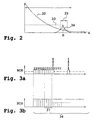
- Figure 2 shows the local transmit power of the base station 31.
- Figures 3a and 3b show the undertaken simulation of these signals.
- there is a curve 32 showing the decrease in locally detectable power of emissions from the base station 3 as a function of a distance d from this base station 3. Mobile phones moving away from base station 3 notice this decrease.
- the base station 31 is placed at a distance D from the station 3.
- the emissions of base station 31 simulating the emissions of base station 3 are broadcast with higher local power 33 at the power 34 with which locally we receive the emissions from the base station 3.
- the mobile phones present detect the injunctions emanating from the base station 31, rather than those from base station 3. Possibly the coverage area of the base station 31 is confined to an airlock in such a way that the emissions from this base station 31 do not not disturb the operation of the network 1.
- the identification request is periodic. Through example it is launched every second.
- the requested mobile telephone 6 responds with a message on a beacon channel or on another indicating that his response is an identification response, and that its identification is ID. If the standard so provides, he may reply that its call number is C. But if it does not provide it, the base station 31 receives this ID number.
- the central circuit 9, in application of program 21, searches memory 16 for record 26 which corresponds to the identification ID (or number C). If the phone user 6 is a visitor, or someone unknown to the central circuit 9, nothing happens past. If this user is a user for whom a record 26 has been created, this record 26 is activated as provided above.
- the base station 31 is connected to a private network 2 which is itself connected to a public telephone network (not shown), switched or mobile.
- the rerouting instructions can then be routed to this public network, via private network 2 which sends to this public network a sequence of signals setting up the rerouting.
- This public network then implements this rerouting in a way similar to that of network 2.
- the public network is a switched, fixed network, prior rerouting authorization must have been agreed.
- the public network is the mobile phone network of mobile phone 6, we can avoid this prior authorization by sending this network mobile telephony the references of mobile telephone 6 at the same time as rerouting instructions.
- the night light base station 31 can thus be connected to this public network not by a fixed link, but by a switched link. This switched link is of the same type as that which connects the corded telephone 8 to the central circuit 9.
- Figure 3a shows diagrammatically signals transmitted by the station of base 3 during successive time frames and distributed according to a known pattern.
- a pattern comprises a succession of frames FCH, SCH, BCCH, CCCH, RACCH and SACCH whose purpose is transmit frequency (F) signals to mobile phones synchronization (S), general broadcast (B), control (C), and miscellaneous requests (R).
- Mobile phones respond during type frames CCCH, or SACCH.
- the station is made to transmit basic 31 (with a higher local power level) all, 36, or part, 37, signals transmitted by the base station 3. This transmission is carried out in a compatible way.
- mobile phones in space C receive these signals with synchronization which respects their distance from base station 3.
- the signals transmitted by the base station 31 are transmitted in synchronization with those transmitted by the base station 3, they are sent louder and above all with different content so as to mask the signals of base station 3 by signals corresponding to the request for identification mentioned.
- employees working in area 7 will have mobile telephones 6 provided with a microcircuit card 38 of SIM type, for Secure Identification Module which means secure identification module.
- SIM card allows, when the phone is put into service mobile 6, to the holder of a secret code of the card 38 to be able alone to do operate this mobile telephone 6.
- the exchange between the base station 31 and the mobile 6 is of the type of that carried out by the mobile telephone with a base station of network 1. It corresponds for example to a line recovery which prevails between a mobile phone and a network 1 base station when for reasons for propagation, binding or monitoring between this phone mobile and this base station have been lost. Or it corresponds to steps taken when the phone is put into service mobile in network 1.
- the particularity of the invention lies here in the fact the night light base station 31 is not connected, via the circuit central 9 than network 2. It is not directly connected to network 1.
- zone 28 can be delayed.
- a temporization for example aims to stop the correlation between the telephone number A and mobile telephone number C at the end of day, in order to take account of the departure of the user of telephone 6 outside the domain 7. Either this departure can be measured by base station 31 or, if this departure is not measured in this way, we can predict that at the end of day that all zones 28 of records 26 are reset to zero.
- the mobile telephone 6 can be of the mixed public-private type.
- its public operating protocol is for example of GSM type while its protocol of operation in the private mode is by example of DECT or CTS type.
- the base station 31 can then, after having launched its request for identification, and after having detected that the calls on phone 8 had to be rerouted, cause in phone 6 a switching mode of use.
- This switch from public mode to mode private is carried out at the same time as the rerouting is undertaken in the central circuit 9.
- This changeover is all the better performed when the telephone 6 is at this time in public mode, and that the base station 31 broadcasts in public mode.
- phone 6 becomes phone 10 mentioned above. If phone 6 is of the permanent mixed type, it can still receive calls from base station 3, and calls from base station 11.
- the rerouting also preferably depends on the location of the detection. So it is possible that in domain 7 some number of base stations such as 31 placed for example near access to various places. These various places each correspond to telephones different connected to network 2. In this case, the rerouting will be modified from the next way.
- This other base station, of the type of station 31, which performs the detection of the mobile telephone 6 is associated with a telephone whose the number is E.
- zone 30 is modified to indicate the telephone number E which corresponds to the extension attached to it.
Landscapes
- Engineering & Computer Science (AREA)
- Signal Processing (AREA)
- Computer Networks & Wireless Communication (AREA)
- Mobile Radio Communication Systems (AREA)
Applications Claiming Priority (2)
| Application Number | Priority Date | Filing Date | Title |
|---|---|---|---|
| FR9815432 | 1998-12-07 | ||
| FR9815432A FR2786975B1 (fr) | 1998-12-07 | 1998-12-07 | Procede de routage d'appels entrants destines a un telephone mobile |
Publications (2)
| Publication Number | Publication Date |
|---|---|
| EP1009178A1 true EP1009178A1 (de) | 2000-06-14 |
| EP1009178B1 EP1009178B1 (de) | 2007-02-14 |
Family
ID=9533675
Family Applications (1)
| Application Number | Title | Priority Date | Filing Date |
|---|---|---|---|
| EP19990403032 Expired - Lifetime EP1009178B1 (de) | 1998-12-07 | 1999-12-06 | Verfahren zur Anrufleitweglenkung zu einem mobilen Telefon |
Country Status (4)
| Country | Link |
|---|---|
| EP (1) | EP1009178B1 (de) |
| DE (1) | DE69935114T2 (de) |
| ES (1) | ES2281956T3 (de) |
| FR (1) | FR2786975B1 (de) |
Cited By (1)
| Publication number | Priority date | Publication date | Assignee | Title |
|---|---|---|---|---|
| EP1212885A4 (de) * | 2000-06-21 | 2004-12-22 | Seiko Epson Corp | Mobiltelefon und funkkommunikationsgerät zur gemeinsamen verarbeitung eines ankommenden anrufes |
Citations (4)
| Publication number | Priority date | Publication date | Assignee | Title |
|---|---|---|---|---|
| WO1995001070A1 (en) * | 1993-06-22 | 1995-01-05 | Telefonaktiebolaget Lm Ericsson | Multinetwork terminal |
| US5592533A (en) * | 1994-12-23 | 1997-01-07 | Bell Atlantic Mobile Systems, Inc. | Personal communication service registration system and method |
| US5675629A (en) * | 1995-09-08 | 1997-10-07 | At&T | Cordless cellular system base station |
| US5826191A (en) * | 1996-07-03 | 1998-10-20 | Nokia Mobile Phones Limited | Dual mode network call forwarding activation and deactivation |
-
1998
- 1998-12-07 FR FR9815432A patent/FR2786975B1/fr not_active Expired - Lifetime
-
1999
- 1999-12-06 EP EP19990403032 patent/EP1009178B1/de not_active Expired - Lifetime
- 1999-12-06 ES ES99403032T patent/ES2281956T3/es not_active Expired - Lifetime
- 1999-12-06 DE DE1999635114 patent/DE69935114T2/de not_active Expired - Lifetime
Patent Citations (4)
| Publication number | Priority date | Publication date | Assignee | Title |
|---|---|---|---|---|
| WO1995001070A1 (en) * | 1993-06-22 | 1995-01-05 | Telefonaktiebolaget Lm Ericsson | Multinetwork terminal |
| US5592533A (en) * | 1994-12-23 | 1997-01-07 | Bell Atlantic Mobile Systems, Inc. | Personal communication service registration system and method |
| US5675629A (en) * | 1995-09-08 | 1997-10-07 | At&T | Cordless cellular system base station |
| US5826191A (en) * | 1996-07-03 | 1998-10-20 | Nokia Mobile Phones Limited | Dual mode network call forwarding activation and deactivation |
Cited By (2)
| Publication number | Priority date | Publication date | Assignee | Title |
|---|---|---|---|---|
| EP1212885A4 (de) * | 2000-06-21 | 2004-12-22 | Seiko Epson Corp | Mobiltelefon und funkkommunikationsgerät zur gemeinsamen verarbeitung eines ankommenden anrufes |
| US7016707B2 (en) | 2000-06-21 | 2006-03-21 | Seiko Epson Corporation | Mobile telephone and radio communication device cooperatively processing incoming call |
Also Published As
| Publication number | Publication date |
|---|---|
| FR2786975A1 (fr) | 2000-06-09 |
| DE69935114D1 (de) | 2007-03-29 |
| EP1009178B1 (de) | 2007-02-14 |
| DE69935114T2 (de) | 2007-12-06 |
| ES2281956T3 (es) | 2007-10-01 |
| FR2786975B1 (fr) | 2001-02-16 |
Similar Documents
| Publication | Publication Date | Title |
|---|---|---|
| EP0461451B1 (de) | Verfahren zur Anrufsvermittlung für einen Teilnehmer eines schnurlosen Telefondienstes | |
| CA2046579C (fr) | Unite de raccordement d'abonnes, a autonomie d'acheminement, pour un reseau de telecommunication ayant une structure de reseau intelligent | |
| FR2804809A1 (fr) | Procede d'utilisation multiple d'une station mobile d'un systeme de radiocommunication, avec notamment un etat mobile et un etat fixe | |
| EP1453344A1 (de) | Verfahren und Vorrichtung zur Anrufumleitung zwischen einem zellularen Kommunikationsnetz und einem lokalen Netzwerk abhängig von der Position der mobilen Station | |
| EP0459337A1 (de) | Teilnehmer-Zugriffsverfahren auf Abonnementdaten für einen schnurlosen Telefondienst | |
| WO2001045368A3 (en) | Aggregates in a presence management system | |
| FR2907290A1 (fr) | Procede de configuration d'une borne d'acces a un service, controleur, reseau d'acces, borne d'acces et programme d'ordinateur associes | |
| EP0932315B1 (de) | Vorrichtung zur Erkennung eines gerufenen Endgeräts aus mehreren Teilnehmerendgeräten einer Fernsprechvermittlung, wobei die Fernsprechvermittlung mit mindestens einem festen Funkfernsprechendgerät verbunden ist | |
| EP1192797B1 (de) | Verwaltung von münzfernsprechern | |
| EP0334746A1 (de) | Anordnung zur Herstellung und Vermittlung von Ferngesprächen zwischen Teilnehmern eines Funknetzes und/oder Fernsprechnetzes | |
| FR2796796A1 (fr) | Systeme d'acces a distance a des services de telecommunications et/ou d'informatique utilisant les messages courts des telephones fixes ou mobiles | |
| FR2662034A1 (fr) | Dispositif et procede d'interconnexion telephoniques pour reseau de communication a stations autonomes. | |
| FR2760587A1 (fr) | Systeme de communication multireseau pour organisation disposant de terminaux de reseau radio cellulaire numerique | |
| EP1009178B1 (de) | Verfahren zur Anrufleitweglenkung zu einem mobilen Telefon | |
| EP1032225B1 (de) | Server zur Kommunikation zwischen einem Paar von Maschinen und einer dritten Maschine und privates DECT Fernsprechsystem mit einem solchen Server | |
| EP0681408A1 (de) | Verfahren und Vorrichtung zur Herstellung von Fernsprechverbindungen von oder zu einem mobilen Teilnehmer mit mehreren Abonnementenmoden | |
| WO2001043378A2 (fr) | Passerelle de telecommunication entre un reseau prive et un reseau mobile | |
| EP0923816A1 (de) | Verfahren für die leitweglenkung von verbindungen in einem satellitennetzwerk | |
| EP1240747B1 (de) | Verfahren und system zur dienstesteuerung in einem datenkommunikationsnetz | |
| CA2370526A1 (fr) | Systeme de mise en oeuvre de services telephoniques, organe de commande d'un autocommutateur et serveur cti | |
| FR2786974A1 (fr) | Procede de routage d'appels entrants destines a une personne | |
| FR2808403A1 (fr) | Installation et procede de telecommunication pour l'echange d'informations entre des telephones et des fournisseurs de services | |
| WO2001011898A2 (en) | Information method using telephone numbers and sms | |
| EP1457027B1 (de) | Verfahren und system zur bereitstellung eines verzeichnisdientes | |
| WO1984000072A1 (fr) | Procede d'echange, de chargement et de consultation d'informations et circuit de commutation entre un terminal et une banque d'informations |
Legal Events
| Date | Code | Title | Description |
|---|---|---|---|
| PUAI | Public reference made under article 153(3) epc to a published international application that has entered the european phase |
Free format text: ORIGINAL CODE: 0009012 |
|
| AK | Designated contracting states |
Kind code of ref document: A1 Designated state(s): DE ES FI GB IT SE |
|
| AX | Request for extension of the european patent |
Free format text: AL;LT;LV;MK;RO;SI |
|
| 17P | Request for examination filed |
Effective date: 20000503 |
|
| AKX | Designation fees paid |
Free format text: DE ES FI GB IT SE |
|
| RAP1 | Party data changed (applicant data changed or rights of an application transferred) |
Owner name: SAGEM S.A. |
|
| RAP1 | Party data changed (applicant data changed or rights of an application transferred) |
Owner name: SAGEM COMMUNICATION |
|
| GRAP | Despatch of communication of intention to grant a patent |
Free format text: ORIGINAL CODE: EPIDOSNIGR1 |
|
| GRAS | Grant fee paid |
Free format text: ORIGINAL CODE: EPIDOSNIGR3 |
|
| GRAA | (expected) grant |
Free format text: ORIGINAL CODE: 0009210 |
|
| AK | Designated contracting states |
Kind code of ref document: B1 Designated state(s): DE ES FI GB IT SE |
|
| PG25 | Lapsed in a contracting state [announced via postgrant information from national office to epo] |
Ref country code: FI Free format text: LAPSE BECAUSE OF FAILURE TO SUBMIT A TRANSLATION OF THE DESCRIPTION OR TO PAY THE FEE WITHIN THE PRESCRIBED TIME-LIMIT Effective date: 20070214 |
|
| REG | Reference to a national code |
Ref country code: GB Ref legal event code: FG4D Free format text: NOT ENGLISH |
|
| REF | Corresponds to: |
Ref document number: 69935114 Country of ref document: DE Date of ref document: 20070329 Kind code of ref document: P |
|
| GBT | Gb: translation of ep patent filed (gb section 77(6)(a)/1977) |
Effective date: 20070411 |
|
| PG25 | Lapsed in a contracting state [announced via postgrant information from national office to epo] |
Ref country code: SE Free format text: LAPSE BECAUSE OF FAILURE TO SUBMIT A TRANSLATION OF THE DESCRIPTION OR TO PAY THE FEE WITHIN THE PRESCRIBED TIME-LIMIT Effective date: 20070514 |
|
| REG | Reference to a national code |
Ref country code: ES Ref legal event code: FG2A Ref document number: 2281956 Country of ref document: ES Kind code of ref document: T3 |
|
| PLBE | No opposition filed within time limit |
Free format text: ORIGINAL CODE: 0009261 |
|
| STAA | Information on the status of an ep patent application or granted ep patent |
Free format text: STATUS: NO OPPOSITION FILED WITHIN TIME LIMIT |
|
| 26N | No opposition filed |
Effective date: 20071115 |
|
| REG | Reference to a national code |
Ref country code: DE Ref legal event code: R082 Ref document number: 69935114 Country of ref document: DE Representative=s name: BARDEHLE PAGENBERG PARTNERSCHAFT PATENTANWAELT, DE |
|
| REG | Reference to a national code |
Ref country code: DE Ref legal event code: R082 Ref document number: 69935114 Country of ref document: DE Representative=s name: BARDEHLE PAGENBERG PARTNERSCHAFT MBB PATENTANW, DE Effective date: 20121212 Ref country code: DE Ref legal event code: R082 Ref document number: 69935114 Country of ref document: DE Representative=s name: BARDEHLE PAGENBERG PARTNERSCHAFT PATENTANWAELT, DE Effective date: 20121212 Ref country code: DE Ref legal event code: R081 Ref document number: 69935114 Country of ref document: DE Owner name: APPLE INC., CUPERTINO, US Free format text: FORMER OWNER: SAGEM MOBILES, PARIS, FR Effective date: 20121212 Ref country code: DE Ref legal event code: R081 Ref document number: 69935114 Country of ref document: DE Owner name: APPLE INC., US Free format text: FORMER OWNER: SAGEM MOBILES, PARIS, FR Effective date: 20121212 |
|
| REG | Reference to a national code |
Ref country code: GB Ref legal event code: 732E Free format text: REGISTERED BETWEEN 20180927 AND 20181005 |
|
| PGFP | Annual fee paid to national office [announced via postgrant information from national office to epo] |
Ref country code: DE Payment date: 20181120 Year of fee payment: 20 |
|
| PGFP | Annual fee paid to national office [announced via postgrant information from national office to epo] |
Ref country code: GB Payment date: 20181205 Year of fee payment: 20 |
|
| PGFP | Annual fee paid to national office [announced via postgrant information from national office to epo] |
Ref country code: ES Payment date: 20190102 Year of fee payment: 20 Ref country code: IT Payment date: 20181220 Year of fee payment: 20 |
|
| REG | Reference to a national code |
Ref country code: DE Ref legal event code: R071 Ref document number: 69935114 Country of ref document: DE |
|
| REG | Reference to a national code |
Ref country code: GB Ref legal event code: PE20 Expiry date: 20191205 |
|
| PG25 | Lapsed in a contracting state [announced via postgrant information from national office to epo] |
Ref country code: GB Free format text: LAPSE BECAUSE OF EXPIRATION OF PROTECTION Effective date: 20191205 |
|
| REG | Reference to a national code |
Ref country code: ES Ref legal event code: FD2A Effective date: 20200804 |
|
| PG25 | Lapsed in a contracting state [announced via postgrant information from national office to epo] |
Ref country code: ES Free format text: LAPSE BECAUSE OF EXPIRATION OF PROTECTION Effective date: 20191207 |