EP1009616B9 - Preforme permettant l'obtention apres deformation d'appareils orthodontiques ou d'orthopedie dento-faciale personnalises, les appareils obtenus, leur procede d'obtention, et le noyau d'expansion mis en oeuvre dans ledit procede - Google Patents
Preforme permettant l'obtention apres deformation d'appareils orthodontiques ou d'orthopedie dento-faciale personnalises, les appareils obtenus, leur procede d'obtention, et le noyau d'expansion mis en oeuvre dans ledit procede Download PDFInfo
- Publication number
- EP1009616B9 EP1009616B9 EP98925731A EP98925731A EP1009616B9 EP 1009616 B9 EP1009616 B9 EP 1009616B9 EP 98925731 A EP98925731 A EP 98925731A EP 98925731 A EP98925731 A EP 98925731A EP 1009616 B9 EP1009616 B9 EP 1009616B9
- Authority
- EP
- European Patent Office
- Prior art keywords
- expansion
- preform
- appliance
- orthopaedics
- patient
- Prior art date
- Legal status (The legal status is an assumption and is not a legal conclusion. Google has not performed a legal analysis and makes no representation as to the accuracy of the status listed.)
- Expired - Lifetime
Links
- 238000000034 method Methods 0.000 title claims abstract description 61
- 238000004519 manufacturing process Methods 0.000 claims abstract description 18
- 239000000463 material Substances 0.000 claims description 28
- 238000003780 insertion Methods 0.000 claims description 13
- 230000037431 insertion Effects 0.000 claims description 13
- 238000004873 anchoring Methods 0.000 claims description 11
- 239000012530 fluid Substances 0.000 claims description 11
- 239000004020 conductor Substances 0.000 claims description 10
- 238000010438 heat treatment Methods 0.000 claims description 9
- 229920001187 thermosetting polymer Polymers 0.000 claims description 9
- 239000002184 metal Substances 0.000 claims description 8
- 229910052751 metal Inorganic materials 0.000 claims description 8
- 230000002787 reinforcement Effects 0.000 claims description 7
- 238000005520 cutting process Methods 0.000 claims description 6
- 230000009471 action Effects 0.000 claims description 5
- 239000004033 plastic Substances 0.000 claims description 5
- 229920003023 plastic Polymers 0.000 claims description 5
- 239000004926 polymethyl methacrylate Substances 0.000 claims description 5
- 229920002635 polyurethane Polymers 0.000 claims description 5
- 239000004814 polyurethane Substances 0.000 claims description 5
- 230000005855 radiation Effects 0.000 claims description 5
- 229920001169 thermoplastic Polymers 0.000 claims description 5
- 230000000295 complement effect Effects 0.000 claims description 4
- 229920003229 poly(methyl methacrylate) Polymers 0.000 claims description 4
- -1 polyethylene Polymers 0.000 claims description 4
- 238000005498 polishing Methods 0.000 claims description 3
- 239000004416 thermosoftening plastic Substances 0.000 claims description 3
- XLYOFNOQVPJJNP-UHFFFAOYSA-N water Substances O XLYOFNOQVPJJNP-UHFFFAOYSA-N 0.000 claims description 3
- 239000004698 Polyethylene Substances 0.000 claims description 2
- 239000004743 Polypropylene Substances 0.000 claims description 2
- 239000000470 constituent Substances 0.000 claims description 2
- 239000013536 elastomeric material Substances 0.000 claims description 2
- 229920000515 polycarbonate Polymers 0.000 claims description 2
- 239000004417 polycarbonate Substances 0.000 claims description 2
- 229920000573 polyethylene Polymers 0.000 claims description 2
- 229920001155 polypropylene Polymers 0.000 claims description 2
- 239000004800 polyvinyl chloride Substances 0.000 claims description 2
- 229920000915 polyvinyl chloride Polymers 0.000 claims description 2
- 230000000422 nocturnal effect Effects 0.000 claims 3
- 230000008569 process Effects 0.000 abstract description 15
- 230000000399 orthopedic effect Effects 0.000 abstract description 6
- SEQDDYPDSLOBDC-UHFFFAOYSA-N Temazepam Chemical compound N=1C(O)C(=O)N(C)C2=CC=C(Cl)C=C2C=1C1=CC=CC=C1 SEQDDYPDSLOBDC-UHFFFAOYSA-N 0.000 abstract description 3
- 230000009466 transformation Effects 0.000 description 28
- 239000011505 plaster Substances 0.000 description 11
- 230000006870 function Effects 0.000 description 9
- 210000000214 mouth Anatomy 0.000 description 9
- 238000003466 welding Methods 0.000 description 9
- 230000006978 adaptation Effects 0.000 description 8
- 238000000465 moulding Methods 0.000 description 7
- 238000006116 polymerization reaction Methods 0.000 description 7
- 235000010443 alginic acid Nutrition 0.000 description 5
- 229920000615 alginic acid Polymers 0.000 description 5
- 238000003856 thermoforming Methods 0.000 description 5
- 239000000428 dust Substances 0.000 description 4
- 239000007788 liquid Substances 0.000 description 4
- 238000003754 machining Methods 0.000 description 4
- 210000004373 mandible Anatomy 0.000 description 4
- FHVDTGUDJYJELY-UHFFFAOYSA-N 6-{[2-carboxy-4,5-dihydroxy-6-(phosphanyloxy)oxan-3-yl]oxy}-4,5-dihydroxy-3-phosphanyloxane-2-carboxylic acid Chemical compound O1C(C(O)=O)C(P)C(O)C(O)C1OC1C(C(O)=O)OC(OP)C(O)C1O FHVDTGUDJYJELY-UHFFFAOYSA-N 0.000 description 3
- 238000004026 adhesive bonding Methods 0.000 description 3
- 229940072056 alginate Drugs 0.000 description 3
- 230000005540 biological transmission Effects 0.000 description 3
- 238000007796 conventional method Methods 0.000 description 3
- 238000001816 cooling Methods 0.000 description 3
- 230000000694 effects Effects 0.000 description 3
- 239000013529 heat transfer fluid Substances 0.000 description 3
- 238000002347 injection Methods 0.000 description 3
- 239000007924 injection Substances 0.000 description 3
- 230000001788 irregular Effects 0.000 description 3
- 230000001921 mouthing effect Effects 0.000 description 3
- 235000019645 odor Nutrition 0.000 description 3
- 210000003254 palate Anatomy 0.000 description 3
- 229920001296 polysiloxane Polymers 0.000 description 3
- 229910001220 stainless steel Inorganic materials 0.000 description 3
- 239000010935 stainless steel Substances 0.000 description 3
- 239000012815 thermoplastic material Substances 0.000 description 3
- 230000001131 transforming effect Effects 0.000 description 3
- XEEYBQQBJWHFJM-UHFFFAOYSA-N Iron Chemical compound [Fe] XEEYBQQBJWHFJM-UHFFFAOYSA-N 0.000 description 2
- 239000000853 adhesive Substances 0.000 description 2
- 230000037237 body shape Effects 0.000 description 2
- 238000010276 construction Methods 0.000 description 2
- 238000011161 development Methods 0.000 description 2
- 238000006073 displacement reaction Methods 0.000 description 2
- 239000012768 molten material Substances 0.000 description 2
- 230000009467 reduction Effects 0.000 description 2
- 238000005096 rolling process Methods 0.000 description 2
- 239000007787 solid Substances 0.000 description 2
- 239000002904 solvent Substances 0.000 description 2
- 239000001993 wax Substances 0.000 description 2
- 208000031968 Cadaver Diseases 0.000 description 1
- 229920005372 Plexiglas® Polymers 0.000 description 1
- 229920000297 Rayon Polymers 0.000 description 1
- 241001080024 Telles Species 0.000 description 1
- 230000001070 adhesive effect Effects 0.000 description 1
- 238000000071 blow moulding Methods 0.000 description 1
- 244000309464 bull Species 0.000 description 1
- 238000005266 casting Methods 0.000 description 1
- 230000008859 change Effects 0.000 description 1
- 210000000080 chela (arthropods) Anatomy 0.000 description 1
- 239000003086 colorant Substances 0.000 description 1
- 230000006835 compression Effects 0.000 description 1
- 238000007906 compression Methods 0.000 description 1
- 239000002826 coolant Substances 0.000 description 1
- 230000007423 decrease Effects 0.000 description 1
- 230000003247 decreasing effect Effects 0.000 description 1
- 230000001934 delay Effects 0.000 description 1
- 230000001627 detrimental effect Effects 0.000 description 1
- 229920001971 elastomer Polymers 0.000 description 1
- 239000000806 elastomer Substances 0.000 description 1
- 230000005670 electromagnetic radiation Effects 0.000 description 1
- 238000000605 extraction Methods 0.000 description 1
- 230000002349 favourable effect Effects 0.000 description 1
- 239000000945 filler Substances 0.000 description 1
- 239000000796 flavoring agent Substances 0.000 description 1
- 235000019634 flavors Nutrition 0.000 description 1
- 210000001061 forehead Anatomy 0.000 description 1
- 238000000227 grinding Methods 0.000 description 1
- 239000012943 hotmelt Substances 0.000 description 1
- 238000010102 injection blow moulding Methods 0.000 description 1
- 229910052742 iron Inorganic materials 0.000 description 1
- 210000001847 jaw Anatomy 0.000 description 1
- 239000011159 matrix material Substances 0.000 description 1
- 238000012986 modification Methods 0.000 description 1
- 230000004048 modification Effects 0.000 description 1
- 150000002825 nitriles Chemical class 0.000 description 1
- 239000012188 paraffin wax Substances 0.000 description 1
- 235000011837 pasties Nutrition 0.000 description 1
- 239000002985 plastic film Substances 0.000 description 1
- 229920006255 plastic film Polymers 0.000 description 1
- 239000004810 polytetrafluoroethylene Substances 0.000 description 1
- 229920001343 polytetrafluoroethylene Polymers 0.000 description 1
- 230000002035 prolonged effect Effects 0.000 description 1
- 239000002964 rayon Substances 0.000 description 1
- 239000011347 resin Substances 0.000 description 1
- 229920005989 resin Polymers 0.000 description 1
- 230000004044 response Effects 0.000 description 1
- 238000002791 soaking Methods 0.000 description 1
- 238000005476 soldering Methods 0.000 description 1
- 210000001779 taste bud Anatomy 0.000 description 1
- 238000000844 transformation Methods 0.000 description 1
- 230000001960 triggered effect Effects 0.000 description 1
- 238000002604 ultrasonography Methods 0.000 description 1
- 239000011800 void material Substances 0.000 description 1
- 238000004073 vulcanization Methods 0.000 description 1
- 238000004018 waxing Methods 0.000 description 1
- 238000009736 wetting Methods 0.000 description 1
Images


Classifications
-
- A—HUMAN NECESSITIES
- A61—MEDICAL OR VETERINARY SCIENCE; HYGIENE
- A61C—DENTISTRY; APPARATUS OR METHODS FOR ORAL OR DENTAL HYGIENE
- A61C7/00—Orthodontics, i.e. obtaining or maintaining the desired position of teeth, e.g. by straightening, evening, regulating, separating, or by correcting malocclusions
- A61C7/08—Mouthpiece-type retainers or positioners, e.g. for both the lower and upper arch
Definitions
- the present invention relates to the sector of orthodontic appliances or dento-facial orthopedics, especially those that are adapted precisely to the specific morphology of each patient.
- Such possibly removable devices may be those intended for to maintain the patient's tongue in a given volume, especially those of type Lingual Envelope Nocturne or E.L.N. of Bonnet.
- the invention relates to the apparatus necessarily be adapted very precisely to each patient or to perform their function, and which can not be manufactured in from a plane plate blank due to their shape complex finish (open hollow body, varying thicknesses that one does not can get by simple deformation of a plate, ).
- these devices are made from a preform or preform whose shape allows its expansion in a mold reproducing the morphology of the patient.
- This preform has a general body shape three-dimensional hollow, more particularly a tubular shape or substantially hollow tubular, more particularly still a form tubular or substantially tubular hollow and cut on the part upper front to form an opening.
- thermoforming attempts have been made to overcome some of the disadvantages associated with the conventional method.
- the technique of thermoforming is widely used for making devices Orthodontics. It is described in many general works.
- the basic material is in the form of a plastic film of constant thickness, maintained by film, which is subjected, by a contribution of heat and a depression, a deformation until reaching a model made from fingerprints taken directly on the patient.
- the basic material as part of this document, by its flat shape and constant thickness, has a form away from the initial shape of the orthodontic appliance. The the deformation that this equipment must undergo causes disadvantages such as the no control of the thicknesses.
- this method is not effective for shaped apparatus hollow body and variable thickness. Indeed, the stretching that the plate must bear in these cases are quite important and so hard to get without tearing. Above all, the thicknesses can not to be controlled, since they are simply a function of lengthening necessary to obtain the desired shape, and are thus irregular since not all areas are stretched in the same way. This technique is not suitable for a certain number of cases.
- the variant consisting of using a device in two parts, that is to say two base plates giving two half-appliances that are assembled, is not suitable either. It reduces the stretching by the plates, so the risks of tearing and the problems thicknesses too irregular, but the problem is partly displaced towards the assembly of the two half-apparatuses obtained. Indeed, the difficulty lies in the precision and strength of the assembly by gluing welding, especially since this area must also be assembly hooks fixing the fixture of the device in the patient's mouth.
- the invention solves these problems by proposing a three-dimensional device that can be mass-produced, so little expensive, called preform.
- This preform is different from a plate planar and has a tubular or substantially hollow tubular shape allowing its expansion in a mold reproducing the morphology of the patient.
- This preform present, more particularly a form cut on the upper front part to form an opening.
- Said preform can then be adapted perfectly to each patient, in the practitioner's office or the laboratory of the prosthetist, by a deformation process comprising an expansion, easy and quick to implement, in a mold made from the plaster model and without risk for said plaster model. She permits obtaining a functional device that can not be obtained by a conventional thermoforming process from a flat plate.
- the invention also comprises the method of transforming said preform, as defined in independent claim 8, an expansion core as defined in independent claim 27, which is implemented in said method, and apparatus according to independent claim 29.
- doctor will refer to the person transforming the preform in a functional device, whether it be the practitioner in his office, or the prosthetist in his laboratory.
- this preform is made of a material biocompatible since in direct contact sometimes prolonged with a cavity of the human body. In this respect, it must comply with the standards in force. It may be made of thermosetting plastic material or thermoplastic, deformable by expansion, and obtained for example by injection or any other appropriate industrial process (first transformation), and has a three-dimensional shape such that its deformation makes it easy to obtain the final apparatus adapted to each patient. This deformation or second transformation, which includes a expansion, is carried out quickly and easily by the operator, in function of the morphology of the patient.
- the merit of the invention is to have emerged from the disadvantages associated with necessary manufacture and adaptation of a device orthodontic, allowing mass production so low cost of a preform, which will then be easily adaptable by the practitioner or prosthetist to the patient, in order to obtain after finishing a functional apparatus in the form of a hollow body and having variations thick that we could not get by simple deformation of a flat plate and, in certain variants (particularly if the material used is thermoplastic), likely to be equipped with fixing hooks in the mouth by a method that allows movements of the anchorage.
- the manufacturing cost is therefore lower, the lead times are shorter, the process is clean (without dust, noise and odor) and easy to put on without risk for the plaster model, and facilitates the work of the operator.
- the shape of the preform is defined taking into account the deformations means that it will undergo during the second transformation, for example decreases in the thickness and width of the walls, so function of the functional apparatus that one wishes to obtain. So we can provide a preform for such a device and for patients of this size or sex or age. Thus, mass production of the preform is allowed, while limiting the deformations that it will have to undergo, so the length and the complexity of the second transformation.
- the preform is manufactured and delivered to the operator in flat form, so general shape in two dimensions and no longer in three dimensions.
- preform-developed Such a case will be detailed later in reference to the figures.
- the preform-developed is then put into volume, by the operator, by rolling or folding, around a jig which may be a controlled expansion core, to constitute the preform as such.
- a jig which may be a controlled expansion core
- this two-dimensional structure facilitates certain manipulations by the operator (layout of a opening,).
- connection (cut) to restore the hollow body is located in the area less deformed during the expansion, for example on the bow of the toboggan in the case of E.L.N. of Bonnet.
- the welding is done by hand by pressure (eg self-adhesive effect, by application of a solvent or an adhesive adapted to the material of the developed preform) so as to what it resists then to expansion.
- the second transformation depends on the plastic material used. If we uses thermoplastic plastics, the second transformation can be achieved by techniques related to blow molding, thermoforming, injection blow molding, even mechanically, or any other appropriate means. If we use thermosetting materials, the second transformation may be realized by techniques of compression type, bag molding, vacuum molding, preforming on a grid or any other means appropriate.
- This second transformation will be carried out by the operator, that is to say by the practitioner, in his office, or by the prosthetist, in his laboratory, quickly and easily, by a "clean" process, that is to say without dust, noise or odor, in a very short time and under conditions allowing a perfect adaptation to the morphology of the patient.
- the different devices needed during treatment in because of the evolution of the morphology of the patient can be realized successively from the first device made from a preform.
- the first device will become the preform of the second device, needed a few months later, this second device becoming in turn the preform of the third, etc. .... Transformations will be fast, since we do not restart from zero each time, contrary to what has been done so far.
- the method of the invention also makes it possible to slightly move the anchoring position of the fastening hooks in the device at the moment the mouth and / or during the treatment, which avoids, in some cases, to make a new device.
- FIGS. 1 and 2 describe preforms (1) according to the invention, adapted to obtain an E.L.N. of Bonnet.
- the preforms according to the invention can have variable shapes, depending on the function so the shape of the device that we get by deformation of said preform.
- some adaptations necessary to obtain a functional device can be performed either at the preform stage or during the so-called second stage transformation, after this step. These adaptations can be done by cutting, machining, hot welding, or other process.
- the preform has a shape as close as possible to the final shape that one wishes to obtain after deformation, in order to limit the number of operations to be performed by the practitioner or prosthetist while allowing mass production of the preform of departure.
- the preform is provided with at least one opening.
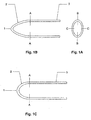
- FIGS. 1 depict a preform (1) according to the invention, in form substantially hollow tubular, without opening, having one end useful (2) and a non-useful end (3), said non-useful end being eliminated after the second transformation of the preform into a device adapted to the patient.
- Figures 2 describe another preform (1) according to the invention.
- This preform is substantially hollow tubular shaped and cut on the upper front portion to form an opening (8).
- This opening (8) is intended in the final functional apparatus to allow the language the patient to touch the front of the palate, especially the taste buds palatal. This opening is performed before the second transformation, but it is also possible to realize it only after this second transformation.
- the preform may also include an outgrowth (6) for wedging the preform in the device for performing the second transformation, as well as pilot holes (7) for accommodating the fastening tabs of the apparatus functional in the mouth.
- Zone (5) corresponds to the palace, and the zone (4) at the bottom or slide of the E.L.N. of Bonnet.
- the transformation of the preform will, after possibly adaptation (opening arrangement, pilot holes, fixing of parts complementing, fixing anchor hooks, reducing the surface areas, recesses, polishing, etc.), to obtain a functional apparatus.
- Some areas of this unit will need to be precisely adapted to the specific morphology of the patient, other must respect the forms defined by the rules of the art of orthodontics in relation to the shape of the oral cavity.
- zone (5) corresponding to the palace, must be precisely adapted to the morphology of the patient.
- zone (4) which corresponds to the lower part, that is to say to the part in removal of the mandible, and the lateral areas, set back from the gums and teeth, are areas defined by the rules of art rather than by the morphology of the patient.
- FIG. 3 represents the device making it possible to perform the second transformation of the preform, so as to obtain a functional apparatus, possibly after adaptation (arrangement of an opening, reduction of the surface of certain zones, ...), before the mouthing by the practitioner.
- This device comprises an expansion mold (or system of molds of the one or more models (9, 10) generally plaster of the maxillary and mandible of the patient.
- This mold can be completed or modified by means traditional mechanics (machining, addition of metal parts, fur made of flexible material, for example silicone in plate or width band, variable length and thickness adjusted for control the space left between the expanded device and the cavity the patient's mouth, or other) so as to present in areas where this is necessary the inner forms defined by the rules of art rather than by the morphology of the patient.
- the plaster models (9, 10) constituting the expansion mold are held firmly and precisely in position one with respect to the other in natural occlusion or in the relative position chosen by the practitioner and defined for example by a "bitten" on wax or by marking of the models, by a fastening system (13), for example a mechanical system, so as to constitute the mold of second transformation.
- the clamping system can also fulfill the support function and orientation relative to the vertical of all.
- the preform (1) is placed in the expansion mold (9, 10).
- the process of second transformation depends on the material used for make the preform. It includes a deformation by expansion of the preform to obtain a device adapted to the morphology of the patient and the rules of the art in orthodontics.
- the method comprises a step main expansion of the preform.
- the process also includes before demolding a polymerization step.
- Expansion can be done hot.
- step of the temperature preform expansion and the expansion stage are not necessarily performed in the same device. For example, you can wear the preform at expansion temperature in an oven and then move it into the mold for expansion.
- the preform is brought to expansion temperature by the action of a radiation (for example in an oven for example an oven with infrared) or a heat transfer fluid supplied by a tube (12).
- a radiation for example in an oven for example an oven with infrared
- a heat transfer fluid supplied by a tube (12).
- the radiation used may also be of the microwave type or ultraviolet.
- the coolant can for example be water brought to 100 ° C.
- the heat transfer fluid merges with the expansion fluid.
- Expansion can be done by means of an expansion fluid, by example of compressed air or water, or mechanically, until the preform has taken the desired shape, that is to say is plated at least partially against the inside of the mold.
- the expansion can also be limited by a controlled expansion core as it is described later. In this case, the expansion will be controlled both by the mold (in some parts) and the controlled expansion core (in other parts).
- Expansion can be achieved by any means allowing the preform to take the desired shape.
- This means can be a device of expansion by displacement of mechanical parts driven by the operator during the expansion phase.
- the expansion will be achieved by inflating a nucleus for expansion (14) having a void space (17) therein, previously arranged inside the preform (1) and inflated by a expansion fluid.
- This core may be of elastomeric material or the like material resistant to expansion temperature.
- the core is contained in position during expansion by a shield of contention (15) secured to the arrival cane of the expansion fluid (For example compressed air) (11) itself attached to the support (13).
- the end of the preform can be held in position by through the outgrowth (6) or through part of the nucleus Expansion (14).
- Such an expansion core can be made by injection of elastomer resistant to the expansion temperature, such as silicone, polyurethane, nitrile.
- elastomer resistant to the expansion temperature such as silicone, polyurethane, nitrile.
- the production of the injection mold is conventional techniques not described in detail here. For example, we can consider injecting or casting silicone into a mold by example in Plexiglas (for better visibility) containing a core paraffin primer hot-discarded after cold vulcanization or polymerization; or by soaking with a primary core equipped reinforcements that is to say without mold.
- the primary nucleus will be necessarily fuse or destructible in order to free space necessary (17) in the expansion core.
- the expansion core may be of simple spherical shape or cylindrical constant thickness, but one can also use a advanced core or controlled expansion core. Such a core to controlled expansion is described in FIGS. 4 and 5A to 5C.
- This evolved core (16) has at least one sound control means expansion, for example an increase in the thickness of its wall in certain areas and / or introduction in its wall rigid reinforcements for example metal.
- such a core will have at rest the precise shape of the preform. It thus allows the prehension of this preform, and its movement and rapid positioning during handling especially in hot expansion, between the temperature range expansion and expansion that is to say when the preform is hot.
- the expansion temperature range can therefore be carried out on the preform alone (out of the mold) for example in an oven and by example by infrared radiation, and can be selective that is to say favor areas that need to expand strongly.
- the zones undergoing the strongest deformations, so those that will be more heated are the upper edge of the toboggan and the upper rear part of the E.L.N. from Bonnet (who will dock the patient's palate).
- the core may also contain metal reinforcements such as spring strips (19) in certain areas, which will allow a better control of the deformations undergone by the preform: we speak of expansion controlled, that is to say anisotropic.
- the expansion of the preform itself will be controlled at least in part by the kernel and not just by the mold.
- the core will be able to replace the mold in the zones respecting the rules of the art rather than the exact morphology of the In these areas, metal reinforcements will prevent certain unwanted deformations. This simplifies the molds.
- the element (20) serves to hold the preform in position during expansion.
- the core may contain a rigid tube (11), for example stainless steel, pierced with a hole (18), which will allow the arrival of the expansion fluid.
- the expansion-controlled core will have a more complex as the only expansion of the preform.
- an advanced kernel used in the development of an E.L.N. de Bonnet may have the following particularities: and metal reinforcement at the front of the slide, lateral thickness decreasing and elastic metal reinforcement, metal tube inserted, strong rear thickness, thin at the top and bottom.
- expansion is accompanied simultaneously or later by a triggering factor of the polymerization, which can be by exempt (i) an increase in the temperature of the mold assembly expansion + preform + possibly balloon, or (ii) a source electromagnetic for example microwave or ultraviolet emitted by a source arranged in the core or in the preform and powered by the inside of the compressed air supply pipe (11).
- a triggering factor of the polymerization can be by exempt (i) an increase in the temperature of the mold assembly expansion + preform + possibly balloon, or (ii) a source electromagnetic for example microwave or ultraviolet emitted by a source arranged in the core or in the preform and powered by the inside of the compressed air supply pipe (11).
- the part obtained by opening of the clamping system After the expansion, which allows the preform to reach the desired shape, and optionally the polymerization, the part obtained by opening of the clamping system. In the case of a hot expansion, the whole is cooled before demolding the piece to freeze the shape obtained.
- This piece can then be finished or machined by any traditional method, such as polishing, deburring, micro-gun localized heating hot air or other, to obtain a functional device adapted to the patient.
- This finishing step is shorter than in a classical process, since the piece obtained is very close to the shape final precisely adapted to the patient.
- the opening or openings are arranged in the part obtained after the second transformation by cutting, and eliminates unnecessary parts (window, end not useful) or reduces the surface of some areas, and then finishes as previously.
- the invention allows the same device is used during the treatment of the patient, by doing so evolve according to the evolution of the morphology: the first device manufactured serves as a preform to the second, itself serving as a preform third, and so on. It is no longer necessary to manufacture a new device at every step. In parallel, it is essential to provide fixing hooks whose anchoring points can be displaced over time, according to the evolution of the morphology of the patient and therefore according to the evolution of the device.
- An object of the invention is therefore to propose an orthodontic appliance obtained by the process described, from the described preform, and whose Fixation hooks include movable anchor points.
- the device for supplying electrical energy to heating also ensures stable mechanical positioning.
- the contribution of electrical energy can be performed by a current generator portable hand held by the operator (eg a soldering iron snapshot designed or tuned to deliver an intensity that gives the part to insert the appropriate temperature (about 5 amperes, 200 ° C), having a pair of rigid conductors.
- a current generator portable hand held by the operator eg a soldering iron snapshot designed or tuned to deliver an intensity that gives the part to insert the appropriate temperature (about 5 amperes, 200 ° C)
- it can include a device called gun that holds mechanically a pair of rigid electrical conductors connected by flexible conductors to a fixed generator. The ends of Rigid conductors are arranged to transmit to the hook at insert the desired mechanical forces printed by the operator.
- the three devices described differ in the mode of transmission mechanical forces on the part to be heated and anchored, and therefore by the form ends of the rigid conductors.
- each driver has a shape adapted to diameter of the wire or the shape of the part to be inserted, that is to say the hook fixing, in order to prevent said hook from slipping.
- This form ensures stability of the support point of the device on the part to be inserted despite the effort transmitting.
- a shape can be for example a form of fork.
- Such a device is designated by the term device fork.
- the operator stops pushing, the circuit electric opens, the heating stops, the room is free in the plastic melted locally.
- the surplus of molten material discharged on the surface can be removed or spatulate still hot (for example by a piece constituted by or coated with PTFE or other material that does not stick to the plastic) by the operator to improve the mechanical strength and aesthetics of insertion.
- the spatulation is carried out by a device with spring triggered by the operator possibly together with the cut off the heating current.
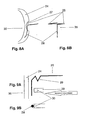
- Figure 8 shows a hook (25) right side of Sahar inserted or anchored in a device (35) according to the invention, more precisely at a lateral zone (24) of the apparatus close to the occlusal plane.
- the hook (25) comprises a branch to be inserted (28) and a zigzag (26). This zigzag is inserted into a recess (27) of the area (24) of the apparatus (35).
- Fig. 9 shows a front right hook (25) insertion or anchoring in the lateral zone (24) of a device (35) by a fork insertion device.
- the end of each rigid conductor (29) of the device inserted in the form of a fork (30).
- Device comprising two ends in the form of a pincer, the piece to be inserted (fixing hook) including a return branch.
- each driver is arranged to pinch the piece to be inserted (for example by means of a clamping screw electric domino, micro-screw or spring-loaded, micromandrin with three jaws, or any other mechanical system).
- the insert part has a return branch which remains out of the device at the end of insertion, and the two branches are pinched by the device.
- branch hooks back ".
- the operator cuts the current (for example by gun trigger), the piece remains held by the device that continues to pinch the piece, the positioning of the piece can be adjusted precisely in all the degrees of freedom during the phase of cooling.
- the surplus of molten material discharged on the surface can be removed or spatulate as before.
- both ends of the inserted part are released by opening the clamps, and remain emerging from the apparatus. They are of course conceived and / or finished according to the conventional means (loop or end ball) so as not to injure or embarrass the patient.
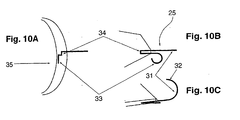
- FIG 10 (10A, 10B and 10C) shows a rear hook (25) right return branch inserted into a device (35) according to the invention, in a part of the apparatus whose thickness is sufficient, in general close to the occlusal plane.
- This return hook includes a main branch (31) coiling the teeth, a support zone (32) of the hook on the teeth, and a return branch (33) at the end formed in a loop. Between the main branch (31) and the return branch (33) is the zone (34) of the hook (25) which is inserted into the apparatus (35).
- each end of the device is arranged according to one of the above devices, that is to say with fork and clamp.
- This The process is generally well suited to Sahar's side hooks.
- this configuration makes it possible to maintain the part to be inserted by the branch pinched and totally insert the other branch.
- Fixing hooks or additional parts may also be anchored during the second transformation: it is then the expansion itself which creates overmoldings for anchoring the fastening hooks or additional parts.
- the preform is manufactured and delivered to the operator under developed form, that is to say in two dimensions. We are talking about preform undeveloped.
- FIG. 6 describes such a developed preform adapted for obtaining an E.L.N. of Bonnet.
- Zone 21 is the half-developed left 21G or right 21D of the toboggan cone
- zone 22 is the half-developed left 22G or right 22D of the palace.
- the zones 23 will constitute the bow of the toboggan.
- the dashed lines represent the right, left and central fold axes (axis of symmetry).
- the preform developed is then put in volume, by the operator, to form the preform as such, shown in FIG. found the cone of the slide 21 and the palace 22.
- the dotted line represents the right fold axis.
- the connection (cut) for restore the hollow body is located in the least deformed area during the expansion, on the bow 23 of slide 21 in the case of the E.L.N. of Bonnet.
- the welding is carried out by hand by pressure (effect sticker) so that it resists expansion.
- the present invention also relates to orthodontic appliances or custom dento-facial orthopedics obtained by said method transforming from said preform.
- a such apparatus constitutes a Lingual Envelope Nocturne or E.L.N. of Cap.
- the present invention covers the various adaptations, applications and modes of implementation that can be envisaged and which are at the range of the skilled person.
- preforms of shape and of different thicknesses, which can be easily adapted to the function sought after, the size and morphology of patients (adults, children, etc.) and the deformation that the preform will undergo during second transformation.
- pilot holes formed to receive hooks of fixation where necessary may be deleted or replaced by other devices or arrangements (eg fingerprints) facilitating the insertion of fasteners (bars with holes or pins, etc %) during (by overmolding) or after (gluing, screwing, welding, etc ...) the second transformation.
- the preform may have on the surface guiding means, for example example bosses or hollows, intended to guide the operator during the cutting operation, before or after the second transformation (window layout, reduction of the surface area certain areas, ).
- the material chosen to manufacture the preform may be variable.
- thermoplastic material it is possible, for example, to use polyethylene, polypropylene, polymethylmethacrylate, polycarbonates, PVC or polyurethanes or any other material appropriate.
- thermoplastic material can refer in particular to the work of M. AMORIC quoted above.
- thermosetting material it will be possible to use example of polyurethanes or polymethylmethacrylate or any other suitable material.
- the preform can, in some parts, especially in the areas where the geometry of the surface is determined by the rules of art and not by the morphology of the patient, to have the final shape of the device functional.
- the part lower or toboggan has a shape close to that of a truncated cone.
- the expansion mold can consist of a single maxillary model as a first half-mold, and by an assembly of parts presenting standard shapes according to the rules of orthodontics or specific to the patient as a second half-mold.
- the controlled expansion core can also play the role of the mold in some areas.
- the temperature of the preform can be achieved by several processes, for example air or other hot gas, hot liquid, electromagnetic radiation (eg infrared or microwaves or ultraviolet) emitted by a source external to the core or internal powered by the air intake cane.
- air or other hot gas hot liquid
- electromagnetic radiation eg infrared or microwaves or ultraviolet
- the flow of heat transfer fluid which may be the expansion fluid, may be external to the preform and / or internal using the fluid inlet tube and a second inner tube to the first for the output, the same for the cooling after transformation.
Landscapes
- Health & Medical Sciences (AREA)
- Oral & Maxillofacial Surgery (AREA)
- Dentistry (AREA)
- Epidemiology (AREA)
- Life Sciences & Earth Sciences (AREA)
- Animal Behavior & Ethology (AREA)
- General Health & Medical Sciences (AREA)
- Public Health (AREA)
- Veterinary Medicine (AREA)
- Dental Tools And Instruments Or Auxiliary Dental Instruments (AREA)
- Blow-Moulding Or Thermoforming Of Plastics Or The Like (AREA)
- Heating, Cooling, Or Curing Plastics Or The Like In General (AREA)
Description
- Construction du moule : Le praticien prend une empreinte du maxillaire et éventuellement une empreinte de mandibule de son patient, le plus souvent en alginates en raison de leurs propriétés de polymérisation rapide et de biocompatibilité. Ces empreintes servent de base à la fabrication d'un modèle en une ou deux parties le plus souvent en plâtre que l'on complète à l'aide de cires facilement collables et/ou déformables. Ceci nécessite de l'opérateur un vrai savoir-faire, intégrant coup d'oeil, dextérité et expérience. L'opérateur positionne aussi à l'aide de cire les systèmes de fixation (ou pattes ou crochets de fixation), en général des fils métalliques, qui seront ensuite surmoulés et rempliront la fonction de fixation de l'appareil terminé dans la bouche du patient, ainsi que toute autre pièce complémentaire nécessaire.
- Moulage au contact :
On utilise une résine à deux composants, un solide en
poudre et un liquide, adaptée au moulage au contact des pièces
classiques d'orthodontie. On travaille par passes successives de
mouillage par le liquide à l'aide de pipette et/ou pinceau et saupoudrage
du solide.Cependant, la forme de corps creux à épaisseur variable de
certains appareils comme l'E.L.N. de Bonnet entraíne des difficultés
particulières de réalisation car les différentes zones de l'appareil ont des
orientations et des rayons de courbures très variés. L'opérateur est donc
confronté à plusieurs difficultés :
- (i) II lui faut trouver un compromis entre des passes trop liquides ou trop minces, ou de trop petite surface qu'il faut multiplier, ce qui allonge le temps opératoire, et des passes trop épaisses ou trop pâteuses qui créent des sur-épaisseurs irrégulières qu'il faudra ensuite meuler,
- (ii) II lui est difficile d'estimer ou mesurer les épaisseurs déposées pour contrôler son travail au fur et à mesure,
- (iii) Il lui faut choisir entre le moulage de toutes les passes en une seule campagne de plusieurs minutes ou dizaines de minutes suivie d'une polymérisation unique finale, ou le moulage en plusieurs campagnes très brèves d'environ une minute chacune et autant de phases de polymérisation intermédiaires en autoclave sous pression supérieure à la pression atmosphérique (sinon présence de bulles de gaz qui nuisent à l'aspect de la pièce finie). Dans le premier cas, on obtient une pièce de transparence irrégulière peu flatteuse, dans le second cas le temps de réalisation et donc le coût sont notablement plus élevés.
- Démoulage et finition On démoule l'ébauche, puis la finition est réalisée par usinage, meulage. La forme de l'ébauche étant assez éloignée de la pièce finale, la finition est une opération longue et délicate, qui génère du bruit et de la poussière. Ces pollutions étant incompatibles avec un cabinet d'orthodontie, la finition doit donc être réalisée dans un local et avec un équipement spécifique, notamment par exemple une hotte aspirante.- Il existe des variantes, dans lesquelles on utilise la partie dents et gencive du modèle de mandibule, en complément du modèle du maxillaire. On complète avec un matériau de bourrage (par exemple du plâtre) la partie manquante, afin d'obtenir un moule complet. Le moule est dans ce cas totalement externe à la pièce à mouler ; l'accessibilité et la visibilité générales sont moins mauvaises que dans la variante précédente.
- les crochets latéraux (en général symétriques, au nombre de 2) Ils sont utilisés surtout sur les jeunes enfants. Ils sont ancrés dans l'appareil par une de leurs extrémités qui est insérée dans la paroi latérale de l'appareil, l'autre extrémité venant s'insérer élastiquement dans un diasthème pour fixer l'appareil en bouche. Ils sont généralement conformés suivant la méthode de Sahar, c'est-à-dire que le début de la partie émergée a une forme en zigzag telle qu'elle peut être déformée par le praticien pour régler le serrage de l'ancrage à la première mise en bouche et aux visites suivantes en fonction de l'évolution de l'environnement buccal du patient, et ceci sans changer l'ancrage c'est-à-dire la position de la partie du crochet incluse dans l'appareil. Un évidement est réservé dans l'épaisseur de la paroi extérieure de l'appareil pour loger ce zigzag dont la forme est changée pendant la durée de vie de l'appareil.
- les crochets arrière (en général symétriques au nombre de 2) Ils sont ancrés dans l'appareil de façon à ce que le fil débouche à l'arrière de l'appareil approximativement dans le plan horizontal d'occlusion. Le fil contourne ensuite en général les dents les plus en arrière (par exemple la dent de 6 ans ou la dent de 12 ans). Puis il vient appuyer extérieurement sur le tube d'une bague. Il est conformé de façon à ce que la résultante des légers efforts symétriques dirigés vers le haut et l'extérieur exercés en réaction sur l'appareil par l'appui des deux crochets arrière droit et gauche le maintiennent en position plaqué au palais.
- La figure 1A représente en coupe frontale (axe A-A) une préforme sans ouverture selon l'invention, adaptée pour l'obtention d'une E.L.N. de Bonnet,
- Les figure 1B et 1C représentent cette préforme respectivement en coupe sagittale (= longitudinale verticale) (axe B-B) et longitudinale horizontale (axe C-C),
- La figure 2A représente une vue de côté d'une préforme selon l'invention, pourvue d'une ouverture,
- La figure 2B représente cette préforme 2A vue de dessus,
- La figure 2C représente cette préforme 2A en perspective,
- La figure 3 représente un dispositif permettant de transformer, suivant la morphologie du patient, une préforme en appareil fonctionnel,
- La figure 4 représente une coupe en perspective d'un noyau à expansion contrôlée mis en oeuvre dans un procédé selon l'invention,
- Les figure 5A, 5B et 5C représentent le noyau de la figure 4 selon une coupe respectivement frontale, longitudinale horizontale et sagittale (longitudinale verticale),
- La figure 6 représente une préforme-développée selon l'invention,
- La figure 7 représente représente la préforme obtenue par roulage/pliage de la préforme-développée de la figure 6,
- La figure 8 (8a + 8b) représente un crochet latéral droit de Sahar inséré ou ancré dans un appareil selon l'invention (vue de l'arrière et vue de droite),
- La figure 9 (9a + 9b) représente un crochet latéral droit avant ancrage dans un appareil selon l'invention par un dispositif d'ancrage de crochet comportant deux extrémités en forme de fourchette (vue de gauche et vue de dessus),
- La figure 10 (10a + 10b + 10c) représente un crochet arrière droit à branche retour inséré ou ancré dans un appareil selon l'invention (vue de l'arrière, vue de gauche et vue de dessus).
- constitution d'un moule d'expansion réalisé au moins en partie à partir du ou des modèles d'étude réalisés à partir des empreintes (en général en alginate) prises par le praticien sur son patient,
- positionnement de la préforme dans le moule d'expansion,
- expansion de la préforme jusqu'à ce qu'elle ait atteint la forme voulue,
- démoulage de l'appareil obtenu qui devient fonctionnel après finitions.
- le chauffage, qui peut être obtenu par tout moyen approprié, par exemple mécaniquement par ultrasons, ou électriquement par effet Joule, et
- la transmission de l'effort d'insertion dans l'appareil et éventuellement le positionnement mécanique de la pièce à insérer pendant le refroidissement.
Claims (32)
- Préforme (1) permettant l'obtention après déformation d'appareils orthodontiques ou d'orthopédie dento-faciale personnalisés, qui présente une forme tubulaire ou sensiblement tubulaire creuse permettant son expansion dans un moule reproduisant la morphologie du patient.
- Préforme selon la revendication 1, caractérisée en ce qu'elle présente une forme tubulaire ou sensiblement tubulaire creuse et découpée sur la partie avant supérieure pour former une ouverture 8.
- Préforme selon l'une quelconque des revendications 1 à 2, caractérisée en ce qu'elle est fabriquée en un matériau plastique de type thermoplastique ou thermodurcissable déformable par expansion.
- Préforme selon la revendication 3, caractérisée en ce qu'elle est fabriquée en un matériau plastique thermoplastique choisi dans le groupe constitué du polyéthylène, polypropylène, polycarbonates, polyméthacrylate de méthyle, PVC, polyuréthannes ou en un matériau plastique thermodurcissable choisi dans le groupe constitué du polyméthacrylate de méthyle et polyuréthannes.
- Préforme selon l'une quelconque des revendications 1 à 4, caractérisée en ce qu'elle présente en surface des moyens de guidage, par exemple des bossages ou des creux, destinés à guider l'opérateur pendant l'opération de découpe, et/ou des avant-trous (7) servant à loger les pates de fixation de l'appareil fonctionnel.
- Préforme selon l'une quelconque des revendications 1 à 5, caractérisée en ce qu'elle est fabriquée sous forme développée à plat avant d'être mise en forme par l'opérateur.
- Préforme selon l'une quelconque des revendications précédentes, permettant l'obtention après déformation d'une Enveloppe Linguale Nocturne ou E.L.N. de Bonnet.
- Procédé de fabrication d'un appareil orthodontique ou d'orthopédie dento-faciale personnalisé qui comprend les étapes suivantes :constitution d'un moule d'expansion (9, 10) réalisé au moins en partie à partir du ou des modèles d'étude réalisés par le praticien à partir de l'empreinte ou des empreintes prise sur son patient,positionnement de la préforme (1) selon l'une quelconque des revendications 1 à 7 dans le moule d'expansion,expansion de la préforme jusqu'à ce qu'elle ait atteint la forme voulue,démoulage de l'appareil obtenu qui devient fonctionnel après finitions.
- Procédé selon la revendication 8, caractérisé en ce que l'expansion se fait à chaud et en ce que l'on porte la préforme à la température de déformation de son matériau constitutif avant l'étape d'expansion, soit avant soit après l'étape de positionnement dans le moule d'expansion.
- Procédé selon la revendication 9, caractérisé en ce que la portée à température d'expansion est réalisée par l'action d'un rayonnement ou d'un fluide caloporteur.
- Procédé selon la revendication 10, caractérisé en ce que le rayonnement utilisé est du type micro-ondes ou à ultraviolet ou à infrarouge.
- Procédé selon l'une quelconque des revendications 8 à 11, caractérisé en ce que l'expansion est réalisée par tout moyen approprié pour obtenir l'expansion de la préforme à la forme souhaitée.
- Procédé selon la revendication 12, caractérisé en ce que l'expansion est réalisée par l'action d'un fluide d'expansion ou de façon mécanique.
- Procédé selon la revendication 13, caractérisé en ce que le fluide d'expansion est de l'air comprimé ou de l'eau.
- Procédé selon l'une quelconque des revendications 8 à 14, caractérisé en ce que l'expansion est réalisée par l'intermédiaire d'un noyau d'expansion (14) placé dans la préforme (1) et gonflé par le fluide d'expansion.
- Procédé selon la revendication 15, caractérisé en ce que le noyau est à expansion contrôlée (16).
- Procédé selon la revendication 15 ou 16, caractérisé en ce que le noyau d'expansion (14, 16) est en un matériau résistant à la température d'expansion par exemple en un matériau élastomère.
- Procédé selon l'une quelconque des revendications 8 à 17, caractérisé en ce que la préforme est en matériau thermodurcissable et en ce que l'étape d'expansion est accompagnée simultanément ou ultérieurement d'une étape de polymérisation du matériau thermodurcissable.
- Procédé selon l'une quelconque des revendications 8 à 18, caractérisé en ce qu'il comprend de plus, pendant l'expansion, l'insertion par surmoulage de pièces de fixation ou pièces complémentaires.
- Procédé selon l'une quelconque des revendications 8 à 19, caractérisé en ce que l'étape de finitions comprend l'une au moins des actions suivantes : aménagement d'une ou de plusieurs ouvertures, polissage, ancrage de crochets de fixation, fixation de pièce complémentaire, élimination des parties inutiles, réduction de la surface de certaines zones.
- Procédé selon l'une quelconque des revendications 8 à 20, caractérisé en ce qu'il comprend une étape d'ancrage de crochets de fixation à points d'ancrage déplaçables.
- Procédé selon l'une quelconque des revendications 8 à 21, caractérisé en ce que l'on utilise comme préforme l'appareil orthodontique ou d'orthopédie dento-faciale obtenu par le procédé lors d'un cycle précédent.
- Procédé selon l'une quelconque des revendications 8 à 22, caractérisé en ce que l'appareil orthodontique ou d'orthopédie dento-faciale personnalisé obtenu est une Enveloppe Linguale Nocturne ou E.L.N. de Bonnet.
- Procédé selon la revendication 21, caractérisé en ce que les crochets de fixation sont ancrés sur un appareil orthodontique ou d'orthopédie dento-faciale fabriqué selon le procédé décrit dans les revendications 8 à 23, au moyen d'un dispositif d'apport d'énergie électrique de chauffage et de positionnement mécanique stable du crochet de fixation à ancrer.
- Procédé selon la revendication 24, caractérisé en ce que l'apport d'énergie électrique est effectué soit par un générateur de courant portable tenu par la main de l'opérateur et comportant deux conducteurs électriques rigides, soit par un pistolet tenant mécaniquement une paire de conducteurs électriques rigides reliés par des conducteurs souples à un générateur fixe.
- Procédé selon la revendication 24 ou 25, caractérisé en ce que le positionnement mécanique stable est effectué par les extrémités des conducteurs électriques qui présentent une forme de pince, ou une forme adaptée au diamètre du fil ou à la forme du crochet à insérer par exemple une forme de fourchette.
- Noyau d'expansion qui est mis en oeuvre dans un procédé selon l'une quelconque des revendications 15 à 26, et qui comporte au moins un moyen de contrôle de son expansion.
- Noyau selon la revendication 27, caractérisé en ce que le moyen de contrôle de son expansion est choisi parmi les moyens suivants, à savoir une augmentation de l'épaisseur de sa paroi dans certaines zones et l'introduction dans sa paroi de renforts rigides par exemple métalliques.
- Appareil orthodontique ou d'orthopédie dento-faciale personnalisé tel que fabriqué à partir d'une préforme (1) selon l'une quelconque des revendications 1 à 7 par l'intermédiaire d'un procédé selon l'une quelconque des revendications 8 à 26.
- Appareil orthodontique ou d'orthopédie dento-faciale selon la revendication 29, caractérisé en ce qu'il constitue une Enveloppe Linguale Nocturne ou E.L.N. de Bonnet.
- Appareil orthodontique ou d'orthopédie dento-faciale selon l'une quelconque des revendications 29 ou 30, caractérisé en ce qu'il comporte un ou plusieurs crochets de fixation comprenant des points d'ancrage déplaçables.
- Appareil orthodontique ou d'orthopédie dento-faciale personnalisé selon l'une quelconque des revendications 29 à 31, caractérisé en ce qu'il comporte un ou plusieurs crochets de fixation, et en ce que les crochets de fixation comportent une branche dite branche de retour qui reste hors de l'appareil en fin d'insertion.
Applications Claiming Priority (3)
| Application Number | Priority Date | Filing Date | Title |
|---|---|---|---|
| FR9706082 | 1997-05-15 | ||
| FR9706082A FR2763238B1 (fr) | 1997-05-15 | 1997-05-15 | Preforme permettant l'obtention apres deformation d'appareils orthodontiques personnalises, les appareils obtenus et leur procede d'obtention |
| PCT/FR1998/000984 WO1998051472A1 (fr) | 1997-05-15 | 1998-05-15 | Preforme permettant l'obtention apres deformation d'appareils orthodontiques ou d'orthopedie dento-faciale personnalises, les appareils obtenus et leur procede d'obtention |
Publications (3)
| Publication Number | Publication Date |
|---|---|
| EP1009616A1 EP1009616A1 (fr) | 2000-06-21 |
| EP1009616B1 EP1009616B1 (fr) | 2003-08-20 |
| EP1009616B9 true EP1009616B9 (fr) | 2004-03-24 |
Family
ID=9506999
Family Applications (1)
| Application Number | Title | Priority Date | Filing Date |
|---|---|---|---|
| EP98925731A Expired - Lifetime EP1009616B9 (fr) | 1997-05-15 | 1998-05-15 | Preforme permettant l'obtention apres deformation d'appareils orthodontiques ou d'orthopedie dento-faciale personnalises, les appareils obtenus, leur procede d'obtention, et le noyau d'expansion mis en oeuvre dans ledit procede |
Country Status (9)
| Country | Link |
|---|---|
| US (1) | US6832914B1 (fr) |
| EP (1) | EP1009616B9 (fr) |
| JP (1) | JP2002512546A (fr) |
| AT (1) | ATE247555T1 (fr) |
| AU (1) | AU746013B2 (fr) |
| CA (1) | CA2289443A1 (fr) |
| DE (1) | DE69817372T2 (fr) |
| FR (1) | FR2763238B1 (fr) |
| WO (1) | WO1998051472A1 (fr) |
Families Citing this family (71)
| Publication number | Priority date | Publication date | Assignee | Title |
|---|---|---|---|---|
| US11026768B2 (en) | 1998-10-08 | 2021-06-08 | Align Technology, Inc. | Dental appliance reinforcement |
| US6979420B2 (en) * | 2002-03-28 | 2005-12-27 | Scimed Life Systems, Inc. | Method of molding balloon catheters employing microwave energy |
| US9492245B2 (en) | 2004-02-27 | 2016-11-15 | Align Technology, Inc. | Method and system for providing dynamic orthodontic assessment and treatment profiles |
| JP2008503256A (ja) * | 2004-06-18 | 2008-02-07 | デンツプライ インターナショナル インコーポレーテッド | 歯科用製品を熱成形するためのプラスチック・シート |
| US20060073433A1 (en) * | 2004-06-18 | 2006-04-06 | Anderson Michael C | Thermoforming plastic sheets for dental products |
| US20060141420A1 (en) | 2004-09-14 | 2006-06-29 | Dentsply Research And Development Corp. | Notched pontic and system for fabricating dental appliance for use therewith |
| ES2370405T3 (es) * | 2004-11-17 | 2011-12-15 | Dentsply International, Inc. | Láminas de plástico para termoconformado de productos dentales. |
| WO2006055700A2 (fr) * | 2004-11-17 | 2006-05-26 | Dentsply International Inc. | Procede de thermoformage de feuilles plastiques droites et transparentes |
| JP4901761B2 (ja) * | 2005-02-16 | 2012-03-21 | デンツプライ インターナショナル インコーポレーテッド | 熱成形プラスチックタイプii |
| FR2898803B1 (fr) * | 2006-03-22 | 2008-10-03 | Diagnotec Ag | Conformateur buccal |
| US7878805B2 (en) | 2007-05-25 | 2011-02-01 | Align Technology, Inc. | Tabbed dental appliance |
| US8099268B2 (en) * | 2007-05-25 | 2012-01-17 | Align Technology, Inc. | Tooth modeling |
| US8275180B2 (en) * | 2007-08-02 | 2012-09-25 | Align Technology, Inc. | Mapping abnormal dental references |
| FR2919172A1 (fr) | 2007-07-24 | 2009-01-30 | Huu Tam Tran | Preforme adaptable. |
| US8738394B2 (en) | 2007-11-08 | 2014-05-27 | Eric E. Kuo | Clinical data file |
| US8108189B2 (en) | 2008-03-25 | 2012-01-31 | Align Technologies, Inc. | Reconstruction of non-visible part of tooth |
| US8092215B2 (en) | 2008-05-23 | 2012-01-10 | Align Technology, Inc. | Smile designer |
| US9492243B2 (en) | 2008-05-23 | 2016-11-15 | Align Technology, Inc. | Dental implant positioning |
| US8172569B2 (en) | 2008-06-12 | 2012-05-08 | Align Technology, Inc. | Dental appliance |
| US8152518B2 (en) | 2008-10-08 | 2012-04-10 | Align Technology, Inc. | Dental positioning appliance having metallic portion |
| US8292617B2 (en) | 2009-03-19 | 2012-10-23 | Align Technology, Inc. | Dental wire attachment |
| US8765031B2 (en) | 2009-08-13 | 2014-07-01 | Align Technology, Inc. | Method of forming a dental appliance |
| US9241774B2 (en) | 2010-04-30 | 2016-01-26 | Align Technology, Inc. | Patterned dental positioning appliance |
| US9211166B2 (en) | 2010-04-30 | 2015-12-15 | Align Technology, Inc. | Individualized orthodontic treatment index |
| US9403238B2 (en) | 2011-09-21 | 2016-08-02 | Align Technology, Inc. | Laser cutting |
| US9375300B2 (en) | 2012-02-02 | 2016-06-28 | Align Technology, Inc. | Identifying forces on a tooth |
| US9220580B2 (en) | 2012-03-01 | 2015-12-29 | Align Technology, Inc. | Determining a dental treatment difficulty |
| US9414897B2 (en) | 2012-05-22 | 2016-08-16 | Align Technology, Inc. | Adjustment of tooth position in a virtual dental model |
| US9610141B2 (en) | 2014-09-19 | 2017-04-04 | Align Technology, Inc. | Arch expanding appliance |
| US10449016B2 (en) | 2014-09-19 | 2019-10-22 | Align Technology, Inc. | Arch adjustment appliance |
| US9744001B2 (en) | 2014-11-13 | 2017-08-29 | Align Technology, Inc. | Dental appliance with cavity for an unerupted or erupting tooth |
| DE102014018678B4 (de) | 2014-12-18 | 2021-11-11 | Andreas Fahl Medizintechnik-Vertrieb Gmbh | Tracheostomaschutz |
| US10504386B2 (en) | 2015-01-27 | 2019-12-10 | Align Technology, Inc. | Training method and system for oral-cavity-imaging-and-modeling equipment |
| US11931222B2 (en) | 2015-11-12 | 2024-03-19 | Align Technology, Inc. | Dental attachment formation structures |
| US11554000B2 (en) | 2015-11-12 | 2023-01-17 | Align Technology, Inc. | Dental attachment formation structure |
| US11103330B2 (en) | 2015-12-09 | 2021-08-31 | Align Technology, Inc. | Dental attachment placement structure |
| US11596502B2 (en) | 2015-12-09 | 2023-03-07 | Align Technology, Inc. | Dental attachment placement structure |
| CN107149505B (zh) * | 2016-03-03 | 2019-07-05 | 北京大学口腔医学院 | 一种口腔诊断模型无支撑三维打印方法 |
| WO2017218951A1 (fr) | 2016-06-17 | 2017-12-21 | Align Technology, Inc. | Dispositif de surveillance de performances d'un appareil orthodontique |
| EP3471599B1 (fr) | 2016-06-17 | 2025-11-19 | Align Technology, Inc. | Appareils intraoraux avec détection |
| WO2018022940A1 (fr) | 2016-07-27 | 2018-02-01 | Align Technology, Inc. | Scanner intra-buccal pouvant établir un diagnostic dentaire |
| US10595966B2 (en) | 2016-11-04 | 2020-03-24 | Align Technology, Inc. | Methods and apparatuses for dental images |
| US11376101B2 (en) | 2016-12-02 | 2022-07-05 | Align Technology, Inc. | Force control, stop mechanism, regulating structure of removable arch adjustment appliance |
| CN114224534B (zh) | 2016-12-02 | 2025-02-18 | 阿莱恩技术有限公司 | 腭扩张器和扩张腭的方法 |
| EP3547950A1 (fr) | 2016-12-02 | 2019-10-09 | Align Technology, Inc. | Procédés et appareils pour personnaliser des dispositifs d'expansion palatine rapides à l'aide de modèles numériques |
| US11026831B2 (en) | 2016-12-02 | 2021-06-08 | Align Technology, Inc. | Dental appliance features for speech enhancement |
| US10548700B2 (en) | 2016-12-16 | 2020-02-04 | Align Technology, Inc. | Dental appliance etch template |
| US10779718B2 (en) | 2017-02-13 | 2020-09-22 | Align Technology, Inc. | Cheek retractor and mobile device holder |
| WO2018183358A1 (fr) | 2017-03-27 | 2018-10-04 | Align Technology, Inc. | Appareils et procédés d'aide à des thérapies dentaires |
| US10613515B2 (en) | 2017-03-31 | 2020-04-07 | Align Technology, Inc. | Orthodontic appliances including at least partially un-erupted teeth and method of forming them |
| US11045283B2 (en) | 2017-06-09 | 2021-06-29 | Align Technology, Inc. | Palatal expander with skeletal anchorage devices |
| US10639134B2 (en) | 2017-06-26 | 2020-05-05 | Align Technology, Inc. | Biosensor performance indicator for intraoral appliances |
| US10885521B2 (en) | 2017-07-17 | 2021-01-05 | Align Technology, Inc. | Method and apparatuses for interactive ordering of dental aligners |
| WO2019018784A1 (fr) | 2017-07-21 | 2019-01-24 | Align Technology, Inc. | Ancrage de contour palatin |
| WO2019023461A1 (fr) | 2017-07-27 | 2019-01-31 | Align Technology, Inc. | Teinte, transparence et émaillage dentaire |
| US12274597B2 (en) | 2017-08-11 | 2025-04-15 | Align Technology, Inc. | Dental attachment template tray systems |
| WO2019035979A1 (fr) | 2017-08-15 | 2019-02-21 | Align Technology, Inc. | Évaluation et calcul de couloir buccal |
| WO2019036677A1 (fr) | 2017-08-17 | 2019-02-21 | Align Technology, Inc. | Surveillance de conformité d'appareil dentaire |
| US12171575B2 (en) | 2017-10-04 | 2024-12-24 | Align Technology, Inc. | Intraoral systems and methods for sampling soft-tissue |
| US10813720B2 (en) | 2017-10-05 | 2020-10-27 | Align Technology, Inc. | Interproximal reduction templates |
| WO2019084326A1 (fr) | 2017-10-27 | 2019-05-02 | Align Technology, Inc. | Autres structures de réglage de morsure |
| CN116602778A (zh) | 2017-10-31 | 2023-08-18 | 阿莱恩技术有限公司 | 具有选择性牙合负荷和受控牙尖交错的牙科器具 |
| EP3703607B1 (fr) | 2017-11-01 | 2025-03-26 | Align Technology, Inc. | Planification automatique de traitement |
| US11534974B2 (en) | 2017-11-17 | 2022-12-27 | Align Technology, Inc. | Customized fabrication of orthodontic retainers based on patient anatomy |
| CN118948478A (zh) | 2017-11-30 | 2024-11-15 | 阿莱恩技术有限公司 | 用于监测口腔矫治器的传感器 |
| WO2019118876A1 (fr) | 2017-12-15 | 2019-06-20 | Align Technology, Inc. | Méthodes et appareils de traitement orthodontique adaptatif à boucle fermée |
| US10980613B2 (en) | 2017-12-29 | 2021-04-20 | Align Technology, Inc. | Augmented reality enhancements for dental practitioners |
| JP7427595B2 (ja) | 2018-01-26 | 2024-02-05 | アライン テクノロジー, インコーポレイテッド | 診断の為の口腔内のスキャン及び追跡 |
| US11937991B2 (en) | 2018-03-27 | 2024-03-26 | Align Technology, Inc. | Dental attachment placement structure |
| WO2019200008A1 (fr) | 2018-04-11 | 2019-10-17 | Align Technology, Inc. | Appareils d'expansion palatine libérables |
| CN114506094B (zh) * | 2022-01-18 | 2024-01-30 | 上海伽材新材料科技有限公司 | 一种预浸料铺贴定位方法 |
Family Cites Families (10)
| Publication number | Priority date | Publication date | Assignee | Title |
|---|---|---|---|---|
| US1896123A (en) * | 1925-07-29 | 1933-02-07 | Schweitzer Heinrich | Wax dental form and method of making same |
| US2317763A (en) * | 1938-10-07 | 1943-04-27 | Hall Frances Cushing | Method of making hollow molded objects from organic plastic material |
| US4079111A (en) * | 1974-08-08 | 1978-03-14 | Owens-Illinois, Inc. | Method of forming thermoplastic containers |
| SE7411960L (sv) * | 1974-09-24 | 1976-03-25 | Fabriker As Haustrups | Sett att framstella behallare sasom flaskor eller burkar av polyester |
| SE417592B (sv) * | 1978-03-13 | 1981-03-30 | Plm Ab | Behallare av teromplastiskt plastmaterial med i behallarveggen inbyggda forsterkningar, samt forfarande for framstellning av en sadan behallare |
| US4391861A (en) * | 1980-05-29 | 1983-07-05 | Plm Ab | Preform of a thermoplastic |
| US4798534A (en) * | 1984-08-03 | 1989-01-17 | Great Lakes Orthodontic Laboratories Inc. | Method of making a dental appliance |
| DE3610349A1 (de) * | 1986-03-27 | 1987-10-08 | Rolf Schatz | Verfahren und vorrichtung zur herstellung von individuellen kunststoff-gussmodellen fuer zahntechnische gussobjekte |
| US4785948A (en) * | 1987-02-03 | 1988-11-22 | Herbert Strassheimer | Blow molded plastic container having a reinforced wall structure and preform therefor |
| US5158817A (en) * | 1990-04-12 | 1992-10-27 | Continental Pet Technologies, Inc. | Method of forming the base section of oblong or oval containers and a preform for effecting same |
-
1997
- 1997-05-15 FR FR9706082A patent/FR2763238B1/fr not_active Expired - Fee Related
-
1998
- 1998-05-15 CA CA002289443A patent/CA2289443A1/fr not_active Abandoned
- 1998-05-15 WO PCT/FR1998/000984 patent/WO1998051472A1/fr not_active Ceased
- 1998-05-15 AU AU77738/98A patent/AU746013B2/en not_active Ceased
- 1998-05-15 EP EP98925731A patent/EP1009616B9/fr not_active Expired - Lifetime
- 1998-05-15 JP JP54887898A patent/JP2002512546A/ja active Pending
- 1998-05-15 DE DE69817372T patent/DE69817372T2/de not_active Expired - Fee Related
- 1998-05-15 AT AT98925731T patent/ATE247555T1/de not_active IP Right Cessation
- 1998-05-15 US US09/423,858 patent/US6832914B1/en not_active Expired - Fee Related
Also Published As
| Publication number | Publication date |
|---|---|
| AU746013B2 (en) | 2002-04-11 |
| WO1998051472A1 (fr) | 1998-11-19 |
| JP2002512546A (ja) | 2002-04-23 |
| US6832914B1 (en) | 2004-12-21 |
| FR2763238A1 (fr) | 1998-11-20 |
| DE69817372T2 (de) | 2004-06-09 |
| EP1009616A1 (fr) | 2000-06-21 |
| ATE247555T1 (de) | 2003-09-15 |
| AU7773898A (en) | 1998-12-08 |
| CA2289443A1 (fr) | 1998-11-19 |
| DE69817372D1 (de) | 2003-09-25 |
| FR2763238B1 (fr) | 1999-08-06 |
| EP1009616B1 (fr) | 2003-08-20 |
Similar Documents
| Publication | Publication Date | Title |
|---|---|---|
| EP1009616B9 (fr) | Preforme permettant l'obtention apres deformation d'appareils orthodontiques ou d'orthopedie dento-faciale personnalises, les appareils obtenus, leur procede d'obtention, et le noyau d'expansion mis en oeuvre dans ledit procede | |
| EP0004829B1 (fr) | Procédé pour adapter un élément d'habillement ou accessoire à une partie du corps humain et élément ou accessoire pour la mise en oeuvre du procédé | |
| EP2209434B1 (fr) | Procédé de réalisation d'un appareillage orthodontique individualisé | |
| US7811486B2 (en) | Method of manufacturing a hardenable dental article | |
| EP3478222B1 (fr) | Procédé de fabrication d'une prothèse dentaire partielle amovible par moulage à l'aide d'un moule réalisé en fabrication additive | |
| CN107624043B (zh) | 刷头组件及制造方法 | |
| FR2752168A1 (fr) | Protecteur des molaires d'un athlete et son procede de fabrication | |
| US5028231A (en) | Optically clear tooth positioning and retaining appliance | |
| FR2838328A1 (fr) | Porte-empreinte dentaire a geometrie variable | |
| FR2750851A1 (fr) | Articulateur pour prothese dentaire | |
| FR2526305A1 (fr) | Plateau porte-empreinte dentaire et procede de realisation d'une prothese dentaire | |
| US20080044793A1 (en) | Simulated teeth coverings | |
| FR2631541A1 (fr) | Preforme pour la fabrication de protheses occlusives | |
| WO2018096295A1 (fr) | Appareil buccodentaire d'amélioration de la ventilation pulmonaire d'un sujet et procédé de réalisation | |
| US2491050A (en) | Dental clamp | |
| JP2013188253A (ja) | 歯肉保護用トレー及びその製造方法並びにマウスピース組合せ体 | |
| US4695417A (en) | Method of making an optically clear tooth positioning and retaining appliance | |
| JP2004065814A (ja) | 歯科矯正装置及びその製造方法 | |
| EP3549550B1 (fr) | Procéde de fabrication d'une prothèse dentaire | |
| CA3028891C (fr) | Procede de fabrication d'une prothese dentaire amovible par moulage a l'aide d'un moule realise en fabrication additive | |
| GB2329341A (en) | Mouldable dental impression tray | |
| JP2000342678A (ja) | 人体補綴用装具 | |
| FR2529780A1 (fr) | Moule pour realiser une dent artificielle | |
| FR2947443A1 (fr) | Conception d'une gouttiere orthodontique unique et reactivable | |
| FR2793187A1 (fr) | Miroir dentaire et procede et dispositif de fabrication d'outils manuels tels un miroir dentaire |
Legal Events
| Date | Code | Title | Description |
|---|---|---|---|
| PUAI | Public reference made under article 153(3) epc to a published international application that has entered the european phase |
Free format text: ORIGINAL CODE: 0009012 |
|
| 17P | Request for examination filed |
Effective date: 19991215 |
|
| AK | Designated contracting states |
Kind code of ref document: A1 Designated state(s): AT BE CH DE ES FR GB IT LI NL SE |
|
| 17Q | First examination report despatched |
Effective date: 20001213 |
|
| GRAH | Despatch of communication of intention to grant a patent |
Free format text: ORIGINAL CODE: EPIDOS IGRA |
|
| RTI1 | Title (correction) |
Free format text: PREFORM FOR OBTAINING AFTER DEFORMATION CUSTOMISED ORTHODONTIC APPLIANCES OR DENTAL ORTHOPAEDICS, RESULTING APPLIANCES, METHOD FOR OBTAINING SAME, AND EXPANSION CORE USED IN THE METHOD |
|
| GRAS | Grant fee paid |
Free format text: ORIGINAL CODE: EPIDOSNIGR3 |
|
| GRAA | (expected) grant |
Free format text: ORIGINAL CODE: 0009210 |
|
| RAP1 | Party data changed (applicant data changed or rights of an application transferred) |
Owner name: BONNET, BRUNO Owner name: BONNET, MAIWENN Owner name: BONNET, FRANEOIS |
|
| RIN1 | Information on inventor provided before grant (corrected) |
Inventor name: BONNET, BRUNO Inventor name: BONNET, MAIWENN Inventor name: BONNET, FRANEOIS |
|
| AK | Designated contracting states |
Designated state(s): AT BE CH DE ES FR GB IT LI NL SE |
|
| PG25 | Lapsed in a contracting state [announced via postgrant information from national office to epo] |
Ref country code: NL Free format text: LAPSE BECAUSE OF FAILURE TO SUBMIT A TRANSLATION OF THE DESCRIPTION OR TO PAY THE FEE WITHIN THE PRESCRIBED TIME-LIMIT Effective date: 20030820 Ref country code: GB Free format text: LAPSE BECAUSE OF FAILURE TO SUBMIT A TRANSLATION OF THE DESCRIPTION OR TO PAY THE FEE WITHIN THE PRESCRIBED TIME-LIMIT Effective date: 20030820 Ref country code: AT Free format text: LAPSE BECAUSE OF FAILURE TO SUBMIT A TRANSLATION OF THE DESCRIPTION OR TO PAY THE FEE WITHIN THE PRESCRIBED TIME-LIMIT Effective date: 20030820 |
|
| RAP1 | Party data changed (applicant data changed or rights of an application transferred) |
Owner name: BONNET, BRUNO Owner name: BONNET, MAIWENN Owner name: BONNET, FRANEOIS |
|
| REG | Reference to a national code |
Ref country code: GB Ref legal event code: FG4D Free format text: NOT ENGLISH |
|
| RIN1 | Information on inventor provided before grant (corrected) |
Inventor name: BONNET, BRUNO Inventor name: BONNET, MAIWENN Inventor name: BONNET, FRANEOIS |
|
| REG | Reference to a national code |
Ref country code: CH Ref legal event code: EP |
|
| REF | Corresponds to: |
Ref document number: 69817372 Country of ref document: DE Date of ref document: 20030925 Kind code of ref document: P |
|
| PG25 | Lapsed in a contracting state [announced via postgrant information from national office to epo] |
Ref country code: SE Free format text: LAPSE BECAUSE OF FAILURE TO SUBMIT A TRANSLATION OF THE DESCRIPTION OR TO PAY THE FEE WITHIN THE PRESCRIBED TIME-LIMIT Effective date: 20031120 |
|
| PG25 | Lapsed in a contracting state [announced via postgrant information from national office to epo] |
Ref country code: ES Free format text: LAPSE BECAUSE OF FAILURE TO SUBMIT A TRANSLATION OF THE DESCRIPTION OR TO PAY THE FEE WITHIN THE PRESCRIBED TIME-LIMIT Effective date: 20031201 |
|
| NLV1 | Nl: lapsed or annulled due to failure to fulfill the requirements of art. 29p and 29m of the patents act | ||
| GBV | Gb: ep patent (uk) treated as always having been void in accordance with gb section 77(7)/1977 [no translation filed] |
Effective date: 20030820 |
|
| PG25 | Lapsed in a contracting state [announced via postgrant information from national office to epo] |
Ref country code: LI Free format text: LAPSE BECAUSE OF NON-PAYMENT OF DUE FEES Effective date: 20040531 Ref country code: CH Free format text: LAPSE BECAUSE OF NON-PAYMENT OF DUE FEES Effective date: 20040531 Ref country code: BE Free format text: LAPSE BECAUSE OF NON-PAYMENT OF DUE FEES Effective date: 20040531 |
|
| PLBE | No opposition filed within time limit |
Free format text: ORIGINAL CODE: 0009261 |
|
| STAA | Information on the status of an ep patent application or granted ep patent |
Free format text: STATUS: NO OPPOSITION FILED WITHIN TIME LIMIT |
|
| 26N | No opposition filed |
Effective date: 20040524 |
|
| BERE | Be: lapsed |
Owner name: *BONNET BRUNO Effective date: 20040531 Owner name: *BONNET MAIWENN Effective date: 20040531 Owner name: *BONNET FRANCOIS Effective date: 20040531 |
|
| REG | Reference to a national code |
Ref country code: CH Ref legal event code: PL |
|
| PGFP | Annual fee paid to national office [announced via postgrant information from national office to epo] |
Ref country code: IT Payment date: 20080522 Year of fee payment: 11 |
|
| PGFP | Annual fee paid to national office [announced via postgrant information from national office to epo] |
Ref country code: DE Payment date: 20080626 Year of fee payment: 11 |
|
| PG25 | Lapsed in a contracting state [announced via postgrant information from national office to epo] |
Ref country code: DE Free format text: LAPSE BECAUSE OF NON-PAYMENT OF DUE FEES Effective date: 20091201 |
|
| PG25 | Lapsed in a contracting state [announced via postgrant information from national office to epo] |
Ref country code: IT Free format text: LAPSE BECAUSE OF NON-PAYMENT OF DUE FEES Effective date: 20090515 |
|
| PGFP | Annual fee paid to national office [announced via postgrant information from national office to epo] |
Ref country code: FR Payment date: 20120614 Year of fee payment: 15 |
|
| REG | Reference to a national code |
Ref country code: FR Ref legal event code: ST Effective date: 20140131 |
|
| PG25 | Lapsed in a contracting state [announced via postgrant information from national office to epo] |
Ref country code: FR Free format text: LAPSE BECAUSE OF NON-PAYMENT OF DUE FEES Effective date: 20130531 |