EP1009877B1 - Verfahren und vorrichtung zur trocknung einer beschichteten papierbahn - Google Patents
Verfahren und vorrichtung zur trocknung einer beschichteten papierbahn Download PDFInfo
- Publication number
- EP1009877B1 EP1009877B1 EP98932189A EP98932189A EP1009877B1 EP 1009877 B1 EP1009877 B1 EP 1009877B1 EP 98932189 A EP98932189 A EP 98932189A EP 98932189 A EP98932189 A EP 98932189A EP 1009877 B1 EP1009877 B1 EP 1009877B1
- Authority
- EP
- European Patent Office
- Prior art keywords
- web
- nozzles
- overpressure
- turning device
- counterpart
- Prior art date
- Legal status (The legal status is an assumption and is not a legal conclusion. Google has not performed a legal analysis and makes no representation as to the accuracy of the status listed.)
- Expired - Lifetime
Links
- 238000001035 drying Methods 0.000 title claims abstract description 29
- 238000000034 method Methods 0.000 title claims abstract description 15
- 238000007664 blowing Methods 0.000 claims description 10
- 238000007667 floating Methods 0.000 claims description 4
- 238000005192 partition Methods 0.000 claims description 3
- 238000007599 discharging Methods 0.000 claims 3
- 230000000087 stabilizing effect Effects 0.000 abstract description 3
- 230000007423 decrease Effects 0.000 description 6
- 230000000694 effects Effects 0.000 description 3
- 230000003321 amplification Effects 0.000 description 2
- 230000001419 dependent effect Effects 0.000 description 2
- 238000003199 nucleic acid amplification method Methods 0.000 description 2
- 230000003068 static effect Effects 0.000 description 2
- 238000009834 vaporization Methods 0.000 description 2
- 230000008016 vaporization Effects 0.000 description 2
- 229910000831 Steel Inorganic materials 0.000 description 1
- 230000002411 adverse Effects 0.000 description 1
- 230000005540 biological transmission Effects 0.000 description 1
- 238000009530 blood pressure measurement Methods 0.000 description 1
- 239000011248 coating agent Substances 0.000 description 1
- 238000000576 coating method Methods 0.000 description 1
- 238000005516 engineering process Methods 0.000 description 1
- 239000011888 foil Substances 0.000 description 1
- 239000000203 mixture Substances 0.000 description 1
- 238000007645 offset printing Methods 0.000 description 1
- 238000011084 recovery Methods 0.000 description 1
- 238000004064 recycling Methods 0.000 description 1
- 239000010959 steel Substances 0.000 description 1
Images


Classifications
-
- F—MECHANICAL ENGINEERING; LIGHTING; HEATING; WEAPONS; BLASTING
- F26—DRYING
- F26B—DRYING SOLID MATERIALS OR OBJECTS BY REMOVING LIQUID THEREFROM
- F26B13/00—Machines and apparatus for drying fabrics, fibres, yarns, or other materials in long lengths, with progressive movement
- F26B13/10—Arrangements for feeding, heating or supporting materials; Controlling movement, tension or position of materials
- F26B13/101—Supporting materials without tension, e.g. on or between foraminous belts
- F26B13/104—Supporting materials without tension, e.g. on or between foraminous belts supported by fluid jets only; Fluid blowing arrangements for flotation dryers, e.g. coanda nozzles
-
- D—TEXTILES; PAPER
- D21—PAPER-MAKING; PRODUCTION OF CELLULOSE
- D21F—PAPER-MAKING MACHINES; METHODS OF PRODUCING PAPER THEREON
- D21F5/00—Dryer section of machines for making continuous webs of paper
- D21F5/18—Drying webs by hot air
- D21F5/185—Supporting webs in hot air dryers
- D21F5/187—Supporting webs in hot air dryers by air jets
-
- D—TEXTILES; PAPER
- D21—PAPER-MAKING; PRODUCTION OF CELLULOSE
- D21H—PULP COMPOSITIONS; PREPARATION THEREOF NOT COVERED BY SUBCLASSES D21C OR D21D; IMPREGNATING OR COATING OF PAPER; TREATMENT OF FINISHED PAPER NOT COVERED BY CLASS B31 OR SUBCLASS D21G; PAPER NOT OTHERWISE PROVIDED FOR
- D21H25/00—After-treatment of paper not provided for in groups D21H17/00 - D21H23/00
- D21H25/04—Physical treatment, e.g. heating, irradiating
- D21H25/06—Physical treatment, e.g. heating, irradiating of impregnated or coated paper
Definitions
- the present invention relates to a method and an apparatus for drying a coated paper web.
- a static underpressure zone is formed between the nozzles and the web in the nozzle area in the said counterparts known per se, principally over the entire nozzle area.
- the aim is to use this underpressure to intensify the pushing effect of the turning device by means of suction in the counterpart area. Suction is used to spread the web outwards in order to stabilize the web on its curved course.
- underpressure nozzles there is a risk that paper web, should it slacken for example due to tension variations, contacts the nozzles of the counterpart whereupon the coating is damaged and/or the web breaks.
- Patent publication US 3,549,070 shows an arrangement for use in web offset printing or also for heavy boards and even to steel plates. The use of sine wave is mentioned as a solution for light paper webs.
- Patent publication EP 770 731 shows an arrangement in drying a paper web in a straight dryer and by using a turning device prior to that portion. Nozzles in the turning device are situated on one side of the path.
- the object of the present invention is thus to provide a new, improved method and an apparatus in which the drawbacks presented above have been minimized.
- a further object is to provide a method and an apparatus providing a larger drying capacity of the paper web than before, and thus save space in the machine room.
- Overpressure nozzles refer hereto nozzles the blows of which generate a web pushing power at all distances from the web.
- the starting point has been the reverse; in them, underpressure nozzles have been used for generating at a certain distance from the web a power opposite to the pushing power in order to spread the web.
- the overpressure nozzles of the invention it is possible to control the running of the web better and to ensure that the web stays apart from the nozzles.
- the counterpart may be provided with, for example, Float or Push nozzles disclosed in the applicant's US patent 4384666.
- the counterpart may also be provided with simple impingement nozzles which include, for example, a perforated plate or one or more slots extending across the web, from which air is blown principally directly against the web.
- the overpressure nozzles of the counterpart are arranged radially against the blow nozzles of the turning device, i.e. so that blows from the counterpart are directed against the paper web and against the blows from the turning device arranged on the first side of the web.
- the blows for example from Float overpressure nozzles, generate a local overpressure on both sides of the web between the paper web and the carrier surfaces of the nozzle, i.e. the nozzle surfaces; with this overpressure, the running of the paper web may be stabilized and the runnability and controllability of the web may be improved.
- Impingement nozzles provide the same result, although the pressure generated by the impingement nozzles generally is slightly lower than the pressure generated by overpressure nozzles of the Float type.
- floating nozzles on the opposite sides of the paper web are, however, arranged advantageously interlaced with each other so that the web travels in a sine-wave path between the nozzles arranged on both sides of the web, which allows an as smooth as possible web run.
- the running direction of the web may be turned even 20°-260°, typically 30°-160°.
- the actual turning device of the invention in which the running direction of the paper web may be turned 20°-260°, comprises typically 3-15 blow nozzles.
- the counterpart comprises the same number of overpressure nozzles, i.e. 3-15 nozzles.
- the blow nozzles of the actual turning device are overpressure nozzles.
- the pushing nozzles of both the turning device and the counterpart are principally so-called Float overpressure nozzles of the applicant.
- the nozzles in the turning section additionally are arranged opposite to each other on both sides of the web, the pushing forces caused by the nozzle flows are directed against each other. This generates a local overpressure at the carrier surface areas of the nozzles on both sides of the web.
- the local overpressures arranged opposite to each other on both sides of the web have a stabilizing effect on the web run, and improve the runnability and controllability of the web, also in cases of disturbance.
- the arrangement of the invention provides an optimal configuration of nozzles as to the control of the web.
- overpressure nozzles such as Float nozzles
- underpressure nozzles known per se such as Foil or Pull nozzles disclosed in the applicant's patent US 4247993
- the important advantage is achieved compared with the known technology, that it is considerably less probable that, due to tension variations, the paper web would contact the nozzles of the counterpart or the turning device, because the overpressure nozzle pushes the web away, while an underpressure nozzle is not necessarily always able to keep the web away from the nozzle surface.
- the turning device of the invention is further advantageously provided with a control device, increasing the controllability of the turning device and making it possible to automatically control the distance between the turning device and the web, this control being based on the ratio between the supply air pressure of the turning device and the pad pressure.
- the pressures may be used for automatically calculating the tension of the web.
- control device typically comprises
- the pad pressure refers to overpressure in the turning device, generated into the turning device, as a box or a similar structure arranged around it restricts the discharge of blowing air from the turning device. With a certain turning device structure, the pad pressure is principally dependent on the amount of air led to the turning device, the pressure prevailing in the counterpart, and the tension of the web. The pad pressure is measured in the free space between the nozzles of the turning device.
- the distance between the carrier surface of the nozzles and the paper web is generally controlled either by adjusting the operating speed of the blower blowing air to the blow nozzles of the turning device, or by a guide vane adjuster so that, by controlling the air supply in this way, also the nozzle pressure P SP of the blow nozzles, and thus also the distance of the web from the nozzles, is controlled.
- the automatic adjustment of the distance between the carrier surface of the turning device nozzles and the paper web is in practice carried out so that the internal pressure P SP of the nozzle of the turning device and the pad pressure P KL between the paper web and the turning device are measured automatically by two pressure sensors, whereafter the distance of the web from the nozzle surface is automatically calculated with the help of the ratio between the internal pressure in the nozzle (nozzle pressure) and the pad pressure, using the above mentioned formula.
- this ratio may be corrected by adjusting the supply of blowing air so that the distance of the web from the nozzle surface remains at a desired level.
- the adjustment may be automatic, in which case the aim is usually to maintain the distance constant by keeping the ratio between the nozzle pressure and pad pressure constant.
- the web run may thus be corrected with the said pressure adjustment, for example, in a case in which the paper web is drawn away from the nozzle surface due to the decrease in web tension.
- the pad pressure of the turning device decreases and the ratio between the nozzle pressure P SP and the pad pressure P KL increases.
- the nozzle pressure may thus be automatically reduced whereupon the ratio of the nozzle pressure and the pad pressure, and thus also the distance of the web from the nozzle surface, decreases.
- the calculated tension value may be used for controlling the tension adjustment.
- a static pressure P VK deviating from the atmospheric pressure may be generated between the web and the counterpart, which is dependent on the running mode, and on the supply and discharge of air; this pressure may be above or below the atmospheric pressure, in which case it has to be taken into account when calculating the tension. It may be mentioned that the pressures given in this application generally refer to pressures in relation to the atmospheric pressure, unless stated otherwise.
- the pressure in the counterpart also affects the pad pressure between the turning device and the web.
- the pressure in the counterpart may thus also be controlled from the counterpart side.
- the overpressure nozzles of the counterpart, as well as the blow nozzles of the turning device may be used for blowing hot air onto the paper web, the temperature of air being 100-450°C, preferably 150-400°C, and the speed of air 20-100 m/s, preferably 40-80 m/s so that the paper web may efficiently be dried from both sides of the web already in the turning section.
- the overpressure nozzles may be used for blowing hot air onto the paper web, the temperature of air being 100-450°C, preferably 150-400°C, and the speed of air 20-100 m/s, preferably 40-80 m/s so that the paper web may efficiently be dried from both sides of the web already in the turning section.
- a more efficient drying is achieved by overpressure nozzles than by underpressure nozzles, due to better nozzle geometry.
- With the overpressure nozzles a bigger heat transmission coefficient may be achieved than with underpressure nozzles, due e.g. to the turbulence of the air flow being discharge
- the turning device on the first side of the paper web and the airborne web-dryer unit following it may advantageously be covered with a common housing structure.
- the counterpart on the opposite side of the web and the airborne web-dryer unit following it may advantageously be covered with a common housing structure.
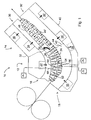
- Fig. 1 shows a two-sided turning device 10 in accordance with the invention for drying a coated paper web W.
- the device comprises a device 12 turning the running direction of the paper web, and a drying apparatus 14 arranged in the running direction of the web after the web turning device.
- the turning device comprises the actual turning device 16 on the first side of the web, in the case shown in the Figure above the web, and a counterpart 18 for this device on the second side of the web.
- the turning device 16 comprises six blow nozzles 20 which, in the case of the Figure, are overpressure nozzles of the so-called Float type of the applicant.
- the Float nozzles are symmetrical nozzles, from the longitudinal slots on both edges transverse to the web of the carrier surface of which blows are directed against each other and against the web, forming an overpressure zone between the nozzle and the web, and turning the running direction of the web about 70-80 degrees, in the case shown in the Figure.
- the turning device 16 of the Figure has its own air system with air supply channels 22 for bringing make-up air to the turning device.
- air in the machine room, exhaust air from the airborne web-dryer, circulating air, or a mixture of these, for example, may be used as blowing air.
- the counterpart 18 has likewise six overpressure nozzles 24 arranged on the second side of the web exactly opposite to the nozzles 20 of the turning device.
- the counterpart may have an air supply system of its own with air supply channels 26, as is shown in broken lines in Fig. 1.
- the counterpart may also have its own exhaust or return air system with exhaust air channels 28, into which air blown against the web is absorbed, as is also shown in broken lines in Fig. 1.
- the supply and discharge of air in the counterpart may advantageously be arranged through the drying apparatus, as is explained below.
- the drying apparatus 14 is an airborne web-dryer with separate airborne web-dryers or airborne web-dryer units 30 and 30' on both sides of the web.
- the upper airborne web-dryer unit 30 is combined with the turning device 16 under the same housing structure 32. However, the turning device is separated from the airborne web-dryer unit by a partition 39.
- the said airborne web-dryer unit 30 above the web has its own air supply system with air supply channels 34.
- the airborne web-dryer unit 30 also has its own exhaust air system with exhaust air channels 36. From the turning device 16, air is transferred along with the web to the upper airborne web-dryer unit, as is in an exemplary way shown with arrow 38, and from there onwards into the exhaust air channel 36. The necessary amount of make-up air is brought to the turning device.
- the lower airborne web-dryer unit 30' is connected in a similar way to the counterpart 18 with a common housing structure 40. Exhaust air from the counterpart is arranged to flow into the exhaust air channel 36' of the airborne web-dryer unit 30'. Supply air, i.e. pressurized blowing air is led to the counterpart through the air supply channel 34' of the airborne web-dryer unit 30'.
- the supply air systems for the airborne web-dryer 30' and the counterpart 18, as well as the exhaust air systems may be separated from each other by a partition 42 restricting the flow, which is provided with an adjustable damper 44 or a similar element, as is shown in broken lines in Fig. 1, with which the supply of air of the counterpart may be adjusted separately from the air flows of the airborne web-dryer unit.
- the floating or blow nozzles 46 and 46' are interlaced so that the web runs in a sine-wave form through the straight airborne web-dryer section.
- Fig. 1 also indicates the pressure measurements for the control system of the turning device.
- the pressure sensor 48 arranged into the blow nozzle 20 of the actual turning device 16 measures the nozzle pressure P SP of the nozzle.
- the pressure sensor 50 arranged between the nozzles 20 of the turning device measures the pad pressure P KL of the turning device.
- the pressure sensor 56 arranged between the nozzles 24 of the counterpart may respectively be used for measuring the possible underpressure or overpressure P VK in the counterpart.
- the small arrows indicate how the blows from the nozzles 20 and 24 arranged on both sides of the web blow against each other, forming a local overpressure between the nozzle carrier surfaces 52 and 54 and the paper web on both sides of the web. These local overpressures have a stabilizing effect on the paper web and improve the runnability and controllability of the web.
- Fig. 3 shows an enlargement of an overpressure nozzle 24 of the US patent 4,384,666 used in a counterpart of the invention.
- the arrows indicate the direction of the blows from the carrier surface 54 towards the web.
- Fig. 2 The control system for a two-sided turning device in accordance with the invention is shown in more detail in Fig. 2. It may be seen from Fig. 2, that the measuring results from the differential pressure instruments 48 and 50 are led to the control device 58 with which it is possible to control the blower 60 feeding air into the air supply channel 22 of the turning device 16.
- FIG. 2 shows the alternative in which both the supply air and the exhaust air arrangement of the counterpart are connected to the airborne web-dryer unit 30'.
Landscapes
- Engineering & Computer Science (AREA)
- Textile Engineering (AREA)
- Mechanical Engineering (AREA)
- General Engineering & Computer Science (AREA)
- Paper (AREA)
- Drying Of Solid Materials (AREA)
- Organic Low-Molecular-Weight Compounds And Preparation Thereof (AREA)
- Preparation Of Compounds By Using Micro-Organisms (AREA)
Claims (10)
- Verfahren zum Trocknen einer beschichteten Papierbahn (W) in einer Vorrichtung (10), die in einer Aufeinanderfolge in der Laufrichtung der Bahn aufweist:- eine Bahnwendevorrichtung (16), die an einer ersten Seite der Bahn angeordnet ist und mit Überdruckgebläsedüsen (20) versehen ist, die eine Drückkraft gegen die Bahn richten;- Bahntrockenvorrichtungen (30, 30'), die an der ersten und der zweiten Seite der Bahn angeordnet sind, wobei die Trockenvorrichtungen der Bahn Lufttrage-Bahntrocknereinheiten (30, 30') aufweisen, die mit Abluftkanälen (36, 36') versehen sind und an beiden Seiten der Bahn angeordnet sind; undin diesem Verfahren- die Laufrichtung der zu trocknenden Bahn (W) in einer kontaktfreien Weise mittels Blasströmungen gewendet wird, die mittels Gebläsedüsen (20) in der Wendevorrichtung (16) erzeugt werden;- die Bahn danach in einer kontaktfreien Weise durch die Trockenvorrichtungen getrocknet wird; und- der Bahnverlauf weiter stabilisiert wird durch Blasströmungen, die in dem Wendevorrichtungsbereich durch Überdruckdüsen (24) eines Gegenstücks (18) erzeugt werden, das an der zweiten Seite der Bahn angeordnet ist, wobei die Überdruckdüsen eine Drückkraft gegen die Bahn richten, die die Bahn drückt, wobei geblasene Luft von den Überdruckgebläsedüsen (20) der Wendevorrichtung und /oder geblasene Luft von den Überdruckdüsen (24) des Gegenstücks in die Abluftkanäle der Lufttrage-Bahntrocknereinheiten absorbiert wird, und die Blasströmungen von den Überdruckdüsen (24) des Gegenstücks (18) in Richtung zu der zweiten Seite der Bahn gegen die Überdruckgebläsedüsen (20) der Wendevorrichtung, die an der ersten Seite angeordnet ist, gerichtet werden, wobei die Überdruckdüsen (24) des Gegenstücks (18) und die Überdruckgebläsedüsen der Wendevorrichtung zueinander entgegengesetzt an beiden Seiten der Bahn angeordnet sind.
- Verfahren nach Anspruch 1,
dadurch gekennzeichnet, daß
die Überdruckdüsen (24) des Gegenstücks (18) zum Blasen von Heißluft verwendet werden, wobei deren Temperatur 100 bis 450°C, vorzugsweise 150 bis 400°C beträgt, und die Geschwindigkeit 20 bis 100 m/s beträgt, vorzugsweise 40 bis 80 m/s. - Verfahren nach Anspruch 1,
dadurch gekennzeichnet, daß
Luft von der Wendevorrichtung hauptsächlich in die Lufttragebahntrocknereinheit (30) ausgestoßen wird, die nach der Wendevorrichtung angeordnet ist. - Verfahren nach Anspruch 1,
dadurch gekennzeichnet, daß
der Bahnverlauf zusätzlich gesteuert wird durch ein Einstellen des in dem Gegenstück vorherrschenden Drucks in den freien Raum zwischen den Düsen. - Vorrichtung (10) zum Trocknen einer beschichteten Papierbahn (W), die in Aufeinanderfolge in der Laufrichtung der Bahn aufweist:- eine Wendevorrichtung (16), die an einer ersten Seite der Bahn angeordnet ist und mit Überdruckgebläsedüsen versehen ist zum Wenden der Laufrichtung der zu trocknenden Bahn (W) in einer kontaktfreien Weise unter Anwendung von durch die Gebläsedüsen (20) erzeugten Überdruckblasströmungen, und zum Richten der Drückkraft gegen die Bahn; und- Trockenvorrichtungen (30, 30'), die an der ersten und der zweiten Seite der Bahn angeordnet sind und mit Flotationsdüsen (46, 46') für ein kontaktfreies Trocknen der Bahn versehen sind;wobei die Vorrichtung des weiteren aufweist:- ein Gegenstück (18), das mit Überdruckdüsen (24) versehen ist und an der zweiten Seite der Bahn in dem Bereich der Wendevorrichtung angeordnet ist, wobei das Gegenstück mit den Überdruckdüsen (24) versehen ist zum Erzeugen von Überdruckblasströmungen, die eine die Bahn wegdrückende Kraft erzeugen, wobei die Trockenvorrichtungen (30, 30') Lufttrage-Bahntrocknereinheiten sind, die an der ersten und zweiten Seite der Bahn angeordnet sind, und mit Abluftkanälen (36, 36') versehen sind zum Ausstoßen vom Gebläseluft aus dem Raum zwischen den Flotationsdüsen (46, 46') und der Bahn, und die Überdruckgebläsedüsen (20) der Wendevorrichtung (16) und die Überdruckdüsen (24) des Gegenstücks (18) symmetrische Überdruckdüsen sind, und zueinander entgegengesetzt an beiden Seiten der Bahn angeordnet sind, womit sie eine Überdruckzone zwischen den Düsen und der Bahn an beiden Seiten der Bahn ausbilden.
- Vorrichtung nach Anspruch 5,
dadurch gekennzeichnet, daß- der Raum zwischen der Wendevorrichtung (16) und der Bahn (W) mit dem Abluftkanal (36) der Lufttragebahntrocknereinheit (30) an der ersten Seite der Bahn verbunden ist, um von der Wendevorrichtung geblasene Luft auszustoßen; und / oder- der Raum zwischen dem Gegenstück (18) und der Bahn (W) mit dem Abluftkanal (36') der Lufttragebahntrocknereinheit (30') an der zweiten Seite der Bahn verbunden ist zum Ausstoßen von Luft, die durch die Überdruckdüsen (24) von dem Gegenstück in Richtung auf die Bahn geblasen wird. - Vorrichtung nach Anspruch 5,
dadurch gekennzeichnet, daß
die Vorrichtung eine Gehäusestruktur (40) aufweist, die den Teil des Gegenstücks (18) abdeckt, der von der Bahn weggewandt ist, wobei die Gehäusestruktur einen Abluftkanal (28) zum Absorbieren der Luft aufweist, die in Richtung auf die Papierbahn hin aus dem Raum zwischen der Bahn und den Überdruckdüsen (24) des Gegenstücks geblasen wird. - Vorrichtung nach Anspruch 5,
dadurch gekennzeichnet, daß
die Vorrichtung eine gemeinsame Gehäusestruktur (40) hat, die die Trockenvorrichtung (30'), die an der zweiten Seite der Bahn angeordnet ist, und das Gegenstück (18) abdeckt, das an derselben Seite angeordnet ist, wobei die Gehäusestruktur einen Abluftkanal (36') zum Absorbieren von Trockenluft und Luft einschließt, die durch die Überdruckdüsen in dem Gegenstück geblasen wird. - Vorrichtung nach Anspruch 5,
dadurch gekennzeichnet, daß- die Wendevorrichtung (16) 3 bis 15 Überdruckgebläsedüsen (20) aufweist, die über der Bahn an der ersten Seite der Bahn angeordnet sind; und daß- das Gegenstück (18) 3 bis 15 Überdruckdüsen (24) aufweist, die über der Bahn an der zweiten Seite der Bahn angeordnet sind, wobei die Überdruckdüsen des Gegenstücks (18) so angeordnet sind, dass sie in Richtung auf die Bahn zu einem Punkt blasen, an dem sich eine Überdruckgebläsedüse (20) der Wendevorrichtung an der ersten Seite der Bahn befindet. - Vorrichtung nach Anspruch 5,
dadurch gekennzeichnet, daß- die Vorrichtung eine Gehäusestruktur (32) aufweist, die die Wendevorrichtung und den Lufttragebahntrockner (30) abdeckt, der benachbart zu der Wendevorrichtung angeordnet ist; und daß- eine Abtrennung zwischen der Wendevorrichtung und dem Lufttragebahntrockner vorgesehen ist zum Aufrechterhalten eines Polsterdrucks in der Wendevorrichtung.
Applications Claiming Priority (3)
| Application Number | Priority Date | Filing Date | Title |
|---|---|---|---|
| FI972878 | 1997-07-07 | ||
| FI972878A FI114933B (fi) | 1997-07-07 | 1997-07-07 | Menetelmä ja laite päällystetyn paperiradan tai vastaavan kuivatuksessa |
| PCT/FI1998/000567 WO1999002773A1 (en) | 1997-07-07 | 1998-07-03 | Method and apparatus for drying a coated paper web or the like |
Publications (3)
| Publication Number | Publication Date |
|---|---|
| EP1009877A1 EP1009877A1 (de) | 2000-06-21 |
| EP1009877B1 true EP1009877B1 (de) | 2006-05-10 |
| EP1009877B9 EP1009877B9 (de) | 2006-12-13 |
Family
ID=8549203
Family Applications (1)
| Application Number | Title | Priority Date | Filing Date |
|---|---|---|---|
| EP98932189A Expired - Lifetime EP1009877B9 (de) | 1997-07-07 | 1998-07-03 | Verfahren und vorrichtung zur trocknung einer beschichteten papierbahn |
Country Status (10)
| Country | Link |
|---|---|
| US (1) | US6293031B1 (de) |
| EP (1) | EP1009877B9 (de) |
| JP (1) | JP3488689B2 (de) |
| AT (1) | ATE325924T1 (de) |
| AU (1) | AU8217798A (de) |
| CA (1) | CA2294862C (de) |
| DE (2) | DE1009877T1 (de) |
| ES (1) | ES2262235T3 (de) |
| FI (1) | FI114933B (de) |
| WO (1) | WO1999002773A1 (de) |
Cited By (1)
| Publication number | Priority date | Publication date | Assignee | Title |
|---|---|---|---|---|
| EP3988713B1 (de) | 2020-10-23 | 2023-11-01 | Valmet Technologies Oy | Verfahren zur behandlung eines faservlieses und behandlungssystem zur behandlung eines faservlieses |
Families Citing this family (9)
| Publication number | Priority date | Publication date | Assignee | Title |
|---|---|---|---|---|
| US6634120B2 (en) | 2001-03-26 | 2003-10-21 | Voith Paper Patent Gmbh | Apparatus for coating moving fiber webs |
| ATE367480T1 (de) * | 2001-03-26 | 2007-08-15 | Voith Patent Gmbh | Vorrichtung zur beschichtung einer laufenden bahn,insbesondere einer papier- oder kartonbahn |
| US6851367B2 (en) * | 2002-08-08 | 2005-02-08 | Presstek, Inc. | Web handling cylinder with modulated tension loss |
| US7118062B2 (en) * | 2002-08-08 | 2006-10-10 | Presstek, Inc. | Web handling with tension sensing and adjustment |
| US7828547B2 (en) * | 2004-12-10 | 2010-11-09 | Kodak Graphic Communications | Method and apparatus for rapidly heating printing plates |
| FI120368B (fi) | 2007-10-25 | 2009-09-30 | Metso Paper Inc | Menetelmä ja järjestely kuiturainan ominaisuuksien säätämiseksi |
| US8088255B2 (en) | 2008-04-18 | 2012-01-03 | Honeywell Asca Inc | Sheet stabilizer with dual inline machine direction air clamps and backsteps |
| FI20085539A0 (fi) * | 2008-06-03 | 2008-06-03 | Upm Kymmene Oyj | Laite ja menetelmä rainan kuivaamiseksi |
| CN117184968A (zh) * | 2023-10-16 | 2023-12-08 | 南京奥拓电子科技有限公司 | 一种走纸道、应用方法及打印机 |
Citations (3)
| Publication number | Priority date | Publication date | Assignee | Title |
|---|---|---|---|---|
| EP0236819A2 (de) * | 1986-02-28 | 1987-09-16 | Thermo Electron-Web Systems, Inc. | Kontaktlose Wende- und Trocknungsvorrichtung für Warenbahnen |
| US4833794A (en) * | 1988-08-10 | 1989-05-30 | Advance Systems, Inc. | Dryer apparatus for floating a running web and having baffle means for spent return air |
| EP0770731A1 (de) * | 1995-10-25 | 1997-05-02 | Valmet Corporation | Verfahren und Vorrichtung zum Trocknen einer Beschichtung auf einer Papierbahn oder einem gleichwertigen Träger |
Family Cites Families (5)
| Publication number | Priority date | Publication date | Assignee | Title |
|---|---|---|---|---|
| US3549070A (en) * | 1969-02-27 | 1970-12-22 | Tec Systems | Floatation of sheet materials |
| DE4110875A1 (de) * | 1991-04-04 | 1992-10-08 | Voith Gmbh J M | Trockenpartie |
| IT1253394B (it) * | 1991-10-18 | 1995-08-08 | Dispositivo per asciugare con aria calda un film stampato in una macchina rotocalco. | |
| FR2710971B1 (fr) * | 1993-10-06 | 1995-12-29 | Infra Rouge System | Dispositif de déviation sans contact pour matériau en feuille. |
| US5634402A (en) * | 1995-10-12 | 1997-06-03 | Research, Incorporated | Coating heater system |
-
1997
- 1997-07-07 FI FI972878A patent/FI114933B/fi not_active IP Right Cessation
-
1998
- 1998-07-03 DE DE1009877T patent/DE1009877T1/de active Pending
- 1998-07-03 CA CA002294862A patent/CA2294862C/en not_active Expired - Lifetime
- 1998-07-03 US US09/462,293 patent/US6293031B1/en not_active Expired - Lifetime
- 1998-07-03 AU AU82177/98A patent/AU8217798A/en not_active Abandoned
- 1998-07-03 DE DE69834496T patent/DE69834496T2/de not_active Expired - Lifetime
- 1998-07-03 JP JP2000502258A patent/JP3488689B2/ja not_active Expired - Fee Related
- 1998-07-03 AT AT98932189T patent/ATE325924T1/de active
- 1998-07-03 EP EP98932189A patent/EP1009877B9/de not_active Expired - Lifetime
- 1998-07-03 ES ES98932189T patent/ES2262235T3/es not_active Expired - Lifetime
- 1998-07-03 WO PCT/FI1998/000567 patent/WO1999002773A1/en not_active Ceased
Patent Citations (3)
| Publication number | Priority date | Publication date | Assignee | Title |
|---|---|---|---|---|
| EP0236819A2 (de) * | 1986-02-28 | 1987-09-16 | Thermo Electron-Web Systems, Inc. | Kontaktlose Wende- und Trocknungsvorrichtung für Warenbahnen |
| US4833794A (en) * | 1988-08-10 | 1989-05-30 | Advance Systems, Inc. | Dryer apparatus for floating a running web and having baffle means for spent return air |
| EP0770731A1 (de) * | 1995-10-25 | 1997-05-02 | Valmet Corporation | Verfahren und Vorrichtung zum Trocknen einer Beschichtung auf einer Papierbahn oder einem gleichwertigen Träger |
Cited By (1)
| Publication number | Priority date | Publication date | Assignee | Title |
|---|---|---|---|---|
| EP3988713B1 (de) | 2020-10-23 | 2023-11-01 | Valmet Technologies Oy | Verfahren zur behandlung eines faservlieses und behandlungssystem zur behandlung eines faservlieses |
Also Published As
| Publication number | Publication date |
|---|---|
| FI972878A0 (fi) | 1997-07-07 |
| US6293031B1 (en) | 2001-09-25 |
| EP1009877A1 (de) | 2000-06-21 |
| ES2262235T3 (es) | 2006-11-16 |
| AU8217798A (en) | 1999-02-08 |
| EP1009877B9 (de) | 2006-12-13 |
| JP2001509556A (ja) | 2001-07-24 |
| DE1009877T1 (de) | 2001-01-11 |
| DE69834496T2 (de) | 2007-02-01 |
| FI972878A7 (fi) | 1999-01-08 |
| JP3488689B2 (ja) | 2004-01-19 |
| ATE325924T1 (de) | 2006-06-15 |
| DE69834496D1 (de) | 2006-06-14 |
| FI114933B (fi) | 2005-01-31 |
| CA2294862C (en) | 2006-10-31 |
| WO1999002773A1 (en) | 1999-01-21 |
| CA2294862A1 (en) | 1999-01-21 |
Similar Documents
| Publication | Publication Date | Title |
|---|---|---|
| US5009016A (en) | Method for on-machine coating-drying of a paper web or the like | |
| US4881327A (en) | Dryer section | |
| FI62571B (fi) | Anordning vid flercylindertork i en pappersmaskin | |
| US4936025A (en) | Combination infrared and airborne drying of a web | |
| CA1314392C (en) | Cross directional gloss controller | |
| EP1009877B1 (de) | Verfahren und vorrichtung zur trocknung einer beschichteten papierbahn | |
| EP0561256B1 (de) | Verfahren zum Lufttrocknen von freigeführten Materialbahnen and Lufttrockner zur Durchführung des Verfahrens | |
| FI114932B (fi) | Menetelmä ja laite paperirainan kuivatuksen optimoimiseksi | |
| US5588223A (en) | Restrained paper dryer | |
| JPS5844945B2 (ja) | 連続状の運動する帯状物を浮動支持する空気柱装置 | |
| US4942674A (en) | Method in the drying of a paper web or equivalent | |
| US5033207A (en) | Device for drying a material web | |
| WO1989002953A1 (en) | Arrangement of pressure nozzles for the treatment of webs | |
| FI78525C (fi) | Infratork. | |
| JPH03137288A (ja) | コーター等の乾燥部における方法および装置 | |
| US5647144A (en) | Combination air bar and hole bar flotation dryer | |
| KR19980703814A (ko) | 건조기부 콘셉트 및 제지/판지 웨브의 건조방법 | |
| US10401085B2 (en) | Air bar arrangement for drying tissue on a belt | |
| FI111092B (fi) | Menetelmä kuivatuskaasun puhaltamiseksi paperirainaa vasten ja paperikoneen päällepuhalluskuivatin | |
| US4893416A (en) | Apparatus for the contactless guiding of webs of material | |
| CA2365683C (en) | Method and apparatus for stabilizing the running of a web in a paper machine or a like | |
| JPS636192A (ja) | ノズルおよび紙乾燥設備 | |
| US20050223593A1 (en) | Step air foil | |
| JP2804810B2 (ja) | ウェブの支持転向延展装置 | |
| US6105277A (en) | Process and system for promoting complete web support within the dryer section of a papermachine |
Legal Events
| Date | Code | Title | Description |
|---|---|---|---|
| PUAI | Public reference made under article 153(3) epc to a published international application that has entered the european phase |
Free format text: ORIGINAL CODE: 0009012 |
|
| 17P | Request for examination filed |
Effective date: 20000103 |
|
| AK | Designated contracting states |
Kind code of ref document: A1 Designated state(s): AT DE ES FR GB IT SE |
|
| DET | De: translation of patent claims | ||
| RAP1 | Party data changed (applicant data changed or rights of an application transferred) |
Owner name: METSO PAPER, INC. |
|
| 17Q | First examination report despatched |
Effective date: 20020304 |
|
| GRAP | Despatch of communication of intention to grant a patent |
Free format text: ORIGINAL CODE: EPIDOSNIGR1 |
|
| RTI1 | Title (correction) |
Free format text: METHOD AND APPARATUS FOR DRYING A COATED PAPER WEB |
|
| GRAS | Grant fee paid |
Free format text: ORIGINAL CODE: EPIDOSNIGR3 |
|
| GRAA | (expected) grant |
Free format text: ORIGINAL CODE: 0009210 |
|
| RIN1 | Information on inventor provided before grant (corrected) |
Inventor name: SOLIN, RICHARD Inventor name: RINGBOM, KNUT |
|
| AK | Designated contracting states |
Kind code of ref document: B1 Designated state(s): AT DE ES FR GB IT SE |
|
| REG | Reference to a national code |
Ref country code: GB Ref legal event code: FG4D |
|
| REF | Corresponds to: |
Ref document number: 69834496 Country of ref document: DE Date of ref document: 20060614 Kind code of ref document: P |
|
| REG | Reference to a national code |
Ref country code: SE Ref legal event code: TRGR |
|
| REG | Reference to a national code |
Ref country code: ES Ref legal event code: FG2A Ref document number: 2262235 Country of ref document: ES Kind code of ref document: T3 |
|
| ET | Fr: translation filed | ||
| PLBE | No opposition filed within time limit |
Free format text: ORIGINAL CODE: 0009261 |
|
| STAA | Information on the status of an ep patent application or granted ep patent |
Free format text: STATUS: NO OPPOSITION FILED WITHIN TIME LIMIT |
|
| 26N | No opposition filed |
Effective date: 20070213 |
|
| PGFP | Annual fee paid to national office [announced via postgrant information from national office to epo] |
Ref country code: SE Payment date: 20120725 Year of fee payment: 15 |
|
| PGFP | Annual fee paid to national office [announced via postgrant information from national office to epo] |
Ref country code: IT Payment date: 20120724 Year of fee payment: 15 |
|
| REG | Reference to a national code |
Ref country code: SE Ref legal event code: EUG |
|
| PG25 | Lapsed in a contracting state [announced via postgrant information from national office to epo] |
Ref country code: SE Free format text: LAPSE BECAUSE OF NON-PAYMENT OF DUE FEES Effective date: 20130704 |
|
| PG25 | Lapsed in a contracting state [announced via postgrant information from national office to epo] |
Ref country code: IT Free format text: LAPSE BECAUSE OF NON-PAYMENT OF DUE FEES Effective date: 20130703 |
|
| PGFP | Annual fee paid to national office [announced via postgrant information from national office to epo] |
Ref country code: FR Payment date: 20140721 Year of fee payment: 17 Ref country code: ES Payment date: 20140728 Year of fee payment: 17 |
|
| REG | Reference to a national code |
Ref country code: FR Ref legal event code: ST Effective date: 20160331 |
|
| PG25 | Lapsed in a contracting state [announced via postgrant information from national office to epo] |
Ref country code: FR Free format text: LAPSE BECAUSE OF NON-PAYMENT OF DUE FEES Effective date: 20150731 |
|
| REG | Reference to a national code |
Ref country code: ES Ref legal event code: FD2A Effective date: 20160829 |
|
| PG25 | Lapsed in a contracting state [announced via postgrant information from national office to epo] |
Ref country code: ES Free format text: LAPSE BECAUSE OF NON-PAYMENT OF DUE FEES Effective date: 20150704 |
|
| PGFP | Annual fee paid to national office [announced via postgrant information from national office to epo] |
Ref country code: DE Payment date: 20170724 Year of fee payment: 20 Ref country code: GB Payment date: 20170719 Year of fee payment: 20 |
|
| PGFP | Annual fee paid to national office [announced via postgrant information from national office to epo] |
Ref country code: AT Payment date: 20170720 Year of fee payment: 20 |
|
| REG | Reference to a national code |
Ref country code: DE Ref legal event code: R071 Ref document number: 69834496 Country of ref document: DE |
|
| REG | Reference to a national code |
Ref country code: GB Ref legal event code: PE20 Expiry date: 20180702 |
|
| REG | Reference to a national code |
Ref country code: AT Ref legal event code: MK07 Ref document number: 325924 Country of ref document: AT Kind code of ref document: T Effective date: 20180703 |
|
| PG25 | Lapsed in a contracting state [announced via postgrant information from national office to epo] |
Ref country code: GB Free format text: LAPSE BECAUSE OF EXPIRATION OF PROTECTION Effective date: 20180702 |