EP1010090B1 - Mehrprozessorrechnersystem mit verwendung eines gruppenschutzmechanismus - Google Patents
Mehrprozessorrechnersystem mit verwendung eines gruppenschutzmechanismus Download PDFInfo
- Publication number
- EP1010090B1 EP1010090B1 EP98946854A EP98946854A EP1010090B1 EP 1010090 B1 EP1010090 B1 EP 1010090B1 EP 98946854 A EP98946854 A EP 98946854A EP 98946854 A EP98946854 A EP 98946854A EP 1010090 B1 EP1010090 B1 EP 1010090B1
- Authority
- EP
- European Patent Office
- Prior art keywords
- node
- address
- transaction
- computer system
- bus
- Prior art date
- Legal status (The legal status is an assumption and is not a legal conclusion. Google has not performed a legal analysis and makes no representation as to the accuracy of the status listed.)
- Expired - Lifetime
Links
Images




Classifications
-
- G—PHYSICS
- G06—COMPUTING OR CALCULATING; COUNTING
- G06F—ELECTRIC DIGITAL DATA PROCESSING
- G06F11/00—Error detection; Error correction; Monitoring
- G06F11/07—Responding to the occurrence of a fault, e.g. fault tolerance
- G06F11/0703—Error or fault processing not based on redundancy, i.e. by taking additional measures to deal with the error or fault not making use of redundancy in operation, in hardware, or in data representation
- G06F11/0706—Error or fault processing not based on redundancy, i.e. by taking additional measures to deal with the error or fault not making use of redundancy in operation, in hardware, or in data representation the processing taking place on a specific hardware platform or in a specific software environment
- G06F11/0712—Error or fault processing not based on redundancy, i.e. by taking additional measures to deal with the error or fault not making use of redundancy in operation, in hardware, or in data representation the processing taking place on a specific hardware platform or in a specific software environment in a virtual computing platform, e.g. logically partitioned systems
-
- G—PHYSICS
- G06—COMPUTING OR CALCULATING; COUNTING
- G06F—ELECTRIC DIGITAL DATA PROCESSING
- G06F11/00—Error detection; Error correction; Monitoring
- G06F11/07—Responding to the occurrence of a fault, e.g. fault tolerance
- G06F11/0703—Error or fault processing not based on redundancy, i.e. by taking additional measures to deal with the error or fault not making use of redundancy in operation, in hardware, or in data representation
- G06F11/0706—Error or fault processing not based on redundancy, i.e. by taking additional measures to deal with the error or fault not making use of redundancy in operation, in hardware, or in data representation the processing taking place on a specific hardware platform or in a specific software environment
- G06F11/0721—Error or fault processing not based on redundancy, i.e. by taking additional measures to deal with the error or fault not making use of redundancy in operation, in hardware, or in data representation the processing taking place on a specific hardware platform or in a specific software environment within a central processing unit [CPU]
- G06F11/0724—Error or fault processing not based on redundancy, i.e. by taking additional measures to deal with the error or fault not making use of redundancy in operation, in hardware, or in data representation the processing taking place on a specific hardware platform or in a specific software environment within a central processing unit [CPU] in a multiprocessor or a multi-core unit
-
- G—PHYSICS
- G06—COMPUTING OR CALCULATING; COUNTING
- G06F—ELECTRIC DIGITAL DATA PROCESSING
- G06F11/00—Error detection; Error correction; Monitoring
- G06F11/07—Responding to the occurrence of a fault, e.g. fault tolerance
- G06F11/0703—Error or fault processing not based on redundancy, i.e. by taking additional measures to deal with the error or fault not making use of redundancy in operation, in hardware, or in data representation
- G06F11/0706—Error or fault processing not based on redundancy, i.e. by taking additional measures to deal with the error or fault not making use of redundancy in operation, in hardware, or in data representation the processing taking place on a specific hardware platform or in a specific software environment
- G06F11/073—Error or fault processing not based on redundancy, i.e. by taking additional measures to deal with the error or fault not making use of redundancy in operation, in hardware, or in data representation the processing taking place on a specific hardware platform or in a specific software environment in a memory management context, e.g. virtual memory or cache management
-
- G—PHYSICS
- G06—COMPUTING OR CALCULATING; COUNTING
- G06F—ELECTRIC DIGITAL DATA PROCESSING
- G06F12/00—Accessing, addressing or allocating within memory systems or architectures
- G06F12/02—Addressing or allocation; Relocation
- G06F12/0223—User address space allocation, e.g. contiguous or non contiguous base addressing
- G06F12/0284—Multiple user address space allocation, e.g. using different base addresses
-
- G—PHYSICS
- G06—COMPUTING OR CALCULATING; COUNTING
- G06F—ELECTRIC DIGITAL DATA PROCESSING
- G06F12/00—Accessing, addressing or allocating within memory systems or architectures
- G06F12/02—Addressing or allocation; Relocation
- G06F12/08—Addressing or allocation; Relocation in hierarchically structured memory systems, e.g. virtual memory systems
- G06F12/10—Address translation
- G06F12/1009—Address translation using page tables, e.g. page table structures
- G06F12/1018—Address translation using page tables, e.g. page table structures involving hashing techniques, e.g. inverted page tables
-
- G—PHYSICS
- G06—COMPUTING OR CALCULATING; COUNTING
- G06F—ELECTRIC DIGITAL DATA PROCESSING
- G06F12/00—Accessing, addressing or allocating within memory systems or architectures
- G06F12/02—Addressing or allocation; Relocation
- G06F12/08—Addressing or allocation; Relocation in hierarchically structured memory systems, e.g. virtual memory systems
- G06F12/10—Address translation
- G06F12/1072—Decentralised address translation, e.g. in distributed shared memory systems
-
- G—PHYSICS
- G06—COMPUTING OR CALCULATING; COUNTING
- G06F—ELECTRIC DIGITAL DATA PROCESSING
- G06F11/00—Error detection; Error correction; Monitoring
- G06F11/07—Responding to the occurrence of a fault, e.g. fault tolerance
- G06F11/0703—Error or fault processing not based on redundancy, i.e. by taking additional measures to deal with the error or fault not making use of redundancy in operation, in hardware, or in data representation
- G06F11/0766—Error or fault reporting or storing
-
- G—PHYSICS
- G06—COMPUTING OR CALCULATING; COUNTING
- G06F—ELECTRIC DIGITAL DATA PROCESSING
- G06F12/00—Accessing, addressing or allocating within memory systems or architectures
- G06F12/02—Addressing or allocation; Relocation
- G06F12/08—Addressing or allocation; Relocation in hierarchically structured memory systems, e.g. virtual memory systems
- G06F12/0802—Addressing of a memory level in which the access to the desired data or data block requires associative addressing means, e.g. caches
- G06F12/0864—Addressing of a memory level in which the access to the desired data or data block requires associative addressing means, e.g. caches using pseudo-associative means, e.g. set-associative or hashing
-
- G—PHYSICS
- G06—COMPUTING OR CALCULATING; COUNTING
- G06F—ELECTRIC DIGITAL DATA PROCESSING
- G06F2212/00—Indexing scheme relating to accessing, addressing or allocation within memory systems or architectures
- G06F2212/25—Using a specific main memory architecture
- G06F2212/254—Distributed memory
- G06F2212/2542—Non-uniform memory access [NUMA] architecture
-
- G—PHYSICS
- G06—COMPUTING OR CALCULATING; COUNTING
- G06F—ELECTRIC DIGITAL DATA PROCESSING
- G06F2212/00—Indexing scheme relating to accessing, addressing or allocation within memory systems or architectures
- G06F2212/27—Using a specific cache architecture
- G06F2212/272—Cache only memory architecture [COMA]
Definitions
- This invention relates to the field of multiprocessor computer systems and, more particularly, to multiprocessor computer systems which operate in a cluster mode to provide fault isolation.
- Multiprocessing computer systems include two or more processors which may be employed to perform computing tasks.
- a particular computing task may be performed upon one processor while other processors perform unrelated computing tasks.
- components of a particular computing task may be distributed among multiple processors to decrease the time required to perform the computing task as a whole.
- a processor is a device configured to perform an operation upon one or more operands to produce a result. The operation is performed in response to an instruction executed by the processor.
- SMP symmetric multiprocessor
- an SMP computer system comprises multiple processors connected through a cache hierarchy to a shared bus. Additionally connected to the bus is a memory, which is shared among the processors in the system. Access to any particular memory location within the memory occurs in a similar amount of time as access to any other particular memory location. Since each location in the memory may be accessed in a uniform manner, this structure is often referred to as a uniform memory architecture (UMA).
- UMA uniform memory architecture
- Processors are often configured with internal caches, and one or more caches are typically included in the cache hierarchy between the processors and the shared bus in an SMP computer system. Multiple copies of data residing at a particular main memory address may be stored in these caches.
- shared bus computer systems employ cache coherency.
- an operation is coherent if the effects of the operation upon data stored at a particular memory address are reflected in each copy of the data within the cache hierarchy. For example, when data stored at a particular memory address is updated, the update may be supplied to the caches which are storing copies of the previous data.
- the copies of the previous data may be invalidated in the caches such that a subsequent access to the particular memory address causes the updated copy to be transferred from main memory.
- a snoop bus protocol is typically employed. Each coherent transaction performed upon the shared bus is examined (or "snooped") against data in the caches. If a copy of the affected data is found, the state of the cache line containing the data may be updated in response to the coherent transaction.
- a bus is capable of a peak bandwidth (e.g. a number of bytes/second which may be transferred across the bus). As additional processors are attached to the bus, the bandwidth required to supply the processors with data and instructions may exceed the peak bus bandwidth. Since some processors are forced to wait for available bus bandwidth, performance of the computer system suffers when the bandwidth requirements of the processors exceeds available bus bandwidth.
- adding more processors to a shared bus increases the capacitive loading on the bus and may even cause the physical length of the bus to be increased.
- the increased capacitive loading and extended bus length increases the delay in propagating a signal across the bus. Due to the increased propagation delay, transactions may take longer to perform. Therefore, the peak bandwidth of the bus may decrease as more processors are added.
- SSM scalable shared memory
- An SSM architecture includes multiple nodes within which processors and memory reside. The multiple nodes communicate via a network coupled therebetween. When considered as a whole, the memory included within the multiple nodes forms the shared memory for the computer system.
- directories are used to identify which nodes have cached copies of data corresponding to a particular address. Coherency activities may be generated via examination of the directories.
- SSM systems are scaleable, overcoming the limitations of the shared bus architecture. Since many of the processor accesses are completed within a node, nodes typically have much lower bandwidth requirements upon the network than a shared bus architecture must provide upon its shared bus. The nodes may operate at high clock frequency and bandwidth, accessing the network when needed. Additional nodes may be added to the network without affecting the local bandwidth of the nodes. Instead, only the network bandwidth is affected.
- a global domain is created by way of the SSM protocol which makes all the memory attached to the global domain look like one shared memory accessible to all of its processors.
- a global domain typically runs a single kernel.
- Hardware provides conventional MMU (memory management unit) protection, and the kernel manages mappings (e.g. reloading of key registers on context switches) to allow user programs to co-exist without trusting one another. Since the nodes of a global domain share memory and may cache data, a software error in one node may create a fatal software error which may crash the entire system. Similarly, a fatal hardware error in one node will typically cause the entire global domain to crash.
- clustering may be employed to provide greater fault protection.
- the memory of one node in a cluster system is not freely accessible by processors of other cluster nodes.
- the I/O of one node is typically not freely accessible by processors of other nodes.
- memory is not freely shared between nodes of a cluster, a cluster allows nodes to communicate with each other in a protected way using an interconnection network which is virtualized and protected via operating system abstractions. Normally, each node of a cluster runs a separate kernel. Nodes connected in a cluster should not be able to spread local faults, both hardware and software, that would crash other nodes.
- cluster systems While the concept of clustering for providing protection in multiprocessing computer systems is generally known, various limitations have been associated with cluster systems. These limitations include the lack of addressing schemes which cover a large number of nodes, the lack of flexible protection mechanisms that protect a node from software and hardware failures in other nodes, the lack of protocols which are extensible that allow communications to be set up as "hops" through other nodes to thereby allow efficient interconnect networks, and the lack of error reporting mechanisms that are applicable to protocols running at a user-level.
- Cluster systems attempt to provide each cluster node control over which resources are made available to other nodes in the cluster.
- current technology does not always give a node which provides resources with control over exactly how those resources may be used.
- control over the type of access to be made to local resources is not transparent to the remote node; this potentially requires the remote node to perform different cluster operations based on the type of local resource it wishes to access.
- cluster systems are often built on communication mechanisms which are less reliable than, for instance, SMP buses, since they must connect computers in separate chassis which may be separated by substantial distances. Because of this, cluster operations may incur errors, and application programs must be informed of these errors so that they can take appropriate recovery steps.
- An ideal cluster error reporting mechanism would be completely accurate and easy to use.
- Currently-used technology has various limitations in this area. For instance, interfaces which do not provide process-virtualized error information, but log errors on a controller- or system-wide basis, may cause processes which were not responsible for an error to incur error recovery overhead.
- interfaces which report error information directly to an initiating processor in the form of a processor fault or trap are less easy to use, since many programming languages do not cleanly support the handling of asynchronous errors.
- cluster systems allow memory in remote cluster nodes to be mapped into a local node's virtual address space; in order to implement this efficiently, it is desirable to map all of the available remote memory into the local node's physical address space. While currently-existing technology can accomplish this operation, there are limitations in some of the methods used.
- Some of these limitations are the inability to use the vast majority of an SMP's hardware address space to access remote memory; the inability to do fine-grained sharing of an SMP's address space among multiple hardware interfaces, to support load balancing between them; and the inability to transfer the handling of transactions destined for a particular remote node from one hardware interface to another, without changing the physical addresses being used by currently-running application programs.
- cluster systems can use many varied network topologies, each of which has benefits and drawbacks.
- One potential topology which is well-suited for many applications uses a central switching element to distribute cluster network traffic. Since this topology is useful, it is commonly implemented in cluster configurations. However, many implementations of switches have a serious drawback, which is related to their cost.
- the VIC 8251F "VIC to VME Interface with Mirrored Memory", version 1.1, part number DOC8251F/UM, June 1994, available from Creative Electronics Systems SA, Petit-Lancy I, Switzerland, describes an interface between a global interconnect and a plurality of nodes that each include processors and local buses.
- a multiprocessing computer system comprising a plurality of processing nodes and a global bus interconnecting said plurality of processing nodes, wherein first node includes: a processor; a memory coupled to said processor through a local bus; and a system interface coupled between said global bus and said local bus, wherein said system interface includes a memory management unit including a plurality of entries, wherein a global transaction received by said system interface from a remote node includes an address signal which is used to select a particular entry of said plurality of entries, and wherein said particular entry includes a first field containing a value which controls the type of operation performed upon said local bus by said system interface in response to said global transaction and characterised in that said particular entry includes a second field that indicates which of the processing nodes is allowed access to a location within said memory.
- a method for operating a multiprocessing computer system including a plurality of processing nodes in a global bus interconnecting said plurality of processing nodes, said method comprising: a processor of a first node initiating a local transaction on a local bus; a first system interface of said first node conveying a global transaction upon said global bus which corresponds to said local transaction; a second network interface of a second node receiving said global transaction; a memory management unit, that includes a plurality of entries, of said second system interface accessing a particular entry associated with an address of said global transaction; and said second system interface controlling the type of operation performed upon a second local bus in response to said global transaction depending upon a value contained in a field of said particular entry; and characterised by said second system interface checking a field of said particular entry to determine which of said processing nodes is allowed access to a memory location of said second node.
- An embodiment of the invention can enable a plurality of nodes to operate in a cluster mode and to provide a fast and reliable communication mechanism which allows for efficient implementation of user and kernel-level communication protocols.
- Computer system 10 includes multiple SMP nodes 12A-12D interconnected by a point-to-point network 14. Elements referred to herein with a particular reference number followed by a letter will be collectively referred to by the reference number alone.
- SMP nodes 12A-12D will be collectively referred to as SMP nodes 12.
- each SMP node 12 includes multiple processors, external caches, an SMP bus, a memory, and a system interface.
- SMP node 12A is configured with multiple processors including processors 16A-16B.
- the processors 16 are connected to external caches 18, which are further coupled to an SMP bus 20.
- a memory 22 and a system interface 24 are coupled to SMP bus 20. Still further, one or more input/output (I/O) interfaces 26 may be coupled to SMP bus 20. I/O interfaces 26 are used to interface to peripheral devices such as serial and parallel ports, disk drives, modems, printers, etc. Other SMP nodes 12B-12D may be configured similarly.
- computer system 10 is operable in either a scaled shared memory (SSM) mode or in a cluster mode.
- SSM scaled shared memory
- the mode in which computer system 10 operates is set during initialization by setting configuration control registers within each node's system interface 24.
- Figs. 2-3 Aspects of the operation of computer system 10 in cluster mode are described more fully in conjunction with Figs. 4-10.
- a memory operation is an operation causing the transfer of data from a source to a destination.
- the source and/or destination may be storage locations within the initiator, or may be storage locations within memory. When a source or destination is a storage location within memory, the source or destination is specified via an address conveyed with the memory operation.
- Memory operations may be read or write operations. A read operation causes transfer of data from a source outside of the initiator to a destination within the initiator. Conversely, a write operation causes transfer of data from a source within the initiator to a destination outside of the initiator.
- a memory operation may include one or more transactions upon SMP bus 20 as well as one or more coherency operations upon network 14.
- Each SMP node 12 is essentially an SMP system having memory 22 as the shared memory.
- Processors 16 are high performance processors.
- each processor 16 is a SPARC processor compliant with version 9 of the SPARC processor architecture. It is noted, however, that any processor architecture may be employed by processors 16.
- processors 16 include internal instruction and data caches. Therefore, external caches 18 are labeled as L2 caches (for level 2, wherein the internal caches are level 1 caches). If processors 16 are not configured with internal caches, then external caches 18 are level 1 caches. It is noted that the "level” nomenclature is used to identify proximity of a particular cache to the processing core within processor 16. Level 1 is nearest the processing core, level 2 is next nearest, etc. External caches 18 provide rapid access to memory addresses frequently accessed by the processor 16 coupled thereto. It is noted that external caches 18 may be configured in any of a variety of specific cache arrangements. For example, set-associative or direct-mapped configurations may be employed by external caches 18.
- SMP bus 20 accommodates communication between processors 16 (through caches 18), memory 22, system interface 24, and I/O interface 26.
- SMP bus 20 includes an address bus and related control signals, as well as a data bus and related control signals. Because the address and data buses are separate, a split-transaction bus protocol may be employed upon SMP bus 20. Generally speaking, a split-transaction bus protocol is a protocol in which a transaction occurring upon the address bus may differ from a concurrent transaction occurring upon the data bus. Transactions involving address and data include an address phase in which the address and related control information is conveyed upon the address bus, and a data phase in which the data is conveyed upon the data bus.
- Additional address phases and/or data phases for other transactions may be initiated prior to the data phase corresponding to a particular address phase.
- An address phase and the corresponding data phase may be correlated in a number of ways. For example, data transactions may occur in the same order that the address transactions occur. Alternatively, address and data phases of a transaction may be identified via a unique tag.
- Memory 22 is configured to store data and instruction code for use by processors 16.
- Memory 22 preferably comprises dynamic random access memory (DRAM), although any type of memory may be used.
- DRAM dynamic random access memory
- memory 22 in conjunction with the similar illustrated memories in the other SMP nodes 12 form a distributed shared memory system.
- Each address in the address space of the distributed shared memory is assigned to a particular node, referred to as the home node of the address.
- a processor within a different node than the home node may access the data at an address of the home node, potentially caching the data. Therefore, coherency is maintained between SMP nodes 12 as well as among processors 16 and caches 18 within a particular SMP node 12A-12D.
- System interface 24 provides internode coherency, while snooping upon SMP bus 20 provides intranode coherency.
- system interface 24 detects addresses upon SMP bus 20 which require a data transfer to or from another SMP node 12. System interface 24 performs the transfer, and provides the corresponding data for the transaction upon SMP bus 20.
- system interface 24 is coupled to a point-to-point network 14. However, it is noted that in alternative embodiments other networks may be used.
- point-to-point network individual connections exist between each node upon the network. A particular node communicates directly with a second node via a dedicated link. To communicate with a third node, the particular node utilizes a different link than the one used to communicate with the second node.
- the interconnect network 38 may be configured such that a particular node may be used as a "hop" to pass through communications between a sending node and a receiving node. That is, the network is arranged such that all communications from the sending node to the receiving node must pass through a hop node. By configuring the network using hop nodes, the cost of the system may be reduced, and the interconnect network may be simplified.
- SMP nodes 12 Although four SMP nodes 12 are shown in Fig. 1, embodiments of computer system 10 employing any number of nodes are contemplated. It is further noted that embodiments are also contemplated wherein a plurality of nodes are configured to operate in an SSM mode of operation with respect to each other, but that collectively form a cluster node within a cluster which includes other cluster nodes.
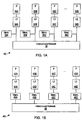
- Figs. 1A and 1B are conceptualized illustrations of distributed memory architectures supported by one embodiment of computer system 10. Specifically, Figs. 1A and 1B illustrate alternative ways in which each SMP node 12 of Fig. 1 may cache data and perform memory accesses. Details regarding the manner in which computer system 10 supports such accesses will be described in further detail below.
- Fig. 1A is a logical diagram depicting a first memory architecture 30 supported by one embodiment of computer system 10 is shown.
- Architecture 30 includes multiple processors 32A-32D, multiple caches 34A-34D, multiple memories 36A-36D, and an interconnect network 38.
- the multiple memories 36 form a distributed shared memory. Each address within the address space corresponds to a location within one of memories 36.
- NUMA Architecture 30 is a non-uniform memory architecture (NUMA).
- NUMA non-uniform memory architecture
- the amount of time required to access a first memory address may be substantially different than the amount of time required to access a second memory address.
- the access time depends upon the origin of the access and the location of the memory 36A-36D which stores the accessed data. For example, if processor 32A accesses a first memory address stored in memory 36A, the access time may be significantly shorter than the access time for an access to a second memory address stored in one of memories 36B-36D. That is, an access by processor 32A to memory 36A may be completed locally (e.g. without transfers upon network 38), while a processor 32A access to memory 36B is performed via network 38.
- an access through network 38 is slower than an access completed within a local memory. For example, a local access might be completed in a few hundred nanoseconds while an access via the network might occupy a few microseconds.
- Data corresponding to addresses stored in remote nodes may be cached in any of the caches 34. However, once a cache 34 discards the data corresponding to such a remote address, a subsequent access to the remote address is completed via a transfer upon network 38.
- NUMA architectures may provide excellent performance characteristics for software applications which use addresses that correspond primarily to a particular local memory.
- Software applications which exhibit more random access patterns and which do not confine their memory accesses to addresses within a particular local memory may experience a large amount of network traffic as a particular processor 32 performs repeated accesses to remote nodes.
- FIG. 1B a logic diagram depicting a second memory architecture 40 supported by the computer system 10 of Fig. 1 is shown.
- Architecture 40 includes multiple processors 42A-42D, multiple caches 44A-44D, multiple memories 46A-46D, and network 48. However, memories 46 are logically coupled between caches 44 and network 48. Memories 46 serve as larger caches (e.g. a level 3 cache), storing addresses which are accessed by the corresponding processors 42. Memories 46 are said to "attract" the data being operated upon by a corresponding processor 42. As opposed to the NUMA architecture shown in Fig. 1A, architecture 40 reduces the number of accesses upon the network 48 by storing remote data in the local memory when the local processor accesses that data. The remote data stored in local memory is referred to herein as shadow pages of the remote data.
- Architecture 40 is referred to as a cache-only memory architecture (COMA). Multiple locations within the distributed shared memory formed by the combination of memories 46 may store data corresponding to a particular address. No permanent mapping of a particular address to a particular storage location is assigned. Instead, the location storing data corresponding to the particular address changes dynamically based upon the processors 42 which access that particular address. Conversely, in the NUMA architecture a particular storage location within memories 46 is assigned to a particular address. Architecture 40 adjusts to the memory access patterns performed by applications executing thereon, and coherency is maintained between the memories 46.
- COMPA cache-only memory architecture
- a memory address may be accessed in a NUMA fashion from one SMP node 12A-12D while being accessed in a COMA manner from another SMP node 12A-12D.
- a NUMA access is detected if the node ID bits of the address upon SMP bus 20 identify another SMP node 12 as the home node of the address presented. Otherwise, a COMA access is presumed. Additional details will be provided below.
- a data accessed in a COMA manner is stored as a shadow page within the node accessing the data.
- the COMA architecture is implemented using a combination of hardware and software techniques.
- Hardware maintains coherency between the locally cached copies of pages, and software (e.g. the operating system employed in computer system 10) is responsible for deallocating and allocating cached pages.
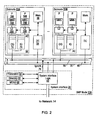
- Fig. 2 depicts details of one implementation of an SMP node 12A that generally conforms to the SMP node 12A shown in Fig. 1.
- Other nodes 12 may be configured similarly. It is noted that alternative specific implementations of each SMP node 12 of Fig. 1 are also possible.
- the implementation of SMP node 12A shown in Fig. 2 includes multiple subnodes such as subnodes 50A and 50B.
- Each subnode 50 includes two processors 16 and corresponding caches 18, a memory portion 56, an address controller 52, and a data controller 54.
- the memory portions 56 within subnodes 50 collectively form the memory 22 of the SMP node 12A of Fig. 1.
- Other subnodes (not shown) are further coupled to SMP bus 20 to form the I/O interfaces 26.
- SMP bus 20 includes an address bus 58 and a data bus 60.
- Address controller 52 is coupled to address bus 58
- data controller 54 is coupled to data bus 60.
- Fig. 2 also illustrates system interface 24, including a system interface logic block 62, a translation storage 64, a directory 66, and a memory tag (MTAG) 68.
- Logic block 62 is coupled to both address bus 58 and data bus 60, and asserts an ignore signal 70 upon address bus 58 under certain circumstances as will be explained further below. Additionally, logic block 62 is coupled to translation storage 64, directory 66, MTAG 68, and network 14.
- each subnode 50 is configured upon a printed circuit board which may be inserted into a backplane upon which SMP bus 20 is situated.
- the number of processors and/or I/O interfaces 26 included within an SMP node 12 may be varied by inserting or removing subnodes 50.
- computer system 10 may initially be configured with a small number of subnodes 50. Additional subnodes 50 may be added from time to time as the computing power required by the users of computer system 10 grows.
- Address controller 52 provides an interface between caches 18 and the address portion of SMP bus 20.
- address controller 52 includes an out queue 72 and some number of in queues 74.
- Out queue 72 buffers transactions from the processors connected thereto until address controller 52 is granted access to address bus 58.
- Address controller 52 performs the transactions stored in out queue 72 in the order those transactions were placed into out queue 72 (i.e. out queue 72 is a FIFO queue). Transactions performed by address controller 52 as well as transactions received from address bus 58 which are to be snooped by caches 18 and caches internal to processors 16 are placed into in queue 74.
- in queue 74 is a FIFO queue. All address transactions are stored in the in queue 74 of each subnode 50 (even within the in queue 74 of the subnode 50 which initiates the address transaction). Address transactions are thus presented to caches 18 and processors 16 for snooping in the order they occur upon address bus 58.
- the order that transactions occur upon address bus 58 is the order for SMP node 12A.
- the complete system is expected to have one global memory order. This ordering expectation creates a problem in both the NUMA and COMA architectures employed by computer system 10, since the global order may need to be established by the order of operations upon network 14.
- the order that the corresponding coherency operations occur at the home node for the address defines the order of the two transactions as seen within each node. For example, if two write transactions are performed to the same address, then the second write operation to arrive at the address' home node should be the second write transaction to complete (i.e. a byte location which is updated by both write transactions stores a value provided by the second write transaction upon completion of both transactions). However, the node which performs the second transaction may actually have the second transaction occur first upon SMP bus 20. Ignore signal 70 allows the second transaction to be transferred to system interface 24 without the remainder of the SMP node 12 reacting to the transaction.
- system interface logic block 62 employs ignore signal 70.
- logic block 62 asserts the ignore signal 70.
- Assertion of the ignore signal 70 with respect to a transaction causes address controller 52 to inhibit storage of the transaction into in queues 74. Therefore, other transactions which may occur subsequent to the ignored transaction and which complete locally within SMP node 12A may complete out of order with respect to the ignored transaction without violating the ordering rules of in queue 74.
- transactions performed by system interface 24 in response to coherency activity upon network 14 may be performed and completed subsequent to the ignored transaction.
- the ignored transaction may be reissued by system interface logic block 62 upon address bus 58. The transaction is thereby placed into in queue 74, and may complete in order with transactions occurring at the time of reissue.
- Transactions from a particular processor 16 may have an important ordering relationship with respect to each other, independent of the ordering requirements imposed by presentation upon address bus 58.
- a transaction may be separated from another transaction by a memory synchronizing instruction such as the MEMBAR instruction included in the SPARC architecture.
- the processor 16 conveys the transactions in the order the transactions are to be performed with respect to each other.
- the transactions are ordered within out queue 72, and therefore the transactions originating from a particular out queue 72 are to be performed in order. Ignoring subsequent transactions from a particular address controller 52 allows the in-order rules for a particular out queue 72 to be preserved.
- logic block 62 maintains the order of all transactions from a particular out queue 72. It is noted that other implementations of subnode 50 are possible that allow exceptions to this rule.
- Data controller 54 routes data to and from data bus 60, memory portion 56 and caches 18.
- Data controller 54 may include in and out queues similar to address controller 52.
- data controller 54 employs multiple physical units in a byte-sliced bus configuration.
- Processors 16 as shown in Fig. 2 include memory management units (MMUs) 76A-76B.
- MMUs 76 perform a virtual to physical address translation upon the data addresses generated by the instruction code executed upon processors 16, as well as the instruction addresses.
- the addresses generated in response to instruction execution are virtual addresses.
- the virtual addresses are the addresses created by the programmer of the instruction code.
- the virtual addresses are passed through an address translation mechanism (embodied in MMUs 76), from which corresponding physical addresses are created.
- the physical address identifies a storage location within memory 22.
- Virtual to physical address translation is performed for many reasons.
- the address translation mechanism may be used to grant or deny a particular computing task's access to certain memory addresses.
- the data and instructions within one computing task are isolated from the data and instructions of another computing task.
- portions of the data and instructions of a computing task may be "paged out" to a hard disk drive. When a portion is paged out, the translation is invalidated.
- an interrupt occurs due to the failed translation. The interrupt allows the operating system to retrieve the corresponding information from the hard disk drive. In this manner, more virtual memory may be available than actual memory in memory 22. Many other uses for virtual memory are well known.
- the physical address computed by MMUs 76 may be a local physical address (LPA) which identifies an address for which the SMP node 12 is the home node, or it may be a global address (GA).
- LPA local physical address
- GA global address
- MTAG 68 stores a coherency state for each "coherency unit" in memory 22.
- system interface logic block 62 examines the coherency state stored in MTAG 68 for the accessed coherency unit If the coherency state indicates that the SMP node 12 has sufficient access rights to the coherency unit to perform the access, then the address transaction proceeds.
- system interface logic block 62 asserts the ignore signal 70.
- Logic block 62 performs coherency operations upon network 14 to acquire the appropriate coherency state.
- logic block 62 reissues the ignored transaction upon SMP bus 20. Subsequently, the transaction completes.
- the coherency state maintained for a coherency unit at a particular storage location indicates the access rights to the coherency unit at that SMP node 12.
- the access right indicates the validity of the coherency unit, as well as the read/write permission granted for the copy of the coherency unit within that SMP node 12.
- the coherency states employed by computer system 10 are modified, owned, shared, and invalid.
- the modified state indicates that the SMP node 12 has updated the corresponding coherency unit Therefore, other SMP nodes 12 do not have a copy of the coherency unit. Additionally, when the modified coherency unit is discarded by the SMP node 12, the coherency unit is stored back to the home node.
- the owned state indicates that the SMP node 12 is responsible for the coherency unit, but other SMP nodes 12 may have shared copies. Again, when the coherency unit is discarded by the SMP node 12, the coherency unit is stored back to the home node.
- the shared state indicates that the SMP node 12 may read the coherency unit but may not update the coherency unit without acquiring the owned state. Additionally, other SMP nodes 12 may have copies of the coherency unit as well.
- the invalid state indicates that the SMP node 12 does not have a copy of the coherency unit.
- the modified state indicates write permission and any state but invalid indicates read permission to the corresponding coherency unit.
- a coherency unit is a number of contiguous bytes of memory which are treated as a unit for coherency purposes. For example, if one byte within the coherency unit is updated, the entire coherency unit is considered to be updated.
- the coherency unit is a cache line, comprising 64 contiguous bytes. It is understood, however, that a coherency unit may comprise any number of bytes.
- System interface 24 also includes a translation mechanism which utilizes translation storage 64 to store translations from a local physical address (LPA) to a global address (GA).
- LPA local physical address
- GA global address
- Certain bits within a physical address identify the home node for the address, at which coherency information is stored for that global address.
- an embodiment of computer system 10 may employ four SMP nodes 12 such as that of Fig. 1.
- two bits of the physical address identify the home node.
- bits from the most significant portion of the physical address are used to identify the home node.
- the same bits are used in the physical address to identify NUMA accesses. If the bits of the physical address indicate that the local node is not the home node, then the physical address is a global address and the transaction is performed in NUMA mode.
- a local address (on SMP bus 20) may equal a GA (for NUMA accesses as well as for global addresses whose home is within the memory 22 in the node in which the local address is presented).
- a local address may be translated to a GA when the local address identified storage locations used for storing copies of data having a home in another SMP node 12.
- the directory 66 of a particular home node identifies which SMP nodes 12 have copies of data corresponding to a given physical address assigned to the home node such that coherency between the copies may be maintained. Additionally, the directory 66 of the home node identifies the SMP node 12 which owns the coherency unit. Therefore, while local coherency between caches 18 and processors 16 is maintained via snooping, system-wide (or global) coherency is maintained using MTAG 68 and directory 66. Directory 66 stores the coherency information corresponding to the coherency units which are assigned to SMP node 12A (i.e. for which SMP node 12A is the home node).
- directory 66 and MTAG 68 store information for each coherency unit (i.e., on a coherency unit basis).
- translation storage 64 stores local physical to global address translations defined for pages.
- a page includes multiple coherency units, and is typically several kilobytes or even megabytes in size.
- Computer system 10 accordingly creates local physical address to global address translations on a page basis (thereby allocating a local memory page for storing a copy of a remotely stored global page). Therefore, blocks of memory 22 are allocated to a particular global address on a page basis as well.
- coherency states and coherency activities are performed upon a coherency unit. Therefore, when a page is allocated in memory to a particular global address, the data corresponding to the page is not necessarily transferred to the allocated memory. Instead, as processors 16 access various coherency units within the page, those coherency units are transferred from the owner of the coherency unit In this manner, the data actually accessed by SMP node 12A is transferred into the corresponding memory 22. Data not accessed by SMP node 12A may not be transferred, thereby reducing overall bandwidth usage upon network 14 in comparison to embodiments which transfer the page of data upon allocation of the page in memory 22.
- translation storage 64, directory 66, and/or MTAG 68 may be caches which store only a portion of the associated translation, directory, and MTAG information, respectively.
- the entirety of the translation, directory, and MTAG information may be stored in tables within memory 22 or a dedicated memory storage (not shown). If required information for an access is not found in the corresponding cache, the tables are accessed by system interface 24.
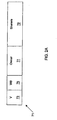
- Directory entry 71 may be employed by one embodiment of directory 66 shown in Fig. 2. Other embodiments of directory 66 may employ dissimilar directory entries.
- Directory entry 71 includes a valid bit 73, a write back bit 75, an owner field 77, and a sharers field 79.
- Directory entry 71 resides within the table of directory entries, and is located within the table via the global address identifying the corresponding coherency unit More particularly, the directory entry 71 associated with a coherency unit is stored within the table of directory entries at an offset formed from the global address which identifies the coherency unit.
- Valid bit 73 indicates, when set, that directory entry 71 is valid (i.e. that directory entry 71 is storing coherency information for a corresponding coherency unit). When clear, valid bit 73 indicates that directory entry 71 is invalid.
- Owner field 77 identifies one of SMP nodes 12 as the owner of the coherency unit
- the owning SMP node 12A-12D maintains the coherency unit in either the modified or owned states. Typically, the owning SMP node 12A-12D acquires the coherency unit in the modified state. Subsequently, the owning SMP node 12A-12D may then transition to the owned state upon providing a copy of the coherency unit to another SMP node 12A-12D. The other SMP node 12A-12D acquires the coherency unit in the shared state.
- owner field 77 comprises two bits encoded to identify one of four SMP nodes 12A-12D as the owner of the coherency unit.
- Sharers field 79 includes one bit assigned to each SMP node 12A-12D. If an SMP node 12A-12D is maintaining a shared copy of the coherency unit, the corresponding bit within sharers field 79 is set. Conversely, if the SMP node 12A-12D is not maintaining a shared copy of the coherency unit, the corresponding bit within sharers field 79 is clear. In this manner, sharers field 79 indicates all of the shared copies of the coherency unit which exist within the computer system 10 of Fig. 1.
- Write back bit 75 indicates, when set, that the SMP node 12A-12D identified as the owner of the coherency unit via owner field 77 has written the updated copy of the coherency unit to the home SMP node 12.
- bit 75 indicates that the owning SMP node 12A-12D has not written the updated copy of the coherency unit to the home SMP node 12A-12D.
- system interface 24 includes directory 66, translation storage 64, and MTAG 68.
- Translation storage 64 is shown as a global address to local physical address (GA2LPA) translation unit 80 and a local physical address to global address (LPA2GA) translation unit 82.
- G2LPA global address to local physical address
- LPA2GA local physical address to global address
- System interface 24 also includes input and output queues for storing transactions to be performed upon SMP bus 20 or network 14. Specifically, for the embodiment shown, system interface 24 includes input header queue 84 and output header queue 86 for buffering header packets to and from network 14. Header packets identify an operation to be performed, and specify the number and format of any data packets which may follow. Output header queue 86 buffers header packets to be transmitted upon network 14, and input header queue 84 buffers header packets received from network 14 until system interface 24 processes the received header packets. Similarly, data packets are buffered in input data queue 88 and output data queue 90 until the data may be transferred upon SMP data bus 60 and network 14, respectively.
- SMP out queue 92, SMP in queue 94, and SMP I/O in queue (PIQ) 96 are used to buffer address transactions to and from address bus 58.
- SMP out queue 92 buffers transactions to be presented by system interface 24 upon address bus 58. Reissue transactions queued in response to the completion of coherency activity with respect to an ignored transaction are buffered in SMP out queue 92. Additionally, transactions generated in response to coherency activity received from network 14 are buffered in SMP out queue 92.
- SMP in queue 94 stores coherency related transactions to be serviced by system interface 24.
- SMP PIQ 96 stores I/O transactions to be conveyed to an I/O interface residing in another SMP node 12. I/O transactions generally are considered non-coherent and therefore do not generate coherency activities.
- SMP in queue 94 and SMP PIQ 96 receive transactions to be queued from a transaction filter 98.
- Transaction filter 98 is coupled to MTAG 68 and SMP address bus 58. If transaction filter 98 detects an I/O transaction upon address bus 58 which identifies an I/O interface upon another SMP node 12, transaction filter 98 places the transaction into SMP PIQ 96. If a coherent transaction to an LPA address is detected by transaction filter 98, then the corresponding coherency state from MTAG 68 is examined. In accordance with the coherency state, transaction filter 98 may assert ignore signal 70 and may queue a coherency transaction in SMP in queue 94.
- Ignore signal 70 is asserted and a coherency transaction queued if MTAG 68 indicates that insufficient access rights to the coherency unit for performing the coherent transaction is maintained by SMP node 12A. Conversely, ignore signal 70 is deasserted and a coherency transaction is not generated if MTAG 68 indicates that a sufficient access right is maintained by SMP node 12A.
- LPA2GA translation unit 82 translates the address of the transaction (if it is an LPA address) from the local physical address presented upon SMP address bus 58 into the corresponding global address.
- Request agent 100 then generates a header packet specifying a particular coherency request to be transmitted to the home node identified by the global address. The coherency request is placed into output header queue 86. Subsequently, a coherency reply is received into input header queue 84.
- Request agent 100 processes the coherency replies from input header queue 84, potentially generating reissue transactions for SMP out queue 92 (as described below).
- Home agent 102 processes coherency requests received from input header queue 84. From the coherency information stored in directory 66 with respect to a particular global address, home agent 102 determines if a coherency demand is to be transmitted to one or more slave agents in other SMP nodes 12. In one embodiment, home agent 102 blocks the coherency information corresponding to the affected coherency unit. In other words, subsequent requests involving the coherency unit are not performed until the coherency activity corresponding to the coherency request is completed. According to one embodiment, home agent 102 receives a coherency completion from the request agent which initiated the coherency request (via input header queue 84).
- the coherency completion indicates that the coherency activity has completed.
- home agent 102 Upon receipt of the coherency completion, home agent 102 removes the block upon the coherency information corresponding to the affected coherency unit. It is noted that, since the coherency information is blocked until completion of the coherency activity, home agent 102 may update the coherency information in accordance with the coherency activity performed immediately when the coherency request is received.
- Slave agent 104 receives coherency demands from home agents of other SMP nodes 12 via input header queue 84. In response to a particular coherency demand, slave agent 104 may queue a coherency transaction in SMP out queue 92. In one embodiment, the coherency transaction may cause caches 18 and caches internal to processors 16 to invalidate the affected coherency unit. If the coherency unit is modified in the caches, the modified data is transferred to system interface 24. Alternatively, the coherency transaction may cause caches 18 and caches internal to processors 16 to change the coherency state of the coherency unit to shared.
- slave agent 104 transmits a coherency reply to the request agent which initiated the coherency request corresponding to the coherency demand.
- the coherency reply is queued in output header queue 86.
- the global address received with the coherency demand is translated to a local physical address via GA2LPA translation unit 80.
- the coherency protocol enforced by request agents 100, home agents 102, and slave agents 104 includes a write invalidate policy.
- a processor 16 within an SMP node 12 updates a coherency unit
- any copies of the coherency unit stored within other SMP nodes 12 are invalidated.
- other write policies may be used in other embodiments.
- a write update policy may be employed.
- a write update policy when an coherency unit is updated the updated data is transmitted to each of the copies of the coherency unit stored in each of the SMP nodes 12.
- the MMU within processor 16 converts the virtual address generated by the program to a physical address.
- the physical address includes a node ID field which indicates the home node to which the physical address is assigned. If the home node corresponds to the node which initiates the transaction (i.e. the requesting node), the address is referred to as a local physical address. Alternatively, if the node ID field identifies a node other than the requesting node, the address is referred to as a global address.
- processor 16 determines whether the data that corresponds to the physical address is stored in cache 18.
- Cache 18 may store data corresponding to local physical addresses or data corresponding to global addresses (data accessed in a NUMA manner may be stored in cache with a global address).
- processor 16 accesses the data from the cache. Alternatively, if the data is not located in cache 18, then a request for the data is output on SMP bus 20. If the physical address is a global address, system interface 24 will initiate a global transaction to acquire the desired data. Alternatively, if the physical address is a local physical address, system interface logic 62 will determine whether the node has sufficient access rights to perform the transaction by reading the entry of MTAG 68 that corresponds to address. If the node has sufficient access rights for the desired transaction, the transaction is performed on the data in memory 22. In one embodiment, the data may be transferred to cache 18 before the transaction is performed. If the node does not have sufficient access rights, the node must acquire sufficient access rights before performing the transaction. The node obtains the access rights by initiating a coherency operation to obtain those rights.
- each node includes two logical address spaces. Both logical address spaces are mapped to memory 22.
- a first address space called CMR space, stores shadow copies of data from other nodes. The remaining data is stored in a second address space, called local address space.
- a local physical address includes an address bit, called a CMR bit, that indicates whether the local physical address corresponds to an address assigned to the requesting node (i.e., the requesting node is the home node for the data) or to a shadow page within the CMR address space (i.e., a shadow copy of data from a remote node). If the CMR bit is set, which indicates the data is a shadow page, system interface 24 translates the local physical address to a global address prior to performing a coherency operation. Alternatively, if the CMR bit is clear, which indicates the requesting node is the home node for the data, the local physical address is the same as the global address and no translation is necessary prior to performing a coherency operation. Addresses with the CMR bit set are mapped to CMR space. Addresses with the CMR bit cleared are mapped to local address space.
- a CMR bit an address bit
- system interface logic 24 cannot differentiate between a local physical address that corresponds to local data and a local physical address that corresponds to a shadow copy of remote data. Accordingly, system interface 24 will translate all local physical addresses prior to performing a coherency operation. Because the translation is unnecessary for local physical addresses that correspond to local data, the translation adds unnecessary latency to the transaction and increases the bandwidth that translation storage 64 must handle.
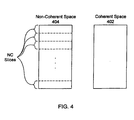
- Fig. 4 illustrates an exemplary mapping of physical addresses within one specific implementation of computer system 10.
- the MSB (most significant bit) of the physical address is typically driven to "0" for coherent space transactions and is driven to "1" for non-coherent space 404 transactions.
- coherent transactions are performed for requests to memory locations within the coherent space 402.
- the coherent space 402 may be divided into several separate regions, wherein an access to any specific region may dictate the type of operation to be performed.
- a first region of coherent space 402 may be used to specify normal memory read and write accesses to particular locations, while other regions may be dedicated for specifying that specialized operations be performed upon the particular locations (i.e., upon the same physical memory), such as flush operations and fast write stream operations, among others.
- Non-coherent space 404 is used during the SSM mode for accessing I/O devices and for configuration storage.
- the physical address comprises a total of 43 bits. It is understood, however, that any number of address bits may be employed in variations of the system.
- cluster mode may be established upon system initialization by appropriately setting the configuration of the system interface 24 of each node.
- a multiprocessing computer system may be configured to operate only in cluster mode (i.e., a system which does not support alternative modes such as SSM).
- each of (or multiples of) the SMP nodes 12 may be operated as separate cluster nodes, wherein accesses to the memory of a particular node 12 by other cluster nodes may be restricted and protected against, as determined by operating system control over the configuration of each of the system interfaces.
- Each cluster node in such a system typically runs its own kernel.
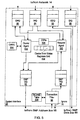
- Fig. 5 is a block diagram which depicts features of a system interface 24 which are operational during the cluster mode.
- a cluster agent 502 is coupled between SMP0Q 92, which provides an interface to SMP bus 20, and input and output header queues 84 and 86, which provide an interface to network 14.
- a cluster memory management unit (CMMU 504) is shown coupled to cluster agent 502.
- CMMU 504 is shown coupled to cluster agent 502.
- NC2NID table 506 is shown coupled to transaction filter 98, and a cluster error status registers unit 508 is shown coupled to request agent 100.
- NC2NID table 506 is shown coupled to transaction filter 98
- a cluster error status registers unit 508 is shown coupled to request agent 100.
- a remote cluster node may be accessed by launching either a read or a write type transaction to a dedicated address in the initiating node.
- cluster node 12A may access a location in cluster node 12B by launching either a read or a write type request transaction through network 14.
- the launching mechanism of node 12A will identify node 12B as the receiver of the read or write transaction.
- only read and write transaction requests which may be conveyed in the form of packets, are transferred on the global network 14 between the system interfaces 24 of differing cluster nodes. It is contemplated, however, that in other systems, other specific types of transaction requests conveyed between cluster nodes may be supported.
- cluster mode only the non-coherent address space 404 is utilized for addressing memory locations.
- the entire non-coherent space is divided into 256 "cluster slices" (CS), each one being 16GB large.
- a particular slice may thus be identified using 8 bits of the address conveyed upon SMP bus 20 during the address phase of a particular transaction.
- the NC2NID table 506 of each system interface 24 is initialized to associate these slices with remote nodes or to be "not valid", in which case the system interface 24 ignores the transaction on its SMP bus 20.
- the NC2NID table 506 of the system interface 24 of that node is accessed to determine if the transaction is directed to a remote cluster node as determined by the slice mappings. If a transaction is directed to a remote cluster node, the node ID for that remote cluster node is retrieved from the NC2NID table 506. The node ID along with the request initiated upon SMP bus 20 is then provided to request agent 100 through queue 96. Request agent 100 responsively causes a packet indicating the requested transaction to be routed through network 14 for communication to the remote node.
- NC2NID table 506 is utilized by routing logic (not shown) associated with system interface 24 which causes the transaction to be communicated over the appropriate channel of network 14 which provides connection to the identified remote node.
- the NC2NID table 506 may further be used to control the routing of data packets received from SMP bus 20 to a particular remote node.
- reaction and "packet” are used to generally refer to information conveyed through a bus.
- the specific form of a “transaction” or a “packet” is dependent upon the specific bus protocol.
- specific information contained within a transaction or packet conveyed through a bus may be dependent, for example, upon whether a particular transaction is being used to indicate the iniation of a particular operation, such as a read or write operation to a particular address, or to supply information such as data or an acknowledgement in response to a previous transaction.
- CMMU 504 of each node Upon arrival of a transaction which indicates a requested operation at the remote node, the transaction undergoes a protection/translation step within the CMMU 504 of the remote node.
- the CMMU 504 of each node is initialized by the kernel for that node before an access is allowed to a specific slice of the cluster address space.
- CMMU 504 includes a per-page translation entry with information regarding which other cluster nodes may access this page, which types of accesses (read and/or write) are allowed, the local physical page address for the node, and what command type should be launched in the node in response to the cluster communication (received through network 14).
- command types may be specified, including memory operations (i.e. read/write), atomic test and set operations, I/O operations, and interrupt operations, among others. Further details regarding these command types and other aspects of the operation of CMMU 504 will be discussed further below.
- a remote cluster node may be reached by going through one or more intermediate nodes (or “switches”) configured in pass-through mode.
- the number of such intermediate hops is transparent in the transferring of read and write data.
- various mechanisms are provided, as discussed further below.
- Fig. 6 illustrates functionality performed by CMMU 504, as well as functionality associated with a set of cluster status registers (CSRs) 602A-602C which are coupled to cluster agent 502.
- Fig. 7 illustrates particular cluster protection checks which may be performed by cluster agent 502 in response to the cluster node receiving a transaction from network 14 through input header queue 84.
- an incoming transaction which indicates a requested operation includes a cluster address of 43 bits.
- the cluster address includes a field which specifies the NC slice corresponding to this transaction, a page address (LPA page) specifying the page corresponding to the access, and a field for specifying the page offset.
- the incoming transaction packet further includes a "from node" field which indicates the node that initiated the request
- CSR 602A (also referred to as the cluster member CSR) is programmed to specify the cluster members from which transactions may be received and processed (that is, CSR 602A may be programmed to indicate the other nodes with which it is "friendly").
- CSR 602B (also referred to as the pass through enable CSR) is programmed to indicate whether this node is acting as a hop for a particular slice.
- CSR 602C (also referred to as the local NC slice CSR) is programmed to identify the slices which are local to a particular node. Typically, a particular cluster node would not have both the pass through enable bit for a particular slice set at the same time the local NC slice bit for that slice is set.
- the first protection check tests to determine if this is a pass through transaction to an NC slice which has pass-through enabled (by checking the corresponding bit of pass-through enable CSR 602B) during steps 702 and 704.
- the checking mechanism may further insure that this transaction has not previously done a pass through hop in another cluster node by checking the highest order bit of the cluster address, as will be discussed in further detail below. If the packet is a pass-through packet, the MSB of the address is cleared to a "0", and a corresponding packet is conveyed upon SMP bus 20 (steps 706 and 708).
- the protection mechanism of cluster agent 502 checks if the incoming transaction is for an NC slice local to this cluster node (by checking a corresponding bit of the NC slice CSR 602C) during step 710.
- Cluster agent 502 additionally indexes into the corresponding page entry of CMMU 504 (step 712) using selected bits of the cluster address (e.g., the page address).
- Each entry of CMMU 504 includes an "access right” field which indicates whether cluster read requests, cluster write requests, or both, received from network 14 are allowed access rights for that page, a LADDR field which specifies the local physical address for the page to be accessed within the node, an "access node” field which specifies what initiating cluster nodes are explicitly allowed access to this node, and a "type” field which may be used to specify the specific operation to be invoked on SMP bus 20.
- cluster agent 502 determines if the access right is sufficient (e.g.
- the transaction issued on SMP bus 20 uses the local physical page address obtained from a field of the CMMU 504 for the page address of the corresponding transaction to be initiated on SMP bus 20.
- a third protection check implemented (also step 714) by cluster agent 502 tests to determine if the incoming transaction is for an NC slice covered by this node (as specified by corresponding bit of NC slice CSR 602Cduring step 710), whether the access right to the slice is sufficient, whether the initiating cluster node is a cluster member (as specified by corresponding bit of cluster members CSR 602A), and whether the CMMU entry for that page specifies accesses for "all" cluster member nodes.
- a transaction which meets this test also gets its local physical page address from the CMMU local physical address entry.
- a transaction is issued on the receiving node's SMP bus 20 (step 708 or 720).
- a corresponding transaction is issued on SMP bus 20 of the pass through node using the original GA address received in the cluster transaction (and without accessing the pass through node's CMMU).
- the MSB of the address is driven to a "0" to indicate that this is a pass-through transaction.
- the kernel for that node may program the entries of CMMU 504 as well as the node's control status registers 602A-602C.
- the cluster node can thus effectively protect against unauthorized accesses by remote nodes. Flexible and efficient operation is further accomodated due to the several protection checks implemented by cluster agent 502 and controlled by CMMU 504 and CSRs 602A-602C.
- each CMMU entry includes a type field which controls the specific type of operation performed on SMP node 20, even further flexibility and control over cluster communications may be dictated by each receiving cluster node.
- a remote cluster node may be reached by passing a transaction through one or many intermediate nodes configured in pass-through mode.
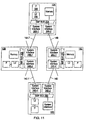
- Fig. 8 is a diagram which illustrates a configuration for network 14 in which node 12B is used as a hop for communications between both nodes 12A and 12C as well as between nodes 12A and 12D.
- pass through operations in a particular cluster node may be handled through only a single system interface, such as system interface 24B-1, or handled by differing system interfaces within a common cluster node, such as system interfaces 24B-1 and 24B-2. Details regarding pass through operations for each of these cases will next be discussed.
- a read or a write transaction is launched by system interface 24 of node 12A which is directed to a slice mapped to node 12D.
- a transaction may be initiated by a processor 16 of node 12A.
- the system interface 24 of node 12A uses its NC2NID table to determine that the transaction is destined for node 12D.
- System interface 24 accordingly conveys a request packet upon network 14 to communicate the request.
- the routing logic associated with system interface 24 will route the request through the channel connected to node 12B. Included with the request packet conveyed through network 14 is the node ID for node 12A (the initiator node ID).
- cluster agent 502 When system interface 24B-1 of node 12B receives the request packet, its cluster agent 502 initiates the protection checks as described above. In this instance, node 12B will be set up as a pass through hop for this slice, and thus no CMMU access is performed within node 12B. Instead, cluster agent 502 causes the most significant bit of the cluster address to be cleared, and initiates a corresponding transaction upon SMP bus 20 of node 12B. Since the node ID for the initiating node (node 12A) is needed by the receiving node (12D) (for its protection mechanisms), a field of the packet conveyed on SMP bus 20 which is normally unused during IO transactions is used to convey the initiating node ID along with the transaction request.
- system interface 24B-2 When the pass through communication is conveyed upon SMP bus 20B of node 12B, system interface 24B-2 would respond to the transaction in accordance with its NC2NID table 506 (that is, the slice address for this transaction will correspond to a valid entry within its NC2NID table and which associates the NC slice with node 12D). In addition, system interface 24B-2 identifies this transaction as being of a pass through type, since the MSB of the conveyed address is "0". In response to detecting this pass through operation, the request agent 100 of system interface 24B-2 will convey a corresponding request packet to node 12D, but will specify node 12A as the initiating node within the packet. The system interface 24D of node 12D receives the request packet from node 12B.
- the cluster agent 502 will identify the slice as being local to this node, and will perform the protection checks as described previously by accessing its CMMU 504 entry. Assuming the transaction passes the protection checks, the transaction will be conveyed upon the SMP bus 20D of node 12D in accordance with the request packet and the command type specified by the CMMU entry.
- Cluster communications from node 12A to 12C in the system of Fig. 8 are handled similarly.
- system interface 24B-1 of the pass through node 12B conveys a transaction upon SMP bus 20B indicating the request initiated by node 12A
- the NC2NID table 506 of system interface 24B-1 will identify that slice as being designated for routing through its interface. Accordingly, system interface 24B-1 responds to the transaction initiated upon SMP bus 20B by passing a corresponding packet indicating the request to node 12C through the corresponding channel of network 14.
- SMP bus 20 of each node may support various specific protocols, in one particular implementation SMP bus 20 is a split transaction bus.
- SMP bus 20 is a split transaction bus.
- a transaction is conveyed upon the SMP bus 20 by the initiator which specifies a buffer it has reserved internally for the read data.
- the target device obtains the requested data, the target device conveys the data packet to the specified buffer.
- These transactions may be accomplished through separate address and data phases which include transaction IDs to associate the information (e.g., in the form of packets) received during the different phases.
- an initiating device may first convey a packet upon SMP bus 20 indicating the address to which it would like to write data.
- the target device responsively sends a packet in another phase identifying a buffer within the target into which the data should be written. Subsequently, the initiating device writes the data to the specified buffer.
- the 8 bit cluster node ID information during pass-through operations is conveyed using 6 unused bits of the transaction's byte mask and the two least significant bits of the transaction's address, which are normally unused in this type of I/O transaction since the transaction is required to be 64 byte aligned and comprises 64 bytes.
- I/O read requests propagated through the switch are normally replied to with a data packet and an associated coding of a tag field to indicate a normal read Occurrences of various errors upon a read transaction may be conveyed through SMP bus 20 by providing different codings in this tag field to identify the error.
- Write requests initiated on SMP bus 20 in pass through mode are normally replied to with a pull request identifying a location in the outgoing data buffer of system interface 24.
- a write error may be propagated through the pass-through node by sending a pull request which specifies an invalid distinction, such as to the device itself. In such a situation, an error code may be encoded using selected bits of the address specified by the pull request. Further details regarding the handling of errors in the cluster will be provided below.
- FIG. 9 illustrates an exemplary system in which node 12B includes a plurality of system interfaces 24B-1 through 24B-I.
- Each system interface 24 which may be implemented as an integrated circuit chip, includes a finite number of ports to support point-to-point connections to other nodes. Accordingly, by including several system interfaces within a common node, greater connectivity to additional nodes may be achieved.
- the NC2NID tables in each system interface are configured to control the routing of transactions through the various nodes.
- a specific cluster slice may also have a valid NC2NID entry in more than one interface.
- the different interfaces may be initialized to handle only a subset of the accesses to that slice. For example, one interface may handle even addresses while another interface handles addresses. In that way, having more than one interface may increase the bandwidth provided to one specific node.
- Fig. 10 illustrates an exemplary system configuration wherein a node 12A includes a pair of system interfaces 24A-1 and 24A-2, each coupled to provide selected cluster communications to corresponding system interfaces 24B-1 and 24B-2 of node 12B.
- a specific cluster slice may have a valid NC2NID entry in both system interface 24A-1 and system interface 24A-2.
- system interfaces 24A-1 and 24A-2 may be initialized (e.g., using dedicated configuration registers) to handle only a subset of the accesses to that slice.
- system interface 24A-1 may be configured to handle even addresses for the slice, while system interface 24A-2 is configured to handle odd addresses.
- This "data striping" thus provides increased bandwidth to node 12B for accesses to that slice, since the burden associated with such transfers is spread between the system interfaces.
- NC2NID table The validity of certain slices in a particular interface's NC2NID table may change during system execution. This property can be used to cope with network failures or as an alternative method of balancing load over multiple interfaces.
- Fig. 11 illustrates an exemplary system configuration wherein node 12A includes a pair of system interfaces 24A-1 and 24A-2. These interfaces are used in conjunction with a pair of nodes, 12B and 12C, which are operating in a pass through mode and providing switching services between node 12A and a set of other nodes.
- One particular node in that set is node 12D, which includes a pair of system interfaces 24D-1 and 24D-2.
- node 12A and 12D might be initialized such that:
- Changes to the validity of certain slices in the NC2NID tables of multiple interfaces can also allow load balancing between switch nodes.
- the reprogramming is motivated by the fact that SMP bus 20B is substantially more loaded than SMP bus 20C.
- the reprogramming is not coping with a network failure, but is aiding in balancing the load between the two SMP buses.
- the system interface 24A-1 may be reprogrammed so that all NC2NID entries were invalid; in other words, node 12B would no long be used for switching purposes.
- NC2NID values in system interface 24A-1 would be reprogrammed to be invalid; that is, the switching of traffic for some, but not all, remote nodes from node 12B to node 12C would be moved.
- the cluster error status registers unit 508 of system interface 24 includes a cluster error status register corresponding to each processor within the node.
- Each cluster error status register may be separately written or read to thereby set or read a specific error code.
- each CESR contains 4 bits. If a cluster transaction initiated from the node through network 14 results in an error being communicated back from the remote node, the CESR corresponding to the CPU which initiated the transaction is set to indicate the error.
- the 4-bit encodings for errors which may be reported and stored by each CESR are as follows:
- an error may be reported to a requesting node if the CMMU in the remote node determines that the initiating node does not have sufficient access rights to the page.
- error types such as a time out in the remote node while accessing its local memory, user-level defined error in the remote node, and interrupt destination busy.
- the system interface 24 of the initiating node may also report an error by itself, such as a time out while waiting for a reply from the remote node. Any error detected will be recorded in the CESR corresponding to the CPU that initiated the transaction. Errors are communicated upon network 14 by the system interfaces 24 using error-type transaction packets.
- the request agent 100 of the system interface 24 to which an error is reported ensures that the initiating CPU will see no direct effect by the error. This is achieved by returning "dummy" read data for a read, and by pulling write data for a write but discarding it. In this manner, an incorrect error reported by a remote node cannot crash the local node.
- this error code may be passed through the SMP bus 20 of the pass through node during a read operation by specifying the error within a certain field or set of bits that are normally unused on the SMP bus 20 during I/O transactions.
- a pull request may be initiated to an invalid location, in which the receiving system interface will detect as indicating an error.
- the error code may be passed through any normally unused bits of the transaction.
- the error messages may be passed through the pass-through node depending upon the particular protocols supported by SMP bus 20.
- request agent 100 can determine which CPU issued the transaction. To record an error associated with that transaction, request agent 100 selects the particular CESR associated with that CPU by using the initiator id to index into the cluster error status registers unit 508.
- a processor can periodically read the cluster error status registers unit 508 to determine if any error has been recorded since the last time it read the cluster error status registers unit 508. This may be accomplished by performing a read operation to a particular address in the configuration space of the system to which the cluster error status registers unit 508 is mapped. The initiator id corresponding to that read operation is further used by request agent 100 to determine the specific CESR which should be read. In this manner, a process need not know which CPU it is running on in order to determine which CESR to access.
- the operating system When the operating system performs a process switch, it may issue a MEMBAR operation, which determines that all outstanding transaction have completed. This also guarantees all errors for those transaction have also been recorded in the CPU's CESR.
- the process switch code will save the current value of the CPU's CESR and store it together with the other state associated with the process.
- the process' saved CESR value is restored on that CPU's CESR.
- the CESR is virtualized to a per-process or a per-task CESR. This allows for it to be used in user-level code.
- accessing an address on page "0" of an NC2NID slice is interpreted as accessing the CESR configuration space in the interface handling this subset of this cluster slice.
- entries in the NC2NID table 506 may also be typed and used for accesses other than cluster accesses, such as accesses to SRAM slices and remote I/O slices.
- the number of pass through hops transactions can pass through may be limited. For example, in one embodiment, upon passing a transaction through a first node, the MSB of the cluster address remains "0", such that a subsequent node must either accept the transaction as a local slice, in accordance with its protection mechanism, or report an error. In this manner, transactions are limited to being passed through only a single node, and transactions are prevented from endlessly looping through pass through nodes in the event the system configuration is set in properly. This feature may be enabled or disabled through self-direct control of a configuration register such as a CSR, within each system interface.
- a configuration register such as a CSR
- a multiprocessing computer system employing the cluster protection mechanisms described herein may advantageously allow a given node to control how its resources are used by remote cluster nodes. Additionally, relatively simple cluster communication protocols may be implemented at the global level, while allowing the type of access performed locally to be specified by the local node. Additionally, the protection mechanisms described herein may further allow cluster implementations wherein access restrictions may be specified flexibily without requiring large amounts of memory to implement the flexibility.
- SMP nodes 12 have been described in the above exemplary embodiments, generally speaking an embodiment of computer system 10 may include one or more processing nodes.
- a processing node includes at least one processor and a corresponding memory. Additionally, circuitry for communicating with other processing nodes is included. When more than one processing node is included in an embodiment of computer system 10, the corresponding memories within the processing nodes form a distributed shared memory.
- a processing node may be referred to as remote or local.
- a processing node is a remote processing node with respect to a particular processor if the processing node does not include the particular processor. Conversely, the processing node which includes the particular processor is that particular processor's local processing node.
Landscapes
- Engineering & Computer Science (AREA)
- Theoretical Computer Science (AREA)
- Physics & Mathematics (AREA)
- General Physics & Mathematics (AREA)
- General Engineering & Computer Science (AREA)
- Quality & Reliability (AREA)
- Mathematical Physics (AREA)
- Memory System Of A Hierarchy Structure (AREA)
- Multi Processors (AREA)
- Storage Device Security (AREA)
- Indexing, Searching, Synchronizing, And The Amount Of Synchronization Travel Of Record Carriers (AREA)
- Signal Processing For Digital Recording And Reproducing (AREA)
- Heat-Pump Type And Storage Water Heaters (AREA)
- Emergency Protection Circuit Devices (AREA)
Claims (18)
- Multiprozessor-Computersystem (10) mit einer Mehrzahl von Verarbeitungsknoten (12A-12D) und einem globalen Bus (14), der die Mehrzahl von Verarbeitungsknoten miteinander verbindet, wobei der erste Knoten aufweist:dadurch gekennzeichnet, daß es ein zweites Feld aufweist, welches anzeigt, welcher der Verarbeitungsknoten eine Zugriffsmöglichkeit auf eine Stelle innerhalb des Speichers erhält.einen Prozessor (16A),einen Speicher (22), der über einen lokalen Bus (20) mit dem Prozessor (16A) verbunden ist, undeine Systemschnittstelle (24), die zwischen den globalen Bus und den lokalen Bus geschaltet ist, wobei die Systemschnittstelle eine Speicherverwaltungseinheit umfaßt, die eine Mehrzahl von Einträgen enthält, wobei eine globale Transaktion, die von der Systemschnittstelle von einem ferngelegenen Knoten aus empfangen wird, ein Adreßsignal umfaßt, welches verwendet wird, um einen bestimmten Eintrag aus der Mehrzahl von Einträgen auszuwählen, und wobei der bestimmte Eintrag ein erstes Feld umfaßt, welches einen Wert enthält, der den Typ der durch die Systemschnittstelle in Reaktion auf die globale Bustransaktion auf dem lokalen Bus ausgeführte Operation steuert, und
- Multiprozessor-Computersystem nach Anspruch 1, wobei der besondere Eintrag weiterhin ein drittes Feld umfaßt, welches anzeigt, ob der globale Transaktionstyp Zugriff auf die Stelle bzw. Position in dem Speicher erhält.
- Multiprozessor-Computersystem nach Anspruch 2, wobei der besondere Eintrag weiterhin ein viertes Feld umfaßt, welches eine lokale physikalische Adresse angibt, die in Reaktion auf die globale Transaktion auf den globalen Bus übermittelt wird.
- Multiprozessor-Computersystem nach Anspruch 3, wobei die lokale physikalische Adresse eine lokale physikalische Seitenadresse ist.
- Multiprozessor-Computersystem nach Anspruch 1, wobei die Systemschnittstelle weiterhin einen Clusteragenten umfaßt, der mit der Speicherverwaltungseinheit verbunden ist, wobei der Clusteragent so ausgestaltet ist, daß er die globalen Transaktionen empfängt und in Reaktion darauf auf den speziellen Eintrag zugreift.
- Multiprozessor-Computersystem nach Anspruch 5, wobei die Systemschnittstelle weiterhin ein erstes Steuerregister umfaßt, welches mit dem Clusteragenten verbunden ist, um einen Wert zu speichern, der anzeigt, ob der erste Knoten Transaktionen von dem entfernt gelegenen Knoten empfängt.
- Multiprozessor-Computersystem nach Anspruch 6, wobei das erste Steuerregister eine Mehrzahl von Anzeigen speichert, die jeweils anzeigen, ob ein bestimmter Knoten in dem Multiprozessor-Computersystem Zugriff auf den ersten Knoten erhalten darf.
- Multiprozessor-Computersystem nach Anspruch 7, wobei auf den besonderen Eintrag gemäß einer Seitenadresse zugegriffen wird, die von dem ferngelegenen Knoten aus der globalen Transaktion zugeordnet wird.
- Multiprozessor-Computersystem nach Anspruch 6, wobei die Systemschnittstelle weiterhin ein zweites Steuerregister aufweist, wobei das zweite Steuerregister eine Mehrzahl von Werten umfaßt, die jeweils pro Adresse anzeigen, ob die globale Transaktion eine Durchlauftransaktion ist.
- Multiprozessor-Computersystem nach Anspruch 9, wobei die Systemschnittstelle weiterhin ein drittes Steuerregister aufweist, welches eine Mehrzahl von Werten umfaßt, die jeweils pro Adresse anzeigen, ob die globale Transaktion an einen lokalen Speicherbereich gerichtet ist.
- Multiprozessor-Computersystem nach Anspruch 10, wobei der Clusteragent so ausgestaltet ist, daß er auf die ersten, zweiten und dritten Steuerregister und den besonderen Eintrag der Speicherverwaltungseinheit zugreift, um zu bestimmen, ob eine Transaktion entsprechend der globalen Transaktion auf dem lokalen Bus ausgelöst wird.
- Multiprozessor-Computersystem nach Anspruch 1, wobei der lokale Bus ein SMP-Bus ist.
- Multiprozessor-Computersystem nach Anspruch 1, wobei die Systemschnittstelle so ausgestaltbar ist, daß sie entweder in einem Clusterbetriebszustand oder einem SSM-Betriebszustand arbeitet.
- Multiprozessor-Computersystem nach Anspruch 1, wobei die Mehrzahl von Einträgen in der Speicherverwaltungseinheit in Abhängigkeit von dem Adreßsignal jeweils pro Seite bzw. seitenweise vorgesehen ist.
- Multiprozessor-Computersystem nach Anspruch 1, wobei die Art der auf dem lokalen Bus ausgeführten Operation, wie sie durch den Wert in dem ersten Feld des speziellen Eintrags beschrieben ist, so auswählbar ist, daß sie ein normaler Lese- oder Schreibvorgang oder ein unteilbar-Test- und Einstellvorgang ist.
- Multiprozessor-Computersystem nach Anspruch 1, wobei die Art der auf dem lokalen Bus ausgeführten Operation, wie sie durch den Wert in dem ersten Feld des speziellen Eintrags spezifiziert ist, so auswählbar ist, daß sie entweder ein normaler Lese- oder Schreibvorgang oder ein unteilbar-Test- und Einstellvorgang oder ein Interrupt-Vorgang ist.
- Multiprozessor-Computersystem nach Anspruch 1, wobei die Art der auf dem lokalen Bus durchgeführten Operation, wie sie durch den Wert in dem ersten Feld des speziellen Eintrags angegeben ist, so auswählbar ist, daß sie entweder ein normaler Lese- oder Schreibvorgang oder ein I/O-Vorgang ist.
- Verfahren zum Betreiben eines Multiprozessor-Computersystems (10), welches eine Mehrzahl von Verarbeitungsknoten (12A ... 12D) in einem globalen Bus (14) aufweist, der die Mehrzahl von Verarbeitungsknoten miteinander verbindet, wobei das Verfahren die Schritte aufweist:dadurch gekennzeichnet, daßEin Prozessor (16) eines ersten Knotens (12A) liest eine lokale Transaktion auf einem lokalen Bus (20) aus,eine erste Systemschnittstelle (24) des ersten Knotens transportiert eine globale Transaktion auf dem globalen Bus (14), die der lokalen Transaktion entspricht,eine zweite Netzwerkschnittstelle eines zweiten Knotens (12B) empfängt die globale Transaktion, eine Speicherverwaltungseinheit (504), welche eine Mehrzahl von Einträgen (71) der zweiten Systemschnittstelle enthält, greift auf einen speziellen Eintrag zu, der eine Adresse der globalen Transaktion zugeordnet ist, unddie zweite Systemschnittstelle steuert die Art der Operation, die auf einem zweiten lokalen Bus in Reaktion auf die erste globale Transaktion durchgeführt wird, und zwar in Abhängigkeit von einem Wert, der in einem Feld des speziellen Eintrags enthalten ist, und
die zweite Systemschnittstelle ein Feld des besonderen Eintrags überprüft, um zu bestimmen, welcher der Verarbeitungsknoten auf eine Speicherstelle in dem zweiten Knoten zugreifen darf.
Applications Claiming Priority (3)
| Application Number | Priority Date | Filing Date | Title |
|---|---|---|---|
| US924385 | 1986-10-29 | ||
| US92438597A | 1997-09-05 | 1997-09-05 | |
| PCT/US1998/018466 WO1999012102A1 (en) | 1997-09-05 | 1998-09-04 | A multiprocessing system including cluster optimization mechanisms |
Publications (2)
| Publication Number | Publication Date |
|---|---|
| EP1010090A1 EP1010090A1 (de) | 2000-06-21 |
| EP1010090B1 true EP1010090B1 (de) | 2003-08-13 |
Family
ID=25450157
Family Applications (2)
| Application Number | Title | Priority Date | Filing Date |
|---|---|---|---|
| EP98946854A Expired - Lifetime EP1010090B1 (de) | 1997-09-05 | 1998-09-04 | Mehrprozessorrechnersystem mit verwendung eines gruppenschutzmechanismus |
| EP98944751A Expired - Lifetime EP1019840B1 (de) | 1997-09-05 | 1998-09-04 | Nachschlagtabelle und verfahren zur datenspeicherung darin |
Family Applications After (1)
| Application Number | Title | Priority Date | Filing Date |
|---|---|---|---|
| EP98944751A Expired - Lifetime EP1019840B1 (de) | 1997-09-05 | 1998-09-04 | Nachschlagtabelle und verfahren zur datenspeicherung darin |
Country Status (6)
| Country | Link |
|---|---|
| US (11) | US6308246B1 (de) |
| EP (2) | EP1010090B1 (de) |
| JP (2) | JP2001515244A (de) |
| AT (2) | ATE247299T1 (de) |
| DE (2) | DE69817192D1 (de) |
| WO (2) | WO1999012103A2 (de) |
Families Citing this family (233)
| Publication number | Priority date | Publication date | Assignee | Title |
|---|---|---|---|---|
| DE69817192D1 (de) * | 1997-09-05 | 2003-09-18 | Sun Microsystems Inc | Mehrprozessorrechnersystem mit verwendung eines gruppenschutzmechanismus |
| CA2313073C (en) * | 1997-12-19 | 2008-08-26 | Unilever Plc | Olive oil containing food composition |
| US6826651B2 (en) * | 1998-05-29 | 2004-11-30 | International Business Machines Corporation | State-based allocation and replacement for improved hit ratio in directory caches |
| US6308284B1 (en) * | 1998-08-28 | 2001-10-23 | Emc Corporation | Method and apparatus for maintaining data coherency |
| US6414955B1 (en) * | 1999-03-23 | 2002-07-02 | Innovative Technology Licensing, Llc | Distributed topology learning method and apparatus for wireless networks |
| US6370595B1 (en) * | 1999-03-29 | 2002-04-09 | U.S. Philips Corporation | Method of addressing a plurality of addressable units by a single address word |
| US6618698B1 (en) * | 1999-08-12 | 2003-09-09 | Quickturn Design Systems, Inc. | Clustered processors in an emulation engine |
| US6457146B1 (en) * | 1999-09-30 | 2002-09-24 | Silicon Graphics, Inc. | Method and apparatus for processing errors in a computer system |
| US7529799B2 (en) * | 1999-11-08 | 2009-05-05 | International Business Machines Corporation | Method and apparatus for transaction tag assignment and maintenance in a distributed symmetric multiprocessor system |
| SE9904553D0 (sv) * | 1999-12-13 | 1999-12-13 | Ericsson Telefon Ab L M | A telecommunication device |
| US6529968B1 (en) * | 1999-12-21 | 2003-03-04 | Intel Corporation | DMA controller and coherency-tracking unit for efficient data transfers between coherent and non-coherent memory spaces |
| US6694380B1 (en) * | 1999-12-27 | 2004-02-17 | Intel Corporation | Mapping requests from a processing unit that uses memory-mapped input-output space |
| US6769046B2 (en) * | 2000-02-14 | 2004-07-27 | Palmchip Corporation | System-resource router |
| US6622163B1 (en) * | 2000-03-09 | 2003-09-16 | Dell Products L.P. | System and method for managing storage resources in a clustered computing environment |
| US7168138B2 (en) * | 2000-03-27 | 2007-01-30 | Newfrey Llc | Resilient clip fastener |
| US6667960B1 (en) * | 2000-04-29 | 2003-12-23 | Hewlett-Packard Development Company, L.P. | Protocol for identifying components in a point-to-point computer system |
| US6785713B1 (en) | 2000-05-08 | 2004-08-31 | Citrix Systems, Inc. | Method and apparatus for communicating among a network of servers utilizing a transport mechanism |
| US6789112B1 (en) | 2000-05-08 | 2004-09-07 | Citrix Systems, Inc. | Method and apparatus for administering a server having a subsystem in communication with an event channel |
| US6922724B1 (en) | 2000-05-08 | 2005-07-26 | Citrix Systems, Inc. | Method and apparatus for managing server load |
| US6785726B1 (en) * | 2000-05-08 | 2004-08-31 | Citrix Systems, Inc. | Method and apparatus for delivering local and remote server events in a similar fashion |
| US7499872B1 (en) | 2000-06-02 | 2009-03-03 | Tuition Fund, Llc | Methods and systems for applying rebates to higher education |
| WO2002000318A1 (de) * | 2000-06-26 | 2002-01-03 | Wns-Europe.Com Ag | Verwendung der von einem ortungssystem für rennfahrzeuge gespeicherten daten zur unterstützung computergestützter simulationsspiele |
| US6598130B2 (en) * | 2000-07-31 | 2003-07-22 | Hewlett-Packard Development Company, L.P. | Technique for referencing distributed shared memory locally rather than remotely |
| US20020124083A1 (en) * | 2000-09-06 | 2002-09-05 | Sun Microsystems, Inc. | Method and apparatus for increasing the efficiency of transactions and connection sharing in an enterprise environment |
| US6567817B1 (en) * | 2000-09-08 | 2003-05-20 | Hewlett-Packard Development Company, L.P. | Cache management system using hashing |
| JP3377994B2 (ja) * | 2000-11-14 | 2003-02-17 | 三菱電機株式会社 | データ配信管理装置およびデータ配信管理方法 |
| US7016998B2 (en) * | 2000-11-27 | 2006-03-21 | Silicon Graphics, Inc. | System and method for generating sequences and global interrupts in a cluster of nodes |
| US7072981B1 (en) | 2000-12-21 | 2006-07-04 | Cisco Technology, Inc. | Preallocation of client network address translation addresses for client-server networks |
| US7089328B1 (en) * | 2000-12-29 | 2006-08-08 | Cisco Technology, Inc. | Method allocation scheme for maintaining server load balancers services in a high throughput environment |
| US6813522B1 (en) * | 2000-12-29 | 2004-11-02 | Emc Corporation | Method of sharing memory in a multi-processor system including a cloning of code and data |
| US7010726B2 (en) * | 2001-03-01 | 2006-03-07 | International Business Machines Corporation | Method and apparatus for saving data used in error analysis |
| US6842857B2 (en) * | 2001-04-12 | 2005-01-11 | International Business Machines Corporation | Method and apparatus to concurrently boot multiple processors in a non-uniform-memory-access machine |
| US7197536B2 (en) * | 2001-04-30 | 2007-03-27 | International Business Machines Corporation | Primitive communication mechanism for adjacent nodes in a clustered computer system |
| US20070220000A1 (en) * | 2001-05-09 | 2007-09-20 | Walsh Aaron E | Universal Cache |
| US6754782B2 (en) | 2001-06-21 | 2004-06-22 | International Business Machines Corporation | Decentralized global coherency management in a multi-node computer system |
| US6615322B2 (en) | 2001-06-21 | 2003-09-02 | International Business Machines Corporation | Two-stage request protocol for accessing remote memory data in a NUMA data processing system |
| US6760817B2 (en) | 2001-06-21 | 2004-07-06 | International Business Machines Corporation | Method and system for prefetching utilizing memory initiated prefetch write operations |
| US6760809B2 (en) | 2001-06-21 | 2004-07-06 | International Business Machines Corporation | Non-uniform memory access (NUMA) data processing system having remote memory cache incorporated within system memory |
| US6711652B2 (en) | 2001-06-21 | 2004-03-23 | International Business Machines Corporation | Non-uniform memory access (NUMA) data processing system that provides precise notification of remote deallocation of modified data |
| US6654857B2 (en) | 2001-06-21 | 2003-11-25 | International Business Machines Corporation | Non-uniform memory access (NUMA) computer system having distributed global coherency management |
| US6901485B2 (en) | 2001-06-21 | 2005-05-31 | International Business Machines Corporation | Memory directory management in a multi-node computer system |
| US6658538B2 (en) * | 2001-06-21 | 2003-12-02 | International Business Machines Corporation | Non-uniform memory access (NUMA) data processing system having a page table including node-specific data storage and coherency control |
| GB2378277B (en) * | 2001-07-31 | 2003-06-25 | Sun Microsystems Inc | Multiple address translations |
| US6766386B2 (en) * | 2001-08-28 | 2004-07-20 | Broadcom Corporation | Method and interface for improved efficiency in performing bus-to-bus read data transfers |
| US6578126B1 (en) * | 2001-09-21 | 2003-06-10 | Emc Corporation | Memory system and method of using same |
| US20030061462A1 (en) * | 2001-09-26 | 2003-03-27 | Fister James D.M. | Memory expansion and enhanced system interaction using network-distributed memory mapping |
| JP4721379B2 (ja) * | 2001-09-26 | 2011-07-13 | 株式会社日立製作所 | ストレージシステム、ディスク制御クラスタおよびディスク制御クラスタの増設方法 |
| US7330885B2 (en) * | 2001-10-25 | 2008-02-12 | Sun Microsystems, Inc. | Method and apparatus for managing data time-outs |
| US20030093626A1 (en) * | 2001-11-14 | 2003-05-15 | Fister James D.M. | Memory caching scheme in a distributed-memory network |
| US7152026B1 (en) * | 2001-12-07 | 2006-12-19 | Ncr Corp. | Versioned node configurations for parallel applications |
| US6839826B2 (en) * | 2002-02-06 | 2005-01-04 | Sandisk Corporation | Memory device with pointer structure to map logical to physical addresses |
| US20030154221A1 (en) * | 2002-02-13 | 2003-08-14 | Sun Microsystems, Inc. | System and method for accessing file system entities |
| US7085866B1 (en) * | 2002-02-19 | 2006-08-01 | Hobson Richard F | Hierarchical bus structure and memory access protocol for multiprocessor systems |
| US6959372B1 (en) * | 2002-02-19 | 2005-10-25 | Cogent Chipware Inc. | Processor cluster architecture and associated parallel processing methods |
| US7080156B2 (en) * | 2002-03-21 | 2006-07-18 | Sun Microsystems, Inc. | Message routing in a torus interconnect |
| CN1152330C (zh) * | 2002-04-09 | 2004-06-02 | 威盛电子股份有限公司 | 远程节点读取本地内存维护方法及其应用装置 |
| GB2389207B (en) * | 2002-04-09 | 2004-05-12 | Via Tech Inc | Remote node accessing local memory by using distributed shared memory |
| GB2417111B (en) * | 2002-04-22 | 2006-08-16 | Micron Technology Inc | Providing a register file memory with local addressing in a SIMD parallel processor |
| CA2384185A1 (en) * | 2002-04-29 | 2003-10-29 | Ibm Canada Limited-Ibm Canada Limitee | Resizable cache sensitive hash table |
| US7451199B2 (en) * | 2002-05-10 | 2008-11-11 | International Business Machines Corporation | Network attached storage SNMP single system image |
| US7269709B2 (en) * | 2002-05-15 | 2007-09-11 | Broadcom Corporation | Memory controller configurable to allow bandwidth/latency tradeoff |
| US7266587B2 (en) * | 2002-05-15 | 2007-09-04 | Broadcom Corporation | System having interfaces, switch, and memory bridge for CC-NUMA operation |
| US7281055B2 (en) * | 2002-05-28 | 2007-10-09 | Newisys, Inc. | Routing mechanisms in systems having multiple multi-processor clusters |
| US7103636B2 (en) * | 2002-05-28 | 2006-09-05 | Newisys, Inc. | Methods and apparatus for speculative probing of a remote cluster |
| US7251698B2 (en) * | 2002-05-28 | 2007-07-31 | Newisys, Inc. | Address space management in systems having multiple multi-processor clusters |
| US7155525B2 (en) * | 2002-05-28 | 2006-12-26 | Newisys, Inc. | Transaction management in systems having multiple multi-processor clusters |
| US7017012B2 (en) * | 2002-06-20 | 2006-03-21 | Sun Microsystems, Inc. | Distributed storage cache coherency system and method |
| US7254741B1 (en) * | 2002-09-27 | 2007-08-07 | Emc Corporation | Attaining high availability through a power system branch architecture |
| US6918023B2 (en) * | 2002-09-30 | 2005-07-12 | International Business Machines Corporation | Method, system, and computer program product for invalidating pretranslations for dynamic memory removal |
| US7051163B2 (en) * | 2002-10-03 | 2006-05-23 | Hewlett-Packard Development Company, L.P. | Directory structure permitting efficient write-backs in a shared memory computer system |
| US7171521B2 (en) * | 2002-10-16 | 2007-01-30 | Broadcom Corporation | Coherent shared memory processing system |
| US20040078732A1 (en) * | 2002-10-21 | 2004-04-22 | International Business Machines Corporation | SMP computer system having a distributed error reporting structure |
| RU2376635C2 (ru) * | 2002-10-23 | 2009-12-20 | Закрытое акционерное общество "МедиаЛингва" | Способ и система проведения транзакций в сети с использованием сетевых идентификаторов |
| US8185602B2 (en) * | 2002-11-05 | 2012-05-22 | Newisys, Inc. | Transaction processing using multiple protocol engines in systems having multiple multi-processor clusters |
| US7577755B2 (en) * | 2002-11-19 | 2009-08-18 | Newisys, Inc. | Methods and apparatus for distributing system management signals |
| US7028218B2 (en) * | 2002-12-02 | 2006-04-11 | Emc Corporation | Redundant multi-processor and logical processor configuration for a file server |
| JP4014155B2 (ja) * | 2003-01-27 | 2007-11-28 | インターナショナル・ビジネス・マシーンズ・コーポレーション | 情報処理装置及び方法、プログラム、データ構造、並びにコンピュータ読取り可能な記録媒体 |
| US7418517B2 (en) * | 2003-01-30 | 2008-08-26 | Newisys, Inc. | Methods and apparatus for distributing system management signals |
| US9110853B2 (en) * | 2003-03-10 | 2015-08-18 | Oracle America, Inc. | Computer system with multiple classes of device IDs |
| US7571252B2 (en) * | 2003-03-10 | 2009-08-04 | Sun Microsystems, Inc. | Computer system with multiple classes of transaction IDs |
| EP1611513B1 (de) * | 2003-04-04 | 2010-12-15 | Oracle America, Inc. | Mehrknoten system, bei dem die globale adresse, die durch ein verarbeitungsuntersystem erzeugt wird, globale-zu-lokale übersetzungsinformationen miteinschliesst |
| US20050010615A1 (en) * | 2003-04-11 | 2005-01-13 | Sun Microsystems, Inc. | Multi-node computer system implementing memory-correctable speculative proxy transactions |
| US20050027947A1 (en) * | 2003-04-11 | 2005-02-03 | Sun Microsystems, Inc. | Multi-node computer system including a mechanism to encode node ID of a transaction-initiating node in invalidating proxy address packets |
| US7386626B2 (en) * | 2003-06-23 | 2008-06-10 | Newisys, Inc. | Bandwidth, framing and error detection in communications between multi-processor clusters of multi-cluster computer systems |
| US7577727B2 (en) * | 2003-06-27 | 2009-08-18 | Newisys, Inc. | Dynamic multiple cluster system reconfiguration |
| GB0315504D0 (en) * | 2003-07-02 | 2003-08-06 | Advanced Risc Mach Ltd | Coherent multi-processing system |
| US7117419B2 (en) * | 2003-08-05 | 2006-10-03 | Newisys, Inc. | Reliable communication between multi-processor clusters of multi-cluster computer systems |
| US7159137B2 (en) * | 2003-08-05 | 2007-01-02 | Newisys, Inc. | Synchronized communication between multi-processor clusters of multi-cluster computer systems |
| US7103823B2 (en) | 2003-08-05 | 2006-09-05 | Newisys, Inc. | Communication between multi-processor clusters of multi-cluster computer systems |
| US7395347B2 (en) * | 2003-08-05 | 2008-07-01 | Newisys, Inc, | Communication between and within multi-processor clusters of multi-cluster computer systems |
| US7231492B2 (en) * | 2003-09-30 | 2007-06-12 | Emc Corporation | Data transfer method wherein a sequence of messages update tag structures during a read data transfer |
| US7310721B2 (en) * | 2003-10-30 | 2007-12-18 | Microsoft Corporation | Shadow page tables for address translation control |
| US7325239B2 (en) * | 2003-11-12 | 2008-01-29 | International Business Machines Corporation | Method and system of generically managing tables for network processors |
| US7324995B2 (en) * | 2003-11-17 | 2008-01-29 | Rackable Systems Inc. | Method for retrieving and modifying data elements on a shared medium |
| US20050108300A1 (en) * | 2003-11-17 | 2005-05-19 | Terrascale Technologies Inc. | Method for the management of local client cache buffers in a clustered computer environment |
| JP4023441B2 (ja) * | 2003-12-09 | 2007-12-19 | 日本電気株式会社 | コンピュータシステム及びプログラム |
| US7124253B1 (en) * | 2004-02-18 | 2006-10-17 | Sun Microsystems, Inc. | Supporting directory-based cache coherence in an object-addressed memory hierarchy |
| US7162647B2 (en) * | 2004-03-11 | 2007-01-09 | Hitachi, Ltd. | Method and apparatus for cryptographic conversion in a data storage system |
| WO2005089239A2 (en) * | 2004-03-13 | 2005-09-29 | Cluster Resources, Inc. | System and method of providing a self-optimizing reservation in space of compute resources |
| US20050216695A1 (en) * | 2004-03-26 | 2005-09-29 | Jean-Pierre Bono | Memory extension for a data processor to provide both common and separate physical memory areas for virtual memory spaces |
| US7346813B1 (en) | 2004-04-05 | 2008-03-18 | Sun Microsystems, Inc. | Distributed event reporting hierarchy |
| US7904608B2 (en) * | 2004-05-04 | 2011-03-08 | Price Robert M | System and method for updating software in electronic devices |
| US7206915B2 (en) * | 2004-06-03 | 2007-04-17 | Emc Corp | Virtual space manager for computer having a physical address extension feature |
| US20060015589A1 (en) * | 2004-07-16 | 2006-01-19 | Ang Boon S | Generating a service configuration |
| US20060015772A1 (en) * | 2004-07-16 | 2006-01-19 | Ang Boon S | Reconfigurable memory system |
| DE102004035843B4 (de) * | 2004-07-23 | 2010-04-15 | Infineon Technologies Ag | Router-Netzwerkprozessor |
| KR101061850B1 (ko) * | 2004-09-08 | 2011-09-02 | 삼성전자주식회사 | 박막 트랜지스터 표시판 및 그 제조방법 |
| US7774562B2 (en) * | 2004-09-17 | 2010-08-10 | Hewlett-Packard Development Company, L.P. | Timeout acceleration for globally shared memory transaction tracking table |
| US7383423B1 (en) * | 2004-10-01 | 2008-06-03 | Advanced Micro Devices, Inc. | Shared resources in a chip multiprocessor |
| US20060168379A1 (en) * | 2004-12-13 | 2006-07-27 | Tim Frodsham | Method, system, and apparatus for link latency management |
| US7970980B2 (en) * | 2004-12-15 | 2011-06-28 | International Business Machines Corporation | Method and apparatus for accessing memory in a computer system architecture supporting heterogeneous configurations of memory structures |
| US7360008B2 (en) * | 2004-12-30 | 2008-04-15 | Intel Corporation | Enforcing global ordering through a caching bridge in a multicore multiprocessor system |
| US20060161718A1 (en) * | 2005-01-20 | 2006-07-20 | Berke Stuart A | System and method for a non-uniform crossbar switch plane topology |
| US7281096B1 (en) * | 2005-02-09 | 2007-10-09 | Sun Microsystems, Inc. | System and method for block write to memory |
| US8254411B2 (en) * | 2005-02-10 | 2012-08-28 | International Business Machines Corporation | Data processing system, method and interconnect fabric having a flow governor |
| US7437617B2 (en) * | 2005-02-11 | 2008-10-14 | International Business Machines Corporation | Method, apparatus, and computer program product in a processor for concurrently sharing a memory controller among a tracing process and non-tracing processes using a programmable variable number of shared memory write buffers |
| US7437618B2 (en) * | 2005-02-11 | 2008-10-14 | International Business Machines Corporation | Method in a processor for dynamically during runtime allocating memory for in-memory hardware tracing |
| US20060184837A1 (en) * | 2005-02-11 | 2006-08-17 | International Business Machines Corporation | Method, apparatus, and computer program product in a processor for balancing hardware trace collection among different hardware trace facilities |
| US7418629B2 (en) * | 2005-02-11 | 2008-08-26 | International Business Machines Corporation | Synchronizing triggering of multiple hardware trace facilities using an existing system bus |
| US8214353B2 (en) * | 2005-02-18 | 2012-07-03 | International Business Machines Corporation | Support for schema evolution in a multi-node peer-to-peer replication environment |
| US9286346B2 (en) * | 2005-02-18 | 2016-03-15 | International Business Machines Corporation | Replication-only triggers |
| US7376675B2 (en) | 2005-02-18 | 2008-05-20 | International Business Machines Corporation | Simulating multi-user activity while maintaining original linear request order for asynchronous transactional events |
| US8037056B2 (en) | 2005-02-18 | 2011-10-11 | International Business Machines Corporation | Online repair of a replicated table |
| US7353360B1 (en) * | 2005-04-05 | 2008-04-01 | Sun Microsystems, Inc. | Method for maximizing page locality |
| US7813288B2 (en) * | 2005-11-21 | 2010-10-12 | Intel Corporation | Transaction detection in link based computing system |
| CN2852260Y (zh) * | 2005-12-01 | 2006-12-27 | 华为技术有限公司 | 一种服务器 |
| US20070180128A1 (en) * | 2006-01-18 | 2007-08-02 | International Business Machines Corporation | User account validity definition in clustered computer systems |
| US8510596B1 (en) * | 2006-02-09 | 2013-08-13 | Virsec Systems, Inc. | System and methods for run time detection and correction of memory corruption |
| US7426627B2 (en) * | 2006-03-10 | 2008-09-16 | Microsoft Corporation | Selective address translation for a resource such as a hardware device |
| US7774579B1 (en) * | 2006-04-14 | 2010-08-10 | Tilera Corporation | Protection in a parallel processing environment using access information associated with each switch to prevent data from being forwarded outside a plurality of tiles |
| US7577820B1 (en) | 2006-04-14 | 2009-08-18 | Tilera Corporation | Managing data in a parallel processing environment |
| US20080059469A1 (en) * | 2006-08-31 | 2008-03-06 | International Business Machines Corporation | Replication Token Based Synchronization |
| US20080120475A1 (en) * | 2006-10-05 | 2008-05-22 | Holt John M | Adding one or more computers to a multiple computer system |
| US7774551B2 (en) * | 2006-10-06 | 2010-08-10 | Hewlett-Packard Development Company, L.P. | Hierarchical cache coherence directory structure |
| US7571270B1 (en) | 2006-11-29 | 2009-08-04 | Consentry Networks, Inc. | Monitoring of shared-resource locks in a multi-processor system with locked-resource bits packed into registers to detect starved threads |
| JP5079342B2 (ja) | 2007-01-22 | 2012-11-21 | ルネサスエレクトロニクス株式会社 | マルチプロセッサ装置 |
| US7941499B2 (en) * | 2007-03-06 | 2011-05-10 | Freescale Semiconductor, Inc. | Interprocessor message transmission via coherency-based interconnect |
| WO2008150510A1 (en) * | 2007-06-01 | 2008-12-11 | General Dynamics Adanced Information Systems, Inc. | System and method for managing addresses in a computing system |
| US7930459B2 (en) * | 2007-09-28 | 2011-04-19 | Intel Corporation | Coherent input output device |
| US8200932B2 (en) * | 2007-10-19 | 2012-06-12 | Virident Systems Inc. | Managing memory systems containing components with asymmetric characteristics |
| US7921261B2 (en) * | 2007-12-18 | 2011-04-05 | International Business Machines Corporation | Reserving a global address space |
| US8484307B2 (en) * | 2008-02-01 | 2013-07-09 | International Business Machines Corporation | Host fabric interface (HFI) to perform global shared memory (GSM) operations |
| US7844746B2 (en) * | 2008-02-01 | 2010-11-30 | International Business Machines Corporation | Accessing an effective address and determining whether the effective address is associated with remotely coupled I/O adapters |
| US8893126B2 (en) * | 2008-02-01 | 2014-11-18 | International Business Machines Corporation | Binding a process to a special purpose processing element having characteristics of a processor |
| US8255913B2 (en) * | 2008-02-01 | 2012-08-28 | International Business Machines Corporation | Notification to task of completion of GSM operations by initiator node |
| US8275947B2 (en) * | 2008-02-01 | 2012-09-25 | International Business Machines Corporation | Mechanism to prevent illegal access to task address space by unauthorized tasks |
| US8146094B2 (en) * | 2008-02-01 | 2012-03-27 | International Business Machines Corporation | Guaranteeing delivery of multi-packet GSM messages |
| US8214604B2 (en) * | 2008-02-01 | 2012-07-03 | International Business Machines Corporation | Mechanisms to order global shared memory operations |
| US8239879B2 (en) * | 2008-02-01 | 2012-08-07 | International Business Machines Corporation | Notification by task of completion of GSM operations at target node |
| US8200910B2 (en) * | 2008-02-01 | 2012-06-12 | International Business Machines Corporation | Generating and issuing global shared memory operations via a send FIFO |
| US8380766B2 (en) * | 2008-02-08 | 2013-02-19 | Adaptive Intelligence Llc | Systems and methods for handling addresses within a database application |
| US8397030B2 (en) | 2008-06-24 | 2013-03-12 | International Business Machines Corporation | Efficient region coherence protocol for clustered shared-memory multiprocessor systems |
| US8145812B1 (en) | 2008-07-25 | 2012-03-27 | Gaurang Kavaiya | Line driving and receiving system |
| US8776063B2 (en) * | 2008-11-26 | 2014-07-08 | Oracle America, Inc. | Method and system for hardware feedback in transactional memory |
| US8799587B2 (en) | 2009-01-26 | 2014-08-05 | International Business Machines Corporation | Region coherence array for a mult-processor system having subregions and subregion prefetching |
| US8285942B2 (en) | 2009-01-27 | 2012-10-09 | International Business Machines Corporation | Region coherence array having hint bits for a clustered shared-memory multiprocessor system |
| US7908530B2 (en) * | 2009-03-16 | 2011-03-15 | Faraday Technology Corp. | Memory module and on-line build-in self-test method thereof for enhancing memory system reliability |
| WO2010147590A1 (en) * | 2009-06-18 | 2010-12-23 | Hewlett-Packard Development Company, L.P. | Processor topology switches |
| US8327228B2 (en) * | 2009-09-30 | 2012-12-04 | Intel Corporation | Home agent data and memory management |
| US8799586B2 (en) * | 2009-09-30 | 2014-08-05 | Intel Corporation | Memory mirroring and migration at home agent |
| US8370595B2 (en) * | 2009-12-21 | 2013-02-05 | International Business Machines Corporation | Aggregate data processing system having multiple overlapping synthetic computers |
| US8364922B2 (en) * | 2009-12-21 | 2013-01-29 | International Business Machines Corporation | Aggregate symmetric multiprocessor system |
| US8699185B1 (en) | 2012-12-10 | 2014-04-15 | Western Digital Technologies, Inc. | Disk drive defining guard bands to support zone sequentiality when butterfly writing shingled data tracks |
| US8687306B1 (en) | 2010-03-22 | 2014-04-01 | Western Digital Technologies, Inc. | Systems and methods for improving sequential data rate performance using sorted data zones |
| US8693133B1 (en) | 2010-03-22 | 2014-04-08 | Western Digital Technologies, Inc. | Systems and methods for improving sequential data rate performance using sorted data zones for butterfly format |
| US9330715B1 (en) | 2010-03-22 | 2016-05-03 | Western Digital Technologies, Inc. | Mapping of shingled magnetic recording media |
| US8856438B1 (en) * | 2011-12-09 | 2014-10-07 | Western Digital Technologies, Inc. | Disk drive with reduced-size translation table |
| US8103937B1 (en) * | 2010-03-31 | 2012-01-24 | Emc Corporation | Cas command network replication |
| US9558119B2 (en) * | 2010-06-23 | 2017-01-31 | International Business Machines Corporation | Main memory operations in a symmetric multiprocessing computer |
| KR101671494B1 (ko) * | 2010-10-08 | 2016-11-02 | 삼성전자주식회사 | 공유 가상 메모리를 이용한 멀티 프로세서 및 주소 변환 테이블 생성 방법 |
| US8949551B2 (en) | 2011-02-23 | 2015-02-03 | Freescale Semiconductor, Inc. | Memory protection unit (MPU) having a shared portion and method of operation |
| US9116845B2 (en) | 2011-02-23 | 2015-08-25 | Freescale Semiconductor, Inc. | Remote permissions provisioning for storage in a cache and device therefor |
| US8639895B2 (en) | 2011-07-14 | 2014-01-28 | Freescale Semiconductor, Inc. | Systems and methods for memory region descriptor attribute override |
| US8572345B2 (en) | 2011-09-16 | 2013-10-29 | Freescale Semiconductor, Inc. | Memory management unit (MMU) having region descriptor globalization controls and method of operation |
| KR20140077167A (ko) | 2011-10-07 | 2014-06-23 | 휴렛-팩커드 디벨롭먼트 컴퍼니, 엘.피. | 매핑 영구형 저장장치 |
| US20130097387A1 (en) * | 2011-10-14 | 2013-04-18 | The Board Of Trustees Of The Leland Stanford Junior University | Memory-based apparatus and method |
| US8966187B2 (en) * | 2011-12-01 | 2015-02-24 | International Business Machines Corporation | Flexible replication with skewed mapping in multi-core chips |
| US9213493B1 (en) | 2011-12-16 | 2015-12-15 | Western Digital Technologies, Inc. | Sorted serpentine mapping for storage drives |
| WO2013148003A1 (en) * | 2012-03-26 | 2013-10-03 | Unicorn Media, Inc. | Dynamic audio track selection for media streaming |
| US9146705B2 (en) * | 2012-04-09 | 2015-09-29 | Microsoft Technology, LLC | Split brain protection in computer clusters |
| US8848576B2 (en) * | 2012-07-26 | 2014-09-30 | Oracle International Corporation | Dynamic node configuration in directory-based symmetric multiprocessing systems |
| US9176669B2 (en) * | 2013-03-15 | 2015-11-03 | Silicon Graphics International Corp. | Address resource mapping in a shared memory computer system |
| US11126372B2 (en) | 2013-04-01 | 2021-09-21 | Hewlett Packard Enterprise Development Lp | External memory controller |
| CN105051707A (zh) | 2013-04-01 | 2015-11-11 | 惠普发展公司,有限责任合伙企业 | 外部存储器控制器 |
| JP2016534479A (ja) | 2013-09-12 | 2016-11-04 | ヴァーセック・システムズ・インコーポレーテッドVirsec Systems,Inc. | マルウェアのランタイム中の自動検出 |
| US9021296B1 (en) * | 2013-10-18 | 2015-04-28 | Hitachi Data Systems Engineering UK Limited | Independent data integrity and redundancy recovery in a storage system |
| TWI489279B (zh) * | 2013-11-27 | 2015-06-21 | Realtek Semiconductor Corp | 虛擬實體位址轉換系統以及虛擬實體位址轉換系統的管理方法 |
| US9864691B1 (en) * | 2013-12-13 | 2018-01-09 | EMC IP Holding Company LLC | Deletion indication implementation based on internal model |
| WO2015094260A1 (en) * | 2013-12-19 | 2015-06-25 | Intel Corporation | Elastic virtual multipath resource access using sequestered partitions |
| CN105793830B (zh) | 2013-12-26 | 2019-12-24 | 英特尔公司 | 一种在节点之间共享存储器和i/o服务的装置、方法、系统 |
| US9529532B2 (en) * | 2014-03-07 | 2016-12-27 | Cavium, Inc. | Method and apparatus for memory allocation in a multi-node system |
| US9372800B2 (en) | 2014-03-07 | 2016-06-21 | Cavium, Inc. | Inter-chip interconnect protocol for a multi-chip system |
| US9411644B2 (en) | 2014-03-07 | 2016-08-09 | Cavium, Inc. | Method and system for work scheduling in a multi-chip system |
| US10592459B2 (en) | 2014-03-07 | 2020-03-17 | Cavium, Llc | Method and system for ordering I/O access in a multi-node environment |
| CA2953793C (en) | 2014-06-24 | 2021-10-19 | Virsec Systems, Inc. | System and methods for automated detection of input and output validation and resource management vulnerability |
| EP3161638A1 (de) | 2014-06-24 | 2017-05-03 | Virsec Systems, Inc. | Automatisierte grundursachenanalyse einzelner oder n-gestufter anwendungen |
| RU2658886C1 (ru) * | 2014-08-12 | 2018-06-25 | Хуавэй Текнолоджиз Ко., Лтд. | Способ управления файлами, распределенная система хранения и узел управления |
| CN105701019A (zh) * | 2014-11-25 | 2016-06-22 | 阿里巴巴集团控股有限公司 | 一种内存管理方法以及装置 |
| US9575881B2 (en) | 2014-12-04 | 2017-02-21 | Qualcomm Incorporated | Systems and methods for providing improved latency in a non-uniform memory architecture |
| US9542333B2 (en) | 2014-12-04 | 2017-01-10 | Qualcomm Incorporated | Systems and methods for providing improved latency in a non-uniform memory architecture |
| EP3248106A4 (de) | 2015-01-20 | 2018-09-12 | Ultrata LLC | Verteilter index für fehlertolerante objektspeichermatrix |
| US11086521B2 (en) | 2015-01-20 | 2021-08-10 | Ultrata, Llc | Object memory data flow instruction execution |
| US9940287B2 (en) * | 2015-03-27 | 2018-04-10 | Intel Corporation | Pooled memory address translation |
| US10698628B2 (en) | 2015-06-09 | 2020-06-30 | Ultrata, Llc | Infinite memory fabric hardware implementation with memory |
| US9886210B2 (en) | 2015-06-09 | 2018-02-06 | Ultrata, Llc | Infinite memory fabric hardware implementation with router |
| US9971542B2 (en) | 2015-06-09 | 2018-05-15 | Ultrata, Llc | Infinite memory fabric streams and APIs |
| CN105302577B (zh) * | 2015-11-26 | 2019-05-07 | 上海兆芯集成电路有限公司 | 驱动执行单元的机器码产生方法以及装置 |
| US10235063B2 (en) | 2015-12-08 | 2019-03-19 | Ultrata, Llc | Memory fabric operations and coherency using fault tolerant objects |
| CN108885604B (zh) | 2015-12-08 | 2022-04-12 | 乌尔特拉塔有限责任公司 | 存储器结构软件实现方案 |
| CN115061971A (zh) | 2015-12-08 | 2022-09-16 | 乌尔特拉塔有限责任公司 | 使用容错对象的存储器结构操作和一致性 |
| US10241676B2 (en) | 2015-12-08 | 2019-03-26 | Ultrata, Llc | Memory fabric software implementation |
| US9424155B1 (en) * | 2016-01-27 | 2016-08-23 | International Business Machines Corporation | Use efficiency of platform memory resources through firmware managed I/O translation table paging |
| CN107533458A (zh) * | 2016-02-04 | 2018-01-02 | 慧与发展有限责任合伙企业 | 基于存储器寄存器中断的信令和消息传递 |
| AU2017273169B2 (en) | 2016-06-03 | 2020-07-30 | Aimed Bio Inc. | Method for screening antibody using patient-derived tumor spheroids |
| CA3027728C (en) | 2016-06-16 | 2026-05-05 | Virsec Systems, Inc. | Systems and methods for remediating memory corruption in a computer application |
| KR102514717B1 (ko) * | 2016-10-24 | 2023-03-27 | 삼성전자주식회사 | 메모리 컨트롤러 및 이를 포함하는 메모리 시스템 |
| GB2557254B (en) * | 2016-12-02 | 2020-02-12 | Advanced Risc Mach Ltd | Filtering coherency protocol transactions |
| US10956325B2 (en) * | 2016-12-12 | 2021-03-23 | Intel Corporation | Instruction and logic for flushing memory ranges in a distributed shared memory system |
| US10970177B2 (en) * | 2017-08-18 | 2021-04-06 | Brian J. Bulkowski | Methods and systems of managing consistency and availability tradeoffs in a real-time operational DBMS |
| US10621086B2 (en) * | 2017-10-30 | 2020-04-14 | International Business Machines Corporation | Dynamic resource visibility tracking to avoid atomic reference counting |
| US10769076B2 (en) | 2018-11-21 | 2020-09-08 | Nvidia Corporation | Distributed address translation in a multi-node interconnect fabric |
| US11048630B2 (en) | 2018-11-27 | 2021-06-29 | International Business Machines Corporation | Symmetrical multi-processing node |
| US11734192B2 (en) | 2018-12-10 | 2023-08-22 | International Business Machines Corporation | Identifying location of data granules in global virtual address space |
| US11016908B2 (en) * | 2018-12-11 | 2021-05-25 | International Business Machines Corporation | Distributed directory of named data elements in coordination namespace |
| JP6881485B2 (ja) | 2019-02-26 | 2021-06-02 | 日本電気株式会社 | メモリ配置装置、メモリ配置方法、及び、メモリ配置プログラム |
| US11165732B2 (en) * | 2020-03-20 | 2021-11-02 | International Business Machines Corporation | System and method to detect and define activity and patterns on a large relationship data network |
| CN114860163B (zh) * | 2020-04-28 | 2023-08-22 | 华为技术有限公司 | 一种存储系统、内存管理方法和管理节点 |
| US12112200B2 (en) | 2021-09-13 | 2024-10-08 | International Business Machines Corporation | Pipeline parallel computing using extended memory |
| KR20230114577A (ko) | 2022-01-25 | 2023-08-01 | 삼성전자주식회사 | 데이터 처리 장치 및 방법 |
| CN116662224A (zh) | 2022-02-17 | 2023-08-29 | 华为技术有限公司 | 内存访问的方法、装置、存储介质及计算机程序产品 |
| GB2618128B (en) * | 2022-04-28 | 2024-04-24 | Advanced Risc Mach Ltd | Protecting execution environments within domains |
| CN115114185A (zh) * | 2022-06-27 | 2022-09-27 | 三星(中国)半导体有限公司 | 用于numa系统的内存访问方法和装置 |
| US20240311316A1 (en) * | 2023-03-14 | 2024-09-19 | Samsung Electronics Co., Ltd. | Systems, methods, and apparatus for remote memory access by nodes |
Family Cites Families (60)
| Publication number | Priority date | Publication date | Assignee | Title |
|---|---|---|---|---|
| US4164787A (en) | 1977-11-09 | 1979-08-14 | Bell Telephone Laboratories, Incorporated | Multiple microprocessor intercommunication arrangement |
| IT1126475B (it) | 1979-12-03 | 1986-05-21 | Honeywell Inf Systems | Apparato di comunicazione tra piu' processori |
| US4463420A (en) * | 1982-02-23 | 1984-07-31 | International Business Machines Corporation | Multiprocessor cache replacement under task control |
| EP0113379B1 (de) | 1982-12-13 | 1987-09-30 | Fraunhofer-Gesellschaft Zur Förderung Der Angewandten Forschung E.V. | Rechnerkopplung |
| DE3334797A1 (de) | 1983-09-26 | 1985-01-03 | Siemens AG, 1000 Berlin und 8000 München | Multiprozessor-rechner, insbesondere multiprozessor-zentralsteuereinheit eines fernsprech-vermittlungssystems |
| JPS61150059A (ja) | 1984-12-24 | 1986-07-08 | Sony Corp | デ−タ処理装置 |
| US4814982A (en) | 1984-12-24 | 1989-03-21 | General Electric Company | Reconfigurable, multiprocessor system with protected, multiple, memories |
| US5021945A (en) * | 1985-10-31 | 1991-06-04 | Mcc Development, Ltd. | Parallel processor system for processing natural concurrencies and method therefor |
| US4933846A (en) | 1987-04-24 | 1990-06-12 | Network Systems Corporation | Network communications adapter with dual interleaved memory banks servicing multiple processors |
| US5341483A (en) | 1987-12-22 | 1994-08-23 | Kendall Square Research Corporation | Dynamic hierarchial associative memory |
| US5117350A (en) * | 1988-12-15 | 1992-05-26 | Flashpoint Computer Corporation | Memory address mechanism in a distributed memory architecture |
| US5339398A (en) | 1989-07-31 | 1994-08-16 | North American Philips Corporation | Memory architecture and method of data organization optimized for hashing |
| IT1239122B (it) | 1989-12-04 | 1993-09-28 | Bull Hn Information Syst | Sistema multiprocessore a risorse distribuite con replicazione dinamica di dati globali |
| US5161156A (en) * | 1990-02-02 | 1992-11-03 | International Business Machines Corporation | Multiprocessing packet switching connection system having provision for error correction and recovery |
| DD294678A5 (de) | 1990-05-29 | 1991-10-10 | ����������@����������@����������@����������k���Kk�� | Anordnung zur beruehrungslosen einzelueberwachung eines fadenfoermigen materials |
| DE4034444A1 (de) | 1990-10-30 | 1992-05-14 | Ant Nachrichtentech | Datenschuetzender arbeitsplatzrechner |
| US5765011A (en) | 1990-11-13 | 1998-06-09 | International Business Machines Corporation | Parallel processing system having a synchronous SIMD processing with processing elements emulating SIMD operation using individual instruction streams |
| US5590345A (en) | 1990-11-13 | 1996-12-31 | International Business Machines Corporation | Advanced parallel array processor(APAP) |
| US5794059A (en) | 1990-11-13 | 1998-08-11 | International Business Machines Corporation | N-dimensional modified hypercube |
| US5237673A (en) * | 1991-03-20 | 1993-08-17 | Digital Equipment Corporation | Memory management method for coupled memory multiprocessor systems |
| US5410654A (en) * | 1991-07-22 | 1995-04-25 | International Business Machines Corporation | Interface with address decoder for selectively generating first and second address and control signals respectively in response to received address and control signals |
| US5485594A (en) * | 1992-07-17 | 1996-01-16 | International Business Machines Corporation | Apparatus and method using an atomic fetch and add for establishing temporary ownership of a common system resource in a multiprocessor data processing system |
| WO1994003856A1 (en) * | 1992-08-07 | 1994-02-17 | Massachusetts Institute Of Technology | Column-associative cache |
| US5647056A (en) * | 1992-11-18 | 1997-07-08 | Canon Information Systems, Inc. | Method and apparatus for managing access to a networked peripheral |
| JPH084273B2 (ja) * | 1992-11-30 | 1996-01-17 | 日本電気株式会社 | 複合通信網 |
| US5590308A (en) * | 1993-09-01 | 1996-12-31 | International Business Machines Corporation | Method and apparatus for reducing false invalidations in distributed systems |
| US5701482A (en) * | 1993-09-03 | 1997-12-23 | Hughes Aircraft Company | Modular array processor architecture having a plurality of interconnected load-balanced parallel processing nodes |
| ZA947317B (en) * | 1993-09-24 | 1995-05-10 | Qualcomm Inc | Multirate serial viterbi decoder for code division multiple access system applications |
| US5499359A (en) * | 1994-01-18 | 1996-03-12 | Borland International, Inc. | Methods for improved referential integrity in a relational database management system |
| US5392280A (en) | 1994-04-07 | 1995-02-21 | Mitsubishi Electric Research Laboratories, Inc. | Data transmission system and scheduling protocol for connection-oriented packet or cell switching networks |
| US5539892A (en) * | 1994-08-02 | 1996-07-23 | Motorola, Inc. | Address translation lookaside buffer replacement apparatus and method with user override |
| DE69629331T2 (de) | 1995-06-02 | 2004-02-12 | Sun Microsystems, Inc., Mountain View | System und Verfahren zur Bereitstellung einer flexiblen Speicherhierarchie |
| US5613071A (en) | 1995-07-14 | 1997-03-18 | Intel Corporation | Method and apparatus for providing remote memory access in a distributed memory multiprocessor system |
| US5924125A (en) | 1995-08-01 | 1999-07-13 | Arya; Siamak | Method and apparatus for parallel access to consecutive TLB entries |
| US5710907A (en) | 1995-12-22 | 1998-01-20 | Sun Microsystems, Inc. | Hybrid NUMA COMA caching system and methods for selecting between the caching modes |
| US5694335A (en) * | 1996-03-12 | 1997-12-02 | Hollenberg; Dennis D. | Secure personal applications network |
| US5761716A (en) * | 1996-05-01 | 1998-06-02 | International Business Machines Corporation | Rate based memory replacement mechanism for replacing cache entries when the cache is full |
| US5940870A (en) * | 1996-05-21 | 1999-08-17 | Industrial Technology Research Institute | Address translation for shared-memory multiprocessor clustering |
| US5802568A (en) * | 1996-06-06 | 1998-09-01 | Sun Microsystems, Inc. | Simplified least-recently-used entry replacement in associative cache memories and translation lookaside buffers |
| US5860146A (en) * | 1996-06-25 | 1999-01-12 | Sun Microsystems, Inc. | Auxiliary translation lookaside buffer for assisting in accessing data in remote address spaces |
| US5897664A (en) | 1996-07-01 | 1999-04-27 | Sun Microsystems, Inc. | Multiprocessor system having mapping table in each node to map global physical addresses to local physical addresses of page copies |
| US5862316A (en) * | 1996-07-01 | 1999-01-19 | Sun Microsystems, Inc. | Multiprocessing system having coherency-related error logging capabilities |
| US5860109A (en) * | 1996-07-01 | 1999-01-12 | Sun Microsystems, Inc. | Methods and apparatus for a coherence transformer for connecting computer system coherence domains |
| US5734922A (en) * | 1996-07-01 | 1998-03-31 | Sun Microsystems, Inc. | Multiprocessing system configured to detect and efficiently provide for migratory data access patterns |
| US5887138A (en) * | 1996-07-01 | 1999-03-23 | Sun Microsystems, Inc. | Multiprocessing computer system employing local and global address spaces and COMA and NUMA access modes |
| US5862357A (en) | 1996-07-02 | 1999-01-19 | Sun Microsystems, Inc. | Hierarchical SMP computer system |
| US5845071A (en) * | 1996-09-27 | 1998-12-01 | Hewlett-Packard Co. | Error containment cluster of nodes |
| US5920900A (en) * | 1996-12-30 | 1999-07-06 | Cabletron Systems, Inc. | Hash-based translation method and apparatus with multiple level collision resolution |
| US5802602A (en) * | 1997-01-17 | 1998-09-01 | Intel Corporation | Method and apparatus for performing reads of related data from a set-associative cache memory |
| US5884018A (en) * | 1997-01-28 | 1999-03-16 | Tandem Computers Incorporated | Method and apparatus for distributed agreement on processor membership in a multi-processor system |
| US6151688A (en) * | 1997-02-21 | 2000-11-21 | Novell, Inc. | Resource management in a clustered computer system |
| US5992290A (en) | 1997-04-09 | 1999-11-30 | Cubic Defense Systems, Inc. | Aircraft interface device and crossover cable kit |
| US5968176A (en) * | 1997-05-29 | 1999-10-19 | 3Com Corporation | Multilayer firewall system |
| US5887134A (en) * | 1997-06-30 | 1999-03-23 | Sun Microsystems | System and method for preserving message order while employing both programmed I/O and DMA operations |
| US6014710A (en) * | 1997-06-30 | 2000-01-11 | Sun Microsystems, Inc. | System and method for message transmission between network nodes using remote wires |
| DE69817192D1 (de) * | 1997-09-05 | 2003-09-18 | Sun Microsystems Inc | Mehrprozessorrechnersystem mit verwendung eines gruppenschutzmechanismus |
| US6112263A (en) * | 1997-12-15 | 2000-08-29 | Intel Corporation | Method for multiple independent processes controlling access to I/O devices in a computer system |
| US6038651A (en) * | 1998-03-23 | 2000-03-14 | International Business Machines Corporation | SMP clusters with remote resource managers for distributing work to other clusters while reducing bus traffic to a minimum |
| US6163829A (en) * | 1998-04-17 | 2000-12-19 | Intelect Systems Corporation | DSP interrupt control for handling multiple interrupts |
| US6185631B1 (en) * | 1998-10-14 | 2001-02-06 | International Business Machines Corporation | Program for transferring execution of certain channel functions to a control unit and having means for combining certain commands and data packets in one sequence |
-
1998
- 1998-09-04 DE DE69817192T patent/DE69817192D1/de not_active Expired - Lifetime
- 1998-09-04 AT AT98946854T patent/ATE247299T1/de not_active IP Right Cessation
- 1998-09-04 EP EP98946854A patent/EP1010090B1/de not_active Expired - Lifetime
- 1998-09-04 EP EP98944751A patent/EP1019840B1/de not_active Expired - Lifetime
- 1998-09-04 JP JP2000509039A patent/JP2001515244A/ja active Pending
- 1998-09-04 JP JP2000509038A patent/JP2001515243A/ja active Pending
- 1998-09-04 US US09/148,820 patent/US6308246B1/en not_active Expired - Fee Related
- 1998-09-04 US US09/148,738 patent/US6351795B1/en not_active Expired - Lifetime
- 1998-09-04 US US09/148,218 patent/US6240501B1/en not_active Expired - Lifetime
- 1998-09-04 US US09/148,820 patent/US20010042176A1/en active Granted
- 1998-09-04 WO PCT/US1998/018469 patent/WO1999012103A2/en not_active Ceased
- 1998-09-04 WO PCT/US1998/018466 patent/WO1999012102A1/en not_active Ceased
- 1998-09-04 AT AT98944751T patent/ATE254778T1/de not_active IP Right Cessation
- 1998-09-04 US US09/148,734 patent/US6401174B1/en not_active Expired - Lifetime
- 1998-09-04 US US09/148,541 patent/US6370585B1/en not_active Expired - Lifetime
- 1998-09-04 US US09/148,736 patent/US6332165B1/en not_active Expired - Lifetime
- 1998-09-04 DE DE69819927T patent/DE69819927D1/de not_active Expired - Lifetime
- 1998-09-04 US US09/148,735 patent/US6449700B2/en not_active Expired - Lifetime
-
2001
- 2001-06-05 US US09/875,233 patent/US6446185B2/en not_active Expired - Lifetime
- 2001-08-27 US US09/940,172 patent/US6654866B2/en not_active Expired - Lifetime
-
2002
- 2002-07-19 US US10/198,905 patent/US6618799B2/en not_active Expired - Lifetime
Non-Patent Citations (1)
| Title |
|---|
| The VIC 8352F User's Manual version 1.1, 30-06-1994, Creative Electronics Systems, Petit-Lancy * |
Also Published As
| Publication number | Publication date |
|---|---|
| US6446185B2 (en) | 2002-09-03 |
| ATE247299T1 (de) | 2003-08-15 |
| US20020004886A1 (en) | 2002-01-10 |
| EP1010090A1 (de) | 2000-06-21 |
| US6351795B1 (en) | 2002-02-26 |
| US6240501B1 (en) | 2001-05-29 |
| EP1019840B1 (de) | 2003-11-19 |
| DE69817192D1 (de) | 2003-09-18 |
| WO1999012102A1 (en) | 1999-03-11 |
| US6308246B1 (en) | 2001-10-23 |
| JP2001515243A (ja) | 2001-09-18 |
| WO1999012103A2 (en) | 1999-03-11 |
| JP2001515244A (ja) | 2001-09-18 |
| EP1019840A2 (de) | 2000-07-19 |
| US20010042176A1 (en) | 2001-11-15 |
| US6401174B1 (en) | 2002-06-04 |
| ATE254778T1 (de) | 2003-12-15 |
| US20010027512A1 (en) | 2001-10-04 |
| US20030097539A1 (en) | 2003-05-22 |
| US6370585B1 (en) | 2002-04-09 |
| US6332165B1 (en) | 2001-12-18 |
| US6449700B2 (en) | 2002-09-10 |
| WO1999012103A3 (en) | 1999-06-03 |
| US20020019921A1 (en) | 2002-02-14 |
| DE69819927D1 (de) | 2003-12-24 |
| US6618799B2 (en) | 2003-09-09 |
| WO1999012102A8 (en) | 1999-05-06 |
| US6654866B2 (en) | 2003-11-25 |
Similar Documents
| Publication | Publication Date | Title |
|---|---|---|
| US6332165B1 (en) | Multiprocessor computer system employing a mechanism for routing communication traffic through a cluster node having a slice of memory directed for pass through transactions | |
| US5878268A (en) | Multiprocessing system configured to store coherency state within multiple subnodes of a processing node | |
| EP0817093B1 (de) | Ein Mehrrechnersystem mit Anordnung zum Durchführen von Blockkopieroperationen | |
| EP0817051B1 (de) | Multiprozessorsystem mit Konsistenzfehler-Registrierung mit entsprechendem Verfahren | |
| US5749095A (en) | Multiprocessing system configured to perform efficient write operations | |
| EP0817076B1 (de) | Ein Mehrprozessorrechnersystem mit lokalen und globalen Adressräumen und mehreren Zugriffsmoden | |
| US6536000B1 (en) | Communication error reporting mechanism in a multiprocessing computer system | |
| US5860159A (en) | Multiprocessing system including an apparatus for optimizing spin--lock operations | |
| US5734922A (en) | Multiprocessing system configured to detect and efficiently provide for migratory data access patterns | |
| US5897657A (en) | Multiprocessing system employing a coherency protocol including a reply count | |
| US5848254A (en) | Multiprocessing system using an access to a second memory space to initiate software controlled data prefetch into a first address space | |
| US5983326A (en) | Multiprocessing system including an enhanced blocking mechanism for read-to-share-transactions in a NUMA mode | |
| US5950226A (en) | Multiprocessing system employing a three-hop communication protocol | |
| US5881303A (en) | Multiprocessing system configured to perform prefetch coherency activity with separate reissue queue for each processing subnode | |
| US5958019A (en) | Multiprocessing system configured to perform synchronization operations |
Legal Events
| Date | Code | Title | Description |
|---|---|---|---|
| PUAI | Public reference made under article 153(3) epc to a published international application that has entered the european phase |
Free format text: ORIGINAL CODE: 0009012 |
|
| 17P | Request for examination filed |
Effective date: 20000306 |
|
| AK | Designated contracting states |
Kind code of ref document: A1 Designated state(s): AT BE CH CY DE DK ES FI FR GB GR IE IT LI LU MC NL PT SE |
|
| GRAH | Despatch of communication of intention to grant a patent |
Free format text: ORIGINAL CODE: EPIDOS IGRA |
|
| RIC1 | Information provided on ipc code assigned before grant |
Free format text: 7G 06F 15/00 A, 7G 06F 12/10 B |
|
| GRAH | Despatch of communication of intention to grant a patent |
Free format text: ORIGINAL CODE: EPIDOS IGRA |
|
| RAP1 | Party data changed (applicant data changed or rights of an application transferred) |
Owner name: SUN MICROSYSTEMS, INC. |
|
| GRAA | (expected) grant |
Free format text: ORIGINAL CODE: 0009210 |
|
| AK | Designated contracting states |
Designated state(s): AT BE CH CY DE DK ES FI FR GB GR IE IT LI LU MC NL PT SE |
|
| PG25 | Lapsed in a contracting state [announced via postgrant information from national office to epo] |
Ref country code: NL Free format text: LAPSE BECAUSE OF FAILURE TO SUBMIT A TRANSLATION OF THE DESCRIPTION OR TO PAY THE FEE WITHIN THE PRESCRIBED TIME-LIMIT Effective date: 20030813 Ref country code: LI Free format text: LAPSE BECAUSE OF FAILURE TO SUBMIT A TRANSLATION OF THE DESCRIPTION OR TO PAY THE FEE WITHIN THE PRESCRIBED TIME-LIMIT Effective date: 20030813 Ref country code: IT Free format text: LAPSE BECAUSE OF FAILURE TO SUBMIT A TRANSLATION OF THE DESCRIPTION OR TO PAY THE FEE WITHIN THE PRESCRIBED TIME-LIMIT;WARNING: LAPSES OF ITALIAN PATENTS WITH EFFECTIVE DATE BEFORE 2007 MAY HAVE OCCURRED AT ANY TIME BEFORE 2007. THE CORRECT EFFECTIVE DATE MAY BE DIFFERENT FROM THE ONE RECORDED. Effective date: 20030813 Ref country code: FR Free format text: LAPSE BECAUSE OF NON-PAYMENT OF DUE FEES Effective date: 20030813 Ref country code: FI Free format text: LAPSE BECAUSE OF FAILURE TO SUBMIT A TRANSLATION OF THE DESCRIPTION OR TO PAY THE FEE WITHIN THE PRESCRIBED TIME-LIMIT Effective date: 20030813 Ref country code: ES Free format text: LAPSE BECAUSE OF FAILURE TO SUBMIT A TRANSLATION OF THE DESCRIPTION OR TO PAY THE FEE WITHIN THE PRESCRIBED TIME-LIMIT Effective date: 20030813 Ref country code: CH Free format text: LAPSE BECAUSE OF FAILURE TO SUBMIT A TRANSLATION OF THE DESCRIPTION OR TO PAY THE FEE WITHIN THE PRESCRIBED TIME-LIMIT Effective date: 20030813 Ref country code: BE Free format text: LAPSE BECAUSE OF FAILURE TO SUBMIT A TRANSLATION OF THE DESCRIPTION OR TO PAY THE FEE WITHIN THE PRESCRIBED TIME-LIMIT Effective date: 20030813 Ref country code: AT Free format text: LAPSE BECAUSE OF FAILURE TO SUBMIT A TRANSLATION OF THE DESCRIPTION OR TO PAY THE FEE WITHIN THE PRESCRIBED TIME-LIMIT Effective date: 20030813 |
|
| REG | Reference to a national code |
Ref country code: GB Ref legal event code: FG4D |
|
| REG | Reference to a national code |
Ref country code: CH Ref legal event code: EP |
|
| PG25 | Lapsed in a contracting state [announced via postgrant information from national office to epo] |
Ref country code: LU Free format text: LAPSE BECAUSE OF NON-PAYMENT OF DUE FEES Effective date: 20030904 Ref country code: IE Free format text: LAPSE BECAUSE OF NON-PAYMENT OF DUE FEES Effective date: 20030904 Ref country code: CY Free format text: LAPSE BECAUSE OF FAILURE TO SUBMIT A TRANSLATION OF THE DESCRIPTION OR TO PAY THE FEE WITHIN THE PRESCRIBED TIME-LIMIT Effective date: 20030904 |
|
| PGFP | Annual fee paid to national office [announced via postgrant information from national office to epo] |
Ref country code: GB Payment date: 20030910 Year of fee payment: 6 |
|
| REG | Reference to a national code |
Ref country code: IE Ref legal event code: FG4D |
|
| REF | Corresponds to: |
Ref document number: 69817192 Country of ref document: DE Date of ref document: 20030918 Kind code of ref document: P |
|
| PG25 | Lapsed in a contracting state [announced via postgrant information from national office to epo] |
Ref country code: MC Free format text: LAPSE BECAUSE OF NON-PAYMENT OF DUE FEES Effective date: 20030930 |
|
| PG25 | Lapsed in a contracting state [announced via postgrant information from national office to epo] |
Ref country code: SE Free format text: LAPSE BECAUSE OF FAILURE TO SUBMIT A TRANSLATION OF THE DESCRIPTION OR TO PAY THE FEE WITHIN THE PRESCRIBED TIME-LIMIT Effective date: 20031113 Ref country code: GR Free format text: LAPSE BECAUSE OF FAILURE TO SUBMIT A TRANSLATION OF THE DESCRIPTION OR TO PAY THE FEE WITHIN THE PRESCRIBED TIME-LIMIT Effective date: 20031113 Ref country code: DK Free format text: LAPSE BECAUSE OF FAILURE TO SUBMIT A TRANSLATION OF THE DESCRIPTION OR TO PAY THE FEE WITHIN THE PRESCRIBED TIME-LIMIT Effective date: 20031113 |
|
| PG25 | Lapsed in a contracting state [announced via postgrant information from national office to epo] |
Ref country code: DE Free format text: LAPSE BECAUSE OF FAILURE TO SUBMIT A TRANSLATION OF THE DESCRIPTION OR TO PAY THE FEE WITHIN THE PRESCRIBED TIME-LIMIT Effective date: 20031114 |
|
| PG25 | Lapsed in a contracting state [announced via postgrant information from national office to epo] |
Ref country code: PT Free format text: LAPSE BECAUSE OF FAILURE TO SUBMIT A TRANSLATION OF THE DESCRIPTION OR TO PAY THE FEE WITHIN THE PRESCRIBED TIME-LIMIT Effective date: 20040113 |
|
| NLV1 | Nl: lapsed or annulled due to failure to fulfill the requirements of art. 29p and 29m of the patents act | ||
| REG | Reference to a national code |
Ref country code: CH Ref legal event code: PL |
|
| PLBE | No opposition filed within time limit |
Free format text: ORIGINAL CODE: 0009261 |
|
| STAA | Information on the status of an ep patent application or granted ep patent |
Free format text: STATUS: NO OPPOSITION FILED WITHIN TIME LIMIT |
|
| REG | Reference to a national code |
Ref country code: IE Ref legal event code: MM4A |
|
| 26N | No opposition filed |
Effective date: 20040514 |
|
| EN | Fr: translation not filed | ||
| PG25 | Lapsed in a contracting state [announced via postgrant information from national office to epo] |
Ref country code: GB Free format text: LAPSE BECAUSE OF NON-PAYMENT OF DUE FEES Effective date: 20040904 |
|
| GBPC | Gb: european patent ceased through non-payment of renewal fee |
Effective date: 20040904 |