EP1010790A2 - Coulisseau pour des machines à tricoter à double cylindre - Google Patents
Coulisseau pour des machines à tricoter à double cylindre Download PDFInfo
- Publication number
- EP1010790A2 EP1010790A2 EP99123961A EP99123961A EP1010790A2 EP 1010790 A2 EP1010790 A2 EP 1010790A2 EP 99123961 A EP99123961 A EP 99123961A EP 99123961 A EP99123961 A EP 99123961A EP 1010790 A2 EP1010790 A2 EP 1010790A2
- Authority
- EP
- European Patent Office
- Prior art keywords
- laminar body
- heel
- slider
- needle
- respect
- Prior art date
- Legal status (The legal status is an assumption and is not a legal conclusion. Google has not performed a legal analysis and makes no representation as to the accuracy of the status listed.)
- Withdrawn
Links
Images


Classifications
-
- D—TEXTILES; PAPER
- D04—BRAIDING; LACE-MAKING; KNITTING; TRIMMINGS; NON-WOVEN FABRICS
- D04B—KNITTING
- D04B9/00—Circular knitting machines with independently-movable needles
- D04B9/10—Circular knitting machines with independently-movable needles with two needle cylinders for purl work or for Links-Links loop formation
-
- D—TEXTILES; PAPER
- D04—BRAIDING; LACE-MAKING; KNITTING; TRIMMINGS; NON-WOVEN FABRICS
- D04B—KNITTING
- D04B9/00—Circular knitting machines with independently-movable needles
-
- D—TEXTILES; PAPER
- D04—BRAIDING; LACE-MAKING; KNITTING; TRIMMINGS; NON-WOVEN FABRICS
- D04B—KNITTING
- D04B15/00—Details of, or auxiliary devices incorporated in, weft knitting machines, restricted to machines of this kind
- D04B15/66—Devices for determining or controlling patterns ; Program-control arrangements
- D04B15/68—Devices for determining or controlling patterns ; Program-control arrangements characterised by the knitting instruments used
Definitions
- the present invention relates to a slider for double-cylinder circular knitting machines, particularly for hosiery knitting.
- double-cylinder circular hosiery knitting machines generally comprise a lower needle cylinder and an upper needle cylinder which are mutually coaxial and can be actuated rigidly together with a rotary motion about their common axis.
- each one of the axial slots of the lower needle cylinder generally accommodates, starting from below, a selector and a slider, whereas each one of the axial slots of the upper needle cylinder accommodates a slider.
- each needle cylinder i.e., in the knitting region, in each one of the axial slots there is a needle which has two tips, respectively an upper tip and a lower tip; depending on whether plain stitches or purl stitches are to be produced, said needle is moved into the lower needle cylinder so that it knits with its upper tip or into the lower needle cylinder so that it knits with its lower tip.
- the needle Since the needle does not have a heel, it is actuated by means of the slider located in the lower needle cylinder or by means of the slider arranged in the upper needle cylinder depending on whether it is meant to form plain or purl stitches.
- the sliders currently used in double-cylinder circular hosiery knitting machines are generally constituted by an elongated laminar body which has a first longitudinal side which is meant to rest on the bottom of the axial slot formed in the curved surface of the lower needle cylinder or in the curved surface of the upper needle cylinder.
- Said sliders are further provided with two heels which are mutually spaced along the longitudinal extension of the slider and protrude transversely from a second longitudinal side of the slider which lies opposite the first side.
- Said heels are used to move the slider along the corresponding axial slot of the lower needle cylinder or upper needle cylinder, so as to produce the actuation of the needle that is associated with said slider in the various knitting processes of the machine.
- the slider furthermore has on its first longitudinal side, i.e., on its side directed toward the bottom of the axial slot inside which it is accommodated, a hook which engages the lower or upper tip of the needle, depending on whether the slider is in the lower needle cylinder or in the upper needle cylinder.
- a plurality of cams are arranged around the curved surface of the lower needle cylinder and around the curved surface of the upper needle cylinder and form a series of paths with which the heels of the sliders engage when the needle cylinders are actuated so as to rotate about their axis with respect to said cams.
- the paths formed by the cams are shaped so as to produce the movement of the sliders along the axial slots of the needle cylinders in which they are accommodated and accordingly produce the actuation of the needles associated therewith.
- cams that determine the paths for the heels of the sliders are provided so that they can move in a radial direction with respect to the needle cylinders, so that they can be transferred from an active position, in which they are close to the needle cylinders so that they can be engaged by the heels of the sliders, to an inactive position, in which they are spaced from the needle cylinders so as to avoid interfering with the heels of the sliders, or viceversa, so as to allow to produce different kinds of knitting.
- the aim of the present invention is to solve the above problems, providing a slider for double-cylinder circular hosiery knitting machines which allows to significantly reduce the number of movable cams required for its actuation.
- an object of the invention is to provide a slider which allows to considerably simplify the set of cams required for its actuation.
- Another object of the invention is to provide a slider which, despite a simplification of the cams required for its actuation, nonetheless allows to perform the usual knitting processes that are possible in conventional types of double-cylinder circular hosiery knitting machine.
- a slider for double-cylinder circular hosiery knitting machines comprising an elongated laminar body which has a first longitudinal side which is meant to be rested on the bottom of an axial slot formed in the curved surface of the lower needle cylinder or in the curved surface of the upper needle cylinder and at least two heels which protrude transversely to the longitudinal extension of said laminar body on a second longitudinal side of the laminar body which lies opposite said first side; said laminar body having, proximate to one of its longitudinal ends, means for engagement with a needle, characterized in that a first one of said two heels is arranged on a portion of said laminar body which can move with respect to the remaining part of said laminar body in a direction which has a component which is transverse with respect to the longitudinal extension of said laminar body for the transfer of said first heel from an inactive position to an active position, or viceversa; said first heel being spaced from said first side more in
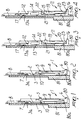
- the slider according to the invention in the first embodiment, generally designated by the reference numeral 1, comprises an elongated laminar body 2 which has a first longitudinal side 3, meant to rest on the bottom 80a of the axial slot 80 of the needle cylinder 81 in which it is inserted, and a second longitudinal side 4, which lies opposite with respect to the first longitudinal side 3.
- the slider is provided with a first heel 5 and with a second heel 6 which are mutually spaced along the longitudinal extension of the laminar body 2 and run transversely to the longitudinal extension of the laminar body 2 on the second side 4.
- the first heel 5 is arranged on a portion of the laminar body 2 which can move with respect to the remaining part of the laminar body 2 in a direction which has a component which is transverse with respect to the longitudinal extension of the laminar body in order to allow the transfer of the first heel 5 from an inactive position to an active position or viceversa. In the active position, the first heel 5 is spaced from the first side 3 of the laminar body 2 more than in the inactive position.
- the laminar body 2 Proximate to one of its longitudinal ends, the laminar body 2 is provided, on its first longitudinal side 3, with means 7 for engaging the needle 8 that is located in the same slot 80 of the lower or upper needle cylinder 81.
- Said engagement means 7 are constituted by a hook which is provided at a suitable seat 3a which is formed starting from a longitudinal end of the laminar body 2 and in which it is possible to accommodate the lower or upper portion of the needle 8 depending on whether the slider is in the lower needle cylinder or in the upper needle cylinder.
- the first heel 5 is preferably constituted by the heel that lies closest to the longitudinal end of the laminar body 2 which can engage the needle 8.
- the first heel 5 is associated, preferably monolithically, with a portion 9 of the laminar body 2 which can flex elastically on the plane of arrangement of the laminar body 2 with respect to the remaining part of the laminar body 2.
- portion 9 is preferably formed monolithically with the remaining part of the laminar body 2 and extends from it starting from a region which is proximate to the longitudinal end of the laminar body 2 that lies opposite with respect to the end of said body that can engage the needle 8.
- the second heel 6, located proximate to the longitudinal end of the laminar body 2 that lies opposite the end that can engage the needle 8, is preferably rigidly coupled to the remaining part of the laminar body 2.
- the portion 9 has, on the opposite side with respect to the first heel 5, a resting region 10 which can be engaged against the remaining part of the laminar body 2 in the flexing of the portion 9, so as to delimit the movement of the first heel 5 transversely to the longitudinal extension of the laminar body 2 in its transfer from the active position to the inactive position, as shown in particular in Figure 2.
- the slider according to the invention in the second embodiment, shown in particular in Figures 3 and 4 and generally designated by the reference numeral 11, also comprises an elongated laminar body 12 which has a first longitudinal side 13 which is meant to rest against the bottom 80a of the axial slot 80 of the lower or upper needle cylinder 81, in which it is to be accommodated, and a second longitudinal side 14 which lies opposite the first longitudinal side 13.
- the slider 11 is provided, proximate to one of its longitudinal ends, with means 17 for engagement with a needle 8.
- Said engagement means 17 are constituted, as in the first embodiment, by a hook which can engage the lower or upper tip of the needle 8 and is formed in a suitable seat 13a which is provided on the side 13 of the laminar body 12 starting from its longitudinal end which is meant to be directed toward the needle 8.
- the seat 13a is meant to receive the lower portion or the upper portion of the needle 8, depending on whether the slider is accommodated in the lower needle cylinder or in the upper needle cylinder.
- the laminar body 12 is provided with a first heel 15 and with a second heel 16 which run transversely to the longitudinal extension of the laminar body 2 on the second longitudinal side 14.
- the second heel 16 located proximate to the longitudinal end of the laminar body 12 that lies opposite the end that can engage the needle 8, is preferably rigidly coupled to the remaining part of the laminar body 12.
- the first heel 15 is fitted on a portion 19 which can oscillate with respect to the remaining part of the laminar body 12 in order to allow the transfer of the first heel 15 from an inactive position, in which it is close to the second side 13, to an active position, in which it is further spaced from the first longitudinal side 13 than in the inactive position, or viceversa.
- the first heel 15 of the two heels 15 and 16 is the one nearest to the end of the laminar body 12 that can engage the needle 8.
- the oscillating portion 19 is pivoted to the remaining part of the laminar body 12 at an intermediate portion.
- the pivoting can be achieved, as shown, by means of a particular geometric configuration of the sides of the portion 19 and of the remaining part of the laminar body 12 which are in mutual contact.
- the first heel 15 is located proximate to the end of the oscillating portion 19 that lies closest to the end of the laminar body 12 that can engage the needle 8, and proximate to the other end of the oscillating portion 19, which lies proximate to the second heel 16, an actuation lug 20 is provided which can be contacted to produce the oscillation of the oscillating portion 19 in the transfer of the first heel 15 from the inactive position to the active position, as will become apparent hereinafter.
- the laminar body 12 of the slider in the second embodiment, is provided with means for delimiting the oscillation angle of the oscillating portion 19 with respect to the remaining part of the laminar body 12.
- Said delimiting means comprise a seat 21 which is formed on the second longitudinal side 14 of the laminar body 12; the oscillating portion 19 is arranged in said seat 21.
- the seat 21 is delimited, along a direction which is parallel to the longitudinal extension of the laminar body 12, by two sides located proximate to the ends of the oscillating portion 19.
- shoulders 22 and 23 On these two sides there are shoulders 22 and 23 which are engaged respectively by one end of the oscillating portion 19 when the heel 15 is moved into the active position and by the other end of the oscillating portion 19 when the first heel 15 is moved into the inactive position, thus limiting the breadth of the oscillation allowed to the oscillating portion 19.
- first heel 15 when the first heel 15 is in the active position it protrudes from the slot 80 of the needle cylinder 81 and can engage at least some of the slider actuation cams that surround the needle cylinder and will be described in greater detail hereinafter, whereas when it is in the inactive position it is recessed in the slot 80 of the needle cylinder so as to avoid engaging said cams.
- the actuation lug 20 When the first heel 15 is in the active position, the actuation lug 20 is located inside the slot 80, whereas when the first heel 15 is in the inactive position said lug protrudes from the slot 80 and can engage at least some of the slider actuation cams that face the needle cylinder and will be described in greater detail hereinafter.
- the cams comprise a fixed upper cam 30 which has, along its lower edge, regions designated by the reference numerals 31 to 36 which are shaped like an inclined plane and can be contacted by the first heel 15. Said regions 31-36 produce the transfer of said heel 15 from the active position to the inactive position or allow its transfer from the inactive position to the active position.
- the actuation cams for the first heel 15 further comprise a first lifting cam 37, two mutually opposite lowering cams, designated by the reference numerals 38 and 39 respectively, which are provided at a first feed or drop of the machine, and a lowering cam 40, which is provided at a second feed or drop of the machine.
- the actuation cams for the first heel 15 are completed by two lifting cams 41 and 42 which are arranged consecutively with respect to each other at the feed or drop proximate to the lowering cam 40.
- the actuation cams for the second heel 16 comprise a fixed cam 50 which runs entirely around the needle cylinder and further cams which are designated by the reference numerals 51 to 54.
- the first heel 15 is represented by a rectangle which is black when the first heel 15 is in the active position and is instead white when said heel 15 is in the inactive position.
- the same rule has been adopted for the actuation lug 20, which is represented by a black rectangle when it protrudes from the needle cylinder and by a white rectangle when it is instead recessed in the slot 80 of the needle cylinder.
- Figure 5 illustrates the path followed by the heels 15 and 16 and by the actuation lug 20 of the slider 11 when the corresponding needle 8 must be excluded from knitting at the two feeds of the machine; the movement of the slider 11 with respect to the set of cams for its actuation is designated by the arrow 60.
- the first heel 15 is in the inactive position.
- the slider 11 is not moved along the corresponding slot 80 of the needle cylinder 81 in which it is inserted and the first heel 15 can move without interference beyond the cams 37, 38, 39, 41, 42 and 40 since it is in the inactive position.
- cam 38 which can usually move in a radial direction with respect to the needle cylinder, can be provided as a fixed cam and the lowering cams 39 and 40 also can be provided as fixed cams except, of course, for the possibility to move said cams, in a per se known manner, in a direction which is parallel to the axis of the needle cylinders in order to allow to vary the length of the loops of knitting.
- the first heel 15 is initially, i.e., starting from the right side of Figure 6, in the active position.
- the slider is lifted by other elements, constituted for example by selectors which are present in the same slot 80 below said slider, and is then lowered by the cam 30.
- the slider is then raised by means of the selector or of other underlying elements and the first heel 15 engages the inclined-plane region 31 of the cam 30 that produces the transfer of the heel 16 from the active position to the inactive position.
- the slider by means of other cams of a known type which are not described further for the sake of simplicity, disengages with its hook 7 from the lower tip of the needle which is engaged by the slider arranged in the upper cylinder.
- the actuation lug 20 engages against the guiding element 72, which produces the transfer of the first heel to the active position.
- the first heel 15 then engages a descending portion of the cam 30 which produces the lowering of the slider.
- the first heel 15 engages the portion 34 of the cam 30 that returns the first heel 15 to the inactive position.
- Said Figure 6 illustrates the further lifting of the slider in the lower cylinder, directly ahead of the feed served by the lowering cam 40, in the direction indicated by the arrow 61, in order to open the tab of the needle that has been transferred into the upper needle cylinder.
- the actuation lug 20 is contacted by the guiding element 74, which again causes the transfer of the first heel 15 into the active position, so that by engaging another descending portion of the cam 30 it produces the lowering of the slider.
- Figure 7 illustrates the path of the heels of the slider during the production of drop stitches with the needle associated therewith at the two feeds of the machine.
- the first heel 15 is moved into the active position and, after the needle associated with the slider has engaged the thread at the feed being considered, the first heel 15 engages the lowering cam 39, which produces the lowering of the slider and therefore the retraction of the associated needle 8 into the lower needle cylinder in order to form new loops, lowering the previously formed loops.
- the slider is then lifted again by the selector or other underlying element and is moved to a level which allows the needle 8 associated therewith to engage the thread at the next feed. Due to this lifting, the previously formed loops are lowered onto the shank of the needle.
- the first heel 15 Downstream of the feed served by the lowering cam 40, the first heel 15 again engages the cam 37, which produces the transfer of the first heel 15 into the inactive position, and the cycle resumes as already described.
- the slider according to the invention has been described with reference to its use in the lower needle cylinder of a two-feed machine, it is understood that the slider according to the invention can also be used in the upper needle cylinder and in machines having a different number of feeds.
- the slider according to the invention fully achieves the intended aim, since it allows to considerably simplify the slider actuation cams and to significantly reduce the number of cams that can move in a radial direction with respect to the needle cylinders.
- the materials employed, as well as the dimensions, may be any according to requirements and to the state of the art.
Landscapes
- Engineering & Computer Science (AREA)
- Textile Engineering (AREA)
- Knitting Machines (AREA)
- Footwear And Its Accessory, Manufacturing Method And Apparatuses (AREA)
- Compressors, Vaccum Pumps And Other Relevant Systems (AREA)
Applications Claiming Priority (2)
| Application Number | Priority Date | Filing Date | Title |
|---|---|---|---|
| ITMI982645 | 1998-12-09 | ||
| IT1998MI002645A IT1303828B1 (it) | 1998-12-09 | 1998-12-09 | Platina di trasferimento o slider per macchine circolari permaglieria o calzetteria a doppio cilindro. |
Publications (2)
| Publication Number | Publication Date |
|---|---|
| EP1010790A2 true EP1010790A2 (fr) | 2000-06-21 |
| EP1010790A3 EP1010790A3 (fr) | 2001-05-23 |
Family
ID=11381199
Family Applications (1)
| Application Number | Title | Priority Date | Filing Date |
|---|---|---|---|
| EP99123961A Withdrawn EP1010790A3 (fr) | 1998-12-09 | 1999-12-06 | Coulisseau pour des machines à tricoter à double cylindre |
Country Status (6)
| Country | Link |
|---|---|
| US (1) | US6220061B1 (fr) |
| EP (1) | EP1010790A3 (fr) |
| JP (1) | JP2000170062A (fr) |
| KR (1) | KR20000048037A (fr) |
| CN (1) | CN1256329A (fr) |
| IT (1) | IT1303828B1 (fr) |
Cited By (4)
| Publication number | Priority date | Publication date | Assignee | Title |
|---|---|---|---|---|
| WO2007112915A1 (fr) * | 2006-03-31 | 2007-10-11 | Lonati S.P.A. | Metier a tricoter circulaire a double cylindre pour articles de bonneterie ou autres articles tricotes |
| WO2007113649A1 (fr) * | 2006-03-31 | 2007-10-11 | Lonati S.P.A. | Machine à tricoter circulaire pour bonneterie ou analogue |
| WO2007113659A3 (fr) * | 2006-03-31 | 2008-02-14 | Lonati Spa | Métier circulaire destiné à la fabrication d'articles de bonneterie ou analogue |
| ITUB20155479A1 (it) * | 2015-11-11 | 2017-05-11 | Lonati Spa | Procedimento per la preparazione di un manufatto tubolare del tipo calza o simile al prelievo automatizzato al termine della sua formazione su una macchina circolare a doppio cilindro con almeno una alimentazione o caduta e macchina circolare a doppio cilindro per la sua esecuzione. |
Families Citing this family (6)
| Publication number | Priority date | Publication date | Assignee | Title |
|---|---|---|---|---|
| ITMI20060637A1 (it) * | 2006-03-31 | 2007-10-01 | Matec Spa | Macchina circolare per maglieria o per calzetteria o simile a doppio cilindro |
| ITMI20060628A1 (it) * | 2006-03-31 | 2007-10-01 | Matec Spa | Macchina circolare per maglieria o per calzetteria o simile a doppio cilindro |
| CZ2007107A3 (cs) * | 2007-02-12 | 2008-08-20 | Golden Lady Company S.P.A. | Jehelní ústrojí |
| CN106087228A (zh) * | 2016-08-22 | 2016-11-09 | 浙江华诗秀纺织有限公司 | 一种针织圆机的对针编织结构 |
| CN110512347B (zh) * | 2019-04-10 | 2020-12-22 | 浙江叶晓机械科技有限公司 | 一种双针筒织机编织方法 |
| CN118814346B (zh) * | 2024-09-20 | 2024-12-10 | 浙江伟焕机械制造股份有限公司 | 双针筒袜机及编织袜口的方法 |
Family Cites Families (10)
| Publication number | Priority date | Publication date | Assignee | Title |
|---|---|---|---|---|
| FR1595574A (fr) * | 1967-08-02 | 1970-06-15 | ||
| GB1281391A (en) * | 1969-02-25 | 1972-07-12 | Bentley Machine Dev Company Lt | Improvements in needle operating means in knitting machines |
| US4073163A (en) * | 1976-11-08 | 1978-02-14 | Francesco Lonati | Circular knitting machine |
| CH601543A5 (fr) * | 1976-12-23 | 1978-07-14 | Dubied & Cie Sa E | |
| IT1137166B (it) * | 1981-05-28 | 1986-09-03 | Mecmor Spa | Macchina circolare per maglieria a cilindro e piatto con dispositivo di selezione degli aghi del piatto |
| IT1146698B (it) * | 1981-09-10 | 1986-11-12 | Savio Spa | Procedimento di lavorazione con macchine circolari per maglieria e macchine circolari adottanti tale procedimento |
| CZ280577B6 (cs) * | 1991-12-30 | 1996-02-14 | Uniplet, A.S. | Okrouhlý pletací stroj |
| GB2264308B (en) * | 1992-02-21 | 1996-01-17 | Uniplet As | Knitting machine |
| ITBO940161A1 (it) * | 1994-04-15 | 1995-10-15 | Matec Srl | Dispositivo di selezione per selettore elastico per aghi in macchina tessile circolare |
| DE19720169C2 (de) * | 1997-05-14 | 1999-04-08 | Groz Beckert Kg | Auswahlplatine |
-
1998
- 1998-12-09 IT IT1998MI002645A patent/IT1303828B1/it active
-
1999
- 1999-12-03 US US09/454,440 patent/US6220061B1/en not_active Expired - Fee Related
- 1999-12-06 EP EP99123961A patent/EP1010790A3/fr not_active Withdrawn
- 1999-12-09 JP JP11350030A patent/JP2000170062A/ja not_active Withdrawn
- 1999-12-09 KR KR1019990056189A patent/KR20000048037A/ko not_active Withdrawn
- 1999-12-09 CN CN99126132A patent/CN1256329A/zh active Pending
Cited By (14)
| Publication number | Priority date | Publication date | Assignee | Title |
|---|---|---|---|---|
| WO2007112915A1 (fr) * | 2006-03-31 | 2007-10-11 | Lonati S.P.A. | Metier a tricoter circulaire a double cylindre pour articles de bonneterie ou autres articles tricotes |
| WO2007113649A1 (fr) * | 2006-03-31 | 2007-10-11 | Lonati S.P.A. | Machine à tricoter circulaire pour bonneterie ou analogue |
| WO2007113662A3 (fr) * | 2006-03-31 | 2007-11-29 | Lonati Spa | Métier circulaire destiné à la fabrication d'articles de bonneterie ou analogue |
| WO2007113659A3 (fr) * | 2006-03-31 | 2008-02-14 | Lonati Spa | Métier circulaire destiné à la fabrication d'articles de bonneterie ou analogue |
| US7685845B2 (en) | 2006-03-31 | 2010-03-30 | Lonati S.P.A. | Circular knitting machine for hosiery or the like |
| US7739889B2 (en) | 2006-03-31 | 2010-06-22 | Lonati S.P.A. | Circular knitting machine for hosiery or the like |
| US7765836B2 (en) | 2006-03-31 | 2010-08-03 | Lonati S.P.A. | Circular knitting machine for hosiery or the like |
| KR101368303B1 (ko) * | 2006-03-31 | 2014-03-12 | 로나티 에스.피.에이. | 양말 또는 그외 편물 등을 위한 더블 실린더 환편기 |
| ITUB20155479A1 (it) * | 2015-11-11 | 2017-05-11 | Lonati Spa | Procedimento per la preparazione di un manufatto tubolare del tipo calza o simile al prelievo automatizzato al termine della sua formazione su una macchina circolare a doppio cilindro con almeno una alimentazione o caduta e macchina circolare a doppio cilindro per la sua esecuzione. |
| WO2017080931A1 (fr) * | 2015-11-11 | 2017-05-18 | Lonati S.P.A. | Procédé de préparation d'un article tubulaire, tel qu'une chaussette ou similaire, pour collecte automatique à la fin de sa formation sur une machine circulaire à double cylindre avec au moins une alimentation ou chute, et machine circulaire à double cylindre pour l'exécution de celui-ci |
| KR20180081046A (ko) * | 2015-11-11 | 2018-07-13 | 로나티 에스.피.에이. | 적어도 하나의 공급부 또는 드롭부를 갖는 이중 실린더 원형 기계에서 양말 등과 같은 관형 물품의 형성이 끝나면 자동화된 픽업을 위해 관형 물품을 준비하기 위한 방법, 및 이 방법을 실시하기 위한 이중 실린더 원형 기계 |
| KR102087311B1 (ko) | 2015-11-11 | 2020-04-27 | 로나티 에스.피.에이. | 적어도 하나의 공급부 또는 드롭부를 갖는 이중 실린더 원형 기계에서 양말 등과 같은 관형 물품의 형성이 끝나면 자동화된 픽업을 위해 관형 물품을 준비하기 위한 방법, 및 이 방법을 실시하기 위한 이중 실린더 원형 기계 |
| US10718075B2 (en) | 2015-11-11 | 2020-07-21 | Lonati S.P.A. | Method for preparing a tubular article, such as a sock or the like, for automated pickup at the end of its forming on a double cylinder circular machine with at least one feed or drop, and double cylinder circular machine for the execution thereof |
| EA036310B1 (ru) * | 2015-11-11 | 2020-10-26 | ЛОНАТИ С.п.А. | Способ подготовки трубчатого изделия, такого как чулочное изделие, к автоматическому сниманию в конце его формирования на двухцилиндровой кругловязальной машине и двухцилиндровая кругловязальная машина для выполнения такого способа |
Also Published As
| Publication number | Publication date |
|---|---|
| ITMI982645A1 (it) | 2000-06-09 |
| CN1256329A (zh) | 2000-06-14 |
| JP2000170062A (ja) | 2000-06-20 |
| IT1303828B1 (it) | 2001-02-23 |
| US6220061B1 (en) | 2001-04-24 |
| KR20000048037A (ko) | 2000-07-25 |
| EP1010790A3 (fr) | 2001-05-23 |
Similar Documents
| Publication | Publication Date | Title |
|---|---|---|
| US7739889B2 (en) | Circular knitting machine for hosiery or the like | |
| US6220061B1 (en) | Slider for double-cylinder circular knitting machines | |
| US7765836B2 (en) | Circular knitting machine for hosiery or the like | |
| US5408849A (en) | Flat bed knitting machine | |
| US5931025A (en) | Lowering sinker actuation cam set for circular knitting machines for forming standard-terry knitting and sandwich-terry knitting | |
| US6609395B2 (en) | Double-cylinder circular stocking knitting machine with structurally highly simplified cam box | |
| EP0683257B1 (fr) | Métier à tricoter circulaire à platines pour retenir le tricot | |
| CN101415873A (zh) | 用于袜类或其它针织物品的双针筒圆型针织机 | |
| US2313642A (en) | Circular independent needle knitting machine | |
| US5960645A (en) | Device for selecting needles in circular stocking knitting machines | |
| US3335581A (en) | Cam means for circular knitting machines | |
| US5335518A (en) | Circular knitting machine for manufacturing socks, stockings and the like, with device for producing patterns with toweling stitches | |
| CN101415872B (zh) | 用于袜类或类似物的圆型针织机 | |
| EP0225502B1 (fr) | Métier à tricoter à double cylindre avec dispositif pour commander la platine de transfert | |
| US20010023599A1 (en) | "Thread dispensing device for dispensing thread at a feed of a circular knitting machine" | |
| US2385056A (en) | Circular knitting machine | |
| US6257026B1 (en) | Needle control device for stocking knitting machines | |
| EP0962569A2 (fr) | Métier à tricoter circulaire à grand adaptabilité pour bas et similaires avec multiples systèmes ou alimentations | |
| EP0960966B1 (fr) | Procédé et dispositif pour l'alimentation simultané d'au moins deux fils dans des machines à tricoter circulaires à deux cylindres | |
| US2809507A (en) | Stitch cam for circular knitting machines | |
| CZ442399A3 (cs) | Platina pro dvouválcové okrouhlé pletací stroje na výrobu punčochového zboží | |
| US3180114A (en) | Pattern means for knitting machines | |
| US4233823A (en) | Double-cylinder circular knitting machine | |
| US3389581A (en) | Yarn feed controlling means for knitting machines | |
| ITMI982647A1 (it) | Macchina circolare per maglieria o calzetteria a doppio cilindro, adelevata semplicita' strutturale. |
Legal Events
| Date | Code | Title | Description |
|---|---|---|---|
| PUAI | Public reference made under article 153(3) epc to a published international application that has entered the european phase |
Free format text: ORIGINAL CODE: 0009012 |
|
| AK | Designated contracting states |
Kind code of ref document: A2 Designated state(s): DE FR GB IT |
|
| AX | Request for extension of the european patent |
Free format text: AL;LT;LV;MK;RO;SI |
|
| PUAL | Search report despatched |
Free format text: ORIGINAL CODE: 0009013 |
|
| AK | Designated contracting states |
Kind code of ref document: A3 Designated state(s): AT BE CH CY DE DK ES FI FR GB GR IE IT LI LU MC NL PT SE |
|
| AX | Request for extension of the european patent |
Free format text: AL;LT;LV;MK;RO;SI |
|
| RIC1 | Information provided on ipc code assigned before grant |
Free format text: 7D 04B 9/10 A, 7D 04B 15/68 B |
|
| 17P | Request for examination filed |
Effective date: 20011122 |
|
| AKX | Designation fees paid |
Free format text: DE FR GB IT |
|
| STAA | Information on the status of an ep patent application or granted ep patent |
Free format text: STATUS: THE APPLICATION HAS BEEN WITHDRAWN |
|
| 18W | Application withdrawn |
Effective date: 20021209 |