EP1012121B1 - Verfahren zur nitrifikation von abwasser unter verwendung von aus ammoniumhaltigen wasser isolierten und angereicherten mikro-organismen - Google Patents
Verfahren zur nitrifikation von abwasser unter verwendung von aus ammoniumhaltigen wasser isolierten und angereicherten mikro-organismen Download PDFInfo
- Publication number
- EP1012121B1 EP1012121B1 EP19980902335 EP98902335A EP1012121B1 EP 1012121 B1 EP1012121 B1 EP 1012121B1 EP 19980902335 EP19980902335 EP 19980902335 EP 98902335 A EP98902335 A EP 98902335A EP 1012121 B1 EP1012121 B1 EP 1012121B1
- Authority
- EP
- European Patent Office
- Prior art keywords
- sludge
- accordance
- biological
- wastewater
- ammonia
- Prior art date
- Legal status (The legal status is an assumption and is not a legal conclusion. Google has not performed a legal analysis and makes no representation as to the accuracy of the status listed.)
- Expired - Lifetime
Links
- 238000000034 method Methods 0.000 title claims abstract description 80
- QGZKDVFQNNGYKY-UHFFFAOYSA-N Ammonia Chemical compound N QGZKDVFQNNGYKY-UHFFFAOYSA-N 0.000 title claims abstract description 42
- 244000005700 microbiome Species 0.000 title claims abstract description 34
- XLYOFNOQVPJJNP-UHFFFAOYSA-N water Substances O XLYOFNOQVPJJNP-UHFFFAOYSA-N 0.000 title claims abstract description 32
- 239000002351 wastewater Substances 0.000 title claims abstract description 22
- 229910021529 ammonia Inorganic materials 0.000 title claims abstract description 20
- 230000008569 process Effects 0.000 title abstract description 47
- 230000001546 nitrifying effect Effects 0.000 title abstract description 8
- 239000010802 sludge Substances 0.000 claims abstract description 116
- IJGRMHOSHXDMSA-UHFFFAOYSA-N Atomic nitrogen Chemical compound N#N IJGRMHOSHXDMSA-UHFFFAOYSA-N 0.000 claims abstract description 60
- 239000005416 organic matter Substances 0.000 claims abstract description 26
- 238000005273 aeration Methods 0.000 claims abstract description 23
- OAICVXFJPJFONN-UHFFFAOYSA-N Phosphorus Chemical compound [P] OAICVXFJPJFONN-UHFFFAOYSA-N 0.000 claims abstract description 21
- 229910052698 phosphorus Inorganic materials 0.000 claims abstract description 21
- 239000011574 phosphorus Substances 0.000 claims abstract description 21
- NHNBFGGVMKEFGY-UHFFFAOYSA-N Nitrate Chemical compound [O-][N+]([O-])=O NHNBFGGVMKEFGY-UHFFFAOYSA-N 0.000 claims abstract description 20
- 229910002651 NO3 Inorganic materials 0.000 claims abstract description 18
- 238000000926 separation method Methods 0.000 claims abstract description 15
- 238000006243 chemical reaction Methods 0.000 claims abstract description 12
- OKTJSMMVPCPJKN-UHFFFAOYSA-N Carbon Chemical compound [C] OKTJSMMVPCPJKN-UHFFFAOYSA-N 0.000 claims description 23
- 229910052799 carbon Inorganic materials 0.000 claims description 23
- 239000007787 solid Substances 0.000 claims description 9
- 239000004571 lime Substances 0.000 claims description 7
- LFQSCWFLJHTTHZ-UHFFFAOYSA-N Ethanol Chemical compound CCO LFQSCWFLJHTTHZ-UHFFFAOYSA-N 0.000 claims description 6
- 238000001556 precipitation Methods 0.000 claims description 6
- IOVCWXUNBOPUCH-UHFFFAOYSA-M Nitrite anion Chemical compound [O-]N=O IOVCWXUNBOPUCH-UHFFFAOYSA-M 0.000 claims description 5
- 230000009467 reduction Effects 0.000 claims description 5
- 239000002562 thickening agent Substances 0.000 claims description 5
- 231100000331 toxic Toxicity 0.000 claims description 5
- 230000002588 toxic effect Effects 0.000 claims description 5
- 230000009466 transformation Effects 0.000 claims description 5
- 239000000701 coagulant Substances 0.000 claims description 4
- 239000006228 supernatant Substances 0.000 claims description 4
- 230000003247 decreasing effect Effects 0.000 claims description 3
- 238000010899 nucleation Methods 0.000 claims description 3
- 239000000203 mixture Substances 0.000 claims description 2
- 238000006213 oxygenation reaction Methods 0.000 claims description 2
- 238000007873 sieving Methods 0.000 claims description 2
- 230000006641 stabilisation Effects 0.000 claims description 2
- VTYYLEPIZMXCLO-UHFFFAOYSA-L Calcium carbonate Chemical compound [Ca+2].[O-]C([O-])=O VTYYLEPIZMXCLO-UHFFFAOYSA-L 0.000 claims 6
- 229910000019 calcium carbonate Inorganic materials 0.000 claims 3
- 235000012204 lemonade/lime carbonate Nutrition 0.000 claims 3
- 239000007788 liquid Substances 0.000 claims 2
- 229910001873 dinitrogen Inorganic materials 0.000 claims 1
- 230000029058 respiratory gaseous exchange Effects 0.000 claims 1
- 238000011105 stabilization Methods 0.000 claims 1
- 238000011144 upstream manufacturing Methods 0.000 claims 1
- 229910052757 nitrogen Inorganic materials 0.000 abstract description 29
- 239000000126 substance Substances 0.000 abstract description 13
- 230000003647 oxidation Effects 0.000 abstract description 4
- 238000007254 oxidation reaction Methods 0.000 abstract description 4
- -1 e.g. Substances 0.000 abstract description 2
- 230000000694 effects Effects 0.000 abstract description 2
- 230000004936 stimulating effect Effects 0.000 abstract description 2
- 241000894007 species Species 0.000 abstract 1
- QVGXLLKOCUKJST-UHFFFAOYSA-N atomic oxygen Chemical compound [O] QVGXLLKOCUKJST-UHFFFAOYSA-N 0.000 description 15
- 229910052760 oxygen Inorganic materials 0.000 description 15
- 239000001301 oxygen Substances 0.000 description 15
- 230000008901 benefit Effects 0.000 description 6
- 238000013461 design Methods 0.000 description 5
- 241000894006 Bacteria Species 0.000 description 4
- 239000002028 Biomass Substances 0.000 description 4
- 235000008733 Citrus aurantifolia Nutrition 0.000 description 4
- 235000011941 Tilia x europaea Nutrition 0.000 description 4
- 238000003860 storage Methods 0.000 description 4
- 239000002699 waste material Substances 0.000 description 4
- OKKJLVBELUTLKV-UHFFFAOYSA-N Methanol Chemical compound OC OKKJLVBELUTLKV-UHFFFAOYSA-N 0.000 description 3
- 239000012535 impurity Substances 0.000 description 3
- 230000004048 modification Effects 0.000 description 3
- 238000012986 modification Methods 0.000 description 3
- 235000015097 nutrients Nutrition 0.000 description 3
- 238000000247 postprecipitation Methods 0.000 description 3
- 230000008719 thickening Effects 0.000 description 3
- XKMRRTOUMJRJIA-UHFFFAOYSA-N ammonia nh3 Chemical compound N.N XKMRRTOUMJRJIA-UHFFFAOYSA-N 0.000 description 2
- 235000012206 bottled water Nutrition 0.000 description 2
- 239000003651 drinking water Substances 0.000 description 2
- 238000005259 measurement Methods 0.000 description 2
- 150000002823 nitrates Chemical class 0.000 description 2
- 238000013486 operation strategy Methods 0.000 description 2
- 238000002203 pretreatment Methods 0.000 description 2
- 230000008929 regeneration Effects 0.000 description 2
- 238000011069 regeneration method Methods 0.000 description 2
- 239000002253 acid Substances 0.000 description 1
- 230000004071 biological effect Effects 0.000 description 1
- 230000015572 biosynthetic process Effects 0.000 description 1
- 230000000740 bleeding effect Effects 0.000 description 1
- 239000000969 carrier Substances 0.000 description 1
- 238000005352 clarification Methods 0.000 description 1
- 238000007796 conventional method Methods 0.000 description 1
- 230000000593 degrading effect Effects 0.000 description 1
- IJGRMHOSHXDMSA-UHFFFAOYSA-O diazynium Chemical group [NH+]#N IJGRMHOSHXDMSA-UHFFFAOYSA-O 0.000 description 1
- 230000029087 digestion Effects 0.000 description 1
- 238000005516 engineering process Methods 0.000 description 1
- 230000004151 fermentation Effects 0.000 description 1
- 238000000855 fermentation Methods 0.000 description 1
- 239000003673 groundwater Substances 0.000 description 1
- 230000006872 improvement Effects 0.000 description 1
- 230000002401 inhibitory effect Effects 0.000 description 1
- 230000010354 integration Effects 0.000 description 1
- 238000005342 ion exchange Methods 0.000 description 1
- 238000004519 manufacturing process Methods 0.000 description 1
- 238000002844 melting Methods 0.000 description 1
- 230000008018 melting Effects 0.000 description 1
- 238000002156 mixing Methods 0.000 description 1
- 238000012544 monitoring process Methods 0.000 description 1
- 239000010841 municipal wastewater Substances 0.000 description 1
- 150000002826 nitrites Chemical class 0.000 description 1
- 229910017464 nitrogen compound Inorganic materials 0.000 description 1
- 150000002830 nitrogen compounds Chemical class 0.000 description 1
- 125000001477 organic nitrogen group Chemical group 0.000 description 1
- 230000036284 oxygen consumption Effects 0.000 description 1
- 230000001376 precipitating effect Effects 0.000 description 1
- 238000011084 recovery Methods 0.000 description 1
- 150000003839 salts Chemical class 0.000 description 1
- 238000004062 sedimentation Methods 0.000 description 1
- 239000010865 sewage Substances 0.000 description 1
- 230000003019 stabilising effect Effects 0.000 description 1
- 238000012360 testing method Methods 0.000 description 1
- 230000001131 transforming effect Effects 0.000 description 1
- 238000004065 wastewater treatment Methods 0.000 description 1
Images


Classifications
-
- C—CHEMISTRY; METALLURGY
- C02—TREATMENT OF WATER, WASTE WATER, SEWAGE, OR SLUDGE
- C02F—TREATMENT OF WATER, WASTE WATER, SEWAGE, OR SLUDGE
- C02F3/00—Biological treatment of water, waste water, or sewage
- C02F3/02—Aerobic processes
- C02F3/12—Activated sludge processes
-
- C—CHEMISTRY; METALLURGY
- C02—TREATMENT OF WATER, WASTE WATER, SEWAGE, OR SLUDGE
- C02F—TREATMENT OF WATER, WASTE WATER, SEWAGE, OR SLUDGE
- C02F3/00—Biological treatment of water, waste water, or sewage
- C02F3/30—Aerobic and anaerobic processes
-
- C—CHEMISTRY; METALLURGY
- C02—TREATMENT OF WATER, WASTE WATER, SEWAGE, OR SLUDGE
- C02F—TREATMENT OF WATER, WASTE WATER, SEWAGE, OR SLUDGE
- C02F3/00—Biological treatment of water, waste water, or sewage
- C02F3/30—Aerobic and anaerobic processes
- C02F3/308—Biological phosphorus removal
-
- Y—GENERAL TAGGING OF NEW TECHNOLOGICAL DEVELOPMENTS; GENERAL TAGGING OF CROSS-SECTIONAL TECHNOLOGIES SPANNING OVER SEVERAL SECTIONS OF THE IPC; TECHNICAL SUBJECTS COVERED BY FORMER USPC CROSS-REFERENCE ART COLLECTIONS [XRACs] AND DIGESTS
- Y02—TECHNOLOGIES OR APPLICATIONS FOR MITIGATION OR ADAPTATION AGAINST CLIMATE CHANGE
- Y02W—CLIMATE CHANGE MITIGATION TECHNOLOGIES RELATED TO WASTEWATER TREATMENT OR WASTE MANAGEMENT
- Y02W10/00—Technologies for wastewater treatment
- Y02W10/10—Biological treatment of water, waste water, or sewage
-
- Y—GENERAL TAGGING OF NEW TECHNOLOGICAL DEVELOPMENTS; GENERAL TAGGING OF CROSS-SECTIONAL TECHNOLOGIES SPANNING OVER SEVERAL SECTIONS OF THE IPC; TECHNICAL SUBJECTS COVERED BY FORMER USPC CROSS-REFERENCE ART COLLECTIONS [XRACs] AND DIGESTS
- Y10—TECHNICAL SUBJECTS COVERED BY FORMER USPC
- Y10S—TECHNICAL SUBJECTS COVERED BY FORMER USPC CROSS-REFERENCE ART COLLECTIONS [XRACs] AND DIGESTS
- Y10S210/00—Liquid purification or separation
- Y10S210/902—Materials removed
- Y10S210/903—Nitrogenous
Definitions
- Wastewater is treated in treatment plants by mechanical ( primary ), biological ( secondary ) and sometimes also ( tertiary ) chemical treatment.
- mechanical treatment suspended solids are separated by some form of sieving, followed by separation, usually sedimentation.
- separation usually sedimentation.
- biological treatment is needed, which means that micro-organisms transform organic matter into bio-mass, or sludge, provided that correct physical-chemical conditions are at hand.
- access to oxygen, or aerobic conditions is required. which is obtained by some form of aeration system.
- nutrients like nitrogen and phosphorus must be present, which is the case in municipal wastewater in abundance.
- biological treatment more than 90 % organic removal can be achieved, as well as high removal of bacteria. Nutrient removal, however, will be limited to some 30 % nitrogen and phosphorus removal by assimilation into the bio-mass, which is removed as excess sludge for separate treatment and recovery, or disposed of.
- Chemical treatment involves the addition of a coagulant, which is able to coagulate and flocculate remaining impurities into chemical floes, also precipitating phosphorus, resulting in more than 90 % removal of phosphorus.
- a coagulant which is able to coagulate and flocculate remaining impurities into chemical floes, also precipitating phosphorus, resulting in more than 90 % removal of phosphorus.
- the coagulant can also be fed into the primary settling stage, pre-precipitation, or in the biological stage, simultaneous precipitation, which in many Swedish treatment plants has resulted in the possibility of using the existing tertiary stage for other purposes, or as an extra safety.
- the obtained removal of nitrogen is thus by assimilation, or some 30 %. If the sludge is stabilised for possible reuse in agriculture, some of the assimilated nitrogen is released, and re-circulated with the reject water after dewatering, which will result in only 15-20 % nitrogen removal.
- Nitrate can be reduced to nitrites, which is toxic to infants.
- All treatment of (waste) water includes the separation of suspended matter, either in the untreated (waste) water, or in the biological or chemical treatment stage.
- Biological treatment involves the transformation of organic matter by micro-organisms into biological flocs, which are separated from the water.
- Chemical treatment means the transformation of colloidal or fine suspended solids, as well as dissolved matter like phosphorus, into chemical flocs, which are separated from the water.
- the transformation process with nitrification and denitrification can be more effective, as well as the separation properties of the flocs, for an overall better performance in smaller volumes, which is of great importance by upgrading of treatment plants.
- oxygen is fed into the wastewater by aeration or some other means, and micro-organisms are then transforming impurities into cells or bio-mass, forming biological flocs.
- the flocs are then separated as a sludge in the separation stage.
- the process can be carried out as a fix film process with immobilised micro-organisms, e.g. in trickling filters, rotating biological discs or suspended carriers.
- the mostly used process is the activated sludge process, is using suspended micro-organisms, which are separated and recirculated from the separation stage, thus building up a large concentration of active micro-organisms in an aerated (oxygenated) reactor, where rapid degrading of organic matter will be achieved.
- the activated sludge process will give a high removal of organic matter, measured as BOD, though having a disadvantage by the large amount of recirculated sludge.
- BOD organic matter
- At peak flow conditions e.g. by rain storms or in snow melting periods, there is a risk for the sludge not having time to settle and thus following the discharged water, so called solids carry over.
- Another problem with the process is that at unfavourable composition of the wastewater, or when the process is not properly followed up, the 'wrong' type of micro-organisms might be formed, e.g. filamentous micro-organisms, resulting in poor floc separation conditions, called 'sludge bulking'.
- nitrification In order to achieve nitrification, longer detention time and/or higher temperature is required, compared to only removing organic matter (BOD), and in many treatment conventionally designed plants, nitrification will occur at low loads during the summer time, sometimes giving problems when post-precipitation is in use.
- BOD organic matter
- the nitrification requires a higher sludge age and higher detention time than for just BOD-removal, Figure 2 .
- the oxygen consumption will also increase, normally more than 50 %.
- the ammonia nitrogen is transformed via nitrite to nitrate using autotrofic micro-organisms with a longer regeneration time than the micro-organisms, which remove organic matter, BOD. That is the reason for the necessary longer detention time, as otherwise the nirifying micro-organisms, nitrifiers, will be washed out from the process.
- the regeneration time for the nitrifiers is some 3 days, and a sludge age of 10 days is normally required. Practical experience, however, shows that at a sludge age of 8 days, stable nitrification/denitrification has resulted in effluent values of some 8 mg total nitrogen per litre at a temperature of 8 degrees.
- the denitrification requires an anoxic environment, i.e. no dissolved oxygen, where the micro-organisms takes the necessary oxygen from the nitrates, being transformed into gaseous nitrogen into the atmosphere, Figure 3.
- the alkalinity and pH-value is increased.
- the denitrification requires access to easy degradable carbon, and at the first treatment plants for biological nitrogen removal, methanol was dosed into a second activated sludge stage for post-denitrification.
- a two-stage process will increase both investment and operation costs, as expensive organic matter has to be used, where the process previously has removed organic matter.
- the pre-denitrification can be introduced as soon as nitrification has been reached and the process has several advantages.
- N red 100 * (Q R + Q N )/(Q + Q R + Q N ) %
- the carbon source can be a supernatant from a primary thickener, or as an external source, preferably ethanol.
- Another possibility can be to use part of the influent raw sewage after pre-treatment, where the influent raw BOD will be the carbon source.
- the primary (pre-precipitation) stage and the biological treatment will less loaded, resulting in lower operation costs and higher capacity.
- Another advantage with the sludge anoxic zone is the 'anoxic biosorbtion' with a sludge storage, reducing the impact of short peak loads on the process.
- the process can be operated with on-line instrumentation, preferably ammonia metering in the sludge aeration zone, and pH/redox-metering in the sludge anoxic zone.
- a process design with a sludge anoxic zone will automatically enable biological phosphorus removal, as anaerobic conditions will come forth as soon as nitrate is used up in the recycled sludge.
- Biological phosphorus removal means that more phosphorus is assimilated in the excess sludge in the anaerobic zone (no dissolved oxygen or nitrate).
- the anaerobic zone will give a competing edge to a certain type of micro-organisms, acinobacter, which in an aerobic environment can obtain energy by taking up phosphorus, and in an anaerobic environment by taking up organic matter and releasing phosphorus.
- a correctly bleeding out of excess sludge will contain 5-6 % phosphorus, compared to normally some 1 %.
- Filamentous micro-organisms can otherwise result in a voluminous sludge, difficult to effectively separate from the water.
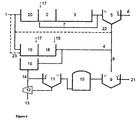
- the present invention is illustrated by Figure 6, and comprises a method for improved biological oxidation of nitrogen in water, e.g., wastewater, nirification, by creating a reaction volume for the selction and enrichment of nitrifying microorganisms, followed by biological denitrification.
- the method will make maximum use of reaction volumes, enabling shorter detention time and lower operational costs, and at the same time achieve a more reliable operation for nitrogen removal.
- the process is also comprising a wholistic view of the overall process design, with integration and optimisation of different process stages for best possible results.
- the possibility of stimulating the micro-organisms to higher biological activity is also included, by controlling the physical-chemical conditions, and/or the possible addition of a carbon source for improved denitrification.
- lime can be dosed and/or an anaerobic zone can be introduced, also enabling biological phosphorus removal, for less dosage of coagulant and consequently less chemical sludge to handle.
- the method is applied in an activated sludge system, it is advantageous to aerate/oxidise the recycled sludge in the reaction volume, 18, as the sludge content and total sludge amount per unit volume is higher than in the activated sludge aeration tanks.
- the higher amount of active sludge will contain a large content of nitrifying micro-organisms, and result in a higher sludge age and higher nitrification rate as a larger amount of active bio-mass is available for nitrification.
- the method can especially be used when reject water from dewatering of stabilised sludge (14) is collected, where by anaerobic digestion 15-20% of the total nitrogen load otherwise is re-circulated into the inlet, resulting in many advantages, listed below.
- the earlier described sludge anoxic zone, 19, can also be combined with sludge aeration, 18, in this new modification.
- sludge aeration 18, in this new modification.
- the overall control would use a computer, under an operational strategy.
- the method can also be used for fixed film processes.
Landscapes
- Life Sciences & Earth Sciences (AREA)
- Biodiversity & Conservation Biology (AREA)
- Microbiology (AREA)
- Hydrology & Water Resources (AREA)
- Engineering & Computer Science (AREA)
- Environmental & Geological Engineering (AREA)
- Water Supply & Treatment (AREA)
- Chemical & Material Sciences (AREA)
- Organic Chemistry (AREA)
- Health & Medical Sciences (AREA)
- Molecular Biology (AREA)
- Purification Treatments By Anaerobic Or Anaerobic And Aerobic Bacteria Or Animals (AREA)
- Removal Of Specific Substances (AREA)
- Physical Water Treatments (AREA)
Claims (19)
- Verfahren zur biologischen Behandlung von Abwasser durch Mikroorganismen für den Abbau organischer Stoffe sowie durch andere Mikroorganismen für eine Nitrifikation, umfassend
eine eventuelle Vorbehandlung des genannten Abwassers durch Sieben und/oder Absetzen,
Vorbeileiten des genannten Abwassers in einem Behandlungsstrom von einem Zulauf zu einem Ablauf,
biologische Behandlung des genannten Abwassers in dem genannten Behandlungsstrom durch die ersten Mikroorganismen für die Umwandlung von organischem Material in Schwebegut,
biologische Behandlung des genannten Abwassers in dem genannten Behandlungsstrom durch die anderen Mikroorganismen für die Nitrifikation von Ammonium zu Nitrit und Nitrat,
Abscheidung des genannten Schwebegutes, inklusive der Mikroorganismen, vom genannten Abwasser als biologischer Schlamm,
Rückführung des genannten biologischen Schlammes in einem Rückführungsstrom zu dem genannten Zulauf der genannten biologischen Behandlung, wobei im Rückführungsstrom ein niedriger Gehalt an organischem Material und Ammonium vorliegt,
Belüftung oder andere Oxygenierung des genannten biologischen Schlammes in einem aeroben Reaktor, der im Rücklaufstrom angeordnet ist,
gekennzeichnet durch
Einspeisen von ammoniumreichem Wasser in den genannten Rückführungsstrom in oder stromaufwärts von dem genannten aeroben Reaktor. - Verfahren gemäß Patentanspruch 1, gekennzeichnet durch
Entfernen eines Überschussschlammanteils von dem genannten Rückführungsstrom,
Stabilisieren und Entwässern des genannten Entsorgungsanteils zum Erhöhen des Ammoniumgehalts in dem genannten Entsorgungsanteil,
Abscheidung des Flüssigkeitsanteils des genannten Entsorgungsanteils und Einspeisen des genannten Flüssigkeitsanteils in den genannten Rückführungsstrom als das genannte ammoniumreiche Wasser. - Verfahren gemäß Patentanspruch 1 oder 2, gekennzeichnet durch
biologische Reduktion von Nitrat zu Stickstoffgas unter anoxischen Bedingungen in einer anoxischen Zone, die stromabwärts nach dem genannten aeroben Reaktor in dem genannten Rücklaufstrom angeordnet ist. - Verfahren gemäß Patentanspruch 3, gekennzeichnet durch
Zusetzen einer Kohlenstoffquelle zu der genannten anoxischen Zone. - Verfahren gemäß Patentanspruch 4, dadurch gekennzeichnet, dass
das genannte Zusetzen einer Kohlenstoffquelle von einer externen Quelle geschieht, vorzugsweise Ethanol. - Verfahren gemäß Patentanspruch 4, dadurch gekennzeichnet, dass
das genannte Zusetzen einer Kohlenstoffquelle von einer internen Quelle geschieht, z.B. durch an der Oberfläche einer Rohschlammeindickung schwebender Stoff. - Verfahren gemäß Patentanspruch 4, dadurch gekennzeichnet, dass
das genannte Zusetzen einer Kohlenstoffquelle durch Abwasser geschieht, das von vor der biologischen Behandlung herstammt. - Verfahren gemäß einem der Patentansprüche 4 - 7, dadurch gekennzeichnet, dass
das genannte Zusetzen einer Kohlenstoffquelle mithilfe einer pH-/Redox-Messanordnung im Auslass der anoxischen Zone gesteuert wird. - Verfahren gemäß Patentanspruch 7, dadurch gekennzeichnet, dass
das genannte Zusetzen einer Kohlenstoffquelle durch den Schwebegutgehalt, den TOC-Gehalt oder die Messung der Respiration im Zulaufabwasser gesteuert wird. - Verfahren gemäß einem der vorhergehenden Patentansprüche, gekennzeichnet durch
eine anaerobe Stufe zum Kontrollieren der Schlammqualität und auch für eine eventuelle biologische Phosphorentfernung stromabwärts der genannten anoxischen Zone in dem genannten Rückführungsstrom. - Verfahren gemäß einem der vorhergehenden Patentansprüche, gekennzeichnet durch
Steuerung der Einspeisung des genannten ammoniumreichen Wassers in den genannten Rückführungsstrom mithilfe einer Ammoniummessanordnung im Auslass des genannten aeroben Reaktors. - Verfahren gemäß einem der vorhergehenden Patentansprüche, gekennzeichnet durch
Zusetzen von Kalk oder Kalziumkarbonat in den genannten Rücklaufstrom. - Verfahren gemäß Patentanspruch 12, dadurch gekennzeichnet, dass der genannte Zusatz geringer ist als 100 mg/l, berechnet auf den Zuleitungsfluss.
- Verfahren gemäß Patentanspruch 12 oder 13, gekennzeichnet durch
Steuerung des Zusetzens von Kalk oder Kalziumkarbonat durch ein Verfahren, welches aus der Gruppe gewählt wird, welche aus der Messung der Alkalinität, des pH-Wertes oder beider besteht. - Verfahren gemäß Patentanspruch 12 oder 13, gekennzeichnet durch
Zusetzen des Kalkes oder des Kalziumkarbonates zu einer Vorfällungsstufe, wodurch die Entfernung verbessert und somit die Belastung der biologischen Stufe gesenkt wird, und wodurch die Koagulierungsmittelmenge gesenkt wird. - Verfahren gemäß einem der vorhergehenden Patentansprüche, dadurch gekennzeichnet, dass kein getrennter Nitratrückfluss verwendet wird.
- Verfahren gemäß einem der vorhergehenden Patentansprüche, dadurch gekennzeichnet, dass
bei vorliegenden Spitzendurchflüssen das Schlammbelüftungsvolumen umgangen wird, und dass der gespeicherte Schlamm später zum Keimen verwendet werden kann. - Verfahren gemäß einem der vorhergehenden Patentansprüche, dadurch gekennzeichnet, dass, wenn dies notwendig ist, z.B. bei Spitzendurchflüssen oder bei industriellen Einleitungen, das Umgehen des Reaktionsvolumens automatisch ausgeführt wird, durch Impulse von der Zuleitungsdurchflussmessanordnung und/oder der Schwebestoffmessanordnung im Belüftungs- oder zurückgeflossenen Schlamm, oder durch industrielle Einleitungen mithilfe einer on-line arbeitenden Giftmessanordnung.
- Verfahren gemäß einem der vorhergehenden Patentansprüche, dadurch gekennzeichnet, dass
der Reaktor für die biologische Behandlung des genannten Abwassers in dem genannten Rückflussstrom durch die genannten anderen Mikroorganismen zur Nitrifikation einen Festfilm- oder Festbettreaktor umfasst.
Applications Claiming Priority (3)
| Application Number | Priority Date | Filing Date | Title |
|---|---|---|---|
| SE9700302 | 1997-01-30 | ||
| SE9700302A SE9700302D0 (sv) | 1997-01-30 | 1997-01-30 | Metod för effektiviserad biologisk närsaltreduktion |
| PCT/SE1998/000120 WO1998033745A1 (en) | 1997-01-30 | 1998-01-28 | Process, using ammonia rich water for the selection and enrichment of nitrifying micro-organisms for nitrification of wastewater |
Publications (2)
| Publication Number | Publication Date |
|---|---|
| EP1012121A1 EP1012121A1 (de) | 2000-06-28 |
| EP1012121B1 true EP1012121B1 (de) | 2005-03-23 |
Family
ID=20405591
Family Applications (1)
| Application Number | Title | Priority Date | Filing Date |
|---|---|---|---|
| EP19980902335 Expired - Lifetime EP1012121B1 (de) | 1997-01-30 | 1998-01-28 | Verfahren zur nitrifikation von abwasser unter verwendung von aus ammoniumhaltigen wasser isolierten und angereicherten mikro-organismen |
Country Status (8)
| Country | Link |
|---|---|
| US (1) | US6163932A (de) |
| EP (1) | EP1012121B1 (de) |
| AT (1) | ATE291560T1 (de) |
| AU (1) | AU731280B2 (de) |
| DE (1) | DE69829482T2 (de) |
| ES (1) | ES2241113T3 (de) |
| SE (1) | SE9700302D0 (de) |
| WO (1) | WO1998033745A1 (de) |
Cited By (2)
| Publication number | Priority date | Publication date | Assignee | Title |
|---|---|---|---|---|
| CN101723552B (zh) * | 2009-12-07 | 2011-05-04 | 广州大学 | 一种垃圾渗滤液的处理方法 |
| CN103265151A (zh) * | 2013-06-09 | 2013-08-28 | 广东新大禹环境工程有限公司 | 重金属废水的处理方法 |
Families Citing this family (31)
| Publication number | Priority date | Publication date | Assignee | Title |
|---|---|---|---|---|
| JP3212909B2 (ja) * | 1997-06-13 | 2001-09-25 | 神鋼パンテツク株式会社 | 有機性廃液の処理方法及びその処理装置 |
| ATE280135T1 (de) * | 1998-07-24 | 2004-11-15 | Dhv Water Bv | Verfahren zur behandlung von spezifischen verbindungen, z.b. ammoniak enthaltendem abwasser |
| US6660163B2 (en) | 2001-03-02 | 2003-12-09 | Daniel Robert Miklos | Waste treatment with control over biological solids |
| US7854842B2 (en) * | 2001-03-02 | 2010-12-21 | Daniel Robert Miklos | Apparatus and methods for control of waste treatment processes |
| US6893567B1 (en) | 2001-07-13 | 2005-05-17 | The United States Of America As Represented By The Secretary Of Agriculture | Wastewater treatment system |
| US6921486B2 (en) * | 2002-11-14 | 2005-07-26 | Stephen Hough | Waste activated sludge anaerobic contact waste stream treatment process |
| GB0411215D0 (en) * | 2004-05-20 | 2004-06-23 | Univ Cranfield | Waste water treatment |
| US20060027495A1 (en) * | 2004-08-05 | 2006-02-09 | Hough Stephen G | Waste activated sludge anaerobic contact waste stream treatment process-recycle |
| US7402247B2 (en) * | 2004-12-14 | 2008-07-22 | Shaw Intellectual Property Holdings, Inc. | System for wastewater treatment and digestion having aerobic and anaerobic treatment zones |
| US7153429B1 (en) * | 2005-05-25 | 2006-12-26 | Pedros Philip B | Method of optimizing influent conditions and chemical addition control for biological denitrification |
| US7404897B2 (en) * | 2005-10-26 | 2008-07-29 | D.C. Water & Sewer Authority | Method for nitrogen removal and treatment of digester reject water in wastewater using bioaugmentation |
| US8741154B2 (en) | 2008-10-17 | 2014-06-03 | Remembrance Newcombe | Water denitrification |
| US8545700B1 (en) * | 2009-02-24 | 2013-10-01 | University Of South Florida | Reduction and control of pH and soluble CO2 for optimal nitrification of wastewater |
| ES2483150T3 (es) * | 2010-03-10 | 2014-08-05 | Demon Gmbh | Procedimiento para la purificación biológica de un agua residual que contiene amonio |
| US10093568B2 (en) | 2011-06-01 | 2018-10-09 | The Hong Kong University Of Science And Technology | Method for wastewater treatment by urine separation, seawater addition, and nitrification and in-sewer denitrification |
| CN102616993A (zh) * | 2012-03-30 | 2012-08-01 | 南京大学连云港高新技术研究院 | 一种剩余污泥零排放脱氮除磷工艺及装置 |
| US10167216B2 (en) | 2012-09-14 | 2019-01-01 | Gregory D. Graves | High efficiency wastewater treatment system |
| US10676383B2 (en) | 2012-09-14 | 2020-06-09 | Gregory D. Graves | High efficiency wastewater treatment system |
| CN102923911B (zh) * | 2012-11-01 | 2013-10-30 | 中国石油集团工程设计有限责任公司 | 天然气净化厂高浓度生产废水处理系统及处理方法 |
| CN103787511B (zh) * | 2014-03-10 | 2015-03-04 | 济南大学 | 一种通过缩短沉降时间实现短程硝化反硝化的方法 |
| US9399591B2 (en) * | 2014-05-02 | 2016-07-26 | Baker Hughes Incorporated | Nitrogen-containing compounds for bacterial control in water based fluids |
| US9995758B1 (en) | 2014-10-31 | 2018-06-12 | Western Autotroph Company LLC | Methods and systems for controlling oxidative stress in humans and animals |
| CN105540841B (zh) * | 2015-12-15 | 2018-06-22 | 华东师范大学 | 一种好氧/厌氧生物滤池生物脱氮方法和装置 |
| CN105668794B (zh) * | 2016-04-17 | 2018-08-21 | 北京工业大学 | 一种处理低c/n污水的a/o生物膜脱氮装置和方法 |
| CN106167330B (zh) * | 2016-06-09 | 2022-11-18 | 北京工业大学 | 一种iem-uf氮富集亚硝化反硝化脱氮方法及装置 |
| CN107162190A (zh) * | 2017-06-16 | 2017-09-15 | 北京工业大学 | 一种iem‑uf氮富集前置反硝化硝化脱氮方法及装置 |
| CN107973406B (zh) * | 2017-12-12 | 2023-10-03 | 广州市蕴泰电力成套设备有限公司 | 一种实现污水中有机物和氨氮分离的装置和方法 |
| CN111398521B (zh) * | 2020-03-14 | 2025-02-18 | 北控水务(中国)投资有限公司 | 一种污水处理外碳源筛选装置及其使用方法 |
| CN112777745A (zh) * | 2021-01-28 | 2021-05-11 | 苏州科技大学 | 一种全膜化污水生物脱氮处理装置及污水生物脱氮处理的方法 |
| CN115487666B (zh) * | 2022-08-26 | 2023-09-12 | 福州大学 | 一种烟气中no高效转化n2o的方法 |
| CN119370993A (zh) * | 2024-10-29 | 2025-01-28 | 中国电建集团建筑规划设计研究院有限公司 | 一种节能减排型生化脱氮除磷污水处理系统 |
Family Cites Families (6)
| Publication number | Priority date | Publication date | Assignee | Title |
|---|---|---|---|---|
| US3394814A (en) * | 1966-01-07 | 1968-07-30 | Dorr Oliver Inc | Sewage treatment including sludge disposal through digestion |
| DE2924449C2 (de) * | 1979-06-18 | 1986-03-27 | Linde Ag, 6200 Wiesbaden | Verfahren zum Reinigen von Abwasser nach dem Belebtschlammverfahren |
| US4874519A (en) * | 1988-06-02 | 1989-10-17 | Orange Water & Sewer Authority | Process for treating wastewater |
| GB2259699B (en) * | 1991-09-21 | 1994-04-06 | Osc Process Engineering Limite | Process and plant for the treatment of high-strength ammoniacal liquors |
| US5308491A (en) * | 1991-09-27 | 1994-05-03 | The Dow Chemical Company | Biological wastewater treatment process |
| US5356537A (en) * | 1992-05-28 | 1994-10-18 | No Sludge, Inc. | Method and apparatus for treating waste water |
-
1997
- 1997-01-30 SE SE9700302A patent/SE9700302D0/xx unknown
-
1998
- 1998-01-28 US US09/355,546 patent/US6163932A/en not_active Expired - Fee Related
- 1998-01-28 EP EP19980902335 patent/EP1012121B1/de not_active Expired - Lifetime
- 1998-01-28 AU AU58890/98A patent/AU731280B2/en not_active Ceased
- 1998-01-28 DE DE1998629482 patent/DE69829482T2/de not_active Expired - Fee Related
- 1998-01-28 AT AT98902335T patent/ATE291560T1/de not_active IP Right Cessation
- 1998-01-28 ES ES98902335T patent/ES2241113T3/es not_active Expired - Lifetime
- 1998-01-28 WO PCT/SE1998/000120 patent/WO1998033745A1/en not_active Ceased
Cited By (3)
| Publication number | Priority date | Publication date | Assignee | Title |
|---|---|---|---|---|
| CN101723552B (zh) * | 2009-12-07 | 2011-05-04 | 广州大学 | 一种垃圾渗滤液的处理方法 |
| CN103265151A (zh) * | 2013-06-09 | 2013-08-28 | 广东新大禹环境工程有限公司 | 重金属废水的处理方法 |
| CN103265151B (zh) * | 2013-06-09 | 2014-12-03 | 广东新大禹环境工程有限公司 | 重金属废水的处理方法 |
Also Published As
| Publication number | Publication date |
|---|---|
| DE69829482T2 (de) | 2006-02-09 |
| ATE291560T1 (de) | 2005-04-15 |
| WO1998033745A1 (en) | 1998-08-06 |
| ES2241113T3 (es) | 2005-10-16 |
| EP1012121A1 (de) | 2000-06-28 |
| AU731280B2 (en) | 2001-03-29 |
| AU5889098A (en) | 1998-08-25 |
| SE9700302D0 (sv) | 1997-01-30 |
| US6163932A (en) | 2000-12-26 |
| DE69829482D1 (de) | 2005-04-28 |
Similar Documents
| Publication | Publication Date | Title |
|---|---|---|
| EP1012121B1 (de) | Verfahren zur nitrifikation von abwasser unter verwendung von aus ammoniumhaltigen wasser isolierten und angereicherten mikro-organismen | |
| US5182021A (en) | Biological process for enhanced removal of ammonia, nitrite, nitrate, and phosphate from wastewater | |
| US4173531A (en) | Nitrification-denitrification of wastewater | |
| US8894857B2 (en) | Methods and systems for treating wastewater | |
| WO2011066790A1 (zh) | 废水预处理方法及应用该预处理方法的污水处理方法 | |
| CN108046518B (zh) | 一种低碳源污水的强化脱氮除磷的装置和方法 | |
| Purtschert et al. | Enhanced denitrification with methanol at WWTP Zürich-Werdhölzli | |
| Rusten et al. | Sequencing batch reactors for nutrient removal at small wastewater treatment plants | |
| KR100430382B1 (ko) | 고농도 유기물, 질소, 인 함유 축산폐수의 처리 방법 및 그에 사용되는 처리 시스템 | |
| KR100440748B1 (ko) | 연속회분식 혐기성공정과 고도처리공정을 결합한 고효율 축산폐수 처리 시스템 | |
| KR20210040632A (ko) | 다양한 고농도 폐액의 아질산화 반응과 미생물 배양강화를 통한 하수처리장 수처리공정에서 혐기성 암모늄 산화 공법 기반의 하수처리 시스템 | |
| Soriano et al. | A Comparative Pilot‐Scale Study of the Performance of Conventional Activated Sludge and Membrane Bioreactors under Limiting Operating Conditions | |
| JP3799557B2 (ja) | 廃水処理方法 | |
| GB2228930A (en) | Removal of nitrogen and phosphorus from sewage | |
| CN112093977A (zh) | 基于活性污泥工艺的低碳氮比污水脱氮除磷系统及方法 | |
| KR102607197B1 (ko) | 상향류 복합 생물 반응조를 이용한 고농도의 매립장 침출수, 축산폐수, 분뇨,음폐수,산업폐수및저농도의 하폐수처리시스템 | |
| KR100705541B1 (ko) | 하·폐수에서 영양염류를 제거하기 위한 하·폐수처리방법 및장치 | |
| Moriyama et al. | Retrofitting and operation of small extended aeration plants for advanced treatment–some experiences in Japan | |
| KR960011888B1 (ko) | 질소, 인제거 겸용 생물학적 하,폐수처리장치 및 그 처리방법 | |
| KR20050029872A (ko) | 하수의 처리 장치 및 방법 | |
| KR100202066B1 (ko) | 단일반응조에서의 생물학적 3상 소화공정을 이용한 폐수처리방법 | |
| KR100244376B1 (ko) | Cod/tkn 비가 낮은 하.폐수로부터의 질소와 인 제거방법 및 이를수행하는 데 적합한 하.폐수처리 시스템 | |
| Seyfried et al. | Upgrading of Wastewater Treatment Plants for the Reduction of Nitrogen and Phosphorus in Schleswig-Holstein, FRG | |
| Karlsson et al. | Use of internal carbon from sludge hydrolysis in biological wastewater treatment | |
| KR200267140Y1 (ko) | 고도 하수 처리 장치 |
Legal Events
| Date | Code | Title | Description |
|---|---|---|---|
| PUAI | Public reference made under article 153(3) epc to a published international application that has entered the european phase |
Free format text: ORIGINAL CODE: 0009012 |
|
| 17P | Request for examination filed |
Effective date: 19990816 |
|
| AK | Designated contracting states |
Kind code of ref document: A1 Designated state(s): AT BE CH DE DK ES FI FR GB GR IE IT LI LU MC NL PT SE |
|
| 17Q | First examination report despatched |
Effective date: 20020415 |
|
| GRAP | Despatch of communication of intention to grant a patent |
Free format text: ORIGINAL CODE: EPIDOSNIGR1 |
|
| GRAS | Grant fee paid |
Free format text: ORIGINAL CODE: EPIDOSNIGR3 |
|
| GRAA | (expected) grant |
Free format text: ORIGINAL CODE: 0009210 |
|
| AK | Designated contracting states |
Kind code of ref document: B1 Designated state(s): AT BE CH DE DK ES FI FR GB GR IE IT LI LU MC NL PT SE |
|
| PG25 | Lapsed in a contracting state [announced via postgrant information from national office to epo] |
Ref country code: NL Free format text: LAPSE BECAUSE OF FAILURE TO SUBMIT A TRANSLATION OF THE DESCRIPTION OR TO PAY THE FEE WITHIN THE PRESCRIBED TIME-LIMIT Effective date: 20050323 Ref country code: LI Free format text: LAPSE BECAUSE OF FAILURE TO SUBMIT A TRANSLATION OF THE DESCRIPTION OR TO PAY THE FEE WITHIN THE PRESCRIBED TIME-LIMIT Effective date: 20050323 Ref country code: FI Free format text: LAPSE BECAUSE OF FAILURE TO SUBMIT A TRANSLATION OF THE DESCRIPTION OR TO PAY THE FEE WITHIN THE PRESCRIBED TIME-LIMIT Effective date: 20050323 Ref country code: CH Free format text: LAPSE BECAUSE OF FAILURE TO SUBMIT A TRANSLATION OF THE DESCRIPTION OR TO PAY THE FEE WITHIN THE PRESCRIBED TIME-LIMIT Effective date: 20050323 Ref country code: BE Free format text: LAPSE BECAUSE OF FAILURE TO SUBMIT A TRANSLATION OF THE DESCRIPTION OR TO PAY THE FEE WITHIN THE PRESCRIBED TIME-LIMIT Effective date: 20050323 Ref country code: AT Free format text: LAPSE BECAUSE OF FAILURE TO SUBMIT A TRANSLATION OF THE DESCRIPTION OR TO PAY THE FEE WITHIN THE PRESCRIBED TIME-LIMIT Effective date: 20050323 |
|
| REG | Reference to a national code |
Ref country code: GB Ref legal event code: FG4D |
|
| RIN1 | Information on inventor provided before grant (corrected) |
Inventor name: ROSEN, BJOERN, HUBERT |
|
| REG | Reference to a national code |
Ref country code: CH Ref legal event code: EP |
|
| REG | Reference to a national code |
Ref country code: IE Ref legal event code: FG4D |
|
| REF | Corresponds to: |
Ref document number: 69829482 Country of ref document: DE Date of ref document: 20050428 Kind code of ref document: P |
|
| PG25 | Lapsed in a contracting state [announced via postgrant information from national office to epo] |
Ref country code: GR Free format text: LAPSE BECAUSE OF FAILURE TO SUBMIT A TRANSLATION OF THE DESCRIPTION OR TO PAY THE FEE WITHIN THE PRESCRIBED TIME-LIMIT Effective date: 20050623 Ref country code: DK Free format text: LAPSE BECAUSE OF FAILURE TO SUBMIT A TRANSLATION OF THE DESCRIPTION OR TO PAY THE FEE WITHIN THE PRESCRIBED TIME-LIMIT Effective date: 20050623 |
|
| NLV1 | Nl: lapsed or annulled due to failure to fulfill the requirements of art. 29p and 29m of the patents act | ||
| PG25 | Lapsed in a contracting state [announced via postgrant information from national office to epo] |
Ref country code: PT Free format text: LAPSE BECAUSE OF FAILURE TO SUBMIT A TRANSLATION OF THE DESCRIPTION OR TO PAY THE FEE WITHIN THE PRESCRIBED TIME-LIMIT Effective date: 20050907 |
|
| REG | Reference to a national code |
Ref country code: CH Ref legal event code: PL |
|
| REG | Reference to a national code |
Ref country code: ES Ref legal event code: FG2A Ref document number: 2241113 Country of ref document: ES Kind code of ref document: T3 |
|
| PLBE | No opposition filed within time limit |
Free format text: ORIGINAL CODE: 0009261 |
|
| STAA | Information on the status of an ep patent application or granted ep patent |
Free format text: STATUS: NO OPPOSITION FILED WITHIN TIME LIMIT |
|
| PG25 | Lapsed in a contracting state [announced via postgrant information from national office to epo] |
Ref country code: IE Free format text: LAPSE BECAUSE OF NON-PAYMENT OF DUE FEES Effective date: 20060130 |
|
| PG25 | Lapsed in a contracting state [announced via postgrant information from national office to epo] |
Ref country code: MC Free format text: LAPSE BECAUSE OF NON-PAYMENT OF DUE FEES Effective date: 20060131 Ref country code: LU Free format text: LAPSE BECAUSE OF NON-PAYMENT OF DUE FEES Effective date: 20060131 |
|
| REG | Reference to a national code |
Ref country code: SE Ref legal event code: TRGR |
|
| 26N | No opposition filed |
Effective date: 20051227 |
|
| ET | Fr: translation filed | ||
| REG | Reference to a national code |
Ref country code: IE Ref legal event code: MM4A |
|
| PG25 | Lapsed in a contracting state [announced via postgrant information from national office to epo] |
Ref country code: SE Free format text: LAPSE BECAUSE OF FAILURE TO SUBMIT A TRANSLATION OF THE DESCRIPTION OR TO PAY THE FEE WITHIN THE PRESCRIBED TIME-LIMIT Effective date: 20050623 |
|
| PGRI | Patent reinstated in contracting state [announced from national office to epo] |
Ref country code: SE Effective date: 20060125 |
|
| PGFP | Annual fee paid to national office [announced via postgrant information from national office to epo] |
Ref country code: ES Payment date: 20090130 Year of fee payment: 12 |
|
| PGFP | Annual fee paid to national office [announced via postgrant information from national office to epo] |
Ref country code: DE Payment date: 20081229 Year of fee payment: 12 |
|
| PGFP | Annual fee paid to national office [announced via postgrant information from national office to epo] |
Ref country code: GB Payment date: 20081218 Year of fee payment: 12 |
|
| PGFP | Annual fee paid to national office [announced via postgrant information from national office to epo] |
Ref country code: FR Payment date: 20090116 Year of fee payment: 12 |
|
| GBPC | Gb: european patent ceased through non-payment of renewal fee |
Effective date: 20100128 |
|
| REG | Reference to a national code |
Ref country code: FR Ref legal event code: ST Effective date: 20100930 |
|
| PG25 | Lapsed in a contracting state [announced via postgrant information from national office to epo] |
Ref country code: FR Free format text: LAPSE BECAUSE OF NON-PAYMENT OF DUE FEES Effective date: 20100201 |
|
| PG25 | Lapsed in a contracting state [announced via postgrant information from national office to epo] |
Ref country code: DE Free format text: LAPSE BECAUSE OF NON-PAYMENT OF DUE FEES Effective date: 20100803 |
|
| PG25 | Lapsed in a contracting state [announced via postgrant information from national office to epo] |
Ref country code: GB Free format text: LAPSE BECAUSE OF NON-PAYMENT OF DUE FEES Effective date: 20100128 |
|
| PG25 | Lapsed in a contracting state [announced via postgrant information from national office to epo] |
Ref country code: IT Free format text: LAPSE BECAUSE OF NON-PAYMENT OF DUE FEES Effective date: 20090128 |
|
| REG | Reference to a national code |
Ref country code: ES Ref legal event code: FD2A Effective date: 20110408 |
|
| PG25 | Lapsed in a contracting state [announced via postgrant information from national office to epo] |
Ref country code: ES Free format text: LAPSE BECAUSE OF NON-PAYMENT OF DUE FEES Effective date: 20110328 |
|
| PGFP | Annual fee paid to national office [announced via postgrant information from national office to epo] |
Ref country code: IT Payment date: 20090114 Year of fee payment: 12 |
|
| PGRI | Patent reinstated in contracting state [announced from national office to epo] |
Ref country code: IT Effective date: 20110616 |
|
| PG25 | Lapsed in a contracting state [announced via postgrant information from national office to epo] |
Ref country code: ES Free format text: LAPSE BECAUSE OF NON-PAYMENT OF DUE FEES Effective date: 20100129 |
|
| PGRI | Patent reinstated in contracting state [announced from national office to epo] |
Ref country code: IT Effective date: 20110616 |
|
| PGFP | Annual fee paid to national office [announced via postgrant information from national office to epo] |
Ref country code: SE Payment date: 20170117 Year of fee payment: 20 |
|
| REG | Reference to a national code |
Ref country code: SE Ref legal event code: EUG |