EP1013080B1 - Positionserfassungssystem in virtuellem studio - Google Patents
Positionserfassungssystem in virtuellem studio Download PDFInfo
- Publication number
- EP1013080B1 EP1013080B1 EP98940420A EP98940420A EP1013080B1 EP 1013080 B1 EP1013080 B1 EP 1013080B1 EP 98940420 A EP98940420 A EP 98940420A EP 98940420 A EP98940420 A EP 98940420A EP 1013080 B1 EP1013080 B1 EP 1013080B1
- Authority
- EP
- European Patent Office
- Prior art keywords
- camera
- real
- led
- dimensional background
- scene
- Prior art date
- Legal status (The legal status is an assumption and is not a legal conclusion. Google has not performed a legal analysis and makes no representation as to the accuracy of the status listed.)
- Expired - Lifetime
Links
- 238000000034 method Methods 0.000 claims abstract 5
- 230000009466 transformation Effects 0.000 claims description 9
- 238000004458 analytical method Methods 0.000 claims description 6
- 238000004519 manufacturing process Methods 0.000 claims description 3
- 230000003287 optical effect Effects 0.000 claims description 3
- 238000001514 detection method Methods 0.000 claims 8
- 239000004744 fabric Substances 0.000 description 5
- 238000004364 calculation method Methods 0.000 description 4
- 239000003086 colorant Substances 0.000 description 3
- 230000003068 static effect Effects 0.000 description 2
- 230000003466 anti-cipated effect Effects 0.000 description 1
- 239000000872 buffer Substances 0.000 description 1
- 239000002131 composite material Substances 0.000 description 1
- 238000004590 computer program Methods 0.000 description 1
- 230000003111 delayed effect Effects 0.000 description 1
- 230000037431 insertion Effects 0.000 description 1
- 238000005259 measurement Methods 0.000 description 1
- 239000007787 solid Substances 0.000 description 1
- 238000001429 visible spectrum Methods 0.000 description 1
Images


Classifications
-
- H—ELECTRICITY
- H04—ELECTRIC COMMUNICATION TECHNIQUE
- H04N—PICTORIAL COMMUNICATION, e.g. TELEVISION
- H04N5/00—Details of television systems
- H04N5/222—Studio circuitry; Studio devices; Studio equipment
- H04N5/2224—Studio circuitry; Studio devices; Studio equipment related to virtual studio applications
-
- H—ELECTRICITY
- H04—ELECTRIC COMMUNICATION TECHNIQUE
- H04N—PICTORIAL COMMUNICATION, e.g. TELEVISION
- H04N5/00—Details of television systems
- H04N5/222—Studio circuitry; Studio devices; Studio equipment
-
- H—ELECTRICITY
- H04—ELECTRIC COMMUNICATION TECHNIQUE
- H04N—PICTORIAL COMMUNICATION, e.g. TELEVISION
- H04N5/00—Details of television systems
- H04N5/222—Studio circuitry; Studio devices; Studio equipment
- H04N5/262—Studio circuits, e.g. for mixing, switching-over, change of character of image, other special effects ; Cameras specially adapted for the electronic generation of special effects
- H04N5/272—Means for inserting a foreground image in a background image, i.e. inlay, outlay
Definitions
- the present invention relates to a virtual studio and in particular to a position sensing system for such a studio.
- the position of the camera is calculable by using a coded pattern on the chroma-key background. This enables the position of the camera, as well as its orientation and the lens zoom, to be continuously calculated and thereby the perspective of the virtual 3D set can be adjusted correctly to suit the camera position.
- WO95/30312 also works well providing that the background panel is a patterned chroma-key panel. However the system does not work where a normal studio or stage set with real background is used.
- the present invention provides a further object to enable actors who represent foreground objects to wear colours which would otherwise clash with normal chroma-key background panel.
- a chroma-key background panel in an arrangement such as in WO95/30312 is a combination of light and dark blue patterns in such a prior arrangement the actors cannot wear blue which is extremely restrictive.
- the actors can wear any colour and the background real set can be any colour.
- the background real set does not have to be flat.
- a plurality of LED's are positioned in a real stage set, the LED's forming a pattern which is known from an initial measurement of the position of each LED.
- the LED's preferably operate in the non-visible spectrum to be thereby non detectable by a normal video camera.
- the LED outputs are detected by a detector camera mounted on a TV camera, the pattern formed by the LED's being utilised to compute the position of the TV camera.
- the present invention therefore provides a virtual reality system for a scene having real background scenery as claimed in claim 1
- the detector device comprises a detector camera which is preferable boresighted to be aligned with the TV camera.
- the LED's are infra-red operating at a frequency outside the frequency range of the TV camera.
- each LED emits light in a coded form, thereby enabling each light source to be individually identifiable.
- the LED's are all positioned in plane or a plurality of planes.
- the real scene may be a scene painted onto a background as used in theatres or may be an actual location.
- the background scene may be any colour or combination of colours.
- a plurality of television cameras may be positioned in front of the background scene, each camera being provided with a detecting device.
- the invention further provides a method for producing a combined video image comprising a real background scene viewed by a TV camera as claimed in claim 7.
- Figure 1 shows a schematic form of a studio set 10 which comprises a backcloth 12 and possible side clothes 14,16.
- backcloths may comprise, as in stage sets normal painted backcloths or could comprise actual real objects such as stairs.
- the set is viewed by one or more cameras 20,22.
- Each first and second cameras 20,22 is provided with LED's A and B (200,220).
- First and second static cameras 30,32 are provided preferably mounted above the set as shown. They may be mounted on rails 300,320 to be adjustable longitudinally and also in angle of view.
- LED's A and B and cameras 30,32 is to identify and track the position in x,y and z planes of the cameras 20 and 22. This operation is described in the co-pending British Patent Application No. 9702636.3 to the present applicant which should be referred to with reference to the calculation of the position of cameras 20,30 relative to the set 10. The technical content of this prior application is incorporated herein by way of technical explanation.
- the "backcloth” comprises a chroma-key panel which is provided with a pattern enabling the perspective of the camera field of view relative to the panel to be continuously calculated.
- the technical content of which is incorporated herein by way of technical explanation.
- Both the prior inventions have a practical problem because both require that the background panels are chroma-key. This prevents real sets being used and also prevents actors who represent foreground objects from wearing colours which are the same as the chroma-key panels.
- the set comprises a background panel which has real views/scenes painted thereon. These are exemplified by trees 120,122.
- a plurality of further LED's 130 are positioned in the panel. If the panel is a flat panel then the LED's can be set into the surface of the panel. If the panel comprises, as in Figure 1, a rear panel 12 and two side panels 14,16 then LED's 130 are preferably positioned within such panels.
- Each LED may be identical but each LED is preferably switched in a coded sequence to thereby render its identity able to be read. Each LED preferably operates in the infra-red region to thereby not be visible to the eye or to cameras 20,22.
- Each camera 20,22 is preferably equipped with an infra-red camera 202,222 which is boresighted (i.e. aligned with the main focal axis) of the camera 20 or 22.
- the cameras 202,222 provide an image of the array of LED's 130, the number of LED's being imaged depending on the distance which the camera 20,22 is away from the panel 12,13,16.
- a plurality of LED's must to imaged. thus, if the camera 20,22 is anticipated to show only part of the panel then a larger number of LED's will be required. Generally 7 LED's are considered sufficient and therefore a panel may have between seven (7) and thirty (30) or more LED's to ensure correct alignment calculations.
- the system can also operate with a theatre set such as shown in Figures 2 and 3.
- the set comprises a generally circular stage 500 (or outdoor setting) with two pillars 502,504 and steps 506,508,510.
- the LED's 130 are positioned in a flat plane but the plane comprises portions of the steps 510 and pillars 502,504 as shown in Figure 3.
- the LED's associated with steps 510 are positioned slightly in front of the steps as shown. This is to enable a flat plane of LED's to be established even if no actual piece of scenery exists at that exact position.
- Unit 400 can switch between cameras 20,22 to provide position information for either or both cameras.
- Unit 400 buffers the input from the cameras 30,32 to provide an output to tracking unit 402 which provides on line 4022 an output signal from the overhead cameras 30,32 which is fed to a position sensing unit 404, the output of which provide on line 4042 x,y and z co-ordinates for each camera 20 or 22.
- tracking unit 402 which provides on line 4022 an output signal from the overhead cameras 30,32 which is fed to a position sensing unit 404, the output of which provide on line 4042 x,y and z co-ordinates for each camera 20 or 22.
- the outputs of cameras 202,222 comprise a map of the LED's 130 as viewed and these outputs are fed on line 4024 to a camera pan, tilt and roll computation unit 406, this unit also receiving on line 4042 the x,y and z co-ordinates.
- the output of unit 406 is fed on line 4062 to a perspective transformation unit 408 which also receives on line 4082 the zoom/focus sensor information of each camera 20,22.
- a plurality of virtual objects/animations is stored in a suitable store 410 and selected ones of these are transformed by unit 408 on line 4102 to the correct perspective to be combined with the camera output 20,22 to 'form a composite picture output such that the viewer sees the real set with real objects and also virtual objects positioned therein.
- a graphics unit 412 can also input graphical information on line 4122 to appear in the combined video output.
- Suitable control systems such as a keyboard 414 or joystick 416 can be used to control the positioning of the virtual object or graphics on the screen.
- the outputs of unit 408 are fed to a combined chroma-keyer unit 418 on lines 4082,4084 and 4086 so that the inserted virtual objects may be combined in the correct perspective, position and size with the foreground video as follows.
- each camera is fed on lines 2022, 2222 to a switcher 420 which enables the output of a selected camera 20 or 22 to be used by the producer of a program.
- the output of the selected camera fed via switcher 420 on line 422 is delayed by a delay circuit 422, the delay of which matches the delay in calculating the camera position/orientation via units 400 to 408 thereby ensuring that the foreground information and any virtual insertion information are combined together in the correct sequence in combiner unit 418.
- the advantage of the system according to the present invention is that a virtual object may be positioned within a real set because since the size and perspective of the virtual object and also its position relative to' the set are known, the virtual object can be positioned within the set. If the object is in front of a part of the set then it will obscure the set and if behind it will be obscured by the set.
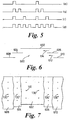
- FIG. 5 simplified digital codes are shown to illustrate a preferred embodiment. In this embodiment only four codes a), b), c) and d) are shown. Each LED is controlled by a control unit 424 to switch in accordance with a defined code.
- each LED 130 in the real set must be known and this. can be accomplished either by having camera 20 moved into a fixed known position and known focus and zoom and then calculating the position of each LED by reference to the read out of camera 202. Alternatively the LED's can be placed in known positions.
- stage set 600 comprising a main backcloth 602, first and second side (wing) cloths 604,606 and third and fourth side (wing) cloths 608, 610.
- Each cloth 602-610 may be painted as usual for a stage set.
- each cloth 602-610 a number of LED's may be positioned. Those on cloth 602 are referenced 130 and on cloths 604,606 are 130' and cloths 608,610 are 130".
- Each LED will have a coded output in the infra-red which will determine not only its position in the cloth 602,604,606,608 or 610 but also which cloth is located in.
- the computer program can determine the position of the camera by reference to LED's in more than one plane.
- two LED's 221,223 are mounted on the cameras 20,22 parallel to the optical axis 225 of the camera. Only camera 22 is described for ease of explanation. This enables the position and part/tilt of the camera to be measured.
- sensors are mounted on the lens.
- the output of lens potentiometers which are present on many standard studio lenses may be read to obtain information on the zoom/focus status of the camera/
- the outputs of the additional LED's 221,223,227,229 and 231 are preferably suitably coded to ensure correct identification by the position sensing equipment to enable the position and pan/tilt/roll of the camera to be correctly measured.
- all cameras may be so equipped.
Landscapes
- Engineering & Computer Science (AREA)
- Multimedia (AREA)
- Signal Processing (AREA)
- Studio Devices (AREA)
- Studio Circuits (AREA)
Claims (7)
- System der virtuellen Realität für eine Szene mit einem realen dreidimensionalen Hintergrundbild, wobei das System eine Fernsehkamera (20), die eine Videoausgabe der Szene bereitstellt, und eine Hilfsdetektionseinrichtung (202), die an der Fernsehkamera (20) montiert ist, aufweist, wobei in dem System eine Mehrzahl von Licht emittierenden Einrichtungen (Light Emitting Devices = LEDs) (130) in bekannten festen Positionen an relevanten Teilen des realen dreidimensionalen Hintergrundbilds oder in bekannter fester Relativbeziehung relativ zu den relevanten Teilen des realen dreidimensionalen Hintergrundbilds befestigt ist, um ein definiertes Feld auszubilden, und wobei das System elektronische Detektionsmittel (402, 406, 408) aufweist, die an die Detektionseinrichtung angeschlossen sind, wobei die Detektionsmittel Positionserfassungsanalysemittel (408) zum Analysieren der Perspektive des definierten Felds aufweisen, so wie es von der Detektoreinrichtung detektiert wird, um einen Positionsauslesewert bereitzustellen, der die Position der Fernsehkamera (20) relativ zu dem realen dreidimensionalen Hintergrundbild und die Position jeder LED aus der Mehrzahl von LEDs relativ zu der Fernsehkamera definiert, wodurch die Position jedes der relevanten Teile des realen dreidimensionalen Hintergrundbilds definiert wird, und wobei das System einen Speicher (410) für virtuelle Objekte, eine Perspektiventransformationseinheit und eine Kombinierereinheit (418) aufweist, wobei der Positionsauslesewert von den Positionserfassungsanalysemitteln an die Perspektiventransformationseinheit angeschlossen ist, um einen Transformationswert bereitzustellen, wobei der Speicher für virtuelle Objekte über die Perspektiventransformationseinheit an die Kombinierereinheit angeschlossen ist, um die Perspektive und die Größe eines virtuellen Objekts, das in die Kombinierereinheit einzusetzen ist, zu transformieren, und wobei die Videoausgabe der Szene, die von der Videokamera bereitgestellt wird, an die Kombiniererschaltung angeschlossen ist und wobei die Kombinierereinheit als Ausgabe ein kombiniertes Videobild bereitstellt, in dem das virtuelle Objekt in der Szene angeordnet und in dem realen dreidimensionalen Hintergrundbild relativ zu der Kamera in solcher Weise beweglich ist, so dass es von einem Betrachter realistisch gesehen werden kann, wie es vor oder hinter einem Teil des realen dreidimensionalen Hintergrundbilds erscheint und wie es von einem Teil des realen dreidimensionalen Hintergrundbilds verdeckt wird, so wie es der Fall wäre, falls das virtuelle Objekt tatsächlich ein reales Objekt innerhalb des realen dreidimensionalen Hintergrundbilds wäre, wobei die Hilfsdetektoreinrichtung (202) eine Detektorkamera aufweist, die justiert ist, um zur Kamera (20) ausgerichtet zu sein, wobei die LEDs (130) im Infrarotbereich bei einer Frequenz außerhalb des Frequenzbereichs der Kamera arbeiten und wobei jede LED (130) Licht in einer codierten Form emittiert, wodurch jede Lichtquelle individuell identifizierbar ist.
- Kamerapositioniersystem nach Anspruch 1, wobei die LEDs (130) sämtlich in einer Ebene oder in einer Mehrzahl von Ebenen angeordnet sind.
- Kamerapositioniersystem nach Anspruch 2, wobei die reale Szene (12) eine Szene ist, die auf einen Hintergrund aufgemalt ist, wie er in Theatern verwendet wird, oder ein tatsächlicher Ort ist.
- Kamerapositioniersystem nach einem der Ansprüche 1 bis 3, wobei eine Mehrzahl von Fernsehkameras (20, 22) vor der Hintergrundszene angeordnet ist, wobei jede Kamera mit einer detektierenden Einrichtung (202, 222) versehen ist.
- Kamerapositioniersystem nach einem der Ansprüche 1 bis 4, das weiterhin zwei LEDs (221, 223) aufweist, die auf jeder Kamera in Positionen parallel zu der optischen Achse der Kamera montiert sind, um die Position und die Drehung/Neigung jeder Kamera messbar zu machen.
- Kamerapositioniersystem nach einem der Ansprüche 1 bis 5, wobei drei weitere LEDs (227, 229, 231) auf jeder Kamera in einem Dreieck montiert sind, um die Verkippung der Kamera messbar zu machen.
- Verfahren zum Erzeugen eines kombinierten Videobilds, das eine reale dreidimensionale Hintergrundszene aufweist, die von einer Fernsehkamera (20) betrachtet wird, welche eine Videoausgabe der Szene bereitstellt, wobei eine Hilfsdetektionseinrichtung (202) an der Fernsehkamera (20) montiert ist, wobei das Verfahren umfasst: Positionieren einer Mehrzahl von Licht emittierenden Einrichtungen (LEDs) (130), die in bekannten festen Positionen an relevanten Teilen des dreidimensionalen Hintergrundbilds oder in bekannter fester Beziehung relativ zu den relevanten Teilen des realen dreidimensionalen Hintergrundbilds zu montieren sind, um ein definiertes Feld auszubilden, und Einschließen von elektronischen Detektionsmitteln (402, 406, 408), die an die Detektionseinrichtung angeschlossen sind, wobei in dem Verfahren, die Detektionsmittel Positionserfassungsanalysemittel (408) zum Analysieren der Perspektive des definierten Felds, so wie es von der Detektoreinrichtung detektiert wird, aufweisen, um einen Positionsauslesewert bereitzustellen, der die Position der Fernsehkamera (20) relativ zu dem realen dreidimensionalen Hintergrundbild und die Position jeder LED aus der Mehrzahl von LEDs relativ zu der Fernsehkamera definiert, wodurch die Position von jedem der relevanten Teile des realen dreidimensionalen Hintergrundbilds definiert wird, und Bereitstellen eines Speichers (410) für virtuelle Objekte, einer Perspektiventransformationseinheit und einer Kombinierereinheit (418), wobei das Positionsauslesesignal von den Positionserfassungsanalysemitteln an die Perspektiventransformationseinheit angeschlossen wird, um einen Transformationswert bereitzustellen, wobei der Speicher für virtuelle Objekte über die Perspektiventransformationseinheit an die Kombinierereinheit angeschlossen wird, um die Perspektive und die Größe eines virtuellen Objekts, das in die Kombinierereinheit einzusetzen ist, zu transformieren, und wobei die Videoausgabe der Szene, die von der Fernsehkamera bereitgestellt wird, an die Kombiniererschaltung angeschlossen wird, wobei in dem Verfahren die Kombiniererschaltung eine Ausgabe eines kombinierten Videobilds bereitstellt und wobei in dem Verfahren das virtuelle Objekt so in der Szene positioniert wird und in dem realen dreidimensionalen Hintergrundbild relativ zu der Kamera in solcher Weise beweglich ist, dass es von einem Betrachter realistisch gesehen werden kann, wie es vor oder hinter einem oder mehreren der relevanten Teile des realen dreidimensionalen Hintergrundbilds erscheint und wie es durch einen oder mehrere Teile des realen dreidimensionalen Hintergrundbilds verdeckt wird, so wie es der Fall wäre, falls das virtuelle Objekt tatsächlich ein reales Objekt wäre, das von dem realen dreidimensionalen Hintergrundbild umfasst wird, wobei die Hilfsdetektoreinrichtung (202) eine Detektorkamera aufweist, die justiert wird, um auf die Kamera (20) ausgerichtet zu sein, wobei die LEDs (130) im Infrarotbereich bei einer Frequenz außerhalb des Frequenzbereichs der Kamera arbeiten und wobei jede LED (130) Licht in codierter Form emittiert, wodurch jede Lichtquelle individuell identifizierbar ist.
Applications Claiming Priority (3)
| Application Number | Priority Date | Filing Date | Title |
|---|---|---|---|
| GB9719379 | 1997-09-12 | ||
| GB9719379A GB2329292A (en) | 1997-09-12 | 1997-09-12 | Camera position sensing system |
| PCT/GB1998/002595 WO1999014939A1 (en) | 1997-09-12 | 1998-08-28 | Virtual studio position sensing system |
Publications (2)
| Publication Number | Publication Date |
|---|---|
| EP1013080A1 EP1013080A1 (de) | 2000-06-28 |
| EP1013080B1 true EP1013080B1 (de) | 2003-10-22 |
Family
ID=10818942
Family Applications (1)
| Application Number | Title | Priority Date | Filing Date |
|---|---|---|---|
| EP98940420A Expired - Lifetime EP1013080B1 (de) | 1997-09-12 | 1998-08-28 | Positionserfassungssystem in virtuellem studio |
Country Status (6)
| Country | Link |
|---|---|
| US (1) | US6559884B1 (de) |
| EP (1) | EP1013080B1 (de) |
| AU (1) | AU8874998A (de) |
| DE (1) | DE69819181T2 (de) |
| GB (1) | GB2329292A (de) |
| WO (1) | WO1999014939A1 (de) |
Cited By (1)
| Publication number | Priority date | Publication date | Assignee | Title |
|---|---|---|---|---|
| KR20210142722A (ko) * | 2019-03-29 | 2021-11-25 | 글로보 코무니카상 이 파르티시파소이 에스.에이. | 이미지 캡쳐 및 투영을 위한 시스템, 시스템의 사용, 그리고 이미지 캡쳐, 투영 및 삽입 방법 |
Families Citing this family (32)
| Publication number | Priority date | Publication date | Assignee | Title |
|---|---|---|---|---|
| AU2834899A (en) * | 1998-02-18 | 1999-09-06 | Gmd-Forschungszentrum Informationstechnik Gmbh | Camera tracking system for a virtual television or video studio |
| AU4610799A (en) * | 1998-06-16 | 2000-01-05 | Limat Ag | Transmission device for transmitting image contents in a concealed manner |
| US6381362B1 (en) * | 1999-04-08 | 2002-04-30 | Tata America International Corporation | Method and apparatus for including virtual ads in video presentations |
| US6965397B1 (en) | 1999-11-22 | 2005-11-15 | Sportvision, Inc. | Measuring camera attitude |
| EP1189171A2 (de) * | 2000-09-08 | 2002-03-20 | Fraunhofer-Gesellschaft zur Förderung der angewandten Forschung e.V. | Verfahren zum Erzeugen eines Bildes in einem virtuellen Studio |
| SE0003373L (sv) * | 2000-09-20 | 2002-01-29 | Jan G Faeger | Metod och anordning för att producera information om en omgivning och användning av anordningen |
| JP4136859B2 (ja) * | 2003-01-10 | 2008-08-20 | キヤノン株式会社 | 位置姿勢計測方法 |
| CN100399799C (zh) * | 2004-08-24 | 2008-07-02 | 西安宏源视讯设备有限责任公司 | 虚拟演播室系统中辅助摄像机光图形接力跟踪方法 |
| GB2418482A (en) * | 2004-09-23 | 2006-03-29 | Wayne Howell | Method for locating luminaires using optical feedback |
| EP1889471B1 (de) * | 2005-06-08 | 2010-08-04 | Thomson Licensing | Verfahren und vorrichtung zur alternierenden bild-videoeinfügung |
| US8207843B2 (en) | 2005-07-14 | 2012-06-26 | Huston Charles D | GPS-based location and messaging system and method |
| US9344842B2 (en) | 2005-07-14 | 2016-05-17 | Charles D. Huston | System and method for viewing golf using virtual reality |
| US8933967B2 (en) | 2005-07-14 | 2015-01-13 | Charles D. Huston | System and method for creating and sharing an event using a social network |
| US11972450B2 (en) | 2005-07-14 | 2024-04-30 | Charles D. Huston | Spectator and participant system and method for displaying different views of an event |
| FR2889753A1 (fr) * | 2005-08-09 | 2007-02-16 | Total Immersion Sa | Systeme permettant a un utilisateur de visualiser un cockpit virtuel dans un environnement video |
| CN101512553B (zh) * | 2006-07-16 | 2012-06-20 | 西姆比有限公司 | 用于虚拟内容安置的系统和方法 |
| US20080117333A1 (en) * | 2006-11-17 | 2008-05-22 | Disney Enterprises, Inc. | Method, System And Computer Program Product For Video Insertion |
| US20090153550A1 (en) * | 2007-12-18 | 2009-06-18 | Disney Enterprises, Inc. | Virtual object rendering system and method |
| GB2456802A (en) * | 2008-01-24 | 2009-07-29 | Areograph Ltd | Image capture and motion picture generation using both motion camera and scene scanning imaging systems |
| TW201110928A (en) * | 2009-09-16 | 2011-04-01 | Univ Chang Gung | Optical tracking apparatus and its positioning method |
| US8786415B2 (en) | 2010-02-24 | 2014-07-22 | Sportvision, Inc. | Tracking system using proximity and/or presence |
| WO2012160531A1 (en) * | 2011-05-25 | 2012-11-29 | Koninklijke Philips Electronics N.V. | An identification system for a surface |
| CN102752488B (zh) * | 2011-08-02 | 2017-08-04 | 新奥特(北京)视频技术有限公司 | 实现多演播室系统的统一控制的方法、设备及系统 |
| US9215383B2 (en) | 2011-08-05 | 2015-12-15 | Sportsvision, Inc. | System for enhancing video from a mobile camera |
| JP2013127774A (ja) * | 2011-11-16 | 2013-06-27 | Canon Inc | 画像処理装置、画像処理方法及びプログラム |
| DE102012107153A1 (de) | 2012-08-03 | 2014-02-27 | Hendrik Fehlis | Vorrichtung und Verfahren zur Bestimmung der Eigenlage einer bildaufnehmenden Kamera |
| FR3034940B1 (fr) * | 2015-04-10 | 2018-04-13 | Solidanim | Systeme et procede de tournage de film video, et environnement utilise |
| CN106969733B (zh) * | 2016-05-20 | 2021-05-14 | 美国西北仪器公司 | 在目标空间中对目标物体进行定位的方法及测距装置 |
| DE102017208526A1 (de) * | 2017-05-19 | 2018-11-22 | Signum Bildtechnik GmbH | Marker basierter Kamera-Tracker |
| US10675536B2 (en) * | 2018-10-03 | 2020-06-09 | Song Chen | Gaming system that alters target images produced by an LED array |
| KR101961844B1 (ko) * | 2018-11-29 | 2019-03-25 | (주)인더텍 | 증강현실 기반 인지훈련용 작업치료 테이블 장치 및 작업치료 방법 |
| DE102021106488A1 (de) | 2020-12-23 | 2022-06-23 | Arnold & Richter Cine Technik Gmbh & Co. Betriebs Kg | Hintergrund-Wiedergabeeinrichtung, Hintergrundwiedergabesystem, Aufnahmesystem, Kamerasystem, digitale Kamera und Verfahren zum Steuern einer Hintergrund-Wiedergabeeinrichtung |
Family Cites Families (13)
| Publication number | Priority date | Publication date | Assignee | Title |
|---|---|---|---|---|
| US4866626A (en) * | 1987-09-18 | 1989-09-12 | Egli Werner H | Navigation by a video-camera sensed ground array |
| IL88263A (en) * | 1988-11-02 | 1993-03-15 | Electro Optics Ind Ltd | Navigation system |
| US5227985A (en) * | 1991-08-19 | 1993-07-13 | University Of Maryland | Computer vision system for position monitoring in three dimensions using non-coplanar light sources attached to a monitored object |
| GB9121707D0 (en) * | 1991-10-12 | 1991-11-27 | British Aerospace | Improvements in computer-generated imagery |
| GB2272343A (en) * | 1992-11-10 | 1994-05-11 | Gec Ferranti Defence Syst | Automatic aircraft landing system calibration |
| IL109487A (en) * | 1994-04-29 | 1996-09-12 | Orad Hi Tec Systems Ltd | Chromakeying system |
| DE9418382U1 (de) * | 1994-11-16 | 1996-03-21 | Smit, Michael, 50997 Köln | Mischbildgenerator |
| AU5446896A (en) * | 1995-04-10 | 1996-10-30 | Electrogig Corporation | Hand-held camera tracking for virtual set video production s ystem |
| DE19521600A1 (de) * | 1995-06-14 | 1996-12-19 | Bodenseewerk Geraetetech | Landeverfahren für unbemannte Luftfahrzeuge |
| GB2305050A (en) * | 1995-09-08 | 1997-03-26 | Orad Hi Tec Systems Ltd | Determining the position of a television camera for use in a virtual studio employing chroma keying |
| JP3359241B2 (ja) * | 1995-10-13 | 2002-12-24 | 日本電信電話株式会社 | 撮像方法および装置 |
| US5889550A (en) * | 1996-06-10 | 1999-03-30 | Adaptive Optics Associates, Inc. | Camera tracking system |
| US6310644B1 (en) * | 1997-03-26 | 2001-10-30 | 3Dm Devices Inc. | Camera theodolite system |
-
1997
- 1997-09-12 GB GB9719379A patent/GB2329292A/en not_active Withdrawn
-
1998
- 1998-08-28 WO PCT/GB1998/002595 patent/WO1999014939A1/en not_active Ceased
- 1998-08-28 DE DE69819181T patent/DE69819181T2/de not_active Expired - Fee Related
- 1998-08-28 AU AU88749/98A patent/AU8874998A/en not_active Abandoned
- 1998-08-28 EP EP98940420A patent/EP1013080B1/de not_active Expired - Lifetime
- 1998-09-04 US US09/148,566 patent/US6559884B1/en not_active Expired - Fee Related
Cited By (2)
| Publication number | Priority date | Publication date | Assignee | Title |
|---|---|---|---|---|
| KR20210142722A (ko) * | 2019-03-29 | 2021-11-25 | 글로보 코무니카상 이 파르티시파소이 에스.에이. | 이미지 캡쳐 및 투영을 위한 시스템, 시스템의 사용, 그리고 이미지 캡쳐, 투영 및 삽입 방법 |
| EP3952267A4 (de) * | 2019-03-29 | 2022-11-30 | Globo Comunicacao e Participacoes S.A. | System und verfahren zur aufnahme und projektion von bildern und verwendung des systems |
Also Published As
| Publication number | Publication date |
|---|---|
| DE69819181D1 (de) | 2003-11-27 |
| GB9719379D0 (en) | 1997-11-12 |
| DE69819181T2 (de) | 2004-08-12 |
| AU8874998A (en) | 1999-04-05 |
| GB2329292A (en) | 1999-03-17 |
| WO1999014939A1 (en) | 1999-03-25 |
| US6559884B1 (en) | 2003-05-06 |
| EP1013080A1 (de) | 2000-06-28 |
Similar Documents
| Publication | Publication Date | Title |
|---|---|---|
| EP1013080B1 (de) | Positionserfassungssystem in virtuellem studio | |
| CA2231374C (en) | Method and apparatus for automatic electronic replacement of billboards in a video image | |
| EP2161925B1 (de) | Verfahren und System zum Fixieren von Videoströmen | |
| EP0956709B1 (de) | Positionserkennungssystem für virtuelles studio | |
| US9756277B2 (en) | System for filming a video movie | |
| US7136090B1 (en) | Communications system | |
| US7468778B2 (en) | Virtual studio system | |
| KR101551800B1 (ko) | 측량 기계 | |
| US20120013711A1 (en) | Method and system for creating three-dimensional viewable video from a single video stream | |
| KR102743306B1 (ko) | 이미지 캡쳐 및 투영을 위한 시스템, 시스템의 사용, 그리고 이미지 캡쳐, 투영 및 삽입 방법 | |
| IL109487A (en) | Chromakeying system | |
| EP0878099B1 (de) | Farbstanzen-studiosystem | |
| GB2305051A (en) | Automatic electronic replacement of billboards in a video image | |
| Vieira et al. | A camera-projector system for real-time 3d video | |
| EP1219115A2 (de) | Rundfunksystem mit schmaler bandbreite | |
| GB2399248A (en) | Projection of supplementary image data onto a studio set | |
| KR20050015737A (ko) | 조명제어에 의한 사실적 영상합성 방법 | |
| GB2386489A (en) | Virtual studio system | |
| GB2324429A (en) | Electronic zoom control in a virtual studio | |
| Auer et al. | Tracking in a multi-user augmented reality system | |
| WO2024118828A1 (en) | Apparatus and method for real-time three dimensional imaging | |
| Kasim et al. | Glasses-free Autostereoscopic Viewing on Laptop through Spatial Tracking | |
| Thomas | Virtual Graphics for Broadcast Production | |
| JPH10126690A (ja) | スタジオ装置 | |
| Tan | Virtual imaging in sports broadcasting: an overview |
Legal Events
| Date | Code | Title | Description |
|---|---|---|---|
| PUAI | Public reference made under article 153(3) epc to a published international application that has entered the european phase |
Free format text: ORIGINAL CODE: 0009012 |
|
| 17P | Request for examination filed |
Effective date: 20000407 |
|
| AK | Designated contracting states |
Kind code of ref document: A1 Designated state(s): DE FR GB IT |
|
| 17Q | First examination report despatched |
Effective date: 20000912 |
|
| GRAH | Despatch of communication of intention to grant a patent |
Free format text: ORIGINAL CODE: EPIDOS IGRA |
|
| GRAS | Grant fee paid |
Free format text: ORIGINAL CODE: EPIDOSNIGR3 |
|
| GRAA | (expected) grant |
Free format text: ORIGINAL CODE: 0009210 |
|
| AK | Designated contracting states |
Kind code of ref document: B1 Designated state(s): DE FR GB IT |
|
| REG | Reference to a national code |
Ref country code: GB Ref legal event code: FG4D |
|
| REF | Corresponds to: |
Ref document number: 69819181 Country of ref document: DE Date of ref document: 20031127 Kind code of ref document: P |
|
| ET | Fr: translation filed | ||
| PLBE | No opposition filed within time limit |
Free format text: ORIGINAL CODE: 0009261 |
|
| STAA | Information on the status of an ep patent application or granted ep patent |
Free format text: STATUS: NO OPPOSITION FILED WITHIN TIME LIMIT |
|
| 26N | No opposition filed |
Effective date: 20040723 |
|
| PGFP | Annual fee paid to national office [announced via postgrant information from national office to epo] |
Ref country code: DE Payment date: 20080912 Year of fee payment: 11 |
|
| PGFP | Annual fee paid to national office [announced via postgrant information from national office to epo] |
Ref country code: IT Payment date: 20080829 Year of fee payment: 11 Ref country code: FR Payment date: 20080903 Year of fee payment: 11 |
|
| PGFP | Annual fee paid to national office [announced via postgrant information from national office to epo] |
Ref country code: GB Payment date: 20080903 Year of fee payment: 11 |
|
| GBPC | Gb: european patent ceased through non-payment of renewal fee |
Effective date: 20090828 |
|
| REG | Reference to a national code |
Ref country code: FR Ref legal event code: ST Effective date: 20100430 |
|
| PG25 | Lapsed in a contracting state [announced via postgrant information from national office to epo] |
Ref country code: FR Free format text: LAPSE BECAUSE OF NON-PAYMENT OF DUE FEES Effective date: 20090831 Ref country code: DE Free format text: LAPSE BECAUSE OF NON-PAYMENT OF DUE FEES Effective date: 20100302 |
|
| PG25 | Lapsed in a contracting state [announced via postgrant information from national office to epo] |
Ref country code: GB Free format text: LAPSE BECAUSE OF NON-PAYMENT OF DUE FEES Effective date: 20090828 |
|
| PG25 | Lapsed in a contracting state [announced via postgrant information from national office to epo] |
Ref country code: IT Free format text: LAPSE BECAUSE OF NON-PAYMENT OF DUE FEES Effective date: 20090828 |